Daily Tech Digest - April 03, 2021

What Is a Cybersecurity Legal Practice?

A cybersecurity attorney is not an auditor; this attorney does not sit in an ivory tower doing oversight of the company’s information technology work. Instead, corporate officers must recognize that a cybersecurity attorney must be a part of the operational team. The attorney should be as involved in the company’s operations as the information technology expert deploying new defensive measures in the company’s networks. An effective cybersecurity attorney has to be in the trenches, helping to develop the statements of work for new contracts, negotiating information-sharing agreements, advising on legal risks associated with the many and varied daily decisions of securing networks, and managing the hour-by-hour response during an incident. ... Finally, a cybersecurity attorney must be multilingual in the jargon of both law and tech. One of the key jobs of such an attorney is to translate legal requirements (such as obligations imposed by regulations) into design requirements and to understand the technical details enough to ask probing questions, spot legal issues and translate risks to organizational leadership.


3 steps to meeting data privacy regulation compliance through identity programs

This focus on security, however, isn’t just a reaction to more cyberattacks. It also correlates with the enormous acceleration in digital transformation initiatives over the last year. Some industry experts dubbed it the shift from “cloud speed to COVID speed.” The pandemic forced a new way of working, and this ultimately means a new way of ensuring the security of how we work. It also means that companies store and manage more data in the cloud, which comes with its own regulatory compliance challenges. Every new process moved to the cloud, automated or made digital, has become a new vulnerability. Security teams need to manage these vulnerabilities to protect the data from a cyber-attack and ensure compliance with the latest data privacy regulations, such as the General Data Protection Regulation (GDPR) or the California Privacy Rights Act (CPRA). Other non-compliance issues will grow over the next year, especially as companies continue to remotely onboard and offboard customers and employees. These new processes will impact how to protect data and comply with the multiple different patchwork privacy regulations from various states and countries.


Speed and resilience: Five priorities for the next five months

Over the past year, organizations have become well versed in the basics of ensuring a safe working environment. More recently, however, companies have reported that some of their workers appear to be more willing to participate in higher-risk activities simply because they are tired of living with virus restrictions. This will require a different type of intervention and messaging, especially because newer COVID-19 variants pose a high risk and may be transmitted in ways that are not yet fully understood. Employers have a unique societal role to play in vaccination; they are important voices and can help reduce the friction associated with getting the vaccine. Self-reported data from a wide range of organizations point to individual and team productivity being higher than before the onset of the pandemic, but not uniformly so. According to a McKinsey survey, productivity is up for about half of all workers, with the other half reporting no change or lower productivity. The same survey suggested that, while the inability to disconnect is a real concern, increased productivity is correlated to a willingness to change how people work. 


Quantum computing may be able to solve the age-old problem of reasoning

The results show that the quantum machine could use inference models to draw conclusions. Probabilistic inference, which means the incorporation of uncertainty into computer programming, is particularly suited to quantum computers, Fiorentini said, because "quantum models have been proven to be more expressive, easier to train under certain circumstances." In practical terms, this means that quantum computing can be useful to solve both scientific and engineering problems. The results are "quite flexible, surprisingly robust, and can be applied in many fields," said Fiorentini. For instance, he added, Bayesian networks have traditionally been used in predictive maintenance of mission-critical equipment, such as jetliners and jet engines. "You model a system, and then you perform inference on the model by asking certain questions and by figuring out if the system is stable, reliable, and robust--or is about to break down--so you can intervene," Fiorentini said. "And which part is signaling the stress more strongly?" Medical diagnostics is another field that can benefit from these results. Although it can't be exactly applied from the results of this study, "continuing in this direction, some of these techniques are applied to drug discovery," Fiorentini noted.


FBI: APTs Actively Exploiting Fortinet VPN Security Holes

Once exploited, the attackers are moving laterally and carrying out reconnaissance on targets, according to officials. “The APT actors may be using any or all of these CVEs to gain access to networks across multiple critical-infrastructure sectors to gain access to key networks as pre-positioning for follow-on data exfiltration or data encryption attacks,” the warning explained. “APT actors may use other CVEs or common exploitation techniques—such as spear-phishing—to gain access to critical infrastructure networks to pre-position for follow-on attacks.” The joint cybersecurity advisory from the FBI and CISA follows last year’s flurry of advisories from U.S. agencies about APT groups using unpatched vulnerabilities to target federal agencies and commercial organizations. For instance, in October an alert went out that APTs were using flaws in outdated VPN technologies from Fortinet, Palo Alto Networks and Pulse Secure to carry out cyberattacks on targets in the United States and overseas. “It’s no surprise to see additional Fortinet FortiOS vulnerabilities like CVE-2019-5591 and CVE-2020-12812 added to the list of known, but unpatched flaws being leveraged by these threat actors,” said Narang.


How AI-powered BI tools will redefine enterprise decision-making

In this fourth wave, the traditional order of BI will be inverted. The traditional method of BI generally begins with a technical analyst investigating a specific question. For example, an electronics retailer may wonder if a higher diversity of refrigerator models in specific geographies will likely increase sales. The analyst blends relevant data sources (perhaps an inventory management system and a billing system) and investigates whether there is a correlation. Once the analyst has completed the work, they present a conclusion about past behavior. They then create a visualization for business decision makers in a system like a Tableau or Looker, which can be revisited as the data changes. This investigation method works quite well, assuming the analyst asks the right questions, the number of variables is relatively well-understood and finite, and the future continues to look somewhat similar to the past. However, this paradigm presents several potential challenges in the future as companies continue to accumulate new types of data, business models and distribution channels evolve, and real-time consumer and competitive adjustments cause constant disruptions.


How Going Back to Coding After 10 Years Almost Crushed Me

Containers, namely Docker, have really streamlined packaging and reduced env-related issues as you move code thru QA and into production. In the old days, you would develop in a system entirely different than where it was deployed (i.e. code on Windows and deploy to Unix), which invariably led to bugs and more work on each test and release cycle. Also, in the past, a release, QA, or DevOps engineer would take code from an SCM tag and figure out how to compile, test, and migrate it — and usually uncover a whole bunch of hardcoded paths and variables or missing libraries and files that needed to be reworked or hacked up to work. ... I remember fairly long release cycles (as long as three months at a startup). After attending specification meetings to understand the requirements line by line, a developer could go to their desk and play games for a few weeks without having to issue a dreaded update on where they were. Now, you have a daily standup and two-week sprint, so there is no more slacking! The role of the BA has also diminished with Agile, as developers now face users or product managers directly.


3 Reasons In-Memory Computing Is Essential for Microservices

The more advanced in-memory platforms support high-performance multiregion global architectures. This enables zero-downtime business operations via a high-performance shared memory layer that supports them. This also simplifies scaling up these services to more fully leverage the promise of cloud native and serverless. They also provide features such as automated disaster recovery, zero down-time code deployments (blue-green deployments), rolling product upgrades, as well as tools to integrate these seamlessly into modern cloud DevOps automation tools and new AIOps tools that help monitor these architectures and deliver auto-scaling and autonomous troubleshooting. For a concrete example of how these could be employed, imagine having many microservices in an online shopping application These include separate capabilities that power browsing for products, adding and removing items from a shopping cart and so on. More so, each one of these microservices can be somewhat independent from one another. But, some actions like checking out, fulfillment and shipping may require multistep orchestration and some roll-back behavior.


Keeping your data safe from hackers while working from home

One of the big changes the move towards remote working has brought about is removing employees from the protection of the corporate firewall. Working from inside the office provides people with anti-virus and other protections that can help to filter out some attacks. Now, instead of this, many people are working from their own computer from their homes, where they may not have anti-virus at all – and their home router won't provide a robust defence against attackers like a corporate firewall would. Criminals know this and are looking to take advantage with cyberattacks, especially when people – rushed off their feet while balancing working from home with the rest of their life – might unintentionally click on a phishing link or respond to a request that appears to come from a colleague but is actually a cyber criminal. "Humans are are ultimately fallible. Unfortunately it's the organic matter behind the keyboard, which is often the vulnerable part of the loop," says Troy Hunt, creator of HaveIBeenPwned and digital advisor to Nord Security. 


Booking.Com's GDPR Fine Should Serve as 'Wake-Up Call'

While the incident itself was troubling, the Dutch Data Protection Authority called out Booking.com for its response to the breach. The company, according to the report, first found out about the security lapse on Jan. 13, 2019, but waited until Feb. 7 of that year to alert authorities. Under GDPR rules, organizations must report a breach within 72 hours of its occurrence. By the time Booking.com notified the Dutch Data Protection Authority, more than 20 days had elapsed. Monique Verdier, the vice president of the Dutch privacy watchdog, noted in the report that the delay in reporting the incident could have put additional customers at risk and showed a disregard for their data. "That speed is very important for the victims of a leak," Verdier said. "After such a report, the AP can, among other things, order a company to immediately warn affected customers. In this way, for example, to prevent criminals from having weeks to continue trying to defraud customers." A spokesman for the company could not be immediately reached for comment on Friday, but the report notes that Booking.com would not appeal the fine.


Quote for the day:

"Enjoy the little things, for one day you may look back and realize they were the big things." -- Robert Brault

Daily Tech Digest - April 02, 2021

Open banking is big. Here’s why open finance is bigger

Open finance will improve the experience for customers in the U.S., but they won’t really notice it directly, Costello says. However, under the hood, they’ll benefit from more reliability and more symmetric customer protection end to end — and that will make a big difference. This move to a regulated open finance experience will give customers not just uniform access to all of the data, but under the same umbrella of symmetric customer protection, their payment account data will be as safe as their loan data, payroll data, and so on. “The customer experience for the person who needs to use these services but is reluctant to is going to be incredibly positively impacted,” he says. “Now they’re going to have enough trust in these tools and services to know that if they’re harmed in some way, if there’s a breach in the system or a bad actor, they’re going to be protected.” “As this ecosystem takes off, the data that is being generated, correlated, and used is beneficial not just for the consumer and their direct third-party service providers, but by all thirdparty service providers,” Costello says


5 key cybersecurity risks in 2021, and how to address them now

Cybersecurity technologies have become more advanced and more available than ever, and this has led to a consistent pattern of over-reliance on point products to defend against threats. While technology is essential to this mission, it isn’t a standalone solution. Oftentimes, mid-market businesses lack dedicated cybersecurity resources that are just as valuable. This skill shortage has been heightened by the pandemic, as the network diagram has expanded to include surfaces like at-home PCs and other WFH access points. According to the Verizon DBIR, almost one in three data breaches in 2020 involved small businesses, and mitigation will take a planned combination of both people, processes and technology. Hiring more security professionals, especially with the growth in demand, can be an expensive undertaking. Rather than investing in an internal 24/7 security operations center (SOC), outsourcing this work has become an appealing option that is a cost-effective and essential addition to your defense strategy. This team can work in a way that unifies disparate technologies with process to create a singular, strong point of visibility.


Is the Future of Manufacturing Automated or Autonomous?

Manufacturing autonomy is not just a good idea, it’s a timely idea, offering a chance to democratize both manufacturing and innovation. By creating autonomous and automated manufacturing solutions, it is possible to substantially reduce the labor cost element in manufacturing, allowing higher labor cost regions to bring manufacturing home. This is extremely timely given the desire of most nations to use manufacturing as part of their post-pandemic recovery strategy. And the pandemic isn’t the only driver or acceleration. The Covid-19 pandemic came on the back of a bitter trade war between the US and China, creating a perfect storm of disruption that has led to a real desire to restore supply chains to make nations more resilient to future risk. Both Theo and Yoav agree that autonomous and automated manufacturing solutions offer the only route to competitiveness for the US and for Western Europe, where the benefits of massive consumer markets are offset by high labor rates. Consumers want to buy products made locally, but they don’t want to pay more for, or get less from, those products. 


CISA Orders Agencies to Recheck for Exchange Compromises

CISA is requiring federal agencies that use on-premises Exchange servers to conduct two exercises by noon Monday. The agencies must run Microsoft's Safety Scanner tool, also known as MSERT, in full scan mode and report those results to CISA. This tool, which was released last month, can detect web shells used during attacks that target the ProxyLogon flaw in Exchange. CISA is also ordering federal agencies to run this same scan every week for four weeks to check for additional compromises. In addition to mandating MSERT sans, CISA is requiring that agencies run a script called Test-ProxyLogon.ps1 to check both Exchange and Internet Information Services, or ISS, logs for any malicious activity related to these attacks. "If attacker activity is identified, the script reports the vulnerabilities for which it found evidence of use and collects logs that it stores in the specified output path in the Test-ProxyLogonLogs directory," CISA notes. After those tasks are complete and the results are returned, CISA is requiring that federal agencies take additional steps to harden networks and infrastructure by June 28.


Quantum computer has the edge for NP verification

The algorithm the researchers use to demonstrate this is known as an interactive proof protocol. Here, one component of the experimental set-up acts as a “prover”, using coherent light pulses to send partial solutions to the NP-complete problem in the form of a quantum state. The second component fills the role of the “verifier”, deciding with high accuracy whether the solution is correct based on the limited information given. When certain bounds are placed on the expected accuracy of the verifier, as well as the protocol’s speed and efficiency in terms of the amount of information that can be communicated throughout the interactions, it is possible to demonstrate that the quantum algorithm far outperforms any classical attempts at doing the same. By showing that a quantum algorithm can verify solutions to NP-complete problems efficiently, the result could allow for new applications in secure remote quantum computing. A client with a rudimentary quantum machine could, for example, verify information they receive from a powerful quantum server without ever having access to the full solution. 


Blockchain Comes Under Data Privacy Scrutiny

The decentralized nature of blockchain eliminates the need for an intermediary serving as a central clearing authority and decreases risks associated with traditional centralized systems and their functionality. By removing the intermediary between a given server and the data being collected, distributed, and analyzed, blockchain enables an increase in the speed and efficiency of data processing. Additionally, blockchain reduces the risk of human error, which typically leads to a reduction in costs and expenses. Traceability is one of the major benefits of blockchain that businesses in various industries are exploiting. Tracing transactions on blockchain is simplified because all data is stored on one immutable digital distributed ledger, which makes it easy to review the history of transactions. The traceability element of blockchain has been especially useful for businesses distributing products on a complicated supply chain because blockchain facilitates tracking within a supply chain. Blockchain will increasingly change how businesses operate in various industries and sectors, but this disruptive technology will undoubtedly continue to face legal and regulatory challenges as it becomes more widely accepted.

Cisco streamlines, upgrades its SASE bundle

The offering includes Cisco's Viptella and Meraki SD-WAN software packages, Duo and AnyConnect remote access, Umbrella security as well as Duo zero trust and other security components. The integrated package will be a plus for enterprises, experts say. “Eighty percent of organizations want to reduce the number of security vendors and products to create a more integrated protection/incident-response and easier to manage security operations," said Peter Firstbrook, a Gartner research vice president. “Reducing the barriers to adoption and increasing the level of integration is going to be a major task for multi-product vendors,” Firstbrook said. “At the same time SASE is a hot topic as more network traffic moves off the LAN and into the cloud. The more of this problem that Cisco can address the more successful they will be.” Within the bundle Cisco added features including the ability to support remote browser isolation, data loss prevention (DLP), cloud malware detection, and support for Cisco Meraki MX environments with Umbrella security. “DLP and remote browser isolation are desirable but they are catch-up items," Firstbrook said.


A strategic vision for model risk management

Banks face cost and capacity pressures as they strengthen frameworks and expand model inventories. Validation backlogs and delays mount as existing validation capacity fails to cover expanding demand. Inventory is increasing as new models are developed outside traditional areas of financial risk. The rapid development of AI is increasing model complexity and adding to the backlog. The quality of validation can consequently suffer unless the bank brings in external support. To manage the model-validation budget, leading banks have industrialized validation, using lean fundamentals and automated processes. Models are prioritized for validation based on key factors such as their importance in business decisions and materiality of the model exposure. Validation intensity is customized by model tiers to improve speed and efficiency. Likewise, model tiers are used to define the resource strategy and governance approach. The use of model tiers to improve efficiency varies by region. In Asia and Latin America, where MRM functions are still maturing, about half our surveyed banks report using tiers in their model inventory. 


Bitcoin was always bound to fail its most important mission

Although Bitcoin has been around for more than a decade, the cryptocurrency industry is still in its nascent stages and the process of maturation requires all manner of approaches to be explored. The underlying technology has already come a long way and so have its alternative use cases (look at the rise of DeFi), but crypto is still largely battling the same demons: volatility, limited adoption and regulatory uncertainty. However, Schwartz is convinced the magnetism of cryptocurrency and the commitment of the community to innovation will mean technological solutions are found to some of these most pressing questions. “It’s going to be an interesting growing up process for cryptocurrency, because regulators have legitimate interest in preventing things like money laundering and terrorist financing. But most [members of the crypto space] want to comply with these kinds of measures.” “Generally speaking, it's not a very good business model to be in defiance of regulation. And it has been a drag on the adoption of crypto that people have had difficulty figuring out how to remain compliant.”


Importance of data governance and management in times of a global pandemic

The problem of data governance has now become prominent. Data governance is different from data management. The latter has to do with the engineering aspects of data – how it is created, stored, accessed, processed, secured, and whether it is complete, are issues that are of relevance. Data governance, on the other hand, is concerned with issues of policy, which are larger and have an impact on the economy and society. Data governance has to do with where data originates, who collects it and how, where it is stored, who uses it and for what purpose, how the information obtained from data is used, and how data is erased. Data governance presents many challenges, contradictions, and consequent trade-offs. For example, one challenge is that of maintaining privacy of data on individuals versus using data for surveillance. During the pandemic this contradiction became prominent. Several countries, including India, introduced infection-tracking software that would inform individuals who were using these apps whether they were close to others who were infected.


Quote for the day:

"Great Groups need to know that the person at the top will fight like a tiger for them." -- Warren G. Bennis

Daily Tech Digest - April 01, 2021

How standard silicon chips could be used for quantum computing

To create and read qubits, which are the building blocks of those devices, scientists first have to retain control over the smallest, quantum particles that make up a material; but there are different ways to do that, with varying degrees of complexity. IBM and Google, for example, have both opted for creating superconducting qubits, which calls for an entirely new manufacturing process; while Honeywell has developed a technology that individually traps atoms, to let researchers measure the particles' states. These approaches require creating new quantum processors in a lab, and are limited in scale. Intel, for example, has created a 49-qubit superconducting quantum processor that is about three inches square, which the company described as already "relatively large", and likely to cause complications when it comes to producing the million-qubit chips that will be required for real-world implementations at commercial scale. With this in mind, Quantum Motion set off to find out whether a better solution could be found in proven, existing technologies. "We need millions of qubits, and there are very few technologies that will make millions of anything – but the silicon transistor is the exception," John Morton, ... tells ZDNet.


Top 5 Attack Techniques May Be Easier to Detect Than You Think

The analysis shows attackers for the most part are continuing to rely on the same techniques and tactics they have been using for years. And, despite all the concern about sophisticated advanced persistent threat (APT) actors and related threats, the most common threats that organizations encountered last year are what some would classify as commodity malware. "Although the threat landscape can be overwhelming, there are many opportunities we have as defenders to catch threats in [our] networks," says Katie Nickels, director of intelligence at Red Canary. "The challenge for defenders is to balance the 'tried and true' detection opportunities that adversaries reuse with keeping an eye on new techniques and threats." Red Canary's analysis shows attackers most commonly abused command and script interpreters like PowerShell and Windows Command Shell to execute commands, scripts, and binaries. ... Attackers most commonly took advantage of PowerShell's interactive command-line interface and scripting features to execute malicious commands, obfuscate malware, and malicious activity to download additional payloads and spawn additional processes.


Preparing for enterprise-class containerisation

Beyond the challenges of taking a cloud-native approach to legacy IT modernisation, containers also offer IT departments a way to rethink their software development pipeline. More and more companies are adopting containers, as well as Kubernetes, to manage their implementations, says Sergey Pronin, product owner at open source database company Percona. “Containers work well in the software development pipeline and make delivery easier,” he says. “After a while, containerised applications move into production, Kubernetes takes care of the management side and everyone is happy.” Thanks to Kubernetes, applications can be programmatically scale up and down to handle peaks in usage by dynamically handling processor, memory, network and storage requirements, he adds. However, while the software engineering teams have done their bit by setting up auto-scalers in Kubernetes to make applications more available and resilient, Pronin warns that IT departments may find their cloud bills starting to snowball. For example, an AWS Elastic Block Storage user will pay for 10TB of provisioned EBS volumes even if only 1TB is really used. This can lead to sky-high cloud costs.


Practical Applications of Complexity Theory in Software and Digital Products Development

The first radical idea has to do with the theory and practice of Complexity. The second radical idea has to do with the human element in Complexity theory. Let’s start with the first one. Most of the literature on Complexity and most of the conversations revolving around Complexity are theoretical. This is true and has been true in the last 17 years, also in the software development community, in the products development community, and more in general in the broader Lean and Agile community. When you look into real teams and organisations, here and there you will find some individual who is passionate about Complexity, who knows the theory, and who is using it to interpret, understand, and make sense of the events happening around her/him and reacting in more effective ways. Complexity gives her/him an edge. But such a presence of Complexity thinking is confined. The first new radical idea is to shift up-side-down the centre of gravity of the conversation around Complexity; to make the practical applications of Complexity theory prominent.


Researchers show that quantum computers can reason

Admittedly, it’s not like you can run down to Best Buy today and purchase a quantum computer. They are not yet ubiquitous. IBM apparently is collecting quantum computers the way Jerry Seinfeld collects classic and rare cars. Big Blue also is installing a quantum computer at Cleveland Clinic, the first private-sector recipient of an IBM Quantum System One. But quantum computing’s time in the sun inches inexorably closer. “Quantum computing (QC) proof of concept (POC) projects abound in 2021 with commercialization already happening in pilots and building to broader adoption before 2025,” REDDS Capital Chairman and General Partner Stephen Ibaraki writes in Forbes. “In my daily engagements’ pro bono with global communities – CEOs, computing science/engineering organizations, United Nations, investments, innovation hubs – I am finding nearly 50% of businesses see applications for QC in five years, though most don’t fully understand how this will come about.” IBM has not been the only major tech company developing quantum computing technology. 


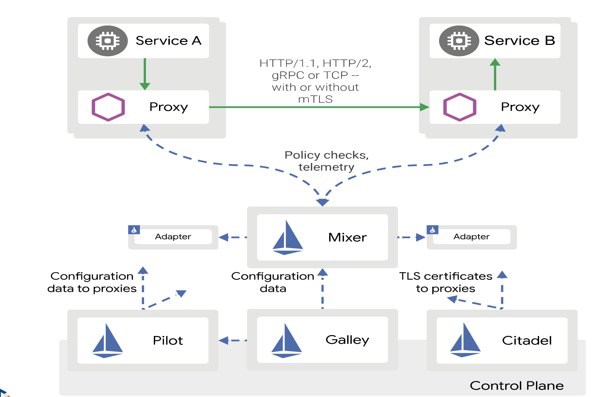
Service Meshes: Why Istio? An Introduction

In any microservice-based architecture, whenever there is a service call from one microservice to another. We are not able to infer or debug what is happening inside the networked service calls. This might lead to serious problems when we are not able to diagnose properly what is the problem if an unwanted situation arises. For example; performance issues, security, load balancing problems, tracing the service calls, or proper observability of the service calls. The severity of the issue gets multiplied when you have to cater to many microservices for any application to work properly. ... Istio has the most features and flexibility of any of these three service meshes by far: Cascading failure prevention (circuit breaking); Authentication and authorization. The service mesh can authorize and authenticate requests made from both outside and within the app, sending only validated requests to instances; Resiliency features (retries, timeouts, deadlines, etc.); Robust load balancing algorithms.
Control over request routing (useful for things like CI/CD release patterns); The ability to introduce and manage TLS termination between communication endpoints; Rich sets of metrics to provide instrumentation at the service-to-service layer ...


Is Explainability In AI Always Necessary?

With increasing sophistication and completeness, the system becomes less understandable. “As a model grows more realistic, it becomes more difficult to understand,” said David Hauser at the recently concluded machine learning developers conference. According to Hauser, clients want the model to be understandable and realistic.This is another paradox a data scientist has to live with. He also stressed that understandable solutions give up on accuracy. For instance, network pruning one such technique which takes a hit on accuracy. The moment non-linearities or interactions are introduced, the answers become less intuitive. ... One of the vital purposes of explanations is to improve ML engineers’ understanding of their models to refine and improve performance. Since machine learning models are “dual-use”, explanations or other tools could enable malicious users to increase capabilities and performance of undesirable systems. There is no denying that explanations allow model refinement. And, as we go forward, apart from the debugging and auditing of the models, organisations are looking at data privacy through the lens of explainability.


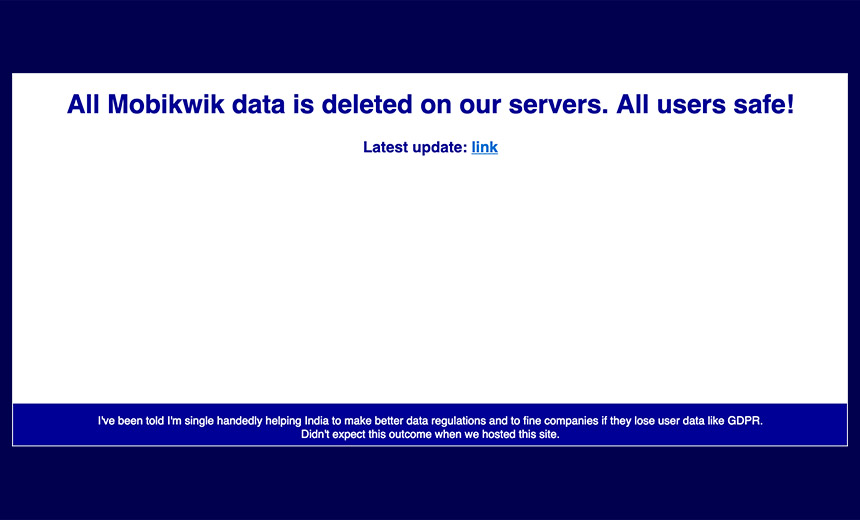
Leaker Dismisses MobiKwik's Not-So-Nimble Breach Denial

MobiKwik hasn't done itself any favors in its handling of this episode, noting that when the allegedly stolen data came to light in February, it "undertook a thorough investigation with the help of external security experts and did not find any evidence of a breach." Subsequently, after they reviewed the leaker's sample of stolen data, "some users have reported that their data is visible on the dark web," it adds, but then it says other breaches must be to blame. "While we are investigating this, it is entirely possible that any user could have uploaded her/ his information on multiple platforms. Hence, it is incorrect to suggest that the data available on the dark web has been accessed from MobiKwik or any identified source," MobiKwik claims. But the company says that despite having already brought in "external security experts" to investigate, it's now bringing in more, "to conduct a forensic data security audit." Hence, it's unclear what the first group of investigators might have done. ... Reuters on Thursday, citing an anonymous source with knowledge of the discussions, reported that the Reserve Bank of India was "not happy" with MobiKwik's statements, and ordered it to immediately launch a full digital forensic investigation.


New Storage Trends Promise to Help Enterprises Handle a Data Avalanche

Data virtualization has been around for some time, but with increasing data usage, complexity, and redundancy, the approach is gaining increasing traction. On the downside, data virtualization can be a performance drag if the abstractions, or data mappings, are too complex, requiring extra processing, Linthicum noted. There's also a longer learning curve for developers, often requiring more training. ... While not exactly a cutting-edge technology, hyper-converged storage is also being adopted by a growing number of organizations. The technology typically arrives as a component within a hyper-converged infrastructure in which storage is combined with computing and networking in a single system, explained Yan Huang, an assistant professor of business technologies at Carnegie Mellon University's Tepper School of Business. Huang noted that hyper-converged storage streamlines and simplifies data storage, as well as the processing of the stored data. "It also allows independently scaling computing and storage capacity in a disaggregated way," she said. 


The importance of tech, training and education in data classification

We have seen how automation plays a key role in establishing a firm foundation for an organisation’s security culture, but given employees play such a vital role in ensuring that business maintains a strong data privacy posture, the ability to work with stakeholders and users to understand data protection requirements and policies is key. Security and data protection education must be conducted company-wide and must exist at a level that is workable and sustainable. Regular security awareness training and a company-wide inclusive security culture within the business will ensure that data security becomes a part of everyday working practice, embedded into all actions and the very heart of the business. A robust data protection protocol is critical for all organisations, and will particularly be the case as we move beyond Covid-19 into the new normal. Delivering optimal operational efficiencies, data management and data classification provision under post-pandemic budget constraints will be an ongoing business-critical challenge. To do nothing, however, will set up an organisation to fail, and we have already seen large fines incurred for those that have not given data security enough of a priority.


Quote for the day:

"Leadership cannot just go along to get along. Leadership must meet the moral challenge of the day." -- Jesse Jackson

Daily Tech Digest - March 31, 2021

What is cyber risk quantification, and why is it important?

Put simply, the idea behind quantification is to prioritize risks according to their potential for financial loss, thus allowing responsible people in a company to create budgets based on mitigation strategies that afford the best protection and return on investment. Now to the difficult part: how to incorporate cyber risk quantification. "Risk quantification starts with the evaluation of your organization's cybersecurity risk landscape," explained Tattersall. "As risks are identified, they are annotated with a potential loss amount and frequency which feeds a statistical model that considers the probability of likelihood and the financial impact." Tattersall continued, "When assessing cybersecurity projects, risk quantification supports the use of loss avoidance as a proxy for return on investment. Investments in tighter controls, assessment practices and risk management tools are ranked by potential exposure." According to Tattersall, companies are already employing cyber risk quantification. He offered the FAIR Institute's Factor Analysis of Information Risk as an example. The FAIR Institute website mentions their platform provides a model for understanding, analyzing and quantifying cyber risk and operational risk in financial terms.


What We Know (and Don't Know) So Far About the 'Supernova' SolarWinds Attack

It's not unusual for multiple nation-state attacker groups to target the same victim organization, nor even to reside concurrently and unbeknownst to one another while conducting their intelligence-gathering operations. But Supernova and the Orion supply chain attack demonstrate how nation-states also can have similar ideas yet different methods regarding how they target and ultimately burrow into the networks of their victims. Supernova homed in on SolarWinds' Orion by exploiting a flaw in the software running on a victim's server; Sunburst did so by inserting malicious code into builds for versions of the Orion network management platform. The digitally signed builds then were automatically sent to some 18,000 federal agencies and businesses last year via a routine software update process, but the attackers ultimately targeted far fewer victims than those who received the malicious software update, with fewer than 10 federal agencies affected as well as some 40 of Microsoft's own customers. US intelligence agencies have attributed that attack to a Russian nation-state group, and many details of the attack remain unknown.


World Backup Day 2021: what businesses need to know post-pandemic

For many businesses, the shift to remote working that occurred worldwide last year due to the Covid-19 outbreak brought with it an ‘always on’, omnichannel approach to customer service. As this looks set to continue meeting the needs of consumers, organisations must consider how they can protect their data continuously, with every change, update or new piece of data protected and available in real time. “Continuous data protection (CDP) is enabling this change, saving data in intervals of seconds – rather than days or months – and giving IT teams the granularity to quickly rewind operations to just seconds before disruption occurred,” said Levonai. “Completely flexible, CDP enables an IT team to quickly recover anything, from a single file or virtual machine right up to an entire site. “As more organisations join the CDP backup revolution, data loss may one day become as harmless as an April Fool’s joke. Until then, it remains a real and present danger.”... Businesses should back up their data by starting in reverse. Effective backup really starts with the recovery requirements and aligning to the business needs for continued service.


DevOps is Not Enough for Scaling and Evolving Tech-Driven Organizations

DevOps has been an evolution of breaking silos between Development and Operations to enable technical teams to be more effective in their work. However, in most organizations we still have other silos, namely: Business (Product) and IT (Tech). "BizDevOps" can be seen as an evolution from DevOps, where the two classical big silos in organizations are broken into having teams with the product and tech disciplines needed to build a product. This evolution is happening in many organizations, most of the times these are called "Product Teams". Is it enough to maximize impact as an organization? I don't think so, and that is the focus of my DevOps Lisbon Meetup talk and ideas around sociotechnical architecture and systems thinking I have been exploring. In a nutshell: we need empowered product teams, but teams must be properly aligned with value streams, which in turn must be aligned to maximize the value exchange with the customer. To accomplish this, we need to have a more holistic view and co-design of the organization structures and technical architecture.


This CEO believes it’s time to embrace idealogical diversity and AI can help

It’s important to remember that each decision from a recruiter or hiring manager contributes to a vast dataset. AI utilizes these actions and learns the context of companies’ hiring practices. This nature makes it susceptible to bias when used improperly, so it is extremely critical to deploy AI models that are designed to minimize any adverse impact. Organizations can make sure humans are in the loop and providing feedback, steering AI to learn based on skill preferences and hiring requirements. With the ongoing curation of objective data, AI can help companies achieve recruiting efficiency while still driving talent diversity. One way hiring managers can distance themselves from political bias is by relying on AI to “score” candidates based on factors such as proficiency and experience, rather than data like where they live or where they attended college. In the future, AI might also be able to mask details such as name and gender to further reduce the risk of bias. With AI, team leaders receive an objective second opinion on hiring decisions by either confirming their favored candidate or compelling them to question whether their choice is the right one.


Why AI can’t solve unknown problems

Throughout the history of artificial intelligence, scientists have regularly invented new ways to leverage advances in computers to solve problems in ingenious ways. The earlier decades of AI focused on symbolic systems. This branch of AI assumes human thinking is based on the manipulation of symbols, and any system that can compute symbols is intelligent. Symbolic AI requires human developers to meticulously specify the rules, facts, and structures that define the behavior of a computer program. Symbolic systems can perform remarkable feats, such as memorizing information, computing complex mathematical formulas at ultra-fast speeds, and emulating expert decision-making. Popular programming languages and most applications we use every day have their roots in the work that has been done on symbolic AI. But symbolic AI can only solve problems for which we can provide well-formed, step-by-step solutions. The problem is that most tasks humans and animals perform can’t be represented in clear-cut rules.


The ‘why’ of digital transformation is the key to unlocking value

Ill-prepared digital transformation projects have ripple effects. One digitalization effort that fails to produce value doesn’t just exist in a vacuum. If a technical upgrade, cloud migration, or ERP merge results in a system that looks the same as before, with processes that aren’t delivering anything new, then the decision makers will see that lack of ROI and lose interest in any further digitalization because they believe the value just isn’t there. Imagine an IT team leader saying they want fancy new dashboards and new digital boardroom features. But a digital transformation project that ends with just implementing new dashboards doesn’t change the underlying facts about what kind of data may be read on those dashboards. And if your fancy dashboards start displaying incorrect data or gaps in data sets, you haven’t just undermined the efficacy and “cool factor” of those dashboards; you’ve also made it that much harder to salvage the credibility of the project and advocate for any new digitalization in the future. What’s the value in new dashboards if you haven’t fixed the data problems underneath?


New Security Signals study shows firmware attacks on the rise

Microsoft has created a new class of devices specifically designed to eliminate threats aimed at firmware called Secured-core PCs. This was recently extended to Server and IOT announced at this year’s Microsoft Ignite conference. With Zero Trust built in from the ground up, this means SDMs will be able to invest more of their resources in strategies and technologies that will prevent attacks in the future rather than constantly defending against the onslaught of attacks aimed at them today. The SDMs in the study who reported they have invested in secured-core PCs showed a higher level of satisfaction with their security and enhanced confidentiality, availability, and integrity of data as opposed to those not using them. Based on analysis from Microsoft threat intelligence data, secured-core PCs provide more than twice the protection from infection than non-secured-core PCs. Sixty percent of surveyed organizations who invested in secured-core PCs reported supply chain visibility and monitoring as a top concern. 


7 Traits of Incredibly Efficient Data Scientists

Believe it or not, not every data analysis requires machine learning and artificial intelligence. The most efficient way to solve a problem is to use the simplest tool possible. Sometimes, a simple Excel spreadsheet can yield the same result as a big fancy algorithm using deep learning. By choosing the right algorithms and tools from the start, a data science project becomes much more efficient. While it’s cool to impress everyone with a super complex tool, it doesn’t make sense in the long run when less time could be spent using a more simple, efficient solution. ... Doing the job right the first time is the most efficient way to complete any project. When it comes to data science, that means writing code using a strict structure that makes it easy to go back and review, debug, change, and even make your code production-ready. Clear syntax guidelines make it possible for everyone to understand everyone else’s code. However, syntax guidelines aren’t just there so you can understand someone else’s chicken scratch — they’re also there so you can focus on writing the cleanest, most efficient code possible.


How insurers can act on the opportunity of digital ecosystems

First, insurers must embrace the shift to service dominant strategies and gradually establish a culture of openness and collaboration, which will be necessary for the dynamic empowerment of all players involved. Second, insurers must bring to the platform the existing organizational capabilities required for customer-centric value propositions. This means establishing experts in the respective ecosystems—for example, in mobility, health, home, finance, or well-being—and building the technological foundations necessary to integrate partners into terms-of-service catalogs and APIs, as well as to create seamless customer journeys. Finally, insurers must engage customers and other external actors by integrating resources and engaging in service exchange for mutual value generation. My wife, for example, has just signed up for a telematics policy with an insurance company that offers not only incentives for driving behavior but also value-added services, including car sales and services. She now regularly checks whether her driving style reaches the maximum level possible.


Quote for the day:

"When we lead from the heart, we don't need to work on being authentic we just are!" -- Gordon Tredgold

Daily Tech Digest - March 30, 2021

Start-ups, established enterprises, and tech: what is the cost of change?

There is no tech stack that will give you a leg-up because it’s new and different from what everybody else is using. The only thing that will give you a leg-up is something that everybody already knows how to use. But what about “this is the best tool for the job”? That way of thinking can be a myopic view of both the words ‘best’ and ‘job.’ The job is keeping the organisation in business. The best tool will occupy the ‘least worst’ position for as many problems as possible. Pragmatism wins the day. Build things that are simple, build things that are boring, and build things that are battle-tested. Isolate things that are specifically tied to one area of your business and make sure all of that is together. When you must make decisions about encapsulating or abstracting it, it’s all contained. Then you can define boundaries. Make sure you define those boundaries within a simple code base. Think about this in terms of cheap vs expensive: it’s cheap to stick to those boundaries. Understand your boundaries, be clean with them and adjust them as you’re evolving. And don’t ever stop! The cost of reshaping a function name, or its position in a code base, is extremely low relative to the cost of moving things between services.


How to avoid 4 common zero trust traps (including one that could cost you your job)

The trap most practitioners fall into is the need to understand and define every identity in their organizations. Initially, this seems simple but then you realize there are service accounts and machine and application identities. It’s even more difficult because that identity project has to include permissions and each application has its own schema for what permissions are granted. There’s no standardization. Instead, focus on the user accounts. When we start with the application ecosystems, our intent is to focus on the user and application boundary. Now if we look at identities, start with interactive logins, i.e., users who need to access an account to perform an action. Ensure non-repudiation by getting rid of generic logins, using certificates and rotating credentials. ... Most boardrooms see zero trust as a way of using any device to be able to conduct business. That should be the end result of a robust zero trust program. If it is where you start, you will be overwhelmed with breaches. The purpose of zero trust is to technically express the fact that you don’t trust any device or network. You don’t accomplish that by closing your eyes to it.


In Secure Silicon We Trust

With RoT technology, "It's possible to gain a high degree of assurance that what's expected to be running is actually running," MacDonald explains. The technology achieves this level of protection using an encrypted instruction set that is etched into the chip at the time it is manufactured. When the system boots, the chip checks this immutable signature to validate the BIOS. If everything checks out the computer loads the software stack. If there's a problem, it simply won't boot. Secure silicon doesn't directly protect against all types of threats, but it does ensure that a system is secure at the foundational level. This is critical because attackers who gain access to the BIOS or firmware can potentially bypass the operating system and tamper with encryption and antivirus software, notes Rick Martinez, senior distinguished engineer in the Client Solutions Group Office of the CTO at Dell Technologies. "It provides a reliable trust anchor for supply chain security for the platform or device," Martinez notes. Intel has introduced the SGX chip, which bypasses a system's OS and virtual machine (VM) layers while altering the way the system accesses memory. SGX also supports verification of the application and the hardware it is running.

Finding remote work a struggle? Here's how to get your team back on track

"If you want to support people who are remote working, you cannot be an old-fashioned leader. That sounds critical, but you can't be the kind of leader that is saying, 'I don't really like people who are remote working and I want to know that they're doing stuff', and then always checking that the green light's on," she says. Evdience from the Harvard Business Review suggests Dawson is onto something. HBR says business leaders must understand that being nice to each other and goofing around together is part of the work we do. The informal interactions at risk in hybrid and remote work are not distractions; instead; they foster the employee connections that feed productivity and innovation. Dawson says successful business leaders in the future will have to be more empathetic. They will have to be unafraid of asking people how they're getting on. That question will need to be posed in the right way: rather than checking up on staff to see if they're at their desks, leaders should have conversations with staff about their feelings and objectives.


NaaS: Network-as-a-service is the future, but it’s got challenges

Full adoption of NaaS is still in its early days because most enterprise network functions require physical hardware to transport data to and from endpoints and the data center or internet. That is a challenge to deliver as a service. The Layer 4-7 functions are already available in a cloud-delivery model. Over the next five-plus years, IT teams will increasingly adopt NaaS as suppliers deliver hybrid offerings that include software, cloud intelligence, and the option for management of on-premises hardware. These services will be subscription-based and pay as you go, making networking more of an operational cost than a capital cost. They will provide centralized management with the ability to easily add and remove network and security functionality. The services will enable outsourcing of enterprise network operations to providers that may include vendors and their partners who provide service level agreements (SLA) to define uptime and problem-resolution guarantees. Right now, NaaS is best suited to organizations with a lean-IT philosophy and a need to provide networking support for at-home and branch locations.


Industrial AI prepares for the mainstream – How asset-intensive businesses can get themselves ready

A future-proof industrial AI infrastructure necessitates the need to lay the groundwork for industrial AI readiness, requiring collaboration across industrial environments. In fact, the software, hardware, architecture, and personnel elements will form the building blocks of the industrial AI infrastructure. And that infrastructure is what empowers organisations to take their industrial AI proof-of-concepts and mature them into tangible solutions that drive ROI. An industrial AI infrastructure needs to accelerate time to market, build operational flexibility and scalability into AI investments and harmonise the AI model lifecycle across all applications. Roles, skills, and training are critical. Executing industrial AI relies on having the right people in charge. That means making a deliberate effort to cultivate the skills and approaches needed to create and deploy AI-powered initiatives organisation-wide. Finally, ethical and responsible AI use is predicated on transparency, and transparency involving keeping everyone in the loop: creating clear channels of communication, reliable process documentation and alignment across all stakeholders.


Operating in an increasingly digitalized world

Consumers have become less cost-conscious and more focused on sustainability, he said. Those are "top of mind issues. [Consumers] will pick slower shipping if they see it's good for the environment. They want to support their local communities so they're shopping more locally." Buyers are also looking for unique products and "no longer the same old, same old." Merchants have started creating 3D models of their products, Jaffer said. Digital transformation will help with environmental sustainability and climate change, Lapiello said. Organizations will have to fully embrace privacy, cybersecurity and artificial intelligence, he said. "By 2030, quantum computing will be available in some shape or form and will be an incredibly disruptive technology," Lapiello said. "I truly believe the current machine learning generating predictions based on correlations will become obsolete and will be replaced by causal AI, which is quite ripe and will allow for better decisions." One of the biggest changes will be that people will have moved away from using mobile phones to glasses, Hackl said. "It's not a question of will it happen, but when ... We're 3D beings in a 3D world and the content you'll consume through these glasses will have dimensions" that change what we see in our surroundings.


SD-WAN surges over past two years as MPLS plummets

“SD-WAN has dramatically increased in adoption in the past couple of years. The pandemic slowed roll-outs for a time, but increased interest in adoption. SD-WAN frees WAN managers to select a broad mix of underlay technologies, and can also boost performance.” The report aimed to offer a clear picture of how mid-size to large enterprises are adjusting to emerging WAN technologies, helping suppliers make more informed decisions. It provided an in-depth analysis based on the experiences of WAN managers from 125 companies, with those represented in the survey having a median revenue of $10bn and a range of IT managers covering the design, sourcing and management of US national, regional and global corporate wide-area computer networks. The standout finding for the study was that 43% of enterprises surveyed had installed SD-WAN in 2020, compared with just 18% in 2018. Driving this growth – and key motivators for WAN managers pursuing SD-WAN, according to the survey – were increasing site capacity and using alternative access solutions. Two-fifths of respondents preferred a co-managed SD-WAN setup and, on top of this, enterprises were running MPLS at an average of 71% of sites during the three-year period of 2018-2020.


Applying CIAM Principles to Employee Authentication

To enhance employee authentication for system access, some organizations, including Navy Federal Credit Union and the travel portal Priceline, are adopting customer identity and access management, or CIAM, procedures for their workforces. Those include dynamic authorization, continuous authentication and the use of various forms of biometrics. "With the death of user ID and password, I am trying to create digital layers of authentication on the workforce side," Malta says. "We are looking to be able to let the hybrid workforce ‘inside our network’ in a very frictionless way." Joe Dropkin, principal server engineer at Priceline, says he's been applying the concept of CIAM to employee authentication because of the shift toward applications and data storage in the cloud. “We did not want our employees to go through multiple layers of authentication to SAAS applications. The users now have single 'pane of glass' to look at,” he says. Priceline employees no longer have to log in multiple times to access different applications. Once they're authenticated, using multiple layers, they gain access to all appropriate systems, Dropkin says.


Beyond MITRE ATT&CK: The Case for a New Cyber Kill Chain

MITRE ATT&CK, by contrast, is a more modern approach focused on TTPs. It seeks to classify attackers' goals, tasks, and steps; as such, it is a much more comprehensive approach to modeling an attack. That said, MITRE ATT&CK also has its shortcomings, notably when a security team is using an XDR platform. In an automated detection scenario, defenders might see the symptoms without knowing the exact root cause, such as suspicious user behavior, and such scenarios are harder to fit into MITRE ATT&CK. Stellar Cyber, a developer of XDR technology, argues for the creation of a new framework. It envisions an XDR framework/kill chain leveraging MITRE ATT&CK on the known root causes and attackers' goals but going further regarding other data sources, such as anomalous user behavior. There is precedent for an individual vendor feeling a need to extend or amend frameworks. FireEye came up with its own version of the kill chain, which put more emphasis on attackers' ability to persist threats, while endpoint detection and response (EDR) heavyweight CrowdStrike uses MITRE ATT&CK extensively but provides a set of nonstandard categories to cover a broader range of scenarios.


Quote for the day:

"Don't be buffaloed by experts and elites. Experts often possess more data than judgement." -- Colin Powell