Quote for the day:
"Little minds are tamed and subdued by misfortune; but great minds rise above it." -- Washington Irving
🎧 Listen to this digest on YouTube Music
▶ Play Audio DigestDuration: 21 mins • Perfect for listening on the go.
New Research Highlights Growing Digital Trust Crisis as AI Accelerates Online Threats
 A recent report reveals that organizations are facing a mounting crisis of
digital trust as cyber threats increasingly move beyond traditional security
perimeters. Instead of merely attacking internal networks, attackers are now
targeting the public internet, focusing heavily on brand reputation, employee
identities, and customer relationships. The study found that while most
companies have experienced a significant security incident in the past year,
very few consider their defense programs mature enough to handle them. The
rapid advancement of artificial intelligence is accelerating this shift.
Attackers are using AI tools to create highly convincing deepfakes, voice
clones, and impersonation campaigns, making it much harder for people to spot
fraud through simple errors like poor grammar. Furthermore, as businesses
adopt AI agents to automate everyday tasks, they expose themselves to new
risks. Malicious instructions can be cleverly hidden in external content,
tricking these automated systems into taking unintended actions at speeds
faster than humans can intervene. To counter these evolving threats,
organizations must move beyond protecting only top executives and begin
defending their entire workforce. Over the next few years, businesses that
apply the same strict oversight to their artificial intelligence systems as
they do to their standard access controls will be in a much stronger position
to protect their operations and maintain public confidence.
A recent report reveals that organizations are facing a mounting crisis of
digital trust as cyber threats increasingly move beyond traditional security
perimeters. Instead of merely attacking internal networks, attackers are now
targeting the public internet, focusing heavily on brand reputation, employee
identities, and customer relationships. The study found that while most
companies have experienced a significant security incident in the past year,
very few consider their defense programs mature enough to handle them. The
rapid advancement of artificial intelligence is accelerating this shift.
Attackers are using AI tools to create highly convincing deepfakes, voice
clones, and impersonation campaigns, making it much harder for people to spot
fraud through simple errors like poor grammar. Furthermore, as businesses
adopt AI agents to automate everyday tasks, they expose themselves to new
risks. Malicious instructions can be cleverly hidden in external content,
tricking these automated systems into taking unintended actions at speeds
faster than humans can intervene. To counter these evolving threats,
organizations must move beyond protecting only top executives and begin
defending their entire workforce. Over the next few years, businesses that
apply the same strict oversight to their artificial intelligence systems as
they do to their standard access controls will be in a much stronger position
to protect their operations and maintain public confidence.The Invisible Invoice: The Cost of Building Software Without Understanding It
The software industry typically measures success by delivery speed and whether
an application works on launch day, but it rarely tracks the ongoing expense
of keeping it running years later. When teams build software without deeply
understanding the core business problem, they often rely on heavy, complicated
frameworks to speed up initial development. While these shortcuts might save a
few weeks upfront, they create an invisible invoice of hidden costs. Over
time, maintaining this code through security patches, version upgrades, and
changing requirements becomes incredibly expensive and drains precious time.
Because there is no alternative version of the same software to compare it
against, companies usually write off these escalating costs as unavoidable
technical debt or standard enterprise complexity. Building software is
ultimately a learning process where the true needs of the business are
discovered along the way. To avoid the invisible invoice trap, developers must
separate the strict rules of the business from the optional technical
plumbing. The primary goal should be to translate essential business logic
into a clear structure that both domain experts and programmers can easily
read and understand. By focusing intensely on the actual purpose of the
application rather than default technical conventions, teams can build
adaptable systems that evolve over time instead of rigid platforms that must
eventually be discarded.
The Scalable Innovation Playbook: Architecture Patterns, Governance, and Platforms
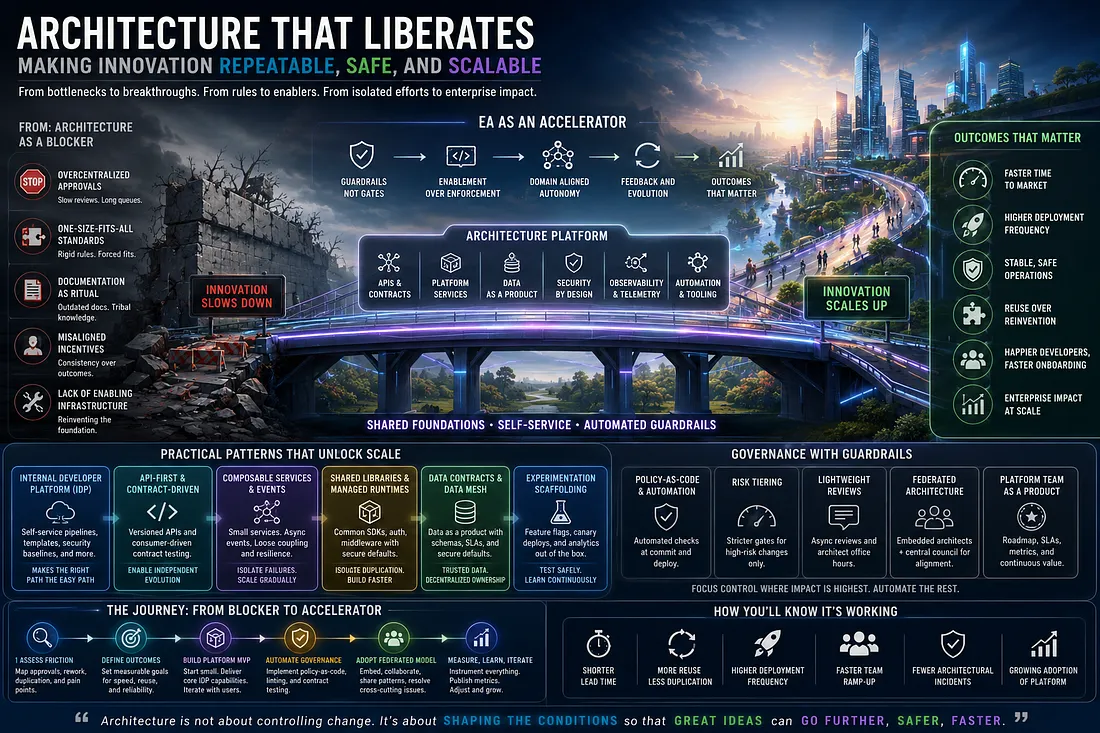 To successfully drive innovation at scale, organizations need a structured
approach that moves beyond temporary projects and isolated teams. The core of
this strategy relies on establishing flexible architecture patterns, practical
governance, and reliable internal platforms. Modern architecture patterns,
such as modular designs, allow development teams to build and modify
applications quickly without disrupting the entire system. However, this
flexibility requires clear governance to prevent operational chaos across the
business. Good governance acts as a set of helpful guardrails rather than a
rigid roadblock, ensuring that different teams follow consistent security
standards and reliable data practices without sacrificing their creative
independence. Supporting this critical balance are internal developer
platforms, which provide ready tools and infrastructure so engineers can focus
directly on solving core business problems instead of constantly setting up
basic software environments. By treating these platforms as internal products
built specifically for their own developers, companies greatly reduce wasted
effort and significantly speed up delivery times. Ultimately, scaling
innovation is not simply about adopting the newest technology trends, but
rather about creating a sustainable environment where technical teams have the
freedom to experiment safely. When architecture, governance, and platforms
work together smoothly, businesses can adapt to market changes and build new
solutions with predictable success and stability.
To successfully drive innovation at scale, organizations need a structured
approach that moves beyond temporary projects and isolated teams. The core of
this strategy relies on establishing flexible architecture patterns, practical
governance, and reliable internal platforms. Modern architecture patterns,
such as modular designs, allow development teams to build and modify
applications quickly without disrupting the entire system. However, this
flexibility requires clear governance to prevent operational chaos across the
business. Good governance acts as a set of helpful guardrails rather than a
rigid roadblock, ensuring that different teams follow consistent security
standards and reliable data practices without sacrificing their creative
independence. Supporting this critical balance are internal developer
platforms, which provide ready tools and infrastructure so engineers can focus
directly on solving core business problems instead of constantly setting up
basic software environments. By treating these platforms as internal products
built specifically for their own developers, companies greatly reduce wasted
effort and significantly speed up delivery times. Ultimately, scaling
innovation is not simply about adopting the newest technology trends, but
rather about creating a sustainable environment where technical teams have the
freedom to experiment safely. When architecture, governance, and platforms
work together smoothly, businesses can adapt to market changes and build new
solutions with predictable success and stability.When Adopting AI-Powered Cyber Tools, Proceed With Caution
As cyber threats evolve to become faster and more sophisticated, organizations
increasingly need intelligent defensive systems to protect their networks.
Hackers are now using automated technology to find and exploit unseen
vulnerabilities rapidly, meaning manual patching and traditional security
measures are no longer enough to keep up. While it is necessary to deploy
intelligent countermeasures to detect and respond to these attacks,
organizations must proceed with careful planning rather than rushing into
blind implementation. A thoughtful adoption strategy involves three practical
steps. First, security teams must analyze their environment and identify the
most critical assets. Less vital systems, like standard employee workstations,
can be updated first with proper review, while highly sensitive infrastructure
requires a more cautious approach. Second, before allowing automated systems
to make live configuration changes, organizations should run simulations to
understand the potential impact on user access and business operations.
Finally, frequent backups and system snapshots must be scheduled early in the
deployment process. If a newly integrated security tool makes an unintended or
unauthorized change, these backups ensure teams can immediately restore their
systems to a secure baseline. Ultimately, keeping enterprise environments
secure requires strict technical limits and strong access controls. By
implementing these practical safeguards, organizations can safely integrate
modern defensive tools without jeopardizing their core operations.
The Rise of the AI Development Life Cycle
 Artificial intelligence is fundamentally changing how companies build
software, moving beyond simple coding assistants to a fully integrated AI
development life cycle. Initially, organizations saw modest productivity gains
by using AI to automate specific tasks like writing code or drafting tests.
Now, expectations are shifting toward a model where hybrid teams of humans and
AI handle entire workflows, potentially multiplying productivity several times
over. This evolution breaks down the traditional barriers between designing a
product and building it. Instead of moving in rigid, sequential steps, teams
can continuously define, develop, test, and refine software together. However,
many early efforts stall because companies focus too narrowly on isolated
tasks without updating their broader processes. To succeed, organizations must
undergo a complete structural change. This means adjusting team roles, such as
developers transitioning to orchestrators of AI tools, and establishing new
ways of working that prioritize clear instructions, continuous feedback, and
strict security rules. Furthermore, measuring success requires moving past
basic speed metrics. Companies must track system-wide outcomes, defect rates,
and overall risk to ensure that faster development does not introduce hidden
problems. Ultimately, adapting to this new era of software creation is not
simply a technology upgrade, but a comprehensive redesign of how a business
operates and delivers value.
Artificial intelligence is fundamentally changing how companies build
software, moving beyond simple coding assistants to a fully integrated AI
development life cycle. Initially, organizations saw modest productivity gains
by using AI to automate specific tasks like writing code or drafting tests.
Now, expectations are shifting toward a model where hybrid teams of humans and
AI handle entire workflows, potentially multiplying productivity several times
over. This evolution breaks down the traditional barriers between designing a
product and building it. Instead of moving in rigid, sequential steps, teams
can continuously define, develop, test, and refine software together. However,
many early efforts stall because companies focus too narrowly on isolated
tasks without updating their broader processes. To succeed, organizations must
undergo a complete structural change. This means adjusting team roles, such as
developers transitioning to orchestrators of AI tools, and establishing new
ways of working that prioritize clear instructions, continuous feedback, and
strict security rules. Furthermore, measuring success requires moving past
basic speed metrics. Companies must track system-wide outcomes, defect rates,
and overall risk to ensure that faster development does not introduce hidden
problems. Ultimately, adapting to this new era of software creation is not
simply a technology upgrade, but a comprehensive redesign of how a business
operates and delivers value.House Subcommittee on Cybersecurity and Infrastructure Protection Hosts Hearing on AI Security
During a recent House Subcommittee hearing, lawmakers and industry experts gathered to discuss how artificial intelligence is changing national cybersecurity and the resilience of critical infrastructure. The primary focus was the dual nature of advanced AI models. While these tools offer practical defensive benefits by finding and fixing software vulnerabilities quickly, they also provide malicious actors with the ability to discover and exploit weaknesses faster than human teams can patch them. Representative Andy Ogles highlighted the specific risk of foreign adversaries, particularly China, distributing inexpensive, open models that lack safety controls and could become the global standard, introducing serious security and censorship risks. Sandra Joyce, an executive at Google Threat Intelligence, confirmed that cybercriminals have already begun using AI to build novel digital exploits. To counter these accelerating threats, experts advised that traditional, reactive security measures are no longer sufficient. Organizations must transition to an automated, continuous process of scanning and repairing vulnerabilities before attackers can take advantage of them. The hearing underscored the practical need for a cohesive national strategy that prioritizes building security into software from the very beginning. This approach will be essential for ensuring the United States maintains a defensive advantage against increasingly autonomous cyber threats. The article examines Europe's vulnerable position within the global
"sovereignty triangle," a difficult balancing act dominated by the United
States and China. As modern infrastructure becomes deeply tied to national
security and economic health, Europe finds itself heavily reliant on foreign
products, particularly American cloud networks and Asian computer chips. The
piece argues that to avoid remaining a mere consumer of foreign tools, the
European Union must move past simply writing rules and regulations, such as
data privacy laws, and start actively building its own core technologies. This
shift requires overcoming divisions between member countries and committing to
serious financial investments in vital areas like artificial intelligence,
hardware manufacturing, and secure digital networks. True independence is not
about isolating from the world or closing borders, but having the practical
ability to make independent choices without being pressured by outside powers.
The text points out that Europe's best path forward involves smart
partnerships and industrial plans that encourage local development. By
creating solid alternatives and keeping strong alliances, Europe can protect
its political and economic freedom. Ultimately, this shared effort is
necessary to ensure the continent remains an equal player in shaping the
future, rather than just a rule maker caught between two massive powers.
The article examines Europe's vulnerable position within the global
"sovereignty triangle," a difficult balancing act dominated by the United
States and China. As modern infrastructure becomes deeply tied to national
security and economic health, Europe finds itself heavily reliant on foreign
products, particularly American cloud networks and Asian computer chips. The
piece argues that to avoid remaining a mere consumer of foreign tools, the
European Union must move past simply writing rules and regulations, such as
data privacy laws, and start actively building its own core technologies. This
shift requires overcoming divisions between member countries and committing to
serious financial investments in vital areas like artificial intelligence,
hardware manufacturing, and secure digital networks. True independence is not
about isolating from the world or closing borders, but having the practical
ability to make independent choices without being pressured by outside powers.
The text points out that Europe's best path forward involves smart
partnerships and industrial plans that encourage local development. By
creating solid alternatives and keeping strong alliances, Europe can protect
its political and economic freedom. Ultimately, this shared effort is
necessary to ensure the continent remains an equal player in shaping the
future, rather than just a rule maker caught between two massive powers.How Capital Allocation Changes When Agents Run the Stack
As businesses increasingly adopt autonomous artificial intelligence for their
daily operations, chief information officers face a complex challenge in
managing shifting costs and maintaining accountability. According to Arun
Ramchandran, CEO at QBurst, true autonomous commerce is not just an advanced
rules engine; it represents a sophisticated system capable of handling complex
goals, research, and execution without constant human intervention. However,
many leaders mistakenly treat this transition purely as a technology project
rather than a fundamental organizational design overhaul. Deploying these
systems successfully requires addressing three major areas of complexity.
First, organizations need clean, deeply contextual data, which often means
capturing the unrecorded institutional knowledge that employees hold. Second,
a strict governance structure is necessary to define accountability when
different systems interact and to prevent runaway operational costs from
endless processing loops. Finally, companies must carefully design the handoff
between human workers and autonomous systems, ensuring humans remain
appropriately involved when needed. Evaluating the total cost of ownership for
these systems also proves uniquely difficult. Because processing costs are
dropping while usage rates are soaring simultaneously, building a financial
model based on current transaction rates is highly unpredictable. Ultimately,
building a reliable infrastructure for autonomous operations demands a highly
thoughtful approach to data management, clear governance, and well-designed
integration with human teams.
How CIOs Can Prove the Value of Technology in the Age of AI
 In today's fast-moving business landscape, technology leaders face increasing
pressure to justify their investments, especially as artificial intelligence
initiatives require significant capital. To successfully prove the value of
tech in the age of AI, Chief Information Officers must shift their focus from
traditional cost metrics to clear business outcomes. This means stepping away
from technical jargon and measuring success by how well technology improves
operational efficiency, drives revenue, or enhances the overall customer
experience. Instead of treating AI as a standalone project, technology leaders
should embed these tools directly into everyday business processes, ensuring
they solve real problems rather than just serving as interesting experiments.
Furthermore, proving value requires a strong partnership between the IT
department and other business units. CIOs need to collaborate closely with
finance and operations teams to establish shared goals and transparent
reporting frameworks. Building this trust also involves prioritizing human
elements, such as training employees to confidently use new AI systems safely
and effectively. This strategic alignment turns abstract concepts into
practical benefits. By connecting technology directly to core business
objectives and fostering a culture of cross-functional teamwork, CIOs can
demonstrate that their AI and technology investments are not merely expensive
operational costs, but essential drivers of long-term corporate growth and
sustainability.
In today's fast-moving business landscape, technology leaders face increasing
pressure to justify their investments, especially as artificial intelligence
initiatives require significant capital. To successfully prove the value of
tech in the age of AI, Chief Information Officers must shift their focus from
traditional cost metrics to clear business outcomes. This means stepping away
from technical jargon and measuring success by how well technology improves
operational efficiency, drives revenue, or enhances the overall customer
experience. Instead of treating AI as a standalone project, technology leaders
should embed these tools directly into everyday business processes, ensuring
they solve real problems rather than just serving as interesting experiments.
Furthermore, proving value requires a strong partnership between the IT
department and other business units. CIOs need to collaborate closely with
finance and operations teams to establish shared goals and transparent
reporting frameworks. Building this trust also involves prioritizing human
elements, such as training employees to confidently use new AI systems safely
and effectively. This strategic alignment turns abstract concepts into
practical benefits. By connecting technology directly to core business
objectives and fostering a culture of cross-functional teamwork, CIOs can
demonstrate that their AI and technology investments are not merely expensive
operational costs, but essential drivers of long-term corporate growth and
sustainability.CMMC Is Here, But AI Changes The Compliance Conversation
The integration of artificial intelligence into the defense sector offers
significant speed and convenience, but it also introduces serious compliance
risks under the Cybersecurity Maturity Model Certification (CMMC). As defense
contractors increasingly rely on coding assistants and chatbots to summarize
requirements or draft responses, they inadvertently create new, unmanaged data
environments. CMMC regulations demand strict accountability for sensitive
information, and these rules apply equally whether data is mishandled through
a traditional file share or a modern AI tool. Simply put, convenience is not
an acceptable security control. When employees upload technical notes or
contract details into an AI system, that information often becomes part of the
model's history, raising questions about data retention, access, and proper
handling. This exposure is especially critical across the supply chain, as a
single subcontractor using unauthorized AI can put an entire project at risk.
To navigate this safely, organizations must recognize that AI adoption
currently outpaces security maturity. They need to establish clear rules for
which AI tools are permissible and how they can be used. A responsible
approach requires implementing data classification guidelines, mandating human
reviews for AI-generated outputs, enforcing security standards across all
suppliers, and maintaining continuous oversight to ensure sensitive defense
information remains fully protected.


No comments:
Post a Comment