Showing posts with label diversity. Show all posts

Daily Tech Digest - March 28, 2026


Quote for the day:

"We are moving from a world where we have to understand computers to a world where they will understand us." -- Jensen Huang


🎧 Listen to this digest on YouTube Music

▶ Play Audio Digest

Duration: 16 mins • Perfect for listening on the go.


When clean UI becomes cold UI

The article "When Clean UI Becomes Cold UI" explores the pitfalls of over-minimalism in modern digital interface design, arguing that a "clean" aesthetic can easily shift from elegant to emotionally distant. This "cold UI" occurs when essential guidance—such as text labels, instructions, and reassuring feedback—is stripped away in favor of a sleek, portfolio-worthy appearance. While such designs may impress other designers, they often fail real-world users by forcing them to rely on assumptions, which increases cognitive friction and erodes the human connection. The central premise is that designers must shift their focus from "clean" design to "clear" design. Every element removed for the sake of aesthetics involves a trade-off that often sacrifices functional clarity for visual simplicity. To avoid creating a "ghost town" interface, the author encourages prioritizing meaning over layout, ensuring icons are paired with labels and that the design supports users during moments of uncertainty. Ultimately, a truly successful interface is not one that is simply empty, but one that knows when to provide direction and when to step back, balancing aesthetic minimalism with the transparency required for a user to feel genuinely supported and understood.


5 Practical Techniques to Detect and Mitigate LLM Hallucinations Beyond Prompt Engineering
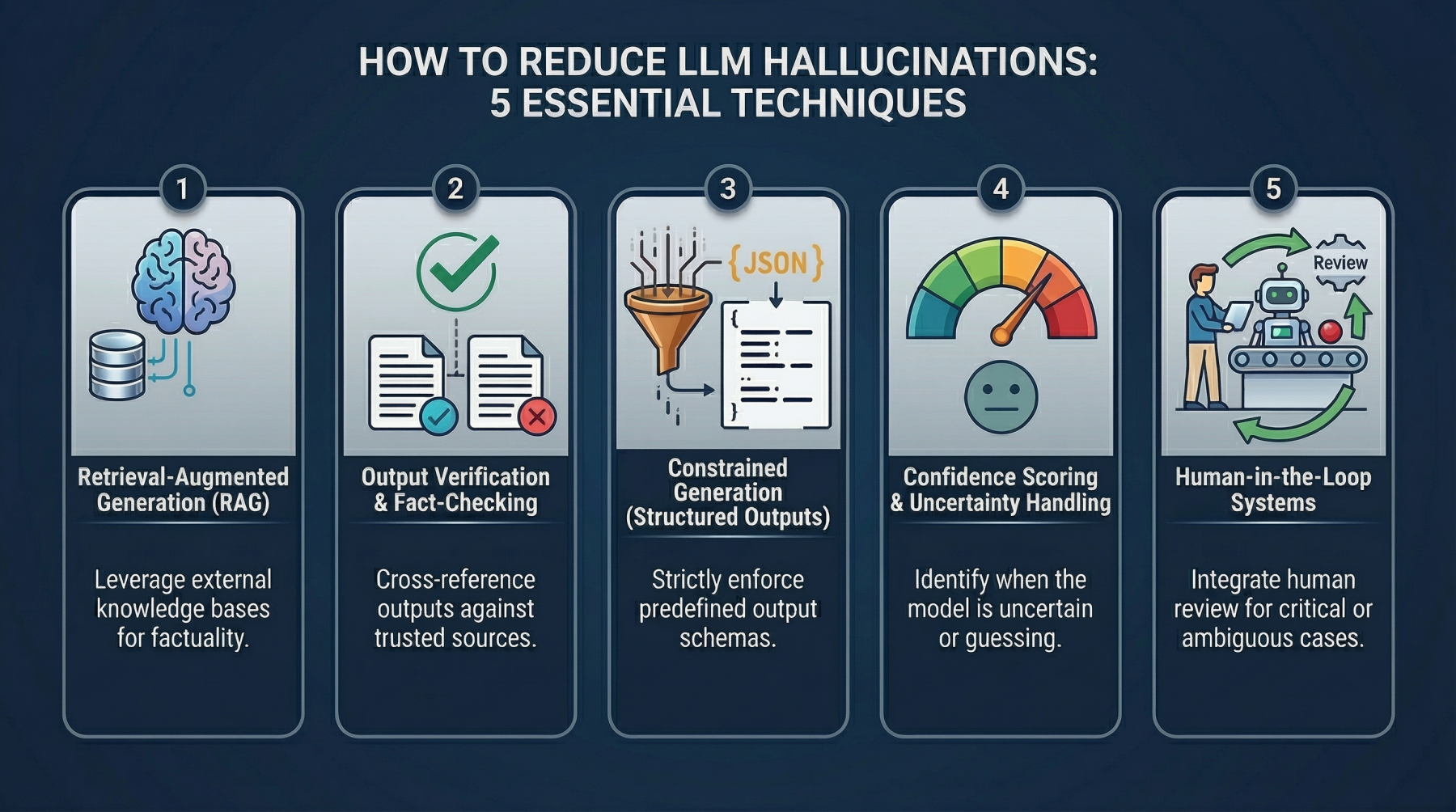
The article "5 Practical Techniques to Detect and Mitigate LLM Hallucinations Beyond Prompt Engineering" from Machine Learning Mastery explores advanced system-level strategies to ensure AI reliability. While basic prompting can improve performance, it often fails in production settings where strict accuracy is critical. The first technique, Retrieval-Augmented Generation (RAG), anchors model responses in real-time, external verified data, moving away from reliance on static, often outdated training memory. Second, the article advocates for Output Verification Layers, where a secondary model or automated cross-referencing system validates initial drafts before they reach the user. Third, Constrained Generation utilizes structured formats like JSON or XML to limit speculative or tangential output, ensuring machine-readable consistency. Fourth, Confidence Scoring and Uncertainty Handling encourage models to quantify their own reliability or admit ignorance through "I don’t know" responses rather than guessing. Finally, Human-in-the-Loop Systems integrate human oversight to refine results, provide feedback, and build essential user trust. Collectively, these methods transition LLM applications from experimental prototypes to robust, factual tools. By implementing these architectural patterns, developers can move beyond trial-and-error prompting to create production-ready systems capable of handling high-stakes tasks where the cost of a hallucination is significantly high.


Agentic GRC: Teams Get the Tech. The Mindset Shift Is What's Missing

In "Agentic GRC: Teams Get the Tech, the Mindset Shift Is What's Missing," Yair Kuznitsov explores the transformative impact of AI agents on Governance, Risk, and Compliance. Traditionally, GRC professionals derived value from operational competence, specifically manual evidence collection and audit management. However, agentic AI now automates these workflows, creating an identity crisis for those whose roles were defined by execution. The author argues that while technology is ready, many teams remain reluctant because they struggle to redefine their professional purpose beyond operational tasks. Crucially, GRC was intended as a strategic risk management function, but it became consumed by scaling inefficiencies. Agentic GRC offers a return to these roots, transitioning practitioners toward "GRC Engineering" where controls are managed as code via Git and CI/CD pipelines. This essential shift requires moving from a "checkbox" mentality to strategic risk leadership. Humans must provide critical judgment, define risk appetite, and translate business context into compliance logic—capabilities AI cannot replicate. Ultimately, successful organizations will empower their GRC teams to stop merely managing operational machines and start leading proactive, risk-based initiatives. This evolution represents an opportunity for professionals to finally perform the high-level work they were originally trained to do.


The Missing Layer in Agentic AI

The article "The Missing Layer in Agentic AI" argues that while current AI development focuses heavily on large language models and reasoning capabilities, a critical "middleware" layer is currently absent. This missing component, referred to as an agentic orchestration layer, is essential for transforming static models into truly autonomous systems capable of executing complex, multi-step tasks in dynamic environments. The author explains that for AI agents to be effective, they require more than just raw intelligence; they need robust frameworks for memory management, tool integration, and state persistence. This layer acts as the glue that connects high-level planning with low-level execution, ensuring that agents can maintain context and recover from errors during long-running processes. Furthermore, the piece highlights that without this specialized infrastructure, developers are forced to build bespoke, brittle solutions that do not scale. By establishing a standardized orchestration layer, the industry can move toward more reliable, observable, and interoperable agentic workflows. Ultimately, the article suggests that the next frontier of AI progress lies not just in better models, but in the sophisticated software engineering required to manage how those models interact with the world and each other.


Edge clouds and local data centers reshape IT

For over a decade, enterprise cloud strategy prioritized centralization on hyperscale platforms to achieve economies of scale and reduce infrastructure sprawl. However, the rise of edge clouds and local data centers is fundamentally reshaping this paradigm toward a selectively distributed architecture. Modern digital systems increasingly require real-time responsiveness, adherence to regional data sovereignty regulations, and efficient handling of massive data volumes from sensors and video feeds. To meet these demands, enterprises are adopting a dual architecture that combines the strengths of centralized cloud platforms—well-suited for model training and storage—with localized infrastructure positioned closer to the source of interaction. This shift is visible in sectors like retail and manufacturing, where proximity reduces latency and operational costs. Despite its benefits, the transition to edge computing introduces significant complexities, including fragmented life-cycle management, security hardening, and the need for robust observability across hundreds of distributed sites. Rather than replacing the cloud, the edge serves as a coordinated layer within an integrated hybrid model. By placing workloads where they are most operationally and economically effective, organizations can navigate bandwidth limitations and physical-world complexities, ensuring their digital infrastructure remains agile and resilient in a changing technological landscape.


AI frenzy feeds credential chaos, secrets leak through code, tools, and infrastructure

GitGuardian’s State of Secrets Sprawl 2026 report highlights an alarming surge in cybersecurity risks, revealing that 28.65 million new hardcoded secrets were detected in public GitHub commits during 2025. This multi-year upward trend demonstrates that credentials, including access keys, tokens, and passwords, are increasingly leaking through code, development tools, and infrastructure. Beyond public repositories, the report underscores a significant shift toward internal environments, which often carry a higher density of sensitive production credentials. The explosion of AI development has exacerbated the problem; AI-assisted coding and the proliferation of new model providers and agent frameworks have introduced vast numbers of fresh credentials that are frequently mismanaged. Furthermore, collaboration platforms like Slack and Jira, along with self-hosted Docker registries, serve as additional points of exposure. A particularly concerning finding is the longevity of these leaks, as many credentials remain active and usable for years due to the operational complexities of remediation across fragmented systems. Ultimately, the report illustrates a widening gap between the rapid pace of software innovation and the governance required to secure the expanding surface area of modern, interconnected development workflows, leaving critical infrastructure vulnerable to exploitation.
In “Architecting Autonomy at Scale,” Shweta Aggarwal and Ron Klein argue that traditional, centralized architectural governance becomes a significant bottleneck as organizations grow, necessitating a fundamental shift toward decentralized decision-making. Utilizing a “parental metaphor,” the article describes the evolution of architecture from “infancy,” where strong central guidance is required to prevent chaos, to “adulthood,” where teams operate autonomously within established systems. The authors propose a structured framework built on clear decision boundaries, shared principles, and robust guardrails rather than restrictive approval gates. Key technical practices include documenting decisions via Architecture Decision Records (ADRs) to preserve context, utilizing “fitness functions” for automated governance within CI/CD pipelines, and leveraging AI for detecting architectural drift. By aligning architectural authority with the C4 model levels, organizations can clarify ownership and reduce delivery friction. Ultimately, the role of the architect evolves from a top-down gatekeeper to a coach and platform enabler, focusing on creating “paved roads” that allow teams to experiment safely. This transition is framed as a socio-technical transformation that requires cultural shifts, leadership support, and a trust-based governance model to successfully balance local agility with enterprise-wide coherence and long-term technical sustainability.
The European Commission is intensifying its enforcement of the Digital Services Act (DSA) by moving away from "self-declaration" as a valid method for online age assurance. Following a series of investigations, regulators have determined that simple "click-to-confirm" mechanisms on major adult content platforms, including Pornhub, Stripchat, XNXX, and XVideos, are insufficient to protect minors from harmful material. These platforms are now being urged to implement more robust, privacy-preserving age verification measures to ensure compliance with EU standards. Simultaneously, the Commission has opened a formal investigation into Snapchat over concerns that its reliance on self-declaration fails to prevent underage children from accessing the app or to provide age-appropriate experiences for teenagers. Beyond the European Commission's actions, the UK Information Commissioner's Office (ICO) is also pressuring social media giants to strengthen their age-gate systems. Potential solutions being discussed include the use of the European Digital Identity (EUDI) Wallet, facial age estimation technology, and identity document scans. This coordinated regulatory crackdown signals a major shift in the digital landscape, where platforms must now prioritize societal risks to minors over business-centric concerns. Failure to adopt these more stringent verification methods could lead to significant financial penalties across the European Union.


5 reasons why the tech industry is failing women

The CIO.com article, “Women in Tech Statistics: The Hard Truths of an Uphill Battle,” highlights the persistent gender gap and systemic challenges women face in the technology sector. Despite representing 42% of the global workforce, women hold only 26-28% of tech roles and just 12% of C-suite positions. A significant “leaky pipeline” begins in academia, where women earn only 21% of computer science degrees, and continues into the workplace. Troublingly, 50% of women leave the industry by age 35—a rate 45% higher than men—driven by toxic cultures, microaggressions, and a lack of flexible work-life balance. Economic instability further compounds these issues, with women being 1.6 times more likely to face layoffs; during 2022’s mass tech layoffs, they accounted for 69% of job losses. Financial disparities remain stark, as women earn approximately $15,000 less annually than their male counterparts. Furthermore, the rise of artificial intelligence presents new risks, with women’s roles 34% more likely to be disrupted by automation compared to 25% for men. Collectively, these statistics underscore that achieving gender parity requires more than corporate pledges; it necessitates fundamental shifts in recruitment, retention, and structural support systems.


15+ Global Banks Exploring Quantum Technologies

The article titled "15+ global banks probing the wonderful world of quantum technologies," published by The Quantum Insider on March 27, 2026, highlights the accelerating integration of quantum computing within the global financial sector. Central to this movement is the "Quantum Innovation Index," a benchmarking tool developed in collaboration with HorizonX Consulting, which identifies top performers like JPMorgan Chase, HSBC, and Goldman Sachs. These institutions are leading a group of over fifteen major banks that have transitioned from theoretical research to practical experimentation. The report details how these banks are leveraging quantum advantages for high-dimensional computational tasks, including portfolio optimization, complex risk modeling through Monte Carlo simulations, and real-time fraud detection. Furthermore, the article emphasizes a proactive shift toward "quantum readiness" to combat cryptographic threats, with banks like HSBC trialing quantum-secure trading for digital assets. With nearly 80% of the world’s fifty largest banks now exploring these frontier technologies, the narrative has shifted from whether quantum will disrupt finance to when its full-scale implementation will occur. This trend is bolstered by significant investments, such as JPMorgan’s backing of Quantinuum, underscoring a strategic imperative to maintain competitiveness and ensure systemic stability in a post-quantum world.

Daily Tech Digest - December 27, 2025


Quote for the day:

"Always remember, your focus determines your reality." -- George Lucas


Leading In The Age Of AI: Five Human Competencies Every Modern Leader Needs

Leaders are surrounded by data, metrics and algorithmic recommendations, but decision quality depends on interpretation rather than volume. Insight is the ability to turn information and diverse perspectives into clarity. It requires curiosity, patience and the humility to question assumptions. Leaders who demonstrate this capability articulate complex issues clearly, invite dissent before deciding and translate analysis into meaningful direction. ... Integration is the capability to design environments where human creativity and machine intelligence reinforce one another. Leaders strong in this capability align technology with purpose and culture, encourage experimentation and ensure that tools enhance human capability rather than replacing reflection and judgment. The aim is capability at scale, not efficiency at any cost. ... Inspiration is the ability to energize people by helping them see what is possible and how their work contributes to a larger purpose. It is grounded optimism rather than polished enthusiasm. Leaders who inspire use story, clarity and authenticity to create shared commitment rather than simple compliance. When purpose becomes personal, contribution follows. ... It is not only about speed or quarterly numbers. It is about sustainable value for people, organizations and society. Leaders strong in this capability balance performance with well-being and growth, adapt strategy based on real feedback and design systems that strengthen capacity over time instead of exhausting it.


Big shifts that will reshape work in 2026

We’re moving into a new chapter where real skills and what people can actually do matter more than degrees or job titles. In 2026, this shift will become the standard across organisations in APAC. Instead of just looking for certificates, employers are now keen to find people who can show adaptability, pick up new things quickly, and prove their expertise through action. ... as helpful as AI can be, there’s a catch. Technology can make things faster and smarter, but it’s not a substitute for the human touch—creativity, empathy, and making the right call when it matters. The real test for leaders will be making sure AI helps people do their best work, not strip away what makes us human. That means setting clear rules for how AI is used, helping employees build digital skills, and keeping trust at the centre of it all. Organisations that succeed will strike a balance: leveraging AI’s analytical power to unlock efficiencies, while empowering people to focus on the relational, imaginative, and moral dimensions of work. ... Employee wellbeing is set to become the foundation of the future of work. No longer a peripheral benefit or a box to check, wellbeing will be woven into organisational culture, shaping every aspect of the employee experience. ... Purpose is emerging as the new currency of talent attraction and retention, particularly for Gen Z and millennials, who are steadfast in their desire to work for organisations that reflect their personal values. 


How AI could close the education inequality gap - or widen it

On one side are those who say that AI tools will never be able to replace the teaching offered by humans. On the other side are those who insist that access to AI-powered tutoring is better than no access to tutoring at all. The one thing that can be agreed on across the board is that students can benefit from tutoring, and fair access remains a major challenge -- one that AI may be able to smooth over. "The best human tutors will remain ahead of AI for a long time yet to come, but do most people have access to tutors outside of class?" said Mollick. To evaluate educational tools, Mollick uses what he calls the "BAH" test, which measures whether a tool is better than the best available human a student can realistically access. ... AI tools that function like a tutor could also help students who don't have the resources to access a human tutor. A recent Brookings Institution report found that the largest barrier to scaling effective tutoring programs is cost, estimating a requirement $1,000 to $3,000 per student annually for high-impact models. Because private tutoring often requires financial investment, it can drive disparities in educational achievement. Aly Murray experienced those disparities firsthand. Raised by a single mother who immigrated to the US from Cuba, Murray grew up as a low-income student and later recognized how transformative access to a human tutor could have been. 


Shift-Left Strategies for Cloud-Native and Serverless Architectures

The whole architectural framework of shift-left security depends on moving critical security practices earlier in the development lifecycle. Incorporating security in the development lifecycle should not be an afterthought. Within this context, teams are empowered to identify and eliminate risks at design time, build time, and during CI/CD — not after. These modern workloads are highly dynamic and interconnected, and a single mishap can trickle down across the entire environment. ... Serverless Functions can introduce issues if they run with excessive privileges. This can be addressed by simply embedding permissions checks early in the development lifecycle. A baseline of minimum required identity and access management (IAM) privileges should be enforced to keep development tight. Wildcards or broad permissions should be leveraged in this context. Also, it makes sense to use runtime permission boundary generation — otherwise, functions can be compromised without appropriate safeguards. ... In modern-day cloud environments, it is crucial that observability is considered a major priority. Shifting left within the context of observability means logs, metrics, traces, and alerts are integrated directly into the application from day one. AWS CloudWatch or DataDog metrics can be integrated into the application code so that developers can keep an eye on the critical behaviors of the application. 


Agentic AI and Autonomous Agents: The Dawn of Smarter Machines

At their core, agentic AI and autonomous agents rely on a few powerhouse components: planning, reasoning, acting, and tool integration. Planning is the blueprint phase the AI breaks a goal into subtasks, like mapping out a road trip with stops for gas and sights. Reasoning kicks in next, where it evaluates options using logic, past data, or even ethical guidelines (more on that later). Acting is the execution: interfacing with the real world via APIs, databases, or even physical robots. And tool integration?  ... Diving deeper, it’s worth comparing agentic AI to other paradigms to see why it’s a game-changer. Standalone LLMs, like basic GPT models, are fantastic for generating text but falter on execution — they can’t “do” things without external help. Agentic systems bridge that by embedding action loops. Multi-agent setups take it further: Imagine a team of specialized agents collaborating, one for research, another for analysis, like a virtual task force. ... Looking ahead, the future of agentic AI feels electric yet cautious. By 2030, I predict multi-agent collaborations becoming standard, with advancements in human-in-the-loop designs to mitigate ethics pitfalls — like ensuring transparency in decision-making or preventing job displacement. OpenAI’s push for standardized frameworks addresses this, but we must grapple with questions: Who owns the data agents learn from? How do we audit autonomous actions? 


Operationalizing Data Strategy with OKRs: From Vision to Execution

For any business, some of the most critical data-driven initiatives and priorities include risk mitigation, revenue growth, and customer experience. To drive more effectiveness and accuracy in such business functions, finding ways to blend the technical output and performance data with tangible business outcomes is important. You must also proactively assess the shortcomings and errors in your data strategy to identify and correct any misaligned priorities. ... OKRs can empower data teams to leverage analytics and data sources to deliver highly actionable, timely insights. Set measurable and time-bound objectives to ensure focus and drive tangible progress toward your goals by leveraging an OKR platform, creating visually appealing dashboards, and assigning accountability to employees. ... If your high-level vision is “to become a data-driven organization,” the most effective way to work toward it is to break it into specific and measurable objectives. More importantly, consider segmenting your core strategy into multiple use cases, like operations optimization, customer analytics, and regulatory compliance. With these easily trackable segments, improve your focus and enable your teams to deliver incremental value. ... By tying OKRs with processes like governance and quality, you can ensure that they become measurable and visible priorities, causing fewer incidents and building confidence in analytics-based projects and processes.


This tiny chip could change the future of quantum computing

At the heart of the technology are microwave-frequency vibrations that oscillate billions of times per second. These vibrations allow the chip to manipulate laser light with remarkable precision. By directly controlling the phase of a laser beam, the device can generate new laser frequencies that are both stable and efficient. This level of control is a key requirement not only for quantum computing, but also for emerging fields such as quantum sensing and quantum networking. ... The new device generates laser frequency shifts through efficient phase modulation while using about 80 times less microwave power than many existing commercial modulators. Lower power consumption means less heat, which allows more channels to be packed closely together, even onto a single chip. Taken together, these advantages transform the chip into a scalable system capable of coordinating the precise interactions atoms need to perform quantum calculations. ... The researchers are now working on fully integrated photonic circuits that combine frequency generation, filtering, and pulse shaping on a single chip. This effort moves the field closer to a complete, operational quantum photonic platform. Next, the team plans to partner with quantum computing companies to test these chips inside advanced trapped-ion and trapped-neutral-atom quantum computers.


The 5-Step Framework to Ensure AI Actually Frees Your Time Instead of Creating More Work

Success with AI isn’t measured by the number of automations you have deployed. True AI leverage is measured by the number of high-value tasks that can be executed without oversight from the business owner. ... Map what matters most — It’s critical to focus your energy on where it matters the most. Look through your processes to identify bottlenecks and repetitive decisions or tasks that don’t need your input. ... Design roles before rules — Figure out where you need human ownership in your processes. These will be activities that require traits like empathy, creative thinking and high-level strategy. Once the roles are established, you can build automation that supports those roles. ... Document before you delegate — Both humans and machines need clear direction. Be sure to document any processes, procedures, and SOPs before delegating or automating them. ... Automate boring and elevate brilliant — Your primary goal with automation is to free up your time for creating, strategy and building relationships. Of course, the reality is that not everything should be automated. ... Measure output, not inputs — Too many entrepreneurs spend their time focused on what their team and AI agents are doing and not what they are achieving. Intentional automation requires placing your focus on outputs to ensure the processes you have in place are working effectively, or where they can be improved. 


The next big IT security battle is all about privileged access

As the space matures, privileged access workflows will increasingly depend on adaptive authentication policies that validate identity and device posture in real time. Vendors that offer flexible passwordless frameworks and integrations with existing IAM and PAM systems will see increased market traction. This will mark a shift in the promised end of passwords, eliminating one of the most exploited attack vectors in privilege abuse and account takeovers. ... Instead of relying solely on human auditors or predefined rules, IAM/PAM solutions will use generative AI to summarize risky session activities, detect lateral movement indicators, and suggest remediations in real time. AI-assisted security will make privileged access oversight continuous and contextual, helping enterprises detect insider threats and compromised accounts faster than ever before. This will also move the industry toward autonomous access governance. ... Compromised privileged credentials will remain the single most direct path to data loss, and a sharp rise in targeted breaches, ransomware campaigns, and supply-chain intrusions involving administrative accounts will elevate IAM/PAM to a board-level concern in 2026. Enterprises will accelerate investments in vendor privileged access tools to mitigate risk from contractors, managed service providers, and external support staff.


Mentorship and Diversity: Shaping the Next Generation of Cyber Experts

For those considering a career in cybersecurity, Voight's advice is both practical and inspiring: follow your passion and embrace the industry's constant evolution. Whether you're starting in security operations or exploring niche areas like architecture and engineering, the key is to stay curious and committed to learning. As artificial intelligence and automation reshape the field, Voight remains optimistic, assuring that human expertise will always be essential, encouraging aspiring professionals to dive into a field brimming with opportunity, innovation, and the chance to make a meaningful impact. ... Cybersecurity is fascinating and offers many paths of entry. You don't necessarily need a specific academic program to get involved. The biggest piece is having a passion for it. The more you love learning about this industry, the better it will be for you in the long run. It's something you do because you love it. ... Sometimes, it's the people and teams you work with that make the job exciting. You want to be doing something new and exciting, something you can embrace and contribute to. Keep an open mind to all the different paths. There isn't one direct path, and not everyone will become a Chief Information Security Officer (CISO). Being a CISO may not be the role everyone imagines it to be when considering the responsibilities involved.

Daily Tech Digest - October 17, 2025


Quote for the day:

"Listen with curiosity, speak with honesty act with integrity." -- Roy T Bennett


AI Agents Transform Enterprise Application Development

There's now discussion about the agent development life cycle and the need to supervise or manage AI agent developers - calling for agent governance and infrastructure changes. New products, services and partnerships announced in the past few weeks support this trend. ... Enterprises were cautious about entrusting public models and agents with intellectual property. But the partnership with Anthropic could make models more trustworthy. "Enterprises are looking for AI they can actually trust with their code, their data and their day-to-day operations," said Mike Krieger, chief product officer at Anthropic. ... Embedding agentic AI within the fabric of enterprise architecture enables organizations to unlock transformative agility, reduce cognitive load and accelerate innovation - without compromising trust, compliance or control - says an IBM report titled "Architecting secure enterprise AI agents with MCP." Developers adopted globally recognized models such as Capability Maturity Model Integration, or CMMI, and CMMI-DEV as paths to improve the software development and maintenance processes. ... Enterprises must be prepared to implement radical process and infrastructure changes to successfully adopt AI agents in software delivery. AI agents must be managed by a central governance framework to enable complete visibility into agents, agent performance monitoring and security.


There’s no such thing as quantum incident response – and that changes everything

CISOs are directing attention to have quantum security risks added to the corporate risk register. It belongs there. But the problem to be solved is not a quick fix, despite what some snake oil salesmen might be pushing. There is no simple configuration checkbox on AWS or Azure or GCP where you “turn on” post-quantum cryptography (PQC) and then you’re good to go. ... Without significant engagement from developers, QA teams and product owners, the quantum decryption risk will remain in play. You cannot transfer this risk by adding more cyber insurance policy coverage. The entire cyber insurance industry itself is in a bit of an existential doubt situation regarding whether cybersecurity can reasonably be insured against, given the systemic impacts of supply chain attacks that cascade across entire industries. ...The moment when a cryptographically relevant quantum computer comes into existence won’t arrive with fanfare or bombast. Hence, the idea of the silent boom. But by then, it will be too late for incident response. What you should do Monday morning: Start that data classification exercise. Figure out what needs protecting for the long term versus what has a shorter shelf life. In the world of DNS, we have Time To Live (TTL) that declares how long a resolver can cache a response. Think of a “PQC TTL” for your sensitive data, because not everything needs 30-year protection.


Hackers Use Blockchain to Hide Malware in Plain Sight

At least two hacking groups are using public blockchains to conceal and control malware in ways that make their operations nearly impossible to dismantle, shows research from Google's Threat Intelligence Group. ... The technique, known as EtherHiding, embeds malicious instructions in blockchain smart contracts rather than traditional servers. Since the blockchain is decentralized and immutable, attackers gain what the researchers call a "bulletproof" infrastructure. The development signals an "escalation in the threat landscape," said Robert Wallace, consulting leader at Mandiant, which is part of Google Cloud. Hackers have found a method "resistant to law enforcement takedowns" that and can be "easily modified for new campaigns." ... The group over time expanded its architecture from a single smart contract to a three-tier system mimicking a software "proxy pattern." This allows rapid updates without touching the compromised sites. One contract acts as a router, another fingerprints the victim's system and a third holds encrypted payload data and decryption keys. A single blockchain transaction, costing as little as a dollar in network fees, can change lure URLs or encryption keys across thousands of infected sites. The researchers said the threat actor used social engineering tricks like fake Cloudflare verification or Chrome update prompts to persuade victims to run malicious commands.


Everyone’s adopting AI, few are managing the risk

Across industries, many organizations are caught in what AuditBoard calls the “middle maturity trap.” Teams are active, frameworks are updated, and risks are logged, but progress fades after early success. When boards include risk oversight as a standing agenda item and align on shared performance goals, activity becomes consistent and forward-looking. When governance and ownership are unclear, adoption slows and collaboration fades. ... Many enterprises are adopting or updating risk frameworks, but implementation depth varies. The typical organization maps its controls to several frameworks, while leading firms embed thousands of requirements into daily operations. The report warns that “surface compliance” is common. Breadth without depth leaves gaps that only appear during audits or disruptions. Mature programs treat frameworks as living systems that evolve with business and regulatory change. ... The findings show that many organizations are investing heavily in risk management and AI, but maturity depends less on technology and more on integration. Advanced organizations use governance to connect teams and turn data into foresight. AuditBoard’s research suggests that as AI becomes more embedded in enterprise systems, risk leaders will need to move beyond activity and focus on consistency. Those that do will be better positioned to anticipate change and turn risk management into a strategic advantage.


A mini-CrowdStrike moment? Windows 11 update cripples dev environments

The October 2025 cumulative update, (KB5066835), addressed security issues in Windows operating systems (OSes), but also appears to have blocked Windows’ ability to talk within itself. Localhost allows apps and services to communicate internally without using internet or external network access. Developers use the function to develop, test, and debug websites and apps locally on a Windows machine before releasing them to the public. ... When localhost stops working, entire application development environments can be impacted or “even grind to a halt,” causing internal processes and services to fail and stop communicating, he pointed out. This means developers are unable to test or run web applications locally. This issue is really about “denial of service,” where tools and processes dependent on internal loopback services break, he noted. Developers can’t debug locally, and automated testing processes can fail. At the same time, IT departments are left to troubleshoot, field an influx of service tickets, roll back patches, and look for workarounds. “This bug is definitely disruptive enough to cause delays, lost productivity, and frustration across teams,” said Avakian. ... This type of issue underscores the importance of quality control and thorough testing by third-party suppliers and vendors before releasing updates to commercial markets, he said. Not doing so can have significant downstream impacts and “erode trust” in the update process while making teams more cautious about patching.


How Banks of Every Size Can Put AI to Work, and Take Back Control

For smaller banks and credit unions, the AI conversation begins with math. They want the same digital responsiveness as larger competitors but can’t afford the infrastructure or staffing that traditionally make that possible. The promise of AI, especially low-code and automated implementation, changes that equation. What once required teams of engineers months of coding can now be deployed out-of-the-box, configured and pushed live in a day. That shift finally brings digital innovation within reach for smaller institutions that had long been priced out of it. But even when self-service tools are available, many institutions still rely on outside help for routine changes or maintenance. For these players, the first question is whether they’re willing or able to take product dev work inhouse, even with "AI inside"; the next question is whether they can find partners that can meet them on their own terms. ... For mid-sized players, the AI opportunity centers on reclaiming control. These institutions typically have strong internal teams and clear strategic ideas, yet they remain bound by vendor SLAs that slow innovation. The gap between what they can envision and what they can deliver is wide. AI-driven orchestration tools, especially those that let internal teams configure and launch digital products directly, can help close that gap. By removing layers of technical dependency, mid-sized institutions can move from periodic rollouts to something closer to iterative improvement. 


Why your AI is failing — and how a smarter data architecture can fix it

Traditional enterprises operate four separate, incompatible technology stacks, each optimized for different computing eras, not for AI reasoning capabilities. ... When you try to deploy AI across these fragmented stacks, chaos follows. The same business data gets replicated across systems with different formats and validation rules. Semantic relationships between business entities get lost during integration. Context critical for intelligent decision-making gets stripped away to optimize for system performance. AI systems receive technically clean datasets that are semantically impoverished and contextually devoid of meaning. ... As organizations begin shaping their enterprise general intelligence (EGI) architecture, critical operational intelligence remains trapped in disconnected silos. Engineering designs live in PLM systems, isolated from the ERP bill of materials. Quality metrics sit locked in MES platforms with no linkage to supplier performance data. Process parameters exist independently of equipment maintenance records. ... Enterprises solving the data architecture challenge gain sustainable competitive advantages. AI deployment timelines are measured in weeks rather than months. Decision accuracy reaches enterprise-grade reliability. Intelligence scales across all business domains. Innovation accelerates as AI creates new capabilities rather than just automating existing processes.


Under the hood of AI agents: A technical guide to the next frontier of gen AI

With agents, authorization works in two directions. First, of course, users require authorization to run the agents they’ve created. But as the agent is acting on the user’s behalf, it will usually require its own authorization to access networked resources. There are a few different ways to approach the problem of authorization. One is with an access delegation algorithm like OAuth, which essentially plumbs the authorization process through the agentic system. ... Agents also need to remember their prior interactions with their clients. If last week I told the restaurant booking agent what type of food I like, I don’t want to have to tell it again this week. The same goes for my price tolerance, the sort of ambiance I’m looking for, and so on. Long-term memory allows the agent to look up what it needs to know about prior conversations with the user. Agents don’t typically create long-term memories themselves, however. Instead, after a session is complete, the whole conversation passes to a separate AI model, which creates new long-term memories or updates existing ones. ... Agents are a new kind of software system, and they require new ways to think about observing, monitoring and auditing their behavior. Some of the questions we ask will look familiar: Whether the agents are running fast enough, how much they’re costing, how many tool calls they’re making and whether users are happy. 


Data Is the New Advantage – If You Can Hold On To It

Proprietary data has emerged as one of the most valuable assets for enterprises—and increasingly, the expectation is that data must be stored indefinitely, ready to fuel future models, insights, and innovations as the technology continues to evolve. ... Globally, data architects, managers, and protectors are in uncharted territory. The arrival of generative AI has proven just how unpredictable and fast-moving technological leaps can be – and if there’s one thing the past few years have taught us, it’s that we can’t know what comes next. The only way to prepare is to ensure proprietary data is not just stored but preserved indefinitely. Tomorrow’s breakthroughs – whether in AI, analytics, or some other yet-unimagined technology – will depend on the depth and quality of the data you have today, and how well you can utilize the storage technologies of your choice to serve your data usage and workflow needs. ... The lesson is clear: don’t get left behind, because your competitors are learning these lessons as well. The enterprises that thrive in this next era of digital innovation will be those that recognize the enduring value of their data. That means keeping it all and planning to keep it forever. By embracing hybrid storage strategies that combine the strengths of tape, cloud, and on-premises systems, organizations can rise to the challenge of exponential growth, protect themselves from evolving threats, and ensure they are ready for whatever comes next. In the age of AI, your competitive advantage won’t just come from your technology stack.


Why women are leading the next chapter of data centers

Working her way up through finance and operations into large-scale digital infrastructure, Xiao’s career reflects a steady ascent across disciplines, including senior roles as president of Chindata Group and CFO at Shanghai Wangsu. These roles sharpened her ability to translate high-level strategy into expansion, particularly in the demanding data center sector. ... Today, she shapes BDC’s commercial playbook, which includes setting capital priorities, driving cost-efficient delivery models, and embedding resilience and sustainability into every development decision. In mission-critical industries like data centers, repeatability is a challenge. Every market has unique variables – land, power, water, regulatory frameworks, contractor ecosystems, and community engagement. ... For the next wave of talent, building credibility in the data center industry requires more than technical expertise. Engaging in forums, networks, and industry resources not only earns recognition and respect but also broadens knowledge and sharpens perspective. ... Peer networks within hyperscaler and operator communities, Xiao notes, are invaluable for exchanging insights and challenging assumptions. “Industry conferences, cross-company working groups, government-industry task forces, and ecosystem media engagements all matter. And for bench strength, I value partnerships with local technology innovators and digital twin or AI firms that help us run safer, greener facilities,” Xiao explains.

Daily Tech Digest - October 12, 2025


Quote for the day:

"Trust because you are willing to accept the risk, not because it's safe or certain." -- Anonymous


AI and Data Governance: The Power Duo Reshaping Business Intelligence

Fortunately, the relationship between AI and data governance isn’t one-sided. By leveraging automation, pattern recognition, and real-time analytics, AI enables organizations to manage data quality, compliance, and security more effectively. AI models can identify inaccuracies or inconsistencies, flag anomalies, and automatically correct missing or duplicate records, minimizing the risk of generating misleading results from poor-quality datasets. It can track organizational data in real time, ensuring accurate classification of sensitive information, enforcing access controls, and proactively identifying policy violations before they escalate. This approach enables organizations to move away from manual auditing and adopt automated, self-correcting governance workflows. ... To leverage the full potential of the relationship between AI and governance, organizations must establish a continuous feedback loop between their governance frameworks and AI systems. AI shouldn’t function independently; it must be constantly updated and aligned with governance policies to maintain accuracy, transparency, and compliance. One of the best ways to achieve this is by using intelligent data platforms such as Semarchy’s master data management (MDM) and data catalog solutions. These solutions unify and control AI data from a trusted, single source of truth, ensuring consistency across business functions.


Building cyber resilience in a volatile world

Supply chain attacks show just how fragile the ecosystem can be, given that when one link breaks, the shockwaves ripple across agencies and sectors. That’s why the shift away from outmoded ideas of “prevention” by building walls around environments to a new kind of resilience is so stark. For example, zero trust is no longer optional; it’s the baseline. Verification must be constant, and assumptions about “safe” internal networks belong in the past. Meanwhile, AI governance and quantum-resistant cryptography have jumped from academic conversations to immediate government standards. Institutional muscle is being flexed too.  ... The transformation ahead is as much cultural as technical. Agencies must shift from being static defenders to dynamic operators, and need to be ready to adapt, recover, and press on even as attacks intensify. Cybersecurity is not just another line item in the IT budget, but rather the backbone of national resilience. The ability to keep delivering services, protect citizen trust, and safeguard critical infrastructure is now inseparable from how well agencies manage cyber risk. Resilience is not built by chance. It’s built through strategy, investment, and relentless partnership. It means turning frameworks into live capability, leveraging industry expertise, and embedding a mindset that sees cyber not as a constraint but as a foundation for confidence and continuity.


Fighting Disinformation Demands Confronting Social and Economic Drivers

Moving beyond security theater requires embracing ideological critique as a foundational methodology for information integrity policy research. This means shifting from “how do we stop misinformation?” to “what material and symbolic interests does information serve, and how do power relations shape what counts as legitimate knowledge?” This approach demands examining not just false information, but the entire apparatus through which beliefs become hegemonic, others verboten. Ideological critique offers three analytical tools absent from current information integrity policy research. First, it provides established scholarly techniques for examining how seemingly neutral technical systems encode worldviews and serve specific class interests. Platform algorithms, content moderation policies, and fact-checking systems all embed assumptions about authority, truth, and social order that more often than not favor existing power arrangements. Second, it offers frameworks for understanding how dominant groups maintain cognitive hegemony: the ability to shape not just what people think, but how they think. Third, it provides tools for analyzing how groups develop counter-hegemonic consciousness, alternative meaning-making systems and their ‘hidden transcripts’. Adopting these techniques can craft better policy responses to disinformation.


Cloud Infrastructure Isn't Dead, It's Just Becoming Invisible

Let's be honest: most cloud platforms are more alike than different. Storage, compute, and networking are commoditized. APIs are standard. Reliability and scalability is expected. Most agree that the cloud itself is no longer a differentiator, it's a utility. That's why the value is moving up the stack. Engineers don't need more IaaS, they need better ways to work with it. They want file systems that feel local, even when they're remote. They want zero-copy collaboration and speed. And they want all of that without worrying about provisioning, syncing, or latency. Today, cloud users are shifting their expectations toward solutions that utilize standard infrastructure such as object storage and virtual servers, yet abstract away the complexity. The appeal is in performance and usability improvements that make infrastructure feel invisible. ... What makes this shift important is that it's rooted in practical need. When you're working with terabytes or petabytes of high-resolution video, training a model on noisy real-world data, or collaborating across time zones on a shared dataset, traditional cloud workflows break down. Downloading files locally isn't scalable, and copying data between environments wastes time and resources. Latency is a momentum killer. This is where invisible infrastructure shines. It doesn't just abstract the cloud, it makes it better suited to the way developers actually build and collaborate today.


The great misalignment in business transformation

It’s easy to point the finger at artificial intelligence (AI) for today’s disruption in the tech workforce. After all, AI is changing how coding, analysis and even project management are done. Entire categories of tasks are being automated. Advocates argue that workers will inevitably be replaced, while critics frame it as the next wave of technological unemployment. Recent surveys have shown that employee optimism is fading. ... The problem is compounded by the emphasis on being “more artistic” or “more technical.” Both approaches miss the mark. Neither artistry for its own sake nor hyper-technical detail guarantees relevance if business problems remain unsolved. The technology industry has always experienced cycles of boom and bust. From the dot-com bubble to the recent AI surge, waves of hiring and layoffs are nothing new. What is new, however, is the growing realization that some jobs may not need to come back at all. ... Analysis without insight devolves into repetitive reporting, adding noise rather than clarity. Creativity without business grounding drifts into theatre, producing workshops and “innovation sessions” that inspire but fail to deliver results. Both are missing the target. Worse still, companies have proven they can operate without many of these roles altogether. The lesson is clear: being more artistic or more technical is not the answer. 


The Architecture Repository: Turning Enterprise Architecture into a Strategic Asset

While the Enterprise Continuum provides the context — a spectrum from generic to organization-specific models — the Architecture Repository provides the structure to store, manage, and evolve those models. ... At the heart of the repository lies the Architecture Metamodel. This is the blueprint for how architectural content is structured, related, and interpreted. It defines the vocabulary, relationships, and rules that govern the creation and classification of artifacts. The metamodel ensures consistency across the repository. Whether you’re modeling business processes, application components, or data flows, the metamodel provides a common language and structure. It’s the foundation for traceability, reuse, and integration. In practice, the metamodel is tailored to the organization’s needs. It reflects the enterprise’s modeling standards, governance policies, and stakeholder requirements. It’s not just a technical artifact — it’s a strategic enabler of clarity and coherence. ... Architecture must respond to real needs. The Architecture Requirements Repository captures all authorized requirements — business drivers, stakeholder concerns, and regulatory mandates — that guide architectural development. ... Architecture is not just about models — it’s about solutions. The Solutions Landscape presents the architectural representation of Solution Building Blocks (SBBs) that support the Architecture Landscape.


Cyberpsychology’s Influence on Modern Computing

Psychological research on decision making and cognitive processes has been fundamental to understanding perceptions and behavior in the areas of cybersecurity and cyberprivacy. Much of this work focuses on cognitive biases and emotional states, which inform the actions of both users and attackers. ... Both cognition and affect play a role in these phenomena. Specifically, under conditions of diminished information processing—such as in the case of cognitive demands or affective experiences such as a positive mood state—people are less likely to make decisions based on strongly held beliefs. For example, a consumer’s positive emotional state, such as happiness with the Internet, mediates the negative effects of information-collection concerns on their willingness to disclose personal information. Interestingly, cybersecurity experts are as vulnerable to phishing and social engineering attacks as those who are not cybersecurity experts. A deep understanding of the perceptual, cognitive, and emotional mechanisms that result in lapses of judgment or even behavior incongruent with one’s intellectual understanding is vital to minimizing such threats. In addition to cognitive and emotional states, personality models have provided insight into human behavior vis á vis technology. The “big five” personality theory, also known as the five-factor model, is a widely accepted framework that has been applied to a broad range of cyber-related behaviors, including cybersecurity.


The Cybersecurity Skills Gap and the Role of Diversity

Cybersecurity is often presented as a technically demanding field, she points out. “This further discourages some women from first entering the industry. For those who have, it’s then about being able to continue growing their careers when they may feel challenged by perceived technical demands,” says Pinkard. And today, cybersecurity is not a purely technical subject. Demand for technical skills will always exist, but the job has changed, says Amanda Finch, CEO, The Chartered Institute for Information Security. ... While the low number of women in cybersecurity is concerning, it’s also important to consider how other types of diversity can help fill the skills gap in the workforce. Inclusion and opportunity is “100% about more than just bringing in more women”: “It's about the different life perspective,” says Pinkard. Those “lived perspectives” are driven by areas such as neurodiversity, ethnic diversity and physical ability diversity, she says. ... Too many companies still treat diversity as a compliance exercise, says Mullins. “When it was no longer a legal requirement in the US, many simply stopped. Others will say, ‘we want more women’, but won’t update their maternity policies and complain that only men apply to their roles. Or they say ‘we want neurodiverse talent’, but resist implementing more flexible working policies to facilitate them.” 


Data quality is no longer optional

AI systems can only be as good as the data that feeds them. When information is incomplete, inconsistent or trapped in silos, the insights and predictions those systems produce become unreliable. The risk is not just missed opportunities but strategic missteps that erode customer trust and competitive positioning. ... Companies with a strong digital foundation are already ahead in AI adoption, and those without risk drowning in information while starving their AI models of the clean, reliable inputs they need. But before any organisation can realise AI’s full potential, it must first build a resilient data foundation, and the enterprises that place data quality at the heart of their digital strategy are already seeing measurable gains. By investing in robust governance, integrating AI with data management and removing silos across departments, they create connected teams and more agile operations. ... Raising data quality is not a one-off exercise; it requires a cultural shift that calls for collaboration across IT, operations and business units. Leaders must set clear standards for how data is captured, cleaned and maintained, and champion the idea that every employee is a steward of data integrity. The long-term challenge is to design data architectures that can support scale and complexity and embrace distributed paradigms that support interoperability. These architectures do more than maintain order. 


Shadow AI in Your Systems: How to Detect and Control It

"Shadow AI" is when people in an organization use AI tools like generative models, coding assistants, agentic bots, or third-party LLM services without getting permission from IT or cybersecurity. This is the next step in the evolution of "shadow IT," but the stakes are higher because models can read sensitive text, make API calls on their own, and do automated tasks across systems. Industry definitions and primers say that shadow AI happens when employees use AI apps without official supervision, which can lead to data leaks, privacy issues, and compliance problems. ... Agents that automate web interactions usually need credentials, API keys, or tokens to do things for employees. Agents can get into systems directly if keys are poorly managed or embedded in scripts. ... Queries are outbound traffic to known AI provider endpoints, nonstandard hostname patterns, or unusual POST bodies. Modern proxy and firewall logs often show ULRs and headers that show which model vendors are being used. Check your web gateway and proxy logs for spikes in API calls and endpoints that you don't know about. ... Agents often do a lot of navigations, clicks, and form submissions in a short amount of time, which is different from how people do it. Look for patterns in how people navigate, intervals that are always the same, or pages that are crawled in tight loops.

Daily Tech Digest - August 28, 2025


Quote for the day:

“Rarely have I seen a situation where doing less than the other guy is a good strategy.” -- Jimmy Spithill


Emerging Infrastructure Transformations in AI Adoption

Balanced scaling of infrastructure storage and compute clusters optimizes resource use in the face of emerging elastic use cases. Throughput, latency, scalability, and resiliency are key metrics for measuring storage performance. Scaling storage with demand for AI solutions without contributing to technical debt is a careful balance to contemplate for infrastructure transformations. ... Data governance in AI extends beyond traditional access control. ML workflows have additional governance tasks such as lineage tracking, role-based permissions for model modification, and policy enforcement over how data is labeled, versioned, and reused. This includes dataset documentation, drift tracking, and LLM-specific controls over prompt inputs and generated outputs. Governance frameworks that support continuous learning cycles are more valuable: Every inference and user correction can become training data. ... As models become more stateful and retain context over time, pipelines must support real-time, memory-intensive operations. Even Apache Spark documentation hints at future support for stateful algorithms (models that maintain internal memory of past interactions), reflecting a broader industry trend. AI workflows are moving toward stateful "agent" models that can handle ongoing, contextual tasks rather than stateless, single-pass processing.


The rise of the creative cybercriminal: Leveraging data visibility to combat them

In response to the evolving cyber threats faced by organisations and governments, a comprehensive approach that addresses both the human factor and their IT systems is essential. Employee training in cybersecurity best practices, such as adopting a zero-trust approach and maintaining heightened vigilance against potential threats, like social engineering attacks, are crucial. Similarly, cybersecurity analysts and Security Operations Centres (SOCs) play a pivotal role by utilising Security Information and Event Management (SIEM) solutions to continuously monitor IT systems, identifying potential threats, and accelerating their investigation and response times. Given that these tasks can be labor-intensive, integrating a modern SIEM solution that harnesses generative AI (GenAI) is essential. ... By integrating GenAI's data processing capabilities with an advanced search platform, cybersecurity teams can search at scale across vast amounts of data, including unstructured data. This approach supports critical functions such as monitoring, compliance, threat detection, prevention, and incident response. With full-stack observability, or in other words, complete visibility across every layer of their technology stack, security teams can gain access to content-aware insights, and the platform can swiftly flag any suspicious activity.


How to secure digital trust amid deepfakes and AI

To ensure resilience in the shifting cybersecurity landscape, organizations should proactively adopt a hybrid fraud-prevention approach, strategically integrating AI solutions with traditional security measures to build robust, layered defenses. Ultimately, a comprehensive, adaptive, and collaborative security framework is essential for enterprises to effectively safeguard against increasingly sophisticated cyberattacks – and there are several preemptive strategies organizations must leverage to counteract threats and strengthen their security posture. ... Fraudsters are adaptive, usually leveraging both advanced methods (deepfakes and synthetic identities) and simpler techniques (password spraying and phishing) to exploit vulnerabilities. By combining AI with tools like strong and continuous authentication, behavioral analytics, and ongoing user education, organizations can build a more resilient defense system. This hybrid approach ensures that no single point of failure exposes the entire system, and that both human and machine vulnerabilities are addressed. Recent threats rely on social engineering to obtain credentials, bypass authentication, and steal sensitive data, and it is evolving along with AI. Utilizing real-time verification techniques, such as liveness detection, can reliably distinguish between legitimate users and deepfake impersonators. 


Why Generative AI's Future Isn't in the Cloud

Instead of telling customers they needed to bring their data to the AI in the cloud, we decided to bring AI to the data where it's created or resides, locally on-premises or at the edge. We flipped the model by bringing intelligence to the edge, making it self-contained, secure and ready to operate with zero dependency on the cloud. That's not just a performance advantage in terms of latency, but in defense and sensitive use cases, it's a requirement. ... The cloud has driven incredible innovation, but it's created a monoculture in how we think about deploying AI. When your entire stack depends on centralized compute and constant connectivity, you're inherently vulnerable to outages, latency, bandwidth constraints, and, in defense scenarios, active adversary disruption. The blind spot is that this fragility is invisible until it fails, and by then the cost of that failure can be enormous. We're proving that edge-first AI isn't just a defense-sector niche, it's a resilience model every enterprise should be thinking about. ... The line between commercial and military use of AI is blurring fast. As a company operating in this space, how do you navigate the dual-use nature of your tech responsibly? We consider ourselves a dual-use defense technology company and we also have enterprise customers. Being dual use actually helps us build better products for the military because our products are also tested and validated by commercial customers and partners. 


Why DEI Won't Die: The Benefits of a Diverse IT Workforce

For technology teams, diversity is a strategic imperative that drives better business outcomes. In IT, diverse leadership teams generate 19% more revenue from innovation, solve complex problems faster, and design products that better serve global markets — driving stronger adoption, retention of top talent, and a sustained competitive edge. Zoya Schaller, director of cybersecurity compliance at Keeper Security, says that when a team brings together people with different life experiences, they naturally approach challenges from unique perspectives. ... Common missteps, according to Ellis, include over-focusing on meeting diversity hiring targets without addressing the retention, development, and advancement of underrepresented technologists. "Crafting overly broad or tokenistic job descriptions can fail to resonate with specific tech talent communities," she says. "Don't treat DEI as an HR-only initiative but rather embed it into engineering and leadership accountability." Schaller cautions that bias often shows up in subtle ways — how résumés are reviewed, who is selected for interviews, or even what it means to be a "culture fit." ... Leaders should be active champions of inclusivity, as it is an ongoing commitment that requires consistent action and reinforcement from the top.


The Future of Software Is Not Just Faster Code - It's Smarter Organizations

Using AI effectively doesn't just mean handing over tasks. It requires developers to work alongside AI tools in a more thoughtful way — understanding how to write structured prompts, evaluate AI-generated results and iterate them based on context. This partnership is being pushed even further with agentic AI. Agentic systems can break a goal into smaller steps, decide the best order to tackle them, tap into multiple tools or models, and adapt in real time without constant human direction. For developers, this means AI can do more than suggesting code. It can act like a junior teammate who can design, implement, test and refine features on its own. ... But while these tools are powerful, they're not foolproof. Like other AI applications, their value depends on how well they're implemented, tuned and interpreted. That's where AI-literate developers come in. It's not enough to simply plug in a tool and expect it to catch every threat. Developers need to understand how to fine-tune these systems to their specific environments — configuring scanning parameters to align with their architecture, training models to recognize application-specific risks and adjusting thresholds to reduce noise without missing critical issues. ... However, the real challenge isn't just finding AI talent, its reorganizing teams to get the most out of AI's capabilities. 


Industrial Copilots: From Assistants to Essential Team Members

Behind the scenes, industrial copilots are supported by a technical stack that includes predictive analytics, real-time data integration, and cross-platform interoperability. These assistants do more than just respond — they help automate code generation, validate engineering logic, and reduce the burden of repetitive tasks. In doing so, they enable faster deployment of production systems while improving the quality and efficiency of engineering work. Despite these advances, several challenges remain. Data remains the bedrock of effective copilots, yet many workers on the shop floor are still not accustomed to working with data directly. Upskilling and improving data literacy among frontline staff is critical. Additionally, industrial companies are learning that while not all problems need AI, AI absolutely needs high-quality data to function well. An important lesson shared during Siemens’ AI with Purpose Summit was the importance of a data classification framework. To ensure copilots have access to usable data without risking intellectual property or compliance violations, one company adopted a color-coded approach: white for synthetic data (freely usable), green for uncritical data (approval required), yellow for sensitive information, and red for internal IP (restricted to internal use only). 


Will the future be Consolidated Platforms or Expanding Niches?

Ramprakash Ramamoorthy believes enterprise SaaS is already making moves in consolidation. “The initial stage of a hype cycle includes features disguised as products and products disguised as companies. Well we are past that, many of these organizations that delivered a single product have to go through either vertical integration or sell out. In fact a lot of companies are mimicking those single-product features natively on large platforms.” Ramamoorthy says he also feels AI model providers will develop into enterprise SaaS organizations themselves as they continue to capture the value proposition of user data and usage signals for SaaS providers. This is why Zoho built their own AI backbone—to keep pace with competitive offerings and to maintain independence. On the subject of vibe-code and low-code tools, Ramamoorthy seems quite clear-eyed about their suitability for mass-market production. “Vibe-code can accelerate you from 0 to 1 faster, but particularly with the increase in governance and privacy, you need additional rigor. For example, in India, we have started to see compliance as a framework.” In terms of the best generative tools today, he observes “Anytime I see a UI or content generated by AI—I can immediately recognize the quality that is just not there yet.”


Beyond the Prompt: Building Trustworthy Agent Systems

While a basic LLM call responds statically to a single prompt, an agent system plans. It breaks down a high-level goal into subtasks, decides on tools or data needed, executes steps, evaluates outcomes, and iterates – potentially over long timeframes and with autonomy. This dynamism unlocks immense potential but can introduce new layers of complexity and security risk. ... Technology controls are vital but not comprehensive. That’s because the most sophisticated agent system can be undermined by human error or manipulation. This is where principles of human risk management become critical. Humans are often the weakest link. How does this play out with agents? Agents should operate with clear visibility. Log every step, every decision point, every data access. Build dashboards showing the agent’s “thought process” and actions. Enable safe interruption points. Humans must be able to audit, understand, and stop the agent when necessary. ... The allure of agentic AI is undeniable. The promise of automating complex workflows, unlocking insights, and boosting productivity is real. But realizing this potential without introducing unacceptable risk requires moving beyond experimentation into disciplined engineering. It means architecting systems with context, security, and human oversight at their core.


Where security, DevOps, and data science finally meet on AI strategy

The key is to define isolation requirements upfront and then optimize aggressively within those constraints. Make the business trade-offs explicit and measurable. When teams try to optimize first and secure second, they usually have to redo everything. However, when they establish their security boundaries, the optimization work becomes more focused and effective. ... The intersection with cost controls is immediate. You need visibility into whether your GPU resources are being utilized or just sitting idle. We’ve seen companies waste a significant portion of their budget on GPUs because they’ve never been appropriately monitored or because they are only utilized for short bursts, which makes it complex to optimize. ... Observability also helps you understand the difference between training workloads running on 100% utilization and inference workloads, where buffer capacity is needed for response times. ... From a security perspective, the very reason teams can get away with hoarding is the reason there may be security concerns. AI initiatives are often extremely high priority, where the ends justify the means. This often makes cost control an afterthought, and the same dynamic can also cause other enterprise controls to be more lax as innovation and time to market dominate.