Daily Tech Digest - September 15, 2019

Gartner: Get ready for more AI in the workplace

automation iot machine learning process ai artificial intelligence by zapp2photo getty
AI will help out with the more mundane tasks managers already do. “Let's think about what managers do every day: they set schedules, assign work, do performance reviews, offer career guidance, help you access training, they do approvals, they cascade information and they enforce directives,” Cain said. “We can have AI doing a lot of that. “Your manager won't be replaced by an algorithm, but your manager will be using a lot of AI constructs to help improve and to make more efficient a lot of the routine work that they do. We think that that is going to be the combination.” There will also be more intelligence embedded in the workplace, as smart office technologies become more common, said Cain. “First of all, we are going to see workplaces have huge amounts of beacon and sensor networks woven throughout the physical workspace,” he said. “This can be used for space optimization, heating and cooling, energy use, supply replenishment [and] contextual data displays as you navigate the workplace.


Intelligent Field Instruments: The Smart Way to Industry 4.0

Industrial_IoT_2.jpg
A key aspect in realizing a smart factory is the use of field instruments possessing intelligence—so-called smart transmitters. They support factory monitoring and diagnostics as well as networking with additional new field instruments. These transmitters can be distributed over the entire plant, different sensors can be connected, and previously unconnected parts can be monitored. The field instruments form the universal, intelligent basic unit of Industry 4.0. These units will be considered in more detail using the example of an instrument that can be employed with various sensors, such as resistance thermometers, thermocouples, and pressure sensors. Developed from the field instruments commonly in use today, smart transmitters are intelligent field instruments that are either purely loop-fed or supplied with auxiliary energy. A smart transmitter, besides containing other components, utilizes a microprocessor containing the software needed to make a transmitter smart.


How AI Is Changing Cyber Security Landscape and Preventing Cyber Attacks

How Artificial Intelligence Is Changing Cyber Security Landscape and Preventing Cyber Attacks
Organizations have to be able to detect a cyber-attack in advance to be able to thwart whatever the adversaries are attempting to achieve. Machine learning is that part of Artificial Intelligence which has proven to be extremely useful when it comes to detecting cyber threats based on analyzing data and identifying a threat before it exploits a vulnerability in your information systems. Machine Learning enables computers to use and adapt algorithms based on the data received, learning from it, and understanding the consequent improvements required. In a cybersecurity context, this will mean that machine learning is enabling the computer to predict threats and observe any anomalies with a lot more accuracy than any human can. Traditional technology relies too much on past data and cannot improvise in the way that AI can. Conventional technology cannot keep up with the new mechanisms and tricks of hackers the way AI can. Additionally, the volume of cyber threats people has to deal with daily is too much for humans and is best dealt with by AI.


7 key relationships for the transformational CIO

handshake deal vendor management hands business relationship agreement
This last relationship is one of the hardest for the CIO. Board members are often not technologically savvy and are business and/or financially minded. CIOs, on the other hand, are not typically business and/or financially minded. Nor does the CIO typically have exposure to the board of directors. Hence, the challenge with this relationship. Even so, this relationship is key for two reasons: a) differentiated company strategies rely heavily on technology and b) cybersecurity and risk. Like any relationship, relationships do not happen overnight and take time to build. Remember that relationships are one-to-one, not one-to-many. The combination of respect and trust becomes the foundation for each relationship. As the CIO, consider going to where the other person is. Do not expect or ask them to come to you. This is not a statement of physical location but rather a statement of current state. Consider where the other person is and approach the relationship from their perspective. With time, the work put into developing and nurturing these relationships will pay dividends for a long time. The effort also sets a good example for your teams to follow.


Does Education For Entrepreneurs Miss The Mark?


Particular areas of interest for entrepreneurs looking for this kind of just-in-time learning include identifying their customers and understanding their needs, developing and testing prototypes, creating value propositions, defining go-to-market strategies, determining the right profit model and learning from other entrepreneurs how they addressed these issues. In the two to four years it typically takes to launch a venture, it’s likely that founders will struggle with all of these challenges multiple times. It is not unusual for an entrepreneur to revisit these issues every two to three months and seek guidance from other entrepreneurs. This is why I joined forces with my Stanford GSB colleagues Jim Lattin and Baba Shiv to develop Stanford’s latest offering, Embark, a subscription based offering that combines frameworks and insights from our unique position in Silicon Valley with tactical steps necessary to launching or validating a sustainable business. The platform provides video advice from dozens of entrepreneurs about how to use these frameworks and is designed to support thousands of members.


What is incident response management and why do you need it?

The longer it takes an organisation to detect a vulnerability, the more likely it is that it will lead to a serious security incident. For example, perhaps you have an unpatched system that’s waiting to be exploited by a cyber criminal, or your anti-malware software isn’t up to scratch and is letting infected attachments pass into employees’ inboxes. Criminals sometimes exploit vulnerabilities as soon as they discover them, causing problems that organisations must react to immediately. However, they’re just as likely to exploit them surreptitiously, with the organisation only discovering the breach weeks or months later – often after being made aware by a third party. It takes 175 days on average to identify a breach, giving criminals plenty of time to access sensitive information and launch further attacks. As Ponemon Institute’s 2019 Cost of a Data Breach Study found, the damages associated with undetected security incidents can quickly add up, with the average cost of recovery being £3.17 million.


How Artificial Intelligence Will Transform Marketing in 2020

How Artificial Intelligence Will Transform Marketing in 2020
While one attempts to leverage the knowledge of AI to empower marketing, it also helps in fostering relevant and compelling interactions with customers, boost ROI, and affect revenue figures positively. Artificial Intelligence Marketing can function to work with a truckload of data at a much faster rate compared to any marketing team run by humans ever. Thus, finding hidden insights that affect consumer behavior, critical data points, and recognizing purchaser trends are valuable touchpoints for any marketing team to focus upon in order to develop creative content and impact strategy. Though a lot has been said about AI and the future of marketing, it is significant to understand why and how organizations are bent on implementing AI solutions for their marketing wing to prosper. Reportedly, brands who have recently adopted AI for marketing strategy, predict a 37 percent reduction in costs along with a 39 percent increase in revenue figures on an average by the end of 2020 alone. AI provides traditional marketing with tools that make way for personalized and relevant content brought at the right time to impact conversion rates for any business out there.


What Makes A Data Visualisation Elegant?
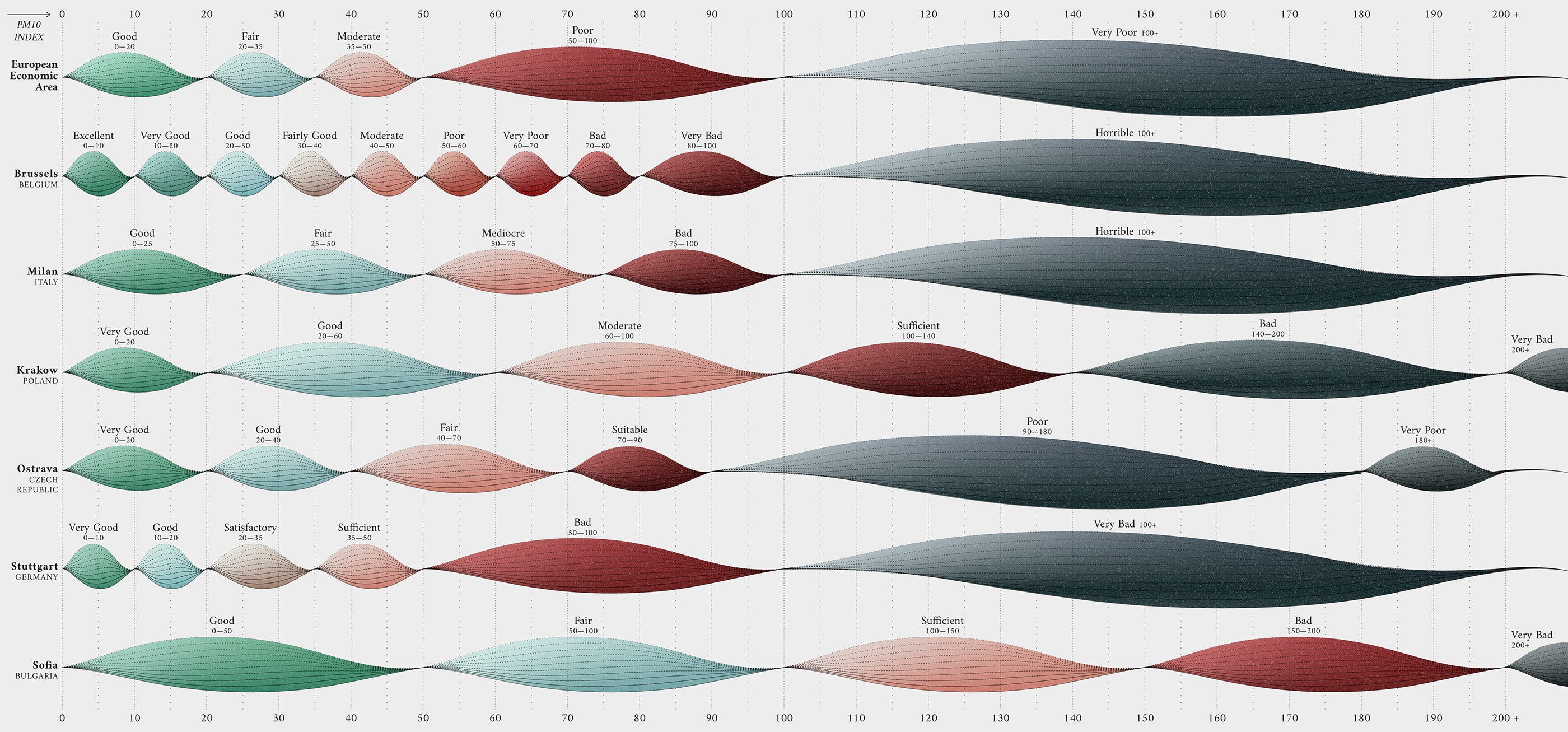

Perhaps a more sophisticated and flexible modern approach to the somewhat blunt notion of minimalism is that of “refinement”. What’s important is editing and, at times, being courageous or restrained about what you should not include or attempt to do. It’s about finding that moment — perhaps only through experience — where something just ‘feels right’. That leads me to one of my favourite German words, fingerspitzengefühl, which means having an intuitive flair or instinct — a ‘finger tip feeling’ where you just know. Moritz Stefaner mentions another key German word for this discussion, “pragnanz”, as meaning “concise and on point, but also memorable and assertive… so, not minimal for minimalism’s sake, but maximally effective with minimal effort”. Refinement is about being decisive. Possessing the clarity of vision and caring for the little details. This conveys to your viewer that your work has been thought-through and thought-about.


Anomaly detection methods unleash microservices performance


Traditional single or simple n-tier applications require platform and performance monitoring, but microservices add several logical layers to the equation. Along with more tiers come the y and z axes of the scale cube, including Kubernetes or another cluster manager for containers; a service layer and associated tools, such as the fabric and API gateways; and data and service partitioning across multiple clients. To detect and analyze performance problems, begin with the basics of problem identification and cause analysis. The techniques described here are relevant to microservices deployments. Each aims to identify and fix the internal source of application problems based on observable behavior. A symptom-manifestation-cause approach involves working back from external signs of poor performance to internal manifestations of a problem to then investigate likely root causes.


Why the founder of Apache is all-in on blockchain

Data container block with hexagons
As a result, "blockchain technology seemed urgent to get involved in [and] that lined up with these idealistic and pragmatic impulses that I've had—and I think other people in open source have had," he adds. Specifically, it was the emergence of a set of use cases beyond programmable money that drew in Behlendorf. "I think the one that pulled me in was land titles and emerging markets," he recalls. It wasn't just about having a distributed database. It was about having a distributed ledger that "actually supported consensus, one that actually had the network enforcing rules about valid transactions versus invalid transactions. One that was programmable, with smart contracts on top. This started to make sense to me, and [it] was something that was appealing to me in a way that financial instruments and proof-of-work was not." Behlendorf makes the point that for blockchain technology to have a purpose, the network has to be decentralized. For example, you probably want "nodes that are being run by different technology partners or … nodes being run by end-user organizations themselves because otherwise, why not just use a central database run by a single vendor or a single technology partner?" he argues.


Quote for the day:


If you can't handle others disapproval, then leadership isn't for you. -- Miles Anthony Smith


Daily Tech Digest - September 14, 2019

Chinese APT Group 'Thrip' Powers Ahead

Chinese APT Group 'Thrip' Powers Ahead
Thrip continues to attack the same types of organizations as when Symantec researchers first discovered the group in June 2018. What caught the researchers' attention last year was the group's targeting of a satellite communications operator, infecting computers that included software designed to monitor and control satellites. ... The 12 attacks that Symantec attributes to Thrip since it was first detected have spanned targets in maritime communications, education and the media in addition to the military and satellite communications, researchers say. "Thrip seems to be leaning, like most other targeted attacking entities, toward usage of clean tools in-built into the operating system," Thakur says. "This is critical for Thrip as their targets over the past couple years have spanned satellite operators, defense contractors and militaries of countries. Maintaining presence on such sensitive networks requires the attackers to avoid reliance on custom, low-prevalence malicious files. In one sense, Thrip has evolved in their tools and procedures over the past year. Their targets continue to remain high-profile by anyone's standards."


Sandboxie becomes freeware, soon-to-be open source

“Sandboxie has never been a significant component of Sophos’ business, and we have been exploring options for its future for a while,” Seth Geftic, the Director of Product Marketing at Sophos, explained. “Frankly, the easiest and least costly decision for Sophos would have been to simply end of life Sandboxie. However, we love the technology too much to see it fade away. More importantly, we love the Sandboxie community too much to do that.” So, they decided to open-source it. They are still working on the details of making the transition but, in the meantime, they decided to make all premium features of Sandboxie free. To that end, they have released v5.31.4 of the software, which does not restrict any features. It can be downloaded here. The software supports Windows 7 through 10, all major browsers, Microsoft’s Office suite, PDF and multimedia files. Versions up to 5.22 support Windows XP.


Google: We've changed search rankings to reward 'original news reporting'


"This means readers interested in the latest news can find the story that started it all, and publishers can benefit from having their original reporting more widely seen," wrote Gingras. However, Google hasn't described how these changes will direct more search traffic to original stories. For example, whether original stories would stay longer in the Top Stories section at the top of search results. Gingras told the New York Times that the changes are intended to serve Google's interest in engaging its users. "We do everything here with Google Search and Google News to continue to earn and retain the trust of our users," he told the publication. The change also comes as 50 US state attorney generals mount an antitrust investigation into the company's advertising business.  For the time being, most publishers will have to just wait and observe how Google's changes impact them, since Google doesn't actually have a clear definition of original reporting when it comes to search rankings. That's somewhat understandable, given that even original stories are often built on top of earlier reports from other publications, while other reports can provide background and context that wasn't included in the breaking story.


Azure Data Lake Analytics and U-SQL

Even though big data and Hadoop technologies are more than a decade old now, big data and big data analytics are more relevant than ever. While the initial version of Hadoop was only able to handle batch workloads, now Hadoop ecosystem has tools for other use cases like structured data, streaming data, event processing, machine learning workloads and graph processing. While Hadoop ecosystem has a bunch of tools like Hive, Impala, Pig, Storm, and Mahout to provide the complete set of features, newer data analytics framework like Spark have an integrated approach to handle different types of workloads. Azure Data Lake Analytics, or ADLA, is one of the newer big data analytics engines. ADLA is Microsoft’s fully managed, on-demand analytics service on Azure cloud. Together with Azure Data Lake Storage and HDInsight, Azure Data Lake Analytics forms the complete cloud hosted data lake and analytics offering from Microsoft. Azure Data Lake Analytics introduces a new big data query and processing language called U-SQL.


The use of AI in robotics and hardware — what CTOs need to know

The use of AI in robotics and hardware: what CTOs need to know image
“In truth, the fears around humans losing their jobs to robots are, for the most part, unfounded. When one thinks about this, for every complex task resolved, there will always be another more difficult one set to appear, so the advancements made in robotics will leave humans free to focus on more pressing and important jobs. This, in turn, will naturally upskill the workforce and ensure it is better equipped to deal with future problems that arise.” While this is true to an extent, it is difficult to imagine a taxi or lorry driver being able to run the software of an autonomous fleet ahead of a wide-eyed tech graduate or tech professional. Where will the automation age leave those whose careers have been forged in manual intensive roles? Organisations will have to invest more time and effort into helping employees develop new skills — they can’t be left behind. “It is an economic shift that has be planned and take action progressively,” Espingardeiro agrees. “Yes, the ethical standards are crucial but most importantly it’s how we shape the foundations and how we put it into practice that will make the real difference.”


Artificial intelligence: The future IT help desk


Today, the average IT support ticket takes three calendar days to resolve. This process is painfully slow largely because it's managed by a long chain of people. Also, employees are very good at describing their problem — whether it's resetting a password, unlocking an account, getting a license for an application, or getting an answer to a simple question — but they don't always know what system to access to resolve the issue. We have IT help desk people that handle this type of diagnosis. But IT teams still spend far too much time working on highly repetitive tasks when they'd rather focus on more strategic parts of the business. ... On the backend, IT support has made some progress. It's at least looking better than it did 10 years ago. But not nearly enough has changed. The reason is that most IT ticketing and portal systems are unable to make the direct connection between what the employee needs and the mechanism to trigger the resolution. Current solutions focus on providing workflows to route and manage ticket queues, leaving the actual work of interpretation and understanding to IT service desk agents. It's also because the systems deployed today don't actually do the work to resolve the issue.


Cognitive computing is a game changer for HR

What can chatbots do for HR? … Free HR professionals’ time so they can focus on more value-added (and potentially meaningful) work by consolidating and simplifying a variety of HR tasks, such as open enrollment, PTO management, scheduling, time entry, and feedback processes. … Ease talent acquisition and lighten the load of recruiters and sourcers by fielding prospect and candidate questions and automating screening and interviewing processes. … Simplify onboarding new hires by guiding them through the necessary admin steps. … Drive a consumer-grade employee experience as part of a self-service digital gateway that gives employees access to all of their HR programs and services, from benefits to learning & development resources to internal mobility options and more. This type of digital workplace tool (Deloitte’s ConnectMe is an example) can also function as a digital assistant to complete requests and transactions, as well as a social platform for connecting with co-workers.


Why The Cybersecurity Skills Gap Won't Be Solved In The Classroom

uncaptioned
The world is desperate for cybersecurity talent, yet the sector limits entrants and clings to obsolete training methods. As the skills gap grows and organizations become increasingly vulnerable to ever-more complex threats, the need for a diverse pool of cybersecurity experts to learn in real time, rather than a classroom, strengthens. The way that cyber talent is taught – at university and during training – is no match for the evolving threat landscape. Static measurements of skills, such as certification and periodic training, cannot keep pace with new threats that even the savviest security teams are unfamiliar with. The barrage of 24-hour threat intelligence is increasingly disconnected from the skills of these security teams, meaning badly trained defenders are simplifying attackers’ jobs. In my time at GCHQ I learnt that the best cyber talent is creative and curious; they develop by breaking things and thinking on their feet, not sitting in classrooms and learning passively. Unfortunately, this jars with traditional training methods, which is one of the factors contributing to an unnecessary talent drain.


The True Cost of Data


Marketers are mesmerised by its potential and with no obvious limit to the number of data points you can collect on target customers for the purposes of advertising or sales conversion, it’s easy to see why. Data has always been useful, but in an analogue world it was expensive to gather. In a digital world, it is infinitely easier to collect, combine and then mine with AI. Google, Facebook and other social companies have become a dominant oligopoly by collecting data-by-stealth and thereby controlling global advertising and more with their data-based business model. The advent of GDPR has brought this oligopoly under a spotlight, but other organisations who have shared BigTech’s addiction to customer data are finding it a tough habit to control. This is particularly true for brands that have relied on collecting customer data to build profiles to personalise customer experiences, such as those in retail or the travel sector. Recent high profile fines however are a stark reminder that addictions come with risks attached. Google itself was the first to come under fire when they were fined EUROS 50 million by France’s data protection supervisory authority – CNIL – for lack of transparency, inadequate information, and lack of valid consent regarding personalisation of ads.


Cyber-Intelligence Firm NSO Group Tries to Boost Reputation

NSO's critics say the company still has a lot of work to do to clean up its reputation. Siena Anstis, a senior legal adviser with Citizen Lab, took to Twitter to call out several problems that NSO still has, including a lack of disclosure over who buys the company's tools and whether governments that use NSO's service have a history of human rights abuses."Citizen Labs and Amnesty [International] research shows spyware is abused and deployed against human rights defenders, civil society and journalists. NSO Group has made no commitment to refusing to sell to states with records of such abuses," Anstis wrote on Twitter. ... "While on the surface it appears a step forward, NSO has a track record of refusing to take responsibility," Ingleton says. "The firm has sold invasive digital surveillance to governments who have used these products to track, intimidate and silence activists, journalists and critics." NSO did not respond to a request for comment.


Quote for the day:


"People seldom improve when they have no other model but themselves." -- Oliver Goldsmith


Daily Tech Digest - September 13, 2019

How 6G will work: Terahertz-to-fiber conversion

How 6G will work: Terahertz-to-fiber conversion
Upcoming 6G wireless, superseding 5G and arriving possibly by 2030, is envisaged to function at hundreds of gigabits per second. Slowly, the technical advances needed are being made. A hole in the tech development thus far has been at the interface between terahertz spectrum and hard, optical transmission lines. How does one connect terahertz (THz), which is basically through-the-air spectrum found between microwave and infrared, to the transmission lines that will be needed for the longer-distance data sends? The curvature of the Earth, for one thing, limits line of sight, so hard-wiring is necessary for distances. Short distances, too, can be impeded by environmental obstructions: blocking by objects, even rain or fog, becomes more apparent the higher in spectrum one goes, as wavelengths get shorter. ... The fiber-terahertz connection in 6G, though, isn’t the only area that must be addressed over the next few years. Spatial multiplexing also needs to be mastered at terahertz to get the kinds of throughputs desired, experts say. Spatial multiplexing is where individual data signals are beamed out in streams. Every bit of the bandwidth thus gets used and reused continually, introducing bandwidth efficiency.


Ultimate Guide to Become a REAL Programmer

As a beginner, mostly you are a learner in addition to the developer. In programming, your learning will never end. But as a junior, you will have to learn even more. Learning and impostor syndrome are closely related and one of the reason is that learning is a sole journey. People around could guide you but in the end, it is you who has to go through the fire. This sole journey amplifies the negative feelings and developers get demotivated and think of themselves as incompetent. Beware it is impostor syndrome. ... It is very difficult to keep yourself motivated. You may feel motivated by reading about a top performer having impostor syndrome but it will not last. I have created a tool of motivation that you can use it to keep your motivation up on-demand. I created it by documenting my progress. I use my journal to document my progress. Here is the step-by-step guide to documenting your progress. At the end of the quarter and year, I review my past progress with the help of my journal. I always get amazed by looking at the projects I have completed.


Microsoft's October 2 event will be about more than just new Surface devices


There's some speculation as to whether Microsoft also could introduce a new Surface-branded portable speaker at the event. It seems as if this device would be more business-focused and built around Microsoft's Teams group-chat service based on some hints in a recent patent filing. As one of my readers speculated, maybe such a device also could be used with "Teams for Life," an as-yet-unannounced (but expected) version of Teams that Microsoft could offer for families. I'd think if and when Teams for Life becomes available, it could be a cornerstone for Microsoft's expected Microsoft 365 Consumer subscription bundle. The biggest question in the minds of many of us Microsoft watchers is what, if anything, Microsoft will say about its still unofficially acknowledged "Windows Lite" OS, which is expected to be a ChromeOS competitor. Microsoft has been building a dual-screen PC, codenamed "Centaurus," which could be one of a number of different Microsoft and third-party devices to run Lite OS. Microsoft recently showed off advanced renders of Centaurus at an internal meeting, but my contacts say the device is still quite a way from being commercialized.


Organizations And Customers Opting For Passwordless Future: Study

Organizations and customers opting for passwordless future: Study - CIO&Leader
A dangerous side-effect of password forgetfulness is the use of easily guessable (AKA hackable) passwords. A weak password not only puts consumer data at risk—it puts the companies that hold this data at risk, too. Some extra authentication methods may include a notification email sent to the user or administrator. Here are some ways they do this ... CIAM software allows you to connect your app or website to a 3rd party provider that your customer uses. This way, your customers can sign in to your app or website using their existing credentials instead of creating a new password. Ex: Sign In with Apple. Therefore, anyone who uses Apple will never have to remember a password when connecting to integrated 3rd-party apps. In addition, users can hide their emails, allowing for greater privacy and security. A common example of BYOI is social login, where a customer may use Facebook or other social platforms to access a website or app ... Instead of asking people what they know (passwords), many enterprises are using authentication methods based on what people have—their smartphones. The common term for this is SMS-based authentication.


IoT will dominate Bluetooth market in 2024

wearable.jpg
Both Wi-Fi and Bluetooth will still rely on smartphones for the majority of its business, but in five years ABI reported that smartphones will represent less that 30% of the market. "Bluetooth will continue to grow in other areas, such as speakers, headsets, mobile, and PC accessories, and both technologies will continue to push into other consumer electronics devices such as connected toys and home entertainment. However, IoT is beginning to take an increasingly significant share of the market," said Andrew Zignani, principal analyst for ABI. The study laid out a number of different sectors that will begin to take larger shares of the Bluetooth and Wi-Fi markets as we move into the 2020s. ABI predicts that asset management, and device location tools will grow to become 8.5% of the Bluetooth market by 2024. These kinds of devices are mainly beacons or trackers, which will become more prevalent as factories turn more to robotic equipment. Smartwatches, activity trackers, and smart clothing will also drive sections of the Bluetooth market, with ABI predicting that there will be at least 400 million Bluetooth-enabled wearable devices by 2024. 


Secret CSO: Ryan Weeks, Datto

Secret CSO: Ryan Weeks, Datto
The shortfall of qualified InfoSec candidates is a real problem. If I can work closely with my team and those in supporting functions to expand their potential and grow their capability then that pays dividends for the cybersecurity programme and ultimately keeping data and systems safe from intrusion. ... I find qualified Intrusion Analysts and Experienced Penetration Testers to be difficult roles to fill, taking on average six months to find a suitable fit. I have built relationships with universities that have cybersecurity programmes and find that building a pipeline of talent from universities through mentoring, internships, ... In cybersecurity you can never stop learning. We have to stay aware of the latest trends and attacker tactics. I find podcasts, news articles, on-the-job experience, career development events, and peer groups to be a large source of continuous learning. ... Managing people is ‘real' work. A friend, who knew my propensity for individual contribution, challenged me with this statement and it helped me to focus on growing those around me as much as achieving outcomes independently. It gave me perspective that created balance at a key time in my career.


Top 3 Misconceptions About SD-WAN

istock 482453586
While you may find some areas where you can replace MPLS with a less costly service, there’s no guarantee that operational costs will be reduced with SD-WAN, especially if you add additional connections to some or all sites. “We don’t see spend immediately go down with SD-WAN. Rather, it stays the same or maybe increases,” because companies add services, Lawson says. “But it does provide more efficient bandwidth utilization and is a more efficient way to grow your network.”  Zeus Kerravala, founder and principal analyst with ZK Research, agrees. “If the business ditches its MPLS and replaces it with broadband, then the transport costs will certainly drop. In most of the implementations I have seen, though, the company keeps the MPLS and buys broadband to augment that network, which results in a net higher cost,” he writes in Network World. You may see reduced capital costs, however, since SD-WAN doesn’t require routers or switches; it’s delivered via an appliance or even as a virtual service.


Researchers invent cryptocurrency wallet that eliminates ‘entire classes’ of vulnerabilities


What makes Notary different is a set of hardware fail-safes designed to mitigate successful cyberattacks. Known as "reset-based switching," the wallet will reset the CPU, memory, and other hardware components when a user switches between one app to another. "The goal of this approach is for applications to be more strongly isolated from one another so that the security of apps in the wallet is not threatened if a single app is hacked or has a vulnerability," MIT says.  Reset-based switching is intended to remove the threat of vulnerability classes by changing the infrastructure of a device to act as a multiple computer system. Notary runs management code on one system and applications on another -- and so when task-switching occurs, the management console resets the application computer fully before booting up another app.  By using physically separate systems-on-a-chip, this could nullify threats such as Rowhammer. The research team says that due to reset-switching, memory errors -- especially those involving vulnerable memory protection units able to break app isolation, can be avoided. MPUs in themselves are not used, in favor of physically separate domains and resets.


Government Agencies Field More Cybersecurity Maturity Models 


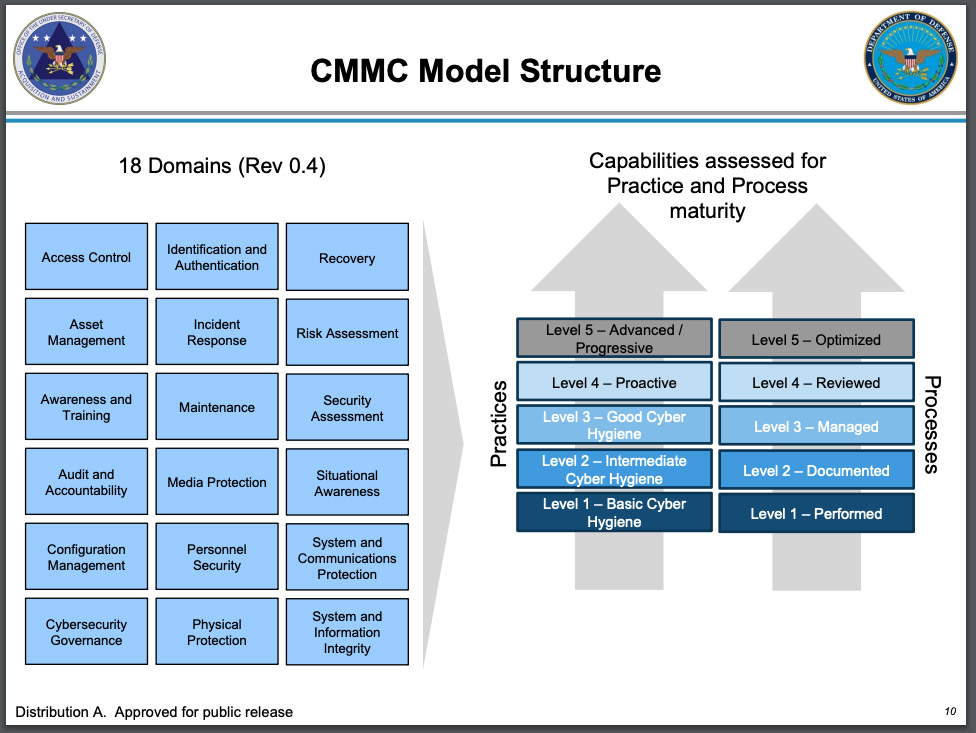
As defined by DOE, "a maturity model is a set of characteristics, attributes, indicators, or patterns that represent capability and progression in a particular discipline," so organizations can identify their maturity level and then next steps for improvement. "Model content typically exemplifies best practices and may incorporate standards or other codes of practice of the discipline." ... Caltagirone at Dragos says the release of C2M2 and upcoming CMMC point to increasing cybersecurity maturity across multiple sectors and the importance of better sector-specific guidance. "Cybersecurity, and cybersecurity in critical infrastructure, is such a new domain that the proliferation of models and frameworks such as C2M2 is expected, and welcomed," he says. "It seems as if new models are created every day, and they are, but that is a sign of progress - that we recognize deficiency and work to improve it. The industry should have as many descriptive and supportive models as possible as none are perfect, but we should strive for few prescriptive models. ... "


Best Practices for Event-Driven Microservice Architecture

Of course, event-driven architectures have drawbacks as well. They are easy to over-engineer by separating concerns that might be simpler when closely coupled; they can require significant upfront investment; and often result in additional complexity in infrastructure, service contracts or schemas, polyglot build systems, and dependency graphs. Perhaps the most significant drawback and the challenge is data and transaction management. Because of their asynchronous nature, event-driven models must carefully handle inconsistent data between services, incompatible versions, watch for duplicate events, and typically do not support ACID transactions, instead of supporting eventual consistency which can be more difficult to track or debug. Even with these drawbacks, an event-driven architecture is usually the better choice for enterprise-level microservice systems. The pros—scalable, loosely coupled, dev-ops friendly design—outweigh the cons.


Quote for the day:


"Trust is the lubrication that makes it possible for organizations to work." -- Warren G. Bennis


Daily Tech Digest - September 12, 2019

Developing your AI skills: what AI courses are available?

Developing your AI skills: what AI courses are available? image
According to Kumar, the variety AI courses leads to lots of debate around who should take responsibility for ensuring workers have the right AI skills. He asks, “is it enterprises, institutions, governments or individuals? “While everyone should take their share of responsibility, in the short term, it is essential for enterprises to create internal opportunities for their current employees to upskill. Only by training their current workforce to be AI-ready, can businesses truly take the technology to the next level.” As the technology moves across the hype cycle, AI is scaling and becoming more pervasive in the enterprise. Use cases are emerging and organisations are realising the benefits that can be extracted from AI “and are looking to undertake business-wide initiatives around it,” continues Kumar. “We are also seeing greater depth and complexity when it comes to AI projects themselves since organisations now have a better understanding of it and have defined specific use cases — and are more realistic about budget provisions. As a result, AI is finding use across more technologies and industries than ever before.


IT budgets: If money was no object, how would you spend it?

Roberts says that effort requires significant coordination. The current target in Leeds is to get 8,000 people a year who are digitally excluded and make them digitally included. Roberts says he only has four co-ordinators at the moment, but his team also works with 70-plus third-party organisations. These specialist partners help people – such as the elderly – to get online and to do the things they want to do. "We believe everyone can get involved through that locality-based ecosystem – all we are is the convenors," says Roberts. "But if we could give grants to train people on technology, then I think that change could make a massive difference. People might talk about spending £3,000-plus on something like HoloLens, but just think about how you could use that money to empower the people who deliver digital inclusion." ... Foote says the team's business model relies on outsourcing as much non-core expertise as possible. Technology partnerships can play a key role in F1 – and Haas F1 uses trusted providers to help the team achieve its aims.  "If money was no object, I'd use the cash to both seek out new technology and then to use it to ultimately create benefits for the team," he says.


Mirai descendants dominate IoT threat environment


F-Secure said its honeypot network recorded 12 times more attack events during the first six months of this year than in the first half of 2018, with the increase driven by traffic targeting the IoT Telnet (760 million attack events) and UPnP (611 million) protocols, with most coming from devices infected with Mirai. Meanwhile, the SMB protocol, which is more commonly used by the Eternal exploit family – first used during the 2017 WannaCry outbreak – to spread ransomware and trojans, was behind 556 million events. According to F-Secure, a recent development has been new variants of Mirai that are engineered to infect enterprise IoT devices, such as digital signage screens or wireless presentation systems. This is a source of concern because it allows attackers access to higher-bandwidth internet connections, which means the scale of any resulting DDoS attacks is potentially much higher.


Here's How IoT and AI are Set to Revolutionize the Way We Live and Work

Smart Living: Here's How IoT and AI are Set to Revolutionize the Way We Live and Work
Households today have situations where both spouses are working or are often out of the home, while having kids and elders at home. So safety and security is starting to be an important and basic driver of Smart Living as a means to be warned when things are happening at home or to be able to quickly seek help. Intrusion sensors, Panic buttons, Laser perimeters and more are available through the use of IoT technology to alert the authorities. IP Cameras with AI technologies such as image recognition and interpretation allow for identification of dangerous situations without needing a human being to constantly monitor video feeds. For certain aspects like fire safety in many of these high-rises, there is an increasing concern that unless Smart Living features like smoke or fire sensors detect the safety event early, it may be challenging in many of high rises to control a fire event or even depend on fire engines trying to make their way through impossible traffic. In addition to these from the comfort and convenience perspective, Smart Living can provide many advantages through thermostats, video door bells, air conditioners, motorized curtains and blinds, microwaves, washing machines, coffee makers and more. 


The true cost of network performance issues for your business


Network brownouts are unanticipated and unplanned drops in network quality, which could cost organizations more money than expected, according to a recent survey from Netrounds, a network monitoring software provider based in Sweden. The survey examined common network performance issues organizations face -- network brownouts, in particular -- and the extent of a brownout's potential damage. Netrounds surveyed 400 respondents across the U.S. from companies with over 1,000 employees. Overall, respondents claimed that IT teams didn't notice over 60% of network brownouts, as some alarm systems often didn't detect these network performance issues. This means customers and employees discovered over 40% of brownouts, the survey said, while 14% went unreported. Although 90% of respondents said their network is critical to business operations, network brownouts remain a persistently silent but detrimental foe.


Why saying "yes" to no-meeting days increases productivity

The idea for no meeting days isn't necessarily new, but the issue begins when there's lack of enforcement. It's up to the managers to weave this mindset into the team's culture and lead by example to set the tone. If a meeting is scheduled on a designated no-meeting day, encourage the team to move it or decline it.  I also encourage team members to challenge meetings booked on designated no-meeting days by asking the organizer if the meeting can be moved or if your presence is required. If there's pushback, this is where management comes in.  CTOs and team leaders need to advocate for employees within the company too. It's important to reiterate the benefits at all-hands or staff meetings to ensure employees are well-versed in the benefits and understand why the rule is in place. Lastly, managers should remember to stay flexible and remain open to new ways to the rule can fit into a team's structure and schedule. The more you allow others to be involved in the rule, the more likely they'll stick to it.


Ransomware attacks: Weak passwords are now your biggest risk


"Plain and simply, brute-force attacks are the primary choice for hackers because it works, we're seeing that there are an abundance of accounts that have way too many insecure and weak passwords – making it too easy for hackers to bypass them," Jarno Niemela, principal researcher at F-Secure, told ZDNet. Remote Desktop Protocol (RDP) attacks can also be conducted in this way, with attackers attempting to guess passwords in order to remotely gain control of internet-facing endpoints. It's also possible for hackers to use underground forums to buy the usernames and passwords required to attack previously compromised endpoints. But despite the rise in brute force attacks, spam and phishing remains a highly common attack vector for ransomware: almost a quarter of the ransomware attacks targeting F-Secure honeypots looked to deliver ransomware via email. All it can take for an attack to potentially compromise an entire network is for one user to download a malicious attachment – especially if the network is running unpatched software or doesn't have anti-virus. GandCrab ransomware was commonly distributed by email during the first half of this year.


UN agency Unicef praised for response to accidental data leak


Sam Curry, chief security officer at Cybereason, said the organisation had taken appropriate steps to limit any damage caused. “Kudos to Unicef officials for leaning in and taking steps to limit the damage. The problem is that the word ‘breach’ has a Pavlovian response in the media. We have been trained to treat all breaches the same, and they aren’t. So Unicef is leaning in, taking it seriously, apologising and fixing it,” he said. Curry pointed out that there was a world of difference between hacks targeting confidential data, such as credit card numbers, that they know how to monetise, and an accidental leak. “Just because it’s sensitive and could be very bad doesn’t mean Snidely Whiplash is waiting behind the dumpster and making a run on liquidating the data. It’s sensitive also because it’s children, it’s a not for profit and we never want to think it’s okay to lose data in any way, but there remain degrees of breach and degrees of impact nonetheless.”


To secure industrial IoT, use segmentation instead of firewalls

To secure industrial IoT, use segmentation instead of firewalls
With IIoT, connections can be much more dynamic and traffic can flow between devices in an “east-west” pattern, bypassing where the firewalls are located. That means security teams would need to deploy an internal firewall at every possible IIoT connection point and then manage the policies and configurations across hundreds, possibly thousands of firewalls, creating an almost unmanageable situation. To get a better understanding of the magnitude of this problem, I talked with Jeff Hussey, president and CEO of Tempered Networks, which specializes in IIoT security solutions, and he told me about one of the company’s customers that explored using internal firewalls. After doing an extensive evaluation of where all the internal firewalls would need to go, the business estimated that the total cost of firewalls would be about $100 million. Even if a business could afford that, there’s another layer of challenges associated with the operational side. Hussey then told me about a healthcare customer that’s trying to use a combination of firewall rules, ACL, VLANs, and VPNs to secure their environment, but, as he put it, “the complexity was killing them” and makes it impossible to get anything done because of the operational overhead.


Evolving Role of Artificial Intelligence (AI) in Transforming Talent Acquisition

The core benefits that enterprises implementing AI are seeking are around cost-reduction, enhanced efficiency and actionable insights. While these are significant benefits, enterprises are looking at them in silos. This limits the potential impact of AI, which can be huge, if implemented holistically across the recruitment value chain through a well thought out strategic plan. Enterprises need to look at the potential of AI through two key lenses – what can be achieved with the current maturity of AI technology in the near term and the expectations from AI in the long term as the technology matures and buyers become more comfortable with the concept and use of AI in their recruitment processes. In the first scenario, with the current maturity of AI and other digital technologies, there is potential to digitalize close to 50% of all talent acquisition processes that are currently performed manually. The exhibit below shows the extent of digitalization in high potential processes that can be achieved, from the existing state, by leveraging AI in combination with other digital technologies.


Quote for the day:


The very essence of leadership is that you have to have vision. You can't blow an uncertain trumpet. -- Theodore M. Hesburgh


Daily Tech Digest - September 11, 2019

Is Java the next COBOL?

Is Java the next COBOL?
Java, like COBOL, is relatively easy to read and write. Also like COBOL, Java has maintained its modernity. Every time Java looked like it was fading, something has perked it up. According to Brian Leroux, Android is definitely partially responsible for [Java’s] continued relevance.” A bit later, big data revived Java further. As Nitin Borwankar has highlighted, “Java received [a] second wind due to Hadoop and the whole data science ecosystem including Hive, HBase, Spark, Cassandra, Kafka, and JVM languages such as Groovy and Clojure. All of that is not going away anytime soon.” Indeed, as with COBOL, one of the primary reasons we’re likely to see Java etched on our headstones is because, as Jonathan Eunice writes, it’s “deployed deeply and widely in critical apps, making it worthy of systematic critique.” The more enterprises embed Java into their most mission-critical apps, the less likely it is to be ripped and replaced for modern alternatives. The cost and risk mitigate against doing so. In like manner, Python may well prove its staying power. To Lauren Cooney’s mind, Python will endure because it’s a “GSD [get stuff done] language vs. a cool language.”


Next-Generation Smart Environments: From System of Systems to Data Ecosystems

As the IoT is enabling the deployment of lower-cost sensors, we are seeing broader adoption of intelligent systems and gaining more visibility (and data) into smart environments. Not only are smart environments generating more data, but they are also producing different types of data with an increase in the number of multimedia devices deployed such as vehicle and traffic cameras. The emergence of the Internet of Multimedia Things (IoMT) is resulting in large quantities of high-volume and high-velocity multimedia event streams that need to be processed. The result is a data-rich ecosystem of structured and unstructured data (i.e., images, video, audio, and even text) detailing the smart environment that can be exploited by data-driven techniques. The increased availability of data has opened the door to the use of the data-driven probabilistic models, and their use within smart environments is becoming increasingly commonplace for “good enough” scenarios


Define a continuous improvement process with EA models, practices


One school of thought says that continuous improvement should exist as a new mission for existing EA approaches, not a stand-alone process with tools and software. Continuous improvement simply formalizes how process feedback, a staple of EA-driven businesses, drives change to business processes. In this approach, the organization relies on enterprise architects' well-established integration with software selection and development, so there is no need for new software quality tasks or tools to build out a continuous improvement process. Continuous improvement, at most, might reveal a lack of organization in the way the organization manages feedback. EA teams shouldn't need much additional help from software or changed practices to make continuous improvement work. In a second school of thought, traditional EA work establishes a business process baseline. Once there's a baseline, the continuous improvement process helps keep it aligned with business efficiency and opportunity signals.


Catches of the month: Phishing scams for September 2019

Utility providers were caught out by a rudimentary phishing scam involving a shoe retailer and a former member of the pop group McFly. The scam email is short, with someone called ‘Adam’ providing a PDF attachment containing remittance advice. This is despite the fact that the email comes from Friary Shoes. ... Once users click the attachment, it unleashes Adwind, a type of spyware that: Takes screenshots; Harvests credentials from Chrome, Internet Explorer and Microsoft Edge; Records video and audio; Takes photos; Steals files; Performs keylogging; Reads emails; and Steals VPN certificates. Experts found that Adwind was available as Spyware as a Service, meaning anyone willing to pay for it could use the malware to target organisations. ... the common denominator is your staff. They are the ones who are targeted, and once they open a phishing email, the only thing preventing a data breach is their ability to spot that it’s a scam. Fortunately, there are always clues that reveal the true nature of malicious emails, and our Phishing Staff Awareness E-Learning Course teaches you how to spot them.


The growth economics of artificial intelligence

artificial intelligence, economics of artificial intelligence, AI driven economy, MSME, start-ups, global GDP, Indian economy, information technology services
As the entire world is looking forward to harness the potential of AI for the growth of the industry and for the betterment of society, India has already taken steps to leverage the potential of AI in all walks of life. To foster AI-led growth across all the sections of the society, the government is taking steps to promote Indian tech talent and skills to achieve national goals. With a unique vision of “AI for All”, India can enhance and empower human capabilities to address the challenges of accessibility, affordability and quality of skilled expertise, which, in turn, can help develop scalable solutions for emerging technologies by leveraging collaborations and partnerships among various stakeholders including industry, industry associations, academia, and state and central governments. Besides collaborations, this segment requires a lot of incentivisation and funding support from various stakeholders. As this technology requires massive R&D and innovation, and a highly-skilled manpower for the creation of world-class products, hence sufficient funding is necessary to exploit this technology to its fullest extent.


Data Fabric: Pulling the Covers off the Hype for Business Value

Data Fabric, Business Value
The rate of technological advancement — especially in the data management space — has been astronomical over the last five years. Enterprises find themselves in transit between legacy physical servers and cloud storage, all while streaming data in real-time from various sources in a wide array of formats and file types. These changes provide many unique challenges that can be difficult to navigate without the right data platform. This constant state of flux is the new normal, as technological advancements show no signs of slowing down. Enterprises need to not only adjust to the current evolving data ecosystem but future proof for what tomorrow will bring. At the core of all of this has to be a strong foundation for building around, and adapting to various technologies, architectures, and frameworks. That’s where the idea of constructing a data fabric comes into play. Thinking about interconnectivity, ease of access, clean reliable data and data governance, it cannot be an afterthought. Companies that try to implement a patchwork approach will find themselves unable to adapt, adding new layers of complexity to their data ecosystem each time a new piece of technology is introduced.


Intel Joins Industry Consortium to Accelerate Confidential Computing

consortium 2x1
Confidential computing may take multiple forms, but early use cases rely on trusted execution environments (TEE), also called trusted enclaves, where data and operations are isolated and protected from any other software, including the operating system and cloud service stack. Combined with encrypted data storage and transmission methods, TEEs can create an end-to-end protection architecture for your most sensitive data. Enterprises and cloud service providers can apply confidential computing to a wide range of workloads. The most popular of the early use cases use the trusted enclave for key protection and crypto-operations. But trusted enclaves can be used to protect any type of highly sensitive information. For example, healthcare analytics can be performed so that the enclave protects any data that may contain personally identifiable information, thus keeping results anonymous. Companies that wish to run their applications in the public cloud but don’t want their most valuable software IP visible to other software or the cloud provider can run their proprietary algorithms inside an enclave.


DevOps-as-a-Service: Overcoming Challenges in Large Organizations

Government building
People naturally hate change. It is a law of nature. You can't change that, but you can show people the value of the change so the desire to change overcomes natural resistance. Changing culture can be especially challenging, but it has to be done to properly implement a DevOps culture. As the famed business strategist Peter Drucker said, "Culture eats strategy for breakfast." ... The Authority-to-Operate (ATO) is a specific term for the U.S. government, but the concept can be found across organizations. In essence, security needs to approve an application, or even a subset of a larger application, to operate on the system. ... Janek and Svetlana are implementing DevOp-as-a-Service to solve the aforementioned challenges. It involves a team and a platform with the goal to continuously increase the number and scale of self-service capabilities. Svetlana dove into some specifics of the platform, Monarch, during the presentation. Monarch is a platform that GDIT created for their government client. It is a self-service platform that development teams can use to build Docker containers and deploy them into AWS Elastic Container Service.


What is fileless malware and how do you protect against it?

fileless-taxonomy.jpg
Fileless techniques can be extremely advanced, and they are harder for traditional antivirus software to detect. But not every advanced malware attack is fileless and throwing the term around doesn't help organisations defend against it, Tanmay Ganacharya told TechRepublic. Ganacharya runs the Microsoft Defender threat research team, which analyses new threats and builds models to detect them. "Fileless is such an overused term, and it has gone from the truly fileless threats, to now people wanting to call almost everything that is even slightly advanced fileless and making it slightly buzzwordy," he says. To demystify the term, the threat research team started categorising fileless attacks based on how they get onto a PC and where they're hosted. There are more than a dozen combinations of those 'entry points' and malware hosts being used for fileless attacks — some of which are very sophisticated and are rarely used for targeted attacks, and some of which have been commoditised and are showing up more often for common attacks like trying to run a coin miner on your system. But they fall into three broad groups.


Penetration Testing in the IoT Age

Because IoT objects can lack comprehensive input validation mechanisms, extending the coverage of test payloads is desirable. A widely used method, fuzz testing, employs randomly generated payloads, but this is ine cient due to resources wasted on meaningless inputs. An alternative is to exhaustively or randomly generate syntax-correct inputs. This method provides better test coverage but is still inefficient, as the space of syntaxcorrect inputs is usually large. Intelligently mutating known payloads is a compromise between manual testing and exhaustive/random testing. Combining existing evasion techniques provides greater ability to circumvent validation mechanisms. In this case, conflicting or overlapping techniques should be manipulated carefully to prune unnecessary test cases. On the other hand, converting payloads to syntactically or semantically equivalent payloads is worthy of further investigation. Syntactic mutation generates payloads with slight changes at the syntax level.


Quote for the day:


"Brilliant strategy is the best route to desirable ends with available means." - Max McKeown

Daily Tech Digest - September 06, 2019

It's time for cloud management with automated fixes

It's time for cloud management with automated fixes
What I’m seeing now is a clear demand: a demand that those charged with managing clouds be given the tools not only to find issues with applications, databases, and other cloud-based production processing, but also to automate most simple fixes without bothering humans.This is a mandate for a few core reasons: First, putting humans in the process means that responses will be inconsistent. Different humans will be charged with fixing problems at different times and will do so in different ways. In some cases they won’t get fixed in a timely manner, considering that humans sleep through the phone ringing or find other ways to ignore issues with their applications deployed on the public cloud. Second, we now have automation capabilities that can do some pretty remarkable things. With machine learning we can not only automate some fixes, but do experienced learning as things are being fixed. For instance, once you find out that the database should be reset before the middleware server on your public cloud provider, you can store that knowledge for later. I’ve built nothing but management with automated fix or self-healing capabilities. Why? People need their sleep, and outages get fixed so fast most never even knew they happened. Sound better?


Listen and learn about QA automation, built-in quality

It's more about: How do you get more effective in terms of transformation? Or how do you get more effective in terms of software development delivery? Because there's no shortage of good ideas. There's just really a shortage of people being able to get things done fast enough, quick enough, efficiently enough for the dollars they have, and a lot of organizations struggle with that. There's a lot of different ideas out there from the Agile community, the DevOps community. They say, 'Do these practices, and you'll get better.' What I found is that I'm in a somewhat unique industry in that I'm a thought leader, but also, when I work with organizations, I don't work with them unless I can stay with them through the journey and help coach them along the way. That gives me a couple of advantages. One is I don't know exactly what to tell them up until they start running into problems. Two is that I get to learn from them along that journey. So, I get to see what's working and what's not working.


COBOL turns 60: Why it will outlive us all

dw-82pfuqaamzno.jpg
"While market sizing is difficult to specify with any accuracy, we do know the number of organizations running COBOL systems today is in the tens of thousands. It is impossible to estimate the tens of millions of end users who interface with COBOL-based applications on a daily basis, but the language's reliance is clearly seen with its use in 70 percent of global transaction processing systems." What does that mean? Britton explained: "Any time you phone a call center, any time you transfer money, or check your account, or pay a mortgage, or renew or get an insurance quote, or when contacting a government department, or shipping a parcel, or ordering some flowers, or buying something online at a whole range of retailers, or booking a vacation, or a flight, or trading stocks, or even checking your favorite baseball team's seasonal statistics, you are interacting with COBOL." That's because the largest number of businesses using COBOL are financial institutions. This includes "banking, insurance and wealth management/equities trading. Second is government services (federal, provincial, local)."


Police use of controversial facial recognition technology deemed lawful


According to Liberty lawyer Megan Goulding: “This disappointing judgment does not reflect the very serious threat that facial recognition poses to our rights and freedoms. “Facial recognition is a highly intrusive surveillance technology that allows the police to monitor and track us all. It is time that the government recognised the danger this dystopian technology presents to our democratic values and banned its use.” Despite their ruling, the judges said “the future development of AFR technology is likely to require periodic re-evaluation of the sufficiency of the legal regime,” leaving the door open for further conflict over use of the technology. “I recognise that the use of AI and face-matching technologies around the world is of great interest and, at times, concern,” said South Wales chief constable Matt Jukes. “I’m pleased that the court has recognised the responsibility that South Wales Police has shown in our programme. With the benefit of this judgment, we will continue to explore how to ensure the ongoing fairness and transparency of our approach.”


Why Red Hat sees Knative as the answer to Kubernetes orchestration


Knative allows organizations to run their own serverless architecture on their own servers—in practice, this is more normal than it sounds. "There are many, many reasons… the most common one we hear from our customers is around security," William Markito Oliveira, senior manager of product management at Red Hat, told TechRepublic. "Financial institutions, healthcare, they would prefer to [be] running on their own data centers, or they can't move all the data that they have to the cloud." "The other is around portability, and the vendor lock-in story, where they want to do serverless but on their own terms," Oliveira continued. "They want to be able to run the same kind of workload… without having to rewrite all their applications for that specific implementation of serverless." "One of the key benefits that you get out of Kubernetes," according to Oliveira, is consistency. "For every Kubernetes cluster, that application is going to behave exactly the same way regardless of which Kubernetes distribution you are using, or regardless of where that particular Kubernetes [cluster] is running. [Moving] from Cloud provider A to Cloud provider B, there is always some rework that you have to do at the application level."


Data Analytics in the World of Agility

A learning process is required in order to expand on different points of view when observing a customer, and this is already being introduced in the education sector; at Deusto Business School within the Master in Business Innovation (MBI) for example, 15 students travel every year to Florence in order to learn from artistic work. You do learn in a very different way listening to the voice of Lorenzo de Medici (1449-1492). It is not a data-driven, but a data-inspired industry that we are heading for today, brought together with a wide variety of perspectives, if we want to see our customer as a human being and not just a consumer of mass-production. What we need is a healthy mix of big-data analysis, ethnographical research, anthropological views, and continuous education to expand the vision on our business! The digital industry has learned this lesson, and you can already find ethnographic observation in many sectors, which is near to becoming a market standard already.


Why hybrid blockchains will dominate ecommerce

IBM blockchain Walmart
"There are two different worlds. You have business-to-business [B2B] transactions and business-to-consumer [B2C] transactions. If you look at B2C, many times people will substitute convenience for privacy," Woods said. "This is one of the big issues we have in today's world, where all these tech giants are out there in social media and consumers will say, 'I'll give my personal information away to Facebook, Google, Apple or Amazon and they'll give me services in return.'" Much in the same way IT shops control which employees can access sensitive information within a business through rights management and permissions, businesses want to segregate information they may not want rivals to see. In the B2B world, where privacy and confidentiality are prized over convenience, companies don't do business with partners they don't know – hence a permissioned blockchain. "So, if you look at the B2B environment for blockchain, it pretty much looks the same way. You need to be permissioned and everyone needs to know everyone else," Woods said. "All companies go through know-your-customer and anti-money laundering processes to ensure all players are who they say they are. Businesses do business based on trust."


HPE's vision for the intelligent edge

The challenge is how to inject automation into areas such as data centers, IoT and granting network access to endpoints. In the past, automation and manageability were afterthoughts, he said. “The wired network world never really enabled native management monitoring and automation from the get-go.” Melkote said HPE is changing that world with its next generation of switches and apps, starting with a switching line the company introduced a little over a year ago, the Core Switch 8400 series, which puts the the ability to monitor, manage and automate right at the heart of the network itself, he said. In addition to providing the network fabric, it also provides deep visibility, deep penetrability and deep automation capabilities. "That is where we see the wide network foundation evolving," he said. In the wireless world, speeds and capacity have also increased over time, but there remains the need to improve network efficiency for high-density deployments, Melkote said.


First long-distance heart surgery performed via robot

corindus.jpg
During the remote procedures, Dr. Patel used Corindus' CorPath GRX robot and a hardwired internet connection, manipulating the robot with a set of joysticks and a video monitor. Corindus has performed several remote test cases in the U.S. since, but Dr. Patel's procedure marked a major milestone in medicine. "Remote procedures have the potential to transform how we deliver care when treating the most time-sensitive illnesses such as heart attack and stroke," says Mark Toland, President and Chief Executive Officer of Corindus Vascular Robotics. "The success of this study paves the way for large-scale, long-distance telerobotic platforms across the globe, and its publication in Lancet's EClinicalMedicine demonstrates the transformative nature of telerobotics. While remote robotic procedures are still in the early stages of development, it is clear we are on track to expand patients' access to care, while reducing their time to treatment."


Low-code goes mainstream to ease app dev woes

Surging interest in low-code/no-code adoption comes not just to help increase developers' productivity, but also to empower enterprise business users. A Gartner report on the low-code space, released in August 2019, predicted that by 2024, 75% of large enterprises will use at least four low-code development tools for both IT application development and citizen development, and over 65% of applications will be developed with low-code technology. Upwork, the web platform for matching freelance workers with jobs, recently identified low-code development skills as rapidly gaining in popularity, particularly for developers familiar with Salesforce's Lightning low-code tools to build web apps. Low-code analyses from Gartner and Forrester in 2018 did not rank Microsoft as a leader, but the software giant shot up in the rankings with the latest release of its Power Platform and PowerApps low-code environment that broadly supports both citizen developers and professional developers.


Quote for the day:


"No matter what accomplishments you make, somebody helps you." -- Althea Gibson