Showing posts with label prompt injection. Show all posts

Daily Tech Digest - April 24, 2026


Quote for the day:

"To strongly disagree with someone, and yet engage with them with respect, grace, humility and honesty, is a superpower." -- Vala Afshar


🎧 Listen to this digest on YouTube Music

▶ Play Audio Digest

Duration: 31 mins • Perfect for listening on the go.


Data debt: AI’s value killer hidden in plain sight

Data debt has emerged as a critical barrier to artificial intelligence success, acting as a "value killer" for modern enterprises. As CIOs prioritize AI initiatives, many are discovering that years of shortcuts, poor documentation, and outdated data management practices—collectively known as data debt—are causing significant project failures. Unlike traditional business intelligence, AI is uniquely unforgiving; it rapidly exposes deep-seated issues such as siloed information, inconsistent definitions, and missing context. Research suggests that delaying data remediation could lead to a 50% increase in AI failure rates and skyrocketing operational costs by 2027. This debt often accumulates through mergers, acquisitions, and the rapid deployment of fragmented systems without centralized governance. To address this growing threat, organizational leaders must treat data debt as a board-level risk rather than a simple technical glitch. Effective remediation requires more than just better technology; it demands a fundamental shift in organizational discipline and the standardization of core business processes. By establishing a reliable data foundation and rigorous governance, companies can prevent their AI ambitions from being stifled by sustained operational friction. Ultimately, addressing data debt is not just a prerequisite for scaling AI responsibly but a vital investment in long-term institutional stability and competitive advantage.


The Autonomy Problem: Why AI Agents Demand a New Security Playbook

As artificial intelligence transitions from passive chat interfaces to autonomous agents, the cybersecurity landscape faces a fundamental shift that renders traditional defense models insufficient. This evolution, often referred to as the "autonomy problem," stems from agents' ability to execute multi-step objectives, interact with APIs, and modify enterprise data independently without constant human intervention. Unlike standard software, agentic AI introduces dynamic risks such as prompt injection, excessive agency, and "logic hijacking," where an agent might be manipulated into performing unintended high-privilege actions. Consequently, security teams must move beyond static identity management and perimeter defense toward a runtime-centric strategy focused on continuous behavioral validation. A new security playbook for this era emphasizes "least privilege" for AI entities, ensuring agents only possess the temporary permissions necessary for a specific task. Furthermore, implementing robust observability and "Human-in-the-Loop" (HITL) checkpoints is critical for high-stakes decision-making. By treating AI agents as digital employees rather than simple tools, organizations can better manage the expanded attack surface. Ultimately, the goal is to balance the massive operational scale offered by autonomous systems with a governance framework that prioritizes transparency, real-time monitoring, and rigorous sandboxing to prevent self-directed machine speed from becoming a liability.


How indirect prompt injection attacks on AI work - and 6 ways to shut them down

Indirect prompt injection attacks represent a critical security vulnerability for Large Language Models (LLMs) that process external data, such as web content, emails, or documents. Unlike direct injections, where a user intentionally feeds malicious commands to a chatbot, indirect attacks occur when hackers hide instructions within third-party data that the AI is likely to retrieve. When the LLM parses this "poisoned" content, it may unknowingly execute the hidden commands, leading to serious risks like data exfiltration, the spread of phishing links, or unauthorized system overrides. For instance, a malicious website could contain hidden text telling an AI summarizer to ignore its safety protocols and send sensitive user information to a remote server. To mitigate these evolving threats, organizations are adopting multi-layered defense strategies, including rigorous input and output sanitization, human-in-the-loop oversight, and the principle of least privilege for AI agents. Major tech companies like Google, Microsoft, and OpenAI are also utilizing automated red-teaming and specialized machine learning classifiers to detect and block these subtle manipulations. For end-users, staying safe involves limiting the permissions granted to AI tools, treating AI-generated summaries with skepticism, and closely monitoring for any suspicious behavior that suggests the model has been compromised.


Advanced Middleware Architecture For Secure, Auditable, and Reliable Data Exchange Across Systems

The article "Advanced Middleware Architecture For Secure, Auditable, and Reliable Data Exchange Across Systems" by Abhijit Roy introduces a high-performance framework designed to bridge the critical gap between security, auditability, and efficiency in distributed environments. Utilizing a layered architecture built on Python and FastAPI, the proposed system integrates JWT-based stateless authentication with cryptographic integrity checks—such as SHA-256 hashing and HMAC signatures—to ensure non-repudiation and end-to-end traceability. By employing asynchronous message processing and standardized Pydantic data models, the middleware achieves a 100% transaction success rate and supports over 25 concurrent users, significantly outperforming legacy systems. Key results include a throughput of 6.8 messages per second and an average latency of 2.69 ms, with security overhead minimized to just 0.2 ms. This structured workflow facilitates seamless interoperability between heterogeneous platforms, making it highly suitable for mission-critical applications in sectors like healthcare, finance, and industrial IoT. The framework not only enforces consistent data validation and type safety but also enhances compliance efficiency through extensive logging and rapid audit retrieval times. Ultimately, the study demonstrates that robust security and detailed audit trails can be maintained without compromising system performance or scalability in complex multi-cloud or containerized settings.


The Performance Delta: Balancing Transaction And Transformation

Alexandra Zanela’s article exploring "The Performance Delta" emphasizes the critical necessity of balancing transactional and transformational leadership behaviors rather than viewing them as mutually exclusive personality traits. Transactional leadership serves as a vital foundation, providing organizational stability and psychological safety by establishing clear expectations, measurable goals, and contingent rewards. However, while transactions ensure tasks are fulfilled, they rarely inspire innovation. This is where transformational leadership—driven by the "four I’s" of idealized influence, inspirational motivation, intellectual stimulation, and individualized consideration—triggers the "augmentation effect." This effect creates a performance delta where effectiveness is multiplied rather than merely added, fostering employee growth, extra-role effort, and reduced burnout. As artificial intelligence increasingly automates the execution of routine transactional tasks like KPI monitoring and resource allocation, the role of the modern leader is shifting. Leaders are now tasked with designing the transactional frameworks while dedicating their freed capacity to human-centric transformational actions that AI cannot replicate, such as professional coaching and ethical vision-setting. Ultimately, thriving in the modern era requires leaders to master both modes, strategically toggling between them to maximize their team’s collective potential and successfully navigate profound organizational changes.


Digital Twins Could Be the Future of Proactive Cybersecurity

Digital twins are revolutionizing cybersecurity by providing dynamic, high-fidelity virtual replicas of IT, OT, and IoT infrastructures. According to the article, these "cyber sandboxes" enable organizations to transition from reactive defense to proactive, rehearsal-based strategies. By simulating sophisticated threats like ransomware campaigns and zero-day exploits within controlled environments, security teams can identify vulnerabilities and analyze the "blast radius" of potential breaches without risking production systems. The technical integration of AI further enhances these models, contributing to significant operational improvements, such as a 33% reduction in breach detection times and an 80% decrease in mean time to resolution. Beyond threat modeling, digital twins facilitate more effective network management and physical security optimization, allowing for the pre-deployment testing of firewall rules and access controls. This technology supports the "shift-left" and "shift-right" paradigms, ensuring security is embedded throughout the entire system lifecycle. Despite challenges regarding data integrity and implementation costs, the strategic adoption of digital twins—currently explored by 70% of C-suite executives—represents a transformative shift toward organizational resilience. By leveraging these real-time simulations, enterprises can validate security postures and implement targeted mitigation strategies, ultimately staying ahead of increasingly automated and stealthy cyberattackers in a complex digital landscape.


How to Manage Operations in DevOps Using Modern Technology

Managing operations in modern DevOps environments requires shifting from manual, queue-based workflows to a streamlined model focused on automation, visibility, and developer enablement. According to the article, modern operations encompass not just infrastructure and deployments but also security, compliance, and cost visibility. To handle these complexities, teams should prioritize automating repetitive tasks and codifying changes through Infrastructure as Code and policy-as-code tools like Open Policy Agent. These automated guardrails ensure consistency and compliance without hindering development speed. Furthermore, the strategic integration of Artificial Intelligence and AIOps can significantly reduce operational toil by identifying anomalies and grouping alerts, though humans must remain the final decision-makers regarding critical reliability. Observability tools provide deeper insights than traditional monitoring by correlating metrics, logs, and traces to diagnose system health in real-time. Perhaps most crucially, the article advocates for the creation of self-service platforms and internal developer portals, which empower engineers to manage their own services while maintaining strict operational standards. By embedding security into daily workflows and using data-driven metrics to track progress, organizations can transform their operations teams from bottlenecks into enablers of innovation. Ultimately, modern technology simplifies management by fostering a culture where the best path is also the easiest one for teams to follow.


Your Data Strategy Isn’t Ready for 2026’s AI, and Neither Is Anyone Else’s

The article argues that most current data strategies are woefully inadequate for the AI landscape expected by 2026. While organizations are currently fixated on basic Generative AI, they are failing to prepare for the rise of "agentic AI"—autonomous systems that require seamless, real-time data access rather than static reports. The central issue is that legacy architectures were designed primarily for human consumption, featuring siloed structures and slow governance processes that cannot support the high-velocity demands of sophisticated machine learning models. To bridge this gap, companies must prioritize "data liquidity" and shift toward AI-native infrastructures. This transformation requires moving away from traditional dashboards and investing in active metadata management, robust data observability, and automated quality controls. By 2026, the competitive divide will be defined by an organization’s ability to feed autonomous agents with high-fidelity, interconnected information. Consequently, businesses must stop viewing data as a passive asset and start treating it as a dynamic, scalable engine for automated decision-making. Failing to modernize these foundations now will leave enterprises unable to leverage the next generation of intelligence, rendering their current AI initiatives obsolete as the technology evolves into more complex, independent operational systems.


Agentic AI to autonomous enterprises: Are businesses ready to hand over decision-making?

The article by Abhishek Agarwal explores the transformative shift from traditional analytical AI to "agentic" systems, which are capable of planning and executing multi-step operational tasks without constant human intervention. Unlike previous AI iterations that merely provided insights for human review, agentic AI can independently manage complex workflows such as supplier selection, inventory management, and customer support. While the business case for these autonomous enterprises is compelling due to gains in speed, scalability, and consistency, the transition presents significant challenges regarding governance and accountability. Organizations must grapple with who is responsible for errors and whether their existing data infrastructure is mature enough to support reliable, large-scale decision-making. The debate over "human-in-the-loop" oversight remains central, with experts suggesting a domain-specific strategy where autonomy is reserved for well-defined, low-risk areas. Ultimately, the author emphasizes that becoming an autonomous enterprise is a strategic journey rather than a race. Success depends on building robust governance frameworks and ensuring high data quality to avoid accountability crises. Rushing into agentic AI prematurely could jeopardize long-term progress, making a thoughtful, honest assessment of readiness essential for any business aiming to leverage these powerful technologies for a sustainable competitive advantage in the modern digital landscape.


When Elite Cyber Teams Can’t Crack Web Security

The article "When Elite Cyber Teams Can’t Crack Web Security" by Jacob Krell explores the significant disparity between theoretical security credentials and practical defensive capabilities. Drawing from Hack The Box’s 2025 Global Cyber Skills Benchmark, which tested nearly 800 corporate security teams, Krell reveals a troubling reality: only 21.1% of these elite teams successfully identified and mitigated common web vulnerabilities. This performance gap persists across highly regulated sectors like finance and healthcare, suggesting that clean compliance audits and professional certifications often provide a false sense of security. The report highlights a "Certification Paradox," where industry-standard exams prioritize knowledge retention over the applied skills necessary to thwart real-world attacks. Furthermore, the abysmal 18.7% solve rate for secure coding challenges exposes the "Shift Left" movement as largely aspirational, with many organizations automating pipelines without cultivating security competency among developers. To address these systemic failures, Krell argues that businesses must move beyond "security theater" by implementing performance-based validations and continuous hands-on training. Ultimately, true resilience requires embedding security as a core craft within development teams rather than treating it as an external compliance checkbox, as attackers exploit practical skill gaps that tools and credentials alone cannot bridge.

Daily Tech Digest - March 10, 2026


Quote for the day:

"A leader has the vision and conviction that a dream can be achieved. He inspires the power and energy to get it done." -- Ralph Nader


🎧 Listen to this digest on YouTube Music

▶ Play Audio Digest

Duration: 37 mins • Perfect for listening on the go.

Job disruption by AI remains limited — and traditional metrics may be missing the real impact

This article on computerworld explores the current state of artificial intelligence in the workforce. Despite widespread alarm, data from Challenger, Gray & Christmas indicates that AI accounted for roughly 8 to 10 percent of job cuts in early 2026. Researchers from Anthropic argue that traditional metrics fail to capture the nuances of AI integration, introducing an "observed exposure" methodology. This technique combines theoretical large language model capabilities with actual usage data, revealing that while certain roles—such as computer programmers and customer service representatives—have high exposure to automation, actual deployment lags significantly behind technical potential. Currently, AI functions primarily as a tool for task-based augmentation rather than full-scale replacement, which enhances worker productivity but complicates entry-level hiring. The report suggests that while immediate mass unemployment hasn't materialized, the long-term impact will require a fundamental re-engineering of workflows. This shift may disproportionately affect younger workers as companies struggle to balance AI efficiency with the necessity of maintaining a pipeline of human talent. Ultimately, the transition necessitates a strategic realignment of human roles to ensure sustainable growth in an intelligence-native era.


Why Password Audits Miss the Accounts Attackers Actually Want

This article on BleepingComputer highlights a critical disconnect between standard compliance-driven password audits and the actual tactics used by cybercriminals. While traditional audits prioritize technical requirements like complexity and rotation, they often overlook the context that makes an account vulnerable. For instance, a password can be statistically "strong" yet already compromised in a previous breach; research indicates that 83% of leaked passwords still meet regulatory standards. Furthermore, audits frequently neglect "orphaned" accounts belonging to former employees or contractors, which provide silent entry points for attackers. Service accounts—often over-privileged and exempt from expiry policies—represent another major blind spot. The piece argues that point-in-time snapshots are insufficient against continuous threats like credential stuffing. To be truly effective, security teams must shift toward continuous monitoring, incorporating breached-password screening and risk-based prioritization. By expanding the scope to include dormant, external, and service accounts, organizations can move beyond mere compliance to address the high-value targets that attackers prioritize. Ultimately, securing a digital environment requires recognizing that a compliant password is not necessarily a safe one in the face of modern, targeted exploitation.


AI is supercharging cloud cyberattacks - and third-party software is the most vulnerable

The latest Google Cloud Threat Report, as analyzed by ZDNET, highlights a significant escalation in cybersecurity risks where artificial intelligence is increasingly being used to "supercharge" cloud-based attacks. The report reveals a dramatic collapse in the window between the disclosure of a vulnerability and its mass exploitation, shrinking from weeks to mere days. Rather than targeting the highly secured core infrastructure of major cloud providers, threat actors are now focusing their efforts on unpatched third-party software and code libraries. This shift emphasizes that the modern supply chain remains a critical weak point for many organizations. Furthermore, the report notes a transition away from traditional brute force attacks toward more sophisticated identity-based compromises, including vishing, phishing, and the misuse of stolen human and non-human identities. Data exfiltration is also evolving, with "malicious insiders" increasingly using consumer-grade cloud storage services to move confidential information outside the corporate perimeter. To combat these AI-powered threats, Google’s experts recommend that businesses adopt automated, AI-augmented defenses, prioritize immediate patching of third-party tools, and strengthen identity management protocols. Ultimately, the report serves as a stark warning that in the current threat landscape, speed and automation are no longer optional but essential components of a robust cybersecurity strategy.


Change as Metrics: Measuring System Reliability Through Change Delivery Signals

This article highlights that system changes account for the vast majority of production incidents, necessitating their treatment as primary reliability indicators. To manage this risk, the author proposes a framework centered on three core business metrics: Change Lead Time, Change Success Rate, and Incident Leakage Rate. While aligned with DORA principles, this model specifically focuses on delivery quality by distinguishing between immediate deployment failures and latent defects that manifest as post-release incidents. To operationalize these goals, technical control metrics such as Change Approval Rate, Progressive Rollout Rate, and Change Monitoring Windows are introduced to provide actionable insights into pipeline friction and risk. The piece further advocates for a platform-agnostic, event-centric data architecture to collect these signals across diverse, distributed environments. This centralized approach avoids the brittleness of platform-specific logging and provides a unified view of system health. Ultimately, the framework empowers organizations to transform change management from a reactive necessity into a proactive, measurable engineering capability. By integrating these metrics, development teams can effectively balance the need for high-speed delivery with the imperative of system stability, ensuring that rapid innovation does not come at the expense of user experience or operational reliability.


The future of generative AI in software testing

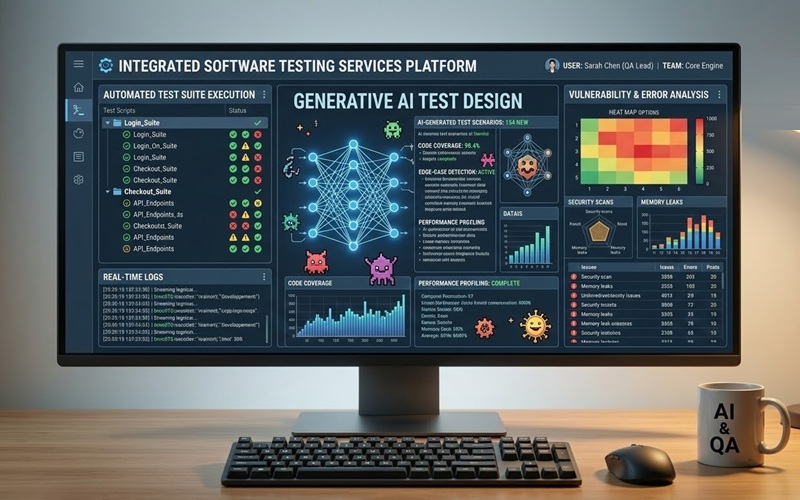
In this article on Techzine, experts Hélder Ferreira and Bruno Mazzotta discuss the transformative shift of AI from a simple task accelerator to a fundamental structural layer within delivery pipelines. As global IT investment in AI is projected to surge toward $6.15 trillion by 2026, the software testing landscape is evolving beyond early challenges like hallucinations and "vibe coding" toward a sophisticated "quality intelligence layer." The authors outline four critical areas where AI adds strategic value: generating complex scenario-based datasets, suggesting high-risk exploratory prompts, automating defect triage to identify regression patterns, and enabling context-aware execution that prioritizes testing based on actual risk rather than volume. Crucially, the piece argues that while AI can significantly enhance velocity, sustainable success depends on maintaining "humans-in-the-loop" to ensure traceability and accountability. In this new era, the primary differentiator for enterprises will not be the sheer amount of AI deployed, but the effectiveness of their governance frameworks. By linking intent with execution and using AI as connective tissue across the lifecycle, organizations can achieve a balance where rapid delivery is supported by explainable automation and human-verified confidence in software quality.


CIOs cut IT corners to manufacture budget for AI

In this CIO.com article, author Esther Shein examines the aggressive strategies IT leaders are employing to fund artificial intelligence initiatives amidst stagnant overall budgets. Faced with intense pressure from boards and executive leadership to prioritize AI, many CIOs are being forced to make difficult trade-offs that jeopardize long-term stability. Common tactics include delaying non-critical infrastructure refreshes, such as server expansions and network improvements, which are often pushed out by twelve to eighteen months. Additionally, organizations are aggressively consolidating vendors, renegotiating contracts, and cutting legacy software subscriptions to free up capital. Some leaders have even implemented strict "self-funding" mandates where every new AI project must be offset by equivalent cuts elsewhere. Beyond technical sacrifices, the human element is also affected, with many departments reducing reliance on contractors or trimming internal staff to reallocate funds toward high-impact AI use cases. While these measures enable rapid deployment, they frequently lead to the accumulation of technical debt and a narrower scope for implementations. Ultimately, the piece warns that while these "corners" are being cut to fuel innovation, the resulting lack of focus on foundational maintenance could present significant operational risks in the future.


Beyond Prompt Injection: The Hidden AI Security Threats in Machine Learning Platforms

In the article "Beyond Prompt Injection: The Hidden AI Security Threats in Machine Learning Platforms," the focus of AI security shifts from headline-grabbing prompt injections to the critical vulnerabilities within MLOps infrastructure. While many security teams prioritize protecting chatbots from manipulation, the underlying platforms used to train and deploy models often present a far more dangerous attack surface. Through a red team engagement, researchers demonstrated how a simple self-registered trial account could be used to achieve remote code execution on a provider’s cloud infrastructure. By deploying a seemingly legitimate but malicious machine learning model, attackers can exploit the fact that these platforms must execute arbitrary code to function. The study highlights a significant risk: once RCE is achieved, weak network segmentation can allow adversaries to bypass trust boundaries and access sensitive internal databases or services. This effectively turns a managed ML environment into a gateway for lateral movement within a corporate network. To mitigate these threats, the article stresses that organizations must move beyond model-centric security and adopt robust infrastructure protections, including strict network isolation, continuous behavior monitoring, and a "zero-trust" approach to user-deployed artifacts, ensuring that the convenience of rapid AI development does not come at the cost of total system compromise.


Enterprise agentic AI requires a process layer most companies haven’t built

The VentureBeat article emphasizes that while 85% of enterprises aspire to implement agentic AI within the next three years, a staggering 76% acknowledge that their current operations are fundamentally unequipped for this transition. The core issue lies in the absence of a "process layer"—a critical foundation of optimized workflows and operational intelligence that provides AI agents with the necessary context to function effectively. Without this layer, agents are essentially "guessing," leading to a lack of reliability that causes 82% of decision-makers to fear a failure in return on investment. The piece argues that the primary hurdle is not merely technological but rather rooted in organizational structure and change management. Most companies suffer from siloed data and fragmented processes that hinder the seamless integration of autonomous systems. To overcome these barriers, businesses must prioritize process optimization and operational visibility, ensuring that AI-driven initiatives are linked to strategic executive outcomes. Simply layering advanced AI over inefficient, legacy frameworks will likely result in costly friction. Ultimately, for agentic AI to move beyond experimental pilots and deliver scalable value, organizations must first build a robust architectural bridge that connects sophisticated models with the complex, real-world logic of their daily business operations and high-stakes organizational decision cycles.


Building resilient foundations for India’s expanding Data Centre ecosystem

In "Building resilient foundations for India's expanding Data Centre ecosystem," Saurabh Verma explores the rapid evolution of India’s data infrastructure and the urgent necessity of prioritizing long-term resilience over mere capacity. As cloud adoption and 5G accelerate growth across hubs like Mumbai, Chennai, and Hyderabad, the sector faces escalating challenges that demand a sophisticated understanding of risk management. The article argues that modern data centres are no longer just IT assets but critical infrastructure whose failure directly impacts the digital economy. Beyond physical damage, business interruptions often result in massive financial losses, contractual penalties, and significant reputational harm. Climate change has emerged as a significant operational reality, with heatwaves and flooding stressing cooling systems and electrical grids. Furthermore, the convergence of cyber and physical risks means that digital disruptions can quickly translate into tangible infrastructure damage. Construction complexities and logistical interdependencies further amplify potential losses, making early risk engineering essential for success. Ultimately, the piece emphasizes that resilience must be a core design pillar rather than an afterthought. By integrating disciplined risk management from site selection through operations, Indian providers can gain a commercial advantage, securing better investment and insurance terms while building a sustainable, trustworthy backbone for the nation’s digital future.


CVE program funding secured, easing fears of repeat crisis

The Common Vulnerabilities and Exposures (CVE) program has successfully secured stable funding, alleviating industry-wide fears of a repeat of the 2025 crisis that nearly crippled global vulnerability tracking. As detailed in the CSO Online report, the Cybersecurity and Infrastructure Security Agency (CISA) and the MITRE Corporation have renegotiated their contract, transitioning the 26-year-old program from a discretionary expenditure to a protected line item within CISA's budget. This structural change effectively eliminates the "funding cliff" that previously required a last-minute emergency extension. While CISA leadership emphasizes that the program is now fully funded and evolving, some experts note that the specifics of the "mystery contract" remain opaque. The resolution comes at a critical time, as the cybersecurity community had already begun developing contingencies, such as the independent CVE Foundation, to reduce reliance on a single government source. Despite the financial stability, challenges regarding transparency, modernization, and international governance persist. The article underscores that while the immediate threat of a service lapse has faded, the incident served as a stark reminder of the global security ecosystem's fragility. Moving forward, the focus shifts toward ensuring this essential public resource remains resilient against future political or administrative shifts within the United States government.

Daily Tech Digest - January 17, 2026


Quote for the day:

"Success does not consist in never making mistakes but in never making the same one a second time." -- George Bernard Shaw


Expectations from AI ramp up as investors eye returns in 2026

Billions in investments and a concerted focus on the tech over the past few years has led to artificial intelligence (AI) completely transforming how major global industries work. Now, investors are finally expecting to see some returns. ... Investors will no longer be satisfied with AI’s potential future capabilities – they want measurable returns on investment (ROI), says Jiahao Sun, the CEO of Flock.ie, a platform that allows users to build, train and deploy AI models in a decentralised manner. AI investment is entering its “show me the money era”, he says. This isn’t to say that investments into AI will pause, but that investors will begin prioritising critical areas that give guaranteed returns. These could include agentic AI platforms that enable multi-agent orchestration; AI-native infrastructures built for scale, security and interoperability; data modernisation tools that unlock the full potential of unstructured data; and AI observability and safety tools that monitor, govern and refine agent behaviour in real time, explains Neeraj Abhyankar, the VP of Data and AI at R Systems. ... “Single-purpose tools will be absorbed into unified AI platforms. The era of juggling 10 different AI products is ending and the race to offer a complete, integrated experience will intensify,” he adds. Meanwhile, some experts say that the EU’s AI Act will – for better or for worse – prohibit European firms from experimenting with high-risk use cases for AI.


The Next S-Curve of Cybersecurity: Governing Trust in a New Converging Intelligence Economy

Cybersecurity has crossed a threshold where it no longer merely protects technology ~ it governs trust itself. In an era defined by AI-driven decision-making, decentralized financial systems, cloud-to-edge computing, and the approaching reality of quantum disruption, cyber risk is no longer episodic or containable. It is continuous, compounding, and enterprise-defining. What changed in 2025 wasn’t just the threat landscape. It was the architecture of risk. Identity replaced networks as the dominant attack surface. Software supply chains emerged as systemic liabilities. Machine intelligence ~ on both sides of the attack began evolving faster than the controls designed to govern it. For boards, investors, and executives, this marked the end of cybersecurity as a control function and the beginning of cybersecurity as a strategic mandate. ... The next S-curve of cybersecurity is not driven by better tooling. It is driven by a shift in how trust is architected and governed across a converging ecosystem. This new curve is defined by: Identity-centric security rather than network-centric defense; Data-aware protection instead of application-bound controls; Continuous assurance rather than point-in-time audits; and Integration with enterprise risk, governance, and capital strategy Cybersecurity evolves from a defensive posture into a trust architecture discipline ~ one that governs how intelligence, identity, data, and decisions interact at scale.


Why Mental Fitness Is Leadership's Next Frontier

The distinction Craze draws between mental health and mental fitness is crucial. Mental health, he explains, is ultimately about functioning—being sufficiently free from psychological injury or mental illness to show up and perform one's job. "Your mental health or illness is a private matter between yourself, and perhaps your family or physician, and is a matter of respecting your individual rights," he says. Mental fitness, by contrast, is about capacity. "Assuming you are mentally healthy enough to show up and perform your job, then mental fitness is all about how well your mind performs under load, over time, and in conditions of uncertainty," Craze explains. "Being mentally healthy is a baseline. Being mentally fit is what allows leaders to think clearly at hour ten, stay composed in conflict, and recover quickly after setbacks rather than slowly eroding away," he says. Here, the comparison to elite athletics is instructive. In professional sports, no one confuses being injury-free with being competition-ready. Leadership has been slower to make that distinction, even as today’s executives face sustained cognitive and emotional demands that would have been unthinkable a generation ago. ... One of the most persistent myths in leadership development, according to Craze, is the idea that thinking happens in some abstract cognitive space, detached from the body. "In reality, every act of judgment, attention and self-control has an underlying physiological component and cost," he says. 


Taking the Technical Leadership Path

Without technical alignment, individuals constantly touch the same codebase, adding their feature in the simplest way (for them) but often they do this without ensuring the codebase is kept consistent. Over time accidental complexity grows such as having five different libraries that do the same job, or seven different implementations of how an email or push notification is sent and when someone wants to make a future change to that area, their work is now much harder. ... There are plenty of resources available to develop leadership skills. Kua advised to break broader leadership skills into specific ones, such as coaching, mentoring, communicating, mediating, influencing, etc. Even when someone is not a formal leader, there are daily opportunities to practice these skills in the workplace, he said. ... Formal technical leaders are accountable for ensuring teams have enough technical leadership. One way of doing this is to cultivate an environment where everyone is comfortable stepping up and demonstrating technical leadership. When you do this well, this means everyone can demonstrate informal technical leadership. Formal leaders exist because not all teams are automatically healthy or high-performing. I’m sure every technical person can remember a team they’ve been on with two engineers constantly debating about which approach to take, and wish someone had stepped in to help the team reach a decision. In an ideal world, a formal leader wouldn’t be necessary, but it’s rare that teams live in the perfect world.


From model collapse to citation collapse: risks of over-reliance on AI in the academy

Model collapse is the slow erosion of a generative AI system grounded in reality as it learns more and more from machine-generated data rather than from human-generated content. As a result of model collapse, the AI model loses diversity in its outputs, reinforces its misconceptions, increases its confidence in its hallucinations and amplifies its biases. ... Among all the writing tasks involved in research, GenAI appears to be disproportionately good at writing literature reviews. ChatGPT and Google Gemini both have deep research features that try to take a deep dive into the literature on a topic, returning heavily sourced and relatively accurate syntheses of the related research, while typically avoiding the well-documented tendency to hallucinate sources altogether. In some ways, it should not be too surprising that these technologies thrive in this area because literature reviews are exactly the sort of thing GenAI should be good at: textual summaries that stay pretty close to the source material. But here is my major concern: while nothing is fundamentally wrong with the way GenAI surfaces sources for literature reviews, it risks exacerbating the citation Matthew effect that tools like Google Scholar have caused. Modern AI models largely thrive on a snapshot of the internet circa 2022. In fact, I suspect that verifiably pre-2022 datasets will become prized sources for future models, largely untainted by AI-generated content, in much the same way that pre-World War II steel is prized for its lack of radioactive contamination from nuclear testing. 


Why is Debugging Hard? How to Develop an Effective Debugging Mindset

Here’s how most developers debug code: Something is broken; Let me change the line; Let’s refresh (wishing the error would go away); Hmm… still broken!; Now, let me add a console.log(); Let me refresh again (Ah, this time it may…); Ok, looks like this time it worked! This is reaction-based debugging. It’s like throwing a stone in the dark or finding a needle in a haystack. It feels busy, it sounds productive, but it’s mostly guessing. And guessing doesn’t scale in programming. This approach and the guessing mindset make debugging hard for developers. The lack of a methodology and solid approach makes many devs feel helpless and frustrated, which makes the process feel much more difficult than coding. This is why we need a different mental model, a defined skillset to master the art of debugging. ... Good debuggers don’t fight bugs. They investigate them. They don’t start with the mindset of “How do I fix this?”. They start with, “Why must this bug exist?” This one question changes everything. When you ask about the existence of a bug, you go back to the history to collect information about the code, its changes, and its flow. Then, you feed this information through a “mental model” to make decisions that lead you to the fix. ... Once the facts are clear and assumptions are visible, the debugging makes its way forward. Now you’ll need to form a hypothesis. A hypothesis is a simple cause-and-effect statement: If this assumption is wrong, then the behaviour makes sense. If not, provide a fix.


Promptware Kill Chain – Five-Step Kill Chain Model for Analyzing Cyberthreats

While the security industry has focused narrowly on prompt injection as a catch-all term, the reality is far more complex. Attacks now follow systematic, sequential patterns: initial access through malicious prompts, privilege escalation by bypassing safety constraints, establishing persistence in system memory, moving laterally across connected services, and finally executing their objectives. This mirrors how traditional malware campaigns unfold, suggesting that conventional cybersecurity knowledge can inform AI security strategies. ... The promptware kill chain begins with Initial Access, where attackers insert malicious instructions through prompt injection—either directly from users or indirectly through poisoned documents retrieved by the system. The second phase, Privilege Escalation, involves jailbreaking techniques that bypass safety training designed to refuse harmful requests. ... Traditional malware achieves persistence through registry modifications or scheduled tasks. Promptware exploits the data stores that LLM applications depend on. Retrieval-dependent persistence embeds payloads in data repositories like email systems or knowledge bases, reactivating when the system retrieves similar content. Even more potent is retrieval-independent persistence, which targets the agent’s memory directly, ensuring the malicious instructions execute on every interaction regardless of user input.


AI SOC Agents Are Only as Good as the Data They Are Fed

If your telemetry is fragmented, your schemas are inconsistent, or your context is missing, you won’t get faster responses from AI SOC agents. You’ll just get faster mistakes. These agents are being built to excel at cybersecurity analysis and decision support. They are not constructed to wrangle data collection, cleansing, normalization, and governance across dozens of sources. ... Modern SOCs integrate telemetry from EDRs, cloud providers, identity, networks, SaaS apps, data lakes, and more. Normalizing all that into a common schema eliminates the constant “translation tax.” An agent that can analyze standardized fields once, and doesn’t have to re-learn CrowdStrike vs. Splunk Search Processing Language vs. vendor-specific JavaScript Object Notation, will make faster, more reliable decisions. ... If the agent must “crawl back” into five source systems to enrich an alert on its own, latency spikes and success rates drop. The right move is to centralize, normalize, and clean security data into an accessible store, like a data lake, for your AI SOC agents and continue streaming a distilled, security-relevant subset to the Security Information and Event Management (SIEM) platform for detections and cybersecurity analysts. Let the SIEM be the place where detections originate; let the lake be the place your agents do their deep thinking. The problem is that the industry’s largest SIEM, Endpoint Detection and Response (EDR), and Security Orchestration, Automation, and Response (SOAR) platforms are consolidating into vertically integrated ecosystems. ...”


IT portfolio management: Optimizing IT assets for business value

The enterprise’s most critical systems for conducting day-to-day business are a category unto themselves. These systems may be readily apparent, or hidden deep in a technical stack. So all assets should be evaluated as to how mission-critical they are. ... The goal of an IT portfolio is to contain assets that are presently relevant and will continue to be relevant well into the future. Consequently, asset risk should be evaluated for each IT resource. Is the resource at risk for vendor sunsetting or obsolescence? Is the vendor itself unstable? Does IT have the on-staff resources to continue running a given system, no matter how good it is (a custom legacy system written in COBOL and Assembler, for example)? Is a particular system or piece of hardware becoming too expense to run? Do existing IT resources have a clear path to integration with the new technologies that will populate IT in the future? ... Is every IT asset pulling its weight? Like monetary and stock investments, technologies under management must show they are continuing to produce measurable and sustainable value. The primary indicators of asset value that IT uses are total cost of ownership (TCO) and return on investment (ROI). TCO is what gauges the value of an asset over time. For instance, investments in new servers for the data center might have paid off four years ago, but now the data center has an aging bay of servers with obsolete technology and it is cheaper to relocate compute to the cloud.


Ransomware activity never dies, it multiplies

One of the most significant findings in the study involves extortion campaigns that do not rely on encryption. These attacks focus on stealing data and threatening to publish it, skipping the deployment of ransomware entirely. Encryption based attacks remained just above 4,700 incidents annually. When data theft extortion is included, total extortion incidents reached 6,182 in 2025. That represents a 23% increase compared with 2024. Snakefly, which runs the Cl0p ransomware operation, played a major role in this shift. These actors exploited vulnerabilities in widely used enterprise software to extract data at scale. Victims included large organizations in government and industry, with some campaigns affecting hundreds of companies through a single flaw. ... A newer ransomware strain tracked as Warlock drew attention due to its tooling and infrastructure. First observed in mid 2025, Warlock attacks exploited a zero day vulnerability in Microsoft SharePoint and used DLL sideloading for payload delivery. Analysis linked Warlock to tooling previously associated with Chinese espionage activity, including signed drivers and custom command frameworks. Some ransomware payloads appeared to be modified versions of leaked LockBit code, combined with older malware components. The study notes overlaps between ransomware activity and long running espionage campaigns, where ransomware deployment may serve operational or financial goals within broader intrusion efforts.

Daily Tech Digest - December 25, 2025


Quote for the day:

"When I dare to be powerful - to use my strength in the service of my vision, then it becomes less and less important whether I am afraid." -- Audre Lorde


Declaring Quantum Christmas Advantage: How Quantum Computing Could Optimize The Holidays

If logistics is about moving stuff, gaming is about moving minds. And quantum computing’s influence here is more playful, at least for now. At the intersection of quantum and gaming, researchers are experimenting with quantum-inspired procedural content generation. Essentially, this is using hybrid quantum-classical approaches to generate game worlds, rules and narratives that are bigger and more complex than traditional methods allow. ... The holiday shopping season — part retail frenzy, part seasonal ritual and part absolute bottom-line need for business survival — is another area where quantum computing’s optimization chops could shine in a future-looking Christmas playbook. Retailers are beginning to explore how quantum optimization could help with workforce scheduling, inventory planning, dynamic pricing, and promotion planning, all classic holiday headaches for brick-and-mortar and online merchants alike, according to a D-Wave report. ... Finally, an esoteric — but perhaps way more festive — application of quantum tech would be using it for holiday analytics and personalization. Imagine real-time gift-recommendation engines that use quantum-accelerated models to process massive datasets instantly, teasing out patterns and preferences that help retailers suggest the perfect present for even the hardest-to-buy-for relative. 


How Today’s Attackers Exploit the Growing Application Security Gap

Zero-day vulnerabilities in applications are quite common these days, even in well-supported and mature technologies. But most zero-days aren’t that fancy. Attackers regularly exploit some common errors developers make. A good resource to learn from about this is the OWASP Top 10, which was recently updated to cover the latest application security gaps. The main issue on the list is broken access controls, which happens when the application doesn’t properly enforce who can access what. In reality, this translates into bad actors being able to view or manipulate data and functionality they shouldn’t have access to. Next on the list are security misconfigurations. These are simple to tune, but given the vast number of environments, services, and cloud platforms most applications span, they are difficult to maintain at scale. A common example are exposed admin interfaces, which opens the door to credential-related attacks, particularly brute-forcing. Software supply chain failures add another layer of risk. Modern applications rely heavily on open-source libraries, APIs, packages, container images, and CI/CD components. Any of these can introduce vulnerabilities or malicious code into production. A single compromised dependency can impact thousands of downstream applications. For application developers and enthusiasts, it is highly recommended to study the entries in the OWASP Top 10, along with related OWASP lists such as the API Security Top 10 and emerging AI security guidance.


Data governance key to AI security

Cybersecurity was once built to respond. Today, the response alone is no longer enough. We believe security must be predictive, adaptive, and intelligent. This belief led to the creation of the Digital Vaccine, an evolution of Managed Security Services (MSSP) designed for an AI-first, quantum-ready world. "Much like a biological vaccine, Digital Vaccine continuously identifies new and unknown attack patterns, learns from every attempted breach, and builds defence mechanisms before damage occurs," he explained. The urgency is real, according to the experts, because post-quantum risks will soon render many of today's encryption methods ineffective, exposing sensitive data that was once considered secure. At the same time, AI-powered cyber threats are becoming autonomous, faster, and more targeted-operating at machine speed and scale. ... Almost every AI is built on data. "It is transforming data into knowledge. Once it is learned, we cannot remove it. So what is being fed into the data and LLModels? No governance policies exist as of today," pointed out Krishnadas. Cybersecurity was once built to respond. Today, the response alone is no longer enough. We believe security must be predictive, adaptive, and intelligent. This belief led to the creation of the Digital Vaccine, an evolution of Managed Security Services (MSSP) designed for an AI-first, quantum-ready world.


How the AI era is driving the resurgence in disaggregated storage

As AI workloads surge and accelerated computing takes the center stage, data center architectures and storage systems must keep pace with the increasing demand for memory and compute. Yet, the fast and ever-evolving high-performance computing (HPC) and AI systems have different requirements for the various IT infrastructure hardware components. While they require Central Processing Unit (CPU) and Graphic Processing Unit (GPU) nodes to be refreshed every couple of years to keep up with the AI workload demands, storage solutions like high-capacity HDDs come with longer warranties (up to five years), are therefore built to last several years longer, and don’t need to be refreshed as often. Based on this, more and more organizations are moving storage out of the server and embracing disaggregated infrastructures to avoid wasting resources. ... In the AI era and ZB age, IT leaders need more from their storage systems. They are looking for scalable, low-risk solutions that can evolve with them, delivering an optimized cost per Terabyte ($/TB), better energy-efficiency per TB (kW/TB), improved storage density, high-quality, and trust to perform at scale. Disaggregated storage can be a solution that offers precisely this flexibility of demand-driven scaling to meet the individual requirements of data center workloads and business needs. ... With disaggregated storage, enterprises can embrace AI and HPC while no longer being tethered to HCI architectures. 


OpenAI admits prompt injection is here to stay as enterprises lag on defenses

OpenAI, the company deploying one of the most widely used AI agents, confirmed publicly that agent mode “expands the security threat surface” and that even sophisticated defenses can’t offer deterministic guarantees. For enterprises already running AI in production, this isn’t a revelation. It’s validation — and a signal that the gap between how AI is deployed and how it’s defended is no longer theoretical. None of this surprises anyone running AI in production. What concerns security leaders is the gap between this reality and enterprise readiness. ... OpenAI pushed significant responsibility back to enterprises and the users they support. It’s a long-standing pattern that security teams should recognize from cloud shared responsibility models. The company recommends explicitly using logged-out mode when the agent doesn't need access to authenticated sites. It advises carefully reviewing confirmation requests before the agent takes consequential actions like sending emails or completing purchases. And it warns against broad instructions. "Avoid overly broad prompts like 'review my emails and take whatever action is needed,'" OpenAI wrote. "Wide latitude makes it easier for hidden or malicious content to influence the agent, even when safeguards are in place." The implications are clear regarding agentic autonomy and its potential threats. The more independence you give an AI agent, the more attack surface you create. 


The 3-Phase Framework for Turning a Cyberattack Into a Strategic Advantage

Typically, a lot of companies will panic and then look for a scapegoat when faced with a crisis. Maersk opted to realize that the root cause of the problem was not just a virus. Leaders accepted that they were bang average in terms of how they handled cybersecurity. The company also accepted that what happened may have been due to a cultural problem internally that needed to be fixed. While malware was a cause of issues, they also understood that their culture played a part, as security was seen as something that IT dealt with and not a core business thing. ... Maersk succeeded in strengthening customer trust and communication as it turned what could have been a defeat into a competitive advantage. Rather than trying to sugarcoat, they were very transparent and quickly informed customers of what was happening in the journey to recovery. Instead of telling customers, “we failed you,” they opted for a stance of “we are being tested, and we are in this together.” ... After a data disaster, your aim should not just be to recover, but you must also aim to build an “antifragile” organization that can come out stronger after a major challenge. An important step is to ensure that you fully internalize the lessons. When Maersk had to act, it did not just fix the problem. Instead, it embedded a new security system into its future planning. Accountability was added to all teams. Resilience should not just be something you aim for or use in a one-time project. 


Leadership And The Simple Magic Of Getting Lost

There’s a part of the brain called the hippocampus that’s deeply tied to memory and spatial reasoning. It’s what helps us build internal maps of the world. It helps us recognize patterns, landmarks, distance and direction. It lights up when we have to figure things out for ourselves. When we follow turn-by-turn directions all the time, something subtle shifts. We’re not really navigating anymore. We’re just ... complying. It's efficient, yes. But also quieter, mentally. There’s growing concern among neuroscientists that when we outsource too much of this kind of thinking, we may be weakening one of the core systems tied to memory and long-term brain health. The research is still unfolding. Nothing is fully settled. But there’s enough there that it’s worth paying attention. Because the brain, like the body, works on a simple principle: Use it or lose it. ... This is why, every once in a while, I’ll let myself get a little lost on purpose. Not dangerously. Not recklessly. Just less optimized. I’ll take a different road. Walk through a neighborhood I don’t know. Let the uncertainty stretch a little. Let my brain build the map instead of borrowing one. This is the same skill we build in children when we’re teaching them how to find their way, but inside companies, it shows up as orientation. When you’re facing something unfamiliar—a new market, a hard strategic turn, a problem no one has quite named yet—your job isn’t to hand your team a route. It’s to give them landmarks: Here’s what we know. Here’s what can’t change.


Gen AI Paradox: Turning Legacy Code Into an Asset

Legacy modernization for decades was unglamorous and often postponed until the pain of technical debt surpassed the risks of migration. There is $2.41 trillion in technical debt in the United States alone. Seventy percent of workloads still run on-premises, and 70% of legacy IT software for Fortune 500 companies was developed over 20 years ago. ... It's not just about wishful thinking but is also driven by internal organizational dynamics. When we launched AWS Transform, after processing over a billion lines of code, we estimated it saved customers about 800,000 hours of manual work. But for a CIO, the true measure often relates to capacity. We observe organizations saving up to 80% in manual effort. This doesn't only mean cost reductions, but also avoiding the need to increase headcount for maintenance. For instance, I spoke with a technology leader managing a smaller team of about 200 people. His dilemma was: "Do I invest in building new functions, or do I maintain and modernize?" He told his team he wouldn't add a single person for modernization. They have to use tools to accomplish it. Using these tools, he completed a .NET transformation of 800,000 lines of code in two weeks, a project he estimated would typically take six months. The justification for the CIO is simple: save time and redirect 20% to 30% of the budget previously spent on tech debt toward innovation.


5 stages to observability maturity

The first requirement is coherence. Companies must move away from fragmented tooling and build unified telemetry pipelines capable of capturing logs, metrics, traces, and model signals in a consistent way. For many, this means embracing open standards such as OpenTelemetry and consolidating data sources so AI systems have a complete picture of the environment. ... The second requirement is business alignment. Enterprises that successfully evolve from monitoring to observability, and from observability to autonomous operations, do so because they learn to articulate the relationship between technical signals and business outcomes. Leaders want to understand not just the number of errors thrown by a microservice, but customers affected, the revenue at stake, or the SLA exposure if the issue persists. ... A third element is AI governance. As Nigam says, AI models change character over time, so observability must extend into the AI layer, providing real-time visibility into model behavior and early signs of instability. Companies that rely more heavily on AI must also accept a new operational responsibility to ensure the AI itself remains reliable, auditable, and secure. Finally, organizations must learn to construct guardrails for automation. Casanova and Woodside both say the shift to autonomous operations isn’t an overnight leap but a progressive widening of the boundary between what humans review and what machines handle automatically. 


In the race to be AI-first, discipline matters more than speed

In an environment defined by uncertainty, economic volatility, cyber threats, supply-chain shocks, Srivastava believes resilience must be architected deliberately into the IT ecosystem. “We create an ecosystem that is so frugal that even if there are funding cuts or crisis situations, operations continue to run,” he explains. The objective is simple and uncompromising, the business must not stop. Digital initiatives may slow down, but the organisation itself should remain operational, regardless of external disruption. This focus on frugality is not about austerity. It is about discipline. “Resilience is not built when times are good,” Srivastava says. “It’s built when you assume disruption is inevitable.” ... Despite the complexity of modern IT stacks, Srivastava is unequivocal about where the real difficulty lies. “Technology is the easiest piece to crack,” he says. “Digital transformation is one of the most abused terms in the industry. Digital is easy. Transformation is hard.” Enterprises, he notes, are usually successful at acquiring tools, platforms, and licenses. “Everything that money can buy…tools, people, licenses…falls into place,” he says. What money cannot buy, however, is where transformation often breaks down to mindset shifts, adoption, ownership, and behavioural change. This challenge is particularly acute in manufacturing. 

Daily Tech Digest - September 11, 2025


Quote for the day:

"You live longer once you realize that any time spent being unhappy is wasted." -- Ruth E. Renkl


Six hard truths for software development bosses

Everyone behaves differently when the boss is around. Everyone. And you, as a boss, need to realize this. There are two things to realize here. Firstly, when you are present, people will change who they are and what they say. Secondly, you should consider that fact when deciding whether to be in the room. ... Bosses need to realize that what they say, even comments that you might think are flippant and not meant to be taken seriously, will be taken seriously. ... The other side of that coin is that your silence and non-action can have profound effects. Maybe you space out in a meeting and miss a question. The team might think you blew them off and left the great idea hanging. Maybe you forgot to answer an email. Maybe you had bigger fish to fry and you were a bit short and dismissive of an approach by a direct report. Small lapses can be easily misconstrued by your team. ... You are the boss. You have the power to promote, demote, and award raises and bonuses. These powers are important, and people will see you in that light. Even your best attempts at being cordial, friendly, and collegial will not overcome the slight apprehension your authority will engender. Your mood on any given day will be noticed and tracked. ... You can and should have input into technical decisions and design decisions, but your team will want to be the ones driving what direction things take and how things get done. 


AI prompt injection gets real — with macros the latest hidden threat

“Broadly speaking, this threat vector — ‘malicious prompts embedded in macros’ — is yet another prompt injection method,” Roberto Enea, lead data scientist at cybersecurity services firm Fortra, told CSO. “In this specific case, the injection is done inside document macros or VBA [Visual Basic for Applications] scripts and is aimed at AI systems that analyze files.” Enea added: “Typically, the end goal is to mislead the AI system into classifying malware as safe.” ... “Attackers could embed hidden instructions in common business files like emails or Word documents, and when Copilot processed the file, it executed those instructions automatically,” Quentin Rhoads-Herrera, VP of cybersecurity services at Stratascale, explained. In response to the vulnerability, Microsoft recommended patching, restricting Copilot access, stripping hidden metadata from shared files, and enabling its built-in AI security controls. ... “We’ve already seen proof-of-concept attacks where malicious prompts are hidden inside documents, macros, or configuration files to trick AI systems into exfiltrating data or executing unintended actions,” Stratascale’s Rhoads-Herrera commented. “Researchers have also demonstrated how LLMs can be misled through hidden instructions in code comments or metadata, showing the same principle at work.” Rhoads-Herrera added: “While some of these remain research-driven, the techniques are quickly moving into the hands of attackers who are skilled at weaponizing proof-of-concepts.”


Are you really ready for AI? Exposing shadow tools in your organisation

When an organisation doesn’t regulate an approved framework of AI tools in place, its employees will commonly turn to using these applications across everyday actions. By now, everyone is aware of the existence of generative AI assets, whether they are actively using them or not, but without a proper ruleset in place, everyday employee actions can quickly become security nightmares. This can be everything from employees pasting sensitive client information or proprietary code into public generative AI tools to developers downloading promising open-source models from unverified repositories. ... The root cause of turning to shadow AI isn’t malicious intent. Unlike cyber actors, aiming to disrupt and exploit business infrastructure weaknesses for a hefty payout, employees aren’t leaking data outside of your organisation intentionally. AI is simply an accessible, powerful tool that many find exciting. In the absence of clear policies, training and oversight, and the increased pressure of faster, greater delivery, people will naturally seek the most effective support to get the job done. ... Regardless, you cannot protect against what you can’t see. Tools like Data Loss Prevention (DLP) and Cloud Access Security Brokers (CASB), which detect unauthorised AI use, must be an essential part of your security monitoring toolkit. Ensuring these alerts connect directly to your SIEM and defining clear processes for escalation and correction are also key for maximum security.


How to error-proof your team’s emergency communications

Hierarchy paralysis occurs when critical information is withheld by junior staff due to the belief that speaking up may undermine the chain of command. Junior operators may notice an anomaly or suspect a procedure is incorrect, but often neglect to disclose their concerns until after a mistake has happened. They may assume their input will be dismissed or even met with backlash due to their position. In many cases, their default stance is to believe that senior staff are acting on insight that they themselves lack. CRM trains employees to follow a structured verbal escalation path during critical incidents. Similar to emergency operations procedures (EOPs), staff are taught to express their concerns using short, direct phrases. This approach helps newer employees focus on the issue itself rather than navigating the interaction’s social aspects — an area that can lead to cognitive overload or delayed action. In such scenarios, CRM recommends the “2-challenge rule”: team members should attempt to communicate an observed issue twice, and if the issue remains unaddressed, escalate it to upper management. ... Strengthening emergency protocols can help eliminate miscommunication between employees and departments. Owners and operators can adopt strategies from other mission-critical industries to reduce human error and improve team responsiveness. While interpersonal issues between departments and individuals in different roles are inevitable, tighter emergency procedures can ensure consistency and more predictable team behavior.


SpamGPT – AI-powered Attack Tool Used By Hackers For Massive Phishing Attack

SpamGPT’s dark-themed user interface provides a comprehensive dashboard for managing criminal campaigns. It includes modules for setting up SMTP/IMAP servers, testing email deliverability, and analyzing campaign results features typically found in Fortune 500 marketing tools but repurposed for cybercrime. The platform gives attackers real-time, agentless monitoring dashboards that provide immediate feedback on email delivery and engagement. ... Attackers no longer need strong writing skills; they can simply prompt the AI to create scam templates for them. The toolkit’s emphasis on scale is equally concerning, as it promises guaranteed inbox delivery to popular providers like Gmail, Outlook, and Microsoft 365 by abusing trusted cloud services such as Amazon AWS and SendGrid to mask its malicious traffic. ... What once required significant technical expertise can now be executed by a single operator with a ready-made toolkit. The rise of such AI-driven platforms signals a new evolution in cybercrime, where automation and intelligent content generation make attacks more scalable, convincing, and difficult to detect. To counter this emerging threat, organizations must harden their email defenses. Enforcing strong email authentication protocols such as DMARC, SPF, and DKIM is a critical first step to make domain spoofing more difficult. Furthermore, enterprises should deploy AI-powered email security solutions capable of detecting the subtle linguistic patterns and technical signatures of AI-generated phishing content.


How attackers weaponize communications networks

The most attractive targets for advanced threat actors are not endpoint devices or individual servers, but the foundational communications networks that connect everything. This includes telecommunications providers, ISPs, and the routing infrastructure that forms the internet’s backbone. These networks are a “target-rich environment” because compromising a single point of entry can grant access to a vast amount of data from a multitude of downstream targets. The primary motivation is overwhelmingly geopolitical. We’re seeing a trend of nation-state actors, such as those behind the Salt Typhoon campaign, moving beyond corporate espionage to a more strategic, long-term intelligence-gathering mission. ... Two recent trends are particularly telling and serve as major warning signs. The first is the sheer scale and persistence of these attacks. ... The second trend is the fusion of technical exploits with AI-powered social engineering. ... A key challenge is the lack of a standardized global approach. Differing regulations around data retention, privacy, and incident reporting can create a patchwork of security requirements that threat actors can easily exploit. For a global espionage campaign, a weak link in one country’s regulatory framework can compromise an entire international communications chain. The goal of international policy should be to establish a baseline of security that includes mandatory incident reporting, a unified approach to patching known vulnerabilities, and a focus on building a collective defense.


AI's free web scraping days may be over, thanks to this new licensing protocol

AI companies are capturing as much content as possible from websites while also extracting information. Now, several heavyweight publishers and tech companies -- Reddit, Yahoo, People, O'Reilly Media, Medium, and Ziff Davis (ZDNET's parent company) -- have developed a response: the Really Simple Licensing (RSL) standard. You can think of RSL as Really Simple Syndication's (RSS) younger, tougher brother. While RSS is about syndication, getting your words, stories, and videos out onto the wider web, RSL says: "If you're an AI crawler gobbling up my content, you don't just get to eat for free anymore." The idea behind RSL is brutally simple. Instead of the old robots.txt file -- which only said, "yes, you can crawl me," or "no, you can't," and which AI companies often ignore -- publishers can now add something new: machine-readable licensing terms. Want an attribution? You can demand it. Want payment every time an AI crawler ingests your work, or even every time it spits out an answer powered by your article? Yep, there's a tag for that too. ... It's a clever fix for a complex problem. As Tim O'Reilly, the O'Reilly Media CEO and one of the RSL initiative's high-profile backers, said: "RSS was critical to the internet's evolution…but today, as AI systems absorb and repurpose that same content without permission or compensation, the rules need to evolve. RSL is that evolution."


AI is changing the game for global trade: Nagendra Bandaru, Wipro

AI is revolutionising global supply chain and trade management by enabling businesses across industries to make real-time, intelligent decisions. This transformative shift is driven by the deployment of AI agents, which dynamically respond to changing tariff regimes, logistics constraints, and demand fluctuations. Moving beyond traditional static models, AI agents are helping create more adaptive and responsive supply chains. ... The strategic focus is also evolving. While cost optimisation remains important, AI is now being leveraged to de-risk operations, anticipate geopolitical disruptions, and ensure continuity. In essence, agentic AI is reshaping supply chains into predictive, adaptive ecosystems that align more closely with the complexities of global trade. ... The next frontier is going to be threefold: first, the rise of agentic AI at scale marks a shift from isolated use cases to enterprise-wide deployment of autonomous agents capable of managing end-to-end trade ecosystems; second, the development of sovereign and domain-specific language models is enabling lightweight, highly contextualised solutions that uphold data sovereignty while delivering robust, enterprise-grade outcomes; and third, the convergence of AI with emerging technologies—including blockchain for provenance and quantum computing for optimisation—is poised to redefine global trade dynamics.


5 challenges every multicloud strategy must address

Transferring AI data among various cloud services and providers also adds complexity — but also significant risks. “Tackling software sprawl, especially as organizations accelerate their adoption of AI, is a top action for CIOs and CTOs,” says Mindy Lieberman, CIO at database platform provider MongoDB. ... A multicloud environment can complicate the management of data sovereignty. Companies need to ensure that data remains in line with the laws and regulations of the specific geographic regions where it is stored and processed. ... Deploying even one cloud service can present cybersecurity risks for an enterprise, so having a strong security program in place is all the more vital for a multicloud environment. The risks stem from expanded attack surfaces, inconsistent security practices among service providers, increased complexity of the IT infrastructure, fragmented visibility, and other factors. IT needs to be able to manage user access to cloud services and detect threats across multiple environments — in many cases without even having a full inventory of cloud services. ... “With greater complexity comes more potential avenues of failure, but also more opportunities for customization and optimization,” Wall says. “Each cloud provider offers unique strengths and weaknesses, which means forward-thinking enterprises must know how to leverage the right services at the right time.”


What Makes Small Businesses’ Data Valuable to Cybercriminals?

Small businesses face unique challenges that make them particularly vulnerable. They often lack dedicated IT or cybersecurity teams, sophisticated systems, and enterprise-grade protections. Budget constraints mean many cannot afford enterprise-level cybersecurity solutions, creating easily exploitable gaps. Common issues include outdated software, reduced security measures, and unpatched systems, which weaken defenses and provide easy entry points for criminals. A significant vulnerability is the lack of employee cybersecurity awareness. ... Small businesses, just like large organizations, collect and store vast amounts of valuable data. Customer data represents a goldmine for cybercriminals, including first and last names, home and email addresses, phone numbers, financial information, and even medical information. Financial records are equally attractive targets, including business financial information, payment details, and credit/debit card payment data. Intellectual property and trade secrets represent valuable proprietary assets that can be sold to competitors or used for corporate espionage. ... Small businesses are undeniably attractive targets for cybercriminals, not because they are financial giants, but because they are perceived as easier to breach due to resource constraints and common vulnerabilities. Their data, from customer PII to financial records and intellectual property, is highly valuable for resale, fraud, and as gateways to larger targets.