Showing posts with label SLM. Show all posts

Daily Tech Digest - May 04, 2026


Quote for the day:

"The most powerful thing a leader can do is take something complicated and make it clear. Clarity is the ultimate competitive advantage." -- Gordon Tredgold

🎧 Listen to this digest on YouTube Music

▶ Play Audio Digest

Duration: 24 mins • Perfect for listening on the go.


Edge + Cloud data modernisation: architecting real-time intelligence for IoT

The article by Chandrakant Deshmukh explores the critical shift from traditional "cloud-first" IoT architectures to a modernized edge-cloud continuum, which is essential for achieving true real-time intelligence. The author argues that purely cloud-centric models are failing due to prohibitive latency, high bandwidth costs, and complex data sovereignty requirements. To address these challenges, enterprises must adopt a tiered architectural approach governed by "data gravity," where raw signals are processed locally at the edge for immediate control, while the cloud is reserved for long-horizon analytics and model training. This modernization relies on three core technical pillars: an event-driven transport spine using protocols like MQTT and Kafka, a dedicated stream-processing layer for real-time data handling, and digital twins to synchronize physical assets with digital representations. Beyond technology, the article emphasizes the importance of intellectual property governance, urging organizations to clarify data ownership and lineage early in vendor contracts. By treating edge and cloud as complementary tiers rather than competing locations, businesses can unlock significant returns on investment, including predictive maintenance and enhanced operational efficiency. Ultimately, successful IoT modernization is not merely a technical project but a strategic commitment to processing data at the most efficient tier to drive industrial intelligence.


AI Code Review Only Catches Half of Your Bugs

The O’Reilly Radar article, "AI Code Review Only Catches Half of Your Bugs," explores the critical limitations of using artificial intelligence for automated code verification. While AI tools like GitHub Copilot and CodeRabbit are proficient at identifying structural defects—such as null pointer dereferences, resource leaks, and race conditions—they struggle significantly with "intent violations." These are logical bugs that occur when the code executes successfully but fails to do what the developer actually intended. Research indicates that while AI can catch approximately 65% of structural issues, it often misses the deeper 35% to 50% of defects rooted in misunderstood requirements or complex business logic. The article emphasizes that AI lacks the institutional memory and operational context that human engineers possess. For instance, an AI agent might suggest an efficient code refactor that inadvertently bypasses a necessary security wrapper or violates a project-specific architectural guideline. To bridge this gap, the author suggests a shift toward "context-aware reasoning" and the use of tools like the Quality Playbook. This approach involves feeding AI agents specific documentation, such as READMEs and design notes, to help them "infer" intent. Ultimately, the piece argues that while AI is a powerful assistant, human oversight remains essential for catching the subtle, high-stakes errors that automated systems cannot yet perceive.


Small Language Models (SLMs) as the gold standard for trust in AI

The article argues that Small Language Models (SLMs) are emerging as the "gold standard" for establishing trust in artificial intelligence, particularly in precision-dependent industries like finance. While Large Language Models (LLMs) often prioritize sounding confident and clever over being accurate, they frequently succumb to hallucinations because they are trained on vast, unverified datasets. In contrast, SLMs are trained on narrow, high-quality data, allowing them to be faster, more cost-effective, and significantly more accurate in their results. They aim to be "correct, not clever," making them ideal for high-stakes environments where even minor errors can lead to severe financial loss or compliance nightmares. The most resilient business strategy involves orchestrating a hybrid architecture where LLMs serve as the intuitive reasoning layer and user interface, while a "swarm" of specialized SLMs acts as the deterministic verifiers for specific, granular tasks. This collaboration is facilitated by tools like the Model Context Protocol, ensuring that final outputs are grounded in fact rather than statistical probability. Furthermore, trust is reinforced by incorporating confidence scores and human-in-the-loop verification processes. Ultimately, shifting toward specialized, connected AI architectures allows professionals to move away from tedious manual data entry and focus on high-impact advisory work, ensuring that AI remains a reliable and secure partner in complex professional workflows.


Upgrading legacy systems: How to confidently implement modernised applications

In the article "Upgrading legacy systems: How to confidently implement modernised applications," Ger O’Sullivan explores the critical shift from outdated technology to agile, AI-enhanced operational frameworks. For years, legacy systems have served as organizational backbones but now present significant hurdles, including high maintenance costs, security vulnerabilities, and reduced agility. O’Sullivan argues that modernization is no longer an optional luxury but a strategic imperative for sustained competitiveness and growth. Fortunately, the emergence of AI-enabled tooling and structured, end-to-end frameworks has made this process more predictable and cost-effective than ever before. These advancements allow organizations—particularly in the public sector where systems are often undocumented and deeply integrated—to move away from risky "start from scratch" approaches toward incremental, value-driven transformations. The author emphasizes that successful modernization must be business-aligned rather than purely technical, suggesting that leaders should prioritize applications based on their potential business value and risk profile. By starting with small, manageable pilots, teams can demonstrate quick wins, build momentum, and refine their governance processes before scaling across the enterprise. Ultimately, O’Sullivan highlights that with the right strategic advisors and a focus on long-term outcomes, organizations can transform their legacy burdens into powerful drivers of innovation, service quality, and operational resilience.


Relying on LLMs is nearly impossible when AI vendors keep changing things

In the article "Relying on LLMs is nearly impossible when AI vendors keep changing things," Evan Schuman examines the growing instability enterprise IT faces when integrating generative AI systems. The core issue revolves around AI vendors frequently implementing background updates without notifying customers, a practice highlighted by a candid report from Anthropic. This report detailed several instances where adjustments—meant to improve latency or efficiency—inadvertently degraded model performance, such as reducing reasoning depth or causing "forgetfulness" in sessions. Schuman argues that while businesses have long accepted limited control over SaaS platforms, the opaque nature of Large Language Models (LLMs) represents a new extreme. Because these systems are non-deterministic and highly interdependent, performance regressions are difficult for both vendors and users to detect or reproduce accurately. Furthermore, the article notes a potential conflict of interest: since most enterprise clients pay per token, vendors have a financial incentive to make changes that increase consumption. Ultimately, the author warns that the reliability of mission-critical AI applications is currently at the mercy of vendors who can "dumb down" services overnight. He concludes that internal monitoring of accuracy, speed, and cost is no longer optional for organizations seeking a clean return on investment in an environment defined by "buyer beware."


The evolution of data protection: Why enterprises must move beyond traditional backup

The article titled "The Evolution of Data Protection: Why Enterprises Must Move Beyond Traditional Backup" explores the paradigm shift from simple data recovery to comprehensive enterprise resilience. Author Seemanta Patnaik argues that in today’s landscape of sophisticated AI-driven cyber threats and ransomware, traditional backups serve only as a starting point rather than a total solution. Modern enterprises face significant vulnerabilities, including flat network architectures, legacy infrastructures, and human susceptibility to phishing, necessitating a holistic lifecycle approach that encompasses prevention, detection, and rapid response. Patnaik emphasizes that data protection must be driven by risk-based thinking rather than mere regulatory compliance, as sectors like banking and insurance face increasingly complex legal mandates. Key strategies highlighted include the "3-2-1-1-0" rule, rigorous testing of recovery systems, and the use of automation to manage the scale of distributed data environments. Furthermore, critical metrics like Recovery Time Objective (RTO) and Recovery Point Objective (RPO) are presented as essential benchmarks for measuring business continuity effectiveness. Ultimately, the piece asserts that true resilience requires executive-level governance and a proactive shift toward predictive security models. By integrating AI for faster threat detection and automated recovery, organizations can better navigate the evolving digital ecosystem and ensure they return to business as usual with minimal disruption.


What researchers learned about building an LLM security workflow

The Help Net Security article "What researchers learned about building an LLM security workflow" highlights critical findings from the University of Oslo and the Norwegian Defence Research Establishment regarding the integration of Large Language Models into Security Operations Centers. While vendors often market LLMs as immediate solutions for alert triage, the research reveals that these models fail significantly when operating in isolation. Specifically, when provided with only high-level summaries of malicious network activity, popular models like GPT-5-mini and Claude 3 Haiku achieved a zero percent detection rate. However, performance improved dramatically when the models were embedded within a structured, agentic workflow. By implementing a system where models could plan investigations, execute specific SQL queries against logs, and iteratively summarize evidence, malicious detection accuracy surged to an average of 93 percent. This shift demonstrates that a model's effectiveness is not solely dependent on its internal intelligence but rather on the constrained tools and rigorous processes surrounding it. Despite this success, the models often flagged benign cases as "uncertain," suggesting that while such workflows reduce missed threats, they may still necessitate human oversight. Ultimately, the study emphasizes that a well-defined architecture is essential for transforming LLMs from passive data recipients into proactive, reliable security analysts.


Cyber-physical resilience reshaping industrial cybersecurity beyond perimeter defense to protect core processes

The article explores the critical transition from perimeter-centric defense to cyber-physical resilience in industrial cybersecurity, driven by the dissolution of traditional barriers between IT and OT environments. As operational technology becomes increasingly interconnected, conventional "air gaps" have vanished, leaving 78% of industrial control devices with unfixable vulnerabilities. Experts from firms like Booz Allen Hamilton and Fortinet emphasize that modern resilience is no longer just about preventing every attack but ensuring that essential services—such as power and water—continue to function even during a compromise. This proactive approach prioritizes the integrity of core processes over the absolute security of individual systems. Key challenges highlighted include a dangerous overconfidence among operators and a persistent lack of visibility into serial and analog communications, which remain the backbone of physical processes. With approximately 21% of industrial companies facing OT-specific attacks annually, the shift toward resilience demands continuous monitoring, cross-disciplinary collaboration, and dynamic recovery strategies. Ultimately, cyber-physical resilience is defined by an organization's capacity to identify, mitigate, and recover from disruptions without halting production. By focusing on process-level protection rather than just network boundaries, critical infrastructure can adapt to a landscape where cyber threats have direct, real-world physical consequences.


AI exposes attacks traditional detection methods can’t see

Evan Powell’s article on SiliconANGLE highlights a critical vulnerability in modern cybersecurity: the inherent architectural limitations of rule-based detection systems. For decades, security has relied on signatures, thresholds, and anomaly baselines to identify threats. However, these traditional methods are increasingly blind to side-channel attacks and sophisticated, AI-assisted intrusions that utilize legitimate tools or encrypted channels. Because these maneuvers do not produce discrete "matchable" signals or cross predefined boundaries, they often remain invisible to standard scanners. The article argues that the industry is currently deploying AI at the wrong layer; most tools focus on post-detection response—such as summarizing alerts and automating investigations—rather than the initial detection process itself. This misplaced focus leaves a significant gap where attackers can operate indefinitely without triggering a single alert. To close this divide, security architecture must evolve beyond simple rules toward advanced AI systems capable of interpreting complex patterns in timing, sequencing, and interaction. Currently, the most dangerous signals are not traditional indicators at all, but rather subtle behaviors that require a fundamental shift in how detection is engineered. Without moving AI deeper into the observation layer, organizations will continue to optimize their response to known threats while remaining entirely exposed to a growing class of silent, architectural-level attacks.


Why service desks are emerging as a critical security weakness

The article from SecurityBrief Australia examines the escalating vulnerability of corporate service desks, which have become primary targets for sophisticated cybercriminals. While many organizations invest heavily in technical perimeters, the service desk represents a critical "human element" that is easily exploited through social engineering. Attackers utilize tactics like voice phishing, or "vishing," to impersonate employees or high-level executives, often leveraging personal information gathered from social media or previous data breaches. Their ultimate objective is to manipulate help desk staff into resetting passwords, enrolling unauthorized multi-factor authentication devices, or bypassing standard security controls. This issue is intensified by the broad permissions typically granted to service desk agents, where a single compromised identity can provide a gateway to the entire corporate network. Furthermore, the rise of remote work and the use of virtual private networks have made verifying identities over digital channels increasingly difficult. To combat these threats, the article advocates for a fundamental shift toward the principle of least privilege and the implementation of robust, automated identity verification processes, such as biometric checks, to replace reliance on easily discoverable personal data. Ultimately, organizations must prioritize securing the service desk to prevent it from inadvertently serving as an open door for devastating ransomware attacks and data breaches.

Daily Tech Digest - March 20, 2026


Quote for the day:

"Nothing so conclusively proves a man's ability to lead others as what he does from day to day to lead himself." -- Thomas J. Watson


🎧 Listen to this digest on YouTube Music

▶ Play Audio Digest

Duration: 23 mins • Perfect for listening on the go.


Rethinking Cyber Preparedness in Age of AI Cyberwarfare

The article "Rethinking Cyber Preparedness in the Age of AI and Cyberwarfare" highlights a critical disconnect termed the "readiness paradox," where nearly 80% of IT leaders feel prepared for cyberwarfare despite over half of organizations suffering AI-driven attacks recently. According to Armis’s latest report, traditional defense mechanisms are failing against agentic AI, which nation-state actors now deploy for rapid reconnaissance and lateral movement. As autonomous agents begin weaponizing zero-day exploits faster than human researchers can categorize them, the attack surface has expanded to include overlooked assets like building management systems and IoT devices. The financial stakes are escalating, with average ransomware payouts reaching $11.6 million, often exceeding annual security budgets. To counter these sophisticated threats, the article emphasizes that organizations must achieve superior visibility into their internal environments and map every network asset. Furthermore, IT leaders should embrace AI-driven security policies rather than ineffective bans to combat the risks of "shadow AI" used by employees. Ultimately, true resilience depends on whether a company knows its own infrastructure better than its adversaries, transforming AI from a liability into a vital defensive tool for modern geopolitical threats.


Are small language models finally having their moment?

The rapid ascent of Small Language Models (SLMs) marks a strategic shift in the artificial intelligence landscape, as enterprises seek to mitigate the immense costs and security risks associated with massive frontier models. Unlike their trillion-parameter counterparts, SLMs operate with significantly fewer parameters—ranging from millions to a few billion—allowing them to run locally on laptops or mobile devices without internet connectivity. This architectural efficiency ensures superior data privacy and regulatory compliance, particularly in sensitive sectors like healthcare, defense, and banking where proprietary data must remain on-premises. While Large Language Models (LLMs) excel at general synthesis and creative tasks, SLMs are increasingly preferred for specialized, rules-based functions such as code completion and document classification. Gartner even projects that by 2027, task-specific SLM usage will triple that of LLMs. Through techniques like knowledge distillation and pruning, these compact models offer a cost-effective, energy-efficient alternative that delivers high performance with minimal latency. Consequently, the industry is moving toward a hybrid ecosystem where SLMs handle secure, specialized operations while LLMs provide broader abstraction, proving that in the evolving world of enterprise AI, bigger is not always better for every specific business need.


What it takes to level up your org’s AI maturity

To advance an organization's AI maturity, leaders must transition from merely "doing AI" to driving substantial business impact through an outcomes-based, AI-first strategy. According to experts Afshean Talasaz and Zar Toolan, this shift requires CIOs to adopt an "innovator-operator" mindset, balancing the need for rapid evolution with the stability required for consistent execution. Maturity is categorized into three levels, with the most advanced organizations enjoying a first-mover advantage led by CEO-backed agendas. A critical component of this journey is the "from-to so-that" modeling, which aligns data and AI initiatives with specific strategic outcomes like trust, business value, and reduced time to value. Winners in this space prioritize long-term infrastructure investments and rigorous data cleanup while securing short-term wins to demonstrate ROI. Furthermore, scaling AI successfully demands an intense focus on granular details rather than abstract concepts; without getting the technical and operational nuances right, true scale remains elusive. Ultimately, the transformation is a "team sport" requiring absolute alignment across the C-suite and a commitment to reducing internal volatility. By preparing thoroughly and maintaining consistent execution, organizations can move beyond operational tools to treat sovereign enterprise data as a powerful competitive moat.


The Power Ladder Architecture—A System For Turning Risk Work Into Decisions, Delivery And Proof

Maman Ibrahim’s article, "The Power Ladder Architecture," addresses the critical gap between identifying organizational risks and executing meaningful change. Ibrahim argues that risk management often fails not because of a lack of effort, but because it fails to convert analysis into "leadership work." Many teams present polished dashboards that provide a false sense of security while stalling when faced with difficult trade-offs. The Power Ladder is proposed as a solution, shifting the focus from mere reporting to three tangible outcomes: decisions, delivery, and proof. First, "decisions" require framing risks as binary choices for leadership, forcing clarity on trade-offs like speed versus security. Second, "delivery" ensures that once a choice is made, it is translated into structured tasks with clear ownership and deadlines. Finally, "proof" demands verifiable evidence that the risk profile has actually improved, rather than just being documented. By implementing this architecture, organizations can move beyond ceremonial risk management and establish a high-altitude system where audit concerns and cyber exposures are effectively neutralized. This approach transforms risk work into a powerful engine for operational resilience, ensuring that every identified vulnerability leads to a documented decision and a validated result.


The espionage reality: Your infrastructure is already in the collection path

Modern enterprises are increasingly caught in the "collection path" of global espionage, not necessarily as primary targets, but because they utilize the same centralized infrastructure as their adversaries. This shift highlights a structural exposure problem where shared dependencies—such as telecommunications, cloud services, and identity layers—become conduits for siphoning data and monitoring authentication. When national telecommunications providers are compromised, attackers can collect intelligence directly from the pathways an organization relies on, rendering traditional internal security measures insufficient. The article emphasizes that security leaders must move beyond internal asset protection to evaluate risk through the lens of upstream dependencies. Key recommendations include demanding integrity attestation from providers, reducing implicit trust in external networks, and hardening session layers to mitigate token theft and impersonation. Furthermore, the persistence of advanced persistent threats (APTs) within backbone infrastructure is now influencing the cyber insurance market, leading to higher premiums and stricter exclusions. Ultimately, organizations must integrate intelligence-driven assessments into their governance models, acknowledging that upstream compromise is a structural reality. To maintain resilience, CISOs must treat every external partner as an active component of their threat surface and design systems that degrade safely under inevitable compromise.


A direct approach to satellite communication

The article "A Direct Approach to Satellite Communication" on Data Center Dynamics explores the transformative shift in how satellite systems integrate with terrestrial network infrastructures. It highlights the evolution from traditional, isolated satellite setups toward a more "direct" and seamless integration within the broader data center and cloud ecosystem. The piece details how Low Earth Orbit (LEO) constellations and advancements in software-defined networking (SDN) are reducing latency and increasing bandwidth, making satellite links a viable, high-performance extension for enterprise networks rather than just a backup for remote locations. By treating space-based assets as reachable network nodes, providers can offer direct cloud connectivity, bypassing complex ground-station hops that previously hampered speed. This integration allows data centers to achieve greater resiliency and global reach, facilitating real-time data processing for edge computing and IoT applications in underserved regions. Ultimately, the analysis suggests that the convergence of space and ground infrastructure is turning satellite communication into a mainstream pillar of modern digital architecture, effectively "cloudifying" the final frontier to support the next generation of global, high-speed connectivity.


AI will accelerate tech job growth - former Tesla president explains where and why

In this ZDNet article, Jon McNeill, former Tesla president and current CEO of DVx Ventures, challenges the "tech job apocalypse" narrative by highlighting how artificial intelligence will actually accelerate employment in specific sectors. McNeill argues that the growing complexity of AI-driven ecosystems creates an intense demand for human expertise, particularly in infrastructure and networking. As organizations deploy massive server farms and sophisticated GPU clusters, the need for skilled professionals to manage, synchronize, and maintain these resilient networks becomes critical. While AI may handle basic coding and quality control, McNeill emphasizes that high-level architectural design remains a uniquely human domain, requiring "smart computer scientists" to navigate multi-layered model stacks. A core takeaway from his experience is the "automate last" principle, which suggests that businesses must first simplify and optimize their manual processes before introducing automation. By doing so, companies avoid the trap of embedding complexity into rigid code. Ultimately, McNeill urges technology professionals to move up the value chain, focusing on architectural innovation and process optimization, while cautioning against using expensive AI solutions where simpler, human-led methods are more effective and efficient for long-term growth.


Are You the Problem at Work? These 15 Questions Will Reveal the Truth.

In the Entrepreneur article "15 Questions That Reveal If You’re the Problem at Work," author Roy Dekel challenges leaders to look inward rather than blaming external factors for workplace issues like high turnover or low engagement. The piece argues that while many professionals prioritize strategic optimization, the true bottleneck is often a lack of emotional intelligence (EQ). To help leaders identify their blind spots, Dekel presents fifteen diagnostic questions that assess one’s "emotional wake." These include whether a team falls silent when the leader enters the room, how the leader reacts to bad news, and whether they value outcomes over effort. High EQ is framed as the foundation of psychological safety; leaders who possess it tend to listen more, apologize easily, and regulate their emotions under pressure, ultimately making their employees feel "bigger" rather than "smaller." By honestly answering these questions, managers can transition from being a source of tension to becoming a catalyst for trust and innovation. The article concludes that leadership is effectively the environment in which others must work, emphasizing that self-awareness is a learnable skill that can fundamentally transform organizational culture and employee satisfaction.


Aura breach and AI companion app flaws sharpen privacy fears

The recent security report highlighting widespread vulnerabilities in AI companion apps, coupled with a significant data exposure at identity protection firm Aura, has intensified global privacy concerns regarding the management of intimate user data. Aura recently confirmed that a targeted phishing attack on an employee allowed unauthorized access to approximately 900,000 records, including names and email addresses, though sensitive financial data remained secure. Simultaneously, research by Oversecured revealed that seventeen popular AI companion and dating simulator apps—boasting over 150 million installs—contain hundreds of critical and high-severity security flaws. These vulnerabilities, ranging from hardcoded cloud credentials to exploitable chat interfaces, potentially expose deeply personal information such as erotic chat histories, sexual orientation, and even suicidal thoughts. Despite the sensitivity of this data, the report emphasizes a regulatory "blind spot," noting that while authorities have addressed child safety and broad privacy disclosures, they have yet to enforce rigorous application-layer security standards. Together, these incidents underscore the growing risk of a digital era where companies frequently fail to protect the highly personal details they solicit from users. This convergence of corporate breaches and structural app flaws highlights an urgent need for stricter oversight and improved security architectures across the global network ecosystem.


The rise of the intelligent agent: Why human-in-the-loop is the future of AIOps

The article "The Rise of the Intelligent Agent: Why Human-in-the-Loop is the Future of AIOps" examines the transformative role of Agentic AI in IT operations through an interview with Srinivasa Raghavan S of ManageEngine. It argues that intelligent agents should amplify human expertise rather than replace it, specifically by automating repetitive tasks and filtering out telemetry noise to provide actionable insights. A central theme is the "human-in-the-loop" architecture, which integrates automation with strict policy guardrails, orchestration, and auditability to ensure engineers maintain control. These systems utilize machine learning for predictive anomaly detection and causal AI for rapid root-cause analysis, significantly decreasing mean time to resolution. By transitioning from reactive monitoring to self-driving observability, enterprises can better align technical health with business goals like customer experience and uptime SLAs. Although hybrid and multi-cloud environments introduce visibility challenges, unified observability platforms help manage this complexity. Ultimately, the article advocates for a phased adoption of autonomous remediation, building trust through transparent, guarded processes that combine machine speed with human oversight to navigate the intricacies of modern digital infrastructure effectively and safely.

Daily Tech Digest - February 07, 2026


Quote for the day:

"Success in almost any field depends more on energy and drive than it does on intelligence. This explains why we have so many stupid leaders." -- Sloan Wilson


Tiny AI: The new oxymoron in town? Not really!

Could SLMs and minituarised models be the drink that would make today’s AI small enough to walk through these future doors without AI bumping into carbon-footprint issues? Would model compression tools like pruning, quantisation, and knowledge distillation help to lift some weight off the shoulders of heavy AI backyards? Lightweight models, edge devices that save compute resources, smaller algorithms that do not put huge stress on AI infrastructures, and AI that is thin on computational complexity- Tiny AI- as an AI creation and adoption approach- sounds unusual and promising at the onset. ... hardware innovations and new approaches to modelling that enable Tiny AI can significantly ease the compute and environmental burdens of large-scale AI infrastructures, avers Biswajeet Mahapatra, principal analyst at Forrester. “Specialised hardware like AI accelerators, neuromorphic chips, and edge-optimised processors reduces energy consumption by performing inference locally rather than relying on massive cloud-based models. At the same time, techniques such as model pruning, quantisation, knowledge distillation, and efficient architectures like transformers-lite allow smaller models to deliver high accuracy with far fewer parameters.” ... Tiny AI models run directly on edge devices, enabling fast, local decision-making by operating on narrowly optimised datasets and sending only relevant, aggregated insights upstream, Acharya spells out. 


Kali Linux vs. Parrot OS: Which security-forward distro is right for you?

The first thing you should know is that Kali Linux is based on Debian, which means it has access to the standard Debian repositories, which include a wealth of installable applications. ... There are also the 600+ preinstalled applications, most of which are geared toward information gathering, vulnerability analysis, wireless attacks, web application testing, and more. Many of those applications include industry-specific modifications, such as those for computer forensics, reverse engineering, and vulnerability detection. And then there are the two modes: Forensics Mode for investigation and "Kali Undercover," which blends the OS with Windows. ... Parrot OS (aka Parrot Security or just Parrot) is another popular pentesting Linux distribution that operates in a similar fashion. Parrot OS is also based on Debian and is designed for security experts, developers, and users who prioritize privacy. It's that last bit you should pay attention to. Yes, Parrot OS includes a similar collection of tools as does Kali Linux, but it also offers apps to protect your online privacy. To that end, Parrot is available in two editions: Security and Home. ... What I like about Parrot OS is that you have options. If you want to run tests on your network and/or systems, you can do that. If you want to learn more about cybersecurity, you can do that. If you want to use a general-purpose operating system that has added privacy features, you can do that.


Bridging the AI Readiness Gap: Practical Steps to Move from Exploration to Production

To bridge the gap between AI readiness and implementation, organizations can adopt the following practical framework, which draws from both enterprise experience and my ongoing doctoral research. The framework centers on four critical pillars: leadership alignment, data maturity, innovation culture, and change management. When addressed together, these pillars provide a strong foundation for sustainable and scalable AI adoption. ... This begins with a comprehensive, cross-functional assessment across the four pillars of readiness: leadership alignment, data maturity, innovation culture, and change management. The goal of this assessment is to identify internal gaps that may hinder scale and long-term impact. From there, companies should prioritize a small set of use cases that align with clearly defined business objectives and deliver measurable value. These early efforts should serve as structured pilots to test viability, refine processes, and build stakeholder confidence before scaling. Once priorities are established, organizations must develop an implementation road map that achieves the right balance of people, processes, and technology. This road map should define ownership, timelines, and integration strategies that embed AI into business workflows rather than treating it as a separate initiative. Technology alone will not deliver results; success depends on aligning AI with decision-making processes and ensuring that employees understand its value. 


Proxmox's best feature isn't virtualization; it's the backup system

Because backups are integrated into Proxmox instead of being bolted on as some third-party add-on, setting up and using backups is entirely seamless. Agents don't need to be configured per instance. No extra management is required, and no scripts need to be created to handle the running of snapshots and recovery. The best part about this approach is that it ensures everything will continue working with each OS update. Backups can be spotted per instance, too, so it's easy to check how far you can go back and how many copies are available. The entire backup strategy within Proxmox is snapshot-based, leveraging localised storage when available. This allows Proxmox to create snapshots of not only running Linux containers, but also complex virtual machines. They're reliable, fast, and don't cause unnecessary downtime. But while they're powerful additions to a hypervised configuration, the backups aren't difficult to use. This is key since it would render the backups less functional if it proved troublesome to use them when it mattered most. These backups don't have to use local storage either. NFS, CIFS, and iSCSI can all be targeted as backup locations.  ... It can also be a mixture of local storage and cloud services, something we recommend and push for with a 3-2-1 backup strategy. But there's one thing of using Proxmox's snapshots and built-in tools and a whole different ball game with Proxmox Backup Server. With PBS, we've got duplication, incremental backups, compression, encryption, and verification.


The Fintech Infrastructure Enabling AI-Powered Financial Services

AI is reshaping financial services faster than most realize. Machine learning models power credit decisions. Natural language processing handles customer service. Computer vision processes documents. But there’s a critical infrastructure layer that determines whether AI-powered financial platforms actually work for end users: payment infrastructure. The disconnect is striking. Fintech companies invest millions in AI capabilities, recommendation engines, fraud detection, personalization algorithms. ... From a technical standpoint, the integration happens via API. The platform exposes user balances and transaction authorization through standard REST endpoints. The card provider handles everything downstream: card issuance logistics, real-time currency conversion, payment network settlement, fraud detection at the transaction level, dispute resolution workflows. This architectural pattern enables fintech platforms to add payment functionality in 8-12 weeks rather than the 18-24 months required to build from scratch. ... The compliance layer operates transparently to end users while protecting platforms from liability. KYC verification happens at multiple checkpoints. AML monitoring runs continuously across transaction patterns. Reporting systems generate required documentation automatically. The platform gets payment functionality without becoming responsible for navigating payment regulations across dozens of jurisdictions.


Context Engineering for Coding Agents

Context engineering is relevant for all types of agents and LLM usage of course. My colleague Bharani Subramaniam’s simple definition is: “Context engineering is curating what the model sees so that you get a better result.” For coding agents, there is an emerging set of context engineering approaches and terms. The foundation of it are the configuration features offered by the tools, and then the nitty gritty of part is how we conceptually use those features. ... One of the goals of context engineering is to balance the amount of context given - not too little, not too much. Even though context windows have technically gotten really big, that doesn’t mean that it’s a good idea to indiscriminately dump information in there. An agent’s effectiveness goes down when it gets too much context, and too much context is a cost factor as well of course. Some of this size management is up to the developer: How much context configuration we create, and how much text we put in there. My recommendation would be to build context like rules files up gradually, and not pump too much stuff in there right from the start. ... As I said in the beginning, these features are just the foundation for humans to do the actual work and filling these with reasonable context. It takes quite a bit of time to build up a good setup, because you have to use a configuration for a while to be able to say if it’s working well or not - there are no unit tests for context engineering. Therefore, people are keen to share good setups with each other.


Reimagining The Way Organizations Hire Cyber Talent

The way we hire cybersecurity professionals is fundamentally flawed. Employers post unicorn job descriptions that combine three roles’ worth of responsibilities into one. Qualified candidates are filtered out by automated scans or rejected because their resumes don’t match unrealistic expectations. Interviews are rushed, mismatched, or even faked—literally, in some cases. On the other side, skilled professionals—many of whom are eager to work—find themselves lost in a sea of noise, unable to connect with the opportunities that align with their capabilities and career goals. Add in economic uncertainty, AI disruption and changing work preferences, and it’s clear the traditional hiring playbook simply isn’t working anymore. ... Part of fixing this broken system means rethinking what we expect from roles in the first place. Jones believes that instead of packing every security function into a single job description and hoping for a miracle, organizations should modularize their needs. Need a penetration tester for one month? A compliance SME for two weeks? A security architect to review your Zero Trust strategy? You shouldn’t have to hire full-time just to get those tasks done. ... Solving the cybersecurity workforce challenge won’t come from doubling down on job boards or resume filters. But organizations may be able to shift things in the right direction by reimagining the way they connect people to the work that matters—with clarity, flexibility and mutual trust.


News sites are locking out the Internet Archive to stop AI crawling. Is the ‘open web’ closing?

Publishers claim technology companies have accessed a lot of this content for free and without the consent of copyright owners. Some began taking tech companies to court, claiming they had stolen their intellectual property. High-profile examples include The New York Times’ case against ChatGPT’s parent company OpenAI and News Corp’s lawsuit against Perplexity AI. ... Publishers are also using technology to stop unwanted AI bots accessing their content, including the crawlers used by the Internet Archive to record internet history. News publishers have referred to the Internet Archive as a “back door” to their catalogues, allowing unscrupulous tech companies to continue scraping their content. ... The opposite approach – placing all commercial news behind paywalls – has its own problems. As news publishers move to subscription-only models, people have to juggle multiple expensive subscriptions or limit their news appetite. Otherwise, they’re left with whatever news remains online for free or is served up by social media algorithms. The result is a more closed, commercial internet. This isn’t the first time that the Internet Archive has been in the crosshairs of publishers, as the organisation was previously sued and found to be in breach of copyright through its Open Library project. ... Today’s websites become tomorrow’s historical records. Without the preservation efforts of not-for-profit organisations like The Internet Archive, we risk losing vital records.


Who will be the first CIO fired for AI agent havoc?

As CIOs deploy teams of agents that work together across the enterprise, there’s a risk that one agent’s error compounds itself as other agents act on the bad result, he says. “You have an endless loop they can get out of,” he adds. Many organizations have rushed to deploy AI agents because of the fear of missing out, or FOMO, Nadkarni says. But good governance of agents takes a thoughtful approach, he adds, and CIOs must consider all the risks as they assign agents to automate tasks previously done by human employees. ... Lawsuits and fines seem likely, and plaintiffs will not need new AI laws to file claims, says Robert Feldman, chief legal officer at database services provider EnterpriseDB. “If an AI agent causes financial loss or consumer harm, existing legal theories already apply,” he says. “Regulators are also in a similar position. They can act as soon as AI drives decisions past the line of any form of compliance and safety threshold.” ... CIOs will play a big role in figuring out the guardrails, he adds. “Once the legal action reaches the public domain, boards want answers to what happened and why,” Feldman says. ... CIOs should be proactive about agent governance, Osler recommends. They should require proof for sensitive actions and make every action traceable. They can also put humans in the loop for sensitive agent tasks, design agents to hand off action when the situation is ambiguous or risky, and they can add friction to high-stakes agent actions and make it more difficult to trigger irreversible steps, he says.


Measuring What Matters: Balancing Data, Trust and Alignment for Developer Productivity

Organizations need to take steps over and above these frameworks. It's important to integrate those insights with qualitative feedback. With the right balance of quantitative and qualitative data insights, companies can improve DevEx, increase employee engagement, and drive overall growth. Productivity metrics can only be a game-changer if used carefully and in conjunction with a consultative human-based approach to improvement. They should be used to inform management decisions, not replace them. Metrics can paint a clear picture of efficiency, but only become truly useful once you combine them with a nuanced view of the subjective developer experience. ... People who feel safe at work are more productive and creative, so taking DevEx into account when optimizing processes and designing productivity frameworks includes establishing an environment where developers can flag unrealistic deadlines and identify and solve problems together, faster. Tools, including integrated development environments (IDEs), source code repositories and collaboration platforms, all help to identify the systemic bottlenecks that are disrupting teams' workflows and enable proactive action to reduce friction. Ultimately, this will help you build a better picture of how your team is performing against your KPIs, without resorting to micromanagement. Additionally, when company priorities are misaligned, confusion and complexity follow, which is exhausting for developers, who are forced to waste their energy on bridging the gaps, rather than delivering value.

Daily Tech Digest - September 13, 2025


Quote for the day:

"Small daily improvements over time lead to stunning results." -- Robin Sharma


When it comes to AI, bigger isn’t always better

Developers were already warming to small language models, but most of the discussion has focused on technical or security advantages. In reality, for many enterprise use cases, smaller, domain-specific models often deliver faster, more relevant results than general-purpose LLMs. Why? Because most business problems are narrow by nature. You don’t need a model that has read TS Eliot or that can plan your next holiday. You need a model that understands your lead times, logistics constraints, and supplier risk. ... Just like in e-commerce or IT architecture, organizations are increasingly finding success with best-of-breed strategies, using the right tool for the right job and connecting them through orchestrated workflows. I contend that AI follows a similar path, moving from proof-of-concept to practical value by embracing this modular, integrated approach. Plus, SLMs aren’t just cheaper than larger models, they can also outperform them. ... The strongest case for the future of generative AI? Focused small language models, continuously enriched by a living knowledge graph. Yes, SLMs are still early-stage. The tools are immature, infrastructure is catching up, and they don’t yet offer the plug-and-play simplicity of something like an OpenAI API. But momentum is building, particularly in regulated sectors like law enforcement where vendors with deep domain expertise are already driving meaningful automation with SLMs.


Building Sovereign Data‑Centre Infrastructure in India

Beyond regulatory drivers, domestic data centre capacity delivers critical performance and compliance advantages. Locating infrastructure closer to users through edge or regional facilities has evidently delivered substantial performance gains, with studies demonstrating latency reductions of more than 80 percent compared to centralised cloud models. This proximity directly translates into higher service quality, enabling faster digital payments, smoother video streaming, and more reliable enterprise cloud applications. Local hosting also strengthens resilience and simplifies compliance by reducing dependence on centralised infrastructure and obligations, such as rapid incident reporting under Section 70B of the Information Technology (Amendment) Act, 2008, that are easier to fulfil when infrastructure is located within the country. ... India’s data centre expansion is constrained by key challenges in permitting, power availability, water and cooling, equipment procurement, and skilled labour. Each of these bottlenecks has policy levers that can reduce risk, lower costs, and accelerate delivery. ... AI-heavy workloads are driving rack power densities to nearly three times those of traditional applications, sharply increasing cooling demand. This growth coincides with acute groundwater stress in many Indian cities, where freshwater use for industrial cooling is already constrained. 


How AI is helping one lawyer get kids out of jail faster

Anderson said his use of AI saves up to 94% of evidence review time for his juvenile clients age 12-18. Anderson can now prepare for a bail hearing in half an hour versus days. The time saved by using AI also results in thousands of dollars in time saved. While the tools for AI-based video analysis are many, Anderson uses Rev, a legal-tech AI tool that transcribes and indexes video evidence to quickly turn overwhelming footage into accurate, searchable information. ... “The biggest ROI is in critical, time-sensitive situations, like a bail hearing. If a DA sends me three hours of video right after my client is arrested, I can upload it to Rev and be ready to make a bail argument in half an hour. This could be the difference between my client being held in custody for a week versus getting them out that very day. The time I save allows me to focus on what I need to do to win a case, like coming up with a persuasive argument or doing research.” ... “We are absolutely at an inflection point. I believe AI is leveling the playing field for solo and small practices. In the past, all of the time-consuming tasks of preparing for trial, like transcribing and editing video, were done manually. Rev has made it so easy to do on the fly, by myself, that I don’t have to anticipate where an officer will stray in their testimony. I can just react in real time. This technology empowers a small practice to have the same capabilities as a large one, allowing me to focus on the work that matters most.”


AI-powered Pentesting Tool ‘Villager’ Combines Kali Linux Tools with DeepSeek AI for Automated Attacks

The emergence of Villager represents a significant shift in the cybersecurity landscape, with researchers warning it could follow the malicious use of Cobalt Strike, transforming from a legitimate red-team tool into a weapon of choice for malicious threat actors. Unlike traditional penetration testing frameworks that rely on scripted playbooks, Villager utilizes natural language processing to convert plain text commands into dynamic, AI-driven attack sequences. Villager operates as a Model Context Protocol (MCP) client, implementing a sophisticated distributed architecture that includes multiple service components designed for maximum automation and minimal detection. ... This tool’s most alarming feature is its ability to evade forensic detection. Containers are configured with a 24-hour self-destruct mechanism that automatically wipes activity logs and evidence, while randomized SSH ports make detection and forensic analysis significantly more challenging. This transient nature of attack containers, combined with AI-driven orchestration, creates substantial obstacles for incident response teams attempting to track malicious activity. ... Villager’s task-based command and control architecture enables complex, multi-stage attacks through its FastAPI interface operating on port 37695.


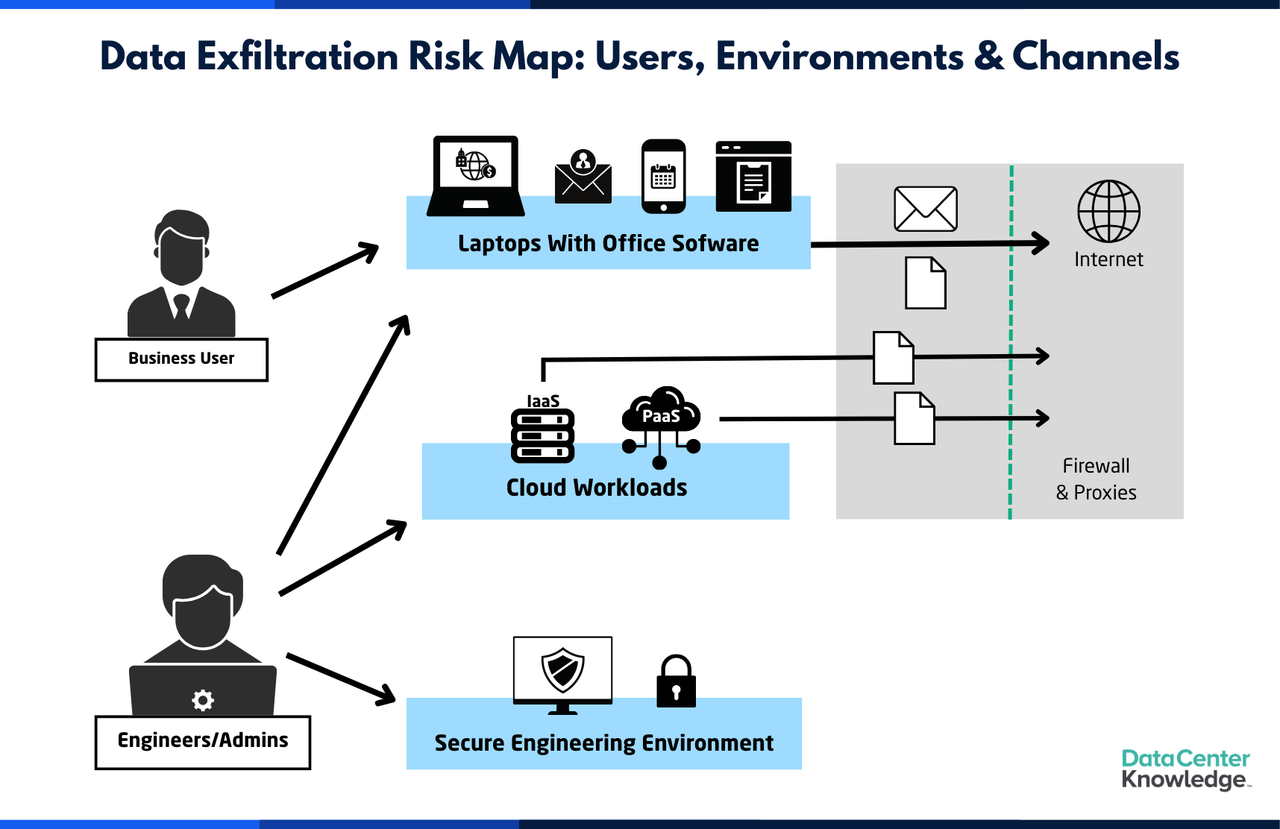
Cloud DLP Playbook: Stopping Data Leaks Before They Happen

To get started on a cloud DLP strategy, organizations must answer two key questions: Which users should be included in the scope?; and Which communication channels should the DLP system cover Addressing these questions can help organizations create a well-defined and actionable cloud DLP strategy that aligns with their broader security and compliance objectives. ... Unlike business users, engineers and administrators require elevated access and permissions to perform their jobs effectively. While they might operate under some of the same technical restrictions, they often have additional capabilities to exfiltrate files. ... While DLP tools serve as the critical last line of defense against active data exfiltration attempts, organizations should not rely only on these tools to prevent data breaches. Reducing the amount of sensitive data circulating within the network can significantly lower risks. ... Network DLP inspects traffic originating from laptops and servers, regardless of whether it comes from browsers, tools, applications, or command-line operations. It also monitors traffic from PaaS components and VMs, making it a versatile system for cloud environments. While network DLP requires all traffic to pass through a network component, such as a proxy, it is indispensable for monitoring data transfers originating from VMs and PaaS services.


Weighing the true cost of transformation

“Most costs aren’t IT costs, because digital transformation isn’t an IT project,” he says. “There’s the cost of cultural change in the people who will have to adopt the new technologies, and that’s where the greatest corporate effort is required.” Dimitri also highlights the learning curve costs. Initially, most people are naturally reluctant to change and inefficient with new technology. ... “Cultural transformation is the most significant and costly part of digital transformation because it’s essential to bring the entire company on board,” Dimitri says. ... Without a structured approach to change, even the best technological tools fail as resistance manifests itself in subtle delays, passive defaults, or a silent return to old processes. Change, therefore, must be guided, communicated, and cultivated. Skipping this step is one of the costliest mistakes a company can make in terms of unrealized value. Organizations must also cultivate a mindset that embraces experimentation, tolerates failure, and values ​​continuous learning. This has its own associated costs and often requires unlearning entrenched habits and stepping out of comfort zones. There are other implicit costs to consider, too, like the stress of learning a new system and the impact on staff morale. If not managed with empathy, digital transformation can lead to burnout and confusion, so ongoing support through a hyper-assistance phase is needed, especially during the first weeks following a major implementation.


5 Costly Customer Data Mistakes Businesses Will Make In 2025

As AI continues to reshape the business technology landscape, one thing remains unchanged: Customer data is the fuel that fires business engines in the drive for value and growth. Thanks to a new generation of automation and tools, it holds the key to personalization, super-charged customer experience, and next-level efficiency gains. ... In fact, low-quality customer data can actively degrade the performance of AI by causing “data cascades” where seemingly small errors are replicated over and over, leading to large errors further along the pipeline. That isn't the only problem. Storing and processing huge amounts of data—particularly sensitive customer data—is expensive, time-consuming and confers what can be onerous regulatory obligations. ... Synthetic customer data lets businesses test pricing strategies, marketing spend, and product features, as well as virtual behaviors like shopping cart abandonment, and real-world behaviors like footfall traffic around stores. Synthetic customer data is far less expensive to generate and not subject to any of the regulatory and privacy burdens that come with actual customer data. ... Most businesses are only scratching the surface of the value their customer data holds. For example, Nvidia reports that 90 percent of enterprise customer data can’t be tapped for value. Usually, this is because it’s unstructured, with mountains of data gathered from call recordings, video footage, social media posts, and many other sources.


Vibe coding is dead: Agentic swarm coding is the new enterprise moat

“Even Karpathy’s vibe coding term is legacy now. It’s outdated,” Val Bercovici, chief AI officer of WEKA, told me in a recent conversation. “It’s been superseded by this concept of agentic swarm coding, where multiple agents in coordination are delivering… very functional MVPs and version one apps.” And this comes from Bercovici, who carries some weight: He’s a long-time infrastructure veteran who served as a CTO at NetApp and was a founding board member of the Cloud Native Compute Foundation (CNCF), which stewards Kubernetes. The idea of swarms isn't entirely new — OpenAI's own agent SDK was originally called Swarm when it was first released as an experimental framework last year. But the capability of these swarms reached an inflection point this summer. ... Instead of one AI trying to do everything, agentic swarms assign roles. A "planner" agent breaks down the task, "coder" agents write the code, and a "critic" agent reviews the work. This mirrors a human software team and is the principle behind frameworks like Claude Flow, developed by Toronto-based Reuven Cohen. Bercovici described it as a system where "tens of instances of Claude code in parallel are being orchestrated to work on specifications, documentation... the full CICD DevOps life cycle." This is the engine behind the agentic swarm, condensing a month of teamwork into a single hour.


The Role of Human-in-the-Loop in AI-Driven Data Management

Human-in-the-loop (HITL) is no longer a niche safety net—it’s becoming a foundational strategy for operationalizing trust. Especially in healthcare and financial services, where data-driven decisions must comply with strict regulations and ethical expectations, keeping humans strategically involved in the pipeline is the only way to scale intelligence without surrendering accountability. ... The goal of HITL is not to slow systems down, but to apply human oversight where it is most impactful. Overuse can create workflow bottlenecks and increase operational overhead. But underuse can result in unchecked bias, regulatory breaches, or loss of public trust. Leading organizations are moving toward risk-based HITL frameworks that calibrate oversight based on the sensitivity of the data and the consequences of error. ... As AI systems become more agentic—capable of taking actions, not just making predictions—the role of human judgment becomes even more critical. HITL strategies must evolve beyond spot-checks or approvals. They need to be embedded in design, monitored continuously, and measured for efficacy. For data and compliance leaders, HITL isn’t a step backward from digital transformation. It provides a scalable approach to ensure that AI is deployed responsibly—especially in sectors where decisions carry long-term consequences.


AI vs Gen Z: How AI has changed the career pathway for junior developers

Ethical dilemmas aside, an overreliance on AI obviously causes an atrophy of skills for young thinkers. Why spend time reading your textbooks when you can get the answers right away? Why bother working through a particularly difficult homework problem when you can just dump it into an AI to give you the answer? To form the critical thinking skills necessary for not just a fruitful career, but a happy life, must include some of the discomfort that comes from not knowing. AI tools eliminate the discovery phase of learning—that precious, priceless part where you root around blindly until you finally understand. ... The truth is that AI has made much of what junior developers of the past did redundant. Gone are the days of needing junior developers to manually write code or debug, because now an already tenured developer can just ask their AI assistant to do it. There’s even some sentiment that AI has made junior developers less competent, and that they’ve lost some of the foundational skills that make for a successful entry-level employee. See above section on AI in school if you need a refresher on why this might be happening. ... More optimistic outlooks on the AI job market see this disruption as an opportunity for early career professionals to evolve their skillsets to better fit an AI-driven world. If I believe in nothing else, I believe in my generation’s ability to adapt, especially to technology.

Daily Tech Digest - July 02, 2025


Quote for the day:

"Success is not the absence of failure; it's the persistence through failure." -- Aisha Tyle


How cybersecurity leaders can defend against the spur of AI-driven NHI

Many companies don’t have lifecycle management for all their machine identities and security teams may be reluctant to shut down old accounts because doing so might break critical business processes. ... Access-management systems that provide one-time-use credentials to be used exactly when they are needed are cumbersome to set up. And some systems come with default logins like “admin” that are never changed. ... AI agents are the next step in the evolution of generative AI. Unlike chatbots, which only work with company data when provided by a user or an augmented prompt, agents are typically more autonomous, and can go out and find needed information on their own. This means that they need access to enterprise systems, at a level that would allow them to carry out all their assigned tasks. “The thing I’m worried about first is misconfiguration,” says Yageo’s Taylor. If an AI agent’s permissions are set incorrectly “it opens up the door to a lot of bad things to happen.” Because of their ability to plan, reason, act, and learn AI agents can exhibit unpredictable and emergent behaviors. An AI agent that’s been instructed to accomplish a particular goal might find a way to do it in an unanticipated way, and with unanticipated consequences. This risk is magnified even further, with agentic AI systems that use multiple AI agents working together to complete bigger tasks, or even automate entire business processes. 


The silent backbone of 5G & beyond: How network APIs are powering the future of connectivity

Network APIs are fueling a transformation by making telecom networks programmable and monetisable platforms that accelerate innovation, improve customer experiences, and open new revenue streams.  ... Contextual intelligence is what makes these new-generation APIs so attractive. Your needs change significantly depending on whether you’re playing a cloud game, streaming a match, or participating in a remote meeting. Programmable networks can now detect these needs and adjust dynamically. Take the example of a user streaming a football match. With network APIs, a telecom operator can offer temporary bandwidth boosts just for the game’s duration. Once it ends, the network automatically reverts to the user’s standard plan—no friction, no intervention. ... Programmable networks are expected to have the greatest impact in Industry 4.0, which goes beyond consumer applications. ... 5G combined IOT and with network APIs enables industrial systems to become truly connected and intelligent. Remote monitoring of manufacturing equipment allows for real-time maintenance schedule adjustments based on machine behavior. Over a programmable, secure network, an API-triggered alert can coordinate a remote diagnostic session and even start remedial actions if a fault is found.


Quantum Computers Just Reached the Holy Grail – No Assumptions, No Limits

A breakthrough led by Daniel Lidar, a professor of engineering at USC and an expert in quantum error correction, has pushed quantum computing past a key milestone. Working with researchers from USC and Johns Hopkins, Lidar’s team demonstrated a powerful exponential speedup using two of IBM’s 127-qubit Eagle quantum processors — all operated remotely through the cloud. Their results were published in the prestigious journal Physical Review X. “There have previously been demonstrations of more modest types of speedups like a polynomial speedup, says Lidar, who is also the cofounder of Quantum Elements, Inc. “But an exponential speedup is the most dramatic type of speed up that we expect to see from quantum computers.” ... What makes a speedup “unconditional,” Lidar explains, is that it doesn’t rely on any unproven assumptions. Prior speedup claims required the assumption that there is no better classical algorithm against which to benchmark the quantum algorithm. Here, the team led by Lidar used an algorithm they modified for the quantum computer to solve a variation of “Simon’s problem,” an early example of quantum algorithms that can, in theory, solve a task exponentially faster than any classical counterpart, unconditionally.


4 things that make an AI strategy work in the short and long term

Most AI gains came from embedding tools like Microsoft Copilot, GitHub Copilot, and OpenAI APIs into existing workflows. Aviad Almagor, VP of technology innovation at tech company Trimble, also notes that more than 90% of Trimble engineers use Github Copilot. The ROI, he says, is evident in shorter development cycles, and reduced friction in HR and customer service. Moreover, Trimble has introduced AI into their transportation management system, where AI agents optimize freight procurement by dynamically matching shippers and carriers. ... While analysts often lament the difficulty of showing short-term ROI for AI projects, these four organizations disagree — at least in part. Their secret: flexible thinking and diverse metrics. They view ROI not only as dollars saved or earned, but also as time saved, satisfaction increased, and strategic flexibility gained. London says that Upwave listens for customer signals like positive feedback, contract renewals, and increased engagement with AI-generated content. Given the low cost of implementing prebuilt AI models, even modest wins yield high returns. For example, if a customer cites an AI-generated feature as a reason to renew or expand their contract, that’s taken as a strong ROI indicator. Trimble uses lifecycle metrics in engineering and operations. For instance, one customer used Trimble AI tools to reduce the time it took to perform a tunnel safety analysis from 30 minutes to just three.


How IT Leaders Can Rise to a CIO or Other C-level Position

For any IT professional who aspires to become a CIO, the key is to start thinking like a business leader, not just a technologist, says Antony Marceles, a technology consultant and founder of software staffing firm Pumex. "This means taking every opportunity to understand the why behind the technology, how it impacts revenue, operations, and customer experience," he explained in an email. The most successful tech leaders aren't necessarily great technical experts, but they possess the ability to translate tech speak into business strategy, Marceles says, adding that "Volunteering for cross-functional projects and asking to sit in on executive discussions can give you that perspective." ... CIOs rarely have solo success stories; they're built up by the teams around them, Marceles says. "Colleagues can support a future CIO by giving honest feedback, nominating them for opportunities, and looping them into strategic conversations." Networking also plays a pivotal role in career advancement, not just for exposure, but for learning how other organizations approach IT leadership, he adds. Don't underestimate the power of having an executive sponsor, someone who can speak to your capabilities when you’re not there to speak for yourself, Eidem says. "The combination of delivering value and having someone champion that value -- that's what creates real upward momentum."


SLMs vs. LLMs: Efficiency and adaptability take centre stage

SLMs are becoming central to Agentic AI systems due to their inherent efficiency and adaptability. Agentic AI systems typically involve multiple autonomous agents that collaborate on complex, multi-step tasks and interact with environments. Fine-tuning methods like Reinforcement Learning (RL) effectively imbue SLMs with task-specific knowledge and external tool-use capabilities, which are crucial for agentic operations. This enables SLMs to be efficiently deployed for real-time interactions and adaptive workflow automation, overcoming the prohibitive costs and latency often associated with larger models in agentic contexts. ... Operating entirely on-premises ensures that decisions are made instantly at the data source, eliminating network delays and safeguarding sensitive information. This enables timely interpretation of equipment alerts, detection of inventory issues, and real-time workflow adjustments, supporting faster and more secure enterprise operations. SLMs also enable real-time reasoning and decision-making through advanced fine-tuning, especially Reinforcement Learning. RL allows SLMs to learn from verifiable rewards, teaching them to reason through complex problems, choose optimal paths, and effectively use external tools. 


Quantum’s quandary: racing toward reality or stuck in hyperbole?

One important reason is for researchers to demonstrate their advances and show that they are adding value. Quantum computing research requires significant expenditure, and the return on investment will be substantial if a quantum computer can solve problems previously deemed unsolvable. However, this return is not assured, nor is the timeframe for when a useful quantum computer might be achievable. To continue to receive funding and backing for what ultimately is a gamble, researchers need to show progress — to their bosses, investors, and stakeholders. ... As soon as such announcements are made, scientists and researchers scrutinize them for weaknesses and hyperbole. The benchmarks used for these tests are subject to immense debate, with many critics arguing that the computations are not practical problems or that success in one problem does not imply broader applicability. In Microsoft’s case, a lack of peer-reviewed data means there is uncertainty about whether the Majorana particle even exists beyond theory. The scientific method encourages debate and repetition, with the aim of reaching a consensus on what is true. However, in quantum computing, marketing hype and the need to demonstrate advancement take priority over the verification of claims, making it difficult to place these announcements in the context of the bigger picture.


Ethical AI for Product Owners and Product Managers

As the product and customer information steward, the PO/PM must lead the process of protecting sensitive data. The Product Backlog often contains confidential customer feedback, competitive analysis, and strategic plans that cannot be exposed. This guardrail requires establishing clear protocols for what data can be shared with AI tools. A practical first step is to lead the team in a data classification exercise, categorizing information as Public, Internal, or Restricted. Any data classified for internal use, such as direct customer quotes, must be anonymized before being used in an AI prompt. ... AI is proficient at generating text but possesses no real-world experience, empathy, or strategic insight. This guardrail involves proactively defining the unique, high-value work that AI can assist but never replace. Product leaders should clearly delineate between AI-optimal tasks, creating first drafts of technical user stories, summarizing feedback themes, or checking for consistency across Product Backlog items and PO/PM-essential areas. These human-centric responsibilities include building genuine empathy through stakeholder interviews, making difficult strategic prioritization trade-offs, negotiating scope, resolving conflicting stakeholder needs, and communicating the product vision. By modeling this partnership and using AI as an assistant to prepare for strategic work, the PO/PM reinforces that their core value lies in strategy, relationships, and empathy.


Sharded vs. Distributed: The Math Behind Resilience and High Availability

In probability theory, independent events are events whose outcomes do not affect each other. For example, when throwing four dice, the number displayed on each dice is independent of the other three dice. Similarly, the availability of each server in a six-node application-sharded cluster is independent of the others. This means that each server has an individual probability of being available or unavailable, and the failure of one server is not affected by the failure or otherwise of other servers in the cluster. In reality, there may be shared resources or shared infrastructure that links the availability of one server to another. In mathematical terms, this means that the events are dependent. However, we consider the probability of these types of failures to be low, and therefore, we do not take them into account in this analysis.  ... Traditional architectures are limited by single-node failure risk. Application-level sharding compounds this problem because if any node goes down, its shard and therefore the total system becomes unavailable. In contrast, distributed databases with quorum-based consensus (like YugabyteDB) provide fault tolerance and scalability, enabling higher resilience and improved availability.


How FinTechs are turning GRC into a strategic enabler

The misconception that risk management and innovation exist in tension is one that modern FinTechs must move beyond. At its core, cybersecurity – when thoughtfully integrated – serves not as a brake but as an enabler of innovation. The key is to design governance structures that are both intelligent and adaptive (and resilient in itself). The foundation lies in aligning cybersecurity risk management with the broader business objective: enablement. This means integrating security thinking early in the innovation cycle, using standardized interfaces, expectations, and frameworks that don’t obstruct, but rather channel innovation safely. For instance, when risk statements are defined consistently across teams, decisions can be made faster and with greater confidence. Critically, it starts with the threat model. A well-defined, enterprise-level threat model is the compass that guides risk assessments and controls where they matter most. Yet many companies still operate without a clear articulation of their own threat landscape, leaving their enterprise risk strategies untethered from reality. Without this grounding, risk management becomes either overly cautious or blindly permissive, or a bit of both. We place a strong emphasis on bridging the traditional silos between GRC, IT Security, Red Teaming, and Operational teams.