Showing posts with label security testing. Show all posts

Daily Tech Digest - September 18, 2025


Quote for the day:

"When your life flashes before your eyes, make sure you’ve got plenty to watch.” -- Anonymous


The new IT operating model: cloud-managed networking as a strategic lever

Enterprises are navigating an environment where the complexity of IT is increasing exponentially. Hybrid work requires consistent connectivity across homes, offices, and campuses. Edge computing and IoT generate massive volumes of data at distributed sites. Security risks escalate as the attack surface grows. Traditional, hardware-centric approaches leave IT teams struggling to keep up. Managing dozens or hundreds of controllers, patching firmware manually, and troubleshooting issues site by site is not sustainable. Cloud-managed networking changes that equation. By centralizing management, applying AI-driven intelligence, and extending visibility across distributed environments, it enables IT to shift from reactive firefighting to proactive strategy. ... Enterprises adopting cloud-managed networking are making a decisive shift from complexity to clarity. Success requires more than technology alone. It demands a partner that understands how to translate advanced capabilities into measurable business outcomes. ... Cloud-managed networking is not just another IT trend. It is the operating model that will define enterprise technology for the next decade. By elevating the network from infrastructure to strategy, it enables organizations to move faster, stay secure, and innovate with confidence.


Why Shadow AI Is the Next Big Governance Challenge for CISOs

In many respects, shadow AI is a subset of a broader shadow IT problem. Shadow IT is an issue that emerged more than a decade ago, largely emanating from employee use of unauthorized cloud apps, including SaaS. Lohrmann noted that cloud access security broker (CASB) solutions were developed to deal with the shadow IT issue. These tools are designed to provide organizations with full visibility of what employees are doing on the network and on protected devices, while only allowing access to authorized instances. However, shadow AI presents distinct challenges that CASB tools are unable to adequately address. “Organizations still need to address other questions related to licensing, application sprawl, security and privacy policies, procedures and more ..,” Lohrmann noted. A key difference between IT and AI is the nature of data, the speed of adoption and the complexity of the underlying technology. In addition, AI is often integrated into existing IT systems, including cloud applications, making these tools more difficult to identify. Chuvakin added, “With shadow IT, unauthorized tools often leave recognizable traces – unapproved applications on devices, unusual network traffic or access attempts to restricted services. Shadow AI interactions, however, often occur entirely within a web browser or personal device, blending seamlessly with regular online activity or not leaving any trace on any corporate system at all.”


Cisco strengthens integrated IT/OT network and security controls

Melding IT and OT networking and security is not a new idea, but it’s one that has seen growing attention from Cisco. ... Cisco also added a new technology called AI-powered asset clustering to its Cyber Vision OT management suite. Cyber Vison keeps track of devices connected to an industrial network, builds a real-time map of how these devices talk to each other and to IT systems, and can detect abnormal behavior, vulnerabilities, or policy violations that could signal malware, misconfigurations, or insider threats, Cisco says. ... Another significant move that will help IT/OT integration is the planned integration of the management console for Cisco’s Catalyst and Meraki networks. That combination will allow IT and OT teams to see the same dashboard for industrial OT and IT enterprise/campus networks. Cyber Vision will feeds into the dashboard along with other Cisco management offerings such as ThousandEyes, which gives customers a shared inventory of assets, traffic flows and security. “What we are focusing on is helping our customers have the secure networking foundation and architecture that lets IT teams and operational teams kind of have one fabric, one architecture, that goes from the carpeted spaces all the way to the far reaches of their OT network,” Butaney said.


Global hiring risks: What you need to know about identity fraud and screening trends

Most organizations globally include criminal record checks in their pre-employment screening. Employment and education verifications are also common, especially in EMEA and APAC. ... “Employers that fail to strengthen their identity verification processes or overlook recurring discrepancy patterns could face costly consequences, from compliance failures to reputational harm,” said Euan Menzies, President and CEO of HireRight. ... More than three-quarters of businesses globally found at least one discrepancy in a candidate’s background over the past year. Thirteen percent reported finding one discrepancy for every five candidates screened. Employment verification remains the area where most inconsistencies are discovered, especially in APAC and EMEA. These discrepancies range from minor errors like incorrect dates to more serious issues such as fabricated job histories. ... Companies are increasingly adopting post-hire screening to address risks that emerge after someone is hired. In North America, only 38 percent of companies now say they do no post-hire screening, a sharp drop from 57 percent last year. Common post-hire checks include driver monitoring and periodic rescreening for regulated roles. These efforts help companies catch new issues such as undisclosed criminal activity, changes in legal eligibility to work, or evolving insider threats.


Doomprompting: Endless tinkering with AI outputs can cripple IT results

Some LLMs appear to be designed to encourage long-lasting conversation loops, with answers often spurring another prompt. ... “When an individual engineer is prompting an AI, they get a pretty good response pretty quick,” he says. “It gets in your head, ‘That’s pretty good; surely, I could get to perfect.’ And you get to the point where it’s the classic sunk-cost fallacy, where the engineer is like, ‘I’ve spent all this time prompting, surely I can prompt myself out of this hole.’” The problem often happens when the project lacks definitions of what a good result looks like, he adds. “Employees who don’t really understand the goal they’re after will spin in circles not knowing when they should just call it done or step away,” Farmer says. “The enemy of good is perfect, and LLMs make us feel like if we just tweak that last prompt a little bit, we’ll get there.” ... Govindarajan has seen some IT teams get stuck in “doom loops” as they add more and more instructions to agents to refine the outputs. As organizations deploy multiple agents, constant tinkering with outputs can slow down deployments and burn through staff time, he says. “The whole idea of doomprompting is basically putting that instruction down and hoping that it works as you set more and more instructions, some of them contradicting with each other,” he adds. “It comes at the sacrifice of system intelligence.”


Vanishing Public Record Makes Enterprise Data a Strategic Asset

“We are rapidly running out of public data that is credible and usable. More and more enterprises will start to assign value to their data and go beyond partnerships to monetize it. For example, wind measurements captured by a wind turbine company could be helpful to many businesses that are not competitors,” said Olga Kupriyanova, principal consultant of AI and data engineering at ISG. ... "We’re entering a defining moment in AI where access to reliable, scalable, and ethical data is quickly becoming the central bottleneck, and also the most valuable asset. As legal and regulatory pressure tightens access to public data, due to copyright lawsuits, privacy concerns, or manipulation of open data repositories, enterprises are being forced to rethink where their AI advantage will come from,” said Farshid Sabet, CEO and co-founder at Corvic AI, developer of a GenAI management platform. ... The economic consequences of such data loss are already visible. Analysts estimate that U.S. public data underpinned nearly $750 billion of business activity as recently as 2022, according to the Department of Commerce. The loss of such data blinds companies that build models for everything from supply chain forecasting to investment strategy and predictions.


The Architecture of Responsible AI: Balancing Innovation and Accountability

The field of AI governance suffers from what Mackenzie et al reaffirm as the “principal-agent problem,” where one party (the principal) delegates tasks to another party (the agent). But their interests are not perfectly aligned, leading to potential conflicts and inefficiencies. ... Architects occupy a unique position in this landscape. Unlike regulators who may impose constraints post-design, architects work at the intersection of possibility and constraint. They must balance competing requirements, such as performance and privacy, efficiency and equity, speed and safety, within coherent system designs. Every architectural decision must embed values, priorities, and assumptions about how systems should behave. ... current AI guidance suffers from systematic weaknesses: evidence quality is sacrificed for speed, commercial interests masquerade as objective advice, and some perspectives dominate while broader stakeholder voices remain unheard ... Architects, being well-placed to bridge the gap between strategy and technology, hold a key role in establishing the principles that govern how systems behave, interact, and evolve. In the context of AI, this principle set extends beyond technical design. It encompasses the ethical, social, and legal aspects as well. .


AI will make workers ‘busier in the future’ – so what’s the point exactly?

“I have to admit that I’m afraid to say that we are going to be busier in the future than now,” he told host Liz Claman. “And the reason for that is because a lot of different things that take a long time to do are now faster to do. I’m always waiting for work to get done because I’ve got more ideas.” ... “The more productive we are, the more opportunity we get to pursue new ideas,” Huang continued. Reading between the lines here, it seems the so-called efficiency gains afforded by AI will mean workers have more work dumped in their laps – onto the next task, no rest for the wicked, etc. Huang’s comments run counter to the prevailing sentiment among big tech executives on exactly what AI will deliver for both enterprises and individual workers. ... We’ve all read the marketing copy and heard it regurgitated by tech leaders on podcasts and keynote stages – AI will allow us to focus on the “more rewarding” aspects of our jobs. They’ve never fully explained what this entails, or how it will pan out in the workplace. To be quite honest, I don’t think they know what it means. Marketing probably made it up and they’ve stuck with it. ... Will we be busier spending time on those rewarding aspects of our jobs? I have to say, I’m doubtful. The reality is that workers will be pulled into other tasks and merely end up drowning in the same cumbersome workloads they’ve been dealing with since the pandemic.


Building Safer Digital Experiences Through Robust Testing Practices

Secure software testing forms the bedrock of resilient applications, proactively uncovering flaws before they become critical. Early testing practices can significantly reduce risks, costs, and exposure to threats. According to Global Market Insights, the growing number and size of data breaches have increased the need for security testing services. Organizations that heavily use security AI and automation save an average of USD 1.76 million compared to those that don’t. About 51% plan to increase their security spending. Early integration of techniques like Static Application Security Testing (SAST) can detect vulnerabilities in existing code. It can also help to fix bugs during development. ... Organizations must verify that their systems handle personal data securely and comply with global regulations like GDPR and CCPA. Testing ensures sensitive information is protected from leaks or unauthorized use. Americans are highly concerned about how companies use their private data. ... Stress testing evaluates how applications perform under extreme loads. It helps identify potential failures in scalability, response times, and resource management. Vulnerability assessments concentrate on uncovering security gaps. Verified Market Reports notes that, after recent financial crises, governments are putting stronger emphasis on stress testing.


Prompt Engineering Is Dead – Long Live PromptOps

PromptOps is gaining traction rapidly because it has the potential to address major challenges in the use of LLMs, such as prompt drift and suboptimal output. Yet incorporating PromptOps effectively into an organization is far from simple, requiring a structured and clear process, the right tools, and a mindset that enables collaboration and effective centralization. Digging deeper into what PromptOps is, why it is needed, and how it can be implemented effectively can help companies to find the right approach when incorporating this methodology for improving their LLM applications usage. ... Before PromptOps is implemented, an organization typically has prompts scattered across multiple teams and tools, with no structured management in place. The first stage of implementing PromptOps involves gathering every detail on LLM applications usage within an organization. It is essential to understand precisely which prompts are being used, by which teams, and with which models. The next stage is to build consistency into this practice by incorporating versioning and testing. Adding secure access control at this stage is also important, in order to ensure only those who need it have access to prompts. With these practices in place, organizations will be well-positioned to introduce cross-model design and embed core compliance and security practices into all prompt crafting. 

Daily Tech Digest - September 13, 2025


Quote for the day:

"Small daily improvements over time lead to stunning results." -- Robin Sharma


When it comes to AI, bigger isn’t always better

Developers were already warming to small language models, but most of the discussion has focused on technical or security advantages. In reality, for many enterprise use cases, smaller, domain-specific models often deliver faster, more relevant results than general-purpose LLMs. Why? Because most business problems are narrow by nature. You don’t need a model that has read TS Eliot or that can plan your next holiday. You need a model that understands your lead times, logistics constraints, and supplier risk. ... Just like in e-commerce or IT architecture, organizations are increasingly finding success with best-of-breed strategies, using the right tool for the right job and connecting them through orchestrated workflows. I contend that AI follows a similar path, moving from proof-of-concept to practical value by embracing this modular, integrated approach. Plus, SLMs aren’t just cheaper than larger models, they can also outperform them. ... The strongest case for the future of generative AI? Focused small language models, continuously enriched by a living knowledge graph. Yes, SLMs are still early-stage. The tools are immature, infrastructure is catching up, and they don’t yet offer the plug-and-play simplicity of something like an OpenAI API. But momentum is building, particularly in regulated sectors like law enforcement where vendors with deep domain expertise are already driving meaningful automation with SLMs.


Building Sovereign Data‑Centre Infrastructure in India

Beyond regulatory drivers, domestic data centre capacity delivers critical performance and compliance advantages. Locating infrastructure closer to users through edge or regional facilities has evidently delivered substantial performance gains, with studies demonstrating latency reductions of more than 80 percent compared to centralised cloud models. This proximity directly translates into higher service quality, enabling faster digital payments, smoother video streaming, and more reliable enterprise cloud applications. Local hosting also strengthens resilience and simplifies compliance by reducing dependence on centralised infrastructure and obligations, such as rapid incident reporting under Section 70B of the Information Technology (Amendment) Act, 2008, that are easier to fulfil when infrastructure is located within the country. ... India’s data centre expansion is constrained by key challenges in permitting, power availability, water and cooling, equipment procurement, and skilled labour. Each of these bottlenecks has policy levers that can reduce risk, lower costs, and accelerate delivery. ... AI-heavy workloads are driving rack power densities to nearly three times those of traditional applications, sharply increasing cooling demand. This growth coincides with acute groundwater stress in many Indian cities, where freshwater use for industrial cooling is already constrained. 


How AI is helping one lawyer get kids out of jail faster

Anderson said his use of AI saves up to 94% of evidence review time for his juvenile clients age 12-18. Anderson can now prepare for a bail hearing in half an hour versus days. The time saved by using AI also results in thousands of dollars in time saved. While the tools for AI-based video analysis are many, Anderson uses Rev, a legal-tech AI tool that transcribes and indexes video evidence to quickly turn overwhelming footage into accurate, searchable information. ... “The biggest ROI is in critical, time-sensitive situations, like a bail hearing. If a DA sends me three hours of video right after my client is arrested, I can upload it to Rev and be ready to make a bail argument in half an hour. This could be the difference between my client being held in custody for a week versus getting them out that very day. The time I save allows me to focus on what I need to do to win a case, like coming up with a persuasive argument or doing research.” ... “We are absolutely at an inflection point. I believe AI is leveling the playing field for solo and small practices. In the past, all of the time-consuming tasks of preparing for trial, like transcribing and editing video, were done manually. Rev has made it so easy to do on the fly, by myself, that I don’t have to anticipate where an officer will stray in their testimony. I can just react in real time. This technology empowers a small practice to have the same capabilities as a large one, allowing me to focus on the work that matters most.”


AI-powered Pentesting Tool ‘Villager’ Combines Kali Linux Tools with DeepSeek AI for Automated Attacks

The emergence of Villager represents a significant shift in the cybersecurity landscape, with researchers warning it could follow the malicious use of Cobalt Strike, transforming from a legitimate red-team tool into a weapon of choice for malicious threat actors. Unlike traditional penetration testing frameworks that rely on scripted playbooks, Villager utilizes natural language processing to convert plain text commands into dynamic, AI-driven attack sequences. Villager operates as a Model Context Protocol (MCP) client, implementing a sophisticated distributed architecture that includes multiple service components designed for maximum automation and minimal detection. ... This tool’s most alarming feature is its ability to evade forensic detection. Containers are configured with a 24-hour self-destruct mechanism that automatically wipes activity logs and evidence, while randomized SSH ports make detection and forensic analysis significantly more challenging. This transient nature of attack containers, combined with AI-driven orchestration, creates substantial obstacles for incident response teams attempting to track malicious activity. ... Villager’s task-based command and control architecture enables complex, multi-stage attacks through its FastAPI interface operating on port 37695.


Cloud DLP Playbook: Stopping Data Leaks Before They Happen

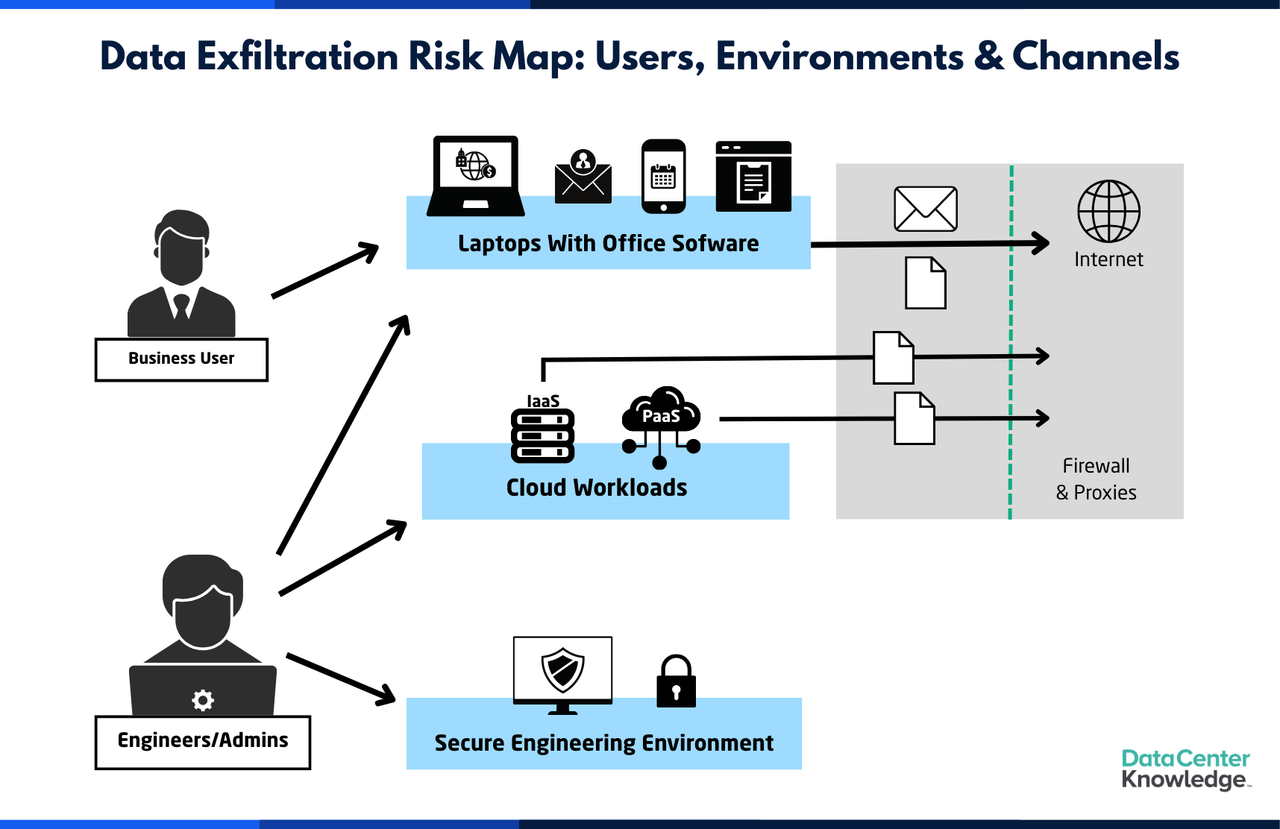
To get started on a cloud DLP strategy, organizations must answer two key questions: Which users should be included in the scope?; and Which communication channels should the DLP system cover Addressing these questions can help organizations create a well-defined and actionable cloud DLP strategy that aligns with their broader security and compliance objectives. ... Unlike business users, engineers and administrators require elevated access and permissions to perform their jobs effectively. While they might operate under some of the same technical restrictions, they often have additional capabilities to exfiltrate files. ... While DLP tools serve as the critical last line of defense against active data exfiltration attempts, organizations should not rely only on these tools to prevent data breaches. Reducing the amount of sensitive data circulating within the network can significantly lower risks. ... Network DLP inspects traffic originating from laptops and servers, regardless of whether it comes from browsers, tools, applications, or command-line operations. It also monitors traffic from PaaS components and VMs, making it a versatile system for cloud environments. While network DLP requires all traffic to pass through a network component, such as a proxy, it is indispensable for monitoring data transfers originating from VMs and PaaS services.


Weighing the true cost of transformation

“Most costs aren’t IT costs, because digital transformation isn’t an IT project,” he says. “There’s the cost of cultural change in the people who will have to adopt the new technologies, and that’s where the greatest corporate effort is required.” Dimitri also highlights the learning curve costs. Initially, most people are naturally reluctant to change and inefficient with new technology. ... “Cultural transformation is the most significant and costly part of digital transformation because it’s essential to bring the entire company on board,” Dimitri says. ... Without a structured approach to change, even the best technological tools fail as resistance manifests itself in subtle delays, passive defaults, or a silent return to old processes. Change, therefore, must be guided, communicated, and cultivated. Skipping this step is one of the costliest mistakes a company can make in terms of unrealized value. Organizations must also cultivate a mindset that embraces experimentation, tolerates failure, and values ​​continuous learning. This has its own associated costs and often requires unlearning entrenched habits and stepping out of comfort zones. There are other implicit costs to consider, too, like the stress of learning a new system and the impact on staff morale. If not managed with empathy, digital transformation can lead to burnout and confusion, so ongoing support through a hyper-assistance phase is needed, especially during the first weeks following a major implementation.


5 Costly Customer Data Mistakes Businesses Will Make In 2025

As AI continues to reshape the business technology landscape, one thing remains unchanged: Customer data is the fuel that fires business engines in the drive for value and growth. Thanks to a new generation of automation and tools, it holds the key to personalization, super-charged customer experience, and next-level efficiency gains. ... In fact, low-quality customer data can actively degrade the performance of AI by causing “data cascades” where seemingly small errors are replicated over and over, leading to large errors further along the pipeline. That isn't the only problem. Storing and processing huge amounts of data—particularly sensitive customer data—is expensive, time-consuming and confers what can be onerous regulatory obligations. ... Synthetic customer data lets businesses test pricing strategies, marketing spend, and product features, as well as virtual behaviors like shopping cart abandonment, and real-world behaviors like footfall traffic around stores. Synthetic customer data is far less expensive to generate and not subject to any of the regulatory and privacy burdens that come with actual customer data. ... Most businesses are only scratching the surface of the value their customer data holds. For example, Nvidia reports that 90 percent of enterprise customer data can’t be tapped for value. Usually, this is because it’s unstructured, with mountains of data gathered from call recordings, video footage, social media posts, and many other sources.


Vibe coding is dead: Agentic swarm coding is the new enterprise moat

“Even Karpathy’s vibe coding term is legacy now. It’s outdated,” Val Bercovici, chief AI officer of WEKA, told me in a recent conversation. “It’s been superseded by this concept of agentic swarm coding, where multiple agents in coordination are delivering… very functional MVPs and version one apps.” And this comes from Bercovici, who carries some weight: He’s a long-time infrastructure veteran who served as a CTO at NetApp and was a founding board member of the Cloud Native Compute Foundation (CNCF), which stewards Kubernetes. The idea of swarms isn't entirely new — OpenAI's own agent SDK was originally called Swarm when it was first released as an experimental framework last year. But the capability of these swarms reached an inflection point this summer. ... Instead of one AI trying to do everything, agentic swarms assign roles. A "planner" agent breaks down the task, "coder" agents write the code, and a "critic" agent reviews the work. This mirrors a human software team and is the principle behind frameworks like Claude Flow, developed by Toronto-based Reuven Cohen. Bercovici described it as a system where "tens of instances of Claude code in parallel are being orchestrated to work on specifications, documentation... the full CICD DevOps life cycle." This is the engine behind the agentic swarm, condensing a month of teamwork into a single hour.


The Role of Human-in-the-Loop in AI-Driven Data Management

Human-in-the-loop (HITL) is no longer a niche safety net—it’s becoming a foundational strategy for operationalizing trust. Especially in healthcare and financial services, where data-driven decisions must comply with strict regulations and ethical expectations, keeping humans strategically involved in the pipeline is the only way to scale intelligence without surrendering accountability. ... The goal of HITL is not to slow systems down, but to apply human oversight where it is most impactful. Overuse can create workflow bottlenecks and increase operational overhead. But underuse can result in unchecked bias, regulatory breaches, or loss of public trust. Leading organizations are moving toward risk-based HITL frameworks that calibrate oversight based on the sensitivity of the data and the consequences of error. ... As AI systems become more agentic—capable of taking actions, not just making predictions—the role of human judgment becomes even more critical. HITL strategies must evolve beyond spot-checks or approvals. They need to be embedded in design, monitored continuously, and measured for efficacy. For data and compliance leaders, HITL isn’t a step backward from digital transformation. It provides a scalable approach to ensure that AI is deployed responsibly—especially in sectors where decisions carry long-term consequences.


AI vs Gen Z: How AI has changed the career pathway for junior developers

Ethical dilemmas aside, an overreliance on AI obviously causes an atrophy of skills for young thinkers. Why spend time reading your textbooks when you can get the answers right away? Why bother working through a particularly difficult homework problem when you can just dump it into an AI to give you the answer? To form the critical thinking skills necessary for not just a fruitful career, but a happy life, must include some of the discomfort that comes from not knowing. AI tools eliminate the discovery phase of learning—that precious, priceless part where you root around blindly until you finally understand. ... The truth is that AI has made much of what junior developers of the past did redundant. Gone are the days of needing junior developers to manually write code or debug, because now an already tenured developer can just ask their AI assistant to do it. There’s even some sentiment that AI has made junior developers less competent, and that they’ve lost some of the foundational skills that make for a successful entry-level employee. See above section on AI in school if you need a refresher on why this might be happening. ... More optimistic outlooks on the AI job market see this disruption as an opportunity for early career professionals to evolve their skillsets to better fit an AI-driven world. If I believe in nothing else, I believe in my generation’s ability to adapt, especially to technology.

Daily Tech Digest - August 19, 2025


Quote for the day:

“A great person attracts great people and knows how to hold them together. “ -- Johann Wolfgang von Goethe


What happens when penetration testing goes virtual and gets an AI coach

Researchers from the University of Bari Aldo Moro propose using Cyber Digital Twins (CDTs) and generative AI to create realistic, interactive environments for cybersecurity education. Their framework simulates IT, OT, and IoT systems in a controlled virtual space and layers AI-driven feedback on top. The goal is to improve penetration testing skills and strengthen understanding of the full cyberattack lifecycle. At the center of the framework is the Red Team Knife (RTK), a toolkit that integrates common penetration testing tools like Nmap, theHarvester, sqlmap, and others. What makes RTK different is how it walks learners through the stages of the Cyber Kill Chain model. It prompts users to reflect on next steps, reevaluate earlier findings, and build a deeper understanding of how different phases connect. ... This setup reflects the non-linear nature of real-world penetration testing. Learners might start with a network scan, move on to exploitation, then loop back to refine reconnaissance based on new insights. RTK helps users navigate this process with suggestions that adapt to each situation. The research also connects this training approach to a broader concept called Cyber Social Security, which focuses on the intersection of human behavior, social factors, and cybersecurity. 


7 signs it’s time for a managed security service provider

When your SOC team is ignoring 300 daily alerts and manually triaging what should be automated, that’s your cue to consider an MSSP, says Toby Basalla, founder and principal data consultant at data consulting firm Synthelize. When confusion reigns, who in the SOC team knows which red flag actually means something? Plus, if you’re depending on one person to monitor traffic during off-hours, and that individual is out sick, what happens then? ... Organizations typically realize they need an MSSP when their internal team struggles to keep pace with alerts, incident response, or compliance requirements, says Ensar Seker, CISO at SOCRadar, where he specializes in threat intelligence, ransomware mitigation, and supply chain security. This vulnerability becomes particularly evident after a close call or audit finding, when gaps in visibility, threat detection, or 24/7 coverage become undeniable. ... Many smaller enterprises simply can’t afford the cost of a full-time cybersecurity staff, or even a single dedicated expert. This leaves such organizations particularly vulnerable to all types of attacks. An MSSP can significantly help such organizations by providing a full array of services, including 24/7 monitoring, threat detection, incident response, and access to a broad range of specialized security tools and expertise. “They bring economies of scale, proactive threat intelligence, and a deep understanding of best practices,” Young says.


Cyber Security Responsibilities of Roles Involved in Software Development

Building secure software is crucial as a vulnerable software would be an easy target for the cyber criminals to exploit. There are people, process and technology forming part of the software supply chain and it is very important that all of these plays a role in securing the supply chain. While process and technology play the role of enablers, it is people who should buy-in and adapt to the mindset of ensuring security in every aspect of their routine work. ... This includes developers implementing secure coding techniques, security teams identifying vulnerabilities, and everyone involved staying updated on the latest threats and best practices to prevent potential security breaches. Whatever said and done, the root cause of a vulnerability in a software ultimately boils down to people, because someone somewhere had missed something and thus a security defect creeps in to the supply chain and shows up as a vulnerability. It could be a missed requirement by the Business Analyst or a simple coding mistake by a developer. So, everyone involved in the software development right from gathering requirements to deployment of the software in production environment need to have the sense of cyber security in what they do. Even those involved in support and maintenance of software systems also has a role in keeping the software secure.


Build Boringly Reliable ai Into Your DevOps

Observability for ai is different because “correctness” isn’t binary and inputs are messy. We focus on three pillars: live service metrics, evaluation metrics (task success, hallucination rate), and lineage. The first pillar looks like any microservice: we scrape metrics and trace request/response cycles. We prefer OpenTelemetry for traces because we can tag spans with prompt IDs, model routes, and experiment flags. The benefit is obvious when a perf spike happens and you can isolate it to “experiment=prompt_v17.” ... Costs don’t explode; they creep—one verbose chain-of-thought at a time. We price every inference the same way we price a SQL query: tokens in, tokens out, latency, and downstream work. For a customer-support deflection bot, we discovered that truncating history to the last 6 messages cut average tokens by 41% with no measurable drop in solved-rate over 30 days. That was an easy win. Harder wins come from selective routing: ship easy tasks to a small, fast model; escalate only when confidence is low. ... Data quality makes or breaks ai results. Before we debate model choices, we sanitize inputs, enforce schemas, and redact PII. You don’t want a customer’s credit card to become part of your “context.” We’ve had great results with a lightweight validation layer in the request path and daily batch checks on the source corpora. 


Why Training Won’t Solve the Citizen Developer Security Problem

In most organizations, security training is a core component of cybersecurity frameworks and often a compliance requirement. Helping employees recognize and respond to cyber threats significantly reduces human error, the leading cause of security breaches. That said, traditional security training for technically inclined IT staff and developer teams is already a formidable challenge. Rolling out training for citizen developers—employees with little to no formal IT or security background— is exponentially harder for several reasons ... It’s a well-known fact: security training has always struggled to deliver lasting behavioral change. For two decades, employees have been told, “Don’t click suspicious links in emails.” Yet, click rates on phishing emails remain stubbornly high. Why? Human error is persistent, so training alone is not enough. In response, businesses are layering technology — advanced email gateways, sandboxing, Endpoint Detection and Response (EDR), and real-time URL scanning — around users to compensate for their inevitable lapses in judgment. ... Unfortunately, traditional AppSec tools fall short for no-code apps, which aren’t built line by line and rely on proprietary logic inaccessible to standard code scans. Even with access, interpreting their risks demands specialized cybersecurity expertise, rendering traditional code-scanning tools ineffective.


6 signs of a dying digital transformation

“It’s a fundamental disconnect where the technology being implemented simply isn’t delivering the promised improvements to operations, customer experience, or competitive advantage.” This indicator, he notes, often reveals itself as a growing cynicism within the organization, with teams feeling like they’re simply “doing digital” for its own sake without a clear understanding of the “why” or seeing any real positive impact. ... When users aren’t interested or feel no need to use the transformation’s new tools or applications, it indicates a disconnect between the users, their goals, and actual business outcomes, says Aparna Achanta, IBM Consulting’s cybersecurity strategist and AI governance and transformation leader. To successfully address this issue, Achanta recommends aligning digital transformation with the overall business vision, making sure that the voices of end-users and customers are being heard. ... Strong business leadership, and a willingness to admit mistakes, are essential to digital transformation success, Hochman says. “Too often, enterprises run away from failure.” He notes that such moments are actually golden opportunities to break paradigms and try new approaches. “The more failures a company speaks openly about, the more innovation occurs.” ... “Adoption is the oxygen of transformation,” he says. 


Why Master Data Management Is Even More Important Now

There is a mindset shift that must happen to get people to buy into the cost and the overhead of managing the data in a way that's going to be usable, Thompson says. “It’s knowing how to match technology up with a set of business processes, internal culture, commitment to do things properly and tie [that] to a business outcome that makes sense,” he says. “[T]he level of maturity of some good companies is bad. They’re just bad at managing their data assets.” ... “[MDM] has very real business consequences, and I think that's the part that we can all do better is to start talking about the business outcome, because these business outcomes are so serious and so easy to understand that it shouldn't be hard to get business leaders behind it,” says Thompson. “But if you try to get business leaders behind MDM, it sounds like you want to undertake a science project with their help. It’s not about the MDM, it’s about the business outcome that you can get if you do a great job at MDM.” ... In older organizations, MDM maturity tends to be unevenly distributed. The core data tends to be fairly well organized and managed, but the rest isn’t. The age-old problem of data ownership and a reticence to share data doesn’t help. “The notion of data mesh [is] I’ll manage this piece, and you manage that piece. We’ll be disconnected but we can connect, and you can use it, but don’t mess with it. It’s mine,” says Landry.


How to Future-Proof Your Data and AI Strategy

The earlier you find a software bug, the less expensive it is to fix and the less negative customer impact it has – this is a basic principle of software development. And the value of a shift-left approach becomes even more apparent when applied to data privacy in the age of AI. If you use personal information to train models and realize later that you shouldn’t have, the only solution is to roll back the model, which also rolls back the value of the system and the competitive advantage it was intended to deliver. ... Companies need a scalable approach to determine where to go deep and where to move quickly. Prioritize based on impact by applying stricter controls where AI is high-risk or high-stakes, such as projects where AI is core to the functionality of new solutions or segments of the business. Apply lighter-touch governance where risk is low and build scalable policies that align governance intensity with business context, risk appetite, and innovation goals. ... Future-proofing your data and AI strategy is more than having the right tools and processes; it’s a mindset. If your approach isn’t designed for scalability and agility, it can quickly become a source of friction. A rigid, compliance-focused model makes even the best tools feel ineffective and can result in governance being seen as a bottleneck rather than a value driver.


The Unavoidable ‘SCREAM’: Why Enterprise Architecture Must Transform for the Organization of Tomorrow

In an era where every discussion, whether personal or organizational, is steeped in the pervasive influence of AI and data, one naturally questions the true state of Enterprise Architecture (EA) within most organizations today. Too often, we observe situational chaos and a predominantly reactive posture, where EA teams find themselves supporting hasty executive decisions in a culture of order-taking. Businesses, in turn, perceive Information Technology as slow to deliver, while IT teams, grappling with a perceived lack of business understanding, struggle to demonstrate timely value. This dynamic often leads to organizations becoming vendor-driven, with core architectural management often unaddressed. Despite this, there’s no doubt that the demand for Enterprise Architecture is surging. However, the existing challenges—from the sheer breadth of required skillsets and knowledge to the overwhelming abundance of frameworks to choose from—frequently plunge EA practices into moments of SCREAM: Situational Chaotic Realities of Enterprise Architecture Management. However, among these challenges, there persists a profound desire for adaptive design and resilient enterprise architecture. Significant architectural efforts are indeed undertaken across organizations of all sizes. The equilibrium that every organization truly needs, however, often feels elusive.


Microsoft Morphs Fusion Developers To Full Stack Builders

Citizen development is a thorny subject; allowing business “laypersons” to impact the way software application code is structured, aligned and executed is an unpopular concept with command line purists who would prefer to keep the suits at arm’s length, if not further. ... The central argument from Silver and Cunningham is that it’s really tough to teach businesspeople to code and, equally tough to teach software engineers the principles of business operations. The Redmond pair suggest that Microsoft Power Platform will provide the “scaffolding” for full-stack teams to fuse (yes, okay, we’re not using that word anymore) their two previously quite separate working environments. ... To make full-stack development a reality inside any given organization, Microsoft has said that there will need to be a degree of initial investment into engineering systems and context. This, then, would be the scaffolding. Redmond suggests that new applications will emerge that are architected to support natural language development, augmentation and modification. With boundaries, safeguards and guardrails in place to oversee what AI agents can do when left in the hands of businesspeople, software systems will need to be engineered with enough meta-knowledge to understand the business context of the decisions that might be made without breaking other parts of the system. 

Daily Tech Digest - August 14, 2025


Quote for the day:

"Act as if what you do makes a difference. It does." -- William James


What happens the day after superintelligence?

As context, artificial superintelligence (ASI) refers to systems that can outthink humans on most fronts, from planning and reasoning to problem-solving, strategic thinking and raw creativity. These systems will solve complex problems in a fraction of a second that might take the smartest human experts days, weeks or even years to work through. ... So ask yourself, honestly, how will humans act in this new reality? Will we reflexively seek advice from our AI assistants as we navigate every little challenge we encounter? Or worse, will we learn to trust our AI assistants more than our own thoughts and instincts? ... Imagine walking down the street in your town. You see a coworker heading towards you. You can’t remember his name, but your AI assistant does. It detects your hesitation and whispers the coworker’s name into your ears. The AI also recommends that you ask the coworker about his wife, who had surgery a few weeks ago. The coworker appreciates the sentiment, then asks you about your recent promotion, likely at the advice of his own AI. Is this human empowerment, or a loss of human agency? ... Many experts believe that body-worn AI assistants will make us feel more powerful and capable, but that’s not the only way this could go. These same technologies could make us feel less confident in ourselves and less impactful in our lives.


Confidential Computing: A Solution to the Uncertainty of Using the Public Cloud

Confidential computing is a way to ensure that no external party can look at your data and business logic while it is executed. It looks to secure Data in Use. When you now add to that the already established way to secure Data at Rest and Data in Transit it can be ensured that most likely no external party can access secured data running in a confidential computing environment wherever that may be. ... To be able to execute services in the cloud the company needs to be sure that the data and the business logic cannot be accessed or changed from third parties especially by the system administrator of that cloud provider. It needs to be protected. Or better, it needs to be executed in the Trusted Compute Base (TCB) of the company. This is the environment where specific security standards are set to restrict all possible access to data and business logic. ... Here attestation is used to verify that a confidential environment (instance) is securely running in the public cloud and it can be trusted to implement all the security standards necessary. Only after successful attestation the TCB is then extended into the Public cloud to incorporate the attested instances. One basic requirement of attestation is that the attestation service is located independently of the infrastructure where the instance is running. 


Open Banking's Next Phase: AI, Inclusion and Collaboration

Think of open banking as the backbone for secure, event-driven automation: a bill gets paid, and a savings allocation triggers instantly across multiple platforms. The future lies in secure, permissioned coordination across data silos, and when applied to finance, it unlocks new, high-margin services grounded in trust, automation and personalisation. ... By building modular systems that handle hierarchy, fee setup, reconciliation and compliance – all in one cohesive platform – we can unlock new revenue opportunities. ... Regulators must ensure they are stepping up efforts to sustain progress and support fintech innovation whilst also meeting their aim to keep customers safe. Work must also be done to boost public awareness of the value of open banking. Many consumers are unaware of the financial opportunities open banking offers and some remain wary of sharing their data with unknown third parties. ... Rather than duplicating efforts or competing head-to-head, institutions and fintechs should focus on co-developing shared infrastructure. When core functions like fee management, operational controls and compliance processes are unified in a central platform, fintechs can innovate on customer experience, while banks provide the stability, trust and reach. 


Data centers are eating the economy — and we’re not even using them

Building new data centers is the easy solution, but it’s neither sustainable nor efficient. As I’ve witnessed firsthand in developing compute orchestration platforms, the real problem isn’t capacity. It’s allocation and optimization. There’s already an abundant supply sitting idle across thousands of data centers worldwide. The challenge lies in efficiently connecting this scattered, underutilized capacity with demand. ... The solution isn’t more centralized infrastructure. It’s smarter orchestration of existing resources. Modern software can aggregate idle compute from data centers, enterprise servers, and even consumer devices into unified, on-demand compute pools. ... The technology to orchestrate distributed compute already exists. Some network models already demonstrate how software can abstract away the complexity of managing resources across multiple providers and locations. Docker containers and modern orchestration tools make workload portability seamless. The missing piece is just the industry’s willingness to embrace a fundamentally different approach. Companies need to recognize that most servers are idle 70%-85% of the time. It’s not a hardware problem requiring more infrastructure. 


How an AI-Based 'Pen Tester' Became a Top Bug Hunter on HackerOne

While GenAI tools can be extremely effective at finding potential vulnerabilities, XBOW's team found they were't very good at validating the findings. The trick to making a successful AI-driven pen tester, Dolan-Gavitt explained, was to use something other than an LLM to verify the vulnerabilities. In this case of XBOW, researchers used a deterministic validation approach. "Potentially, maybe in a couple years down the road, we'll be able to actually use large language models out of the box to verify vulnerabilities," he said. "But for today, and for the rest of this talk, I want to propose and argue for a different way, which is essentially non-AI, deterministic code to validate vulnerabilities." But AI still plays an integral role with XBOW's pen tester. Dolan-Gavitt said the technology uses a capture-the-flag (CTF) approach in which "canaries" are placed in the source code and XBOW sends AI agents after them to see if they can access them. For example, he said, if researchers want to find a remote code execution (RCE) flaw or an arbitrary file read vulnerability, they can plant canaries on the server's file system and set the agents loose. ... Dolan-Gavitt cautioned that AI-powered pen testers are not panacea. XBOW still sees some false positives because some vulnerabilities, like business logic flaws, are difficult to validate automatically.


Data Governance Maturity Models and Assessments: 2025 Guide

Data governance maturity frameworks help organizations assess their data governance capabilities and guide their evolution toward optimal data management. To implement a data governance or data management maturity framework (a “model”) it is important to learn what data governance maturity is, explore how and why it should be assessed, discover various maturity models and their features, and understand the common challenges associated with using maturity models. Data governance maturity refers to the level of sophistication and effectiveness with which an organization manages its data governance processes. It encompasses the extent to which an organization has implemented, institutionalized, and optimized its data governance practices. A mature data governance framework ensures that the organization can support its business objectives with accurate, trusted, and accessible data. Maturity in data governance is typically assessed through various models that measure different aspects of data management such as data quality and compliance and examine processes for managing data’s context (metadata) and its security. Maturity models provide a structured way to evaluate where an organization stands and how it can improve for a given function.


Open-source flow monitoring with SENSOR: Benefits and trade-offs

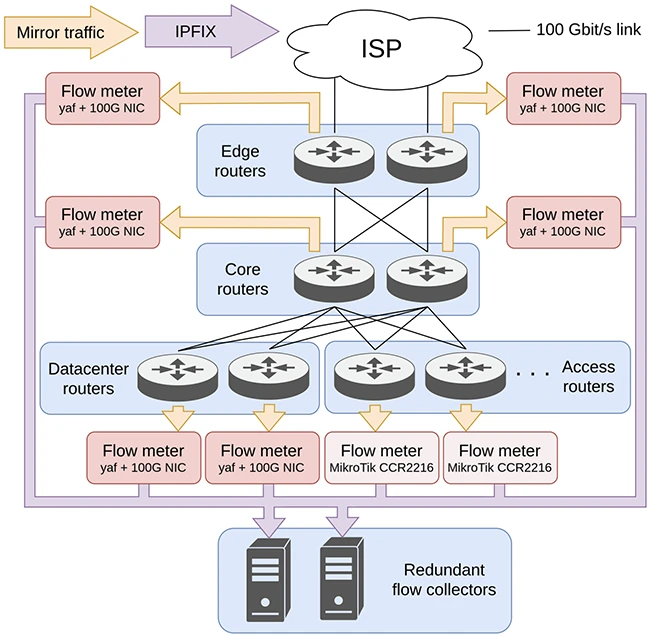
Most flow monitoring setups rely on embedded flow meters that are locked to a vendor and require powerful, expensive devices. SENSOR shows it’s possible to build a flexible and scalable alternative using only open tools and commodity hardware. It also allows operators to monitor internal traffic more comprehensively, not just what crosses the network border. ... For a large network, that can make troubleshooting and oversight more complex. “Something like this is fine for small networks,” David explains, “but it certainly complicates troubleshooting and oversight on larger networks.” David also sees potential for SENSOR to expand beyond historical analysis by adding real-time alerting. “The paper doesn’t describe whether the flow collectors can trigger alarms for anomalies like rapidly spiking UDP traffic, which could indicate a DDoS attack in progress. Adding real-time triggers like this would be a valuable enhancement that makes SENSOR more operationally useful for network teams.” ... “Finally, the approach is fragile. It relies on precise bridge and firewall configurations to push traffic through the RouterOS stack, which makes it sensitive to updates, misconfigurations, or hardware changes. 


Network Segmentation Strategies for Hybrid Environments

It's not a simple feat to implement network segmentation. Network managers must address network architectural issues, obtain tools and methodologies, review and enact security policies, practices and protocols, and -- in many cases -- overcome political obstacles. ... The goal of network segmentation is to place the most mission-critical and sensitive resources and systems under comprehensive security for a finite ecosystem of users. From a business standpoint, it's equally critical to understand the business value of each network asset and to gain support from users and management before segmenting. ... Divide the network segments logically into security segments based on workload, whether on premises, cloud-based or within an extranet. For example, if the Engineering department requires secure access to its product configuration system, only that team would have access to the network segment that contains the Engineering product configuration system. ... A third prong of segmented network security enforcement in hybrid environments is user identity management. Identity and access management (IAM) technology identifies and tracks users at a granular level based on their authorization credentials in on-premises networks but not on the cloud. 


Convergence of AI and cybersecurity has truly transformed the CISO’s role

The most significant impact of AI in security at present is in automation and predictive analysis. Automation especially when enhanced with AI, such as integrating models like Copilot Security with tools like Microsoft Sentinel allows organisations to monitor thousands of indicators of compromise in milliseconds and receive instant assessments. ... The convergence of AI and cybersecurity has truly transformed the CISO’s role, especially post-pandemic when user locations and systems have become unpredictable. Traditionally, CISOs operated primarily as reactive defenders responding to alerts and attacks as they arose. Now, with AI-driven predictive analysis, we’re moving into a much more proactive space. CISOs are becoming strategic risk managers, able to anticipate threats and respond with advanced tools. ... Achieving real-time threat detection in the cloud through AI requires the integration of several foundational pillars that work in concert to address the complexity and speed of modern digital environments. At the heart of this approach is the adoption of a Zero Trust Architecture: rather than assuming implicit trust based on network perimeters, this model treats every access request whether to data, applications, or infrastructure as potentially hostile, enforcing strict verification and comprehensive compliance controls. 


Initial Access Brokers Selling Bundles, Privileges and More

"By the time a threat actor logs in using the access and privileged credentials bought from a broker, a lot of the heavy lifting has already been done for them. Therefore, it's not about if you're exposed, but whether you can respond before the intrusion escalates." More than one attacker may use any given initial access, either because the broker sells it to multiple customers, or because a customer uses the access for one purpose - say, to steal data - then sells it on to someone else, who perhaps monetizes their purchase by further ransacking data and unleashing ransomware. "Organizations that unwittingly have their network access posted for sale on initial access broker forums have already been victimized once, and they are on their way to being victimized once again when the buyer attacks," the report says. ... "Access brokers often create new local or domain accounts, sometimes with elevated privileges, to maintain persistence or allow easier access for buyers," says a recent report from cybersecurity firm Kela. For detecting such activity, "unexpected new user accounts are a major red flag." So too is "unusual login activity" to legitimate accounts that traces to never-before-seen IP addresses, or repeat attempts that only belatedly succeed, Kela said. "Watch for legitimate accounts doing unusual actions or accessing resources they normally don't - these can be signs of account takeover."

Daily Tech Digest - August 08, 2025


Quote for the day:

“Every adversity, every failure, every heartache carries with it the seed of an equal or greater benefit.” -- Napoleon Hill


Major Enterprise AI Assistants Can Be Abused for Data Theft, Manipulation

In the case of Copilot Studio agents that engage with the internet — over 3,000 instances have been found — the researchers showed how an agent could be hijacked to exfiltrate information that is available to it. Copilot Studio is used by some organizations for customer service, and Zenity showed how it can be abused to obtain a company’s entire CRM. When Cursor is integrated with Jira MCP, an attacker can create malicious Jira tickets that instruct the AI agent to harvest credentials and send them to the attacker. This is dangerous in the case of email systems that automatically open Jira tickets — hundreds of such instances have been found by Zenity. In a demonstration targeting Salesforce’s Einstein, the attacker can target instances with case-to-case automations — again hundreds of instances have been found. The threat actor can create malicious cases on the targeted Salesforce instance that hijack Einstein when they are processed by it. The researchers showed how an attacker could update the email addresses for all cases, effectively rerouting customer communication through a server they control. In a Gemini attack demo, the experts showed how prompt injection can be leveraged to get the gen-AI tool to display incorrect information. 


Who’s Leading Whom? The Evolving Relationship Between Business and Data Teams

As the data boom matured, organizations realized that clear business questions weren’t enough. If we wanted analytics to drive value, we had to build stronger technical teams, including data scientists and machine learning engineers. And we realized something else: we had spent years telling business leaders they needed a working knowledge of data science. Now we had to tell data scientists they needed a working knowledge of the business. This shift in emphasis was necessary, but it didn’t go perfectly. We had told the data teams to make their work useful, usable, and used, and they took that mandate seriously. But in the absence of clear guidance and shared norms, they filled in the gap in ways that didn’t always move the business forward. ... The foundation of any effective business-data partnership is a shared understanding of what actually counts as evidence. Without it, teams risk offering solutions that don’t stand up to scrutiny, don’t translate into action, or don’t move the business forward. A shared burden of proof makes sure that everyone is working from the same assumptions about what’s convincing and credible. This shared commitment is the foundation that allows the organization to decide with clarity and confidence. 


A new worst coder has entered the chat: vibe coding without code knowledge

A clear disconnect then stood out to me between the vibe coding of this app and the actual practiced work of coding. Because this app existed solely as an experiment for myself, the fact that it didn’t work so well and the code wasn’t great didn’t really matter. But vibe coding isn’t being touted as “a great use of AI if you’re just mucking about and don’t really care.” It’s supposed to be a tool for developer productivity, a bridge for nontechnical people into development, and someday a replacement for junior developers. That was the promise. And, sure, if I wanted to, I could probably take the feedback from my software engineer pals and plug it into Bolt. One of my friends recommended adding “descriptive class names” to help with the readability, and it took almost no time for Bolt to update the code.  ... The mess of my code would be a problem in any of those situations. Even though I made something that worked, did it really? Had this been a real work project, a developer would have had to come in after the fact to clean up everything I had made, lest future developers be lost in the mayhem of my creation. This is called the “productivity tax,” the biggest frustration that developers have with AI tools, because they spit out code that is almost—but not quite—right.


From WAF to WAAP: The Evolution of Application Protection in the API Era

The most dangerous attacks often use perfectly valid API calls arranged in unexpected sequences or volumes. API attacks don't break the rules. Instead, they abuse legitimate functionality by understanding the business logic better than the developers who built it. Advanced attacks differ from traditional web threats. For example, an SQL injection attempt looks syntactically different from legitimate input, making it detectable through pattern matching. However, an API attack might consist of perfectly valid requests that individually pass all schema validation tests, with the malicious intent emerging only from their sequence, timing, or cross-endpoint correlation patterns. ... The strategic value of WAAP goes well beyond just keeping attackers out. It's becoming a key enabler for faster, more confident API development cycles. Think about how your API security works today — you build an endpoint, then security teams manually review it, continuous penetration testing (link is external) breaks it, you fix it, and around and around you go. This approach inevitably creates friction between velocity and security. Through continuous visibility and protection, WAAP allows development teams to focus on building features rather than manually hardening each API endpoint. Hence, you can shift the traditional security bottleneck into a security enablement model. 


Scrutinizing LLM Reasoning Models

Assessing CoT quality is an important step towards improving reasoning model outcomes. Other efforts attempt to grasp the core cause of reasoning hallucination. One theory suggests the problem starts with how reasoning models are trained. Among other training techniques, LLMs go through multiple rounds of reinforcement learning (RL), a form of machine learning that teaches the difference between desirable and undesirable behavior through a point-based reward system. During the RL process, LLMs learn to accumulate as many positive points as possible, with “good” behavior yielding positive points and “bad” behavior yielding negative points. While RL is used on non-reasoning LLMs, a large amount of it seems to be necessary to incentivize LLMs to produce CoT, which means that reasoning models generally receive more of it. ... If optimizing for CoT length leads to confused reasoning or inaccurate answers, it might be better to incentivize models to produce shorter CoT. This is the intuition that inspired researchers at Wand AI to see what would happen if they used RL to encourage conciseness and directness rather than verbosity. Across multiple experiments conducted in early 2025, Wand AI’s team discovered a “natural correlation” between CoT brevity and answer accuracy, challenging the widely held notion that the additional time and compute required to create long CoT leads to better reasoning outcomes.


4 regions you didn't know already had age verification laws – and how they're enforced

Australia’s 2021 Online Safety Act was less focused on restricting access to adult content than it was on tackling issues of cyberbullying and online abuse of children, especially on social media platforms. The act introduced a legal framework to allow people to request the removal of hateful and abusive content,  ... Chinese law has required online service providers to implement a real-name registration system for over a decade. In 2012, the Decision on Strengthening Network Information Protection was passed, before being codified into law in 2016 as the Cybersecurity Law. The legislation requires online service providers to collect users’ real names, ID numbers, and other personal information. ... As with the other laws we’ve looked at, COPPA has its fair share of critics and opponents, and has been criticized as being both ineffective and unconstitutional by experts. Critics claim that it encourages users to lie about their age to access content, and allows websites to sidestep the need for parental consent. ... In 2025, the European Commission took the first steps towards creating an EU-wide strategy for age verification on websites when it released a prototype app for a potential age verification solution called a mini wallet, which is designed to be interoperable with the EU Digital Identity Wallet scheme.


The AI-enabled company of the future will need a whole new org chart

Let’s say you’ve designed a multi-agent team of AI products. Now you need to integrate them into your company by aligning them with your processes, values and policies. Of course, businesses onboard people all the time – but not usually 50 different roles at once. Clearly, the sheer scale of agentic AI presents its own challenges. Businesses will need to rely on a really tight onboarding process. The role of the agent onboarding lead creates the AI equivalent of an employee handbook: spelling out what agents are responsible for, how they escalate decisions, and where they must defer to humans. They’ll define trust thresholds, safe deployment criteria, and sandbox environments for gradual rollout. ... Organisational change rarely fails on capability – it fails on culture. The AI Culture & Collaboration Officer protects the human heartbeat of the company through a time of radical transition. As agents take on more responsibilities, human employees risk losing a sense of purpose, visibility, or control. The culture officer will continually check how everyone feels about the transition. This role ensures collaboration rituals evolve, morale stays intact, and trust is continually monitored — not just in the agents, but in the organisation’s direction of travel. It’s a future-facing HR function with teeth.


The Myth of Legacy Programming Languages: Age Doesn't Define Value

Instead of trying to define legacy languages based on one or two subjective criteria, a better approach is to consider the wide range of factors that may make a language count as legacy or not. ... Languages may be considered legacy when no one is still actively developing them — meaning the language standards cease receiving updates, often along with complementary resources like libraries and compilers. This seems reasonable because when a language ceases to be actively maintained, it may stop working with modern hardware platforms. ... Distinguishing between legacy and modern languages based on their popularity may also seem reasonable. After all, if few coders are still using a language, doesn't that make it legacy? Maybe, but there are a couple of complications to consider. One is that measuring the popularity of programming languages in a highly accurate way is impossible — so just because one authority deems a language to be unpopular doesn't necessarily mean developers hate it. The other challenge is that when a language becomes unpopular, it tends to mean that developers no longer prefer it for writing new applications. ... Programming languages sometimes end up in the "legacy" bin when they are associated with other forms of legacy technology — or when they lack associations with more "modern" technologies.


From Data Overload to Actionable Insights: Scaling Viewership Analytics with Semantic Intelligence

Semantic intelligence allows users to find reliable and accurate answers, irrespective of the terminology used in a query. They can interact freely with data and discover new insights by navigating massive databases, which previously required specialized IT involvement, in turn, reducing the workload of already overburdened IT teams. At its core, semantic intelligence lays the foundation for true self-serve analytics, allowing departments across an organization to confidently access information from a single source of truth. ... A semantic layer in this architecture lets you query data in a way that feels natural and enables you to get relevant and precise results. It bridges the gap between complex data structures and user-friendly access. This allows users to ask questions without any need to understand the underlying data intricacies. Standardized definitions and context across the sources streamlines analytics and accelerates insights using any BI tool of choice. ... One of the core functions of semantic intelligence is to standardize definitions and provide a single source of truth. This improves overall data governance with role-based access controls and robust security at all levels. In addition, row- and column-level security at both user and group levels can ensure that access to specific rows is restricted for specific users. 


Why VAPT is now essential for small & medium business security

One misconception, often held by smaller companies, is that they are less likely to be targeted. Industry experts disagree. "You might think, 'Well, we're a small company. Who'd want to hack us?' But here's the hard truth: Cybercriminals love easy targets, and small to medium businesses often have the weakest defences," states a representative from Borderless CS. VAPT combines two different strategies to identify vulnerabilities and potential entry points before malicious actors do. A Vulnerability Assessment scans servers, software, and applications for known problems in a manner similar to a security walkthrough of a physical building. Penetration Testing (often shortened to pen testing) simulates real attacks, enabling businesses to understand how a determined attacker might breach their systems. ... Borderless CS maintains that VAPT is applicable across sectors. "Retail businesses store customer data and payment info. Healthcare providers hold sensitive patient information. Service companies often rely on cloud tools and email systems that are vulnerable. Even a small eCommerce store can be a jackpot for the wrong person. Cyber attackers don't discriminate. In fact, they often prefer smaller businesses because they assume you haven't taken strong security measures. Let's not give them that satisfaction."