Daily Tech Digest - December 21, 2022

The Cybersecurity Industry Doesn't Have a Stress Problem — It Has a Leadership Problem

Many of the cybersecurity issues raised in the CIISec survey point to a need for strong leadership that proactively identifies and resolves issues. But cybersecurity teams need servant leaders, not those who lead by establishing command and control structures. Servant leaders create authority by — you guessed it — serving their employees. Cybersecurity executives of this ilk are concerned about the well-being of the team, regularly checking in with team members on how they are doing, and removing roadblocks that harm operational performance. They'll go to bat with upper management to get an increased budget for new tools and additional staff to smooth out workloads for teams. Servant leaders take turns serving on call to understand work conditions from analysts' perspectives and hold regular team meetings to discuss key trends and issues. They're also likely to look ahead to anticipate market and business developments and reposition their organization to get ready to meet them. As a result, these leaders' teams feel supported. Analysts are not afraid to share problems or new ideas, as they know their leaders will listen, consider them carefully and, most importantly, respond.


Cybersecurity: What is Changing and What Isn’t

A lot of things have changed, but a lot remain the same. Adversaries have gotten smarter, so defense has had to do the same. Every piece of technology has a computer embedded in it nowadays – cars, fridges, thermostats, cameras, speakers, and of course, the ubiquitous mobile phones – resulting in a vastly increased attack surface, and the need for trained professionals to protect this Internet of Things (IoT). The general migration to the cloud has also encouraged the growth of professionals seeking to protect data outside the confines of on-prem systems. However, some core tenets still hold true – restricting user access, limiting system functionality, backing up critical data, planning for disruptions, and of course, security awareness training. Even the best of security controls can be overcome by a user clicking on the wrong link (phishing), visiting the wrong website (drive-by download), connecting to the wrong network (rogue access point), opening the wrong attachment (malicious macro), letting in the wrong person in a secured area (tailgating), or just simply, disclosing the right information to the wrong person (vishing).


Intro to the Observable design pattern

The Observable design pattern is used in many important Java APIs. One well-known example is a JButton that uses the ActionListener API to execute an action. In this example, we have an ActionListener listening or observing on the button. When the button is clicked, the ActionListener performs an action. The Observable pattern is also used with reactive programming. The use of observers in reactive applications makes sense because the essence of reactive is reaction: something happens when another process occurs. Observable is a behavioral design pattern. Its function is to perform an action when an event happens. Two common examples are button clicks and notifications, but there are many more uses for this pattern. ... By using the Observable pattern, the notification would happen only once to all of your subscribers. It's a huge performance gain as well as being an effective code optimization. This code can easily be extended or changed. The reactive programming paradigm uses the Observable pattern everywhere. If you ever worked with Angular, then you will know that using Observable components is very common. 


How to Embed Gen Z in Your Organization’s Security Culture

Providing the most cutting-edge instruction will engage Gen Zers and provide them with meaningful security best practices for work and home. The threat landscape is more dangerous than it was when Gen Zers were coming of age. Current threats extend beyond traditional scams. They may be lurking in the unsecured WiFi available at a coffee shop. All the threat actor needs is someone desperate for free internet and tired of clicking checkboxes. With that ever-changing threat landscape in mind, your organization’s security program needs the resilience to adapt. The IBM Security X-Force Cyber Range provides a variety of experiences to prepare organizations for a cyber incident. The team can also cater content to different audiences, such as the C-suite or the board of directors. Gen Z may not be a part of those groups yet, but the X-Force Cyber Range offers a range of experiences for professionals at all levels. The X-Force Cyber Range team tailors immersive experiences to your organization’s industry and context to provide the most realistic scenario. 


Intelligence and Efficiency Will Guide Unstructured Data Management in 2023

Smarter edge data management will avoid overspending on storing extraneous data in cloud data lakes and warehouses by filtering and deleting non-valuable data at the edge first. Edge analytics tools will quickly process the data without the need to send large files back and forth to cloud or on-premises data centers, saving time and money. The right edge analytics and data management program can deliver real-time insights to improve customer experiences or detect issues quickly, such as a manufacturing defect or a ransomware breach. ... Storage and IT managers will need to prepare by getting full visibility into data across silos, understanding data characteristics and metadata to enable rapid classification and search, and then moving it into the optimal storage tier to feed the data lake and analytics platforms preferred by their end users. IT will need to work closely with stakeholders from security, legal, data governance, research, and data science teams, as well as business unit leaders, to fulfill the requirements of new, unstructured data analytics programs.


The FBI is worried about a wave of cyber crime against America’s small businesses

Small and medium-sized businesses face a big threat from cyberattacks and hackers, according to a special agent in the FBI’s cyber division. “The large businesses continue to invest in their cybersecurity and enhance their cybersecurity posture,” FBI Supervisory Special Agent Michael Sohn said at CNBC’s Small Business Playbook virtual event on Wednesday. “So what the cybercriminals are doing is they’re pivoting, they’re evolving and targeting the soft targets, which are the small and medium businesses.” In 2021, the FBI’s Internet Crime Complaint Center (IC3) received 847,376 complaints from the American public regarding cyberattacks and malicious cyber activity, a 7% year-over-year increase. In total, potential losses from those attacks exceed $6.9 billion, a 64% increase compared to the previous year. “Unfortunately, the majority of those victims were small businesses,” Sohn told CNBC’s Frank Holland. But even as small businesses are increasingly being targeted by hackers and cyber criminals, CNBC and SurveyMonkey data has shown that most small business owners are not concerned.


Healthcare: Essential Defenses for Combating Ransomware

From a defensive standpoint, Siegel says organizations can employ a long list of tactics. Leading up to ransomware, the biggest weakness he sees is a cultural issue, centered on failing to take the risk seriously and make appropriate investments to prevent such incidents. "These are the times we live in, and it's just the cost of doing business," he says. "You have to make these investments." Ransomware attackers gain remote access to a victim's network and typically linger, studying the network and gaining greater access, before deploying crypto-locking malware. Thus, it's imperative to spot those activities before files start getting encrypted. "Most groups now will also want to steal large amounts of data before they launch the ransomware, and then they'll actually plan out how they're going to deploy the ransomware to all of your servers, all of your machines or whichever ones they choose," says Peter Mackenzie, director of incident response at Sophos. "That's not something that happens instantly. That can take days or weeks of preparation."


Engineering AI-Enabled Computer Vision Systems: Lessons From Manufacturing

While traditional non-AI software acts as a tool to execute preset rules, an AI-enabled system makes decisions based on (past) data and probabilistic outcomes, which constitutes a paradigm shift—especially within traditional manufacturing organizations. Therefore, proven software development approaches need to be extended to build and further evolve systems that contain ML components.13 One example is DevOps, which needs to be extended into DataOps or MLOps when developing AI solutions to meet specific requirements of handling the everchanging data. Engineering AI-enabled computer vision systems goes beyond merely building AI algorithms. To build industrial solutions, these AI algorithms need to be embedded into grown-up software products which also poses novel challenges for software engineers. To provide an overview of challenges and success factors in engineering AI-enabled computer vision systems, we analyzed corresponding manufacturing use cases, shadowed project meetings, and incorporated our own expertise.


IT Industry Outlook 2023: Trends Likely to Impact the Industry and Tech Pros

Employers are no longer restricted to hiring candidates that are within a commutable distance of local offices, giving job hunters an opportunity to apply for roles that may not have been open to them previously. “I believe with the continued prevalence of remote working, hiring decisions will become less based on culture fit and similar criteria, and more focused on skills and performance,” Finnigan says. “This will open the door to a much more globally diverse workforce, provided skills gaps continue to close.” ... Replacing early interview screenings with skills-based assessments that mimic a company's tech stack allows hiring managers to assess candidates’ compatibility quickly and accurately, moving only the best through the pipeline. “With this approach, hiring managers can spend more time with candidates who are truly qualified, which can lead to a more accurate decision and a faster time-to-hire,” Finnigan says. Westfall says that smaller organizations may be able to offer IT pros looking for a change of pace an assortment of unique perks, as well as a close-knit company culture and a greater impact on local communities.


APIs are placing your enterprise at risk

Stolen API keys are the culprit behind some of the largest cyberattacks to date. We see the headlines and we read the news stories, but we often fail to realize the broad consequences – particularly the notable impacts on enterprise mobile security. Consider the news earlier this year of 3,000+ mobile applications leaking Twitter’s API keys, meaning bad actors could compromise thousands of individual accounts and conduct a slew of nefarious activities. Imagine if this was your company and the role was reversed and hundreds or even thousands of mobile applications were leaking the API keys to your corporate Gmail, Slack or OneDrive accounts. If this or similar scenarios were to happen, employee devices and sensitive company data would be at extreme risk. The recent push to focus on API security comes at a critical time where more enterprises are relying on enterprise mobility, meaning increasing a reliance on mobile app connectivity. A recent survey of US and UK-based security directors and mobile applications developers found that 74% of respondents felt mobile apps were critical to business success.


Quote for the day:

"Make heroes out of the employees who personify what you want to see in the organization." -- Anita Roddick

Daily Tech Digest - December 20, 2022

Ransomware: It’s coming for your backup servers

Backup and recovery systems are at risk for two types of ransomware attacks: encryption and exfiltration – and most on-premises backup servers are wide open to both. This makes backup systems themselves the primary target of some ransomware groups, and warrants special attention. Hackers understand that backup servers are often under-protected and administered by junior personnel that are less well versed in information security. And it seems no one wants to do something about it lest they become the new backup expert responsible for the server. This is an age-old problem that can allow backup systems to pass under the radar of sound processes that protect most servers. It should be just the opposite. Backup server should be the most updated and secure systems in the data center. They should be the hardest to login to as Administrator or root. And they should require jumping through the most hoops to login remotely. An important role backup servers play is providing the means to recover from a ransomware attack without paying the ransom. 


How We Improved Application’s Resiliency by Uncovering Our Hidden Issues Using Chaos Testing

The goal of chaos engineering is to educate and inform the organization of unknown vulnerabilities and previously unanticipated outcomes of a computer system. A primary focus of these complex testing procedures is to identify hidden problems that can potentially arise during production environments prior to an outage failure outside of the organization’s control. Only then can the disaster recovery team address systematic weaknesses and enhance the system’s overall fault-tolerance and resiliency. Hence, Chaos testing is being carried out at various levels. ... Chaos testing is a new concept, but we always had the mindset to perform it, and we did perform it sometimes, without knowing that it was a chaos testing. It has its own principles, benefits and pitfalls. However, I would advise all teams to weigh the pros and cons of conducting these tests before formulating a plan. You should be very clear as to what you want to achieve from these disruptive tests. Take permissions from your bosses and convince them why it is important to carry out these tests. 


How Our Behavioral Bad Habits Are a Community Trait and Security Problem

Internal naming groups and conventions become exposed to the outside world in a variety of ways. They're buried in website code, detailed in technical documentation or as part of APIs, or just simply published in public system information. Admittedly, this is a very large haystack, but finding the needles is exactly what the patent I was involved in (US Patent 10,515,219) endeavors to do. Site-scanning tools collect a range of information, and unsurprisingly, an overload of information. My approach strips out all the technical programming information (such as markup, JavaScript, etc.), and leaves just words. It then compares results with lists of English words. The algorithm then identifies groupings of words or abbreviations not present in the selected language that, presumably, may signify an internal naming convention or credentials. As is common with brute-force campaigns, it may not, but as the axiom goes, the attacker only needs to be right once, so the ability to generate context-sensitive word lists may make or break your next campaign. This is when the picture may start to become clearer and the shape of things such as user groups, system names, etc., manifest.


The Agile Compromise Calls for Courage

We cannot eliminate the risk of building the wrong thing with better design and more focus groups. We can only do it by shorter and more frequent iterations of a working product that is incomplete and maybe not that great yet. That’s the Agile compromise. Shorter cycles decrease the risk of building the wrong thing but increase the risk of degrading the process. Accruing technical debt is one. Not a necessary consequence, just a standard price to pay for quicker deliveries. No pundit with stories about the constant commitment to quality will convince me otherwise. If you want greater speed, accept more risks. The Agile compromise towards risk-taking also recognizes that software, as a creative discipline, by nature exposes black swans: the risks we didn’t know we would ever run into. No engineering approach provides full reassurance against them, nor can testing and validation ever give you full peace of mind. It’s a little bit scary, but if you pride yourself on an Agile mindset, you must embrace it. Software is complex rather than complicated. Its many moving parts behave in unpredictable ways when unleashed on the world. Risks are a natural part of that property.


GPT: High-tech parlor trick or the first real AI for everyday use?

In many cases, such as ChatGPT, AI is still a parlor trick that will enthrall us until the next trick comes along. In some cases, it’s a useful technology that can augment both human and machine activities through incredibly fast analysis of huge volumes of data to propose a known reaction. You can see the promise of that in the GPT-fueled Copysmith.AI even as you experience the Potemkin village reality of today. At a basic level, AI is pattern matching and correlation done at incredible speeds that allow for fast reactions — faster than what people can do in some cases, like detecting cyberattacks and improving many enterprise activities. The underlying algorithms and the training models that form the engines of AI try to impose some sense onto the information and derived patterns, as well as the consequent reactions. AI is not simply about knowledge or information, though the more information it can successfully correlate and assess, the better AI can function. AI is also not intelligent like humans, cats, dogs, octopi, and so many other creatures in our world.


How you can stop corporate login credential theft

Organizations should take a layered approach to credential management. The goal is to reduce the number of sites users have to put passwords into. Organizations should endeavor to implement single sign-on (SSO) for all reputable necessary work applications and websites. All SaaS providers should support SSO. If there are logins that require different credentials, a password manager would be helpful in the interim. This also provides a way for employees to know if a login page can be trusted, as the password manager won’t offer credentials up for a site it does not recognize. Organizations should also enable multi-factor authentication (MFA) to secure logins. FIDO2 is also gaining adoption. It will provide a more robust solution than traditional authenticator apps, although those apps are still better than codes sent via text messages. Not all of this is foolproof, and risky login pages could slip through the net. A last resort is needed for flagging risky login pages to employees. This can be done by analyzing, in real time, threat intelligence metrics, webpage similarities, domain age and how users got to a login page. 


Security Risks, Serious Vulnerabilities Rampant Among XIoT Devices in the Workplace

The potential intent of assorted Chinese hardware manufacturers (such as Huawei and ZTE) led to a 2018 ban on use of their equipment by federal agencies. These devices remain widely in use in private organizations, however, and sometimes banned devices slip through dragnets via the process of “white labeling”. Organizations also often do not have visibility into the code that XIoT devices run on. When these devices draw on third-party firmware libraries, several possible security risks emerge. One is simply that the vendor will abandon support for the device, no longer issuing security patches to address emerging vulnerabilities. Another is that the code may be maintained by open source developers, who have the capability to insert malicious elements or even abandon or spike the project unexpectedly. A simple problem that has dogged XIoT devices from the very beginning also remains; the manufacturers are often not tech outfits and thus are not familiar with security by design elements, and/or do not have the budget in place to add them and still come in at their desired price points in competitive markets.


Understanding e-signatures: the key differences and requirements

A QES is considered to have more probative value than an AES, which means that courts will give more weight as evidence. The first key difference is that they offer a higher level of security than AES. This is because qualified signatures are created using a qualified signature creation device (QSCD), which stores the signing key. Examples of physical QSCDs include smart cards, SIM cards or USB tokens. It’s also possible for signatories to create a QES without having a physical device in their hands. In this instance, signatories remotely access a signing key, which is stored in a trusted service provider’s data centre. This is often the preferred choice for organisations since it streamlines device management. A QES must also be based on a ‘qualified certificate for electronic signatures’, which is another key difference between an AES and a QES. Only ‘Qualified trust service providers’ (QTSPs) listed on the European Union’s trusted provider database can issue this certificate. To become a QTSP, organisations must successfully complete a series of evaluations and audits that ensure compliance with eIDAS regulations.


Top cloud strategy mistakes CIOs can’t help making

“Not architecting for the cloud,” says IDC analyst Dave McCarthy, when asked where CIOs commonly go wrong when building their cloud strategy. “While it is possible to ‘lift and shift’ existing workloads, enterprises often experience less than desirable costs and performance with this approach. You need to adapt applications to cloud-native concepts to realize the full value.” CIOs also often make the mistake of “not implementing enough automation,” says McCarthy, who is research vice president of cloud and edge infrastructure services for IDC. “Best practices in cloud include automating everything from the deployment of infrastructure and applications to management and security. Most outages or security breaches are the result of manual misconfigurations. But perhaps the worst sin CIOs can make, analysts across the spectrum agree, is fail to plan for the shift in culture and skills required to devise and implement a successful cloud strategy. The cloud functions differently than traditional IT systems, and a cloud strategy must not only require new skills but a change in thinking about how to design and manage the environment, McCarthy says.


What is a business architect and how do you become one?

An enterprise architecture is comprised of different kinds of components (business strategy and outcome, technology platforms and infrastructure, and security), and a business architecture encompasses how all these things come together to best serve the business. It is a component of enterprise architecture. My responsibility as a business architect is to manage the business architecture practice and its governance. I primarily focus on establishing standards and best practices for our team's deliverables and developing relationships within our organization. I also collect information on our business and map domains (including capabilities, value streams, information, and organization) according to the business architecture framework to gain insights. I think business architecture is foundational to organizations today. A strategy is a plan of action to achieve a goal. My team receives business ideas and potential projects that align with our organization's strategies and influence our performance as a leader in our market. 


Quote for the day:

"The leader has to be practical and a realist, yet must talk the language of the visionary and the idealist." -- Eric Hoffer

Daily Tech Digest - December 19, 2022

7 ways CIOs can build a high-performance team

“People want to grow and change, and good business leaders are willing to give them the opportunity to do so,” adds Cohn. Here, you can get HR involved, encouraging them to bring their expertise and ideas to the table to help you come up with the right approach to training and employee development. In addition, it’s important to remember that an empathetic leader understands that people come from different places and therefore won’t grow and develop in the same manner. Modern CIOs must approach upskilling and training with this reality in mind, advises Benjamin Marais, CIO at financial services company Liberty Group SA. You also need to create opportunities that expose your employees to what’s happening outside the business, suggests van den Berg. This is especially true where it pertains to future technologies and skills because if teams know what’s out there, they better understand what they need to do to keep up. Given the rise in competition for skills in the market, you have to demonstrate your best when trying to attract top talent and retain them, stresses Cohn. 


10 Trends in DevOps, Automated Testing and More for 2023

Developers and QA professionals are some of the most sought-after skilled laborers who are acutely aware of the value they provide to organizations. As we head into next year, this group will continue to leverage the demand for their skills in pursuit of their ideal work environment. Companies that do not consider their developer experience and force pre-pandemic systems onto a hybrid-first world set themselves up for failure, especially when tools for remote and virtual testing and quality assurance are readily available. Developer teams also need to be equally equipped for success through the tools and opportunities that can help ensure an innate sense of value to the organization – and if they don’t have the tools they need, these developers will find them elsewhere. ... We’re starting to see consolidation in both the market and in the user personas we’re all chasing. Testing companies are offering monitoring, and monitoring companies are offering testing. This is a natural outcome of the industry’s desire to move toward true observability: deep understanding of real-world user behavior, synthetic user testing, passively watching for signals and doing real-time root cause analysis—all in service of perfecting the customer experience.


The beautiful intersection of simulation and AI

Simulation models can synthesize real-world data that is difficult or expensive to collect into good, clean and cataloged data. While most AI models run using fixed parameter values, they are constantly exposed to new data that may not be captured in the training set. If unnoticed, these models will generate inaccurate insights or fail outright, causing engineers to spend hours trying to determine why the model is not working. ... Businesses have always struggled with time-to-market. Organizations that push a buggy or defective solution to customers risk irreparable harm to their brand, particularly startups. The opposite is true as “also-rans” in an established market have difficulty gaining traction. Simulations were an important design innovation when they were first introduced, but their steady improvement and ability to create realistic scenarios can slow perfectionist engineers. Too often, organizations try to build “perfect” simulation models that take a significant amount of time to build, which introduces the risk that the market will have moved on.


What is VPN split tunneling and should I be using it?

The ability to choose which apps and services use your VPN of choice and which don't is incredibly powerful. Activities like remote work, browsing your bank's website, or online shopping via public Wi-Fi can definitely benefit from the added security of a VPN, but other pursuits, like playing online games or streaming readily available content, can be hurt by the slight delay VPNs may add to your traffic. The modest decrease to your connection speed is barely noticeable for browsing, but can be disastrous for online games. Being able to simultaneously connect to sensitive sites and services through your secure VPN, and to non-sensitive games and apps means you won't constantly need to enable and disable your VPN connection when switching tasks. This is important as forgetting to enable it at the wrong time could leave you exposed to security risks. ... Split tunneling divides your network traffic in two. Your standard, unencrypted traffic continues to flow unimpeded down one path, while your sensitive and secured data gets encrypted and routed through the VPN's private network. It's like having a second network connection that's completely separate, a tiny bit slower, but also far more secure.


Why don’t cloud providers integrate?

Although it’s not an apples-to-apples comparison, Google’s Athos enables enterprises to run applications across clouds and other operating environments, including ones Google doesn’t control. As with Amazon DataZone, it’s very possible to manage third-party data sources. One senior IT executive from a large travel and hospitality company told me on condition of anonymity, “I’m sure [cloud vendors] can integrate with third-party services, but I suspect that’s not a choice they’re willing to make. For instance, they could publish some interfaces for third parties to integrate with their control plane as well as other means in the data plane.” Integration is possible, in other words, but vendors don’t always seem to want it. This desire to control sometimes leads vendors down roads that aren’t optimal for customers. As this IT executive said, “The ecosystem is being broken. Instead of interoperating with third-party services, [cloud vendors often] choose to create API-compatible competing services.” He continued, “There is a zero-sum game mindset here.” Namely, if a customer runs a third-party database and not the vendor’s preferred first-party database, the vendor has lost.


How RegTech helps financial services providers overcome regulation challenges

Two main types of RegTech capabilities are helping financial service institutions stay compliant: software that encompasses the whole system — for example a full client onboarding cycle — and software that manages a particular process, such as reporting or document management. Hugo Larguinho Brás explains: “The technologies that handle the whole process from A to Z are typically heavier to deploy, but they will allow you to cover most of your needs. These are also more expensive and often more difficult to adapt in line with a company’s specificities.” “Meanwhile, those technologies that treat part of the process can be combined with other tools. While this brings more agility, the need to find and combine several tools can also turn your target model more complex to run.” “We see more and more cloud and on-premises solutions available to asset management and securities companies, from software-as-a-service (SaaS) and platform-as-a-service (PaaS) deployed in-house, to solutions combined to outsourced capabilities ...”


What You Need to Know About Hyperscalers

Current hyperscaler adopters are primarily large enterprises. “The speed, efficiencies, and global reach hyperscalers can provide will surpass what most enterprise organizations can build within their own data centers,” Drobisewski says. He predicts that the partnerships being built today between hyperscalers and large enterprises are strategic and will continue to grow in value. “As hyperscalers maintain their focus on lifecycle, performance, and resiliency, businesses can consume hyperscaler services to thrive and accelerate the creation of new digital experiences for their customers,” Drobisewski says. ... Many adopters begin their hyperscaler migration by selecting the software applications that are best suited to run within a cloud environment, Hoecker says. Over time, these organizations will continue to migrate workloads to the cloud as their business goals evolve, he adds. Many hyperscaler adopters, as they become increasingly comfortable with the approach, are beginning to establish multi-cloud estates. “The decision criteria is typically based on performance, cost, security, access to skills, and regulatory and compliance factors,” Hoecker notes.


UID smuggling: A new technique for tracking users online

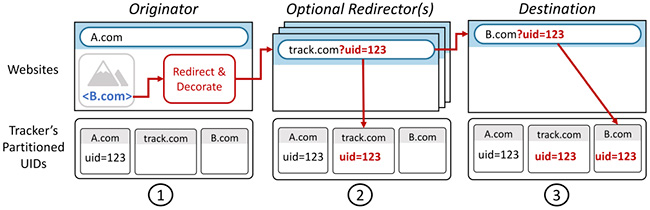
Researchers at UC San Diego have for the first time sought to quantify the frequency of UID smuggling in the wild, by developing a measurement tool called CrumbCruncher. CrumbCruncher navigates the Web like an ordinary user, but along the way, it keeps track of how many times it has been tracked using UID smuggling. The researchers found that UID smuggling was present in about 8 percent of the navigations that CrumbCruncher made. The team is also releasing both their complete dataset and their measurement pipeline for use by browser developers. The team’s main goal is to raise awareness of the issue with browser developers, said first author Audrey Randall, a computer science Ph.D. student at UC San Diego. “UID smuggling is more widely used than we anticipated,” she said. “But we don’t know how much of it is a threat to user privacy.” ... UID smuggling can have legitimate uses, the researchers say. For example, embedding user IDs in URLs can allow a website to realize a user is already logged in, which means they can skip the login page and navigate directly to content.


Bring Sanity to Managing Database Proliferation

How can you avoid being a victim of the bow wave of database proliferation? Recognize that you can allocate your resources in a way that benefits both your bottom line and your stress level by consolidating how you run and manage modern databases. Investing heavily in self-managing the legacy databases used in high volume by many of your people makes a lot of sense. Database workloads that are typically used for mission-critical transaction processing, such as IBM DB2 in financial services, are subject to performance tuning, regular patching and upgrading by specialized database administrators in a kind of siloed sanctum sanctorum. Many organizations will hire an in-house Oracle or SAP Hana expert and create a team, ... But what about the 40 other highly functional, highly desirable cloud databases in your enterprise that aren’t used as often? Do you need another 20 people to manage them? Open source databases like MySQL, MongoDB, Cassandra, PostgreSQL and many others have gained wide adoption, and many of their use cases are considered mission-critical. 


An Ode to Unit Tests: In Defense of the Testing Pyramid

What does the unit in unit tests mean? It means a unit of behavior. There's nothing in that definition dictating that a test has to focus on a single file, object, or function. Why is it difficult to write unit tests focused on behavior? A common problem with many types of testing comes from a tight connection between software structure and tests. That happens when the developer loses sight of the test goal and approaches it in a clear-box (sometimes referred to as white-box) way. Clear-box testing means testing with the internal design in mind to guarantee the system works correctly. This is really common in unit tests. The problem with clear-box testing is that tests tend to become too granular, and you end up with a huge number of tests that are hard to maintain due to their tight coupling to the underlying structure. Part of the unhappiness around unit tests stems from this fact. Integration tests, being more removed from the underlying design, tend to be impacted less by refactoring than unit tests. I like to look at things differently. Is this a benefit of integration tests or a problem caused by the clear-box testing approach? What if we had approached unit tests in an opaque-box approach?


Quote for the day:

"Strategy is not really a solo sport even if you_re the CEO." -- Max McKeown

Daily Tech Digest - December 18, 2022

Shift Left Testing in Microservices Environments

The waterfall model of development involved the explicit passing of responsibilities between highly specialized design, development, QA, and release teams. It also involved lengthy feedback loops. Scrum and agile methodologies made the entire SDLC more flexible and nimble by introducing sprints and allowing more frequent iterative development and delivery. Further, DevOps and DevSecOps focus on removing the silos between development, operations, and security through tooling and automation. As a result, the time to market and quality have improved dramatically. Adding shift left testing into the mix better positions teams to handle the broad range of responsibilities from the design stage through the maintenance stage as effectively as possible. Shift left testing focuses on prevention rather than detection. Shift left benefits include the following:Increase efficiency by eliminating bugs earlier in the SDLC: Reduce human errors and associated costs; Increase delivery speed and reduce the time between releases; Improve the quality of software; Gain a competitive advantage.


Cyber Security Blue Team: Roles, Exercise, Tools & Skills

The blue teams are responsible for establishing security measures around an organization's key assets. Therefore, the blue team conducts a risk assessment by identifying threats and weaknesses these threats can exploit after obtaining data and documenting what needs to be protected. Blue teams perform risk assessments. They identify critical assets, determine what impact their absence will have on the business, and document the importance of these assets. Following that, employees are educated on security procedures, and stricter password policies are implemented to tighten access to the system. A monitoring tool is often installed to log and check access to systems. As part of regular maintenance, blue teams will perform DNS audits, scan internal and external networks for vulnerabilities, and capture network traffic samples. Senior management has a crucial role in this stage since only they can accept a risk or implement mitigating controls. As a result, security controls are often selected based on their cost-benefit ratio.


An AI-Stretch Of The Imagination

Think about yourself as a customer for a moment, about how many businesses have your personal information housed in their data warehouses. Even if they have your permission to store your details and notify you of relevant promotional offers, this does not guarantee your information will not be leaked at some point. Data leaks are not going away any time soon, so businesses focused on enhancing personal and relevant customer experiences—while remaining committed to protecting your privacy—are fast waking up to the value of synthesizing their structured data. By structured data, I mean the hundreds/thousands/millions of rows of data that live in places like databases or CSV files. We’re talking about billions of data points, and this number continues to grow. Here, AI trains on the original data and generates a synthetic version of that data which is privacy safe, with zero links back to any original data points. Not only is it statistically representative, but the data can be modified during the synthesization process; for example, an existing bias can be corrected to produce a more balanced data set.


DNS Is Conduit Into Air-Gapped Networks, Say Researchers

An air-gapped network's DNS server connected to the enterprise IT system has connections to the public DNS system on the internet even if it's kept behind a firewall. That's because of the nature of the DNS system, Uriel Gabay, a Pentera security researcher, tells Information Security Media Group. The DNS is the decentralized system that translates domain names into the numerical IP addresses needed for routing across a network. A large majority of organizations surveyed by IDC earlier this year said they experienced some type of DNS attack in 2022. Most DNS traffic is sent over the UDP protocol, meaning there isn't built-in error detection for packets sent and received as there is in TCP. It's the "received" part of a DNS response that poses a risk. Given the possibility for a DNS request to trace the hops from an air-gapped network to the enterprise network to a public DNS server, a datagram originating from outside the air gap is ultimately received by a computer on the inside. "You allow the response to come into your organization because this is the meaning of allowing the protocol.


10 Most-Liked Programming Languages that Humans Will Use in 2050

JavaScript is a powerful programming languages that is a vital part of the World Wide Web. 98 percent of several sites use it as a client-side programming language. Originally utilized only to build internet browsers, JavaScript is currently used for server-side website deployments and non-internet browser applications. ... Java is a Most Liked programming language that is widely utilized for creating client-server applications. The main benefit of Java is that it is treated as a loosely connected programming language that can be simply worked on any platform and can support Java. Due to this, Java is referred to as the programming language that enable its users to “write once and implement anyplace.” ... Python is simply to learn, object-oriented, and flexible language. It is the best choice of most developers who wish to work on Machine Learning and Artificial Intelligence. It is even utilized for frontend and backend development, web robotization, PC vision, and code testing. With the growth in prerequisite and demand for Data Science and Artificial Intelligence, Python is popular for the upcoming years.


3 types of channels in Microsoft Teams

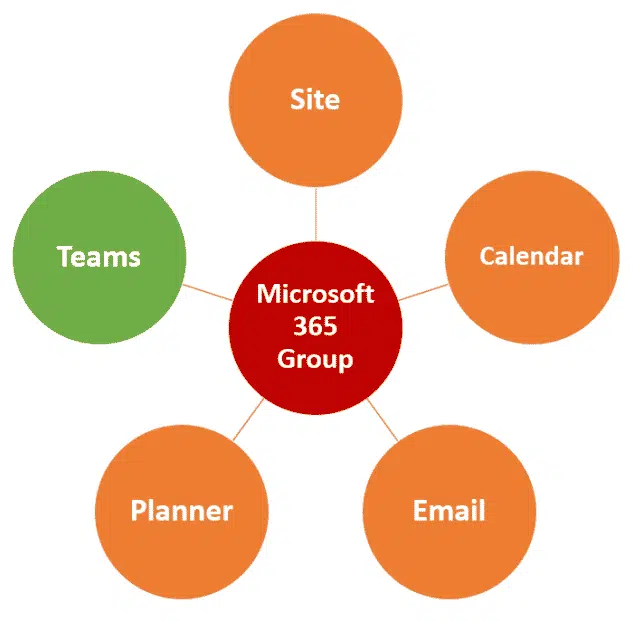
Private Channels can be accessed by those members of the team who were included in the Private Channel. And this is very critical and important to understand. You cannot invite just about anyone into Private Channel. You can only invite users who are already a member of the overall Team. In other words, using the example I mentioned above, I can only include John and Mary in the private channel, who are already members of the Team. I cannot invite David, who is not part of my Team in the first place. So think of Private Channels as almost a separate membership roster available in the overall Team roster (membership). ... The Shared Channel is represented by a “shared” icon on the channel name and is only visible to the members of that shared channel only. It would be invisible to the users who are regular team members and who are not members of that channel. ... You probably already guessed that the file management model for the Shared Channel resembles that of a Private Channel. Just like with Private Channel, a separate SharePoint site is created. It has the same naming convention: [name of the team]-[name of the shared channel].


Accenture shares 9 cybersecurity predictions for 2023

“As the cyber threat landscape evolves, we will see the number of cyber events and organizations held to ransom continue to rise,” said James Nunn-Price, growth markets security lead at Accenture. “With this increase, organizations will continue to make significant investments in their situational awareness, threat-based security monitoring, incident response and crisis management practices.” However, many organizations, including those with mature practices, are still overly reliant on people, and that can slow detection and responses, he said. For example, Accenture found that even when security monitoring teams took action to mitigate attacks, it was still too late to stop data exfiltration. Attackers are using the latest tools and automated technologies to strike fast and hard — to exfiltrate key data and damage infrastructure within minutes. “In 2023, more organizations will prioritize fully automated response technology, as the impacts from a successful breach now far outweigh the risks of these newer technologies, which in turn, frees their people up to focus on how the business can become more cyber resilient, said Nunn-Price.


Meta's Data2vec 2.0: Second time around is faster

The second time around, Meta's scientists made the program faster and, in a few cases, more accurate on benchmark tests of machine learning tasks. "Data2vec 2.0 shows that the training speed of self-supervised learning can be substantially improved with no loss in downstream task accuracy," write authors Alexei Baevski, Arun Babu, Wei-Ning Hsu, and Michael Auli, four of the authors of the original Data2vec paper, in this new work, Efficient Self-supervised Learning with Contextualized Target Representations for Vision, Speech and Language, posted on arXiv. The singular accomplishment of this second Data2vec is to reduce the time it takes to train Data2vec. Training a neural net is typically measured in terms of "epochs," meaning the number of times the neural net is given the training examples. It can also be measured by the wall clock time, the literal hours, minutes, and days counted from start to finish. "Experiments show that Data2vec 2.0 can reach the same accuracy as many popular existing algorithms in 2-16x the training speed," they write.


How The Metaverse Could Impact Businesses In The Not-Too-Distant Future

For engineering, procurement and construction (EPC) companies like my company, Black & Veatch (BV), the metaverse opens a door of opportunity. By placing a top priority on developing and maintaining a strong safety culture, these new technologies provide virtual training experiences that can be designed to closely match real-world situations. Using a game-styled approach, workers can practice safety procedures in the metaverse and be better prepared to work on construction sites. The metaverse can be a new creative way for companies to address a variety of hiring and retention challenges in today’s changing work world. According to Indeed, 88% of employers say they now conduct video interviews with candidates. Most companies said this provides them with an opportunity to engage more leaders in the interview process and allows for more flexibility in scheduling. Another way the metaverse could impact talent management is by using virtual worlds to assess and test skills and performance. 


Dozens of cybersecurity efforts included in this year’s US NDAA

FedRAMP Authorization Act - The bill includes a provision to codify into law and update the Federal Risk and Authorization Management Program (FedRAMP). The FedRAMP program is operated by the General Services Administration (GSA) to provide a standardized, government-wide approach to security assessment, authorization, and continuous monitoring for cloud products and services used by federal government agencies. Protection of critical infrastructure - This provision enhances the military’s ability to step to conduct actions in defense of attacks on critical infrastructure. It states that if “the President determines that there is an active, systematic, and ongoing campaign of attacks in cyberspace by a foreign power against the Government or the critical infrastructure of the United States,” the President may authorize the secretary of defense, acting through the commander of Cybercom, to conduct military cyber activities or operations pursuant to existing statutory war powers in foreign cyberspace to deter, safeguard, or defend against such attacks.


Quote for the day:

"Leadership is based on a spiritual quality; the power to inspire, the power to inspire others to follow." -- Vince Lombardi

Daily Tech Digest - December 17, 2022

Innovation vs. execution: You have to have both

Innovation requires a major marketing commitment. Humans don’t like change, but there’s no way to innovate without introducing change. You have to convince potential buyers that the benefits of the change are worthwhile. If you don’t, you could have the best product around and still falter in the market. Take the Microsoft Zune, for example. It was far more innovative than the iPod at the time. It was more robust, played video, allowed for legal music sharing, and it came in colors. But Microsoft didn’t market those differences, the design was less attractive, The Zune required a subscription, and getting video to work was … problematic. Microsoft fixed the execution problems made the Zune better looking, got video to work, and even made the subscription more compelling. But it cut back on marketing and lost even the fans it had. Innovation needs both execution and marketing to make a difference – and that the most innovative products have the highest execution and marketing needs. Tesla is popular because it hit a niche otherc armakers didn’t take seriously, the ecologically conscious buyer. And its unique vehicle (and strong customer advocacy) allowed it to take market leadership.


The Key Role of Citizen Developers in Creating Digital Transformation

Citizen developers have the potential to create meaningful DX without any of these burdens. They are only interested in the core definition of DX, making things work better, faster, less expensively to help people do a better job and enjoy doing it much more. Since they always start from the processes already in use, citizen developers can be more targeted more accurately than their code-cutting counterparts. New hardware, software, or infrastructure are only considered part of the initiative occasionally. In many cases, the end-product from an IDE may ideally suit the need and be used as-is. In worst case, the resulting program is given to the professionals to expand upon, meaning they get a head-start on development. It's based on deep knowledge of the user community, and it's already partially baked! Developers need spend much less time in discovery and development. Forrester suggests that this partnership approach, first citizen developer then professional developer, has "the potential to make software development as much as 10-times faster than traditional methods."


Why Employee-Targeted Digital Risks Are The Next Frontier Of Enterprise Cybersecurity

Employee-Targeted Digital Risk represents the threat surface of attacks that come to the enterprise via the team’s personal devices, personal accounts and digital lives. These attacks take a variety of forms, but what they have in common is that they circumvent the extensive cybersecurity controls companies have in place by targeting accounts and devices outside the company’s purview and then using that access to move laterally to company systems and data. Sometimes these incidents start with a specific target company, and bad actors will identify a vulnerable employee. In other cases, these incidents start with vulnerable or exposed personal data, and target companies are chosen opportunistically. We in the industry have been speaking on this extensively for several years—for example, Martin Casado of Andressen Horowitz dug into this problem in 2019 in The New Attack Surface is Your Life, and my company and Strategy of Security collaborated on a recent whitepaper—but only recently has the threat surface become more talked about. 


Microservices Deployment Patterns

In many cases, microservices need their own space and a clearly separated deployment environment. In such cases, they can’t share the deployment environment with other services or service instances. There may be a chance of resource conflict or scarcity. There might be issues when services written in the same language or framework but with different versions can’t be co-located.In such cases, a service instance could be deployed on its own host. The host could either be a physical or virtual machine. In such cases, there wouldn’t be any conflict with other services. The service remains entirely isolated. All the resources of the VM are available for consumption by the service. It can be easily monitored. ... In many cases, microservices need their own, self-contained deployment environment. The microservice must be robust and must start and stop quickly. Again, it also needs quick upscaling and downscaling. It can’t share any resources with any other service. It can’t afford to have conflicts with other services. It needs more resources, and the resources must be properly allocated to the service.


Are robots too insecure for lethal use by law enforcement?

The law enforcement agency argued that the robots would only be used in extreme circumstances, and only a few high-ranking officers could authorize their use as a deadly force. SFPD also stressed that the robots would not be autonomous and would be operated remotely by officers trained to do just that. The proposal came about after the SFPD struck language from a policy proposal related to the city’s use of its military-style weapons. The excised language, proposed by Board of Supervisors Rules Committee Chair Aaron Peskin, said, “Robots shall not be used as a use of force against any person.” The removal of this language cleared the path for the SFPD to retrofit any of the department’s 17 robots to engage in lethal force actions. Following public furor over the prospects of “murder” robots, the Board of Supervisors reversed itself a week later and voted 8-3 to prohibit police from using remote-controlled robots with lethal force. The supervisors separately sent the original lethal robot provision of the policy back to the Board’s Rules Committee for further review, which means it could be brought back again for future approval.


Why Memory Allocation Resilience Matters in IoT

After all, modern computers, tablets, and servers count so much space that memory often seems like an infinite resource. And, if there is any trouble, a memory allocation failure or error is so unlikely that the system normally defaults to program exit. This is very different, however, when it comes to the Internet of Things (IoT). In these embedded connected devices, memory is a limited resource and multiple programs fight over how much they can consume. The system is smaller and so is the memory. Therefore, it is best viewed as a limited resource and used conservatively. ... In modern connected embedded systems, malloc is more frequently used and many embedded systems and platforms have decent malloc implementation. The reason for the shift is that modern connected embedded systems do more tasks and it is often not feasible to statically allocate the maximum required resources for all possible executions of the program. This shift to using malloc actively in modern connected embedded systems requires more thorough and systematic software testing to uncover errors.


Artificial Intelligence could steal your restaurant job. Here's how

AI-powered voice bots such as Tori will join other tech used in quick-service restaurants. Tori is a front-of-house "employee," but other robotic restaurant workers cook, clean, and serve food. Robotics and AIs in the food industry are a direct result of a crippling labor shortage, as restaurants around the country have hundreds of thousands of fewer employees than they did two years ago, according to the US Labor Department. Other uses for AI in the restaurant industry include leveraging AI-powered vision to monitor drive-thru efficiency. Companies like Plainsight offer their services to help restaurants mitigate lost revenue due to customers leaving the drive-thru because of long wait times. ... AI can also help restaurants reduce waste, which helps decrease food costs and the burden of food waste on the environment. Companies such as Winnow deliver AI-powered software to help restaurants decrease their food waste. The technology specialist created a kitchen tool called Winnow Vision, which monitors what food is thrown in the trash and automatically collects that data. It uses that information to notify kitchen staff about how much of what food is being wasted throughout the day.


New AI Bot Could Take Phishing, Malware to a Whole New Level

Since the cybercrime market for ransomware as a service is already organized to outsource malware development, tools such as ChatGPT could make the process even easier for criminals entering the market. "I have no doubt that ChatGPT and other tools like this will democratize cybercrime," says Suleyman Ozarslan, security researcher and co-founder of Picus Security. "It's bad enough that ransomware code is already available for people to buy off the shelf on the dark web. Now virtually anyone can create it themselves." In testing ChatGPT, Ozarslan instructed the bot to write a phishing email, and it spat out a perfect mail within seconds. "Misspellings and poor grammar are often tell-tale signs of phishing, especially when attackers are targeting people from another region. Conversational AI eliminates these mistakes, making it quicker to scale and harder to spot them," he says. While the terms of service for ChatGPT prohibit individuals from using the software for nefarious purposes, Ozarslan prompted the bot to write the phishing email by telling it the code would be used for a simulated attack.


California’s finance department confirms breach as LockBit claims data theft

California’s Department of Finance has confirmed it’s investigating a “cybersecurity incident” after the prolific LockBit ransomware group claims to have stolen confidential data from the agency. The California Office of Emergency Services (Cal OES) in a statement on Monday described the threat as an “intrusion” that was “identified through coordination with state and federal security partners.” The statement did not provide any specifics about the nature of the incident, who was involved or whether any information had been stolen. The California Department of Finance did not respond to TechCrunch’s questions prior to publication. “While we cannot comment on specifics of the ongoing investigation, we can share that no state funds have been compromised, and the department of finance is continuing its work to prepare the governor’s budget that will be released next month,” the statement said. While state officials remain tight-lipped about the incident, the notorious LockBit ransomware gang on Monday claimed responsibility for the attack.


Why diversity and inclusion matter for technology

There are ways in which technology firms can help improve their diversity and inclusion. Jinny Mitchell-Kent, chief operating officer at digital agency Great State, believes more needs to be done to encourage applications from different groups in the first place. “Considering where we market roles, what language we use in our job descriptions and what our hiring process is like can facilitate receiving more diverse candidates,” she says. “For example, neurodivergent people may be more receptive to an online job advert that is not on a hugely colourful background with lots of moving components.” Training existing staff can also help to ensure individuals avoid unconscious bias and become advocates for change, believes Suki Sandhu OBE, CEO and founder of diversity consultancy INvolve and executive recruiter Audeliss. “Training and workshops are critical to contextualise issues surrounding race, gender and LGBTQ+ communities within a workplace, and provide employees with a deeper understanding of diversity and inclusion’s importance and their role in driving action,” he says.


Quote for the day:

"Leadership matters more in times of uncertainty." -- Wayde Goodall