Quote for the day:
“In the end, it is important to remember that we cannot become what we need to be by remaining what we are.” -- Max De Pree
🎧 Listen to this digest on YouTube Music
▶ Play Audio DigestDuration: 20 mins • Perfect for listening on the go.
Beyond the degree: What education must become in the age of AI
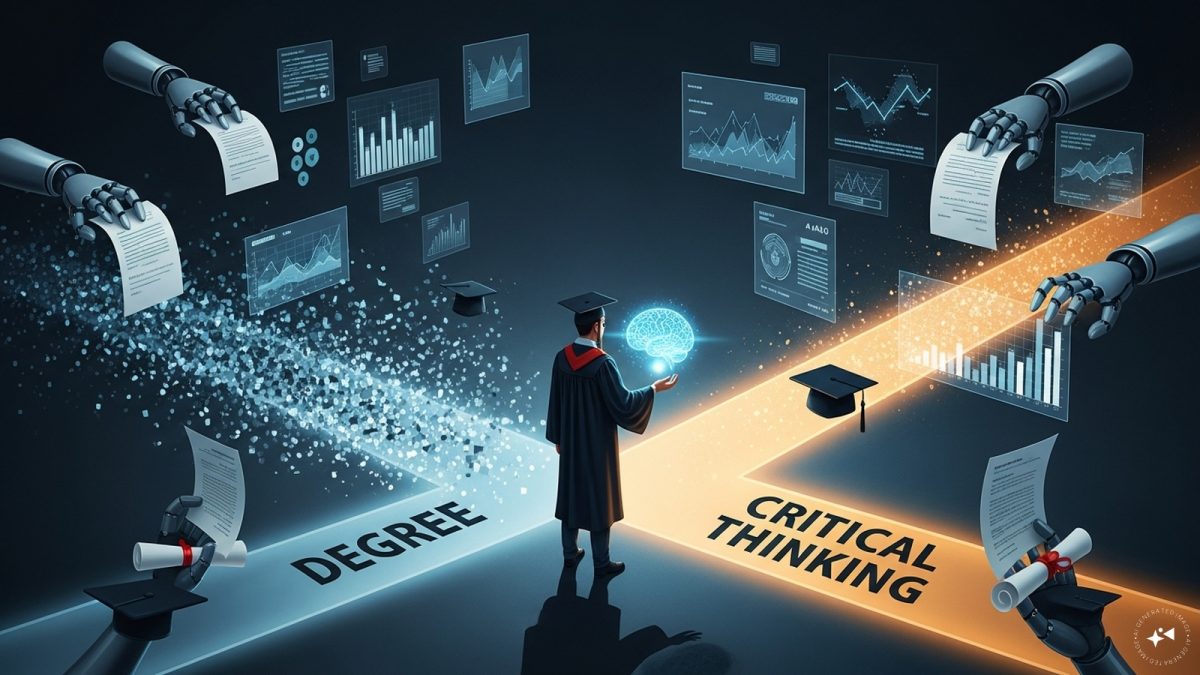) The Firstpost opinion piece titled "Beyond degree: Education in the age of AI"
explores the fundamental disruption of traditional academic structures caused
by rapid artificial intelligence advancements. It argues that the era where a
degree served as a definitive lifelong credential is coming to an end,
replaced by a pressing need for continuous, skill-based learning. As AI
increasingly automates technical and administrative tasks, the article posits
that the uniquely human advantage now lies in higher-order cognitive and
ethical functions. Specifically, education must evolve to prioritize the
ability to formulate the right questions, critically evaluate AI-generated
outputs, and maintain firm personal accountability for decisions that impact
society. Rather than focusing on rote memorization—which has been rendered
redundant by ubiquitous digital tools—future curricula should nurture
curiosity, empathy, and cross-disciplinary thinking. The author highlights
that while AI democratizes knowledge through personalized learning, it also
necessitates a profound shift in how we value intelligence, moving away from
rigid institutional metrics toward adaptable, lifelong expertise. Ultimately,
the piece concludes that the most successful individuals in an automated
economy will be those who combine technological proficiency with the critical
judgment and human-centric values required to guide AI responsibly. By
fostering these unique human traits, the educational system can better prepare
students for a complex, technology-driven future.
The Firstpost opinion piece titled "Beyond degree: Education in the age of AI"
explores the fundamental disruption of traditional academic structures caused
by rapid artificial intelligence advancements. It argues that the era where a
degree served as a definitive lifelong credential is coming to an end,
replaced by a pressing need for continuous, skill-based learning. As AI
increasingly automates technical and administrative tasks, the article posits
that the uniquely human advantage now lies in higher-order cognitive and
ethical functions. Specifically, education must evolve to prioritize the
ability to formulate the right questions, critically evaluate AI-generated
outputs, and maintain firm personal accountability for decisions that impact
society. Rather than focusing on rote memorization—which has been rendered
redundant by ubiquitous digital tools—future curricula should nurture
curiosity, empathy, and cross-disciplinary thinking. The author highlights
that while AI democratizes knowledge through personalized learning, it also
necessitates a profound shift in how we value intelligence, moving away from
rigid institutional metrics toward adaptable, lifelong expertise. Ultimately,
the piece concludes that the most successful individuals in an automated
economy will be those who combine technological proficiency with the critical
judgment and human-centric values required to guide AI responsibly. By
fostering these unique human traits, the educational system can better prepare
students for a complex, technology-driven future.
In her article, Angela Zhao addresses a critical architectural flaw in modern
AI agent infrastructure: the lack of "Decision Coherence." Current systems
typically fragment critical data across relational databases, feature stores,
and vector databases, with each component operating without a shared
transactional boundary. This fragmentation creates a "seam problem" where
agents retrieve inconsistent, disparate views of reality—such as current
account balances paired with stale behavioral signals or outdated semantic
embeddings. Consequently, agents may make incorrect, irreversible decisions,
particularly in high-concurrency environments like financial transaction
approvals or resource allocation. To bridge this gap, Zhao introduces the
concept of the "Context Lake," a system class specifically designed to enforce
Decision Coherence. Unlike traditional decoupled stacks, a Context Lake
integrates episodic events, semantic transformations, and procedural rules
within a single transactional scope. This ensures that every decision-making
context is internally consistent, semantically enriched, and strictly bounded
in freshness. By moving semantic computations—like embedding generation—inside
the system boundary, the Context Lake eliminates the asynchronous delays that
plague existing architectures. Based on research by Xiaowei Jiang, this
emerging infrastructure layer is essential for production-grade AI agents that
manage fast-changing, shared states and require absolute correctness to avoid
costly operational failures or system-wide logic errors.
The Algorithmic Arms Race: Navigating the Age of Autonomous Attacks
 In the article "The Algorithmic Arms Race," Kannan Subbiah explores the
paradigm shift from human-led cyberattacks to the rise of autonomous Cyber
Reasoning Systems. This transition marks an evolution from traditional
automated scripts to cognitive AI agents capable of independent reasoning,
real-time adaptation, and executing the entire cyber kill chain at machine
speed. Subbiah details the anatomy of these autonomous attacks, highlighting
how they compress reconnaissance, weaponization, and lateral movement into
rapid, self-directed sequences that outpace human intervention. Through case
studies like Operation Cyber Guardian and the Shai-Hulud supply chain siege,
the author illustrates a future where malware independently manages its own
obfuscation and identifies obscure vulnerabilities. To counter these
sophisticated threats, the article advocates for a "fighting fire with fire"
strategy, urging organizations to deploy Autonomous Security Operations
Centers, Moving Target Defense, and hyper-segmented Zero Trust architectures.
Furthermore, Subbiah emphasizes the necessity of integrated risk analytics,
mandatory Software Bill of Materials, and adversarial red teaming where AI
systems challenge one another. Ultimately, the narrative stresses that in an
era of machine-speed conflict, human-centric defense models are no longer
sufficient; instead, organizations must embrace autonomous, resilient
infrastructures while maintaining human oversight as a final ethical and
operational kill switch.
In the article "The Algorithmic Arms Race," Kannan Subbiah explores the
paradigm shift from human-led cyberattacks to the rise of autonomous Cyber
Reasoning Systems. This transition marks an evolution from traditional
automated scripts to cognitive AI agents capable of independent reasoning,
real-time adaptation, and executing the entire cyber kill chain at machine
speed. Subbiah details the anatomy of these autonomous attacks, highlighting
how they compress reconnaissance, weaponization, and lateral movement into
rapid, self-directed sequences that outpace human intervention. Through case
studies like Operation Cyber Guardian and the Shai-Hulud supply chain siege,
the author illustrates a future where malware independently manages its own
obfuscation and identifies obscure vulnerabilities. To counter these
sophisticated threats, the article advocates for a "fighting fire with fire"
strategy, urging organizations to deploy Autonomous Security Operations
Centers, Moving Target Defense, and hyper-segmented Zero Trust architectures.
Furthermore, Subbiah emphasizes the necessity of integrated risk analytics,
mandatory Software Bill of Materials, and adversarial red teaming where AI
systems challenge one another. Ultimately, the narrative stresses that in an
era of machine-speed conflict, human-centric defense models are no longer
sufficient; instead, organizations must embrace autonomous, resilient
infrastructures while maintaining human oversight as a final ethical and
operational kill switch.Workplace stress in 2026 is still worse than before the pandemic
 The 2026 Workplace Stress Report from Help Net Security highlights a
concerning trend: employee stress remains significantly higher than
pre-pandemic levels, with global engagement hitting a five-year low. According
to Gallup’s latest findings, roughly 40% of workers worldwide experience daily
stress, while negative emotions like anger and sadness persist at elevated
rates. This lack of engagement is not just a cultural issue but a massive
economic burden, costing the global economy approximately $10 trillion in lost
productivity, or 9% of global GDP. The report indicates that managers and
leaders are bearing the brunt of this emotional weight, reporting higher
levels of loneliness and stress compared to individual contributors.
Demographic disparities are also evident, as women and workers under the age
of 35 report higher stress levels than their peers. Geographically, the United
States and Canada lead the world in daily stress at 50%. Interestingly, the
study finds that work location plays a role, with hybrid and remote-capable
employees experiencing more stress than those in fully remote or strictly
on-site roles. Ultimately, the data suggests that organizational success is
deeply tied to emotional wellbeing, as engaged leaders are far more likely to
thrive and mitigate the negative impacts of workplace pressure.
The 2026 Workplace Stress Report from Help Net Security highlights a
concerning trend: employee stress remains significantly higher than
pre-pandemic levels, with global engagement hitting a five-year low. According
to Gallup’s latest findings, roughly 40% of workers worldwide experience daily
stress, while negative emotions like anger and sadness persist at elevated
rates. This lack of engagement is not just a cultural issue but a massive
economic burden, costing the global economy approximately $10 trillion in lost
productivity, or 9% of global GDP. The report indicates that managers and
leaders are bearing the brunt of this emotional weight, reporting higher
levels of loneliness and stress compared to individual contributors.
Demographic disparities are also evident, as women and workers under the age
of 35 report higher stress levels than their peers. Geographically, the United
States and Canada lead the world in daily stress at 50%. Interestingly, the
study finds that work location plays a role, with hybrid and remote-capable
employees experiencing more stress than those in fully remote or strictly
on-site roles. Ultimately, the data suggests that organizational success is
deeply tied to emotional wellbeing, as engaged leaders are far more likely to
thrive and mitigate the negative impacts of workplace pressure.Most enterprises can't stop stage-three AI agent threats, VentureBeat survey finds
 According to a recent VentureBeat survey, a significant security gap exists as
enterprises struggle to defend against "stage-three" AI agent threats. The
survey identifies a three-stage maturity model: Stage 1 focuses on
observation, Stage 2 on enforcement via Identity and Access Management (IAM),
and Stage 3 on isolation through sandboxed execution. While monitoring
investment has surged to 45% of security budgets, most organizations remain
trapped at the observation stage, leaving them vulnerable to sophisticated
agentic failures where traditional guardrails prove insufficient. Data from
Gravitee and the Cloud Security Alliance underscores this readiness gap,
noting that only 21.9% of teams treat AI agents as distinct identity-bearing
entities, while 45.6% still rely on shared API keys. This structural weakness
allows for rapid lateral movement and unauthorized actions, which 72% of CISOs
identify as their top priority. Despite the high demand for robust
permissioning, current enterprise infrastructure often lacks the necessary
runtime enforcement to contain a "blast radius" when agents go rogue. The
survey highlights that while agents are already operating with privileged
access to siloed data, security teams are lagging behind in providing the
isolation required to stop the next wave of autonomous exploits and
supply-chain breaches.
According to a recent VentureBeat survey, a significant security gap exists as
enterprises struggle to defend against "stage-three" AI agent threats. The
survey identifies a three-stage maturity model: Stage 1 focuses on
observation, Stage 2 on enforcement via Identity and Access Management (IAM),
and Stage 3 on isolation through sandboxed execution. While monitoring
investment has surged to 45% of security budgets, most organizations remain
trapped at the observation stage, leaving them vulnerable to sophisticated
agentic failures where traditional guardrails prove insufficient. Data from
Gravitee and the Cloud Security Alliance underscores this readiness gap,
noting that only 21.9% of teams treat AI agents as distinct identity-bearing
entities, while 45.6% still rely on shared API keys. This structural weakness
allows for rapid lateral movement and unauthorized actions, which 72% of CISOs
identify as their top priority. Despite the high demand for robust
permissioning, current enterprise infrastructure often lacks the necessary
runtime enforcement to contain a "blast radius" when agents go rogue. The
survey highlights that while agents are already operating with privileged
access to siloed data, security teams are lagging behind in providing the
isolation required to stop the next wave of autonomous exploits and
supply-chain breaches.Empty Attestations: OT Lacks the Tools for Cryptographic Readiness
 Operational technology (OT) systems face a critical security gap as regulators
increasingly demand attestations of post-quantum cryptographic readiness
despite a severe lack of specialized auditing tools. Unlike IT environments,
which prioritize confidentiality and can be regularly updated, OT
infrastructure focuses primarily on availability and often relies on
decades-old legacy hardware with minimal processing power. This makes the
implementation of modern cryptographic standards exceptionally difficult, as
many devices lack the memory to execute post-quantum algorithms or have
encryption hard-coded into immutable firmware. Consequently, asset owners are
often forced to treat security compliance as a box-ticking exercise, producing
paperwork that provides a false sense of assurance rather than genuine
protection. This vulnerability is compounded by "harvest now, decrypt later"
tactics and the risk of stolen firmware signing keys, which allow adversaries
to maintain long-term access and potentially push malicious updates. Without
OT-specific frameworks and instrumentation, these systems remain exposed to
sophisticated threats like Volt Typhoon. To truly secure critical
infrastructure, industry leaders and regulators must acknowledge that current
IT-centric assessment models are insufficient, requiring a shift toward
developing practical tools that account for the unique operational constraints
and long life cycles inherent in industrial environments.
Operational technology (OT) systems face a critical security gap as regulators
increasingly demand attestations of post-quantum cryptographic readiness
despite a severe lack of specialized auditing tools. Unlike IT environments,
which prioritize confidentiality and can be regularly updated, OT
infrastructure focuses primarily on availability and often relies on
decades-old legacy hardware with minimal processing power. This makes the
implementation of modern cryptographic standards exceptionally difficult, as
many devices lack the memory to execute post-quantum algorithms or have
encryption hard-coded into immutable firmware. Consequently, asset owners are
often forced to treat security compliance as a box-ticking exercise, producing
paperwork that provides a false sense of assurance rather than genuine
protection. This vulnerability is compounded by "harvest now, decrypt later"
tactics and the risk of stolen firmware signing keys, which allow adversaries
to maintain long-term access and potentially push malicious updates. Without
OT-specific frameworks and instrumentation, these systems remain exposed to
sophisticated threats like Volt Typhoon. To truly secure critical
infrastructure, industry leaders and regulators must acknowledge that current
IT-centric assessment models are insufficient, requiring a shift toward
developing practical tools that account for the unique operational constraints
and long life cycles inherent in industrial environments.Business Risk: How It’s Changing In The Digital Economy
 The digital economy has fundamentally transformed the landscape of business
risk, shifting focus from traditional financial and operational concerns
toward complex, technology-driven vulnerabilities. According to experts from
the Forbes Business Council, risk is no longer a separate "balance sheet"
issue but is now embedded in every design choice and organizational decision.
Key emerging threats include data vulnerability, algorithmic bias, and cyber
risks that extend across entire supply chains via sophisticated social
engineering. Notably, the rapid adoption of artificial intelligence introduces
"invisible" risks, such as business models quietly becoming obsolete or
conflicting AI agents causing critical system outages. Furthermore, companies
face unprecedented challenges regarding digital visibility and public
perception; in an oversaturated market, being unseen or suffering from viral
reputation damage can be as detrimental as direct financial loss. Managing
these dynamic parameters requires a shift from reactive detection to
proactive, upstream governance and a focus on organizational adaptability.
Ultimately, the modern definition of risk centers on a firm's ability to match
its cognitive capabilities with the increasing speed and non-linearity of the
digital environment. To survive, leaders must move beyond standard business
formulas, integrating real-time intelligence and human-centered context to
navigate the uncertainty inherent in a data-driven world.
The digital economy has fundamentally transformed the landscape of business
risk, shifting focus from traditional financial and operational concerns
toward complex, technology-driven vulnerabilities. According to experts from
the Forbes Business Council, risk is no longer a separate "balance sheet"
issue but is now embedded in every design choice and organizational decision.
Key emerging threats include data vulnerability, algorithmic bias, and cyber
risks that extend across entire supply chains via sophisticated social
engineering. Notably, the rapid adoption of artificial intelligence introduces
"invisible" risks, such as business models quietly becoming obsolete or
conflicting AI agents causing critical system outages. Furthermore, companies
face unprecedented challenges regarding digital visibility and public
perception; in an oversaturated market, being unseen or suffering from viral
reputation damage can be as detrimental as direct financial loss. Managing
these dynamic parameters requires a shift from reactive detection to
proactive, upstream governance and a focus on organizational adaptability.
Ultimately, the modern definition of risk centers on a firm's ability to match
its cognitive capabilities with the increasing speed and non-linearity of the
digital environment. To survive, leaders must move beyond standard business
formulas, integrating real-time intelligence and human-centered context to
navigate the uncertainty inherent in a data-driven world.Building your cryptographic inventory: A customer strategy for cryptographic posture management
 As post-quantum cryptography approaches, Microsoft emphasizes that the primary
challenge for organizations is not selecting new algorithms, but discovering
existing cryptographic assets. This Microsoft Security blog post outlines a
strategy for building a cryptographic inventory as the foundation of
Cryptography Posture Management (CPM). A cryptographic inventory is defined as
a dynamic catalog encompassing certificates, keys, protocols, and libraries
used across an enterprise. To manage these effectively, Microsoft proposes a
continuous six-stage lifecycle: discovery, normalization, risk assessment,
prioritization, remediation, and ongoing monitoring. This approach spans four
critical domains—code, network, runtime, and storage—ensuring visibility into
everything from source code primitives to active network sessions.
Organizations can leverage existing tools like GitHub Advanced Security for
code analysis, Microsoft Defender for Endpoint for runtime signals, and Azure
Key Vault for centralized key management to simplify this process. Rather than
a one-time project, CPM requires clear ownership and documented policy
baselines to maintain security hygiene and achieve "crypto agility." By
establishing these practices now, businesses can proactively identify
vulnerabilities, comply with emerging global regulations, and ensure a
resilient transition to a quantum-safe future. Through strategic integration
of Microsoft capabilities and partner solutions, teams can transform complex
cryptographic landscapes into manageable, risk-informed systems.
As post-quantum cryptography approaches, Microsoft emphasizes that the primary
challenge for organizations is not selecting new algorithms, but discovering
existing cryptographic assets. This Microsoft Security blog post outlines a
strategy for building a cryptographic inventory as the foundation of
Cryptography Posture Management (CPM). A cryptographic inventory is defined as
a dynamic catalog encompassing certificates, keys, protocols, and libraries
used across an enterprise. To manage these effectively, Microsoft proposes a
continuous six-stage lifecycle: discovery, normalization, risk assessment,
prioritization, remediation, and ongoing monitoring. This approach spans four
critical domains—code, network, runtime, and storage—ensuring visibility into
everything from source code primitives to active network sessions.
Organizations can leverage existing tools like GitHub Advanced Security for
code analysis, Microsoft Defender for Endpoint for runtime signals, and Azure
Key Vault for centralized key management to simplify this process. Rather than
a one-time project, CPM requires clear ownership and documented policy
baselines to maintain security hygiene and achieve "crypto agility." By
establishing these practices now, businesses can proactively identify
vulnerabilities, comply with emerging global regulations, and ensure a
resilient transition to a quantum-safe future. Through strategic integration
of Microsoft capabilities and partner solutions, teams can transform complex
cryptographic landscapes into manageable, risk-informed systems.The Rise of Intelligent Automation: How Technology Is Redefining Work and Efficiency
 The rise of intelligent automation (IA) is fundamentally reshaping the
financial landscape by blending artificial intelligence with robotic process
automation to create more agile, efficient, and strategic work environments.
According to Global Banking & Finance Review, this shift is not merely
about replacing manual labor but about redefining the nature of work itself.
By automating repetitive and high-volume tasks—such as data entry,
reconciliation, and compliance checks—organizations can significantly reduce
human error and operational costs while accelerating processing speeds. Beyond
mere efficiency, IA empowers financial institutions to leverage advanced
analytics for real-time decision-making and hyper-personalized customer
experiences, such as tailored loan products and instant virtual assistance.
This technological evolution allows human professionals to pivot from mundane
administrative roles toward high-value activities like strategic planning and
creative problem-solving. Furthermore, IA enhances risk management through
proactive fraud detection and seamless regulatory adherence, providing a
robust framework for digital transformation. As the industry moves toward
autonomous financial operations, embracing these intelligent systems becomes a
competitive necessity. Ultimately, the integration of intelligent automation
fosters a culture of innovation, ensuring that financial services remain
resilient, secure, and customer-centric in an increasingly complex and
data-driven global market.
The rise of intelligent automation (IA) is fundamentally reshaping the
financial landscape by blending artificial intelligence with robotic process
automation to create more agile, efficient, and strategic work environments.
According to Global Banking & Finance Review, this shift is not merely
about replacing manual labor but about redefining the nature of work itself.
By automating repetitive and high-volume tasks—such as data entry,
reconciliation, and compliance checks—organizations can significantly reduce
human error and operational costs while accelerating processing speeds. Beyond
mere efficiency, IA empowers financial institutions to leverage advanced
analytics for real-time decision-making and hyper-personalized customer
experiences, such as tailored loan products and instant virtual assistance.
This technological evolution allows human professionals to pivot from mundane
administrative roles toward high-value activities like strategic planning and
creative problem-solving. Furthermore, IA enhances risk management through
proactive fraud detection and seamless regulatory adherence, providing a
robust framework for digital transformation. As the industry moves toward
autonomous financial operations, embracing these intelligent systems becomes a
competitive necessity. Ultimately, the integration of intelligent automation
fosters a culture of innovation, ensuring that financial services remain
resilient, secure, and customer-centric in an increasingly complex and
data-driven global market.World targets central IDV, AI agent management role with selfie biometrics
 World has unveiled a major strategic expansion aimed at becoming the primary
identity verification (IDV) layer for an economy increasingly dominated by
agentic AI. Central to this update is the introduction of "Selfie Check," a
face biometric and liveness detection service that provides a lower-assurance
alternative to its high-level iris-based verification. This shift positions
World as a versatile IDV provider, allowing apps to pay for proof of
personhood to combat bots and deepfakes. Key features include the "Deep Face"
tool, which integrates with platforms like Zoom to offer hardware-backed "root
of trust" for real-time presence verification. Beyond individual
authentication, the new World ID app introduces AI agent management and
delegation tools, supported by partnerships with industry leaders such as AWS,
Okta, and Shopify. These updates represent a comprehensive reengineering of
the World stack, incorporating privacy-enhancing technologies like multi-party
entropy and key rotation to keep user data unlinkable. By diversifying its
verification methods and focusing on the governance of autonomous digital
agents, World seeks to monetize its infrastructure as a global trust anchor.
This evolution reflects a broader market push to align biometric credentials
with the evolving demands of AI-driven interactions, securing human identity
in an increasingly automated world.
World has unveiled a major strategic expansion aimed at becoming the primary
identity verification (IDV) layer for an economy increasingly dominated by
agentic AI. Central to this update is the introduction of "Selfie Check," a
face biometric and liveness detection service that provides a lower-assurance
alternative to its high-level iris-based verification. This shift positions
World as a versatile IDV provider, allowing apps to pay for proof of
personhood to combat bots and deepfakes. Key features include the "Deep Face"
tool, which integrates with platforms like Zoom to offer hardware-backed "root
of trust" for real-time presence verification. Beyond individual
authentication, the new World ID app introduces AI agent management and
delegation tools, supported by partnerships with industry leaders such as AWS,
Okta, and Shopify. These updates represent a comprehensive reengineering of
the World stack, incorporating privacy-enhancing technologies like multi-party
entropy and key rotation to keep user data unlinkable. By diversifying its
verification methods and focusing on the governance of autonomous digital
agents, World seeks to monetize its infrastructure as a global trust anchor.
This evolution reflects a broader market push to align biometric credentials
with the evolving demands of AI-driven interactions, securing human identity
in an increasingly automated world.

No comments:
Post a Comment