Daily Tech Digest - December 15, 2022

How acceptable is your acceptable use policy?

Your AUP needs to be auditable and enforceable—but there’s a tricky balance between protecting employees and making them feel like they’re working for an authoritarian regime. “It should be written to the end user rather than the technical person who works in security,” says Michaels. “One of the pitfalls that we see in the development of policies is the security leader will either own the creation of the policy or delegate it to somebody on their team, and they won’t go out and source feedback and check that they’re on the right track.” More mature security programs source feedback and have closer partnerships with HR and the other functions in the business. But many companies are “still trying to do the basic blocking and tackling,” Michaels says. “They’re still more focused on the technology and the process rather than the people that they’re impacting.” The AUP should be clear, concise, and easy to understand—not technobabble or legalese. But getting employee buy-in could also come down to something as simple as word choice.


The power of incremental momentum

Companies can get the type of disruptive innovation they need to survive and create lasting change, without moving fast and breaking things. This can be achieved by building momentum for change incrementally. It’s not a new approach, but it can get overlooked when a sense of urgency arises and appears to dictate swift action. ... Incremental momentum has been successfully used in other endeavors. Almost 120 years after Roosevelt’s work, a team of environmental scientists in Finland surveyed the success of incremental change in achieving the country’s sustainability goals. They concluded: “The strengths of small wins include the ability to react to the constantly changing, dynamic conditions…and to deepen trust, commitment and understanding among people.” The report continued, small wins “can facilitate progress and interfere with old routines by bringing about small steps that may result in continuous transformational change and generate radical changes in the long run.” ... The risks were great. The SAP executive team had to balance putting effort into building cloud solutions with maintaining engineering support for the ERP system innovations that its customers relied on.


IT leaders face reality check on hybrid productivity

Organizations are realizing that hybrid work is more about how teams come together — not just what’s right for the organization or individual, says Jonathan Pearce, workforce strategies lead at Deloitte Consulting. So more companies are ratcheting up expectations for their team leaders to decide how work gets done, and then hold them accountable as a team when it comes to performance and rewards. “We’re expecting more team leaders to have open discussions with their teams on what’s working and not working around communication, the norms around [how quickly] they’re expected to respond and how we come together when we need to collaborate,” Pearce says. “The question now becomes how do we up their game as managers — not just managers of work but really orchestrators of a more complex team environment,” Pearce says. Good managers make work more enjoyable for their teams, are better able to identify and use each employee’s strengths and help those workers gain more skills and experience they need to develop their careers and be more productive, he adds.


Improving Cyberresilience in an Age of Continuous Attacks

Effective cybersecurity is about risk management. For example, when banks lend money or issue credit cards, the chief risk officer (CRO) has created a model based on profiles that assume there will be a default rate, meaning certain borrowers may not ever repay their obligations. This is communicated to the chief executive officer (CEO) so that the entire management team understands that it will incur losses from certain customers. Banks are then able to plan and reserve for these losses before they happen. Enterprises must think of cybersecurity in the same manner in which banks lend money. It is only a matter of time before a breach occurs. If the right controls are in place, these breaches are nothing more than a simple incident of 1 machine being compromised vs. an entire network’s worth of data being compromised. Each new attack has the potential to change the threat model. This may not be the first thing on cybersecurity team members’ minds after an attack, but changes could be required immediately. 


The 3G shutdown: Here are the impacted devices. Do you own any?

So, what does this all mean for older hardware like cell phones, alarms, and GPS systems that thrive on the 3G spectrum? To put it bluntly, many of the network-driven features will become obsolete, presenting some unforeseen dangers. Fortunately, there are steps that you and your loved ones can take to safely transition from aging to future-proof tech. In some cases, manufacturers may even be able to give your older gadgets new life through software upgrades. ... Besides ushering in the revolution of smartphones, 3G has played a foundational role in the navigation and alarm-based systems that we rely on during our everyday commutes. With the institution of faster and more reliable 5G, roadside assistance and emergency crash alerts are among the many network-based features that will be affected by the shutting down of 3G. Many cars also have an emergency SOS button that, when pressed, dials first responders via 3G. That, too, will lose functionality. Vehicles from popular automakers like Toyota, Lexus, Nissan, Hyundai, Dodge, and more released before 2019 are susceptible to the issues mentioned above. 


Quantum Computing Will Change Our Lives. But Be Patient, Please

Over and over at Q2B, quantum computing advocates showed themselves to be measured in their predictions and guarded about promising imminent breakthroughs. Comments that quantum computing will be "bigger than fire" are the exception, not the rule. Instead, advocates prefer to point to a reasonable track record of steady progress. Quantum computer makers have gradually increased the scale of quantum computers, improved its software and decreased the qubit-perturbing noise that derails calculations. The race to build a quantum computer is balanced against patience and technology road maps that stretch years into the future. ... And new quantum computing efforts keep cropping up. Cloud computing powerhouse Amazon, which started its Braket service with access to others' quantum computers, is now at work on its own machines too. At Q2B, the Novo Nordisk Foundation -- with funding from its Novo Nordisk pharmaceutical company -- announced a plan to fund a quantum computer for biosciences at the University of Copenhagen's Niels Bohr Institute in Denmark.


The Future: Data Access Must Be Intelligently Automated

Of course, an AI engine must contain certain features, including the ability to provide transparent explanations to data managers regarding processes and the capability to receive data manager feedback for learning and improving the DPP. It must also boost efficiency and accuracy when automating and improving how policies are built, maintained and enforced. Then, over time, these policy applications become more accurate, flexible and intelligently automated. An AI engine also requires vast data sets for training. However, it’s possible to reduce the time required by applying the “human in the loop concept,” where data managers educate the AI. Through this process, the AI engine learns faster and makes better decisions and suggestions. Policies can then be maintained and updated, improving the DPP and supporting organizations to quickly and automatically decide on sharing processes that are safe, secure and compliant. This is the ideal convergence of human expertise and AI technology. And it’s the future of data access governance and lifecycle management. Is your business ready to take advantage?


How much digital trust can you place on zero-trust?

One very important principle of zero-trust that is often understated is assumed breach. All too often, some identity and access management (IAM) product suppliers are quick to share how they can help enterprises achieve zero-trust. This is all well and good, except for the fact that they often cover the first two principles of i) verify explicitly and ii) use least privilege access, but not enough of iii) assume breach. While the first two principles help to limit any attack blast radius and hinder a breach as it steps through the attack kill chain, the third and last principle is critical to effective and efficient detection and containment of a breach in the ability to detect fast, contain fast and recover fast. If we believe that breaches are inevitable, assume breach requires a bigger stage. ... With the increase of triple-extortion ransomware and ransom cartels, it is important to zoom in on decoys. The deployment of time-based database honeytokens shortens incident response time by allowing an enterprise to quickly determine whether the source of a data leak arose from any system breach within the enterprise or was the result of a case of re-hashing of past leaked data from breach databases.


The Great Resignation isn’t over yet

One in four employees don’t feel secure in their current positions and almost half of them plan to explore new job options in 2023, according to a new report that indicates the Great Resignation remains in full swing. Over the past year, more than 4 million workers have quit their jobs every month, according to US Bureau of Labor Statistics The report, by human resource management software provider isolved, says the top way employers can improve company culture and retain their workers is by paying their employees market value. “This comes as no surprise, considering pay transparency laws have jumped to the forefront, and the pressure is on employers to eliminate pay inequality within their organizations,” isolved said in its report. “Data shows employees are more anxious, burnt-out and financial security-driven than ever," ” James Norwood, isolved’s chief strategy officer, said in a statement. "To combat these concerns, HR departments of all sizes must evaluate what they can automate and gain efficiencies in, enhance what they can to improve employee experience, and extend the impact of their team."


The Professionalization of Ransomware: What You Need to Know

Carson says it is critical that IT professionals are current with the ransomware trends and techniques, as it will help IT professionals identify the best ways to reduce those risks and enhance the security controls for the business they are hired to protect. From his perspective, the breakup of some of the large ransomware criminal gangs makes it more likely that smaller splinter groups will become the top threat in 2023. “They have the knowledge of a larger ransomware gang and can now operate more efficiently, sometimes even more targeted,” he says. Kirk explains ransomware is still largely successful due to security mistakes or weaknesses that usually can be mitigated or eliminated. “The risk from stolen login credentials can be mitigated by employing multifactor authentication,” he says. “Cybersecurity awareness training can reduce the likelihood an employee may be tricked into downloading a malicious attachment.” He adds that promptly patching software -- particularly for internet-facing systems such as email servers or VPNs -- is extremely important, as is ensuring that remote connectivity software is securely managed.


Quote for the day:

"Brilliant strategy is the best route to desirable ends with available means." -- Max McKeown

Daily Tech Digest - December 14, 2022

The nature of the CISO role will be in flux in 2023

“Today’s CISOs are taking up the mantle of responsibilities that have traditionally fallen solely to the CIO, which is to act as the primary gateway from the tech department into the wider business and the outside marketplace,” said James Larkin, managing partner at Marlin Hawk. “This widening scope requires CISOs to be adept communicators to the board, the broader business, as well as the marketplace of shareholders and customers. By thriving in the ‘softer’ skillsets of communication, leadership and strategy, CISOs are now setting the new industry standards of today and, I predict, will be progressing into the board directors of tomorrow.” ... “I also feel that over the last eight to 10 years, the CISO role has become a CISO-plus role – CISO plus engineering, CISO plus physical security, CISO plus operational resiliency, or CISO plus product security. As a result, we’ve seen multiple CISOs that have done a great job with cyber security, fusion centres, SOC and leadership. This has paved the way for the CISO office to become a business enabler and also a transformational technology function.”


Addressing Professional Ethical Dilemmas

The problem lies in determining which actions are considered ethical and which are unethical. Consider the driver waiting at the traffic signal. Would it be considered ethical if the person drove through while the signal was still red if they did so in an effort to bring an injured person to the hospital? The same act, which would normally be considered unethical, can be considered ethical under different circumstances. Professional ethics are not so different from this example. Professionals are supposed to engage in ethical behaviors, but they are not immune to ethical dilemmas such as those described. There is a need to understand and determine which actions are ethical and which are unethical, since stakeholders prefer to do business with reputable enterprises that conduct themselves ethically. An ethical professional helps set the standard for others within the organization. Professionals have an opportunity to not only inspire others to do the right thing, but also to consider what kind of people they themselves want to be. There are various ethical dilemmas that a professional may encounter.


Mastering the Mesh: Finding Clarity in the Data Lake

Data mastering–or the process of taking new records and linking them to pre-existing master records that have already been vetted–was one of the important data quality steps that enterprises traditionally did as part of loading their data warehouses. However, master data management (MDM) largely fell by the wayside as the pace of data creation picked up and the “schema upon read” approach of the data lake took hold. Tamr, which sponsored the 451 Research report, is one of the software vendors trying to bring MDM back and make it relevant in the big data world. The company, which was co-founded by Turing Award winner Michael Stonebraker, accepts that relying on humans alone to power MDM isn’t feasible. Neither is a rules-based approach. But backed by the pattern-matching and anomaly-spotting power of machine learning, MDM can provide that critical data quality step that’s needed in today’s big data world without becoming another bottleneck in the process. ... “Enterprise data needs to be cleansed and standardized for the data mesh concept to work at its full potential,” the 451 Research authors write. 


Preparations for Quantum Cyber Threat Get a Senate Boost

The Quantum Computing Cybersecurity Preparedness Act largely echoes a national security memo the administration issued in May laying out deadlines for agencies to inventory all currently deployed cryptographic systems in order to prioritize their transition to forms of encryption experts say would be invulnerable to speedy quantum computers. The National Institute of Standards and Technology and the National Security Agency are currently developing standards for the implementation of four quantum-resistant algorithms NIST announced in July after inviting scientists around the world to submit their proposals. In anticipation of the algorithms, a January national security memo granted NSA the power to issue binding operational directives to facilitate agencies’ migration to the new standards. In addition to reiterating the administration’s instructions for agencies, including the Office of Management and Budget, the legislation directs OMB to report annually to Congress on the migration effort. The reports should outline the administration’s strategy and projected costs, according to the press release.


How to combat counterfeit network gear

The most obvious sign that a device may be counterfeit is its price. "Too good to be true is just that," says Lessin. He also urges purchasers to keep a sharp eye out for small details that counterfeiters often overlook, such as packaging design and quality, as well as documentation language. Most of the legitimate networking vendors offer comprehensive tutorial videos showing how to tell if you're using an authentic product, says Keatron Evans, principal security researcher at security education provider Infosec Institute. "If you can't verify something as authentic, you should count it as potentially counterfeit," he advises. "Trying to do it the other way around, by looking for signs of counterfeiting, is not as effective because of how rapidly things change." Unfortunately, for many victims, a bogus component will reveal its true fake identity only after it has been deployed. "Counterfeits are most commonly identified when the device fails," says Mike Mellor, vice president of cybersecurity consulting at managed security services provider Nuspire.


An Introduction to Accelerator and Parallel Programming

Today, when we talk about a hardware accelerator, we are often talking about a GPU. However, there are myriad different types of accelerators that have arisen to solve various problems—including deep learning and AI—which utilize hardware specifically designed to perform large-scale matrix operations, the heart of DL workloads. In addition, there are hardware-acceleration technologies built into traditional CPUs like Intel® Advanced Vector Extensions (Intel® AVX) and Intel® Advanced Matrix Extensions (Intel® AMX). With the rise of new accelerators, there is always the challenge of how to program for them. Most accelerators currently available are based on parallel execution and, hence, some form of parallel programming. ... Parallel programming is how we write code to express parallelism in any code/algorithm to get it to run on an accelerator or multiple CPUs. But what is parallelism? Parallelism is when parts of a program can run at the same time as another part of the program. Typically, we break this down into two categories: task parallelism and data parallelism.


5 risks of AI and machine learning that modelops remediates

Data scientists are generally not experts in risk management, and in enterprises, a first step should be to partner with risk management leaders and develop a strategy aligned to the modelops life cycle. Wheeler says, “The goal of innovation is to seek better methods for achieving a desired business outcome. For data scientists, that often means creating new data models to drive better decision-making. However, without risk management, that desired business outcome may come at a high cost. When striving to innovate, data scientists must also seek to create reliable and valid data models by understanding and mitigating the risks that lie within the data.” ... When a tree falls in the forest, will anyone take notice? We know the code needs to be maintained to support framework, library, and infrastructure upgrades. When an ML model underperforms, do monitors and trending reports alert data science teams? “Every AI/ML model put into production is guaranteed to degrade over time due to the changing data of dynamic business environments,” says Hillary Ashton


Talent Transformation Strategies for Security Leaders

A cybersecurity workforce with a growth mindset sees challenges as opportunities to grow, learn and become more resilient and adaptable. The hybrid work environment prevalent today needs security employees working toward a common goal that is aligned with broader organizational objectives. It is the responsibility of security leaders to set the tone at the top and communicate frequently and effectively with their teams on the vision and purpose of the organization’s security functions to the broader business and the value that security unlocks for the business to rapidly scale and expand. ... Security leaders should train their managers to lead and manage teams in this new hybrid working model and educate the cybersecurity staff to deal with the impact on security investments, workforce restructuring and work backlog to meet business requirements. Organizations should build a stronger workforce by augmenting their internal capacity with external security vendors and managed security service providers (MSSPs) where required. Managed services can take the form of outsourcing or co-sourcing models, which can be quick and effective ways to overcome these challenges.


Cloud-based fingerprint system for UK police nears completion

Known as the Transforming Forensics (TF) programme, the capability is hosted by the Police Digital Service (PDS), which is aiming to deliver the first full deployment in March 2023. The PDS said that through access to a digital suite of tools – housed on the PDS Xchange platform, which is powered by Amazon Web Services (AWS) – police forensic teams would be able to send fingerprint and crime scene images in real time, allowing them to identify suspects within hours instead of days, as well as improve work processes by taking them off paper and into automated workflows. ... While the UK data protection watchdog will initially consult with the organisation to advise them on how to make their operations compliant, it also reserves the right to issue two tiers of monetary penalties. These include a “standard maximum penalty” of roughly £9m or 2% of the organisation’s annual turnover, or a “higher maximum” of £18m or 4% of annual turnover. In both cases, the offending organisation will be fined whichever amount is higher.


Platform Engineering Needs a Prescriptive Roadmap

Fundamentally the problem is that all of these transformations have a massive people-interaction component, and the bigger and older you are as an organisation, the more difficult it is to change how people interact, and the higher up the chain you have to go to create organisational change. Having spent time at a “webscale” large tech company, a small-to-medium tech company, and then working for the last decade with a lot of very traditional enterprises, it’s striking how poor internal communication is inside most enterprises compared to tech companies. ... Ultimately success requires being very deliberate about architecting productive team-to-team interactions, with as few intermediaries as possible, and to focus on the feedback loops between the producers and consumers of systems. A common mistake I see folks make is to set an open-ended goal of “collaboration” between teams, with endless meetings and working sessions, and it turns out this is extremely inefficient at scale when your consumers outnumber your producers (which they should do in almost every situation!).


Quote for the day:

"Decision-making is a skill. Wisdom is a leadership trait." -- Mark Miller

Daily Tech Digest - December 13, 2022

The Broken Promise Of AI: What Went Wrong Between 2012 And 2022

Data science as a discipline was poorly understood, and most organizations had not yet implemented a data strategy aligned with their business objectives. Therefore, the first wave of data scientists had the time, training and support of the business to experiment and explore possibilities, just as Patil and Davenport had recommended. “Experimentation” is not scoped to any specific strategic priority, however. In practice, data science was science—a pursuit of knowledge. Real-world applications would have to wait. The consequence is that AI as a concept matured but AI in practice faltered. Over time, data science divisions moved further from the business strategy they were supposed to support. Silos emerged between business and technical units. Small successes were celebrated and held up as indicators that the process was working. But scaling them proved difficult. Executives, unsure why the whole process isn’t automated, continue to invest in people and technology to try to narrow the gap. The problem they face isn’t technological, though. It’s cultural. The goal of a company is not to set up a robust data environment; it’s to build, use and sell data products. 


Disconnect between CEOs & testers puts companies at risk of software failure

So, if there is an acknowledgment that testing is important and a fear that failing to test software could lead to job losses, the obvious question is why is software not tested properly? This often comes down to businesses not thinking there is a viable, cost-effective option and choosing speed over stability. However, there are more specifics we can unpack. When asked why their software wasn’t tested properly before being released, CEOs and testers in the same Censuswide survey cited a few primary reasons. The first is a reliance on manual testing, which is time and resource intensive, so therefore often skipped or rushed. This is compounded by the feeling that development cycles need to be quicker to compete in a crowded market. The next most prominent reasons were a lack of skilled developers available to conduct testing, or a lack of investment in training and development to upskill those already on the team. ... There needs to be a transition from manual testing towards automation to meet the testing requirements of increasingly complex software, with businesses struggling to scale their chosen solutions and leverage existing skills across Quality Assurance departments.


Machines and Megaprojects – AI Trajectory 2023+

Disruptive technologies like AI, blockchain or metaverse herald new value and wealth creation possibilities for many investors and technologists. But then there is a much larger subset of humanity, people for whom the ascendance of these new machines lives as an existential threat. Might the housekeeping robot one day get fed up with serving the morning coffee and turn into a killer robot? From one day to the next, the robot’s owners become slaves. We are tongue-in-cheek here, but these are genuine concerns for many people. When it comes to our jobs, careers, and employment, the big questions at the back of our minds are, “Will my job become obsolete? Will I be terminated? Worse, will I be unemployable, a little pawn in a world run by a super-intelligence?” These are the ethical, moral, and practical questions in the background for which solutions have yet to be invented. ... A hidden bias that disproportionately favors one racial or age or gender group over another in crucial decisions such as hiring individuals is one thing. More chillingly, consider the impact AI bias could have in determining whether someone should be prosecuted or sentenced to prison, and perhaps even the length of their sentence.


The future of finance belongs to open source

While crypto-currency pushes blockchain technologies' limits and makes the headlines, financial services companies are known for their conservative approach to software development. That doesn't mean they've been unfriendly to Linux and open source. It's been quite the opposite. ... So it is, said Gabriele Columbro, FINOS' Executive Director, that open-source adoption is continuing "laying out the necessary building blocks for an organic, growing, and sustainable open community in the industry. While we know there is still a lot of work to do to reach full maturity, we're extremely proud of the major role that FINOS played in opening up financial services to the disruptive innovation benefits open source can deliver to this sector." Part of that work is that compared with other sectors, such as IT, science, and telecom, financial service companies lag behind in encouraging open-source contribution. Still, more than half (54%) of respondents say contributing to open source improved the quality of the software they are currently using. In addition, active participation in open source was cited as a key factor in recruiting and retaining IT talent.


Citizens Are Happy To Hand Over Data So Long as Use Is Transparent

The old quip that ‘if you’re not paying for the product, you are the product’ has not discouraged people from joining services such as Facebook, which has seen exponential user growth since its launch. According to Statista, 2.7 billion people use Facebook, a figure that has grown remarkably consistently since the company passed 1 billion users in 2012. However, you only have to look at the uproar that Facebook caused in January when it updated WhatsApp’s terms of service to state that data from private conversations would be used to inform ads on Facebook’s other platforms, to see the value people put on transparency. The change led to a 4,200% increase in user growth for rival app Signal. ... ForgeRock’s research suggests that Singaporeans are not averse to providing access to their data, so long as they are told upfront what it will be used for. The outcry over TraceTogether provides a lesson on the importance of transparency when talking to people about how their data is going to be used. This is only going to become more crucial in the future. 


2023 emerging AI and Machine Learning trends

There is a blurring of boundaries between AI and the Internet of Things. While each technology has merits of its own, only when they are combined can they offer novel possibilities? Smart voice assistants like Alexa and Siri only exist because AI and the Internet of Things have come together. Why, therefore, do these two technologies complement one another so well? ... Moving on from the concept of Artificial Intelligence to Augmented Intelligence, where decisions models are blended artificial and human intelligence, where AI finds, summarizes, and collates information from across the information landscape – for example, company’s internal data sources. ... Composite AI is a new approach that generates deeper insights from any content and data by fusing different AI technologies. Knowledge graphs are much more symbolic, explicitly modeling domain knowledge and, when combined with the statistical approach of ML, create a compelling proposition. Composite AI expands the quality and scope of AI applications and, as a result, is more accurate, faster, transparent ,and understandable, and delivers better results to the user.


Is Your Business Ready for the Programmable World?

Imagine a world where the environment around you is as programmable as software: a world where control, customization, and automation are enmeshed in our surroundings. In this world, people can command their physical environment to meet their own needs, choosing what they see, interact with and experience. Meanwhile, businesses leverage this enhanced programmability to reinvent their operations, subsequently building and delivering new experiences for their customers. ... Leading enterprises will be at the forefront of the programmable world, tackling everything from innovating the next generation of customizable products and services, to architecting the hyper-personalized and hyper-automated experiences that shape our future world. Organizations that ignore this trend, fatigued from the promise of IoT, will struggle as the world automates around them. This will delay building the infrastructure and technology necessary to tap into this rich opportunity, and many organizations may find themselves playing catchup in a world that has already taken the next step.


Cyber security needs a makeover if we are to meet skills demand

While it’s true the profession is suited to logical thinkers, often with a strength in maths, this is by no means the cliché that is so often represented. Perception is incredibly important. Young people making decisions on their future are influenced by so many factors. From more traditional sources such as teachers, careers advisors and family, through to how they perceive a job role or industry from the media they consume. While there has been heavy-handed attempts to subvert stereotypes – just think about the somewhat notorious government-backed advert depicting a ballet dancer who could retrain to work in cyber security – I do believe the overall sentiment was correct. Next year will see the launch of the cyber security occupational specialism that will form part of the Digital T Level. The qualification is aimed at 16 to 19 year olds and is equivalent to three A Levels, with a focus on developing technical and vocational skills through a mix of classroom based learning and an industry placement.


Want to set yourself apart? Own your job

Simplifying complexity is an art form, but such an exercise can easily fall into the trap of oversimplification. And yet, through all my years of asking leaders about the X factors that separate employees, I have wondered what quality actually makes someone stand out and get that promotion. Here’s my vote: an extreme sense of accountability and ownership of the job. People with these qualities figure out how to get something done, even if the path to success is unclear. When things get tough, they don’t point fingers or throw up their hands in frustration or complain that something isn’t fair or is too hard. Ownership is not just about having a strong work ethic—it’s about having a sense of responsibility to follow through and deliver. I saw this quality firsthand in many of the reporters I worked with during my 14 years as an editor at Newsweek magazine and the New York Times. Reporting requires creativity, resourcefulness, and persistence. There were some people who I just knew would get the work done. And when I’ve interviewed business leaders about the qualities that set high performers apart, this theme of responsibility has come up often.


Responsible AI by design: Building a framework of trust

Responsible AI practices have not kept pace with AI adoption for various reasons. Some firms put responsible AI on hold because of legislative uncertainty and complexity, thus delaying value realization on business opportunities. Other challenges include concerns about AI’s potential for unintended consequences, lack of consensus on defining and implementing responsible AI practices, and over-reliance on tools and technology. To overcome these challenges, it’s important to understand that technology alone is insufficient to keep up with the rapidly evolving AI space. Tools, bias detection, privacy protection, and regulatory compliance can lure organizations into a false sense of confidence and security. Overly defined accountability and incentives for responsible AI practices may look good on paper but are often ineffective. Bringing multiple perspectives and a diversity of opinions to technology requires a disciplined, pragmatic approach. To adopt a responsible AI strategy, some key concepts must be kept in mind, starting with setting a strong foundation.


Quote for the day:

"Courage is the ability to execute tasks and assignments without fear or intimidation." -- Jaachynma N.E. Agu

Daily Tech Digest - December 12, 2022

14 lessons CISOs learned in 2022

Ransomware attacks have increased in 2022, with companies and government entities among the most prominent targets. Nvidia, Toyota, SpiceJet, Optus, Medibank, the city of Palermo, Italy, and government agencies in Costa Rica, Argentina, and the Dominican Republic were among the victims in 2022, a year in which the lines between financially and politically motivated ransomware groups continued to be blurred. A critical piece of any organization's defense strategy should be employee awareness and training because "employees continue to be targeted in threat actor strategies through phishing and other social engineering means," says Gary Brickhouse, CISO at GuidePoint Security. ... Organizations should also do more to keep up with vulnerabilities in both open- and closed-source software. However, this is no easy task since thousands of bugs surface yearly. Vulnerability management tools can help identify and prioritize vulnerabilities found in operating systems applications.


Grow your own CIO: Building leadership and succession plans

To ensure the long-term health of the company, tech chiefs must focus on building up that middle tier of IT leaders, a reality many CIOs are only now recognizing the need to address. “There are not enough people out there — you have to develop your own people,’’ says Roberts, who estimates that only 10% to 20% of companies are “being intentional about doing formal development programs.’’ Mike Eichenwald, a senior client partner at Korn Ferry Consulting, agrees that it’s important to elevate individuals from vertical leadership roles within the pillars of infrastructure, engineering, product, and security to enterprise leadership roles. With technology converging in all aspects of the business, doing so will help organizations leverage the diversity of experience those midlevel managers have under their belts, and their learning curve and degree of risk will be minimized, Eichenwald says. “Unfortunately, organizations miss an opportunity to cultivate that talent internally and often find themselves needing to reach out to the [external] market to bring it in,’’ he adds.


Open source security fought back in 2022

Anyone paying attention to open source for the past 20 years—or even the past two—will not be surprised to see commercial interests start to flourish around these popular open source technologies. As has become standard, that commercial success is usually spelled c-l-o-u-d. Here's one prominent example: On December 8, 2022, Chainguard, the company whose founders cocreated Sigstore while at Google, released Chainguard Enforce Signing, which enables customers to use Sigstore-as-a-service to generate digital signatures for software artifacts inside their own organization using their individual identities and one-time-use keys. This new capability helps organizations ensure the integrity of container images, code commits, and other artifacts with private signatures that can be validated at any point an artifact needs to be verified. It also allows a dividing line where open source software artifacts are signed in the open in a public transparency log; however, enterprises can sign their own software with the same flow, but with private versions that aren’t in the public log. 


Turning the vision of a utopic smart city into reality

It’s critical to consider what success looks like, and this can be measured by how user-friendly and efficient a service is, as well as cost efficiencies. For instance, reducing the time to find a parking space in a new city from an hour to just a few minutes when using parking apps which can indicate spaces and process payment. It’s almost impossible to consider smart cities without thinking about the efficient energy management benefits of smart buildings. Sustainable initiatives such as integrated workplace management systems already have the capability to monitor over 50,000 data points per second, analyse data, and send it to mobile apps. This could see millions of users saving energy. With a long-term vision for smart city platforms to become unified or standardised, one solution can potentially work seamlessly anywhere in the world. Platforms could integrate city infrastructure and navigation, and access to emergency and city services. Transformation will be driven by users empowered with the right data, perhaps even according to their user type of student, tourist, or city resident.


Can real-time data visualisation deliver trust and opportunity?

What is interesting is that so much of this is driven through an ecosystem of partners. No one organisation can deliver the breadth and depth of data and tools needed to make such projects work and there is much to learn from that. Collaborations and partnerships can elevate and enhance real-time data visualisation and value. For many organisations however, real-time data is still virgin territory and real-time visualisation is one of those technologies where reality cannot hope to match expectation, at least according to Jaco Vermeulen, CTO of tech consultancy BML Digital. “Almost every customer says they want real-time visualisation, but then nine out of 10 can’t qualify why they need it, especially when it comes to what decisions or actions it will enable,” says Vermeulen. “This is usually because they start from the belief that the data is always available and therefore should be immediately understandable and yield profound insight. The truth is a bit more challenging.” ... “It is the real-time decisions that create impact,” he says. “Optimising supply chains, reducing waste and pollution, optimising operations, and informing and satisfying consumers. 


IBM’s Krishnan Talks Finding the Right Balance for AI Governance

The challenge comes essentially from not knowing how the sausage was made. One client, for instance, had built 700 models but had no idea how they were constructed or what stages the models were in, Krishnan said. “They had no automated way to even see what was going on.” The models had been built with each engineer’s tool of choice with no way to know further details. As result, the client could not make decisions fast enough, Krishnan said, or move the models into production. She said it is important to think about explainability and transparency for the entire life cycle rather than fall into the tendency to focus on models already in production. Krishnan suggested that organizations should ask whether the right data is being used even before something gets built. They should also ask if they have the right kind of model and if there is bias in the models. Further, she said automation needs to scale as more data and models come in. The second trend Krishan cited was the increased responsible use of AI to manage risk and reputation to instill and maintain confidence in the organization. 


13 tech predictions for 2023

“Different edges are implemented for different purposes. Edge servers and gateways may aggregate multiple servers and devices in a distributed location, such as a manufacturing plant. An end-user premises edge might look more like a traditional remote/branch office (ROBO) configuration, often consisting of a rack of blade servers. Telecommunications providers have their own architectures that break down into a provider far edge, a provider access edge, and a provider aggregation edge. ... As we enter 2023, CIOs have earned a seat among the decision-makers and are now at the helm of company-wide technology decision-making. Amid a volatile economic climate, IT leaders must prioritize reducing costs, but they are finding themselves pulled between contrasting concerns of managing spend, dealing with security risks, and fostering innovation. As they navigate an uncertain market, CIOs will need to analyze company usage, along with their previous experience, to rethink business approaches and make decisions. The goal is to identify ways to reduce spend across the company, but not at the expense of key areas like cybersecurity and innovation. 


Preventing a ransomware attack with intelligence: Strategies for CISOs

One of the most effective ways to stop a ransomware attack is to deny them access in the first place; without access, there is no attack. The adversary only needs one route of access, and yet the defender has to be aware and prevent all entry points into a network. Various types of intelligence can illuminate risk across the pre-attack chain—and help organizations monitor and defend their attack surfaces before they’re targeted by attackers. The best vulnerability intelligence should be robust and actionable. For instance, with vulnerability intelligence that includes exploit availability, attack type, impact, disclosure patterns, and other characteristics, vulnerability management teams predict the likelihood that a vulnerability could be used in a ransomware attack. With this information in hand, vulnerability management teams, who are often under-resourced, can prioritize patching and preemptively defend against vulnerabilities that could lead to a ransomware attack. Having a deep and active understanding of the illicit online communities where ransomware groups operate can also help inform methodology, and prevent compromise.


What to do when your devops team is downsized

If you lead teams or manage people, your first thought must be how they feel or how they are personally impacted by the layoffs. Some will be angry if they’ve seen friends and confidants let go; others may be fearful they’re next. Even when leadership does a reasonable job at communication (which is all too often not the case), chances are your teams and colleagues will have unanswered questions. Your first task after layoffs are announced is to open a dialogue, ask people how they feel, and dial up your active listening skills. Other steps to help teammates feel safe include building empathy for personal situations, energizing everyone around a mission, and thanking team members for the smallest wins. Use your listening skills to identify the people who have greater concerns and fears or who may be flight risks. You’ll want to talk to them individually and find ways to help them through their anxieties or recognize when they need professional help. You should also give people and teams time to reflect and adjust. Asking everyone to get back to their sprint commitments and IT tickets is insensitive and unrealistic, especially if the company laid off many people.


Our ChatGPT Interview Shows AI Future in Banking Is Scary-Good

ChatGPT is a large, advanced language processing model that is trained using a technique called generative pre-trained transformer, or GPT. This allows ChatGPT to generate human-like responses to questions and statements in a conversation, making it a powerful tool for a wide range of applications. Compared to traditional chatbots, which are often limited in their ability to understand and generate natural language, ChatGPT has the advantage of being able to provide more accurate and detailed responses. Additionally, because it is trained using a large amount of data, ChatGPT is able to learn and adapt to different conversational styles and contexts, making it more versatile and capable of handling a wider range of scenarios. ... The banking industry can use ChatGPT technology in a number of ways to improve their operations and provide better service to their customers. For example, ChatGPT can be used to automate customer service tasks, such as answering frequently asked questions or providing detailed information about products and services. This can free up customer service representatives to focus on more complex or high-value tasks, improving overall efficiency and customer satisfaction.


Quote for the day:

"Strong leaders encourage you to do things for your own benefit, not just theirs." -- Tim Tebow

Daily Tech Digest - December 11, 2022

Designing out of difficult times

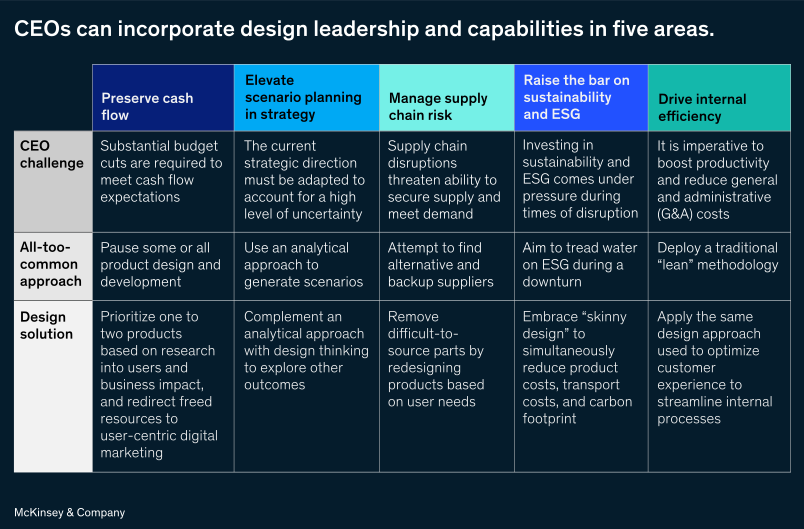
Uniquely challenging times call for unique approaches, not the standard playbook. Design offers this fresh perspective. McKinsey research has shown that companies that embrace the business value of design are better able to respond to shifting landscapes and generate improved performance. From 2013 to 2018, these companies had TSR that were 56 percentage points higher than that of their peers.3 In addition, companies that continued or increased their investment in innovation during the 2008–09 recession generated three times more growth compared with their industry peers in the three to five years that followed—in many cases leapfrogging their competitors.4 These results make sense given that a recession doesn’t mean that markets and customer needs suddenly stop evolving. In fact, such evolutions often speed up. For these reasons, we believe design should join topics such as finance, strategy, and talent on the CEO’s agenda. In this article, we explore specific examples where design has the potential to create significant value and boost an organization’s resilience. Executives can use the design function to unleash the power of creativity in strategy and problem solving in at least five important areas (exhibit).


Microsoft’s Distributed Application Framework Orleans Reaches Version 7

In Orleans, the desired distributed functionality is modelled as a grain, an addressable unit of execution that can send and receive messages to other grains and maintain its own state if necessary. The grains are virtual actors, persisted to durable storage and activated in memory on demand, in the same sense as virtual memory is an abstraction over a computer's physical memory. The grains had to inherit from the Grain base class in the previous versions of Orleans. Now the grains can be POCO objects. To get access to the code previously available only inside the Grain class, they can now implement the IGrainBase interface instead. The Orleans runtime keeps track of the activation/deactivation and finding/invoking grains as necessary. It also keeps clusters of silos, the containers for the execution of grains. The communication with the Orleans runtime is done using the client library. The last Orleans major version before 7.0 was version 3.0, released in 2019. The planned 4.0 release was later ported to .NET 7 and renamed to 7.0 to match the broader .NET 7 ecosystem launches.


Collaboration on IoT could transform risk and insurance

IoT offers an opportunity to fundamentally transform the insurance and risk management proposition in the large commercial space, to the mutual benefit of both customers and carriers. Networks of partnerships and IoT ecosystems will enable insurers to bundle technology, risk management services and risk transfer, while the flow of real-time risk data and insights would pave the way for a range of new and innovative solutions. However, these benefits can only be fully realised when IoT is installed in close collaboration with risk management and other business functions that stand to benefit or that would be impacted. Risk managers and risk experts play a vital role in transforming IoT data into a meaningful tool, and are ideally positioned to facilitate these discussions with internal stakeholders, as well as insurers. We are only at the start of this exciting journey, but collaboration will be critical for understanding customer needs and creating new solutions.


4 Steps to Help Organizations Embrace Risk from Emerging Technology

Particularly as companies invest in emerging technologies, business leaders need to listen more to their risk and compliance functions and integrate them into conversations about how those technologies will be implemented. Artificial intelligence is a great example: when companies rush to implement systems to accelerate efficiency and analyze trends, they risk creating disproportionate bias and violating personal privacy through data sourcing. Risk professionals need to be at the table from beginning to end to make sure that an evolving regulatory environment and other pitfalls are fully accounted for in the organization’s implementation process. While investment in risk management technology is helpful, it is insufficient without making structural changes to the organization to prioritize the risk function company-wide. ... When adopted purposefully, emerging technologies can make companies more efficient, more profitable, and better stewards for their employees, clients and communities. Risk is often unavoidable for early adopters of emerging technologies, but it can be mitigated if C-suites equip their risk functions with a holistic strategy and a voice in key business decisions.


EU fails to protect human rights in surveillance tech transfers

In its decision, the Ombudsman said that, having examined the documentation surrounding several EUTFA projects, there was no indication that proper human rights impact assessments were carried out. “The Ombudsman has identified shortcomings in that the Commission was not able to demonstrate that the measures in place ensured a coherent and structured approach to assessing the human rights impacts of EUTFA projects,” it said. “The Ombudsman finds it regrettable that the EUTFA projects in question were not subject to a clear human rights impact assessment, presented either as separate document or a separate section in the action documents. It further noted, for example, that despite the EUTFA projects covered by its inquiry being implemented in countries with major governance issues and poor human rights records, the analysis conducted by the Commission focused more on logistical issues, and that any assessments of the human rights impacts were “sporadic and unstructured” at best. It added that while the Commission itself considers the measures in place – including its multilayer approval process of projects; the use of specific “action” documentation for projects; and the possible suspension of funds – to be sufficient in safeguarding human rights, “the Ombudsman disagrees”.


Defining a Data-Driven Culture to Turn Uncertainty into Possibility

The limiting factor often lies in the design of organizational structures, especially in those focused on executing or exploiting current business models. The ultra-focus on efficiency here may lead to leaders stifling key impulses that lead to change such as seeking new data or exploring new possibilities that are also inherently a basic human attribute. Recognizing this need for change in uncertain environments is a critical first step and a strong data-driven culture values and promotes curiosity among its employees, and fosters creativity as an outcome to turn uncertainty into possibility. Nathan Furr, a celebrated author and professor at Institut Européen d’Administration des Affaires (INSEAD) has studied uncertainty based on interviews and observations across world-renowned leaders, innovators, and entrepreneurs. His studies provide strong evidence that leaders can be trained to face uncertainty and as result, discover new sources of revenue not seen before. You need to start by asking how your industry must evolve to meet the challenges of new technologies. 


Is the Hassle of Sharing Data Worth the Value it Creates?

When deciding whether to address customer demands that require collection, use and sharing of their personal data, D&A leaders must consider the balance of economic and consumer value. Too often, a focus on regulations and legalese gets in the way of this conversation. Legal discussions about data-driven initiatives are often constrained by risk avoidance mindsets, which limits business impact and value. To prioritize business outcomes, executive leaders must focus data collection and monetization discussions on revenue generation, cost savings, and balanced risk mitigation. Start data sharing and monetization efforts by identifying known desired business outcomes, as well as unknown opportunities, for quantifiable economic benefit. Organizations can expend sizable investments for personal data rights, including the right to use/reuse and share/reshare data, but not all rights procured will match your business case, be relevant to consumer demand, or even be enforceable, resulting in economic waste. Invest resources to obtain legal rights to locate, use and share the “right” data to match your targeted monetization use case.


Privacy-first data via data mesh: migrating governance to federated delegation

As you are building organizational co-ownership and shared responsibility via federation, you also need to design systems that allow for federated design, development and use. This means pushing your architects to think about data governance in a federated manner, which might be new for them! For privacy experts at your organization, this means working closely with your information security and technical counterparts. How can we implement the privacy goals set by the organization in our architecture and software? How does our architecture design support privacy first? You may need to spend time exchanging knowledge to get to a place where this conversation can happen more fluidly and in the same language. If technical leaders at your organization haven’t already heard about Privacy Engineering — this is a great place for them to start learning the current technologies, processes, design and theory around incorporating privacy in a technical environment. 


Stakeholders want more than AI Bill of Rights guidance

The AI Bill of Rights offers guidance and resources to businesses, but is not an enforceable law, meaning businesses and federal agencies don't need to comply with the ethical AI principles it lays out, Engler said. Instead, the AI Bill of Rights catalyzes federal agencies to act on the guidance and points the way for policymakers to consider AI regulation, said Harlan Yu, executive director of technology and equity nonprofit Upturn, based in Washington, D.C. "This document in the long term, will be judged not by what's on paper but all the concrete actions that are going to flow from this document, particularly from the federal agencies," Yu said during the panel discussion. "We're talking about prospective rule-making, enforcement actions, regulatory guidance and legislative actions that really need to put these principles into practice." The AI Bill of Rights applies to all automated systems that significantly impact people, such as AI decision-making systems for housing, employment and healthcare-related decisions, said Sorelle Friedler, OSTP's assistant director for data and democracy and a panelist.


Does Enterprise Architecture belong in IT?

The belief among the panelists was that EA is a core component in delivering business value. They all saw themselves as acting on behalf of the business to support business objectives. I wondered if, perhaps, the reason some EAs wanted to move to the business was because they believed they would have more visibility and more purpose there. As if to echo my thoughts, at least one attendee was not totally confident that shifting to the business would would have the desired effect. Mats Berglund from Ericsson, wanted to understand why Enterprise Architects have a “kind of complex” about where they sit. Instead of asking whether we should report into this or that part of the organization, he said, “We should be asking ourselves, as EAs, what are we giving the business?” Mats said it didn't matter that EA was in IT. Enterprise Architects should continuously prove their value to the business wherever they sit. Their contribution, after all, is what makes EAs credible advisors to the business. Returning for a moment to Dominik’s Söhnle’s thesis, he makes the point there that part of this "IT or the business" tension arises from a lack of business focus in some of the EA tools on the market. 


Quote for the day:

"There is no "one" way to be a perfect leader, but there are a million ways to be a good one." -- Mark W. Boyer