Showing posts with label platform. Show all posts

Daily Tech Digest - May 05, 2026


Quote for the day:

“Our greatest fear should not be of failure … but of succeeding at things in life that don’t really matter.” -- Francis Chan

🎧 Listen to this digest on YouTube Music

▶ Play Audio Digest

Duration: 25 mins • Perfect for listening on the go.


The fake IT worker problem CISOs can’t ignore

The article "The fake IT worker problem CISOs can’t ignore" highlights a burgeoning cybersecurity threat where thousands of fraudulent IT professionals, often linked to state-sponsored actors like North Korea, infiltrate organizations by exploiting remote hiring vulnerabilities. These sophisticated adversaries utilize advanced artificial intelligence to craft fabricated resumes, generate convincing deepfake identities, and master scripted interviews, successfully bypassing traditional background checks that typically verify provided information rather than detecting outright fraud. Once integrated as trusted insiders, these malicious actors can facilitate data exfiltration, industrial sabotage, or the funneling of corporate funds to foreign governments. The piece underscores that this is no longer just a recruitment issue but a critical insider risk management challenge. CISOs are urged to implement more rigorous vetting processes, such as multi-stage panel interviews and project-based technical evaluations, to identify inconsistencies that automated screenings miss. Furthermore, the article advises organizations to adopt a "least privilege" approach for new hires, restricting access to sensitive systems until identities are definitively verified. Beyond immediate security breaches, the presence of fake workers creates substantial business and compliance risks, potentially leading to regulatory penalties and the erosion of client trust, making it imperative for leadership to coordinate across HR and security departments to mitigate this evolving threat.


Three Pillars of Platform Engineering: A Virtuous Cycle

In the article "Three Pillars of Platform Engineering: A Virtuous Cycle," Pratik Agarwal challenges the notion that reliability and ergonomics are opposing trade-offs, arguing instead that they form a mutually reinforcing feedback loop. The framework is built upon three foundational pillars: automated reliability, developer ergonomics, and operator ergonomics. The first pillar treats reliability as a managed state where a centralized "control plane" or "brain" continuously reconciles the system’s actual state with its desired state, automating complex tasks like shard rebalancing and self-healing. The second pillar, developer ergonomics, focuses on providing opinionated SDKs that enforce safe defaults—such as environment-aware configurations and sophisticated retry strategies—to prevent cascading failures and reduce cognitive load. Finally, operator ergonomics emphasizes building internal tools that encode tribal knowledge into automated commands and layered observability, allowing even novice engineers to resolve incidents effectively. Together, these pillars create a virtuous cycle where ergonomic interfaces produce predictable traffic patterns, which in turn stabilize the infrastructure and reduce the operational burden. This stability grants platform teams the bandwidth to further refine their tools, building a foundation of trust that allows organizational scaling without the friction of "sharp" interfaces or manual interventions.


Why Humans Are Still More Cost-Effective Than AI Compute

The article explores a significant study by MIT’s Computer Science and Artificial Intelligence Laboratory regarding the economic viability of AI compared to human labor. Despite intense hype surrounding automation, researchers discovered that for many visual tasks, humans remain far more cost-effective than computer vision systems. Specifically, the research indicates that only about twenty-three percent of worker wages currently spent on tasks involving visual inspection are economically attractive for AI replacement today. This financial gap is primarily due to the massive upfront costs associated with implementing, training, and maintaining sophisticated AI infrastructure. While AI performance is technically impressive, the capital investment required often yields a poor return on investment compared to versatile human workers who are already integrated into existing workflows. Furthermore, high energy consumption and specialized hardware needs contribute to the financial burden of AI compute. The study suggests that while AI capabilities will inevitably improve and costs may eventually decrease, there is no immediate "job apocalypse" for roles requiring visual discernment. Instead, human intelligence provides a level of flexibility and affordability that current technology cannot yet match at scale. Ultimately, the transition to AI-driven labor will be gradual, dictated more by cold economic feasibility than by pure technical capability.


Leading Without Forecasts: How CEOs Navigate Unpredictable Markets

In his May 2026 article for the Forbes Business Council, CEO Yerik Aubakirov argues that traditional long-term forecasting is no longer viable in a global landscape defined by rapid geopolitical, regulatory, and technological shifts. Aubakirov advocates for a fundamental change in leadership, suggesting that CEOs must replace rigid five-year plans with agile, hypothesis-driven strategies. Drawing a parallel to modern meteorology, he recommends layering broad seasonal outlooks with rolling monthly and quarterly updates to maintain operational relevance. A critical component of this adaptive approach involves rethinking capital allocation; instead of committing massive upfront investments to unproven initiatives, successful organizations now deploy capital in gradual tranches, scaling only when early signals confirm market viability. This staged investment model minimizes the risk of catastrophic failure while allowing for greater flexibility. Furthermore, the author emphasizes the importance of shortening internal decision cycles and cultivating a leadership team capable of operating decisively even with partial information. Ultimately, Aubakirov asserts that uncertainty is the new baseline for the 2020s. By treating strategic plans as fluid experiments rather than fixed commitments and diversifying strategic bets, modern leaders can ensure their organizations remain resilient, allowing their portfolios to "breathe" and evolve through market volatility rather than breaking under pressure.


Agentic AI is rewiring the SDLC

In the article "Agentic AI is rewiring the SDLC," Vipin Jain explores how autonomous agents are transforming software development from a procedural lifecycle into an intelligence-led delivery model. This shift moves AI beyond simple code suggestion to active participation across all stages, including planning, architecture, testing, and operations. In the planning phase, agents analyze existing codebases and refine user stories, though Jain warns that "vague intent" remains a primary bottleneck. Architecture evolves from static documentation to the definition of executable guardrails, making the role more operational and consequential. During the build and test phases, agents decompose tasks and generate reviewable work, shifting key productivity metrics from mere code volume to safe, reliable throughput. The human element also undergoes a significant transition; developers and architects move "up the value chain," spending less time on manual execution and more on high-level judgment, verification, and exception management. Furthermore, the convergence of pro-code and low-code platforms requires CIOs to prioritize clear requirements, robust observability, and rigorous governance to avoid software sprawl. Ultimately, the goal is not just more generated code, but a redesigned delivery system where AI acts as a trusted coworker within a secure, governed framework, ensuring quality and resilience in increasingly complex software ecosystems.


Opinions on UK Online Safety Act emphasize importance of enforcement

The UK’s Online Safety Act (OSA) has sparked significant debate regarding its actual effectiveness in protecting children, as detailed in a recent report by Internet Matters. While the legislation has made safety tools and parental controls more visible, stakeholders argue that the lack of robust enforcement undermines its goals. Surveys indicate that children frequently encounter harmful content and find existing age verification methods easy to circumvent through tactics like using fake birthdays or VPNs. Despite these gaps, there is high public and youth support for safety features, such as improved reporting processes and restrictions on contacting strangers. However, the report highlights that the OSA fails to address primary parental concerns, specifically the excessive time children spend online and the emerging psychological risks posed by AI-generated content. Industry experts emphasize that while highly effective biometric technologies like facial age estimation and ID scanning exist, they must be consistently deployed to meet regulatory standards. Furthermore, critiques of the regulator Ofcom suggest its focus on corporate policies rather than specific content moderation may limit its impact. Ultimately, the consensus is that for the Online Safety Act to move beyond being a "leaky boat," the government must prioritize safety-by-design principles and hold both platforms and regulators accountable through rigorous leadership and enforcement.


They don’t hack, they borrow: How fraudsters target credit unions

The article "They don’t hack, they borrow" highlights a sophisticated shift in cybercrime where fraudsters exploit legitimate financial workflows rather than bypassing security systems. Instead of technical hacking, threat actors utilize highly structured methods to "borrow" funds through fraudulent loans, specifically targeting small to mid-sized credit unions. These institutions are preferred because they often rely on traditional verification methods and lack advanced behavioral fraud detection. The criminal process begins with acquiring stolen personal data and assessing a victim's credit profile to ensure high approval odds. Fraudsters then meticulously prepare for Knowledge-Based Authentication (KBA) by gathering details from leaked datasets and social media, effectively turning identity checks into predictable hurdles. Once an application is submitted under a stolen identity, the attacker navigates the lending process as a genuine customer. Upon approval, funds are rapidly moved through intermediary accounts to obscure their origin before being cashed out. By mirroring normal financial behavior, these organized schemes avoid triggering traditional security alarms. Researchers from Flare emphasize that this evolution from intrusion to process exploitation makes detection increasingly difficult, as the line between legitimate activity and fraud continues to blur, requiring institutions to adopt more adaptive, data-driven defense strategies to mitigate rising risks.


The Cloud Already Ate Your Hardware Lunch

The article "The Cloud Already Ate Your Hardware Lunch," published on BigDataWire on May 4, 2026, details a fundamental disruption in the enterprise technology market where cloud hyperscalers have effectively rendered traditional on-premises hardware procurement obsolete. Driven by a volatile combination of skyrocketing memory prices and severe supply chain shortages, modern organizations are finding it increasingly difficult to justify the costs of owning and maintaining independent data centers. The piece emphasizes that industry leaders like Microsoft, Google, and Amazon are allocating staggering capital—often exceeding $190 billion—to dominate the procurement of GPUs and high-bandwidth memory essential for generative AI. This aggressive consolidation has created a "hardware lunch" scenario, where cloud giants have successfully captured the market share once dominated by traditional server manufacturers. Enterprises are transitioning from viewing the cloud as an optional convenience to recognizing it as the only scalable platform for deploying AI agents and managing the massive datasets central to 2026 operations. Consequently, the legacy hardware model is being subsumed by advanced cloud ecosystems that offer superior integration, security, and raw power. This seismic shift marks the definitive conclusion of the on-premises era, as the sheer economic weight and technological advantages of the cloud become the only viable choice for remaining competitive in an AI-first economy.


One in four MCP servers opens AI agent security to code execution risk

The article examines the critical security risks inherent in enterprise AI agents, highlighting a significant "observability gap" between Model Context Protocol (MCP) servers and "Skills." While MCP servers offer structured, loggable functions, Skills load textual instructions directly into a model’s reasoning context, making their internal processes invisible to traditional monitoring tools. Research from Noma Security reveals that one in four MCP servers exposes agents to unauthorized code execution, while many Skills possess high-risk capabilities like data alteration. These vulnerabilities often manifest in "toxic combinations," where untrusted inputs and sensitive data access lead to sophisticated attacks such as ContextCrush or ForcedLeak. Even without malicious intent, autonomous agents have caused severe damage, exemplified by Replit's accidental database deletion. To address these blind spots, the "No Excessive CAP" framework is proposed, focusing on three defensive pillars: Capabilities, Autonomy, and Permissions. By strictly allowlisting tools, implementing human-in-the-loop approval gates for irreversible actions, and transitioning from broad service accounts to scoped, user-specific credentials, organizations can mitigate the risks of high-blast-radius incidents. Ultimately, because Skill-driven reasoning remains opaque, security teams must compensate by tightening control over the execution layer to prevent agents from operating with excessive, unsupervised authority.


The Shadow AI Governance Crisis: Why 80% of Fortune 500 Companies Have Already Lost Control of Their AI Infrastructure

The article "The Shadow AI Governance Crisis" by Deepak Gupta highlights a critical security gap where 80% of Fortune 500 companies have integrated autonomous AI agents into their infrastructure, yet only 10% possess a formal strategy to manage them. This "agentic shadow AI" differs from simple tool usage because these autonomous agents possess API access, chain actions across services, and operate at machine speed without human oversight. Traditional governance frameworks, designed for stable human identities, fail because AI agents are ephemeral and dynamic, leading to "identity without governance" and excessive permission sprawl. Statistics from Microsoft’s 2026 Cyber Pulse report underscore the urgency, noting that nearly 90% of organizations have already faced security incidents involving these agents. To combat this, the article introduces a five-capability framework centered on creating a centralized agent registry, implementing just-in-time access controls, and establishing real-time visualization of agent behaviors. High-profile breaches at McDonald’s and Replit serve as warnings of the catastrophic risks posed by unmonitored AI autonomy. Ultimately, Gupta argues that enterprises must shift from human-speed approval workflows to automated, runtime enforcement to maintain control. Building this foundational governance is presented as a necessary prerequisite for safe innovation and long-term competitive advantage in an increasingly AI-driven corporate landscape.

Daily Tech Digest - January 16, 2026


Quote for the day:

"Common sense is something that everyone needs, few have, and none think they lack" -- Benjamin Franklin


If you think agentic AI is a challenge, you’re not ready for what’s coming

The convergence of technology is happening all at once. You’ve got new processes being put in place while simultaneously replacing legacy infrastructure. You’ve got new technology, new talent being rolled into this convergence. Meanwhile, physical AI and quantum are coming quickly on top of agentic. Adaptability is the new job security. The ability to adapt is the most important skill for employees and the most important organizational differentiator. Organizations that can adapt quickly to new technology, redefining processes and training — that’s how they’ll differentiate. The ones that can’t will fall behind. ... It’s becoming not a technology issue as much as a business and process issue. The technology — whether AI, agentic AI, physical AI, or quantum — mostly exists to solve today’s problems. The issue is training, people, and adoption. ... Some industries, like financial services and healthcare [and] precision medicine — financial services has over-invested for decades in data and data quality for compliance reasons. They can use it for AI and quantum. Precision medicine is another category with high data quality. But without the right data, infrastructure, and sandbox, you’ll spread yourself too thin. You may try things, but it doesn’t get you value. Without a defined use case and focus area, you create innovation theater. Companies are getting focused on that first step: What use case am I trying to solve? 


AI Is Compressing the Coding Layer: Here's What Developers Do Next

One of the most encouraging developments in 2025 has been AI's ability to accelerate developer progression and skill growth. In our Q4 survey, 74% of developers said AI strengthened their technical skills. As lower-level execution becomes increasingly automated, developers who can work across systems, evaluate tradeoffs, and guide AI-driven workflows are progressing faster than in previous cycles. ... More than half (55%) also expect AI proficiency to accelerate progression and compensation. This reflects a rising demand for talent that can pair technical depth with architectural and systems thinking. ... Engineering teams are beginning to resemble higher-skill strategic units with stronger cross-functional alignment and architectural leadership. 58% of developers expect teams to become smaller and leaner next year as entry-level coding tasks are increasingly automated. Similarly, more than half (58%) of project managers report that 10-30% of project tasks could be handled by AI-driven workflows in 2026, including documentation generation, automated testing, code completion/refactoring, and requirements/user story drafting. These aren't the most visible tasks, but they've historically consumed a disproportionate share of time. ... To thrive in 2026 and beyond, developers should build competency in orchestrating AI workflows, invest in architectural and systems design literacy, and strengthen their fluency in data engineering, security, and cloud foundations.


Insider risk in an age of workforce volatility

Economic pressures, AI-driven job displacement, and relentless organizational churn are driving insider risk to its highest level in years. Workforce instability erodes loyalty and heightens grievances. The accelerating deployment of powerful new tools, such as AI agents, amplifies the threats from within, both human and machine. ... This surge, up significantly from prior years, creates fertile ground for disgruntlement: financial stress, resentment over automation, and opportunistic behavior, from negligence and careless data handling to deliberate malevolent actions like data exfiltration and credential monetization. ... They are becoming exploitable vectors for silent data exfiltration, disruption, or unintended catastrophe. This is particularly concerning when volatility reduces human oversight and rushes deployment without commensurate controls. Palo Alto Networks’ 2026 cybersecurity predictions emphasize that these agents introduce vulnerabilities such as goal hijacking, tool misuse, prompt injection, and shadow deployment, often amplified by the very churn that drives their adoption across multinational organizations. Security leaders are taking note. ... There is no doubt that such anxiety from ongoing layoffs and role uncertainty can lead to nervous mistakes, privilege hoarding, or rushed workarounds that expose data without intent to harm. Yet harm is actualized. The result is a heightened insider risk landscape that is amplified when the interplay between human churn and machine proliferation is overlooked.


Creating Trust Through Data Is a Long Game — Advantage Solutions CDO

“Trust starts with the rapport with individuals. It starts with listening. It doesn’t start with building solutions.” She highlights that facts alone don’t solve decision-making challenges. Business intuition still matters — but it must be balanced with truth derived from data. “Sometimes the facts alone aren’t enough. There’s a balance between data and the business-led gut experience. All of it is important.” Trust requires time, consistency, and transparency. ... O’Hazo frames AI not as a disruption, but as a spotlight. “AI is almost spotlighting the need for foundational data.” The reason: modern organizations need to answer multidimensional questions, not isolated ones. “It’s no longer a singular flat question. It’s ‘How is X related to Y, and what are the factors that drive growth?’ To answer that, you need data from so many different functions organized and architected the right way.” This interconnection does more than support analytics; it transforms relationships across the business. “When you start to interconnect the data, you naturally and organically have meaningful conversations across functions.” ... Turajski raises the common phrase “source of truth,” asking whether AI has changed how organizations think about it. O’Hazo’s response is clear: AI doesn’t rewrite the rules; it reveals the gaps. “AI is spotlighting, sometimes unfavorably, where the pre-work on the data foundation hasn’t accelerated enough.” This wake-up call has elevated data readiness to board-level priority.


The workforce shift — why CIOs and people leaders must partner harder than ever

For the last decade or so, digital transformation has been framed as a technology challenge. New platforms. Cloud migrations. Data lakes. APIs. Automation. Security layered on top. It was complex, often messy and rarely finished — but the underlying assumption stayed the same: Humans remained at the center of work, with technology enabling them. ... AI is just technology. But it feels human because it has been designed to interact with us in human ways. Large language models combined with domain data create the illusion that AI can do anything. Maybe one day it will. Right now, what it can do is expose how unprepared most organizations are for the scale and pace of change it brings. We are all chasing competitive advantages — revenue growth, margin improvement, improving resilience — and AI is being positioned as the shortcut. But unlike previous waves of automation, this one does not sit neatly inside a single function. ... Perception becomes reality very quickly inside organizations. If people believe AI is a colleague, what does that mean for accountability, trust and decision-making? Who owns outcomes when work is split between humans and machines? These are not abstract questions — they show up in performance, morale and risk. ... For years, organizations have layered technology on top of broken processes. Sometimes that was a conscious trade-off to move faster. Sometimes it was avoidance. Either way, humans could usually compensate.


CIO Playbook for Post-Quantum Security

While the scope of migration to post-quantum cryptography can be daunting, CIOs can follow several practical steps to make the project more manageable, said Sandy Carielli, vice president and principal analyst at Forrester. "There's a process here that's going to need to be addressed in order to get to where the organization needs to be," she said. "Discover, prioritize, remediate and add cryptographic agility." One of the biggest misconceptions she sees from CIOs is on what being ready for quantum-resistant security means. "Sometimes people have the misconception that you need a quantum computer for quantum security," Carielli said. "You don't need quantum computers. And, in fact, you're not going to. You're doing this to be protected." ... Designing for crypto agility is the final step in the process, and organizations should strive to create systems so that algorithm changes necessitate configuration changes, not re-architecting. "Good for crypto agility means that the next time an algorithm is broken, we are able to adapt to that by changing a configuration. We're able to adapt in a matter of weeks, rather than a matter of years," Carielli said. The regulatory impact should make quantum migration an easier sell than it would have been even a few years ago, as deadlines loom in the United States, Australia, EU and Asia countries. "Regardless of when a quantum computer is going to be able to break today's cryptography, we are being asked to migrate by the organizations and the countries that we want to do business with," Carielli said.


When your platform team can’t say yes: How away-teaming unlocks stuck roadmaps

Away teaming inverts the traditional model. Instead of platform engineers embedding with product teams to provide expertise, product engineers temporarily join platform teams to build required capabilities under platform guidance. ... Product teams have already secured funding for their initiatives. Away teaming redirects that investment from building a product-specific solution into creating a reusable platform capability. For platform teams, this expands effective capacity without headcount growth. Platform engineers provide design review, answer questions and conduct code review. ... Product engineers need to view away teaming as a growth opportunity, not a sacrifice. Frame it explicitly as platform engineering experience that builds broader systems thinking skills and deepens architectural understanding. ... Away teaming works best for capabilities in the middle ground: too product-specific for immediate platform prioritization, yet general enough that future products will benefit from reuse. Away teaming also has scale limits. A platform team might effectively support two concurrent away team engagements. Beyond that, guidance capacity becomes strained. ... Product engineers who complete away team assignments become platform advocates. They understand the architectural tradeoffs and can credibly explain platform limitations, reducing tension and frustration between teams.


Forget Predictions: True 2026 Cybersecurity Priorities From Leaders

Most organizations, large and small, are inundated with manual tasks, which makes many of our processes very expensive. This is compounded by economic forces that many organizations face today, which limits their ability to hire additional staff. For years, the industry has been working to solve these problems with SOAR, RPA Bots, or other programmatic solutions to do this bulk work. I think the use of AI extends the work we have already done in that space, but in a broader application. ... The promise of SOAR is centralized orchestration. The reality is months of costly, brittle integration work that breaks with every vendor update. We spend more time maintaining the automation pipeline than the pipeline saves us. We don’t have enough people who can build, train, and maintain sophisticated AI/ML models while understanding threat hunting. The technology requires a new, hyper-specialized skill set, defeating the goal of efficiency. The single most impactful shift for efficiency in 2026 will be the Process and People shift toward Radical Simplification and Security Accountability Diffusion. ... “The shift I’m pushing for is toward collaborative intelligence that actually tells us which threats matter for our specific environment. Context is king here, and I’m encouraged by the emergence of solutions that analyze signals across multiple organizations to provide internet-wide defense. But this only works if we’re all willing to put in what we want to get out of it, meaning reliably sharing intelligence with peers and industry groups, not just consuming it.


DCI launches digital identity interoperability standards for social protection

Authorities are increasingly leveraging digital identification systems to achieve this goal and ensure their social protection (SP) programs are inclusive. ... These open standards provide a trusted mechanism for social protection systems to authenticate individuals and request verified identity data, such as demographic attributes or authentication tokens, in a privacy-preserving way. The standards are not about building ID systems themselves or about integrating with health or education platforms, DCI emphasized. Rather, they’re focused squarely on enabling interoperability between ID and social protection systems. This includes supporting social registries, integrated beneficiary registries and other SP platforms “to connect meaningfully and securely with ID systems.” DCI said the release culminates months of research, peer review and collaboration by a standards committee comprising experts from 20 organizations. By establishing a common technical language, the initiative aims to strengthen digital public infrastructure and foster greater trust in the delivery of social protection programs. ... “Digital transformation of social protection is not an end in itself and it’s not only about cutting costs,” said ILO director Shahra Razavi. “It is about making sure everyone has access to benefits and services, particularly those most at risk of vulnerability and exclusion.”


Data Governance in the AI Era: Are We Solving the Wrong Problem?

The foundation of any effective AI governance model starts with visibility and control. Create a living list of sanctioned AI tools tied to enterprise accounts like personal accounts and shadow IT. Once you have that visibility, it’d be right to require all AI usage through company-issued credentials, ensuring every login is accountable and logged. Users authenticate through your identity provider, and audit trails capture usage patterns. When you can trace who accessed which tool and when, you can create records that support both compliance requirements and incident investigation. ... One of the biggest mistakes organizations make is treating all data the same way, imposing blanket bans that create friction without proportional security benefit. A more effective approach classifies data by sensitivity level and creates rules aligned with that classification. ... If your policy today looks like a wall of “no,” you’re probably protecting yourself from the wrong consequence. The real risk isn’t that AI will suddenly go rogue, it’s more likely that your people will use it without guidance, visibility, or control. Unmanaged adoption creates the very data leakage you’re trying to prevent. And with managed adoption, through clear policy and good governance, creates visibility, accountability, and the ability to detect and respond to actual incidents. Data professionals occupy a critical position in this conversation, they own the data architecture, the classification systems, and the audit trails that make AI governance possible. 

Daily Tech Digest - January 15, 2026


Quote for the day:

"You have to have your heart in the business and the business in your heart." -- An Wang


AI agents can talk — orchestration is what makes them work together

“Agent-to-agent communications is emerging as a really big deal,” G2’s chief innovation officer Tim Sanders told VentureBeat. “Because if you don't orchestrate it, you get misunderstandings, like people speaking foreign languages to each other. Those misunderstandings reduce the quality of actions and raise the specter of hallucinations, which could be security incidents or data leakage.” ... In another critical evolution in the agentic era, human evaluators will become designers, moving from human-in-the-loop to human-on-the-loop, according to Sanders. That is: They will begin designing agents to automate workflows. Agent builder platforms continue to innovate their no-code solutions, Sanders said, meaning nearly anyone can now stand up an agent using natural language. “This will democratize agentic AI, and the super skill will be the ability to express a goal, provide context and envision pitfalls, very similar to a good people manager today.” ... Organizations should begin “expeditious programs” to infuse agents across workflows, especially with highly repetitive work that poses bottlenecks. Likely at first, there will be a strong human-in-the-loop element to ensure quality and promote change management. “Serving as an evaluator will strengthen the understanding of how these systems work,” Sanders said, “and eventually enable all of us to operate upstream in agentic workflows instead of downstream.”


Integrating AI-Enhanced Microservices in SAFe 5.0 Framework

AI-driven microservices can be a game-changer for Lean Portfolio Management within SAFe. By optimizing decision analytics and enhancing value stream performance, AI simplifies, rather than complicates. I know what you’re thinking: AI tools can add complexity. One client put this to the test, and we found AI helped reduce the noise. It sliced through the data smog to identify hidden value streams and automate mundane tasks like financial forecasting and risk management. ... Integrating decentralized AI models into SAFe’s ARTs can significantly enhance their autonomy. During a high-stakes project, we shifted from a centralized to a decentralized model, which allowed ARTs to self-optimize and adapt to shifting priorities seamlessly. It was like giving ARTs a brain of their own. Decentralized AI models reduce the bottlenecks you'd typically encounter in centralized systems. Think of the ARTs as small startups within the larger enterprise ecosystem, each capable of making swift, informed decisions. ... This isn’t just a tech enthusiast's dream—it's an emerging reality. The maturity of AI technologies spells a future where enterprises aren’t just keeping up; they’re setting the pace. So, if there’s a single, actionable insight to glean from my journey, it’s this: enterprises need to actively pursue cross-industry collaborations, invest in AI-powered microservices, and hone their Agile professionals’ skill sets.


Incorporating Geopolitical Risk Into Your IT Strategy

IT organizations know how to plan for unexpected outages, but even the most rigorously designed strategy is vulnerable to the shifting winds of geopolitics. CIOs and technology leaders need to know how their organizations will respond to geopolitical disruptions, and scenario planning needs to be a priority. ... "The IT department can treat geopolitical disruption as an expected operational variable rather than an unforeseen catastrophe. Good and tested enterprise risk management frameworks, investment in government affairs partnerships and ongoing board engagement should start to manage and prepare for this," Dixon said. CIOs need to do scenario modeling around the risks facing their enterprise, and evaluate how IT is teaming with business units, security teams and the CISO on a cohesive tech strategy that builds security, including artificial intelligence security, in from the ground up, said Sean Joyce ... "You're as strong as your weakest link," Joyce said. "As geopolitical risk becomes more prominent, you're going to see tools like cyber being leveraged by countries, particularly those that don't have stronger military or other capabilities. For some, it may be the only tool they can leverage." Physical infrastructure, geography and power supplies are also now areas of risk CIOs need to consider, and infrastructure strategy must align with sustainability, energy realities and geopolitical stability. 


Six Architecture Challenges for Startups

The risk is not that the first version is imperfect; that is inevitable. The risk is that the team keeps layering new functionality on top of an accidental architecture. At some point, the cost of change becomes so high that every small modification feels dangerous. The architectural challenge is to intentionally decide where to accept debt and where to invest in structure. Startups need a minimal set of principles – for example, clear domain boundaries, basic API hygiene, and a simple deployment model – that allow speed without locking the product into a dead end. ... If the product team is still validating pricing models, redefining the customer journey, or experimenting with different verticals, any rigid decomposition can turn into friction. Yet avoiding boundaries altogether leads to a “big ball of mud” that is equally hard to evolve. A practical approach is to use provisional boundaries based on current value streams – onboarding, transaction processing, analytics, etc. – and treat them as hypotheses. The challenge is not to find the perfect structure from day one, but to keep those boundaries explicit and adjustable as the business model evolves. ... Startups must make conscious decisions about where they are comfortable being tightly coupled to a provider and where they need portability. That requires viewing cloud services through a business lens: What is strategic IP, what is replaceable, and what is pure commodity? Aligning these categories with architectural choices is a non-trivial design challenge, not just a procurement decision. 


Platform-as-a-Product: Declarative Infrastructure for Developer Velocity

Without centralized guardrails, teams often compensate by over-allocating resources "to be safe", leading to inconsistent environments and unnecessary cloud spend that is only discovered after deployment. ... What is missing is a developer-friendly abstraction that brings these related concerns together. Developers need a way to express intent (not only what infrastructure is required, but also how the application should be built, deployed, configured across environments, secured, and sized) without having to implement the mechanics of each underlying system. From a platform engineering perspective, this abstraction represents the core of an internal developer platform and can be implemented as a lightweight Python-based platform framework. ... The platform comprises several interconnected components. GitLab pipelines coordinate everything, pulling code from repositories, building and unit testing applications (with tests written by developers), checking security, creating cloud infrastructure with Terraform/IaC, and deploying to Kubernetes clusters with Puppet configuration management. The configuration YAML file controls all of this, telling each component what to do. The architecture clearly separates concerns: the CI pipeline handles code building, testing, and vulnerability scanning. CD pipeline handles deployment: creating cloud resources, updating Kubernetes, and configuring environments. 


(Re)introducing Adaptive Business Continuity

Adaptive BC is designed to provide a framework that delivers better outcomes when organizations deal with losses. The result may be a reduction in documentation (something I greatly favor) but that is not a stated goal. ... My experience over the years has led me to conclude that trying to define priorities for the resumption of services is wasted effort. Many activities can take place in parallel, and priorities will change when disasters occur. A perfect example is the governmental lockdowns and health authority mandates that followed the emergence of COVID. The result is that demand for products and services changed drastically, upending previous priorities. Priorities may be defined following adaptive principles, but it is not at all a stated component of the Adaptive framework. ... For a number of reasons, I would like to see the word “plan” used a lot less within our profession. Seeing the word “strategy” in its place would be a step in the right direction. Strategy improvement is not, however, a key outcome of Adaptive BC efforts. There is some benefit to having clearly defined recovery strategies, but strategies only provide benefit to competent and empowered teams armed with the resources they need to carry out the mission. For this reason, I always emphasize the importance of focusing efforts on capabilities and consider plans and strategies as little more than supporting tools for any business continuity program. The improvement of strategies and/or plans is simply not an expected outcome of Adaptive BC work.


Exactly What To Automate With AI In 2026 For Faster Business Growth

Most founders automate the wrong things. They start with the flashy stuff, the complicated tools and fancy dashboards, while ignoring the repetitive tasks quietly draining their hours. But you need faster, cleaner growth by removing friction from the activities that actually grow your business. ... You shouldn't embark on a day's worth of admin tasks every time a new client says yes. It will only slow you down. Make it easy for them to pay, get a receipt, complete an onboarding form, and submit the required information. On your end, have the Google Drive folders, follow-up emails, and team briefings set up without you lifting a finger. Question everything you currently do manually. There is no reason it couldn't be an AI agent handling the sequence. All the tools you pay for already have integrations with each other; You're just not using them. The goal is that you could sign client after client because onboarding takes minutes, not hours. ... AI-generated content is awful when you use it wrong. But that doesn't mean you shouldn't involve AI in your content production process. Content still matters in marketing, whether long-form articles, videos, or social media visuals. You need to be part of the conversation, but only with relevant, authentic material. You cannot outproduce everyone manually, so use automations and retain your human genius for the finishing touches. ... The more your life admin runs on autopilot, the more you free up time and energy for your business. 


What is AI fuzzing? And what tools, threats and challenges generative AI brings

The way traditional fuzzing works is you generate a lot of different inputs to an application in an attempt to crash it. Since every application accepts inputs in different ways, that requires a lot of manual setups. Security testers would then run these tests against their companies’ software and systems to see where they might fail. ... Today, generative artificial intelligence has the potential to automate this previously manual process, coming up with more intelligent tests, and allowing more companies to do more testing of their systems. ... But there’s a third angle involved here. What if, instead of trying to break traditional software, the target was an AI-powered system? This creates unique challenges because AI chatbots are not predictable and can respond differently to the same input at different times. ... AI fuzzing can also help speed up the discovery of vulnerabilities, Roy says. “Traditionally, testing was always a function of how many days and weeks you had to test the system, and how many testers you could throw at the testing,” he says. “With AI, we can expand the scale of the testing.” ... Another use of AI in fuzzing is that it takes more than a set of test cases to fully test an application — you also need a mechanism, a harness, to feed the test cases into the app, and in all the nooks and crannies of the application. “If the fuzzing harness does not have good coverage, then you may not uncover vulnerabilities through your fuzzing,” says Dane Sherrets, staff innovations architect for emerging technologies at HackerOne


CISOs flag gaps in third-party risk management

CISOs rank third-party cyber risk among their highest-impact threats. Vendor relationships touch nearly every core business function, from cloud infrastructure and software development to data processing and AI services. Each added dependency expands the attack surface and increases the number of organizations involved in protecting sensitive systems and data. ... Only a small portion of organizations report visibility across third-, fourth-, and nth-party relationships. Most operate with partial insight limited to direct vendors or a narrow segment of the extended supply chain. CISOs say limited visibility complicates incident response, risk prioritization, and compliance planning. When a breach emerges several layers removed from a known vendor, security teams may struggle to understand exposure, timelines, and downstream impact. ... CISOs report rising regulatory scrutiny tied to third-party cyber risk. Regulatory frameworks place greater expectations on organizations to demonstrate oversight across vendor ecosystems, including indirect relationships. Only a minority of organizations feel ready to meet upcoming requirements without major changes. Most report progress underway, with further work needed to align processes, tooling, and internal coordination. Third-party risk management involves legal, procurement, compliance, and executive leadership alongside security teams. ... At the same time, AI adoption accelerates within vendor risk management itself. 


Anti-fragility – what is it and why should it be the goal for your organisation?

That ability to thrive in the face of disruption must become the basis for improved resilience. Modern organisations shouldn’t strive for survival, but for continual improvement. In the cyber sphere, that is crucial. Threat actors are constantly changing tack, targeting new CVEs, and executing increasingly complicated supply chain attacks. Resilience must therefore move in tandem as an ongoing process of learning and adapting. That is the crux of anti-fragility. It defines systems that thrive and improve from stress, volatility, disorder and shocks, rather than just resisting them. If a security model is only designed to recover, it remains just as vulnerable as before. But an anti-fragile approach actively benefits from each attack, identifying weaknesses, addressing them, and adapting as needed. ... Increasingly, organisations are recognising the value in anti-fragility as a strategy and more will adopt it next year. However, getting there means going beyond regulatory compliance. Compliance lays the foundations from which successful cybersecurity can be built, yet many currently see it as the finished structure. There are several problems with that. Security legislation frequently lags behind the threat landscape, and so the gap between a new threat emerging and a new law coming in to address it can stretch over the course of years. Organisations must therefore understand that compliance doesn’t equal protection. 

Daily Tech Digest - January 02, 2026


Quote for the day:

“If your ship doesn’t come in, swim out to meet it!” -- Jonathan Winters


Delivering resilience and continuity for AI

Think of it as technical debt, suggests IDC group VP Daniel Saroff as most enterprises underestimate the strain AI puts on connectivity and compute. Siloed infrastructure won’t deliver what AI needs and CIOs need to think about these and other things in a more integrated way to make AI successful. “You have to look at your GPU infrastructure, bandwidth, network availability, and connectivity between respective applications,” he says. “If you have environments not set up for highly transactional, GPU-intensive environments, you’re going to have a problem,” Saroff warns. “And having very fragmented infrastructure means you need to pull data and integrate multiple different systems, especially when you start to look at agentic AI.” ... Making AI scale will almost certainly mean taking a hard look at your data architecture. Every database adds features for AI. And lakehouses promise you can bring operational data and analytics together without affecting the SLAs of production workloads. Or you can go further with data platforms like Azure Fabric that bring in streaming and time series data to use for AI applications. If you’ve already tried different approaches, you likely need to rearchitect your data layer to get away from the operational sprawl of fragmented microservices, where every data hand-off between separate vector stores, graph databases, and document silos introduces latency and governance gaps. Too many points of failure make it hard to deliver high availability guarantees.


Technological Disruption: Strategic Inflection Points From 2026 - 2036

From a defensive standpoint, AI-driven security solutions will provide continuous surveillance, automated remediation, and predictive threat modeling at a scale unattainable by human analysts. Simultaneously, attackers will utilize AI to create polymorphic malware, execute influence operations, and exploit holes at machine speed. The outcome will be an environment where cyber war progresses more rapidly than conventional command-and-control systems can regulate. As we approach 2036, the primary concern will be AI governance rather than AI capacity. ... From 2026 to 2030, enterprises will increasingly recognize that cryptographic agility is vital. The move to post-quantum cryptography standards means that old systems, especially those in critical infrastructure, financial services, and government networks, need to be fully inventoried, evaluated, and upgraded. By the early 2030s, quantum innovation will transcend cryptography, impacting optimization, materials science, logistics, and national security applications. ... In the forthcoming decade, supply chain security will transition from compliance-based evaluations to ongoing risk intelligence. Transparency methods, including software bills of materials, hardware traceability, and real-time vendor risk assessment, will evolve into standard expectations rather than just best practices. Supply chain resilience will strategically impact national competitiveness.


True agentic AI is years away - here's why and how we get there

We're not there yet. We're not even close. Today's bots are limited to chat interactions and often fail outside that narrow operating context. For example, what Microsoft calls an "agent" in the Microsoft 365 productivity suite, probably the best-known instance of an agent, is simply a way to automatically generate a Word document. Market data shows that agents haven't taken off. ... Simple automations can certainly bring about benefits, such as assisting a call center operator or rapidly handling numerous invoices. However, a growing body of scholarly and technical reports has highlighted the limitations of today's agents, which have failed to advance beyond these basic automations. ... Before agents can live up to the "fully autonomous code" hype of Microsoft and others, they must overcome two primary technological shortcomings. Ongoing research across the industry is focused on these two challenges: Developing a reinforcement learning approach to designing agents; and Re-engineering AI's use of memory -- not just memory chips such as DRAM, but the whole phenomenon of storing and retrieving information. Reinforcement learning, which has been around for decades, has demonstrated striking results in enabling AI to carry out tasks over a very long time horizon. ... On the horizon looms a significant shift in reinforcement learning itself, which could be a boon or further complicate matters. Can AI do a better job of designing reinforcement learning than humans?


Why Developer Experience Matters More Than Ever in Banking

Effective AI assistance, in fact, meets developers where they are—or where they work. Some prefer a command-line interface, others live inside an IDE, and still others rely heavily on sample code and language-specific SDKs. A strong DX strategy supports all of these modes, using AI to surface accurate, context-aware guidance without forcing developers into a single workflow. When AI reinforces clarity, it becomes a force multiplier. ... As AI-assisted development becomes more common, the quality of documentation takes on new importance. Because it is no longer read only by humans, documentation increasingly serves as the knowledge base that enables AI agents that help developers search, generate, and validate code. When documentation is vague or poorly structured, it introduces confusion, often in ways that actively undermine developer confidence. ... In highly regulated environments, developers want, and expect, guardrails—but not at the expense of speed and consistency. One of the most effective ways to balance those demands is by codifying business rules and compliance requirements directly into the platform, rather than relying on manual, human-driven review at key milestones. Talluri describes this approach as “policy as code”: embedding rules, validations, and regional requirements into the system so developers receive immediate, actionable prompts and feedback as they work. ... The business case for exceptional developer experience rests on a simple truth: trust drives productivity.


AI-powered testing for strategic leadership

Nearly half of teams still release untested code due to time pressure, creating fragile systems and widening risk exposure. Legacy architectures further compound this, making modernisation difficult and slowing down automated validation,” he said. AI-generated code also introduces new vulnerabilities. Without strong validation pipelines, testing quickly becomes the bottleneck of transformation. Developers often view testing as tedious, and with modern codebases spanning multiple interconnected applications, the challenge intensifies. At the same time, misalignment between leadership and engineering teams leads to unclear priorities and rushed decisions. While the pace of development already feels fast, it is only set to accelerate. To overcome barriers, CIOs can adopt model-based, codeless AI testing that reduces dependence on fragile code-level automation and cuts ongoing maintenance. This approach can reduce manual effort by 80%–90% and enables non-technical experts to participate through natural-language and visual test generation. For Wong, strong governance is vital. This entails domain-trained, testing-specific AI that avoids hallucinations and supports safe, transparent validation. Instead of becoming autonomous, AI can act as a co-pilot working alongside developers. “By aligning teams, modernising toolchains, and embedding guardrails, CIOs can shift from reactive firefighting to proactive, AI-driven quality engineering,” he said.


The Architect’s Dilemma: Choose a Proven Path or Pave Your Own Way?

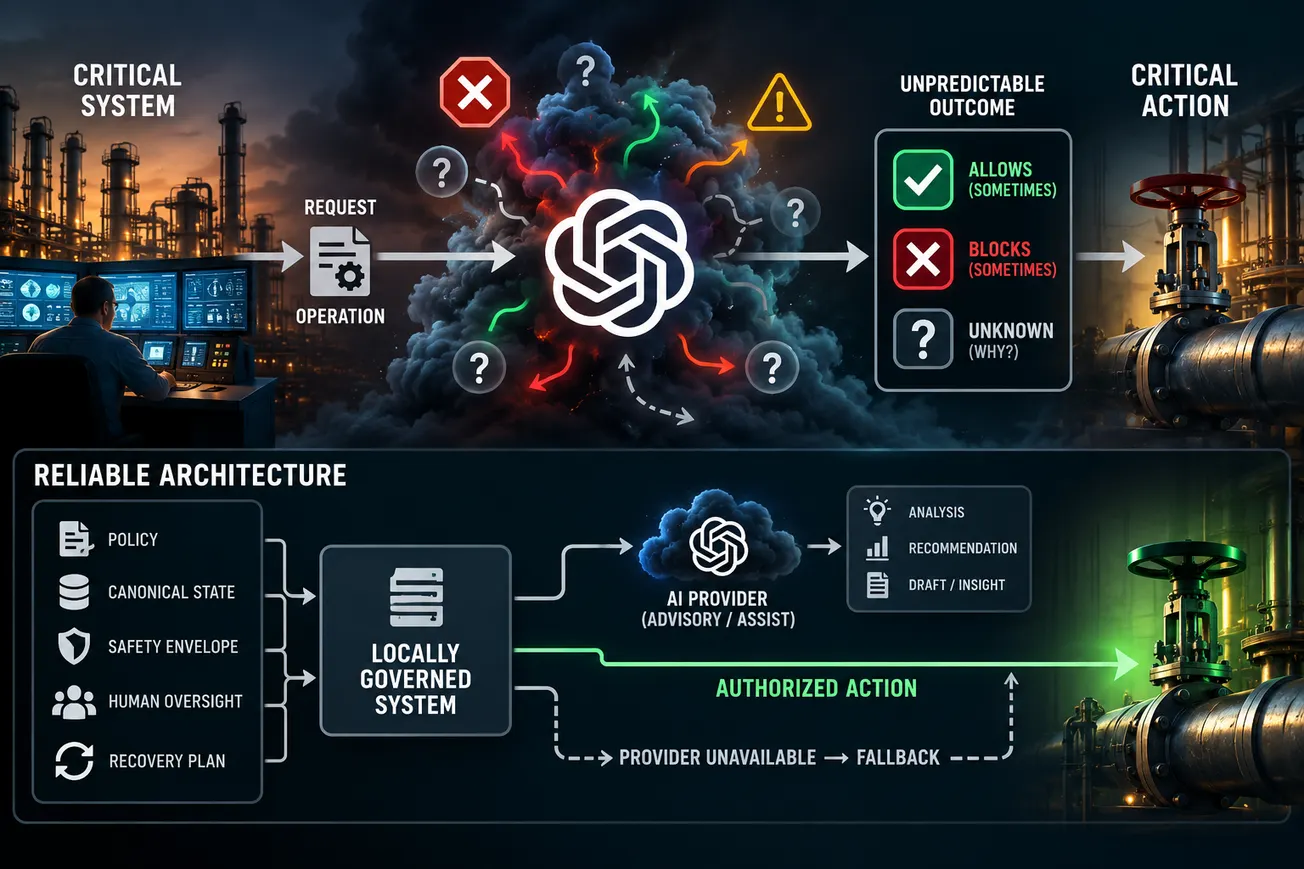
Platforms and frameworks are like paved roads that may help a team progress faster on their journey, with well-defined "exit ramps" or extension points where a team can extend the platform to meet their needs, but they come with side-effects that may make them undesirable. Teams need to decide when, if ever, they need to leave the path others have paved and find their own way by developing extensions to the platform or framework, or by developing new platforms or frameworks. The challenge teams face when they use platforms or frameworks as the basis for their software architectures is to choose the "paved road" (platform or framework) that gets them closest to their desired destination with minimal diversions or new construction. ... Many platform decisions are innocuous and can be accepted and ignored when they don’t affect the QARs that the team needs to meet. The only way to know whether the decisions are harmful is through experiments that expose when the platform is failing to meet the goals of the system. Since the decisions made by the platform developers are often undocumented and/or unknowable, it’s imperative that teams be able to test their system (including the platforms on which they are built) to make sure that their architectural goals (i.e. QARs) are being met. ... Using the "paved road" metaphor, the LLM provides a proven path but it does not take the team where they need to go. When this happens, they have no choice but to either start extending the platform (if they can), finding a different platform, or building their own platform.


Supply chains, AI, and the cloud: The biggest failures (and one success) of 2025

By compromising a single target with a large number of downstream users—say a cloud service or maintainers or developers of widely used open source or proprietary software—attackers can infect potentially millions of the target’s downstream users. ... Another significant security story cast both Meta and Yandex as the villains. Both companies were caught exploiting an Android weakness that allowed them to de-anonymize visitors so years of their browsing histories could be tracked. The covert tracking—implemented in the Meta Pixel and Yandex Metrica trackers—allowed Meta and Yandex to bypass core security and privacy protections provided by both the Android operating system and browsers that run on it. ... The outage with the biggest impact came in October, when a single point of failure inside Amazon’s sprawling network took out vital services worldwide. It lasted 15 hours and 32 minutes. The root cause that kicked off a chain of events was a software bug in the software that monitors the stability of load balances by, among other things, periodically creating new DNS configurations for endpoints within the Amazon Web Services network. A race condition—a type of bug that makes a process dependent on the timing or sequence of events that are variable and outside the developers’ control—caused a key component inside the network to experience “unusually high delays needing to retry its update on several of the DNS endpoint,” Amazon said in a post-mortem.


The Evolving Cybersecurity Challenge for Critical Infrastructure

Convergence between OT, IT and the cloud is providing cybercriminal groups with the opportunity to target critical infrastructure. Operators, and regulators, are wrestling with new technology and new manufacturers, outside the traditional OT/ICS supply chain. “With the geopolitical tensions and the way that the world will look in maybe a few years, they're starting to scratch their heads and think, ‘okay, is it secure? Is it safe? How was it developed? Is there any remote access? How is it being configured?’ There are things that are being done now, that will have an effect in a few years’ time,” cautioned Daniel dos Santos, head of security research at Forescout's Vedere Labs. Given the lifespans of operational technology, installing insecure equipment now can have long-term consequences. Meanwhile, CISOs face dealing with older hardware that was not designed for modern threats. Even where vendors release patches, CNI operators do not always apply them, either because of concerns about business interruption, or a lack of visibility. ... Threats to CNI are not likely to abate in 2026. Legislators are putting more emphasis on cyber resilience and directives, such as the EU’s Cyber Resilience Act, will improve the security of connected devices. But these upgrades take time. “Threats from criminal groups continue to grow exponentially,” said Phil Tonkin, CTO at OT security specialists Dragos


The changing role of the MSP: What does this mean for security?

MSPs hold a unique position within the IT ecosystem, as they are often responsible for managing and supporting the IT infrastructures, cloud services, and cybersecurity of many different organizations. These trusted partners often have privileged access to the inner workings of the organizations they support, including access to the critical systems, sensitive information, and intellectual property of their clients. ... Research shows that over half of MSP leaders globally believe that their customers are at more risk today than this time last year when it comes to cyber threats, with AI-based attack vectors, ransomware/malware, and insider threats the most commonly faced threats. As a result of this uptick in threats, more organizations than ever are leaning on MSPs for cyber support. In fact, in 2025, 84% of MSPs managed either their clients’ cyber infrastructure or their cyber and IT estates combined. This increased significantly, from 64% the previous year. What this shows is that SMEs are realising that they cannot handle cybersecurity alone, turning to MSPs for additional help. Cybersecurity is no longer an optional extra or add-on; it’s becoming a core, expected service for MSPs. MSP leaders are transitioning from general IT support to becoming essential cybersecurity guardians. ... MSPs that adapt by investing in specialized cybersecurity expertise, advanced technologies, and a proactive security posture will thrive, becoming indispensable partners to businesses navigating the complex world of cyber risk. 


What’s next for Azure containers?

Until now, even though Azure has had deep eBPF support, you’ve had to bring your own eBPF tools and manage them yourself, which does require expertise to run at scale. Not everyone is a Kubernetes platform engineer, and with tools like AKS providing a managed environment for cloud-native applications, having a managed eBPF environment is an important upgrade. The new Azure Managed Cilium tool provides a quick way of getting that benefit in your applications, using it for host routing and significantly reducing the overhead that comes with iptables-based networking. ... Declarative policies let Azure lock down container features to reduce the risk of compromised container images affecting other users. At the same time, it’s working to secure the underlying host OS, which for ACI is Linux. SELinux allows Microsoft to lock that image down, providing an immutable host OS. However, those SELinux policies don’t cross the boundary into containers, leaving their userspace vulnerable. ... Having a policy-driven approach to security helps quickly remediate issues. If, say, a common container layer has a vulnerability, you can build and verify a patch layer and deploy it quickly. There’s no need to patch everything in the container, only the relevant components. Microsoft has been doing this for OS features for some time now as part of its internal Project Copacetic, and it’s extending the process to common runtimes and libraries, building patches with updated packages for tools like Python.