Daily Tech Digest - June 02, 2023

A Data Scientist’s Essential Guide to Exploratory Data Analysis

Analyzing the individual characteristics of each feature is crucial as it will help us decide on their relevance for the analysis and the type of data preparation they may require to achieve optimal results. For instance, we may find values that are extremely out of range and may refer to inconsistencies or outliers. We may need to standardize numerical data or perform a one-hot encoding of categorical features, depending on the number of existing categories. Or we may have to perform additional data preparation to handle numeric features that are shifted or skewed, if the machine learning algorithm we intend to use expects a particular distribution. ... For Multivariate Analysis, best practices focus mainly on two strategies: analyzing the interactions between features, and analyzing their correlations. ... Interactions let us visually explore how each pair of features behaves, i.e., how the values of one feature relate to the values of the other. 


Resilient data backup and recovery is critical to enterprise success

So, what must IT leaders consider? The first step is to establish data protection policies that include encryption and least privilege access permissions. Businesses should then ensure they have three copies of their data – the production copy already exists and is effectively the first copy. The second copy should be stored on a different media type, not necessarily in a different physical location (the logic behind it is to not store your production and backup data in the same storage device). The third copy could or should be an offsite copy that is also offline, air-gapped, or immutable (Amazon S3 with Object Lock is one example). Organizations also need to make sure they have a centralized view of data protection across all environments for greater management, monitoring and governance, and they need orchestration tools to help automate data recovery. Finally, organizations should conduct frequent backup and recovery testing to make sure that everything works as it should.


Data Warehouse Architecture Types

Different architectural approaches offer unique advantages and cater to varying business requirements. In this comprehensive guide, we will explore different data warehouse architecture types, shedding light on their characteristics, benefits, and considerations. Whether you are building a new data warehouse or evaluating your existing architecture, understanding these options will empower you to make informed decisions that align with your organization’s goals. ... Selecting the right data warehouse architecture is a critical decision that directly impacts an organization’s ability to leverage its data assets effectively. Each architecture type has its own strengths and considerations, and there is no one-size-fits-all solution. By understanding the characteristics, benefits, and challenges of different data warehouse architecture types, businesses can align their architecture with their unique requirements and strategic goals. Whether it’s a traditional data warehouse, hub-and-spoke model, federated approach, data lake architecture, or a hybrid solution, the key is to choose an architecture that empowers data-driven insights, scalability, agility, and flexibility.


What is federated Identity? How it works and its importance to enterprise security

FIM has many benefits, including reducing the number of passwords a user needs to remember, improving their user experience and improving security infrastructure. On the downside, federated identity does introduce complexity into application architecture. This complexity can also introduce new attack surfaces, but on balance, properly implemented federated identity is a net improvement to application security. In general, we can see federated identity as improving convenience and security at the cost of complexity. ... Federated single sign-on allows for sharing credentials across enterprise boundaries. As such, it usually relies on a large, well-established entity with widespread security credibility, organizations such as Google, Microsoft, and Amazon, for example. In this case, applications are usually gaining not just a simplified login experience for their users, but the impression and actual reliance on high-level security infrastructure. Put another way, even a small application can add “Sign in with Google” to its login flow relatively easily, giving users a simple login option, which keeps sensitive information in the hands of the big organization.


Millions of PC Motherboards Were Sold With a Firmware Backdoor

Given the millions of potentially affected devices, Eclypsium’s discovery is “troubling,” says Rich Smith, who is the chief security officer of supply-chain-focused cybersecurity startup Crash Override. Smith has published research on firmware vulnerabilities and reviewed Eclypsium’s findings. He compares the situation to the Sony rootkit scandal of the mid-2000s. Sony had hidden digital-rights-management code on CDs that invisibly installed itself on users’ computers and in doing so created a vulnerability that hackers used to hide their malware. “You can use techniques that have traditionally been used by malicious actors, but that wasn’t acceptable, it crossed the line,” Smith says. “I can’t speak to why Gigabyte chose this method to deliver their software. But for me, this feels like it crosses a similar line in the firmware space.” Smith acknowledges that Gigabyte probably had no malicious or deceptive intent in its hidden firmware tool. But by leaving security vulnerabilities in the invisible code that lies beneath the operating system of so many computers, it nonetheless erodes a fundamental layer of trust users have in their machines. 


Minimising the Impact of Machine Learning on our Climate

There are several things we can do to mitigate the negative impact of software on our climate. They will be different depending on your specific scenario. But what they all have in common is that they should strive to be energy-efficient, hardware-efficient and carbon-aware. GSF is gathering patterns for different types of software systems; these have all been reviewed by experts and agreed on by all member organisations before being published. In this section we will cover some of the patterns for machine learning as well as some good practices which are not (yet?) patterns. If we divide the actions after the ML life cycle, or at least a simplified version of it, we get four categories: Project Planning, Data Collection, Design and Training of ML model and finally, Deployment and Maintenance. The project planning phase is the time to start asking the difficult questions, think about what the carbon impact of your project will be and how you plan to measure it. This is also the time to think about your SLA; overcommitting to strict latency or performance metrics that you actually don’t need can quickly become a source of emission you can avoid.


5 ways AI can transform compliance

Compliance is all about controls. Data must be classified according to multiple rules, and the movement and access to that data recorded. It’s the perfect task for AI. Ville Somppi, vice president of industry solutions at M-Files, says: “Thanks to AI, organisations can automatically classify information and apply pre-defined compliance rules. In the case of choosing the right document category from a compliance perspective, the AI can be trained quickly with a small sample set categorised by people. This is convenient, especially when people can still correct wrong suggestions in the beginning of the learning process. ... Data pools are too big for humans to comb through. AI is the only way. In some sectors, adoption of AI has been delayed owing to regulatory issues. However, full deployment ought now to be possible. Gabriel Hopkins chief product officer at Ripjar, says: “Banks and financial services companies face complex responsibilities when it comes to compliance activities, especially with regard to combatting the financing of terrorism and preventing laundering or criminal proceeds.


Former Uber CSO Sullivan on Engaging the Security Community

CISO is a lonely role. There's a really amazing camaraderie between security executives that I'm not sure exists in any other kind of leadership role. The CISO role is pretty new compared to the other leadership roles. It's far from settled what kind of background is ideal for the role. It's far from settled where the person in the role should report. It’s far from settled what kind of a budget you're going to get. It's far from settled in terms of what type of decision-making power you're going to have. So, as a result, I think security leaders often feel lonely and on an island. They have an executive team above them that expects them to know all the answers about security, and then they have a team underneath them that expects them to know all the answers about security. So, they can't betray ignorance to anybody without undermining their role. And so, the security leader community often turns to each other for support, for guidance. There are a good number of Slack channels and conferences that are just CISOs talking through the role and asking for best practices and advice on how to deal with hard situations.


Google Drive Deficiency Allows Attackers to Exfiltrate Workspace Data Without a Trace

Mitiga reached out to Google about the issue, but the researchers said they have not yet received a response, adding that Google's security team typically doesn't recognize forensics deficiencies as a security problem. This highlights a concern when working with software-as-a-service (SaaS) and cloud providers, in that organizations that use their services "are solely dependent on them regarding what forensic data you can have," Aspir notes. "When it comes to SaaS and cloud providers, we’re talking about a shared responsibility regarding security because you can't add additional safeguards within what is given." ... Fortunately, there are steps that organizations using Google Workspace can take to ensure that the issue outlined by Mitiga isn't exploited, the researchers said. This includes keeping an eye out for certain actions in their Admin Log Events feature, such as events about license assignments and revocations, they said.


How defense contractors can move from cybersecurity to cyber resilience
We’re thinking way too small about a coordinated cyberattack’s capacity for creating major disruption to our daily lives. One recent, vivid illustration of that fact happened in 2022, when the Russia-linked cybercrime group Conti launched a series of prolonged attacks on the core infrastructure of the country of Costa Rica, plunging the country into chaos for months. Over a period of two weeks, Conti tried to breach different government organizations nearly every day, targeting a total of 27 agencies. Soon after that, the group launched a separate attack on the country’s health care system, causing tens of thousands of appointments to be canceled and patients to experience delays in getting treatment. The country declared a national emergency and eventually, with the help of allies around the world including the United States and Microsoft, regained control of its systems. The US federal government’s strict compliance standards often impede businesses from excelling beyond the most basic requirements. 


Quote for the day:

"Uncertainty is not an indication of poor leadership; it underscores the need for leadership." -- Andy Stanley

Daily Tech Digest - June 01, 2023

Throw out all those black boxes and say hello to the software-defined car

Software-defined vehicles might give automakers more flexibility in terms of the features and functions they can create, but it comes with some headaches on their end, including ensuring that a car works in each market where it's offered. "All the requirements are different for each region, and the complexity is so high. And from my perspective, this is the biggest challenge for engineers. Complexity is so high, especially if you sell cars worldwide. It is not easy. So in the past, we had this world car, so you bring one car for each market. We are not able to bring this world car for all regions anymore," Hoffmann told me. "In the past, it was not easy, but it was very clear—more performance, more efficiency, focus on design. And now that's changed dramatically. So software became very important; you have to focus on the ecosystem, and it is very, very complex. For each region you have, you have dedicated and different ecosystems," he said. ... The move to software-defined vehicles complicates this, as it applies to software as well as hardware. That means each update needs to be signed off by a regulator before being sent out over the air.


Staying ahead: How the best CEOs continually improve performance

Between three and five years into their tenure, the best CEOs typically combine what they’ve gained from their expanded learning agenda and their self-directed outsider’s perspective to form a point of view on what the next performance S-curve is for their company. The concept of the S-curve is that, with any strategy, there’s a period of slow initial progress as the strategy is formed and initiatives are launched. That is followed by a rapid ascent from the cumulative effect of initiatives coming to fruition and then by a plateau where the value of the portfolio of strategic initiatives has largely been captured. Dominic Barton, McKinsey’s former global managing partner, describes why managing a series of S-curves is important: “No one likes change, so you need to create a rhythm of change. Think of it as applying ‘heart paddles’ to the organization.” Former Best Buy CEO Hubert Joly describes why and how he applied heart paddles to his organization, moving from one S-curve to another: “We started with a turnaround, something we called ‘Renew Blue.’ 


Cloud Security: Don’t Confuse Vendor and Tool Consolidation

Unfortunately, simply buying solutions from fewer vendors doesn’t necessarily deliver the operation efficiencies or efficacy of security coverage — that entirely depends on the nature of those solutions, how integrated they are and how good the user experience is that they provide. If you’re an in-the-trenches application developer or security practitioner, consolidating cybersecurity-tool vendors might not mean much to you. If the vendor that your business chooses doesn’t offer an integrated platform, you’re still left juggling multiple tools. You are constantly toggling between screens and dealing with the productivity hit that comes with endless context switching. You have to move data manually from one tool to another to aggregate, normalize, reconcile, analyze and archive it. You have to sit down and think about which alerts to prioritize because each tool is generating different alerts, and without tooling integrations, one tool is incapable of telling you how an issue it has surfaced might (or might not) be related to an alert from a different tool.


Deconstructing DevSecOps: Why A DevOps-Centric Approach To Security Is Needed In 2023

DevSecOps, in reality, is actually more of a bridge building exercise: DevOps are asked to be that bridge to the security teams. Yet, simultaneously, DevOps are asked to enhance the technology used (for example, strong customer authentication, or SCA for short) often without the full input of security teams and so new potential for risk is introduced. These are DevOps security tasks, in effect, rather than DevSecOps. These need to be approached from the top down and bottom up: an organisational risk assessment to prioritise the software security tasks, and then a bottom-up modelling of how to incorporate something like SCA in our example. This is a DevOps-centric approach to security rather than the commonly accepted DevSecOps one. ... Security risks cover the entire software lifecycle from the initial open source building blocks right through to deployed and in production. Understanding this level of maturity is essential to a DevOps-centric approach, with a shift right being equally important to the shift-left focus of old. You can think of this as modernising DevSecOps, reducing alert 'noise' within developer range, and ensuring contextual threat levels are brought into focus. 


Why 'Data Center vs. Cloud' Is the Wrong Way to Think

If you think in more nuanced ways about how data centers relate to the cloud, you'll realize that terms like "data center vs. cloud" just don't make sense. There are several reasons why. First and foremost, data centers are an integral part of public clouds. If you move your workload to AWS, Azure, or another public cloud, it's hosted in a data center. The difference between the cloud and private data centers is that in the cloud, someone else owns and manages the data center. ... A second reason why it's tricky to compare data centers to the cloud is that not all workloads that exist outside of the public cloud are hosted in private data centers dedicated to handling just one business's applications and data. ... Another cause for blurred lines between data centers and the cloud is that in certain cases, you can obtain services inside private data centers that resemble those most closely associated with the public cloud. I'm thinking here of offerings like Equinix Metal, which is essentially an infrastructure-as-a-service (IaaS) solution that allows companies to stand up servers on-demand inside colocation centers. 


Tales of Kafka at Cloudflare: Lessons Learnt on the Way to 1 Trillion Messages

With an event-driven system, to avoid coupling, systems shouldn't be aware of each other. Initially, we had no enforced message format and producer teams were left to decide how to structure their messages. This can lead to unstructured communication and pose a challenge if the teams don't have a strong contract in place, with an increased number of unprocessable messages. To avoid unstructured communication, the team searched for solutions within the Kafka ecosystem and found two viable options, Apache Avro and protobuf, with the latter being the final choice. We had previously been using JSON, but found it difficult to enforce compatibility and the JSON messages were larger compared to protobuf. ... Based on Kafka connectors, the framework enables engineers to create services that read from one system and push it to another one, like Kafka or Quicksilver, Cloudflare's Edge database. To simplify the process, we use Cookiecutter to template the service creation, and engineers only need to enter a few parameters into the CLI.


Agile & UX: a failed marriage?

Where should UX teams sit in an Agile organisation? I have worked with companies where they’ve resided in engineering/technology, product, customer experience, digital, and even their own vertical. The choice of where the function sits should be based on organisational maturity, for example, newer companies tend to have them bundled with engineering (and therefore the designers tend to be UI designers who are helping the front end developers code) and more mature ones might to have them sit in either product or standalone orgs. The challenge is what follows. Most companies that are Agile tend to have cross-functional mission teams working on a product or feature. In the case study, we saw that there were two distinct teams: first, the business and architecture group and second the PO and their Agile delivery squad. Hidden behind this seemingly simple structure is much more complexity. For example, while UX teams work with the PO and their squad, they have a role to play, arguably a fundamental one in helping the business and solution architects understand the sort of experience that will emerge (and therefore should be considered when estimating timeframes/investments).=


Hybrid working: the new workplace normal

Some enterprises are allowing teams within the organization to decide whether to continue to work from home or come back to the office for a few days a week. But the transition is creating a new set of challenges: Since many organizations reduced their office real estate footprint during the pandemic, scheduling problems now crop up when multiple teams are doing “in-office” days simultaneously and vying for space and resources such as meeting rooms and videoconferencing equipment. The rise of this “hoteling” concept can create new headaches for operations and IT teams. One constant among the attendees is the technology gap increasingly associated with a hybrid or remote workforce. Employees returning to the workplace are discovering that it is no longer a plug-and-play environment. Downsizing, moving, and years of work-at-home technology often lead to frustrating searches for the right cable to connect, the right power adapter, and proper training for the new audioconferencing bridge that they never learned how to use.


How generative AI regulation is shaping up around the world

Laws relating to regulation of AI in Canada are currently subject to a mixture of data privacy, human rights and intellectual property legislation on a state-to-state basis. However, an Artificial Intelligence and Data Act (AIDA) is planned for 2025 at the earliest, with drafting having begun under the Bill C-27, the Digital Charter Implementation Act, 2022. An in-progress framework for managing the risks and pitfalls of generative AI, as well as other areas of this technology across Canada, aims to encourage responsible adoption, with consultations reportedly planned with stakeholders. ... The Indian government announced in March 2021 that it would apply a “light touch” to AI regulation in the aim of maintaining innovation across the country, with no immediate plans for specific regulation currently. Opting against regulation of AI growth, this area of tech was identified by the Ministry of Electronics and IT as “significant and strategic”, but the agency stated that it would put in place policies and infrastructure measures to help combat bias, discrimination and ethical concerns.


Good Cop, Bad Cop: Investigating AI for Policing

On a brighter note, police departments with real-time crime centers, as well as regional intelligence centers, can benefit from AI technology due to the massive amounts of data pouring in from multiple sources. AI can effectively sort through and prioritize such data in real time to allow faster and more targeted responses to unfolding situations. Perhaps most critically, law enforcement agencies can turn to AI for assistance during unfolding incidents. “A 911 dispatching system, emergency management watch center, or real-time crime center embedded with assistive AI can analyze data from multiple sources, such as cameras, sensors and databases, to gain insights that might otherwise go unseen during a fast-moving situation or investigation,” Sims says. Hara notes that AI is already playing an important role in several key law enforcement areas. He points to crowd management as an example. “AI will understand how many people are expected at a location and alert officials to a variance,” Hara says. AI can also play a critical role in school safety, taking advantage of the surveillance cameras many schools have already installed.


Why the Document Model Is More Cost-Efficient Than RDBMS

A common objection from customers before they try a NoSQL database like MongoDB Atlas is that their developers already know how to use RDBMS, so it is easy for them to “stay the course.” Believe me when I say that nothing is easier than storing your data the way your application actually uses it. A proper document data model mirrors the objects that the application uses. It stores data using the same data structures already defined in the application code using containers that mimic the way the data is actually processed. There is no abstraction between the physical storage or increased time complexity to the query. The result is less CPU time spent processing the queries that matter. One might say this sounds a bit like hard-coding data structures into storage like the HMS systems of yesteryear. So what about those OLAP queries that RDBMS was designed to support? MongoDB has always invested in APIs that allow users to run the ad hoc queries required by common enterprise workloads. 


Quote for the day:

“You never know how strong you are until being strong is the only choice you have.” -- Bob Marley

Daily Tech Digest - May 31, 2023

5 best practices for software development partnerships

“The key to successful co-creation is ensuring your partner is not just doing their job, but acting as a true strategic asset and advisor in support of your company’s bottom line,” says Mark Bishopp, head of embedded payments/finance and partnerships at Fortis. “This begins with asking probing questions during the prospective stage to ensure they truly understand, through years of experience on both sides of the table, the unique nuances of the industries you’re working in.” Beyond asking questions about skills and capabilities, evaluate the partner’s mindset, risk tolerance, approach to quality, and other areas that require alignment with your organization’s business practices and culture. ... To eradicate the us-versus-them mentality, consider shifting to more open, feedback-driven, and transparent practices wherever feasible and compliant. Share information on performance issues and outages, have everyone participate in retrospectives, review customer complaints openly, and disclose the most challenging data quality issues.


Revolutionizing Algorithmic Trading: The Power of Reinforcement Learning

The fundamental components of a reinforcement learning system are the agent, the environment, states, actions, and rewards. The agent is the decision-maker, the environment is what the agent interacts with, states are the situations the agent finds itself in, actions are what the agent can do, and rewards are the feedback the agent gets after taking an action. One key concept in reinforcement learning is the idea of exploration vs exploitation. The agent needs to balance between exploring the environment to find out new information and exploiting the knowledge it already has to maximize the rewards. This is known as the exploration-exploitation tradeoff. Another important aspect of reinforcement learning is the concept of a policy. A policy is a strategy that the agent follows while deciding on an action from a particular state. The goal of reinforcement learning is to find the optimal policy, which maximizes the expected cumulative reward over time. Reinforcement learning has been successfully applied in various fields, from game playing (like the famous AlphaGo) to robotics (for teaching robots new tasks).


Data Governance Roles and Responsibilities

Executive-level roles include leadership in the C-suite at the organization’s top. According to Seiner, people at the executive level support, sponsor, and understand Data Governance and determine its overall success and traction. Typically, these managers meet periodically as part of a steering committee to cover broadly what is happening in the organization, so they would add Data Governance as a line item, suggested Seiner. These senior managers take responsibility for understanding and supporting Data Governance. They keep up to date on Data Governance progress through direct reports and communications from those at the strategic level. ... According to Seiner, strategic members take responsibility for learning about Data Governance, reporting to the executive level about the program, being aware of Data Governance activities and initiatives, and attending meetings or sending alternates. Moreover, this group has the power to make timely decisions about Data Governance policies and how to enact them. 


Effective Test Automation Approaches for Modern CI/CD Pipelines

Design is not just about unit tests though. One of the biggest barriers to test automation executing directly in the pipeline is that the team that deals with the larger integrated system only starts a lot of their testing and automation effort once the code has been deployed into a bigger environment. This wastes critical time in the development process, as certain issues will only be discovered later and there should be enough detail to allow testers to at least start writing the majority of their automated tests while the developers are coding on their side. This doesn’t mean that manual verification, exploratory testing, and actually using the software shouldn’t take place. Those are critical parts of any testing process and are important steps to ensuring software behaves as desired. These approaches are also effective at finding faults with the proposed design. However, automating the integration tests allows the process to be streamlined.


What Does Being a Cross-Functional Team in Scrum Mean?

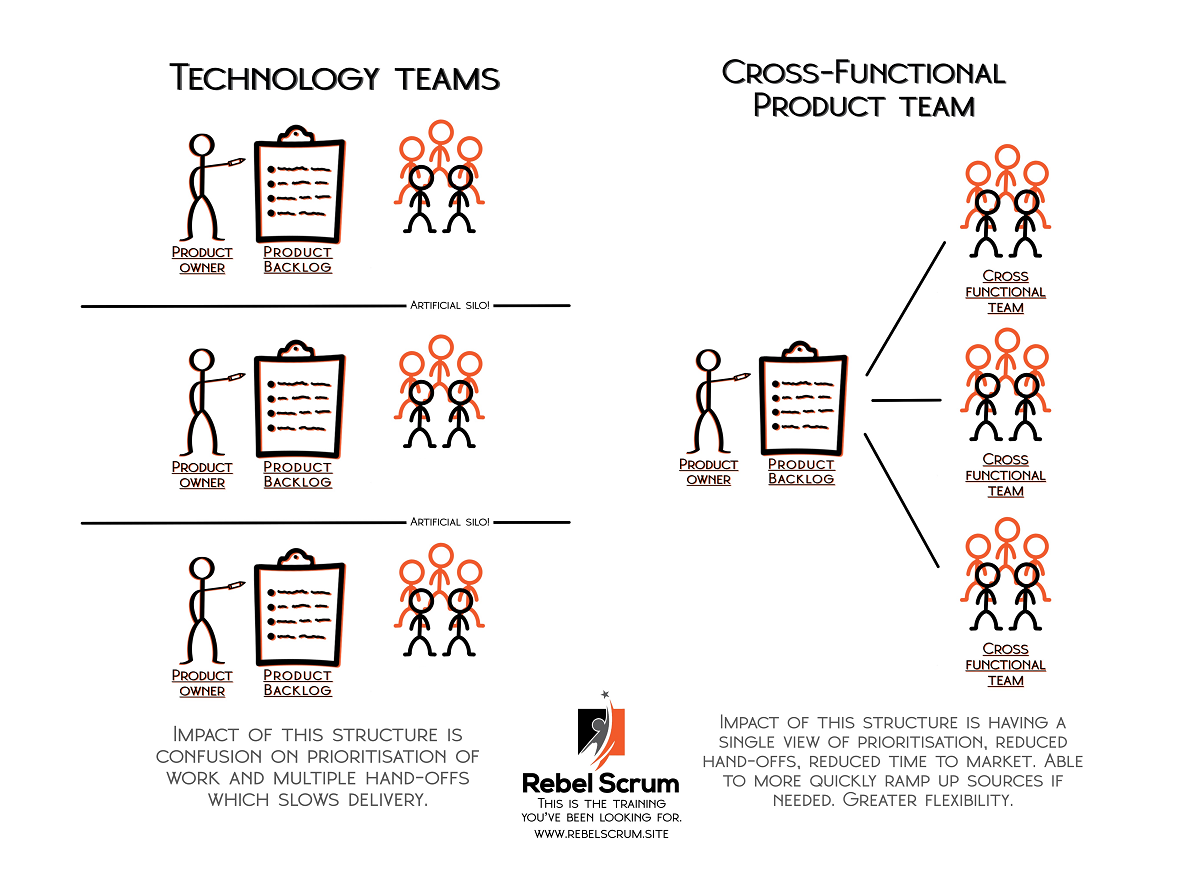
By bringing together individuals with different skills and perspectives, these teams promote innovation, problem-solving, and a holistic approach to project delivery. They reduce handoffs, bottlenecks, and communication barriers often plaguing traditional development models. Moreover, cross-functional teams enable faster feedback cycles and facilitate continuous improvement. With all the necessary skills in one team, there's no need to wait for handoffs or external dependencies. This enables quicker decision-making, faster iterations, and the ability to respond to customer feedback promptly. In short, being a cross-functional Scrum Team means having a group of individuals with diverse skills, a shared sense of responsibility, and a collaborative mindset. They work together autonomously, leveraging their varied expertise to deliver high-quality software increments. ... Building genuinely cross-functional Scrum Teams starts with product definition. This means identifying and understanding the scope, requirements, and goals of the product the team will work on. 


The strategic importance of digital trust for modern businesses

Modern software development processes, like DevOps, are highly automated. An engineer clicks a button that triggers a sequence of complicated, but automated, steps. If a part of this sequence (e.g., code signing) is manual then there is a likelihood that the step may be missed because everything else is automated. Mistakes like using the wrong certificate or the wrong command line options can happen. However, the biggest danger is often that the developer will store private code signing keys in a convenient location (like their laptop or build server) instead of a secure location. Key theft, misused keys, server breaches, and other insecure processes can permit code with malware to be signed and distributed as trusted software. Companies need a secure, enterprise-level code signing solution that integrates with the CI/CD pipeline and automated DevOps workflows but also provides key protection and code signing policy enforcement.


Managing IT right starts with rightsizing IT for value

IT financial management — sometimes called FinOps — is overlooked in many organizations. A surprising number of organizations do not have a very good handle on the IT resources being used. Another way of saying this is: Executives do not know what IT they are spending money on. CIOs need to make IT spend totally transparent. Executives need to know what the labor costs are, what the application costs are, and what the hardware and software costs are that support those applications. The organization needs to know everything that runs — every day, every month, every year. IT resources need to be matched to business units. IT and the business unit need to have frank discussions about how important that IT resource really is to them — is it Tier One? Tier Two? Tier Thirty? In the data management space — same story. Organizations have too much data. Stop paying to store data you don’t need and don’t use. Atle Skjekkeland, CEO at Norway-based Infotechtion, and John Chickering, former C-level executive at Fidelity, both insist that organizations, “Define their priority data, figure out what it is, protect it, and get rid of the rest.”


Implementing Risk-Based Vulnerability Discovery and Remediation

A risk-based vulnerability management program is a complex preventative approach used for swiftly detecting and ranking vulnerabilities based on their potential threat to a business. By implementing a risk-based vulnerability management approach, organizations can improve their security posture and reduce the likelihood of data breaches and other security events. ... Organizations should still have a methodology for testing and validating that patches and upgrades have been appropriately implemented and would not cause unanticipated flaws or compatibility concerns that might harm their operations. Also, remember that there is no "silver bullet": automated vulnerability management can help identify and prioritize vulnerabilities, making it easier to direct resources where they are most needed. ... Streamlining your patching management is another crucial part of your security posture: an automated patch management system is a powerful tool that may assist businesses in swiftly and effectively applying essential security fixes to their systems and software.


Upskilling the non-technical: finding cyber certification and training for internal hires

“If you are moving people into technical security from other parts of the organization, look at the delta between the employee's transferrable skills and the job they’d be moving into. For example, if you need a product security person, you could upskill a product engineer or product manager because they know how the product works but may be missing the security mindset,” she says. “It’s important to identify those who are ready for a new challenge, identify their transferrable skills, and create career paths to retain and advance your best people instead of hiring from outside.” ... While upskilling and certifying existing employees would help the organization retain talented people who already know the company, Diedre Diamond, founding CEO of cyber talent search company CyberSN, cautions against moving skilled workers to entry-level roles in security that don’t pay what the employees are used to earning. Upskilling financial analysts into compliance, either as a cyber risk analyst or GRC analyst will require higher-level certifications, but the pay for those upskilled positions may be more equitable for those higher-paid employees, she adds.


Data Engineering in Microsoft Fabric: An Overview

Fabric makes it quick and easy to connect to Azure Data Services, as well as other cloud-based platforms and on-premises data sources, for streamlined data ingestion. You can quickly build insights for your organization using more than 200 native connectors. These connectors are integrated into the Fabric pipeline and utilize the user-friendly drag-and-drop data transformation with dataflow. Fabric standardizes on Delta Lake format. Which means all the Fabric engines can access and manipulate the same dataset stored in OneLake without duplicating data. This storage system provides the flexibility to build lakehouses using a medallion architecture or a data mesh, depending on your organizational requirement. You can choose between a low-code or no-code experience for data transformation, utilizing either pipelines/dataflows or notebook/Spark for a code-first experience. Power BI can consume data from the Lakehouse for reporting and visualization. Each Lakehouse has a built-in TDS/SQL endpoint, for easy connectivity and querying of data in the Lakehouse tables from other reporting tools.


Quote for the day:

"Be willing to make decisions. That's the most important quality in a good leader." -- General George S. Patton, Jr.

Daily Tech Digest - May 18, 2023

Security breaches push digital trust to the fore

Digital trust needs to be integrated within the organization and isn’t necessarily owned by a single department or job title. Even so, cybersecurity, and the CISO, have an important role to play, according to the World Economic Forum’s 2022 Earning Digital Trust report, in protecting interconnectivity that support business, livelihoods of people and society generally as people’s reliance on digital interactions grows. As governments and regulators implement stricter requirements for ensuring data privacy and security, CISOs face a renewed need to prioritize digital trust or risk fines, lawsuits, significant brand damage and revenue loss to the organization. Thomas suggests that for CISOs digital trust could become the measurable metrics and outcome of security initiatives. “Organizations are not only secure to be compliant and protect information. The outcome of this is the trust that customers have, and that is what's going to change the way we measure how well security is being implemented,” he says. “If you want to ensure your customers trust you, you need to look at it as an organizational goal, or have it as a part of the strategy. ...”


Preparing the Mindset for Change: Five Roadblocks That Lead Digital Transformation to Failure

The absence of effective advocacy may have significantly contributed to the failure of many digital transformation progress. However, it is the responsibility of the stakeholders to be the advocates of the change. The goal to change cannot be just a business decision it needs to be believed in. A business that is generational, often sees the founders married to legacy processes, they find it difficult to break the norm and adapt to automation irrespective of disparate systems restricting the growth and scale. ... A lack of strategic planning before and after implementation can lead to severe consequences for an organization. Conflicting priorities can arise, and critical objectives may not be effectively communicated or achieved due to a disconnect between business and technology plans.
Unfortunately, many organizations fail to recognize the importance of pre-and post-implementation planning and instead focus solely on the implementation process. This shortsighted approach can lead to poor customer and stakeholder engagement, as well as employee dissatisfaction. 


Don't overlook attack surface management

Let’s look at three aspects of ASM that you should consider today: ... Visibility and discovery. Attack surface management should provide a comprehensive view of the cloud environment, allowing organizations to identify potential security weaknesses and blind spots. It helps uncover unknown assets, unauthorized services, and overlooked configurations, offering a clearer picture of potential entry points for attackers. ... Risk assessment and prioritization. By understanding the scope and impact of vulnerabilities, organizations can assess the associated risks and prioritize them. Attack surface management empowers businesses to allocate resources efficiently, focusing on high-risk areas that could have severe consequences if compromised. ... Remediation and incident response. When vulnerabilities are detected, ASM management provides the necessary insights to remediate them promptly. It facilitates incident response by helping organizations take immediate action, such as applying patches, updating configurations, or isolating compromised resources.


One on One with Automated Software Testing Expert Phil Japikse

A common misconception is that creating automated testing increases the delivery time. There was a study done at Microsoft some years ago that looked at different teams. Some were using a test-first strategy, some were using a test-eventual strategy, and some groups were using traditional QA departments for their testing. Although the cycle time was slightly higher for those doing automated testing, the throughput was much higher. This was because the quality of their work was much higher, and they had much less rework. We all know it’s more interesting to work on new features and tedious and boring to fix bugs. If you aren’t including at least some automated testing in your development process, you are going to spend more time fixing bugs and less time building new features. ... The more complex or important the system is, the more testing it needs. Software that controls airplanes, for example, must be extremely well tested. One could argue that game software doesn’t need as much testing. It all depends on the business requirements for the application.


The Work Habits That Are Blocking Your Ideas, Dreams and Breakthrough Success

A reactive mind prevents us from responding productively to the moment. Any time we are reactive, because we are not effectively relating to ourselves in the moment, we cannot be present with others. Those who have been tasked with carrying out our objectives can sense our lack of clarity and misalignment. They may perceive us as "confused," for instance, and then our reactivity triggers their self-protective belief structures. Miscommunication becomes the norm when a reactive individual is leading a team. ... Your colleague's negativity is not only self-destructive; it is also destructive to the organization and the morale of their co-workers. But your own disconnection from the truth of the moment is also destructive. By prejudging a colleague, you are missing out on the opportunity to positively interact with them or influence their behavior, and both of these things matter. A healthy yet skeptical outlook is helpful. Would you want a contract written by your lawyer that only foresaw favorable outcomes? The invitation is to transform negativity into a healthy dynamic so that co-creativity and joy are both possible. You need to be open to the possibilities that each of us possesses.


Dialectic Thinking: The Secret to Exceptional Mindful Leadership

The paradox of acceptance and change may very well be the toughest one we grapple with. Whether this is in our own meditation practice and self-development, or leading an organization it’s vital to take a dialectic approach. For genuine change to occur, there must first be acceptance of the current state. This acceptance forms the bedrock of reality, a foundation that is crucial for creating meaningful change. It's a truth that can't be obscured or sugarcoated. With acceptance, there's an opportunity to see things as they are and then to envisage something different. However, we can often misconstrue acceptance as passivity or complacency. It can be seen as an excuse to “do nothing”, to shy away from bold action, or to remain comfortably entrenched in the status quo. On the flip side, a relentless push for change can create a sense of perpetual dissatisfaction, hindering our ability to appreciate what already is. This can also foster a short-term, transactional mindset, particularly in relationships.


How to explain data meshes, fabrics, and clouds

“A data mesh is a decentralized approach to managing data, where multiple teams within a company are responsible for their own data, promoting collaboration and flexibility,” he said. There are no complex words in this definition, and it introduces the problems data meshes aim to solve, the type of solution, and why it’s important. Expect to be asked for more technical details, though, especially if the executive has prior knowledge of other data management technologies. For example, “Weren't data warehouses and data lakes supposed to solve the data management issue?” This question can be a trap if you answer it with the technical differences between data warehouses, lakes, and meshes. Instead, focus your response on the business objective. Satish Jayanthi, co-founder and CTO of Coalesce, offers this suggestion: “Data quality often affects the accuracy of business analytics and decision-making. By implementing data mesh paradigms, the quality and accuracy of data can be enhanced, resulting in increased trust among businesses to utilize data more extensively for informed decision-making.”


Has the Cloud Forever Changed Disaster Recovery?

For today’s organisations, resilience is paramount to a successful data protection plan, mentioned Lawrence Yeo, Enterprise Solutions Director, ASEAN, Hitachi Vantara. Being resilient entails having the flexibility to quickly restore data and applications to both existing and new cloud accounts. We believe that traditional backup and disaster recovery systems focused on data centres are becoming outdated. Instead, we need a data protection strategy that prioritises IT resilience and can protect data anywhere, including public clouds and SaaS applications. Resilience is the key to a robust data protection strategy as a slow disaster recovery or data restoration can negatively impact business processes. To be resilient, you need a data protection solution that encompasses backup and disaster recovery across on-premises and public clouds, allowing you to restore data and applications quickly, either to existing or new cloud accounts.


IOT Sensors - Sensing the danger

How can an operator establish integrity and accuracy within a sensor and mitigate potential vulnerabilities? This is where Root of Trust (RoT) hardware plays a crucial role. Hardware such as a Device Identifier Composition Engine (DICE) can supply a unique security key to each firmware layer found in a sensor or connected device. ... Should an attack on your systems be successful, and a layer become exposed, the unique key accessed by a hacker cannot be used to breach further elements. This can help reduce the risk of a significant data breach and enables operators to trust the devices they utilise in a network. A device can also easily be re-keyed should any unauthorised amendments be discovered within the sensor’s firmware, enabling users to quickly identify vulnerabilities throughout the system’s update process. For organisations with smaller devices and an even smaller budget, specifications such as the Measurement and Attestation Roots (MARS) can be deployed to instil the necessary capabilities of identity, measurement storage, and reporting in a more cost-effective manner.


Data hoarding is bad for business and the environment

The findings suggest young consumers are unaware of the impact of their own carbon footprint. From the report, 44% said it’s wrong for businesses to waste energy and cause pollution by storing unneeded information online. ... The fallout? The Veritas study found that 47% of consumers would stop buying from a company if they knew it was willfully causing environmental damage by failing to control how much unnecessary data it was storing. Meanwhile, 49% of consumers think it’s the responsibility of the organizations that store their information to delete it when it’s no longer needed, the report said. ... It is incumbent upon leaders to pay attention to this issue. Srinivasan cautioned that organizations should not underestimate the environmental impact of poor data management practices – even if they are outsourcing their storage to public cloud providers. Some good data management practices would be to make consumers aware of the costs of all this data, especially the negative externalities on our overheating planet.


Quote for the day:

"Management is about arranging and telling. Leadership is about nurturing and enhancing." -- Tom Peters

Daily Tech Digest - May 16, 2023

Law enforcement crackdowns and new techniques are forcing cybercriminals to pivot

Because of stepped-up law enforcement efforts, cybercriminals are also facing a crisis in cashing out their cryptocurrencies, with only a handful of laundering vehicles in place due to actions against crypto-mixers who help obfuscate the money trail. "Eventually, they'll have to cash out to pay for their office space in St. Petersburg to pay for their Lambos. So, they're going to need to find an exchange," Burns Coven said. Cybercriminals are just sitting on their money, like stuffing money under the mattress. "It's been a tumultuous two years for the threat actors," she said. "A lot of law enforcement takedowns, challenging operational environments, and harder to get funds. And we're seeing this sophisticated laundering technique called absolutely nothing doing, just sitting on it." Despite the rising number of challenges, "I don't think there's a mass exodus of threat actors from ransomware," Burns Coven tells CSO, saying they are shifting tactics rather than exiting the business altogether. 


5 IT management practices certain to kill IT productivity

Holding people accountable is root cause analysis predicated on the assumption that if something goes wrong it must be someone’s fault. It’s a flawed assumption because most often, when something goes wrong, it’s the result of bad systems and processes, not someone screwing up. When a manager holds someone accountable they’re really just blame-shifting. Managers are, after all, accountable for their organization’s systems and processes, aren’t they? Second problem: If you hold people accountable when something goes wrong, they’ll do their best to conceal the problem from you. And the longer nobody deals with a problem, the worse it gets. One more: If you hold people accountable whenever something doesn’t work, they’re unlikely to take any risks, because why would they? Why it’s a temptation: Finding someone to blame is, compared to serious root cause analysis, easy, and fixing the “problem” is, compared to improving systems and practices, child’s play. As someone once said, hard work pays off sometime in the indefinite future, but laziness pays off right now.


How AI ethics is coming to the fore with generative AI

The discussion of AI ethics often starts with a set of principles guiding the moral use of AI, which is then applied in responsible AI practices. The most common ethical principles include being human-centric and socially beneficial, being fair, offering explainability and transparency, being secure and safe, and showing accountability. ... “But it’s still about saving lives and while the model may not detect everything, especially the early stages of breast cancer, it’s a very important question,” Sicular says. “And because of its predictive nature, you will not have everyone answering the question in the same fashion. That makes it challenging because there’s no right or wrong answer.” ... “With generative AI, you will never be able to explain 10 trillion parameters, even if you have a perfectly transparent model,” Sicular says. “It’s a matter of AI governance and policy to decide what should be explainable or interpretable in critical paths. It’s not about generative AI per se; it's always been a question for the AI world and a long-standing problem.”


Design Patterns Are A Better Way To Collaborate On Your Design System

You probably don’t think of your own design activities as a “pattern-making” practice, but the idea has a lot of very useful overlap with the practice of making a design system. The trick is to collaborate with your team to find the design patterns in your own product design, the parts that repeat in different variations that you can reuse. Once you find them, they are a powerful tool for making design systems work with a team. ... All designers and developers can make their design system better and more effective by focusing on patterns first (instead of the elements), making sure that each is completely reusable and polished for any context in their product. “Pattern work can be a fully integrated part of both getting some immediate work done and maintaining a design system. ... This kind of design pattern activity can be a direct path for designers and developers to collaborate, to align the way things are designed with the way they are built, and vice-versa. For that purpose, a pattern does not have to be a polished design. It can be a rough outline or wireframe that designers and developers make together. It needs no special skills and can be started and iterated on by all. 


Digital Twin Technology: Revolutionizing Product Development

Digital twin technology accelerates product development while reducing time to market and improving product performance, Norton says. The ability to design and develop products using computer-aided design and advanced simulation techniques can also facilitate collaboration, enable data driven decision making, engineer a market advantage, and reduce design churn. “Furthermore, developing an integrated digital thread can enable digital twins across the product lifecycle, further improving product design and performance by utilizing feedback from manufacturing and the field.” Using digital twins and generative design upfront allows better informed product design, enabling teams to generate a variety of possible designs based on ranked requirements and then run simulations on their proposed design, Marshall says. “Leveraging digital twins during the product use-cycle allows them to get data from users in the field in order to get feedback for better development,” she adds. Digital twin investments should always be aimed at driving business value. 


DevEx, a New Metrics Framework From the Authors of SPACE

Organizations can improve developer experience by identifying the top points of friction that developers encounter, and then investing in improving areas that will increase the capacity or satisfaction of developers. For example, an organization can focus on reducing friction in development tools in order to allow developers to complete tasks more seamlessly. Even a small reduction in wasted time, when multiplied across an engineering organization, can have a greater impact on productivity than hiring additional engineers. ... The first task for organizations looking to improve their developer experience is to measure where friction exists across the three previously described dimensions. The authors recommend selecting topics within each dimension to measure, capturing both perceptual and workflow metrics for each topic, and also capturing KPIs to stay aligned with the intended higher-level outcomes. ... The DevEx framework provides a practical framework for understanding developer experience, while the accompanying measurement approaches systematically help guide improvement.
While there are many companies with altruistic intentions, the reality is that most organizations are beholden to stakeholders whose chief interests are profit and growth. If AI tools help achieve those objectives, some companies will undoubtedly be indifferent to their downstream consequences, negative or otherwise. Therefore, addressing corporate accountability around AI will likely start outside the industry in the form of regulation. Currently, corporate regulation is pretty straightforward. Discrimination, for instance, is unlawful and definable. We can make clean judgments about matters of discrimination because we understand the difference between male and female, or a person’s origin or disability. But AI presents a new wrinkle. How do you define these things in a world of virtual knowledge? How can you control it? Additionally, a serious evaluation of what a company is deploying is necessary. What kind of technology is being used? Is it critical to the public? How might it affect others? Consider airport security. 


Prepare for generative AI with experimentation and clear guidelines

Your first step should be deciding where to put generative AI to work in your company, both short-term and into the future. Boston Consulting Group (BCG) calls these your “golden” use cases — “things that bring true competitive advantage and create the largest impact” compared to using today’s tools — in a recent report. Gather your corporate brain trust to start exploring these scenarios. Look to your strategic vendor partners to see what they’re doing; many are planning to incorporate generative AI into software ranging from customer service to freight management. Some of these tools already exist, at least in beta form. Offer to help test these apps; it will help teach your teams about generative AI technology in a context they’re already familiar with. ... To help discern the applications that will benefit the most from generative AI in the next year or so, get the technology into the hands of key user departments, whether it’s marketing, customer support, sales, or engineering, and crowdsource some ideas. Give people time and the tools to start trying it out, to learn what it can do and what its limitations are. 


Cyberdefense will need AI capabilities to safeguard digital borders

Speaking at CSIT's twentieth anniversary celebrations, where he announced the launch of the training scheme, Teo said: "Malign actors are exploiting technology for their nefarious goals. The security picture has, therefore, evolved. Malicious actors are using very sophisticated technologies and tactics, whether to steal sensitive information or to take down critical infrastructure for political reasons or for profit. "Ransomware attacks globally are bringing down digital government services for extended periods of time. Corporations are not spared. Hackers continue to breach sophisticated systems and put up stolen personal data for sale, and classified information." Teo also said that deepfakes and bot farms are generating fake news to manipulate public opinion, with increasingly sophisticated content that blur the line between fact and fiction likely to emerge as generative AI tools, such as ChatGPT, mature and become widely available. "Threats like these reinforce our need to develop strong capabilities that will support our security agencies and keep Singapore safe," the minister said. 


Five key signs of a bad MSP relationship – and what to do about them

Red flags to look out for here include overly long and unnecessarily complicated contracts. These are often signs of MSPs making lofty promises, trying to tie you into a longer project, and pre-emptively trying to raise bureaucratic walls to make accessing the services you are entitled to more complex. The advice here is simple – don’t rush the contract signing. Instead, ensure that the draft contract is passed through the necessary channels, so that all stakeholders have complete oversight. Also, do not be tempted by outlandish promises; think pragmatically about what you want to achieve with your MSP relationship, and make sure the contract reflects your goals. If you’re already locked into a contract, consider renegotiating specific terms. ... If projects are moving behind schedule and issues are coming up regularly, this is a sign that your project lacks true project management leadership. Of course, both parties will need some time when the project starts to get processes running smoothly, but if you’re deep into a contract and still experiencing delays and setbacks, this is a sign that all is not well at your MSP. 


Quote for the day:

"The greatest thing is, at any moment, to be willing to give up who we are in order to become all that we can be." -- Max de Pree

Daily Tech Digest - May 14, 2023

How to Balance Data Governance with Data Democracy

Data democratization is important to an organization because it ensures an effective and efficient method of providing all users, regardless of technical expertise, the ability to analyze readily accessible and reliable data to influence data-driven decisions and drive real-time insights. This eliminates the frustration of requesting access, sorting information, or reaching out to IT for help. ... The solution to this problem lies in data federation, which makes data from multiple sources accessible under a uniform data model. This model acts as a "single point of access" such that organizations create a virtual database where data can be accessed where it already lives. This makes it easier for organizations to query data from different sources in one place. With a single point of access, users can go to one location for searching, finding, and accessing every piece of data your organization has. This will make it easier to democratize data access because you won’t need to facilitate access across many different sources.


Will ChatGPT and Generative AI “Replace” Testing?

It stands to reason, then, that ChatGPT and generative AI will not "replace" testing or remove the need to invest in QA. Instead, like test execution automation before it, generative AI will provide a useful tool for moving faster. Yet, there will always be a need for more work, and at least a constant (if not greater) need for human input. Testers' time might be applied less to repetitive tasks like scripting, but new processes will fill the void. Meanwhile, the creativity and critical thinking offered by testers will not diminish in value as these repetitive processes are automated; such creativity should be given greater freedom. At the same time, your testers will have vital insight into how generative AI should be used in your organization. Nothing is adopted overnight, and identifying the optimal applications of tools like ChatGPT will be an ongoing conversation, just as the testing community has continually explored and improved practices for getting the most out of test automation frameworks. Lastly, as the volume of possible test scenarios grows, automation and AI will need a human steer in knowing where to target its efforts, even as we can increasingly use data to target test generation.


How agtech is poised to transform India into a farming powerhouse

Collaboration will be crucial. While agtechs might facilitate better decision making and replace manual farming practices like spraying, reducing dependence on retailers and mandis, incumbents remain important in the new ecosystem for R&D and the supply of chemicals and fertilizers. There are successful platforms already emerging that offer farmers an umbrella of products and services to address multiple, critical pain points. These one-stop shop agri-ecosystems are also creating a physical backbone/supply chain—which makes it easier for incumbents and start-ups to access the fragmented farmer base. Agtechs have a unique opportunity to become ideal partners for companies seeking market access. In this scenario, existing agriculture companies are creating value for the farmer by having more efficient and cost-effective access to the farmer versus traditional manpower-intensive setups. It’s a system that builds: the more agtechs know the farmer, the better products they can develop. India’s farms have been putting food on the table for India and the world for decades. 


How A Non Data Science Person Can Work Effectively With A Data Scientist

Effective communication is essential for a successful partnership. The data scientist should communicate technical procedures and conclusions in a clear and concise manner. In contrast, the non-data science person should communicate business requirements and limitations. Both sides can collaborate successfully by developing a clear understanding of the project objectives and the data science methodologies. Setting expectations and establishing the project’s scope from the beginning is equally critical. The non-data scientist should specify what they expect from the data scientist, including the results they intend to achieve and the project’s schedule. In return, they should describe their areas of strength and the achievable goals that fall within the project’s parameters. It is crucial to keep the lines of communication open and transparent throughout the process. Regular meetings and status reports should be organized to keep everyone informed of the project’s progress and to identify any potential issues.


Why Metadata Is a Critical Asset for Storage and IT Managers

Advanced metadata is handled differently by file storage and object storage environments. File storage organizes data in directory hierarchies, which means you can’t easily add custom metadata attributes. ... Metadata is massive because the volume and variety of unstructured data – files and objects – are massive and difficult to wrangle. Data is spread across on-premises and edge data centers and clouds and stored in potentially many different systems. To leverage metadata, you first need a process and tools for managing data. Managing metadata requires both strategy and automation; choosing the best path forward can be difficult when business needs are constantly changing and data types may also be morphing from the collection of new data types such as IoT data, surveillance data, geospatial data, and instrument data. Managing metadata as it grows can also be problematic. Can you have too much? One risk is a decrease in file storage performance. Organizations must consider how to mitigate this; one large enterprise we know switched from tagging metadata at the file level to the directory level.


Understand the 3 major approaches to data migration

Application data migration—sometimes called logical data migration or transaction-level migration—is a migration approach that utilizes the data mobility capabilities built natively into the application workload itself. ... Technique: Some applications offer proprietary data mobility features. These capabilities usually facilitate or assist with configuring backups or secondary storage. These applications then synchronously or asynchronously ensure that the secondary storage is valid and, when necessary, can be used without the primary copy. ... Block-level data migration is performed at the storage volume level. Block-level migrations are not strictly concerned about the actual data stored within the storage volume. Rather, they include file system data of any kind, partitions of any kind, raw block storage, and data from any applications. Technique: Block-level migration tools synchronize one storage volume to another storage volume from the beginning of the volume (byte 0) to the end of the entire volume (byte N) without processing any data content.


Open Source MongoDB Alternative FerretDB Now Generally Available

FerretDB works as a proxy that translates MongoDB wire protocol queries to SQL, with PostgreSQL as the database backend. Started as an open-source alternative to MongoDB, FerretDB provides the same MongoDB APIs without developers needing to learn a new language or command. Peter Farkas, co-founder and CEO of FerretDB, explains: We are creating a new standard for document databases with MongoDB compatibility. FerretDB is a drop-in replacement for MongoDB, but it also aims to set a new standard that not only brings easy-to-use document databases back to its open-source roots but also enables different database engines to run document database workloads using a standardized interface. While FerretDB is built on PostgreSQL, the database is designed with a pluggable architecture to support other backends, with projects for Tigris, SAP HANA, and SQLite currently in the working. Written in Go, the project was originally started as the Server Side Public License (SSPL) that MongoDB adopted in 2018 does not meet all criteria for open-source software set by the Open Source Initiative.


Wardley Mapping and Strategy for Software Developers

This is a more engineering-focused way to look at a business and isn’t dependent on stories, aphorisms or strange MBA terms. A few people have asked me personally whether this method really works. But it isn’t a “method” as such; just a way to agree on the environment that may otherwise be left unchallenged. Jennifer Riggins has already covered the background to Wardley mapping in detail, so I only need to summarize what we need to become aware of. ... So how do you map your own projects? One good start is simply to get your team together and see if they can map just the build process — with a build as the final product (the cup of tea). For example; starting from an agreed story, through to a change in the code in the repository, to a checkout into a staging build, to deployment. See if everyone even agrees what this looks like. The result should eventually be a common understanding. There are plenty of introductions to mapping, but the important thing is to recognize that you can represent a business in a fairly straightforward way. 


The Leader's Role in Building Independent Thinkers: How to Equip Your Team for Success

Striving for perfection can often lead to "analysis paralysis," hindering progress and preventing team members from taking action. To encourage independent thinking, leaders must prioritize action over perfection. By creating a culture of experimentation and iteration, employees learn from their mistakes, build confidence, and become less afraid of failure. ... Standing firmly behind your values and vision is a powerful way for leaders to generate independent thinking in their teams. When team members see their leader living by strong values and embodying a clear vision, they feel empowered to follow their example. This approach cultivates an environment of trust and confidence, enabling your employees to think critically and independently. ... It is essential for leaders to avoid merely delegating tasks and stepping back. Instead, actively participate in the work alongside your team, providing guidance and offering support when needed. This approach instills a sense of collaboration and helps your team feel part of something bigger. 


The Great Resignation takes a dark turn: Is it now the Great Layoff? Expert weighs in

The main challenges that Gen-Z employees face in the event of a layoff are a lack of savings, a lack of job experience, and a lack of job security. Many Generation Z workers are just starting out in their careers and haven't had time to save. Many people may have little or no savings in case of a financial emergency, such as job loss. Because Generation Z is so young, they have yet to have the opportunity to gain the experience that their elders have. If they are laid off, they are concerned that they will not have the necessary experience to re-enter the workforce. Finally, even if Gen Z workers are employed, they may believe their job is in jeopardy due to the pandemic's impact on their industry. They may be concerned that their employer will lay off employees or that their position will become obsolete as the company adapts to the changing business environment. Because of these challenges and ongoing economic uncertainty, Generation Z remains concerned about the possibility of layoffs. 


Quote for the day:

"Innovation distinguishes between a leader and a follower." -- Steve Jobs