Daily Tech Digest - December 17, 2019

Microsoft’s C# 9.0 begins to take shape

Microsoft’s C# 9.0 begins to take shape
Among the capabilities eyed for C# 9.0 thus far include: Simplified parameter null validation code, allowing for standard null validation on parameters to be simplified using a small annotation on parameters; Support for a switch expression as a statement expression when every arm’s expression is also a statement expression. No common type among the arms is needed when used as a statement expression; Records, a simplified declaration form for C# class and struct types combining benefits of similar features. Records provide a mechanism for declaring a datatype by describing members of the aggregate as well as additional code or deviations from the usual boilerplate, if any; CallerArgumentExpression, enabling developers to capture the expression passed to a method, to allow better error messages in diagnostic/testing APIs and reduce keystrokes; Relaxing of ordering constraints around “ref” and “partial” modifiers on type declarations; Primary constructors, to reduce programming overhead by putting constructor arguments directly in scope throughout a class, obviating the need to explicitly declare a backing field.


Why the gig economy is in danger


The new California law, which takes effect on Jan. 1, 2020, will require companies to reclassify contract, freelance and contingent workers as full-time employees eligible for benefits, a guaranteed $12 to $13 state minimum wage and protections under the state's employment law. The employer must deduct Social Security and Medicare taxes from the freelancer's fees, and contribute to worker's comp and unemployment insurance. It will put a damper on what freelancers can use as tax deductions. And this is not a one-industry issue, despite the initial response as being all about freelance writers. While there are some 20 jobs that will be exempt from the law, including "creatives" (artists), travel agents, fishermen, stockbrokers, accountants, architects, doctors, insurance agents, lawyers, grant writers, real estate agents, tutors, truck drivers, and manicurists, many people who gig are going to find their income seriously curtailed. ... Previously, California had applied a 10-factor test, often distilled down to one core factor, the "right to control," explained Danielle Lackey.


What we can learn from five recent IT outages

British Airways came under fire in 2019.
The year 2019 was remarkable for the sheer volume and diversity of IT outages that organizations experienced. It seemed like no one was immune from performance degradations, including major airlines, hospitals, commercial banks, stock exchanges, and even cloud providers. ... Salesforce faced its biggest service disruption in May 2019 when the deployment of a database script to its Pardot Marketing Cloud ended up granting elevated permissions to regular users. Salesforce had to block access to Pardot users to prevent employees from stealing sensitive corporate data. However, when this fix didn’t work, Salesforce had to then block network access to other Salesforce services like Sales Cloud and Service Cloud. Customers were unable to access the Pardot Marketing Cloud for 20 hours as Salesforce engineers took affected systems offline to resolve user access permissions. While Salesforce was able to restore data permissions for most customers within a day, it took an additional 12 days to roll out fixes for other Salesforce services.


Augmented Reality with the ArcGIS Runtime SDK for iOS

Augmented Reality (AR) experiences are designed to "augment" the physical world with virtual content. That means showing virtual content on top of a device's camera feed. As the device is moved around, that virtual content respects the real-world scale, position, and orientation of the camera's view. The ArcGIS Runtime SDK for iOS and the ArcGIS Runtime Toolkit for iOS from Esri together provide a simplified approach to developing AR solutions that overlay maps and geographic data on top of a live camera feed. Users can feel like they are viewing digital mapping content in the real world. In this article, we'll learn how to give users that AR map experience. But first, some terminology: in Runtime parlance, a Scene is a description of a 3D "Map" containing potentially many types of 3D geographic data. A Runtime SceneView is a UI component used to display that Scene to the user. When used in conjunction with the ArcGIS Toolkit, a SceneView can quickly and easily be turned into an AR experience to display 3D geographic data as virtual content on top of a camera feed.


Microsoft: We never encourage a ransomware victim to pay

ransomware
"We never encourage a ransomware victim to pay any form of ransom demand," said Ola Peters, Senior Cybersecurity Consultant for Microsoft Detection and Response Team (DART), the OS maker's official incident response team. "Paying a ransom is often expensive, dangerous, and only refuels the attackers' capacity to continue their operations," Peters added. However, Microsoft understands that in many cases, organizations are sometimes left with only one option on the table -- paying the ransom -- as they don't have access to recent backups, or the ransomware encrypted the backups as well. But even if victims choose to pay the ransom, Microsoft warns that "paying cybercriminals to get a ransomware decryption key provides no guarantee that your encrypted data will be restored." .... Instead, Microsoft would want companies to take a pro-active approach and treat ransomware or any form of cyber-attack "as a matter of when" and not "whether." Companies, Microsoft says, should invest in minimizing the attack surface and in creating a solid backup strategy so they can recover from any attack.


12 programming mistakes to avoid

caution tape avoid mistake mistakes be careful crime scene by christian storto fotografia getty
Failing to shore up the basics is the easiest way to undercut your code. Often this means overlooking how arbitrary user behavior will affect your program. Will the input of a zero find its way into a division operation? Will submitted text be the right length? Have date formats been vetted? Is the username verified against the database? Mistakes in the smallest places cause software to fail. Some developers exploit the error catching features of the code to cover up these failures. They wrap their entire stack with one big catch for all possible exceptions. They dump the error to a log file, return an error code, and let someone else deal with the issue. ... On the flip side, overly buttoned-up software can slow to a crawl. Checking a few null pointers may not make much difference, but some software is written to be like an obsessive-compulsive who must check that the doors are locked again and again so that sleep never comes. Relentless devotion to detail can even lock up software if the obsessive checking requires communicating with a distant website over the network.


A decade of smart city projects: What worked and what didn't


American cities faced unintended consequence as a result of one data-driven idea. To improve public transportation in low-income communities, cities started building apartments and condos near transit stops to accomplish this. Instead of expanding educational and employment opportunities, these developments encouraged gentrification and pushed out the same people the project was designed to help. These new developments often raised rents in poor neighborhoods and priced out the people the transit expansions were meant to serve. The San Diego Union Tribune studied the developments in four California cities where about 400 multifamily buildings were completed or under construction within a half mile of a transit stop.  In neighborhoods where most families made less than $64,000 a year, the newspaper analysis found that monthly rent for a two-bedroom apartment was more than $3,500. In some areas where median household income was less than $30,000, the average rent on a two-bedroom apartment is still more than $3,300.


Credit: The Open Group
Most people are going into EA because they want to have a holistic view of the problem at hand. I do think that EA is a mindset that you can use to apply to any type of issue or problem you have. You look at an issue from many different perspectives and try to understand the fit between the issue or the problem and potential solutions. That’s human nature to want to do, to look at things from a holistic point of view. It’s such an interesting area to be in, because you can apply it to just about everything. Particularly, a general EA application, where you look at the business, how it works, and how that will affect the IT part of it. So looking at that holistic view I think is the important part -- and that’s the motivation. ... But to become agile doing EA, means adopting the agile mindset, too. We talked earlier about EA being the mindset.


The future of intelligence analysis

The intelligence cycle
Intelligence leaders know that AI can help cope with this data deluge but they may also wonder what impact AI will have on their work and workforce. According to surveys of private sector companies, there is a significant gap between the introduction of AI and understanding its impact. Nearly 20 percent of workers report experiencing a change in roles, tasks, or ways of working as a result of implementing AI, yet nearly 50 percent of companies have not measured how workers are being impacted by AI implementation.3 This article begins to tackle those questions, offering a tasks-level look at how AI may change work for intel analysts. It will also offer ideas for organizations seeking to speed adoption rates and move from pilots to full scale. AI is already here; let’s see how it will shape the future of intelligence analysis. ... Intelligence flows through a five-step “cycle” carried out by specialists, analysts, and management across the IC: planning and direction; collection; processing; analysis and production; and dissemination. The value of outputs throughout the cycle, including the finished intelligence that analysts put into the hands of decision-makers, is shaped to an important degree by the technology and processes used, including those that leverage AI.


5 Top Cybersecurity and DevOps Trends for 2020


“The case for why companies should protect consumer data is clear: companies lose less money and consumer information is safe from predators,” said Simon Marchand, chief fraud prevention officer for Nuance Communications. “But in the event of a data breach, what many people don’t consider is that, once their data is stolen, it is often made available for the highest bidder on the dark web. And, in some cases, this personal data is used to fund some of the most heinous of crimes—from terrorist organizations to drug and human trafficking.” Companies have a responsibility to stop the broader implications of fraud that go beyond their bottom line and their brand perception, Marchand added: “It’s not only about preventing customer information from being stolen, it’s preventing fraudsters from getting in organizations with information stolen elsewhere.” To that, Munya Kanaventi, senior director of information security at Everbridge, added: “A gap exists in the current Chief Security Officer and Chief Information Security Officer job descriptions, which is the ability to add strategic value to the company. There’s a lot of highly technical people in this role, but when you advance to the C-suite title, there’s a need for business vision alongside technical prowess.”


Quote for the day:


"No man is good enough to govern another man without that other's consent." -- Abraham Lincoln


Daily Tech Digest - December 16, 2019

AI R&D is booming, but general intelligence is still out of reach


For a start, the majority of these milestones come from defeating humans in video games and board games — domains that, because of their clear rules and easy simulation, are particularly amenable to AI training. Such training usually relies on AI agents sinking many lifetimes’ worth of work into a single game, training hundreds of years in a solar day: a fact that highlights how quickly humans learn compared to computers. Similarly, each achievements was set in a single domain. With very few exceptions, AI systems trained at one task can’t transfer what they’ve learned to another. A superhuman StarCraft II bot would lose to a five-year-old playing chess. And while an AI might be able to spot breast cancer tumors as accurately as an oncologist, it can’t do the same for lung cancer (let alone write a prescription or deliver a diagnosis). In other words: AI systems are single-use tools, not flexible intelligences that are stand-ins for humans. But — and yes, there’s another but — that doesn’t mean AI isn’t incredibly useful. As this report shows, despite the limitations of machine learning, it continues to accelerate in terms of funding, interest, and technical achievements.


Data Management Patterns for Microservices Architecture

For the applications where multiple transactions are possible, the Saga Pattern acts as a predominant microservices Data Management pattern. It is a series of local transactions where each transaction publishes an event stating the status of the queries being triggered. The other services are dependent on the previous services’ status, and hence, for the transactions with previously failing status, the saga will automatically undo the further transactions. When a customer places an order in an eCommerce store, the two services called customer service and order service will be working. When a customer service sends the order, the order will be in the pending state. The saga contacts the eCommerce store through the order service and will manage the placing of events. Once the order service gets the confirmation about the order, it sends the reply. Depending on the reply, the saga will approve or reject the order. The final status of the order is presented to the customer stating that the order will be delivered or having the buyer proceed to the payment method.


Algorithmia: 50% of companies spend between 8 and 90 days deploying a single AI model


Despite the fierce search for data science talent in the enterprise, nearly 55% of companies represented in the report say they haven’t yet deployed a machine learning model (up from 51% of companies last year). A full one-fifth are still evaluating use cases or plan to move models into production within the year, and just over 22% have had models in production for two years or fewer. That jibes with a recent study conducted by analysts at International Data Corporation (IDC), which found that of the organizations already using AI, only 25% have developed an “enterprise-wide” AI strategy. Firms responding to that survey blamed the cost of AI solutions and a lack of qualified workers, as well as biased data and unrealistic expectations. As alluded to earlier, moving models into production remains a challenge for most organizations, according to Algorithmia. At least 20% of companies of all sizes say their data scientists spend a quarter of their time deploying models, owing to pervasive scaling blockers like sourcing the hardware, data, and tools and performing the necessary optimizations.


Facial recognition boxes and dots cover the photo of a blond man.
But AI doesn’t just operate behind the scenes. If you’ve ever applied for a job and then been engaged by a text conversation, there’s a chance you’re talking to a recruitment bot. Chatbots that use natural-language understanding created by companies like Mya can help automate the process of reaching out to previous applicants about a new opening at a company, or finding out whether an applicant meets a position’s basic requirements — like availability — thus eliminating the need for human phone-screening interviews. Mya, for instance, can reach out over text and email, as well as through messaging applications like Facebook and WhatsApp. Another burgeoning use of artificial intelligence in job selection is talent and personality assessments. ... These systems typically operate on a scale greater than a human recruiter. For instance, HireVue  claims the artificial intelligence used in its video platform evaluates “tens of thousands of factors.” Even if companies are using the same AI-based hiring tool, they’re likely using a system that’s optimized to their own hiring preferences. Plus, an algorithm is likely changing if it’s continuously being trained on new data.


Spatial computing comes to the enterprise


As we've become increasingly familiar with the positive effects AR has on attention and memory encoding, it was exciting to see AR's adoption expand outside of a marketing context. In the workplace we observed practical applications of AR in areas such as employee onboarding, training, and professional development, with empirical evidence highlighting AR's power to drive efficiencies, time to competency and memory recall — galvanizing a disconnected workforce and helping reduce overheads. Pizza chain Papa Murphy's, for example, continue to leverage AR for its employee onboarding program by creating AR-powered stations at key training locations. These types of use cases are becoming increasingly common across a variety of industries — from financial services to healthcare, large consumer goods conglomerates to higher education and vocational learning institutions. As more businesses trial the technology and best use cases get shared, the more adoption we'll see and the more mainstream AR will become as an L&D tool.


Predictions 2020: What's Going to Happen in Cloud Computing

Hyperconvergence emerged several years back to describe several data center elements consolidating into a single box. More recently, we’ve started to see the emergence of DHCI (distributed hyperconverged infrastructure), an approach that I see as is contradictory and antithetical. As our industry moves forward in 2020, a new category will capture the essence of software-defined everything, and I believe it will be the notion of hybrid cloud. Hardware will still be required, but it could be located anywhere; software will continue to coordinate the increasing complexity to the point where location of hardware will increasingly become irrelevant in 2020. ... Containerization and solution portability will become the new battleground for enterprise IT; vendors having "the best" deployment-specific point solutions will lose out to competitors that can span multiple domains (e.g., public cloud, private cloud, on-premises) with ubiquitous offerings, thereby providing freedom and leverage against lock-in. Advertising claims will soar.


AI's real impact? Freeing us from the tyranny of repetitive tasks


In 2020, AI will begin to live up to the hype by starting to generate real economic value through its application across industries. According to consulting firm PricewaterhouseCoopers, the widespread adoption of AI will add about $15.7 trillion (£12.8 trillion) to global GDP by 2030. Most of that business value will come not from AI-focused companies, but from the infusion of artificial intelligence into traditional industries. Early movers who embrace AI will become the winners. One defining area of AI infusion is in the automation of repetitive tasks, using technologies such as RPA (robotic process automation). RPA will see widespread application in the work performed by functions such as accounts payable, back-office processing and various forms of data management. Routine tasks associated with a large number of jobs will now lend themselves to automation, freeing up people’s time to focus on more complex endeavours. RPA is already creating some of the most valuable AI companies in the world. Another similar area of routine task replacement is the use of speech recognition and natural-language processing in customer service, telemarketing and telesales.


How to Effectively Achieve IT Resilience with Hybrid Cloud and Multi-cloud

As companies look to implement these alternative cloud models, it’s important that they fully understand the time and resource investments needed to ensure they’re not leaving the company susceptible to IT failures or cyberattacks. Orchestrating these environments in a way that meets both IT and business needs is no easy feat. ... There are a host of different cloud options that an organization can choose from. So it’s critical that companies take a pragmatic approach to evaluate their options and ensure they’re picking services that meet both IT and business needs. To do this, they should create a committee of key decision-makers to establish which data, systems, and applications are most critical to operations; set a budget; and discuss where data currently resides. This way, they have a full picture of the current status of their IT infrastructure and can establish parameters around what they’d ideally like the outcome of the project to be. The biggest mistake organizations make is embarking on these projects without identifying internal champions to lead the endeavor.


Like many new technologies, BCIs have attracted interest from the military, and US military emerging technology agency DARPA is investing tens of millions of dollars in developing a brain-computer interface for use by soldiers. More broadly, it's easy to see the appeal of BCIs for the military: soldiers in the field could patch in teams back at HQ for extra intelligence, for example, and communicate with each other without making a sound. Equally, there are darker uses that the army could put BCIs too -- like interrogation and espionage. ... There are currently two approaches to BCIs: invasive and non-invasive. Invasive systems have hardware that's in contact with the brain; non-invasive systems typically pick up the brain's signals from the scalp, using head-worn sensors.  The two approaches have their own different benefits and disadvantages. With invasive BCI systems, because electrode arrays are touching the brain, they can gather much more fine-grained and accurate signals. However, as you can imagine, they involve brain surgery and the brain isn't always too happy about having electrode arrays attached to it -- the brain reacts with a process called glial scarring, which in turn can make it harder for the array to pick up signals.


As the saying goes, “You get out what you put in”. An organisation can have masses of data, but unless it is cleansed and normalised it can be useless. We do not take for granted knowing who the right John Smith is and being able to link a name with the correct address and date of birth. As usage-based insurance develops, whether through aftermarket telematics devices, smartphone apps, connected vehicles, even in the future from smart home data, all that data needs to be gathered, normalised, standardised so that consumers can enjoy an improved shopping experience based on their needs and preferences. In motor insurance we call this Driver DNA®, this allows insurers to verify and benchmark existing telematics scores. This market score becomes portable and allows drivers to take their driving score from one insurer and shop for insurance with another – in the same way as no claims discounts are universally applied. Image recognition ML techniques gives us the speed limits of UK roads, in real-time. Without this data we could not know with a good degree of confidence that a person may be travelling at twice the speed limit in an urban area.


Quote for the day:


"Any one can hold the helm when the sea is calm." -- Publilius Syrus


Daily Tech Digest - December 15, 2019

5 Key Insights From Intel’s New “Accelerate Industrial”

Manager Technical Industrial Engineer working and control robotics with monitoring system software and icon industry network connection on tablet. AI, Artificial Intelligence, Automation robot arm
A technical skills gap stands out as the number one obstacle to a successful digital transformation—flagged as crucial by over a third of respondents. Intel’s report highlights a dramatic shift in the mix of skills needed for success: Manufacturing companies believe the top 5 skills they will need for future growth are all digital skills, from data science to cybersecurity. Manufacturing skills, ranked as today’s second most valuable ability, rank only # 6 when looking at the future. Crucial will be the workforce’s “digital dexterity”, that is the ability to understand both the manufacturing process and the new digital tools. To leverage the full value of digital-industrial innovations, companies will need to truly meld digital technologies into their manufacturing processes, and this requires a workforce fluent in both sets of skills. ... The skills gap represents a tremendous challenge for companies. At the moment, companies are trying to address the gap by setting up training programs in specific digital skills. This, however, will not be enough.


Blood test combined with AI program could speed up diagnosis of brain tumors

Dr Brennan has worked with Dr Matthew Baker, reader in chemistry at the University of Strathclyde, UK, and chief scientific officer at ClinSpec Diagnostics Ltd to develop a test to help doctors to quickly and efficiently find those patients who are most likely to have a brain tumor. The test relies on an existing technique, called infrared spectroscopy, to examine the chemical makeup of a person's blood, combined with an AI program that can spot the chemical clues that indicates the likelihood of a brain tumor. The researchers tried out the new test on blood samples taken from 400 patients with possible signs of brain tumor who had been referred for a brain scan at the Western General Hospital in Edinburgh, UK. Of these, 40 were subsequently found to have a brain tumor. Using the test, the researchers were able to correctly identify 82% of brain tumors. The test was also able to correctly identify 84% of people who did not have brain tumors, meaning it had a low rate of 'false positives. In the case of the most common form of brain tumor, called glioma, the test was 92% accurate at picking up which people had tumors.


Google rolls out Verified SMS and Spam Protection in Android

google-verified-sms-and-spam.png
As the name of the first feature hints, Verified SMS works by confirming the identity of the SMS sender. "When a message is verified-which is done without sending your messages to Google-you'll see the business name and logo as well as a verification badge in the message thread," said Roma Slyusarchuk, a Google Software Engineer on the Messages app. The Verified SMS will only be used to verify the authenticity of SMS messages sent by businesses. It won't verify and add a verification badge to messages sent by normal users. Google said it created this feature to help users trust the messages they receive, especially for "things like one-time passwords, account alerts or appointment confirmations." The Android OS maker didn't explain how the new feature works, but it did say that it should be able to detect SMS messages sent from random numbers, previously not associated with a company, and consequently, help prevent some phishing attacks.


Slow Down to Do More: “Leave room in your schedule for the unexpected” 

One of the biggest problems with rushing through things, both in work and in life, is that it increases the likelihood that you’ll make a mistake. Multitasking is a skill so many people want to fully harness, but the reality is that studies have shown that trying to focus on several tasks at once doesn’t allow you to do any of the tasks as well, and it doesn’t save you time. It can actually waste time because when you switch from one task to another, your brain must refocus. This requires additional time if you’re constantly switching back and forth, compared to if you just focus on one task at a time. In addition, people who rush through their work tend to have higher stress levels, which can lead to more health problems and a lower level of happiness. Finally, we need to find time to take some distance from our work, to take the high ground and just to think. We are constantly consumed by distractions, and when we take the time to break from the norm, and create room for thoughts to ideate, we will be considerably more productive, healthier and happier.


Agile Estimation — Prerequisites for Better Estimates

measuring tape
Someone might consider all aspects of functional requirements, nonfunctional requirements to estimate it as big. Another person might estimate as low without considering nonfunctional requirements like security, performance, etc. It also depends on your delivery best practices, if you consider Unit Test, Automation, Accessibility, device support are part of doneness criteria then the estimate would be different. Of course, I definitely recommend all these best practices are part of your estimation. These best practices are a must for quality and better maintenance. They will cut down the cost in the long run. ... The development team and product management team must be on the same page. The development team must understand the business goals equally with the Product management team. Also, understand the objectives of the product management team and identify must-have requirements for supporting business growth. It will help you to decide the type of architecture foundation required. As per business goals, the expectation is going bigger in terms of size (user, data footprint) in the road map then the architecture will have to be different from the shorter business goals.


Q&A on the Book Building Digital Experience Platforms

Digital Experience Platforms are integrated set of technologies that aim to provide user-centric engaging experience, improve productivity, accelerate integration and deliver a solution in quick time. Digital Experience Platforms are based on platform philosophy so that they can easily extend and be scaled to future demands of innovation, and continuously adapt to the changing trends of technology. Enterprises can have solid integrated foundation for all the applications, which meets the needs of organizations going through digital transformation and provides a better customer experience across all touchpoints. DXPs package the most essential set of technologies, such as content management, portals, and ecommerce, which are necessary to digitize the enterprise operations and play a crucial role in the digital transformation journey. DXPs offer inbuilt features such as presentation, user management, content management, personalization, analytics, integrations, SEO, campaign management, social and collaboration, and search, among others.


4 Robotic Process Automation Trends For 2020

Robotic Process Automation
For a long time, prognosticators have anticipated a future with robots and intelligent elements running the world to the detriment of human laborers. Employment losses, they anticipated, would be unavoidable as AI did things quicker, more brilliant and with less HR headaches. As indicated by the HBR report that concentrated the effect of different RPA implementations demonstrated that supplanting administrative employees was neither the essential goal nor a typical result in 47% of the activities they contemplated. Truth be told, just a bunch of those RPA projects prompted decreases in headcount, and much of the time, the tasks had just been moved to outside workers. RPA bots that are intended to adjust to changing conditions and automatically deal with the correct response quickly. RPA is most normally thought of as a productivity and effectiveness tool. Decreasing or taking out tedious manual procedures is an effectiveness unto itself. RPA and different types of automation will turn into an increasingly obvious piece of data security methodologies, not on the grounds that a multitude of bots will be battling threats on the front lines, but since they can help lessen the most universal risk of all: human mistake.


Angular Breadcrumbs with Complex Routing and Navigation

The UI structure of the breadcrumbs on any serious website looks simple. But the underlying code logic, operation rules, and navigation workflow are not simple at all due to related routing complexities and navigation varieties. This article will demonstrate a sample application with full-featured breadcrumbs and discuss the resolutions of implementing and testing issues. The sample application that can be downloaded with the above links is the modified version of the original Heroes Example from the Angular document Routing & Navigation. I wouldn’t like to reinvent wheels for creating my sample application from scratch. The Heroes Example covers most routing patterns and types, hence, can be a base source for adding breadcrumb features. It, however, is not enough for demonstrating the realistic breadcrumbs with complex navigation scenarios and workflow completeness. The modification tasks involve adding more pages with corresponding navigation routes, changing UI structures and styles, fixing active router link issues with custom alternatives, updating code logic for authenticated session creation and persistence, just to mention a few.


Blockchain Prediction: 2020 Will Enable Levels of Data Trust


It will seem counterintuitive to most CISOs and other security professionals to hear that something public is more secure. Enterprises often prefer to operate in their walled garden and at first will be skeptical of public ledgers. But this stance will change over time. It is somewhat analogous to what happened with intranets and the internet. At first, enterprises only wanted systems connected internally (intranet), but eventually realized the value in connecting to external networks (internet) as well. Interest in blockchain has also germinated a vibrant research community that’s looking into novel cryptographic techniques such as zero-knowledge proofs, trusted computing platforms, verifiable delay functions and other innovative “cryptoeconomic” tools. As this research moves from the lab to the data center, we anticipate that these technologies will make computing more secure and private than ever before.  Security has always been a priority, but more recently privacy. Individuals aren’t in control of their data. From your healthcare data to browsing history, your data is at risk of being exposed or worse, manipulated.


Two Critical Questions for your Enterprise Blockchain Application

question-mark-graffiti
Any data going on a public chain are open, accessible, and irrevocable. Thus, public blockchain is not GDPR (and CCPA from next year) compliant, unless the data has been encoded with quantum-resistant algorithms and stored. Personally Identifiable Information (PII) or sensitive data compromising user privacy should not be stored on a blockchain. However, blockchain still needs account aka wallet addresses to individually link them with their real users ... The performance of software directly depends on the performance of its dependencies and their host environments. Blockchain brings a new paradigm of decentralization architecture, where every node on the chain constantly updates its states to maintain the world state. In addition to that, a blockchain application also needs to deal with the following issues and their varied implementations. ... A blockchain relies on the distributed consensus of participant nodes. The PoW (Proof of Work) consensus takes more time to achieve a consensus across the system based on the finality gadget watermark compared to any PoS (Proof of Stake) system.


Quote for the day:


"The ability to summon positive emotions during periods of intense stress lies at the heart of effective leadership." -- Jim Loehr


Daily Tech Digest - December 14, 2019

Watch Out: 7 Digital Disruptions for IT Leaders

Image: beeboys - stock.adobe.com
Inexpensive sensors can now track physical biometrics, and organizations are working on providing hyper-personalized digital experiences, according to Gartner. The firm is forecasting that by 2024, AI identification of emotions will influence more than half of the online ads that you see. This trend will reach beyond marketing to consumers. It could also be used in HR applications and be applied to employee evaluations, for instance. Gartner recommends that CIOs identify emotional trigger-based opportunities with employees and customers, add emotional states evaluation to 360 Review processes, and mitigate privacy concerns with opt-in for-pay emotion mining. ... While it cost 4% of the entire U.S. budget to put a man on the moon, putting a satellite into orbit now costs just $300,000, Plummer said. That has led to a low space orbit getting mighty crowded with hundreds of satellites. It also raises a host of new questions. What rules apply to data residency in space? What laws apply? What about crime in space? Countries and companies will be competing in space, and the cheaper it gets to launch a satellite, the more crowded it will become.


Corporate venture capital deals hit new record as banks invest in fintech competitors

RT: Goldman Sachs sign
Financial services corporate venture deals surged 500% from 2014 through the third quarter of 2019. Nearly half of the total financial services deals are in California. Citi Ventures is the most active when it comes to deal flow with 66 venture deals, compared to 64 by Goldman Sachs’ VC arm. Goldman has backed the most so-called unicorns with five companies valued at more than $1 billion. Its bets include Plaid, Circle and Marqeta. Six other financial services groups have invested in three or more unicorns. American Express Ventures came in at number three with 55 deals since 2014. Payment corporate venture capital deals reached peak levels this year, according to CB Insights. But capital markets corporate VC with names like CME Ventures, Monex Ventures and Nasdaq Ventures, is slowing, according to CB Insights. It’s not just corporate venture capital. Overall, fintech funding is surging, with start-ups bringing in a record $24.6 billion in funding through September, according to CB Insights.


Going to the dark side: Should you consider becoming a consultant?

Happy business colleagues in modern office using tablet
If there's one thing I find that makes or breaks a successful consultant, it's an ability to thrive in an uncertain environment. Some people think I'm joking when I tell them I have no idea where I'll be physically working, what company I'll be working with, and what I'll be trying to accomplish weeks from now, but it's absolutely true. For some people, that's a thrilling proposition and very different from a predictable role where they can map out their future with relative certainty months, or even years out. Consulting provides a unique opportunity to quickly gain wildly diverse experiences across industries, geographies, and technologies, and also creates an opportunity to reinvent your career on a regular basis as you acquire new experiences and quickly develop new skills. The downside to this unpredictability is what drives many people to leave the profession. It's difficult to plan everything from family events to routine doctor visits when you could literally be anywhere in the world, in some cases with a day's notice (or less). The excitement of the unknown can quickly become a frightening instability and a sense that you have no control over your destiny.


Financial innovation in China: leading the way and one eye on the future

In the payment space, Accenture predicts ongoing cumulative losses of $US 61 billion to China’s incumbent banks between 2019 and 2025 due to digital payment platforms. Currently, Alipay and WeChat Pay represent about 90% of the payment market. Meanwhile, the loan books of the neobanks have grown with incredible speed. The total credit on the books of the biggest neobanks owned by WeChat and Alipay at the end of 2017, was RMB 1.3 trillion, or 22% of all of China’s consumer credit. An impressive figure considering they did this within three years of launch. So yes, being threatened is undoubtedly an excellent motivator for innovation. But there is an even more significant threat. Banking is becoming an afterthought. With the ease of digital payment provided by WeChat Pay and Alipay, most users don’t care much about the bank’s app or services, they are irrelevant, and banks are used only for storing money. Relegated to the role that some refer to as “dumb pipes.”


Mozilla to force all add-on devs to use 2FA to prevent supply-chain attacks

mozilla-to-firefox-users-heres-how-were-5da72643dc406100013edce7-1-oct-25-2019-19-28-12-poster.jpg
When this happens, hackers can use the developers' compromised accounts to ship tainted add-on updates to Firefox users. Since Firefox add-ons have a pretty privileged position inside the browser, an attacker can use a compromised add-on to steal passwords, authentication/session cookies, spy on a user's browsing habits, or redirect users to phishing pages or malware download sites. These types of incidents are usually referred to as supply-chain attacks. When they happen, end users have no way of detecting if an add-on update is malicious or not, especially when a tainted update comes from the official Mozilla AMO -- a source considered secure by all Firefox users. Mozilla's decision to force add-on devs to enable 2FA is the best course of action the browser maker could have taken to prevent future supply-chain incidents. While there have been no known cases of AMO account hijackings for Firefox add-ons in recent years, there have been many cases of hijacked Chrome extensions.


How the ArchiMate Modeling Standard Helps EAs Deliver Greater Business Agility

The key role of architecture is to ensure that you have flexibility in the short-term and in the long-term. Models are a great help in that. And that’s of course where the ArchiMate standard comes in. It lets you create models in standardized ways, where everybody understands them in the same way. It lets you analyze your architecture across many aspects, including identifying complexity bottlenecks, cost issues, and risks from outdated technology -- or any other kind of analysis you want to make. Enterprise architecture is the key discipline in this new world of digital transformation and business agility. Although the discipline has to change to move with the times, it’s still very important to make sure that your organization is adaptive, can change with the times, and doesn’t get stuck in an overly complex, legacy world. ... The capability concept and the mapping between them is also very important. That allows you see what capabilities are needed for the stages in the value production.


Instagram explains how it uses AI to choose content for your Explore tab


In its blog post, though, Instagram’s engineers explain the operation of the Explore tab while steering clear of thorny political issues. “This is the first time we’re going into heavy detail on the foundational building blocks that help us provide personalized content at scale,” Instagram software engineer Ivan Medvedev told The Verge over email. (You can read about how Instagram organizes content on the main feed in this story from last year.) The post emphasizes that Instagram is huge, and the content it contains is extremely varied, “with topics varying from Arabic calligraphy to model trains to slime.” This presents a challenge for recommending content, which Instagram overcomes by focusing not on what posts users might like to see, but on what accounts might interest them instead. Instagram identifies accounts that are similar to one another by adapting a common machine learning method known as “word embedding.” Word embedding systems study the order in which words appear in text to measure how related they are.


IoT Has Spawned Entity-Based Risks -- Now What?

uncaptioned
The security problem will only grow more complex. A study conducted by 451 Research (via Yahoo Finance) estimates that “the number of IoT connected devices (excluding PCs, smart TVs, and game consoles) will be approximately 8 billion in 2019 and reaching nearly 14 billion in 2024," while a report from the International Data Corporation (via MarketWatch) forecasts that worldwide spending on IoT will reach $745 billion in 2019. Increased connectivity means increased security threats. From my experience, many IoT products don't get regular updates, while some can't be updated. This exposes devices to potential cyberattacks that target vulnerabilities in outdated hardware and software. In addition, most IoT devices come with default passwords that can be easily compromised using publicly available password lists and automated searches for particular devices. Others have weak credentials that are susceptible to brute-force password hacking. The exponential growth in IoT devices has led to more ransomware, malware and botnet attacks that are specifically targeting certain equipment.


Battleground over accountability for AI


Vogel said that many people have a view that AI systems are neutral but they don't understand how many human touch points are involved in their development. With successful AI being reliant on diversity in their data sets and development teams, the under-representation of different gender and cultural groups in the IT industry, he said, has exacerbated any problems relating to AI neutrality. Lyndon Summers, the operations manager at Open Universities Australia, agreed that we need expertise from diverse backgrounds. He noted that some of the most successful service developments and improvements he has seen came from listening to call centre staff, as well as developers and software engineers. "One of the biggest values is the human touch points," said Summers. "We need to find the right balance between people and automation and, if we are going to increase the level of automation we use, we have to find roles for the people we displace and perhaps get them into roles to help us build even more automation".


Adaptive systems, machine learning and collaborative AI with Dr. Besmira Nushi

We’re really good in reasoning and imagination. And machines are good in processing these terabytes of data for us and giving us these patterns. However, you know, if we can use the machine capabilities in an efficient way, we can be quicker and faster, as I said. But then, on the other hand, you know, these are concepts that, if you think deep about it, they are not that new. In the sense that when we invented personal computing in the 80s, this is one of the reasons why it became so successful, because the personal computer was suddenly this “buddy” that could help you do things faster and quicker. But then there is another thing that enabled that development in those years and really, I think that that is the field of human computer interaction. ... Another one that we focus a lot on is predictability of errors. And what this really means is that, if I’m working with an AI algorithm, I should be able to, kind of, understand that that AI algorithm is going to make mistakes.


Quote for the day:


"Many men may see the King in a Kid but it takes a true leader to nurture it." -- Bernard Kelvin Clive


Daily Tech Digest - December 13, 2019

State of enterprise machine learning in 2020: 7 key findings


"Machine learning has the ability to, in a lot of cases, reduce errors, which can help a company make more money and save money," Oppenheimer said. "Like in jobs where there's a lot of data entry or processing, where there might be a lot of humans involved, where it's error prone and it's slightly slow, machine learning can automate a lot of that and make it more precise. It liberates those humans who are doing basic data entry to do higher level tasks, which humans are better suited for." While medium to large companies, in particular, are primarily focused on cutting costs, small companies are more interested in improving the customer experience, the report found. Smaller companies are trying to retain customers and have steady business--a problem that larger companies may not have. When thinking about how to use machine learning, optimization is a huge use case, Oppenheimer said. ... Machine learning projects will still be in early stages at organizations in 2020: 21% of businesses said they would be evaluating use cases, and 20% identified themselves as early-stage adopters in machine learning production, the report found.


Experiences from Mob Programming at an Insurance Startup


Mob programming brings the team lots of feedback. Victoor said that being together the whole time helps a lot when making technical decisions. It also gives them a lot of courage to tackle complex issues and tough refactorings. Rouve mentioned that the main benefit of mob programming is continuous sharing and learning; plus, mob programming forces the team to be aligned on best practices and coding standards. "It daily improves our work by communicating more efficiently," he said. ... During a mob session, all ideas are discussed. This is really great for problem-solving. When you are alone and you need to solve a problem, you are biased. If you are a senior developer, you may think of a solution that you have applied in the past to a similar problem. This solution may not be the simplest, or the most efficient to the current problem. When mobbing, everyone can speak up, share ideas and concerns. This is really a great way to build simpIe designs, shared by every single member of the team.


Cisco targets hyperscalers with silicon, high-end routers

fiber optics
“Moore’s law is stalling," wrote Jonathan Davidson senior vice president and general manager of Cisco Service Provider Networking in a blog about Silicon One. "While the rest of the industry slows down from the physics of traditional approaches, we have unlocked new dimensions of innovation. By rethinking silicon design entirely, we can deliver industry-leading performance today and create a ‘fast lane’ to the future. “In the past, multiple types of silicon have been used across a network and even within a single device. Feature development was inconsistent. Telemetry varied dramatically. Operators had to spend too much time and effort coordinating and testing parity of new features across the network. Now, a single silicon architecture can serve different market segments, different functions, and various form factors for a unified experience that dramatically reduces costs of operations and time-to-value for new services.” Another component of Silicon One is that it will be available for white-box vendors or hyperscalers developing their own networking systems – one of the few times Cisco has been a merchant silicon vendor in its own right. Its chip technology is typically used just in its own equipment.


Must Buy Smart Travel Gadgets for 2020

travel gadget drone
Monoprice is known for quality generic brand tech products like USB cables, wall mounts, adapters, power banks at a cheaper price point. If you are looking to add a power bank to your next travel packing list, then look out for the Monoprice holiday deals. One of the specials they have is their own brand Select Series power banks. They are currently offering 15% off for 10,000mAh, 20,000mAh, and 27,200mAh battery capacity power banks. When you are traveling with it, you are guaranteed to never run out of power since you can fully charge your iPhone or Android phones three times before the power runs out. ... A portable hard drive can be a traveler’s best friend, especially for gamers and photographers. Western Digital has everything you need for your next trip. Although cloud storage is great and useful, don’t forget that Internet connectivity is not always available everywhere in the world. You don’t want to stop taking pictures because your digital camera is running out of space. Also, it is always good to back up your pictures and other digital assets in both cloud storage and external hard drive.


Security 101: What Is a Man-in-the-Middle Attack?

(Image: peterschreiber.media/Adobe Stock)
MitM attacks are attempts to "intercept" electronic communications – to snoop on transmissions in an attack on confidentiality or to alter them in an attack on integrity. "At its core, digital communication isn't all that much different from passing notes in a classroom – only there are a lot of notes," explains Brian Vecci, field CTO at Varonis. "Users communicate with servers and other users by passing these notes. A man-in-the-middle attack involves an adversary sitting between the sender and receiver and using the notes and communication to perform a cyberattack." ... "People think they are accessing a legitimate hotspot," he says, "but, in fact, they are connecting to a device that allows the hacker to log all their keystrokes and steal logins, passwords, and credit card numbers." Another popular MitM tactic is a fraudulent browser plugin installed by a user, thinking it will offer shopping discounts and coupons, Guruswamy says. "The plugin then proceeds to watch over user's browsing traffic, stealing sensitive information like passwords [and] bank accounts, and surreptitiously sends them out-of-band," he says.


For IT pros, adding blockchain skills can pad your paycheck – by a lot

Certification / Graduate silhouette surrounded by abstract technology and blockchain imagery.
Understanding how blockchain integrates with artificial intelligence, machine learning, robotics, and IoT is seen largely as a plus for technologists at the moment. But it will be a requirement in the future as these other technologies mature and adoption rates increase. Salaries for blockchain developer or "engineer" positions are high, with median salaries in the U.S. hovering around $130,000 a year; that compares to general software developers, whose annual median pay is $105,000, according to Matt Sigelman, CEO of job data analytics firm Burning Glass Technologies. People with experience with specific blockchain iterations such as Solidity and Hyperledger Composer are in even higher demand – and that demand is increasing steadily, said Eric Piscini, a principal in the technology and banking practices at Deloitte Consulting LLP. Universities are some of the best places to learn blockchain skills, though there are online courses available from vendors as well. According to a new Gartner research note, 75% of IoT technology adopters in the U.S. have already adopted blockchain or are planning to adopt it by the end of 2020.


VISA Warns of Ongoing Cyber Attacks on Gas Pump PoS Systems 

VISA Warns of Ongoing Cyber Attacks on Gas Pump PoS Systems
PFD says that in the first incident it identified, unknown attackers were able to compromise their target using a phishing email that allowed them to infect one of the systems on the network with a Remote Access Trojan (RAT). This provided them with direct network access, making it possible to obtain credentials with enough permissions to move laterally throughout the network and compromise the company's POS system as "there was also a lack of network segmentation between the Cardholder Data Environment (CDE) and corporate network." The last stage of the attack saw the actors deploying a RAM scraper that helped them collect and exfiltrate customer payment card data. During the second and third incidents, PFD states that the threat actors used malicious tools and TTPs attributable to the financially-motivated FIN8 cybercrime group.


Implement CI/CD for Multibranch Pipeline in Jenkins

Jenkins is a continuous integration server that can fetch the latest code from the version control system (VCS), build it, test it, and notify developers. Jenkins can do many things apart from just being a Continuous Integration (CI) server. Originally known as Hudson, Jenkins is an open-source project written by Kohsuke Kawaguchi. As Jenkins is a Java-based project, before installing and running Jenkins on your machine, first, you need to install Java 8. The Multibranch Pipeline allows you to automatically create a pipeline for each branch on your Source Code Management (SCM) repository with the help of Jenkinsfile. Jenkins pipelines can be defined using a text file called Jenkinsfile. You can implement pipeline as code using Jenkinsfile, and this can be defined by using a domain-specific language (DSL). With Jenkinsfile, you can write the steps needed for running a Jenkins pipeline. The Multibranch Pipeline project type enables you to implement different Jenkinsfile for different branches of the same project.


What soft skills are most needed in IT? Toronto Women in IT winners share

What soft skills are most needed in IT? Toronto Women in IT winners share image
Technology is getting to be the easy part, with so many off-the-shelf systems that can be sold to any business leader. The talent that the IT leader brings to the table is ensuring they use discipline to not jump to a solution until the problem is fully understood, articulated, and agreed upon. It is only when everyone collaborates and then agrees on exactly what problem they are trying to solve, that a technical solution can truly be sought. ... Humility and adaptability are also important soft skills for anyone working in IT. You must be willing to admit mistakes and learn from what went wrong in order to drive the best product forward. Being too focused on perfection prevents you from doing that. You also need to be adaptable to be able to respond to changes quickly and implement feedback at all stages in the development process. You can cultivate new soft skills over the course of your career if you commit to being a life-long learner and exploring new ways of getting things done. Move beyond what is known and familiar to you in order to stretch your thinking and add to your repertoire of soft skills.


Supreme Court to Have Final Say in Oracle v. Google Java API Battle

Google holds fast that APIs are not copyrightable and the reuse of software interfaces is necessary to make systems interoperable. The issue is whether copyright law prohibits reimplementing—i.e., reusing—the software interfaces that are necessary to connect dozens of platforms to millions of applications on billions of devices. Without interfaces, your contact list cannot access your email program, which cannot send a message using the operating system, which cannot access your phone in the first place. Each is an island. Countless other examples abound. The information age depends on the reuse of interfaces. In 2018, an appeals court ruled in favor of Oracle and overturned previous rulings that favored Google. Dissatisfied with the lower court’s decision, Google petitioned the Supreme Court to hear its case. Previously, the Supreme Court had refused to hear Google’s petition but finally granted it on November 15th 2019. Given that Google filed the petition, the case is now dubbed "Google v. Oracle" instead of "Oracle v. Google".


Quote for the day:


"Great leaders go forward without stopping, remain firm without tiring and remain enthusiastic while growing." -- Reed Markham


Daily Tech Digest - December 12, 2019

Blockchain/IoT integration accelerates, hits a 'sweet spot'

Internet of Things (IoT) / security alert / wireless network management
Blockchain acts as an automated communication layer between IoT sensors as well as a repository for the data they produce and upload. For example, IoT devices in shipping containers can track not only location but monitor temperature, vibration and whether a package has been tampered with. Earlier this year, FedEx touted a proof of concept involving "sensor-based logistics," using two types of IoT sensors about the size of a stick of gum. One acts as a geo-sensor, the other automatically transmits data to a blockchain ledger. Gartner is not alone in seeing a lot of activity related to IoT and blockchain. Last month, UK-based Juniper Research said in a report that the use of blockchain and IoT tracking technology will "revolutionize" the food industry, reducing food fraud by $131 billion in five years. Currently, food-tracking systems rely on paper-based transactions to manually track goods throughout a supply chain, an inefficient system that allows records to be lost or unreconciled, according to Juniper analyst Morgane Kimmich. Additionally, paper-based records cannot be shared by all supply chain users, hindering visibility into the supply chain.


The rise of a digital underclass may be tech's next big challenge


"Any organization processing data is required to let people access this data and rectify it if necessary," she said. "But most people don't exercise those rights "We can't have safeguards only for those who have the time, expertise and money to understand what they are entitled to by law." For her, the solution lies in accountability – "because accountability means that organizations have to consider the risk that data processing poses for people," she said. A successful step forward, she said, was the implementation of GDPR. With accountability featuring among its key principles, GDPR warns organizations that they are responsible for putting in place appropriate technical measures to meet the requirements of data protection. For example, corporations may have to implement privacy-by-design, which requires tech companies to develop software that makes privacy the default mode of operation. While accountability is at the heart of GDPR, however, there is still reason to be skeptical that the new European rules will be enough to change the whole game.


GraphQL: The Future of APIs

Lin graph drawn on paper with ruler
A pre-defined schema is offered to clients by the GraphQL server. This is basically the model data that can be retrieved from the server where the schema acts as the connector between the server and the client whilst defining the process of accessing the information. The basic elements of a GraphQL schema are written down in SDL or Schema Definition Language. It explains all sorts of objects that can be requested on that specific server including the fields that they possess. The queries that are permitted to be requested such as what types of data can be fetched and the relationships between these types are defined by the schema. In fact, the GraphQL schema can be developed and an interface can be created around it with any programming language. To make sure that the server is able to respond to the query, the client can validate their query against the schema. You will be able to predict the outcomes depending on the shape of the GraphQL query that closely resembles the result. This additionally scrubs out any unwelcome surprises, for example, incorrect structure or unavailable data.


Passive optical LAN: Its day is dawning

4 catastrophe vulnerable disaster fiber optic cables
The increased speeds pose quite a predicament for companies. If the organization has Cat5 cabling, the speed is capped at 1Gbps. If Cat6 is deployed, speeds of 10Gbps can be reached but only 55 meter’s distance. If the company wants to reach the full 100M length of copper, Cat6A or higher must be used. Optical cable has no distance limitations because POL is completely passive and requires no electronics to boost the signal. Optical cabling can carry petabytes of bandwidth over long distances. Also, with optical, there’s no concern over what type of cable is being used and having the quality degrade over time. ... The project features an optical network built on Huawei’s Campus OptiX solution that simplifies the network as the architecture moves from a three-tier hierarchical design to a two-tier one. That design uses less equipment and reduces power and cooling requirements. Also, the flat, 10Gbps network obviates the need for parallel overlay networks, making it easier to manage and giving it a degree of future-proofing as the network can easily be upgraded. The all-optical network resulted in a 60% improvement in operational efficiency and a deployment time that was cut in half compared a similar network using Ethernet.


Cracking the Code to Mobile Productivity


Human-centered research underpins great design, and our teams dove deep to understand how people think, feel, and act when getting things done on the go. Research in mobile-first or mobile-only markets like India and China allowed us to study everyone from students to factory floor workers. We also leveraged pioneering work by Jaime Teevan and Microsoft researchers around “microproductivity.” Microproductivity exemplifies meeting users where they’re at: the modern world has increasingly fragmented work. Instead of solely pushing people to focus more, however, we explored whether those fragmented slices of time could be more productive with “microtasks.” A microtask is a bite-sized piece of a bigger task, like writing one paragraph instead of working on an entire Word document. Research showed microtasks increase feelings of productivity. This aligned with our observations of mobile behavior where, despite spending up to four hours a day on the phone, sessions average just 20 to 30 seconds.


5 Mobile App Design Trends You Should Know for 2020

Industry NewsT Light_870x220
Whenever a popular device or app moves to the dark side (i.e. Dark Mode), it’s always big news. Apple just recently enabled the feature on its iPhones in October of 2019. Instagram added it around the same time, too. People went nuts for it. ... One could argue that mobile apps are much easier to use than websites that are overloaded with content. However, the assumption that mobile users know what to do when they first enter an app or even that they understand the real value of it can be problematic. Because if you feel like the app is a no-brainer, then you’re going to design it that way, which may prevent some users from ever really knowing how much they can do with it. Since you don’t have the luxury of sharing as much information with users as your PWA counterparts do, I think swipeable intros are the solution. We’re starting to see a number of apps utilize these before ever inviting users to sign up or log in and I think more apps will adopt this friendlier approach to onboarding users in the years to come.


CorePlus: A Microsoft Bot Framework v4 Template

Not Helpful Answer
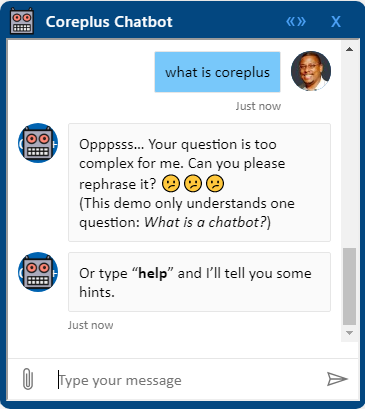
Microsoft has developed a number of samples to help you get started with the Bot Builder SDK v4, as well as a set of templates powered by the scaffolding tool Yeoman. This article introduces CorePlus, a Microsoft Bot Framework v4 template that I have created, based on a previous version of the Core Bot template (Node.js) supported by the generator-botbuilder Yeoman generator. It's an extended and advanced version, intended as a quick-start for setting up a Transactional, Question and Answer, and Conversational chatbot, all in one, using core AI capabilities. The template proposes a modified project structure and architecture, and provides solutions for the technical and design challenges that arise. Although some basic knowledge on Microsoft Bot Framework: Node.js SDK, LUIS, QnA Maker, Bot Framework Emulator, etc., is recommended, it's not required. The code is fully commented and the article provides lots of external links to samples, documents and other articles that can help you expand your vision and knowledge on Microsoft's framework as well as on chatbots design and development in general. Visual Studio Code is suggested as the code editor of choice. You may use any other one of your preferences, though, such as WebStorm.


Microsoft details the most clever phishing techniques it saw in 2019

fig1-phishing-poisoned-search-results.png
The first is a multi-layered malware operation through which a criminal gang poisoned Google search results. The scheme went as follows: Crooks funneled web traffic hijacked from legitimate sites to websites they controlled; The domains became the top Google search result for very specific terms; Phishers sent emails to victims linking the Google search result for that specific term; If the victim clicked the Google link, and then the top result, they'd land on an attacker-controlled website; and This website would then redirect the user to a phishing page. One might think that altering Google search results takes a gigantic amount of effort, but this was actually pretty easy, as attackers didn't target high-traffic keywords, but instead focused on gibberish like "hOJoXatrCPy." ... A third phishing trick that Microsoft wanted to highlight as a clever phishing attack this year was one that made use of a man-in-the-middle (MitM) server. Microsoft explains:"One particular phishing campaign in 2019 took impersonation to the next level.


The Future of APIs and API Monetization

One dollar bills spread out
First, the future API stack is secure. There is a lot of information and prioritization around cybersecurity and endpoint security, but sometimes API endpoints are overlooked. While OAuth is not new, the use of OAuth is essential to control fine-grained access to APIs. Second, APIs must enable personalization and experimentation. Companies need the ability to control and test API capabilities so that we can personalize search results as easily as we personalize user experience. We continuously experiment with search rankings and results to better serve our sellers and buyers. eBay is a search-driven marketplace. APIs must be designed so they can support personalization and experimentation. Third, the future API stack must be device-agnostic. APIs should understand if they are talking to a desktop or mobile device, or communicating across limited bandwidth, and adjust the fidelity of their responses accordingly. If your client pulls data from a massive data center over a LAN connection, it’s probably fine for APIs to allow access to several GBs of data.


How to develop IT leaders into future CIOs

A businessman ascends a staircase surrounded by symbols of business and business data.
Every IT leader reaches an inflection point where they have to become very good at team leadership if they want to take on more responsibility. The ability to lead and not do is more important to the CIO role than technical depth. If you don’t start to develop those skills early in your career, you will fail as a CIO. This is not about delegation, which is just handing a task off to someone else. Leadership is about empowerment and trust. ... There are a number of ways, including getting your MBA or finding a mentor who is a leader in a business function that is not IT. Early in my career, I held finance, HR and customer service roles, which had a technology flavor to them, but were not in IT. Future CIOs should get that cross functional experience early in their careers because it is harder to move in and out of IT as you advance. Understand also that sometimes you have to take a step backward to move forward. You might have to drop down a level for roles in finance or supply chain, but that move will allow you to advance later in your career.


Quote for the day:


"Do all the good you can. By all the means you can. In all the ways you can... At all the times you can." -- John Wesley