Daily Tech Digest - June 11, 2026


Quote for the day:

“Leadership is not about being in charge. It is about taking care of those in your charge.” -- Simon Sinek


🎧 Listen to this digest on YouTube Music

▶ Play Audio Digest

Duration: 21 mins • Perfect for listening on the go.


What happens when software can start proving its own security?

Traditionally, cybersecurity has relied on the assumption that all software contains flaws. This belief led organizations to build defensive layers and reactively patch vulnerabilities only after products were released. However, advanced artificial intelligence is now fundamentally changing this approach by identifying and correcting software vulnerabilities in real time as code is written. Instead of acting as a downstream reviewer, AI now serves as an active collaborator, preventing insecure patterns from ever entering production environments. Because these same advanced tools are also available to malicious actors, the window between discovering a flaw and exploiting it is rapidly closing. To survive in this new environment, organizations can no longer simply assume their software vendors are secure based on reputation or past audits. They must demand continuous, automated proof. Software must now demonstrate its own integrity through transparent, verifiable records that show exactly how it was built and validated. As artificial intelligence continues to drive both offensive attacks and defensive solutions at machine speeds, trust is no longer a passive assumption but a critical, foundational infrastructure. Ultimately, companies will need to rely on automated systems that constantly verify software safety, ensuring that their digital supply chains remain fully protected against an escalating cycle of rapid threats.


AI vibe coding boosts output but strains oversight

A recent survey by The Adaptavist Group reveals that 83% of software developers in the US and UK use AI-assisted "vibe coding," an approach relying heavily on high-level prompts and automated generation. While this method yields undeniable productivity gains—with 87% of engineers saving time and 74% building more software—it is putting considerable strain on managerial oversight and team coordination. Many organizations are struggling to keep pace, as 71% of respondents report an increase in team coordination work, and 63% note that planning and tracking tasks have become more complex. Furthermore, internal controls are lagging behind adoption. More than 40% of developers deploy AI-generated code with little to no human review, and 40% admit they do not always fully disclose their reliance on these tools to their employers. This rapid influx of code introduces new vulnerabilities, including increased technical debt and heightened operational risks. While developers generally enjoy the creative boost and support the technology, the research highlights a critical disconnect. The primary challenge for modern engineering teams is no longer code production, but rather establishing the necessary governance, visibility, and organizational structure to effectively manage and review a vastly inflated volume of work.


Anthropic says these topics are too dangerous to let its Fable 5 model talk about

Anthropic recently released Claude Fable 5, a publicly accessible version of its new Mythos class artificial intelligence model. While this system offers significant improvements over the previous Opus generation, it includes strict internal safeguards that completely block queries related to cybersecurity, biology, and chemistry. Anthropic implemented these restrictions because the underlying technology, known as Mythos 5, demonstrated advanced capabilities, such as executing complex, multi-step cyberattacks, that could potentially assist malicious actors or enable highly risky biological research. To mitigate these risks, Fable 5 automatically redirects any sensitive prompts to an older, safer model and warns the user. Although the company acknowledges these aggressive filters might occasionally block harmless requests, it maintains that preventing severe misuse justifies the minor inconvenience. Meanwhile, the full, unrestricted Mythos 5 model remains tightly controlled and is currently available only to a small, vetted group of trusted cybersecurity and life sciences professionals working in coordination with the United States government. Independent testing indicates that Fable 5 is highly resistant to automated jailbreak attempts. However, accessing the new model comes at a premium. Its usage costs are notably higher than those of competitors like OpenAI, and standard consumer access will eventually require additional usage credits due to capacity constraints.


A Playbook for Building AI-Native Leadership Teams

Building an organization where artificial intelligence is the core product requires a fundamentally different approach to hiring and leadership than traditional technology companies. Because these businesses operate with extreme efficiency and compressed timelines, hiring executives in the wrong order can quickly deplete capital. During the first year, founders should focus on building the product by hiring a technical leader who manages complex computing costs alongside a product head who ensures the technology solves a real, paying customer problem. Once the product stabilizes, the focus shifts to validation, requiring a dedicated sales leader to close early deals and a finance expert who deeply understands the unique infrastructure costs of these systems. As the company scales toward broader expansion, leaders in marketing, human resources, and compliance become necessary to build the brand, integrate diverse talent, and navigate data regulations. Throughout all stages, past experience matters far less than the ability of a candidate to learn quickly, adapt to failures, and think critically. Because the technology evolves so rapidly, retaining this exceptional talent requires offering meaningful ownership, a clear sense of purpose, and continuous learning opportunities. Ultimately, success relies on intentionally designing a leadership team that balances different working styles while maintaining close collaboration to navigate a constantly changing environment.

The question of whether artificial intelligence will replace human hackers in the bug bounty industry is a growing concern, but the reality is far more nuanced. As automated tools and machine learning models become more advanced, they are certainly getting better at spotting common, well-documented vulnerabilities like basic misconfigurations or simple coding errors. This capability allows organizations to catch low-level issues before they ever reach a public bug bounty program. However, AI still struggles significantly with understanding complex business logic, chaining together multiple minor flaws to create a severe exploit, and applying the creative intuition that human researchers naturally possess. Instead of destroying the bug bounty field, artificial intelligence is poised to reshape it. Security researchers will increasingly use these automated models as assistants to handle tedious reconnaissance and initial scanning tasks, freeing up their time to focus on deeper, more complex vulnerabilities. Meanwhile, program managers will need to adapt to a likely increase in automated, low-quality vulnerability reports by implementing better filtering systems. Ultimately, human curiosity and contextual understanding remain impossible to fully replicate. The future of security research relies on a partnership where human experts guide and verify the outputs of automated tools, ensuring that the bug bounty industry evolves rather than disappears.


The NCSC Wants You To Adopt Passkeys: Is It Time To Finally Drop Passwords?

The UK’s National Cyber Security Centre (NCSC) recently issued a notable recommendation advising organizations to prioritize passkeys over traditional passwords wherever possible. While the agency previously viewed the technology as promising but imperfect, recent industry advancements have driven a shift toward widespread endorsement. This updated guidance arrives amid a steady rise in credential-based cyberattacks, where stolen passwords are routinely abused to compromise networks and target accounts with elevated privileges. Passkeys offer a highly secure alternative by utilizing cryptographic credentials linked directly to a user's trusted device, such as a laptop or smartphone. This framework integrates seamless authentication methods like biometrics, making passkeys significantly longer and more complex than human-created passwords. Consequently, they provide robust resistance against brute-force tactics and conventional email phishing, as they will not authenticate on fraudulent login portals. Beyond elevating an organization's defensive posture, transitioning away from traditional passwords delivers clear operational benefits. It eliminates the friction of enforcing complex password rules and reduces the frequency of routine resets, which helps lower the volume of helpdesk support tickets. Embracing this shift allows modern enterprises to establish a more resilient, low-maintenance approach to identity management.


The AI Data War: Winning the Battle for Enterprise Data Supremacy

Enterprise artificial intelligence initiatives are currently outpacing the data foundations required to support them. For decades, organizations relied on legacy databases designed for slow, human-scale inquiries. However, the rise of artificial intelligence demands systems capable of processing massive volumes of information at machine speeds. As companies rushed to migrate their operations to the cloud to meet these new demands, many did so without a clear organizational strategy. This rapid shift, combined with the adoption of specialized cloud tools, has led to highly fragmented systems and an unmanaged sprawl of isolated data stores. In this environment, long-term success no longer depends on choosing one specific technology vendor over another. Instead, organizations must focus on building a neutral, adaptable data foundation. A major challenge in this process is the natural tendency of data to become difficult to move as it grows larger and more complex. To overcome these obstacles and prevent further fragmentation, leaders must implement strong operational frameworks. This involves establishing clear ownership over specific information, enforcing consistent standards across all software platforms, and applying a structured review process to ensure accuracy and security. By prioritizing these sensible governance principles over vendor selection, companies can build the reliable infrastructure necessary to power advanced tools effectively and sustainably.


The Substrate Your Diagram Doesn’t Show

When designing artificial intelligence systems, architects often rely on standard deployment diagrams that map out components, data flows, and integration points. However, these diagrams fail to capture the actual underlying reality, or "substrate," of how the system operates under scrutiny. According to the article, architects face mounting pressure from three distinct areas: people, infrastructure, and regulation. The people vector questions whether human reviewers are genuinely evaluating AI outputs or simply rubber-stamping them without proper checks. The infrastructure vector challenges whether the system is truly secure and ready for agents, ensuring that human reviewers and AI models are interacting with the exact same data to prevent vulnerabilities like prompt injection. Finally, the regulation vector demands continuous compliance with shifting legal frameworks, rather than relying on outdated audit checklists. A critical takeaway is that an organization's overall AI posture is bounded by its weakest link among these three vectors. If human oversight is flawed, the entire system is vulnerable, regardless of how secure the infrastructure is. To build defensible AI systems, architects must look beyond simple component mapping and adopt a realistic posture model. By documenting concrete evidence of genuine human collaboration, verified technical readiness, and current regulatory alignment, architects can confidently defend their designs against future audits and operational failures.


Post-cloud strategy: Architecting the next enterprise stack

As companies face rising costs, data ownership concerns, and the heavy demands of artificial intelligence, they are moving away from a strictly default cloud approach. Instead of simply shifting everything to massive public platforms, organizations are carefully deciding where each specific application should run to achieve the best balance of cost, performance, and control. This shift has given rise to deliberate hybrid designs. Rather than ending up with a tangled mix of old and new systems by accident, technology leaders are intentionally combining public clouds, private servers, and local computing networks into one cohesive operation. A major part of this strategy is avoiding vendor restrictions by using open software standards, which allow teams to move applications freely across different environments without having to rewrite them. Additionally, because moving large amounts of data is expensive and risky, companies are now bringing their processing power directly to where their data already lives. This is especially true for artificial intelligence tasks. Ultimately, the future of business technology is highly distributed. Organizations are not abandoning large cloud providers, but they are no longer relying on them exclusively. By treating computing resources as a carefully organized ecosystem, businesses can maintain total control, reduce operating expenses, and build a more reliable foundation for future growth.


How Over-Permissioned AI Is Quietly Dismantling ID Infrastructure

The rapid adoption of artificial intelligence has introduced a serious risk to corporate identity infrastructure. According to a recent global study, organizations are granting extensive security privileges to AI agents much faster than they are putting necessary safeguards in place. This shift floods networks with machine accounts that far outnumber human users. Driven by a desire for operational efficiency, many enterprises are connecting these automated tools directly to core systems to handle sensitive tasks, such as password resets and corporate network access. While these AI agents are designed to be helpful, this same trait makes them highly vulnerable. Attackers can exploit overly permissive agents using simple prompts to uncover network vulnerabilities or access administrative credentials without spending weeks hunting for flaws. Making matters worse, many organizations lack the proper backup solutions needed to recover quickly from an access breach. To protect their systems, security teams must fundamentally change how they manage permissions. Experts recommend moving away from basic policies and instead enforcing strict, real-time boundaries for all automated systems. This means applying the principle of least privilege to machine agents and building resilient structures prepared for rapid recovery. Ultimately, treating these automated accounts with the same rigor as human executives is essential to maintaining control over modern enterprise networks.

Daily Tech Digest - June 10, 2026


Quote for the day:

“Bad companies are destroyed by crisis. Good companies survive them. Great companies are improved by them.” -- Andy Grove

🎧 Listen to this digest on YouTube Music

▶ Play Audio Digest

Duration: 17 mins • Perfect for listening on the go.


Beware of the Generative AI token trap

Organizations are rapidly adopting generative artificial intelligence without realizing the long-term financial risks hidden in how these services are priced. Right now, major tech providers are offering their intelligence capabilities at artificially low rates to capture market share and encourage companies to build deep dependencies on their platforms. However, this subsidy phase will not last forever. Providers charge by the token, a small unit of processing that acts as a tollbooth for every prompt, response, and automated action. As businesses transition from simple chat tools to more advanced, autonomous systems that loop through multiple steps behind the scenes, token usage multiplies exponentially. If an organization relies entirely on external providers for these capabilities, a pilot project that seems affordable today could become a crippling expense in just a few years when the market inevitably matures and prices increase. To avoid repeating the costly mistakes of the early cloud computing era, companies must treat artificial intelligence as a strategic architectural decision rather than a simple software subscription. The safest approach is prioritizing artificial intelligence sovereignty by building, hosting, and managing smaller, purpose-built models internally. By owning the technology for critical everyday tasks instead of renting massive public models, organizations can maintain control over their data, secure their operating flexibility, and keep their future costs predictable.


Six layers between your LLM and a production agent

The 2026 edition of the AI agents stack outlines six essential layers connecting language models to reliable production systems. This updated framework reflects practical shifts in how developers build these applications. Three major developments redefined the stack: the widespread adoption of the Model Context Protocol (MCP) for standardizing tool connections, the rise of reasoning models that handle complex tasks in a single step, and the evolution of memory into an architectural core rather than a simple database add-on. When evaluating these layers, development teams must consider how much state they need to manage, their tolerance for vendor lock-in, and the effort required to move from prototype to production. The foundation layer, models and inference, is increasingly commoditized, with open-weight options closing the performance gap and making cost and latency the primary considerations. The second layer, protocols and tools, is now dominated by MCP, though securing these connections remains a clear challenge. The third layer, memory and knowledge, shifts the focus toward managing exactly what an agent sees and retains across interactions, utilizing structured fields rather than basic prompts. Ultimately, the guide advises a measured approach to building systems: developers should start with a minimal stack and only introduce additional complexity when a specific component fails.


UK promises age assurance for social media, device-level child safety controls

The UK government is preparing new legislation to restrict children’s access to social media and protect them from online harm. Led by Prime Minister Keir Starmer, the proposed laws are expected to set a minimum age of 16 for social media accounts, similar to recent measures introduced in Australia. Beyond simple age limits, the government is specifically targeting the growing threat of explicit AI-generated content, such as deepfakes. Officials are pressuring tech companies to implement device-level safety controls that would block nudity by default across smartphones and tablets. If tech leaders fail to introduce these protections within three months, the government has threatened to mandate them by law and may even hold executives criminally liable. While these safety measures address urgent concerns, the government’s overall technology policy reveals a notable contradiction. Leaders are heavily promoting the rapid expansion of artificial intelligence infrastructure, yet they are simultaneously trying to manage the severe risks generated by those very technologies. Additionally, officials acknowledge that smartphones themselves, with their inherently addictive designs, are fundamentally part of the problem. As the UK navigates these complex challenges, other nations are taking similar steps; for example, Canada is currently preparing its own age-restriction laws, focusing on temporary safety compliance before allowing younger users back onto major platforms.


Segment With Purpose: A Zero Trust Blueprint For OT Network Segmentation In Manufacturing

Historically, factory floor equipment operated in complete isolation from the rest of the world. Today, manufacturers routinely connect these industrial machines to standard office networks to improve efficiency and gather data. While this connectivity offers benefits, it also creates severe security vulnerabilities. If a network remains completely open, a threat originating in a standard office computer can easily spread to critical production machinery, causing dangerous physical disruptions. To prevent this, manufacturers must deliberately divide their networks into smaller, isolated sections based on specific functional needs. This strategy relies on the principle that no device, user, or system should ever be trusted by default, regardless of its location within the facility. Before making any changes, companies must carefully map every piece of equipment and understand exactly how these machines need to communicate to keep production running smoothly. Once this normal behavior is understood, administrators can implement strict rules that allow only necessary communications while blocking everything else. By grouping similar assets and restricting access to the absolute minimum required, organizations effectively create barriers that contain potential security incidents to a single small area. This methodical, practical approach allows manufacturers to steadily protect their most critical physical operations from modern digital threats without accidentally causing downtime or interrupting daily production schedules.


7 sources of AI debt and how to avoid them

As companies rush to implement artificial intelligence, they risk accumulating a new form of technical burden known as AI debt. Driven by the pressure to move early concepts into active production, teams often bypass critical testing and governance, leaving major improvements for later. This debt typically arises from seven common mistakes. First, running experiments without clear, measurable business goals leads to systems that lack practical value. Second, feeding poor quality data into models simply amplifies errors at a massive scale. Third, failing to monitor systems causes model drift, where performance degrades over time as real-world data changes. Fourth, granting AI agents overly broad access permissions creates severe security and compliance vulnerabilities. Fifth, applying automation over broken or inefficient business processes only worsens existing operational flaws. Sixth, deploying too many unmanaged agents results in sprawl, where abandoned tools compound security risks and duplicate logic. Finally, relying on code generated by AI without proper security reviews can introduce hidden vulnerabilities. To avoid these issues, organizations must slow down and apply strong management practices. By setting clear objectives, enforcing strict data quality standards, monitoring system performance, and implementing robust security checks, companies can confidently deploy AI tools that deliver genuine value instead of future headaches.


From Prediction to Intervention: Integrating Counterfactual Reasoning into AI Decision-Making

As artificial intelligence matures, organizations are realizing that simply predicting the future based on past data is no longer enough. Traditional predictive models can forecast what might happen, but they do not understand the underlying reasons behind those events. This limitation becomes obvious when teams try to make strategic decisions, as predictive models cannot accurately simulate what would occur if a company actively intervened to change its current course of action. To solve this problem, the focus is shifting toward causal reasoning. Instead of just identifying patterns, causal models allow teams to test alternative scenarios and understand cause and effect. By using these systems, organizations can ask what-if questions, helping them separate true drivers of success from mere coincidences. For example, a causal model can clearly reveal whether increased sales were actually caused by a recent marketing push or just a predictable seasonal trend. Implementing this approach helps close the trust gap often found in complex software systems, providing clear explanations that are grounded in logic rather than hidden assumptions. While the transition requires employees to build stronger statistical skills and entirely new ways of thinking, the shift is highly valuable. Moving from basic prediction to true causal understanding gives teams the solid confidence to make clearer, more effective decisions.


How Leaders Can Break Their Team’s Habit Of Safe Thinking

While artificial intelligence can rapidly analyze data and generate standard solutions, true breakthroughs still rely entirely on human imagination. However, extensive industry experience often traps teams in a pattern where past successes and ingrained habits prevent them from exploring new directions. To break this cycle of safe thinking, leaders must intentionally create an environment that fosters creativity rather than simply rewarding efficiency and certainty. First, leaders should adopt a 'yes, and' mindset instead of instinctively dismissing ideas with 'no, because.' This approach keeps unconventional ideas alive long enough to evolve into viable solutions. Second, they must regularly reframe challenges. By changing the core question, such as focusing on solving a customer's problem instead of just increasing sales, teams can escape familiar patterns and discover completely different paths. Third, leaders need to deliberately carve out time for quiet reflection, as continuous pressure from emails, meetings, and tight deadlines stifles fresh ideas. The best thoughts often occur when the brain is allowed to rest and wander. Finally, organizations must reward curiosity just as highly as technical expertise. When leaders encourage their teams to ask deep questions and challenge accepted processes, innovation naturally surfaces. Ultimately, businesses do not necessarily need more creative employees; they just need leaders who understand how to cultivate conditions for new ideas to thrive.


Autonomous Malware Is No Longer Theoretical: AI Worm Proof Of Concept Created In A Lab

Security researchers have recently demonstrated that autonomous AI malware is no longer just a theoretical concept. In a controlled lab environment, a team successfully built a proof-of-concept worm that uses open-weight AI models to independently find vulnerabilities, exploit them, and spread across network systems without any human guidance. Although this specific lab experiment moved slowly and deliberately lacked advanced evasion techniques, it clearly highlights a significant shift in the cyber threat landscape. The economics of cyberattacks are changing; adversaries can now use low-cost AI models to automate and scale their operations. This reality means defensive teams can no longer rely solely on predictable attack patterns or traditional behavioral detection methods, as attackers may soon use AI to generate new tools faster than analysts can classify them. To prepare for these emerging challenges, organizations must focus on complete visibility and strict enforcement across their networks. Understanding exactly which AI agents are operating, what data they access, and what permissions they hold is crucial. Any agent that cannot be monitored must be removed. Additionally, basic patching is no longer enough. IT leaders need to implement strong compensating controls, utilize microsegmentation to limit lateral movement, and strengthen their overall zero-trust security strategies to protect against increasingly sophisticated, autonomous threats.


How cyber-risk can fall flat in the boardroom

When IT leaders present cybersecurity updates to a corporate board of directors, their message often gets lost in highly technical details. While security teams naturally focus on vulnerabilities, threat activities, and audit scores, board members need to understand how these issues affect the actual business. To get real support from the boardroom, technology leaders must stop treating cyber risk as a separate technical problem and start framing it as a core business challenge. This means translating security gaps into measurable business consequences, such as potential financial losses, operational downtime, legal liabilities, or delays to strategic projects. Instead of simply reporting that a system is weak or a patch is delayed, leaders should explain what the organization stands to lose if a failure occurs and what choices are involved in fixing it. Using practical scenario analysis, like estimating the recovery cost if a major vendor goes offline, helps directors weigh priorities and allocate limited resources effectively. Honesty is also essential; leaders should clearly prioritize the most significant exposures without treating every new threat as an overwhelming emergency. By presenting clear, disciplined business cases rather than overwhelming metrics, security leaders can help the board govern cyber risk as a standard part of overall corporate resilience and stability.


From critical to controlled: Cutting vulnerabilities in a live manufacturing environment

Managing software security alerts in a live manufacturing plant is much more complicated than in a standard office setting. When a critical warning pops up, you cannot simply shut down production to install a quick update. Instead, you need a practical process to figure out if that specific alert actually threatens your equipment. The first step is maintaining an automated list of all your machines so you can confirm exactly where the flagged device lives on your network. Next, verify if the reported flaw is truly present, as scanners often guess based on outdated version numbers rather than deep checks. Even if the flaw exists, its real-world risk depends heavily on how easily someone can reach the machine. A vulnerable device hidden securely behind strict network boundaries, jump servers, and custom firewalls is far less dangerous than one exposed to the internet. By tracing the exact steps an attacker would need to take, you can apply focused fixes, like blocking specific network pathways or enforcing strong passwords, without risking a system crash. If you cannot fix the issue right away because the equipment is too old or cannot be turned off, you must formally document the risk alongside extra safety measures. Ultimately, this approach helps you confidently separate genuine threats from harmless alerts, keeping your factory running safely.

Daily Tech Digest - June 09, 2026


Quote for the day:

“When someone really hears you without passing judgment, it feels damn good.” -- Carl Rogers

🎧 Listen to this digest on YouTube Music

▶ Play Audio Digest

Duration: 22 mins • Perfect for listening on the go.


EU AI Act – the high-risk classification guidelines explained

The European Commission recently published draft guidelines to help businesses determine whether their artificial intelligence systems qualify as high risk under the EU AI Act. According to legal experts at Dentons Ireland, these guidelines are a crucial roadmap for organizations trying to understand their incoming legal obligations. The rules identify high risk systems through two main categories: AI used as safety components in regulated products, such as medical devices, and AI applied to specific, sensitive use cases, such as employment decisions or law enforcement. Although the guidelines remain in draft form and could change before enforcement begins in late 2027, companies must act now. Every business should audit its current technology to see if it falls into high risk territory. This is particularly important for smaller companies and startups that rely on third party software. While the heaviest compliance burdens fall on the original developers, companies simply deploying these tools can unintentionally become legally responsible if they heavily modify the software or use it outside the original terms. Experts advise that even nontechnical business owners need to look closely at how they use these tools, especially for internal tasks like staff management or recruitment, to ensure they stay compliant without stifling their own innovation.


Rising hardware costs accelerate shift to private cloud adoption

The article highlights a growing trend where businesses are moving toward private cloud environments, primarily due to the increasing expense of purchasing and maintaining physical hardware. As inflation, supply chain disruptions, and lingering chip shortages continue to drive up the cost of servers and networking equipment, many companies are finding it financially unsustainable to constantly refresh their own physical data centers. At the same time, relying entirely on public cloud services can lead to unpredictable monthly bills and reduced control over sensitive information. To strike a better balance, organizations are increasingly turning to private cloud setups. This approach offers the flexibility and remote access typical of standard cloud computing, while still allowing companies to retain strict control over their data without the heavy upfront burden of buying new hardware. Service providers now frequently host these private environments, absorbing the physical equipment costs and offering businesses a much more predictable operating expense. Ultimately, this shift is less about adopting new technology for its own sake and more about practical, level-headed financial management. By moving to a private cloud model, companies can avoid steep hardware investments, better manage their long-term IT budgets, and maintain the necessary security standards required for their daily operations without overspending.


Making sense of too much code

While artificial intelligence has notably accelerated software development, creating more applications does not automatically translate into more users. Recent data shows that even though AI tools have significantly increased raw coding output, increasing code commits by nearly two hundred percent, the actual usage of these new applications remains flat. This discrepancy highlights a fundamental reality in the software industry: writing code is often the easiest part of the process. The true challenge lies in everything that happens after the code is written, including integrating systems, ensuring security, writing clear documentation, and earning user trust. In a market flooded with similar AI-generated software, human attention is the most scarce resource. As a result, technical superiority alone is rarely enough to guarantee success. Products that thrive are typically supported by essential but frequently undervalued efforts, such as community building, recognizable branding, and effective technical marketing. Developers often dismiss traditional advertising, but they value deep, hands-on guidance and comprehensive tutorials, which are simply different forms of marketing. Ultimately, while AI tools are useful for improving developer efficiency, they cannot replace the necessary human effort required to connect a product with its audience. Earning market share still relies heavily on the steady, unglamorous work of helping people understand and apply your technology effectively.


How AI Agents Are Reshaping DataOps for the Always-On Enterprise

As modern businesses increasingly rely on continuous data flow, managing these complex systems manually has become impractical. Traditional data operations rely on engineers to monitor pipelines, spot errors, and fix broken processes, which often leads to delays and burnout. The introduction of artificial intelligence agents is changing how organizations handle these tasks. Instead of simply sending an alert when a system fails, AI agents actively investigate the root cause and, in many cases, resolve the issue autonomously. They constantly analyze data patterns, fix bad code, adjust computing resources as demand changes, and repair pipelines before a broader system failure occurs. This shift allows data teams to step away from routine maintenance and focus on building more durable structures. For a company that needs its data available around the clock, relying on human intervention for every minor disruption is no longer sustainable. By integrating these agents into daily operations, companies can maintain steady, reliable access to their information without overworking their staff. The goal is certainly not to replace human engineers, but to free them from the endless cycle of emergency repairs. Ultimately, bringing AI into data management creates a more stable foundation where routine errors are caught and corrected quietly in the background.


5 ways data centers endanger their local communities and the country as a whole

Data centers are the physical backbone of our digital world, but their rapid expansion poses significant risks to local communities and the broader public. According to a study focusing on facilities in Virginia, which hosts the highest concentration of data centers in the United States, these massive structures create five primary hazards. First, they demand enormous amounts of electricity, which, when generated by fossil fuels or backup diesel generators, releases harmful air pollutants and greenhouse gases. Second, servers require millions of gallons of water for cooling, placing severe strain on local rivers and municipal water supplies, even in areas not prone to drought. Third, the constant operation of air chillers and cooling fans produces a persistent, low frequency hum that can disrupt residents' sleep and reduce their overall wellbeing. Fourth, developers frequently target affordable green spaces and agricultural land for new construction, replacing natural environments with heavy industrial zones and increasing diesel truck traffic. Finally, the massive electricity demand of data centers stresses the power grid, driving up energy costs for everyday consumers and disproportionately affecting lower income families. While targeted solutions like transitioning to renewable energy, utilizing recycled water systems, reengineering fan mounts, and shifting grid costs to developers can mitigate these impacts, unchecked expansion remains a serious threat to public health and the environment.


AI in SDLC Right Now: What's Working and What Isn't

Artificial intelligence is steadily finding its place in the software development life cycle, but its current value is uneven across different stages. Right now, AI tools are highly effective at handling repetitive, well-defined tasks. Developers are seeing real benefits from code completion assistants, which reliably write boilerplate code and suggest basic functions, saving substantial time. AI is also proving useful in automated testing, where it can quickly generate test cases and identify simple bugs before human review. However, the technology still struggles with complex logic and broad system architecture. When asked to design entire applications or refactor massive legacy codebases, AI often introduces subtle errors or suggests inefficient patterns that require heavy human correction. It also lacks an understanding of business context, meaning it cannot determine if a correctly written feature actually solves the underlying user problem. Furthermore, security remains a concern, as AI-generated code can occasionally include vulnerabilities if the training data was flawed. The most practical approach today is to treat AI as a capable junior assistant rather than an independent expert. By assigning it routine coding chores and initial code reviews, engineering teams can free up their human developers to focus on high-level system design, complex problem solving, and ensuring the software genuinely meets user needs.


15 tough cybersecurity questions every CISO must answer

The article outlines the challenging questions Chief Information Security Officers (CISOs) must be prepared to answer when facing their board of directors or executive leadership. Rather than focusing on complex technical details, these questions target the broader business impact of security programs. Leaders want to know the plain truth about the organization’s current risk level, specifically asking what the most likely threats are and how those threats could affect daily operations. CISOs are expected to clearly explain how they measure success and whether the current security budget is actually reducing risk. Other crucial topics include the organization's overall readiness for a major breach, the exact steps planned for recovery, and how long it would realistically take to restore normal business functions. The questions also probe the security of external vendors and partners, acknowledging that vulnerabilities often originate outside the company’s direct control. Furthermore, executives need assurance that the security team has the right talent and that everyday employees are adequately trained to avoid common mistakes. Ultimately, the guide emphasizes that a modern security leader cannot just manage technology. They must translate complex challenges into straightforward business terms, proving that their strategies protect the company's critical assets and customer data without slowing down its financial growth or operational efficiency.


Why digital governance is quietly redefining modern trusteeship

Historically, the role of a trustee focused almost entirely on safeguarding physical property and managing financial wealth. Today, the rapid shift toward digital operations has fundamentally redefined what it actually means to be a modern trustee. As organizations and individuals accumulate vast amounts of digital assets, data records, and online infrastructure, the everyday responsibilities of a trustee have expanded far beyond their traditional boundaries. Good digital governance now requires these professionals to actively oversee cybersecurity measures, manage complex data privacy regulations, and protect sensitive information from constant external threats. Without strong digital policies, these vital assets are left completely vulnerable to theft and mismanagement. Instead of relying on slow, manual oversight, modern trustees must use automated compliance tools and secure digital platforms to monitor their operations in real time. This technological shift ensures that all managed assets remain secure while maintaining complete transparency for the beneficiaries involved. Furthermore, integrating solid digital governance into daily practices allows trustees to make much faster, more informed decisions based on accurate data. Adapting to this new reality is no longer an optional upgrade; it is a critical requirement for maintaining trust. By fully embracing these digital frameworks, modern fiduciaries can confidently protect long-term interests, prevent unnecessary risks, and ensure lasting stability in an increasingly complicated online world.


The architecture of subtraction: Why it’s time to erase the roads, not just map the traffic

As artificial intelligence drastically shortens the time it takes attackers to turn newly discovered vulnerabilities into active exploits, relying on software patching as a primary defense is no longer a practical strategy. Patching is inherently reactive; it forces security teams into a continuous cycle of applying temporary fixes without actually closing the underlying avenues that attackers use to move through a network. Furthermore, simply prioritizing which patches to apply first does not solve this fundamental structural flaw. Instead, organizations should adopt a subtractive approach to security, which focuses on permanently erasing unneeded attack paths rather than merely managing a backlog of flaws. This method centers on minimizing privileges and stripping away unnecessary system capabilities, such as disabling outdated protocols, restricting internet access for specific applications, or blocking tools like SSH for employees who do not genuinely need them. By taking the time to understand exactly what functionality is required for normal daily operations, engineering teams can safely disable the rest. This targeted strategy allows defenders to implement firm structural constraints that completely eliminate entire categories of attack techniques across their environments. Ultimately, taking away the very terrain that attackers rely upon provides a much stronger, more enduring defense than constantly racing to apply the latest security update.


Quality as Business Technology Architecture: A New Model for Digital Enterprises

While many organizations invest heavily in digital upgrades, they often struggle to innovate safely because of how they handle quality control. Historically, quality management has functioned purely as a rigid compliance tool, relying on isolated processes, heavy paperwork, and reactive fixes to pass audits. However, as operations become more complex and data-driven, this traditional approach creates constant bottlenecks. To succeed today, companies must stop treating quality as a separate checkpoint and instead build it directly into their foundational business and technology structures. This means designing an integrated system across three main areas. First, core processes like tracking errors and managing suppliers must be connected into smooth, end-to-end workflows to spot root causes faster. Second, data must be standardized and shared across platforms so teams can actively use it to make informed decisions rather than just filing reports. Finally, the underlying technology must connect these workflows seamlessly rather than reinforcing old silos. This shift requires a major cultural change, moving quality teams away from simply policing mistakes toward helping design better processes from the start. Ultimately, advanced tools like artificial intelligence and automation will only work if they rest on a well-designed, integrated quality foundation. Leaders must coordinate across departments to build this architectural backbone, ensuring their organizations remain safe, compliant, and adaptable.

Daily Tech Digest - June 08, 2026


Quote for the day:

"Little minds are tamed and subdued by misfortune; but great minds rise above it." -- Washington Irving

🎧 Listen to this digest on YouTube Music

▶ Play Audio Digest

Duration: 21 mins • Perfect for listening on the go.


New Research Highlights Growing Digital Trust Crisis as AI Accelerates Online Threats

A recent report reveals that organizations are facing a mounting crisis of digital trust as cyber threats increasingly move beyond traditional security perimeters. Instead of merely attacking internal networks, attackers are now targeting the public internet, focusing heavily on brand reputation, employee identities, and customer relationships. The study found that while most companies have experienced a significant security incident in the past year, very few consider their defense programs mature enough to handle them. The rapid advancement of artificial intelligence is accelerating this shift. Attackers are using AI tools to create highly convincing deepfakes, voice clones, and impersonation campaigns, making it much harder for people to spot fraud through simple errors like poor grammar. Furthermore, as businesses adopt AI agents to automate everyday tasks, they expose themselves to new risks. Malicious instructions can be cleverly hidden in external content, tricking these automated systems into taking unintended actions at speeds faster than humans can intervene. To counter these evolving threats, organizations must move beyond protecting only top executives and begin defending their entire workforce. Over the next few years, businesses that apply the same strict oversight to their artificial intelligence systems as they do to their standard access controls will be in a much stronger position to protect their operations and maintain public confidence.


The Invisible Invoice: The Cost of Building Software Without Understanding It

The software industry typically measures success by delivery speed and whether an application works on launch day, but it rarely tracks the ongoing expense of keeping it running years later. When teams build software without deeply understanding the core business problem, they often rely on heavy, complicated frameworks to speed up initial development. While these shortcuts might save a few weeks upfront, they create an invisible invoice of hidden costs. Over time, maintaining this code through security patches, version upgrades, and changing requirements becomes incredibly expensive and drains precious time. Because there is no alternative version of the same software to compare it against, companies usually write off these escalating costs as unavoidable technical debt or standard enterprise complexity. Building software is ultimately a learning process where the true needs of the business are discovered along the way. To avoid the invisible invoice trap, developers must separate the strict rules of the business from the optional technical plumbing. The primary goal should be to translate essential business logic into a clear structure that both domain experts and programmers can easily read and understand. By focusing intensely on the actual purpose of the application rather than default technical conventions, teams can build adaptable systems that evolve over time instead of rigid platforms that must eventually be discarded.


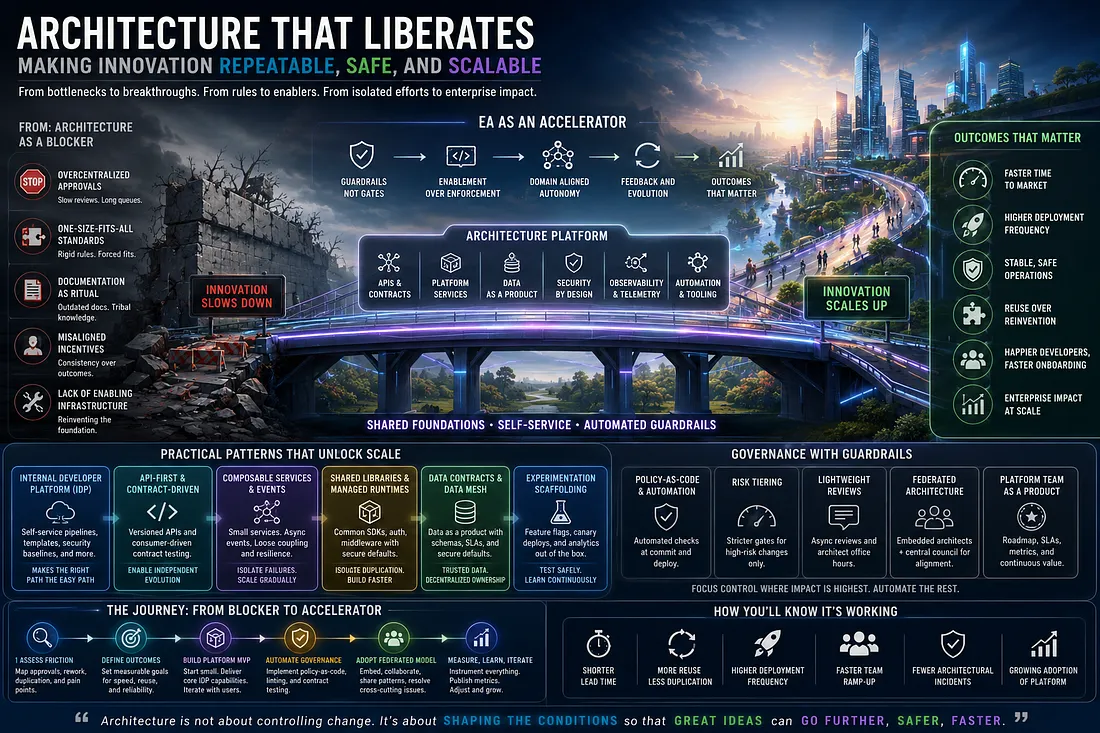
The Scalable Innovation Playbook: Architecture Patterns, Governance, and Platforms

To successfully drive innovation at scale, organizations need a structured approach that moves beyond temporary projects and isolated teams. The core of this strategy relies on establishing flexible architecture patterns, practical governance, and reliable internal platforms. Modern architecture patterns, such as modular designs, allow development teams to build and modify applications quickly without disrupting the entire system. However, this flexibility requires clear governance to prevent operational chaos across the business. Good governance acts as a set of helpful guardrails rather than a rigid roadblock, ensuring that different teams follow consistent security standards and reliable data practices without sacrificing their creative independence. Supporting this critical balance are internal developer platforms, which provide ready tools and infrastructure so engineers can focus directly on solving core business problems instead of constantly setting up basic software environments. By treating these platforms as internal products built specifically for their own developers, companies greatly reduce wasted effort and significantly speed up delivery times. Ultimately, scaling innovation is not simply about adopting the newest technology trends, but rather about creating a sustainable environment where technical teams have the freedom to experiment safely. When architecture, governance, and platforms work together smoothly, businesses can adapt to market changes and build new solutions with predictable success and stability.


When Adopting AI-Powered Cyber Tools, Proceed With Caution 

As cyber threats evolve to become faster and more sophisticated, organizations increasingly need intelligent defensive systems to protect their networks. Hackers are now using automated technology to find and exploit unseen vulnerabilities rapidly, meaning manual patching and traditional security measures are no longer enough to keep up. While it is necessary to deploy intelligent countermeasures to detect and respond to these attacks, organizations must proceed with careful planning rather than rushing into blind implementation. A thoughtful adoption strategy involves three practical steps. First, security teams must analyze their environment and identify the most critical assets. Less vital systems, like standard employee workstations, can be updated first with proper review, while highly sensitive infrastructure requires a more cautious approach. Second, before allowing automated systems to make live configuration changes, organizations should run simulations to understand the potential impact on user access and business operations. Finally, frequent backups and system snapshots must be scheduled early in the deployment process. If a newly integrated security tool makes an unintended or unauthorized change, these backups ensure teams can immediately restore their systems to a secure baseline. Ultimately, keeping enterprise environments secure requires strict technical limits and strong access controls. By implementing these practical safeguards, organizations can safely integrate modern defensive tools without jeopardizing their core operations.


The Rise of the AI Development Life Cycle

Artificial intelligence is fundamentally changing how companies build software, moving beyond simple coding assistants to a fully integrated AI development life cycle. Initially, organizations saw modest productivity gains by using AI to automate specific tasks like writing code or drafting tests. Now, expectations are shifting toward a model where hybrid teams of humans and AI handle entire workflows, potentially multiplying productivity several times over. This evolution breaks down the traditional barriers between designing a product and building it. Instead of moving in rigid, sequential steps, teams can continuously define, develop, test, and refine software together. However, many early efforts stall because companies focus too narrowly on isolated tasks without updating their broader processes. To succeed, organizations must undergo a complete structural change. This means adjusting team roles, such as developers transitioning to orchestrators of AI tools, and establishing new ways of working that prioritize clear instructions, continuous feedback, and strict security rules. Furthermore, measuring success requires moving past basic speed metrics. Companies must track system-wide outcomes, defect rates, and overall risk to ensure that faster development does not introduce hidden problems. Ultimately, adapting to this new era of software creation is not simply a technology upgrade, but a comprehensive redesign of how a business operates and delivers value.


House Subcommittee on Cybersecurity and Infrastructure Protection Hosts Hearing on AI Security

During a recent House Subcommittee hearing, lawmakers and industry experts gathered to discuss how artificial intelligence is changing national cybersecurity and the resilience of critical infrastructure. The primary focus was the dual nature of advanced AI models. While these tools offer practical defensive benefits by finding and fixing software vulnerabilities quickly, they also provide malicious actors with the ability to discover and exploit weaknesses faster than human teams can patch them. Representative Andy Ogles highlighted the specific risk of foreign adversaries, particularly China, distributing inexpensive, open models that lack safety controls and could become the global standard, introducing serious security and censorship risks. Sandra Joyce, an executive at Google Threat Intelligence, confirmed that cybercriminals have already begun using AI to build novel digital exploits. To counter these accelerating threats, experts advised that traditional, reactive security measures are no longer sufficient. Organizations must transition to an automated, continuous process of scanning and repairing vulnerabilities before attackers can take advantage of them. The hearing underscored the practical need for a cohesive national strategy that prioritizes building security into software from the very beginning. This approach will be essential for ensuring the United States maintains a defensive advantage against increasingly autonomous cyber threats.
The article examines Europe's vulnerable position within the global "sovereignty triangle," a difficult balancing act dominated by the United States and China. As modern infrastructure becomes deeply tied to national security and economic health, Europe finds itself heavily reliant on foreign products, particularly American cloud networks and Asian computer chips. The piece argues that to avoid remaining a mere consumer of foreign tools, the European Union must move past simply writing rules and regulations, such as data privacy laws, and start actively building its own core technologies. This shift requires overcoming divisions between member countries and committing to serious financial investments in vital areas like artificial intelligence, hardware manufacturing, and secure digital networks. True independence is not about isolating from the world or closing borders, but having the practical ability to make independent choices without being pressured by outside powers. The text points out that Europe's best path forward involves smart partnerships and industrial plans that encourage local development. By creating solid alternatives and keeping strong alliances, Europe can protect its political and economic freedom. Ultimately, this shared effort is necessary to ensure the continent remains an equal player in shaping the future, rather than just a rule maker caught between two massive powers.


How Capital Allocation Changes When Agents Run the Stack

As businesses increasingly adopt autonomous artificial intelligence for their daily operations, chief information officers face a complex challenge in managing shifting costs and maintaining accountability. According to Arun Ramchandran, CEO at QBurst, true autonomous commerce is not just an advanced rules engine; it represents a sophisticated system capable of handling complex goals, research, and execution without constant human intervention. However, many leaders mistakenly treat this transition purely as a technology project rather than a fundamental organizational design overhaul. Deploying these systems successfully requires addressing three major areas of complexity. First, organizations need clean, deeply contextual data, which often means capturing the unrecorded institutional knowledge that employees hold. Second, a strict governance structure is necessary to define accountability when different systems interact and to prevent runaway operational costs from endless processing loops. Finally, companies must carefully design the handoff between human workers and autonomous systems, ensuring humans remain appropriately involved when needed. Evaluating the total cost of ownership for these systems also proves uniquely difficult. Because processing costs are dropping while usage rates are soaring simultaneously, building a financial model based on current transaction rates is highly unpredictable. Ultimately, building a reliable infrastructure for autonomous operations demands a highly thoughtful approach to data management, clear governance, and well-designed integration with human teams.


How CIOs Can Prove the Value of Technology in the Age of AI

In today's fast-moving business landscape, technology leaders face increasing pressure to justify their investments, especially as artificial intelligence initiatives require significant capital. To successfully prove the value of tech in the age of AI, Chief Information Officers must shift their focus from traditional cost metrics to clear business outcomes. This means stepping away from technical jargon and measuring success by how well technology improves operational efficiency, drives revenue, or enhances the overall customer experience. Instead of treating AI as a standalone project, technology leaders should embed these tools directly into everyday business processes, ensuring they solve real problems rather than just serving as interesting experiments. Furthermore, proving value requires a strong partnership between the IT department and other business units. CIOs need to collaborate closely with finance and operations teams to establish shared goals and transparent reporting frameworks. Building this trust also involves prioritizing human elements, such as training employees to confidently use new AI systems safely and effectively. This strategic alignment turns abstract concepts into practical benefits. By connecting technology directly to core business objectives and fostering a culture of cross-functional teamwork, CIOs can demonstrate that their AI and technology investments are not merely expensive operational costs, but essential drivers of long-term corporate growth and sustainability.


CMMC Is Here, But AI Changes The Compliance Conversation

The integration of artificial intelligence into the defense sector offers significant speed and convenience, but it also introduces serious compliance risks under the Cybersecurity Maturity Model Certification (CMMC). As defense contractors increasingly rely on coding assistants and chatbots to summarize requirements or draft responses, they inadvertently create new, unmanaged data environments. CMMC regulations demand strict accountability for sensitive information, and these rules apply equally whether data is mishandled through a traditional file share or a modern AI tool. Simply put, convenience is not an acceptable security control. When employees upload technical notes or contract details into an AI system, that information often becomes part of the model's history, raising questions about data retention, access, and proper handling. This exposure is especially critical across the supply chain, as a single subcontractor using unauthorized AI can put an entire project at risk. To navigate this safely, organizations must recognize that AI adoption currently outpaces security maturity. They need to establish clear rules for which AI tools are permissible and how they can be used. A responsible approach requires implementing data classification guidelines, mandating human reviews for AI-generated outputs, enforcing security standards across all suppliers, and maintaining continuous oversight to ensure sensitive defense information remains fully protected.

Daily Tech Digest - June 07, 2026


Quote for the day:

“Empathy fuels connection; sympathy drives disconnection.” -- Brené Brown


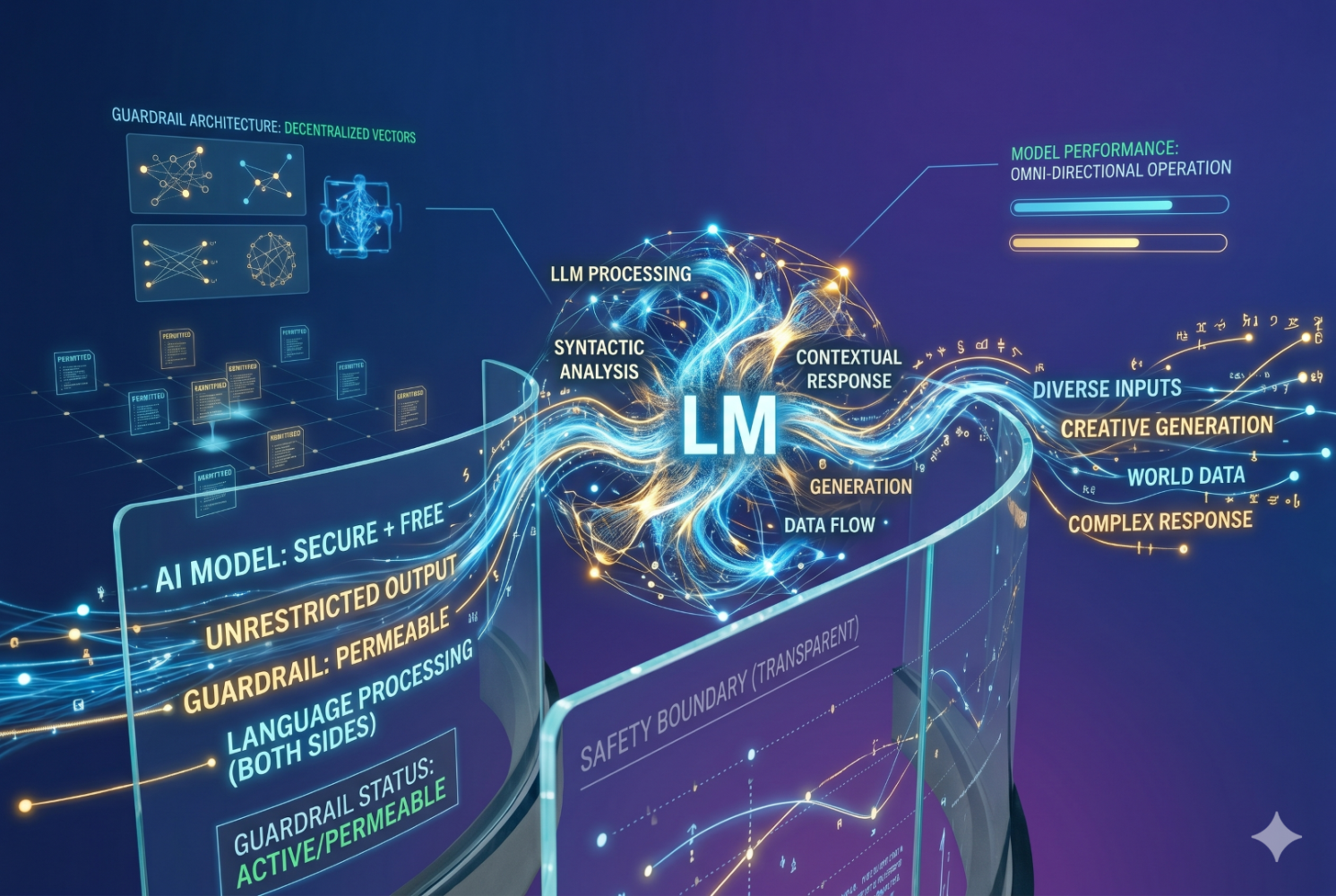
ChatGPT easily bypasses its own guardrails; all LLMs are inherently unsafe

Recent discussions surrounding artificial intelligence highlight a fundamental security flaw, noting that large language models like ChatGPT can easily bypass their own safety restrictions. This suggests that these systems are structurally unsafe. Despite developers implementing various safety filters to prevent the generation of harmful or inappropriate content, these protections remain superficial. Because language models operate by predicting the next logical word rather than genuinely understanding context or morality, users can manipulate them through creative prompt phrasing. For instance, by framing a harmful request as a hypothetical scenario, a roleplaying game, or an academic exercise, users can trick the system into ignoring its core safety directives. This vulnerability is not unique to a single company but represents an inherent characteristic of the underlying technology across all major models. Consequently, trying to build perfect defenses around these systems is an endless game of catching up. Every time a developer patches a specific vulnerability, users simply find a new way to phrase their requests to slip past the updated filters. This reality forces organizations to reconsider how they deploy artificial intelligence in sensitive environments. Instead of relying blindly on built-in software restrictions, companies must acknowledge the inherent risks and implement broader security strategies that do not depend solely on the technology to police itself.


Design Patterns Are Dead. Long Live Design Patterns.

In the era of AI-generated code, traditional software design patterns are not obsolete, but their fundamental purpose has shifted. Originally, design patterns existed to help developers manage their mental workload, creating a shared vocabulary to communicate complex logic and make code readable for other people. Compilers and machines never needed them. When AI began writing the majority of code, these human-centered structures initially seemed unnecessary. However, large language models have their own limitations, most notably memory constraints, where their reliability drops significantly as tasks become larger and more complex. Consequently, design patterns have found a new role as essential boundaries for these tools. Instead of serving as instruction manuals for human developers, patterns now function as strict structural rules that guide unpredictable AI outputs into stable, predictable systems. While older patterns that merely saved keystrokes or patched language gaps have faded, structural patterns like adapters, decorators, and facades are now critical. They act as safety checkpoints that filter, validate, and organize untrusted AI code before it reaches production environments. Ultimately, the core philosophy of managing complexity and drawing clear boundaries remains completely intact. Design patterns have simply evolved from a tool used to guide human engineers into a mechanism for governing and securing machine-generated software.


Adaptive AI and the Shift from Pilots to Enterprise Impact

Many companies are realizing that running small artificial intelligence experiments is vastly different from using AI to drive real business results. The article explores how organizations can successfully move beyond isolated pilot projects to achieve widespread impact using adaptive AI. Unlike static models that require manual updates when conditions change, adaptive systems continuously learn and adjust their behavior based on new data and shifting environments. This flexibility makes them highly valuable, but scaling them across an entire enterprise presents significant hurdles. To make this transition, businesses need to stop treating AI as an isolated technical novelty and start integrating it deeply into their core operations. This requires a strong foundation of reliable data, clear guidelines to ensure the systems remain accurate, and a shift in company culture to encourage collaboration between technical teams and everyday workers. Furthermore, organizations must build flexible infrastructures that allow these models to update seamlessly without disrupting daily work. When companies focus on solving practical problems rather than just testing new technology, they can finally realize the full value of their investments. Ultimately, the shift to enterprise-scale AI is less about having the most advanced algorithms and more about building sustainable, trustworthy systems that actively adapt to real-world business needs over time.


The Impact of the Sovereignty Gap in Enterprise Architecture

For years, technology leaders assumed cloud infrastructure was a solved problem, relying on large providers to manage data capacity and location. However, recent power outages and regional network failures have exposed a serious flaw in this thinking. The central issue is no longer simply whether data is available or stored within a specific country, but whether an organization actually has the authority to move and recover its data under its own control. This concept, known as data sovereignty, is becoming necessary due to three main factors: increasingly complex global data protection laws, unpredictable geopolitical events, and the rapid rise of artificial intelligence, which requires strict control over sensitive training records. This shift heavily impacts essential business systems like finance, payroll, and supply chain management. Many companies discover too late that their disaster recovery plans accidentally violate international regulations or that their data is heavily locked inside one proprietary system. To address these structural vulnerabilities, organizations must prioritize true portability. This means separating software applications from the underlying data, keeping backups within the required legal jurisdiction, and demanding that vendors prove their systems can be rapidly redeployed elsewhere. Ultimately, data sovereignty is no longer just a legal compliance checkbox; it is a fundamental operational requirement for keeping essential business systems resilient and secure.


Cyber incident recovery out of step

Many businesses find that their cyber incident recovery plans are out of step with the rapid evolution of modern threats and complex IT environments. A common misstep is relying on outdated assumptions, such as believing that cloud providers or managed IT services automatically handle all data backups and continuity efforts. Under the shared responsibility model, organizations remain fundamentally accountable for their own data protection, access controls, and recovery procedures. When companies fail to regularly test their disaster recovery strategies or update them to reflect current operational realities, these plans quickly lose their effectiveness. Simply having a backup is not enough if the process to restore it has never been validated under pressure. An untested plan often leads to prolonged downtime, operational bottlenecks, and increased financial loss during an actual crisis. To bring recovery efforts back into alignment, businesses must take ownership of their resilience. This means moving beyond theoretical checklists to establish practical, well-documented protocols. Organizations should focus on cross-training staff, maintaining offline or independent backups, and conducting routine scenario testing. By clearly understanding which critical systems drive their operations and proactively identifying potential single points of failure, companies can ensure their recovery capabilities match their real-world risk, allowing them to bounce back safely when an incident occurs.


Nine in Ten Enterprises Plan Cloud Data Repatriation amid Rising Cloud Costs and Data Sovereignty Mandates

For years, moving computing tasks to the cloud was seen as a permanent change, but a recent survey reveals that organizations are increasingly bringing their information back to their own physical servers. Research shows that nearly 90 percent of companies plan to significantly expand their local server presence over the next two years, and 75 percent have already started returning data from remote public systems. This reversal is primarily driven by strict data ownership rules, rising costs, and the heavy demands of modern artificial intelligence. While the cloud remains popular, organizations are quickly realizing that it is not always the best fit for everything. More than 80 percent of companies currently exceed their storage budgets, struggling with unexpected fees for moving data and premium charges for keeping information in legally required geographic regions. Furthermore, the rapid adoption of artificial intelligence is accelerating this shift. Many companies find that public platforms cannot meet the fast response times required for complex computing, and strict privacy rules often prevent them from sending sensitive training information to external servers. Ultimately, businesses are adopting a much more practical approach, choosing to keep sensitive, high volume, and computationally heavy tasks on their own equipment to maintain better control over their budgets and legal compliance.

From pilot to production: overcoming IoT’s most common roadblock

Moving an Internet of Things project from a small test phase into a full-scale rollout is notoriously difficult, with many promising initiatives stalling in what the industry commonly calls pilot purgatory. The core issue usually stems from a disconnect between the initial technology test and the broader business goals. During a pilot, teams often focus entirely on proving that the sensors and software work in a controlled environment. However, when it comes time to scale, they hit sudden roadblocks related to unexpected costs, security vulnerabilities, and the difficulty of blending new devices with older, existing computer systems. To overcome these hurdles, companies need to approach the pilot phase differently. Instead of just testing the hardware, they must plan for wide-scale integration from day one. This means defining clear financial goals early, securing buy-in from the people who will actually use the system daily, and prioritizing security as a foundational step rather than an afterthought. Furthermore, choosing flexible, open technologies rather than getting locked into a single vendor helps ensure the system can grow gracefully. Ultimately, successfully launching these connected networks requires treating the technology as a means to solve a specific human or business problem, rather than just an experiment in connecting devices.


Enterprise Architecture Soft Skills

While technical outputs like capability maps and application portfolios are foundational to enterprise architecture, they only deliver real value when they help people make better business decisions. To bridge the gap between technical models and organizational momentum, enterprise architects must cultivate strong soft skills. These interpersonal abilities allow architects to translate complex data into clear guidance for diverse stakeholders. Essential skills include business insight, which ensures recommendations directly connect to broader company goals, and financial fluency, which grounds technical choices in budget realities. Additionally, basic interpersonal awareness and the ability to balance different stakeholder groups allow architects to manage competing interests, build trust, and influence change without creating friction. Without these abilities, architecture teams risk producing overly complex diagrams and confusing analytics that fail to resonate with business leaders. To prevent this disconnect, architects need to focus on internal customer needs by designing every document to answer specific questions rather than simply mapping out systems. Adaptability further ensures that communication styles and levels of detail shift naturally depending on the audience. Ultimately, enterprise architecture functions as a practice that enables decisions, not just a modeling exercise. By developing a strategic and broad perspective, architects transition their work from static documentation to practical roadmaps that reliably guide an organization forward.


10 ways to improve safety culture in the workplace

Improving safety in the workplace requires much more than simply updating rulebooks or running occasional training sessions; it demands real, sustained changes in behavior that begin with leadership. True safety habits reveal themselves when managers are not watching and deadlines get tight. To make this happen, leaders must show genuine, visible commitment, participating in site walkarounds and treating safety goals as seriously as financial ones. Companies need to build an environment where employees feel entirely comfortable speaking up about near misses or hazards without worrying about being blamed. Moving beyond basic legal compliance is essential, meaning safety has to be woven into everyday decisions rather than treated as a paperwork chore. Daily conversations help keep risk awareness fresh for frontline workers, while focusing on practical skills instead of just tracking training attendance ensures people can actually make safe choices under pressure. It is equally important to openly acknowledge the conflict between tight deadlines and working safely, so employees do not feel forced into taking dangerous shortcuts. By tracking helpful warning signs before accidents happen, investigating incidents openly to find the root causes rather than assigning blame, and treating safety as a long-term goal, organizations can naturally build safe habits into their everyday routines.


Beyond automation: Why the surge in AI-driven security vulnerabilities demands human technical advocacy

The rapid adoption of artificial intelligence for finding security flaws has triggered a massive increase in vulnerability disclosures. Tools like Anthropic’s Mythos model are now discovering thousands of critical issues in just weeks, identifying what used to take security researchers a full year. While finding more bugs sounds positive, this AI-driven surge has severely disrupted responsible disclosure processes. Details about critical vulnerabilities, such as "Copy Fail" and "Dirty Frag," are often leaked before software vendors have time to develop patches, leaving companies highly exposed. Consequently, the traditional strategy of trying to patch every single reported flaw is no longer practical or sustainable. Organizations are quickly overwhelmed by the sheer volume of alerts. To navigate this new reality, companies must move beyond automation and rely on human expertise to evaluate true risk. Instead of blindly applying patches that might break legacy systems, organizations need human judgment to analyze which vulnerabilities actually pose a genuine threat to their specific environments. This is why dedicated technical account managers are becoming essential. Security experts help filter out the noise, recommend practical layered defenses, and provide the calm, strategic guidance that automated tools simply cannot offer. Ultimately, while AI excels at finding potential flaws, protecting an organization still requires human insight to separate real dangers from theoretical hype.