Daily Tech Digest - February 25, 2026


Quote for the day:

"To strongly disagree with someone, and yet engage with them with respect, grace, humility and honesty, is a superpower" -- Vala Afshar


Is ‘sovereign cloud’ finally becoming something teams can deploy – not just discuss?

Historically, sovereign cloud discussions in Europe have been driven primarily by risk mitigation. Data residency, legal jurisdiction, and protection from international legislation have dominated the narrative. These concerns are valid, but they have framed sovereign cloud largely as a defensive measure – a way to reduce exposure – rather than as an enabler of innovation or value creation. Without a clear value proposition beyond compliance, sovereign cloud has struggled to compete with hyperscale public cloud platforms that offer scale, maturity, and rich developer ecosystems. The absence of enforceable regulation has further compounded this. ... Policymakers and enterprises are also beginning to ask a more practical question: where does sovereign cloud actually create the most value? The answer increasingly points to innovation ecosystems, critical national capabilities, and trust. First, there is a growing recognition that sovereign cloud can underpin domestic innovation, particularly in areas such as AI, advanced research, and data-intensive start-ups. Organisations working with sensitive datasets, intellectual property, or public funding often require cloud environments that are both scalable and secure. ... Second, the sovereign cloud is increasingly being aligned with critical digital infrastructure. Sectors like healthcare, energy, transportation, and defence depend on continuity, accountability, and control. 


India’s DPDP rules 2025: Why access controls are priority one for CIOs

The security stack has traditionally broken down at the point of data rendering or exfiltration. Firewalls and encryption protect the data in transit and at rest, but once the data is rendered on a screen, the risk of data breaches from smartphone cameras, screenshots, or unauthorized sharing occurs outside of the security stack’s ability to protect it. ... Poor enterprise access practices amplify this risk. Over-provisioned user accounts, inconsistent multi-factor authentication, poor logging, and the absence of contextual checks make it easy for insider threats, credential compromise, and supply chain breaches to succeed. Under DPDP, accountability also extends to processors, so third-party CRM or cloud access must meet the same security standards. ... Shift from trust by implication to trust by verification. Implement least-privilege access to ensure users view only required apps and data. Add device posture with device binding, location, time, watermarking and behavior analysis to deny suspicious access. ... Implement identity infrastructure for just-in-time access and automated de-Provisioning based on role changes. Record fine-grained, immutable logs (user, device, resource, date/time) for breach analysis and annual retention. ... Enable dynamic, user-level watermarks (injecting username, IP address, timestamp) for forensic analysis. Prohibit unauthorized screen capture, sharing, or download activity during sensitive sessions, while permitting approved business processes.


What really caused that AWS outage in December?

The back-story was broken by the Financial Times, which reported the 13-hour outage was caused by a Kiro agentic coding system that decided to improve operations by deleting and then recreating a key environment. AWS on Friday shot back to flag what it dubbed “inaccuracies” in the FT story. “The brief service interruption they reported on was the result of user error — specifically misconfigured access controls — not AI as the story claims,” AWS said. ... “The issue stemmed from a misconfigured role — the same issue that could occur with any developer tool (AI powered or not) or manual action.” That’s an impressively narrow interpretation of what happened. AWS then promised it won’t do it again. ... The key detail missing — which AWS would not clarify — is just what was asked and how the engineer replied. Had the engineer been asked by Kiro “I would like to delete and then recreate this environment. May I proceed?” and the engineer replied, “By all means. Please do so,” that would have been user error. But that seems highly unlikely. The more likely scenario is that the system asked something along the lines of “Do you want me to clean up and make this environment more efficient and faster?” Did the engineer say “Sure” or did the engineer respond, “Please list every single change you are proposing along with the likely result and the worst-case scenario result. Once I review that list, I will be able to make a decision.”


Model Inversion Attacks: Growing AI Business Risk
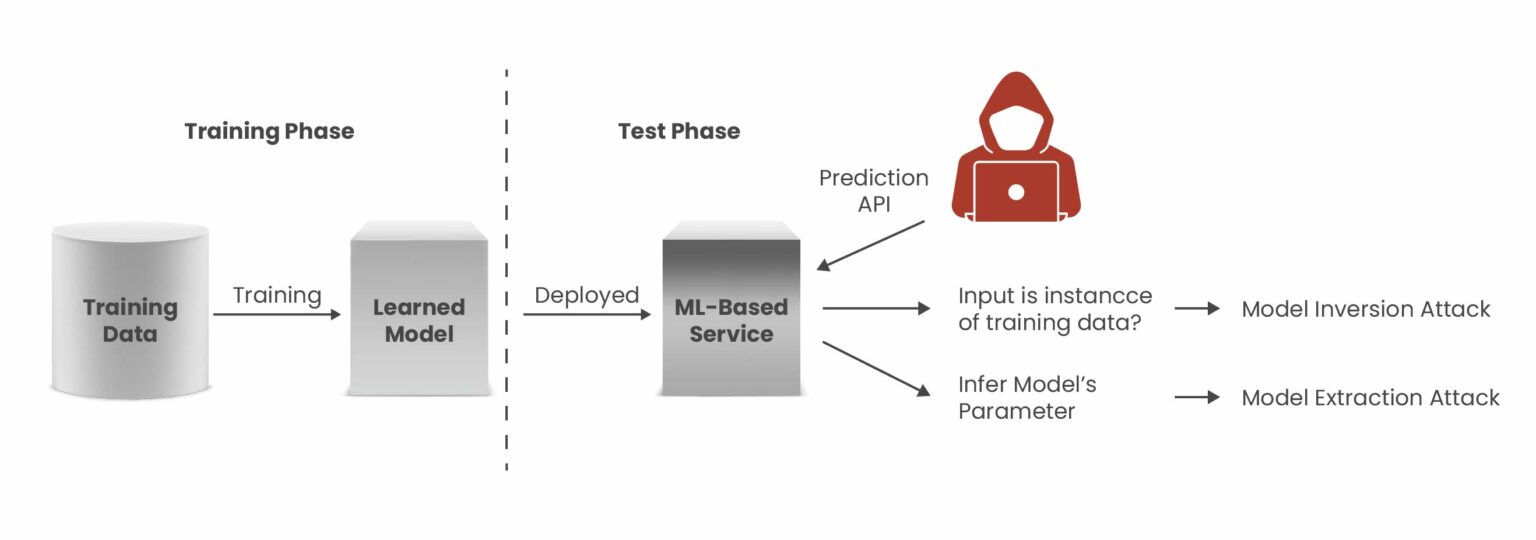
A model inversion attack is a form of privacy attack against machine learning systems in which an adversary uses the outputs of a model to infer sensitive information about the data used to train it. Rather than breaching a database or stealing credentials, attackers observe how a model responds to input queries and leverage those outputs, often including confidence scores or probability values, to reconstruct aspects of the training data that should remain private. ... This type of attack differs fundamentally from other ML attacks, such as membership inference, which aims to determine whether a specific data point was part of the training set, and model extraction, which seeks to copy the model itself. ... Successful model inversion attacks can inflict significant damage across multiple areas of a business. When attackers extract sensitive training data from machine learning models, organizations face not only immediate financial losses but also lasting reputational harm and operational setbacks that continue well beyond the initial incident. ... Attackers target inference-time privacy by moving through multiple stages, submitting carefully crafted queries, studying the model’s responses, and gradually reconstructing sensitive attributes from the outputs. Because these activities can resemble normal usage patterns, such attacks frequently remain undetected when monitoring systems are not specifically tuned to identify machine learning–related security threats.


It’s time to rethink CISO reporting lines

The age-old problem with CISOs reporting into CIOs is that it could present — or at least appear to present — a conflict of interest. Cybersecurity consultant Brian Levine, a former federal prosecutor who serves as executive director of FormerGov, says that concern is even more warranted today. “It’s the legacy model: Treat security as a technical function instead of an enterprise‑wide risk discipline,” he says. ... Enterprise CISOs should be reporting a notch higher, Levine argues. “Ideally, the CISO would report to the CEO or the general counsel, high-level roles explicitly accountable for enterprise risk. Security is fundamentally a risk and governance function, not a cost‑center function,” Levine points out. “When the CISO has independence and a direct line to the top, organizations make clearer decisions about risk, not just cheaper ones." ... Painter is “less dogmatic about where the CISO reports and more focused on whether they actually have a seat at the table,” he says. “Org charts matter far less than influence,” he adds. “Whether the CISO reports to the CIO, the CEO, or someone else, the real question is this: Are they brought in early, listened to, and empowered to shape how the business operates? When that’s true, the structure works. When it’s not, no reporting line will save it.” ... “When the CISO reports to the CIO, risk can be filtered, prioritized out of sight, or reshaped to fit a delivery narrative. It’s not about bad actors. It’s about role tension. And when that tension exists within the same reporting line, risk loses.”


AI drives cyber budgets yet remains first on the chop list

Cybersecurity budgets are rising sharply across large organisations, but a new multinational survey points to a widening gap between spending on artificial intelligence and the ability to justify that spending in business terms. ... "Security leaders are getting mandates to invest in AI, but nobody's given them a way to prove it's working. You can't measure AI transformation with pre-AI metrics," Wilson said. He added that security teams struggle to translate operational data into board-level evidence of reduced risk. "The problem isn't that security teams lack data. They're drowning in it. The issue is they're tracking the wrong things and speaking a language the board doesn't understand. Those are the budgets that get cut first. The window to fix this is closing fast," Wilson said. ... "We need new ways to measure security effectiveness that actually show business impact, because boards don't fund faster ticket closure, they fund measurable risk reduction and business resilience. We have to show that we're not just responding quickly but eliminating and improving the conditions that allow incidents to happen in the first place," he said. ... Security leaders reported pressure to invest in AI, while also struggling to link those investments to outcomes executives recognise as resilience and risk reduction. The report argues this tension may become harder to sustain if economic conditions tighten and boards begin looking for costs to cut.


A cloud-smart strategy for modernizing mission-critical workloads

As enterprises mature in their cloud journeys, many CIOs and senior technology leaders are discovering that modernization is not about where workloads run — it’s about how deliberately they are designed. This realization is driving a shift from cloud-first to cloud-smart, particularly for systems the business cannot afford to lose. A cloud-smart strategy, as highlighted by the Federal Cloud Computing Strategy, encourages agencies to weigh the long-term, total costs of ownership and security risks rather than focusing only on immediate migration. ... Sticking indefinitely with legacy systems can lead to rising maintenance costs, inability to support new business initiatives, security vulnerabilities and even outages as old hardware fails. Many organizations reach a tipping point where they must modernize to stay competitive. The key is to do it wisely — balancing speed and risk and having a solid strategy in place to navigate the complexity. ... A cloud-smart strategy aligns workload placement with business risk, performance needs and regulatory expectations rather than ideology. Instead of asking whether a system can move to the cloud, cloud-smart organizations ask where it performs best. ... Rather than lifting and shifting entire platforms, teams separate core transaction engines from decisioning, orchestration and experience layers. APIs and event-driven integration enable new capabilities around stable cores, allowing systems to evolve incrementally without jeopardizing operational continuity.


Enterprises still can't get a handle on software security debt – and it’s only going to get worse

Four-in-five organizations are drowning in software security debt, new research shows, and the backlog is only getting worse. ... "The speed of software development has skyrocketed, meaning the pace of flaw creation is outstripping the current capacity for remediation,” said Chris Wysopal, chief security evangelist at Veracode. “Despite marginal gains in fix rates, security debt is becoming a much larger issue for many organizations." Organizations are discovering more vulnerabilities as their testing programs mature and expand. Meanwhile, the accelerating pace of software releases creates a continuous stream of new code before existing vulnerabilities can be addressed. ... "Now that AI has taken software development velocity to an unprecedented level, enterprises must ensure they’re making deliberate, intelligent choices to stem the tide of flaws and minimize their risk," said Wysopal. The rise in flaws classed as both “severe” and “highly exploitable” means organizations need to shift from generic severity scoring to prioritization based on real-world attack potential, advised Veracode. As such, researchers called for a shift from simple detection toward a more strategic framework of Prioritize, Protect, and Prove. ... “We are at an inflection point where running faster on the treadmill of vulnerability management is no longer a viable strategy. Success requires a deliberate shift,” said Wysopal.


Protecting your users from the 2026 wave of AI phishing kits

To protect your users today, you have to move past the idea of reactive filtering and embrace identity-centric security. This means your software needs to be smart enough to validate that a user is who they say they are, regardless of the credentials they provide. We’re seeing a massive shift toward behavioral analytics. Instead of just checking a password, your platform should be looking at communication patterns and login behaviors. If a user who typically logs in from Chicago suddenly tries to authorize a high-value financial transfer from a new device in a different country, your system should do more than just send a push notification. ... Beyond the tech, you need to think about the “human” friction you’re creating. We often prioritize convenience over security, but in the current climate, that’s a losing bet. Implementing “probabilistic approval workflows” can help. For example, if your system’s AI is 95% sure a login is legitimate, let it through. If that confidence drops, trigger a more rigorous verification step. ... The phishing scams of 2026 are successful because they leverage the same tools we use for productivity. To counter them, we have to be just as innovative. By building identity validation and phishing-resistant protocols into the core of your product, you’re doing more than just securing data. You’re securing the trust that your business is built on. 


GitOps Implementation at Enterprise Scale — Moving Beyond Traditional CI/CD

Most engineering organizations running traditional CI/CD pipelines eventually hit the ceiling. Deployments work until they don’t, and when they break, the fixes are manual, inconsistent and hard to trace. ... We kept Jenkins and GitHub Actions in the stack for build and test stages where they already worked well. Harness remained an option for teams requiring more sophisticated approval workflows and governance controls. We ruled out purely script-based push deployment approaches because they offered poor drift control and scaled badly. ... Organizational resistance proved more challenging to address than the technical work. Teams feared the new approach would introduce additional bureaucracy. Engineers accustomed to quick kubectl fixes worried about losing agility. We ran hands-on workshops demonstrating that GitOps actually produced faster deployments, easier rollbacks and better visibility into what was running where. We created golden templates for common deployment patterns, so teams did not have to start from scratch. ... Unexpected benefits emerged after full adoption. Onboarding improved as deployment knowledge now lived in Git history and manifests rather than in senior engineers’ heads. Incident response accelerated because traceability let teams pinpoint exactly what changed and when, and rollback became a consistent, reliable operation. The shift from push-based to pull-based operations improved security posture by limiting direct cluster access.

Daily Tech Digest - February 24, 2026


Quote for the day:

"Transparent reviews create fairness. Subjective reviews create frustration." -- Gordon Tredgold


AI agents and bad productivity metrics

The great promise of generative artificial intelligence was that it would finally clear our backlogs. Coding agents would churn out boilerplate at superhuman speeds, and teams would finally ship exactly what the business wants. The reality, as we settle into 2026, is far more uncomfortable. Artificial intelligence is not going to save developer productivity because writing code was never the bottleneck in software engineering. ... For decades, one of the most common debugging techniques was entirely social. A production alert goes off. You look at the version control history, find the person who wrote the code, ask them what they were trying to accomplish, and reconstruct the architectural intent. But what happens to that workflow when no one actually wrote the code? What happens when a human merely skimmed a 3,000-line agent-generated pull request, hit merge, and moved on to the next ticket? When an incident happens, where is the deep knowledge that used to live inside the author? ... The metrics that matter are still the boring ones because they measure actual business outcomes. The DORA metrics remain the best sanity check we have because they tie delivery speed directly to system stability. They measure deployment frequency, lead time for changes, change failure rate, and time to restore service. None of those metrics cares about the number of commits your agents produced today. They only care about whether your system can absorb change without breaking.


How vertical SaaS is redefining enterprise efficiency

For the past decade, horizontal SaaS has been the defining force in enterprise technology. Platforms like CRMs, ERP suites and collaboration tools promised universality, offering a single platform to manage every business function across all industries. The strategy made sense: a large total addressable market, reusable architecture and marketing scale. Vertical SaaS flips that model. It is narrow by design but deep in impact. A report by Strategy& found that B2B vertical software companies are now growing faster than their horizontal peers, thanks to higher retention rates, lower churn rates and better unit economics. When software mirrors how a business already works, people stop treating it like a tool they tolerate and start relying on it like infrastructure. ... In regulated industries, compliance isn’t a feature; it’s the baseline for trust. I learned early that trying to retrofit audit trails or data retention policies after go-live only creates technical debt. Instead, design for compliance as a first-class product layer: immutable logs, permission hierarchies and exportable compliance reports built into the system. ... Vertical products don’t thrive in isolation. Integration with industry hardware, marketplaces and regulatory systems drives adoption. In one case, we partnered with a hardware vendor to automatically sync manifest data from their devices, cutting onboarding time in half and unlocking co-marketing opportunities.


API Security Standards: 10 Essentials to Get You Started

Most API security flaws are created during the design phase. You're too late if you're waiting until deployment to think about threats. Shift-left principles mean integrating security early, especially at the design phase, where flawed assumptions become future exploits. Start by mapping out each endpoint's purpose, what data it touches, and who should access it. Identify where trust is assumed (not earned), roles blur, and inputs aren't validated. ... Every API has a breaking point. If you don't define it, attackers will. Rate limiting and throttling prevent denial-of-service (DoS) attacks, and they're also your first defense against scraping, brute-forcing, enumeration, and even accidental misuse by poorly built integrations. APIs, by nature, invite automation. Without guardrails, that openness turns into a floodgate. And in some cases, unchecked abuse opens the door to far worse issues, like remote code execution, where improperly scoped input or lack of throttling leads directly to exploitation. ... APIs are built to accept input. Attackers find ways to exploit it. The core rule is this - if you didn't expect it, don't process it. If you didn't define it, don't send it. Define request and response schemas explicitly using tools like OpenAPI or JSON Schema, as recommended by leading API security standards. Then enforce them — at the gateway, app layer, or both. Don't just use validation as linting; treat it as a runtime contract. If the payload doesn't match the spec, reject it.


Why AI Urgency Is Forcing a Data Governance Reset

The cost of weak governance shows up in familiar ways: teams can’t find data, requirements arrive late in the process, and launches stall when compliance realities collide with product timelines. Without governance, McQuillan argues, organizations “ultimately suffer from higher cost basis,” with downstream consequences that “impact the bottom line.” ... McQuillan sees a clear step-change in executive urgency since generative AI (GenAI) became mainstream. “There’s been a rapid adoption, particularly since the advent of GenAI and the type of generative and agentic technologies that a lot of C-suites are taking on,” he says. But he also describes a common leadership gap: many executives feel pressure to become “AI-enabled” without a clear definition of what that means or how to build it sustainably. “There’s very much a well-understood need across all companies to become AI-enabled in some way,” he says. “But the problem is a lot of folks don’t necessarily know how to define that.” In the absence of clarity, organizations often fall into scattershot experimentation. What concerns McQuillan the most is how the pace of the “race” shapes priorities. ... When asked whether the long-running mantra “data is the new oil” still holds in the era of large language models and agentic workflows, McQuillan is direct. “It holds true now more than ever,” he says. He acknowledges why attention drifts: “It’s natural for people to gravitate toward things that are shiny,” and “AI in and of itself is an absolutely magnificent space.”


Building a Least-Privilege AI Agent Gateway for Infrastructure Automation with MCP, OPA, and Ephemeral Runners

An agent misinterpreting an instruction can initiate destructive infrastructure changes, such as tearing down environments or modifying production resources. A compromised agent identity can be abused to exfiltrate secrets, create unauthorized workloads, or consume resources at scale. In practice, teams often discover these issues late, because traditional logs record what happened, but not why an agent decided to act in the first place. For organizations, this liability creates operational and governance challenges. Incidents become harder to investigate, change approvals are bypassed unintentionally, and security teams are left with incomplete audit trails. Over time, this problem erodes trust in automation itself, forcing teams to either roll back agent usage or accept increasing levels of unmanaged risk. ... A more sustainable approach is to introduce an explicit control layer between agents and the systems they operate on. In this article, we focus on an AI Agent Gateway, a dedicated boundary that validates intent, enforces policy as code, and isolates execution before any infrastructure or service API is invoked. Rather than treating agents as privileged actors, this model treats them as untrusted requesters whose actions must be authorized, constrained, observed, and contained. ... In the context of AI-driven automation, defense in depth means that no single component, neither the agent, nor the gateway, nor the execution environment, has enough authority on its own to cause damage. 


Demystifying CERT‑In’s Elemental Cyber Defense Controls: A Guide for MSMEs

For India’s Micro, Small, and Medium Enterprises (MSMEs), cybersecurity is no longer a “big company problem.” With digital payments, SaaS adoption, cloud-first operations, and supply‑chain integrations becoming the norm, MSMEs are now prime targets for cyberattacks. To help these organizations build a strong foundational security posture, the Indian Computer Emergency Response Team (CERT-In) has released CIGU-2025-0003, outlining a baseline of Cyber Defense Controls, which prescribes 15 Elemental Cyber Security Controls—a pragmatic, baseline set of safeguards designed to uplift the nation’s cyber hygiene. ... These controls, mapped to 45 recommendations, enable essential digital hygiene, protect against ransomware, ensure regulatory compliance, and are required for annual audits. CERT‑In’s Elemental Controls are designed as minimum essential practices that every Indian organization—regardless of size—should implement. ... The CERT-In guidelines offer a simplified, actionable starting point for MSMEs to benchmark their security. These controls are intentionally prescriptive, unlike ISO or NIST, which are more framework‑oriented. ... Because threats constantly evolve and MSMEs face unique risks depending on their industry and data sensitivity, organizations should view this framework not as an endpoint, but as the first critical step toward building a comprehensive security program akin to ISO 27001 or NIST CSF 2.0.


AI-fuelled cyber attacks hit in minutes, warns CrowdStrike

CrowdStrike reports a sharp acceleration in cyber intrusions, with attackers moving from initial access to lateral movement in less than half an hour on average as widely available artificial intelligence tools become embedded in criminal workflows. Its latest Global Threat Report puts average eCrime "breakout time" at 29 minutes in 2025, a 65% improvement on the prior year. ... Alongside generative AI use in preparation and execution, the report describes attempts to exploit AI systems directly. Adversaries injected malicious prompts into GenAI tools at more than 90 organisations, using them to generate commands associated with credential theft and cryptocurrency theft. ... Incidents linked to North Korea rose more than 130%, while activity by the group CrowdStrike tracks as FAMOUS CHOLLIMA more than doubled. The report says DPRK-nexus actors used AI-generated personas to scale insider operations. It also cites a large cryptocurrency theft attributed to the actor it calls PRESSURE CHOLLIMA, valued at USD $1.46 billion and described as the largest single financial heist ever reported. The report also references AI-linked tooling used by other state and criminal groups. Russia-nexus FANCY BEAR deployed LLM-enabled malware, which it named LAMEHUG, for automated reconnaissance and document collection. The eCrime actor tracked as PUNK SPIDER used AI-generated scripts to speed up credential dumping and erase forensic evidence.


Shadow mode, drift alerts and audit logs: Inside the modern audit loop

When systems moved at the speed of people, it made sense to do compliance checks every so often. But AI doesn't wait for the next review meeting. The change to an inline audit loop means audits will no longer occur just once in a while; they happen all the time. Compliance and risk management should be "baked in" to the AI lifecycle from development to production, rather than just post-deployment. This means establishing live metrics and guardrails that monitor AI behavior as it occurs and raise red flags as soon as something seems off. ... Cultural shift is equally important: Compliance teams must act less like after-the-fact auditors and more like AI co-pilots. In practice, this might mean compliance and AI engineers working together to define policy guardrails and continuously monitor key indicators. With the right tools and mindset, real-time AI governance can “nudge” and intervene early, helping teams course-correct without slowing down innovation. In fact, when done well, continuous governance builds trust rather than friction, providing shared visibility into AI operations for both builders and regulators, instead of unpleasant surprises after deployment. ... Shadow mode is a way to check compliance in real time: It ensures that the model handles inputs correctly and meets policy standards before it is fully released. One AI security framework showed how this method worked: Teams first ran AI in shadow mode, then compared AI and human inputs to determine trust. 


Making AI Compliance Practical: A Guide for Data Teams Navigating Risk, Regulation, and Reality

As AI tools become more embedded in enterprise workflows, data teams are encountering a growing reality: compliance isn’t only a legal concern but also a design constraint, a quality signal, and, often, a competitive differentiator. But navigating compliance can feel complex, especially for teams focused on building and shipping. What is the good news? It doesn’t have to be. When approached intentionally, compliance becomes a pathway to better decisions, not a barrier. ... Automation can help with regulations, but only if it's used correctly. I've looked at a tool before that used algorithms to find private information. It worked well with English, but when tested with material in more than one language, it missed a few personal identifiers. The group thought it was "smart enough." It wasn't. We kept the automation, but we added human review for rare cases, confidence levels to make checks happen, and alerts for input formats that aren't common. The automation stayed the same, but there were built-in checks and balances. ... The biggest compliance failures don’t come from bad people. They come from good teams moving fast, skipping hard questions, and assuming nothing will go wrong. But compliance isn’t a blocker. It’s a product quality signal. People will trust you more if they are aware that your team has carefully considered the details.


Tata Communications’ Andrew Winney on why SASE is now non-negotiable

Zero Trust is often discussed as a product decision, but in reality it is a journey. Many enterprises start with a few use cases, such as securing internet access or enabling remote access to private applications. But they do not always extend those principles across contractors, third-party users, software-as-a-service applications and hybrid environments. Practical Zero Trust requires enterprises to rethink access fundamentally. Every request must be evaluated based on who the user is, the context from which they are accessing, the device they are using and the resource they are requesting. Access must then be granted only to that specific resource. ... Secure Access Service Edge represents a structural convergence of networking and security rather than a simple technology swap. What are the most critical architectural and change-management considerations enterprises must address during this transition? SASE is not a one-time technology change. It represents the convergence of networking and security under unified orchestration and policy management. That transition takes time and must be managed carefully. We typically work with enterprises through phased transition plans. If an organisation’s immediate priority is securing internet access or private application access for remote users, we begin there and expand to additional use cases over time. Integration is critical. Enterprises have existing investments in cloud platforms, local area networks and security tools. 

Daily Tech Digest - February 23, 2026


Quote for the day:

"Prepare, work smarter, Learn from your Mistakes. These are the secret to success!" -- Elizabeth McCormick


What’s wrong (and right) with AI coding agents

“At the scale AI is generating pull requests today, humans simply can’t keep up. You don’t check the accuracy of Excel with an abacus… and in 2026 we shouldn’t expect maintainers to manually inspect machine-speed code without machine-speed assistance,” said Fox. “AI reviews can go deeper than humans in many cases. They don’t get tired, they can reason across large codebases… and they can spot patterns at a scale no individual reviewer can hold in their head. If AI is generating more code, the only viable answer is to use AI to help review and validate it. You have to fight fire with fire.” ... He reminds us that quantity does not always equal quality – especially in the AI-driven world we now live in. He notes that, at least for now, the reality is that AI development tools and ‘vibe coding’ can generate a lot of code very quickly, but code that’s often slower and more memory‑hungry than what a skilled developer would write. ... Although this entire discussion is focused on the now-increasingly-automated command line, it feels like the real focus should be higher and architecture has been mentioned already. “We’re entering a world where, with AI, software changes are propagating faster than governance models can track them. That means AI tools are, plain and simple, accelerating systemic complexity. When an AI agent can generate and deploy changes across interconnected enterprise systems, there’s real danger in the invisible dependencies and downstream effects most orgs can’t fully see,” said Ido Gaver


Identity verification systems are struggling with synthetic fraud

The researchers tied the growth of synthetic identity fraud to the increasing use of AI tools, which can generate convincing fake documents that pass casual inspection. “The biggest risk I see in the next 12 to 18 months is the growing and advancing use of AI. AI is creating fake people, fake voices, and fake documents. Bad actors are using these capabilities to open accounts, take over existing accounts, and impersonate real people in places like bank branches,” Lewis said. ... Financial institutions remain a major target for identity fraud due to access to credit, account funding, and cash movement. A successful fraudster can monetize a single fake or synthetic identity for tens of thousands of dollars before detection, making the sector a frequent target. Online-only retail banks recorded the highest rate of failed identity verification among the financial institution categories in Intellicheck’s dataset. The report also found elevated failure rates across businesses serving underbanked consumers, including check cashing, payday lending, subprime lending, and lease-to-own services. ... AI tools are being used to produce synthetic IDs that are difficult for humans to spot. Lewis said attackers are already using AI and large language models to generate documents that can bypass basic checks. “AI and LLM can create fake ID’s that can easily pass the templating test, old methods don’t work and ID verification service providers can’t rest on their laurels,” Lewis said. 


Neoclouds: Meeting demand for AI acceleration

This surge in demand for AI acceleration has seen a surprising benefactor. According to Tiger Research, cryptocurrency mining firms, seeking to reduce their exposure to bitcoin’s volatile pricing, are redirecting their graphics processing unit (GPU) farms toward AI acceleration applications. ... Before the emergence of neoclouds a few years ago, if an organisation wanted to work with AI, it had no choice but to go to a hyperscaler like Amazon Web Services (AWS) or Google. While the hyperscalers offer AI infrastructure as part of their vast public cloud services portfolio, Roy Illsley, chief analyst at Omdia, says the hyperscalers tend to be expensive and, as he recalls, a few years ago, there was very little choice other than Google’s AI offerings. ... AI infrastructure strategies are becoming inherently hybrid and multicloud by design – not as a by-product of supplier sprawl, but as a deliberate response to workload reality. The cloud market is fragmenting along functional lines, and neoclouds occupy a clear and growing role within that landscape. “Neoclouds started as GPU as a service. If you needed GPUs, these companies bought or leased GPUs from Nvidia, and then they would slice them and sell them off to people in smaller groups and bundles,” says Omdia’s Illsley. However, over time, neocloud providers have added software stacks and developed other services to meet the demand of IT buyers who need GPU power and the software stack required for AI training or AI inferencing.


Sam Altman just said what everyone is thinking about AI layoffs

This isn’t the first time industry stakeholders questioned the veracity of AI-related layoffs. A study by Oxford Economics in January this year claimed most layoffs are due to “more traditional drivers” such as overhiring or poor financial performance. ... "While a rising number of firms are pinning job losses on AI, other more traditional drivers of job layoffs are far more commonly cited,” the report said. “What's more, we suspect some firms are trying to dress up layoffs as a good news story rather than bad news, such as past over-hiring." ... “There’s some real displacement by AI of different kinds of jobs,” he said. “We’ll find new kinds of jobs as we do with every tech revolution. I would expect that the real impact of AI doing jobs in the next few years will begin to be palpable.” Altman’s prediction here aligns with research from Gartner and Forrester on the potential impact of AI on the global jobs market. In January, Forrester predicted 10 million jobs could be lost worldwide as enterprise adoption ramps up. ... Despite a string of studies pointing to the contrary, some tech industry figures still believe that AI will eventually render some workers obsolete. In a recent interview with the Financial Times, for example, Microsoft AI CEO Mustafa Suleyman insisted AI will begin replacing “white collar” workers within 18 months. “I think we’re going to have a human-level performance on most if not all professional tasks,” Suleyman told


Jailbreaking the matrix: How researchers are bypassing AI guardrails to make them safer

As AI assistants move from novelty to infrastructure, helping write code, summarizing medical notes and answering customer questions, the biggest question isn't just what these systems can do, but what happens when they are pushed to do what they shouldn't. "By showing exactly how these defenses break, we give AI developers the information they need to build defenses that actually hold up," Jha said. "The public release of powerful AI is only sustainable if the safety measures can withstand real scrutiny, and right now, our work shows that there's still a gap. We want to help close it." ... Focusing on the internal workings of the LLM allows more accurate measurements of failures while encouraging the development of more robust defenses against the failure of safety measures. According to the researchers, HMNS can help reveal whether specific internal pathways, if exploited, could cause a breakdown. That information can guide stronger training, monitoring and defense strategies. ... Understanding the security shortcomings of LLMs is critical as they become more widespread. Companies like Meta, Alibaba and others have released powerful AI models that are available to anyone. While each platform incorporates safety layers meant to keep it from being misused, the UF team has found that those safety layers can be systematically bypassed.


Plan vs. planning: Why continuous planning must traverse time

The problem is not the plan’s quality. The problem is that a plan freezes a moment in time while the organization continues to move through time. Planning, by contrast, must be a continuous discipline, remaining active as assumptions decay, signals emerge and constraints shift. ... Planning exists to test those assumptions continuously, a distinction long recognized in leadership and management literature that separates planning as an ongoing discipline from planning as a static artifact. Plans are optimized for agreement and commitment. Planning is optimized for learning, decision-making and managing consequences in the face of uncertainty. In practice, this means consequences must be visible at the moment of decision, not discovered months later through execution. ... Many enterprises optimize for compliance, predictability and approval at the expense of feedback and adaptation. Learning is pushed downstream, arriving only after outcomes are locked in and costs incurred. Systems theorist Russell Ackoff described this dynamic clearly: “Most organizations are not short of information. They are short of the ability to learn from it.” Continuous planning restores learning by design, not as postmortem analysis, but as pre-decision feedback. Feedback that arrives before commitment changes behavior. Feedback that arrives after execution becomes an explanation. In volatile environments, that timing difference is decisive, which is why scenario planning and structured foresight have re-emerged as critical executive tools.


The rise of AI factories: Powering an era of pervasive intelligence

In India alone, Google is building a gigawatt-scale AI hub in Visakhapatnam. Microsoft is expanding its cloud and AI footprint in Pune and Chennai and creating a new “India South Central” region in Hyderabad. In partnership with NVIDIA, Reliance Jio is developing a major AI data center in Jamnagar for nationwide GPU-as-a-service offerings. TCS is planning a 1-gigawatt AI data center, likely in Gujarat or Maharashtra, to support startups, hyperscalers, and government institutions. And as part of its Stargate project, OpenAI is actively scouting locations in India for what could become one of the largest AI data centers in all of Asia. ... The growth of AI represents a fundamental transformation in how the world builds and operates computing infrastructure. While traditional data centers are designed for general-purpose workloads, AI superclusters are purpose-built facilities that function as industrial-scale intelligence production systems. And their output is defined by new metrics — most notably tokens per watt and tokens per dollar — that quantify the efficiency and productivity of intelligence at scale. ... To deliver the performance at scale that AI requires, silicon designers are increasingly turning to multi-die designs, including 3D integrated circuits (3DIC) and chiplet-based architectures. While these chip designs offer gains that traditional monolithic SoCs cannot achieve cost-effectively, they also introduce significant complexity to the design process.


Cognizant CAIO Babak Hodjat explains how Agentic AI will transform enterprises

One of the things that agentic systems do is they allow for a diversity of data sources because you can actually have an agent responsible for a data source talking to other agents responsible for other data sources. Your interface into this system could be a consolidation of information and decisions that come from these disparate sources. It is the first time that we can actually have a mapping between intent and disparate sources of data and applications. I think that will work well. That kind of design can work well in a country like India with such diversity of data. ... Population-based approaches like genetic algorithms are very good at non-linear optimisation, especially if you are looking at multiple outcomes at the same time. Pretty much every problem that we look at is multi-objective. Every problem that we look at has improved revenue but reduced costs. You look at curing disease but reduce impact on the economy. It is always more than one outcome that we are looking at. In problems like optimisation of power grids or managing urban traffic systems, these are very well-suited algorithms. ... There are two opposing forces when it comes to AI. Scaling laws mean that building bigger is more powerful, and building bigger typically means using more energy. Many companies are looking at green sources for that additional consumption. On the other hand, companies are optimising models to be smaller and less energy-hungry. For multi-agent systems, smaller models can be more cost-effective and greener.


Inference Becomes the Next AI Chip Battleground

Inference has fundamentally different economics and performance requirements than training, said Karl Freund, founder and principal analyst at Cambrian AI Research. Training AI models is a cost center, while inference is a “profit center” that directly generates revenue. Freund and Kimball noted that while GPUs deliver excellent performance, they often carry architectural features optimized for training that don’t always translate to lower latency or higher efficiency in pure inference use cases. Purpose-built inference chips – ASICs and other accelerators – can deliver faster responses, improved energy efficiency, and lower total cost of ownership. ... "As inference workloads exceed the total amount of training workloads in terms of token output, there will be a greater need for diversity because alternative XPU architectures can achieve better efficiency on some specific inferencing tasks,” said Brendan Burke, research director of semiconductors, supply chain, and emerging tech at Futurum Group. ... Inference opportunities span data centers and the edge, and requirements vary widely by workload and deployment. “The inference you do in your autonomous vehicle is far different than the inferencing you do when you’re an online customer service bot,” Kimball said. ... Analysts expect Nvidia to maintain dominance in both training and inference, but diverse requirements create space for specialized solutions to capture share. 


Why the CFO's Playbook Belongs on Every CIO's Desk

Recent research from Gartner on how CFOs are allocating budgets gives CIOs insight into what priorities look like across departments, and where technology and AI can help move the needle. The research firm's CFO Report: Q1 2026 finds that while budgets are shifting and AI ambitions are high, enterprise-wide AI success remains an aspiration rather than a reality. ... AI is also changing the conversation on ROI for both finance and technology leaders. "There's a lot more to evaluating the success of some of this investment in technology than simply just ROI, and AI is definitely helping change that," Abbasi said. "AI isn't your traditional asset." Unlike standard hardware expenditures, AI investments don't have predictable depreciation curves, and the ways in which returns on AI investment may show up across the business can vary. They may manifest in time to market, customer satisfaction or competitive positioning, not just in cost savings, Abbasi said. CIOs should be sure to articulate how AI will generate strategic returns rather than focus on pitching it as a capital project. "It changes the way you measure the effectiveness of AI, as well as how you measure your business more holistically," he said. "It's not like a traditional asset because you don't necessarily know what the outcomes are going to be for some of these AI projects."

Daily Tech Digest - February 22, 2026


Quote for the day:

"If you care enough for a result, you will most certainly attain it." -- William James


The data center gold rush is warping reality

The real impact isn’t people—it’s power, land, transmission capacity, and water. When you drop 10 massive facilities into a small grid, demand spikes don’t just happen inside the fence line. They ripple outward. Utilities must upgrade substations, reinforce transmission lines, procure new-generation equipment, and finance these investments. ... Here’s the part we don’t say out loud often enough: High-tech companies are spending massive amounts of money on data centers because the market rewards them for doing so. Capital expenditures have become a kind of corporate signaling mechanism. On earnings calls, “We’re investing aggressively” has become synonymous with “We’re winning,” even when the investment is built on forecasts that are, at best, optimistic and, at worst, indistinguishable from wishful thinking. ... The bet is straightforward: When demand spikes, prices and utilization rise, and those who built first make bank. Build the capacity, fill the capacity, charge a premium for the scarce resource, and ride the next decade of digital expansion. It’s the same playbook we’ve seen before in other infrastructure booms, except this time the infrastructure is made of silicon and electrons, and the pitch is wrapped in the language of transformation. ... Then there’s the cost reality. AI systems, especially those that deliver meaningful, production-grade outcomes, often cost five to ten times as much as traditional systems once you account for compute, data movement, storage, tools, and the people required to run them responsibly.


Chip-processing method could assist cryptography schemes to keep data secure

Just like each person has unique fingerprints, every CMOS chip has a distinctive “fingerprint” caused by tiny, random manufacturing variations. Engineers can leverage this unforgeable ID for authentication, to safeguard a device from attackers trying to steal private data. But these cryptographic schemes typically require secret information about a chip’s fingerprint to be stored on a third-party server. This creates security vulnerabilities and requires additional memory and computation. ... “The biggest advantage of this security method is that we don’t need to store any information. All the secrets will always remain safe inside the silicon. This can give a higher level of security. As long as you have this digital key, you can always unlock the door,” says Eunseok Lee, an electrical engineering and computer science (EECS) graduate student and lead author of a paper on this security method. ... A chip’s PUF can be used to provide security just like the human fingerprint identification system on a laptop or door panel. For authentication, a server sends a request to the device, which responds with a secret key based on its unique physical structure. If the key matches an expected value, the server authenticates the device. But the PUF authentication data must be registered and stored in a server for access later, creating a potential security vulnerability.


What MCP Can and Cannot Do for Project Managers Today

The most mature MCPs for PM are official connectors from the platforms themselves. Atlassian’s Rovo MCP Server connects Jira and Confluence, generally available since late 2025. Wrike has its own MCP server for real-time work management. Dart exposes task creation, updates, and querying through MCP. ClickUp does not have an official MCP server, but multiple community implementations wrap its API for task management, comments, docs, and time tracking. ... Most PM work is human and stays human. No LLM replaces the conversation where you talk a frustrated team member through a scope change, or the negotiation where you push back on an unrealistic deadline from the sponsor. No LLM runs a planning workshop or navigates the politics of resource allocation. But woven through all of that is documentation. Every conversation, every decision, every planning session produces written output. The charter that captures what was agreed. ... Beyond documentation, scheduling is where I expected MCP to add the most computational value. This is where the investigation got interesting. Every PM builds schedules. The standard method is CPM: define tasks, set dependencies, estimate durations, calculate the critical path. MS Project does this. Primavera does this. A spreadsheet with formulas does this. CPM is well understood and universally used. CPM does exactly what it says: it calculates the critical path given dependencies and durations. 


How to Write a Good Spec for AI Agents

Instead of overengineering upfront, begin with a clear goal statement and a few core requirements. Treat this as a “product brief” and let the agent generate a more elaborate spec from it. This leverages the AI’s strength in elaboration while you maintain control of the direction. This works well unless you already feel you have very specific technical requirements that must be met from the start. ... Many developers using a strong model do exactly this. The spec file persists between sessions, anchoring the AI whenever work resumes on the project. This mitigates the forgetfulness that can happen when the conversation history gets too long or when you have to restart an agent. It’s akin to how one would use a product requirements document (PRD) in a team: a reference that everyone (human or AI) can consult to stay on track. ... Treat specs as “executable artifacts” tied to version control and CI/CD. The GitHub Spec Kit uses a four-phase gated workflow that makes your specification the center of your engineering process. Instead of writing a spec and setting it aside, the spec drives the implementation, checklists, and task breakdowns. Your primary role is to steer; the coding agent does the bulk of the writing. ... Experienced AI engineers have learned that trying to stuff the entire project into a single prompt or agent message is a recipe for confusion. Not only do you risk hitting token limits; you also risk the model losing focus due to the “curse of instructions”—too many directives causing it to follow none of them well. 


NIST’s Quantum Breakthrough: Single Photons Produced on a Chip

The arrival of quantum computing is future, but the threat is current. Commercial and federal organizations need to protect against quantum computing decryption now. Various new mathematical approaches have been developed for PQC, but while they may be theoretically secure, they are not provably secure. Ultimately, the only provably secure key distribution must be based on physics rather than math. ... While this basic approach is secure, it is neither efficient nor cheap. “Quantum key distribution is an expensive solution for people that have really sensitive information,” continues Bruggeman. “So, think military primarily, and some government agencies where nuclear weapons and national security are involved.” Current implementations tend to use available dark fiber that still has leasing costs. ... “The big advance from NIST is they are able to provide single photons at a time, as opposed to sending multiple photons,” continues Bruggeman. Single photons aren’t new, but in the past, they’ve usually been photons in a stream of photons. “So, they encode the key information on those strings, and that leads to replication. And in cryptography, you don’t want to have replication of data.” There is currently a comfort level in this redundancy, since if one photon in the stream fails, the next one might succeed. But NIST has separately developed Superconducting Nanowire Single-Photon Detectors (SNSPDs) which would allow single photons to be reliably sent and received over longer distances – up to 600 miles.


Quantum security is turning into a supply chain problem

The core issue is timing. Sensitive supplier and contract data has a long shelf life, and adversaries have already started collecting encrypted traffic for future decryption. This is the “harvest now, decrypt later” model, where encrypted records are stolen and stored until quantum computing becomes capable of breaking current public-key encryption. That creates a practical security problem for cybersecurity teams supporting procurement, third-party risk, and supply chain operations. ... There’s growing pressure to adopt post-quantum cryptography (PQC), including partner expectations, insurance scrutiny, and regulatory direction. It argues that PQC adoption is increasingly being driven through procurement requirements, especially from large enterprises and public-sector organizations. Vendors without a PQC roadmap may face longer audits or disqualification during sourcing decisions. ... Beyond cryptographic threats, the researchers argue that quantum computing may eventually improve supply chain risk management by addressing complex optimization problems that overwhelm classical systems. It describes supply chain risk as a “wicked problem,” where variables shift continuously and disruptions propagate in unpredictable ways. ... Quantum readiness spans both cybersecurity and supply chain management. For cybersecurity professionals, the near-term work focuses on long-term encryption durability across vendor ecosystems, along with cryptographic migration planning and third-party dependencies.


CEOs aren't seeing any AI productivity gains, yet some tech industry leaders are still convinced AI will destroy white collar work within two years

Most companies are yet to record any AI productivity gains despite widespread adoption of the technology. That's according to a massive survey by the US National Bureau of Economic Research (NBER), which asked 6,000 executives from a range of firms across the US, UK, Germany, and Australia how they use AI. The study found 70% of companies actively use AI, but the picture is different among execs themselves. Among top executives – including CFOs and CEOs – a quarter don't use the technology at all, while two-thirds say they use it for 1.5 hours a week at most. ... "The most commonly cited uses are ‘text generation using large language models’ followed by ‘visual content creation’ and ‘data processing using machine learning’," the survey added. When it comes to employment savings, 90% of execs said they'd seen no impact from AI over the last three years, with 89% saying they saw no productivity boost, either. The report noted that previous studies have found large productivity gains in specific settings – in particular customer support and writing tasks. ... Despite the lack of impact to date, business leaders still predict AI will start to boost productivity and reduce the number of employees needed in the coming years. Respondents predict a 1.4% productivity boost and 0.8% increase in output thanks to the technology over the next three years, for example. Yet the NBER survey also reveals a "sizable gap in expectations", with senior execs saying AI would cut employment by 0.7% over the next three years — which the report said would mean 1.75 million fewer jobs. 


Observability Without Cost Telemetry Is Broken Engineering

Cost isn't an operational afterthought. It's a signal as essential as CPU saturation or memory pressure, yet we've architected it out of the feedback loop engineers actually use. ... Engineers started evaluating architectural choices through a cost lens without needing MBA training. “Should we cache this aggressively?” became answerable with data: cache infrastructure costs $X/month, API calls saved cost $Y/month, net impact is measurable, not theoretical.  ... The anti-pattern I see most often is siloed visibility. Finance gets billing dashboards. SREs get operational dashboards. Developers get APM traces. Nobody sees the intersection where cost and performance influence each other. You debug a performance issue — say, slow database queries. The fix is to add an index. Query time drops from 800 ms to 40 ms. Victory. Except the database is now using 30% more storage for that index, and your storage tier bills by the gigabyte-month. If you're on a flat-rate hosting plan, maybe that cost is absorbed. If you're on Aurora or Cosmos DB with per-IOPS pricing, you've just traded latency for dollars. Without cost telemetry, you won't notice until the bill arrives. ... Alerting without cost dimensions misses failure modes. Your error rate is fine. Latency is stable. But egress costs just doubled because a misconfigured service is downloading the same 200 GB dataset on every request instead of caching it.


A New Way To Read the “Unreadable” Qubit Could Transform Quantum Technology

“Our work is pioneering because we demonstrate that we can access the information stored in Majorana qubits using a new technique called quantum capacitance,” continues the scientist, who explains that this technique “acts as a global probe sensitive to the overall state of the system.” ... To better understand this achievement, Aguado explains that topological qubits are “like safe boxes for quantum information,” only that, instead of storing data in a specific location, “they distribute it non-locally across a pair of special states, known as Majorana zero modes.” That unusual structure is what makes them attractive for quantum computing. “They are inherently robust against local noise that produces decoherence, since to corrupt the information, a failure would have to affect the system globally.” In other words, small disturbances are unlikely to disrupt the stored information. Yet this strength has also created a major experimental challenge. As Aguado notes, “this same virtue had become their experimental Achilles’ heel: how do you “read” or “detect” a property that doesn’t reside at any specific point?.”  ... The project brings together an advanced experimental platform developed primarily at Delft University of Technology and theoretical work carried out by ICMM-CSIC. According to the authors, this theoretical input was “crucial for understanding this highly sophisticated experiment,” highlighting the importance of close collaboration between theory and experiment in pushing quantum technology forward.


When Excellent Technology Architecture Fails to Deliver Business Results

Industry research consistently shows that most large-scale transformations fail to achieve their expected business outcomes, even when the underlying technology decisions are considered sound. This suggests that the issue is not technical quality. It is structural. ... The real divergence begins later, in day-to-day decision-making. Under delivery pressure, teams make choices driven by deadlines, budget constraints, and individual accountability. Temporary workarounds are accepted. Deviations are justified as exceptions. Risks are taken implicitly rather than explicitly assessed. Architecture is often aware of these decisions, but it is not structurally embedded in the moment where choices are made. As a result, architecture remains correct, but unused.  ... When architecture cannot explain the economic and operational consequences of a decision, it loses relevance. Statements such as “this violates architectural principles” carry little weight if they are not translated into impact on cost of change, delivery speed, or operational risk. ... What is critical is that these compromises are rarely tracked, assessed cumulatively, or reintroduced into management discussions. Architecture may be aware of them, but without a mechanism to record and govern them, their impact remains invisible until flexibility is lost and change becomes expensive. Architecture debt, in this sense, is not a technical failure. It is a governance outcome. When decision trade-offs remain unmanaged, architecture is blamed for consequences it was never empowered to influence.

Daily Tech Digest - February 20, 2026


Quote for the day:

"Hold yourself responsible for a higher standard than anybody expects of you. Never excuse yourself." -- Henry Ward Beecher


From in-house CISO to consultant. What you need to know before making the leap

A growing number of CISOs are either moving into consulting roles or seriously considering it. The appeal is easy to see: more flexibility and quicker learning, alongside steady demand for experienced security leaders. Some of these professionals work as virtual CISOs (vCISOs), advising companies from a distance. Others operate as fractional CISOs, embedding into the organization one or two days a week. ... CISOs line up their first clients while they’re still employed. Otherwise, he says, it can take a long time to build momentum. And the pressure to make it work can quickly turn into panic. In that moment, security professionals may start “underpricing themselves because they need money immediately,” he says. Once rates are set out of desperation, they’re often hard to reset without straining the relationship. Other CISOs-turned-consultants also emphasize preparation. ... Many of the skills CISOs honed inside large organizations translate directly to the new consulting job, while others suddenly matter more than they ever did before. In addition to technical skills, it is often the practical ones that prove most valuable. The ability to prioritize — sharpened over years in a CISO role — becomes especially important in consulting. ... Crisis management is another essential skill. Paired with hands-on knowledge of cybersecurity processes and best practices, it gives former CISOs a real advantage as they move into consulting.


New phishing campaign tricks employees into bypassing Microsoft 365 MFA

The message purports to be about a corporate electronic funds payment, a document about salary bonuses, a voicemail, or contains some other lure. It also includes a code for ‘Secure Authorization’ that the user is asked to enter when they click on the link, which takes them to a real Microsoft Office 365 login page. Victims think the message is legitimate, because the login page is legitimate, so enter the code. But unknown to the victim, it’s actually the code for a device controlled by the threat actor. What the victim has done is issued an OAuth token granting the hacker’s device access to their Microsoft account. From there, the hacker has access to everything the account allows the employee to use. Note that this isn’t about credential theft, although if the attacker wants credentials, they can be stolen. It’s about stealing the victim’s OAuth access and refresh tokens for persistent access to their Microsoft account, including to applications such as Outlook, Teams, and OneDrive. ... The main defense against the latest version of this attack is to restrict the applications users are allowed to connect to their account, he said. Microsoft provides enterprise administrators with the ability to allowlist specific applications that the user may authorize via OAuth. ... The easiest defense is to turn off the ability to add extra login devices to Office 365, unless it’s needed, he said. In addition, employees should also be continuously educated about the risks of unusual login requests, even if they come from a familiar system.


The 200ms latency: A developer’s guide to real-time personalization

The first hurdle every developer faces is the “cold start.” How do you personalize for a user with no history or an anonymous session? Traditional collaborative filtering fails here because it relies on a sparse matrix of past interactions. If a user just landed on your site for the first time, that matrix is empty. To solve this within a 200ms budget, you cannot afford to query a massive data warehouse to look for demographic clusters. You need a strategy based on session vectors. We treat the user’s current session as a real-time stream. ... Another architectural flaw I frequently encounter is the dogmatic attempt to run everything in real-time. This is a recipe for cloud bill bankruptcy and latency spikes. You need a strict decision matrix to decide exactly what happens when the user hits “load.” We divide our strategy based on the “Head” and “Tail” of the distribution. ... Speed means nothing if the system breaks. In a distributed system, a 200ms timeout is a contract you make with the frontend. If your sophisticated AI model hangs and takes 2 seconds to return, the frontend spins and the user leaves. We implement strict circuit breakers and degraded modes. ... We are moving away from static, rule-based systems toward agentic architectures. In this new model, the system does not just recommend a static list of items. It actively constructs a user interface based on intent. This shift makes the 200ms limit even harder to hit. It requires a fundamental rethink of our data infrastructure.


Spec-Driven Development – Adoption at Enterprise Scale

Spec-Driven Development emerged as AI models began demonstrating sustained focus on complex tasks for extended periods of time. Operating in a continuous back-and-forth pattern, instructional interactions between humans and AI is not the best use of this capability. At the same time, allowing AI to operate independently for long periods risks significant deviation from intended outcomes. We need effective context engineering to ensure intent alignment in this scenario. SDD addresses this need by establishing a shared understanding with AI, with specs facilitating dialogue between humans and AI, rather than serving as instruction manuals. ... When senior engineers collaborate, communication is conversational, rather than one-way instructions. We achieve shared understanding through dialogue. That shared understanding defines what we build. SDD facilitates this same pattern between humans and AI agents, where agents help us think through solutions, challenge assumptions, and refine intent before diving into execution. ... Given this significant cultural dimension, treating SDD as a technical rollout leaves substantial value on the table. SDD adoption is an organizational capability to develop, not just a technical practice to install. Those who have lived through enterprise agile adoption will recognize the pattern. Tools and ceremonies are easy to install, but without the cultural shifts we risk "SpecFall" (the equivalent of "Scrumerfall").


Tech layoffs in 2026: Why skills matter more than experience in tech

The impact of AI on tech jobs India is becoming visible as companies prioritise data science and machine learning skills over conventional IT roles. During decades, layoffs were typically associated with the economic recession or lack of revenue in companies. The difference between the present wave is the involvement of automation and strategic restructuring. Although automation has had beneficial impacts on increasing productivity, it implies that jobs that aim at routine and repetitive duties continue to be at risk. ... The traditional career trajectories based on experience or seniority are replaced by market needs of niche skills in machine learning, data engineering, cloud architecture, and product leadership. Employees whose skills have not increased are more exposed to displacement in the event of reorganisation of the companies. These developments explain why tech professionals must reskill to remain employable in an AI-driven industry. The tech labor force in India, which is also one of the largest in the world, is especially vulnerable to the change. ... The future of tech jobs in India 2026 will favour professionals who combine technical expertise with analytical and problem-solving skills. The layoffs in early 2026 explain why the technology industry is vulnerable to job losses because corporate interests can change rapidly. To individuals, it entails being future-ready through the development of skills that would be relevant in the industry direction, including AI integration, cybersecurity, cloud computing, and advanced analytics.


Secrets Management Failures in CI/CD Pipelines

Hardcoded secrets are still the most entrenched security issue. API keys, access tokens and private certificates continue to live in the configuration files of the pipeline, shell scripts or application manifests. While the repository is private, security exposure is the result of only one misconfiguration or breached account. Once committed, secrets linger for months or even years, far outlasting the necessary rotation period. Another common failure is secret sprawl. CI/CD pipelines accumulate credentials over time with no clear ownership. Old tokens remain active because nobody remembers which service depends on them. Thus, as the pipeline develops, secrets management becomes reactive rather than intentional, compromising the likelihood of exposing credentials. Over-permissioned credentials make things worse. ... Technology is not the reason for most secrets management failures; it’s people. Developers tend to copy and paste credentials when they’re trying to get to the bottom of some problem or other. They might even just bypass the security safeguards because things are tight against the wire. It’s pretty easy for nobody to keep absolutely on top of their security posture as your CI/CD pipelines evolve. It’s just exactly for this reason that a DevSecOps culture is important. It has got to be more than just the tools; it has got to be how we all work together to get the job done. Security teams must recognize that what is needed is to consider the CI/CD pipeline as production infrastructure, not some internal tool that can be altered ‘on the fly’.


Agentic AI systems don’t fail suddenly — they drift over time

As organizations move from experimentation to real operational deployment of agentic AI, a new category of risk is emerging — one that traditional AI evaluation, testing and governance practices often struggle to detect. ... Most enterprise AI governance practices evolved around a familiar mental model: a stateless model receives an input and produces an output. Risk is assessed by measuring accuracy, bias or robustness at the level of individual predictions. Agentic systems strain that model. The operational unit of risk is no longer a single prediction, but a behavioral pattern that emerges over time. An agent is not a single inference. It is a process that reasons across multiple steps, invokes tools and external services, retries or branches when needed, accumulates context over time and operates inside a changing environment. Because of that, the unit of failure is no longer a single output, but the sequence of decisions that leads to it. ... In real environments, degradation rarely begins with obviously incorrect outputs. It shows up in subtler ways, such as verification steps running less consistently, tools being used differently under ambiguity, retry behavior shifting or execution depth changing over time. ... Without operational evidence, governance tends to rely more on intent and design assumptions than on observed reality. That’s not a failure of governance so much as a missing layer. Policy defines what should happen, diagnostics help establish what is actually happening and controls depend on that evidence.


Prompt Control is the New Front Door of Application Security

Application security has always been built around a simple assumption: There is a front door. Traffic enters through known interfaces, authentication establishes identity, authorization constrains behavior, and controls downstream enforcement of policy. That model still exists, but our most recent research shows it no longer captures where risk actually concentrates in AI-driven systems. ... Prompts are where intent enters the system. They define not only what a user is asking, but how the model should reason, what context it should retain, and which safeguards it should attempt to bypass. That is why prompt layers now outrank traditional integration points as the most impactful area for both application security and delivery. ... Output moderation still matters, and our research shows it remains a meaningful concern. But its lower ranking is telling. Output controls catch problems after the system has already behaved badly. They are essential guardrails, not primary defenses. It’s always more efficient to stop the thief on the way in rather than try to catch him after the fact, and in the case of inference, it’s less costly because stopping on the ingress means no token processing costs incurred. ... Our second set of findings reinforces this point. Authentication and observability lead the methods organizations use to secure and deliver AI inference services, cited by 55% and 54% of respondents, respectively. This holds true across roles, with the exception of developers, who more often prioritize protection against sensitive data leaks.


The 'last-mile' data problem is stalling enterprise agentic AI — 'golden pipelines' aim to fix it

Traditional ETL tools like dbt or Fivetran prepare data for reporting: structured analytics and dashboards with stable schemas. AI applications need something different: preparing messy, evolving operational data for model inference in real-time. Empromptu calls this distinction "inference integrity" versus "reporting integrity." Instead of treating data preparation as a separate discipline, golden pipelines integrate normalization directly into the AI application workflow, collapsing what typically requires 14 days of manual engineering into under an hour, the company says. Empromptu's "golden pipeline" approach is a way to accelerate data preparation and make sure that data is accurate. ... "Enterprise AI doesn't break at the model layer, it breaks when messy data meets real users," Shanea Leven, CEO and co-founder of Empromptu told VentureBeat in an exclusive interview. "Golden pipelines bring data ingestion, preparation and governance directly into the AI application workflow so teams can build systems that actually work in production." ... Golden pipelines target a specific deployment pattern: organizations building integrated AI applications where data preparation is currently a manual bottleneck between prototype and production. The approach makes less sense for teams that already have mature data engineering organizations with established ETL processes optimized for their specific domains, or for organizations building standalone AI models rather than integrated applications.


From installation to predictive maintenance: The new service backbone of AI data centers

AI workloads bring together several shifts at once: much higher rack densities, more dynamic load profiles, new forms of cooling, and tighter integration between electrical and digital systems. A single misconfiguration in the power chain can have much wider consequences than would have been the case in a traditional facility. This is happening at a time when many operators struggle to recruit and retain experienced operations and maintenance staff. The personnel on site often have to cope with hybrid environments that combine legacy air-cooled rooms with liquid-ready zones, energy storage, and multiple software layers for control and monitoring. In such an environment, services are not a ‘nice to have’. ... As architectures become more intricate, human error remains one of the main residual risks. AI-ready infrastructures combine complex electrical designs, liquid cooling circuits, high-density rack layouts, and multiple software layers such as EMS, BMS and DCIM. Operating and maintaining such systems safely requires clear procedures and a high level of discipline. ... In an AI-driven era, service strategy is as important as the choice of UPS topology, cooling technology or energy storage. Commissioning, monitoring, maintenance, and training are not isolated activities. Together, they form a continuous backbone that supports the entire lifecycle of the data center. Well-designed service models help operators improve availability, optimise energy performance and make better use of the assets they already have.