Daily Tech Digest - August 02, 2019

Digital Transformation: Are you digitally distraught or digitally determined?

Moving towards an eCommerce solution can require new resources to deliver - stock image courtesy of MSheerin
Online orders are rarely a roadblock in B2B sales. The challenge of self-service lies in presenting complex product information and pricing in a system that’s fast, intuitive and capable of recommending the best solutions for a given customer. Businesses often buy products from manufacturers with varied configurations, order sizes and contract terms. Seemingly similar deals can vary in significant ways, and market prices in B2B aren’t always visible. Nonetheless, buyers expect to find pricing information as easily as they might look up product specs online. ... An online B2B purchase is likely to involve pricing algorithms, product databases, chatbots, market data, automated email and detailed customer profiles built across marketing, sales and support. AI can help instantly identify the optimal next steps for customers by analysing thousands of data points gathered during this process. Customers already expect companies like Netflix and Amazon to anticipate what they need. The same will soon be true of product configurations, add-ons and services. As online transactions become the majority of manufacturers sales, successful implementation of AI will become critical to success.


How industry cloud technology is changing healthcare


There is a role for both large providers and smaller ones to help the healthcare sector make the digital transition. Large cloud computing providers have superior computing power, but not the industry expertise and dedicated support to work with healthcare clients, according to Gartner analysts Gregor Petri and Anurag Gupta. This creates a significant opportunity for managed service provider partners. Smaller cloud computing providers can work with Amazon and Microsoft to build and deliver services while establishing direct relationships with healthcare stakeholders. Smaller providers also can help with implementation and ongoing management of cloud-based applications. In addition, these providers can use HIPAA expertise to satisfy the regulatory requirements that healthcare providers must meet.  For Phil Misiowiec, the Chief Technology Officer of Healthcare Blocks, most of his clients already have a cloud strategy in place when they contact him. Systems being deployed to the Healthcare Blocks platform fall into one of three buckets, Misiowiec said


Why the road to 5G might be longer than expected


"From a consumer's perspective, there will certainly be a transition period," Mark McCaffrey, PwC's US technology, media, and telecommunications leader, told TechRepublic. "We won't simply go from 4G/LTE to 5G overnight and a 5G network won't necessarily be maximized with a device meant for 4G. And as 5G is a new technology, we can expect there to be bugs and glitches that need to be worked out along the way."  Creating a 5G network comes with a whole new set of roadblocks that didn't exist when creating 4G, according to the report. This higher density network brings regulatory, cost, and operational challenges.  "The biggest hurdles to 5G are simply logistical ones. To get to the point of widespread adoption on any scale, we must solve regulatory and infrastructure issues," said McCaffrey. "Each federal, state and local community may have unique requirements in its deployment of 5G. All carriers and equipment manufacturers will need to develop their own path to 5G deployment that meets the regulatory requirements including cybersecurity."  5G implementation also requires hundreds of thousands of small cells to be installed across the country, which calls for large bands of spectrum that aren't yet available, the report found.


Five examples of user-centered bank fraud

SMS swapping has become quite common in the banking industry. First, the attacker steals a victim’s private phone number, along with the phone’s Security ID. Then the attacker calls the SIM card call center claiming they lost their phone, have bought a new SIM card and now need to get their old number back. Using the Security ID and other private information, possibly gathered from snooping on social media accounts, they convince the telecommunication support person to perform the phone swap. This scam can even evade security protections. Most banking institutions that offer multi-factor authentication (MFA) to protect online banking sessions and applications rely on SMS-based MFA instead of using mobile tokens. Once hackers steal people’s phone numbers, they have access to these SMS messages. That means they can access the victim’s account even if it has SMS-based MFA in place. Another old but effective tactic is the Man In-The-Middle (MITM) attack, in which attackers target banking platforms that do not adequately protect their infrastructure. This not only allows hackers to steal money, but also negatively affects the bank’s reputation by making their infrastructure seem fragile and vulnerable.


Monument in Bydgoszcz
There have been many examples of seemingly well-prepared financial institutions caught off-guard by rogue units or rogue traders who weren’t properly accounted for in risk models. To that end, SR 11-7 recommends that financial institutions consider risk from individualmodels as well as aggregate risks that stem from model interactions and dependencies. Many ML teams have not started to think of tools and processes for managing risks stemming from the simultaneous deployment of multiple models, but it’s clear that many applications will require this sort of planning and thinking. Health care is another highly regulated industry that AI is rapidly changing. Earlier this year, the U.S. FDA took a big step forward by publishing a Proposed Regulatory Framework for Modifications to AI/ML Based Software as a Medical Device. The document starts by stating that “the traditional paradigm of medical device regulation was not designed for adaptive AI/ML technologies, which have the potential to adapt and optimize device performance in real time to continuously improve health care for patients.”


Black Hat: A Summer Break from the Mundane and Controllable

Security might be your job, but it's just one more additional thing for laypeople in your organization to worry about. Aside from clear mandates on the topic, compliance-driven requirements, or a recent "near-death" experience, most organizations are still balancing security needs with day-to-day pressing needs in order to win more customers and increase revenue. This is a good thing. Security is asking other people to improve the organization above and beyond what individual workers are held accountable for on a daily basis. It's important to understanding that this is the natural order and that security leaders are likely to encounter pushback on additional security controls. ... To make substantial progress on a security problem in a large 20,000-seat corporate environment you need technology. However, when the underlying risk decisions, business processes, and operations have not been addressed in a meaningful way, products only solve part of the problem and give security leaders a false sense of security. 


Visa Contactless Cards Vulnerable to Fraudsters: Report
Researchers Leigh-Anne Galloway and Tim Yunusov say they were able to manipulate two data fields that are exchanged between the card and the terminal during a contactless payment. This was done by using a proxy machine that manipulates the transaction data between the card and the payment gateway, essentially creating a man-in-the-middle attack, the researchers report. The researchers successfully tested a proxy machine with five U.K. banks, which they did not name. They discovered that the vulnerability is common to all Visa-issued contactless cards regardless of the bank and the locality of the person using the card, according to the blog. "Positive Technologies tested the attack with five major U.K. banks, successfully bypassing the U.K. contactless verification limit of £30 on all tested Visa cards, irrespective of the card terminal," the researchers note. The researchers say that an attack using the proxy machines can go through Google Pay by adding Visa to a digital wallet.


Cyber Warfare: Army Deploys 'Social Media Warfare' Division To Fight Russia

What's as interesting is the West's own use of the mainstream and social media to ensure that Russia and its proxies don't have it all their own way. We have always seen that battle for hearts and minds in the physical sphere. What we've started to see with news of cyberattacks on energy grids in Russia and command and control networks in Iran is the beginnings of the same in cyber. "State and non-state actors are continually seeking to gain an advantage in the grey zone that exists below the threshold of conventional conflict," as General Jones put it. And so, moving forward, you can expect much more of the same. "This restructuring is not the answer to everything," Ingram said, "and nor will or can it meet all current threats, but it is the first step in a journey and that first step gives a series of capabilities—and for the new division with psychological warfare in its structure, that rebranding is important in influencing future Army force development."


Self-organizing micro robots may soon swarm the industrial IoT
The robots already jump, and now they self-organize. The Swiss school’s PCB-with-legs robots, en masse, figure for themselves how many fellow microbots to recruit for a particular job. Additionally, the ad hoc, swarming and self-organizing nature of the group means it can’t fail catastrophically—substitute robots get marshalled and join the work environment as necessary. Ad hoc networks are the way to go for robots. One advantage to an ad hoc network in IoT is that one can distribute the sensors randomly, and the sensors, which are basically nodes, figure out how to communicate. Routers don’t get involved. The nodes sample to find out which other nodes are nearby, including how much bandwidth is needed. The concept works on the same principal as how a marketer samples public opinion by just asking a representative group what they think, not everyone. Ants, too, size their nests like that—they bump into other ants, never really counting all of their neighbors. It’s a strong networking concept for locations where the sensor can get moved inadvertently.


Your multicloud strategy is all wrong
Forced to choose, my guess is most enterprises want the higher-order services from particular clouds more than they want that portability across clouds. The latter may appeal to accounting, but the former appeals to the teams tasked with driving agility and innovation within an enterprise. If you had to pick one of those teams to appease, pick the developers. Every. Single. Time. However, siding with developers doesn’t mean that an enterprise needs to cede control of its IT to a vendor. Rather, by going deep with a vendor, not only does that enterprise put itself in a position to develop more expertise with that cloud, but it also sets itself up as a VIP with that cloud. Anyone who has worked in enterprise software knows that while “all animals are created equal,” following Animal Farm logic, “Some animals are more equal than others.” Vendors always tend to listen to their most committed customers, and that “commitment” isn’t merely a matter of money. The cloud vendors, like all enterprise IT vendors, will tend to partner with those customers who help them to push the envelope on innovation and publish success stories (case studies, conference keynotes, etc.).


Quote for the day:


"It is better to be hated for what you are than to be loved for what you are not." -- André Gide



Daily Tech Digest - August 01, 2019

Dealing with the Disconnect Between Developers and Security

Image: WrightStudio - Adobe Stock
Developers want to write secure code and catch vulnerabilities early on, Fletcher says, but they many not have the necessary skills or management support to focus on prioritizing security. “It is literally more work to do,” he says. There could be organizational challenges, for example, if development functions such as testing are handled in separate groups. Those different groups could have separate charters and mandates to adhere to. “They’re not necessarily working off of the same page at the data level,” Fletcher says. “It becomes difficult to create a symbiotic relationship needed to get to that DevSecOps nirvana.” The disparity is particularly pronounced given the pace of DevOps deployment, compared with non-DevOps software rollouts. The narrow window of time for delivery of DevOps applications can leave little room for security screening. Fletcher says continuous delivery and continuous integration, where DevOps applications are built and delivered in an ongoing basis, can mean deployment of code several times per day. That compares with non-DevOps generated applications that might be released quarterly or biannually.


How Blockchain-Based Digital Credentialing Impacts The World Of Work

uncaptioned
New technologies like blockchain, along with advancements in mobile security, have enabled Workday to imagine a new form of digital credential—one that puts individuals in control of their data, and is portable, authentic, and secure. As credentials are issued by organizations and educational institutions, held by individuals, and shared with employers or prospective employers that need to verify them, blockchain provides a common trust layer, allowing each of these parties to independently verify their authenticity. As the common source of verification, blockchain enables data to move between parties, and its distributed ledger can prove that the data has not been modified and the credentials are still valid. This kind of credential creates a transparent, trustworthy, and reliable source of truth that is instantly authentic once shared. We are also taking this blockchain application one step further with our approach to openness. Technology is most powerful when it’s open and interoperable, and this is especially the case with blockchain.


5G enthusiasm abounds from tech CEOs: Is it warranted?


The enthusiasm about 5G is flowing out of earnings conference calls. The big question is whether it is justified. Aside from carriers touting their 5G build out, Qualcomm CEO Steve Mollenkopf said 5G will be deployed and with devices faster than expected. He said: We now have over one hundred fifty 5G designs launched or in-development using our 5G chipsets. In addition to core chipsets, virtually all our 5G design wins are powered by our complete RF Front-End solutions for 5G Sub6 and / or millimeter wave. By the first calendar quarter of 2020, we anticipate reaching the inflection point as our financial results begin to reflect the benefits of our substantial efforts over the years in to bring 5G to the market worldwide. Qualcomm's take revolves around China ramping 5G commercial service and US carriers all on track with nationwide 5G coverage by mid-2020. There will be more operators and devices launching with 5G relative to 4G in the same time frame, according Qualcomm. Samsung's conference call was also bullish on 5G. Samsung has multiple ways to play 5G with smartphones, networking gear, memory and chips that'll benefit. 


Hacking security alert issued for small planes, DHS warns modern flight systems are 'exploitable'


A security alert was issued by federal officials Tuesday focusing on small planes after authorities voiced concerns that modern flight systems are vulnerable to hacking in the event a malicious actor is able to gain physical access to the aircraft. The alert from the Department of Homeland Security's Cybersecurity and Infrastructure Security Agency said that a security flaw of open electronics systems known as "the CAN bus" was discovered by a Boston-based cybersecurity company and reported to the federal government, which found the systems are "exploitable." "An attacker with physical access to the aircraft could attach a device to an avionics CAN bus that could be used to inject false data, resulting in incorrect readings in avionic equipment," CISA said in its alert. "The researchers have outlined that engine telemetry readings, compass and attitude data, altitude, airspeeds, and angle of attack could all be manipulated to provide false measurements to the pilot." Most airports have security officers in place to restrict unauthorized access.


Podcast: 'Know thy user' a key tenet of modern IT design


The first thing you have to do is know who your user is. If you don't know that, then any design work is going to fall short. And now the design work that systems at IT companies are delivering is not only delivered toward IT but also different contingents within their businesses. It might be developers who are in a LOB trying to create the next service or business application that enables their business to be successful. Again, if we look back, the CIO or leaders in IT in the past would have chosen a given platform, whether a database to standardize on or an application server. Nowadays, that's not what happens. Instead, the LOBs have choices. If they want to consume an open source project or use a service that someone else created, they have that choice. Now IT is in the position of having to provide a service that is on par, able to move quickly and efficiently, and meets the needs of developers and LOBs. And that's why it's so important for design to expand the users we are targeting.


A Realistic Path Forward for Security Orchestration and Automation


The idea of security orchestration and automation is itself "the shiny new thing on the block," Cavey says. However, investing in more technology to solve the problem of disparate tools not working in orchestration is not a silver bullet. Keeping infrastructure and data secure across the entire organization requires staffing, which is one reason why Cavey says he anticipates a number of failed implementations on the horizon. Many companies have unrealistic motivations when they are investing in these platforms, he says.  Those motivations are coming from the pain points an organization is feeling, according to Cavey: "There's incredible pressure coming down from the board for these security teams to be able to say, 'Tell us you have this; tell us we are in good shape. We have an interest in IT security and knowing that we as a company are not going to be the next headline.'" Take data loss prevention (DLP), for example. When introduced nearly a decade ago, DLP's promise to the average CISO was its implementation would protect data and prevent it from being stolen, Cavey explains.


Intent-Based Networking (IBN): Bridging the gap on network complexity

Network World - Insider Exclusive [Winter 2018] - Intent-Based Networking [IBN] - cover art
Undoubtedly, we need new tools, not just from the physical device’s perspective, but also from the traffic’s perspective. Verifying the manual way will not work anymore. We have 100s of bits in the packet, meaning the traffic could be performing numerous talks at one time. Hence, tracking the end-to-end flow is impossible using the human approach. When it comes to provisioning, CLI is the most common method used to make configuration changes. But it has many drawbacks. Firstly, it offers the wrong level of abstraction. It targets the human operator and there is no validation whether the engineers will follow the correct procedures. Also, the CLI languages are not standardized across multi-vendors. The industry reacted and introduced NETCONF. However, NETCONF has many inconsistencies across the vendor operating systems. Many use their own proprietary format, making it hard to write NETCONF applications across multiple vendor networks. NETCONF was basically meant to make the automation easy but in reality, the irregularities it presented actually made the automation even more difficult.


Learning lessons from the unicorns: the tech phenomena

Learning lessons from the unicorns: the tech phenomena image
In the UK, 17 companies have attained unicorn status to date. These include the digital bank, Monzo, which recently reached a milestone of 2 million customers and is launching in the US, and food delivery start-up, Deliveroo, which raised £452 million in a funding round last year and is currently valued at more than £1.5 billion. For private tech companies, an IPO strategy could be an attractive proposition, potentially delivering the funding boost needed to take the business into new markets or allow it to innovate and/or diversify its product or service offering. Instead of focusing purely on financial data to support the move, ambitious businesses pursuing this strategy might seek to emulate the unicorns by concentrating on developing a compelling growth story, based on metrics about user numbers and preferences or rapid take up in a new market. Of course, a clear business plan, which sets out where profits will come from in the future is also essential. Ambitious, fast-growing businesses are among those most likely to consider an IPO. 


15 signs you've been hacked -- and how to fight back

hacked computer security symbol   hacked rot
The best protection is to make sure you have good, reliable, tested, offlinebackups. Ransomware is gaining sophistication. The bad guys using malware are spending time in compromised enterprise environments figuring how to do the most damage, and that includes encrypting or corrupting your recent online backups. You are taking a risk if you don’t have good, tested, backups that are inaccessible to malicious intruders. If you belong to a file storage cloud service, it probably has backup copies of your data. Don’t be overly confident. Not all cloud storage services have the ability to recover from ransomware attacks, and some services don’t cover all file types. Consider contacting your cloud-based file service and explain your situation. Sometimes tech support can recover your files, and more of them, than you can yourself. Lastly, several websites may be able to help you recover your files without paying the ransom. Either they’ve figured out the shared secret encryption key or some other way to reverse-engineer the ransomware. You will need to identify the ransomware program and version you are facing.


BizDevOps tools await enterprise maturity


Splunk execs also firmly believe BizDevOps is where the market is headed, but said a majority of enterprise customers still struggle with it. "Many of our customers still deal with disjointed teams -- it's like DevSecOps, it's heading in that direction, but [BizDevOps] is probably not as close [to widespread adoption] as IT and security," said Tim Tully, CTO of Splunk. "The business side has to become more agile. People are seeing convergence in IT, and the world is evolving, and business has to evolve along with it." IT experts that consult with enterprise clients, however, said that evolution has been very slow so far. "We see organizations that want to close the gap between the IT perspective and business perspective of products. But that means addressing not just features, but defects, risks and debt, and what we see is companies double down on CI/CD" said Carmen DeArdo


Quote for the day:


"Great leaders go forward without stopping, remain firm without tiring and remain enthusiastic while growing" -- Reed Markham


Daily Tech Digest - July 31, 2019

The Power Of Purpose: The ROI Of Purpose

The ROI of Purpose - Copyright Conspiracy of Love 2019 www.conspiracyoflove.co
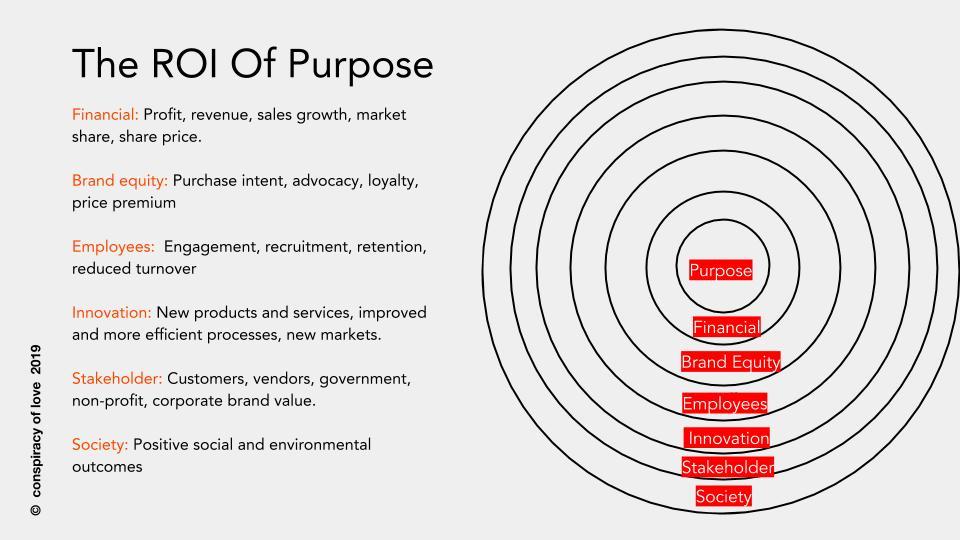
The impact of a purpose-driven initiative on the health of the brand is also another key area to be measured. The ‘silver bullet’ question which is most important is drawing a clear correlation between purpose and sales. However given the complexity of the purchase funnel, I believe that at the very least measuring ‘Purchase Intent’ (‘Does this initiative make you more or less likely to purchase this brand’) is the closest proxy. ... Often, one of the biggest upsides of purpose-driven initiatives is the effect it has on the employees of the company in terms of morale and motivation - not to mention recruiting new talent, especially Millennials and Gen-Z who are increasingly motivated by the opportunity to work for a company that creates meaningful social and environmental impact (leading to lower recruiting costs). While each company has its own metrics for measuring employee engagement, a common one worth measuring is the impact on turnover: Does the initiative make employees more or less likely to stay with the company? Benevity’s research shows that employees are 57% more likely to stay with a company which offers volunteering and fundraising opportunities, leading to significant cost reductions


Why CIOs should focus on trimming their internal email footprint


Reducing business’ reliance on email is just one part of a wider shift in the way companies need to operate going forward. Stanley Louw, UK and Ireland head of digital and innovation at Avanade, believes organisations need a strategy that is digital, not a digital strategy. “The way we have always provided IT for work is actually holding us back,” he said. “You have to apply the sample principles of customer experience to employee experience. What is the experience employees need to do their job? CIOs have to start partnering with HR.” But in Louw’s experience, IT departments still approach desktop IT from a pure IT perspective, which makes their approach to the desktop archaic, very much based in legacy approaches to desktop management. Industry momentum around focusing on customer experience has changed the way businesses look at their customer, he said, adding: “You also need to look internally and start by modernising platforms.”


Chief Integration Officer!

Chief Integration Officer! - ITNEXT
As organizations go for technology-leveraged strategic transformation, they expect technology to help them maximize business value, as an organization. This is different from better decision-making or operational efficiency or a specific new capability at a functional level. The whole value accrued to the organization must be more than the sum of parts. Someone needs to drive that.  That someone, for a very few selected organizations, is a dedicated Chief Digital Officer. But more than 95% of organizations do not have a CDO role; most of them do not intend to have one. Yet, they still need someone to put all the pieces together to create organizational value. That integration has to be done by someone who thoroughly understands technology and its direction as well as business. In most organizations, CIO is the best person to drive that role.  The reason why it has not happened so widely is not as much because the top management has doubt over CIOs’ capability as it is because the CIOs are not ready to move on from nuts and bolts because that may mean giving up control over a big chunk of budget on IT infrastructure.


Why Proxies Are Important for Microservices


The dynamic nature of microservices applications presents challenges when implementing reverse proxies. Services can come and go as they are revisioned or scaled and will have random IP addresses assigned. The synchronization of the available services and the configuration of the reverse proxy is essential to ensure error-free operation. One solution is to use a service registry (e.g. etcd) and have each service maintain its registration while it is running. The reverse proxy watches the service registry to keep its configuration up to date. Kubernetes does all of this automatically for you as part of its automation. The Kube DNS process maintains the service registry with an address (A) and service (SRV) record for each service. The Kube Proxy process routes and load-balances requests across all instances of the services. With all incoming request traffic for a microservices application typically passing through proxies, it is essential to monitor the performance and health of those proxies. Instana sensors include support for Envoy Monitoring, Nginx Monitoring, and Traefik Monitoring, with more proxy technologies coming.


Browser OS could turn the browser into the new desktop


A potential challenge is the browser becomes the desktop for the end user, and that's something folks have to get used to. But to Google's credit and its partnerships with vendors like VMware or Citrix, the UX challenge becomes almost invisible. We'll see how enterprises continue to approach this opportunity, which is ultimately more secure. For certain use cases, field services for example, if a browser OS-based device either dies or gets broken or lost, no data is lost. A user can just go get a new Chromebook and sign in back where he or she left off. That's an unheard-of value proposition -- that begin-where-you-left-off concept is powerful. One other problem enterprises may face is around Microsoft legacy infrastructure -- particularly around endpoint management. Microsoft has moved away from that to help bridge the divide, and Windows 10 is doing well. We'll see a lot more migration happening this year as the Windows 7 sunset comes closer.


This new Android ransomware infects you through SMS messages


Depending on the infected device's language setting, the messages will be sent in one of 42 possible language versions, and the contact's name is also included in the message automatically.  If the link is clicked and the malicious app is installed manually, it often displays material such as a sex simulator. However, the real purpose is quietly running in the background. The app contains hardcoded command-and-control (C2) settings, as well as Bitcoin wallet addresses, within its source code. However, Pastebin is used by the attackers as a conduit for dynamic retrieval.  Once the propagation messages have been sent, Filecoder then scans the infected device to find all storage files and will encrypt the majority of them. Filecoder will encrypt file types including text files and images but fails to include Android-specific files such as .apk or .dex.  ESET believes that the encryption list is no more than a copy-and-paste job from WannaCry, a far more severe and prolific form of ransomware.  A ransom note is then displayed, with demands ranging from approximately $98 to $188 in cryptocurrency. There is no evidence that files will be lost after the time threatened.


Google bolsters hybrid cloud proposition for enterprises through VMware partnership


Google Cloud CEO Thomas Kurian confirmed the news in a blog post, in which he described the move as “another significant step” in his firm’s drive to bolster the enterprise appeal of its public cloud platform.  In recent years, this has seen the Google Cloud team roll out a series of data security and functionality improvements to its platform, and move to introduce industry-specific services. Such moves have resulted in Google Cloud developing into an $8bn annual revenue run rate company that is growing “at significant pace”, as was confirmed by Google CEO Sundar Pichai during a conference call to discuss its parent company’s second-quarter results earlier this month. “Customers are choosing Google Cloud for a variety of reasons,” said Pichai on the call, transcribed by Seeking Alpha. “Reliability and uptime are critical.” He also made reference to the “flexibility” that organisations also need when moving to the cloud, so they can proceed in their “own way”. 


The Future of API Management

There will be a continued emphasis on the developer and recognizing the developer is king and making the job easier for them. We understood this for the public, but we still need to improve internally. In the form of a service catalog for internal developers to make it easier for them to ramp up and get benefits of existing APIs. New architecture — Everything is driven by containers, container platforms, and K8s is leading to microservices architecture with new approaches to control traffic with sidecar approaches to manage traffic like Envoy and Istio to provide service mesh to manage applications within the container cluster.  As these things come up, there will be a proliferation of types of control points with multiple form factors. We embrace Envoy as the new gateway. Right now we live in a mixed world and it’s important to consider how service mesh and API management will overlap. API management is about the relationship of providing a service and multiple consumers of that service. The more scale, the more important the formal API management platform.


zeroday software bug skull and crossbones security flaw exploited danger vulnerabilities by gwengoa
A zero day is a security flaw that has not yet been patched by the vendor and can be exploited and turned into a powerful weapon. Governments discover, purchase, and use zero days for military, intelligence and law enforcement purposes — a controversial practice, as it leaves society defenseless against other attackers who discover the same vulnerability. Zero days command high prices on the black market, but bug bounties aim to encourage discovery and reporting of security flaws to the vendor. The patching crisis means zero days are becoming less important, and so-called 0ld-days become almost as effective. ... Not all zero days are complicated or expensive, however. The popular Zoom videoconferencing software had a nasty zero day that "allows any website to forcibly join a user to a Zoom call, with their video camera activated, without the user's permission," according to the security researcher's write up. "On top of this, this vulnerability would have allowed any web page to DoS (Denial of Service) a Mac by repeatedly joining a user to an invalid call." The Zoom for Mac client also installs a web server on your laptop that can reinstall the Zoom client without your knowledge if it's ever been installed before.


white blocks stacked containers misaligned alignment fragile falling apart flickr
One thing that is widely agreed upon by the security pros – as Kubernetes adoption and deployment grows, so will the security risks. There have been multiple recent events in the cloud and mobile dev spaces where these environments were compromised by attackers. This included everything from disruption, crypto mining, ransomware, and data stealing. Of course, these types of deployments are just as susceptible to exploits and attacks from attackers and insiders as the traditional environments. Thus, it is more important to ensure your large-scale Kubernetes environment has the right deployment architecture and that you use security best practices for all these deployments. As Kubernetes is more widely adopted, it becomes a prime target for threat actors. “The rapid rise in adoption of Kubernetes is likely to uncover gaps that previously went unnoticed on the one hand, and on the other hand gain more attention from bad actors due to a higher profile,” says Amir Jerbi, CTO at Aqua Security.


Quote for the day:


"Leaders begin with a different question than others. Replacing who can I blame with how am I responsible?" -- Orrin Woodward


Daily Tech Digest - July 30, 2019

What to Look Out For When Selecting a DRaaS Provider

What to Look Out For When Selecting a DRaaS Provider
Before exploring DRaaS, your organization should have a business impact analysis. In performing a current business impact analysis, you will be able to posit what would happen in the event of a disaster or disruption of business operations. ... When picking which DRaaS provider is right for you, use this information to determine if providers can accommodate your needs. After figuring out what your disaster recovery requirements are exactly, you can ask questions of providers in order to ascertain if they can support your needs. In the event that you were to experience data loss or corruption, learn the procedures of the providers in that situation by asking questions such as: How many copies of your backups are available? Where are those backups located? Is the provider able to recreate an image of your data at a specific, previous point from available backups? In calendar terms, how far back are backups accessible? What is the provider’s protocol when you perform a failover to DRaaS and are ready to go back to your standard environment afterward?


Google researchers disclose vulnerabilities for 'interactionless' iOS attacks

iPhone iOS
According to the researcher, four of the six security bugs can lead to the execution of malicious code on a remote iOS device, with no user interaction needed. All an attacker needs to do is to send a malformed message to a victim's phone, and the malicious code will execute once the user opens and views the received item. The four bugs are CVE-2019-8641 (details kept private), CVE-2019-8647, CVE-2019-8660, and CVE-2019-8662. The linked bug reports contain technical details about each bug, but also proof-of-concept code that can be used to craft exploits. The fifth and sixth bugs, CVE-2019-8624 and CVE-2019-8646, can allow an attacker to leak data from a device's memory and read files off a remote device --also with no user interaction. While it is always a good idea to install security updates as soon as they become available, the availability of proof-of-concept code means users should install the iOS 12.4 release with no further delay.


Top 5 financial services processes that are ripe for automation


Barely a day goes by without the launch of a new report extolling the potential benefits of artificial intelligence (AI) and automation in the financial services industry. These reports often refer to the potential for cost reduction, increased operational efficiency, improved customer experience and, ultimately, bottom-line growth. Indeed, analysts predict that AI will deliver a 22 percent reduction in operating costs (a saving of more than $1trn) across the global financial services industry by 2030 as business leaders look to transform both front and back-office functions. Demand for AI is coming from both ends of the market: established banks are recognising the need to respond to huge sector-wide disruption and to develop more agile operations in order to compete, while smaller fintech firms are looking to AI and automation as a way to scale quickly while keeping costs down. The scale of the opportunity is so vast that it can sometimes be a challenge for banks and insurance firms to know where to start or how to identify the process automations that will deliver most value.


Avoid chaos with an IT crisis management playbook


The second significant component of an IT crisis management playbook is a breakdown of common or reoccurring issues and their suggested fixes. Append the top resolution suggestions from the application vendors as well. Don't expect to create an exhaustive list, but describe coverage for five to 10 of the business's most critical applications. Create a comprehensive index for both vendors and IT operations staff to see quickly if they need to escalate an issue -- and to whom -- with internal contact information attached. A common question about crisis management playbooks is recommended format: paper or digital? If the modern paperless office is any indicator, create both. Paper binders require effort to update and store, but they also work without power -- something that's not a guarantee with a digital version.


Hackers target Telegram accounts through voicemail backdoor


According to the testimony of one of the arrested suspects, Walter Delgatti Neto, there’s another, potentially more vulnerable, way to get those verification messages – via voicemail. Accessing voicemail boxes turns out to be easier than it should be. Some people forget to set four-digit codes and those that don’t can potentially be undone by crooks cycling through the 10,000 possibilities. Many voicemail systems fight back by checking that the number making an access call belongs to the subscriber, but these numbers can easily be spoofed if the attacker knows the correct number. If an attacker can access voicemail they can access verification messages, such as Telegram’s, which are sent to voicemail if the hacker’s target is on a call or doesn’t answer three times in a row. Apparently, news of the weakness has spread on forums, leading to leaks of attacks on other valuable targets, including Puerto Rico Governor Ricardo RosellĂ³, whose position became untenable after his Telegram chats were recently leaked.


Strategy For and With AI

Our research strongly suggests that in a machine learning era, enterprise strategy is defined by the key performance indicators (KPIs) leaders choose to optimize. (See “About the Analysis.”) These KPIs can be customer centric or cost driven, process specific or investor oriented. These are the measures organizations use to create value, accountability, and competitive advantage. Bluntly: Leadership teams that can’t clearly identify and justify their strategic KPI portfolios have no strategy. In data-rich, digitally instrumented, and algorithmically informed markets, AI plays a critical role in determining what KPIs are measured, how they are measured, and how best to optimize them. Optimizing carefully selected KPIs becomes AI’s strategic purpose. Understanding the business value of optimization is key to aligning and integrating strategies for and with AI and machine learning. KPIs create accountability for optimizing strategic aspirations. Strategic KPIs are what smart machines learn to optimize. 


The Case For Transforming Banking (Even When Profits Are Strong)


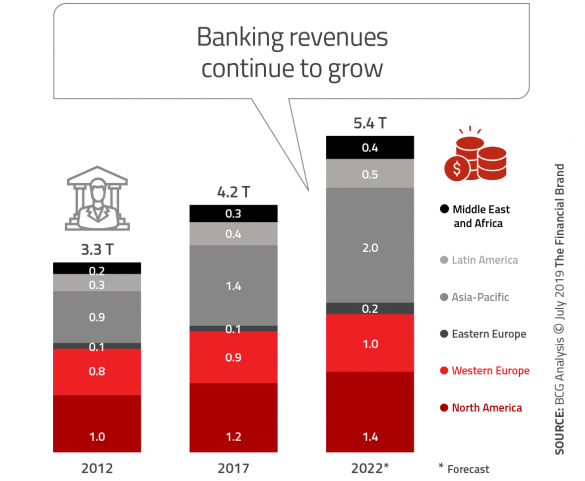
Many financial institutions are saying the right things more than doing what is needed. Often, what is being done is in the context of banking from the past, as opposed to being recreated from the bottom up as you would if you were building a digital banking organization from scratch. And many of these initiatives are still moving at a snails pace. Organizations are building digital account opening, loan application and new customer onboarding processes, but the majority of these processes still require the consumer to come into the branch or have way too many steps similar to the paper-based processes of the past. And, while almost all organizations know the benefits of expanded data, advanced analytics and AI, very few have used these tools to personalize experiences or proactively offer solutions in real time. As stated in the BCG report, banking organizations must look at digital transformation in a holistic manner rather than fragmented components that are not seamlessly integrated. More importantly, the direction for this transformation must come from the organization’s senior leadership and be supported by a culture that encourages innovation, digital customer experiences and aggressive market positioning.


Cyber security leadership in the age of fast and continuous delivery


Addressing the need for agile methods and the need to sustain adequate cyber security presents certain challenges for the CISO navigating a transforming business landscape. Here are the top six key triggers and challenges organizations are grappling with today. ... Cyber security usually has predefined contact points within a team's detailed planning and work schedule. These typically occur during initial software architecture definition and validation, with a couple of checkpoints ending with late testing and acceptance of the solution. Today, modern application security replaces the typically predefined interactions in the software lifecycle with more frequent interations that increase dialogue, collaboration and efficiency. How do organizations re-organize cyber security to support this interaction, either through staffing, automation or clever methodological work-arounds? ... It's not rare today to see cyber departments hiring software developers possessing a strong understanding of modern dynamics and training them in cyber security.


Capital One’s breach was inevitable, because we did nothing after Equifax

capital one blue ribbon companies 2016 gettyimages 617684580
This time it’s the financial giant and credit card issuer Capital One, which revealed on Monday a credit file breach affecting 100 million Americans and 6 million Canadians. Consumers and small businesses affected are those who obtained one of the company’s credit cards dating back to 2005. That includes names, addresses, phone numbers, dates of birth, self-reported income and more credit card application data — including over 140,000 Social Security numbers in the U.S., and more than a million in Canada. The FBI already has a suspect in custody. Seattle resident and software developer Paige A. Thompson, 33, was arrested and detained pending trial. She’s been accused of stealing data by breaching a web application firewall, which was supposed to protect it. Sound familiar? It should. Just last week, credit rating giant Equifax settled for more than $575 million over a date breach it had — and hid from the public for several months — two years prior. Why should we be surprised? Equifax faced zero fallout until its eventual fine. All talk, much bluster, but otherwise little action.


Is The Future Of Artificial Intelligence Tied To The Future Of Blockchain?

uncaptioned
There is no doubt that blockchain is a disruptive technology and will give nations and all its components the foundation to the decentralized future. While blockchain is a disruptive technology, the way it is being used and applied has enormous energy and environmental impacts. The reason behind this is the process that is at the core of blockchain systems. The security of blockchain technology comes from its encryption, and the consensus mechanism of blockchain necessitates that all users require permission to write on the chain. Each of these requirements individually and collectively involves the intricate use of algorithms and enormous amounts of computing power. As the computing power needed to keep the current applications of blockchain running is not sustainable, it is one of the critical challenges facing the future of blockchain. It is not only blockchain and artificial intelligence, but all existing and emerging technologies, that are accelerating global computing power consumption. As a result, there is a visible need for increased computing power.


Quote for the day:


"Leaders stuck in old cow paths are destined to repeat the same mistakes. Change leaders recognize the need to avoid old paths, old ideas and old plans." -- Reed Markham


Daily Tech Digest - July 29, 2019

Back to basics: the top five technical issues to address in industrial cyber security

Top five technical issues to address in industrial cyber security image
While industrial facilities are facing more cyber security challenges than they used to, the good news is that awareness around these challenges is increasing. That said, there’s still a marked difference between how well cyber security is understood in the consumer and corporate IT worlds, and how well it’s understood in industrial environments driven by OT. In a sense that’s not surprising. After all, most well-publicised attacks have been in consumer and corporate IT. But with attacks on critical industrial environments now becoming more frequent, people are starting to wake up to the operational, financial, reputational and even human and environmental damage they can inflict. Awareness is one thing. But the fundamentals of cyber security are still not being practised regularly. What are those fundamentals? In our cyber security work with organisations operating critical infrastructures around the world in sectors including power, oil and gas, water management, manufacturing and maritime, we’ve identified the top five technical issues that need addressing.


Deep learning is about to get easier - more widespread


Deep learning algorithms often require millions of training examples to perform their tasks accurately. But many companies and organizations don’t have access to such large caches of annotated data to train their models (getting millions of pictures of cats is hard enough; how do you get millions of properly annotated customer profiles — or, considering an application from the health care realm, millions of annotated heart failure events?). On top of that, in many domains, data is fragmented and scattered, requiring tremendous efforts and funding to consolidate and clean for AI training. In other fields, data is subject to privacy laws and other regulations, which may put it out of reach of AI engineers. This is why AI researchers have been under pressure over the last few years to find workarounds for the enormous data requirements of deep learning. And it’s why there’s been a lot of interest in recent months as several promising solutions have emerged — two that would require less training data, and one that would allow organizations to create their own training examples.


Universities use data analytics to tackle student mental health


“What we are finding is that students with mental health conditions are far more likely to generate an alert than their peers,” says Ed Foster, the university’s student engagement manager. The alerts, which in its first year have been triggered for 3% to 4% of students, are sent to personal tutors, who can then contact the student. They also have access to a detailed dashboard on students’ engagement. “It helps them to prepare for that first discussion with a student, giving them some pointers,” says Foster. Nottingham Trent also provides students with access to their own dashboard, allowing them to see how they compare to averages for their peer group. Foster says that some students have found themselves motivated by the realisation they were falling behind. But some students at University of Leeds oppose such dashboards, according to Professor Neil Morris, dean of digital education.


Why Invest In Cloud-Based Machine Learning For Cybersecurity?

Cloud computing, illustration
Offloading compute-intensive ML workloads to the cloud frees up precious local resources. Systems that do ML on the same local sensor that gathers the data itself must sacrifice performance and fidelity. By doing all the work on a local box, these tools spread themselves too thin and put a low cap on the value they can provide. Networks today move many gigabytes of data per second, and ML is only as accurate and valuable as the data you feed it; this means that the ideal scenario is one in which ML models can take advantage of all that data flying across the network. That simply isn't possible for products that restrict their ML processing to the compute power of an appliance in the data center. Moving ML to the cloud is the only way to take advantage of the sheer volume of data produced by today's enterprise networks. More often than not, modern enterprises are distributed across more than a single campus. Cloud-based ML architectures allow you to take full and cost-effective advantage of the intelligence, detection, and automation provided by ML-based technologies across all on-premises and cloud environments through a single deployment instead of getting limited insights that only apply to individual network regions where a box is installed.


Robotic Process Automation (RPA): 6 things people get wrong

CIO_Big Data Decisions_2
“As companies look to digitally transform themselves, they are looking to streamline and modernize processes,” says John Thielens, CTO at Cleo. “While RPA perhaps can be viewed as a form of streamlining, it streamlines processes in place, but by itself does not necessarily improve them.” Thielens notes that this misunderstanding can occur in organizations that are looking for process improvements as part of a broader digital transformation; they might see RPA as a solution to process woes when it’s better looked at as a tool for achieving new efficiencies and productivity gains with well-established processes. There’s a related mistake people make with RPA: Automating a process you don’t fully understand. Eggplant COO Antony Edwards recently told us that this is a common pitfall: “Most people don’t have clearly defined processes, so they start automating, and either automate the wrong thing or get lost in trying to reverse-engineer the process.”


Govt panel says no need to mirror personal data in India

foreign firms,Ă‚ personal data,Ă‚ Srikrishna panel, data localisation,Ă‚ NITI Aayog,Ă‚ financial data,Ă‚ Amazon,Ă‚ American Express, amstercard,Ă‚ Paypal,Ă‚ European Union
The government panel has, however, agreed with the Srikrishna panel on health data where it had said personal data relating to health should be permitted to be transferred abroad for reasons of prompt action or emergency. The relaxation by a government panel with regard to storage and processing of personal data comes after last month RBI also relaxed its April 2018 circular which required that all payment data generated in India should be stored within the country. This came as some sort of relaxation for major international firms such as American Express, Visa, Mastercard, Amazon, Paypal, Western Union, etc. In its amended circular, RBI has allowed such international firms to store data abroad in cases where the transaction originates in the country but gets completed overseas, with a proviso that a mirror copy in such transactions be stored in India. However, for end-to-end domestic transactions all storage still needs to be done within the country. Earlier, the RBI had not made a clear-cut distinction between transactions which are completed within the country and transactions which originate here and get completed overseas.


Why AI is entering its golden age

Sharp Corp's RoBoHon, a humanoid communication robot shaped mobile phone, raises its hands up to flag a call as a model tries to answer the call during a photo opportunity at its unveiling event in Tokyo, Japan, April 14, 2016. REUTERS/Yuya Shino TPX IMAGES OF THE DAY
AI is working everywhere. To take one framework, think about the product lifecycle: You have to figure out what products or services to create, figure out how to price it, decide how to market and sell and distribute it so it can get to customers. After they’ve bought it, you have to figure out how to support them and sell them related products and services. If you think about this entire product lifecycle, AI is helping with every single one of those [stages]. For example, when it comes to creating products or services, we have this fantasy of people in a garage in Silicon Valley, inventing something from nothing. Of course, that will always happen. But we’ve also got companies that are mining Amazon and eBay data streams to figure out, what are people are buying? What’s an emerging category? If you think about Amazon’s private label businesses like Amazon Basics, product decisions are all data-driven. They can look to see what’s hot on the platform and make decisions like “oh, we have to make an HDMI cable, or we have to make a backpack.”


Managed security services will take center stage at Black Hat

Managed security services will take center stage at Black Hat
A global cybersecurity skills shortage, that’s what. ESG research indicates that 53% of organizations say they have a problematic shortage of cybersecurity skills (note: I am an ESG employee). Furthermore, the recently published research report from ESG and the information systems security association (ISSA) indicates that 73% of organizations have been impacted by the cybersecurity skills shortage. Sixty-six percent of those impacted say the cybersecurity skills shortage has increased the workload on the infosec team, 47% say the cybersecurity skills shortage has led to the inability to learn or use cybersecurity technologies to their full potential, and 41% have had to hire and train junior employees rather than hiring more experienced staff. There’s one more implication around the cybersecurity skills shortage — nearly one-third (32%) of organizations have had to increase their use of professional/managed services because they remain understaffed and lacking advanced cybersecurity skills. Like I said, organizations can no longer tow the cybersecurity line alone — they need help. 


DMARC's abysmal adoption explains why email spoofing is still a thing


Companies are not taking advantage of the protocol, despite the fact that DMARC has been around for years. This means that most companies are still vulnerable to business email compromise (BEC) attacks, phishing emails, and other types of email scams, as hackers can easily make their emails look authentic and pass their scams as legitimate communications. The good news is that DMARC adoption rate is better than previous years. However, the bad news is that the needle is moving too slowly to make a difference. An FTC report from 2017 found that only 10% of 569 businesses with a significant online presences had deployed DMARC policies with their domains. A November 2018 Agari report found that half of the Fortune 500 companies were supporting DMARC, but that only 13% of companies had actually bothered to set up DMARC rejection policies -- meaning the DMARC protocol was installed, but wasn't actually used to stop spam, phishing, and scams from spoofed domains. A quarter later, in February 2019, the same Agari reported that the percentage of Fortune 500 companies actively using DMARC policies had gone up to 15%. A small increase, but still insufficient, since this still left hundreds of the world's biggest companies open to attacks.


Rediscovering Lean

The trouble is, deep down, I knew I was not! My engineering metrics were great, better than ever. But my Pirate metrics (AAARRR!) sucked. Where was the real user impact I wanted? I grew weary. Each new initiative and with every one of those practices I adopted, I changed how I worked, which required conscious effort to discover, learn, implement and refine. Spending all my mental energy on improving delivery metrics was bad; continuously improving the wrong thing was worse. In the middle of this crisis of confidence, my head of engineering asked me to lead the development of a new mobile product. This was a big deal based on a real user need we could address. Along with it also came a large chance of failure. A year previously, I would have jumped on it. But with more self-awareness around my limitations delivering on such a large project, I wavered. With my approach not working, I needed to change. Was a killer process to solve my problems just around the corner, awaiting discovery?


Quote for the day:


"Leadership is developed daily, not in a day." -- John C. Maxwell


Daily Tech Digest - July 26, 2019

IoT’s role in expanding drone use

IoTĂ¢€™s role in expanding drone use
Iris Automation, not surprisingly, is in the business of creating workable collision avoidance systems for drones in an attempt to solve this issue. Variously called “detect and avoid” or “sense and avoid” technologies, these automated solutions are required for “beyond visual line of sight” (BVLOS) drone operations. There are multiple issues in play. As explained on Iris’ website, “Drone pilots are skilled aviators, but even they struggle to see and avoid obstacles and aircraft when operating drones at extended range [and] no pilot on board means low situational awareness. This risk is huge, and the potential conflicts can be extremely dangerous.” As “a software company with a hardware problem,” McKenzie said, Iris’ systems use artificial intelligence (AI), machine learning, computer vision, and IoT connectivity to identify and focus on the “small group of pixels that could be a risk.” Working together, those technologies are creating an “exponential curve” in detect-and-avoid technology improvements, she added. The result? Drones that “see better than a human pilot,” she claimed.


How artificial intelligence can tackle climate change

AI can also unlock new insights from the massive amounts of complex climate simulations generated by the field of climate modeling, which has come a long way since the first system was created at Princeton in the 1960s. Of the dozens of models that have since come into existence, all represent atmosphere, oceans, land, cryosphere, or ice. But, even with agreement on basic scientific assumptions, Claire Monteleoni, a computer science professor at the University of Colorado, Boulder and a co-founder of climate informatics, points out that while the models generally agree in the short term, differences emerge when it comes to long-term forecasts. “There’s a lot of uncertainty,” Monteleoni said. “They don't even agree on how precipitation will change in the future.” One project Monteleoni worked on uses machine learning algorithms to combine the predictions of the approximately 30 climate models used by the Intergovernmental Panel on Climate Change.


How the CIO role in healthcare has evolved at Northwell Health


It's a lot about how these new innovative technologies are going to take hold as time goes along and how they're going to change the model of how we deliver healthcare. One example might be bed throughput in our hospitals. Our hospitals are very busy, so how quickly we can get patients through them is very important to us so they're not sitting in the ER longer than they need to be. There have been bed management programs on the market for a lot of years. Many hospitals use them, big and small. And they operationally help you to move patients through your hospital faster. If we could take new technologies that are artificial intelligence-based with machine learning algorithms behind them and we can start to predict, in addition to the actual management of the beds, how likely is it they're going to get admitted, how likely is it they're going to go to the ICU, how likely is it that a patient is going to be discharged over the next few days.


Louisiana declares emergency over cyberattacks targeting schools

It’s the first time in Louisiana’s history that a cyberattack is being addressed like a disaster, but there is precedent for this approach. Colorado became the first state to treat a cyberattack like a major disaster in March 2018 after its Department of Transportation was compromised by the ransomware virus known as SamSam. That declaration, by then-Gov. John Hickenlooper, came after more than a week of the Office of Information Technology struggling to repair nearly 2,000 infected devices with a small staff working long hours and subsisting on junk food. Following Hickenlooper’s emergency declaration, oversight of the response to the cyberattack was given to the Colorado Office of Emergency Management, which adapted its natural-disaster playbook for an IT security situation, creating a unified command structure and bringing in the National Guard and support personnel from other states.


How to cautiously reap the benefits of DevOps as a service


Before DaaS adoption, carefully weigh its unique benefits and challenges. A DaaS provider offers access to more mature reporting tools out of the box that inform developers, as well as product and technical stakeholders, about ongoing project health and security. Additionally, cloud-based DevOps tools support collaboration between on-site and remote team members and facilitate data-driven processes, since staff can more easily work with the same data sets. DaaS also facilitates faster testing and deployment because it enables developers to scale compute and data storage on demand based on project requirements. But outsourcing to a DevOps-as-a-service provider isn't without its challenges. First, in-house development and operations teams still must manage the complexities of integration and workflow orchestration.


Transitioning GDPR preparations into successful operations

GDPR is also about value and trust in data, a central element of information governance. Information governance encompasses, among other things, information security or, at a digital level, cybersecurity. There are many organizations that were taken in with checklists and companies offering one-stop technological solutions, without taking the necessary steps to understand how personal data flows through the organization, as opposed to designing and implementing a framework that will fit with the culture and ways of working of your organization. Then there are those organizations that complained “it’s not fair” and placed it on the “too difficult to do” pile. On many occasions, senior stakeholders have told me that they could not see how GDPR affected them as they didn’t collect, store or process personal data – in all cases they had failed to grasp that employment data was personal data. Absorbing GDPR into business as usual requires a holistic approach to information governance.


A data breach forced this family to move home and change their names


As reported by the Hackney Gazette, a family in the area adopted a child and the details of who they were and where they lived were meant to be withheld from the birth parents.  However, during the adoption process in 2016, a solicitor appointed by Hackney Council mistakenly included an unredacted copy of the application form. The publication says that the exposed, sensitive data included the couple's names, addresses, phone numbers, dates of birth, and occupations. The scope of the breach was serious enough that the couple spoke to both the council and police, and ultimately decided that moving home and changing their names was the safest option for their adopted child.  Hackney Council acknowledged their mistake and paid out £106,000 ($131,000) in damages, which also helped facilitate the house move. The council apologized to the couple for the "human error." The UK's Information Commissioner's Office (ICO) was also notified. The data watchdog said that the breach had "potential to cause significant distress and detriment," but no further action was required beyond the council's compensation offer.


Why investment is needed in the cyber insurance market


While insurers are missing out on a considerable business market and will look to stop silent cyber, companies that use these commercial policies may also be putting themselves at risk of a complicated claims process that may be ultimately rejected. As such, businesses and insurance firms must work together to develop the cyber insurance market. Insurance policies can be a lifeline for companies when unexpected events or issues occur, that lead to significant damage or loss to the company in some capacity or another. Standard insurance policies can cover several categories, including public liability and property. Yet when a cyber attack on a business damages property or stops business operations, it is unclear whether a company’s business insurance policy will cover the resulting claim.  This lack of clarity has come to a head in the Mondelez vs Zurich legal battle currently taking place. Insurance firm Zurich is refusing to pay out a $100m claim from food conglomerate Mondelez following a cyber attack. 


The Mesosphere Data Center Operating System (DC/OS) is a distributed OS that runs across a cluster. It's based on the open source kernel Mesos -- similar to the Linux kernel -- which abstracts IT hosting resources. Mesos uses a master/agent architecture, whereby a master daemon controls the agent daemons that run on nodes within the cluster. Because DC/OS is a distributed system, it lends itself to distributed applications. For example, an enterprise could use Mesosphere and its distributed architecture to run large and complex data processing software for a big data initiative, such as Apache Cassandra database or Apache Spark data analytics engine, across abstracted virtual and physical resources that act as a single entity. Mesosphere DC/OS enables greater scalability for those systems, since the OS spans more than one machine, and also simplifies node configuration across a cluster. 


smart city / internet of things
Worse still, some legacy systems can be downright impossible to manage and update in a safe way. Older technology often contains no provision for live updates, and its vulnerabilities can be severe, according to the report. Physical access to some types of devices also remains a serious challenge. The report gives the example of wastewater treatment plants in remote locations in Australia, which were sabotaged by a contractor who accessed the SCADA systems directly. In addition to the risk of compromised control systems, the generalized insecurity of smart city IoT makes the vast amounts of data that it generates highly suspect. Improperly configured devices could collect more information than they’re supposed to, including personally identifiable information, which could violate privacy regulations. Also, the data collected is analyzed to glean useful information about such things as parking patterns, water flow and electricity use, and inaccurate or compromised information can badly undercut the value of smart city technology to a given user.


Quote for the day:


"Your greatest asset is your earning ability. Your greatest resource is your time." -- Brian Tracy