Daily Tech Digest - June 10, 2019

AI needs a certification process, not legislation


Neither legal regulation nor ethical guidelines will keep AI development from running amok. That doesn’t mean there isn’t a solution, though. In fact, the solution is a lot simpler than you might think: Establish an independent body that can create standards and a program for certification. ... These compliance measures have highly technical standards that require organizations to comply with specific password protection measures, mobile phone security, data segregation, firewall protections, and many more nuanced topics. While there’s no legal penalty for non-certification, certification is often a necessity for businesses wanting to engage with one another. In AI, I propose that technical experts, investors, and policymakers within the space come together to create a global, independent governing body responsible for establishing and enforcing AI standards. The standards — which should be reviewed regularly with annual certification requirements — should spell out specific requirements such as compliance around avoiding bias in data sets, checks to ensure AI is being used ethically and in a way that isn’t discriminatory, controls around automated decision making, and emergency measures to stop an AI machine.


One way predictive analytics is changing transportation is in how it is forcing firms to evaluate how they arrange data sourced from electronic logs, video event recorders, electronic control modules, and other vehicle sensors. Organizing these sources is critical for triaging which transportation challenges to solve and means finding relationships among the data that can be made into useful experiences. For an automotive example, think of a Corvette. Specialty versions of the vehicle offer a Performance Data Recorder that enables telemetry overlays of vehicle data on video from a high-definition camera.That data, sourced from various system activities, is used to analyze driver sessions on a race track, enhancing a customer wish.  Exploring data organization will rise as autonomous vehicle fleets become more prominent on public roads. Vehicles have historically managed this data in one format or another, but until now there were no opportunities to consider data from a network, moreover with consideration of a central repository or local platform to host data. Autonomous vehicles generate real-time data creation, which can inform managers with real-time logistic decisions.


Innovation Hubs v Regulatory Sandboxes and the Future of Innovation Facilitators


Regulators gain a better understanding of innovation in financial services, and firms understand better the regulatory and supervisory expectations against the backdrop of rapid technological advancement. “In particular, innovation facilitators can help competent authorities to keep pace with developments by gaining near ‘real time’ insights into emerging technologies (such as distributed ledger technologies, big data analytics, artificial intelligence and machine learning) and their application in the financial sector. Competent authorities can apply these insights for the purposes of anticipating regulatory and supervisory issues and responding proactively.” On the other hand, it makes regulators more accessible to firms and in particular start-ups that lack resources and experience in regulatory matters However, the report also summarises some of the risks that are perceived by competent authority regarding the operation of innovation facilitators in general and with regulatory sandboxes in particular.

Cybersecurity insurance: Read the fine print

istock-503519736.jpg
Ernest Martin Jr. mentioned cybersecurity insurance is trying to protect a new and volatile industry; a good example would be determining how to insure a business that locates the company's technology (hardware and/or software) in a third-party's data center, which is becoming a common practice. "Even when a cyber policy provides a particular type of coverage, the actual scope of that coverage can be restricted in many ways," Dallas attorney Amy Elizabeth Stewart explains to Bounds. Stewart suggests firms that outsource their digital assets should understand how the coverage works when third-party vendors are involved, if they want to avoid unpleasant surprises. Bounds offers an example from Renee Hornbaker, former financial chief for Stream Energy Inc. as well as Flowserve Corporation (now retired). Hornbaker told Bounds she did not look forward to getting cybersecurity insurance, adding, "I found it to be costly, difficult to purchase, and the application process was onerous." Bounds brings up another good point about what could be a problem to some company executives: Obtaining insurance likely will entail disclosing a lot of sensitive information to the insurer, such as infrastructure setup and security practices.


Apache Mesos is an open source cluster management tool that abstracts and isolates resources within distributed IT environments. Enterprises use Mesos with, or as an alternative to, Kubernetes for container orchestration in large-scale deployments. ... Readers should expect the build process -- compiling and linking the components of Apache Mesos -- to take about one hour on a two-core machine with 8 GB of memory. Close any servers and end any running tasks on your machine before you begin compiling the Apache Mesos installation. This process can take 100% of the memory and prevent even SSH login attempts. All commands must execute via the sudo command, which enables you to act as the administrative root user. Test frameworks are not critical: It's a complicated process to write a Mesos test framework, and a regular user is unlikely to need one. Instead, IT admins are more likely to use a Mesos framework developed by an established vendor such as Hadoop, Spark or Cassandra.


The Problem with Quantum Computers

The Problem with Quantum Computers
The trouble is, quantum mechanics challenges our intuition. So we struggle to figure out the best algorithms for performing meaningful tasks. To help overcome these problems, our team at Los Alamos National Laboratory is developing a method to invent and optimize algorithms that perform useful tasks on noisy quantum computers. Algorithms are the lists of operations that tell a computer to do something, analogous to a cooking recipe. Compared to classical algorithms, the quantum kind are best kept as short as possible and, we have found, best tailored to the particular defects and noise regime of a given hardware device. That enables the algorithm to execute more processing steps within the constrained time frame before decoherence reduces the likelihood of a correct result to nearly zero. In our interdisciplinary work on quantum computing at Los Alamos, funded by the Laboratory Directed Research and Development program, we are pursuing a key step in getting algorithms to run effectively. The main idea is to reduce the number of gates in an attempt to finish execution before decoherence and other sources of errors have a chance to unacceptably reduce the likelihood of success.


pink blue powder explosion entrepreneurship innovation
Everyone possesses the ability to be good innovators. We are all born like this. But most of us unlearn these abilities through spending much of our lives within the tightly controlled systems that are constituted by our educational institutions and workplaces. A large 10-year study of 1,600 children which tested their creativity—defined as the ability to engage in divergent thinking, i.e. the ability to have original ideas which differ from anything you have ever seen before—measured the creativity of children who were 5, 10, and 15 years old. ... If those numbers don’t give you pause, I don’t know what will. These results also explain why our organizations lack innovation power. As citizens, we unlearn our skills of divergent thinking, and most of our organizations are built to promote and maintain this state. The organizations may have been founded by people who were creative geniuses, but unless the founders still run the organizations and are very visible bearers of the culture, the organizations quickly change and are left to people who have largely unlearned divergent thinking, and have rather learned convergent thinking, which is the ability to be critical.


Was Chase’s Digital-Only Bank Spinoff a Viable Strategy?


Financial institutions need to transform themselves from product-centric to customer-centric, from efficiency to flexibility, and from digital support to digital-only. The winners in the banking industry will find ways to collect and act on insights faster than the competition. This is what Amazon does and what consumers will expect from their financial institution. This can’t be achieved by protecting existing branch-based organizations, processes, or by hoping that increased investments in technology will save the day. This is because the financial support of legacy branches and processes (at least to the degree that is occurring in most organizations) is not sustainable. Alternative providers can provide greater value, better rates and a better experience at a lower cost. According to noted author and futurist Brett King, “We’re likely to see more digital-only offerings from traditional banks fail in the future where banks aren’t truly committed to digital transformation. The problem is that many traditional banks are doing this for PR reasons — not because they believe in digital as a destination. Ultimately they will fail because the traditional organization kills it off or starves it of adequate support”


Cisco to buy IoT security, management firm Sentryo
nwan 019 iiot
Sentryo's ICS CyberVision lets enterprises ensure continuity, resilience and safety of their industrial operations while preventing possible cyberattacks, said Nandini Natarajan , industry analyst at Frost & Sullivan. "It automatically profiles assets and communication flows using a unique 'universal OT language' in the form of tags, which describe in plain text what each asset is doing. ICS CyberVision gives anyone immediate insights into an asset's role and behaviors; it offers many different analytic views leveraging artificial intelligence algorithms to let users deep-dive into the vast amount of data a typical industrial control system can generate. Sentryo makes it easy to see important or relevant information." In addition, Sentryo's platform uses deep packet inspection (DPI) to extract information from communications among industrial assets, Natarajan said. This DPI engine is deployed through an edge-computing architecture that can run either on Sentryo sensor appliances or on network equipment that is already installed. Thus, Sentryo can embed visibility and cybersecurity features in the industrial network rather than deploying an out-of-band monitoring network, Natarajan said.


Reducing data security complexity: Avoiding endpoint bloat

Whether agents, particularly security control agents, persist over time is the only metric worth our attention, because it puts a spotlight on the greatest hidden danger of all: the naturalness of security decay. Things fall apart. Rust never sleeps. Agents topple over. Decay is the fate of all security agents. But if these serve as the foundation of our security goals or most technical expression of security intent, then what could possibly be more important? It’s also not a question of whether security decay is happening in your environment, you can rest assured it is. What must be asked is, will you persist through it? This question demands an answer. Ideally, organizations reduce their overall security costs by monitoring how their endpoint controls work (or don’t) to reduce endpoint security decay. They validate safeguards and eliminate compliance failures. And they respond to threats and exposures with the confidence to control devices from anywhere.


Quote for the day:


"Leaders are people who believe so passionately that they can seduce other people into sharing their dream." -- Warren G. Bennis,



Daily Tech Digest - June 09, 2019

Budweiser's Parent Company Invests In Blockchain For Farmers

uncaptioned
While the blockchain industry has swayed over the past year to a focus on how blockchain can save giant enterprises money by removing unnecessary middlemen, the investment by Anheuser-Busch InBev, a member of the inaugural Forbes Blockchain 50 list, and best known as the maker of Budweiser, is a return to blockchain’s roots as a way of empowering the unbanked. “Through this work, we are helping to create a digital ledger of farmers’ transactions that will create an economic identity and enable access to financial services,” said Maisie Devine, a director at AB InBev, in a statement. “This will ultimately allow farmers to grow their business and improve the livelihoods of their families and communities.” Belgium-based AB InBev’s work with BanQu was announced in August 2018 with a pilot in Zambia that served 2,000 of the region’s smallholder cassava farmers with subsequent services brought to Uganda, India, Brazil, Costa Rica, India, Indonesia, Jordan, Malawi, Somalia, South Africa, Syria, Uganda and the United States.


GDPR One Year On: Increasing Demand for ''Security By Design''

GDPR’s focus on personal data highlights how software is made and what components are used. Globally, businesses awoke to the reality that open source components are part of their software supply chains. “Security hasn’t caught up to 21st-century software engineering, so that’s being addressed now,” he said. GDPR put pressure on the industry to rethink, and re-engineer, software security at the start. Ilkka emphasized that negative publicity is a key motivating factor. No one wants to be part of the next big breach, meaning security is quickly becoming a mainstream priority, he adds. Simultaneously, a corporate shift is occurring. More software development teams are adopting a DevOps approach to production. This approach, which favors rapid iterations and software releases, produces better software, faster. A consequence is that security must be embedded from the start. A successful, secure design must be automated, repeatable, and scalable.


Tackling bias in artificial intelligence (and in humans)

Tackling bias in artificial intelligence (and in humans)
In many cases, AI can reduce humans’ subjective interpretation of data, because machine learning algorithms learn to consider only the variables that improve their predictive accuracy, based on the training data used. In addition, some evidence shows that algorithms can improve decision making, causing it to become fairer in the process. For example, Jon Kleinberg and others have shown that algorithms could help reduce racial disparities in the criminal justice system. Another study found that automated financial underwriting systems particularly benefit historically underserved applicants. Unlike human decisions, decisions made by AI could in principle (and increasingly in practice) be opened up, examined, and interrogated. To quote Andrew McAfee of MIT, “If you want the bias out, get the algorithms in.” At the same time, extensive evidence suggests that AI models can embed human and societal biases and deploy them at scale.


For two hours, a large chunk of European mobile traffic was rerouted through China

China Telecom
"Today's incident shows that the internet has not yet eradicated the problem of BGP route leaks," Madory said. "It also reveals that China Telecom, a major international carrier, has still implemented neither the basic routing safeguards necessary both to prevent propagation of routing leaks nor the processes and procedures necessary to detect and remediate them in a timely manner when they inevitably occur. "Two hours is a long time for a routing leak of this magnitude to stay in circulation, degrading global communications." But if any other ISP would have caused this incident, it would have likely been ignored. Alas, it was China Telecom, and there's a backstory. An academic paper published by experts from the US Naval War College and Tel Aviv University in October last year blamed China Telecom for "hijacking the vital internet backbone of western countries." The report argued that the Chinese government was using local ISPs for intelligence gathering by systematically hijacking BGP routes to reroute western traffic through its country, where it can log it for later analysis.


Why cryptocurrency’s not quite ready for takeoff


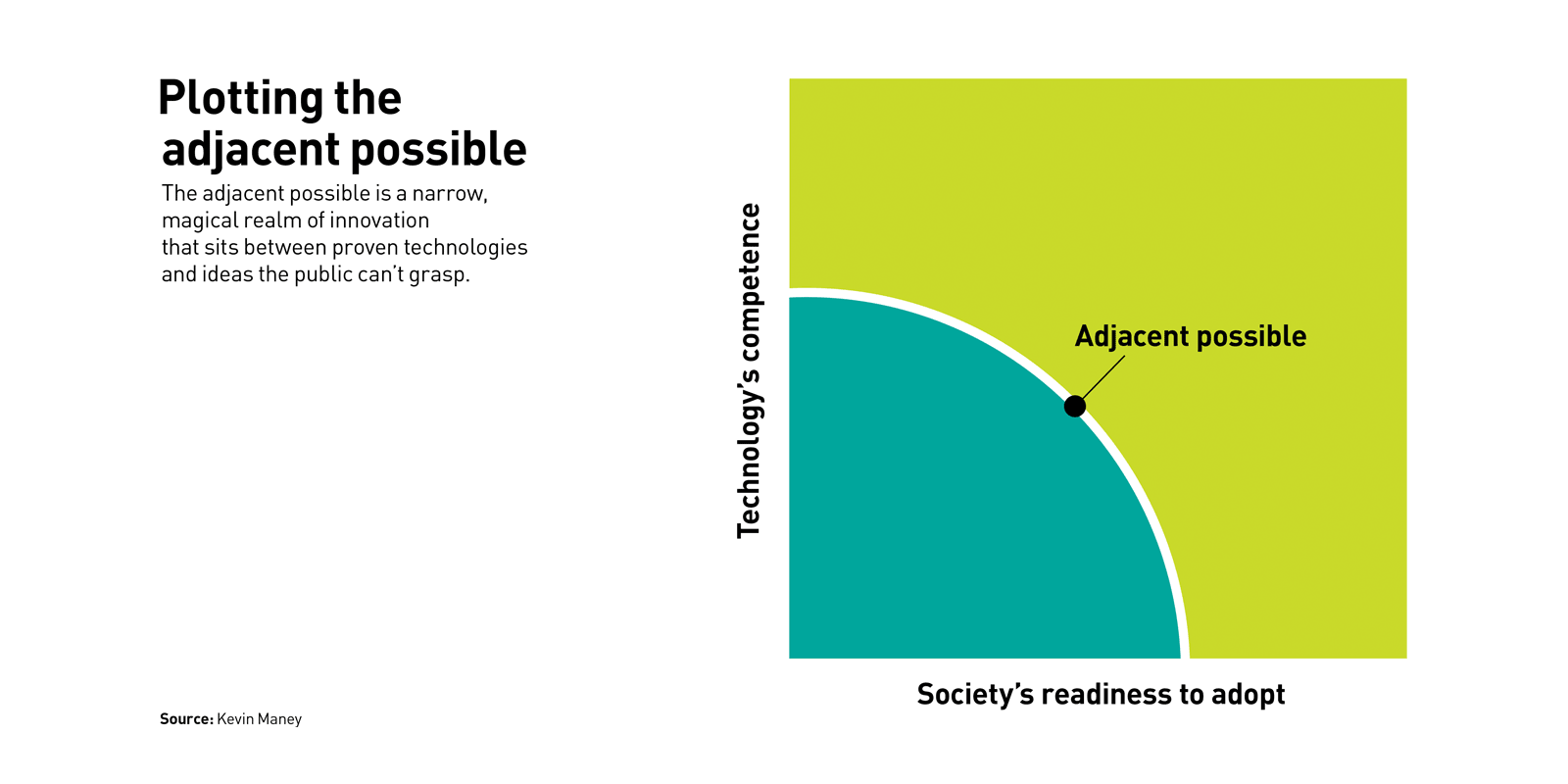
Why? Because crypto remains too far outside of what’s known as the “adjacent possible.” ... The adjacent possible can be illustrated using a coordinate graph. A point on the vertical axis shows how competent the technology is today, and a point on the horizontal axis shows how ready society is to accept and adopt the technology. The curve that connects the two points constantly moves outward over time, as technology gets better and society embraces new innovations. Inside the curve is technology that exists and is accepted. TVs, smartphones, and airliners are all safely inside this zone. Outside the curve is what’s not yet possible or adopted. Either the technology isn’t good enough yet, or the public isn’t ready — or, more typically, both. Holographic entertainment, augmented reality glasses, and consumer space travel sit out in that zone. Build such a product, and it will be too far ahead of its time. The magic happens in the thin band separating the two zones — in the adjacent possible.


Ireland's Priviti and Aussie fintech Accurassi partner for Open Banking

Following the Australian government’s response to the Review into Open Banking in 2018, Australia’s major banks will be required to make data available on credit and debit card, deposit and transaction accounts and mortgages by February 2020. The government’s legislated Consumer Data Right gives Australians greater control over their data and enables them to choose to share their data with trusted recipients for purposes they have authorised. This will first apply to the banking sector, followed by the energy and telecommunications sectors. Seizing the opportunity, Accurassi is launching its marketplace solution with banks and energy suppliers in the next few months and using consumer utility bill data to power personalised energy comparison services. The Priviti API will be embedded into the user experience to provide explicit authorisation to energy retailers for the release of bills to Accurassi.


Meet Kedro, McKinsey’s first open-source software tool

Kedro
The name Kedro, which derives from the Greek word meaning center or core, signifies that this open-source software provides crucial code for ‘productionizing’ advanced analytics projects. Kedro has two major benefits: it allows teams to collaborate more easily by structuring analytics code in a uniform way so that it flows seamlessly through all stages of a project. This can include consolidating data sources, cleaning data, creating features and feeding the data into machine-learning models for explanatory or predictive analytics. Kedro also helps deliver code that is ‘production-ready,’ making it easier to integrate into a business process. “Data scientists are trained in mathematics, statistics and modeling—not necessarily in the software engineering principles required to write production code,” explains Yetunde. “Often, converting a pilot project into production code can add weeks to a timeline, a pain point with clients. Now, they can spend less time on the code, and more time focused on applying analytics to solving their clients’ problems.”


Can Artificial Intelligence Save Us From Asteroidal Armageddon?

NASA'S Planetary Defense Coordination Office uses the Catalina Sky Survey facility in Tucson, Arizona, to catalog space objects
NASA’s Planetary Defense Coordination Office already uses numerous telescopes to find and monitor NEOs that might have the potential to impact Earth. But the non-profit Aerospace Corporation’s A.I. team is working with NASA on implementing software dubbed NEO AID (Near-Earth Object Artificial Intelligence Detection) to differentiate false positives from asteroids and comets that might be real threats. Nightly, researchers at locations such as the Catalina Sky Survey on Mount Lemmon in Tucson, Ariz. pore over hundreds of images of star fields in search of fast-moving objects that need more scrutiny, says Aerospace Corporation. It’s here that Aerospace A.I. engineers used 100 terabytes of data to build and train an artificial intelligence model that is now capable of classifying NEO targets of interest. And by Aerospace Corporation’s calculations, this new A.I. tech has already increased the sky survey’s performance by 10 percent with room for development. NASA’s Center for Near-Earth Object studies says that with over 90 percent of NEOs larger than one kilometer already discovered, the NEO program is now focusing on finding the 90 percent larger than 140 meters.


Machine Learning Is Not Magic: It’s All About Math, Stats, Data, and Programming


One of the main reasons why I kept making a U-turn was the liberal dosage of mathematics found in almost every ML resource that I bookmarked. Despite my determination and commitment, the thought that I need to learn advanced mathematics kept pushing me away. Let me admit it — I dread dealing with mathematics. I barely managed to pass my math papers in high school. When I was a teen, I rejoiced when I found that it was possible to build a career in IT without a master’s degree in mathematics. The fact that some advanced math became a prerequisite for ML disappointed me and, in many ways, brought back the nightmare of my school days. But as I continued to work with my customers on Internet of Things and data-centric projects, the possible usage of ML kept coming back to us. Meanwhile, the hype around ML has reached the peak. So much so that the cloud providers started to push ML more than the core IaaS components like VMs, storage, and networking. It also became extremely clear that ML is becoming the front and center of many emerging technologies including Cognitive Computing, Artificial Intelligence, Chatbots, Personal Assistants, and Predictive Maintenance.


Shifting the Conversation to Security by Design

It wasn’t a surprise that healthcare organizations were asking for this as well. We think that asking for changes to a mandate or regulation is a good thing in theory, but it’s tricky; you don’t want to over-mandate or over-regulate, but you also don’t want to under-regulate either. With cyber hygiene, if you are going to have meaningful regulation, you want to make sure it balances the technology side of the equation with the people side. You often hear the individuals in an organization getting blamed as the weakest link. We don’t like to think of it that way. We like to say individuals can be your strongest line of defense if they are adequately trained and have the right tools and resources, both from a technological perspective, but also from a training perspective. Safe harbor would remove penalties for healthcare organizations that suffer a cyber incident if they were in full compliance with HIPAA requirements and any other mandates that could secure the network or data. No matter how much money you spend, there is no protection that will render a system completely secure.


Quote for the day:


"Being responsible sometimes means pissing people off." -- Colin Powell


Daily Tech Digest - June 08, 2019

Building to last: the industrial internet of things and sustainability

Building to last: the industrial internet of things and sustainability image
The potential for IoT solutions in industrial environments is huge, and sadly, it is also necessary. Because in contrast to the possibilities uncovered by the WEF, the Organisation for Economic Cooperation and Development, (OECD) has reported that a group of ‘mega trends’ are driving change throughout businesses and the world at large, trends that will influence policy, commodity prices, energy and even the availability of water and other essential resources. The OECD’s trends include the world’s population being forecast to grow by an additional 3 billion by 2050, almost half as much again as today’s population. So many people on the planet will place exponentially greater demand on agricultural land for cereal crops and animal products, while 55% more water will be required for social needs and 400% more water would be needed by manufacturing compared with the year 2000. On top of that, such an increase in population would also mean manufacturing’s demand for electricity would ramp up by 140%.


The Next Steps for International Cooperation in Fintech

A significant disruption to the financial landscape is likely to come from the big tech firms, who will use their enormous customer bases and deep pockets to offer financial products based on big data and artificial intelligence. These developments hold out the promise of accelerating inclusion and modernizing financial markets, but raise, in addition to privacy issues, competition and market concentration concerns, both of which could lead to vulnerabilities in the financial system. China’s technology industry is a prime example of this trade-off between benefits and challenges. Over the last five years, technology growth in China has been extremely successful and allowed millions of new entrants to benefit from access to financial products and the creation of high-quality jobs. But it has also led to two firms controlling more than 90% of the mobile payments market. This presents a unique systemic challenge to financial stability and efficiency, and one I hope we can touch on during the G20, and address in a cooperative and consistent fashion


Why We Need a People-first AI Strategy


We need to have what I term as a “people-first” AI strategy. We have to use technology, not because technology exists, but because it helps us to become better individuals. When organizations deploy AI inside their work processes or systems, we have to explicitly focus on putting people first. This could mean a number of things. There will be some instances of jobs getting automated, so we have to make sure that we provide adequate support for re-skilling, for helping people transition across jobs, and making sure they don’t lose their livelihoods. That’s a very important basic condition. But more importantly, AI provides tools for predicting outcomes of various kinds, but the actual implementation is a combination of the outcome prediction plus judgment about the outcome prediction. The judgment component should largely be a human decision. We have to design processes and organizations such that this combination of people and AI lets people be in charge as much as possible. There has to be a human agency-first kind of principle that lets people feel empowered about how to make decisions, how to use AI systems to make better decisions.


5 Ways Big Data Can Vitalize Healthcare

There is a unique challenge that third-world countries, especially those in the Asian continent are facing. That is the quadrupling of ageing population. The United Nations Population Division reports that the population of elderly (aged 65 and above) has increased four times the ageing population of 1900s. Accompanied by a decline in birth rates, this means there are more elderly who need healthcare support than ever before. Time, distance and talent shortage makes it difficult to attend to these elderly on a regular basis. It is here that remote patient monitoring systems pitch in with a helping hand. Enabled with advanced technologies like the Internet of Things and telemedicine, healthcare professionals are now able to reach out to remotely located elderly easily. Singapore’s Elderly Management System (EMS) is a classic example of such data-driven health care initiatives. ... Forecasting healthcare requirements on a regional level cannot be done with the siloed information. Doctors, hospitals and administration need a combined view of the population demographics, the health challenges that they face and the bottlenecks that need to be resolved to improve health care.


When AI Becomes an Everyday Technology


At its core, AI is about automating judgments that have previously been the exclusive domains of humans. This is a significant challenge unto itself, of course, but it brings with it significant risk as well. Increasing effort, for instance, is required to make the decisions of AI systems more transparent and understandable in human terms. Additionally, best practices are emerging on how to use data sets and testing to ensure each sub-population of users is treated with fairness and consistency. There are also adversarial examples — deliberately misleading input intended to cause an AI system to misbehave — as well as deepfakes — realistically modified video — among many other emerging challenges. As leaders in AI, it’s our responsibility to face all of these complexities, and provide the expertise our customers and their users need to steer this technology in the right direction. ... Sooner or later, every technology transitions from an elite niche to a mainstream tool. AI is now undergoing a similar transformation. After years of hype around mysterious neural networks and the PhD researchers who design them, we’re entering an age in which just about anyone can leverage the power of intelligent algorithms to solve the problems that matter to them.


Kaminario Drives Composable Storage 2.0

The combination of Kaminario VisionOS and Flex software enables customers to build racks of commodity, off-the-shelf compute and solid-state drives (SSDs), and to then compose those resources into logical storage resources that are tailored to specific requirements. For example, to serve high performance workloads, the configuration can be CPU-heavy to drive controller functionality with a smaller amount of SSDs. More capacity-oriented workloads may require just two controllers but larger amounts of high-capacity flash. These most basic configuration of these storage resources include two active-active storage controllers and storage capacity in the form of SSDs, and Fibre Channel (FC) or iSCSI connectivity. These storage resources can be scaled as needed, adding one or more storage controllers for additional performance, or one or more JBOF shelves for additional capacity. This enables creation of scale-out clusters which complement the ability of each node to scale up with additional flexibility.


How to fail at digital transformation: 3 pitfalls to avoid at all costs


One of the biggest mistakes companies make is placing too much emphasis on the digital portion of digital transformation, said Solis. In other words, companies shouldn't take on digital initiatives for the sake of the trend. Companies will fail if they follow "Whatever the flavor of the month is, when you look at getting that technology because it's hot, and it's what everybody is doing," said Solis. "If you don't give it a sense of purpose, then that technology is going to be finite in its value to the organization." ... When teams get overwhelmed with too many digital transformation initiatives, their communication will begin to crumble, and the projects will follow suit, Hennessy noted. Organizations must make sure everyone in the company is aware and up to speed on the digital changes occuring. "If the communication is consistent and solid about the 'why' for the change, that can help the organization be ready for it," Hennessy said. "Then you make the change, with a lot of communication around it, reinforce the change over time, and reframe into this new state. ..."


What does an Enterprise Architect look like?

To clarify, the key job of the Enterprise Architect is to deliver the enterprise model, the blueprint. Because today, each Enterprise Architect comes with its own definition and preferred framework, to avoid conflicting EA developments and directions, the enterprise should employ only one Lead Enterprise Architect. The Enterprise Architect has to establish the EA framework, principles, methods and tools, coordinates the team, and plans the work. The role ultimately has to harmonize and coordinate the development of all business units architectures to make sure they fit coherently in the whole. If the enterprise is large enough though, for each business unit there should be an EA architect who reports, in architectural matters, to the Chief EA so that all outcomes are compatible. The Solution Architects may or may not report to the Chief Architect depending on the IT organization. Likewise, the Information Architects and Process Analysts may not report to the EA Architect.
Digital M&A in an era of increased regulatory scrutiny image
Alongside the surge in interest in data and tech acquisitions, international regulatory bodies are stepping up their levels of scrutiny to ensure that M&A activity is fair and doesn’t compromise national security or public interest – and this is inevitably making acquisitions of digital assets more complex. While our report found that between 2009-2017, less than one per cent of deals were withdrawn without completion as result of regulatory intervention, the number of deals that are being investigated – and which take longer to complete as a result – is much bigger. The cause for concern is that regulatory bodies are looking to increase their scrutiny and therefore the number of deals expected to be investigated looks set to increase dramatically, which will impact companies from across multiple sectors that are buying or selling data assets. There are also questions around how the traditional review standards and tools can, and should, be applied to data deals. So why the increased scrutiny by authorities?


How a new wave of accessibility tech is bringing benefits to all


Data released by Ofcom earlier this year revealed that people with disabilities are being left behind or are simply not using modern tech to the same degree as the rest of the population. The report states that only 53% of people with disabilities have a smartphone in their household, compared with 81% of non-disabled people. Ofcom also noted that 67% of people with disabilities use the internet, compared with 92% of non-disabled people. The consequences of improving this situation are profound. According to disability charity Scope, if a million more people with disabilities could work, the UK economy alone would grow by 1.7%, or £45bn. This is a fact Microsoft is aware of and working to change. In April this year it reached the highest level of the government’s disability employment scheme and became a Disability Confident Leader. This is a status it shares with technology resell partner John Lewis, which achieved its leadership credentials for disability employment in February this year.


Quote for the day:


"Good leaders must first become good servants." -- Robert Greenleaf


Daily Tech Digest - June 07, 2019

Autonomous versus automated: What each means and why it matters

Futuristic technology of self-driving car.
Automated systems work best in well-defined environments with clear functions to perform. These systems can be built efficiently, and operate much faster than a human. One area, specific to security, that comes to mind is in validating an infrastructure template. As infrastructure increasingly becomes software defined, a CI/CD like process is needed to validate the configurations. This can be viewed as a pre-deployment compliance check to make sure the infrastructure is provisioned correctly and that human errors are caught. Autonomous systems are most effective in an ever-evolving landscape such as new attack vectors and increased attack surfaces. These systems need access to datasets from which to learn from and new algorithms to analyze the data differently as the AI space matures. These systems come at a cost, however, as many are heavily focused on R&D with increasing investments made over time. Due to the increased cost and complexity, these systems are overkill for solving solutions that are just as easily addressed by automation based systems. Over time, autonomous systems will require less training data, and the complexity is already being reduced by a combination of open source projects and cloud provider offerings, but they will continue to be more complex and expensive relative to automated systems.


Making the most of micro-moments with Dr. Shamsi Iqbal

The word “distraction” has a negative connotation to it and I want to look at it differently because sometimes you do need to step away from work and you do need to take breaks and you do need to just refresh your perspectives and I believe that that actually makes you more productive in the long run. So, I think that the problem is deeper here. So, we need to take breaks. We need to do other stuff, but we have difficulties in prioritizing what is important for us, what we need to get done, what moves us forward in the responsibilities that we have. And we often get lost. And I think that’s where technology can help us. I mean, if I’m not able to help myself because I am just distractible and when I go down that rat hole of distractions, then maybe yes, I do need something that pulls me back out. And so, that’s how we’re coming at this problem because I personally don’t feel that if you take a break and you go and chat with a colleague about mundane things, or if I go on Facebook or Twitter, unless I’m spending hours on it, I don’t see that to be a problem.


Legacy IT systems a significant security challenge


As legacy IT systems age, said Ford, the security risks increase, compounded by the fact that many of these systems are critical to the business and often cannot be decommissioned or replaced because of high costs, complexity or lack of suitable alternatives. “Legacy IT systems are often at the heart of cyber breach incidents, and because decommissioning is not usually an option, information security professionals need to manage the risk by working closely with key business stakeholders to identify all critical systems and the systems that support them,” he said.  The next step, said Ford, is to understand which are the most critical systems. “The role of security professionals is to assess the likelihood and potential impact of a cyber attack, while the role of business [professionals] is to identify what systems and processes are the most critical,” he said. Once security professionals understand what systems are critical, Ford said they would be able to prioritise and plan which ones to update and patch to make them secure. “This should be the objective of all information security professionals as business risk managers.”


Instagram's ecommerce move reveals retailers need blockchain to keep up

Instagram's ecommerce move reveals retailers need blockchain to keep up
Believe it or not, many of the very retailers who promote themselves on Instagram as the latest viral craze still use pen and paper for their internal logistics systems. The reason is simple: instead of modernizing to keep up with consumer trends and technological advancements, suppliers tend to stick with what they know. This results in disastrous outcomes for consumers who purchases get lost in shipping frenzies, particularly around the holidays. For example, in 2014, the U.S. Postal Service reported that about 88 million undeliverable items were directed to the USPS Mail Recovery Center in Atlanta, Georgia. Of those tens of millions of items, only about 3% ended up in the correct customer's hands – the rest either got destroyed, donated or auctioned off. The most frustrating part of this current cycle of mismanagement is that real solutions already exist to help companies improve successful rates of delivery. By incorporating blockchain technology into the shipment process, retailers can create a fully integrated and streamlined system across their entire supply chain.


Cloud Hadoop Competition Hits MapR, Cloudera

Image: echiechi - stock.adobe.com
"MapR has formidable competition on premises from a much larger Cloudera now, and faces increased pressure from cloud providers offering their own Hadoop-based solutions. Their proprietary versions of open source components now appear more risky as a result, and lead to more questions about their suitability for long term plans," Adrian told InformationWeek this week. "Gartner has talked to a number of concerned [MapR] customers, some quite large, who believe in the technology, and some made additional investments during the past year, but the outlook is not encouraging." Among the company's missteps was the transition from direct sales to an indirect model, which is tricky when you are dealing with complicated technology sales to enterprise-sized companies, according to Adrian. In spite of its own difficulties, Cloudera may be positioned to take advantage of MapR's troubles. Cloudera's Reilly said that the merger with Hortonworks has enabled the company to get more resources and scale to develop cloud architecture to "quickly re-platform our business. MapR could not get the resources or scale. Their customer base is an opportunity for us and part of our growing pipeline."


Juniper: Security could help drive interest in SDN


Juniper’s study found that 87 percent of businesses are still doing most or some of their network management at the device level. What all of this shows is that customers are obviously interested in SDN but are still grappling with the best ways to get there, Bushong said. The Juniper study also found users interested in SDN because of the potential for a security boost.  SDN can empowers a variety of security benefits. A customer can split up a network connection between an end user and the data center and have different security settings for the various types of network traffic. A network could have one public-facing, low-security network that does not touch any sensitive information. Another segment could have much more fine-grained remote-access control with software-based firewall and encryption policies on it, which allow sensitive data to traverse over it. SDN users can roll out security policies across the network from the data center to the edge much more rapidly than traditional network environments. 


img-20190604-184848.jpg
"This method was inherently biased," he said, and "failed to captured niche interests like mushroom picking." That led to the creation of Amazon's first recommendation engine. Wilke outlined the technical details of the matrix-based completion methods that Amazon tested, which eventually led to its first commercial deep learning model. Throughout, "We didn't sequester our scientists," he said. Instead, data scientists were integrated into teams focused on the product and customer experience. "They start with the customer experience, not the machine learning algorithm," he said. Similarly, for the development of its in-store shopping experience, Amazon Go VP Dilip Kumar stressed, "If you start with a genuine customer problem, you can use the power of machine learning... to build a stellar customer experience." To create the concept of the Amazon Go store -- "take what you want and just go," according to Kumar -- Amazon had to choose technologies to eliminate the checkout process. It settled on computer vision. The first problem to solve, he said, was identifying the customer account and their precise location in the store. Amazon utilized geometry and deep learning to not just predict customer account location but accurately associate interactions to the right customer account.


Nearly two-thirds of businesses hit by credential abuse


“Both internal employees and third-party vendors need privileged access to be able to do their jobs effectively, but need this access granted in a way that doesn’t compromise security or impede productivity,” said Morey Haber, CTO and CISO of BeyondTrust. “In the face of growing threats, there has never been a greater need to implement organisation-wide strategies and systems to manage and control privileged access in a way that fits the needs of the user.” Globally, the businesses surveyed reported an average of 182 third-party suppliers logging in to their systems every week. In UK organisations, 46% said they have more than 100 suppliers logging in regularly, underlining the scope of risk exposure. The UK data shows that businesses still tend to be too trusting, with 83% admitting they trust third-party suppliers accessing their networks, slightly up from last year’s report. However, trust in employee privileged access was cited at 87%, down from 91% a year ago.


Cloud adoption drives the evolution of application delivery controllers

Cloud adoption drives the evolution of application delivery controllers
This begs the question as to what features ADC buyers want for a cloud environment versus traditional ones. The survey asked specifically what features would be most appealing in future purchases, and the top response was automation, followed by central management, application analytics, on-demand scaling (which is a form of automation), and visibility.  The desire to automate was a positive sign for the evolution of buyer mindset. Just a few years ago, the mere mention of automation would have sent IT pros into a panic. The reality is that IT can’t operate effectively without automation, and technology professionals are starting to understand that. The reason automation is needed is that manual changes are holding businesses back. The survey asked how the speed of ADC changes impacts the speed at which applications are rolled out, and a whopping 60% said it creates significant or minor delays. In an era of DevOps and continuous innovation, multiple minor delays create a drag on the business and can cause it to fall behind is more agile competitors.


Why Should We Care About Technology Ethics? The Updated ACM Code of Ethics

The original purpose of business is to serve society. If you don't serve society it’s less likely that someone will buy your product. And these days there's a been huge push from society towards requiring more ethical business practices. We've also seen pushback from employees within several well-known large companies when it comes to ethical issues, so there’s internal as well as external push for more ethical technologies. We're seeing these sorts of demands for more environmental considerations, more sustainability considerations, and more concern for the societal impact of technologies, too. People are worried about their data, they're worried about their privacy, they're worried about their kids, they're worried about all kinds of ethical issues that impact them. The fact that a lot of these companies have been able to operate in a relatively grey area for so long has meant that we've actually seen where these cases can go. There's now demand for governments to regulate more heavily, as can be seen with the GDPR.


Quote for the day:


"Leadership, on the other hand, is about creating change you believe in." -- Seth Godin


Daily Tech Digest - June 06, 2019

Cisco will use AI/ML to boost intent-based networking

ai vendor relationship management bar code purple artificial intelligence hand on virtual screen
“By applying machine learning and related machine reasoning, assurance can also sift through the massive amount of data related to such a global event to correctly identify if there are any problems arising. We can then get solutions to these issues – and even automatically apply solutions – more quickly and more reliably than before,” Apostolopoulos said. In this case, assurance could identify that the use of WAN bandwidth to certain sites is increasing at a rate that will saturate the network paths and could proactively reroute some of the WAN flows through alternative paths to prevent congestion from occurring, Apostolopoulos wrote.  “In prior systems, this problem would typically only be recognized after the bandwidth bottleneck occurred and users experienced a drop in call quality or even lost their connection to the meeting. It would be challenging or impossible to identify the issue in real time, much less to fix it before it distracted from the experience of the meeting. Accurate and fast identification through ML and MR coupled with intelligent automation through the feedback loop is key to successful outcome.”


DevOps security best practices span code creation to compliance


As software development velocity increases with the adoption of continuous approaches, such as Agile and DevOps, traditional security measures struggle to keep pace. DevOps enables quicker software creation and deployment, but flaws and vulnerabilities proliferate much faster. As a result, organizations must systematically change their approaches to integrate security throughout the DevOps pipeline. ... Software security often starts with the codebase. Developers grapple with countless oversights and vulnerabilities, including buffer overflows; authorization bypasses, such as not requiring passwords for critical functions; overlooked hardware vulnerabilities, such as Spectre and Meltdown; and ignored network vulnerabilities, such as OS command or SQL injection. The emergence of APIs for software integration and extensibility opens the door to security vulnerabilities, such as lax authentication and data loss from unencrypted data sniffing. Developers' responsibilities increasingly include security awareness: They must use security best practices to write hardened code from the start and spot potential security weaknesses in others' code.


Reinforcement learning explained

Reinforcement learning explained
The environment may have many state variables. The agent performs actions according to a policy, which may change the state of the environment. The environment or the training algorithm can send the agent rewards or penalties to implement the reinforcement. These may modify the policy, which constitutes learning. For background, this is the scenario explored in the early 1950s by Richard Bellman, who developed dynamic programming to solve optimal control and Markov decision process problems. Dynamic programming is at the heart of many important algorithms for a variety of applications, and the Bellman equation is very much part of reinforcement learning. A reward signifies what is good immediately. A value, on the other hand, specifies what is good in the long run. In general, the value of a state is the expected sum of future rewards. Action choices—policies—need to be computed on the basis of long-term values, not immediate rewards. Effective policies for reinforcement learning need to balance greed or exploitation—going for the action that the current policy thinks will have the highest value


The Linux desktop's last, best shot


Closer to home in the West, companies are turning to Linux for their engineering and developer desktops. Mark Shuttleworth, founder of Ubuntu Linux and its corporate parent Canonical, recently told me: "We have seen companies signing up for Linux desktop support because they want to have fleets of Ubuntu desktop for their artificial intelligence engineers." Even Microsoft has figured out that advanced development work requires Linux. That's why Windows Subsystem for Linux (WSL) has become a default part of Windows 10.  So, the opportunity is there for Linux to grab some significant market share. My question is: "Is anyone ready to take advantage of this opportunity?" All the major Linux companies -- Canonical, Red Hat and SUSE -- support Linux desktops, though it's not a big part of their businesses. The groups which do focus on the desktop, such as Mint, MX Linux, Manjaro Linux, and elementary OS, are small and under-financed. So I can't see them delivering the support most users -- nevermind governments and companies -- need. 


DNS – a security opportunity not to be overlooked, says Nominet


“We are seeing a lot more breaches, and with many businesses embracing digital transformation, the attack surface is getting wider. But in many cases, having an understanding of what is going on in the DNS layer can reduce the impact of breaches and even prevent them,” said Reed. “DNS has an important role to play because it underpins the network activity of all organisations. And because around 90% of malware uses DNS to cause harm, DNS potentially provides visibility of malware before it does so.” In addition to providing organisations with an opportunity to intercept malware before it contacts its command and control infrastructure, DNS visibility enables organisations to see other indictors of compromise such as spikes in IP traffic and DNS hijacking. “Being able to track and monitor DNS activity is important as it enables organisations to identify phishing campaigns and the associated leakage of data. It also enables them to reduce the time attackers are in the network and spot new domains being spun up for malicious activity and data exfiltration,” said Reed.


The Sustainability Revolution Hits Retail

retail
Technology is paramount to building a truly sustainable business. Retailers are already applying advanced data analytics to supply chains to make the most of resources and reduce waste, which has a knock on effect in terms of sustainability. The Industrial Internet of Things (IIoT) will continue to improve operational efficiency across different organisations, cutting down on energy and expenditure. Despite debate over the sustainability of blockchain, distributed ledger technology could bring about the transparency that could kill environmentally or socially questionable products. Blockchain could provide visibility across the entire supply chain, so buyers know exactly where it came from, and how it was made. Richline Group, for example, is already using blockchain to ensure that its diamonds are ethically sourced. Materials science also has an important role in finding new materials that are cheaper and lower maintenance than existing alternatives. 3D printing is key to working with new materials, creating rapid prototypes for testing. The adoption of innovative manufacturing techniques like 3D printing and advanced robotics is hoped to make supply chains more efficient.


Blazor on the Server: The Good and the Unfortunate


If you're wondering what the difference is between Blazor and BotS ... well, from "the code on the ground" point of view, not much. It's pretty much impossible, just by looking at the code in a page, to tell whether you're working with Blazor-on-the-Client or Blazor-on-the-Server. The primary difference between the two -- where your C# code executes -- is hidden from you. With BotS, SignalR automatically connects activities in the browser with your C# code executing on the server. That SignalR support obviously makes Blazor solutions less scalable than other Web technologies because of SignalR's need to maintain WebSocket connections between the client and the server. However, that scalability issue may not be as much of a limitation as you might think. What BotS does do, however, is "normalize" a lot of the ad hoc ways that have been needed when working Blazor in previous releases. BotS components are, for example, just another part of an ASP.NET Core project and play well beside other ASP.NET Core technologies like Razor Pages, View Components and good old Controllers+Views. 


Self-learning sensor chips won’t need networks

Self-learning sensor chips won̢۪t need networks
Key to Fraunhofer IMS’s Artificial Intelligence for Embedded Systems (AIfES) is that the self-learning takes place at chip level rather than in the cloud or on a computer, and that it is independent of “connectivity towards a cloud or a powerful and resource-hungry processing entity.” But it still offers a “full AI mechanism, like independent learning,” It’s “decentralized AI,” says Fraunhofer IMS. "It’s not focused towards big-data processing.” Indeed, with these kinds of systems, no connection is actually required for the raw data, just for the post-analytical results, if indeed needed. Swarming can even replace that. Swarming lets sensors talk to one another, sharing relevant information without even getting a host network involved. “It is possible to build a network from small and adaptive systems that share tasks among themselves,” Fraunhofer IMS says. Other benefits in decentralized neural networks include that they can be more secure than the cloud. Because all processing takes place on the microprocessor, “no sensitive data needs to be transferred,” Fraunhofer IMS explains.


New RCE vulnerability impacts nearly half of the internet's email servers

email-pam.png
In a security alert shared with ZDNet earlier today, Qualys, a cyber-security firm specialized in cloud security and compliance, said it found a very dangerous vulnerability in Exim installations running versions 4.87 to 4.91. The vulnerability is described as a remote command execution -- different, but just as dangerous as a remote code execution flaw -- that lets a local or remote attacker run commands on the Exim server as root. Qualys said the vulnerability can be exploited instantly by a local attacker that has a presence on an email server, even with a low-privileged account. But the real danger comes from remote hackers exploiting the vulnerability, who can scan the internet for vulnerable servers, and take over systems. "To remotely exploit this vulnerability in the default configuration, an attacker must keep a connection to the vulnerable server open for 7 days (by transmitting one byte every few minutes)," researchers said. "However, because of the extreme complexity of Exim's code, we cannot guarantee that this exploitation method is unique; faster methods may exist."


What is CI/CD? Continuous integration and continuous delivery explained

Continuous integration is a development philosophy backed by process mechanics and some automation. When practicing CI, developers commit their code into the version control repository frequently and most teams have a minimal standard of committing code at least daily. The rationale behind this is that it’s easier to identify defects and other software quality issues on smaller code differentials rather than larger ones developed over extensive period of times. In addition, when developers work on shorter commit cycles, it is less likely for multiple developers to be editing the same code and requiring a merge when committing. Teams implementing continuous integration often start with version control configuration and practice definitions. Even though checking in code is done frequently, features and fixes are implemented on both short and longer time frames. Development teams practicing continuous integration use different techniques to control what features and code is ready for production.


Quote for the day:


"When building a team, I always search first for people who love to win. If I can't find any of those, I look for people who hate to lose." - H. Ross Perot


Daily Tech Digest - June 05, 2019

The Internet of Things enables a floating city of pleasure... and a vision of hell

shipiotcity.jpg
Every passenger and all the ship's staff carry a wireless Bluetooth and NFC-enabled medallion about the size of a fat 25-cent coin. Through a massive network of sensors and edge computing devices, the medallion controls the opening of cabin doors, ordering drinks, delivery of services, and in emergencies it ensures no one is missed. Facial recognition is used to identify passengers as they come on board. And their location is known at all times to the ship's captain through a large dashboard that also shows the exact location of each of the ship's workers. This location information is used in many ways -- like by cleaning staff to service a cabin when they notice it is empty. Previously, they had to rely on knocking or other signs of vacancy. It's also used to deliver drinks and food directly to the passenger. And the medallion automatically unlocks the cabin door before the passenger reaches it. Drinks and food are automatically charged to the passenger's account, and alcohol consumption is not monitored or flagged if excessive. The medallion is also used for funds in the ship's casino.


4 reasons why Agile works and the most common excuse when it doesn’t

This is clearly linked to the self-determination because when teams are setting their own deadlines there is automatically an increased level of confidence in the outcome and confidence is a critical component of success. In my experience teams are not afraid of hard work they are afraid of failure. And when you look at the stats around failure, one study showed that on projects that failed, 75% of the time, the teams involved knew it was going to fail on day 1. Now this lack of confidence can become a self-fulfilling prophecy, but by the same thinking, a belief that the project will be successful can also become self-fulfilling. When teams believe a project will fail, when it starts to fail they go into I told you so mode. However when they believe a project will succeed and it starts to fail they go into solution mode. Looking to find out what’s caused the issues and try to resolve them. Teams in solution mode will always outperform teams in I told you so mode.


Cloud computing and regulation: Following the eye of the storm

cloud
Out of the rapid growth of cloud computing technologies, we are starting to see a shift in how the law and regulation keep up. A major question mark looming over the sector is its lack of standardized guidance. Cloud computing is not governed by a specific “cloud law,” and no direct regulation applies to its services. Instead, the legal and regulatory landscape is made up of a matrix of different rules, as wide as the scope of the technology itself, spanning multiple industries and geographies. Given this breadth, there has been a gradual shift from legislative solutions to industry standardization as a means of closing the gap between regulation and the eye of the technological innovation storm. Whilst there is no direct legislation, some UK regulators, most notably in the financial services sector, have in recent years published guidance on the use of cloud technologies. This guidance focuses on how the technology can be used in compliance with existing regulatory rules, and whilst it has not set out a step-by-step process for deploying cloud technologies in compliance with regulatory requirements, it has shown that the regulators consider that there is no fundamental reason why firms cannot use cloud services in a regulatory compliant manner.


What is the cloud: beyond infrastructure as a service

Cloud adoption has grown rapidly, and today we find that almost all companies are using some form of cloud. However, research estimates that only approximately 20% of an enterprise's applications are in the cloud today. We are now entering chapter two, where we will focus on getting the next 80% of workloads — the mission-critical ones — to the cloud to optimize everything from supply chains to sales transactions. As we enter this next chapter, the definition of cloud is expanding and companies are now viewing it as an opportunity to incorporate existing IT and private cloud environments with new public cloud capabilities like AI and analytics completely underpinned by security. Moreover, they need to be able to easily choose where to deploy their workloads across all of these environments, which requires a commitment to open source technology and increased automation and management. This is a hybrid cloud approach, and this strategy is helping companies find new ways to solve age-old challenges, launch brand new business services, completely transform user and employee experiences, and much more.


Providing Drivers a Safety Net with Computer Vision


Synthetic Data is fast becoming an essential component of autonomous driving and computer vision AI systems. By bringing together techniques from the movie and gaming industries (simulation, CGI) together with emerging generative neural networks (GANs, VAE’s), we are now able to engineer perfectly-labeled, realistic datasets and simulated environments at scale. There is virtually no incremental cost of additional generated images and since the Synthetic Data is created all the attributes are known to pixel-perfect precision. Key labels such as depth, 3D position and partially obstructed objects are all provided by design. Application of this technology could allow important safety features to be brought to market quickly and cost-effectively, from crash prevention software to predictive maintenance, onboard diagnostics, and location insights.  Synthetic Data is a cost-effective solution that cuts down on the time and effort needed to acquire, clean and organize driver data. 


Data Uncertainty In The Time Of Brexit: How Business Can Protect Their Data

With so much noise surrounding Brexit and the constant changing circumstances and deadlines, it can be easy for businesses to bury their heads in the sand and wait for the dust to settle. However, it is crucial for businesses to take proactive measures to ensure their data processes stand the test of time. If they don’t act now, they will be left behind by quicker, more agile businesses. Data is the new currency for any business, and not being able to have an easy flow of data from the EU will seriously impact British business. Without the free flow of data to inform customer insights, markets trends, and competitor analysis, the revenue streams of UK businesses will be seriously impacted as delays in data governance, management and usage will put these businesses at a serious competitive disadvantage. With political decisions continuing to fluctuate, organisations need to be prepared. The outcome of good preparation should be the agility that enables organisational resilience in the face of disruption to international data flows.


Phishing attacks that bypass 2-factor authentication are now easier to execute  

CSO > Phishing attacks that bypass two-factor authentication
To overcome 2FA, attackers need to have their phishing websites function as proxies, forwarding requests on victims' behalf to the legitimate websites and delivering back responses in real time. The final goal is not to obtain only usernames and passwords, but active session tokens known as session cookies that the real websites associate with logged-in accounts. These session cookies can be placed inside a browser to access the accounts they're associated with directly without the need to authenticate. This proxy-based technique is not new and has been known for a long time, but setting up such an attack required technical knowledge and involved configuring multiple independent tools such as the NGINX web server to run as reverse-proxy. Then the attacker needed to manually abuse the stolen session cookies before they expire. Furthermore, some websites use technologies like Subresource Integrity (SRI) and Content Security Policy (CSP) to prevent proxying, and some even block automated browsers based on headers.


On the Frontier of an Evolving IT Workscape: What's Ahead for IT Work

People involved in the buying and selling of IT skills are skeptical that the talent pool emerging from four-year universities, business schools and community colleges will provide the skills that enterprises need to prosper. Only 16% of our respondents in large enterprises and 20% of those in midmarket enterprises believe they'll find the necessary skills from these graduates. And only a third of Habitat respondents in large enterprises and half of those in midmarket organizations believe that paying staff well will enable them to acquire the necessary IT expertise. Damien Bean, a former corporate IT vice president at Hilton Hotels Corp. and founder of CareerCurrency LLC, envisions service providers, not educators, playing an expanded role in getting IT work done. "My hypothesis is that the bottom half of the entire portfolio will move to a service model in the next 10 years," he says. "The hidden parts of this equation are demographics and outsourcing. A lot of the newest and most challenging projects are being built partly or solely offshore."


Network monitoring in the hybrid cloud/multi-cloud era

clouds binoculars network monitoring future it looking horizon vision
Most newer vendors will have a good API, he adds. Older ones might be slower to open up APIs to customers because they consider the data they produce with their analytics to be proprietary. “Infrastructure teams may have an advantage with some of the legacy tools that they currently have that are expanding into cloud-native environments,” Laliberte says. Tool sets like Riverbed, which integrates SNMP polling, flow and packet capture to get an enterprise network view of performance in hybrid cloud environments, and SolarWinds advanced network monitoring for on-premises, hybrid, and cloud, “give the opportunity to tie in both the legacy and cloud” monitoring, he adds. ... Whether we call it hybrid, cloud or SD networking, the future of networking is software defined – with distributed rather than centralized intelligence or control,” Siegfried says. “The same automation philosophy, infrastructure and code techniques that have disrupted other areas of infrastructure management are applying to networking as well.


Surviving and thriving in year three as a chief data officer

Data and analytics projects can be classified as either defense or offense (in the immortal words of Tom Davenport). Data defense seeks to resolve issues, improve efficiency or mitigate risks. Data quality, security, privacy, governance, compliance – these are all critically important endeavors, but they are often viewed as tactical, not strategic. The only time that data defense is discussed at the C level is when something goes wrong. Data offense expands top line revenue, builds the brand, grows the company and in general puts points on the board. Using data analytics to help marketing and sales is data offense. Companies may acknowledge the importance of defense, but they care passionately about offense and focus on it daily. The challenge for a CDO or CAO is that data defense is hard. A company’s shortcomings in governance, security, privacy, or compliance may be glaringly obvious. In some cases, new regulations like GDPR scream for attention. Data defense has a way of consuming more than its fair share of the attention and staff.


Quote for the day:


"Dont be afraid to stand for what you believe in, even if that means standing alone." -- Unknown