Daily Tech Digest - December 23, 2018

Blockchain Data Network
Some critics have been quick to disparage real efforts to create digital voting with strictly theoretical worries. In reality, the rollout in West Virginia is a very focused solution to a specific issue: low overseas voter participation. The current system is broken. A blockchain-driven digital voting app is a clear solution. Anyone but critics of progress should eagerly support West Virginia’s efforts until there is an actual reason to worry. Once any blockchain application is embraced in sufficient numbers by both the using and accepting sides, the impressive software will become an invaluable and ubiquitous tool. More widespread adoption of blockchain’s most beneficial use cases will trigger network effects that will multiply the benefits. Let’s remember that we are in the early days of blockchain. Many industry observers seem to be in a rush to declare blockchain a mainstream technology. As enthusiastic as I am in my support of blockchain, I would not yet call it mainstream. The interconnectedness of the world means its adoption will probably take root and bloom quickly.


Data Analyst and Business Analyst- A contrast

A business analyst is required to have expertise in the industry in which they function. A business analyst working for a finance company must be good with numbers and understand calculations for a payback period and internal rate of return as both are needed for the calculation of ROI( return on investment). They use various tools to analyse and manipulate data. They should also possess excellent communication skills so that they can easily convey the technical data messages to the clients in a way that is understandable to even those who might lack technical knowledge. ... Data analysts are required to possess sharp technical knowledge coupled with excellent industry knowledge. They act like security guards of the company keeping the data safe and also possess a strong and thorough understanding of the relationships that the organisation’s databases hold. They use complex query statements and technologically advanced database tools to extract information from these databases.


Banking with APIs 101


Communication over the phone is no longer necessary thanks to open banking and APIs (Application Programming Interfaces), pieces of software allowing seamless interaction between clients and banks. Not only retail and corporate clients, but an entire ecosystem of internal stakeholders, software suppliers, brokers, asset managers, fintechs, etc. may now benefit from business models shaped around open banking and alternative ways of generating revenues. But what are APIs essentially for? APIs enable communication and data exchange between clients (data requesters) and servers (data holders) in a secure and consistent manner. Applications and data being unbundled in modern architectures, the bank is now requested to share data under open banking regulations. In other words, the most valuable asset the bank possesses, has to be openly and securely shared. APIs can fulfil these needs in the most effective manner. Banks do not of course need to expose all sorts of data, only to provide access to the specific information needed or required. 


Deep automation in machine learning

Automation doesn’t stop when the model is “finished”; in any real-world application, the model can never be considered “finished.” Any model’s performance will degrade over time: situations change, people change, products change, and the model may even play a role in driving that change. We expect to see new tools for automating model testing, either alerting developers when a model needs to be re-trained or starting the training process automatically. And we need to go even further: beyond simple issues of model accuracy, we need to test for fairness and ethics. Those tests can’t be automated completely, but tools can be developed to help domain experts and data scientists detect problems of fairness. For example, such a tool might generate an alert when it detects a potential problem, like a significantly higher loan rejection rate from a protected group; it might also provide tools to help a human expert analyze the problem and make a correction.


Artificial Intelligence - Leading The Silent Revolution in HealthCare


The AI on the CherryHome device can monitor whether an elderly goes into the bathroom and does not return, if they fall, or if their gait is abnormal. To protect the patient’s privacy, CherryHome turns them into a virtual skeleton and sends caregivers and family members real-time notifications of such anomalies. Also, all video footage is processed on-device—not sent to the cloud, as is the case with most home assistants. Already in place is a pilot partnership between CherryHome, TheraCare, in-home caregiving service and TriCura, a tech ecosystem for care agencies. This represents another differentiator for AI, according to Goncharov. A lot of scientists in the AI space are working on fundamental problems—elderly care being just one of them. Looking forward, Goncharov says that AI will be further propelled as machine learning can be done with less and less data. The biggest hurdle to broader applications right now, he says, is the immense amount of data required to teach machines anything—another way that CherryHome is leading the way.


Transforming a Traditional Bank into an Agile Market Leader

In order to fix the environment, you basically boil it down to two big things. You’ve got to create an environment where you teach people and you give people the ability to get their hands dirty, learning by doing. Experimenting. And the second big thing is the fear of risk. In the professional environment, risk is extraordinarily high. At home, worst case is we get frustrated because some app didn’t work. At the bank, people could lose their jobs, they could lose their bonus. So if you figure out a way to learn by doing and make it OK to fail, then it’s OK to take risks. So how do you get this culture change and become like a startup? You have a central team that creates a culture of experimentation, which gives people an opportunity to work with other people [in a risk-free environment]. I was really surprised that in the first couple of years [of our change in mind-set] we started getting really huge traction. And we made it happen in every part of the company, including human resources, marketing and communications, everywhere.


Not all clouds are the same

null
There are different architectures on the cloud security market, some more readily equipped than others to ease the transition away from hardware. An advantage of containerised cloud architecture is streamlined migration to the cloud without sacrificing your network architecture or security posture. Some less sophisticated solutions may compromise on critical capabilities provided by legacy appliances. Consider, for instance, your company’s IP presence and how important it is to operations: an IP address associated with your organisation is used to identify your users to third-party vendors for whitelisting, and for preventing non-authorised users from accessing SAML authentication. Your traffic’s all-important IP identity is lost, however, when traversing typical shared-proxy security architectures. Think too of GDPR - cloud solutions that don’t offer a strong data centre presence, or the controls to keep data in the right place, can be little more than a liability.


Building a VPC with CloudFormation

This article describes how you can use AWS CloudFormation to create and manage a Virtual Private Cloud (VPC), complete with subnets, NATting, route tables, etc. The emphasis is use of CloudFormation and Infrastructure as Code to build and manage resources in AWS, less about the issues of VPC design. You may be wondering why we would use CloudFormation to build our VPC when we can create one via the VPC wizard in the management console.  CloudFormation allows us to create a "stack" of "resources" in one step. Resources are the things we create (EC2 Instances, VPCs, subnets, etc.), a set of these is called a stack. We can write a template that can easily stand up a network stack exactly as we like it in one step. This is faster, repeatable, and more consistent than manually creating our network via the management console or CLI. We can check our template into source control and use it any time we like for any purpose we want.


European Banks Are Pushing the Adoption of Blockchain Technology

European Banks Are Pushing the Adoption of Blockchain Technology
Led by Italy-based Associazione Bancaria Italiana, 14 banks, including BNP Paribas, contributed two months of data to a Corda-based blockchain network. The original press release, delivered in Italian, mentions the establishment of the first phase as a "basis for subsequent synergistic implementations of DLT technologies," which also includes a form of smart contracts that will regulate the transfer of data. With ABI Labs at the helm overseeing a million test transactions between the banks involved, reports show that the performances were satisfactory, which will allow the process to move forward to the next phase. This cooperation between European banks comes on the heels of a project led by the Polish bank PKO Bank Polski, in partnership with the tech company Coinfirm, that will see blockchain technology utilized to notify customers about changes to product terms. The project, titled Trudatum, was described as a "breakthrough on a global scale" by Pawel Kuskowski, President of Coinfirm. All those success stories inevitably attracted the attention of the European Union.


Machine Learning Explainability vs Interpretability

In the context of machine learning and artificial intelligence, explainability and interpretability are often used interchangeably. While they are very closely related, it’s worth unpicking the differences, if only to see how complicated things can get once you start digging deeper into machine learning systems. Interpretability is about the extent to which a cause and effect can be observed within a system. Or, to put it another way, it is the extent to which you are able to predict what is going to happen, given a change in input or algorithmic parameters. It’s being able to look at an algorithm and go yep, I can see what’s happening here. Explainability, meanwhile, is the extent to which the internal mechanics of a machine or deep learning system can be explained in human terms. It’s easy to miss the subtle difference with interpretability, but consider it like this: interpretability is about being able to discern the mechanics without necessarily knowing why. Explainability is being able to quite literally explain what is happening.


Quote for the day:


"Don't focus so much on who is following you, that you forget to lead." -- E'yen A. Gardner


Daily Tech Digest - December 22, 2018

Digital transformation: Are your people just paying lip service?

CIO Engaging, retaining and co-creating IT
The biggest mistake a company can make in digital transformation is starting the transformation journey without first getting the necessary commitment and support. Senior leaders and business stakeholders must commit to rethink and change organizational boundaries, policies, processes, talent and organizational structure as necessary to achieve the strategic intent or vision. If they’re not committed to doing that, the digital transformation effort will fail. Unfortunately, many companies get only lip service from leaders rather than long-term commitment to change. Company leaders can have a great meeting and talk about the need for change and a digital environment to create new competitive positioning, but not get real commitment to change. If your company starts down the path of trying to enable change, without that real commitment, you will face a high risk of pushback and debilitating, passive-aggressive behavior from managers and employees trying to maintain the status quo. The status quo – the existing business model or operating model and efforts to sustain it – represents the most formidable obstacle in your company’s path to digital transformation.


Machine vision can create Harry Potter–style photos for muggles

The code needs to see a head-to-toe cutout of a body seem from the front. It can handle some types of occlusion, such as an arm in front of the body, but cannot handle more complex occlusions, such as somebody sitting with legs crossed. Even still, mapping the cutout from a photograph onto a 3D skeleton does not produce realistic animations. That’s where Weng and co come in. Their main achievement is to develop a way to warp the 2D cutout in a way that creates a realistic 3D model of the body. “Our key technical contribution, then, is a method for constructing an animatable 3D model that matches the silhouette in a single photo,” they say. In the past, computer scientists have tried to solve this problem by deforming a three-dimensional body-shaped mesh to reflect the 2D cutout. That does not always work well, so Weng and co try a different approach. Their idea is to map the body-shaped mesh into 2D space and then align it with the 2D cutout using a warping algorithm.


Data Pipelines of Tomorrow


To grow to scale, data pipeline owners may need to make a few decisions about the data that they store at rest. In the future, the quantity of data generated even within a system will likely outgrow the capacity to store it all. Thus, data engineers of the future will need to consider the following questions: Which data is to remain volatile (in memory only) and temporary?; Which data is kept persistent and stored somewhere? For the data that is stored, a pipeline's storage capacity will need to massively autoscale, while handling increasingly ambiguous formats. This is explains why we now see data pipelines with several different kinds of data stores running side by side. Elasticsearch, for example, works great for storing unstructured (or semi-structured) text-based data, and might be run alongside Redis where super-fast lookups are needed, or a distributed database containing a ledger. ... On a similar note, we predict that the latency of access to data stores — and the time it takes to run queries — will continue to shrink.


How Do You Know If a Graph Database Solves the Problem?


If you have transactional data and do not care how it relates or connects to other transactions, people, etc, then graph is probably not the solution. There are cases where a technology simply stores data, and analysis of the connections and meanings among it is not important. You might have queries that rely on sequentially-indexed data (next record stored next to previous one in storage), rather than relationship-indexed data (record is stored nearest those it is related to). Searching for individual pieces of data or even a list of items also points to other solutions, as it is not interested in the context of that data. Overall, graph solutions will focus and provide the most value from data that is highly-connected and analysis that is looking for possible connections. If this doesn’t fit your use case, another kind of technology may suit it better. ... If you have constant, unchanging types of data that you are collecting, then graph may not be the most appropriate solution. Graphs are well-suited to storing any or all elements and can easily adapt to changing business and data capture needs.


Transparency Is Key to Building Trust in Business

Good governance is critical to building transparency and trust inside and outside an organization. For example, in Australia, the Royal Commission into Misconduct in the Banking, Superannuation and Financial Services Industry, which was established in late 2017, received more than 10,000 submissions, and its findings have revealed widespread misconduct in the sector. Better oversight is clearly necessary and would go a long way in rebuilding consumer trust. But transparent reporting is only a prerequisite for effective board engagement on this and other such issues. It’s also important for the board to engage in robust debate and, when appropriate, challenge the CEO and other leaders, the decisions they make, and the outcomes. CEOs need to think about the imperative for better oversight as a positive development — good governance promotes a healthy organization, and a healthy organization is one that people have confidence in.


Preparing millennials for the age of automation

Even as technology substitutes some forms of work, new types of work will be created. Photo: Aalok Soni/HT
Given the interplay of all these factors, it is difficult to make predictions, but possible to develop scenarios. Our analysis suggests that in India the growth in demand for work, barring extreme scenarios, could more than offset the number of jobs lost to automation. On jobs lost, we find that some 9% of India’s current work activity hours could be automated by 2030 in a “midpoint” automation adoption scenario, and up to 19% in the “rapid” adoption scenario. But, India can, in fact, create enough new jobs to offset automation and employ new entrants, if it undertakes the investments required. Most occupational categories have the potential to grow as India’s economy expands. As many as 100 million new jobs could be created for Indians—net of automation—if the country’s rising prosperity creates demand for construction, retail, and healthcare and education services, and therefore, jobs.


Artificial intelligence, machine learning momentum continues to build

The report digs into mentions of ML and AI in Canadian and UK parliaments, as well as mentions in the US Congressional Record. From 1995 to 2015, there were less than 25 mentions of the technology each year in US Congress. In 2018 there were 100 mentions. In the UK, the technologies were barely mentioned until 2015, while in 2018 mentions skyrocketed to nearly 300. The report also tracks human-level performance milestones of AI. In 1997 IBM's DeepBlue beat chess champion Gary Kasparov, and in 2011 IBM Watson won Jeopardy. By 2016, Google DeepMind's AlphaGo beat leading Go player Lee Sedol. This year, a DeepMind agent reached human level performance in 3D multiplayer first person game, Quake III Arena Capture the Flag. Notably absent from the report is any analysis of military use of AI and government spending on the technology. As noted by UNSW Sydney AI researcher Toby Walsh, some governments including the UK, France, and Germany have committed billions to AI.


The Intelligent Edge: What it is, what it’s not, and why it’s useful

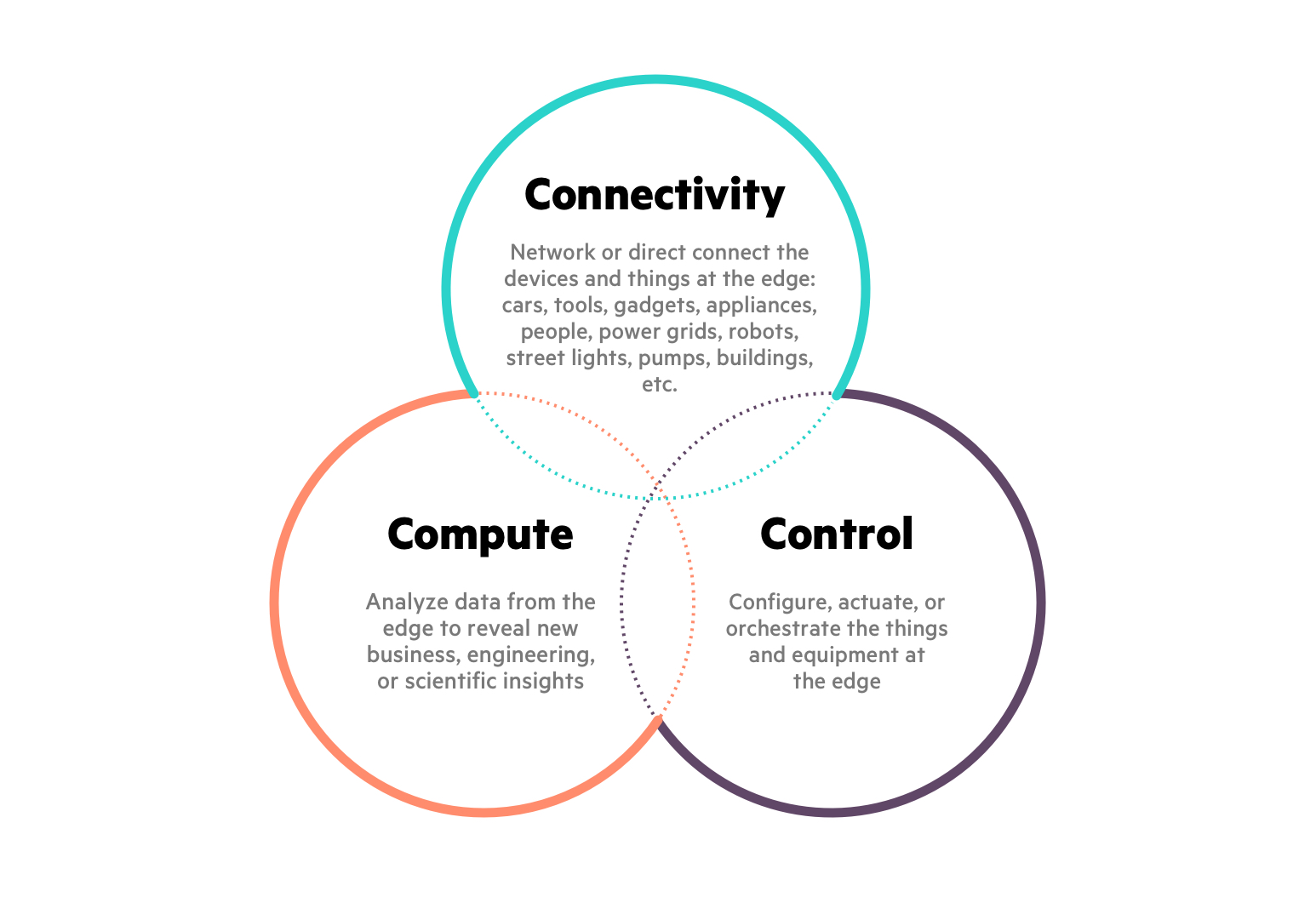
The 3 Cs of the Intelligent Edge: Connectivity, connect and compute
Now consider how an employee with a smartphone app entering a large office building or campus with wireless location services can find a conference room, printer, or people without asking directions. This immediate insight into where the employee resides in relation to these other connected things greatly enhances the experience in this smart building. It's very similar to the retail shopping experience offered by many large retailers, where customers can access turn-by-turn directions on their phones to locate products, figure out what's on sale, or find the restroom. The media and telecom industries face growing distribution pressures from increased video resolution, new formats, expanding bandwidth, and the need for better security and reliability. As a result, telecom service providers are placing sophisticated compute and control systems in businesses and homes. These distributed intelligent edges make the services more competitive and improve customer experiences.


Ethereum thinks it can change the world. It’s running out of time to prove it.

Ethereum is already the most famous cryptocurrency after Bitcoin and the third largest in total value. Unlike the others, however, it aims to serve as a general-purpose computing platform that could, its adherents believe, make possible entirely new forms of social organization. The central topic of Devcon is “Ethereum 2.0,” a radical upgrade that would finally allow the network to realize its true power. The nagging truth, though, is that all the positivity in Prague masks daunting questions about Ethereum’s future. The handful of idealistic researchers, developers, and administrators in charge of maintaining its software are under increasing pressure to overcome technical limitations that stymie the network’s growth. At the same time, well-funded competitors have emerged, claiming that their blockchains perform better. Crackdowns by regulators, and a growing understanding of how far most blockchain applications are from being ready for prime time, have scared many cryptocurrency investors away


APT10 Indictments Show Expansion of MSP Targeting, Cloud Hopper Campaign

The allegations are not new but are almost certain to put further pressure on the already strained relationship between the US and China. The Washington Post last week, in fact, had described the then forthcoming indictments as part of an intensifying US campaign to confront China over the economic espionage activities. Planned actions include sanctions against individuals responsible for the activities and declassification of information related to the breaches. How far such measures will go to deter China remains an open question. Though China famously signed an agreement with the US in 2015 promising not to engage in cyber activities for economic espionage, there's no evidence that hacking activity out of the country has even abated, far less stopped. Dave Weinstein, vice president of threat research at Claroty, sees the latest actions as yet another example of the effort law enforcement is putting into investigating and holding accountable those responsible for such attacks.


Quote for the day:


"What you do makes a difference, and you have to decide what kind of difference you want to make." -- Jane Goodall


Daily Tech Digest - December 21, 2018

GDPR: EU Sees More Data Breach Reports, Privacy Complaints
The number of data breach reports filed since GDPR went into effect has hit about 3,500 in Ireland, over 4,600 in Germany, 6,000 in France and 8,000 in the U.K. GDPR also gives Europeans the ability to file class-action lawsuits against breached organizations, and some law firms have already been exploring these types of actions. And under article 77 of GDPR - "Right to complain to a supervisory authority" - Europeans can also file complaints with regulators about organizations' data protection practices, as they were also able to do before enactment of the new regulation. Regulators say these complaints have also been increasing. Numerous national data protection authorities say they have seen an increase in both complaints as well as breach reports. But as information security expert Brian Honan has told Information Security Media Group, the increase in data breach reports does not mean there has been a surge in data breaches


Everything you need to know about the CDO explained

Because the role is so reliant on the use of technology, there is an overlap with the CIO position -- and there's some competition as a result, says Ellis. Yet rather than being experts in IT implementation, CDOs are commonly characterised as change agents. "Where CDOs can be very effective, and can initiate new approaches quickly, is where they buy cloud services and avoid in-house IT development in a traditional sense," says Ellis. "CIOs remain the owners of the technology infrastructure of any company." CDOs tend to be strong communicators. They talk about the power of disruption and get people to buy into change. Darren Curry, CDO at NHS Business Services Authority, says the role is about more than implementing digital services. "I support people, identify a vision and enable our people to do their very best," he says. "I see myself as leader who removes the blockers and barriers to allow our people to achieve their aims for our services. That's what I feel any leader -- whether that's a CDO or another senior role -- should be working to achieve."


Want to use AI and machine learning? You need the right infrastructure
Regardless of use case, AI/ML success depends on making the right infrastructure choice, which requires understanding the role of data. AI and ML success is largely based on the quality of data fed into the systems. There’s an axiom in the AI industry stating that “bad data leads to bad inferences”— meaning businesses should pay particular attention to how they manage their data. One could extend the axiom to “good data leads to good inferences,” highlighting the need for the right type of infrastructure to ensure the data is “good.” Data plays a key role in every use case of AI, although the type of data used can vary. For example, innovation can be fueled by having machine learning find insights in the large data lakes being generated by businesses. In fact, it’s possible for businesses to cultivate new thinking inside their organization based on data sciences. The key is to understand the role data plays at every step in the AI/ML workflow.


The Role Of Data Governance In An Effective Compliance Program

Data governance becomes more important the more systems and applications a compliance function uses. Compliance officers want systems that store data in a single repository with standardized data formats because strong data governance ensures accurate reports. From there, compliance officers can make accurate decisions based on what the data tells them. Here’s the rub: The current landscape of compliance technology is composed of many disparate systems that don’t integrate with each other. Compliance officers are often stuck searching for critical data and don’t have a connected approach to the technology that supports their program. They want and need a system that stores data in a single repository with standardized data. How can data governance fix this problem? Automating a compliance program’s many tasks helps to create a unified operations environment. In this paradigm, the compliance function goes beyond its tasks of third-party due diligence and training. 


Scaling Observability at Uber

Srivatsan states that "high cardinality has always been the biggest challenge for our alerting platform." As Aaron Sun writes, "cardinality in the context of monitoring systems is defined as the number of unique metric time series stored in your system's time series database." Originally, Uber handled their high cardinality by having alert queries return multiple series and having rules that trigger only if enough series crossed a threshold. This worked well with queries that returned a bounded number of series with well-defined dependencies. However, once teams started writing queries to alert on a per city, per product, and per app version to support their new product lines, the queries no longer fit this constraint. The team began leveraging Origami to help with these more complicated queries. As noted above, Origami is capable of deduplication and rollup of alerts. It is also capable of creating alerts on combinations of city, product, and app version which are then triggered on aggregate policies.


5 steps to getting started with robotic process automation

At the extremes, some businesses go big and “all in” right away, while others are more measured with an individual use case to provide proof points before further deployment. Many others take a hybrid approach that lies somewhere in between. Getting started with RPA may look different from business to business, but designing a proof-of-concept project is often the best way to jumpstart RPA efforts in your organization. Depending on the structure of your organization, change may not always come swiftly. Executives need proof points when making major decisions such as augmenting or flat-out reimagining long-standing processes. When it comes to RPA, using these five steps to assess your organization's processes and determine which would make for a high-impact proof of concept will set you up for both short- and long-term automation success. And remember — it’s not about replacing jobs. It’s more about handling mundane or time-consuming tasks in a more efficient manner to enable your teams to spend more time concentrating on meaningful work.


Hackers Bypass Gmail, Yahoo 2FA at Scale

Amnesty discovered several credential phishing campaigns, likely run by the same attacker, targeting hundreds of individuals across the Middle East and North Africa. One campaign went after Tutanota and ProtonMail accounts; another hit hundreds of Google and Yahoo users. The latter was a targeted phishing campaign designed to steal text-based second-factor codes. Throughout 2017 and 2018, human rights defenders (HRDs) and journalists from the Middle East and North Africa shared suspicious emails with Amnesty, which reports most of this campaign's targets seem to come from the United Arab Emirates, Yemen, Egypt, and Palestine. Most targets initially receive a fake security alert warning them of potential account compromise and instructing them to change their password. It's a simple scheme but effective with HRDs, who have to be on constant high alert for physical and digital security. From there, targets are sent to a convincing but fake Google or Yahoo site to enter their credentials; then they are redirected to a page where they learn they've been sent a two-step verification code.


FBI kicks some of the worst ‘DDoS for hire’ sites off the internet

US-JUSTICE-POLITICS-COMPUTERS
Several seizure warrants granted by a California federal judge went into effect Thursday, removing several of these “booter” or “stresser” sites off the internet “as part of coordinated law enforcement action taken against illegal DDoS-for-hire services.” The orders were granted under federal seizure laws, and the domains were replaced with a federal notice. Prosecutors have charged three men, Matthew Gatrel and Juan Martinez in California and David Bukoski in Alaska, with operating the sites, according to affidavits filed in three U.S. federal courts, which were unsealed Thursday. “DDoS for hire services such as these pose a significant national threat,” U.S. Attorney Bryan Schroder said in a statement. “Coordinated investigations and prosecutions such as these demonstrate the importance of cross-District collaboration and coordination with public sector partners.” The FBI had assistance from the U.K.’s National Crime Agency and the Dutch national police, and the Justice Department named several companies, including Cloudflare, Flashpoint and Google, for providing authorities with additional assistance.


Connecting Business Challenges and Emerging Technologies

Robotic Process Automation (RPA) can be used to automate tasks previously done by human beings, said O’Carroll. It is often applied to repetitive and mundane tasks – the ones often seen as boring. With RPA you can have a robot doing it for you, she said. Solutions based on RPA technology have decisions built in which enable you to do creative work. She explained how you could train a robot to do purchase orders by building rules to extract information from an email, enter the information into the purchase order system, and generate the purchase order. O’Carroll mentioned use cases for RPA: case management (for instance in healthcare), HR for administrating joiners, movers, people leaving, and banks. It can be cheaper to do these activities with robots, and automation can give people more time to spend with customers, she argued. Machine learning (ML) and artificial intelligence (AI) are a different kind of technology as they are based on how our brain works with neural networks, said O’Carroll. It’s about predicting the right answer and getting better at it.


How AI-powered commerce will change shopping

If you think AI is over-hyped from a commerce point of view, think again. Research shows that customers are 9.5X more likely to view AI as revolutionary versus insignificant. Within the next five years, 87 percent of customers believe AI will have transformed their expectations of companies. But how, exactly, is AI changing expectations? While pop culture sometimes paints AI with a scary science-fiction hue, the truth is that many AI-driven experiences are winning customer appreciation, if not affection. A majority of customers say they like or love AI-powered capabilities like credit card fraud detection, personalized recommendations, and voice-activated personal assistants. And today, "personalized recommendations" doesn't mean merely adding an individual's name to an email subject line. We're talking about uber-personalized communications; 59 percent of customers say tailored engagement based on past interactions is very important to winning their business.


Quote for the day:


"Leaders think and talk about the solutions. Followers think and talk about the problems." -- Brian Tracy


Daily Tech Digest - December 20, 2018

Industrial IoT, fog-networking groups merge to gain influence

4 industrial iot robotics automation manufacturing code
“By expanding our pool of resources and expert collaborators, we will continue to accelerate the adoption of not only fog, but a wealth of technologies that provide the underpinnings to IoT, AI and 5G,” wrote Matt Vasey, chairman and president, OpenFog Consortium, in a blog about the merger. “Machines, things, and devices are becoming increasingly intelligent, seamlessly connected, and capable of massive storage with the ability to be autonomous and self-aware. Robots, drones and self-driving cars are early indicators of small and mobile clouds. Distributed intelligence that interacts directly with the world and is immersive with all aspects of their surrounding is the concept behind fog,” he said. Merging the two groups is a natural fit and helps consolidate an overly fragmented collection of groups striving to create standards in the large IoT market, said Christian Renaud, research vice president, internet of things, 451 Research, in a blog about the unification.


RaptorDB - The Document Store

xxxxxxxxxxx
The main driving force behind the development of RaptorDB is making the developer's and support jobs easier, developing software products is hard enough without complete requirements which becomes even harder when requirements and minds change as they only do in the real world. ... Document databases or stores are a class of storage systems which save the whole object hierarchy to disk and retrieve the same without the use of relational tables. To aid the searching in such databases most Document store databases have a map function which extracts the data needed and saves that as a "view" for later browsing and searching. These databases do away with the notion of transactions and locking mechanism in the traditional sense and offer high data through-put and "eventually consistent" data views. This means that the save pipeline is not blocked for insert operations and reading data will eventually reflect the inserts done ( allowing the mapping functions and indexers time to work).


How to Make Cross-Functional Operations a Team Effort

Cross-functional collaboration, if done right, can make a company leaner and more innovative from the ground-up by reducing groupthink, because all decisions are taken through a cooperative and creative process with singular focus on the achievement of each organizational goal. Data supports this observation. A study of over 1100 companies shows that companies that embraced collaborative working are five times as likely to be high performing than those that don’t. If cross-functional teams are so awesome, why don’t we see more of them? Because they’re devilishly hard to manage and steer towards delivering real results, that’s why. Behnam Tabrizi, who teaches transformational leadership at Stanford University, reveals a shocking insight from his research– nearly 75% of cross-functional teams are dysfunctional! So we have two facts that are equally compelling. First, well-oiled cross-functional teams are exponentially more successful than “regular” teams. Second, getting a cross-functional team to perform to their potential is hard, but definitely not impossible.


Mobile security needs a rethink for the 5G era


“We are expecting the first 5G enabled services to come to market next year and we are already doing significant work across the UK test beds,” said Rahim Tafazolli, University of Surrey Regius professor and founding director of the 5GIC. “The benefits of being prepared for what 5G offers are clear for all to see. “Performance risk in such a complex network means that we need to reconsider many of our digital security processes. We believe that with the sound recommendations made in this paper, the UK will be in a good position to continue our leadership position in 5G innovation, development and deployment.” Peter Claydon, project director of AutoAir, said: “Since the age of 2G, mobile networks have been some of the most secure things on the planet, helped by the fact that each one is controlled by a single network operator. 5G opens up mobile networks, allowing network operators to provide ‘slices’ of their networks to customers.


Top smart city predictions for 2019

smart cities
It will be a breakthrough year. We will see a move from pilots/proof of concepts to at-scale implementations. As with any first wave of adoption, this will result in exciting breakthroughs and early learnings. There will be citizen impact; in general, citizens will be more engaged and will push city leaders for impact. Millennials and social media will play a more vocal role in the smart cities conversations and start influencing electability. Equitable access and growth will be a key focus. The focus will move from an umbrella conversation to the top specific use cases: public safety, transportation, resilience and sustainability, and new business models. Infrastructure with vision/sensing capabilities will become real. Teamwork makes the dream work. A global fraternity of cities will start manifesting itself. We will see a much greater trend of cities reaching out and sharing key learnings. The cross-pollination of human talent between public and private sector as it relates to smart cities will be visible. This will help accelerate the overall adoption.


Chinese hackers tap into EU diplomatic communications network

An assessment of Chinese military capabilities conducted by the US Department of Defense (DoD) suggested that the country "saw cyber operations as a low-cost deterrent that can demonstrate capabilities and challenge an adversary." Deterrent it may be, but China has been accused of being behind a range of cyber assaults for years. The US has charged a number of hackers for allegedly belonging to the PLA and conducting cyberattacks of political interest on the unit's behalf. Despite an agreement forged between the US and China in 2015, US government officials warned this year that Chinese hacking activity has increased. Chinese officials have always denied such allegations. The researchers say that the threat actors responsible were able to compromise the network via a successful phishing campaign. However, the team also claims that the attack is part of a larger scheme which has also targeted the United Nations and the American Federation of Labor and Congress of Industrial Organization


Security Architecture for Smart Factories

security architecture for smart factories
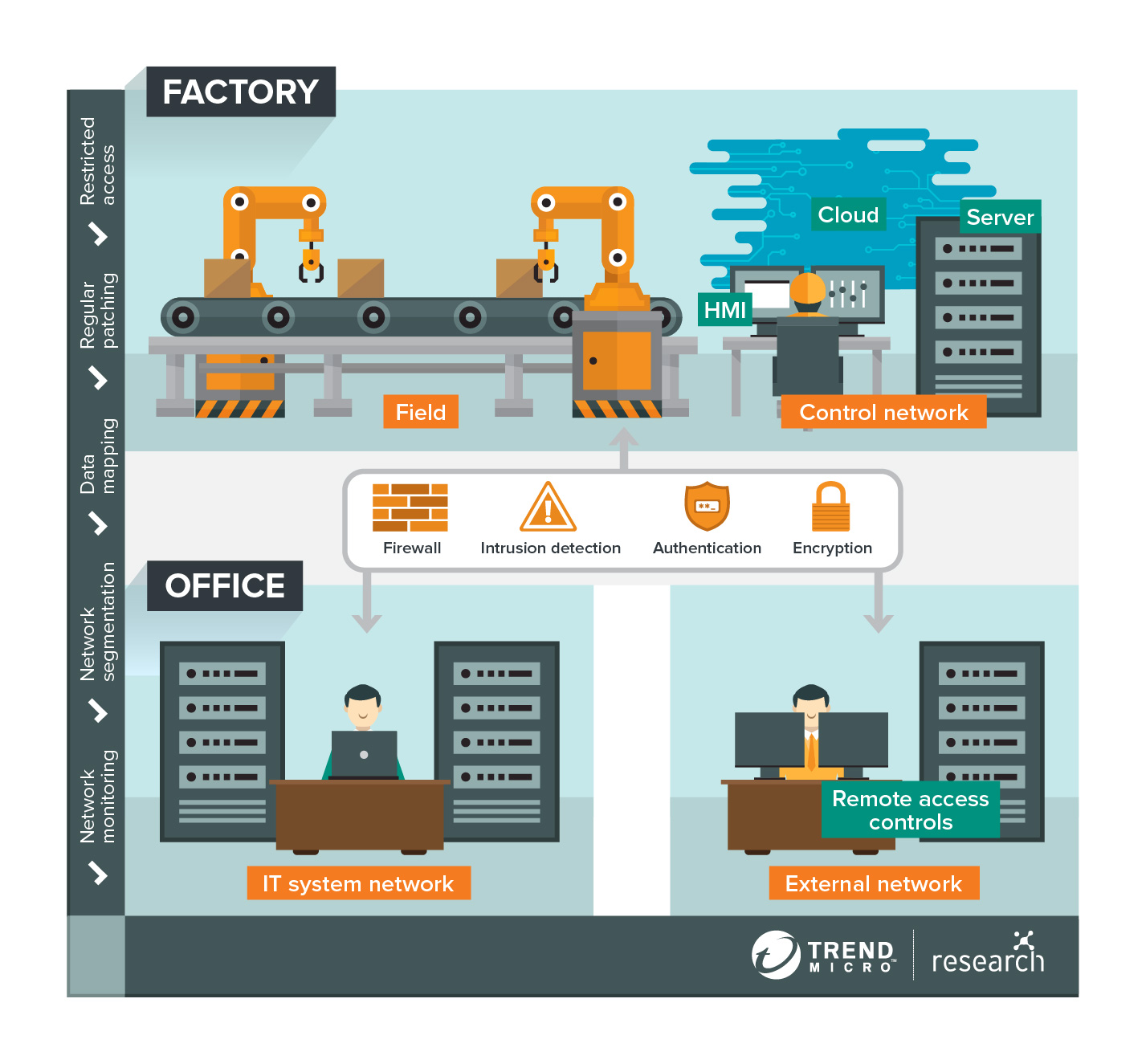
Smart factory operations are data-driven. The abundance of data a smart factory harnesses can include the amount of raw materials it has in storage, the production speeds of its machines, the location of ongoing deliveries, and a great deal more, depending on its industry. Big data allows the smart factory to paint a virtual copy of physical operations that is used to carry out functions such as predicting outcomes and making autonomous decisions. Organizations should be prepared for the vast amount of data this entails. They should be able to identify the types of data to be used and map out its course from collection and transfer to processing and storage. Mapping also means noting all possible exit and entry points. Personnel, for example, can move information from the office to the factory using external storage devices like USB flash drives. Terminals can also be taken in and out of factories for servicing. Aside from setting security protocols for personnel in handling such scenarios, tools should also be used to make sure that these portable devices are clean and virus-free before being connected or reconnected to the factory’s systems.


What Is Shadow DOM, and How Do You Use It?

Shadow DOM may have a name that conjures images of a dark world. But it’s actually a pretty neat feature of modern browsers, allowing for easy encapsulation of DOM elements and smart web components. If you‘re a front-end developer, you’ll likely benefit from understanding how Shadow DOM works and what it can do for you. That’s what this article explains. Keep reading for an introduction to Shadow DOM. ... One interesting thing to note is that, while JavaScript events are retargeted to the parent element in order to avoid exposing access to the internal Shadow DOM elements, these same elements can be interacted with using CSS as long as you know what the elements are and how to access them. But, as cool as it is, how can we best utilize the ... Because none of the code inside a Shadow DOM element can affect anything outside of it, the Shadow DOM is an excellent tool for encapsulation. In some circumstances, obscuring elements may be used as well; however, this method is hardly fool proof, so you are better off reaping the benefits of the encapsulation and management features instead.


Threat Hunting for the Holidays


How will you know for sure if a threat has evaded detection and is now inside your network? Yes, you can scour through every piece of research available about the threat. You can then comb through stacks of network logs across your environment to find anomalies and suspicious behavior. But won’t it take you days or weeks to find out how the threat got in, all the places it has been, and everything it did? And, will your boss have the patience to wait for your definitive response? There’s a better way. Cisco helps boost your ability to conduct threat hunting and incident response activities with a set of integrated tools that allows you to proactively search for threats and understand the full scope of a compromise. And upon seeing a threat in one place, Cisco gives you the ability to automatically block it everywhere else. As part of this integrated security architecture, Cisco Threat Response speeds threat hunting by gathering, combining, and correlating threat intelligence available from: 1) your recorded network and security data, 2) Cisco Talos, 3) other Cisco products, and 4) third-party solutions.


The Manual Regression Testing Manifesto

The manual regression testing manifesto provides a couple of things. First, it helps define a clear line differentiating feature testing from regression testing, a difference that is often a challenge for testers and management. Each core principle in the manifesto focuses on two elements that both have value in testing. By contrasting their relative value, we define expectations for testing throughout the release cycle. It’s not that one is bad and the other good, it’s that there is a time a place for each and testers need to be able to speak to that difference. Second, it provides a framework to start discussing quality and how testers contribute to it. It’s easy for people to typecast testers as nefarious breakers of software, when in reality we probably love the software we are testing as much or more than the developers writing it. We don’t have the bond of the creator yet we spend countless hours working with it just trying to ensure its success. Teams spend a great deal of time discussing coding standards and practices, but code is much more tangible and measurable than testing and quality.


Quote for the day:


"Leaders are more powerful role models when they learn than when they teach." -- Rosabeth Moss Kantor


Daily Tech Digest - December 19, 2018


For tech companies, the worst-case no-deal Brexit could see data flows between the UK and Europe cut or significantly curtailed, major difficulties with recruiting staff from Europe and sending staff to Europe to work on projects, problems with importing products and spare parts, plus a generally worsening economic situation. In fact, the impact of a potential no-deal Brexit is already being felt. Larger tech companies are spending a lot of time figuring out their response to Brexit and are putting in place or triggering various contingency measures. Meanwhile, smaller businesses don't necessarily know where to start or what the implications of a no-deal might be, and don't have the time, money or resources to deal with it anyway. Many firms will simply find it impossible to plan for a no-deal Brexit, says Nigel Driffield, professor of strategy and international business at Warwick Business School.


Open-source containers move toward high-performance computing

Open-source containers move toward high-performance computing
Until quite recently, the high-performance market with its emphasis on big data and supercomputing, paid little attention to containers. This was largely because the tightly coupled technology model of supercomputing didn't fit well into the loosely coupled microservices world that containers generally serve. There were security concerns, as well, since. For example, Docker applications often bestow root privileges on those running them — an issue that doesn't work very well in the supercomputing world where security is exceedingly important. A significant change came about when Singularity — a container system with a focus on high-performance computing — became available. Now provided by Sylabs, Singularity began as an open-source project at Lawrence Berkeley National Laboratory in 2015. Singularity was born because there was a lot of interest in containers for compute, but the commonly used containers (Docker) at the time did not support compute-focused, HPC-type use cases.


Privacy no more: How machine learning in the cloud will strip us naked

Machine learning is an essential part of the digital transformation trend in the modern enterprise. The ability to gain insight into business processes through what is measurable using different types of sensors, and to correlate that data using pattern analysis, is an increasingly important capability that is quickly becoming an essential part of the overall IT toolbox.  For example, companies like SAP, through Leonardo Intelligent Enterprise products, have brought together IoT along with finished application platforms deployed as cloud-based SaaS, which can be easily customized so that enterprises can create complex data visualizations in order to gain insight when solving complex business problems.  Understanding patterns and trends through big data is nothing new: The National Security Agency has been doing complex signal intelligence (SIGINT) for many years in order to defend the country from terrorist and foreign threats.


What is SWOT analysis? A strategic tool for achieving objectives

What is SWOT analysis? A strategic tool for achieving objectives
SWOT analyses from major corporations can help you get an idea of how the process works. Strategic Management Insight offers examples of SWOT analysesfor a wide range of companies, including Google, Starbucks and Amazon.  Its example SWOT analysis of Microsoft evaluates the potential impact of a major leadership change in the organization — in this case, the hiring of CEO Satya Nadella. SM Insight identifies Microsoft’s strengths as the company’s brand awareness, it’s wide acceptance in the enterprise, easy-to-use products, a worldwide network of distributors and an ability to beat analyst’s expectations. Weaknesses include being late to mobile computing, a lack of urgency when the internet was introduced and security flaws in its software. Cloud computing was seen as a big opportunity for Microsoft at that time, as the organization had the chance to take the lead in this trend, and the company was economically strong. Microsoft’s biggest threats included the company’s size, which can slow progress, as well as a failure to notice emerging trends, piracy and lawsuits.


ThoughtWorks COO reveals his top tech predictions for 2019

Companies will continue to leverage technology to gain efficiencies and cost savings. But replacing jobs with machines leads to a zero-sum game and will only take you so far, given its deleterious impact on society and the economy. At ThoughtWorks, we believe that humans and machines can collaborate and this intelligent co-working is what we call Humanity Augmented. Humanity Augmented makes available intelligent tools to augment human capability; aiding in better and quicker decision making, reducing and eliminating mundane and repetitive tasks and allowing people to spend time unleashing their creativity on more complex and fulfilling work. By bringing together human experience and intuition and the ability of machines to process humongous volumes of data, we will be able to address the short-term job losses and in the long-term tackle long- standing issues that the human race faces.


Tech sector vacancies increase by almost a quarter in 2018


The industry is already concerned that not enough people are choosing to study science, technology, engineering and maths (Stem) to fill the growing digital skills gap, and it is estimated that the UK’s digital economy will need about 2.3 million skilled workers by 2020. Kaiser pointed out that developing technical skills is important, but encouraging more people from different backgrounds into tech could also help to close the skills gap. “Developing technical skills, whether that’s studying computer science or learning new coding languages, can open the door to all kinds of careers, from design to technology marketing to managing a business division,” she said. “Yet too often there is a flawed perception that some groups, such as women or BAME [black, Asian and minority ethnic] individuals, don’t belong in Stem professions.” But breaking down industry stereotypes to encourage people from diverse backgrounds to consider Stem careers is only one way to tackle the looming skills gap.


Step-by-step guide to a blockchain implementation

Banks are under particular pressure to get going on blockchain implementations because they're facing pressure on three fronts, said Jeff Garzik, co-founder at Bloq, a startup focused on helping enterprises build blockchain platforms. Technology companies like Apple and Google are rolling out payment software; telecom companies are enabling consumers to use their mobile phones as a bank account, to pay bills and send money; and cryptocurrencies such as Bitcoin and Ethereum, which are underpinned by blockchain technology, are being used to disrupt banks much the same way tech and telecom companies are. But, he said, the disintermediation to banks will not be all-encompassing. "You're not going to have Aunt Joan and Uncle Joe store all of their wealth on their smartphone, for example. Banks are still going to exist and provide loans and provide services that strictly cashlike Bitcoin and Ethereum systems do not provide."


How to develop a data culture within your organisation


Because data is so pervasive, it reaches beyond people’s professional trades and competences. Everyone has a role in data, either as a data owner, a data process owner or simply as a user. The challenge of developing a data culture is not only to make people comfortable with data, but to make them data-savvy. As an encouraging factor, the CDO who succeeds in this endeavour will find his reward in a job that becomes much more gratifying. This challenge requires the leadership to pay more attention to people’s skills and mandates than to their titles and seniority because a data culture is truly a collaborative culture. Developing a collaborative mindset and acknowledging the dependency on people regardless of pay rate is perhaps the most difficult part of developing a data culture because dependencies can seem frightening. The mission can essentially be boiled down to three actions that are required to develop a data culture and enhance the confidence in the people and processes that make up the data culture


Memes on Twitter Used to Communicate With Malware

What's noteworthy about the new Trojan is its use of the Twitter memes to retrieve malicious instructions, according to Trend Micro, the first to report on the threat. The authors of the malware—currently unknown—posted two tweets featuring the malicious memes in late October using a Twitter account that appears to have been created last year. Embedded in the memes is a /print command that basically instructs the infected computer to take screen shots and perform other malicious functions. The malware extracts the command after first downloading the malicious memes to the infected system. The malware supports a variety of other commands including /processos for retrieving a list of running processes, /clipfor capturing clipboard contents, and /username for grabbing the username from the infected system. The screenshots and other captured data are then sent to a control server whose address the malware obtains via a hard-coded URL on pastebin.com, Trend Micro said in a report on the attack.


McAfee researchers analyze cybercriminal markets, reveal tactics, targets

analyze cybercriminal markets
In an effort to evade law enforcement and build trust directly with customers, some entrepreneurial cybercriminals have shifted away from using larger markets to sell their goods and have begun creating their own specialized shops. This shift has sparked a new line of business for website designers offering to build hidden marketplaces for aspiring shady business owners. “Cybercriminals are very opportunistic in nature,” said John Fokker, head of cybercriminal investigations at McAfee. “The cyberthreats we face today once began as conversations on hidden forums and grew into products and services available on underground markets. Additionally, the strong brands we see emerging offer a lot to cybercriminals: higher infection rates, and both operational and financial security.” Hacker forums provide an elusive space for cybercriminals to discuss cybercrime-related topics with their peers. McAfee researchers witnessed conversations around the following topics in Q3


Quote for the day:


"The signs of outstanding leadership are found among the followers." -- Max DePree


Daily Tech Digest - December 18, 2018


The banking CFO’s future looks promising, but there are barriers to success. Banks have been relatively late adapters of some important new technologies; for example, nearly half (43%) of banks told us they do not have a cloud strategy in place or have only started to implement basic cloud practices. Bank CFOs often need to work around a legacy architecture that hampers access to big data and makes it more difficult to plug in analytics, perform stress-testing and satisfy regulatory demands for high-quality, comprehensive data. The to-do list for banking industry CFOs is a long one – they must demonstrate the benefits of technology in their own functions, recruit data scientists and other needed talent to new roles in finance, and champion innovation throughout the organization. But, as respondents told us, there has never been a more exciting time to work in finance. The digital transformation of banking should position CFOs not only as trusted advisers but as the developers of new sources of value for their organizations.


An Interview with Greg DeArment, Head of Infrastructure at Palantir

Modern applications are developed to run in “containers”, a way of packing applications and necessary dependencies in a portable, standardized format. This makes deploying easier and more repeatable across environments than deploying software directly on bare bones operating systems. Enterprise architects and developers are probably familiar with the container solution Docker, but there are many others and even a standard for containers called OCI for Open Container Initiative (OCI). Whatever the container solution, there is a need for better orchestration and management of the containers. This is where Kubernetes comes in. ... Most open-source compute platforms today, such as Hadoop Yarn, lead to a trade-off between security and robustness of the toolset users have at their disposal to empower their business. With Kubernetes, we can enable Foundry users to work with the tools of their choice without compromising the security posture of the platform and putting at risk the security of our customers’ data. 


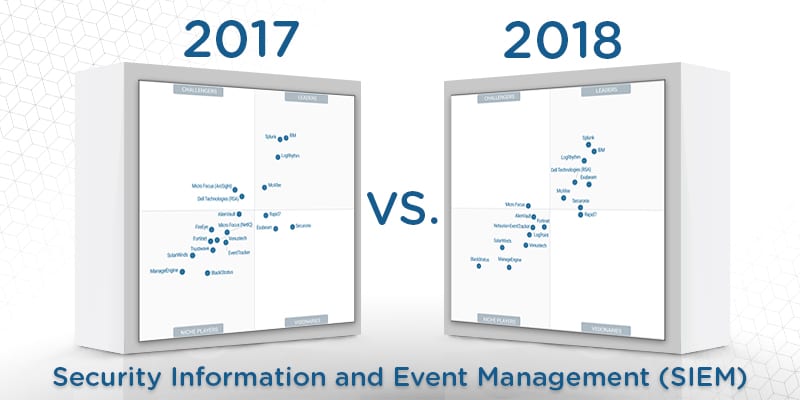
What̢۪s Changed? The Gartner 2018 SIEM Magic Quadrant
Gartner readjusts its Magic Quadrant evaluation criteria, usually in response to market changes, each year. Therefore, vendors who appeared in the MQ report one year may not return for the next one. By the same token, vendors who once did not make the cut in a previous report may find themselves on the next iteration.  Gartner’s states in its report that a vendor’s appearance or disappearance from the quadrant is not a reflection of a change in quality or in opinion, but simply a result of market changes and updated inclusion criteria.  LogPoint made the cut for the 2018 SIEM Magic Quadrant, having met all of Gartner’s inclusion criteria. By the same token, three vendors who previously appeared did not meet the inclusion criteria in this year’s report. Gartner excluded Trustwave and FireEye, as both vendors shift focus from SIEM to managed services and platforms. In addition, Micro Focus (NetIQ) Sentinel lost Gartner’s coverage as the vendor focuses on its ArcSight product instead.


Warding off security vulnerabilities with centralized data

Centralizing information also means that no information should be stored on local devices. USB keys are one of the biggest offenders. These devices are often lost or stolen. In late 2017, a USB stick with highly confidential Heathrow Airport security data was found on the street. The drive’s files included detailed airport security and anti-terror measures. Moreover, people tend to use USB keys that they’ve gotten for free from conferences. It’s possible that these devices have been intentionally infected with viruses. A security event in Taiwan recently awarded quiz winners USB sticks that contained malware designed to steal personal information. That’s not all, the list of USB drive-related incidents goes on. There is also the possibility that your phone or laptop will be lost or stolen. Those odds become even greater when you’re traveling or running between meetings, events, and other appointments. If you have all of your files saved directly on your physical laptop or phone, you’re presented with an obvious problem.


Network Innovation or Iteration? – A Matter of Perspective

networkinnovation
Enterprises have taken notice of what the web scale providers, like Amazon, are achieving, and want to duplicate those strategies. The problem is, most companies do not have teams of developers to build custom network infrastructures, nor the resources to support them. In addition, the network traditionally is not included as a key part of the core business plan. Rather, the network is just one of many tools in IT’s toolbox, often deployed ‘out of the box’ and relied upon to perform and support the demands of the business.  So, while they want the same network agility and manageability the web scale companies enjoy, enterprises struggle to achieve agility and performance based on the available iterations of technology presented to them by known vendors. In addition, network innovation presents an exceptional challenge due to the silos created around network roles and the need for IT staff to manage the network. Because of this isolation, it is easier to pass through iterative solutions as new and continue the cycle of inefficiency.


New chip techniques are needed for the new computing workloads

New chip techniques are needed for the new computing workloads
Intel has designed a new approach. Called Foveros, it allows many different chips built with different technology “nodes” and of different functionality to be stacked on top of each other with very fast communications between them. It also has sufficient power and heat transfer to make the resulting device nearly as effective as a monolithic chip. This type of technology has always been attractive, but it’s only now that Intel has found a way to make its performance and cost of manufacture competitive. ... Some would say Intel is moving down this route because it lost its once two- to three-year advantage in process technology to more nimble players (e.g., TSMC). Certainly Intel has much to do to fix its process manufacturing problems. But many future chips will need circuits that don’t always lend themselves to the most modern process (e.g., FPGAs for AI programming, non-volatile memories, Input/Output and communications/5G), nor do well being embedded in massive monolithic system chips.


Does AI Truly Learn And Why We Need to Stop Overhyping Deep Learning


Whether neural network, Naïve Bayes or simply linear regression, data scientists train their machine learning models on carefully constructed piles of training examples then claim their algorithms have “learned” about the world. Yet, machine learning is in reality merely another form of machine instruction, different from purely expert manual coding of rules, but still guided, with the algorithms and workflows manually tuned for each application. Why does this matter? It matters because as we increasingly deploy AI systems into mission critical applications directly affecting human life, from driverless cars to medicine, we must understand their very real limitations and brittleness in order to properly understand their risks. Putting this all together, in the end, as we ascribe our own aspirations to mundane piles of code, anthropomorphizing them into living breathing silicon humans, rather than merely statistical representations of patterns in data, we lose track of their very real limitations and think in terms of utopian hyperbole rather then the very real risk calculus needed to ensure their safe and robust integration into our lives.


How Governments Are Adopting Blockchain and AI In Advanced Economies

How Governments Are Adopting Blockchain and AI In Advanced Economies Part 2
The government of Denmark is looking into the use of AI and the blockchain in digital identity, healthcare, business support and its welfare system. Denmark is one of those countries which have ensured that most of its service provision to citizens is done digitally. Indeed, 90% of Denmark’s governmental services are already being done digitally (Basu, 2017). But the people want more. Danish citizens are demanding even faster response and delivery times for government services. Denmark is also being forced into the blockchain evolution by the country’s population demographics. Denmark’s ageing population means that fewer younger people are available to get into the public service. Therefore, this is a classical case where augmentation of the human workforce using the blockchain and AI is desirable. For Denmark, this has become a necessity, even though it can be quite controversial. Denmark has a welfare system which caters to retirees, vulnerable groups and pensioners.


Brute force and dictionary attacks: A cheat sheet

securityistock-1065755652bluebay2014.jpg
Brute force attacks involves repeated login attempts using every possible letter, number, and character combination to guess a password. An attacker using brute force is typically trying to guess one of three things: A user or an administrator password, a password hash key, or an encryption key. Guessing a short password can be relatively simple, but that isn't necessarily the case for longer password or encryption keys—the difficulty of brute force attacks grows exponentially the longer the password or key is. The most basic form of brute force attack is an exhaustive key search, which is exactly what it sounds like: Trying every single possible password solution (i.e., lowercase letters, capital letters, numbers, and special characters) character by character until a solution is found. Other brute force methods attempt to narrow the field of possible passwords by using a dictionary of terms (which is covered in more detail below), a rainbow table of precomputed password hashes, or rules based on usernames or other characteristics known about the account being targeted.


Practical CIO: Agility, speed, and business alignment

IT leadership is becoming proficient in all aspects of the business, whether it's marketing, whether it's HR, whether it's legal, whether it's advertising, whether it's the medical side. You have to become knowledgeable on how to apply that technology to get those wins and put game changers, from an IT standpoint, into the business so that you get future growth, you get further merger and acquisitions, scalability and flexibility but, at the same time, keeping it easy and simple. Typically, it's through research. It's peers, other CIOs across the industry, in other industries as well and, in my background, I've been in several different verticals within IT and in leadership, so transportation, retail, insurance, and so bringing that background, some of that background, that experience within healthcare. IT is IT, but how you solve those problems, I think you can bring experience and expertise. You can apply those and get wins in other verticals as well.


Quote for the day:


"Increasingly, management's role is not to organize work, but to direct passion and purpose." -- Greg Satell