Daily Tech Digest - January 13, 2021

Retrospective in Scrum & Agile: A Quick Start Guide for Managers

Speaking of Scrum, retrospective meetings play an important role in this agile framework for leading projects. Typically, retrospective reviews are held at the end of each sprint. Unlike other types of analytical meetings such as after-action reviews (AAR), project post-mortems, or agile sprint reviews (more on this in a moment), sprint retrospectives are organized with the team only (not managers or other stakeholders). It’s a ‘private’ ceremony, facilitated by a Scrum Master, where each person is asked to share their honest observations and feedback (without any blaming or shaming). A good Scrum Master can elicit answers to the following questions from the team: What went well during the sprint and what didn’t; Which areas are due for an improvement (across people-processes-tech).; and What should be added or removed from the current process? The purpose of such project retrospectives is to locate areas for improvement (similarly to what VSM does) and prompt the team to correct their behavior. But, unlike other types of ‘reflective meetings’, retrospectives are held at regular intervals during the project, not at its very end. ... In short, the difference between sprint review and sprint retrospective is the intention behind each meeting. The goal of a sprint review is to discuss the overall project progress including ‘done’ things, future project backlog, any bottlenecks, goals, plans, and timing.


6 Reasons to Start Managing Technical Debt in 2021

Technical debt is one of the reasons people leave - or asking themselves if they should leave. The Codeahoy survey found that 50% of developers surveyed are likely or 'very likely' to leave their jobs because of tech debt. Another 27% percent indicated that they think about it, but aren't sure. All in all, that's a sizable chunk of people who could be swayed by a compelling job offer from a competitor. Suppose your company is experiencing a high turnover of developers. Technical debt might be a factor, especially amongst those who are spending their time putting out fires in response to errors in legacy code at the expense of more exciting projects. ... Every minute spent on maintenance due to technical debt is a lost opportunity for innovation or value-adding work. Research by Accenture into Federal IT systems suggests that technical debt and resulting IT discontinuities impede Innovation and agility and engineering velocity suffers. 83% indicated that technical debt severely limits their ability to be innovative, and 79% report that it inhibits their responsiveness to change. Notably, only 38% of those surveyed were even estimating the cost of remediating technical debt.


Google: Our work to keep you safe and in control of your privacy

In 2020 we continued to invest in easy-to-use privacy and security settings, which are automatically built into every Google Account and Google products. How you use our products and services is a personal choice: When you sign up for Google products and services, we offer you settings that let you choose how to personalize your experience, and control what activity gets saved to your Google Account. And you can change these settings at any time. These privacy and security controls are available in your Google Account and the products you use every day across platforms and devices, including on iOS. For example, Your Data in Search, Maps and YouTube helps you easily understand how data makes these apps work for you and quickly access the right controls, directly in the apps. You can also just search for things like “Is my Google Account secure?” and a box only visible to you will show your privacy and security settings so you can easily review or adjust them. Google Pay, which was recently redesigned in the U.S., has strong privacy and security controls built-in that are easy to understand and simple to set up, access and manage.


How banks and financial services players will monetise open banking

“To provide real-time data sharing solutions through the pre- and post-transaction processing lifecycles allows automation and streamlining of operational processes as they [clients] do not have to rely on batch reports anymore, which are now perhaps legacy,” Vadakath says. Alongside this and fundamental to the success of the partnership between bank and corporate client, she explores how the purpose of APIs have been reinvented and today, they can be utilised as a client access channel and improves said access to various payment rails and a suite of treasury data solutions. In the custody space, as Wayne Hughes, head of data and digital for FI&C at BNP Paribas explores, there is no regulatory requirement for APIs, but the bank’s business goals are aligned with those at NatWest and BNY Mellon. Hughes explains that in addition to enhancing client experience with self-service, BNP Paribas are using APIs to optimise internal processes and build services that their customers will require in the future. “In providing our clients a new flexible means of interacting with their data, this will allow them to both directly extract their data into their platforms as they require and when they require, but also to allow us to implement new solutions and new packages,” such as a client facing chatbot that leverages natural language processing.


The CIO’s next key role: Change agent

As roles shift, Darren Ash, assistant CIO for the USDA Farm Production and Conservation Mission Area, says it’s critical for CIOs to act as an enabler and a partner with the business—not just to identify and deploy technologies to solve business problems, but to get everyone on board with new ways of working. Ash and his IT team do that through direct and sustained outreach to frontline workers in the various mission areas that comprise the USDA agency, including soliciting feedback from agency personnel and final customers to promote transformation. These efforts are designed to increase the stickiness of any digital initiative and to ensure everyone is onboard with the art of the possible when it comes to new implementations. “It’s our responsibility to better educate the business on technology and how it can be used,” Ash explains. “For us to drive change, we have to be better partners with the business, specifically the frontline employees across the mission areas and not just IT employees.” Ash and his CIO agency peers also make a point to have their teams capture the voice of the customer—in this case, farmers and ranchers dependent on agency services—to gauge what works or what can be done better and to foster organic support.


What Is A Time Series GAN?

Built on generative adversarial networks (GANs), Time Series GAN or TadGAN has been trained with cycle consistency loss to allow for effective time-series data reconstruction. With a claim to outperform baseline methods in most cases, the researchers are planning to present this novel framework at the upcoming IEEE BigData conference. The research was done in collaboration with satellite company SES, looking to leverage a deep learning approach to analyse vast time-series data from communication satellites. ... According to the researchers, there are two types of anomalies in time series data — point anomaly and collective anomaly. To flag both anomalies in time series domain, the researchers relied on GAN architecture, often used for image analysis, to generate time series sequences and outperform state-of-the-art benchmarks. Using the generator and discriminator functioning of the unsupervised learning of GAN architecture, the proposed model was able to flag anomalous data points. The researchers implemented five of the most recent deep learning techniques and compared their performances with a baseline method from the 1970s, ARIMA. While some deep learning methods were able to beat ARIMA on 50% of the datasets, two failed to outperform it at all, because of its ability to fit anomalous data well.


IoT 2020 in Review: The 10 Most Relevant IoT Developments of the Year

IoT played (and still plays) a crucial role in navigating the pandemic. A few IoT-centric use cases played (and continue to play) essential roles in helping the world navigate through the pandemic. The most notable ones include IoT-based contact tracing in workplaces, hospitals, and elsewhere (Example: Concept Reply Tracking & Location System) as well as product tracking and verification across the vaccine supply chain (Example: Controlant – see below).  Apart from those IoT 2020 use cases that support the “new reality”, a number of additional themes emerged, many of which have longer-lasting structural implications. IoT Analytics first published these observations in April 2020 in an analysis called “The impact of Covid-19 on the Internet of Things”.  A survey of 60 senior IT decision makers in manufacturing, transportation, and industrial companies, in October 2020 confirmed that nearly all of these 25 trends were perceived as having a longer-lasting effect on their organizations (The results were published in the “Industrial IT Outlook 2021” – available for download for corporate clients).


2021 Technology trend review, part 1: Blockchain, Cloud, Open Source

Open source is winning, in databases and beyond. Gartner predicts that by 2022, more than 70% of new in-house applications will be developed on an open source database, and 50% of existing proprietary relational database instances will have been converted or be in the process of converting. That was our opener for 2020, and if anything, it looks like the trend has accelerated. Open source use went up while the economy went down, and open source jobs are hotter than ever. Open source software is a boon for developers who use it, as it lowers the barrier to entry, and makes their skills transferable. But what about developers who create the software? They get the raw part of the deal, it would seem. The reality is that in the majority of open source software above a certain threshold of complexity, a core team of few people does most of the work. This empirical fact is backed up by analysis on Github data. We highlighted this theme in early 2020, following up on the New York Times article on the relationship between AWS and commercial open source vendors. Wired followed up with another article highlighting the ordeal of open source creators. Salvatore Sanfilippo, Redis' "benevolent dictator", stepping down from his role is another incident in a long chain of open source creators burnout.


How to prep for becoming an IoT leader

One area that will be important going forward is understanding how IoT and Industrial IoT (IIoT) will eventually merge. "There is a lot of existing infrastructure that is working well, but under-monitored and -utilized," Floyd says. It will be interesting to see how legacy industrial equipment will be adapted for greater efficiency and cost savings, he says. The growth of IoT and IIoT will likely lead to a "culture clash" between IT and operations/facilities, Floyd says, "and anyone who can traverse these two worlds, from either side, will find themselves indispensable." Overall, Floyd thinks gaining IoT skills and certifications has proven to be useful in advancing his career. "It provided a lens to view future technologies and their interconnectedness, as well as an avenue towards 'the next big thing' for a career," he says. "Understanding better how to guide a new technology [from] concept to approval and then through implementation and delivery are skills that can be applied to other enterprise technology projects." In addition, Floyd says acquiring these certificates demonstrates a dedication to advancing his career and displays a curiosity about future technologies. "When this topic does come up in my organization, people understand that I have some background, and I can advise if needed."


Productivity Life Hacks for Software Engineers (and All Knowledge Workers)

Why do we need sleep, anyway? Why shouldn't you routinely stay up late into the night coding? After all, time spent sleeping is time not spent getting work done. But, it turns out that sleep is crucial in retaining what you learn. It's during slow-wave sleep (SWS) and rapid-eye-movement (REM) sleep that the information you've learned is consolidated and stored in long-term memory. We sleep in cycles, so a short amount of sleep or a restless night of sleep means less time spent in these phases. To that effect, it is counterproductive to consistently spend late nights working and studying without giving your brain adequate time to process and save all this new information. Lack of sleep can also lead to irritability, the inability to focus, and lower productivity, which hurts your work performance as well as your relationships with your coworkers. Exercise is also important, not just for your body, but for your mind. show that exercise is linked to reduced stress, higher work performance, and increased creativity. Conversely, sitting for long periods of time is correlated with lower work output and poorer mental health. So next time you're feeling an afternoon slump, rather than reach for the caffeine, try taking a short walk.


Quote for the day:

"The greatest thing is, at any moment, to be willing to give up who we are in order to become all that we can be." -- Max de Pree

Daily Tech Digest - January 12, 2021

What industries need to avoid transformation limitations?

Already in 2020, we’ve seen dramatic change thanks to changing consumer habits, a year of online-shopping, a variety of item delivery, pick-up and return models, and store closures. These changes show no signs of slowing down in the years ahead. Likewise, another two industries that are going to undergo a sustained period of innovation-led change are the insurance and transportation industries, respectively. All three will be absorbed by broader, horizontal ecosystems. Although this change will be dramatic and may cause some unrest at first, ultimately, it will mean happier and more loyal customers and corporate leaders who are not under constant strain to reimagine the business. This change is just the tip of the iceberg. Today’s successful CEO would be wise to look at this trio of disappearing industries as canaries in the mineshaft. The evolution from vertically-oriented industries to horizontal ecosystems, constructed from a complex value chain of partners, has begun. Transportation, insurance, and retail represent the three first industries changing at a faster pace than other verticals. Any number of sweeping technological breakthroughs — artificial intelligence (AI), blockchain, the internet of things, and the data-crunching power of advanced analytics — will have a similar impact on other industries.


Addressing the lack of knowledge around pen testing

Pen testing will only be truly effective if it is implemented with the right processes, including both preparation and follow-up. Before carrying out the test, it is important to have the scope and boundaries thoroughly documented. This includes safeguards and processes to cover any issues that might result in discovery, particularly when social engineering and physical security are involved. We provide our team with Get Out of Jail Free cards that explain their purpose and who to contact at the business to avoid a scenario like the Iowa arrest. However, while someone at the organization must be aware of everything the pen testers may be doing, it would be ideal that as few people as possible know about it. It’s also important to have a clear strategy for following up once the pen test results are in. Organizations are often fixated on the number of issues a pen test uncovers (usually a greater number than they were expecting). This information alone is useless, and priority should be given to implementing a plan of action to close those gaps. Given the huge variation of potential threats, the results of a pen test can feel overwhelming and dispiriting. 


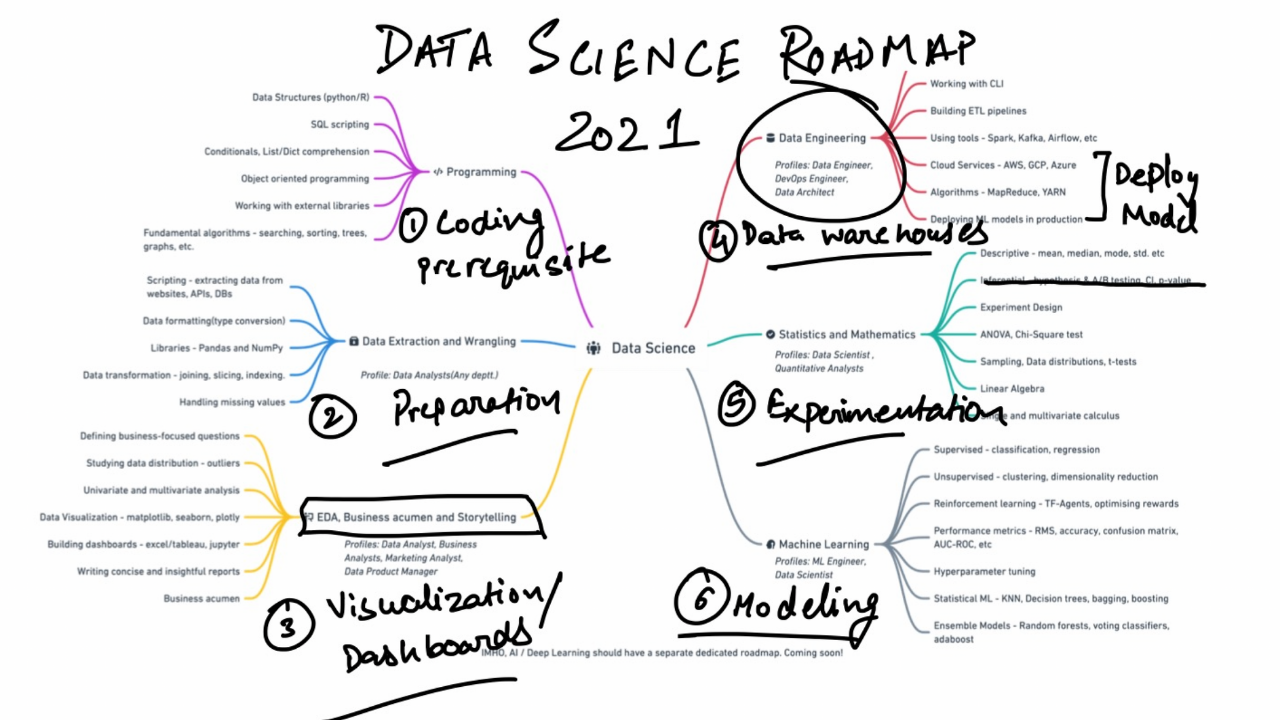
Data Science Learning Roadmap for 2021

A significant part of data science work is centered around finding apt data that can help you solve your problem. You can collect data from different legitimate sources — scraping (if the website allows), APIs, Databases, and publicly available repositories. Once you have data in hand, an analyst will often find themself cleaning dataframes, working with multi-dimensional arrays, using descriptive/scientific computations, and manipulating dataframes to aggregate data. Data are rarely clean and formatted for use in the “real world”. Pandas and NumPy are the two libraries that are at your disposal to go from dirty data to ready-to-analyze data.... Data engineering underpins the R&D teams by making clean data accessible to research engineers and scientists at big data-driven firms. It is a field in itself and you may decide to skip this part if you want to focus on just the statistical algorithm side of the problems. Responsibilities of a data engineer comprise building an efficient data architecture, streamlining data processing, and maintaining large-scale data systems. Engineers use Shell (CLI), SQL, and Python/Scala to create ETL pipelines, automate file system tasks, and optimize the database operations to make them high-performance.


Donkey: A Highly-Performant HTTP Stack for Clojure

Clojure makes writing concurrent applications easy. It frees the developer from the implications of sharing state between threads. It does so by using immutable data structures, as described by Rich Hickey in his talk The Value of Values: If you have a value, if you have an immutable thing, can you give that to somebody else and not worry? Yes, you don't have to worry. Do they have to worry about you now because they both now refer to the same value? Anybody have to worry? No. Values can be shared. Because all objects are immutable, they can be concurrently accessed from multiple threads without fear of lock contention, race conditions, proper synchronization, and all the other “fun” stuff that makes writing concurrent programs so difficult to get right. The downside is that every mutating operation produces a new object with an updated state. An inefficient implementation would cause a great deal of CPU time to be wasted on copying and creating new objects and, as a result, longer and more frequent GC cycles. Fortunately, Clojure uses a Hash Array Mapped Trie (HAMT) to model its data structures internally. By sharing structures that do not change, and copying only what does, it maintains immutability and thread-safety - and does so at a minimal cost.


The UK’s struggle with digital schooling

“There is a huge digital divide and it is getting worse with schools being shut down due to Covid-19. Teachers and school leaders are trying their best to continue with online teaching by providing resources, virtual check-ins and recorded lessons,” said EdTech adviser and consultant Joysy John, who added that many children cannot access these services due to a lack of technology or connectivity. “There are many new initiatives like Oak National Academy, National Tutoring Programme and free resources from Edtech companies, but these benefit those who already have digital access. So the digital divide is going to get wider unless the government thinks of a more holistic approach and provides disadvantaged parents with additional financial and educational support.” Once the lockdown was announced, education secretary Gavin Williamson outlined a number of plans for remote education, including the mandate for schools to provide a set number of hours of “high-quality remote education for pupils”. This is of no help to those without access to online learning, so the government has tried to address the digital divide causing disparity in home schooling during pandemic lockdowns by giving laptops to those from under-privileged backgrounds – something it began doing in the UK’s first lockdown.


SolarWinds Hack Lessons Learned: Finding the Next Supply Chain Attack

It is interesting to note that FireEye's initial detection of the SolarWinds compromise didn't find complex lateral movement, or even data exfiltration. What triggered FireEye's deeper investigation, according to reports, was an unusual remote user login from a previously unknown device with an IP address in a suspect location. It was only upon further review that FireEye discovered the intrusion and ultimately traced it back to SolarWinds. This scenario, now all too real for thousands of enterprises around the world, underscores the importance -- if not necessity -- of having behavioral analytics as a key component of contemporary enterprise cybersecurity product architectures. Behavioral analytics supercharges threat detection by not only analyzing event input based on activity from users and devices, but also by using machine learning, statistical analysis and behavioral modeling to correlate and enrich events. World-class behavioral analytics technology can factor in a wide variety of data points -- such as peer groups, IP association, personal email addresses, and kinetic identifiers like badge reader activity -- to identify a malicious intrusion by stitching together a half dozen or more events that, by themselves, would seem benign.


How IT must adapt to the emerging hybrid workplace

The implications for IT are many: extended support desk hours; remote-support and remote-management tools; work-specific user training; cloud enablement of all software possible; appropriate security for distributed work; enabling multiple forms of collaboration and related activities like scheduling, whiteboarding, and availability tracking; provisioning equipment to home-based workers and/or supporting employee-provided equipment; aiding Facilities in modernizing building technologies to avoid touch-heavy surfaces; and partnering more closely with HR for policy enablement and enforcement and for appropriate monitoring. ... The workforce will not all work in the traditional office or company location, nor will they all be remote. Many people will work from home, but many people still need to work in a corporate facility, such as a production line, data center, retail store, shipping center, lab, or even traditional office. And there are employees whose work is location-agnostic but who can’t work at home due to lack of space or insufficient internet access. Gartner’s Adnams estimates that — although it varies by industry — about half of the workforce in advanced economies will need to work in a corporate facility, 25% to 30% will work permanently at home


Spotlight on home-office connectivity intensifies in 2021

"As the pandemic wears on, we are seeing organizations solidifying their plans for remote working, including adding more sophisticated hardware and software for work from home, with primary drivers including security and productivity," said Neil Anderson, senior director of network solutions at World Wide Technology, a technology and supply chain services company. "For IT, this means quickly assessing and deploying new cloud-based security models and building trust quickly in a solution," Anderson said. "We're also seeing a lot of interest in experience monitoring and optimizing software to put better analytics in place around what the home-office employee app performance is like and how to make it better." While individuals have limited options to speed up their home-office connectivity, IT can step in to provide enterprise-grade services to high-value workers for whom every minute with clients, customers, and coworkers counts, wrote Jean-Luc Valente, Cisco vice president, product management, enterprise routing and SD-WAN, in a blog post about the future of home office connectivity. "The high-value workforce needs superior connectivity that makes working at home just as fluid as being in the office with consistent connectivity and performance. ... " Valente stated.


Competition and Markets Authority battles with cookies and privacy

The CMA said it had been considering how best to address legitimate privacy concerns without distorting competition in discussions of the proposals with the Information Commissioner’s Office (ICO), through the Digital Regulation Cooperation Forum. As part of this work, the CMA said it had been in discussions with Google to gain a greater understanding of the proposed browser changes. The current investigation will provide a framework for the continuation of this work, and, potentially, a legal basis for any solution that emerges. Andrea Coscelli, chief executive of the CMA, said: “As the CMA found in its recent market study, Google’s Privacy Sandbox proposals will potentially have a very significant impact on publishers like newspapers, and the digital advertising market. But there are also privacy concerns to consider, which is why we will continue to work with the ICO as we progress this investigation, while also engaging directly with Google and other market participants about our concerns.” The CMA said it has an open mind and has not reached any conclusions at this stage as to whether competition law has been infringed.


Verizon CEO Talks 5G, Drones, and Compute at the Edge at CES

The move to the higher capacity broadband standard has been trumpeted by others as the beginning of a new frontier with huge amounts of data moving wirelessly. Vestberg said the speed of 5G would reveal new possibilities that transform the world from playing video games to receiving deliveries. “Mobile edge compute will allow businesses to get things done more quickly and easily,” he said. Vestberg talked up the upload and download speeds of Verizon’s 5G Ultra Wideband network, which he said sees peak throughputs of at least 10 times faster that the 4G standard and more than 4 gigabits under ideal conditions. The extremely low lag of 5G, Vestberg said, could eventually make extremely delicate procedures such as remote surgery possible. He also expects the new broadband standard to ramp up the population of connected wireless devices. “In the future, 5G could support more devices than ever before,” Vestberg said. “Up to one million per square kilometer.” The wireless connections could also be support on devices moving more than 500 kmph, he said, allowing users to maintain signal on highspeed vehicles such as commuter trains, aerial drones, or self-driving cars.


Quote for the day:

"Authority without wisdom is like a heavy ax without an edge -- fitter to bruise than polish." -- Anne Bradstreet

Daily Tech Digest - January 11, 2021

AI and automation are linchpins for post-pandemic business success

An investment in AI not only has immediate impact, but also provides longer-term opportunities to unlock new sources of value and drive growth. Today, many uses of AI involve iterating on existing processes to improve efficiency and productivity. In the future, organizations can use AI to reimagine business processes and operational models altogether, finding new ways to measure and deliver real-time value. For example, Land O' Lakes, the American agricultural company best known for its butter, until recently relied on a slow and disconnected legacy system that required multiple tools, extensive infrastructure, and hard-to-find developer skill sets. The challenges and changes presented by COVID-19 didn’t help. They turned to automation and AI to bring together sales, marketing, and commerce to streamline its supply chain management process, enabling a stronger flow of work for both our customers and our employees. Land O’ Lakes built a new system in less than 30 days, transforming its e-commerce and supply chain management processes — increasing company productivity by 25%. The company now uses AI and automation at scale to offer its 2,500 farmers, 1,000 retail partners, and 10,000 employees real-time purchase information on their e-commerce platform along with shipping and tracking data.


Shifting Modes: Creating a Program to Support Sustained Resilience

Incidents are a signal from the system that change is happening too quickly and that there are mismatches between people’s models of the system versus the actual system. Incidents are a buffer that stabilizes the pace of change. Success is the reason that you will never be able to truly prevent incidents according to the Law of Stretched Systems. Embracing this inevitability will be the key to continued success in a climate of increasing complexity and interconnectedness. What I'm witnessing in the software industry is that we're getting stuck in a local maxima. We've plateaued in our approach to safety. I predict that if we don't level up how we cope with increases in complexity and scale soon, we'll be in big trouble. At Indeed, we’ve recognized that we need to drive organizational change to maintain the success we’ve had and keep pace with changing complexity and greater scales. Over the last 16 years, Indeed has grown quickly and the pace of change has accelerated. Because we recognize the importance of getting this right, we are implementing a shift to a Learn & Adapt safety mode within our resilience engineering department.


Three tips for change management success in public sector transformation

Public sector organisations should include members of their leadership teams in pilot groups to kick off digital transformation projects. These leaders shape their organisation’s culture, so ensuring they are on board with change means they will champion the benefits of new ways of working. Change management success is then promoted from within and from above, rather than something that is dictated by an outside force. Having this internal drive from above is especially important in the public sector. With higher job retention than the private sector, employees often work in their roles for decades, so are likely to be used to a certain way of doing things. Change can also be harder given that those on the frontline – from social and council services, to police forces – often deal with stressed or vulnerable residents, so using new tech will not be top of their list of concerns when trying to solve a problem or helping a citizen. Having decision makers brought in to the transformation can help address this challenge and encourage change in others who may be hesitant or unsure of what it means for them.


When It Comes To Security Tools, More Isn't More

It's no secret that companies have been moving to the cloud in droves. In some cases, the pandemic sparked this shift, but many were already on the path. And COVID's impact hasn't been all negative; in many ways it let organizations hit the "restart" button and take a close look at their security strategy. Regardless of what prompts a company's move to the cloud, it's important to not neglect the first requirement of any successful security program: Visibility. Companies must be cognizant that their existing tools may not provide as much (if any) value in the cloud. Visibility is the key to determining whether old tools still provide value, and if not, what should be replaced. Additionally, companies need to set a cadence of patching and maintaining systems that are no longer on-premises. Even though an organization is in the cloud, there are still infrastructure components that must be patched, like software as a service (SaaS), infrastructure as a service (IaaS), function as a service (FaaS), and containerization. When it comes to data loss prevention (DLP), storage strategies used on-premises won't fit the bill. There will be an onslaught of SaaS applications storing data, so companies need a strategy for gaining the data control and protection they need.


The art and science of SaaS pricing: True usage-based pricing

Usage-based pricing can be incredibly powerful, particularly in cases where the SaaS solution handles the flow of money, and the transaction fees can be imbedded — or sometimes buried — in the flow of money. Examples are obviously B2B payments for goods and services, either on the buy side (e.g. expense management, purchase-to-pay, supply chain finance, freight audit and payment) or the sell side. In such cases the SaaS usage fees can be extracted from (revenue) or tagged onto (expenses) the business’ flow of money and are thus often seen as “cost of doing business,” as part of COGS. And that can be incredibly lucrative for the SaaS vendor and usually allows a far higher share of value than a simple subscription ever would. Subscriptions are seen as OpEx spend, an IT budget line item that receives initial and often annual scrutiny, particularly as the solution’s value proposition over time comes to be seen as status quo. I have personally witnessed cases where large enterprise customers balked at a six-figure annual subscription but happily allowed a very healthy seven-figure usage fee to be embedded in the payments flow. As OpEx it was a show-stopper. In COGS it was a rounding error.


How 5G is pushing the envelope on latency

Ericsson calculated that a latency of 50 ms would mean the difference of almost 6 feet of additional travel for a drone flying at 80 mph. "Our radio technology allows us to design complex, three-dimensional drone racing courses that can stretch a mile-long and weave through concrete while enabling our elite drone pilots to compete at the highest level," Ellefson explained. Thus, it's no surprise that T-Mobile recently invested in DRL through its new T-Mobile Ventures investment arm. The company didn't disclose the amount of the investment, but one of the goals is to eventually get the DRL to add 5G drones into its tournaments. "We're excited to partner with T-Mobile to custom-build new racing drones powered by T-Mobile 5G in 2021. These drones will enable high definition-video streaming to create new immersive first-person viewing opportunities and experiences for the tens of millions of DRL fans and T-Mobile customers," Ellefson wrote. "While we are still in the early stages of development and have not announced plans around transitioning our racing to a 5G network, our aim is to one day integrate 5G-powered racing drones into our sport."


Jobs in fintech bounce back after brief lockdown lull

A chief technology officer at a large fintech firm can earn an annual salary as high as €250,000, said the report. Meanwhile, a tech leader at a small to medium-sized fintech can expect to earn between €120,000 and €150,000 a year. It warned that businesses should consider talent acquisition possibilities when deciding where to locate new operations during expansion. “Companies planning tech expansion should make talent acquisition a top strategic priority and should conduct a market mapping exercise prior to deciding on the location for their technical hubs,” it said. Due to the high demand for talent, many European fintechs and payment companies are looking to recruit in Eastern Europe. Although nearshore locations in the region traditionally offer skills at a lower cost, the Headcount report warned that competition was driving salaries up. “In Europe, many employers have focused on tech team growth within Eastern European countries, though frequently discover shallower talent pools than were hoped for here, leading to bidding wars,” it said. But fintechs must focus beyond just offering competitive salaries to attract staff and should also adapt their plans to match talent availability.


Top Predictions For The Insurance Industry In 2021

Whilst technology will continue to be the general enabler, it has opened the mind-set of insurers to adopt a data-led approach. Data is the key ingredients towards successful transformation and a shift from protection to prevention. With an explosion of digital technology, real-time data has become increasingly available, whether it’s to analyse water pressure, personal fitness, how we drive, the status of machine components and much more. Often insurers sell a policy and a customer commits with the hope that it will never be used – using it means there has been an accident or loss. When the insurance model is traditional i.e. when it is a “repair and replace” model, premiums are based on historical data. However, now that customers ask far more questions related to a policy, with the majority related to Covid-19, there’s a higher expectation for insurers to provide a satisfactory solution. A common example has been eligibility for money back on car insurance. This trend was confirmed when Admiral automatically gave customers a £25 car insurance refund during the first national lockdown. Access to risk data is essential in allowing insurers to establish trust with their customers and help businesses themselves with long-term profitability.


How CDOs Can Solve the Top Data and Analytics Challenge

One of the big impediments implementing a data and analytics program that delivers business value is a misalignment between the business organization and the data organization. The data professionals spend time and money building the infrastructure like a data warehouse, data lake, or moving the infrastructure to the cloud. But that focus on the data and analytics infrastructure doesn't satisfy the business use cases and therefore doesn't satisfy the business users, Bean told InformationWeek. "Data organizations that look at business use cases and let those drive investments tend to be the most successful for a number of reasons," he said. "By doing that they establish credibility within the business and within the organization. That can lead to establishing a level of momentum that results in progress." While appointing a chief data officer is not a silver bullet for achieving success in being data driven, more organizations than ever are establishing that role. The 2021 survey reveals that 65% of organizations have appointed a CDO, up from just 12% in 2012. The NewVantage report notes that over half of leading companies have established a CDO function and appointed a CDO for each of the past 5 years.


Some ransomware gangs are going after top execs to pressure companies into paying

Ransomware groups hope that companies will be desperate to avoid having proprietary data or financial numbers posted online and accessible to competitors and would be more willing to pay a ransom demand instead of restoring from backups. In other cases, some ransomware gangs have told companies that the publishing of their data would also amount to a data breach, which would in many cases also incur a fine from authorities, as well as reputational damage, something that companies also want to avoid. However, ransomware gangs aren't always able to get their hands on proprietary data or sensitive information in all the intrusions they carry out. This reduces their ability to negotiate and pressure victims. This is why, in recent intrusions, a group that has often used the Clop ransomware strain has been specifically searching for workstations inside a breached company that are used by its top managers. The group sifts through a manager's files and emails, and exfiltrates data that they think might be useful in threatening, embarrassing, or putting pressure on a company's management — the same people who'd most likely be in charge of approving their ransom demand days later.


Quote for the day:

"The role of leadership is to transform the complex situation into small pieces and prioritize them." -- Carlos Ghosn

Daily Tech Digest - January 10, 2021

Regulatory innovation advances in the face of Covid-19

“Regulators want to understand the impact Covid-19 is having on the markets, industries and sectors they regulate,” Rowan adds. “They simply don’t have access to good data to make informed decisions within the context of Covid-19.” Notably, communication and coordination were also raised as hindrances to the planning and implementation of regulatory initiatives. 39% of respondents noted challenges regarding difficulty with external communications and coordination with other domestic agencies, while the prioritisation of funding and resources and speed of delivery also beleaguered initiative projects. 28% of respondents also cited that restricted access to and availability to necessary technology was proving to be prohibitive. Despite these challenges, the pressure of the pandemic has sparked a surge in pace and progress for existing and new regulatory initiatives. Rowan furthers that “the report found up to 80% of regulatory innovation initiatives have been impacted in some way by Covid-19. Typically, but not always, resulting in the acceleration of these initiatives.” For instance, around one in three respondents say that Covid-19 has accelerated their regulatory sandbox initiatives.


Which? online banking investigation reveals ‘worrying gaps’ in security

“While online banking is a largely safe way to manage money and this is being enhanced by measures such as behavioural biometrics, Which? is concerned that the issues exposed in our investigation highlight that banks could do more to prioritise security above all else.” It said there were instances where scammers could potentially access information, which could be used as part of a sophisticated scam. “They could gain enough sensitive information to pull off convincing cons, such as posing as a bank employee to persuade a customer to transfer money from their bank account to a fraudulent one,” it said. When testing Tesco Bank online, researchers found security headers missing from its webpages. These, it said, protect against a range of cyber attacks by telling browsers how to behave when communicating with websites. According to researchers, it failed to block testers from logging in to the website from two computer networks at the same time and did not log out testers when switching to another website or using the forward and back buttons to leave the session and return to it. During its investigation, Which? also revealed that TSB’s login process did not meet new regulations on strong customer authentication (SCA), introduced in March.


5 Benefits Of Using AI In Customer Service

AI tools can be programmed to handle simple, linear tasks. Since the tool 'takes over' and helps shave off some of the routine workload, your live agents can spend their valuable time servicing customers who are annoyed or engaging in problem-solving/creative tasks that require a human touch and cannot be resolved by a bot. This is true for businesses, both big and small. A tech business, for example, can depend on AI to regulate day to day tasks such as handling basic queries during time off. This way, service reps can have a more relaxed day handling objections. Similarly, small business owners, such as spas, salons or barbershops, can use AI capabilities to get detailed information around their client’s likes and dislikes when they book an online appointment. Needless to say, such clients will return to them again due to the elevated business experience. Furthermore, your AI support technology does not need repetitive training as these intelligent tools tend to self-learn and adapt with time and experience. Key takeaway: AI tools can take over simple, tier-1 tasks so that your agents can use their valuable time and energy in driving complex tasks. As you can imagine, this optimized use of resources has a business as well as financial advantages.


What will happen to bitcoin and crypto this year?

By design, bitcoin creates bubble cycles where you have increased demand, supply shocks, and rising prices. The mimetic desire to own bitcoin at these prices has a reflexive effect on the demand and price and causes the price to skyrocket even more as supply is limited. The difference to the bitcoin bubble in 2017 is that, even though we have reached all-time highs currently, you haven’t really seen any of the mania or hype coming from retail at this point. If you compare, for example, bitcoin Google searches to that of 2017, you will see that the all-time high this time has been going mainly unnoticed in the mainstream retail press. That implies that there’s still a lot of upside for 2021. This recent bubble has been mainly driven by the High-Net-Worth Individuals and Family Offices, Institutions and Corporates that have put bitcoin on their balance sheets, like Microstrategy, Square or Mode.. We’ve seen a lot of big macro investors that have publicly been stating that they have built positions which has then removed career risk from hedge fund managers, and also CFO’s that speak about bitcoin, which is a new thing compared to last time. In my opinion, it will soon be a career risk not to actively consider bitcoin for your investment strategy or your corporate treasury strategy.


IT leadership: 3 practices to let go of in 2021

Many of us in technology keep a close eye on competitors – it’s important to understand your place in the industry. But following the lead of competitors in the current business environment will only distract you from what your company really needs: to double down your focus on your customers and your employees. Due to the uncertainty that pervades virtually all aspects of commerce today, your customers deserve first consideration. Their priorities have shifted. If you’re a vendor or partner, some of the new concerns may be evident to you, but many aren’t. It’s critical to listen to your customers carefully and with empathy, responding with new programs, solutions, and policies that answer urgent needs. ... In today’s world, all sorts of metrics have compressed – none more vital than timeframes. That means leaders across the organization should be evaluating plans not by the traditional annual cadence, but monthly and even weekly. Companies that are able to iterate more than once every 12 months will be the high achievers of 2021. Agility in predicting and responding to change isn’t a luxury anymore. It’s the sign of an enterprise that knows how to conduct business in modern times.


Three ways to unmask a mobile spy

Although spying apps try to conceal themselves, most reveal their presence in one way or another. Mobile data running out quicker than expected or the battery dying similarly fast are two red flags. If you notice either problem, be on your guard and check which apps are consuming your phone’s resources. The settings you need have different names depending on the device; look for something like Data usage and Battery, respectively. If the device turns on Wi-Fi, mobile Internet, or geolocation, even though you turned them off, again, look at which apps are eating data and accessing your location. For more information, see our post about checking Android permissions, or read about iOS permissions on Apple’s website. If you don’t find anything on your Android phone, but you still suspect someone may be spying on you, check which apps have access to Accessibility (Settings -> Accessibility). Accessibility lets apps snoop on other programs, alter settings, and do a lot of other things acting as the user. That makes the permission very useful to spyware. When we say Accessibility is one of the most potentially dangerous permissions in Android, we really mean it. Give that kind of access to your antivirus utility, but nothing else.


How to (not) write an AI pitch

Before we proceed to actual AI pitches, let me point out that there’s an important difference between doing AI research and developing commercial AI products. AI research is what you see at conferences such as NeurIPS, ICLR, and CVPR. The goal is to push the boundaries of science, not to create applications that have a working business model. AI products, on the other hand, are about putting existing technologies to effective use and solving problems that many people face in their daily lives. AI research eventually finds its way into applications, but it takes time. Pitching AI research is not very hard, given the paper presents a genuine idea. Starting with the subject of your email, you should explicitly state that you’re pitching a research paper. You can do this by starting your subject with “Research:” followed by the key point in your research solves. If the paper has been accepted at a major AI conference or published in a peer-reviewed journal, mention the name of the venue in the subject. This shows at first glance that your work has been verified and confirmed by experts in the field. Note, however, that acceptance at a major conference of publication is not an absolute requirement. In the past few years, I’ve covered several papers that were only published on arXiv without being presented at any conference.


Top Crypto and Blockchain Predictions for 2021 and Beyond – Part 1

As we head into 2021, leading digital asset exchange Binance has announced that it plans to continue taking regulations more seriously, but multiple warnings from regulators suggest otherwise. This year, we can expect a lot more regulatory scrutiny, especially from regulators like the US Securities and Exchange Commission (SEC) and also from UK’s Financial Conduct Authority (FCA) – which has also begun to crack down on unauthorized businesses pretending or posing to be licensed. As the digital assets and distributed ledger technology (DLT) industry continues to mature, we can expect that regulators will develop a much better and clearer understanding of these open-source protocols. With more awareness of how these technologies will impact the broader financial markets, regulators like the SEC and the US Commodity Futures Trading Commission (CFTC) can begin drafting more suitable guidelines for blockchain and crypto-assets. It’s worth noting, however, that some recent regulatory actions taken by FinCEN, like their proposed new rules for self-hosted cryptocurrency wallets, seemed quite rushed and unjustified according to many industry professionals. Despite these challenges, it does seem that we can look forward to more productive dialogue or progressive discussions as we move forward.


What is wrong with ITAM?

Software asset management programmes are not delivering business value. The creation of a SAM or wider ITAM programme within an organisation is often driven by events. ITAM and SAM projects that are stood up purely to respond to an audit tend not to deliver value that is sustainable. Our industry is full of effect licence providers (ELP) who don’t go far beyond the number crunching, but often this work is not followed up with meaningful insights into the best course of action for the client. This work should be a part of the means to an end, not the end itself as there is little value in an ELP as an end product. I am not here to trash SAM tools in any way. There is now a healthy range of tool suppliers on the market. When correctly configured and adequately managed, SAM tools can automate hugely complex and laborious licence management tasks. But in the same way that no accounting software can make you an instant accountant, no SAM tool will make untrained IT staff into a software asset manager overnight. The result? “Ghost” SAM tools become the very problem they were designed to address because organisations underestimate the amount of work required to use them effectively.


The outlook for banking in 2021

Chase recently released the results of its Digital Banking Attitudes Study, which revealed Americans have largely adjusted to—and are ready for—a primarily digital banking environment: Four in five customers prefer to manage their finances digitally rather than in person; Roughly eight in 10 use a smartphone and/or desktop/laptop to complete banking activities; The vast majority of Chase (89%) and non-Chase (85%) customers feel they save time by managing their finances digitally; Nearly 70% of Chase customers, and 60% of non-Chase customers, completely or somewhat agree that they feel confident about the safety and security of making payments through digital apps or sending money through peer-to-peer apps; and Only 10% of Chase customers and 14% of non-Chase customers completely or somewhat agree they do not typically manage their finances digitally because technology overwhelms them. Add to this that, in the two years prior to the pandemic, the number of customers leaving their financial institution for another was around 12%—whereas this survey suggests it will jump to 27% for large banks between 2020 and 2022.


Quote for the day:

"Jealousy is a good indication that you are doing things the right way." -- Morgan Freeman

Daily Tech Digest - January 09, 2021

How to be cyber-resilient to head off cybersecurity disasters

Responsible parties in organizations should bite the bullet and choose security over convenience. For example, zero trust in digital communications means people wanting to communicate with someone within the organization must be verified before any communications will be allowed. This also can apply to remote employees. "All users who request access to company resources, even those within the network, should be cleared based on variables such as the device used, project type, geographical location, and role," the authors note. "If anything is amiss, advanced verification has to be done." In addition, even with verification, user access should be limited using the least-privilege principle, in which users or processes are only given privileges essential to perform the intended task. For example, there is no need to give a receptionist the privilege of installing software. In zero trust, those responsible for cybersecurity also need to worry about malicious domains. The authors explain, "To fully implement a zero-trust framework, security teams must perform domain-reputation assessments to prevent access to unreputable domains." 


2021 IT priorities require security considerations

AI's challenges include training the numerous deep learning algorithms that implement AI, the lack of labeled data for training and testing and, most importantly, issues with explainability of what AI does and why. Organizations must have experts on hand who understand internal processes and data before they can use AI effectively. Furthermore, AI can observe phenomena in data that humans have difficulty comprehending. Therefore, humans cannot place 100% trust in the results and recommendations, especially for life-critical applications. The potential for cyber attacks to cause physical harm to people and damage to equipment is one of the greatest concerns. Examples include disrupting the power grid or supply chains or internal attacks on the plethora of IoT devices used within companies. ... When executed mindfully, the cloud can provide a secure environment for organizations. Public cloud providers do an excellent job with the securing "of" the cloud, but it is up to organizations to manage security "in" the cloud. That is where a mindful security architecture and strategy comes in, including ensuring core cloud architecture adheres to best practices. All major public cloud providers have established framework models to use.


The 2021 Crystal Ball for Emerging Tech

Asad Hussain, PitchBook’s lead mobility analyst, says battery electric growth won’t stop anytime soon—but he believes that 2021 will be “the year of the self-driving SPAC.” SPACs are an attractive option for the AV sector for the same reasons as the EV sector: Capital-intensive startups without much (if any) revenue typically need cash quickly, and SPACs provide that. ... Uber officially acquired Postmates earlier this month, DoorDash went public last week, and Instacart’s IPO could come as soon as Q1 2021. Virtually all of the space’s leaders have moved beyond solely food delivery and into areas like convenience and retail. That's led to an even hotter market for last-mile delivery tech: This year, electric vehicle startups Rivian and Arrival partnered with Amazon and UPS, respectively, on future fleets of electric delivery vans. Amazon and Walmart’s delivery drone battle entered a new phase. And shipping giants like FedEx are rolling out autonomous same-day delivery bots. ... In 2021, experts told us, we can expect demand for data engineers and others who can help integrate AI and ML tools into a business’s existing infrastructure. “Small- and medium-sized businesses alike need to bring on the right skilled professionals to help integrate the right tools and systems [for AI],” says Paylor.


Explain How Your Model Works Using Explainable AI

In the industry, you will often hear that business stakeholders tend to prefer models that are more interpretable like linear models (linear\logistic regression) and trees which are intuitive, easy to validate, and explain to a non-expert in data science. In contrast, when we look at the complex structure of real-life data, in the model building & selection phase, the interest is mostly shifted towards more advanced models. That way, we are more likely to obtain improved predictions. Models like these are called black-box models. As the model gets more advanced, it becomes harder to explain how it works. Inputs magically go into a box and voila! We get amazing results. ... What if our data is biased? It will also make our model biased and therefore untrustworthy. It is important to understand & be able to explain to our models so that we can also trust their predictions and maybe even detect issues and fix them before presenting them to others. To improve the interpretability of our models, there are various techniques some of which we already know and implement. Traditional techniques are exploratory data analysis, visualizations, and model evaluation metrics. With the help of them, we can get an idea of the model’s strategy. However, they have some limitations.


How to Stay GDPR Compliant with Access Logs

Deleting user data from the database is easy. You have SQL for that. Deleting user PII from the log file is the tricky part. You might have different servers generating logs and you might feed logs to different cloud services. This might complicate how you perform record deletion. ... You have one month to respond to a user forget-me request. This actually means that you have one month to filter your log files from all user-related records – for example, filter out user IP addresses. Or you can limit the log retention period just to one month. All older log entries will get removed. This way you do not need to do anything besides a one-time configuration of the log retention period. ... PII found in the log events will be grouped together and encrypted. The initial setup will include one time generation of the log-entry password for each user. This password for example can be saved in the user profile stored in Databunker. As we need to know who the record owner is (to decrypt the record), we need to save the user id together with encrypted PII. So, another level of encryption will be used with a generic password. For user identified log events, PII will be encrypted twice. The first time the data will be encrypted using the user's log-entry password.


ThoughtSpot CEO - ‘I want to kill BI and I want all dashboards to die’

Nair argues that BI tools effectively decide what you want to see, which is counter to the idea of hyper-personalisation. ThoughtSpot is approaching this from a use case point of view. For example, Nair said that customer churn is an area that he believes the company can seriously ‘move the needle' for its customers. He gave the example of a large bank, which is unlikely to win lots of new customers in a saturated market, and as such, pleasing and keeping its existing customers is key. In this use case, Nair said, take a bank that has a customer that has a car loan, but is also now looking for a new home loan. But that same customer is annoyed with the bank, because they got charged interest for the car loan for making one payment a day late. This experience may put them off getting a home loan with the same bank and if the bank is just using aggregate, historical data on all customers with car loans, then they will not know the details of this unique customer. The problem is that just throwing more stuff at customers is creating more noise, not signal. So you need to distil the personalised data that you have. If the bank could go back to that customer and say ‘we messed up, we're sorry, here's the interest back, and by the way would you like a home loan?' - that's the bespoke experience and where data matters.


Will Publicly-Backed Companies Finally Embrace Blockchain?

Worthy of note is the fact that blockchain is decentralized. It is not centrally controlled by any bank, government, or corporation. The system is owned and controlled by each block of ownership. The more the network grows, the more decentralized it becomes, and the more decentralized, the safer the network. Many believe that this system of control – decentralization, is responsible for the attitude of the governments and the central bank of nations to blockchain technology. Through blockchain networks, decentralized finance (DeFi) has become possible. DeFi aims to create an open-source, permissionless, and transparent financial service ecosystem that is available to everyone and operates without any central authority. But in spite of the massive growth potential it presents, decentralized finance still faces a couple of challenges like stuck transactions, poor user experience, and impermanent losses, which may pose as a limitation to its adoption in the long run. It might seem unfair to expect men and women, especially renowned investors, who have mastered the current system of transacting and have gone on to build wealth despite the frailties, to accept the blockchain technology without question.


Malware Developers Refresh Their Attack Tools

The attack trends underscore that a multilayered approach to defenses is necessary to detect these attacks. While adversaries may manage to bypass one or more security measures, more potential points of detection will mean a greater chance of detecting intrusions before they become breaches. "Attackers will do what works," Unterbrink says. "If we would prepare ourselves for a certain new bypass technique, they would just use a different one. It is more important to track, find, and detect new techniques used in the wild as soon as possible." In total, the LokiBot dropper uses three stages, each with a layer of encryption, to attempt to hide the eventual source of code. The LokiBot example shows that threat actors are adopting more complex infection chains and using more sophisticated techniques to install their code and compromise systems. Distributing malicious actions over a number of stages is a good way to hide, says Unterbrink. "Due to increased operation system security and endpoint and network protection, malware needs to distribute the malicious infection stages over different techniques," he says. "In some cases, multiple stages are also necessary because of a complex commercial malware distribution system used by the adversaries to sell their malware in the underground as a service."


Bot-As-A-Service: Present Is Great, Future Even Better

Over the years, messaging platforms have created an immense potential for bots. Apart from just carrying out primary chat services, chatbots’ role may soon diversify, and its usage may extend to personal assistant, entertainment, travel agent, news, advertising, and promotion. Intelligent chatbots would continue to grow in the coming years. Some of the trends that can be expected of BaaS are: Bots will be more open and universal. This will allow users to instantaneously find and chat with a company’s bot, not dependent on which messaging is being used. Bots will become more accessible with a minimum complexity factor. This means that even non-developers will be able to build and operate a bot.  The bots will become language-agnostic. Currently, most bots use English as a medium for query solving. However, with the advancement in NLP technology, this is expected to include a larger pool of languages. One step towards making these bots’ universal’ would be to have a This would require developing a generalised framework to allow anyone to operate a bot. Intertwined with better sentiment analysis capabilities, chatbots can be trained to be more human-like. Apart from providing an effective response, chatbots in future will be able to cater to a delightful customer experience by responding to customer emotions accurately.


How to implement mindful information security practices

Employees are change-adverse even if, ultimately, the change helps them. "People default to what is simple and what they know," write Kahn and Beckmann. "Therefore, open dialogue is critical. It must be clear, consistent, and anchored to a 'why' that resonates with employees and makes their life better (not just simpler, but better)." Making an employee's life better is the key to eliminating the, "but this is how we have always done it" response and having employees become mindful stewards of the organization's information, which in turn builds a culture of awareness. Achieving a mindful information culture: For the mindful information culture to move past short-term enthusiasm, Kahn and Beckmann suggest that--just like muscle memory automating physical movements--implementing repeatable and logical processes and directives will also become automatic. "A mature information culture is a state of being, like a never-ending marathon," contend Kahn and Beckmann. "Culture is not a 'sometimes thing,' it is an 'all the time thing.' Building a mindful information culture can be achieved only by implementing a persistent, evolving cycle of assessing, planning, implementing, communicating, monitoring, resolving, and repeating."


Quote for the day:

"Leadership is a matter of having people look at you and gain confidence, seeing how you react. If you're in control, they're in control." -- Tom Laundry

Daily Tech Digest - January 08, 2021

Facial recognition: Now algorithms can see through face masks

This year, in response to the new imperatives brought by the COVID-19 pandemic, the rally has focused on evaluating the ability of AI systems to reliably collect and match images of individuals wearing an array of different face masks, with a view of eventually deploying the technology in international airports around the country. ... The results, however, varied greatly from one system to the other: for example, the best-performing technology correctly identified individuals 96% of the time, even when they were wearing a mask. The worst-performing system tested during the rally, for its part, only identified 4% of masked individuals. "This isn't a perfect 100% solution," said Arun Vemury, director of S&T's Biometric and Identity Technology Center, "but it may reduce risks for many travelers, as well as the frontline staff working in airports, who no longer have to ask all travelers to remove masks."  Facial recognition is currently used in a select number of US airports as part of a program called Simplified Arrival, which is deployed by the Customs and Border Protection (CBP). Under Simplified Arrival, the identity of international travelers who enter and exit the country can be verified at inspection points in the airport by the snap of a picture, rather than having to present a travel document.


How to make sure the switch to multicloud pays off

The first thing you need to think about before adopting the multicloud approach is whether you are actually ready for it. There are a number of things you need to have in place. For example, one non-negotiable element of your IT team is a DevOps culture. By being committed to agile processes and cross-team collaboration, you can make sure that you’re able to continuously make any necessary changes or updates to your product while the transition is underway. Not to mention, having a DevOps culture will enable teams to quickly adopt cutting-edge technologies made available by multicloud, like Spinnaker or Kubernetes. Next, you need to understand how to achieve high availability, resilience, and zero downtime strategies within your existing architecture. In addition, any legacy architecture will need to be modernized before launching a multicloud strategy. This will allow you to make use of modern cloud features like microservices and containerization, as well as achieve interoperability between clouds. For instance, applications that need to be split into multiple parts to run in separate clouds must be modernized, as legacy architectures would be unlikely to enable this.


AI Council advises government to do artificial intelligence moonshots

The roadmap document is partly based on 450 responses to a call, in October 2019, for input from what is described as an AI “ecosystem” of individuals interested in artificial intelligence. The introduction states “we need to ‘double down’ on recent investment the UK has made in AI [and] we must look to the horizon and be adaptable to disruption”. It says the council stands ready “to convene workshops with the wider ecosystem to capture more detail and work together to ensure that a future National AI Strategy enables the whole of the UK to flourish”. The Alan Turing Institute has a central place in the document. The council advises the government to “provide assured long-term public sector funding that will give the Turing Institute and others the confidence to plan and invest in strategic leadership for the UK in AI research, development and innovation”. On the skills front, the council advocates a decade-long programme of “research fellowships, AI-relevant PhDs across disciplines, industry-led masters and level 7 apprenticeships”. And it suggests that tracking diversity data to “invest and ensure that underrepresented groups are given equal opportunity and included in all programmes”.


Using Microsoft 365 Advanced Audit and Advanced eDiscovery to minimize impact

The Microsoft 365 Advanced Audit solution makes a range of data available that is focused on what will be useful to respond to crucial events and forensic investigations. It retains this data for one year (rather than the standard 90-day retention), with an option to extend the retention to ten years. This keeps the audit logs available to long-running investigations and to respond to regulatory and legal obligations. These crucial events can help you investigate possible breaches and determine the scope of compromise. ... In an account takeover, an attacker uses a compromised user account to gain access and operate as a user. The attacker may or may not have intended to access the user’s email. If they intend to access the user’s email, they may or may not have had the chance to do so. This is especially true if the defense in-depth and situational awareness discussed above is in place. The attack may have been detected, password changed, account locked, and more. If the user’s email has confidential information of customers or other stakeholders, we need to know if this email was accessed. We need to separate legitimate access by the mailbox owner during the account takeover from access by the attacker.


5 New Year's Resolutions To Improve How Organizations Work With Data in 2021

To ensure successful data democratization and extract the maximum value from an organization’s investment in data and analytics, data literacy should no longer be ignored. We wouldn’t let people drive cars without passing a test. So, let’s exercise some caution to ensure employees have the necessary training and understanding of data, analysis, and foundational statistical knowledge before reaching conclusions from their data. Building data literacy within an organization will require resources and a structure for ongoing training and development. Upskilling employees and ensuring their knowledge is current should be at the top of the agenda if businesses want to remain competitive. This is critical, especially when you want to use an employee’s analysis and the resulting insights as the basis for making business decisions. ... We often read and hear that artificial intelligence (AI) and machine learning will deliver significant advances in automation and replace jobs in many industries. And while this is certainly a possibility, there are still humans behind the algorithms. And humans carry biases – we all do – so there’s a chance that biases are introduced into the algorithms we are exposed to on a daily basis.


Artificial intelligence accelerated by light

With the rise of AI, conventional electronic computing approaches are gradually reaching their performance limits and lagging behind the rapid growth of data available for processing. Among the various types of AI, artificial neural networks are widely used for AI tasks because of their excellent performance. These networks perform complex mathematical operations using many layers of interconnected artificial neurons. The fundamental operation that uses most of the computational resources is called matrix–vector multiplication. Various efforts have been made to design and implement specific electronic computing systems to accelerate processing in artificial neural networks. In particular, considerable success has been achieved using custom chips known as application-specific integrated circuits, brain-inspired computing and in-memory computing, whereby processing is performed in situ with an array of memory devices called memristors. Electrons are the carriers of information in electronic computing, but photons have long been considered an alternative option. Because the spectrum of light covers a wide range of wavelengths, photons of many different wavelengths can be multiplexed (transmitted in parallel) and modulated (altered in such a way that they can carry information) simultaneously without the optical signals interfering with each other.


Five real world AI and machine learning trends that will make an impact in 2021

Computer vision trains computers to interpret and understand the visual world. Using deep learning models, machines can accurately identify objects in videos, or images in documents, and react to what they see. The practice is already having a big impact on industries like transportation, healthcare, banking and manufacturing. For example, a camera in a self-driving car can identify objects in front of the car, such as stop signs, traffic signals or pedestrians, and react accordingly, said Jung. Computer vision has also been used to analyze scans to determine whether tumors are cancerous or benign, avoiding the need for a biopsy. In banking, computer vision can be used to spot counterfeit bills or for processing document images, rapidly robotizing cumbersome manual processes. In manufacturing, it can improve defect detection rates by up to 90 per cent. And it is even helping to save lives; whereby cameras monitor and analye power lines to enable early detection of wildfires. At the core of machine learning is the idea that computers are not simply trained based on a static set of rules but can learn to adapt to changing circumstances. “It’s similar to the way you learn from your own successes and failures,” said Jung. “Business is going to be moving more and more in this direction.”


DevOps: Watch Out for These 5 Common Snags

Traditionalists often cling to waterfall methodology, which has long been favored in enterprise environments for its rigorous requirements of capture, documentation and governance. While there are times when waterfall may be appropriate, such as instances where customers want to see a clear product roadmap over a set time period, this is rarely the way the world works today. Upstarts are disrupting traditional business models at breakneck speed, with innovative, cutting-edge software applications being rolled out quickly. If an organization is to compete in this climate, it cannot afford the time spent using waterfall to manage and implement DevOps methods and features. That’s like trying to learn to speed row on a frozen lake. We believe that using agile and DevOps practices will help you transition to a faster and higher quality software delivery organization. The faster you can deliver new capabilities and features, the more competitive you’ll be. So, it’s best not to waste time using waterfall to implement DevOps if your ultimate goal is to produce software products that delight customers, ahead of your competition. The goal should always be progress, not perfection. There are many features and capabilities you can implement that will yield positive benefits.


Are No Code and Low Code Answers to the Dev Talent Gap?

The use of no-code and low-code platforms might give organizations ways to finally catch up on the talent gap that threatens to stall growth, says Katherine Kostereva, CEO and managing partner of low-code platform provider Creatio. She says there are almost 1 million IT jobs that remain unfilled in the UK alone. “The demand for IT staff is going to grow,” Kostereva says. “The only way out is to get technology into the hands of the employees of power users and that is exactly what low-code is doing.” Giving people who primarily come from the business operations side access to these platforms can help narrow the talent demand and address a common point of discord in many organizations. Kostereva says there is a continued misalignment where business teams have their own ideas on how interfaces and business processes should work, while IT teams must contend with limitations on resources and growing backlogs of change requests. The emerging market for low code, she says, can help business professionals take on more developer duties to a certain extent. This may be an inevitable trend as more organizations explore ways to use no-code and low-code platforms. 


The nation state threat to business

As the threat grows, it’s important to take action to prevent state sponsored cyber-attacks. For some companies, surviving the impact of this type of cyber-assault simply isn’t possible, says Amanda Finch, Chartered Institute of Information Security CEO. This is partly because fines that come in the wake of an attack can be “crippling”, she warns, adding: “The incident can lead to a loss of confidence from investors and stakeholders. Being cut off from financial resources can stall a company into inactivity, and even cause a collapse.” To protect themselves, organisations need to construct threat models to drive their cyber threat intelligence (CTI) collection plan, says Thornton-Trump. At the same time, Thornton-Trump says, a firm’s CTI team should be equipped to analyse threat actor activity against the organisation’s security controls. “Knowing what a threat actor may use to target the organisation and applying that knowledge can provide a massive defensive advantage.” He explains how the ultimate goal of a CTI program is to understand key mistakes, exploits or unfortunate circumstances that have occurred in the past. “This information can be used to prevent similar attacks on the organisation.”


Quote for the day:

"What good is an idea if it remains an idea? Try. Experiment. Iterate. Fail. Try again. Change the world." -- Simon Sinek