Showing posts with label devices. Show all posts

Daily Tech Digest - February 28, 2018

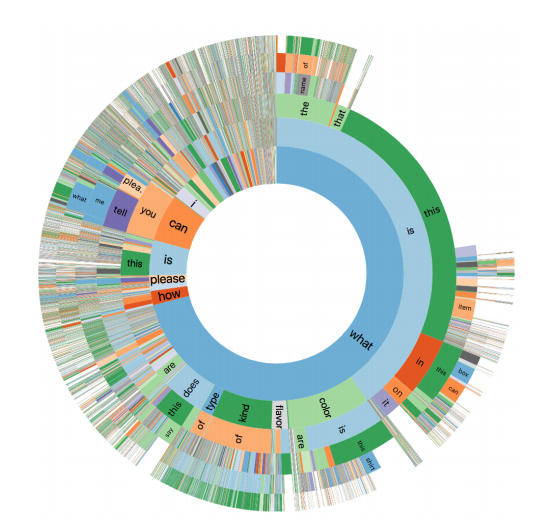
The questions are sometimes simple, but by no means always. Many questions can be summarized as “What is this?” However, only 2 percent call for a yes-or-no answer, and fewer than 2 percent can be answered with a number. And there are other unexpected features. It turns out that while most questions begin with the word “what,” almost a quarter begin with a much more unusual word. This is almost certainly the result of the recording process clipping the beginning of the question. But answers are often still possible. Take questions like “Sell by or use by date of this carton of milk” or “Oven set to thanks?” Both are straightforward to answer if the image provides the right information. The team also analyzed the images. More than a quarter are unsuitable for eliciting an answer, because they are not clear or do not contain the relevant info. Being able to spot these quickly and accurately would be a good start for a machine vision algorithm.


Memcached Servers Being Exploited in Huge DDoS Attacks

Security researchers have previously warned about Internet-facing Memcached servers being open to data theft and other security risks. Desler theorizes one reason why attackers have not used Memcached as an amplification vector in DDoS attacks previously is simply because they have not considered it and not because of any technical limitations. Exploiting Memcached servers is new as far real-world DDoS attacks are concerned, says Chad Seaman, senior engineer, with Akamai's Security Intelligence Response Team. "A researcher had theorized this could be done previously," Seaman says. "But as Memcached isn't meant to run on the Internet and is a LAN-scoped technology that is wide open, he thought it could really only be impactful in a LAN environment." But the use of default settings and reckless administration overall among many enterprises has resulted in a situation where literally tens of thousands of boxes running Memcached are on the public-facing Internet, Seaman says.


Firms failing to learn from cyber attacks

The survey findings suggest security inertia has infiltrated many organisations, with an inability to repel or contain cyber threats and the resultant impact on the business. This inertia is reflected in the fact that 46% of respondents said their organisation cannot prevent attackers from breaking into internal networks every time it is attempted, 36% said that administrative credentials are stored in Word or Excel documents on company PCs, and half admitted their customers’ privacy or PII (personally identifiable information) could be at risk because their data is not secured beyond the legally-required basics. The report notes that the automated processes inherent in cloud and DevOps mean that privileged accounts, credentials and secrets are being created at a prolific rate. If compromised, the report said these can give attackers a crucial jumping-off point to achieve lateral access to sensitive data across networks, data and applications or to use cloud infrastructure for illicit crypto mining activities.

While the “shift to Teal” is a more big picture view, there is an interesting perspective on self-organization in teams and organizations that states basically that organizations with self-organizing teams actually still have leaders / leadership. This perspective brings the big picture view above more in focus in individual organizations and companies. This is discussed in a book by Lex Sisney titled “Organizational Physics - The Science of Growing a Business”. Sisney proposes that in reality instead of having top-down or bottom up organization, some of the most new and adaptable organizations are actually “Design-Centric” organizations. ... So the leadership shift is not a choice of top-down or bottom-up, but rather one where the leader designs a system within the organization that allows teams to self-organize and to be empowered to deliver the organization’s objectives. If this is done well, there is little need for the leader to intervene in the organization or system because the people and teams are able to effectively lead and guide the organization themselves.


14 top tools to assess, implement, and maintain GDPR compliance

The European Union’s General Data Protection Regulation (GDPR) goes into effect in May 2018, which means that any organization doing business in or with the EU has six months from this writing to comply with the strict new privacy law. The GDPR applies to any organization holding or processing personal data of E.U. citizens, and the penalties for noncompliance can be stiff: up to €20 million (about $24 million) or 4 percent of annual global turnover, whichever is greater. Organizations must be able to identify, protect, and manage all personally identifiable information (PII) of EU residents even if those organizations are not based in the EU. Some vendors are offering tools to help you prepare for and comply with the GDPR. What follows is a representative sample of tools to assess what you need to do for compliance, implement measures to meet requirements, and maintain compliance once you reach it.

Chris Webber, a security strategist with SafeBreach, says configuration errors are one of the most frequently occurring issues with NGFWs. “Many users get tripped up if they only rely on vendor-supplied defaults,” Webber said. “A next-generation firewall can be like having a Swiss army knife on your network, but many times its features aren’t turned on, which lets attackers gain access.” Webber also noted that most vendors provide auto-migration tools to help new customers migrate from their legacy firewalls to NGFWs but that errors may occur during this process, as vendor features and architecture can vary. SafeBreach said it has discovered breach scenarios due to these policy gaps and errors resulting from assumptions about new NGFW vendor default policies and auto-migration challenges. Another issue is that many users don’t decrypt encrypted traffic like SSL, TLS, and SSH, which can become a major blind spot for customers, Webber said.
The future of every type of ambitious commercial business, whether it’s a factory making products, a bank loaning money, an IT support shop helping users, a grocery store selling goods, a law firm prepping available information for its client cases, an analyst firm producing insight… is to perform its business operations with the optimum balance of talent, so it can maximise its immediate profits, with an eye on the future to stay ahead of the competition. As soon as someone’s output is predictable, taking inputs from various sources to produce outputs, you can start to figure out how to program software and machines to perform said tasks – and computers will always be cheaper than humans, once they are functional and can do the job. So our goal has to be about furthering our abilities, not only to get the basics of our jobs done, but to immerse ourselves into helping our colleagues and bosses figure out the what next. Because if we only focus on the now, we are eventually going to render ourselves predictable and replaceable.


Virtual Private Networks: Why Their Days Are Numbered

VPNs require an array of equipment, protocols, service providers and topologies to be successfully implemented across an enterprise network – and the complexity is only perpetuated as networks grow. Purchasing the excess capacity and new Multiprotocol Label Switching (MPLS) connections needed to support effective VPNs can weigh heavily on IT budgets, while managing these networks will require greater reliance on personnel. Rather than limit the number of devices on their networks, organizations need to seek out solutions that simplify network management as companies continue embracing mobile and remote workforces. Even businesses that continue to rely on VPN or backhaul networks to protect their data need to employ a defense-in-depth approach to security, since VPNs, on their own, only offer the baseline protections of a standard web proxy.  As more solutions move to the cloud and enterprises rely less and less on physical servers and network connections, the need for VPNs will eventually evolve, if not disappear altogether.

From a security standpoint, what you really want is to be alerted when employees do something suspicious. User behavior analytics (UBA) are a smarter way to sniff out anomalies in users' actions and flag them for further investigation. Companies like IBM and Varonis have developed advanced UBA tools that can detect unusual activity. Is an employee trying to access a file they shouldn’t? Maybe they’re downloading something at 3:00am from a location that isn’t their home. Perhaps they’re trying to move laterally between systems. The beauty of UBA is that it highlights malicious insiders and outsiders using stolen credentials equally well, though it may require further investigation to determine which is which. If you’re going to go to the trouble of monitoring your employees, then maybe you should extract more value from the data you collect. There’s a new breed of software that offers the same potential security protections to ensure compliance but focuses on the end user experience and how it might be improved to remediate issues as they happen.

Monitoring the state of an application is important during development and in production. With a monolithic application, this is rather straightforward, since one can attach a native debugger to the process and have the ability to get a complete picture of the state of the application and its evolution. Monitoring a microservice-based application poses a greater challenge, particularly when the application is composed of tens or hundreds of microservices. Due to the fact that any request may involve being processed by many microservices running multiple times -- potentially on different servers -- it is exceptionally difficult to follow the “story” of the application and identify the causes of problems when they arise. Currently, the main methodology relies on obtaining a trace of all transactions and dependencies using tools that, for example, implement the OpenTracing standard. These tools capture timing, events, and tags, and collect this data out-of-band (asynchronously). 


Quote for the day:

"The mark of a great man is one who knows when to set aside the important things in order to accomplish the vital ones." -- Brandon Sanderson

Daily Tech Digest - September 13, 2017

Strategic thinking in the age of digital transformation

“Most board members are 60-plus, which means that many don’t have first-hand experience of technology,” Clayton explains. “On the other hand, those IT and digital specialists who do are young, in their late-20s or 30s, and may not have enough experience to be an effective NED.” She adds: “We need to find a balance and it’s tricky to get this right. You only have to look at British Airways and its IT crisis to see how essential it is that boards do have the right expertise and knowledge base. ” It’s an issue that affects all organisations with a big customer base and data, not just corporate boards. Clayton adds: “Charities are also highly vulnerable to IT issues. Imagine if Oxfam’s donor list were hacked?” And the problem will get worse as technology speeds up.


Nearly 400 million PCs at risk from new attack method that could hide any malware

"Bashware does not leverage any logic or implementation flaws in WSL's design. In fact, WSL seems to be well-designed. What allows Bashware to operate the way it does is the lack of awareness by various security vendors, due to the fact that this technology is relatively new and expands the known borders of the Windows operating system," Check Point researchers said. Hackers using Bashware also don't require to write malware programs for Linux to run them via WSL on Windows. Instead, Bashware installs a program called Wine, which in turn launches and hides known Windows malware. In order for hackers to use Bashware, they need to already be in possession of the victim's PC admin privileges.


DNSSEC key signing key rollover: Are you ready?

DNSSEC works as a hierarchy with different bodies responsible for each layer and signing the key of the entities in the layer below. The key signing key is a cryptographic public-private key pair, and the root zone KSK secures the topmost layer of the hierarchy, the starting point for DNSSEC validation. There is nothing wrong with the key—it hasn’t been stolen or tampered with—but it is good security practice to periodically rotate the signing key so that even if it falls into the wrong hands, everyone is already using the newer, stronger key. There is no reason to wait for something bad to happen—for the key to be cracked, for example—before updating to a newer, stronger, key. “Updating the DNSSEC KSK is a crucial security step, similar to updating a PKI Root Certificate,” the United States Computer Emergency Response Team (US-CERT) wrote in a recent advisory.


How to Upgrade Judges with Machine Learning

Kleinberg suggests that algorithms could be deployed to help judges without major disruption to the way they currently work in the form of a warning system that flags decisions highly likely to be wrong. Analysis of judges’ performance suggested they have a tendency to occasionally release people who are very likely to fail to show in court, or to commit crime while awaiting trial. An algorithm could catch many of those cases, says Kleinberg. Richard Berk, a professor of criminology at the University of Pennsylvania, describes the study as “very good work,” and an example of a recent acceleration of interest in applying machine learning to improve criminal justice decisions. The idea has been explored for 20 years, but machine learning has become more powerful, and data to train it more available.


The best laptops of 2017: Ultrabooks, budget PCs, 2-in-1s, and more

Choosing the best laptop is about to get a lot harder. Fall is coming—and so are a slew of new laptops. In fact, if you’re hunting for a new ultraportable, we recommend holding off on any purchases for the time being. Intel recently announced four 8th-generation Core i5 and Core i7 mobile processors that could result in a dramatic leap in performance in thin-and-light convertibles, 2-in-1s, hybrids, and traditional laptops. Reveals of notebooks with these chips have begun, with likely more to follow. If you must buy now, though, we’ve got you covered with our current top laptop picks. And if you’re instead in the market for a gaming laptop or even a budget laptop, you’re in luck: Recent reviews include the Gigabyte Aero 15, Asus ROG Zephyrus GX501, and the Acer Aspire E 15.


In the boardroom: mobility in a connected world

I certainly think it is a critical part of virtually every boardroom conversation out there – to have an effective understanding of how that individual company or identity is going to participate in the realm of IoT. Certainly this next era is IoT. Depending on whose numbers you want to believe, there is somewhere between 20 and 50 billion devices that will be hanging off the internet by 2020. Whether we like it or not, it’s coming to us and our devices more directly, through any kind of product manufacturer or government agency, or any other business models. First and foremost we’ve got to provide our customers and end-consumers with an experience that will differentiate us, where utilising our assets will lead to increased demand and loyalty.


Rapid7 CEO: Rethink IT & Security Organizational Structures

Companies are under constant pressure to innovate in today’s fast-paced business environment. That might mean creating a better product, improving efficiency, or creating a better customer experience. Unfortunately, the security function tends to be separate from the innovation process or, worse, after the innovation has created a new vulnerability. That problem will persist unless companies rethink their organizational structures around IT and security. That’s the message that Rapid7 CEO Corey Thomas is delivering in his keynote today at the company’s United 2017 event in Boston. He believes that IT and security teams can work together effectively to innovate, create a better user experience, and adopt new technology without increasing the vulnerability surface.


British Army enhances data-driven decision making to staunch churn

“The model has proven instrumental in helping staff officers identify the conditions that could lead to the early exit of valuable personnel, allowing them to take pre-emptive action to encourage the soldier to stay.” Since initial deployment, adoption of its platform has, the supplier said, expanded to 700 users in the army today. “While primarily used by planners and policy makers, SAS also sees significant use by logistics, education and investment teams as well as for sentiment analysis of the workforce,” it said.  The army is using SAS Visual Analytics and now using SAS Operations Research to help it optimise processes and personnel deployment. It has also recently approved a proof of concept for SAS Text Analytics, which it hopes will allow it to use open source data and more efficiently process freedom of information requests and paperwork.


The Time Is Now for Digital Transformation

You do not want to look back and discover you should have started earlier. You may be creating a crisis which you have not yet discovered. A great quote from Stanford economist Paul Romer is, "A crisis is a terrible thing to waste." Unfortunately, a crisis may be the only way you can convince your organization to rapidly embrace digital transformation. Digital transformation is a change in business and a change in mind set. Think of it as a business turnaround. It doesn't matter whether you are a non-profit, government, business, or any other type of organization. Digital transformation will require imagination. How you did business in the past will not be the best way to do business in the future. The traditional IT organization with projects that may last months or years is inadequate for digital transformation success.


BlueBorne is Bluetooth's Stagefright moment

BlueBorne takes advantage of the fact that Bluetooth-enabled devices are always listening for other devices they can connect to. While devices typically have to be manually paired to form that initial wireless connection, once paired those devices reconnect automatically whenever they are near each other. BlueBorne exploits the vulnerabilities in a way that it can establish the Bluetooth connection with devices nearby without having to go through the pairing process. Unless someone happens to be looking at the list of Bluetooth devices, it’s unlikely these connections will ever be discovered. “BlueBorne is different from past Bluetooth-based exploits, which relied on weaknesses in the protocol that no longer exist, or authentication-based issues related to idiotic PIN codes,” said Nadir Izrael, CTO and co-founder of Armis. “It [BlueBorne] requires nothing from the user.”


Quote for the day:


"Facts do not cease to exist because they are ignored." -- Aldous Huxley


March 19, 2016

How to Connect Cisco Nexus 9396PX to 40G Network

The traditional network usually used a three tier network architecture. However, with the migration of 40/100G, a new architecture is taking place of the traditional one with great advantages. This is known as spine-leaf architecture. ... In spine-leaf network architecture for 40G application, the connections between the spine switches and leaf switches are 40G, while connections between the leaf switches and servers are usually 1/10G. Thus these 40G QSFP+ ports can be used to connect the spine switch and the 1G SFP/10G SFP+ are suggested to connect servers and routers. To accomplish the whole spine-leaf connection, optics and cables or DAC (direct attach cable) should be used. The following picture shows a 40G spine-leaf architecture with Cisco Nexus 9396PX being used in the leaf layer and the fiber cabling choice for Cisco Nexus 9396PX switch in this architecture.


HPE IaaS reference architecture for SAP Business Applications

The solution blueprint outlined in this paper provides an Infrastructure as a Service (IaaS) Cloud infrastructure for SAP Business Applications under both traditional and SAP HANA In-Memory databases as the Cloud service. The platform provides the ease of use and flexibility needed to minimize the effort to bring legacy platforms to SAP HANA performance levels and addresses future needs coming with SAP’s newest software generation S/4HANA. The configurations are based on Hewlett Packard Enterprise servers, storage, networking and software. For customers that need maximum and dedicated database performance, this white paper describes a high performance configuration optimized for SAP HANA bare metal deployments and SAP Business Applications based on virtualization layers.


FlexPod and UCS – where are we now?

Recent announcements around the Gen 3 UCS Fabric Interconnects have revealed that 40GbE is now going to be the standard for UCS connectivity solutions, and the new chassis designs show 4 x 40GbE QSFP connections, totaling 320Gbps total bandwidth per chassis, this is an incredible throughput, and although I can’t see 99% of customers going anywhere near these levels, it does help to strengthen the UCS platform’s use cases for even the most high performance environments, and reduces the requirement for Infiniband type solutions for high throughput environments. Another interesting point, and following on from the ACI ramblings above, is that the new 6300 series Fabric Interconnects are now based on the Nexus 9300 switching line, rather than the Nexus 5K based 6200 series.


Jive prescribes collaboration software as best DNA match for healthcare

The theory here is: better collaboration could improve information, could improve patient care, could improve the fight against the nursing shortage the USA currently being experienced. According to a press statement, "Built on the cloud-based Jive-n interactive intranet, this solution improves the accessibility of nursing curriculum, best practices, specialised knowledge and peer-to-peer feedback amongst nursing educators, professionals and students." Oregon was the first US state to implement a statewide, multi-campus consortium approach for nursing education and OCNE's collaborative online community is claimed to be the first of its kind.


Getting Started with Blockchain

Blockchains are going to be useful wherever there is a need for a trustworthy record, something which is pretty vital for transactions of all sorts whether it be in banking, for legal documents or for registries of things like land or high value art works etc. Startups such as Stampery are looking to use blockchain technology to provide low cost certification services. Blockchain is not just for pure startups however. Twenty-five banks are part of the blockchain company, called R3 CEV, which aims to develop common standards around this technology. R3 CEV’s Head of Technology is Richard Gendal Brown an ex-colleague from IBM.


Open Blockchain

OBC is a modular-based protocol for recording and accessing transactions on a private ledger. Transactions, in this context, can have a wide definition, ranging from data to assets, instructions, and identities. A system that combines both the transactional processing protocol and the information store is a big advantage for multiple domains. For example, the protocol is modular so network administrators can define their own constraints and then set the protocol accordingly. This open source fabric allows infinite sets of unique actors to create their own networks. Communities create a permissioned network, where validating and non-validating nodes are operated by known whitelisted entities. These identities are granted access by an issuing authority on the network. This model is substantially different from current blockchains.


Identity theft, fraudsters, and what to know to prevent an attack

One of the pitfalls to keeping up with security trends, Platt said, "Is that there is a certain pace that organizations work at and putting changes in place can be difficult. You have to be able to make changes immediately, so you always want systems that can be changed and modified at the pace of fraud not at the pace of IT organizations." The pace of attacks has increased through technology, and according to Platt, "Some studies say that up to one-third of all traffic online is non-human." Innovation is driving change at a rapid pace, but while the technology available to people in the security industry is fast, it is changing just as fast for the bad guys. Platt said, "The pace of innovation is helping all of us so that every new attack can be identified and stopped."


BPM tools now used for complex event processing architecture

The events in the context of BPM can be internal events defined, generated or processed within the BPM tool. Examples include the instantiation or completion of a dynamic case or service levels. For example, when an assigned task is late, it is a temporal event that needs to be handled through escalation. The temporal aspect is extremely important in event processing, especially the occurrence and relationship of multiple events in a temporal window. Events can also be external, such as financial transaction events, device or machine-monitoring events and social media events. "Core intelligent complex event capabilities are becoming part of the unified BPM platform that supports intelligence holistically," Khoshafian said.


The Enterprise Architect is no Project Manager though it can be

The architect structures the description of the enterprise, establishes principles for change and evolution, standards for technologies, the roadmap... with the final aim to enable change, decision making and manage, if not reduce, the unnecessary and costly complexity and variation in the enterprise. The PM, having been given the architecture, dependencies, roadmap, risks, the work breakdown, skills and resources necessary and deliverables and acceptance criteria has to come up with a project plan and iterate it until the schedule, resources and costs are all coming together. The PM has then to monitor and report progress, bottlenecks, risks eventuation, organise meetings..


How Cognitive Computing Can Get Businesses Up And Running After Disasters

In the cognitive era, the continuous availability of data, systems, applications and business processes is essential. Organizations will take for granted that these services are “always on.” By applying advanced analytics and automation to predict potential issues, companies can correct systems in advance. At IBM, we are investing in new capabilities to help clients move from reactive business continuity and disaster recovery planning to a cognitive and predictive resiliency program. The goal is to avoid the impact of a disaster before it occurs. What if we could crunch weather data to predict the potential impact of severe weather and prompt appropriate action?


Quote for the day:


"Technological innovation is indeed important to economic growth and the enhancement of human possibilities." -- Leon Kass


February 04, 2016

World Quality Report 2015-2016

Based on analysis of five respondent groups: CIO, VP Application, IT Director, QA/Testing Manager and CDO/CMO, the report surveyed respondents from across the globe through quantitative interviews followed by qualitative deep-dive discussions. Key findings from this year’s report: The impact of IT quality on the end-user experience is a driving force for today’s digital transformation initiatives; QA and Testing budgets have increased 9% year-on-year; Enterprises are widely embracing agile and Development and Operations (DevOps) methodology; Shorter program and application lifecycles are creating increased demand for testing hardware and infrastructure.


The first Ubuntu tablet is a desktop too

Behind the scenes, Ubuntu's convergence is designed to help the ecosystem to grow. There's no point buying into a new ecosystem if there aren't any apps, but equally there's no incentive for developers to make those apps if nobody's buying the phones. This is a real hassle as developers have to build different versions of their apps for the iPhone, iPad and iMac or for different Android devices, but less of a problem for Ubuntu when they only need to build one app and it will work on any Ubuntu phone, tablet or computer. The M10 tablet has a 10.1-inch high-definition display. The screen is protected by Asahi Dragontrail glass, a rival to the tough Gorilla Glass used for the displays of devices including Samsung and HTC smartphones. It's 8.2mm thick and weighs 470 grams (16.6 ounces), feeling lightweight and easy to handle.


Best Agile Method For Your Team: Scrum Vs. Kanban

One of the key differences between scrum and kanban is that kanban places the project and its needs at the heart of the process. In scrum, the sprint and its time box is at the core. Kanban radically changes the way that projects are managed within the non-project environment of the organization, while scrum is more appropriate for organizations in which development is constant rather than episodic. So which is right for your team or company? It really depends on what problem you're trying to solve. Kanban is more linear; scrums are intensely multi-threaded. Kanban looks at agile from the project perspective. Scrum assumes that work on products and systems never ends.


Collaborative Overload

Any effort to increase your organization’s collaborative efficiency should start with an understanding of the existing supply and demand. Employee surveys, electronic communications tracking, and internal systems such as 360-degree feedback and CRM programs can provide valuable data on the volume, type, origin, and destination of requests, as can more in-depth network analyses and tools. For example, Do.com monitors calendars and provides daily and weekly reports to both individual employees and managers about time spent in meetings versus on solo work. The idea is to identify the people most at risk for collaborative overload.


Cybercrime Costs More Than You Think

Cybercrime has become big business. Instances of cybercrime cost the global economy about $450 billion annually. Beyond the monetary damages associated with the crime itself, an instance of cybercrime can severely damage a company's reputation, indirectly affecting the bottom line for years to come. In this paper, we explain how companies can mitigate the reputational risk associated with a cybercrime through internal and external communications practices. Our findings include: The median cost of cybercrime has increased by nearly 200 percent in the last five years and is likely to continue growing; The reputational risk associated with cybercrime extends well beyond monetary damages; and Having a plan in place for how to respond to a cyberattack could save millions.


Hackers claim to have hijacked NASA's Global Hawk drone; NASA says not true

The drone takeover allegedly occurred on April 9, 2015. The zine states, “After countless months of successfully retrieving NASA drone logs automatically, we noticed some weird traffic;” a single .gpx file was pushed out to Global Hawk each time it returned to base, indicating it had a “pre-planned route option” sent over WLAN. The group decided to do something “sinister,” using a man-in-the-middle attack to upload its own custom. gpx file to control the drone and “to crash the Global Hawk into the Pacific Ocean.” ... Shortly after the drone left its predetermined flight plan, NASA noticed and took manual control of the drone.


4 Things Employees Hate About IT (And How To Fix Them)

Chapleau's team used its PÜLS software, ... to find out what their biggest IT complaints were, and how businesses could address them to derive more value. The results were published in Green Elephant's IT User Satisfaction Annual Report. It turns out, getting back to basics is the key. ... "What we wanted to do was emphasize that, to bring greater business value from IT, you have to take user satisfaction and your users' needs into consideration, first and foremost. It's about trust and being able to meet basic user needs; if your users' basic needs aren't being met, they won't trust you to introduce new, cutting-edge and innovative technology, and they won't use it," Chapleau says. Here are the top four things users hate about IT, and how to fix them.


How AI and automation could hollow out the US job market

The argument that automation will worsen inequality is sometimes rejected on the grounds that business owners won't act against their own interests. The reasoning goes that if business owners impoverish their workers they undermine those workers' ability to buy goods and services from that business. However, Kopczuk says this argument is undercut by there being no simple mechanism for employers to collude to keep workers employed and well-paid in this way. "It's a very old argument. I think I would associate it with Henry Ford, 100 years ago. You pay your workers so that they can afford to buy your cars."


Cloud security culture a building block for today's businesses

"An analogy you might think of is a neighborhood block watch," Reavis said. "If you have everybody aware what's going on in the neighborhood, it can be a real strength and really augment the overall security posture of an organization." Lillie has a multilayered approach for cultivating a security culture. Part of it involves a "fleet of tools" --cloud access security brokers, software that protects cloud services; identity management tools; mobile device management; and laptop system protection, to name a few. But just as important as technology is bringing on security team leaders who can communicate the value of crafting and executing a security strategy, and can build relationships across the teams they're going to work with -- from applications to infrastructure to business departments.


CIO interview: Fergus Boyd, vice-president for digital, Yotel

Despite having several partners that help deliver the IT that underpins its operations, the global team delivering the technology and digital initiatives is composed of only four people, while the flagship New York hotel has its own team. The department will grow this year to aid work going into the new hotel openings. Boyd says the main challenge he faces as a leader in a fast-changing and highly competitive sector is to manage tight budgets, as well as retaining talent and developing good in-house expertise. “We have a very aggressive growth plan for the company, so keeping up with that and the pace of change of new technology will be key to success,” he says.


Quote for the day:


"The thing that makes you say, 'I want to do something' -- that is the beginning of talent." -- Stella Adler


February 02, 2016

How to prepare for the IT department of the future

"IT needs to do some marketing and consider users as they do consumers. Is IT delivering only 80 percent of a service without following through? Are they rude? Inefficient? You're providing IT services to your users, and so 'brand' is so important. If your users aren't seeing the value in your services, then the company as a whole isn't going to think that IT has any value," says Simon Chapleau, CEO of Green Elephant. To change that, IT will have to focus on measurement and accountability, Chapleau says. By measuring user satisfaction with IT, and allowing users to grade the services they're receiving, IT can focus on what needs improvement and, in the process, get more done.


Job One for the CDO: Lay Foundation for Data Management

Often working through a matrixed organization, CDOs can help overwhelmed IT teams put the right strategic focus on analytics. If they succeed, business managers at all levels can use higher volumes and varieties of structured, semi-structured and unstructured data to make better decisions about customers, competitors and operations. But how specifically does a CDO accomplish this? The answer varies widely based on the circumstances and maturity of the enterprise. Rarely does a CDO inherit a pretty situation. In their report, “Top Performers Appoint Chief Data Officers”, Forrester analysts Gene Leganza and Jennifer Belissent point out that negative events such as security breaches or disappointing results often prompt the appointment of a CDO to improve data governance or assess new market or customer dynamics. 


Network-attached storage: The smart person's guide

NAS products, as with SANs, are starting to evolve beyond just large boxes filled with hard drives. Most major NAS suppliers now offer all-flash and hybrid disk/flash products. Other modern twists on NAS include products that automatically replicate their data into cloud storage and, as discussed above, versions with advanced clustering that are essentially SANs behind a NAS head unit. Whether these are the "best of both worlds" remains to be seen. Another trend is software-defined NAS, which allows businesses to build their own systems using commodity hardware. There's some irony to this, as business-class storage companies spent years explaining how their proprietary NAS systems were much better than homegrown file servers using independent NAS software.


Are Retailers Improving Cybersecurity?

"We have been in business or incorporation for almost two years now," Engle says of the R-CISC. "We have seen significant growth. ... We're seeing that the retailers are really getting a clearer picture of risk to their organization, and it's not just in the payment transaction." The R-CISC now has more than 100 merchants as members, he points out. What's more, R-CISC's close relationship with Financial Services Information Sharing and Analysis Center is aimed at ensuring that those member merchants are able to collaborate and share threat intelligence directly with the banking community, Engle explains. "We work extremely closely with the FS-ISAC," he says. "We have chosen to utilize the same technology and information sharing platform ... and our ISAC function is actually located in the same building as the FS-ISAC."


Tablet shipments down, but detachables catch on

Detachables are growing fast because end users see them as laptop replacements, IDC analyst Jean Philippe Bouchard said in a statement. He said Apple sold more than 2 million iPad Pros, while Microsoft sold about 1.6 million Surface devices, of which most were the Surface Pro and not the more affordable Surface 3. "It's clear that price is not the most important feature considered, when buying a detachable — performance is," Bouchard said. After Apple, Samsung and Amazon in the top three positions for the fourth quarter in tablet shipments, Lenovo finished fourth and Huawei was fifth. There were 66 million tablets of all types shipped in the quarter, down nearly 14% from the fourth quarter of 2014.


A Short Manual to Bring Change Successfully into Your Team

This is the first question every leader should ask himself before starting this big adventure, because it often turns out to be a rocky and lonely road. Have a look at the WoMan in the mirror and ask yourself before initiating a process of personal changes in your team: are YOU ready for modifications in your own behavior and attitude? If the answer to this question is a clear YES, without any hesitation, then go on and step into this surprising road of change and discover what will happen to you and all the people around you! But if you need to think a little bit longer about the YES or if “Yes?” sounds like a question, you should review your reasoning, double-check your intentions and convince yourself.


Asean organizations braced for cyber attack

“You only need to watch the news or surf the Internet to see what the modern-day hacker is now capable of. Implementing proper security measures is no longer an option, it is a must,” said Somchai Intiraworanont, president of XanSiam International. To ensure that the company plugs all potential security holes, it hired security provider Network Box to upgrade its firewall service to a unified threat management service package. “DDOS attacks were a problem before we deployed Network Box in the data center,” Intiraworanont said. “Today, we have been noticing a lot of zero-day malware getting stopped in its tracks. There have also been a number of intrusion attempts blocked.”


Phishing Attacks Among Greatest Plague Facing Healthcare

Phishing is not just aimed at the largest healthcare organizations; a recent survey by the Healthcare Information Management and Systems Society found that 69 percent of respondents have experienced a phishing attack. Security incidents involving those from outside the organization (phishing and other types of attacks) caused significant problems for some of the organizations responding to the HIMSS survey. Of all respondents affected by a breach, 21 percent reported the loss of data, and a total of 16 percent reported either significant disruption or actual damage to their IT systems. Attacks at Anthem and Primera were frighteningly easy, according to the annual report on healthcare security breaches, by Bitglass, a security solutions vendor.


Defending a network from the NSA

Whitelisting is the opposite of anti-virus software. That is, rather than allowing all software to execute by default and trying to block bad stuff, white listing defaults to blocking everything and only lets known good applications run. Perhaps realizing that many in the audience felt that whitelisting was impractical, Joyce hinted at using it on servers. As a rule, servers run less software than the computers used by employees, and the software is updated less frequently, making it easier to maintain the whitelist. Another area where he suggested whitelisting was outgoing traffic. Companies often allow all outgoing requests by default and then try to block known bad domains. I got he feeling the considered this a fools errand.


The need for cyber security skills in Australia balloons

It’s not just end-user enterprises looking for security skills, either. The federal government is ramping up its cyber know-how with agencies such as the Australian Security Intelligence Organisation (ASIO) and ASIS hiring, according to Acheson, and the vendor community is looking for skills too. Like corporate Australia generally, vendors are looking for a blend of abilities. Sam Ghebranious, regional director for CyberArk in ANZ, said that while technical capability is important, so are the soft, communications skills and the ability to articulate the security challenge that enterprises face. “You need to be able to relate to change management and understand the security policies of the organisation,” he said, adding that 80% of the success of a security solution came from getting users to change behaviour and use the solution.


Quote for the day:


"The majority of our problems are of our own making." -- Gordon Tredgold


October 09, 2015

Time to get mapping - how a blind government can develop sight

Indeed, it’s possible today to build an entire organisation using chains of these standardised, cheap, modular capabilities. And - as was the case with the arrival of other forms of shared infrastructure such as electricity, railways, canals, roads, or radio bandwidth - the ability to consume standard stuff using shared plumbing always changes the economic balance in favour of operating models that standardise and consume, instead of building their own special versions. This can be illustrated by considering that most people would find it time-consuming, expensive and uncomfortable to knit their own underwear. Government should view building its own stuff in the same way - why would it want to do that, without a good reason?


Big Data’s Relationship with Business Intelligence and Data Warehousing

A BIDW is a data analysis system that collects the transactional information and typically provides summaries on selected key fields of the transactions being watched. These summaries can be used to better understand the overall health and trends in the transactions being monitored. The BIDW data is a copy of production and is not in real time, so long-running queries can be initiated without concerns about impacting the live customer actions. Data may be loaded daily or weekly, depending on the data source. The data is kept at several levels to serve the different customers of the BIDW; summary data and dashboards are the most common outputs of a BIDW, but if needed, you can drill into the transactions.


Visio Series: Simple Network Diagrams

There are many free and paid for tools for scanning a network available, and most of them can output the results to a text or XML file. Devices communicate on a network because they are software assigned a unique identifier (Internet Protocol address) to each connection. The connected port is usually on a hardware component that is hardware assigned (Media Access Protocol address). A laptop, for example, could be connected via an Ethernet cable, Wi-Fi or Bluetooth to a network. Each method will have a different IP address and MAC address, but they are all on the same device. The data available in each scanning tool output varies tremendously, but they will all have an IP address and MAC address. Here are three free tools showing examples of their interfaces.


Microsoft and model clauses – where the cloud stands after Safe Harbor

The government argues that as Microsoft is a US company, it is covered by US legislation and regulation that reaches across borders into operations based in other countries. Microsoft says that the data is covered by European data privacy and protection laws – and specifically the Irish interpretation and enforcement of those. The ramifications of the US government’s interpretation being upheld would of course set a precedent that US law enforcement agencies can demand access to data stored on servers or within US-headquartered companies anywhere around the globe. Following the loss of Safe Harbor, and in light of the post-NSA scandal paranoia around the world, the impact of such a precedent could have major ramifications for US cloud computing firms trying to do business around the globe.


New FortiGate Connector for Cisco ACI Delivers App-Centric Security Automation

There are several other customer stories featuring ACI-Fortinet solution, but I’d run out of time and space to list them all. For your easy reference visit http://www.fortinet.com/videos/index.html for more customer videos. Let’s look in detail at the key capabilities of Fortinet-Cisco ACI solution and the benefits it brings to Data Center customers. Fortinet’s FortiGate firewall solution integrated into Cisco Application Policy Infrastructure Controller (APIC) delivers application-centric security automation in modern data centers. The solution provides automated and predefined policy-based security provisioning for next-generation firewall services. It enables location independent security services insertion anywhere in the network fabric through a single-pane-of-glass management.


Six CIO tips for business innovation with data

First, the business runs a number of information-led initiatives to boost customer engagement. “We are, essentially, a retailer and we want to have long-term, valuable relationships with our clients,” he says. The second way First Utility uses data is for optimisation. “Information helps us to understand what processes work, which processes are causing us problems and how we can use our experience around those processes to make the business better,” says Wilkins. The third way the firm uses information is strategically, says Wilkins. “Now we’ve built a platform, we want to know our technology is working and where the business can use systems and services to develop and grow,” he adds. “It’s all about making the most of data to find new opportunities and to market to new sets of customers.”


Why have most merchants missed the EMV deadline?

Mark Horwedel, CEO of the Merchant Advisory Group, agrees. He said the large majority of the burden – especially the financial burden – of this transition falls on the merchants. “This is the most complicated and most costly point-of-sale (POS) project that’s ever been foisted on merchants. They’re making us pay for 75% of the conversion,” he said, adding that in Europe, networks lowered their interchange fees or offered to share some of the cost of installing new equipment. Besides that, he said, U.S. merchants pay transaction fees that are seven to eight times those paid in Europe. “Credit cards are a bank product,” he said, “and on their face they are unsafe, but the industry has made a one-sided effort to shift the expenses (of making it more secure) to the merchants.”


5 Signs Security's Finally Being Taken Seriously

Developed by the Georgia Tech Information Security Center (GTISC) and sponsored by Forbes, the Financial Services Roundtable (FSR), and Palo Alto Networks, the Governance of Cybersecurity: 2015 Report examines cybersecurity risk governance practices and attitudes of executives at these top companies from four surveys over the course of seven years. Unlike a lot of security studies out there lately, this one shows a lot of promise. In spite of breach statistics today—or perhaps because of them—this study shows that enterprises are finally taking security seriously. "This report shows that, for the first time, directors and officers understand they have a fiduciary duty to protect the digital assets of their companies and are paying more than cursory attention to cyber risks; it is a welcome change that will help protect shareholders and customers,” says Jody Westby


5 Disruptive Technology Advancements Which Will Change Business as Usual

Historically, there have been a variety of disruptive technologies that have changed the business world. The personal computer essentially displaced the typewriter, forever changing the way we communicate and work. Email also changed communication, largely displacing traditional letter-writing and causing problems with the greeting card industry. Additionally, smartphones have displaced numerous technologies with all of their available apps, including calculators, GPS devices, and MP3 players. Technology is continuing to advance, and more innovative solutions are hitting the market. If current businesses don’t adapt, they could be at risk of becoming the next technology to be phased out. By identifying some of the disruptive technologies that are on the horizon, businesses can create a plan to adapt for the future.


Surface Book, Surface 4 Pro, XPS 12 or iPad Pro?

It's actually a great problem to have. And it's one that I suspect others will grapple with in the coming months as the 2-in-1 computing category becomes viable for a wider audience. My own decision may actually be more difficult though, for a few reasons that don't apply to others. First, my computing needs are actually relatively meager and I try to keep up with all of the major platforms. So I actually rotate through using a Chromebook Pixel, MacBook 12 and HP laptop running Windows 10. As a full time writer, my most used app is really a browser. I can write directly into a content management system through the web. Other daily activities include email, social networking, music and video consumption, light gameplay, general web browsing and online reading.


Quote for the day:

"If you have no critics you'll likely have no success." -- M.Forbes

October 07, 2015

Data Science Falls Into Many Roles

What is quite interesting is the break down of tasks that they spend their time on per: extract-transform-load operations, data cleaning, basic exploratory analysis, and machine learning and statistics. The fine details are in their report, but most spend 1-4 hours a week on data cleaning and also on exploratory analysis. I was surprised that this third year of the survey there were no longitudinal information of change over the past two years. There are new and more in depth questions this time particularly in the skills, but I would have assumed some general trends on salary. How hard is it to find work in data science? About 35% say it is easy, and 29% say it is an average difficulty, although per their salary chart these map quite closely to their average pay range.


The Myths and Realities of Digital Disruption - An Executive's Guide

Over the last few years the concept of digital disruption has received as much or more attention than any other business topic. Given the massive changes we have seen in the media, advertising, retail, taxi services and other sectors, speculation that similar shifts will spread across the wider economy is only natural. But are these disruptions imminent? Why have some industries been so much more disrupted than others? How, and to what extent, will each of our major industrial sectors really change? Where will Silicon Valley (or its many global imitators) find the next generation of mega successes? This report provides a business executive’s guide to these issues.


Big Data Analytics – The game changer in the world of sports

On-field technologies or sensors present in the gaming equipment also help in the gathering of valuable data are changing the scenario of today’s sporting world. Now you can collect millions of data from the swinging of a tennis racquet to the spin of a baseball. You can learn about the tactics applied by your opponents and analyse with the help of Big Data to predict how they are going to play the next match. Or even improve your own team’s performance by checking out if the players are working as a team or is there any gap in the flow of play. Coaching will also be influenced a lot by Big Data analytics. We have already seen some clubs like Chelsea and Portland Trail Blazers are using coaching apps to make players understand the tactics easier. With Big Data analytics one can understand exactly what happened in each game and predict closely what tactics is going to be beneficial in the next match.


The road to hybrid cloud architecture is paved with mistakes

One error organizations used to make when implementing hybrid cloud architecture, said David Linthicum, author of numerous books on IT, started with OpenStack. IT organizations use the open source cloud software platform to build a private cloud, which offers advantages similar to public cloud but uses in-house architecture. It's a perfectly reasonable endeavor, except many organizations didn't fully understand what they're getting into. "It was too much of an engineering challenge for them to take on, and they ended up going over budget or just abandoning it quickly,"Linthicum said. The problem for many was that they believed the hype on private cloud as a bulletproof and easy-to-implement alternative to public cloud, Linthicum said, citing 2013 as the banner year for vendor bunk.


Business Technology Starts to Get Personal

Remarkably, mass-produced goods increasingly personalize into something unique because of a lot of snooping on you. Few consumers turn personalizing features off, adjust use or boycott the products. In a conflict of personalization and privacy, personalization has triumphed. Mr. Immelt foresaw much the same kind of thing happening with machines. “We can now track every jet engine separately throughout its life,” he said, giving each one the machine equivalent of a Facebook page, which states where it is and how it is “feeling,” making maintenance more efficient. Changing the behavior of devices will enable companies, he said, “to make sure you don’t allow any space between the customer and you.”


Stephen King's practical advice for tech writers

The lay audience has no special or expert knowledge. They connect with the human interest aspect of articles. They usually need background information; they expect more definition and description; and they may want attractive graphics or visuals. The managerial audience may or may not have more knowledge than the lay audience about the subject, but they need knowledge so they can make a decision about the issue. Any background information, facts, or statistics needed to make a decision should be highlighted. The experts may be the most demanding audience in terms of knowledge, presentation, and graphics or visuals. ... For the "expert" audience, ... style and vocabulary may be specialized or technical, source citations are reliable and up-to-date, and documentation is accurate.


Windows 10 on the Raspberry Pi: What you need to know

Windows 10 on the Pi should be able to run any Universal Windows app. Existing Windows Store apps for Windows 8 machines should also be able to be converted into Universal Windows apps, without "much effort", according to Microsoft. While the Windows Store has faced criticism for the poor selection of apps on offer - there are still a wide variety of apps that could be ported - although the performance on the Pi's smartphone-oriented hardware may vary. However, Microsoft is primarily pushing Windows 10 IoT Core - which can run on hardware with or without screens - as an OS that makes it easier to create IoT devices. This aim of lowering the barrier to building appliances is complemented by the Pi's low price and ability to control a range of hardware via its general-purpose input output (GPIO) pins.


Data centre security – Do you understand your risk?

Let’s assume for a moment that you still manage all or some of your data in-house. By implication that means that somewhere in the building you have a room full of servers that need to be maintained and protected. And as a manager you’ll be aware of the physical risks that threaten the integrity of your data. These include not only flood, fire and incursions by malicious third parties but also the havoc that can be created by unauthorized members of staff entering the secure area and, accidentally or deliberately, tampering with the equipment. Naturally enough you do your level best to protect your hardware and software from all these threats. So now let’s say that you’ve made an important decision to outsource your storage and IT functionality to an external data centre.


14 ways to improve corporate wellness programs with wearables

Wellness and fitness program managers should "take extraordinary steps" to protect sensitive information collected via wellness programs, Huffman said. He also suggested that companies work closely with HR managers to assure staff that their wellness program teams don't have access to sensitive data, such as employee health insurance claims.  Eric Dreiband, a partner with law firm Jones Day, stressed the importance of maintaining a secure "firewall" between data collected by wearable technology and personnel records. The goal is to keep staff health and fitness data away from supervisors or other decision makers, so that it cannot inadvertently affect employee pay or promotions.


Average Cost of Cyber-crime in the U.S. Rises to $15 Million

The Cost of Cyber Crime Study also examined global costs, which are not as high on average as those in the U.S. For the 2015 study, the global average annualized cost of cyber-crime is $7.7 million for a 1.9 percent year-over-year increase. The global study methodology examined 252 companies across seven countries, with 1,928 attacks used to measure the total cost. Specifically in the U.S., the study looked at 58 companies, with 638 cyber-attacks used to measure the total cost. "We were surprised by the consistent increase in the cost of cyber-crime over just one year in all countries," Larry Ponemon, chairman and founder of the Ponemon Institute, told eWEEK. "We believe this is due to the increased sophistication and stealth of cyber-attacks."


Quote for the day:

"Successful people make the most of the best and the best of the worst." -- Steve Keating

September 16, 2015

Invisible revolution: How wearables are quietly invading the enterprise

The study, The State of Enterprise Wearable Adoption, focused on the IT or business decision makers in 201 companies with 500 to more than 5,000 employees, and from a range of industries. The industrial enterprise sector was the focus of the study, with government, non-profit, education, professional services, media, hospitality, health care and financial services industries excluded since those areas do not have a direct use for wearables relevant to the study. The 93% of companies interested in wearables are split across almost every industry included, with manufacturing and life sciences "very big" and transportation and retail smaller than anticipated, Ballard said.


5 Ways Big Data Is Making a Splash in the Insurance Industry

Leveraging Big Data insights is well known for its ability to provide quality prospects for businesses, but another lesser known feature is its ability to shed light on low quality prospects or frustrated clients. Advanced analytics tools allow insurers to target individuals who are apt to be a long term loyal customer, and also to weed out individuals who are a high risk of canceling coverage. Predictive analytics is used to track and reveal signal behaviors that indicate an impending cancellation. This allows insurance agents to reach out to unhappy consumers before their final decision has been made, and tailor opportunities to encourage them to stay with the company.


What's New in iOS 9: New SDK Frameworks

Although the new SDK does not introduce as many new or enhanced features as iOS 8, which included more than 4,000 new APIs, it does still provide a wealth of new functionality and enhancements. Along with the new SDK, iOS 9 is also marked by new developer tools to support some of its features, and new releases of Apple’s major programming languages, Swift and Objective-C. This series aims at introducing all that is essential for developers to know about building apps for the latest release of Apple’s mobile OS. It comprises five articles that will cover what’s new in iOS 9 SDK, new features in Swift, Objective-C, and developer tools, and Apple’s new bitcode.


The science of organizational transformations

The latest findings suggest that investing time and effort up front to design a transformation’s initiatives also matters. According to the new results, the most effective initiatives involve four key actions: role modeling, fostering understanding and conviction, reinforcing changes through formal mechanisms, and developing talent and skills. These actions are critical to shifting mind-sets and behaviors. But it’s not enough to design a portfolio of initiatives based on one, or even two, of these actions. When executives report that their companies used all four, the odds of a successful transformation are much higher than if just one were used. The process of howinitiatives are designed is critical too.


High-Potential Employees: 3 Ways to Get More From Your HIPO Program

CEB data show that HIPOs produce 91% more valuable work for the company and exert 21% more effort than non-HIPOs. Managers are right to worry about identifying them (only 1-in-7 high performing employees classify as HIPOs) and to worry twice as much about keeping hold of them, and developing them so that all that glittering potential is realized. And it’s not only their managers. A full 50% of HR professionals worry about their company’s HIPO program (the initiatives in place to identify, retain, and develop HIPOs). HR teams ask questions like, “My high-potential program is expensive – am I investing in the right people?”, “How should we prepare our HIPOs to take on more challenging senior roles in the future?” and, “Why is my high-potential program not working? People we thought of as high-potential are failing when placed into more senior roles.”


Cisco router break-ins bypass cyber defenses

Routers are attractive to hackers because they operate outside the perimeter of firewalls, anti-virus, behavioral detection software and other security tools that organizations use to safeguard data traffic. Until now, they were considered vulnerable to sustained denial-of-service attacks using barrages of millions of packets of data, but not outright takeover. "If you own (seize control of) the router, you own the data of all the companies and government organizations that sit behind that router," FireEye Chief Executive Dave DeWalt told Reuters of his company's discovery. "This is the ultimate spying tool, the ultimate corporate espionage tool, the ultimate cybercrime tool," DeWalt said.


Deception May Be the Best Way to Catch Cybercriminals

"You could do things like emulate an Apache server and make it look like Apache is running somewhere when it isn't," Pingree said. "Or you could run a real copy of Apache that's monitored." As soon as an attacker sends data to the honeypot, it issues an alert. The attacker will most likely start rummaging around, performing passive scans of hosts on the network. The beauty of a honeypot is, legitimate users know it is fake. So the only people accessing it are cybercriminals and hackers, meaning there are no false positives, there is no need to filter out the noise that occurs in most fraud-detection systems. "The biggest problem with security-transaction monitoring is you have to filter out what's good and what's bad," Pingree said. "But if it's a decoy, everyone that's hitting it is bad."


What’s Wrong with the Mainframe?

Despite its technical and economic superiority to distributed platforms, a surprising number of industry voices still contextualize the mainframe as a “legacy” platform from which enterprises need to migrate their core applications if they are to succeed in the digital economy. This makes no sense. First of all, why would any organization migrate its most critical applications from a supremely reliable, secure, scalable and secure platform to a relatively risky and expensive one? And why would any CIO allocate limited resources to a low- or negative-ROI migration project when so many other urgent imperatives clamor for his or her limited IT resources? The answer is that there is no reason. That’s why analysts like Gartner are reporting minimal migration activity—and why 88% of CIOs assert that their mainframes will run existing and even net new workloads for at least another decade.


Customer engagement takes a step forward with Microsoft Dynamics CRM 2016

For many of us, the concepts of customer engagement and customer resource management (CRM) are murky at best. We understand the general idea, and we appreciate the results when customers are happy and buying, but the mechanics of how those sales are accomplished are lost to us. And, for the most part, that is okay, because we don't really need to know how it all comes together. However, if you're a salesperson, the tools provided by applications like Microsoft Dynamics CRM are vital to your success. Without those tools, sales are not made, revenues are not realized, commissions are not calculated, and people don't earn a living. With that being said, for an enterprise of any size operating in today's highly competitive environment, a well-designed CRM solution is required for any sort of success.


Where’s The Money in Data? (Part I)

All data monetization efforts require that data is ultimately used to drive actions or decisions that solve a problem for an end consumer. This fundamental requirement is where most businesses fail when attempting to monetize data because the typical approach is “How can we sell data to increase our revenues?” which assumes that the value is the sale of the data itself. In order to successfully monetize data, organizations must flip this approach and start with the end in mind. The questions should be “What problem can our data solve?” and “How valuable would it be to the end consumer if these problems were solved?” It is important to note that “end consumer” does not always mean customer either. Monetized data solutions can be for internal end consumers as well.


Quote for the day:

"Cream always rises to the top...so do good leaders" -- John Paul Warren