Daily Tech Digest - November 25, 2018

Artificial intelligence: Germans see no reason to fear robot coworkers
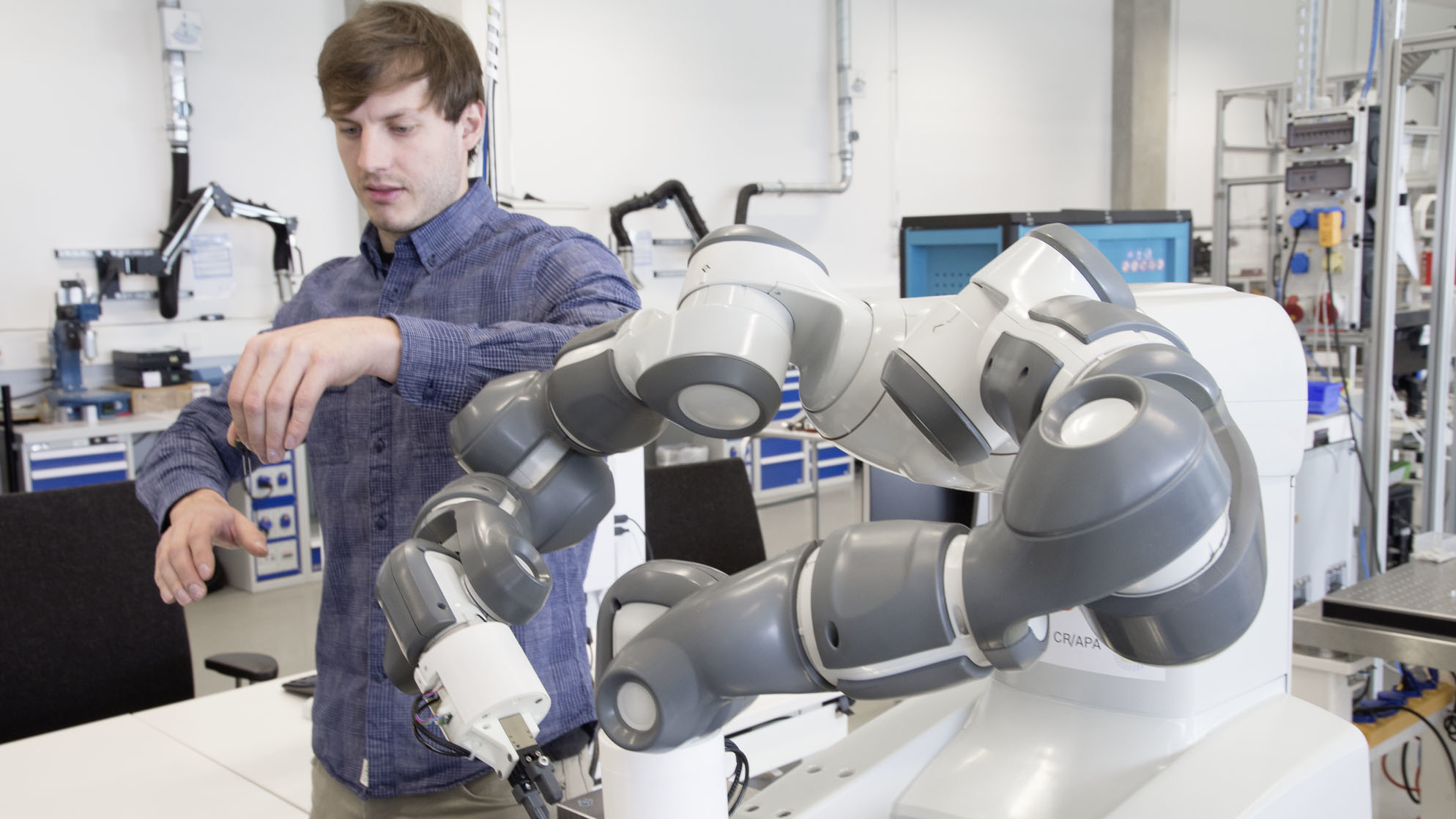
One example of how AI can benefit people is automated driving. Bosch is striving to make road transportation emissions-free, accident-free, and stress-free. With nine out of ten accidents are currently attributable to human error, smart technology could use AI to prevent many of these from happening in the first place. Connected manufacturing is another banner field for AI. In a smart factory, people and machines will work together as an intelligent team. Robots will relieve people of strenuous and dangerous tasks and learn from experience. This will reduce people’s burden. The Bosch survey found that many Germans could imagine being able to accept this situation. Two-thirds of respondents – 67 percent – believe that manufacturing and mobility are going to benefit greatly from artificial intelligence. They are also open to working with a robot if it takes over routine chores. Half of all respondents could well imagine such a situation, and would above all devote the free time gained to social or creative activities.


Women in Blockchain: CryptoWendyO talks about her motivation

There’s so much negative energy directed at crypto from mainstream financial institutions because the public “doesn’t like change.” “Because crypto is intangible, it’s hard for the masses to understand. “We saw this with the internet and credit cards. If you notice, the group of folks present when credit cards became mainstream still write cheques – as time progresses, so will the masses.” The recent falls after the hard fork mean the market – which is basic supply and demand – needs a “catalyst to bring in new money.” WendyO says: “There’s nothing we can do individually to stop negative price action. What we can do is support one another and continue to support the entrepreneurs building in the space. They are the key to mass adoption. “Once Blockchain projects are seamless and make life easier for the masses, they will come.” Asked by me why people are panicking so much, she believes: “Price impacts the human psyche so much. People are entering into positions without proper risk management and education.



We all know how the media and the film industry are overhyping AI with androids and over-intelligent systems. Some computer pioneers, Alan Turing (you may want to watch The Imitation Game to appreciate the legend he is) at the forefront, did set off on projects with a view to making machines that think. Turing, however, did realise that this would be abysmally difficult, and in 1950 proposed: Instead of trying to produce a programme to simulate the adult mind, why not rather try to produce one which simulates the child’s? If this were then subjected to an appropriate course of education, one would obtain the adult brain. This idea grew on to become Deep Learning. Fast forward to 2018: we have, and are still gathering, massive amounts of data. We have and are still developing more and more advanced algorithms. But do we have the hardware to crunch all those calculations within reasonable time? And if we do, can it be done without having all those GPUs cause another global warming on their own by literally heating up from all the processing?


Forget Robots, Blockchain Technology May Be the Real Threat to Your Job

Blockchain isn't just the technology behind the Bitcoin craze. It could also mean the end of the middle manager.
Traditionalists say this is a necessary component of an organization, freeing senior management to think strategically and move away from the day-to-day, while building a talent bench of the next generation of senior managers. Detractors ask what a middle manager actually adds to the bottom line, pointing to an unclear or difficult to define return on investment. The truth, as is often the case, lies somewhere in the middle. But it may not matter. Many organizations have clear, tangible, quantifiable key performance indicators for day-to-day functions, like sales closed or widgets shipped. With the advent of smart contracts on blockchain, it’s clear: robots aren’t the only ones gunning for your job. Blockchain technology is too. A smart contract is code designed to facilitate, verify or enforce performance of set terms. ... Notably, this is not a far-off concept—it’s something that, in many situations, could be implemented tomorrow.


Rebooting analytics leadership: Time to move beyond the math
CAOs often find themselves doing this heavy lifting with a limited sphere of influence. They typically do not have the profit-and-loss or revenue accountability that would grant them due power in the organization. Moreover, like chief marketing officers a decade ago, CAOs need—but typically lack—a true seat at the C-suite table, placing them at a disadvantage when trying to obtain adequate funding or resources to power the analytics agenda. ... Arguably, none of the previous CAO personas could succeed in today’s landscape. We’ve entered an era that requires a new CAO persona—the Catalyst—who embraces a style of leadership geared toward addressing the current demands, roadblocks, and scrutiny most companies face today when it comes to deploying AI and advanced analytics at scale. Catalysts approach their role very differently than did past CAO personas, in ways that those with more scientific and technical career backgrounds might not have ever done before.


How voice biometrics catches fraudsters


According to Costain, it is relatively easy for the system to identify a new voice. Often, a fraudster will phone in to check whether stolen credentials are valid, but in certain cases, the fraudster may scam the customer to obtain these credentials. “It’s a bit like epidemiology with Patient Zero,” he said. The same voice may try to access multiple accounts, which would signal an attempted fraud. RBS has also been compiling a database of evidence, which Costain said has led to a few police arrests of people who have made fraudulent calls. Over the next six months, the bank will have technology to enable customers to determine whether a call they receive from the bank is genuine, he said. Experian’s Global fraud report 2018 found that customers want to be recognised, while businesses want to address the growing fraud they are experiencing.


AI and Neuroscience: A virtuous circle


Another key challenge in contemporary AI research is known as transfer learning. To be able to deal effectively with novel situations, artificial agents need the ability to build on existing knowledge to make sensible decisions. Humans are already good at this - an individual who can drive a car, use a laptop or chair a meeting are usually able to cope even when confronted by an unfamiliar vehicle, operating system or social situation. Researchers are now starting to take the first steps towards understanding how this might be possible in artificial systems. For example, a new class of network architecture known as a “progressive network” can use knowledge learned in one video game to learn another. The same architecture has also been shown to transfer knowledge from a simulated robotic arm to a real-world arm, massively reducing the training time. Intriguingly, these networks bear some similarities to models of sequential task learning in humans. These tantalising links suggest that there are great opportunities for future AI research to learn from work in neuroscience.


6 ways to include dark data in analytic strategies

istock-876586498archive-files.jpg
The goal for CIOs is simple: Find out what data is under company management, but that it possibly didn't know that it had. Then, develop a strategic data plan with executives that addresses what do with this data so that it delivers its highest value to the company. ... As soon as it is determined that certain areas of data are useful, begin to digitalize and exploit it for value so you can get it working for you. ... Outside data sources can enhance the value of data you already have under management. A prime example is the monitoring of Greenland's ice pack. If you monitor climate change and are concerned about the pace of global warming, you can study historical photos of Greenland's land mass from decades ago. Comparison of Greenland against how it was decades ago to how it is today can demonstrate both the impact and progression of global warming. ... As paper-based forms of unstructured data are digitalized, it is essential for data to undergo quality assurance checks for data integrity and quality.


Generative Adversarial Networks (GANs) – The Basics You Need To Know

Horse.gif
So as name suggest it is called as Adversarial Networks because this is made up of two neural networks. Both neural networks are assigned different job role i.e. contesting with each other. Neural Network one is called as Generator, because it generate new data instances. Other neural net is called as Discriminator, evaluates work for first neural net for authenticity. The cycle continue to obtain accuracy or near perfection results. ... To understand “Generative Adversarial Networks”, its very important to differentiate between supervised learning and unsupervised learning. ... GAN’s are fairly new architecture in the deep learning domain. They fall under unsupervised neural network category. The performance measure is far better then traditional neural nets. When we use google search engine we use GANs at time of typing, what we want to search. 


Distributed Machine Learning Is The Answer To Scalability And Computation Requirements


It was this challenge to handle large-scale data due to scalability and efficiency of learning algorithms with respect to computational and memory resources that gave rise to distributed ML. For example, if the computational complexity of the algorithm outpaces the main memory then the algorithm will not scale well and will not be able to process the training data set or will not run due to memory restrictions. Distributed ML algorithms rose to handle very large data sets and develop efficient and scalable algorithms with regard to accuracy and to requirements of computation. Distributed ML algorithms are part of large-scale learning which has received considerable attention over the last few years, thanks to its ability to allocate learning process onto several workstations — distributed computing to scale up learning algorithms. It is these advances which make ML tasks on big data scalable, flexible and efficient.


Quote for the day:


"You can't just wish change; you have to live the change in order for it to become a reality." -- Steve Maraboli



Daily Tech Digest - November 23, 2018

Indian IT companies have had to transform every part of their process for faster growth 

1
To get here, Indian IT companies have had to change every part of their process—even becoming less Indian. They have shed jobs, changed how they work, upended part of their business models by focusing on hiring at client locations abroad, invested in training their employees, and chased acquisitions. The goal this time: growing digital revenue, in the hopes that it would offset the contraction in the traditional business, which is still over 60% of their revenues. “The core purpose of IT has changed to helping transform businesses and drive revenues from reducing cost and improving efficiency. This has led to a new wave of growth for IT, helping customers digitally transform their businesses,” said Hexaware CEO R Srikrishna. ... IT companies are looking at building the same campus recruitment engine in client markets as they did in India, and are focusing on current campus hires to become ambassadors for them at their universities. On Wednesday, Infosys announced it would hire 1,200 locals in Australia by 2020, over a third of whom would come from campuses. 


With more and more Data Centers being built, and soon after we are done bashing the economy and again ready to make hay as the economy starts turning around, we can alter the shape of our destiny dramatically! As other industries will sag, think of hotels, airlines, etc., which will certainly contribute to a certain reduction of carbon emissions, there is strong reason to believe that the spin-offs from the remote-everything will go into overdrive. Today we are carefully talking about online conferences and soon there will be lots of online activities that will be firing up all over the place. This will lead to huge data crunch operations as more and more information will need more processing power as it will come in audio, video and other formats. This will be extremely demanding for data centers, no matter how centralized they are.


TechUK calls on Matt Hancock to fast-track NHS digitisation


Hancock has said he wants the health tech industry to thrive, which TechUK said is a great idea, but very far from the current status quo where tech companies find health and social care one of the most difficult sectors to “crack”. It called on Hancock to ensure better access to data and improved procurement. “Data, like oil, is worth nothing if it is left in the ground,” the manifesto said. “Far too much data is held in non-digital form or in siloed repositories making it impossible to join up. “Tech companies that need data to build, develop, test and prove their solutions find it difficult to access, while companies that produce valuable data find it difficult to feed back into the System to inform better decision making.” 


What machine learning means for software development

Fractal art
Will machine learning eat software, as Pete Warden and Andrej Karpathyhave argued? After all, “software eating the world” has been a process of ever-increasing abstraction and generalization. A laptop, phone, or smart watch can replace radios, televisions, newspapers, pinball machines, locks and keys, light switches, and many more items. All these technologies are possible because we came to see computers as general-purpose machines, not just number crunchers. From this standpoint, it’s easy to imagine machine learning as the next level of abstraction, the most general problem solver that we’ve found yet. Certainly, neural networks have proven they can perform many specific tasks: almost any task for which it’s possible to build a set of training data. Karpathy is optimistic when he says that, for many tasks, it’s easier to collect the data than to explicitly write the program.


Socially Responsible Automation: A Framework for Shaping the Future

We define SRA as the set of technology choices, business strategies, innovation approaches, and management practices that move the affordances of automation beyond cost and performance efficiencies towards profitable and sustainable growth with more and better jobs driving economic development and social cohesion. SRA strives to optimize both business and social goals by adopting “common good” and “shared value” ideals. A minimal approach to SRA would be one where technology decisions are guided by their potential negative impact on jobs and the workforce; where mechanisms such as economic modelling, decision frameworks, and human factors approaches are employed to quantitatively and qualitatively assess technology choices and outcomes, and where appropriate trade-offs are made to balance the economic benefits of automation with the social costs of labor reduction and unemployment.


Chromecast (2018) review: Google's revamped media streamer is what you make of it

chromecast3hero
The new Chromecast isn’t much different from the second-generation model from 2015. The new design has rounder edges, but it’s still a small puck that hangs behind the TV on a 3-inch HDMI cable, and it still uses the TV’s USB port or a wall outlet for power. (You’ll likely need to choose the latter if you want the Chromecast to turn the TV on when it connects to your phone.) The way you use Chromecast hasn’t really changed, either: In lieu of a remote control and TV-based menus, Chromecast uses the streaming apps on your iOS or Android device as the interface. Apps that support Chromecast will show a cast button that links your device to the television, and whatever video you select will begin playing on the larger screen. You can also use the Chrome browser on a laptop or desktop to launch video from websites that offer that feature. What’s different, then?


How data scientists can help operational analytics succeed

A typical company has an organization that develops and an organization that operates. When I was consulting with PayPal, we had a group of talented professionals that constantly improved the functionality of the PayPal website. There was an equally talented group of professionals responsible for handling the operations of the production site. This operations group had a very different environment within which to succeed. That is why they had the best tools available to analyze what was happening at any point in time, and the best practices for troubleshooting problems in the moment. Data science can help tremendously with monitoring and troubleshooting. A key difference between operations and development is in their perspective of the status quo. For operations, stability is the goal—preserve the status quo; therefore, data science must be used to alert operators when the situation is not normal.


Digital Well-being — Its time to look after ourselves


We always choose such immediate enjoyment of likes, reacts, swipes and claps over long term flourishing, punching a hole in our well-being. But all this is not really good for nothing, your each swipe, click, reaction generates tonnes of revenues for companies in exchange for your sleep. Well, they always say, If You're Not Paying For It, You Are The Product. One must have come across recent announcements by Google and Apple on addressing the issue of digital well-being by monitoring screen time. But if one must need to really achieve/experience the state, one must possess the necessary digital skills. I have explained this using an analogy below. Consider an analogy between two phases of life. At young age when children are exposed to the real world society, certain real world skills like language, manners, values and other resources are taught for them to overcome challenges they might face in life. In similar manner when children are exposed to digital technology, are they prepared or equipped with digital skills to face the challenges they may come across?


Malware Moves: Attackers Retool for Cryptocurrency Theft

Malware Moves: Attackers Retool for Cryptocurrency Theft
Modular malware called Trickbot, which has also been used to mine for cryptocurrency, is up to new tricks. "TrickBot has traditionally targeted banking customers in multiple geographies to steal login credentials in order to commit identity fraud and facilitate fraudulent transactions," researchers at Digital Shadows say in a research report. But TrickBot's designers have been adding additional capabilities that appear designed to extend the reach of the malware. In February, TrickBot's designers added an open source monero cryptocurrency-mining module. And in March, they added the ability to crypto-lock devices, "potentially helping threat actors to extort victims," the research report says. Last month, Vitali Kremez, director of research at threat intelligence firm Flashpoint, warned the TrickBot had been updated to included a module designed to steal passwords from multiple types of applications and browsers.


Mirai Evolves From IoT Devices to Linux Servers

Netscout researchers say they have observed what appears to be a relatively small number of threat actors attempting to deliver the malware on Linux servers by exploiting a recently disclosed vulnerability in Hadoop YARN. The YARN vulnerability is a command injection flaw that gives attackers a way to remotely execute arbitrary shell commands on a vulnerable server. Many of the servers running Hadoop YARN are x86-based. Netscout has been tracking attempts to exploit the flaw using its global network of honeypots. It says it has observed tens of thousands of exploit attempts daily. In November alone, Netscout observed attackers attempting to deliver some 225 unique malicious payloads via the Hadoop YARN vulnerability. Of that, at least one dozen of the malware samples were Mirai variants.


Quote for the day:


"Adapt what is useful, reject what is useless, and add what is specifically your own." -- Bruce Lee


Daily Tech Digest - November 21, 2018

Gotcha pricing from the cloud pushes workloads back on premises
An interesting development is the return of apps from the cloud to on premises. Many companies that moved to the cloud to reduce costs got nasty sticker shock. The survey found that organizations that use public cloud spend 26 percent of their annual IT budget on public cloud computing, just 6 percent using public cloud came in under budget, and 35 percent overspent in their use of public cloud resources. Why? It's because of the cost of reserved instances. Many apps start in the cloud in a virtualized instance like Amazon EC2, but once developed and running regularly, they need a more permanent home, especially if this is a high-scaling app. So, the customer moves to reserved instances, where more resources can be brought to play and the instance is permanent, not temporary. And while cloud service providers offer discounts up front, the costs still can add up fast and become unexpectedly expensive.


How AI will shape the future of digital payments
As humankind takes giant leaps in terms of technology, AI ensures machines and gadgets imitate human actions, perceive the environment around, and adjust according to a diverse set of circumstances. Many global companies are working through smart technologies like AI to directly improve the consumer experience across education, daily life, and commerce. At a time when the Indian government is pushing both the digital payments and the financial inclusion agenda, AI can and must offer some real tangible benefits like tighter security and risk management in a world that is increasingly complex and moving at the speed of light. The Indian financial sector has been quick to realise the potential of AI in operations. Over the last few months, Indian PSU heavyweights like SBI and Bank of Baroda have invested heavily in AI platforms to improve efficiencies and offer enhanced services. SBI uses a chat assistant called SBI Intelligent Assistant (SIA), which resolves queries of NRI customers exactly like a bank representative would without the need to wait in queue for customer service. 


SWIFT India Partners With Fintech Firm for Blockchain Pilot
Per the announcement, the new program based on MonetaGo’s financial services network technology will be integrated through standardized SWIFT financial messages. The banks will purportedly deploy a shared distributed ledger network, that complies with industry-level governance, security and data privacy requirements in order to improve the efficiency and security of their financial products and procedures. According to Kiran Shetty, CEO of SWIFT India, the company will digitize trade processes, while MonetaGo will provide “fraud mitigation solutions to avoid double-financing and check authenticity of e-way Bill.” E-way Bill is an electronically generated bill for the specific movement of goods with a value more than 50,000 rupees ($700). "Given India's focus on a digital infrastructure which is supported by both policy and technological innovation, it makes sense that large institutional players are interested in these products and initiatives," said Jesse Chenard, CEO of MonetaGo.


Hyperscale cloud reliability and the art of organic collaboration

networking with a personal touch
Connecting network policies to logical formulas that capture their intent has been a recurring topic in networking research, but prior tools were ad hoc, written for a specialized format and hardly extensible. Microsoft Research’s satisfiability modulo theories solver Z3 is a state-of-the-art theorem prover that is specifically tailored to capture domains that are found commonly in software and hardware descriptions. It is used prominently in software verification, testing, and analysis. By 2012, network verification was an area of nascent interest, and the Azure network was going through early stages of build-out. It quickly became evident that ACLs could be expressed directly as logical formulas and that the machinery that reasons about such formulas was well-suited and sufficiently efficient for checking properties of ACLs. Jayaraman and Bjørner developed the SecGuru tool, replacing manual what-if policy reviews with automated analysis for ACL updates.


9 cyber security predictions for 2019

crystal ball
In 2019, we’ll see how the EU will react to those complaints. That will provide some much-needed clarity regarding the risk that GDPR and other privacy regulations present. If the GDPR doesn’t react, then that’s telling, too. It sends the message not to take the regulation seriously. Rising concern over how companies use and protect personal information will encourage many Americans to hold those companies more accountable. “The reaction by consumers to constant security breaches and other unethical information disclosures (e.g., Facebook) leads U.S. consumers to demand more default privacy and control over their own information,” says CSO contributor Roger Grimes. Grimes expects to see an effort to enact privacy laws similar to GDPR nationally in 2019. The California Consumer Privacy Act has already passed into law and goes into effect in 2020. On November 1, Sen. Ron Wyden introduced a bill titled the Consumer Data Protection Act (CDPA), which has stiff penalties, including jail time, for privacy violations.


Machine learning, meet quantum computing

The big advantage of quantum computing is that it allows an exponential increase in the number of dimensions it can process. While a classical perceptron can process an input of N dimensions, a quantum perceptron can process 2N dimensions. Tacchino and co demonstrate this on IBM’s Q-5 processor. Because of the small number of qubits, the processor can handle N = 2. This is equivalent to a 2x2 black-and-white image. The researchers then ask: does this image contain horizontal or vertical lines, or a checkerboard pattern? It turns out that the quantum perceptron can easily classify the patterns in these simple images. “We show that this quantum model of a perceptron can be used as an elementary nonlinear classifier of simple patterns,” say Tacchino and co. They go on to show how it could be used in more complex patterns, albeit in a way that is limited by the number of qubits the quantum processor can handle.


Dell XPS 13: The best Linux laptop of 2018


What makes it a "Developer Edition" besides the top-of-the-line hardware is its software configuration. Canonical, Ubuntu's parent company, and Dell worked together to certify Ubuntu 18.04 LTS on the XPS 13 9370. This worked flawlessly on my review system. Now, Ubuntu runs without a hitch on almost any PC, but the XPS 13 was the first one I'd seen that comes with the option to automatically install the Canonical Livepatch Service. This Ubuntu Advantage Support package automatically installs critical kernel patches in such a way you won't need to reboot your system. With new Spectre and Meltdown bugs still appearing, you can count on more critical updates coming down the road. The XPS 13's hardware is, in a word, impressive. My best of breed laptop came with an 8th-generation Intel Coffee Lake Core i7-8550U processor. This eight-core CPU runs at 4Ghz. The system comes with 16GB of RAM.


How open source is fuelling an explosion in fintech innovation

The open technologies that fintech services are built upon are new and speak to the new age of financial services in the palm of consumers’ hands. “Fintech firms are establishing themselves not only as significant players in the industry, but also as the benchmark for financial services,” states Ernst & Young in its Fintech Adoption Index. “Their new propositions are increasingly attractive to consumers who are underserved by existing financial services providers, and their use will only rise as fintech awareness grows, consumer concerns fall, and technological advancements, such as open APIs, reduce switching costs.” The blockchain is a central technology that many fintech services have built themselves upon, especially across the P2P payments space. AI, Big Data and the cloud are all vital components of the services fintech companies are innovate with. Together with open APIs and intuitive UI’s, these technologies form a new toolbox that each startups, in particular, are exploiting.


Inside the chief data privacy officer role with Barbara Lawler

While GDPR sucked all the oxygen out of the room and continues to drive new or revised privacy rules around the globe, it is important to keep in mind that no single country or region owns the rules. Each country interprets privacy according to its cultural norms and legal frameworks. Other international efforts such as APEC’s Cross Border Privacy Rules, the EU-US Privacy Shield, along with legal data protection regulations and frameworks in 126 countries and across 50 U.S. states prove that responsibly handling people’s data is serious and critical for business success. New on the horizon is the California Consumer Privacy Act (CCPA) of 2018, inspired by GDPR but carrying its own unique set of requirements. It’s highly likely that other U.S. states will replicate some of it or all of it. This is currently driving renewed dialog and debate in the U.S. 


“Microsoft systematically collects data on a large scale about the individual use of Word, Excel, PowerPoint and Outlook. “Covertly, without informing people, Microsoft does not offer any choice with regard to the amount of data, or possibility to switch off the collection, or ability to see what data are collected, because the data stream is encoded,” Privacy Company wrote in a blog post covering its findings. While Microsoft is considered a data processor, the report warned that the way it collects data from users for diagnostics means it should be classified as a joint controller as defined in article 26 of the GDPR. The DPIA report recommended IT administrators for Dutch government users configure the “zero exhaust” setting in Microsoft Office to prevent sensitive data from being leaked and centrally prohibit the use of Microsoft Connected Services for spell checking and language translation, as well as disabling access to SharePoint Online, OneDrive Online and the web version of Office 365 Live.


Quote for the day:


"Good leaders make people feel that they're at the very heart of things, not at the periphery." -- Warren G. Bennis


Daily Tech Digest - November 20, 2018


Making the banking business even more difficult, smaller fintech and large techfin companies are developing solutions that use insight and digital technology to improve the customer experience across product lines. These new competitors threaten legacy financial institutions of all sizes. ... Failing to respond could lead to the demise of less agile organizations. The good news is that many of the new technologies that are threatening the banking industry also present significant opportunities. In fact, those organizations that can leverage big data, advanced analytics and new technologies to improve the customer experience can build trust, loyalty and revenues that are the keys to success in the future. According to Dan Cohen, Senior Vice President, Global Financial Services and Insurance at Atos, “Banks are at a crossroads. Continuous finTech innovation and new technologies such as blockchain are disrupting the market. While it creates threats, it also opens multiple opportunities for financial services to reinvent themselves and thrive.”


How automating feature engineering can help data scientists

Deep Feature Synthesis is an automated feature engineering approach that, essentially, can be applied to many different types of data, ranging from marketing use cases to financial services use cases to healthcare use cases. The general principle behind it is we're trying to emulate how human data scientists would approach these problems. Deep Feature Synthesis works by having a library of feature engineering building blocks called primitive functions, and each one of these primitives is labeled with the type of data it can input and the type of data it can output. To give you a very simple example, you can imagine a primitive that took in a list of numbers and outputted the maximum value in that list. We have a library of many of these primitives and when we get a new data set, Deep Feature Synthesis looks at the specific column and relationships in the data and figures out which primitives to apply. That's how it can take the generic primitives and create specific features.


Managing cloud infrastructure post-migration — a CTO guide

Managing cloud infrastructure post-migration — a CTO guide image
“This is something many businesses have quickly realised as they have continued along their deployment journeys. ...” “The skills gap has been an extremely prevalent issue in the cloud world for some time, with many businesses either lacking the budget to meet the substantial salaries that people with cloud skill sets now command, or simply unable to find people with the required level of technical expertise. This highlights the importance of finding the right partners so that businesses can hand off the most complicated jobs to a team of experts.” “However, it also highlights the need for better tooling for lifecycle management and operations. Lowering the barrier to entry, a solid choice of orchestration and management frameworks will take a pragmatic view on what’s needed to increase productivity around the day to day operations, and exceed expectations around even complicated processes such as upgrades of complex infrastructure software.”


Has storage become sexy?

The web-scale companies adopted this ethos with gusto and enterprise organizations soon began to follow suit. This march towards a commodity hardware dominated and software-driven world seemed inexorable. And then AI happened. Considering how long AI has been part of the public consciousness, it's almost funny that it snuck up on the entire tech industry. While industry leaders have been working on AI technologies for decades, until recently it didn't play a meaningful role in enterprise strategy nor was it a significant element of tech company go-to-market motions. And then, AI was everywhere. Because of its sudden rise as a top-of-mind issue, enterprise leaders were largely unprepared to deal with AI — and most critically, were ill-equipped to deal with the impact these new AI workloads would have on their newly cloudified architectures. As enterprises have begun working with AI, machine learning, advanced analytics, and other data- and resource-intensive workloads, they have found that commodity-based architectures built for traditional workloads buckle under the demands of these much more intense workloads.


Is Artificial Intelligence Dangerous? 6 AI Risks Everyone Should Know About


AI programmed to do something dangerous, as is the case with autonomous weapons programmed to kill, is one way AI can pose risks. It might even be plausible to expect that the nuclear arms race will be replaced with a global autonomous weapons race. Russia’s president Vladimir Putin said: “Artificial intelligence is the future, not only for Russia, but for all humankind. It comes with enormous opportunities, but also threats that are difficult to predict. Whoever becomes the leader in this sphere will become the ruler of the world.” Aside from being concerned that autonomous weapons might gain a “mind of their own,” a more imminent concern is the dangers autonomous weapons might have with an individual or government that doesn’t value human life. Once deployed, they will likely be difficult to dismantle or combat.


Code First: Girls teaches more women to code in UK than universities

“We are working very closely with, for example, the Institute of Coding,” she said. “We are very much working together to try and address this challenge because they also acknowledge that these numbers just aren’t good enough.” The social enterprise has announced a partnership with telecoms and broadband provider BT to teach cohorts of 30 women the skills they need for a job in tech in a free four-month course. The programme will teach women skills such as web development, Python programming, databases, test-driven development, agile development and cyber security, and participants will be given the opportunity to be interviewed for a job in a BT tech team. De Alwis said BT approached Code First: Girls to ask for help in training groups of women with the potential goal of hiring them, and she pointed out that the organisation helps companies feel confident in hiring outside their usual talent pool.


A closer look at HTC’s blockchain phone, the Exodus 1


The future of all of this is still very much up in the air. “I see us as the trusted Android,” Chen says, vaguely alluding to a future road map that finds HTC shifting its focus from hardware to software and IP. “We’re not talking about [monetization] right now, but we have some ideas.” While the devoted blockchain phone is largely a stepping stone toward incorporating that technology into more mainstream devices, there are plans to continue development on the line, as the Exodus 1 name optimistically implies. Chen explains that the company is working on follows that will be further distinguished from other handsets, though he’s not ready to discuss specifics. Presently HTC has between 20 and 30 engineers working on the blockchain project, bringing in expert in the space to educate them on the intricacies of the technologies. Event among those who are currently devoted to building out the device, this is all clearly very much a learning process.


The actual cost of downtime in the manufacturing industry

Of course, while gathering data is a key driver in solving problems and having a better understanding of downtime, just obtaining more data does not mean that an organization will know what to do with it. According to a recent study by Accenture, 60% of operators cite dealing with outcomes of data gathered as a major challenge. It is important to understand the reasons for collecting increasing amounts of data and how the data can be applied to improve condition-based monitoring and predictive maintenance, including: The ability to identify data-based patterns; Cognitive learning capabilities; Opportunities to leverage data in the Cloud for cross-organization/industry comparisons; and The ability to share data with trusted service providers for additional analysis and insights There is a significant opportunity to continuing carving down unplanned downtime through digitization, but as Deloitte notes in a recent report, “Simply ‘doing’ digital things will not make an organization digital.” Organizations need to go beyond just technology changes to truly embrace the benefits of digitization.


Supporting Multiple API Protocols with Thriftly


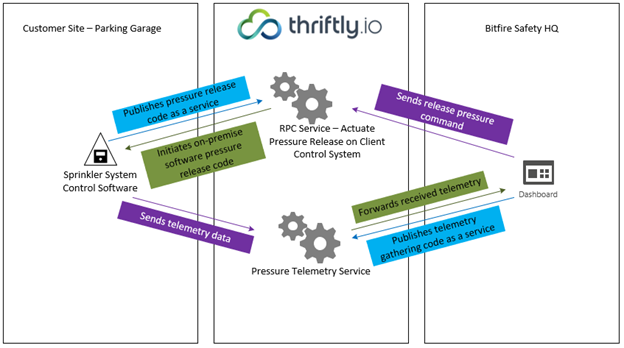
Bitfire Safety is a fictional fire protection company. Bitfire Safety provides dry pipe sprinkler system installations for customers that own cold-climate structures, such as parking garages. These systems are installed and configured with a command panel system interface and software that is used to locally monitor and test various aspects of the system. As part of a modernization initiative, Bitfire Safety is enhancing their services to include remote monitoring and issue remediation. They are first concentrating on the monitoring of the supervisory pressure switches. These switches are responsible for ensuring the proper system pressure and will pump or release pressure through a ball valve to maintain the correct levels. Through monitoring, Bitfire Safety can identify when pressures are tracking low or high. Low pressures could be indicative of an air compressor failing or a leak in the system; pressures tracking high could lead to damaging clappers and gaskets in the system, and could pose a safety risk in the event of a fire where open clappers would just bleed off system air rather than delivering water to a fire.


Building Human Interfaces With Artificial Intelligence

The main trick here is to allow humans to stay human. For decades computers were not exciting to use as they required us to change our ways. We needed to click the right buttons, in the right order to achieve a task. We needed to remember passwords and addresses and know which program to use for different tasks. In essence, we needed to get conditioned to software to use it and to learn how to interface with it before we enjoyed it. When you talk to Cortana, Siri or Google, you don’t need to use a keyboard or a mouse and you can ask questions like "what is the temperature today in the capital of Denmark?" without having to know what the capital is or tell the computer what "today" means. We have a lot of data already out there and computers can analyse the data without extra work from our side. That way we add the extra information the computer needs to give us the right results for the questions we ask.


Quote for the day:


"The final test of a leader is that he leaves behind him in other men, the conviction and the will to carry on." -- Walter Lippmann


Daily Tech Digest - November 19, 2018

Tips for protecting your data when losing an employee


The hard reality is that the majority of your departing employees will try to take company data with them, but there are proactive steps companies can take to ensure their data is safe after the staffers leave. You can’t protect what you don’t know you have. So, the first step is to perform a detailed inventory of your organization’s data and where it’s stored. This involves a thorough audit of the files within your company, which may include in-depth questionnaires for every employee or department. The end result should be a data “map” that details where all of your data is kept, who has access to which files, and when those files were created and modified. Regardless of a former employee’s motives for removing data from your business, if you confront them with evidence of the file-copying, many times they will simply delete or return the files to settle the matter without the need for further action.


Cyber crime: why business should report it as soon as possible

Data breach investigations reveal that some organisations can takeweeks or months to discover a cyber attack, but some cyber criminal activities are identifiable immediately such as distributed denial of service (DDoS) attacks, ransomware and other types of extortion. The message here is not to delay in reporting cyber criminal activity. “Report as soon as possible, particularly if it is a crime in action. We have much more chance of being able to help and of being able to catch the criminals responsible if the crime is reported to us while it is taking place,” says Hulett. The NCA recognises that it can appear to be a “cluttered landscape” for the businesses’ point of view in terms of how to go about reporting a cyber crime, particularly as many organisations will have to report personal data breaches to their data protection authority for the first time under the EU’s General Data Protection Regulation (GDPR) and new GDPR-aligned data protection laws in the UK.


What network pros need to know about IoT

it pros executives iot smart city machine learning ai city skyline metamorworks getty
When it comes to IoT, latency is the enemy. With thousands of devices spread across offices, factories, hospitals, and remote locations, more and more data and computing resources will reside on the edges of the network. "I always say, 'I don't care how fast your network is, you don't deploy your car's airbag from the cloud,'" says Shepherd. "Similarly, if I'm an operations person who needs real-time control over a manufacturing line, I want to move computing for process control and quality as close as feasible to the line, so I'm not relying on a wide-area network to respond." By 2022, Gartner estimates that 75% of all enterprise data will be generated and processed on the network's edge. And that raises a host of new data governance issues. Determining which data stays on the edge and what travels across the network can be complicated, says Kimberly Clavin, vice president of engineering for Pillar Technology, which designs IoT solutions for the automotive, healthcare, and retail industries.


These are the programming language features that really matter to developers

In general, developers want more of a safety net when creating complicated applications, writes Thomas Elliott, data scientist at GitHub. That desire for safety and predictability is evident in the rise of languages that support static typing, where developers can specify the type of each variable, allowing many errors to be flagged when code is compiled. "With the exception of Python, we've seen a rise in static typing, likely because of the security and efficiency it offers individual developers and teams working on larger applications," writes Elliott, who adds there is also an increased appetite for languages that make it easier to build stable multi-threaded applications. "TypeScript's optional static typing adds an element of safety, and Kotlin, in particular, offers greater interactivity, all while creating trustworthy, thread-safe programs." Among the fastest-growing languages, Elliott identifies a common theme of modern, more fully featured languages that can interoperate with older languages, and that, in some cases, are starting to supersede them.


CarsBlues Bluetooth attack Affects tens of millions of vehicles

CarsBlues Bluetooth attack
A new Bluetooth hack, dubbed CarsBlues, potentially affects millions of vehicles, Privacy4Cars warns. The CarsBlues attack leverages security flaws in the infotainment systems installed in several types of vehicles via Bluetooth, it affects users who have synced their smartphone to their cars. Privacy4Cars develops a mobile app for erasing PII from vehicles, according to the firm tens of millions of vehicles could be affected worldwide, and it is an optimistic estimate because the number could be much greater. The riskiest scenario sees drivers who sync their phones to vehicles that have been rented, borrowed, or leased and returned. Their data might be exposed to attackers that can use them for various malicious purposes. “The attack can be performed in a few minutes using inexpensive and readily available hardware and software and does not require significant technical knowledge.” reads the post published by the company. “As a result of these findings, it is believed that users across the globe who have synced a phone to a modern vehicle may have had their privacy threatened. It is estimated that tens of millions of vehicles in circulation are affected worldwide, with that number continuing to rise into the millions as more vehicles are evaluated.”


IoT Home Assistant API for Raspberry Pi

Home Assistant is an open-source home automation platform running on Python 3. It is used to track and control all devices at home and has many utilities to help us with automation control. You can check at Home Assistant blog how dynamic is the community with constant updates and upgrades for the platform. We expect to interact Home Assistant with the embryo API available at the IoT.Starter.Pi thing device. There are many ways to install Home Assistant, since it supports many different hardware platforms. This project focus on Haspbian, a disk image that contains all needed to run Home Assistant on a Raspberry Pi. The Haspbian image is built with same script that generates the official Raspbian image's from the Raspberry Pi Foundation. The same tool used to create the raspberrypi.org Raspbian images was forked from home-assistant/pi-gen repository. The final stages were ripped off and a new stage-3 was replaced to install Home Assistant. With the exception of git , all dependencies are handled by the build script.


Can Artificial Intelligence Improve Learning?


Hard data can indeed help identify learning challenges for individual students. Virtual reality can enliven a science lesson visually, and for engineering students, in particular, simulate and break down connections between moving parts in ways that even the most imaginative teacher cannot put together in a lecture. Engineering education in India is being criticized for churning out unemployable graduates in large numbers. Most of them seem to lack communication skills and find themselves at a loss when asked to solve practical challenges in the workplace. Technologies such as Artificial Intelligence and Virtual Reality can help monitor and identify personal preferences and aptitudes. And they can do this much faster than any human, providing the opportunity for much-needed intervention at exactly the stage at which it is required. That is the crux of providing students with a complete vocational experience and making their education relevant to what is required by industry.


A quick guide to important SDN security issues

Traditional network security vulnerabilities are bad enough without adding SDN security issues to the mix. But, as organizations deploy SDN, they risk exposing their networks to new types of threats and attacks, especially if they don't have proper plans in place. A prevalent concern with SDN security focuses on the SDN controller. The controller contains and provides intelligence for the entire network. Whoever has access to the controller has control of the network. This means organizations need to configure policies and design the network to make sure the right people are in charge. Here are four useful tips to help organizations avoid detrimental SDN security issues and get the most from their SDN deployments. ,,, The SDN controller is a vital part of the security discussion, because successful attacks on the controller can totally disrupt network operations, he said. To combat these attacks, organizations can configure role-based authentication to make sure the right people get access to applications and data. 


How open source makes lock-in worse (and better)

opensourceistock000038083056mindscanner.jpg
Open source creates lock-in? Surely not! Well, surely yes, at least in the enterprise. Why? Because enterprise computing doesn't like change. As hard as it is to get an enterprise to embrace new technologies, once they do, they tend to stick around forever. Remember when mainframes died a decade or two back? Except, of course, they didn't die: Enterprises continue to spend billions each year on old-school tech that had its day back when Flock of Seagulls was still on the radio. Fast forward to Amazon vs. Oracle. Amazon, with a multi-billion dollar database business of its own that directly competes with Oracle's, had every reason to move off the legacy database vendor. And yet it didn't. Year after year, Amazon wrote massive checks worth tens of millions to Oracle, its stated enemy. Finally, on November 9, AWS chief Andy Jassy said that Amazon's consumer business finally weaned itself off Oracle's data warehouse for Amazon Redshift, and was getting close to moving all other applications to Amazon Aurora and DynamoDB.


Robots and the NHS: How automation will change surgery and patient care

Surgeons are one of the first medical specialties to welcome their robot overlords: in the NHS, surgical robots can already be found assisting with a range of operations, including urology, colorectal, and prostate procedures. These robots -- which are made up of a set of arms wielding cameras, lights and medical instruments -- are controlled by a surgeon sitting at a console who is then able to control the actions of the robot's arms with great precision. Using robots means surgeons can make smaller incisions, reducing blood loss and pain for patients, which can mean a faster recovery time and a shorter stay in hospital. That's good news for the patients, who can get back to their normal life quicker, but also good news for the NHS, which has fewer infections and complications to deal with, and sees beds freed up faster. Another attraction is that these robots can reduce the physical burden on surgeons -- bending over patients for several hours a day over years is not kind on the back -- which can allow clinicians to carry on operating for longer.


Quote for the day:


"Honor bespeaks worth. Confidence begets trust. Service brings satisfaction. Cooperation proves the quality of leadership." -- James Cash Penney