Daily Tech Digest - April 17, 2021

Decoupling Frontends and Backends with GraphQL

GraphQL combines the best of APIs and Query Language. It is an API because a simple POST returns the data requested. And it is a query language because the user can ask for what she wants (as long as it is permissible in the definition of the GraphQL API endpoint). GraphQL has three distinct concepts: Types (such as Customer, Order, etc.) that the user (frontend developer) interacts with. These types are linked together in a graph — for example, a customer might have orders — hence the name GraphQL. It has an additional abstraction, an interface, that can be used to further hide types. This is particularly useful when there are multiple different implementations; Queries, such as customerById (queries are just entry points into the graph) return data of a type; and Resolvers, which describe the implementation of the queries and generation of the bits of data associated with types. For example, there might be a resolver that says the query customerById can be executed by issuing a SQL statement against a MySQL database, whereas the query orderByCustomer requires a GET against a REST endpoint.


IoT in Mining

Mining companies have overcome the challenge of connectivity by implementing more reliable connectivity methods and data-processing strategies to collect, transfer and present mission critical data for analysis. Satellite communications can play a critical role in transferring data back to control centers to provide a complete picture of mission critical metrics. Mining companies worked with trusted IoT satellite connectivity specialists such as ‘Inmarsat’ and their partner eco-systems to ensure they extracted and analyzed their data effectively. Cybersecurity will be another major challenge for IoT-powered mines over the coming years As mining operations become more connected, they will also become more vulnerable to hacking, which will require additional investment into security systems. Following a data breach at Goldcorp in 2016, that disproved the previous industry mentality that miners are not typically targets, 10 mining companies established the Mining and Metals Information Sharing and Analysis Centre (MM-ISAC) to share cyber threats among peers in April 2017.


BazarLoader Malware Abuses Slack, BaseCamp Clouds

According to researchers at Sophos, in the first campaign spotted, adversaries are targeting employees of large organizations with emails that purport to offer important information related to contracts, customer service, invoices or payroll. “One spam sample even attempted to disguise itself as a notification that the employee had been laid off from their job,” according to Sophos. The links inside the emails are hosted on Slack or BaseCamp cloud storage, meaning that they could appear to be legitimate if a target works at an organization that uses one of those platforms. In an era of remote working, those odds are good that this is the case. “The attackers prominently displayed the URL pointing to one of these well-known legitimate websites in the body of the document, lending it a veneer of credibility,” researchers said. “The URL might then be further obfuscated through the use of a URL shortening service, to make it less obvious the link points to a file with an .EXE extension.” If a target clicks on the link, BazarLoader downloads and executes on the victim’s machine. The links typically point directly to a digitally signed executable with an Adobe PDF graphic as its icon.


How the Biden Administration Can Make Digital Identity a Reality

Digital identity has already gained bipartisan support on Capitol Hill. In 2020, Representatives Bill Foster (D-IL) and John Katho (R-NY) introduced the Improving Digital Identity Act, designed to establish a nationwide approach to improving digital identity. Now, the Biden administration plans to leverage digital identity for modernization of public services, ranging from government assistance to healthcare to licensing. The act would be a step forward but wouldn't completely address needs in the public and private sectors. Rep. Foster notes that the bill would primarily address the government's need for digital identity, paying less attention to issues (e.g., transaction friction, fraud) facing enterprises and consumers. That said, the Biden administration must take a broader, holistic approach to digital identity, eliminating data siloing that would make future digital IDs unnecessarily purpose-specific. Any error would allow bad actors to access sensitive data and impersonate customers, resulting in fraudulent requests for government services, credit cards, loans, or licenses.


Manufacturing Performance Intelligence: How digital unlocks resilient, agile operations

Digital solutions have a huge role to play in enabling Industry 4.0 and driving sustainable practices. As manufacturers rapidly accelerated their adoption of digital operating models, they have been able to safeguard employee health, ensure commercial resilience and elevate performance using digital intelligence. This is the new opportunity for industries and AVEVA’s portfolio combines the operational data management of PI System with industrial analytics, enabling us to lead the way. By harnessing the power of information with artificial intelligence and human insight, AVEVA is leading the industry with Performance Intelligence. Schneider Electric’s network of Smart Factories was among the world’s first to transform operations, pioneering AVEVA’s Discrete Lean Management software and pivoting to cloud-based operating models to safeguard production. These changes transformed how we operate, cutting downtime by 44% and driving 21% increases in energy efficiency in key factories. The World Economic Forum recognized three Smart Factories as Advanced Manufacturing Lighthouses as a result


Designing & Managing for Resilience

The concept of shared capacity and reciprocity within an organization is more complex than simply directing teams to work together. Many organizations do have cross-functional work teams or attempt to break down organizational silos by rotating executives throughout the business. However, organizations are defined by reporting structures, functional units or product teams - where each have their own goals and objectives. In addition, an engineering leader is tasked with setting direction, vision and priorities for their teams for a given quarter or phase of the business lifecycle which may put them at different tempos than their counterparts. Systemic and difficult problems that span organizational boundaries can be emergent or continuously changing as different teams make attempts to mitigate the problems within their own scope of authority. This can make it difficult to coordinate clear goals and objectives with peers for inter-organizational initiatives. Therefore, a function of the resilient leader is to advocate for capacity sharing and reciprocity as part of their team’s goals and priorities. 


Cyber security for telehealth services

The goal of cybersecurity is to reduce the risk of cyber-attacks and to protect organizations and individuals from intentional and deliberate exploitation of security vulnerabilities in systems, networks, and technologies. You are done with teleconsultation on Practo and now you are about to checkout and you are offered cash withdrawal options with your debit or credit card or UPI, and like you, there are millions of users who are sharing such sensitive information on the platform, have you ever wondered how secured the information on practo is? From updated privacy policies to security-focused patents to use AI for Data Security each company increases its focus on data protection to promote user trust. With the increasing growth in the digital world, cybersecurity threats will continue to intensify as hackers learn to adapt to security strategies. This will increase the overall need for cybersecurity by companies that will be paying more and more highly qualified security professionals to protect their vulnerable assets from cyber-attacks. Telehealth means you no more have to travel, your appointment with the physicians takes place through a TV screen in between you.


Beyond the Quickstart: Running Apache Kafka as a Service on Kubernetes

Kubernetes provides many networking options such as node ports, ingress, load balancers and, with Red Hat OpenShift, routes as well. Kafka requires the producers and consumers to talk to individual brokers based on the placement of partitions and partition leaders. Based on the different networking options, you have to configure your network correctly so that the producers and consumers are able to individually address the brokers. Kafka exposes the “advertised.listeners” option in the broker configuration, which allows the clients to directly connect to the brokers. When configuring the Kubernetes services to allow access to the brokers, you will also configure the “advertised.listeners” in the broker to ensure that producers and consumers are able to connect to the individual brokers. Kubernetes abstracts infrastructure, following an interface pattern wherein third-party providers can create their own plugins that follow a standard interface definition. So you could also build your own routing layer to make sure you are able to address the brokers. Kubernetes allows you to do this via ingress resources.


Using The Internet Of Things For Smart Office Automation

Scheduling is critical in a post-COVID office. IoT technology makes it much easier to keep staff at an optimum number of people throughout the day to ensure compliance with safety practices. Companies can create a check-in process and monitor any potential warning signs. This system enables companies to keep track of who was in the same room and parked their cars using smart parking solutions. Smart scheduling can cut down overtime and stagger start and leave times so that people can have a more flexible schedule while keeping the number of people in the same areas at a minimum. Smart scheduling can automatically create a master plan that considers all staff members’ preferences and meets the company’s overall requirements. Smart scheduling for IoT-enabled devices and networks is useful in a post-COVID office environment. Companies can automatically create schedules for IoT items needed to match employee schedules. This is convenient if employees call in sick because their workspaces can adjust automatically if they are not at work. Making real-time changes to IoT schedules is one of the best uses of smart office technology.


Bank Groups Object to Proposed Breach Notification Regulation

The four banking groups contend that compliance with the new regulation would prove too burdensome for financial institutions. "We share the goal to develop a flexible incident notification framework offering early awareness of disruptions, while also being appropriately scoped to avoid over-reporting and unnecessary burden for the banking industry, third-party service providers and the supervisory community," the groups wrote. The proposed regulation bases its definition of a reportable computer security incident on the National Institute of Standards and Technology's definition. The NIST definition is: "An occurrence that results in actual or potential jeopardy to the confidentiality, integrity or availability of an information system or the information the system processes, stores or transmits or that constitutes a violation or imminent threat of violation of security policies, security procedures or acceptable use policies." The four financial groups wrote that the NIST definition is too broad, and if it's included in a breach notification requirement, it would result in insignificant occurrences becoming reportable incidents.


Quote for the day:

"Effective team leaders realize they neither know all the answers, nor can they succeed without the other members of the team." --  Katzenbach & Smith

Daily Tech Digest - April 15, 2021

Cyber criminals are targeting the cloud — here’s how to defend against them

While threat actors may use methods to actively infiltrate a company’s defences, sometimes the vulnerabilities are already there. CSPs are usually quick to patch known vulnerabilities without requiring customer interaction. However, when cloud services involve the customer in managing the software, oversight can be tricky due to the complexity of the environment. Businesses should prioritise regular scanning and patching of known vulnerabilities with the latest version of each type of software they’re running on their system. On top of this, IT leaders should maintain an up-to-date inventory of assets to ensure visibility of all endpoints that require patching. In the rush to gain a competitive advantage, cloud environments are evolving rapidly with organisations using a hybrid or multi-cloud approach. This complexity can lead to misconfiguration if set up incorrectly. Misconfigured cloud infrastructures can expose data or resources to the public internet, and failure to implement encryption or multi-factor authentication can allow actors to access cloud-related tools, data, assets, or systems.


6 Key Forces Shaping Technology and Service Providers Through 2025
COVID-19 shut down businesses, supply chains and entire countries, and changed the way companies buy, sell and work. But other events like trade wars, legislation, and regulations can all impact technology providers. It’s not about predicting these events as much as identifying existing trends (i.e., work from home, e-commerce) that will accelerate if these occur. Customers demand products and services that meet their particular business or IT needs. In a broader sense, customer demand and expectations are shaped by cultural changes and world events (e.g., stay-at-home orders increasing demand for distributed work tools). User experiences and trends like mobility or subscription and freemium pricing, which were made popular in consumer markets, have led IT customers to want the same benefits from technology providers. Emerging technologies may seem like novelties when they first appear, but when these technologies become a trend, they can profoundly shape buying and selling behavior and enable new business models. Over the next several years, today’s immature technologies and “weak signals” have the potential to disrupt what your product does, who it serves and how you deliver it.


Fast Data - It’s Not Your Grandfather’s Operational Data

Fast data enables full-circle delivery of data that is “in motion.” In other words, it’s generated and consumed instantly by interactive applications running on large numbers of devices. Fast data enables organizations to act on insights gained from user interactions as these insights are generated at the point of the interaction. And because decisions or actions take place right at the front-end, fast data architectures are, by definition, distributed and real-time. Big data is focused on capturing data, storing it, and processing it periodically in batches. A fast data architecture, on the other hand, processes events in real time. Big data focuses on volume, while with fast data, the emphasis is on velocity. Here’s an example. A credit card company might want to create credit risk models based on demographic data. That’s a big data challenge. A fast data architecture would be required if that credit card company wants to send fraud alerts to customers in real-time, when a suspicious activity occurs in their accounts. Think of FedEx. To track millions of packages and ensure on-time and accurate delivery across the planet, FedEx needs access to the right real-time data to perform real-time analysis and deliver the right interaction—right away, right there, not a day later.


Better Software Writing Skills in Data Science: Dead Programs Tell No Lies

When you figure out that something “bad” happen to your program, you know this should not happen and you know there is no way around, the way to throw and exception higher can be via an assert. This will throw an exception to the higher up program which will have to decide what to do with it. An example would be you expect an int as input and you get a string, this is contract breaking, the higher up program ask you to handle improper data, why would your program decide why the contract was broken? It should be the responsibility of the caller to handle that exception properly. That might warrant a assert right there. Depending on the organization you work in, when an how to use exceptions and asserts might get philosophical. On the other hand it could also be subject to very specific rules. There might be really valid reason why an organization might prefer an approach over another. Learn the rules, and if there is no rule, have discussion around it and apply your best judgement. In any case, dead programs tells no lies. Better kill it than having to deal with polluted data a year in the future.


How to avoid social engineering scams

Social engineering is a collective term for ways in which fraudsters manipulate people into performing certain actions. It’s generally used in an information security context to refer to the tactics crooks use to trick people into handing over sensitive information or exposing their devices to malware. This often comes in the form of phishing scams – messages supposedly from a legitimate sender that ask the recipient to download an attachment or follow a link that directs them to a bogus website. However, social engineering isn’t always malicious. For example, say you need someone to do you a favour, but you’re unsure that they’ll agree if you ask them apropos of nothing. You might grease the wheels by offering to do something for them first, making them feel obliged to say yes when you ask them to return the favour. That’s a form of social engineering. You’re performing an action that will compel the person to do something that will benefit you. Understanding social engineering in this context helps you see that social engineering isn’t simply an IT problem. It’s a vulnerability in the way we make decisions and perceive others – something we delve into more in the next section.


Mesh networking vs. traditional Wi-Fi routers: What is best for your home office?

Before changing your setup, you should also consider your ISP package. If you're subscribed to a low-speed offering, new equipment is not going to necessarily help. Instead, package upgrades could be a better option. If you are a sole user and need a stable, powerful connection -- such as for resource-hungry work applications or gaming -- a traditional router may be all you need. Wired should be quicker than wireless, and so investment in a simple Ethernet cable, easily picked up for $10 to $15, could be enough. Wi-Fi range extenders, too, could be considered as an alternative to mesh if you just need to boost coverage in some areas, and will likely be less expensive than purchasing individual mesh nodes. Some vendors also offer mesh 'bolt-ons' such as Asus' AiMesh, which can connect up existing routers to create a mesh-like coverage network without ripping everything out and starting again. However, mesh networking is here to stay and at a time when many of us are now in the home rather than traditional home offices, a mesh setup could be a future-proof investment. 


Intel Report Spotlights Importance Of Transparency In Cybersecurity

Transparency and security assurance are important, but the Intel report also reveals other factors that businesses consider for endpoint and network infrastructure purchasing decisions. Interoperability with existing tools and platforms ranked highest with 63%, followed by installation cost (58%), system complexity (57%), vendor support (55%), and scalability issues (53%). One area that is particularly interesting is the intersection of hardware and software and how they can work together to solve cybersecurity problems in innovative ways. More than three-fourths of the survey participants indicated that it is highly important for technology providers to offer hardware assisted capabilities to mitigate software exploits. More than 70% also noted that it is important for technology providers to offer mechanisms and security controls to protect distributed workloads. Suzy Greenberg, Vice President of Intel Product Assurance and Security for Intel, joined me recently on the TechSpective Podcast to talk about this report and some of the insights and trends she finds interesting.


Security Bug Allows Attackers to Brick Kubernetes Clusters

The impact could be fairly wide: “As of Kubernetes v1.20, Docker is deprecated and the only container engines supported are CRI-O and Containerd,” Sasson explained. “This leads to a situation in which many clusters use CRI-O and are vulnerable. In an attack scenario, an adversary may pull a malicious image to multiple different nodes, crashing all of them and breaking the cluster without leaving a way to fix the issue other than restarting the nodes.” When a container engine pulls an image from a registry, it first downloads its manifest, which has the instructions on how to build the image. Part of that is a list of layers that compose the container file system, which the container engine reads and then downloads and decompresses each layer. “An adversary could upload to the registry a malicious layer that aims to exploit the vulnerability and then upload an image that uses numerous layers, including the malicious layer, and by that create a malicious image,” Sasson explained. “Then, when the victim pulls the image from the registry, it will download the malicious layer in that process and the vulnerability will be exploited.” Once the container engine starts downloading the malicious layer, the end result is a deadlock.


What is the market opportunity for NFTs?

NFTs have seen massive increases in trade volume and users in recent times. Investments in NFTs rose by 299% across 2020, and the NFT market’s sales volume grew by 2,882% in February alone. This increased interest resulted in part of the improving infrastructure surrounding NFTs, which has supported full stack services from trading venues, minting platforms, marketplaces and more. While detractors have suggested that the current crest of interest represents a bubble, experts have pointed to the fact that technology of NFTs is strong enough to survive a possible crash, and is expected to be around for quite some time. According to Beeple, a digital artist who recently made almost $70 million from his NFT sale, the technology will support any work or piece of real value. Similarly, the new owners of Beeple’s record setting piece of artwork, Vignesh (Metakovan) and Anand (Twobadour) believe their transaction represents a paradigm shift in how the world perceives art. They see NFTs as having an equalizing effect between the traditionally dominant West and the global South.


Applications, Challenges For Using AI In Fabs

One of the main applications for machine learning is defect detection and classification. The first step is using machine learning to detect actual defects and ignore noise. We are seeing many examples where machine learning is much better at extracting the actual killer defect signal from a noisy background of process and pattern variations. The second step is to leverage machine learning to classify defects. The challenge these days is that when optical inspectors run at high sensitivity to capture the most subtle, critical defects on the most critical layers, other anomalies are also detected. Machine learning is first applied to the inspection results to optimize the defect sample plan sent for review. Then, high-resolution SEM images are taken of those sites and additional machine learning is used to analyze and classify the defects to provide fab engineers with accurate information about the defect population – actionable data to drive process decisions. An emerging application is to make use of machine learning to be more predictive about where to inspect and measure.


Quote for the day:

"Real leaders are ordinary people with extraordinary determinations." -- John Seaman Garns

Daily Tech Digest - April 14, 2021

How far have we come? The evolution of securing identities

With internal, enterprise-facing identity, these individuals work for your organization and are probably on the payroll. You can make them do things that you can’t ask customers to do. Universal 2nd Factor (U2F) is a great example. You can ship U2F to everyone in your organization because you’re paying them. Plus, you can train internal staff and bring them up to speed with how to use these technologies. We have a lot more control in the internal organization. Consumers are much harder. They are more likely to just jump ship if they don’t like something. Adoption rates of technologies, like multifactor authentication, are extremely low in consumer land because people don’t know what it is or the value proposition. We also see organizations reticent to push it. A few years ago, a client had a 1 percent adoption rate of two-factor authentication. I asked, “Why don’t you push it harder?” They said that every time they have more people using two-factor authentication, there are more people who get a new phone and don’t migrate their soft token or save the recovery codes. Then, they call them up and say, “I have my username or password but not my one-time password.


Informatica debuts its intelligent data management cloud

As data becomes more valuable, so does data management, Informatica argues. Its IDMC offers more than 200 intelligent cloud services, powered by Informatica's AI engine CLAIRE. It applies AI to metadata to give an organization an understanding of its "data estate," Ghai explained. The "data estate" tells you about the fragmentation of data -- its location and the various domains of data. "And through that insight," Ghai said, Informatica will "automate the ability to connect to data, to build data pipelines, process data, provision it for analytics... to apply advanced transformations to cleanse that data and trust it... to match, merge and build a single source of truth." From there, the platform aims to make data more accessible to business users with features like the "data marketplace." With the marketplace, users can "shop for data" much as one would shop for consumer goods on the Amazon marketplace, Ghai explained. The IDMC is micro-services based and API-driven, with elastic and serverless processing. It's built for hybrid and multi-cloud environments. The platform is already running at scale, processing more than 17 trillion transactions each month.


Microservices in the Cloud-Native Era

With developer tools and platforms like Docker, Kubernetes, AWS, GitHub, etc., software development has become very approachable and easy. You have a monolithic architecture and three million lines of code. Making changes to the code base whenever required and releasing new features was not an easy task before. It created a lot of dilemmas between the developer teams. Finding the mistake that was causing the code to break was a monumental task. That’s where microservices architecture shines. Many companies have recently moved from their humongous monolithic architecture to microservices architecture for a bright future. There are many advantages of shifting to microservices architecture. While a monolithic application puts all of its functionality into a single code base and scales by replicating on multiple servers, a microservices architecture breaks an application down into several smaller services. It then segments them by logical domains. Together, microservices communicate with one another over APIs to form what appears as a single application to end-users. The problem with a monolithic application, when something goes wrong, the operations team blames development, and development blames QA.


Modern Data Warehouse & Reverse ETL

“Reverse ETL” is the process of moving data from a modern data warehouse into third party systems to make the data operational. Traditionally data stored in a data warehouse is used for analytical workloads and business intelligence (i.e. identify long-term trends and influencing long-term strategy), but some companies are now recognizing that this data can be further utilized for operational analytics. Operational analytics helps with day-to-day decisions with the goal of improving the efficiency and effectiveness of an organization’s operations. In simpler terms, it’s putting a company’s data to work so everyone can make better and smarter decisions about the business. As examples, if your MDW ingested customer data which was then cleaned and mastered, that customer data can then by copied into multiple SaaS systems such as Salesforce to make sure there is a consistent view of the customer across all systems. Customer info can also be copied to a customer support system to provide better support to that customer by having more info about that person, or copied to a sales system to give the customer a better sales experience.


The Microsoft-Nuance Deal: A new push for voice technology?

Microsoft has had its hand in voice technology since debuting its virtual assistant Cortana in 2015 as part the initial Windows 10 release. Since then, Cortana has evolved to support Android and iOS devices, Xbox, the Edge browser, Windows Mixed Reality headsets, and third-party devices such as thermostats and smart speakers. According to Microsoft, Cortana is currently used by more than 150 million people. More recently, the company shifted Cortana to position it as more of an office assistant rather than for more general use. “Voice recognition is gaining momentum and will be used in every type of industry — from transcription to command-and-control types of applications — and acquiring a leading vendor in this area just makes sense,” Pleasant said. She stressed that as users become familiar with Cortana, Siri and Amazon's Alexa at home, they expect to see similar speech-enabled technologies at work. She also noted that Microsoft is one of the few companies with the resources to acquire a company like Nuance, allowing it to jump ahead of rivals who might have wanted to do the same thing.


Get your firm to say goodbye to password headaches

In a passwordless environment, no password storage or management is needed. Therefore, IT teams are no longer burdened by setting password policies, detecting leaks, resetting forgotten passwords and having to comply with password storage regulation. It’s fair to say that for many helpdesk teams, password reset requests will be the most commonly asked-for thing (from users). Past research has determined that for some larger organizations, up to $1 million per year can be spent on staffing and infrastructure to handle password resets alone. Resetting passwords is probably not a particularly complex issue for most IT departments to deal with, but it’s the sheer number of requests makes handling these requests an extremely time-consuming task. Just how much time does that take away from helpdesks on a daily, weekly or monthly basis? It’s one of those hidden costs that your firm will be incurring that can be streamlined by giving people passwordless connections into their environment. Passwords remain a weakness for those trying to secure customer and corporate data and passwords are the number one target of cyber criminals.


Modernising the insurance industry with a shared IT platform model

Pockets of the insurance industry are heading this way, by, for example, using vehicle trackers that reward good driving with lower premiums. But behind the scenes for many organisations is a mass of hugely complex products and equally unwieldy legacy systems that don’t provide them with the ability to work in a way that is agile and digital-first. Assess your systems as they stand today and you may find that several, or possibly hundreds, have been redundant for some time. Eliminating these systems, which are nothing more than drains on the business’ resources, will allow for a greater level of agility. By moving away from cumbersome legacy systems that are no longer fit for purpose, insurers can create a simplified system that unifies silos, making everyday work more efficient, and saves the business money. Money that they can reinvest into creating a customer-centric company that can rival its strongest competitors. Imagine a world where you could simplify your product range, providing cover for the highest number of people with the fewest number of insurance products.


5 Great Ways To Achieve Complete Automation With AI and ML

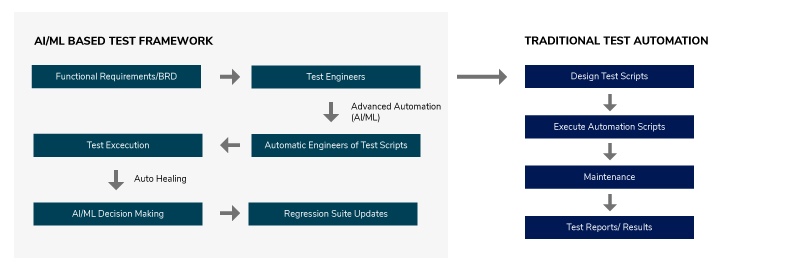
The self-healing technique in test automation solves major issues that involve test script maintenance where automation scripts break at every stage of change in object property, including name, ID, CSS, etc. This is where dynamic location strategy comes into the picture. Here, programs automatically detect these changes and fix them dynamically without human intervention. This changes the overall approach to test automation to a great extent as it allows teams to utilize the shift-left approach in agile testing methodology that makes the process more efficient with increased productivity and faster delivery. ... This self-healing technique saves a lot of time invested by developers in identifying the changes and updating them simultaneously in the UI. Mentioned below is the end-to-end process flow of the self-healing technique which is handled by artificial intelligence-based test platforms. As per this process flow, the moment an AI engine figures out that the project test may break because the object property has been changed, it extracts the entire DOM and studies the properties. It runs the test cases effortlessly without anyone getting to know that any such changes have been made using dynamic location strategy.


Apache Software Foundation retires slew of Hadoop-related projects

ASF's Vice President for Marketing & Publicity, Sally Khudairi, who responded by email, said "Apache Project activity ebbs and flows throughout its lifetime, depending on community participation." Khudairi added: "We've...had an uptick in reviewing and assessing the activity of several Apache Projects, from within the Project Management Committees (PMCs) to the Board, who vote on retiring the Project to the Attic." Khudairi also said that Hervé Boutemy, ASF's Vice President of the Apache Attic "has been super-efficient lately with 'spring cleaning' some of the loose ends with the dozen-plus Projects that have been preparing to retire over the past several months." Despite ASF's assertion that this big data clearance sale is simply a spike of otherwise routine project retirements, it's clear that things in big data land have changed. Hadoop has given way to Spark in open source analytics technology dominance, the senseless duplication of projects between Hortonworks and the old Cloudera has been halted, and the Darwinian natural selection process among those projects completed.


DNS Vulnerabilities Expose Millions of Internet-Connected Devices to Attack

In a new technical report, Forescout and JSOF describe the set of nine vulnerabilities they discovered as giving attackers a way to knock devices offline or to download malware on them in order to steal data and disrupt production systems in operational technology environments. Among the most affected are organizations in the healthcare and government sectors because of the widespread use of devices running the vulnerable DNS implementations in both environments, Forescout and JSOF say. According to the two companies, patches are available for the vulnerabilities in FreeBSD, Nucleus NET, and NetX. Device vendors using the vulnerable stacks should provide updates to customers. But because it may not always be possible to apply patches easily, organizations should consider mitigation measures, such as discovering and inventorying vulnerable systems, segmenting them, monitoring network traffic, and configuring systems to rely on internal DNS servers, they say. The two companies also released tools that other organizations can use to find and fix DNS implementation errors in their own products. 


Quote for the day:

"Coaching isn't an addition to a leader's job, it's an integral part of it." -- George S. Odiorne

Daily Tech Digest - April 13, 2021

19 Realistic Habits To Improve Software Development

When you finish writing a fragment of code and see that it works, take some time to reread it and see if you can improve it. Think that you are going to show it to someone else who is going to evaluate your code. Would you leave it the same? One of the best code refactoring techniques is the red/green process used in Agile test-driven development. To use this technique, your code must be covered with tests. If when refactoring, something fails, the test will not pass, and you will be aware that something is wrong with your refactor. ... Plan a time interval without distractions or interruptions. Interruptions will make your mind lose track of what it is developing, and you will have to start again when you resume the activity, which will cost you extra work time and make you more prone to make mistakes. It works to leave only the IDE open and a browser with a maximum of two tabs. ... Don’t try to write clever code that only you understand. Write code that someone else can read and understand. It doesn’t matter if your code has a few more lines if they’re necessary to make it understood better. Remember that in a few months, you or someone else on your team may have to modify the code, and if it is not easy to understand, it will not be easy to modify.


Clear & Present Danger: Data Hoarding Undermines Better Security

Even though there is overlap between the users of big companies' services and the customers of small businesses, the big companies aren't sharing their data. As a result, customers who use smaller businesses are left to fend for themselves. A few companies are trying to change that. Deduce (disclosure, another company I've consulted for) created a data collective through which companies can share information about user's security-related behavior and logins. In exchange for sharing data with the platform, companies get access to Deduce's repository of identity data from over 150,000 websites. They can use this shared data to better detect suspicious activity and alert their users, just like Microsoft and Google do using their own data. In a different approach to helping businesses identify suspicious users, LexisNexis created unique identifiers for their clients' customers. Using these identifiers, their clients can share trust scores that indicate if a particular user is suspicious. If a suspicious user attempts to log in to a website, the site can block that user to keep themselves and their legitimate users safer.


Optimizing the CIO and CFO Relationship“

CIOs are more likely to be pioneers and/or integrators, while CFOs are more likely to be guardians and drivers,” according to consultancy Deloitte in a description of different corporate personality types. “Pioneers are novelty-seeking, they like having a variety of possibilities, generating new ideas….On the other hand, the guardian personality values structure and loyalty, are much more methodical, detail-oriented, and perhaps a little more risk-averse.” ... CFOs understand that they have to change and expand their skills,” said Mastanuono. “The modern CFO understands technology and how it can transform the business. He or she also needs to understand the future of what finance will look like, and be a transformer of people, processes, and systems. The CFO must move from being a reactive to a proactive collaborator so the end business can be positioned to have the right systems and data at the right time. Breaking down silos and developing empathy and cross-functional collaboration are requirements, and the CFO-CIO relationship is a critical piece.” ... If CFOs and CIOs can develop a common approach to IT investments that looks at strategic risks as well as benefits, it creates common ground for project discussions and evaluations.


How to address post-pandemic infrastructure pain points

Managing workforce transformation is already challenging enough for employees who need to access on-premises resources. It becomes even more difficult if these employees work in regulated sectors, as medical and financial organizations need to track their employees’ identities, access requests, and usage to an even greater degree. Moreover, because there’s no one set of global standards, IT teams will need to account for many different compliance frameworks that vary based on where an employee is sitting, what information they’re accessing, and what sector they’re working in. On top of that, as businesses build new infrastructures that can accommodate and monitor permanently remote workers, they must be mindful of how certain regulations affect what personally identifiable information they can record about their own employees. GDPR, CCPA, and other privacy laws predate the pandemic, but like workforce transformation, they’ve become even starker and more commonplace challenges now. Different jurisdictions will have different mandates, and your IT teams will need to account for them all.


12 steps towards a secure project management framework

Cyber security is a tech-heavy domain, and project/program management is essential to deliver successful projects. However, cyber security requires a few tweaks in regular management practices as it comes with a different set of requirements. Cyber security is a security management program that is complex in nature and entails systematic processes. It deals with all aspects of a company’s operations, from mapping and recruiting skilled security professionals to vendor risk management. It involves protecting and securing computer systems, networks, and data from theft or damage, thereby ensuring business continuity. A project manager usually has to oversee many one-time and recurring cyber security tasks while handling usual responsibilities and priorities. A good project management framework will ensure that projects are delivered smoothly, without exceeding budgets, and are carried out in the timeframe decided. For any project management program to be successful, it’s important to define roles and responsibilities, a detailed plan of action, and milestones to be achieved.While most of the standard project management practices hold good in cyber security programs, there are a few cyber security-specific aspects that need to be taken care of with absolute diligence and strict adherence.


Information Relativity

Relativity was introduced at the beginning of the last century when Einstein proved that reality is fundamentally different depending on your frame of reference, a distortion of the spacetime continuum. The concept has led to the discovery of black holes, gravitational lenses, time dilation, and all kinds of other fantastic things. Relativity is not at all what one would expect based on our regular day-to-day lives that operate according to classic laws of physics. It changes what it means to observe and to be an observer—it means that how we experience the world differs not just in how we interpret it. There are circumstances where the world I experience is inconsistent with yours. It turns out that communication has these same circumstances that also work in this same peculiar way. Information is distorted depending on the location of the observer. Mark Burgess calls this “information relativity”: messages can take multiple paths and interfere with one another, information can be reversed in its order as it travels along one path, the speed of communication can be different from the speed of communication on another path. 


The Role of EiPaaS in Enterprise Architecture: Part 1

When discussing enterprise architecture, a diagram of the IT landscape comes to mind because that is the standard approach to defining an architecture. However, during our work with a number of enterprise architecture teams worldwide, we discovered that enterprise architecture has a larger strategic scope than what typical IT diagrams capture. Fundamentally, enterprise architecture converts business strategy into a value generation outcome by creating a foundation to execute various IT initiatives and processes. It is about gaining a long-term view for the organization, including the integration and standardization of various elements involved in the business. ... At the initial stages, an enterprise architecture will define the systems and subsystems required for each organization’s function. It starts with purchasing core systems, such as human resource management (HRM), customer relationship management (CRM) and/or enterprise resource planning (ERP) based on the business domain of the organization. In addition, subsystems will be built around the core systems by in-house or outsourced development teams. Systems and subsystems that belong to each function operate independently with limited or no information exchange.


Nvidia announces Morpheus, an AI-powered app framework for cybersecurity

Morpheus essentially enables compute nodes in networks to serve as cyberdefense sensors — Nvidia says its newly announced BlueField-3 data processing units can be specifically configured for this purpose. With Morpheus, organizations can analyze packets without information replication, leveraging real-time telemetry and policy enforcement, as well as data processing at the edge. Thanks to AI, Morpheus can ostensibly analyze more security data than conventional cybersecurity app frameworks without sacrificing cost or performance. Developers can create their own Morpheus skills using deep learning models, and Nvidia says “leading” hardware, software, and cybersecurity solutions providers are working to optimize and integrate datacenter security offerings with Morpheus, including Aria Cybersecurity Solutions, Cloudflare, F5, Fortinet, Guardicore Canonical, Red Hat, and VMware. Morpheus is also optimized to run on a number of Nvidia-certified systems from Atos, Dell, Gigabyte, H3C, HPE, Inspur, Lenovo, QCT, and Supermicro. Businesses are increasingly placing their faith in defensive AI like Morpheus to combat the growing number of cyberthreats.


Automation will accelerate decentralization and digital transformation

As the vaccinated population grows, doors reopen, and more people come together again, the reality we find ourselves in will not be the one left behind in 2019. Many long for a return to in-person experiences, but at the same time, have grown accustomed to the flexibilities of a decentralized, digital-first world. As we emerge from lockdown, hitting "rewind" will not satisfy customer and employee needs. Instead, companies must create hybrid experiences that integrate both digital and in-person modalities. In addition, the growing expectations of stakeholders has created unprecedented demand for IT innovation and greater sense of urgency in the post-pandemic world. Even as more offline activities resume, 2020's rapid digitalization will have a large and lasting impact on both customer and employee experiences. For example, analysis of global research from Salesforce shows customers anticipate engaging online with companies just as much in 2021 as they did in 2020. That customers expect to maintain this substantial departure from their 2019 patterns suggests that the swing to digital at the height of the pandemic wasn't purely due to unavailability of in-person channels.


How data poisoning attacks corrupt machine learning models

The main problem with data poisoning is that it's not easy to fix. Models are retrained with newly collected data at certain intervals, depending on their intended use and their owner's preference. Since poisoning usually happens over time, and over some number of training cycles, it can be hard to tell when prediction accuracy starts to shift. Reverting the poisoning effects would require a time-consuming historical analysis of inputs for the affected class to identify all the bad data samples and remove them. Then a version of the model from before the attack started would need to be retrained. When dealing with large quantities of data and a large number of attacks, however, retraining in such a way is simply not feasible and the models never get fixed, according to F-Secure's Patel. "There's this whole notion in academia right now that I think is really cool and not yet practical, but we'll get there, that's called machine unlearning," Hyrum Anderson, principal architect for Trustworthy Machine Learning at Microsoft, tells CSO. "For GPT-3 [a language prediction model developed by OpenAI], the cost was $16 million or something to train the model once.


Quote for the day:

"It's not about how smart you are--it's about capturing minds." -- Richie Norton

Daily Tech Digest - April 12, 2021

Coding interviews are terrible. Can we make them better?

A typical coding interview will involve presenting a candidate with a technical problem, which they'll have to solve in real time and in front of the interviewing panel. While these typically vary from one company to another, one common format is whiteboard coding, whereby a candidate might be asked to provide a solution to a problem involving a binary tree. It was a binary tree task that drew the ire of Howell in his now-famous tweet. These are a fairly typical part of technical interviews, designed to assess a candidate's ability to solve a programming problem and show their thinking 'out loud'. Still, most programmers say this isn't representative of anything they'd have to do in their day-to-day job, and say it's an outdated means of assessing candidates that doesn't reflect their skill level. "These little challenges don't show the greater skill sets, which for me are the ability to construct large programs," says Howell. "It's not about small algorithms. It's about the design of larger systems, and that's way more important." Howell also sees traditional coding interviews as being reflective of an industry that focuses too much on building at speed. "It's partly because the software industry moves so fast," he says.


How Augmented Reality Strengthens Biotech Manufacturing

Factories where engineers or scientists are using smart glasses to obtain virtual guidance, operators working with remote vendors to detect equipment failures in real-time, or interactive training sessions planned by directors located in another continent, are already here. “The barriers to adoption are decreasing as the AR industry becomes more robust,” notes Stracquatanio. Probably, the biggest advantage of AR is it enables seeing the production process virtually, without the need to be there. “It’s a game-changer for the industry. Individuals can have eyes and ears on site at a moment’s notice to address an emerging issue, or to host routine remote collaboration sessions,” Stracquatanio highlights. AR can also increase control over the manufacturing process. Pharma and biotech companies cannot afford mistakes during the production phase. A little oversight might lead to serious consequences such as having to start from scratch, which can be very expensive and time-consuming. A recent example is that of Johnson & Johnson’s manufacturing partner Emergent BioSolutions, whose workers erroneously mixed ingredients from two different Covid-19 vaccines; this led to wasting around 15 million vaccine doses.


Fileless Malware, Endpoint Attacks on the Rise

Cybercriminals are increasingly leveraging fileless malware, cryptominers and encrypted attacks, targeting users both at remote locations as well as corporate assets behind the traditional network perimeter. These were among the findings of WatchGuard Technologies’ Internet Security Report for Q4 2020, which found fileless malware and cryptominer attack rates grew by nearly 900% and 25%, respectively, while unique ransomware payloads plummeted by 48% in 2020 compared to 2019. The report also found botnet malware targeting IoT devices and routers became a top strain, among them the Linux.Generic virus (also known as “The Moon”), malware which is part of a network of servers that directly targets IoT devices and consumer-grade network devices, like routers, to exploit any open vulnerabilities. Total network attack detections grew by 5% in Q4, reaching their highest level in more than two years, while total unique network attack signatures showed steady growth as well, with a 4% increase compared with the third quarter of 2020. “We believe the increase in endpoint attacks between 2019 and 2020 is largely due to the widespread rise of remote work in response to the global pandemic,” Corey Nachreiner, WatchGuard CTO, explained.


Could social media networks pave the way towards stronger authentication?

Passwords are still the most common form of user authentication, “protecting” accounts, devices and systems, but alone, they don’t provide strong security. Not only that, they don’t offer the best user experience. Many passwords don’t even meet the minimum criteria of being unique and complex. People reuse passwords across accounts because they simply can’t keep track of all the logins they have. They choose passwords that are easy to remember to ease the burden, but that makes them easy to guess too. In fact, our research shows that people reuse their passwords across an average of ten personal accounts, while ‘123456’ still topped the list for the most common password in 2020. Even when they have chosen well, their unique and complex password can still fall victim to a modern phishing attack. After all, even an exemplary password can’t protect an account if the holder has been tricked into providing the information. From a user experience perspective, you have the stress and strain of choosing a unique, complex password each time that also meets the criteria demanded by the platform or service provider.


Nation-state cyber attacks double in three years

“Cyber crime economies are shaping the character of nation-state conflicts,” said McGuire. “There is also a ‘second generation’ of cyber weaponry in development that draws upon enhanced capabilities in computing power, AI [artificial intelligence] and cyber/physical integrations. One such example is ‘Boomerang’ malware, which is ‘captured’ malware that can be turned inward to operate against its owners. “Nation states are also developing weaponised chatbots to deliver more persuasive phishing messages, react to new events and send messages via social media sites. In the future, we can also expect to see the use of deepfakes on the digital battlefield, drone swarms capable of disrupting communications or engaging in surveillance, and quantum computing devices with the ability to break almost any encrypted system.” To ease rising tensions and prevent nation states from being drawn into more hostile cyber attacks, 70% of the expert panel said they thought some kind of international treaty would ultimately be necessary – this is by no means a new idea – but just 15% of them thought a cyber convention would be agreed on this decade, 37% said it was more likely to come in the 2030s, and 30% said it would probably never happen.


Quantum computer based on shuttling ions is built by Honeywell

Trapped-ion qubits were used to implement the first quantum logic gates in 1995, and the proposal for a quantum charged coupled device (QCCD) – a type of quantum computer with actions controlled by shuffling the ions around – was first made in 2002 by researchers led by David Wineland of the US National Institute of Standards and Technology, who went on to win the 2012 Nobel Prize for Physics for his work. Quantum gates have subsequently been demonstrated in multiple platforms, from Rydberg atoms to defects in diamond. The quantum computing technology first used by IT giants, however, was solid state qubits. In these, the qubits are superconducting circuits, which can be mounted directly on to a chip. These rapidly surpassed the benchmarks set by trapped ions, and are used in record-breaking machines from IBM and Google: “Working with trapped ions, I would be asked by people, ‘Why aren’t you working with superconducting qubits? Isn’t that race pretty much already settled?’,” says Winfried Hensinger of the UK’s University of Sussex. Recently, however, the progress made using superconducting circuits appears to be slowing as quantum computers integrate more and more qubits.


How MPC can solve blockchain’s data privacy conundrum

MPC, or multi-party computation, solves for confidentiality by utilizing a network of computation nodes that compute directly on encrypted data while maintaining zero knowledge about the data. For example, an employer may want to find out the average age of each of their employees. For privacy reasons, these employees may not be willing to share their ages, so through secret sharing, the employees can share their age without their age being publicly identifiable to them. The possibilities this technology enables are endless, and one must only think of the benefits such technology could bring to industries such as banking and insurance. While MPC solves for privacy, blockchain itself can protect the individual data against data breaches via the decentralization of sensitive information. Alone, blockchain lacks the infrastructure required to ensure data remains private. ... Not only is the pairing of MPC technology and blockchain a better solution to safeguarding consumer data to those currently in existence, it is one of the most viable solutions that effectively deals with the monumental problem of data security.


How Do Large Firms Train ML Models At Scale?

GPipe is a distributed machine learning library that uses synchronous stochastic gradient descent apart from pipeline parallelism to train any DNN containing multiple sequential layers. GPipe partitions a model across various accelerators and spins small batches of training examples to even smaller batches. Hence, GPipe’s accelerators can operate parallelly and maximise the scalability of the training process. It allows easy deployment of more accelerators to train large models and further scale the performance without tuning hyperparameters. GPipe is a distributed machine learning library that uses synchronous stochastic gradient descent apart from pipeline parallelism to train any DNN containing multiple sequential layers. GPipe partitions a model across various accelerators and spins small batches of training examples to even smaller batches. Hence, GPipe’s accelerators can operate parallelly and maximise the scalability of the training process. It allows easy deployment of more accelerators to train large models and further scale the performance without tuning hyperparameters.


Data validates future of work looks quite different than pre-pandemic

Both private and professional lives are slowly readopting former practices, such as eating inside a restaurant. As we cautiously return to normal, road warriors are ready to get back on the road, but we're also excited to keep some of the improved healthcare, restaurant and retail experiences we've discovered over the last year. Respondents cited the top four things they said they missed while working remotely: Spontaneous interactions with colleagues I wouldn't have talked to otherwise; Simply being around other people; Exposure to a diversity of perspectives and ideas; and Productivity. Qualtrics discovered that respondents found improved productivity (51%) and well-being—two times more likely than those who say it declined—during the pandemic lockdown. Managers concur: 55% said their direct reports have been more productive. Generationally, 54% of millennials said they're more productive, 53% of Gen Z, 48% of Gen X and 34% of boomers agree. Productivity has improved due to flexible schedules (31%), no commute (26%), more control over workspace (24%), ability to focus with fewer work interruptions (24%) and more privacy and personal space (23%).


The benefits of cyber threat intelligence

All of this saves time and helps them be more effective at mitigating threats and reducing risks. CTI allows the SOC to see beyond the perimeter, so they are aware of threats before they hit their infrastructure. That allows the SOC time to prepare, tweak defenses, such as deploying specific monitoring rules or knowing what to be on the lookout for. And when dealing with incidents or alerts, having this additional context allows them to place the individual alert, or maybe alerts they are dealing with, in the wider context of who is behind it, what their aims are, while typical next steps would be, or maybe even what must have gone before for this to occur. All of that makes it easier to determine how to respond. And when dealing with multiple alerts or incidents, as SOCs do, having this context allows you to prioritize, separating the wheat from the chaff as it were. And that’s critical as many SOCs are resource strained, and so knowing which items to focus on can help with making the most effective use of limited resources.


Quote for the day:

"It's good to trust others but, not to do so is much better." -- Benito Mussolini

Daily Tech Digest - April 11, 2021

One-stop machine learning platform turns health care data into insights

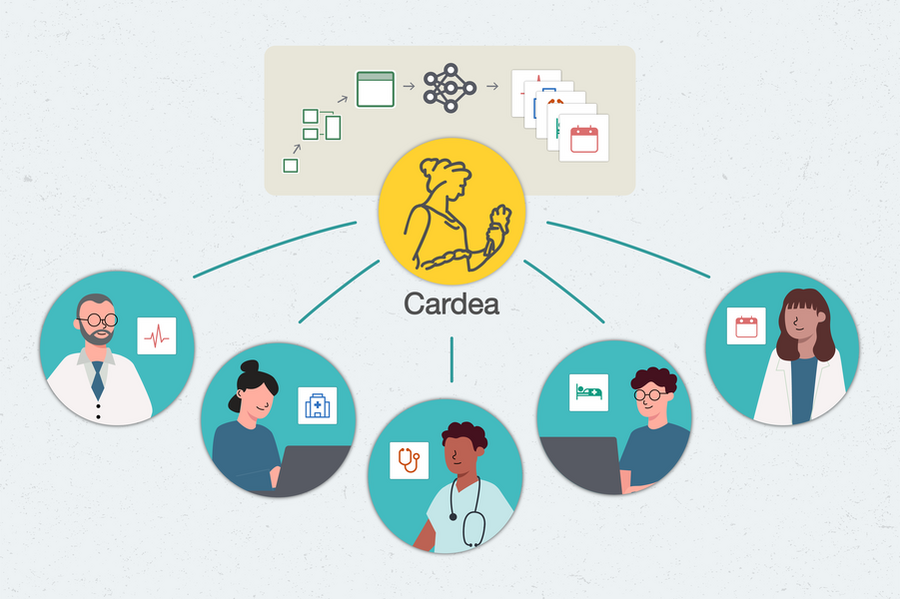
To turn reams of data into useful predictions, Cardea walks users through a pipeline, with choices and safeguards at each step. They are first greeted by a data assembler, which ingests the information they provide. Cardea is built to work with Fast Healthcare Interoperability Resources (FHIR), the current industry standard for electronic health care records. Hospitals vary in exactly how they use FHIR, so Cardea has been built to "adapt to different conditions and different datasets seamlessly," says Veeramachaneni. If there are discrepancies within the data, Cardea's data auditor points them out, so that they can be fixed or dismissed. Next, Cardea asks the user what they want to find out. Perhaps they would like to estimate how long a patient might stay in the hospital. Even seemingly small questions like this one are crucial when it comes to day-to-day hospital operations — especially now, as health care facilities manage their resources during the Covid-19 pandemic, says Alnegheimish. Users can choose between different models, and the software system then uses the dataset and models to learn patterns from previous patients, and to predict what could happen in this case, helping stakeholders plan ahead.


8 Ways Digital Banking Will Evolve Over the Next 5 Years

The initial shift toward digital financial services saw an ad hoc response from regulators. As new technologies come into play and tech giants like Google and Apple become increasingly disruptive in the financial industry, these transformations will force policymakers to identify emerging threat vectors and comprehensively address risk. In contrast to today’s mostly national systems of oversight, a global approach may be necessary to ensure stability in the sector, and we may see the rise of new licensing and supervisory bodies. The future of digital banking appears bright, but the unprecedented pace of innovation and shifts in consumer expectations demand a new level of agility and forward-thinking. Even as financial institutions attempt to differentiate themselves from competitors, co-innovation will become an integral part of success. People and technology will both play critical roles in these developments. Tech capabilities and digital services must be extremely resilient, constantly available at the time of customer need. Human capital, however, will be as crucial as any other asset. Leaders will have to know how to upskill, reskill and retain their talent to promote innovation. 


A new era of innovation: Moore’s Law is not dead and AI is ready to explode

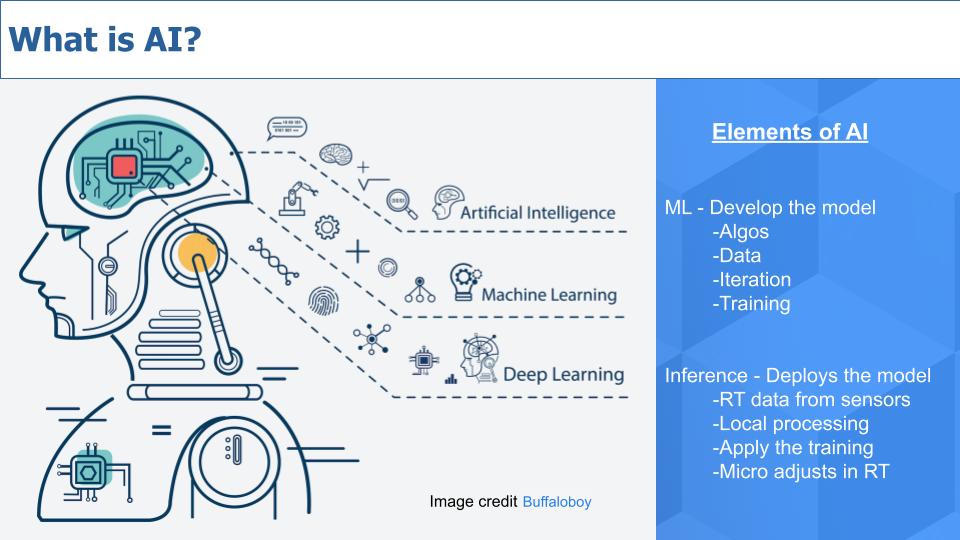
We sometimes use artificial intelligence and machine intelligence interchangeably. This notion comes from our collaborations with author David Moschella. Interestingly, in his book “Seeing Digital,” Moschella says “there’s nothing artificial” about this: There’s nothing artificial about machine intelligence just like there’s nothing artificial about the strength of a tractor. It’s a nuance, but precise language can often bring clarity. We hear a lot about machine learning and deep learning and think of them as subsets of AI. Machine learning applies algorithms and code to data to get “smarter” – make better models, for example, that can lead to augmented intelligence and better decisions by humans, or machines. These models improve as they get more data and iterate over time. Deep learning is a more advanced type of machine learning that uses more complex math. The right side of the chart above shows the two broad elements of AI. The point we want to make here is that much of the activity in AI today is focused on building and training models. And this is mostly happening in the cloud. But we think AI inference will bring the most exciting innovations in the coming years.


Rethinking Ecommerce as Commerce at Home

Ecommerce is all grown up. It’s time to break away from the early-internet paradigm where online shopping was a new, “electronic” form of shopping. Today, almost all commerce involves varying degrees of digital elements (discovery, price comparison, personalization, selection, ordering, payment, delivery, etc.). The defining factor is not whether commerce is digital; rather, one defining factor is the optimal location for a retailer to meet a consumer’s needs. Shopping happens on a spectrum between home and the store. As such, ecommerce is better understood as commerce at home, and Amazon was the early winner. Great retailers focus on convenience or the experiential. In the new paradigm, certain retail truths persist. For example, all great retailers have focused primarily on either convenience retail or experiential retail. To be clear, any retail can be a great experience, but the priority matters. Amazon focuses ruthlessly on convenience. The outcome is a great customer experience. To drive growth, Amazon has prioritized speed and selection over consultation and curation. Amazon’s focus on convenience has yielded an (incredibly) high-volume, low-margin retail business.


These are the AI risks we should be focusing on

AI may never reach the nightmare sci-fi scenarios of Skynet or the Terminator, but that doesn’t mean we can shy away from facing the real social risks today’s AI poses. By working with stakeholder groups, researchers and industry leaders can establish procedures for identifying and mitigating potential risks without overly hampering innovation. After all, AI itself is neither inherently good nor bad. There are many real potential benefits that it can unlock for society — we just need to be thoughtful and responsible in how we develop and deploy it. For example, we should strive for greater diversity within the data science and AI professions, including taking steps to consult with domain experts from relevant fields like social science and economics when developing certain technologies. The potential risks of AI extend beyond the purely technical; so too must the efforts to mitigate those risks. We must also collaborate to establish norms and shared practices around AI like GPT-3 and deepfake models, such as standardized impact assessments or external review periods.


India Inc. must consider Digital Ethics framework for responsible digitalisation

An accelerated pace of digital transition, consumption of goods and services via app-based interface, and proliferation of data bring numerous risks such as biased decision-making processes being transferred to machines or algorithms at the development stage by humans, a Deloitte statement said on Friday. "These biases can be a threat to the reputation and trust towards stakeholders, as well as cause operational risks," it said. Partner, Deloitte India, Vishal Jain, said the pandemic compelled businesses and consumers to embrace digital technologies like artificial intelligence, big data, cloud, IoT and more in a big way. "However, the need of the hour is to relook at the business operations layered on digital touchpoints with the lens of ethics, given biases might arise in the due course, owing to a faster response time to an issue," he said. Societal pressure to do "the right thing" now needs a careful consideration of the trade-offs involved in the responsible usage of technology, Jain said, adding, its interplay becomes vital to managing data privacy rights while actively adopting customer analytics for personalised service.


How to Be a Better Leader By Building a Better Tribe

All of our journeys are exquisitely different, yet come with a unique set of challenges that can blur our leadership lens if not properly focused. This can become a snowball of personal detriment. Therefore, your mental, physical, and emotional health is just as important (if not more) than your professional and economic health—they are interrelated. Identify a therapist, wellness clinician, spiritual leader, life coach, physical trainer and/or anyone who can support your becoming an even greater version of yourself. Let's call this person the "healer". Make time for physical activity, healthy food choices and spending time with loved ones. Ensure the same investment you make in your team members, you also make in yourself. It is up to you to create your rituals for personal success. What will they entail? ... Similarly to curating a list of your tribal elders, remember that you are also an elder to a younger leader in your collective. We all were afforded a different set of societal privileges based on constructs of race/ethnicity, gender, sexual orientation, cognitive and physical abilities, etc. I think it’s important to utilize some of these privileges to be an ally/co-conspirator to someone who may not have the same position in society.


What is an enterprise architect? Everything you need to know about the role

The role of EA is closely connected to solutions architect, but tends to be broader in outlook. While EAs focus on the enterprise-level design of the entire IT environment, solution architects find spot solutions to specific business problems. EAs also work closely with business analysts, who analyse organisational processes, think about how technology might help, and then make sure tech requirements are implemented successfully. Looking upwards, EAs tend to work very closely with chief information officers (CIOs). While the CIO focuses on understanding the wider business strategy, the EA works to ensure that the technology that the organisation buys will help it to meet its business goals, whether that's improvements in productivity, gains in operational efficiency or developing fresh customer experiences, while also working with others – like the security team – to ensure everything remains secure. Nationwide CIO Gary Delooze is a former EA who says a really good enterprise architect will bring the business and IT teams together to create a technology roadmap.


How Blockchain Can Simplify Partnerships

To appreciate the ways in which blockchains can support complex collaborations, consider the task of shipping perishable goods across borders — a feat that requires effective coordination among suppliers, buyers, carriers, customs, and inspectors, among others. When the parties pass the cargo to another, a flood of information is transferred with it. Each party keeps their own record and tends to communicate with one partner at a time, which often leads to inconsistent knowledge across participants, shipping delays, and even counterfeit documentations or products. If, say, the buyer expects the goods to be constantly cooled throughout the shipping process and temperatures exceed agreed thresholds, a dispute is likely to occur among the buyer, the supplier, and the carrier, which can devolve into lengthy wrangling. The carrier may haggle over the liability to lower the compensation, arguing that customs delaying the transportation or the inspectors who improperly operated with the cargo are the ones to blame. The buyer will ask the supplier for remedy, who in turn needs to negotiate with the carrier. And so on. Problems like these can manifest in any collaboration that requires cumbersome information sharing among partners and may involve disputes in the process. 


Practical Points from the DGPO: An Introduction to Information Risk Management

Individuals are starting to pay attention to organizational vulnerabilities that compound risks associated with managing, protecting, and enabling access to information, ranging from poor data quality, insufficient methods of protecting against data breaches, inability to auditably demonstrate compliance with numerous laws and regulations, in addition to customer concerns about ethical and responsible corporate use of personal data. And as organizations expand their data management footprints across an increasingly complex hybrid multicloud environments, there has never been a greater need for systemic information risk management. ... In general, “risk” affects the way that a business operates in a number of ways. At the most fundamental level, it inhibits quality excellence. However, exposure to risks not only has an effect on project objectives, but it also poses threats of quantifiable damage, injury, loss, liability, or other negative occurrence that may be avoided through preemptive action. Using the Wikipedia definition as a start, we can define information risk as “the potential for loss of value due to issues associated with managing information.”


Quote for the day:

"The actions of a responsible executive are contagious." -- Joe D. Batton