Daily Tech Digest - October 15, 2022

Australia becoming hotbed for cyber attacks

“Cyber criminals are targeting the personal data of Australians for financial gain – to sell, to hold to ransom, or to commit financial fraud and scams,” said Reinhart Hansen, director of technology at Imperva’s CTO office. “During the pandemic, many organisations inadvertently created more opportunities for these bad actors. Many rushed their online implementations and transformation projects, taking shortcuts that left them vulnerable to exploitation. “Now we’re seeing a large uptick in common, off-the-shelf and automated type attacks that hackers are continuously recycling and using against Australian targets,” he added. Hansen noted that threat actors have also been looking for known weaknesses and vulnerabilities in applications and application programming interfaces (APIs) to gain access to the data repositories that sit behind them. “Their ultimate aim is to exfiltrate data at scale that will allow them to build citizen profiles that are used as the basis of their illegal activity,” he said. The most heavily targeted industries in Australia were financial, retail and business services. 


To Recruit and Retain a Strong Team, Live the Culture You Talk About

As leaders, if we talk about communication and expect people to follow, that communication needs to start with me. We need to be open to it, like lanes of fluid traffic in both directions, not stocked up silos hoarding information for ourselves. I need to communicate what will happen to my team and stay open to taking their feedback. ... We look for similar values when building personal relationships, but this idea is more difficult as a company. I may not expect everyone to share the same politics, but I expect team alignment around certain values. We should all acknowledge the importance of diversity and respect the humanity of each other. We should share a sense of optimism for the company and a desire to contribute to its growth. As leaders, we need to live the story we tell when a great contributor to our team crosses the line. When the behavior is illegal, that decision is a little easier, but determining when behavior crosses an immoral or unethical line can be in the eye of the beholder. However, if something is clearly over the line in my or my employees' minds, I need to take action and be consistent about those opinions.


Waterfall won the war with Agile!

The dream of a decentralised democratic organisation with low atrophy that can swiftly respond to the needs of our markets is not a pipe dream. To do so we need to shift from an Alpha model for business to a Beta model. However, we continuously allow Alpha to prevail. The focus of agile on the decentralised dream failed because we allowed it to. We, and by we I mean agile practitioners, allowed and continue to allow organisations to believe that they don't have to really change, that this is just a team thing, and to keep the departments and the steering committees and yearly budgets. We are complicit in these continued malformed practices. ... We need to reshape our focus from sustaining the Alpha models to keep people complacent and happy to challenging them and actively promoting Beta models and practices that work in those models. We already have the building blocks to do this in the Agile Manifesto, the Scrum Guide, the Kanban Guide, the Nexus Guide, LESS, Scrum@Scale, and many more. What we need to add is the tools that we need to change the organisation; changing teams is easy.


Making product inclusion and equity a core part of tech

I think the world has had a reckoning over the past two years, with many candid conversations kicking off. There’s been a lot of vulnerability and accountability, frankly, around making sure that people have inclusive and equitable experiences across the board in everything they do. When product teams start to think about product inclusion and equity, I talk to them about the “curb cut effect.” The curb cut in sidewalks was originally made in the ‘70s for wheelchair users, but we all use it now, whether it’s people with skateboards, suitcases, or shopping carts. The critical thing to understand is that building for a historically marginalized group results in better outcomes for everyone. There are a lot of examples of that throughout history; another is closed captioning. So even though it feels amplified now, decades of work have helped to ensure that those who have historically not been at the center of development and design can have their voices involved throughout critical points in the process.


8 Reasons Scrum Is Hard to Learn (but Worth It)

The idea of estimating in story points can definitely be a challenge for many team members. I can almost hear them thinking, “I have a hard estimating in days and now I have to estimate in an abstract relative unit I’ve never heard of before?” Story points are a definite challenge, yet they’re worth the effort. As abstract relative estimates of effort, story points enable better conversations about how long work will take. Without story points, a senior programmer and junior programmer have conversations that devolve into, “That’s how long it will take you, but it would take me twice as long.” And then the two pick an estimate that is horrible for one of them or, perhaps even worse, they split the difference. With story points, the senior and junior programmers can consider adding a new feature and both agree it will take twice as long as doing a simpler feature. They then give the bigger item an estimate twice that of the simpler item. Estimating in this relative manner allows developers to agree even if they would never be able to agree on how many hours or days something would take. 


Design Thinking Improves Your Data Science

As data scientists, our first instinct is to begin to understand the data we are going to use to solve our problems. However, we need to understand what is beyond the data to the people involved in this problem. We can have all of the data in the world but if we do not know how users or stakeholders interact with the product and understand it in their terms, we cannot possibly make a solution that is going to fully solve their problem. ... My favorite way to approach generating problem statements is to use HMW statements. In this process, everyone writes down problem statements starting with the phrase “How might we…”. They are usually generated individually and voted on by the group to obtain the best problem statement. HMW statements are written positively to make sure how we remember how the user should feel. ... Now that you have our problem statement, you will need to think about the different ways the problem can be solved. In this step, any idea is a good idea, focusing on quantity over quality.


JIT vs. AOT: How to Pick the Right Approach

What a just-in-time compiler can't do is compile ahead-of-time. What an ahead-of-time compiler does is it takes all the code and it compiles it to your binary before you ever run the program. It could do all that and avoid all the later work of doing this. What ahead-of-time compiler can't do is compile just-in-time. The annoying thing is the choice. If you have to choose between them, I am definitely on the just-in-time side. I've got some strong arguments for why, because you just get faster code, period. It's provable. The real question is, why do we have to choose? ... It's absolutely true that with ahead-of-time compilation, people feel like they can afford to throw a lot more analysis power at the optimizations, and therefore lots of times people will say, this analysis we can do ahead-of-time. In reality, anything an ahead-of-time compiler can do a just-in-time compiler can do. It's just a question of, can you afford doing? Do you want to spend the time while you're running the program to also do that? That's one direction.


Chaos theory eliminates quantum uncertainty

The most important reason stems from a quantum phenomenon that Schrödinger himself named entanglement. Specifically, two particles can be emitted from a source, such that the properties of the two particles – e.g., their angular momenta (also known as spins) are correlated. This itself is not necessarily strange. However, the Northern Irish physicist John Bell showed that, under seemingly reasonable assumptions, these correlations, suitably combined, are limited in size. This is called Bell’s theorem. The 2022 Nobel Physics Prize was given to three physicists (Alain Aspect, John Clauser and Anton Zeilinger) who showed that in practice, the combined correlations can exceed this limit. Hence one or more of these seemingly reasonable assumptions must be wrong. The standard interpretation of this experimental result is that it confirms that quantum uncertainty is ontological, not epistemological. That is, uncertainty is a feature of reality itself, not a reflection of the limits of our knowledge. Of course, this is such a startling conclusion that physicists have looked for other ways to explain Bell’s theorem.


Get used to cloud vendor lock-in

Granted, now the game is a bit different with higher stakes. Many cloud providers offer the same operating systems and processor options, the same databases, and even the same ops and security tools. So, why is vendor lock-in still a trade-off? As an aside, if you just announced that you’re off to build systems that completely avoid vendor lock-in, I will wish you good luck. However, unless you want consistently crappy applications, you’ll have to leverage native security, native infrastructure as code, serverless systems, etc., that are usually supplied by different providers as native services, which is why you’re on a public cloud in the first place. If we move to the most feature-rich public cloud platforms, it’s to take advantage of their native features. If you use their native features, you lock yourself in to that cloud provider—or even lock yourself in to a subplatform on that cloud provider. Until there are alternatives, you better get used to lock-in. 


Understanding the Four Domains of Enterprise Architecture
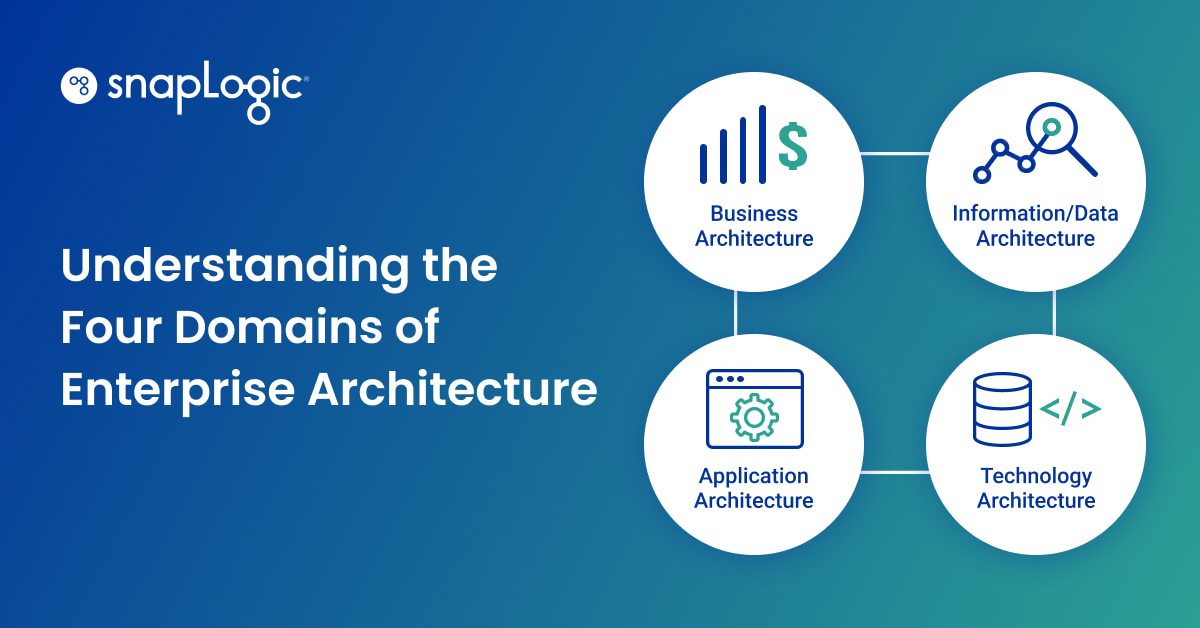
The technology architecture domain encompasses all infrastructure and enterprise uses to support the goals and execution of the business, information and application processes. It covers all logical hardware and software apps, including front-end systems, back-end infrastructures, cloud and on-site platform technologies, IoT, networks and communications. To demonstrate the difference between application and technology architectures, let’s consider an enterprise in the e-commerce industry. The e-commerce app falls under the technology architecture domain because it generates the data for the business — the number of visitors per day or sales per day. An analytics tool like Tableau, which helps translate the data generated into a comprehensible form and distributes it to where it’s needed, is under the application architecture domain. An enterprise architect in this domain would define the requirements of the hardware and software infrastructure needed to power the resources in the application and data architectures that enable and optimize business processes. 


Quote for the day:

"Always be yourself, express yourself, have faith in yourself, do not go out and look for a successful personality and duplicate it." -- Bruce Lee

Daily Tech Digest - October 14, 2022

Which cybersecurity metrics matter most to CISOs today?

Given the rapid increase in malware-free attacks, there’s a tendency on the part of cybersecurity teams to add more metrics. Seeing more reported data as a panacea for rising risks that aren’t immediately understood, cybersecurity teams will turn on as many metrics as possible, looking for clues. Relying on antivirus, SIEM (security information and event management), security ticketing systems, vulnerability scanners, and more, CISOs’ teams generate an overwhelming number of metrics that lack context. CISOs warn that presenting metrics straight from tools without a narrative supporting them is a mistake. C-level executives and the boards they report to are more focused on new insights that are contextually relevant than a series of tactical measures. Every new high-profile intrusion or breach drives up to a dozen or more internal user requests for new metrics. Managing user requests by how much value they provide to contextual intelligence and delivering business value is critical. CISOs tell VentureBeat it’s easy to say no to additional metrics requests when there is no connection to requested metrics that quantify the value cybersecurity delivers.


Making everything connect for smart cities

It’s a vision of how smart cities can be holistically planned by connecting the different city domains and addressing Sustainable Development Goals (SDGs) globally. In this way, mobility, energy, the environment, health, education, security and the economy are not treated separately, but rather as a whole consistent continuity of human-centric services. Smart cities need to be much better at creating an open platform of dialogue that is accessible to all citizens. ... These allow residents to engage with a wide array of data, as well as completing personal tasks like paying bills, finding efficient transportation and assessing energy consumption in the home. Smart cities also need to account for social infrastructure that provides a cultural fabric, making the city attractive to residents and offering a sense of local identity. It is often the social and cultural aspects of a city that citizens find makes it most attractive to live in – aspects such as green open spaces, a wide choice of retail outlets, and bustling nightlife. This is particularly important for cities that are being created ‘from scratch’ (rather than already existing) and need to find effective ways to attract residents.


Dell gets more edge-specific with Project Frontier platform

Dell also said it is expanding its current edge portfolio in the following ways: Edge analytics and operations - Manufacturers can optimize how they deploy edge applications with an Dell Validated Design for Manufacturing Edge, the company said. This now includes new Dell-validated partner applications to support advanced edge use cases, and improve factory processes and efficiencies, while reducing waste and raw materials usage for more sustainable operations. Manufacturers can respond quickly to changes in demand, and enable reconfigurable production lines with Dell's private 5G capability, Dell said. Edge computing and analytics - The PowerEdge XR4000 is the smallest server in the Dell lineup at about the size of a shoebox. The XR4000 is 60% shorter than conventional data center servers, and its multiple mounting options allow it to be installed in a rack, on walls or ceilings, saving valuable floor space. The multi-node, 2U chassis server can survive unpredictable conditions, such as heat waves or falls, the company said.


The White House can build on its AI Bill of Rights blueprint today

Several current uses of AI clearly violate the blueprint and should no longer be used. The president should also stop encouraging agencies to spend American Rescue Plan funds on ShotSpotter and other “gunshot detection” technologies, which change police behavior but have not been shown to decrease gun violence. These tools are in violation of the blueprint’s principles that AI tools must be safe, effective, nondiscriminatory, and transparent. ... On the legislative front, the AI Bill of Rights principles are embodied in both the American Data Privacy Protection Act and the Algorithmic Accountability Act of 2022, both of which the administration could put its support behind. There has been substantial investment in the development and adoption of AI, but nowhere near as much money or energy put toward safeguards or protection. We should not repeat the same self-regulatory mistakes made with social media and online advertising that left us in the privacy crisis we are in today. 


How intelligent automation changes CI/CD

Intelligent automation addresses many of the core requirements for successful software delivery. Basic process automation can increase devops productivity by automating routine manual tasks through code. For example, a developer can run a build in Jenkins that then triggers an automated task that pushes the build to Artifactory and kicks off a delivery pipeline. However, combining automation with AI-powered intelligence can turbocharge processes and improve business outcomes. Intelligent automation can automate routine tasks and then constantly improve automated decision making as the release moves through the delivery lifecycle. Intelligence applied to the release process — when combined with deep tools integrations that provide access not only to events but also to all process data — can automate the detection of software risks and automatically flag release candidates for remediation before they make it to production. In addition to increased devops productivity and faster and more accurate software releases, intelligent automation provides the means to implement centralized, automated control over compliance and security. 


A Big Threat for SMBs: Why Cybersecurity is Everyone’s Responsibility

It impacts everyone across every department and every element of operations. Cybersecurity is a collective responsibility. During this Cybersecurity Awareness Month, let’s debunk the pervasive misconception that cybersecurity is strictly an IT issue. To avoid becoming a statistic, SMBs need to develop a security culture that reinforces the idea that cybersecurity is the responsibility of every team member. From the founder who sets a security-focused tone to the specific teams that implement the policies, to the HR department responsible for onboarding new employees, to the IT team setting system password requirements, and to every employee that can potentially open a phishing email triggering a security incident, it’s a collective effort to stay aware. All individuals need to be trained, vigilant, and engaged. The devil is in the details, as it’s the tools, tasks, and routine activities each team member performs that will protect the company.


Seeing electron movement at fastest speed ever could help unlock next-level quantum computing

Seeing electrons move in increments of one quintillionth of a second could help push processing speeds up to a billion times faster than what is currently possible. In addition, the research offers a “game-changing” tool for the study of many-body physics. “Your current computer’s processor operates in gigahertz, that’s one billionth of a second per operation,” said Mackillo Kira, U-M professor of electrical engineering and computer science, who led the theoretical aspects of the study published in Nature. “In quantum computing, that’s extremely slow because electrons within a computer chip collide trillions of times a second and each collision terminates the quantum computing cycle. ... To see electron movement within two-dimensional quantum materials, researchers typically use short bursts of focused extreme ultraviolet (XUV) light. Those bursts can reveal the activity of electrons attached to an atom’s nucleus. But the large amounts of energy carried in those bursts prevent clear observation of the electrons that travel through semiconductors—as in current computers and in materials under exploration for quantum computers.


New data protection bill must enable a progressive data governance framework

The robust framework that vowed to safeguard the privacy of an individual’s data would have made the privacy design of the bill even more redundant. Consent and notice framework in the new Bill should be dealt with in such a way that it addresses the right to informational privacy while avoiding consent fatigue for consumers. For instance, individuals may receive innumerable privacy notifications causing consent fatigue; this issue was considered and acknowledged by the Justice Srikrishna committee report. Besides, from a business perspective, the cost of compliance, especially for small businesses, will be huge and may result in additional costs. The new personal data governance framework should focus on simplifying the consent and notice framework in such a manner that individuals can easily understand how and for what purpose is their personal data being processed. Besides, the new Bill must lay out better means and ways to obtain consent, which is inclusive, less tiresome, and efficient.


Emotional intelligence: How to create psychological safety for your IT team

The best leaders understand the complexities and imperfections of being human and are not afraid to present their true selves in the workplace. These leaders emanate compassion and encourage their team members to embrace and express their unique gifts and talents. Compassion cuts through mental constructs and perceptions. It begins when leaders examine and undo traditional rules, roles, and narratives that limit their thinking, decision-making, and worldview. Freedom from outdated narratives enables release, self-acceptance, and permission to bring one’s whole self to the workplace. Leaders who are driven by the needs of the ego struggle to let go of outdated competence, values, and skills. Marshall Goldsmith, one of the world’s foremost thought leaders on executive coaching, explains this perfectly in the title of his book, What Got You Here Won’t Get You There. The compulsive need to be right becomes more important than discovering new horizons, untapped potential, and possibilities. Self-righteousness creates a division between the self and the team, eroding trust.


Smart buildings may be your cybersecurity downfall

With the rise of IoT, a wave of adoption of IT and IoT solutions at all levels of building system architecture poses a serious cyber security issue. As it becomes increasingly difficult to distinguish between building automation systems and other systems used in companies and their infrastructures, more “cyber holes” tend to be left unmonitored. The use of insecure industrial protocols is another vulnerability that attackers take advantage of to disrupt smart buildings operations. This is especially the case for building automation systems. Popular protocols like BACnet and LonWorks are not implicitly secure and, like those used in the industrial production sector, tend to have their own vulnerabilities. ... As the cyber-physical equipment within buildings becomes increasingly distributed, especially due to the new trend of supervising building complexes from a central location, cyberattacks on smart buildings, as well as attacks on cities and other smart city infrastructures, can have a significant security impact for users.


Quote for the day:

"Personal leadership is the process of keeping your vision and values before you and aligning your life to be congruent with them." -- Stephen R. Covey

Daily Tech Digest - October 13, 2022

Information overload, burnout, talent retention impacting SOC performance

John Lodge, SOC Manager at Socura, says alert fatigue is a particular problem. “As well as causing fatigue for the analysts, repeating false positives also draws attention from and potentially delays responses to real active threats,” he tells CSO. The main solution to this is with effective tuning, he adds. “Key challenges to overcoming this are getting investment from analysts to ensure tuning opportunities are exploited as soon as possible. In cases where tuning is not possible, automation should be used so as much manual work is taken off the analyst as possible. Again, the challenge here is making sure the initial effort is put in to automate these actions before the false positives build up.” First-time fix challenges are also significant, Lodge says. “When escalating an incident, we ideally we want to be able to have resolved the incident with the tools and information at our disposal. In some cases, this is not possible as further context is required.” The challenge is to ensure that, in all cases, we have carried out as much investigation and response as possible. 


Cybersecurity’s too important to have a dysfunctional team

Teamwork is an essential part of working in a business and this is just as true of cybersecurity teams. Due to the constant vigilance required, it helps cybersecurity professionals to know they have people around them, with whom they can share the workload. There are five fundamental qualities that make every team great: communication, trust, collective responsibility, caring and pride. Everyone individually is important, but it is in coming together that they become unbeatable. Effective teamwork begins and ends with communication. It does not always occur naturally, but it must be taught and practised in order to bring everyone together as one. Along with a strong and functional team, a good leader is essential. Cybersecurity teams have stressful jobs, with the whole company looking to them in times of crisis (which can be heighted during economic instability). For this, the cybersecurity team requires a capable leader under pressure to help engender trust across their staff. They must also be able to advocate for the team if some are burnt out or require further training.


12 things every CIO must get done in year one

Dr. George F. Claffey Jr., CIO and interim vice president of Institutional Advancement and Strategic Partnerships at Central Connecticut State University, says he, too, focuses on listening and building relationships. He sees building trust as an essential extension of that work. “No one is going to have confidence in your agenda if you can’t be trusted,” he says. To build trust, Claffey acknowledges others’ challenges and works to fix them. “We find the win for them,” he says, adding that he also attends meetings held by other departments and demonstrates a genuine interest in their goals so they see “I’m interested in not just IT but everything that’s happening.” ... To have a successful CIO shop from the start, Jim Hall, CEO of consultancy Hallmentum, says CIOs “need to have the right people doing the right things at the right time, and they have to have the right skills.” To ensure they have that, CIOs should assess their teams early on to identify skill gaps in individuals and across teams, and then determine what measures are needed to get in place the right people and skills doing the right thing at the right time.


5 Factors to Weigh When Building Authorization Architecture

As you succeed, you will inevitably want to start winning some larger enterprise customers. This means working with a whole new set of authorization challenges. When working with a transnational business — and, specifically, working with a single department of it at first — reflecting the organizational structure in your permissions quickly becomes a sticking point. New requirements emerge, such as:Users should only be able to access resources and data within their department and geography. Managers in the London office should be able to access everything in the other U.K. offices. Heads of departments globally should be able to do everything in all regions. Company vice presidents want to see everything but don’t really know how things work, so they should only have view access. Sally in the Paris office is our superstar employee who also does work now and again for the U.S. team, so she should have access to their account every 3rd Tuesday if it is a full moon (might have exaggerated a bit here).


9 out of 10 banks still use mainframes. Google Cloud wants to reduce that.

Google Cloud plans to introduce what it’s calling a simpler, more risk-averse way for enterprises to move their legacy mainframe estates to its cloud with a new service built on technology originally developed by Banco Santander. That service is Dual Run, and it enables parallel processing, allowing enterprises to make digital copies of their legacy mainframe systems and run them simultaneously on Google Cloud Platform. The service addresses a big challenge with mainframes: the tight coupling of data to the application layer. It allows real-time testing by customers to ensure their cloud workloads are performing as expected, running securely, and meeting regulatory compliance needs — without stopping an application or negatively impacting their end-user experiences — before transitioning to GCP as their primary system. “This is a simple concept, but hard to implement — hasn't been done so far,” Nirav Mehta, Google Cloud’s senior director of product management for cloud infrastructure solutions and growth, told Protocol.


The Microsoft-Cisco Teams collaboration could create an interoperability revolution

Cisco is a telecom company. It should get, even better than Microsoft, why things in its space need to interoperate and how to differentiate on features, capabilities, and price without locking out competing solutions. Embracing Teams doesn’t mean it's abandoning Webex, but Webex will need to find a path to third-party hardware or it will lose ground against options like Teams. Cisco seems to get this, based on the statement yesterday from Jeetu Patel, executive vice president and general manager, security and collaboration at Cisco: "Interoperability has always been at the forefront of our hybrid work strategy, understanding that customers want collaboration to happen on their terms — regardless of device or meeting platform,” said Patel. “Our partnership with Microsoft brings together two collaboration leaders to completely reimagine the hybrid work experience.” This should help drive Cisco toward a future where Webex and Teams could interoperate, as well, which might mean the end of products like Zoom.


The future of low-code governance with Managed Environments for Power Platform

While the low-code concept has been around for decades, there has been an evolution in governance capabilities and offerings. In the initial era of low-code development, employees would build solutions in Microsoft Excel, Microsoft Access, Microsoft InfoPath, and other tools, often hidden from their IT departments and all governance strategies or policies. As technology matured, many of these solutions became cloud-based and were built using a variety of standalone providers. As each provider offered different governance capabilities, organizations needed to face the challenge of overwhelming low-code solution development and the expertise, specialized resources, and additional time to train the admins on the governance tools that must be implemented. Microsoft Power Platform allows organizations to move to the next era of low-code governance with a central low-code platform that allows makers to enjoy shared components and experiences. 


Distributed cloud computing and its rising importance for businesses

Distributed systems mitigate these drawbacks in cloud computing by adequately allocating the workload to pre-selected servers, typically the ones physically nearest to clients. Soon, augmented reality, virtual reality, and the Internet of Things (IoT) will all be used with data networks. They typically have low latency and primarily benefit from the distributed cloud’s CDN/caching feature. Distributed cloud computing reduces the overall resource requirements for the central infrastructure and speeds up latency for users that need it by keeping certain computations, data delivery, and storage local. It increases the overall solution’s effectiveness for all users. Distributed cloud benefits with cloud computing distributed systems include being open for purchase, allowing users to request that some data remain within particular zones or that a specific performance target for latency or throughput is fulfilled. These are discussed between the client and the cloud provider in Service Level Agreements (SLA).


CIOs sharpen their mainframe exit strategies

Spangler advises IT leaders to “take an economic view” of what to migrate given that there are still “tremendous technology capabilities” that exist on the mainframe. “It can’t be a theoretically thing,’’ he says. “We just know for our environment, because we’re more than a 40-year-old company … we have old technologies we were replacing anyway, and when we looked at our enterprise strategy, it just made sense.” Spangler says IT leaders should also keep the principles of engineering and architecture in mind. “A lot of people are so focused on getting rid of their mainframes they end up with mess,” he says, adding that strong engineering and architecting upfront will help make sure you end up with something that is modern, world-class, expandable, secure, and modifiable. Lastly, Spangler recommends that IT leaders “continuously update your plan because it’s a battle. It’s hard. Brutally hard. We literally zero-base our business case on this every quarter and build from the bottom up.’’


CISO: A day in the life

While engineering and technical disciplines are at the core of our profession, we must effectively communicate with executives and boards of directors to keep our companies, customers, and partners safe. We must communicate the latest threats and regulations in the business context. Understanding potential business risks are essential to prioritizing cybersecurity – and all – risks accordingly. During my time as a cybersecurity consultant for a food company, I highlighted the risk associated with credit card theft. One executive asked how that compared to the risk the company faced if it experienced a salmonella outbreak and a customer died of food poisoning. At the time, I had no good answer to this question. This example shines a light on our role as business enablers. Cybersecurity professionals are tasked with enabling our colleagues to pursue opportunities and innovation. As guardians and protectors of our business, we perform best by embracing that ethos within business operations, with an eye always focused on risk management.


Quote for the day:

"I think the greater responsibility, in terms of morality, is where leadership begins." -- Norman Lear

Daily Tech Digest - October 12, 2022

Consumer cyber hygiene makes significant gains, report shows

The new survey shows 75% of respondents were at least somewhat concerned about privacy of personal data collected online. Of those who showed little concern about the issue, 24% said it was because, “there’s nothing I can do about it anyway.” Another 18% of that group said, “I take all of the privacy precautions that I can, so I believe the security and privacy of my personal data is out of my hands.” According to the report, when asked “who should be most responsible for protecting the online privacy of Americans,” 32% said companies, 33% said the federal government, and 25% said it was consumers themselves. “This isn’t a surprise,” said Harvard Kennedy School fellow and lecturer Bruce Schneier. “Surveys consistently demonstrate that people are concerned about their privacy in the face of both governments and corporations. The reason people don’t often act on those concerns is that they feel powerless. There are often no easy ways people have to protect the privacy of their personal data, nor are there reasonable alternatives to the tech monopolies that make surveillance their business model.”


Australia moots changes to privacy laws after Optus data breach

The proposed regulatory changes would allow telcos in the country to temporarily share certain government identifier data, such as Medicare and passport numbers, with financial services providers. This aimed to facilitate enhanced monitoring and safeguards for customers affected by a data breach, the office of Australian Treasurer Jim Chalmers said in a statement Thursday. He added that the amendments would enable better coordination between the telcos, financial institutions, as well as federal and state government agencies to detect and mitigate the risks of cybersecurity incidents. "The proposed regulations have been carefully designed with strong privacy and security safeguards to ensure that only limited information can be made available for certain purposes," Chalmers said. The amendments will apply to all financial institutions regulated by Australia's Australian Prudential Regulation Authority (APRA), excluding branches of foreign banks, with the personal identifier information only to be used for "preventing or responding" to cybersecurity incidents, fraud, scam activities, or instances of identity theft.


How to Transition from General IT to Cybersecurity

People often ask, “How do I change my career to cybersecurity with no experience?” or “Can I get into cybersecurity without IT experience?” It is critical that employers can distinguish you from your peers. Employers certainly prefer job candidates with experience; however, degrees and certifications also demonstrate your understanding of relevant topics and can set you apart from other applicants. Nearly 9 in 10 (88 percent) of respondents to ISACA’s survey reported that a cybersecurity candidate’s credentials are somewhat or very important in determining if they are qualified. How quickly can you learn cybersecurity? It depends on your path—degrees typically take two to four years, depending on the level of education and focus of the subject matter. Certifications are less of a time commitment but be sure to pick the one that is right for your background and level of experience. For example, ISACA’s Cybersecurity Fundamentals Certificate is designed for entry-level professionals, but the CISM and CSX-P certifications are meant for more seasoned practitioners.


ESG and Cybersecurity Compliance Are Every Employee’s Concern

For the rapidly changing worlds of both cybersecurity and ESG, past performance cannot be considered an indicator of future success. Instead, companies need to train up existing employees, hire new talent, and bring in external consultants to develop and vet their plans for both regulatory compliance and how to showcase that hard work. New hires and specific employee designations are only one piece of achieving legal compliance (and, of course, great PR). Thoughtful training and awareness maintenance is key here as well. In cybersecurity, an organization is only as strong as its weakest link; in ESG, employees with multifaceted skill sets (namely, strategic plan evaluation and ability to analyze both qualitative and quantitative inputs) will be the ones who drive value in meeting this multifaceted and demanding acronym. The best training and awareness programs not only account for legal obligations, but they also consider employees’ specific responsibilities and how everyone interacts with cybersecurity and ESG sectors in differing ways. Dynamic workshops, lecture sessions, and specialized training are solid paths to showcase compliance in both cybersecurity and ESG


Three Ways To Close Your Cyber Skills Gap

If hiring outside talent is too difficult, time-consuming or expensive, it may be time to look inward and develop your own talent pipeline from within your organization. Good cybersecurity employees must be curious, measured and driven with an attitude of “I don’t know the answer, but I can figure it out.” The rest you can teach. I have personally transitioned employees from DevOps and infrastructure teams into roles as IAM specialists, senior security architects and engineers. Unfortunately, internal development programs are often hampered by a lack of time and resources or leadership turnover, which makes it impossible to settle on a strategy for longer than a single technology refresh cycle. But if you make the investment and look beyond certifications and formal training, you will often find passionate existing employees who simply need an opportunity and a nudge in the right direction. Personally, I’ve found that web developers, network administrators, cloud engineers and operations personnel all make fantastic cybersecurity candidates with the right support.


9 things you shouldn’t virtualize

Although virtualization has kept up to date with the ability to handle streaming and other relatively high-performance processes, some memory-intensive projects aren’t a good fit. Not having enough memory or overcommitting the memory you do have can lead to performance issues. Server virtualization may make it easier for you to save physical space, but it still requires a lot of memory. ... When it comes to power sources, it’s best practice to always have a backup. The same is true of virtualizing servers. Don’t go out on a limb with virtualizing something and end up removing the redundancy the original had. Make sure you’ve tested that the virtualized server and its backup work well before you make any changes you can’t reverse. ... What if the VM you’re trying to repair also controls the retinal scanner that is supposed to let you into the building? Now you have a second problem. Software on VMs shouldn’t be the only way to access physical controls, especially if they’re mission critical or could cause problems for the people working on the servers themselves. 


8 signs your low-code platform is overpromising and underdelivering

Many low-code and no-code platforms allow developers to customize the implementation with custom code. But if you are adding too much pro code, being confined to a low-code platform may be constrictive. Alternatively, if business stakeholders are writing requirements and aren’t open to the solutions accelerated through low-code platforms, you might as well develop a custom solution. David Brault, product marketing manager at Mendix, agrees, “A low-code solution that requires developers to leave the platform and revert to full-code development environments to make enhancements to an application is one that will consistently underdeliver.” Guljeet Nagpaul, chief product officer at ACCELQ, adds, “One sign that your low-code platform is not working concerns customizations. If you find that your platform needs constant customizations, that suggests that the code is being written without the discipline of architecture and sound design. The maintenance of this customization will quickly become unsustainable and ultimately drag down the return on investment.”


Mentor Magic: How To Make Mentorship Work for Your Career

Before looking for a mentor, think hard about whether you are ready to be mentored and ready to invest in the relationship. Being a mentee isn’t sitting at the foot of a mentor and having them impart wisdom. The mentor is offering their valuable time and hard-won wisdom; these are gifts that you acknowledge and express gratitude for not just with words, but by your attitude and your actions. Being a great mentee means being open-minded, ready to change, dedicated to preparing ahead of time for sessions with your mentor, and committed to following through on goals or projects established with your mentor. How do you prepare? Know what skill or competency you are looking to build, or the question you need help with. Before the meeting, send an email with a subject line that succinctly telegraphs the topic of the meeting and outlines what you’d like to discuss. This ensures that valuable time during your meeting won’t be wasted on laying out why you are there, and it gives your mentor time to prepare as well. Next, prepare for the meeting itself. Detail the steps you have already taken to build the skill or answer the question yourself. 


CIO role: 5 secrets to success

IT is not a function to be hidden in the shadows anymore. Today, every company is a tech company – and they need to think and act like one. That puts the CIO in a high-visibility/high-impact role. Use a products-and-platforms approach: Prioritize the design and build for the organization’s “customer” or “consumer.” More and more CIOs are talking about business and motivating people inside and outside their organizations. ... Engage business leaders in your vision that information technology is at the heart of the organization. How technology and data are woven into business priorities and support the company’s evolution is a critical conversation that you should be driving and engaging people in. The IT Vision should feel like it is owned by more than just the CIO. The CIO provides the inspiration, the experience, and the direction, but to get true ownership, accountability, and trust, the vision needs to be owned and delivered by the leadership team. Engaging cross-functional and internal leaders in this vision will accelerate the journey toward achieving this transformation.


Have Some CAKE: The New (Stateful) Serverless Stack

C Is for CockroachDB Serverless - To power these next-generation serverless applications, we need a database that solves your scale-up and scale-down problems. And it needs to be a consistent data store so you can use it for your most business-critical applications. ... A Is for Auth - To enable all those different endpoints to have common access controls, we also need next-generation authorization, authentication, session and user management. ... K Is for Kubernetes - Distributed systems are inherently complex, so we need a way to orchestrate all the moving pieces. The essential anchor of our new stateful serverless stack is Kubernetes, since the big K8s vendors are offering dynamic, low-friction scaling mechanisms for our orchestration layer. ... E Is for Serverless Frameworks - Of course, we need to host and deploy our serverless, event-driven architecture. At this point in the stack there are two moving pieces to select: serverless frontend and backend frameworks. 


Quote for the day:

Good leaders value change, they accomplish a desired change that gets the organization and society better. - Anyaele Sam Chiyson

Daily Tech Digest - October 11, 2022

How SASE might improve worker productivity and make CFOs happy

The amount of time that information empowerment saves is likely related directly to the information content of each worker’s job. That doesn’t mean how much time a worker spends on the computer, but on the value of information in supporting productivity. If a worker already has all the information they need, then it’s doubtful that further information empowerment will pay back. Only about half of all workers are “empowerable” based on information needs, so enterprises that want to assess productivity gains to be expected through empowerment usually start by asking workers what data would help them be more efficient. The more helpful data is found, the more network empowerment can improve productivity. The dollar value of that productivity improvement is what CFOs will look for, and that depends on the unit value of labor. For people whose jobs involve producing something, the unit value of labor is the burdened compensation rate for the workers involved, meaning salary plus benefits.


Ukraine and EU explore deeper cyber collaboration

“Cooperation with the European partners includes two key vectors for our country,” said Zhora. “On the one hand, Ukrainian experience in cyber war, confronting cyber threats from Russia, would definitely be beneficial for other democracies. “On the other hand, having gained candidate status for EU membership, our country has to bring its national legislation in conformity with European standards. Intensified collaboration with ENISA will let us make this process much more efficient.” Other points of discussion at the summit were assessments of the current cyber threat landscapes facing the various post-Soviet states, and an account of some of the specific cyber challenges faced; the implementation experiences of EU states linked to the NIS and NIS2 directives and other cyber certifications and standardisation initiatives; cyber capacity- and awareness-building; approaches to more generalised cyber crime; and the role and structure of ENISA as a pan-EU body. 


Enterprises are forced to ramp up resilience in an increasingly erratic world

The good news is that companies are taking resiliency planning seriously: 49% of decision-makers said their company has a well-defined strategy to handle disruptive events and among employees, and almost eight times more said they are prepared than not, according to the report. Digitalization and automation are driving that preparation: 90% of companies that have well-defined resilience strategies in place are investing heavily in these areas, the report said. However, researchers cautioned that it is important to recognize the value in proactive rather than reactive resilience—something that may not be a part of many enterprises’ strategies. Further, natural disasters caused by climate change such as flooding and storms are key challenges for 42% of decision-makers, and more expect it in the future. In essence, more work needs to be done given the current climate, the report stressed. “War. Energy crisis. Natural disasters. Pandemics. Our world has become increasingly complex, and the time to adopt resiliency strategies is now,” said Patrik Hedlund, senior researcher for the Ericsson Consumer & IndustryLab at Ericsson. 


The Future of the Web is on the Edge

When people say “the edge,” they mean that your site or app is going to be hosted simultaneously on multiple servers around the globe, always close to a user. When someone requests your site/app, they will be directed to the one closest to them geographically. These distributed servers not only serve static assets, but can also execute custom code that can power a dynamic web app. Moving servers closer to end-users is also a physical approach towards latency optimization. This means lower latency on every single page load. The longer your pages take to load, the more likely users will bounce. 32% more likely according to Google research when load speeds go from 1 second to 3 seconds. 90% more likely when speeds go from 1 second to 5 seconds. Users will visit 9 pages when pages load in 2 seconds, but only 3 pages when they load in 7 seconds. That’s the gist. Now the nuance. You’ve built an app. It’s cool. It does fun things. You want to show it to the world, so you deploy it. For ease, you use Heroku. You git push heroku main and then head to myfunapp.com to check out your handiwork.


Small business tech outlook: Here are the challenges and opportunities ahead

Digital transformation and the adoption of new technology is an important focus for SMBs as it can put them in a better position to ride out challenging economic conditions and gain an edge on their competitors. Cloud technology such as SaaS applications -- particularly ones aimed at specific vertical markets -- deliver obvious benefits in terms of shifting from capital to operational expenditure by outsourcing the deployment and maintenance of the underlying technology. This should allow businesses to concentrate on adding value via the agile development of bespoke products and services, and by transforming online experiences using new technologies such as AR and VR, machine learning and AI. ... "This prioritization of IT spending represents a continuation of modernization efforts kick started during the pandemic. Over the last few uncertain years, corporate decision makers have seen first-hand the benefits of IT investments, which often pay for themselves by improving processes, enhancing resilience, or enhancing workplace productivity," Tsai added.


The Social and Psychological Consequences of Ransomware Attacks

The social impacts of ransomware attacks can cause lasting damage to an enterprise, its customers and its employees. Social impacts can occur when service is disrupted. For example, because affected enterprises have to shut down operations, their employees may be temporarily laid off, which increases unemployment and can lead to financial stress. There are strong associations between higher levels of financial stress and increased alcohol consumption, which can lead to other negative effects. Victimization can also cause individuals to be unwilling to adopt new technologies in the future, leading to people losing confidence in businesses and governments. There is also a wide range of psychological responses to ransomware attacks. In many cases, victims respond more negatively to the effects of the attack than the attack itself, and each individual handles the threat of a cyberattack differently. Some may proactively face the problem while others may exhibit protective or avoidance behaviors to prevent attacks.


Time To Dispel Myths Surrounding Privacy Enhancing Technologies

How are PETs already benefiting organisations? For financial services firms, being able to access more data in a secure, privacy-preserving, and efficient manner means they are able to make better, intelligence-led decisions in a business-relevant timeframe. Those additional data points and resulting insights are especially important when working to combat money laundering and fraud on a global scale. With PETs, financial institutions can prioritise customer privacy while still ensuring data is accessible when and where it needs to be, even if that location is across jurisdictions. PETs also create a paradigm shift for public health readiness, allowing optimal secure and private data sharing between governments and health agencies. In the clinical research arena, medical professionals and public health officials can use PETs to securely search or analyse decentralised research data across organisational, privacy, and regulatory boundaries while safeguarding patient privacy and sensitive medical indicators.


Scrum Master or Waste Master?

When scrum masters who live and die for delivering agile find themselves, perhaps even subconsciously, in need of more work to feel productive or efficient (aka “keep busy”), they tend to gravitate towards Jira or any other task-managing tool. They start to herd “issues” or “stories” with descriptions of the work that someone thinks lies ahead, they add columns that describe the status of each task, and if they’re really feeling it, some statistical content like burndown charts based on the silly concept known as “estimating.” Going for this approach, the scrum master has now found a purpose: They can keep track of the work and measure things to see how well the team is doing. At least that’s the perceived feeling, in reality, they’re keeping track of waste and guesswork. Agile was created because estimation is impossible in tech. Otherwise, we might as well have stuck with waterfall deliveries, where everything is simply planned ahead of time. The obsession with creating a mountain of future tasks that rarely get carried out is also beyond me.


The Future Of Quantum Computing In Business

The future of quantum computing in the business world looks very promising. Many experts believe quantum computers will eventually outperform classical computers on many tasks, including complex optimization problems and machine learning. This could have significant implications for businesses, which would be able to solve previously unsolvable problems and gain a significant competitive advantage. While quantum computers are not yet widely available, several companies are already working on developing them. IBM, Google, and Microsoft are all investing heavily in quantum computing research, and the first commercial quantum computers will likely become available within the next few years. Given the potential benefits of quantum computing, businesses need to start thinking about how they can use this technology. Quantum computers could revolutionize many industries, so those who can early adopt will be well-positioned to reap the rewards.


Why is Everything so Slow? - Measuring and Optimising How Engineering Teams Deliver

As teams scale, communication becomes more difficult as more and more people are added to the teams. A team of three people will have three primary communication paths, whereas a team of seventeen has one hundred and thirty-six possible paths, for example! So it gets harder and harder to understand what’s going on and it becomes harder to disseminate information without causing cognitive overload. Misalignment also becomes a big problem as teams scale, and not having teams and team members aligned on what’s the priority and what’s next can cause wasted work and a perception that the team is slow because the delivery of value to production doesn’t happen. For example, within a microservices architecture, team A may be working on a change to a service, on which team B needs to build further parts of a wider feature. Unless both teams are aware of the need to coordinate that work, there is a high likelihood of misalignment and work being either wasted or needing rework when, upon feature testing, bugs are found in team A’s solution.


Quote for the day:

"Leadership is not a position. It is a combination of something you are (character) and some things you do (competence)." -- Ken Melrose