Daily Tech Digest - February 05, 2018

The new gold rush: A look inside cryptocurrency fraud

inside cryptocurrency fraud
There are two main ways that threat actors are currently fraudulently mining cryptocurrencies: botnets and crypto jacking. Botnets were first used to mine Bitcoin in 2014 but the complexity of doing so made it financially unviable however it is now making a comeback as newer cryptocurrency like Monero are easier to ‘mine’. As such Digital Shadows has observed botnets available to rent for $40, one such offering has ‘flown off the shelves’ with almost 2,000 rentals so far. One new tool is a new mining software called “Crypto Jacker”, which combines Coinhive, Authedmine and Crypto-Loot into a WordPress plugin (cj-plugin), with added SEO functionality. Available since November 2017 for just $29, the software allows users to clone popular websites that can then be sent out in spam campaigns. According to the Crypto Jacker site, the software “provides a way to earn crypto currency from people who visit your links, even when you’re sharing other websites that you don’t own.



Knowing where an engineer's policies have "gone off the rails" is a big help in keeping networks running smoothly, said Andrew Froehlich, the president of consulting firm West Gate Networks, based in Loveland, Colo. "For network administrators, this is a huge win, because it will help them to pinpoint where problems are occurring when people start shouting the network is slow." Cisco has tied the analytics engine to a troubleshooting library of what the company has identified as the most common network failure scenarios. As a result, when an engineer makes a change to the network, the Assurance Engine can determine, based on its knowledge base, where the modification could create a problem. Initially, the Assurance Engine will cover only the Nexus 9000 switches required for an ACI fabric. Later in the quarter, Cisco plans to extend the software's capabilities to firewalls, load balancers and other network services from Cisco or partners.


Revolutionize Your Finance Industry Business With FinTech Mobile Apps

App developers understand the opportunities and challenges offered by the FinTech revolution. You need to understand how these have affected the finance industry and business in order to create FinTech mobile apps that can be of maximum benefit to the finance industry and prevent a financial crisis. With the increased use of mobiles and digital revolution, every business has been disrupted, and financial services are no exception to this. There has been a drastic change in the way people are now accessing financial products and services. Customers are now looking out for FinServes that offer mobile apps and wearable technology to uninsured millennials. Insurance companies associating with FinTechs is on a rise and FinServes are increasingly leveraging new technologies to enhance customer experience.


8 Eearly Warning Signs Of IT Disaster

8 early warning signs of IT disaster
“Hidden work with late nights, minor but unexplained outages, simple tasks taking increasingly longer to complete — a death by a thousand paper cuts is all too frequently occurring in organizations,” says Adam Serediuk, director of operations at xMatters, a notification and collaboration platform. A certain amount of inefficiency is inherent in any organization, and most processes trade efficiency for effectiveness, Serediuk admits. But when the same systems continue to break over and over, and no one takes proactive steps to prevent it from happening, it creates a hole that's incredibly difficult to climb out of. "There's always a moment when somebody decides to leave an organization," he says. "Like when they've spent their entire week dealing with the same problem for the 10th time, and a recruiter sends them a message on LinkedIn. It's like, 'You know what? I've had enough of this.' And they move on."


Microsoft is about to kill off its weirdest Windows 10 experiment

Anyway, that update simply wouldn't install. (At least one other person had the same problem last week.) And troubleshooting the update problem led to a comedy of errors. The broken update isn't available in the Microsoft Update Catalog; it's only available via Windows Update. The Windows Update Troubleshooter ran but (incorrectly) reported no problems. On Windows 10 S, you can't use a command prompt or PowerShell to run any diagnostic tools or scripts. So the tedious but often-effective manual option to reset Windows Update wasn't available to me. Upgrading to version 1709 manually wasn't possible, either, because that would have required running Setup.exe from a mounted ISO or from the Update Assistant, which is forbidden in the strict Windows 10 S sandbox. ,,, The underlying concept of Windows 10 S is still valid. An operating system that doesn't allow people to be tricked into installing malware is a good thing. But when those same restrictions make the system literally unmanageable, something's wrong.


What is LLVM? The power behind Swift, Rust, Clang, and more

What is LLVM? The power behind Swift, Rust, Clang, and more
LLVM makes it easier to not only create new languages, but to enhance the development of existing ones. It provides tools for automating many of the most thankless parts of the task of language creation: creating a compiler, porting the outputted code to multiple platforms and architectures, and writing code to handle common language metaphors like exceptions. Its liberal licensing means it can be freely reused as a software component or deployed as a service. The roster of languages making use of LLVM has many familiar names. Apple’s Swift language uses LLVM as its compiler framework, and Rust uses LLVM as a core component of its tool chain. Also, many compilers have an LLVM edition, such as Clang, the C/C++ compiler (this the name, “C-lang”), itself a project closely allied with LLVM. And Kotlin, nominally a JVM language, is developing a version of the language called Kotlin Native that uses LLVM to compile to machine-native code.


What Leonardo da Vinci Can Teach Us About Digital Innovation

“If you’re going to be a disrupter, you occasionally need to let your reach extend your grasp,” said Walter. He explained that innovation sometimes depends on challenging yourself and the people around you—and sometimes failing. “With Leonardo, he wanted to make a flying machine. But you can’t do it. We still don’t have a self-propelled flying machine. Leonardo studied different aspects of birds’ flight extensively and tried to develop flying machines throughout his life. After a while, Leo figured out why it can’t be done based on his studies of birds— their anatomy, how wind effects flight and other factors.” After researching and writing about Leonardo, Steve Jobs and other digital innovators, Walter said, “It’s cool to allow your reach to extend your grasp, try something that’s impossible and then discover why it’s impossible. That’s what we do every day in disruptive industries. We sometimes say, ‘I’m willing to fail but let me see why.’”


3 ways to reshape your workforce in the age of AI

istock-802508588.jpg
"To achieve higher rates of growth in the age of AI, companies need to invest more in equipping their people to work with machines in new ways," Mark Knickrehm, group chief executive of Accenture Strategy, said in a press release. "Increasingly, businesses will be judged on their commitment to what we call Applied Intelligence - the ability to rapidly implement intelligent technology and human ingenuity across all parts of their core business to secure this growth." While many fear that AI will replace low-level jobs, most businesses are optimistic about the impact on their companies, the report found: 63% of senior executives said they think their company will create net job gains in the next three years due to AI, while 62% of workers said they believe AI will have a positive impact on their work. Here are three ways business leaders can shape their future workforce in the age of AI, according to Accenture:


Microsoft Teams updates streamline search, sharing features


The Microsoft Teams updates also include a personal view of user apps within Teams that allow users to access tasks, issues or requests they have been assigned to. Users can view recently accessed items such as OneNote notebooks or videos from Microsoft Stream. Microsoft also added a new app, called Who, which uses capabilities from Microsoft Office Graph to let users search for people within their organization by name or topic. Microsoft has also integrated its automated workflow service, Flow, with Teams. The integration allows users to create and manage workflows, review approval requests and launch workflows from within Teams. Constellation Research analyst Alan Lepofsky said in a blog post that the Microsoft Teams updates are good enhancements, but some features, such as the commands for searching and sharing information, will take some getting used to.


Akamai: IoT the new 'shadow IT' of the enterprise

Despite security vendors pushing the idea of "password hygiene" at length, another big problem facing the enterprise is the result of users still having the same username and password across multiple accounts, Sullivan told ZDNet. With a distributed denial of service (DDoS) attack the attackers typically want to make as much noise on the network as possible, but with credential stuffing it is the opposite, as they want to be stealthy. "So they all basically distribute attacks to a target through a massive set of proxy servers ... they're trying to circumvent controls looking at a high request rate from a given IP address and they have commandeered so many IoT devices that they can distribute those requests so far and wide," he explained. "We see about 10 times more IPs participating in credential stuffing attacks than we do DDoS."


Quote for the day:


"If you want to achieve widespread impact and lasting value, be bold." -- Howard Schultz


Daily Tech Digest - January 31, 2018

Separating Science Fact From Science Hype: How Far off Is the Singularity?

singularity
First, on a hardware level, we are hitting the ceiling of Moore’s law as transistors can’t get any smaller. At the same time, we have yet to prove in practice that new computing architectures, such as quantum computing, can be used to continue the growth of computing power at the same rate as we had previously. Second, on a software level, we still have a long way to go. Most of the best-performing AI algorithms require thousands, if not millions, of examples to train themselves successfully. We humans are able to learn new tasks much more efficiently by only seeing a few examples. The applications of AI [and] deep learning nowadays are very narrow. AI systems focus on solving very specific problems, such as recognizing pictures of cats and dogs, driving cars, or composing music, but we haven’t yet managed to train a system to do all these tasks at once like a human is capable of doing.


What is TOGAF? An enterprise architecture methodology for business
TOGAF helps organizations implement software technology in a structured and organized way, with a focus on governance and meeting business objectives. Software development relies on collaboration between multiple departments and business units both inside and outside of IT, and TOGAF helps address any issues around getting key stakeholders on the same page. TOGAF is intended to help create a systematic approach to streamline the development process so that it can be replicated, with as few errors or problems as possible as each phase of development changes hands. By creating a common language that bridges gaps between IT and the business side, it helps bring clarity to everyone involved. It’s an extensive document — but you don’t have to adopt every part of TOGAF. Businesses are better off evaluating their needs to determine which parts of the framework to focus on.


Cyber security salaries will rise 7% in 2018, says research


The increasing investment in cyber security professionals across all industries has often been attributed to the growing number of high-profile cyber attacks over the past year, which have brought attention to the importance of being prepared for these occurrences. In London, a professional in a head of information security role with 10 or more years of experience can expect an annual salary of between £105,000 and £170,000 a year – an increase on a London-based head of information security salary of between £95,000 and £155,000 in 2017. Though the annual salaries for these roles in other parts of the UK, such as the Midlands and the North of England, are lower on average, there has still been a significant increase in the total yearly remuneration for cyber-based roles from 2017 to 2018.


Big Data Isn’t a Thing; Big Data is a State of Mind


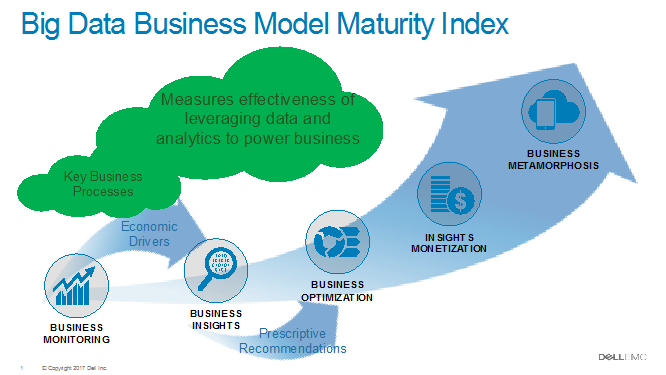
Big Data is about exploiting the unique characteristics of data and analytics as digital assets to create new sources of economic value for the organization. Most assets exhibit a one-to-one transactional relationship. For example, the quantifiable value of a dollar as an asset is finite – it can only be used to buy one item or service at a time. Same with human assets, as a person can only do one job at a time. But measuring the value of data as an asset is not constrained by those transactional limitations. In fact, data is an unusual asset as it exhibits an Economic Multiplier Effect, whereby it never depletes or wears out and can be used simultaneously across multiple use cases at near zero margin cost. This makes data a powerful asset in which to invest ... Leading organizations that embrace digital transformation see data and analytics as a business discipline, not just another IT task. And tomorrow’s business leaders must become experts at leveraging data and analytics to power their business models.


A day in the data science life: Salesforce's Dr. Shrestha Basu Mallick

Pricing is an incredibly complex science and art that takes years to master -- there are hundreds of variables to take into consideration and today's sales process moves faster than ever before. The best price does not always mean the highest price -- it means finding the right price point at which the customer feels that they are getting a good value while capturing that value for the vendor as well. Sales reps are always juggling at least three priorities on any given deal: the customer's satisfaction in the value they're getting; the speed in which they close the deal; and the best price for the company. No human can effectively balance these priorities on their own keeping in mind the different variables -- and its especially difficult for newer sales reps who are just starting off their sales careers. Very few tools drive these pricing conversations effectively. It's equally difficult for sales managers, who have very little data-driven insight into the pricing stages of deals.


These firms have historically maintained a rich history of customer transactions and activity for what can be very high-value customer relationships. Leading firms in sectors such as healthcare, life sciences, media, and manufacturing are also represented. 2018 survey participants included bellwether firms American Express, Bank of America, Capital One, Charles Schwab, CitiGroup, Fidelity Investments, Ford Motors, Goldman Sachs, JP Morgan, IBM, Wells Fargo, and VISA, among nearly 60 industry leaders. In spite of the common recognition of the need for a Chief Data Officer, there appears to be a profound lack of consensus on the nature of the role and responsibilities, mandate, and background that qualifies an executive to operate as a successful CDO. Further, because few organizations -- 13.5% -- have assigned revenue responsibility to their Chief Data Officers, for most firms the CDO role functions primarily as an influencer, not a revenue generator.


Artificial Intelligence will open up new avenues: Experts

Demystifying Artificial Intelligence and addressing these concerns on the future of human work and employment Mr. Binay Rath, Director, APAC Alliances and Channels, Oracle Health Sciences GBU, mentioned that the benefits of AI is clear so instead of being concerned about the threats of AI we need to first understand what AI is and what its potential will be. Followed by which, ethical policy frameworks need to be in place for the operation of machines and AI automated systems. Mr. Nishith Pathak, Vice President at Accenture Labs India and author of many books on AI, echoed similar sentiments. Citing the example of Postal Services he said though we do not write letters nowadays but postman and post offices have not gone redundant; they have a different role to play with a different set of responsibilities. Likewise some low level programming jobs may go and instead data scientists will be in huge demand.


Why You Need To Keep Learning In Data Science

Inteligencia-artificial
It is by no means a static profession, you can apply your skills to an array of different industries and domains, so knowledge on the area you work in is key so that you are able to derive the most valuable insights out of your data. With so many businesses hiring for and building out data science teams, it’s important that you have knowledge of the business you’re working in, or if you’re looking to move jobs – the one you’re wanting to make a move into. The job role is so much more than numbers and big data sets, it’s about contributing to the bigger picture, solving problems for businesses and individuals alike. Continuing your education in Data Science and all related facets within the field throughout your career will benefit your working life greatly. This real-world application of your work requires constantly learning new skills, technologies, and approaches.


Government surveillance regime unlawful, court rules in Tom Watson case

“The government must now bring forward changes to the Investigatory Powers Act to ensure that hundreds of thousands of people, many of whom are innocent victims or witnesses to crime, are protected by a system of independent approval for access to communications data,” said Watson after the verdict. In a 10-page judgment, the Court of Appeal ruled that it is unlawful for the government to access private communications data retained by phone companies and internet service providers, for reasons that fall short of fighting serious crime, or without a prior review from a court or an independent watchdog. ... The proposals limit the ability of senior police officers, and officials at the Department for Work and Pensions and HM Revenue and Customs, to authorise their own access to communications data, requiring permission from a new authorising body, the Office of Communications Data Authorisation.


Disasters: Tech to Map Human Behavior in Crises

According to new research from Embry-Riddle Aeronautical University, during a disaster, escapees are more likely to look for an exit they saw earlier, even if it's farther away, or follow a crowd, even if it means they'll be moving slowly. As evidenced by the unfortunate number of disasters that happened last year, this "panic behavior," if unassisted, can result in fatalities and many injuries.  The rise in incidents that require emergency evacuations, such as airport and concert shootings, hurricanes, and terrorist attacks, has a team of students and professors at Embry-Riddle Aeronautical University’s Daytona Beach Campus employing parallel computing to tackle a topic with very little existing research. Their goal is to analyze human behavior in emergency evacuations from places like airports and other enclosed areas to help create more efficient evacuation policies and save lives.


Quote for the day:


"A good leader inspires others with confidence in him or her. A great leader inspires them with confidence in themselves." -- Raymond Dreyfack


Daily Tech Digest - January 30, 2018

Today, most task work is driven by logic, which typically requires working from our left-brain. Logic is all about numbers, critical thinking, black & white. Those of us who live in our left-brains have great difficulty perceiving right-brain work. But, the right brain is still there waiting for us! Right-brain work includes creativity, design, communications, influencing others, building relationships, engaging, consultative sales, strategy, among others, a lot of stuff our parents warned us not to do. In my new book, The Workplace Engagement Solution, I talk about how a global engagement figure of 13% isn’t just a business problem, disengagement is a tragedy infecting our lives, families, customer satisfaction and day-to-day living. The great disengagement of the modern worker is leading directly to the scourge of our modern economy: underemployment. How many task workers are now part-time task workers? “Consultants?”


How To Manage Your KPIs And Expectations During Digital Transformation


Digital transformation should set you up for the long-term by giving you a scalable, streamlined approach to business growth. And as such, it starts on the inside, building the internal systems that support even the outward-facing initiatives. With that in mind, having a baseline of what's working and what's not in your organization will provide you a good jumping off point. Are processes clear, well documented and accessible to everyone? Are all those processes easily repeatable and scalable, and supported by the right technology? Is there a system in place for hiring the right people, documenting and sharing customer data across different departments, making suggestions for process improvement and acting on it, and getting leadership's approval of major initiatives in an efficient manner? If any of these elements are off, your path to transformation may lead to expensive dead-ends.


Make the case to follow a container strategy at your company

Adding even a simple orchestration tool to the primary container software facilitates container deployment on public and hybrid cloud, as well as across multiple data centers. It can also help organize multicomponent applications, particularly those that share components among applications. Large enterprises should look into this path to achieve container success. The second trail off of the main container highway is for businesses with stringent security and compliance requirements. There are many ways to separate containers within a given server, and not all of them offer the same level of security. The most basic container software is the most popular, but not the most secure. If you have applications that demand an exceptionally high level of isolation and control, such as financial applications and even cloud applications involved in storefront missions, you may want to use something designed for that purpose.


The Anatomy of a Data Story

The Anatomy of a Data Story
The function of data in a data story is to tell what happened, and figuring out what happened typically starts with a question. Typical business-oriented questions usually revolve around sales or other KPIs, but they could be about anything—the results of a customer satisfaction survey, the efficacy of a policy change, the user behavior on a website. Once the overall question is established (e.g., How are our sales doing this quarter compared to last quarter?), you can begin to partition the data into smaller, more manageable pieces. Maybe you can track sales by product or by a sales representative or by company branch. Maybe you can look for correlations between revenue and other variables. If you don’t have a question to answer or artificial intelligence to point you to an interesting trend, you’ll likely have to do some data discovery and exploration to find a story worth telling. This is the process Ben Wellington employs when researching his blog posts.


What Will Artificial Intelligence Be Doing in 2018?

AI increasingly will require knowledge and skill sets that data scientists and AI specialists usually lack, according to the paper. Consider a team of computer scientists creating an AI application to support asset management systems. “The AI specialists probably aren’t experts on markets,” says PwC. “They’ll need economists, analysts, and traders working at their side to identify where AI can best support the human asset manager.” And, since the financial world is in constant flux, once the AI is up and running it will need continual customizing and tweaking. For that, too, functional specialists, not programmers, will have to lead the way. AI has already shown superiority over humans when it comes to hacking. For example, machine learning, often considered a subset of AI, can enable a malicious actor to follow a person’s behavior on social media, then customize phishing tweets or emails just for them, PwC says.


Designing Effective AI Public Policies


Governments lacking in-house expertise is problematic from a policy development perspective. As AI increasingly intersects with safety-critical areas of society, governments hold responsibilities to act in the interests of their citizens. But if they don’t have the ability to formulate measured policies in accordance with these interests, then unintended consequences could arise, placing their citizens at risk. Without belabouring scenarios of misguided policies, governments should prioritise building their own expertise. Whether they’re prepared or not, governments are key stakeholders. They hold Social Contracts with their citizens to act on their behalf. So, as AI is applied to safety-critical industries, like healthcare, energy, and transportation, understanding the opportunities and implications is essential. Ultimately, knowledge and expertise are central to effective policy decisions. And independence helps align policies to the public interest. While the spectrum of potential policy actions for safety-critical AI is broad, all with their own effects, inaction is also a policy position.


AI cracks ancient game of Go
Personalization, 1-to-1 marketing, people-based marketing and other trending terms describe how marketers in every industry are working to stop aggressive, irrelevant advertising campaigns and create highly targeted interactions. Online gaming is no different. Through big data, gaming companies can create meaningful marketing messages. Especially as we talk about all of the data being collected, the thought of playing a mobile game may seem intrusive. But gaming companies are mining such metrics to better appeal to their users with content they’re likely to appreciate, not despise. “Segmentation isn’t enough anymore. 76 percent of digital nomads expect to see a personalized website screen on just about every brand site they visit — and your inability to give any kind of individual regard means they think a lot less of your brand, and makes them significantly more likely to bounce,” according to VentureBeat.


artificial-intelligence-mirror-sphere-on-curved-surface-singularity-colorful-black-hole
No one would dispute the fact that we’re in an age of considerable AI hype, but the progress of AI is littered by booms and busts in hype, growth spurts that alternate with AI winters. So the AI Index attempts to track the progress of algorithms against a series of tasks. How well does computer vision perform at the Large Scale Visual Recognition challenge? (Superhuman at annotating images since 2015, but they still can’t answer questions about images very well, combining natural language processing and image recognition). Speech recognition on phone calls is almost at parity. In other narrow fields, AIs are still catching up to humans. Translation might be good enough that you can usually get the gist of what’s being said, but still scores poorly on the BLEU metric for translation accuracy. Measuring the performance of state-of-the-art AI systems on narrow tasks is useful and fairly easy to do. 


How to build a Successful Advanced Analytics Department

Using data is proven to work. Our client’s examples showcase the possibilities. We’ve built and implemented a dynamic pricing model that deals with over 2 million quarterly pricing decisions. Increased fraud detection from 50% to over 90% and more accurately predicted e-commerce sales a year in advance. Our portfolio includes AI and AA projects for a large range of industries, often times including industry leaders. If you discover more frauds than your competition – you get an advantage. Moreover, you build from there. You get new ideas every time you work with data. The power and value of using data are spreading within organizations as managers start noticing results. ... The very first thing is to understand where you stand today. It might be that you already gather a lot of data, but your organization is mostly driven by spreadsheets. This is how a vast number of organizations are managed. 


The general sentiment of global media coverage of AI in 2017 frequently painted very much what is deemed to be a worst case scenario picture of what the future holds for the technology. Job losses, a lack of human control and even killer robots continued to dominate the headlines in the year just gone. This year however, we can all expect to see the technology applied more widely, and more practically than ever before. Digital transformation will then be experienced through the mainstream application of AI to business operations, coupled with greater adoption of cloud and growth in the scale and degree of AI implementations. Not only will the technology revolutionise areas like the supply chain, in-store operations and merchandise execution but also dependency on AI will become a more prominent means of pursuing new business avenues across the retail sector.


Quote for the day:


"Eventually relationships determine the size and the length of leadership." -- John C. Maxwell


Daily Tech Digest - January 25, 2018

How policymakers should approach AI
AI is already super-human in many domains and in the next 5-20 years it is quite likely that we will be able to capture and express all of extant culturally-communicated human knowledge with it. Already we are far better at predicting individuals' behaviour than individuals are happy to know, and therefore than companies are happy to publicly reveal. Individuals and parties exploiting this are very likely compromising democracy globally, notably in the UK. There is an incredibly large project here for the social sciences and the humanities as we urgently address the political, economic, and existential (in the philosophical sense) challenges of massive improvements in communication, computation, and prediction. Again, natural laws of biology tell us to anticipate an accelerated pace of change given the increased plasticity of increased intelligence. Therefore we need to ensure our societies are robust to this increase, with sufficient resilience built into the system to allow individuals to have periods out of work finding a new place in the economy.


Implement OAuth in 15 minutes with Firebase

Fire
This article provides a 15 minute, step-by-step guide to adding OAuth support to a CLI-generated Angular application using Firebase. We will implement OAuth with a Google account, but other platforms supported by Firebase include: Facebook, Twitter, and GitHub. But first, what is Firebase? Firebase got its start as a realtime cloud-hosted NoSQL database supporting multi-user synchronization. Since being acquired by Google in October of 2015 it has become an entire publishing platform for web and mobile applications. Many major companies, including Lyft, Shazam, The New York Times, and NPR, use Firebase to support their apps . Some of these applications see over 100 million monthly users and update the database more than 3,000 times per second, providing strong evidence that the platform can scale.


Why NoSQL Needs Schema-Free ETL Tools

Even developers don't like writing boring "plumbing code" — code that just links data from one place to another. It's dull and repetitive. Customers don't like it, either — as anywhere that code is needed inevitably means a maintenance headache, not to mention a long time to write and test it in the first place. This means increased costs to initially deploy a new technology like NoSQL. Equally, on the output side, if you can't rapidly visualize the insights you can glean from your data, then you cannot fully realize the benefits of your investment in NoSQL database technology. Trying to code around the problem leads to longer project times, and the aforementioned increase in costs associated with custom coding. Many NoSQL companies have tried to shoe-horn SQL support into their products in an effort to bridge the gap between traditional BI vendors and their products. This has only been partially successful. 


NHS Wales IT outage: What went wrong with its datacentres?


Guillaume Ayme, IT operations evangelist at big data analytics software supplier Splunk, raised concerns about the datacentres’ setup, given that running dual sites usually means that in the event of an outage, one will failover to the other. “For the issue to be impacting two datacentres suggests it is severe, as one would normally be the backup for the other,” he said. “This may suggest there has been a problem in the failover procedure. “Once the service is restored, it will be essential to find the root cause to avoid a potential repeat. This can be complex for organisations that do not have full visibility into the data generated by their IT environment.” ... “While systems are now back up and running, the chaos it created shows why we need to move from hours to minutes to resolve problems like this,” said Anderson. “Ultimately, it comes down to our reliance on software and the need for it to work perfectly – and that’s difficult in IT environments that are getting more complex by the day.


Exploring Modern Data Platforms (Podcast)

The DevOps thing is something that everyone is trying to get their head around right now. When you have a whole staff of people who know SQL and know relational databases and now we say, ‘Okay, but all of your data is going to go to an object data store.’ Like, what does that look like or how should the data be organized? How do you query it? How do you use it? That type of training, but, to be honest, that really is not as much of a leap as it was even a year ago. The evolution is happening very, very, very rapidly. A year or two ago we’d say, ‘You need to use an object data store’, and we were speaking some foreign language. Now they get it, and they say, ‘Okay, let’s do it,’ because they think what’s happened is over the years people started dipping their toes and they’re realizing the economics of it. It’s like Hadoop was the gateway drug for this type of platform where you could start experiencing drastic cost reduction with enhanced capabilities


How CIOs Can Ensure a Seat at the Strategy Table


Digital disruption has placed technology at the heart of most business discussions, yet many CIOs are still fighting for a seat at the strategy table. Monika Sinha, research director at Gartner, says information and technology are considered too late in the strategy process in many enterprises. “IT is fundamental to the new business challenges,” Sinha told CIOs at Gartner Symposium/ITxpo in Goa, India this week. “It underpins new business models, products and services that are disrupting existing industries and creating new markets. As strategists, CIOs are flexible, agile and opportunistic in their approach.” “Once your ambition is clear, appropriately position IT at the heart of your business strategy.” The traditional “wait and respond” approach to enterprise strategy – the business strategy is finalized, the CIO reviews the strategy for IT’s contribution and an IT strategy is developed in response – is no longer viable.


The Benefits Of Open Standards For Process Automation


Once we see overall total cost of ownership of these process automations systems being reduced in the long run, we’ll be able to take advantage of the built-in, intrinsic cybersecurity features that are being designed into these open process automation systems. The rapid insertion of new technologies, new capabilities, and innovations will be inserted into the formerly closed systems in a much faster and cheaper way. Ultimately, that translates in manufacturing to increased equipment reliability, faster time to market, increased quality of production, and other benefits. ... It’s important to also remember that the intellectual property (IP) of those vendors is still preserved. There are points where we’re breaking up existing hardware and software systems into modules. With the modules, there will still be the intellectual property of the vendors—but the interfaces in between are what’s standard. In the future, there still will be the IP of the vendors in the hardware and software and in the application layer.


Cozy is building a personal cloud service that respects your privacy


Instead of creating yet another ecosystem of hosted services financed by ads, Cozy wants to change the balance and create a platform where the user is in charge. As you can read in the terms of services, you remain the owner of your data and your data won’t be shared with anyone unless you give your consent. And for the most privacy-concerned users, you can also install a Cozy instance on your own server. The main GitHub repositories have been updated today. The company just unveiled the first services of this new platform today. First, it starts with a good old file-syncing service. With Cozy Drive, you can install an app on all your computers, synchronize files with Cozy’s servers and find them everywhere — on your other computer, on your phone or on the web. Second, Cozy Photos lets you backup your photos. This works like Google Photos, Microsoft OneDrive’s Camera Upload and similar features.


IIoT and the Open Process Automation Forum

OPAF envisions a future open control system that will take information and data from any device and optimize it for better decision making. It will empower the workforce to be more actively involved and responsible for good business outcomes. For example, secondary measures will be key, such as differential pressure or sensor temperatures. We will be able to collect and communicate data about the overall health status of the instrument or sensor, which will drive new levels of reliability and overall operational integrity and profitability. This new level of control and new control functions will drive incredible value. Fitzgerald: Much depends on the scale and relevant policies of a given client. While DHCP might be “easier” for both wired and wireless integrations, discrete IP addresses associated with given subnets provide additional needed security and robustness of operations.


Robots are needed to manage the automation robots


Dube says the combination of physical robotic machine bodies and AI software brains will eventually make it hard to tell humans and robots apart. “We are carbon-based organisms and robots are silicon-based, but I think the boundaries around them are going to get progressively diffused to the extent that you will not be able to distinguish between a human and an android in the next nine years,” he says. “Robots are becoming fairly smooth in terms of mechanical motion. They can easily walk through a crowded mall, avoiding people. They can take an escalator, climb down stairs and even run faster than humans. In five years, their dexterity will be as good as humans. “But one component is missing – the brain – and that is the area we specialise in. When we implant the brain into the robot frame, it will be able to be asked a question, analyse what was said, and provide an answer. It will be able to walk and talk to you.”


Quote for the day:


"A leader must have the courage to act against an expert_s advice." -- James Callaghan


Daily Tech Digest - January 24, 2018

Can AI predict when that new hire will quit?
“The No. 1 most important data set to look at that predicts turnover more than any other time and again is reference response rate,” Bixler says. “The data conclusively continues to come back in that how the references rate the applicant will in fact help reduce turnover and predict performance one year later.” The average SkillSurvey client sees a 35 percent reduction in turnover. For pattern matching to predict this, though, you have to use good patterns. At DocuSign, Senior Director of Recruiting Susan Ross says references must respond to SkillSurvey within two days or an applicant won’t get the job. Later than that, and internal matching shows they’re not the best hire. Never mind that there are lots of reasons references might not respond that quickly that have nothing to do with the candidate. This timeline is DocuSign specific, though, and Ross says it and other matching works


istock 600402662
The best technology deployments are streamlined and fully integrated with other solutions and devices, and have the ability to empower a diverse employee base to work strategically and collaboratively. Strategy plays an instrumental role in creating the right atmosphere for innovation. Adam Uzialko, in Business News Daily, writes: “The responsive workplace offers an opportunity to extend the office far beyond its walls and enable more complete remote collaboration. The potential for the responsive workplace to dissolve the traditional boundaries of the office could have an immense impact on employees’ attitudes and the quality of the work they produce.” Of course, the onus of making this work falls on business leaders. To improve engagement and promote innovation, companies must take a hard look at how employees interact with the technology and tools at their disposal. Although today’s IT solutions offer significant potential, implementing ineffective or overly complicated technology can translate to a loss of productivity and further worker disengagement.


The old world typically consisted of operational databases providing online transaction processing (OLTP) and relational data warehouses providing online analytical processing (OLAP). Data from a variety of operational databases was typically batch-loaded into a master schema within the data warehouse once or twice a day. This data integration process is commonly referred to as extract-transform-load (ETL). Several recent data trends are driving a dramatic change in the old-world ETL architecture: Single-server databases are being replaced by a myriad of distributed data platforms that operate at company-wide scale; There are many more types of data sources beyond transactional data: e.g., logs, sensors, metrics, etc; and Stream data is increasingly ubiquitous, and there is a business need for faster processing than daily batches. The result of these trends is that traditional approaches to data integration often end up looking like a mess, with a combination of custom transformation scripts, enterprise middleware such as enterprise service buses (ESBs)


5 Things to Keep in Mind When Using Data for Artificial Intelligence
Many companies do not realize that they are sitting on a pile of bad or dirty data. This data contains a lot of missing fields, has wrong formatting, numerous duplicates, or is simply irrelevant information. IBM research estimated that the annual cost of bad data for the U.S. economy is a whopping $3.6 trillion. Still, many managers have certainty that they are sitting on a goldmine of data when in reality they have nothing valuable. I interviewed Sergey Zelvenskiy, who is an experienced machine learning engineer over at ServiceChannel, where he automates facilities management processes using artificial intelligence. We talked about common misconceptions when it comes to the good/bad data dichotomy and what companies should be focusing on when building AI products. As Zelvenskiy says, "The data that companies have may not necessarily be bad, it is just likely incomplete to solve the problem. There is a chicken and egg problem here.


The 6 Biggest Challenges Facing DevOps

Like any process or strategic approach, the field of DevOps is constantly changing. First emerging as a collective term nearly a decade ago, the DevOps field now embraces millions of software developers and entrepreneurs who have adjusted their teams and core philosophies to fall in line with the DevOps vision. However, these guiding principles are still evolving, and if you want to remain relevant and agile in 2018, you’ll need to evolve with them. There are critics who have argued that DevOps is a fad, or is more of a buzzword-driven rebranding campaign than a truly significant change in the industry, but there’s significant evidence to the contrary. The rise and continued success of SaaS platforms, increasing customer demands, and even the new perspectives of young developers are all pushing for DevOps to remain strongly relevant in business. The biggest transformation has been in how the term is used; rather than referring to specific roles, like “DevOps developers,” DevOps refers to a work culture that all individuals within it follow.


Orchestrating Flows for Cyber


An innovative solution uses the northbound interface on the SDN controller to monitor a customer’s network for volumetric increases, and to then dynamically task redirection of flow on the southbound interface to handle the attack. Vendors like Radware, with experience in load balancing, WAF, and anti-DDoS provide the perfect backdrop to building such an elegant approach to the problem. Visualize this in your mind: External traffic is being managed inbound through your software defined data center with the usual assortment of internal destinations: websites, apps, endpoints, and so on. A DDoS attack suddenly builds up toward one of your targets, probably the website, and the SDN controller immediately flow-orchestrates the increased volume to a collection of sinks or scrubbers, while maintaining proper traffic flow to non-targeted entities. It’s important to provide detection and orchestration of security at scale, because we know that with the speed of attacks were seeing on the Internet, enterprise teams will need to rely on proper automation to keep their applications and systems up and running.


Do website design platforms pose too big a security risk?


“Generally, if a platform allows you to insert HTML of third-party scripts and iframes, it can be abused to serve a malicious code. However, we didn’t see serious massive attacks on those sites recently, but we have seen attacks on multinationals and their systems,” says Sinegubko. “In our experience, the main areas of abuse for small to medium-sized businesses are spam via custom templates and using ad-backed widgets. Otherwise, the hacks are not massive. However, if hackers find a vulnerability in the platform itself, that will allow them to modify any sites hosted there, we’ll definitely see massive attacks," he says. “On the other hand, such attacks can be quickly mitigated, as most likely they won’t require action from thousands of individual webmasters, but rather just a coordinated effort from the platform staff.” Ultimately, the consensus seems to be that security should take priority over customisability, and more should be done to educate SME owners of the exploits hackers can take advantage of.


The importance of taking a break

Scientists are discovering that naps are Zambonis for our brains. They smooth out the nicks, scuffs and scratches a typical day leaves on our mental ice. For example, a University of California, Berkeley, study found that an afternoon nap expands the brain's capacity to learn and retain information. Other research has found that naps boost short-term memory, lift mood and increase feelings of "flow," that powerful source of engagement and creativity. Naps can also reduce our risk of heart disease and strengthen our immune systems. But these naps need not be as lengthy as a full-fledged siesta. The ideal naps – those that give us a boost without enveloping us in a haze of "sleep inertia" – are quite short, usually between 10 and 20 minutes. One Australian study published in the journal Sleep found that 10-minute naps had positive effects that lasted nearly three hours.


Secure your SDN controller

Secure your SDN controller
A significant issue regarding SDN security is that virtualizing every aspect of the network infrastructure increases your attack footprint. The SDN controller is typically the primary target for attackers because it is the central point for decisions in a network and a central point of failure. Attackers can try to get control of the network by breaking into a controller or pretending to be one. Once a central controller is compromised, an attacker can gain complete control over your network. This would be considered an extreme scenario, but it could be possible as SDN usage continues to grow. There are new types of denial-of-service attacks that try to exploit potential scaling limits of an SDN infrastructure by locating specific automatic processes that use a significant amount of CPU cycles. An SDN could be very vulnerable to attacks because of the separation of control and data planes. A disruption in the communication path between the two planes could potentially result in a major hole that attackers can compromise.


TalentSumerization – The Employee Experience in Agile Enterprises


The movement towards personalization in the workforce has been coined the “Consumerization of HR” – or “TalentSumerization”. It describes the idea of creating a social, mobile, and consumer-style experiences for employees inside the company. So, just as companies must ensure service excellence for their customers, HR must strive for service excellence for their employees. In fact, consumerization of human resources was identified as one of the most defining and disruptive trends of the industry. It not only changes the way we interact with employees, but also how companies market themselves. It is shifting companies away from a “seat filling” mentality to a “work experience” attitude. The new objective is to create one employer brand which provides a seamless employee experience – from the first interaction with potential candidates to the way we stay connected with former employees.


Quote for the day:


"Let us never negotiate out of fear. But let us never fear to negotiate." -- John F. Kennedy