Daily Tech Digest - September 10, 2025


Quote for the day:

"Don't be pushed around by the fears in your mind. Be led by the dreams in your heart." -- Roy T. Bennet


Identify and eliminate the silent killers of developer productivity

Code reviews are a critical part of the development lifecycle, designed to improve code quality, share knowledge, and catch bugs before they get to production. But they are a significant bottleneck when not handled with care. ... This isn’t just a matter of lost time; it’s a killer of flow. Developers are forced into a constant state of context switching, losing their focus and momentum. You need to establish clear expectations and protocols for code reviews. ... Poor documentation forces a constant stream of interruptions and meetings that pull senior developers away from their own work to answer questions. It’s a prime example of a process failure that creates a huge amount of hidden, unproductive work. Make documentation a first-class citizen in your development process. ... Then there’s the peer who, perhaps with good intentions, cuts corners. They deliver a feature that “looks like it works” for a project manager who is hungry for a win. The PM, not seeing the technical debt or the flawed logic, approves it and pushes for immediate deployment. This undermines the entire team, as it normalizes a low-quality standard and signals that bad behavior is rewarded. You must step in and resolve these interpersonal and process conflicts. Use one-on-one meetings to address these issues directly and set clear expectations. It’s your job to ensure that the team’s decisions are respected and that the quality bar is not lowered for the sake of speed.


Industry leaders urge strong strategies for post-quantum readiness

Questions remain about the readiness of cryptographic solutions to withstand future quantum attacks. Sinha addressed these concerns directly: "Post quantum cryptography is here. DigiCert has been working along with other cryptography experts. We've been collaborating with the National Institute of Standards and Technology, NIST. Last year...NIST had announced the first three post quantum cryptography algorithms. One for encryption and two for authentication. They are the FIPS 203, 204 and 205 standards." ... Panelists underscored the importance of cryptographic inventory. "Creating the cryptographic inventory is the step zero of beginning any migration. And the complexity of creating...the cryptographic inventory cannot be overstated. It's a...real hard task, but it's really essential. It's the step zero because the inventory gives you the roadmap. How do you begin the journey? How do you start prioritising your systems and your applications?" said Chauhan. Luke Valenta added, "A cryptographic inventory is never going to be complete. So it's all really about the...process, and, and journey of putting that together. At Cloudflare in our migration, we started this inventory and we used that to figure out what are the highest priority systems to transition to post quantum first." Reilly noted, "Just raising the awareness and visibility of all the places where an enterprise uses cryptography - it can be a shock when that depth and breadth of the required transformation becomes apparent..."


Tech Debt: Why Fixing the Foundation Comes Before Building the Castle
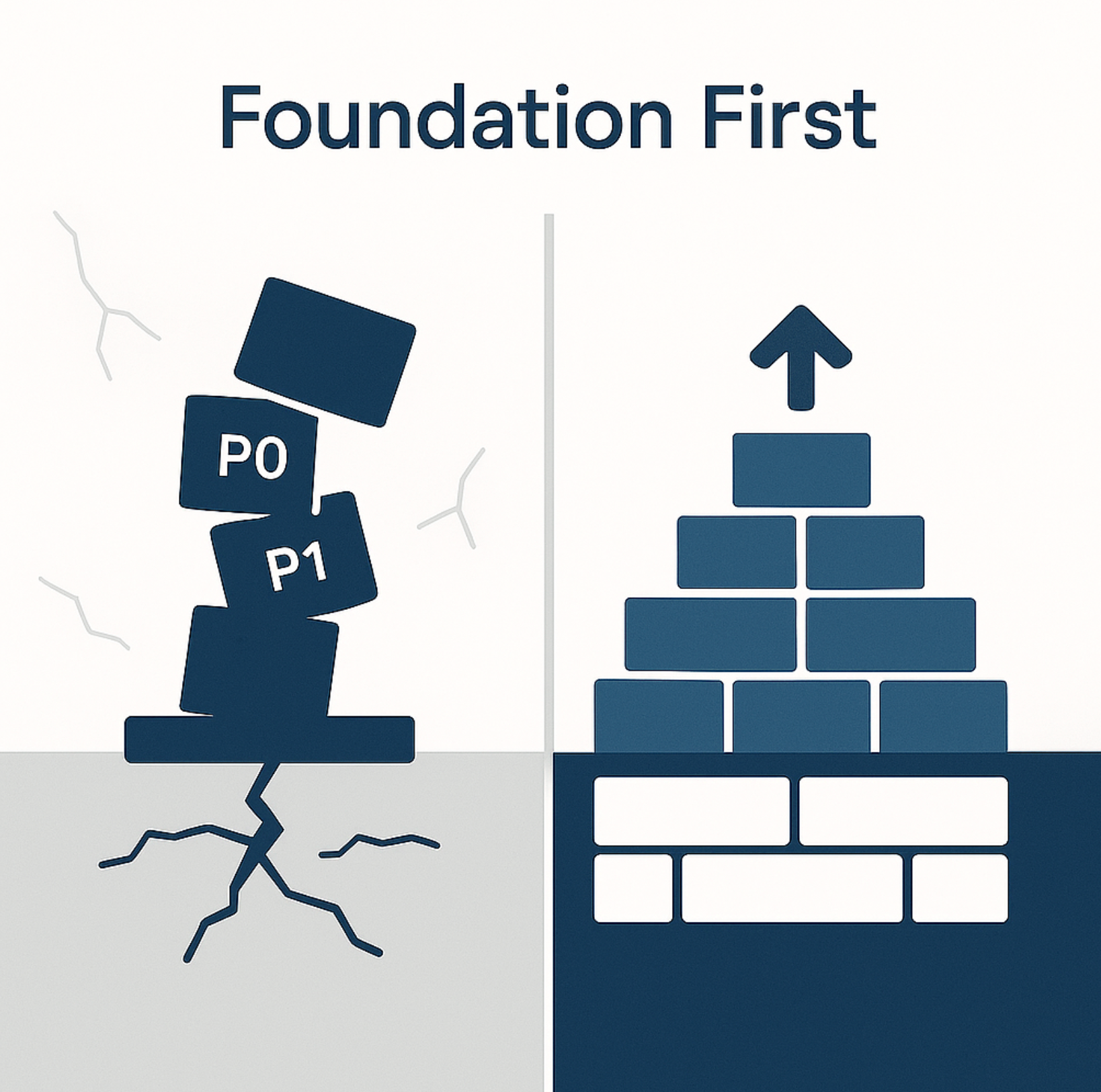
Tech debt is about everything that stems from unstable foundations. I had to learn this during our scaling journey. Early on, we made quick decisions to ship features fast. But as we grew, those shortcuts started choking our growth. Companies pay an additional 10 to 20 percent to address tech debt on top of the costs of any project, and we felt every percentage point. The real killer isn't just the extra time – it's the opportunity cost. While your team is fixing yesterday's shortcuts, your competitors are building tomorrow's features. Developers working on the right things can accelerate a company's move into new markets or product areas and help companies differentiate themselves at disproportionate rates. But there's a human cost too. Nobody likes working with a significant handicap and being unproductive day after day. ... Here's where most companies get it wrong. They think innovation means constantly adding new features, launching new products, exploring new markets. But true innovation requires a stable foundation. 30 percent of CIOs surveyed believe that more than 20 percent of their technical budget ostensibly dedicated to new products is diverted to resolving issues related to tech debt. You're essentially pouring money into a bucket with holes in it. I've learned that the most innovative companies aren't necessarily the ones building the flashiest features – they're the ones who've mastered the discipline of maintaining clean, stable systems that can support rapid innovation.


Regulatory bodies close in on AI chatbots as LLMs face greater scrutiny

As regulators roll out online safety laws designed to protect kids from harms associated with porn and social media, a new threat has crept up behind them that could overshadow both. AI chatbots – exemplified by OpenAI’s large language model, ChatGPT – have been around long enough to prove themselves popular, and risky. ... Inman-Grant says schools have “been reporting that 10- and 11-year-old children are spending up to six hours per day on AI companions.” Moreover, it’s not just that they’re befriending LLMs – it’s that they’re often friends with benefits, or “sexualized chatbots.” “We don’t need to see a body count to know that this is the right thing for the companies to do,” says the commissioner. “I don’t want to see Australian lives ruined or lost as a result of the industry’s insatiable need to move fast and break things.” ... Brazilian authorities are pressuring Meta to immediately remove AI chatbots that “simulate child profiles and engage in sexual conversations with users.” According to PPC Land, the bots in question are those created using Meta AI Studio, a tool for developing custom AI chatbots. In mid-August, Brazil’s Attorney General (AGU) issued an “extrajudicial notice” giving Meta 72 hours to remove the erotic kiddie chatbots. It references Article 217-A of Brazil’s Penal Code, which criminalizes sexual acts with minors under 14 years old.The AGU argues that this includes simulated sexual interactions with AI. Under Brazilian law, platforms are liable for harmful content hosted on their services.


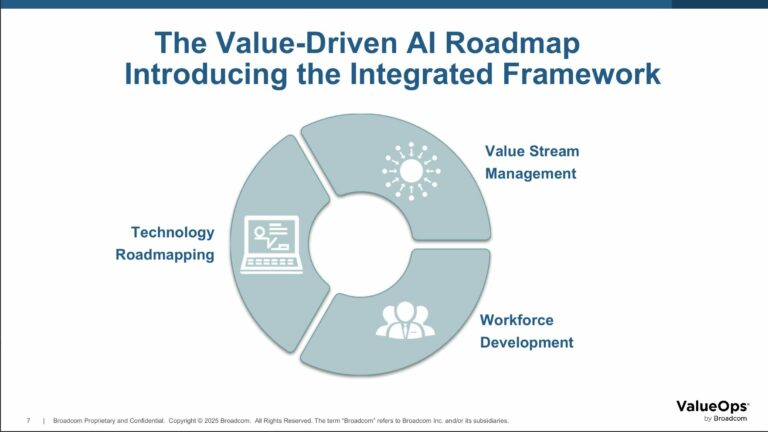
The Value-Driven AI Roadmap

The use of value stream management helps organizations map their processes, identifying impediments to delivering software that has value, and using automation to collect metrics that give insights into those processes – and even anticipate where the next hurdles might pop up, Knight said. “I’m going to map the process out, look at where things are and say, hey, I could put an AI agent here, then create a program and a plan to do that in a technology roadmap to line up with it,” he explained. Technology roadmapping involves aligning AI – what the organization is using now and what its needs might be a few years down the road – with business value. Staying on top of technology involves changes being driven by the market, the level of capability maturity within the organization, and finding where the gaps in your technology exist. “Roadmapping is more about helping organizations line up the change of different technologies and how to roll that out,” he said. Finally, Knight pointed out, assessing the skills within your workforce, where training is needed, and how willing the workers are to change, is critical. “It’s about how people in the future, in organizations, will have AI agents that work for them. And you think about it having extra capabilities where I’m going to have this set of skills with these people, but I may have an agent that works for me,” Knight said. “Maybe that agent does paralegal work for me.


The Hidden Cost of Overuse and Misuse of Data Storage

At first glance, storing everything might not seem like a huge problem. But when you factor in rising energy prices and ballooning data volumes, the cracks in that strategy start to show. Over time, outdated storage practices, from legacy systems to underused cloud buckets, can become a surprisingly expensive problem. ... what often gets overlooked are the hidden costs: the backup of low-value data, the power consumption of idle systems, or the surprise charges that come from cloud services which are not being monitored properly. Then there’s the operational cost. Disorganised or poorly labelled data makes access slower and compliance tougher. It also increases security risks, especially if sensitive information is spread across uncontrolled environments. The longer these issues go unchecked, the more danger there is of a snowball effect. ... Cutting storage costs is an obvious benefit but it’s far from the only one. A smarter, edge-driven strategy helps businesses build a more efficient, resilient, and sustainable digital infrastructure ... By processing and filtering data locally, organisations reduce the energy demands of transmitting and storing large volumes centrally, supporting both carbon reduction targets and lower utility costs. As sustainability reporting becomes more critical, this can also help meet Scope 2 emissions goals.


9 cloud strategy questions every IT leader must answer

Cloud platforms are increasingly procured by non-IT teams. Establishing a unified decision framework that brings together expertise from across the enterprise to guide the cloud lifecycle, from selection to sunsetting, is key. Without this, “organizations face fragmented architectures, redundant tools, and compliance gaps,” says CIO Mentor’s Topinka ... Working with multiple cloud partners can offer negotiating leverage and access to best-of-breed services, but it also compounds complexity and requires a range of expertise. ... “The maturity and advancement of cloud solutions depend on the team’s culture and their ability to operate and innovate within the cloud,” Hackett Group’s Nathan adds. ... “Clear visibility into consumption patterns, resource allocation, and usage metrics is essential,” says Nathan, noting that cloud financial management practices help maintain accountability and prevent cost overruns, particularly in multicloud environments. Allocating cloud costs directly to business units or product teams also increases transparency and encourages more efficient use of cloud resources, according to Kocherlakota. ... Cloud adoption without attendant legacy modernization can backfire, S&P Global’s Kocherlakota says. “Simply using the cloud as a data center while maintaining legacy applications can lead to cost creep,” he says. “Investing in transforming legacy systems optimizes infrastructure and boosts efficiency.”


Has Cloud Security Reached Its Breaking Point?

The comfortable assumptions that have guided cloud security for the past decade are crumbling. Supply chain attacks cascade through thousands of projects simultaneously. ... The GitHub Actions compromise (CVE-2025-30066) represents an evolutionary leap in supply chain attacks. What started as a single compromised Personal Access Token cascaded through 23,000+ repositories by exploiting dependency chains. Attackers retroactively modified version tags and implemented memory dumping to extract AWS keys, GitHub tokens and RSA keys from CI/CD logs. ... 89 percent of enterprises run multi-cloud environments, but only 23 percent have full visibility across their infrastructure. This creates a perfect storm where 70 percent of attacks span three or more cloud surfaces simultaneously ... While experts predict quantum computers will break current encryption by 2027 to 2030, the 'harvest now, decrypt later' attacks are already underway. Only 24 percent of organizations have started post-quantum cryptography preparation, leaving millions of encrypted communications vulnerable to future decryption. ... The evidence is clear that incremental improvements cannot address the mathematical realities we face. Security already struggled to scale for cloud workloads without core organizational and process changes; with AI adoption accelerating, it is impossible unless enterprises address foundational gaps.


Probably Secure: A Look at the Security Concerns of Deterministic vs Probabilistic Systems

From a security standpoint, there are places where probability belongs, and places where it absolutely does not. Identity authentication, transaction authorization, cryptographic key validation, and agent permissions must be rooted in deterministic validation, not statistical confidence. Generative AI, while powerful, can easily mislead developers, suggesting insecure code, leaking secrets through logs, or introducing unsafe patterns without clear visibility. Even well-structured retrieval-augmented generation (RAG) systems have a fundamental limitation: you can’t “tune” them for security beyond scrutinizing all input and output, leaving room for mistakes that attackers can exploit. Your tooling needs to treat probabilistic intelligence as a supplement rather than a trust anchor, reinforcing every critical security decision with deterministic, provable checks. ... Probabilistic tools are powerful for risk detection, prioritization, and context enrichment. Generative AI may accelerate development, but without deterministic guardrails, it can also accelerate risk. Teams need to focus on closing this gap by combining the strengths of AI-driven detection with hardened, verifiable validation for every secret, token, and non-human identity. This layered model ensures that organizations can safely leverage AI-driven insights while preserving a foundation of cryptographic certainty.


What do cybercriminals know about the retail sector that we don’t?

“Stolen customer data is valuable to fraudsters. So, retail is particularly vulnerable because retailers store large quantities of consumer data.” With so much to lose, retailers should be taking more care to protect themselves, but that is no easy feat. The scale of their operations means their businesses have many moving parts. Their supply chains are long and complex, involving an intricate and ever-changing network of suppliers. ... While external cybersecurity advisors are often called in after a breach has occurred, it is also wise to have them on board as a pre-emptive measure, as Kirsten Whitfield, co-head of law firm Fieldfisher’s cyber breach team in London, explains “Get a forensics provider on board to help close down an incident, and engage them in advance, as they could stress test the systems against common attack vectors from their knowledge of hacking groups,” she says. “Even engage a professional ransomware negotiator who can profile attackers.” On the technical front, the biggest challenge is to keep pace with the growth in AI. Hackers are using it, so retailers need to invest in defensive AI to fight fire with fire. “Investing as regulators expect you to will not necessarily mean you are iron clad,” says Whitfield. “Hackers are increasingly sophisticated and use tools like AI, so it is a good idea to invest in it, too, though you don’t want to rush into buying AI that you think will protect you but has not been fully understood.”

Daily Tech Digest - September 09, 2025


Quote for the day:

“The greatest leader is not necessarily the one who does the greatest things. He is the one that gets the people to do the greatest things.” -- Ronald Reagan


Neuromorphic computing and the future of edge AI

While QC captures the mainstream headlines, neuromorphic computing has positioned itself as a force in the next era of AI. While conventional AI relies heavily on GPU/TPU-based architectures, neuromorphic systems mimic the parallel and event-driven nature of the human brain. ... Neuromorphic hardware has shown promise in edge environments where power efficiency, latency and adaptability matter most. From wearable medical devices to battlefield robotics, systems that can “think locally” without requiring constant cloud connectivity offer clear advantages. ... As neuromorphic computing matures, ethical and sustainability considerations will shape adoption as much as raw performance. Spiking neural networks’ efficiency reduces carbon footprints by cutting energy demands compared to GPUs, aligning with global decarbonization targets. At the same time, ensuring that neuromorphic models are transparent, bias‑aware and auditable is critical for applications in healthcare, defense and finance. Calls for AI governance frameworks now explicitly include neuromorphic AI, reflecting its potential role in high‑stakes decision‑making. Embedding sustainability and ethics into the neuromorphic roadmap will ensure that efficiency gains do not come at the cost of fairness or accountability.


10 security leadership career-killers — and how to avoid them

“Security has evolved from being the end goal to being a business-enabling function,” says James Carder, CISO at software maker Benevity. “That means security strategies, communications, planning, and execution need to be aligned with business outcomes. If security efforts aren’t returning meaningful ROI, CISOs are likely doing something wrong. Security should not operate as a cost center, and if we act or report like one, we’re failing in our roles.” ... CISOs generally know that the security function can’t be the “department of no.” But some don’t quite get to a “yes,” either, which means they’re still failing their organizations in a way that could stymie their careers, says Aimee Cardwell, CISO in residence at tech company Transcend and former CISO of UnitedHealth Group. ... CISOs who are too rigid with the rules do a disservice to their organizations and their professional prospects, says Cardwell. Such a situation recently came up in her organization, where one of her team members initially declined to permit a third-party application from being used by workers, pointing to a security policy barring such apps. ... CISOs who don’t have a firm grasp on all that they must secure won’t succeed in their roles. “If they don’t have visibility, if they can’t talk about the effectiveness of the controls, then they won’t have credibility and the confidence in them among leadership will erode,” Knisley says.


A CIO's Evolving Role in the Generative AI Era

The dual mandate facing CIOs today is demanding but unavoidable. They must deliver quick AI pilots that boards can take to the shareholders while also enforcing guardrails on security, ethics and cost aspects. Too much caution can make CIOs irrelevant. This balancing act requires not only technical fluency but also narrative skill. The ability to translate AI experiments into business outcomes that CEOs and boards can trust can make CIOs a force. The MIT report highlights another critical decision point: whether to build or buy. Many enterprises attempt internal builds, but externally built AI partnerships succeed twice as often. CIOs, pressured for fast results, must be pragmatic about when to build and when to partner. Gen AI does not - and never will - replace the CIO role. But it demands corrections. The CIO who once focused on alignment must now lead business transformation. Those who succeed will act less as CIOs and more as AI diplomats, bridging hype with pragmatism, connecting technological opportunities to shareholder value and balancing the boardroom's urgency with the operational reality. As AI advances, so does the CIO's role - but only if they evolve. Their reporting line to the CEO symbolizes greater trust and higher stakes. Unlike previous technology cycles, AI has brought the CIO to the forefront of transformation. 


Building an AI Team May Mean Hiring Where the Talent Is, Not Where Your Bank Is

Much of the adaptation of banking to AI approaches requires close collaboration between AI talent with people who understand how the banking processes involved need to work. This will put people closer together, literally, to facilitate both quick and in-depth but always frequent interactions to make collaboration work — paradoxically, increased automation needs more face-to-face dealings at the formative stages. However, the "where" of the space will also hinge on where AI and innovation talent can be recruited, where that talent is being bred and wants to work, and the types of offices that talent will be attracted to. ... "Banks are also recruiting for emerging specialties in responsible AI and AI governance, ensuring that their AI initiatives are ethical, compliant and risk-managed," the report says. "As ‘agentic AI’ — autonomous AI agents — and generative AI gain traction, firms will need experts in these cutting-edge fields too." ... Decisions don’t stop at the border anymore. Jesrani says that savvy banks look for pockets of talent as well. ... "Banks are contemplating their global strategies because emerging markets can provide them with talent and capabilities that they may not be able to obtain in the U.S.," says Haglund. "Or there may be things happening in those markets that they need to be a part of in order to advance their core business capabilities."


How Data Immaturity is Preventing Advanced AI

Data immaturity, in the context of AI, refers to an organisation’s underdeveloped or inadequate data practices, which limit its ability to leverage AI effectively. It encompasses issues with data quality, accessibility, governance, and infrastructure. Critical signs of data immaturity include inconsistent, incomplete, or outdated data leading to unreliable AI outcomes; data silos across departments hindering access and comprehensive analysis, as well as weak data governance caused by a lack of policies on data ownership, compliance and security, which introduces risks and restricts AI usage. ... Data immaturity also leads to a lack of trust in analysis and predictability of execution. That puts a damper on any plans to leverage AI in a more autonomous manner—whether for business or operational process automation. A recent study by Kearney found that organisations globally are expecting to increase data and analytics budgets by 22% in the next three years as AI adoption scales. Fragmented data limits the predictive accuracy and reliability of AI, which are crucial for autonomous functions where decisions are made without human intervention. As a result, organisations must get their data houses in order before they will be able to truly take advantage of AI’s potential to optimise workflows and free up valuable time for humans to focus on strategy and design, tasks for which most AI is not yet well suited.


From Reactive Tools to Intelligent Agents: Fulcrum Digital’s AI-First Transformation

To mature, LLM is just one layer. Then you require the integration layer, how you integrate it. Every customer has multiple assets in their business which have to connect with LLM layers. Every business has so many existing applications and new applications; businesses are also buying some new AI agents from the market. How do you bring new AI agents, existing old systems, and new modern systems of the business together — integrating with LLM? That is one aspect. The second aspect is every business has its own data. So LLM has to train on those datasets. Copilot and OpenAI are trained on zillions of data, but that is LLM. Industry wants SLM—small language models, private language models, and industry-orientated language models. So LLMs have to be fine-tuned according to the industry and also fine-tuned according to their data. Nowadays people come to realise that LLMs will never give you 100 per cent accurate solutions, no matter which LLM you choose. That is the phenomenon customers and everybody are now learning. The difference between us and others: many players who are new to the game deliver results with LLMs at 70–75 per cent. Because we have matured this game with multiple LLMs coexisting, and with those LLMs together maturing our Ryze platform, we are able to deliver more than 93–95 per cent accuracy. 


You Didn't Get Phished — You Onboarded the Attacker

Many organizations respond by overcorrecting: "I want my entire company to be as locked down as my most sensitive resource." It seems sensible—until the work slows to a crawl. Without nuanced controls that allow your security policies to distinguish between legitimate workflows and unnecessary exposure, simply applying rigid controls that lock everything down across the organization will grind productivity to a halt. Employees need access to do their jobs. If security policies are too restrictive, employees are either going to find workarounds or continually ask for exceptions. Over time, risk creeps in as exceptions become the norm. This collection of internal exceptions slowly pushes you back towards "the castle and moat" approach. The walls are fortified from the outside, but open on the inside. And giving employees the key to unlock everything inside so they can do their jobs means you are giving one to Jordan, too. ... A practical way to begin is by piloting ZSP on your most sensitive system for two weeks. Measure how access requests, approvals, and audits flow in practice. Quick wins here can build momentum for wider adoption, and prove that security and productivity don't have to be at odds. ... When work demands more, employees can receive it on request through time-bound, auditable workflows. Just enough access is granted just in time, then removed. By taking steps to operationalize zero standing privileges, you empower legitimate users to move quickly—without leaving persistent privileges lying around for Jordan to find.


OT Security: When Shutting Down Is Not an Option

some of the most urgent and disruptive threats today are unfolding far from the keyboard, in operational technology environments that keep factories running, energy flowing and transportation systems moving. In these sectors, digital attacks can lead to physical consequences, and defending OT environments demands specialized skills. Real-world incidents across manufacturing and critical infrastructure show how quickly operations can be disrupted when OT systems are not adequately protected. Just this week, Jaguar Land Rover disclosed that a cyberattack "severely disrupted" its automotive manufacturing operations. ... OT environments present challenges that differ sharply from traditional IT. While security is improving, OT security teams must protect legacy control systems running outdated firmware, making them difficult to patch. Operators need to prioritize uptime and safety over system changes; and IT and OT teams frequently work in silos. These conditions mean that breaches can have physical as well as digital consequences, from halting production to endangering lives. Training tailored to OT is essential to secure critical systems while maintaining operational continuity. ... An OT cybersecurity learning ecosystem is not a one-time checklist but a continuous program. The following elements help organizations choose training that meets current needs while building capacity for ongoing improvement.


Connected cars are racing ahead, but security is stuck in neutral

Connected cars are essentially digital platforms with multiple entry points for attackers. The research highlights several areas of concern. Remote access attacks can target telematics systems, wireless interfaces, or mobile apps linked to the car. Data leaks are another major issue because connected cars collect sensitive information, including location history and driving behavior, which is often stored in the cloud. Sensors present their own set of risks. Cameras, radar, lidar, and GPS can be manipulated, creating confusion for driver assistance systems. Once inside a vehicle, attackers can move deeper by exploiting the CAN bus, which connects key systems such as brakes, steering, and acceleration. ... Most drivers want information about what data is collected and where it goes, yet very few said they have received that information. Brand perception also plays a role. Many participants prefer European or Japanese brands, while some expressed distrust toward vehicles from certain countries, citing political concerns, safety issues, or perceived quality gaps. ... Manufacturers are pushing out new software-defined features, integrating apps, and rolling out over the air updates. This speed increases the number of attack paths and makes it harder for security practices and rules to keep up.


Circular strategies for data centers

Digital infrastructure is scaling rapidly, with rising AI workloads and increased compute density shaping investment decisions. Growth on that scale can generate unnecessary waste unless sustainability is integrated into planning. Circular thinking makes it possible to expand capacity without locking facilities into perpetual hardware turnover. Operators can incorporate flexibility into refresh cycles by working with vendors that design modular platforms or by adopting service-based models that build in maintenance, refurbishment, and recovery. ... Sustainable planning also involves continuous evaluation. Instead of defaulting to wholesale replacement, facilities can test whether assets still meet operational requirements through reconfiguration, upgrades, or role reassignment. This kind of iterative approach gives operators a way to match innovation with responsibility, ensuring that capacity keeps pace with demand without discarding equipment prematurely. ... The transition to circular practices is more than an environmental gesture. For data centers, it is a strategic shift in how infrastructure is procured, maintained, and retired. Extending lifecycles, redeploying equipment internally, refurbishing where possible, and ensuring secure, responsible recycling at the end of use all contribute to a more resilient operation in a resource-constrained and tightly regulated industry.

Daily Tech Digest - September 08, 2025


Quote for the day:

"Let no feeling of discouragement prey upon you, and in the end you are sure to succeed." -- Abraham Lincoln


Coding With AI Assistants: Faster Performance, Bigger Flaws

One challenge comes in the form of how AI coding assistants tend to package their code. Rather than delivering bite-size pieces, they generally deliver larger code pull requests for porting into the main project repository. Apiiro saw AI code assistants deliver three to four times as many code commits - meaning changes to a code repository - than non-AI code assistants, but packaging fewer pull requests. The problem is that larger PRs are inherently riskier and more time-consuming to verify. "Bigger, multi-touch PRs slow review, dilute reviewer attention and raise the odds that a subtle break slips through," said Itay Nussbaum, a product manager at Apiiro. ... At the same time, the tools generated deeper problems, in the form of a 150% increase in architectural flaws and an 300% increase in privilege issues. "These are the kinds of issues scanners miss and reviewers struggle to spot - broken auth flows, insecure designs, systemic weaknesses," Nussbaum said. "In other words, AI is fixing the typos but creating the time bombs." The tools also have a greater tendency to leak cloud credentials. "Our analysis found that AI-assisted developers exposed Azure service principals and storage access keys nearly twice as often as their non-AI peers," Nussbaum said. "Unlike a bug that can be caught in testing, a leaked key is live access: an immediate path into the production cloud infrastructure."


IT Leadership Is More Change Management Than Technical Management

Planning is considered critical in business to keep an organization moving forward in a predictable way, but Mahon doesn’t believe in the traditional annual and long-term planning in which lots of time is invested in creating the perfect plan which is then executed. “Never get too engaged in planning. You have a plan, but it’s pretty broad and open-ended. The North Star is very fuzzy, and it never gets to be a pinpoint [because] you need to focus on all the stuff that's going on around you,” says Mahon. “You should know exactly what you're going to do in the next two to three months. From three to six months out, you have a really good idea what you're going to do but be prepared to change. And from six to nine months or a year, [I wait until] we get three months away before I focus on it because tech and business needs change rapidly.” ... “The good ideas are mostly common knowledge. To be honest, I don’t think there are any good self-help books. Instead, I have a leadership coach who is also my mental health coach,” says Mahon. “Books try to get you to change who you are, and it doesn’t work. Be yourself. I have a leadership coach who points out my flaws, 90% of which I’m already aware of. His philosophy is don’t try to fix the flaw, address the flaw so, for example, I’m mindful about my tendency to speak too directly.”


The Anatomy of SCREAM: A Perfect Storm in EA Cupboard

SCREAM- Situational Chaotic Realities of Enterprise Architecture Management- captures the current state of EA practice, where most organizations, from medium to large complexity, struggle to derive optimal value from investments in enterprise architecture capabilities. It’s the persistent legacy challenges across technology stacks and ecosystems that need to be solved to meet strategic business goals and those moments when sudden, ill-defined executive needs are met with a hasty, reactive sprint, leading to a fractured and ultimately paralyzing effect on the entire organization. ... The paradox is that the very technologies offering solutions to business challenges are also key sources of architectural chaos, further entrenching reactive SCREAM. As noted, the inevitable chaos and fragmentation that emerge from continuous technology additions lead to silos and escalating compatibility issues. ... The chaos of SCREAM is not just an external force; it’s a product of our own making. While we preach alignment to the business, we often get caught up in our own storm in an EA cupboard. How often do we play EA on EA? ... While pockets of recognizable EA wins may exist through effective engagement, a true, repeatable value-add requires a seat at the strategic table. This means “architecture-first” must evolve beyond being a mere buzzword or a token effort, becoming a reliable approach that promotes collaborative success rather than individual credit-grabbing.


How Does Network Security Handle AI?

Detecting when AI models begin to vary and yield unusual results is the province of AI specialists, users and possibly the IT applications staff. But the network group still has a role in uncovering unexpected behavior. That role includes: Properly securing all AI models and data repositories on the network. Continuously monitoring all access points to the data and the AI system. Regularly scanning for network viruses and any other cyber invaders that might be lurking. ... both application and network teams need to ensure strict QA principles across the entire project -- much like network vulnerability testing. Develop as many adversarial prompt tests coming from as many different directions and perspectives as you can. Then try to break the AI system in the same way a perpetrator would. Patch up any holes you find in the process. ... Apply least privilege access to any AI resource on the network and continually monitor network traffic. This philosophy should also apply to those on the AI application side. Constrict the AI model being used to the specific use cases for which it was intended. In this way, the AI resource rejects any prompts not directly related to its purpose. ... Red teaming is ethical hacking. In other words, deploy a team whose goal is to probe and exploit the network in any way it can. The aim is to uncover any network or AI vulnerability before a bad actor does the same.


Lack of board access: The No. 1 factor for CISO dissatisfaction

CISOs who don’t get access to the board are often buried within their organizations. “There are a lot of companies that will hire at a director level or even a senior manager level and call it a CISO. But they don’t have the authority and scope to actually be able to execute what a CISO does,” says Nick Kathmann, CISO at LogicGate. Instead of reporting directly to the board or CEO, these CISOs will report to a CIO, CTO or other executive, despite the problems that can arise in this type of reporting structure. CIOs and CTOs are often tasked with implementing new technology. The CISO’s job is to identity risks and ensure the organization is secure. “If the CIO doesn’t like those risks or doesn’t want to do anything to fix those risks, they’ll essentially suppress them [CISOs] as much as they can,” says Kathmann. ... Getting in front of the board is one thing. Effectively communicating cybersecurity needs and getting them met is another. It starts with forming relationships with C-suite peers. Whether CISOs are still reporting up to another executive or not, they need to understand their peers’ priorities and how cybersecurity can mesh with those. “The CISO job is an executive job. As an executive, you rely completely on your peer relationships. You can’t do anything as an executive in a vacuum,” says Barrack. Working in collaboration, rather than contention, with other executives can prepare CISOs to make the most of their time in front of the board.


From Vault Sprawl to Governance: How Modern DevOps Teams Can Solve the Multi-Cloud Secrets Management Nightmare

Every time an application is updated or a new service is deployed, one or multiple new identities are born. These NHIs include service accounts, CI/CD pipelines, containers, and other machine workloads, the running pieces of software that connect to other resources and systems to do work. Enterprises now commonly see 100 or more NHIs for every single human identity. And that number keeps growing. ... Fixing this problem is possible, but it requires an intentional strategy. The first step is creating a centralized inventory of all secrets. This includes secrets stored in vaults, embedded in code, or left exposed in CI/CD pipelines and environments. Orphaned and outdated secrets should be identified and removed. Next, organizations must shift left. Developers and DevOps teams require tools to detect secrets early, before they are committed to source control or merged into production. Educating teams and embedding detection into the development process significantly reduces accidental leaks. Governance must also include lifecycle mapping. Secrets should be enriched with metadata such as owner, creation date, usage frequency, and last rotation. Automated expiration and renewal policies help enforce consistency and reduce long-term risk. Contributions should be both product- and vendor-agnostic, focusing on market insights and thought leadership.


Digital Public Infrastructure: The backbone of rural financial inclusion

When combined, these infrastructures — UPI for payments, ONDC for commerce, AAs for credit, CSCs for handholding support and broadband for connectivity form a powerful ecosystem. Together, these enable a farmer to sell beyond the village, receive instant payment and leverage that income proof for a micro-loan, all within a seamless digital journey. Adding to this, e-KYC ensures that identity verification is quick, low-cost and paperless, while AePS provides last-mile access to cash and banking services, ensuring inclusion even for those outside the smartphone ecosystem. This integration reduces dependence on middlemen, enhances transparency and fosters entrepreneurship. ...  Of course, progress does not mean perfection. There are challenges that must be addressed with urgency and sensitivity. Many rural merchants hesitate to fully embrace digital commerce due to uncertainties around Goods and Services Tax (GST) compliance. Digital literacy, though improving, still varies widely, particularly among older populations and women. Infrastructure costs such as last-mile broadband and device affordability remain burdensome for small operators. These are not reasons to slow down but opportunities to fine-tune policy. Simplifying tax processes for micro-enterprises, investing in vernacular digital literacy programmes, subsidising rural connectivity and embedding financial education into community touchpoints such as CSCs will be essential to ensure no one is left behind.


Cybersecurity research is getting new ethics rules, here’s what you need to know

Ethics analysis should not be treated as a one-time checklist. Stakeholder concerns can shift as a project develops, and researchers may need to revisit their analysis as they move from design to execution to publication. ...“Stakeholder ethical concerns impact academia, industry, and government,” Kalu said. “Security teams should replace reflexive defensiveness with structured collaboration: recognize good-faith research, provide intake channels and SLAs, support coordinated disclosure and pre-publication briefings, and engage on mitigation timelines. A balanced, invitational posture, rather than an adversarial one, will reduce harm, speed remediation, and encourage researchers to keep working on that project.” ... While the new requirements target academic publishing, the ideas extend to industry practice. Security teams often face similar dilemmas when deciding whether to disclose vulnerabilities, release tools, or adopt new defensive methods. Thinking in terms of stakeholders provides a way to weigh the benefits and risks of those decisions. ... Peng said ethical standards should be understood as “scaffolds that empower thoughtful research,” providing clarity and consistency without blocking exploration of adversarial scenarios. “By building ethics into the process from the start and revisiting it as research develops, we can both protect stakeholders and ensure researchers can study the potential threats that adversaries, who face no such constraints, may exploit,” she said.


From KYC to KYAI: Why ‘Algorithmic Transparency’ is Now Critical in Banking

This growing push for transparency into AI models has introduced a new acronym to the risk and compliance vernacular: KYAI, or "know your AI." Just like finance institutions must know the important details about their customers, so too must they understand the essential components of their AI models. The imperative has evolved beyond simply knowing "who" to "how." Based on my work helping large banks and other financial institutions integrate AI into their KYC workflows over the last few years, I’ve seen what can happen when these teams spend the time vetting their AI models and applying rigorous transparency standards. And, I’ve seen what can happen when they become overly trusting of black-box algorithms that deliver decisions based on opaque methods with no ability to attribute accountability. The latter rarely ever ends up being the cheapest or fastest way to produce meaningful results. ... The evolution from KYC to KYAI is not merely driven by regulatory pressure; it reflects a fundamental shift in how businesses operate today. Financial institutions that invest in AI transparency will be equipped to build greater trust, reduce operational risks, and maintain auditability without missing a step in innovation. The transformation from black box AI to transparent, governable systems represents one of the most significant operational challenges facing financial institutions today.


Why compliance clouds are essential

From a technical perspective, compliance clouds offer something that traditional clouds can’t match, these are the battle-tested security architectures. By implementing them, the organizations can reduce their data breach risk by 30-40% compared to standard cloud deployments. This is because compliance clouds are constantly reviewed and monitored by third-party experts, ensuring that we are not just getting compliance, but getting an enterprise-grade security that’s been validated by some of the most security-conscious organizations in the world. ... What’s particularly interesting is that 58% of this market is software focused. As organizations prioritize automation and efficiency in managing complex regulatory requirements, this number is set to grow further. Over 75% of federal agencies have already shifted to cloud-based software to meet evolving compliance needs. Following this, we at our organizations have also achieved FedRAMP® High Ready compliance for Cloud. ... Cloud compliance solutions deliver far-reaching benefits that extend well beyond regulatory adherence, offering a powerful mix of cost efficiency, trust building, adaptability, and innovation enablement. ... In an era where trust is a competitive currency, compliance cloud certifications serve as strong differentiators, signaling an organization’s unwavering commitment to data protection and regulatory excellence.

Daily Tech Digest - September 07, 2025


Quote for the day:

"The struggle you're in today is developing the strength you need for tomorrow." -- #Soar2Success


The Automation Bottleneck: Why Data Still Holds Back Digital Transformation

Even in firms with well-funded digital agendas, legacy system sprawl is an ongoing headache. Data lives in silos, formats vary between regions and business units, and integration efforts can stall once it becomes clear just how much human intervention is involved in daily operations. Elsewhere, the promise of straight-through processing clashes with manual workarounds, from email approvals and spreadsheet imports to ad hoc scripting. Rather than symptoms of technical debt, these gaps point to automation efforts that are being layered on top of brittle foundations. Until firms confront the architectural and operational barriers that keep data locked in fragmented formats, automation will also remain fragmented. Yes, it will create efficiency in isolated functions, but not across end-to-end workflows. And that’s an unforgiving limitation in capital markets where high trade volumes, vast data flows, and regulatory precision are all critical. ... What does drive progress are purpose-built platforms that understand the shape and structure of industry data from day one, moving, enriching, validating, and reformatting it to support the firm’s logic. Reinventing the wheel for every process isn’t necessary, but firms do need to acknowledge that, in financial services, data transformation isn’t some random back-office task. It’s a precondition for the type of smooth and reliable automation that prepares firms for the stark demands of a digital future.


Switching on resilience in a post-PSTN world

The copper PSTN network, first introduced in the Victorian era, was never built for the realities of today’s digital world. The PSTN was installed in the early 80s, and early broadband was introduced using the same lines in the early 90s. And the truth is, it needs to retire, having operated past its maintainable life span. Modern work depends on real-time connectivity and data-heavy applications, with expectations around speed, scalability, and reliability that outpace the capabilities of legacy infrastructure. ... Whether it’s a GP retrieving patient records or an energy network adjusting supply in real time, their operations depend on uninterrupted, high-integrity access to cloud systems and data center infrastructure. That’s why the PSTN switch-off must be seen not as a Telecoms milestone, but as a strategic resilience imperative. Without universal access upgrades, even the most advanced data centers can’t fulfil their role. The priority now is to build a truly modern digital backbone. One that gives homes, businesses, and CNI facilities alike robust, high-speed connectivity into the cloud. This is about more than retiring copper. It’s about enabling a smarter, safer, more responsive nation. Organizations that move early won’t just minimize risk, they’ll unlock new levels of agility, performance, and digital assurance.


Neither driver, nor passenger — covenantal co-creator

The covenantal model rests on a deeper premise: that intelligence itself emerges not just from processing information, but from the dynamic interaction between different perspectives. Just as human understanding often crystallizes through dialogue with others, AI-human collaboration can generate insights that exceed what either mind achieves in isolation. This isn't romantic speculation. It's observable in practice. When human contextual wisdom meets AI pattern recognition in genuine dialogue, new possibilities emerge. When human ethical intuition encounters AI systematic analysis, both are refined. When human creativity engages with AI synthesis, the result often transcends what either could produce alone. ... Critics will rightfully ask: How do we distinguish genuine partnership from sophisticated manipulation? How do we avoid anthropomorphizing systems that may simulate understanding without truly possessing it? ... The real danger isn't just AI dependency or human obsolescence. It's relational fragmentation — isolated humans and isolated AI systems operating in separate silos, missing the generative potential of genuine collaboration. What we need isn't just better drivers or more conscious passengers. We need covenantal spaces where human and artificial minds can meet as genuine partners in the work of understanding.


Facial recognition moves into vehicle lanes at US borders

According to the PTA, VBCE relies on a vendor capture system embedded in designated lanes at land ports of entry. As vehicles approach the primary inspection lane, high-resolution cameras capture facial images of occupants through windshields and side windows. The images are then sent to the VBCE platform where they are processed by a “vendor payload service” that prepares the files for CBP’s backend systems. Each image is stored temporarily in Amazon Web Services’ S3 cloud storage, accompanied by metadata and quality scores. An image-quality service assesses whether the photo is usable while an “occupant count” algorithm tallies the number of people in the vehicle to measure capture rates. A matching service then calls CBP’s Traveler Verification Service (TVS) – the central biometric database that underpins Simplified Arrival – to retrieve “gallery” images from government holdings such as passports, visas, and other travel documents. The PTA specifies that an “image purge service” will delete U.S. citizen photos once capture and quality metrics are obtained, and that all images will be purged when the evaluation ends. Still, during the test phase, images can be retained for up to six months, a far longer window than the 12-hour retention policy CBP applies in operational use for U.S. citizens.


Quantum Computing Meets Finance

Many financial-asset-pricing problems boil down to solving integral or partial differential equations. Quantum linear algebra can potentially speed that up. But the solution is a quantum state. So, you need to be creative about capturing salient properties of the numerical solution to your asset-pricing model. Additionally, pricing models are subject to ambiguity regarding sources of risk—factors that can adversely affect an asset’s value. Quantum information theory provides tools for embedding notions of ambiguity. ... Recall that some of the pioneering research on quantum algorithms was done in the 1990s by scientists like Deutsch, Shor, and Vazirani, among others. Today it’s still a challenge to implement their ideas with current hardware, and that’s three decades later. But besides hardware, we need progress on algorithms—there’s been a bit of a quantum algorithm winter. ... Optimization tasks across industries, including computational chemistry, materials science, and artificial intelligence, are also applied in the financial sector. These optimization algorithms are making progress. In particular, the ones related to quantum annealing are the most reliable scaled hardware out there. ... The most well-known case is portfolio allocation. You have to translate that into what’s known as quadratic unconstrained binary optimization, which means making compromises to maintain what you can actually compute. 


Beyond IT: How Today’s CIOs Are Shaping Innovation, Strategy and Security

It’s no longer acceptable to measure success by uptime or ticket resolution. Your worth is increasingly measured by your ability to partner with business units, translate their needs into scalable technology solutions and get those solutions to market quickly. That means understanding not just the tech, but the business models, revenue drivers and customer expectations. You don’t need to be an expert in marketing or operations, but you need to know how your decisions in architecture, tooling, and staffing directly impact their outcomes. ... Security and risk management are no longer checkboxes handled by a separate compliance team. They must be embedded into the DNA of your tech strategy. Becky refers to this as “table stakes,” and she’s right. If you’re not building with security from the outset, you’re building on sand. That starts with your provisioning model. We’re in a world where misconfigurations can take down global systems. Automated provisioning, integrated compliance checks and audit-ready architectures are essential. Not optional. ... CIOs need to resist the temptation to chase hype. Your core job is not to implement the latest tools. Your job is to drive business value and reduce complexity so your teams can move fast, and your systems remain stable. The right strategy? Focus on the essentials: Automated provisioning, integrated security and clear cloud cost governance. 


The Difference Between Entrepreneurs Who Survive Crises and Those Who Don't

Among the most underrated strategies for protecting reputation, silence holds a special place. It is not passivity; it's an intentional, active choice. Deciding not to react immediately to a provocation buys time to think, assess and respond surgically. Silence has a precise psychological effect: It frustrates your attacker, often pushing them to overplay their hand and make mistakes. This dynamic is well known in negotiation — those who can tolerate pauses and gaps often control the rhythm and content of the exchange. ... Anticipating negative scenarios is not pessimism — it's preparation. It means knowing ahead of time which actions to avoid and which to take to safeguard credibility. As Eccles, Newquist, and Schatz note in Harvard Business Review, a strong, positive reputation doesn't just attract top talent and foster customer loyalty — it directly drives higher pricing power, market valuation and investor confidence, making it one of the most valuable yet vulnerable assets in a company's portfolio. ... Too much exposure without a solid reputation makes an entrepreneur vulnerable and easily manipulated. Conversely, those with strong credibility maintain control even when media attention fades. In the natural cycle of public careers, popularity always diminishes over time. What remains — and continues to generate opportunities — is reputation. 


Ship Faster With 7 Oddly Specific devops Habits

PowerPoint can lie; your repo can’t. If “it works on my machine” is still a common refrain, we’ve left too much to human memory. We make “done” executable. Concretely, we put a Makefile (or a tiny task runner) in every repo so anyone—developer, SRE, or manager who knows just enough to be dangerous—can run the same steps locally and in CI. The pattern is simple: a single entry point to lint, test, build, and package. That becomes the contract for the pipeline. ... Pipelines shouldn’t feel like bespoke furniture. We keep a single “paved path” workflow that most repos can adopt unchanged. The trick is to keep it boring, fast, and self-explanatory. Boring means a sane default: lint, test, build, and publish on main; test on pull requests; cache aggressively; and fail clearly. Fast means smart caching and parallel jobs. Self-explanatory means the pipeline tells you what to do next, not just that you did it wrong. When a team deviates, they do it consciously and document why. Most of the time, they come back to the path once they see the maintenance cost of custom tweaks. ... A release isn’t done until we can see it breathing. We bake observability in before the first customer ever sees the service. That means three things: usable logs, metrics with labels that match our domain (not just infrastructure), and distributed traces. On top of those, we define one or two Service Level Objectives with clear SLIs—usually success rate and latency. 


Kali Linux vs Parrot OS – Which Penetration Testing Platform is Most Suitable for Cybersecurity Professionals?

Kali Linux ships with over 600 pre-installed penetration testing tools, carefully curated to cover the complete spectrum of security assessment activities. The toolset spans multiple categories, including network scanning, vulnerability analysis, exploitation frameworks, digital forensics, and post-exploitation utilities. Notable tools include the Metasploit Framework for exploitation testing, Burp Suite for web application security assessment, Nmap for network discovery, and Wireshark for protocol analysis. The distribution’s strength lies in its comprehensive coverage of penetration testing methodologies, with tools organized into logical categories that align with industry-standard testing procedures. The inclusion of cutting-edge tools such as Sqlmc for SQL injection testing, Sprayhound for password spraying integrated with Bloodhound, and Obsidian for documentation purposes demonstrates Kali’s commitment to addressing evolving security challenges. ... Parrot OS distinguishes itself through its holistic approach to cybersecurity, offering not only penetration testing tools but also integrated privacy and anonymity features. The distribution includes over 600 tools covering penetration testing, digital forensics, cryptography, and privacy protection. Key privacy tools include Tor Browser, AnonSurf for traffic anonymization, and Zulu Crypt for encryption operations.


How Artificial Intelligence Is Reshaping Cybersecurity Careers

AI-Enhanced SOC Analysts upends traditional security operations, where analysts leverage artificial intelligence to enhance their threat detection and incident response capabilities. These positions work with the existing analyst platforms that are capable of autonomous reasoning that mimics expert analyst workflows, correlating evidence, reconstructing timelines, and prioritizing real threats at a much faster rate. ... AI Risk Analysts and Governance Specialists ensure responsible AI deployment through risk assessments and adherence to compliance frameworks. Professionals in this role may hold a certification like the AIGP. This certification demonstrates that the holder can ensure safety and trust in the development and deployment of ethical AI and ongoing management of AI systems. This role requires foundational knowledge of AI systems and their use cases, the impacts of AI, and comprehension of responsible AI principles. ... AI Forensics Specialists represent an emerging role that combines traditional digital forensics with AI-specific environments and technology. This role is designed to analyze model behavior, trace adversarial attacks, and provide expert testimony in legal proceedings involving AI systems. While classic digital forensics focuses on post-incident investigations, preserving evidence and chain of custody, and reconstructing timelines, AI forensics specialists must additionally possess knowledge of machine learning algorithms and frameworks.

Daily Tech Digest - September 06, 2025


Quote for the day:

"Average leaders raise the bar on themselves; good leaders raise the bar for others; great leaders inspire others to raise their own bar." -- Orrin Woodward


Why Most AI Pilots Never Take Flight

The barrier is not infrastructure, regulation or talent but what the authors call "learning gap." Most enterprise AI systems cannot retain memory, adapt to feedback or integrate into workflows. Tools work in isolation, generating content or analysis in a static way, but fail to evolve alongside the organizations that use them. For executives, the result is a sea of proofs of concept with little business impact. "Chatbots succeed because they're easy to try and flexible, but fail in critical workflows due to lack of memory and customization," the report said. Many pilots never survive this transition, Mina Narayanan, research analyst at the Center for Security and Emerging Technology, told Information Security Media Group. ... The implications of this shadow economy are complex. On one hand, it shows clear employee demand, as workers gravitate toward flexible, responsive and familiar tools. On the other, it exposes enterprises to compliance and security risks. Corporate lawyers and procurement officers interviewed in the report admitted they rely on ChatGPT for drafting or analysis, even when their firms purchased specialized tools costing tens of thousands of dollars. When asked why they preferred consumer tools, their answers were consistent: ChatGPT produced better outputs, was easier to iterate with and required less training. "Our purchased AI tool provided rigid summaries with limited customization options," one attorney told the researchers. 


Breaking into cybersecurity without a technical degree: A practical guide

Think of cybersecurity as a house. While penetration testers and security engineers focus on building stronger locks and alarm systems, GRC professionals ensure the house has strong foundations, insurance policies and meets all building regulations. ... Governance involves creating and maintaining the policies, procedures and frameworks that guide an organisation’s security decisions. Risk management focuses on identifying potential threats, assessing their likelihood and impact, then developing strategies to mitigate or accept those risks. ... Certifications alone will not land you a role. This is not understood by most people wanting to take this path. Understanding key frameworks provides the practical knowledge that makes certifications meaningful. ISO 27001, the international standard for information security management systems, appears in most GRC job descriptions. I spent considerable time learning not only what ISO 27001 requires, but how organizations implement its controls in practice. The NIST Cybersecurity Framework (CSF) deserves equal attention. NIST CSF’s six core functions — govern, identify, protect, detect, respond and recover — provide a logical structure for organising security programs that business stakeholders can understand. Personal networks proved more valuable than any job board or recruitment agency. 


To Survive Server Crashes, IT Needs a 'Black Box'

Security teams utilize Security Information and Event Management (SIEM) systems, and DevOps teams have tracing tools. However, infrastructure teams still lack an equivalent tool: a continuously recorded, objective account of system interdependencies before, during, and after incidents. This is where Application Dependency Mapping (ADM) solutions come into play. ADM continuously maps the relationships between servers, applications, services, and external dependencies. Instead of relying on periodic scans or manual documentation, ADM offers real-time, time-stamped visibility. This allows IT teams to rewind their environment to any specific point in time, clearly identifying the connections that existed, which systems interacted, and how traffic flowed during an incident. ... Retrospective visibility is emerging as a key focus in IT infrastructure management. As hybrid and multi-cloud environments become increasingly complex, accurately diagnosing failures after they occur is essential for maintaining uptime, security, and business continuity. IT professionals must monitor systems in real time and learn how to reconstruct the complete story when failures happen. Similar to the aviation industry, which acknowledges that failures can occur and prepares accordingly, the IT sector must shift from reactive troubleshooting to a forensic-level approach to visibility.


Vibe coding with GitHub Spark

The GitHub Spark development space is a web application with three panes. The middle one is for code, the right one shows the running app (and animations as code is being generated), and the left one contains a set of tools. These tools offer a range of functions, first letting you see your prompts and skip back to older ones if you don’t like the current iteration of your application. An input box allows you to add new prompts that iterate on your current generated code, with the ability to choose a screenshot or change the current large language model (LLM) being used by the underlying GitHub Copilot service. I used the default choice, Anthropic’s Claude Sonnet 3.5. As part of this feature, GitHub Spark displays a small selection of possible refinements that take concepts related to your prompts and suggest enhancements to your code. Other controls provide ways to change low-level application design options, including the current theme, font, or the style used for application icons. Other design tools allow you to tweak the borders of graphical elements, the scaling factors used, and to pick an application icon for an install of your code based on Progressive Web Apps (PWAs). GitHub Spark has a built-in key/value store for application data that persists between builds and sessions. The toolbar provides a list of the current key and the data structure used for the value store. 


Legacy IT Infrastructure: Not the Villain We Make It Out to Be

In the realm of IT infrastructure, legacy can often feel like a bad word. No one wants to be told their organization is stuck with legacy IT infrastructure because it implies that it's old or outdated. Yet, when you actually delve into the details of what legacy means in the context of servers, networking, and other infrastructure, a more complex picture emerges. Legacy isn't always bad. ... it's not necessarily the case that a system is bad, or in dire need of replacement, just because it fits the classic definition of legacy IT. There's an argument to be made that, in many cases, legacy systems are worth keeping around. For starters, most legacy infrastructure consists of tried-and-true solutions. If a business has been using a legacy system for years, it's a reliable investment. It may not be as optimal from a cost, scalability, or security perspective as a more modern alternative. But in some cases, this drawback is outweighed by the fact that — unlike a new, as-yet-unproven solution — legacy systems can be trusted to do what they claim to do because they've already been doing it for years. The fact that legacy systems have been around for a while also means that it's often easy to find engineers who know how to work with them. Hiring experts in the latest, greatest technology can be challenging, especially given the widespread IT talent shortage. 


How to Close the AI Governance Gap in Software Development

Despite the advantages, only 42 percent of developers trust the accuracy of AI output in their workflows. In our observations, this should not come as a surprise – we’ve seen even the most proficient developers copying and pasting insecure code from large language models (LLMs) directly into production environments. These teams are under immense pressure to produce more lines of code faster than ever. Because security teams are also overworked, they aren’t able to provide the same level of scrutiny as before, causing overlooked and possibly harmful flaws to proliferate. The situation brings the potential for widespread disruption: BaxBench oversees a coding benchmark to evaluate LLMs for accuracy and security, and has reported that LLMs are not yet capable of generating deployment-ready code. ... What’s more, they often lack the expertise – or don’t even know where to begin – to review and validate AI-enabled code. This disconnect only further elevates their organization’s risk profile, exposing governance gaps. To keep everything from spinning out of control, chief information security officers (CISOs) must work with other organizational leaders to implement a comprehensive and automated governance plan that enforces policies and guardrails, especially within the repository workflow.


The Complexity Crisis: Why Observability Is the Foundation of Digital Resilience

End-to-end observability is evolving beyond its current role in IT and DevOps to become a foundational element of modern business strategy. In doing so, observability plays a critical role in managing risk, maintaining uptime, and safeguarding digital trust. Observability also enables organizations to proactively detect anomalies before they escalate into outages, quickly pinpoint root causes across complex, distributed systems, and automate response actions to reduce mean time to resolution (MTTR). The result is faster, smarter and more resilient operations, giving teams the confidence to innovate without compromising system stability, a critical advantage in a world where digital resilience and speed must go hand in hand. ... As organizations increasingly adopt generative and agentic AI to accelerate innovation, they also expose themselves to new kinds of risks. Agentic AI can be configured to act independently, making changes, triggering workflows, or even deploying code without direct human involvement. This level of autonomy can boost productivity, but it also introduces serious challenges. ... Tomorrow’s industry leaders will be distinguished by their ability to adopt and adapt to new technologies, embracing agentic AI but recognizing the heightened risk exposure and compliance burdens. Leaders will need to shift from reactive operations to proactive and preventative operations.


AI and the end of proof

Fake AI images can lie. But people lie, too, saying real images are fake. Call it the ‘liar’s dividend.’ Call it a crisis of confidence. ... In 2019, when deepfake audio and video became a serious problem, legal experts Bobby Chesney and Danielle Citron came up with the term “liar’s dividend” to describe the advantage a dishonest public figure gets by calling real evidence “fake” in a time when AI-generated content makes people question what they see and hear. False claims of deepfakes can be just as harmful as real deepfakes during elections. ... The ability to make fakes will be everywhere, along with the growing awareness that visual information can be easily and convincingly faked. That awareness makes false claims that something is AI-made more believable. The good news is that Gemini 2.5 Flash Image stamps every image it makes or edits with a hidden SynthID watermark for AI identification after common changes like resizing, rotation, compression, or screenshot copies. Google says this ID system covers all outputs and ships with the new model across the Gemini API, Google AI Studio, and Vertex AI. SynthID for images changes pixels without being seen, but a paired detector can recognize it later, using one neural network to embed the pattern and another to spot it. The detector reports levels like “present,” “suspected,” or “not detected,” which is more helpful than a fragile yes/no that fails after small changes.


Beyond the benchmarks: Understanding the coding personalities of different LLMs

Though the models did have these distinct personalities, they also shared similar strengths and weaknesses. The common strengths were that they quickly produced syntactically correct code, had solid algorithmic and data structure fundamentals, and efficiently translated code to different languages. The common weaknesses were that they all produced a high percentage of high-severity vulnerabilities, introduced severe bugs like resource leaks or API contract violations, and had an inherent bias towards messy code. “Like humans, they become susceptible to subtle issues in the code they generate, and so there’s this correlation between capability and risk introduction, which I think is amazingly human,” said Fischer. Another interesting finding of the report is that newer models may be more technically capable, but are also more likely to generate risky code. ... In terms of security, high and low reasoning modes eliminate common attacks like path-traversal and injection, but replace them with harder-to-detect flaws, like inadequate I/O error-handling. ... “We have seen the path-traversal and injection become zero percent,” said Sarkar. “We can see that they are trying to solve one sector, and what is happening is that while they are trying to solve code quality, they are somewhere doing this trade-off. Inadequate I/O error-handling is another problem that has skyrocketed. ...”


Agentic AI Isn’t a Product – It’s an Integrated Business Strategy

Any leader considering agentic AI should have a clear understanding of what it is (and what it’s not!), which can be difficult considering many organizations are using the term in different ways. To understand what makes the technology so transformative, I think it’s helpful to contract it with the tools many manufacturers are already familiar with. ... Agentic AI doesn’t just help someone do a task. It owns that task, end-to-end, like a trusted digital teammate. If a traditional AI solution is like a dashboard, agentic AI is more like a co-worker who has deep operational knowledge, learns fast, doesn’t need a break and knows exactly when to ask for help. This is also where misconceptions tend to creep in. Agentic AI isn’t a chatbot with a nicer interface that happens to use large language models, nor is it a one-size-fits-all product that slots in after implementation. It’s a purpose-built, action-oriented intelligence that lives inside your operations and evolves with them. ... Agentic AI isn’t a futuristic technology, either. It’s here and gaining momentum fast. According to Capgemini, the number of organizations using AI agents has doubled in the past year, with production-scale deployments expected to reach 48% by 2025. The technology’s adoption trajectory is a sharp departure from traditional AI technologies.