Daily Tech Digest - June 16, 2021

Cloud investments slow to deliver ‘substantial’ benefit for many companies

“After a decade of cloud experience, organizations are facing a talent shortage for all cloud-related skills,” Forrester said in a March 2020 report. “Although legacy skill sets translate well to new cloud technologies, the cultural leap to evaluate, select, and operate for productivity, system-level efficiency, and workload-specific problem solving is proving to be a challenge. Enterprise attempts to hire and train talent are constantly plagued with poaching by the cloud vendors themselves.” Other barriers stand in the way of successful cloud technology implementations. According to PwC, trust-related considerations like a cloud’s impact on customer commitments or regulatory compliance are considered either too late or not all. Only 17% of risk management leaders responding to the firm’s survey said they’re involved at the start of cloud projects. And 55% of chief human resource officers see changes to processes and ways of working as significant issues when it comes to the cloud. ... It comes as no surprise that members of the C-Suite are more involved than before in cloud adoption efforts, given the amount of capital at stake.


Why a Serverless Data API Might be Your Next Database

App development stacks have been improving so rapidly and effectively that today there are a number of easy, straightforward paths to push code to production, on the cloud platform of your choice. But what use are applications without the data that users interact with? Persistent data is such an indispensable piece of the IT puzzle that it’s perhaps the reason the other pieces even exist. Enter cloud and internet scale requirements, essentially mandating that back-end services must be independently scalable / modular subsystems to succeed. Traditionally, this requirement has been difficult in the extreme for stateful systems. No doubt, database as-a-service (DBaaS) has made provisioning, operations, and security easier. But as anyone who has tried to run databases on Kubernetes will tell you: auto scaling databases, especially ones that are easy for developers to use, remain out of reach for mere mortals. Serverless data offers enticing benefits, but market offerings are limited. What serverless data can, should, or could do for us isn’t always well understood. And yet, database simplicity for application developers today is increasingly taking a new form: autoscaling database services that are delivered as fluent, industry standard APIs -- APIs that are secure, well documented, easy to use, and always on.


Making Your Life Easier with C# Scripting

if you've installed Visual Studio, then you already have a perfectly good CS-Script environment: CSI.EXE (I found my copy in C:\Users\<user name>\Source\ExchangeControl.WebService\bin\roslyn). You can create a CS-Script command environment by just opening the Developer Command Prompt for Visual Studio and typing CSI. Once the window has re-displayed the command prompt, you can start entering and executing CS-Script. You're not limited to single C# statements with the CSI prompt: Statements that you enter in the CSI environment build on previous statements you've entered. ... Even more useful is the CS-Script REPL window (Read-Evaluate-Print-Loop) that you can open by going to Visual Studio's View | Other Windows menu choice and selecting C# Interactive. In that window you can now enter CS-Script code and just hit the <Enter> key to have it execute. There are a couple of disappointments here, though. It might make sense to try out classes and their members from the interactive window. However, just because the window has opened in Visual Studio while your solution is open, it doesn't mean the window knows anything about the classes defined in the current solution. In fact, the window's default folder isn't even your current solution's folder.


New threat & vulnerability management APIs - create reports, automate, integrate

Customized reports and dashboards enable you to pool the most meaningful data and insights about your organization’s security posture into a more focused view based on what your organization or specific teams and stakeholders need to know and care about most. Custom reports can increase the actionability of information and improve efficiencies across teams, because it reduces the workload of busy security teams and allows them to focus on the most critical vulnerabilities. Before building custom views using tools such as PowerBI and Excel, you can enrich the native datasets provided by Microsoft’s threat and vulnerability management solution with additional data from Microsoft Defender for Endpoint or a third-party tool of your choice. In addition, these reports/dashboards give you an easy way to report key information and trends to top management to track business KPIs and provide meaningful insights on the overall status of the vulnerability management program in your organization. With a custom interface you can show the information that your teams need and nothing more, creating a simpler task view or list of day-to-day work items. 


Combining classical and quantum computing opens door to new discoveries

The research team from IQC in partnership with the University of Innsbruck is the first to propose the measurement-based approach in a feedback loop with a regular computer, inventing a new way to tackle hard computing problems. Their method is resource-efficient and therefore can use small quantum states because they are custom-tailored to specific types of problems. Hybrid computing, where a regular computer's processor and a quantum co-processor are paired into a feedback loop, gives researchers a more robust and flexible approach than trying to use a quantum computer alone. While researchers are currently building hybrid, computers based on quantum gates, Muschik's research team was interested in the quantum computations that could be done without gates. They designed an algorithm in which a hybrid quantum-classical computation is carried out by performing a sequence of measurements on an entangled quantum state. The team's theoretical research is good news for quantum software developers and experimentalists because it provides a new way of thinking about optimization algorithms. 


Critical Factors for Managing Applications and Kubernetes at the Edge

As 5G wireless finds ubiquity, and as more connected devices on the Internet of Things (IoT) begin using wireless communications, data volumes and data rates are also increasing. While these two factors are somewhat independent, together they increase the demand for applications on the edge by orders of magnitude. This demand for speed means that the old model for a central database slowly reacting to application queries from a variety of sources is now being replaced with both applications and data located at the network edge where they can respond quickly to a vast flow of inputs. Containerized, microservice applications that support this flow must be where they can handle it, which means that they, too, must be at the edge. Kubernetes is the industry’s tool of choice for container orchestration, however, when moving containers to the edge, additional Kubernetes management complications appear. Deployment, security, and fleet management processes all become exponentially more complex given the number of clusters that need to be managed is now measured by the hundreds.


Out in IT: A work-in-progress for the LGBTQ+ community

It’s hard to know exactly how underrepresented because to date, the industry hasn’t focused on tracking LGBTQ+ employment, and companies are only now starting to offer self-identification opportunities to get greater transparency into the makeup of their employee base. While identifying gender and race is a common part of the onboarding process at most companies, sexual orientation and gender identity are not, which makes it all the more difficult to gather metrics. Because the decision to share that status is voluntary, LGBTQ+ employees have a different experience than other “visible” minorities, says Jeff Raver (he/him), a top-level IT executive, who openly identifies as gay. “Gay people must choose to share who they are and this affects people in multiple ways,” says Raver, vice president of strategy, growth, and innovation at SAIC. “Since teams may not know they are working with an LGBTQ co-worker, both unintentional and intentional bias becomes a greater challenge. Additionally, the stress of not sharing your authentic self requires substantial energy and can become a huge distraction for LGBTQ persons that choose to remain in the closet.”


SAFe is a marketing framework, not an Agile scaling framework

SAFe tells a story that resonates with the existing worldview of numerous corporations. The SAFe narrative fits snugly with the existing command & control paradigm of many large companies. You can keep on doing what you did before, shuffle some teams, we’ll throw in some fancy new labels and POOF! now you’re Agile. Doesn’t that sound amazing? No hard work necessary, yet you’ll still have the same magnificent results? That’s the promise and appeal of SAFe. The SAFe acronym was carefully picked to seem risk-free. SAFe sells the illusion you can radically change while staying in your comfort zone. As nice as it sounds, deep down we all know it isn’t true. Radical change is never easy. Agile is a new paradigm that requires you to fundamentally change how you work. Most corporations are not up for those kind of drastic changes and that’s perfectly understandable. For them SAFe offers an alluring but ultimately inconsequential alternative. SAFe offers what corporations are familiar with and are able to recognize. That’s exactly why it’s bound to fail. Working in a new paradigm should feel uncomfortable and uncertain until the moment it doesn’t.


How can banks harness automation to its fullest value?

Automation technologies could contribute an additional $US 1 trillion annually in value across the global banking sector – through increased sales, cost reduction and new or unrealized opportunities. But this value is still largely being left on the table. Why? There are well documented challenges with automation, including lack of clear and strategic intent and senior executive support for automation, plus heavily siloed deployment within organisations, resulting in disconnects within and across digital transformation efforts. To be frank, operating models are, per se, neither enable nor ask for strategic use of automation technologies. But a hidden key reason has become increasingly obvious – the failure to grasp the nature and size of the opportunity. If automation technologies can be recombined in new ways, not only can existing opportunities be seized, but new ones can be created, ad infinitum. Prescient banking executives we are researching understand two things: the strategic opportunities offered by intelligent automation; and how automation can drive the twin engines of compound growth and combinatorial innovation. 


3 Ways CIOs Can Enable Innovation Within a Hybrid Workforce

Plan everything intentionally. Design floats luck to the shore; otherwise luck just lies in the offshore mud and waves feebly at the beach. The best virtual gatherings of 2020 were the planned ones -- the games of charades, the holiday meals where people shared recipes and made them independently, the weddings where guests attended, however briefly, when they never could have in person. Fewer meetings can make for better innovation if parts of the process are aligned to the best ways to achieve them. (Workers tell us they spend 8+ hours a week in meetings, on average; help them cut that time by making the meeting time they do spend the most productive it can be.) Make plans that bring people together for the tasks that demand shared presence but also encourage them to share endeavors they might not have been able to foresee. CIO to-do: Show executives the menu of meeting types that they can choose from and model the best behavior in selection by demanding that any meeting have a reason to happen when it does and a reason to include everyone invited. Require participants to set for themselves a role they’ll play in the meeting.


Quote for the day:

"Added pressure and responsibility should not change one's leadership style, it should merely expose that which already exists." -- Mark W. Boyer

Daily Tech Digest - June 15, 2021

How the public sector can accelerate digital discovery

Firstly, public bodies should focus on outcomes rather than output. By identifying where an immediate impact can be made to address the challenges of legacy technology – rather than trying to fix everything at once – you can empower digital partners and discovery teams to identify issues and make key decisions without blockers from other teams, existing structures or business areas. Removing this red tape will mean decisions and actions will be taken at a pace, delivering greater value and results in the process, rather than creating complicated services that users struggle to navigate. The next focus to enhance digital discovery should be diversity, building and working with project teams that cover a wide range of disciplines and skill sets, as well as ages, races and genders. Increased diversity means that a discovery team benefits from different experiences and frames of reference, helping to avoid conformity and a groupthink mentality, which can result in issues being missed or solutions not being considered as everyone is thinking on the same page. For example, including people from non-digital backgrounds in a discovery team, such as service users, will help to identify problems that otherwise may be missed. 


Delivering the Highest Quality of Experience in a Multi-Cloud World

The global pandemic has accelerated enterprise IT teams’ desire to simplify the management of complex multi-cloud and edge environments and operate them holistically as a single WAN. It is also driving IT requirements for delivering the highest levels of application performance for all their cloud-hosted business applications, from any network in the emerging post-pandemic environment. This shift is intensifying the urgency to transform conventional data center and MPLS-centric and VPN-based networks to a more modern hybrid SD-WAN environment that combines MPLS and internet with secure managed internet-based cloud services. In a hybrid WAN environment, application performance across a WAN can vary considerably from site to site or region to region because of underlying factors such as latency, packet loss and jitter that must be taken into consideration, especially using a mix of MPLS and broadband connectivity services. The Aruba EdgeConnect SD-WAN edge platform, acquired with Silver Peak, supports advanced visibility, routing, control and intent-based policy management for any application – thereby improving the performance and availability of business applications by dynamically routing traffic to virtually any site, automatically adapting to real-time network conditions.


Intelligence gathering: Bringing AI technology into strategic planning

While theories governing corporate strategy have been debated (and sometimes overthrown) over the years, real time strategy focuses on modernizing an aspect that has practically been left untouched: methodology. AI techniques, which include machine learning, can import data from an abundance of sources, identify patterns and trends, and supply insights for decision-makers. In the process, AI-enabled planning upends traditional processes that depend on (and are affected by) human bias. Too often, the authors point out, current strategic decisions are based on information that is flawed across multiple dimensions (e.g., completeness, accuracy) and end up being unduly influenced by intuition and experience. During the exhaustive process of devising a plan, many assumptions and hypotheses are undeservedly promoted to “facts,” especially if they help dim uncertainty. The result: strategic plans that gain consensus, but emerge with a blandness akin to vision statements—and no mechanism for consistent follow-up. Without alignment among business units as to how each defines success, even companies that have embraced AI can end up stalled on the AI maturity curve, unable to progress beyond early victories in cost reductions and productivity gains.


Unique TTPs link Hades ransomware to new threat group

Researchers claim to have discovered the identity of the operators of Hades ransomware, exposing the distinctive tactics, techniques, and procedures (TTPs) they employ in their attacks. Hades ransomware first appeared in December 2020 following attacks on a number of organizations, but to date there has been limited information regarding the perpetrators. ... The findings are a result of incident response engagements carried out by Secureworks in the first quarter of 2021. “Some third-party reporting attributes Hades to the Hafnium threat group, but CTU research does not support that attribution,” the researchers wrote. “Other reporting attributes Hades to the financially motivated Gold Drake threat group based on similarities to that group’s WastedLocker ransomware. Despite use of similar application programming interface (API) calls, the CryptOne crypter, and some of the same commands, CTU researchers attribute Hades and WastedLocker to two distinct groups as of this publication.” ... “Typically, when we see a variety of playbooks used around a particular ransomware, it points to the ransomware being delivered as ransomware-as-a-service (RaaS) with different pockets of threat actors using their own methods,"Marcelle Lee, senior security researcher, CTU-CIC at Secureworks, tells CSO.


AI: It’s Not Just For the Big FAANG Dogs Anymore

“Previously, building models, building features, was extremely difficult” and typically required a data scientist. “But today, particularly for SMEs, this type of automation tool can help those aspects a lot…Our type of automation is definitely helping them to ramp up the speed of their AI journey.” Fujimaki noted how one of dotData’s smaller customers was able to build AI solutions without a huge investment. The company, Sticky.io, develops a subscription management service that is provided to other businesses as a SaaS offering. It wanted to add a predictive capability to identify payments that were likely to fail. “For them, the biggest barrier was…skill,” Fujimaki tells Datanami. “They are a cloud-native company, so the data is stored in AWS. On the AI side, they didn’t have data scientists, so they needed AutoML functionality.” Sticky.io’s product manager was able to use dotData to comb through their data and identify the right features that would go into the predictive model. Even though he didn’t posses preexisting talents in data science, the pilot was a success, and Sticky.io’s leadership recognized the value that it brought. “The most important skill that [customers] have to have is the input side and output side,” Fujimaki says. 


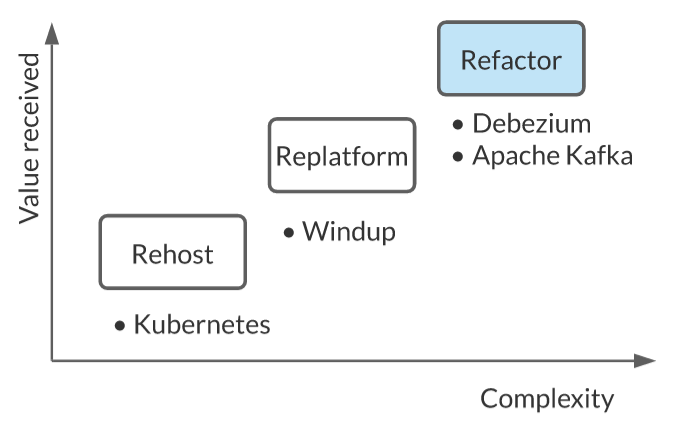
Application modernization patterns with Apache Kafka, Debezium, and Kubernetes

The very first question is where to start the migration. Here, we can use domain-driven design to help us identify aggregates and the bounded contexts where each represents a potential unit of decomposition and a potential boundary for microservices. Or, we can use the event storming technique created by Antonio Brandolini to gain a shared understanding of the domain model. Other important considerations here would be how these models interact with the database and what work is required for database decomposition. Once we have a list of these factors, the next step is to identify the relationships and dependencies between the bounded contexts to get an idea of the relative difficulty of the extraction. Armed with this information, we can proceed with the next question: Do we want to start with the service that has the least amount of dependencies, for an easy win, or should we start with the most difficult part of the system? A good compromise is to pick a service that is representative of many others and can help us build a good technology foundation. That foundation can then serve as a base for estimating and migrating other modules. 


Understanding AIOps – separating fact from fiction

AIOps is much more than another buzzword or a simple tool to correlate incidents. When implemented properly, AIOps can detect anomalies automatically and help remediate and prevent incidents before they impact end-users and customers. Once anomalies or incidents are detected, it takes a further step and provides structured analysis and detail on what these issues are and what the root cause is. This allows the IT team to understand the problem within minutes, and fix it faster, preserving user experience and avoiding disruptions to the business. This is observability in action. When working with telemetry data, AIOps can pick the right team to alert of issues it detects early, and provide actionable insights so that operations become more efficient and DevOps teams can focus on innovation, rather than spending non-productive time reactively troubleshooting problems. ... There is no real reason why a smaller teams could not use AIOps to differentiate their business and correct operational issues and also decrease human burden. In fact for small teams, AIOps can help to quickly discover issues and decrease pressure on already busy teams who need to eliminate toil to focus on value creation.


Data Scientists Will be Extinct in 10 Years

Data scientists will be extinct in 10 years (give or take), or at least the role title will be. Going forward, the skill set collectively known as data science will be borne by a new generation of data savvy business specialists and subject matter experts who are able to imbue analysis with their deep domain knowledge, irrespective of whether they can code or not. Their titles will reflect their expertise rather than the means by which they demonstrate it, be it compliance specialists, product managers or investment analysts. We don’t need to look back far to find historic precedents. During the advent of the spreadsheet, data entry specialists were highly coveted, but nowadays, as Cole Nussbaumer Knaflic (the author of “Storytelling With Data”) aptly observes, proficiency with Microsoft Office suite is a bare minimum. Before that, the ability to touch type with a typewriter was considered a specialist skill, however with the accessibility of personal computing it has also become assumed. Lastly, for those considering a career in data science or commencing their studies, it may serve you well to constantly refer back to the Venn diagram that you will undoubtedly come across.


Cisco bolts together enterprise and industrial edge with new routers

As organizations accelerate digitization, they need a way to simplify management and security across the network and edge devices. "With our new routing portfolio, customers can have a united architecture across their diverse edge use cases from HQ to remote edges. The same rich functionality and robust security models across your entire business – from campuses and branch offices to substations, remote operating locations, fleets, on-the-go connected assets," wrote Butaney. "Now utilities can securely connect their edge to reduce outages, integrate renewables, and improve grid resiliency. Transportation systems providers can optimize routes for first responders and share real-time location and safety information with travelers. Whatever your business, you can connect all your networks with one common architecture and holistic enterprise-wide security approach," Butaney stated. The modular routers, including the Catalyst IR8100, IR8100 Heavy Duty Series and IR8300 Rugged Series Router, can be customized, and all can have storage or CPUs upgraded in the field.


Quick and Seamless Release Management for Java projects with JReleaser

The original mission of JReleaser is to streamline the release and publishing process of Java binaries in such a way that these binaries may be consumed by platform-specific package managers, that is, provide a ZIP, TAR, or JAR file. JReleaser will figure out the rest, letting you publish binaries to Homebrew, Scoop, Snapcraft, Chocolatey, and more. In other words, JReleaser shortens the distance between your binaries and your consumers by meeting them where they prefer to manage their packages and binaries. Early in JReleaser’s design, it became apparent that splitting the work into several steps that could be invoked, individually or as one single unit, would be a better approach than what GoReleaser offers today. This design choice allows developers to micromanage every step as needed to hook-in JReleaser at a specific point of their release process without having to rewrite everything. For example, you can fire up JReleaser and have it create a Git release (GitHub, GitLab, or Gitea) along with an automatically formatted changelog, or you can tell JReleaser to append assets to an existing Git release that was created by other means, or perhaps you’re only interested in packaging and publishing a package to Homebrew regardless of how the Git release was created.


Quote for the day:

"Whenever you see a successful business, someone once made a courageous decision." -- Peter F. Drucker

Daily Tech Digest - June 14, 2021

How and Why Enterprises Must Tackle Ethical AI

Explainability can also help humans who must work with algorithmic findings that don't seem to make sense at first glance. For instance, Cloudera Fast Forward Labs has a prototype available that predicts churn for telecom providers looking to predict which customers are at risk to drop the service. The machine learning model found that one of the most important factors in whether someone would leave is whether they have a high degree of complaints about the service. But it's not the complainers who are at risk of leaving. Actually, the opposite is true. The complainers are the ones who are planning to stay for one reason or another, so they have a higher stake in the quality of the service being good. That's why they complain. They care about the service improving. The ones without the high stake just leave if when they are dissatisfied. That's important to know if you are a service representative who is empowered to offer incentives to customers at risk for churn. Creating explainability is among several important steps enterprises must embed in their artificial intelligence operations in order to make responsible, ethical AI a part of doing business. A key to making it work is to ensure that these steps are part of the overall AI process.


The Engineer’s Guide to Writing Meaningful Code Comments

In most cases, you aren’t the only person working on the same project or codebase. That means that other people get to read your code and have to understand it. That’s also true for the code comments you leave behind. Developers often write ‘quick and dirty’ comments without much context, leaving other developers clueless about what you’re trying to say. It’s a bad practice that creates only more confusion than clarifies things. So, yes - you should be bothered with writing meaningful code comments to help other developers. A code comment that describes the function, the reasoning behind the function, and its input and output will speed up the learning process of other developers. Especially for junior developers, this information comes in handy when learning the code. On the other hand, code comments lead us to the discussion whether we should write them? There’s a significant group of developers that advocate against writing code comments. The reason being that code should be self-explanatory. If another developer can’t understand the purpose of your code by looking at it, it’s bad code. 


Why quantum computers are a risk to your business today, and what you can do about it

We can’t be sure which quantum-safe algorithms NIST will standardise and because these algorithms are still relatively new, you may not want to completely do away with today’s standards. After all, quantum computers are still too primitive to break current encryption standards, so using today’s methods is still an effective way to protect against current info security threats. Therefore, as we make the transition to quantum-safe security, it’s important to practice ‘crypto-agility’. Crypto-agility is the process of understanding what existing cryptographic measures can be migrated over to quantum-ready solutions. ... This crypto-agile approach will offer greater assurance against both traditional attacks and future threats. This is vital as many devices, systems and applications that rely on encryption for security are now looking to be deployed and are expected to have a lifespan of over 10 years – if these aren’t cryptographically agile enough to deal with a future quantum attack, organisations will leave themselves vulnerable in the future.


Inclusion Has to Be Continuous

A leader’s job is to create an environment where people can be challenged, and also show that they can be wrong. What my manager did afterwards on my first job was he went to his peers and to our whole team and said, "You know, you basically showed that I'm an idiot, I should have asked." He showed vulnerability; humans can make mistakes. By revealing this, he created safety. What I try to do now too, is now that I have the title and the authority, I really encourage my team to question me, because that's the only way a good idea becomes a great idea. I get them maybe too comfortable in challenging me. But that way I can create the safety we need. We need to have these open dialogues and conversations, showing that when someone asks a question, it's respected. It's not thought of as something “stupid”, it's about asking questions and showing immediate action to help. Literally, I had a new bathroom within a week; that demonstrated this was no longer lip service. It's about creating safety for people to speak up and take immediate action, whether you can or can't do it, giving them an immediate response to why. And then it becomes safe to ask for help. When leaders ask for help, it shows we all need help.


The Future of Work is in for a (Gigantic) Change

With the advancement of work-from-home culture and future migration to four weekdays and hybrid working models, there would also be a rethinking needed on the large corporate offices. On one hand, people do not want to be in a crowded office space and would prefer odd-even type models, on the other hand, it’s not as easy to set up work from the home office if you do not have additional bedrooms, dedicated space, childcare options, and a large home overall and not everyone has that. Also, there is a need for most companies where they encourage their own employees to interact more for enhanced output and peer learning and competition. This would bring open many corporate offices to be accessible as co-working spaces to everyone looking for innovation, learning, and collaboration. Highly likely that the co-working industry will be back with a big bang as they make possible the dream of office next door or walk to the office culture. In fact, co-working companies may be the new commercial real estate aggregators as there may be many new collaborations underway between corporate offices and co-working companies, to drive the abundantly existing commercial infrastructure into good use.


Fighting Half-Blind Against Ransomware Won't Work

To tackle the ransomware information-sharing gap, the cybersecurity industry should establish the RIRN, as called for in the Ransomware Task Force report. The RIRN would serve several functions, including the receipt and sharing of incident reports, directing organizations to incident response services, aggregating data, and sharing alerts about ongoing threats. The RIRN should develop standard reporting formats based on existing standards to make automated sharing possible, and it should adopt business processes that avoid double-counting data, protect privacy, and focus on the value proposition to participants. This network should include nonprofits, cybersecurity vendors, insurance providers, incident responders, and government agencies. A functioning RIRN would help close the information gap that inhibits our response to ransomware. We should build such a network based on the lessons learned from past information sharing initiatives, thereby avoiding the usual flaws that undermine such efforts. The cybersecurity industry shouldn't wait for the government to take the lead. We can create the network now and invite governments to join something that already exists.


IoT cloud services: How they stack up against DIY

Beyond their own services, the strategy adopted by the cloud vendors is to build a rich ecosystem of partnerships, marketplaces, development platforms, and APIs, so that they can offer as much flexibility and as many pathways as possible—as long as the data that requires higher-level processing eventually ends up in their cloud, says Dilip Sarangan, senior director of research at Frost & Sullivan. Neil Shah, vice-president at Counterpoint Research, says that the major cloud players are offering fully managed, end-to-end IoT deployments for “maximum value capture.” But they are also covering their bases by offering open interfaces and partnering with other players in response to enterprise concerns about vendor lock-in. This “have it your way” approach makes sense when you consider the vastly different types of IoT scenarios and the different types of data generated by connected cars, smart cities, smart homes, manufacturing, verticals like oil and gas or healthcare, video surveillance, etc. Dubrova adds that the one thing the cloud vendors lack is domain expertise in specific verticals. “Cloud vendor analytics toolsets tend to be very horizontal and limited—that is where partnerships are playing a key differentiation role.”


Cybersecurity Beyond The Enterprise: The Top Tips Everyone Should Know

With an increasingly remote workforce, many companies are allowing employees to use their personal phones or laptops for business purposes, and people are using their work devices for personal use, too. These practices became more common during the pandemic, and they open up the door for cybercriminals to steal both personal and corporate data at the same time. Keeping your devices separate is just good practice. That way, if one device gets infected, you have a backup and you haven’t jeopardized both your personal data and your company's security. It’s worth saying three times because the majority of people aren’t listening. Using strong passwords that are complex and unique to each account is the No. 1 way to prevent cyberattacks. A Google-Harris Poll found that 24% of Americans admit to using the word "password" or "123456" to secure their accounts. A whopping 66% say they reuse the same password across multiple accounts. It’s such a problem that Google announced recently that it will enable two-factor authentication by default, automatically pushing users to take extra security steps.


Global Trends That Will Affect Digital Lending And Payments In India

To the online transactions ecosystem, blockchain has been lauded as a technology that will revolutionise the space. Maximising efficiency with exceptional features that include transparency, traceability and enhanced accessibility. Blockchain will be able to provide a high level of security when it comes to the exchange of money and sensitive information, allowing users to draw off its transparency while lowering operational costs and creating an environment for safe real-time transfers. India is the biggest market for remittances, with over $62 Bn sent to India from abroad in 2016. Yet, according to Foreign Exchange Management Act of 1999 (FEMA) only an authorized person/entity under the legislation may deal in foreign exchange. However, with incorporation of blockchain and smart contracts the use case of international remittance for blockchain technology will prove to be a promising proposition for the Indian market. India is the biggest market for remittances, with over $62 Bn sent to India from abroad in 2016. .


Edge Computing in Plain English With Lori MacVittie

There's a lot of devices and sensors that are monitoring equipment. I don't know if you've ever been on the floor of a foundry of a manufacturing plant that makes, say, toilet paper, because there's a lot of that in my area. There are the machines that have taken over to actually do most of that work are incredible, right? They do almost everything, but they also need constant supervision. Who knew machines need supervision? There are sensors and monitors that are constantly gathering information, data about the temperature, about the operation, how much oil is in this one, does this need lubrication? How long has it been working? All that data has to go somewhere to basically to the edge. There's an application, that's gathering it all, analyzing it and sending out warnings or, "Hey, it's almost time for maintenance", right? Whatever. But it's also a point of alert. If something happens, it can also turn off a machine which, when you have people and machines mixed together, especially if you're cutting things like cardboard or paper, there's a potential for a real harm to be done. So, they have to be able to react and say, "Turn that off now. Stop that. Alert someone”. So, they need to be able to react very quickly. That is not something you want to have disassociated from the actual location.


Quote for the day:

"The problem with being a leader is that you're never sure if you're being followed or chased." -- Claire A. Murray

Daily Tech Digest - June 13, 2021

The race is on for quantum-safe cryptography

Existing encryption systems rely on specific mathematical equations that classical computers aren’t very good at solving — but quantum computers may breeze through them. As a security researcher, Chen is particularly interested in quantum computing’s ability to solve two types of math problems: factoring large numbers and solving discrete logarithms. Pretty much all internet security relies on this math to encrypt information or authenticate users in protocols such as Transport Layer Security. These math problems are simple to perform in one direction, but difficult in reverse, and thus ideal for a cryptographic scheme. “From a classical computer’s point of view, these are hard problems,” says Chen. “However, they are not too hard for quantum computers.” In 1994, the mathematician Peter Shor outlined in a paper how a future quantum computer could solve both the factoring and discrete logarithm problems, but engineers are still struggling to make quantum systems work in practice. While several companies like Google and IBM, along with startups such as IonQ and Xanadu, have built small prototypes, these devices cannot perform consistently, and they have not conclusively completed any useful task beyond what the best conventional computers can achieve.


Lightbend’s Akka Serverless PaaS to Manage Distributed State at Scale

Up to now, serverless technology has not been able to support stateful, high-performance, scalable applications that enterprises are building today, Murdoch said. Examples of such applications include consumer and industrial IoT, factory automation, modern e-commerce, real-time financial services, streaming media, internet-based gaming and SaaS applications. “Stateful approaches to serverless application design will be required to support a wide range of enterprise applications that can’t currently take advantage of it, such as e-commerce, workflows and anything requiring a human action,” said William Fellows, research director for cloud native at 451 Research. “Serverless functions are short-lived and lose any ‘state’ or context information when they execute.” Lightbend, with Akka Serverless, has addressed the challenge of managing distributed state at scale. “The most significant piece of feedback that we’ve been getting from the beta is that one of the key things that we had to do to build this platform was to find a way to be able to make the data be available in memory at runtime automatically, without the developer having to do anything,” Murdoch said


Can We Balance Accuracy and Fairness in Machine Learning?

While challenges like these often sound theoretical, they already affect and shape the work that machine learning engineers and researchers produce. Angela Shi looks at a practical application of this conundrum when she explains the visual representation of bias and variance in bulls-eye diagrams. Taking a few steps back, Federico Bianchi and Dirk Hovy’s article identifies the most pressing issues the authors and their colleagues face in the field of natural learning processing (NLP): “the speed with which models are published and then used in applications can exceed the discovery of their risks and limitations. And as their size grows, it becomes harder to reproduce these models to discover those aspects.” Federico and Dirk’s post stops short of offering concrete solutions—no single paper could—but it underscores the importance of learning, asking the right (and often most difficult) questions, and refusing to accept an untenable status quo. If what inspires you to take action is expanding your knowledge and growing your skill set, we have some great options for you to choose from this week, too.


The secret of making better decisions, faster

While agility might be critical for sporting success, that doesn't mean it's easily achieved. Filippi tells ZDNet he's spent many years building a strong team, with great heads of department who are empowered to make big calls. "Most of the time you trust them to get on with it," he says. "I'm more of an orchestrator – you cannot micromanage a race team because there's just too much going on. The pace and the volume of work being achieved every week is just mind-blowing." Hackland has similar experiences at Williams F1. Employees are empowered to take decisions and their confidence to make those calls in the factory or out on the track is a crucial component of success. "The engineer who's sitting on the pit wall doesn't have to ask the CIO if we should pit," he says. "The decisions that are made all through the organisation don't feed up to one single individual. Everyone is allowed to make decisions up or down the organisation." As well as being empowered to make big calls, Hackland says a no-blame culture is critical to establishing and supporting decentralised decision making in racing teams.


How to avoid the ethical pitfalls of artificial intelligence and machine learning

Disconnects also exist between key functional stakeholders required to make sound holistic judgements around ethics in AI and ML. “There is a gap between the bit that is the data analytics AI, and the bit that is the making of the decision by an organisation. You can have really good technology and AI generating really good outputs that are then used really badly by humans, and as a result, this leads to really poor outcomes,” says Prof. Leonard. “So, you have to look not only at what the technology in the AI is doing, but how that is integrated into the making of the decision by an organisation.” This problem exists in many fields. One field in which it is particularly prevalent is digital advertising. Chief marketing officers, for example, determine marketing strategies that are dependent upon the use of advertising technology – which are in turn managed by a technology team. Separate to this is data privacy which is managed by a different team, and Prof. Leonard says each of these teams don’t speak the same language as each other in order to arrive at a strategically cohesive decision. 


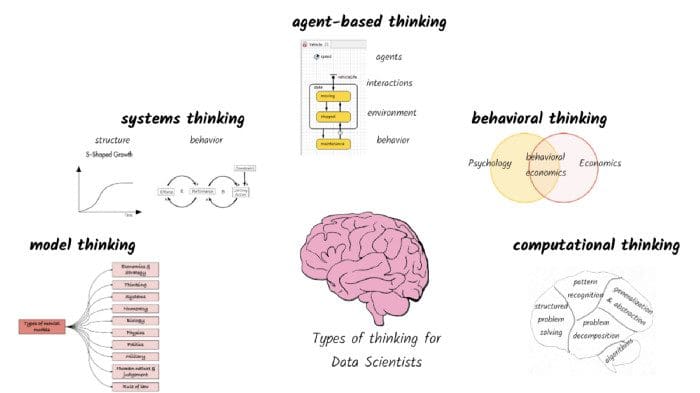
Five types of thinking for a high performing data scientist

As data scientists, the first and foremost skill we need is to think in terms of models. In its most abstract form, a model is any physical, mathematical, or logical representation of an object, property, or process. Let’s say we want to build an aircraft engine that will lift heavy loads. Before we build the complete aircraft engine, we might build a miniature model to test the engine for a variety of properties (e.g., fuel consumption, power) under different conditions (e.g., headwind, impact with objects). Even before we build a miniature model, we might build a 3-D digital model that can predict what will happen to the miniature model built out of different materials. ... Data scientists often approach problems with cross-sectional data at a point in time to make predictions or inferences. Unfortunately, given the constantly changing context around most problems, very few things can be analyzed statically. Static thinking reinforces the ‘one-and-done’ approach to model building that is misleading at best and disastrous at its worst. Even simple recommendation engines and chatbots trained on historical data need to be updated on a regular basis. 


Double Trouble – the Threat of Double Extortion Ransomware

Over the past 12 months, double extortion attacks have become increasingly common as its ‘business model’ has proven effective. The data center giant Equinix was hit by the Netwalker ransomware. The threat actor behind that attack was also responsible for the attack against K-Electric, the largest power supplier in Pakistan, demanding $4.5 million in Bitcoin for decryption keys and to stop the release of stolen data. Other companies known to have suffered such attacks include the French system and software consultancy Sopra Steria; the Japanese game developer Capcom; the Italian liquor company Campari Group; the US military missile contractor Westech; the global aerospace and electronics engineering group ST Engineering; travel management giant CWT, who paid $4.5M in Bitcoin to the Ragnar Locker ransomware operators; business services giant Conduent; even soccer club Manchester United. Research shows that in Q3 2020, nearly half of all ransomware cases included the threat of releasing stolen data, and the average ransom payment was $233,817 – up 30% compared to Q2 2020. And that’s just the average ransom paid.


Evolution of code deployment tools at Mixpanel

Manual deploys worked surprisingly well while we were getting our services up and running. More and more features were added to mix to interact not just with k8s but also other GCP services. To avoid dealing with raw YAML files directly, we moved our k8s configuration management to Jsonnet. Jsonnet allowed us to add templates for commonly used paradigms and reuse them in different deployments. At the same time, we kept adding more k8s clusters. We added more geographically distributed clusters to run the servers handling incoming data to decrease latency perceived by our ingestion API clients. Around the end of 2018, we started evaluating a European Data Residency product. That required us to deploy another full copy of all our services in two zones in the European Union. We were now up to 12 separate clusters, and many of them ran the same code and had similar configurations. While manual deploys worked fine when we ran code in just two zones, it quickly became infeasible to keep 12 separate clusters in sync manually. Across all our teams, we run more than 100 separate services and deployments. 


When physics meets financial networks

Generally, physics and financial systems are not easily associated in people's minds. Yet, principles and techniques originating from physics can be very effective in describing the processes taking place on financial markets. Modeling financial systems as networks can greatly enhance our understanding of phenomena that are relevant not only to researchers in economics and other disciplines, but also to ordinary citizens, public agencies and governments. The theory of Complex Networks represents a powerful framework for studying how shocks propagate in financial systems, identifying early-warning signals of forthcoming crises, and reconstructing hidden linkages in interbank systems. ... Here is where network theory comes into play, by clarifying the interplay between the structure of the network, the heterogeneity of the individual characteristics of financial actors and the dynamics of risk propagation, in particular contagion, i.e. the domino effect by which the instability of some financial institutions can reverberate to other institutions to which they are connected. The associated risk is indeed "systemic", i.e. both produced and faced by the system as a whole, as in collective phenomena studied in physics.


What’s Driving the Surge in Ransomware Attacks?

The trend involves a complex blend of geopolitical and cybersecurity factors, but the underlying reasons for its recent explosion are simple. Ransomware attacks have gotten incredibly easy to execute, and payment methods are now much more friendly to criminals. Meanwhile, businesses are growing increasingly reliant on digital infrastructure and more willing to pay ransoms, thereby increasing the incentive to break in. As the New York Times notes, for years “criminals had to play psychological games to trick people into handing over bank passwords and have the technical know-how to siphon money out of secure personal accounts.” Now, young Russians with a criminal streak and a cash imbalance can simply buy the software and learn the basics on YouTube tutorials, or by getting help from syndicates like DarkSide — who even charge clients a fee to set them up to hack into businesses in exchange for a portion of the proceeds. The breach of the education publisher involving the false pedophile threat was a successful example of such a criminal exchange. Meanwhile, Bitcoin has made it much easier for cybercriminals to collect on their schemes.


Quote for the day:

"To make a decision, all you need is authority. To make a good decision, you also need knowledge, experience, and insight." -- Denise Moreland

Daily Tech Digest - June 12, 2021

Data Architecture: One Size Does Not Fit All

“There’s no one right way,” said George Yuhasz, VP and Head of Enterprise Data at NewRez, because the demands and the value that Data Architecture practices bring to an organization are as varied as the number of firms trying to get value from data. Yuhasz was speaking at DATAVERSITY® Data Architecture Online Conference. The very definition of Data Architecture varies as well, he says, so get clarity among stakeholders to understand the constraints and barriers in which Data Architecture needs to fit. Will the organization prioritize process alone? Or process, platforms, and infrastructure? Or will it be folded into a larger enterprise architecture? Without a clear definition, it’s impossible to determine key success criteria, or to know what success is, both in the short term and long term. The definition should be simple enough to be understood by a diverse group of stakeholders, and elegant enough to handle sophistication and nuance. Without it, he said, the tendency will be to “drop everything that even relates to the term ‘data’ onto your plate.”


Chrome zero-day, hot on the heels of Microsoft’s IE zero-day. Patch now!

This bug is listed as a “type confusion in V8“, where V8 is the part of Chrome that runs JavaScript code, and type confusion means that you can feed V8 one sort of data item but trick JavaScript into handling it as if it were something else, possibly bypassing security checks or running unauthorised code as a result. For example, if your code is doing JavaScript calculations on a data object that has a memory block of 16 bytes allocated to it, but you can trick the JavaScript interpreter into thinking that you are working on an object that uses 1024 bytes of memory, you can probably end up sneakily writing data outside the official 16-byte allocation, thus pulling off a buffer overflow attack. And, as you probably know, JavaScript security holes that can be triggered by JavaScript code embedded in a web page often result in RCE exploits, or remote code execution. That’s because you’re relying on your browser’s JavaScript engine to keep control over what is essentially unknown and untrusted programming downloaded and executed automatically from an external source. 


New quantum repeaters could enable a scalable quantum internet

If it can be built, a quantum internet would allow calculations to be distributed between multiple quantum computers – allowing larger and more complex problems to be solved. A quantum internet would also provide secure communications because eavesdropping on the exchange of quantum information can be easily identified. The backbone of such a quantum network would be quantum-mechanically entangled links between different network points, called nodes. However, creating entangled links over long distances at high data rates remains a challenge. A big problem is that quantum information becomes degraded as it is transmitted, and the rules of quantum mechanics do not allow signals to be amplified by conventional repeater nodes. The solution could be quantum repeaters, which can amplify quantum signals while still obeying quantum physics. Now, two independent research groups — one at the Institute of Photonic Sciences (ICFO) in Spain and the other at the University of Science and Technology of China (USTC) – have shown how quantum memories (QM) offer a path towards practical quantum repeaters.


3 Mindsets High-Performing Business Leaders Use to Create Growth

Success in life comes from understanding that a lot will happen to you outside of your control. As humans, we have emotions and feelings — they tend to take over when something happens to us that's outside of our control. When you focus on the things you can't control, you put yourself in a dark place that threatens to spiral your mind. High-performing entrepreneurs don't invest time, energy and emotion into situations that are outside of their control. Growth-focused business leaders make a deliberate effort to optimize their mind, body and spirit. They do the work to operate in a peak state and learn the techniques to get back into a peak state when they feel themselves slipping. ... Authentic business leadership means you create wealth through purposeful work and the desire to build a legacy. You need a vision for where you're going if you plan to get there and experience the benefits of entrepreneurship. Whether it's setting up a vision board or having your goals displayed on your phone's screensaver, you grow when you have a vision and implement growth strategies consistently. 


Has Serverless Jumped the Shark?

Today’s hyped technologies — such as functions-as-a-service offerings like Amazon Lambda, serverless frameworks for Kubernetes like Knative and other non-FaaS serverless solutions like database-as-a-service (DBaaS) — are the underpinnings of more advanced delivery systems for digital business. New methods of infrastructure delivery and consumption, such as cloud computing, are as much a cultural innovation as a technological one, most obviously in DevOps. Even with these technological innovations, companies will still consume a combination of legacy application data, modern cloud services and other serverless architectures to accomplish their digital transformation. The lynchpin isn’t a wholesale move to new technologies, but rather the ability to integrate these technologies in a way that eases the delivery of digital experiences and is invisible to the end-user. Serverless hasn’t jumped the shark. Rather, it is maturing. The Gartner Hype Cycle, a graphic representation of the maturity and adoption of technologies and applications, forecast in 2017 that it would take two to five years for serverless to move from a point of inflated expectations to a plateau of productivity.


Opinion: Andreessen Horowitz is dead wrong about cloud

In The Cost of Cloud, a Trillion-Dollar Paradox, Andreessen Horowitz Capital Management’s Sarah Wang and Martin Casado highlighted the case of Dropbox closing down its public cloud deployments and returning to the datacenter. Wang and Casado extrapolated the fact that Dropbox and other enterprises realized savings of 50% or more by bailing on some or all of their cloud deployments in the wider cloud-consuming ecosphere. Wang and Casado’s conclusion? Public cloud is more than doubling infrastructure costs for most enterprises relative to legacy data center environments. ... Well-architected and well-operated cloud deployments will be highly successful compared to datacenter deployments in most cases. However, “highly successful” may or may not mean less expensive. A singular comparison between the cost of cloud versus the cost of a datacenter shouldn’t be made as an isolated analysis. Instead, it’s important to analyze the differential ROI of one set of costs versus the alternative. While this is true for any expenditure, it’s doubly true for public cloud, since migration can have profound impacts on revenue. Indeed, the major benefits of the cloud are often related to revenue, not cost.


What Is Penetration Testing -Strategic Approaches & Its Types?

Social engineering acts as a crucial play in penetration testing. It is such a test that proves the Human Network of an organization. This test helps secure an attempt of a potential attack from within the organization by an employee looking to start a breach or an employee being cheated in sharing data. This kind of test has both remote penetration test and physical penetration test, which aims at most common social engineering tactics used by ethical hackers like phishing attacks, imposters, tailgating, pre-texting, gifts, dumpster diving, eavesdropping, to name a few. Mainly organizations need penetration testing professionals and need minimum knowledge about it to secure the organization from cyberattacks. They use different approaches to find the attacks and defend them. And they are five types of penetration testing: network, web application, client-side, wireless network, and social engineering penetration tests. One of the best ways to learn penetration testing certifications is EC-Council Certified Penetration Testing Professional or CPENT is one of the best courses to learn penetration testing. In working in flat networks, this course boosts your understanding by teaching how to pen test OT and IoT systems ...


Global chip shortage: How manufacturers can cope over the long term

Although it is very important to shift more production to the U.S., there are challenges in doing so, Asaduzzaman said. "Currently the number of semiconductor fabrication foundries in the U.S. is not adequate. If we help overseas-based companies to build factories here, that will be good. But we definitely don't want to send all our technology production overseas and then have no control. That will be a big mistake." However, one ray of hope is that policy provisions may encourage domestic production of semiconductors, Asaduzzaman said. "For instance, regulations could require U.S. companies that buy semiconductors to purchase a certain percentage from domestic producers. Industries have to use locally produced chips to make sure that local chip industries can sustain." Asaduzzaman called it "insulting and incorrect" that some overseas chip manufacturers believe the U.S. doesn't have the skills and cannot keep the cost low to compete with others in the industry. "We are the ones who invented the chip technology; now we are depending on overseas companies for chips," he said.


Complexity is the biggest threat to cloud success and security

Enterprises hit the “complexity wall” soon after deployment when they realize the cost and complexity of operating a complicated and widely distributed cloud solution outpaces its benefits. The number of moving parts quickly becomes too heterogeneous and thus too convoluted. It becomes obvious that organizations can’t keep the skills around to operate and maintain these platforms. Welcome to cloud complexity. Many in IT blame complexity on the new array of choices developers have when they build systems within multicloud deployments. However, enterprises need to empower innovative people to build better systems in order to build a better business. Innovation is just too compelling of an opportunity to give up. If you place limits on what technologies can be employed just to avoid operational complexity, odds are you’re not the best business you can be. Security becomes an issue as well. Security experts have long known that more vulnerabilities exist within a more complex technology solution (the more physically and logically distributed and heterogeneous). 


Limits to Blockchain Scalability vs. Holochain

It is worth noting that it would probably take years to get all of Twitter’s users to migrate over to Holochain to host themselves, even if Twitter switched their infrastructure to this kind of decentralized architecture. This is where the Holo hosting framework comes in. Holo enables Holochain apps, that would normally be self-hosted, to be served to a web user from a peer hosting network. In other words, if your users just expect to open their browser, type in a web address, and have access to your app, you may need to provide them with a hosted version. Holo has a currency which pays hosts for the hosting power they provide for Holochain apps that still need to serve mainstream web users. So instead of paying Amazon or Google to host your app, you pay a network of peer hosting providers in the HoloFuel cryptocurrency. Instead of gas fees costing over 1 billion times what it would cost to host on Amazon (as it does on Ethereum), we expect Holo hosting to have more competitive pricing to current cloud providers because of the low demand on system resources as outlined above.


Quote for the day:

“Doing the best at this moment puts you in the best place for the next moment” -- Oprah Winfrey

Daily Tech Digest - June 11, 2021

Why API Quality Is Top Priority for Developers

Processes such as chaos engineering, load testing and manual quality assurance can uncover situations where an API is failing to handle unexpected situations. Deploying your API to a cloud provider with a compelling SLA instead of your own hardware and network shifts the burden of infrastructure resiliency to a service, freeing your time to build features for your customers. A comprehensive suite of automated tests isn’t always sufficient to provide a robust API. Edge cases, unexpected code branches and other unplanned behavior may be triggered by requests that were not considered when writing the test suite. Traditional automated tests should be complimented by fuzz testing to help uncover hidden execution paths. ... It is expected that most APIs are built on layers of open source libraries and frameworks. Software composition analysis is a necessity to stay on top of zero-day vulnerabilities by identifying vulnerable dependencies as soon as they are discovered. OWASP guidance is a must-have—directing API developers to implement attack mitigation strategies such as CORS and CSRF protection. Application logic must be well tested for authorization and authentication.


New Ransomware Group Claiming Connection to REvil Gang Surfaces

Like many established ransomware operators, the gang behind Prometheus has adopted a very professional approach to dealing with its victims — including referring to them as "customers," PAN said. Members of the group communicate with victims via a customer service ticketing system that includes warnings on approaching payment deadlines and notifications of plans to sell stolen data via auction if the deadline is not met. "New ransomware gangs like Prometheus follow the same TTPs as big players [such as] Maze, Ryuk, and NetWalker because it is usually effective when applied the right way with the right victim," Santos says. "However, we do find it interesting that this group sells the data if no ransom is paid and are very vocal about it." From samples provided by the Prometheus ransomware gang on their leak site, the group appears to be selling stolen databases, emails, invoices, and documents that include personally identifiable information. "There are marketplaces where threat actors can sell leaked data for a profit, but we currently don't have any insight on how much this information could be sold in a marketplace," Santos says


Google is using AI to design its next generation of AI chips more quickly than humans can

Google’s engineers trained a reinforcement learning algorithm on a dataset of 10,000 chip floor plans of varying quality, some of which had been randomly generated. Each design was tagged with a specific “reward” function based on its success across different metrics like the length of wire required and power usage. The algorithm then used this data to distinguish between good and bad floor plans and generate its own designs in turn. As we’ve seen when AI systems take on humans at board games, machines don’t necessarily think like humans and often arrive at unexpected solutions to familiar problems. When DeepMind’s AlphaGo played human champion Lee Sedol at Go, this dynamic led to the infamous “move 37” — a seemingly illogical piece placement by the AI that nevertheless led to victory. Nothing quite so dramatic happened with Google’s chip-designing algorithm, but its floor plans nevertheless look quite different to those created by a human. Instead of neat rows of components laid out on the die, sub-systems look like they’ve almost been scattered across the silicon at random.


More and More Professionals Are Using Their Career Expertise to Launch Entrepreneurial Ventures

The first step is to immerse yourself within your training and specialty and have the confidence to be a key thought leader in the space. Do the extra research, spend the time to learn all of the new information and data in your field to truly understand the opportunity within. "I have been fortunate to be involved with several top academic institutions during my training. While the training was fantastic, there were areas that I felt could be improved for the ultimate outcome of increased access to high-quality healthcare," says Dr. Bajaj. "Thankfully, this vision has resulted in great outcomes and happy patients." ... "Ready. Fire. Aim!" as Dr. Bajaj puts it, "Time was not waiting for me to be fully prepared. Sometimes you have to take the leap." In entrepreneurship, there are no guarantees, which is quite different from some of the career paths that we have trained for our entire academic life. Guaranteed salary, retirement plans, and annual bonuses are far from promised in your own business, and it is important to adapt accordingly. Everything will not go according to plan, and it is important to find comfort with that. As long the launchpad for growth has been established - patience is the biggest challenge, not security.


CISOs: It's time to get back to security basics

The goal of cybersecurity used to be protecting data and people's privacy, Summit said. There has been a major shift in that thinking. "It's one thing to lose a patient's data, which is extremely important to protect, but when you start interrupting" people's ability to travel or the food supply chain, "you have a whole different level of problems … It's not just about protecting data but your operations. That's where major changes are starting to occur." Summit added that he has long said if companies were making cybersecurity a high priority long before now, "we wouldn't be in this position" and facing government scrutiny. The cybersecurity field is "incredibly dynamic," Hatter said, and CISOs don't have the luxury of planning out three to five years. "We want to create and deploy a strategy that's sound and solid. But market forces demand; we recalibrate what we do and COVID-19 was a great example of that." CISOs now have to have as resilient a strategy as possible but be prepared to make changes. Managed security service providers can help, Summit said, but CISOs are still feeling overwhelmed.


New quantum entanglement verification method cuts through the noise

Virtually any interaction with their environment can cause them to collapse like a house of cards and lose their quantum correlations – a process called decoherence. If this happens before an algorithm finishes running, the result is a mess, not an answer. (You would not get much work done on a laptop that had to restart every second.) In general, the more qubits a quantum computer has, the harder they are to keep quantum; even today’s most advanced quantum processors still have fewer than 100 physical qubits. The solution to imperfect physical qubits is quantum error correction (QEC). By entangling many qubits together in a so-called “genuine multipartite entangled” (GME) state, where every qubit is entangled with every other qubit in that bunch, it is possible to create a composite “logical” qubit. This logical qubit acts as an ideal qubit: the redundancy of the shared information means if one of the physical qubits decoheres, the information can be recovered from the rest of the logical qubit. Developing quantum error-correcting systems requires verifying that the GME states used in logical qubits are present and working as intended, ideally as quickly and efficiently as possible.


DeepMind says reinforcement learning is ‘enough’ to reach general AI

Some scientists believe that assembling multiple narrow AI modules will produce higher intelligent systems. For example, you can have a software system that coordinates between separate computer vision, voice processing, NLP, and motor control modules to solve complicated problems that require a multitude of skills. A different approach to creating AI, proposed by the DeepMind researchers, is to recreate the simple yet effective rule that has given rise to natural intelligence. “[We] consider an alternative hypothesis: that the generic objective of maximising reward is enough to drive behaviour that exhibits most if not all abilities that are studied in natural and artificial intelligence,” the researchers write. This is basically how nature works. As far as science is concerned, there has been no top-down intelligent design in the complex organisms that we see around us. Billions of years of natural selection and random variation have filtered lifeforms for their fitness to survive and reproduce. Living beings that were better equipped to handle the challenges and situations in their environments managed to survive and reproduce. The rest were eliminated.


Evaluation of Cloud Native Message Queues

The significant rise in internet-connected devices will consequently have a substantial influence on systems’ network traffic, and current point-to-point technologies using synchronous communication between end-points in IoT-systems are not any longer a sustainable solution. Message queue architectures using the publish-subscribe paradigm are widely implemented in event-based systems. This paradigm uses asynchronous communication between entities and conforms to scalable, high throughput, and low latency systems that are well adapted within the IoT-domain. This thesis evaluates the adaptability of three popular message queue systems in Kubernetes. The systems are designed differently, where e.g. the Kafka system is using a peer-to-peer architecture while STAN and RabbitMQ use a master-slave architecture by applying the Raft consensus algorithm. A thorough analysis of the systems’ capabilities in terms of scalability, performance, and overhead are presented. The conducted tests give further knowledge on how the performance of the Kafka system is affected in multi-broker clusters using multiple number of partitions, enabling higher levels of parallelism for the system. 


Mysterious Custom Malware Collects Billions of Stolen Data Points

Researchers have uncovered a 1.2-terabyte database of stolen data, lifted from 3.2 million Windows-based computers over the course of two years by an unknown, custom malware. The heisted info includes 6.6 million files and 26 million credentials, and 2 billion web login cookies – with 400 million of the latter still valid at the time of the database’s discovery. According to researchers at NordLocker, the culprit is a stealthy, unnamed malware that spread via trojanized Adobe Photoshop versions, pirated games and Windows cracking tools, between 2018 and 2020. It’s unlikely that the operators had any depth of skill to pull off their data-harvesting campaign, they added. “The truth is, anyone can get their hands on custom malware. It’s cheap, customizable, and can be found all over the web,” the firm said in a Wednesday posting. “Dark Web ads for these viruses uncover even more truth about this market. For instance, anyone can get their own custom malware and even lessons on how to use the stolen data for as little as $100. And custom does mean custom – advertisers promise that they can build a virus to attack virtually any app the buyer needs.”


Get your technology infrastructure ready for the Age of Uncertainty

As I say, it’s by no means clear what happens next and how ingrained changes will be. It’s plausible, of course, that we largely go back to old habits although that seems unlikely with a groundswell of employees having become accustomed to a different way of life and a different way of working. And it’s worth noting that even evidence of a return to ancient ways of living in the form of crafts, baking and so on are now very much digitally imbued activities. We download apps, consult websites and share ideas on forums when we try out a new recipe, and this sort of binary activity is part of the fabric of life because it is faster, more convenient and more scalable than the older alternatives. But what we need to do is strike the perfect balance between technology-enabled agility and what we want to do with our time. What we will need to manage through change is clear though. Adaptivity, enabled by robust, data-centric digital business designs, will become the watchword of operations. In other words, companies will need to be able to move fast, whatever happens, changing operating models, moving into adjacent markets and generally taking nothing for granted. In the new Age of Uncertainty, legacy systems have to be reassessed in the context of how best to build for agility.


Quote for the day:

"To have long term success as a coach or in any position of leadership, you have to be obsessed in some way." -- Pat Riley