Daily Tech Digest - April 12, 2018

The Role Of Big Data And Mobile Apps In Healthcare


The use of sensors to monitor everything – from whether a patient took the right dose of medication at the right time, to whether their insulin levels are in check – is one of the big growth areas in the Internet of Things (IoT). Combining this with the global adoption of mobile devices, especially smartphones and wearables, means our health can be monitored on a continuous and proactive basis by AI. If a problem is detected, a healthcare professional can be alerted to take appropriate action. While the benefits of such constant surveillance of one’s health, especially in cases of patients with chronic or life-threatening illnesses, are obvious, they also bring added risk. Where there is a sensor, there is vulnerability and the risk of cyberattacks. Recently, Johnson and Johnson warned diabetes patients of the possibility of hackers affecting their insulin dosages. Although the probability is low (and possibly would have been lower without the publicity), this does raise fears of attacks on prominent people who need to manage their insulin.


Digital Is About Speed — But It Takes a Long Time

Digital Transformation Speed Long Term
The ability of digital technologies to accelerate business is giving rise to new value propositions — value propositions that use information to eliminate hassles, enhance awareness, and create solutions. Companies succeed in the digital economy by converting meaningful digital value propositions into revenue-generating digital offerings. We define digital offerings as information-enriched customer solutions wrapped in engaging customer experiences. The great irony is that, while new digital offerings are accelerating the pace of business, they only gradually come to fruition. That is because established companies are usually designed for efficient delivery of their existing products. They are not designed as software companies that rapidly build — and just as rapidly change — their customer offerings. Digital demands entirely new approaches to imagining, designing, delivering, and servicing those value propositions. Consequently, organizational transformation cannot be speedy. ... it takes time — and longer than you might think — to identify and then deliver a new digitally inspired value proposition. The experiences of Royal Philips highlight why.


Global Digital Operations 2018 Survey

Distinct from Industry 3.0, which involved the automation of single machines and processes, Industry 4.0 encompasses end-to-end digitization and data integration of the value chain: offering digital products and services, operating connected physical and virtual assets, transforming and integrating all operations and internal activities, building partnerships, and optimizing customer-facing activities. PwC’s Strategy& interviewed 1,155 manufacturing executives in 26 countries to develop an index that ranks companies by digital operations maturity, from Digital Novices, Digital Followers, Digital Innovators to Digital Champions. Based on the study data, we were able to create a sweeping portrait of Digital Champions — companies that have taken digitization to the highest degree — and assess what it takes to be a Digital Champion through the lens of the four essential ecosystems they must master and orchestrate.


Private by design: Why Apple’s iOS meets the needs of healthcare IT

Apple, iOS, health, mhealth, iPad, iPhone
Apple already has industry-leading security and privacy built in, and a proven commitment to software patches means c.80 percent of all actively used Apple devices are running the most recent version of the OS. Apple’s recently introduced Health Records app for iPhone is clear evidence of Apple’s advantage. It makes patient data portable in such a way as to put the patient in complete control of that data. “I think the good thing about the Apple solution is that the data only resides on the end-user’s device,” Mike Restuccia, CIO at Penn Medicine told Computerworld. “So, we don’t have access to that. Apple doesn’t have access to the data. The beauty of the solution is it is patient managed, patient controlled and patient centered.” That’s fine, but with cloud-based data analytics expected to become a big driver for future mobile healthcare innovation, the need for privacy will become even harder to meet. Such solutions will require data leave the device in such a way as to provide sufficient information for real-time insights and positive health interventions, while at the same time retaining total patient privacy.


Change is Good When It’s Free, Easy, and Has a Happy Endpoint

When a company announces a new version of something I rely upon in my personal life, like Apple announcing a new iPhone, I cringe. Of course, the thought of the latest and best is exciting, but the thought of upgrading – the cost, the hassle – usually makes me wait (longer than my teenage son would like). The same can be said for our customers who are happy using McAfee virus protection to secure their environment. As a McAfee senior product marketing manager focused on endpoint security and endpoint detection and response solutions for enterprises, I can tell you that today that’s not enough. Cyberthreats continue to evolve, no matter how much we resist change. We must move to a modern endpoint defense solution that can detect zero-day threats, and stop them in their tracks. Now, wait a minute before you go running for aspirin because you are thinking, “This is going to cost a lot of money! This is going to be complex and hard to manage!” We thought about that. Upgrading may be easier than you think.


Using data to cross the finish line

tying sports shoe 118291894
Two such areas are geospatial and translytical – both emerging disciplines that hold large amounts of data that were previously untapped. Geospatial data analysis brings together GIS, the system of record for maps, and ERP tools to overlay data onto maps for increased visibility and insights on a geographic basis – a particularly useful tool for applications like smart cities looking to improve traffic patterns, public transportation routes, energy grids and emergency response. Translytical data is another emerging data source that has seen tremendous growth of late, though industry leaders are still defining the term. Gartner defines translytical database architectures as hybrid transactional/analytical processing (HTAP), meaning they work to make operational data more analytical. According to a recent Forrester report, the growth of translytical is due to the fact that “more enterprise architecture pros see translytical as critical for their enterprise strategy.”


Examine CORD architecture's benefits and challenges


CORD offers a new business model to achieve the benefits of NFV. It provides an architecture for open hardware and open software that will reduce overall equipment costs, thus lowering Capex. Networking operators can upgrade their network technology without hardware dependency. A vibrant ecosystem of open source software will accelerate innovation and potentially allow service providers to deliver new services to customers more rapidly. A number of suppliers offer CORD-specific products and development efforts, including Radisys, Calix and Adtran. CORD is early in its adoption cycle, with limited production deployment at this time. CORD architecture has a number of variants -- e.g., R-CORD and M-CORD -- and may not coalesce into a standard with enough critical mass to affect the market. Like NFV, CORD needs to attract a broader ecosystem in terms of NFV hardware, software and services suppliers.


How mobile devices in the travel industry can improve customer service with AR

Mobile devices in the travel industry along with other items travelers use
With competition increasing from Airbnb and other vacation rentals, hotels have been focused on winning over customers by creating immersive, exciting experiences. In that way, augmented reality could be a revolutionary technology. Developers have already identified multiple use cases for AR in hotels. Individual rooms can be outfitted with virtual markers that pull up information about housekeeping, room service and other hotel amenities. Lobbies can overlay maps and directions to navigate the hotel and find luggage checks, pools and other attractions. Hotels can also use AR as a supplement to concierge services, such as providing virtual directions for taking public transportation across the city or finding interesting attractions nearby. Because hotels offer a physical space that travelers spend so much time in, each property represents a gold mine of AR markers that can increase engagement and customer satisfaction. Most travelers know what it’s like to look at a historic building and not entirely know what they’re looking at or why it’s important.


Agile Development & Remote Teams - 6 Powerful Productivity Hacks You Should Know


Agile environment is backed by the idea to make clustered or in-house teams more productive. AGILE CULTURE RUNS ON THE PRINCIPLE OF TEAM COLLABORATION, CONTINUOUS LEARNING & PLANNING, AND SEAMLESS INTERACTION. As businesses go global, expand to different geographies, teams become more scattered with talent from less competitive markets working on projects around the clock. Effective collaboration between remote teams using Agile, as one of the new-age development models, has proven to be very effective. However, Agile development and remote teams sometimes have friction and fall into different sorts of challenges such as: Building rapport with team members; Coordinating across time zones; Scheduling meetings when both teams are online together only for a short duration; and Collaboration among different development cultures. To ease this conflicting situation, organizations require a hybrid Agile development approach specifically targeted towards streamlining and powering up remote software development.


11 signs you’re writing great code

11 signs you’re writing great code
Even if you have a modern debugger that you can attach to your runtime and step through your code, the world just does not work that way. Meaning, you code may run somewhere else, it may be serverless, it may be multithreaded or distributed, or it may run on a cloud somewhere. In those environments, it may not behave the same as on your computer. So, you’re going to need a log. And that means you need a logging framework. You need to write the code and set up the logging in a way that makes the log readable or at least digestible with some sort of log reader. You need to make this part of your software going in. If you fail to do so, you end up doing production deployments to deploy logging code to debug a production problem. In other words, your hair is on fire and you are walking into an oil refinery. At long last, write unit tests. This is a red line. Leave any company that traps you in the old “business case for writing unit tests” discussion—chaos and hell is going to follow this discussion.


Quote for the day:


"Success is liking yourself, liking what you do, and liking how you do it. -- Maya Angelou


Daily Tech Digest - April 11, 2018

How GDPR Drives Real-Time Analytics

How GDPR Drives Real-Time Analytics
The regulations apply to organisations that are trading within the EU. However, this potentially includes organisations from every part of the world. The regulations would keep European organisations from working with companies and states that do not meet the requirements of GDPR. The regulation aims to protect the personal data of natural persons, whatever their nationality or place of residence. The regulations have the potential to apply to citizens and businesses from the U.S., Asia, and other parts of the world. EU organisations are bound by the regulation to protect the personal data of anyone from anywhere in the world and not just the EU citizens. Data collectors from outside the EU are also bound to protect the personal data of European citizens as long as it is collected within the European borders. The scope of the term personal data has been expanded in the new legislation. It now encompasses any information relating to an identified or natural person such as their name, location data, identification number, or employment, etc. Personal data also includes the physical, genetic, mental, physiological, economic, cultural, or social identity of that person.


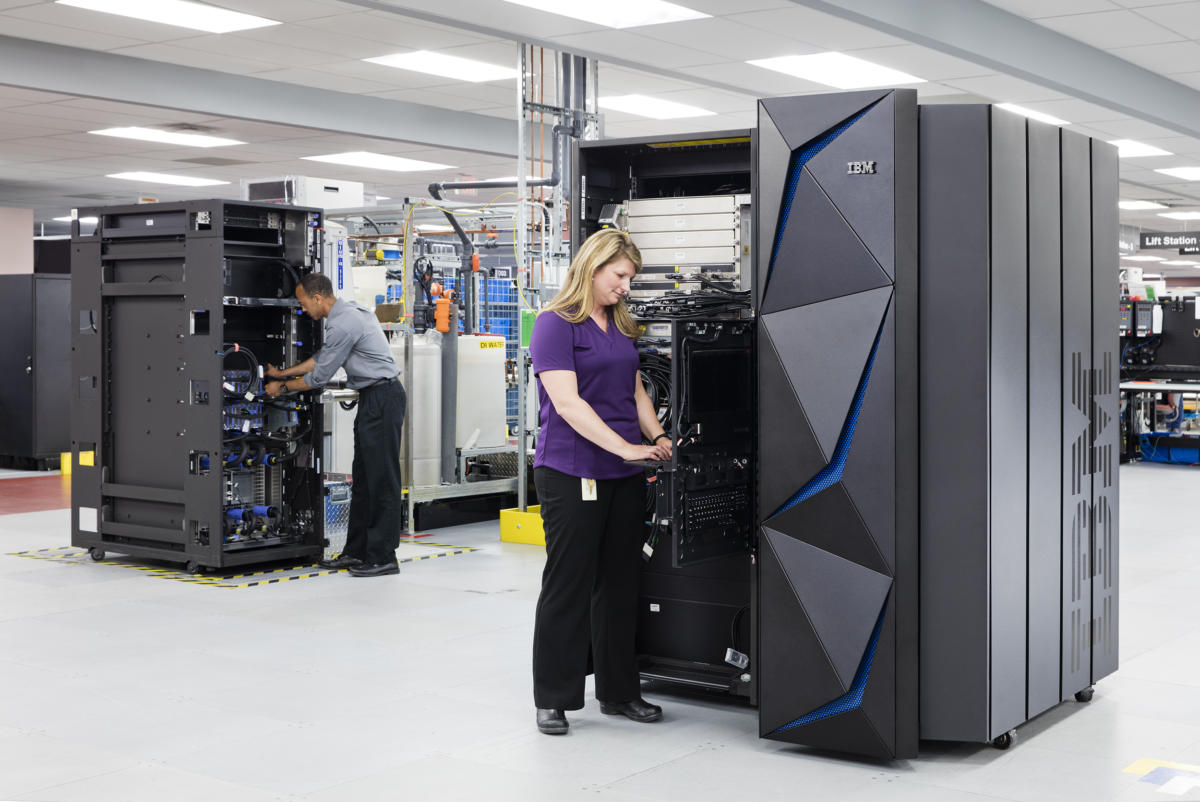
IBM tweaks its z14 mainframe to make it a better physical fit for the data center

IBM Z mainframe
There are other benefits too: The ZR1 specs give it 16U of space free, so storage, networking or monitoring systems can go in the same rack rather than an adjacent cabinet. And it uses standard air cooling and single-phase power, where the original z14 required a three-phase power supply, he said. Alongside the introduction of the ZR1, IBM is also strengthening the platform's logical partitioning capabilities with Secure Service Container technology. Pop an app in a Docker container, and you can lock it down so that the only way of accessing its data once the workload is running is through defined APIs, Jollans said. "The reason for doing that is one of the major threats to enterprises is insider attack.," he said. "You've got encryption, protection against malware, isolation from other partitions and so on, so it provides a very tight, secure environment for running workloads." So far, IBM has been running its cloud blockchain workload in that context but is now offering it for use with generic applications. 


Slack’s Enterprise Grid gets security and compliance enhancements

#slack signage
“This is not like a 500-person company where you can easily send the 10 or so people that start every month to a Slack on-boarding class,” Frank said. “You are talking a 50,000 or 100,000-person company; that is a lot more complicated.”  Raul Castañon-Martinez, senior analyst at 451 Research, said the new features should help enhance Slack’s enterprise-friendliness as deployments of the tool grow in scale. “Slack’s success is closely tied to organic, bottom-up adoption; this means that employees find value in it,” Castañon-Martinez said. “The new features show that Slack is also paying close attention to the other part of the equation: enterprise requirements for management and security. “The new product features Slack’s commitment to continue building an enterprise-grade platform,” he said. Slack has also made changes to its compliance processes and features. It is now possible to create a Custom Terms of Service that all employees must sign before logging in to Slack. Custom Terms of Service can be applied to guest accounts too, which could differ from those provided for staff and require an NDA, for example.


3 key steps for running chaos engineering experiments

3 key steps for running chaos engineering experiments
Chaos engineering is the practice of running thoughtful, planned experiments that teach us how our systems behave in the face of failure. Given the trends around dynamic cloud environments and the rise of microservices, the web continues to grow increasingly complex alongside our dependency on these systems. Making sure failures are mitigated and proactively deterred is more important now than ever. Even brief issues can hurt customer experience and impact a company’s bottom line. The cost of downtime is becoming a major KPI for engineering teams, and when there’s a major outage the cost can be devastating. In 2017, 98 percent of ITIC surveyed organizations said a single hour of downtime would cost their business over $100,000. One major outage could cost a single company millions of dollars. The CEO of British Airways recently revealed that a technological failure that stranded tens of thousands of British Airways passengers in May 2017 cost the company 80 million pounds ($102.19 million USD).


Facebook’s data problems have an upside for banks

Citibank signage outside a branch.
Banks are quick to emphasize how important guarding someone’s data is, and they have long bickered over how to share data outside of the bank’s four walls. In Jamie Dimon’s annual letter to JPMorgan Chase shareholders, the CEO of the bank wrote, “We have consistently warned our customers about privacy issues, which will become increasingly critical for all industries as consumers realize the severity of the problem.” Given Facebook’s woes, a bank brouhaha has already broken out over whether the social media platform’s data breach should slow down the open banking movement. But regardless of the implications for nonbank apps, some see the heightened sensitivity around data sharing as reasons why banks ought to step up the ways they slice and dice consumer information. Certainly, Citi is betting on an opportunity in financial wellness. Its app, which will be available to iPhone users in the coming weeks, will initially rely on word-of-mouth marketing for a service designed to help anybody understand spending patterns, spot recurring bills and open an account in-app if desired.


Bank of America, Harvard form group to promote responsible AI

Bessant pointed out that financial institutions have a big impact on consumers’ lives and therefore a great duty to be responsible in their use of AI when it comes to extending credit, recommending investments and protecting customer funds, data and digital systems. “Because we affect money, whether it’s the movement of money or the investment and return of money or it’s how capital markets work for companies and jobs, I believe we have a monumental responsibility to get it right,” she said. All of these services "have to use models and algorithms and will be at their best when we can use predictive technologies, but we have to make sure that as we capture that growth and do what’s right and great for our customers and clients, that we’re also recognizing the potential pitfalls.” Like any other program, an artificial intelligence program can be subject to “garbage in, garbage out” and drawing false conclusions based on flawed or incomplete data.


Oblivious DNS could protect your internet traffic against snooping

At its most basic level DNS matches website names with their IP addresses, making it a fundamental part of the structure of the internet. Any change to DNS is likely to be met with resistance, the researchers say, making changing it to protect users difficult. It's also simple for a third party, like law enforcement or cyber criminals, to snoop on the personally identifying information that is transmitted to DNS servers. That information includes your IP address, the geographical subnet you are on (and therefore your general location), your MAC address, and the name of the website you want to visit. Those personal details are transmitted in plain text, making intercepting it easy. Internet users also need to have faith in the security of their DNS provider—all the information transmitted can be stored, creating a total profile of the internet use coming from your IP address, or even your particular computer.


Splunk debuts IIoT product for in-depth analytics

Splunk debuts IIoT product for in-depth analytics
“Industry 4.0’s kind of broad – it encompasses customers from transportation, oil and gas, energy and utilities companies,” she said. “These companies are using Splunk enterprise today … we see them using Splunk enterprise to gain insight into their industrial operations.” Splunk is known as a provider of log analysis and infrastructure management tools centered primarily around an expertise with big data analytics. Splunk has enlisted an array of partners to help the company navigate the murky waters of the industrial world, according to Haji. “We’ve invested very heavily in building out a very targeted set of system integrators,” she said. “These are the guys that have deep domain expertise in industrial IoT, and they also have a deep relationship with their customers.” Splunk’s the first major player in the log analysis sector to make a major push into IoT, but it’ll face a brand-new slate of competitors, beyond the Sumo Logics and Logglys of the world.


How to Get Yourself Out of Technical Debt


On a long enough timeline, technical debt creates a lot of misery in the office. Team members tend toward finger pointing and infighting, and a sense of embarrassment pervades. Nobody likes explaining over and over again to stakeholders that seemingly simple changes are actually really hard. So you might just take a breath one day and ask yourself if life isn't too short to keep coming in every day and gingerly massaging some 20-year-old, battleship-gray Winforms app into shape. Maybe it's time to move on to greener and more satisfying pastures. Now, bear in mind that I'm not advocating that you quit your job every time the team makes a technical decision you don't agree with. I'm talking about a situation that feels like a true dead end and where you can feel your market worth slipping day over day. It's not a decision to make lightly, but you should understand that crushing technical debt isn't something you have to tolerate indefinitely, either.


Polyglot Persistence Powering Microservices

Netflix has to look at the user authorization and licensing for the content. Netflix has a network of Open Connect Appliances (OCAs) spread all over the world. These OCAs are where Netflix stores the video bits, and the sole purpose of these appliances is to deliver the bits as quickly and efficiently as possible to your devices while we have an Amazon plane that handles the microservices and data-persistence store. This service is the one responsible for generating the URL, and from there, we can stream the movie to you. The very first requirement for this service is to be highly available. We don't want any user experience to be compromised when you are trying to watch a movie, say, so high availability was priority number one. Next, we want tiny read and write latencies, less than one millisecond, because this service lies in the middle of the path of streaming, and we want the movie to play for you the moment you click play. We also want high throughput per node. Although the files are pre-positioned in all of these caches, they can change based on the cache held or when Netflix introduces new movies — there are multiple dimensions along which these movie files can change.


Quote for the day:


"Leaders think and talk about the solutions. Followers think and talk about the problems." -- Brian Tracy


Daily Tech Digest - April 10, 2018

Cloud migrations: Don’t settle for just some operational savings

Cloud migrations: Don’t settle for just some operational savings
Of course, I am not arguing against migration to the cloud. But mot enterprises need to think more deeply as to why they are migrating to the cloud, and then how. Unfortunately, most enterprises consider cloud to be a tactical technology, and the CFOs and CEOs are glad to see the cost reductions. But if the use of cloud computing is not transformative to the core business, it’s really not providing you the ROI you seek. “Transformative” means that you leverage the innovation and disruption that cloud computing provides. For example, a car company that can remove all friction from its supply chain by using cloud-based technologies, or a bank that can finally use its systems to gain access to key customer data that lets it provide better products and increase market share. These are tricks we’ve done with technology for years, but the cloud removes much of the complexity and cost from having to on-board these technologies with traditional mechanisms. 


According to a World Health Organisation (WHO) report, India produces 35 percent of counterfeit drugs that are sold globally. Furthermore, the Associated Chambers of Commerce and Industry of India (Assocham), states that around "60-70 percent of dietary supplements being sold across India are fake, counterfeit, unregistered and unapproved." NITI Aayog hopes to counter this state of affairs by generating a unique ID number for each medicine, which will be tracked through the supply chain on a blockchain, the official explained. With the system, a consumer or business can access the history and source of the drug by scanning a QR code or barcode on the medicine. The project has reportedly got the green light from the country's pharmaceutical industry, despite some cost concerns.Dilip G. Shah, secretary general of the Indian Pharmaceutical Alliance, a lobby group, said: "Fake drugs are a concern and, if blockchain can help the industry get rid of the problem, we are up for it." 


Infrastructureless Computing

Computations (algorithms) run in Docker containers on Windows, Mac, and Linux workstations, servers, VMs, and even IoT devices. We call these Computes nodes, nanocores. Our nanocores can discover other nanocore nodes on the same private mesh computer network and connect, communicate (via peer-to-peer), and compute together as if they are physical cores within a single supercomputer. Our nanocore workload is managed by our decentralized queuing system called Lattice. Lattice distributes computations in the right order (serial or parallel) to the right core in the right location at the right time. Since our nanocores run everywhere (any operating system and in any platform — cloud, fog, edge, mist), they essentially are universal computes. This allows Lattice to run algorithms as close to data sources as possible rather than trying to move all of your data to the cloud to run algorithms in a serverless environment. Lattice allows you to run your AI algorithms everywherewithout worrying about the infrastructure.


Cyber threat to UK business greater than ever, report reveals


Martin notes in the foreword to the report that the past year has seen no deceleration in the tempo and volume of cyber incidents, as attackers devise new ways to harm businesses and citizens around the globe. However, despite these threats to the nation’s security, he said he is “confident” in the UK’s ability to combat the attacks that organisations face every day. The report underlines that failure to do so could result in the crippling of smaller organisations and significant loss in stock market value for powerful multinational organisations if they lose the personal data and trust of customers. “The NCSC’s aim is to make the UK an unattractive target to cyber criminals and certain nation states by increasing their risk, and reducing their return on investment,” wrote Martin. “We have adopted a proactive approach to dealing with the increasingly challenging cyber landscape and in tandem with the NCA are taking a proactive approach to combating cyber crime.


Security warning: Your suppliers are now your weakest link

"It is clear that even if an organisation has excellent cybersecurity, there can be no guarantee that the same standards are applied by contractors and third party suppliers in the supply chain. Attackers will target the most vulnerable part of a supply chain to reach their intended victim," warns the report. The challenge with supply chain attacks is that they are often difficult to detect if they are done well, as attackers will stealthily make their way into networks, often with the aid of spear-phishing and other techniques designed to steal credentials or create backdoors. Indeed, the report points to the success of Cloud Hopper, an advanced Chinese cyber-espionage campaign which targeted IT suppliers around the world, as an example of the threat this tactic can pose. The third parties were compromised as a stepping stone towards bigger, more lucrative targets, but still proved to be fruitful for the attackers as many were handling sensitive data.


4 steps to creating a winning cybersecurity strategy in 2018

teamwork - collaboration
“In our CISO executive education program, we have been working with students on changing the narrative associated with cyber security from a pure technical/process focus to business justification and risk assessment. As the attack surface becomes larger due to increasing level of digitization, propensity to collect and store data and sophistication of different types of exploits, the role of security becomes increasingly strategic,” said Ari Lightman, Director, CISO Certificate Program, Carnegie Mellon University. The CISO is not an overhead because their presence helps instill confidence and delivers positive ROI as it helps close deals by accelerating the due diligence process with buyers. “We have successfully closed contracts with large Fortune 1000 customers due to our strong cybersecurity posture and investments that has become a competitive advantage for us,” said Dan Allison, the Chief Technology Officer (CTO) at Indiggo, a leadership and executive performance management SaaS platform hosted on AWS. Dan’s organization has invested in an independent cybersecurity operations and management capability to satisfy their customers’ due diligence process.


Human Beings, AI and Robots to Represent the New Workforce in 2028

The digital component of most jobs will accelerate, putting an emphasis on workforce digital dexterity — that is, the ability and desire to use new and existing technologies for better business outcomes. We, as individuals, will increasingly gravitate toward work and organizations that accelerate “We Working” — a work philosophy that depends on ensembles of autonomous and high-performing teams fulfilling critical outcomes. “The illiterate of the 21st century will not be those who cannot read and write, but those who cannot learn, unlearn and relearn” Work will revolve around portfolios of diversified roles and skills performed in teams that dynamically resize and reform. “CIOs and business leaders must anticipate how trends in business, society, technology and information will converge to change where, when, why and with whom we will work in a digital business,” says Griffin. “However, there are two remaining challenges that CIOs need to control to achieve greater business and personal success.”


Should you buy a Core i9 laptop?

asus rog g703
The longer answer is yes, but only if you truly use those CPU threads. If you edit video, render 3D scenes, or do any task that’s typically multi-threaded, you will see a huge performance boost by going with a 6-core chip over a 4-core chip. Adding cores will also generally improve performance if you also tend to do a many things simultaneously. And while the vast majority of games won’t really use all six cores, the extra hardware will be a blessing if you stream to Twitch or Mixer while you game, or if you edit video of your adventures to post on YouTube. Upgrading to a 6-core Core i9 or Core i7 is a worthwhile investment for gamers who also create content. ... The most performance you can wring out of a laptop will still likely come from a Core i9 laptop. It runs faster than any other 8th-gen mobile processor, and there’s also a new “Thermal Velocity Boost” feature in Core i9 hardware that allows for higher clock speeds when the chip is below 50 degrees Celsius. But in general, these 8th-gen chips should run at higher clock speeds than their predecessors. The improvement in single-threaded performance won’t be as wide as it is with multi-threaded but it’ll still be better than what was typically available before.


How to Present Security So People Will Listen — and Take Action

Whether you are a manager presenting security audit findings to staff or a keynote speaker at a weeklong technology conference or security summit, there are plenty of challenges to making your case for security.  Engaging others in meaningful, memorable, positive ways is usually difficult for any topic. But bring up cyberSAFETY, or cyberSECURITY or cyberDEFENSE or cyberETHICS or cyberANYTHING at the office to non-geeks, and the conversation usually gets boring, stale and short very quickly.  Actually, getting people to truly listen and engage in a conversation about security topics around the coffee pot is extremely hard — unless you work in a security function. And in case you think that using words like "information security" or "information assurance" will make things better — think again. Yes — you can throw in words like "hacker" and "identity theft" to grab their attention and liven things up a bit, but that is usually because people start thinking about movies or scary headlines.


Digital transformation: Closing the gap between innovation and execution

"As organisations become more agile, we see successes, but also complications, in terms of how they bring new ideas to market," says Feng. "Ideas are common, yet game-changing concepts are rare. There's a gap between the ability to start generating ideas and the reality of bringing those ideas to market in a relevant way." Feng says many of the challenges around creativity are related to definitions. He says many employees still think innovation is about creating something brand new. "Most things already exist -- innovation is about creating new value across existing dimensions," says Feng. The good news, he says, is modern businesses have access to more ideas than ever before. The smartest executives adopt and adapt these ideas flexibly. Fast-moving organisations, which develop business models across a range of areas, are more likely to be successful. So, rather than focusing on the transformation of an existing operation, Feng says executives should use the cash generated by their core business to invest in new internal and external ventures. Feng encourages business leaders to embrace broad experimentation.


Quote for the day:


"Great leaders are almost always great simplifiers who can cut through argument, debate and doubt to offer a solution everybody can understand." -- General Colin Powell


Daily Tech Digest - April 09, 2018

Architecturally Aligned Testing


A loosely coupled system follows a service autonomy principle as its architecture is based on the decomposition in autonomous parts. Microservices are increasingly being adopted by organizations to improve the autonomy of their teams and increase the speed of change. Microservice applications are composed of those small, independently versioned, and scalable customer-focused services that communicate with each other over standard protocols with well-defined interfaces. ... Microservices are often accompanied by DevOps: In agile and DevOps, there is no separate design phase with an architect responsible to define the architecture prior to the development phase. Instead, the architecture is defined more federated, addressed across the project, and owned by the whole team. And how is the test approach changing for those systems? Also testing is typically not done anymore in a separate test phase by an independent test team. Instead, everybody is responsible for the quality.


Proxeus And Partners IBM, Canton Zug, Legally Register Business Using Blockchain
The event took place as part of the digitalswitzerland challenge, a joint initiative from several of Switzerland’s leading businesses aimed at driving digitalization efforts across the country. The group said the idea emerged from the realization that an alternative to the current cumbersome, time-consuming and paper-intensive process of business registration needed to be introduced in Switzerland. By shifting the entire process encompassing the entrepreneur, lawyer, bank, notary and commercial register to a digital workflow and Hyperledger blockchain and by utilizing smart contracts, the key steps can be processed instantly, drastically reducing the amount of time spent toward verification. “The bank will state that the capital money has indeed been paid; the notary will confirm that the necessary documents have been provided, read over, and approved; and the commercial register does the final check that everything is lawful. If all of the conditions are met, then the filing, which up until that point will have been provisional, will be officially registered with the Commercial Register and Official Gazette of Commerce,” the group explained.


Microsoft's New Cortana Chief Plans To Put Her Smarts In More Places

microsoft cortana on the lock screen
If Soltero’s words are any indication, Cortana’s future will have her ranging far and wide beyond Windows. “The guiding light for us is the assistant concept, and the idea that you want to help people get more out of their time, and whether actively or proactively make the things that you do every day easier or better or more effective,” Soltero said. Cortana continues to be her most helpful when she can keep an eye on you and find ways to help. “Part of that means looking at a person throughout their day,” Soltero explained, “looking at opportunities and the different kinds of places where...an assistant technology or product experience or whatever you want to call it can provide.” That means Cortana will continue to pipe up when she senses a need. “What we’ve noticed, I guess, and what the world has shown us is that you can start by being convenient,” Soltero added. “There is actually a path towards earning the right to be an assistant.” This is how Microsoft sees Cortana’s next steps: less flash, more utility. But Soltero also said that doesn’t always play well with a user base that looks for the next big thing.


The future of enterprise IoT

The future of enterprise IoT
As enterprise IoT grows, I was interested in what use cases would take hold first. Karen Panetta, an IEEE Fellow and dean of Graduate Engineering Education at Tufts University, looked to consumer applications like “deep learning on household security monitoring and energy consumption information.” Already, she said, “consumers can set their thermostats and virtually ‘answer their doorbell’ from anywhere. Next will come understanding exactly where that energy is being used within the household, such as how much energy goes into lighting, heating, doing laundry, TV, and computers.” At the same time, of course, that will give companies a much deeper understanding of how customers spend their time. On a more explicitly enterprise level, “IoT technologies that have a rapid return on investment (ROI) are the most likely to take off first, and that means “reducing costs through automation,” said Kayne McGladrey, an IEEE member and director of Integral Partners, an identity and access management (IAM) consultant firm.


Social Engineering: It's time to patch the human

marionette social engineering
In short, if we don't patch the human – no matter how good the tech is – we're still going to have problems. "Everybody wants to build a Blinky Box, and build technology that intercepts and protects the human, instead of getting humans to be developed and educated enough to protect the technology. They're not a liability, they're an asset. [Humans] are the biggest intrusion detection system that you're going to get." There's an assumption within some circles that continuous awareness training is a too difficult of a battle to fight within a given organization. Depending on scope, it can be a resource drain on time and money. Yet, equally as difficult is the recovery from socially-based attacks when they could've been prevented. The harsh truth though, is that information security really isn't part of the average worker's job, and even if there are some security elements, they're an afterthought, not the core. "We're not making information security part of the user's job, and if it's not part of their job, then it's not their concern and they don't care about it," Street said.


New Microsoft Teams features on deck, but more work needed

Over the past six months, Microsoft has moved many Skype for Business features into Teams. The vendor announced in September 2017 that cloud-based Skype for Business in Office 365 would transition to Teams. Despite its progress, however, Microsoft still has work to do, especially for full enterprise voice features. Many key Microsoft Teams features -- particularly for meetings and calling -- are expected to launch by the end of the second quarter this year. Other calling capabilities -- such as call park, group call pickup, location-based routing and shared line experience -- are expected by the end of this year.  The migration roadmap for Skype for Business to Microsoft Teams includes 70 enterprise voice features, according to Lori Wright, general manager of Microsoft Teams and Skype. Microsoft delivered half of those features by January 2018, Wright said. The vast majority of overall voice features should be completed by June 2018, she added.


How blockchain could solve the internet privacy problem

bitcoins and dollar bills
There are many blockchain specifications, and many of them are based on open-source software. The Sovrin Network is based on the Linux Foundation's Hyperledger Indy specification, which was built from the ground up for verifying a user's identity. Blockchain networks, or distributed electronic ledgers, can protect the identity of users behind a randomly generated hash table, a type of cryptographically signed credential, to prove the digital identity information in the identity owner's possession. Once a business or organization has verified information about a person, a simple icon can be used approve a transaction. Besides being used for bitcoin and other cryptocurrency transactions, blockchain has most recently been adopted for business transactions, such as automating supply-chain management and cross-border money exchanges. In short, many businesses and governments believe blockchain could underpin a new trust economy, one constructed of person-to-person (P2P) transactions and not dependent on more traditional methods such as credit ratings or guaranteed cashier's checks.


Data scientists that produce data-driven products rule the market

In a data-driven product organization, the data science team will also work closely with the product manager, head of product or chief product officer, as invariably the data scientists will likely be the biggest contributors to the organization's product designs and ultimate success. What is a data-driven product? In straightforward terms, a data-driven product is a software, service or platform that is able to solve deeply complex problems by utilizing a number of different machine learning algorithms. These algorithms will vary from the straightforward all the way to much more complex programs that utilize deep learning and artificial intelligence. There isn't an industry where data-driven products aren't becoming mainstream. Demand for this role: In these data-driven project firms, the product is defined by the quality of data that goes into it and the ability of the said product to create actionable insight through machine learning. Due to this, the data science team is absolutely indispensable.


What Hackers Do: Their Motivations & Their Malware

security vulnerabilities such as hackers and cyberattacks
The malware writer or distributor may also be paid to infect people’s devices with completely different types of malware. It’s a renter’s market out there, and if the malware controller can make more money renting the compromised devices than they can make alone, they will do it. Plus, it’s much less risk for the controller in the end. Many hackers (and hacking groups) use malware to gain access across a company or much broader array of target victims, and then individually select some of the already compromised targets to spend more effort on. Other times, like with most ransomware, the malware program is the whole ball of wax, able to compromise and extort money without any interaction from its malicious leader. Once released, all the hacker has to do is collect the ill-gotten gains. Malware is often created and then sold or rented to the people who distribute and use them. ... Today, most hackers belong to professional groups, which are motivated by taking something of value, and often causing significant harm. The malware they use is designed to be covert as possible and to take as much of something of value as is possible before discovery.


Google's Fuchsia could replace Android and unite all devices


There is a lot of uncertainty around Fuchsia, but we know a few things about it. It’s rumoured there could be a launch in 2019 at the very earliest. Its user interface comes in two animal-named versions; Capybara for the desktop, and Armadillo for mobile, the OS is built using a brand new kernel called ‘Zircon’, instead of using Linux like Android does, and it’s all designed to be continuously upgraded. At the moment, Android has a fragmentation problem where most users run older versions. It also contains a feature called ‘Ledger’ which will synchronise all your devices together, letting you start writing something on one machine and finish it on another. Apps for Fuchsia can be made using Flutter, a Google-made software development kit that is already in use for its existing operating systems. Developers and intrepid users have been able to look at a basic preview of Fuchsia by downloading the files to Google’s Pixelbook, the only device currently supported.


Quote for the day:


"The successful man doesn't use others. Other people use the successful man. For above all the success is of service" -- Mark Kainee


Daily Tech Digest - April 08, 2018

France pledges to use force only in legitimate self-defense, that is, in response to a cyber attack that would cross the UN Charter’s Article 51 threshold. This rules out the possibility of a “preventive cyber attack” against a hostile third party. By contrast, strictly preemptive action could in certain circumstances be legal under international law, depending on the scale and effects of the attack. The decision to abide by international law in times of conflict constrains the range of possible responses to cyber attacks with more ambiguous consequences. For example, although the document claims democratic life is an asset of vital importance just like a power grid, even a large hack aimed at disrupting an election would be less likely to trigger a conventional military response than an attack against a key power grid would be. If the threshold for offensive action is not met, France claims it would act under the UN Charter’s Chapter VI, taking economic or political reprisal measures, a stance consistent with America’s response to Russia’s electoral interference in 2016.


Building single source of truth using Serverless and NoSQL

When it comes to large scale data ingestion in Azure, Event Hubs provide a data streaming platform, capable of receiving and capturing millions of events per second. However the customer had enterprise high-value messaging requirements such as transactions, ordering and dead-lettering. Luckily we have such a service at our disposal in Azure Service Bus. We could have easily skipped Service Bus and directly persisted data to the storage, however the queue-based load leveling pattern allows us to decouple ingestion from storage, adds resilience in the form of retries, as well as enables asynchronous processing of ingested data. Instead of directly exposing Service Bus to the source systems, we wanted a REST API with friendly URL. Azure Functions allows us to develop event-driven Serverless applications by providing a multitude of triggers and bindings. All functions have exactly one trigger which defines how the function is invoked. In just few lines below, we were able to create an HTTP trigger function which inserts JSON-serialized product entity to the Service Bus Queue called productsQueue.


Is Your Blockchain Business Doomed?


It’s possible that even an individual’s public Bitcoin address—a string of letters and numbers used to send and receive the digital currency—could be considered personal information. “Encrypted data will often qualify as personal data and not as anonymous data,” the law firm Hogan Lovells said in a recent note. “This means that in most instances the privacy rules will be applicable to at least some of the data involved in blockchain systems.” Some companies may have to redesign their software and buy costly traditional databases to move any personally identifiable information they possess off a blockchain. That would help with compliance, but it could remove some of a blockchain’s benefits. It will be harder to ensure that documents stored outside a blockchain haven’t been tampered with, for example. And moving off a blockchain could be expensive, especially for startups. Maintaining their own databases costs more, and such companies might need to raise funds to build IT infrastructure.


Pain in the bot? Artificial intelligence in banking

bots.png
This focus is already heating up the development landscape as chatbot technology advances at a rapid clip. Google and Microsoft already offer digital assistants on smartphones, called Google Now and Cortana, respectively, which gain increasingly deep knowledge of their users’ habits and schedules. Amazon sells a stand-alone device called Echo that features Alexa, who can, among other things, play music, read books aloud and help buy items through Amazon. And Siri of course reigns over the Apple universe. According to Gartner, about 38% of American consumers have used virtual-assistant services on their smartphones recently; by the end of 2016 an estimated two-thirds of consumers in developed markets will use them daily. So, all signs point toward an AI-induced change in the way we interact with... well, probably everything. ,,, Although some interesting examples emerged from a recent Mondo hackathon, and some non-bank fintech startups are starting to introduce clever apps


Exploring the Future of Banking

Lately, banks and fintech firms find that they have complementary assets that could result in mutually beneficial relationships. Banks have the market’s trust and a large customer base that fintech firms have had a hard time to replicate. Fintech firms have innovative solutions that banks haven’t been able to develop. Partnerships would be ideal in such a situation. Unfortunately, due to regulatory concerns, most FIs see fintech firms as either vendors, acquisition targets, or investments. True partnerships are few in the industry. That said there are various opportunities. For example, the robo-advisor space in wealth management is ripe for strong collaborations. Traditionally, investing has been kept to the mass affluent market and above. Fintech firms like Betterment, Wealthfront, Robinhood, and Acorns continue to show that the mass market is ready to take advice through automated solutions and PFM assistants powered by AI and algorithms. To be honest, banks aren’t worried by these players. Correctly, many bankers point to the fact that these lenders haven’t gone through a downturn in the economy.


How to use data science to understand customer emotions and decisions

Emotions
To be clear, computers don't understand emotions, but they can be shown examples around an arbitrary concept and be taught to recognise the weak signals and indicators that identify them. The aim is to give automated systems the ability to listen to and understand the emotional subtext in a dialogue and do so at a level of sophistication and scale that humans can't replicate. If you like, we're attempting to give computers some EQ to go with their IQ. Of course, the natural follow-on to this is that the organisation also must be good at acting on the insights - listening is only half the equation. I like to think about it as putting the 'relationship' back into customer relationship management and we all know that the best relationships are far more than meeting each other's rational needs. ... This data fuels the analyses. Next is the ability to extract emotional meaning from narratives using advanced natural languages tools, ones that don't just categorise conversations or answer questions - this is predominantly the world of AI and Machine Learning.


What you need to know about cryptocurrencies in UAE


On one hand, the Central Bank of the UAE's Regulatory Framework for Stored Values and Electronic Payment Systems indicates very clearly that "all virtual currencies [and any transactions thereof] are prohibited". On the other hand, the UAE and Saudi Arabia have recently made public their plans to implement their own cryptocurrency to be used and regulated in the region. In September 2017, the Dubai Financial Services Authority has issued in a statement addressed to the Dubai International Financial Centre's investors that it did not "regulate these types of product offerings [cryptocurrencies]" whilst declaring them to be "high-risk investments". Today in the UAE, there is no clear vision on this phenomenon. And it is a mere question of definition. UAE central bank governor Mubarak Rashid Khamis Al Mansouri indicated that "these regulations do not cover 'virtual currency', which is defined as any type of digital unit used as a medium of exchange, a unit of account, or a form of stored value. In this context, these regulations do not apply to bitcoin or other cryptocurrencies, currency exchanges, or underlying technology such as blockchain".


Blockchain use cases where IoT and distributed ledger technology meet

In an age where consumers want their goods faster than ever and the pressure for digital supply chains to be more interconnected and efficient is high. With interconnected we don’t mean supply chains as such but the data flows, processes, control mechanisms, myriad stakeholders, processes, actions and interactions (as mentioned in a blockchain smart port case there are over 30 different parties with on average 200 interactions between them just to get a container from one point or the other in shipping). No wonder that global logistics and transportation are among the fastest movers in testing and adopting blockchain technology. It is no different in the intersections of IoT and distributed ledgers from the ecosystem perspective as the Kaleido Insights report depicts it: supply chain is one of five blockchain IoT use case or rather industries/activities where blockchain is seen as the foundation for autonomous products and ecosystem services.


Patterns for Microservice Developer Workflows and Deployment


To improve feature velocity in an organization, you can organize your people as independent, self-sufficient feature teams that own an entire feature from beginning to end. This will improve feature velocity in two ways. First, since the different functions (product, development, QA, and operations) are scoped to a single feature, you can customize the process to that feature area — e.g., your process doesn't need to prioritize stability for a new feature that nobody is using. Second, since all the components needed for that feature are owned by the same team, the communication and coordination necessary to get a feature out the door can happen much more quickly and effectively. When you do this, you end up breaking up that monolithic process that was the gating factor for feature velocity, and you create many smaller processes owned by your independent feature teams. The side effect of this is that these independent teams deliver their features as microservices. The fact that this is a side effect is really important to understand.


Laying a Framework for IoT with Enterprise Architecture


IoT transformation projects are complex and require careful planning and tracking against progress. Having an IoT roadmap will keep you from adding valueless technology to your landscape. Enterprise architects should be in the driver’s seat, and lead when identifying conflicts in requirements between different projects regarding the same applications. Planning and tracking the transformation process can cut down the time of the entire process of successfully deploying the IoT-supported system. Here, enterprise architects can easily track the phase-ins of new applications and retirements of legacy applications, and plan for scenarios of the application landscape to future-proof the organizations’ system. ... With data breaches occurring almost weekly, security is a crucial issue and proves to be a significant challenge for IoT. One of the biggest and most impactful costs of integrating an EA system that supports IoT is the potential security risks to the organization if left exposed.


Quote for the day:


"Tomorrow's leaders will not lead dictating from the front, nor pushing from the back. They will lead from the centre - from the heart" -- Rasheed Ogunlaru


Daily Tech Digest - April 07, 2018

Disrupting And Elevating The Relationship Between Brand And Consumer


In the industry of digital brand building, our success as an agency can be measured by the longevity of a business -- and user experience strategies have proven to be the key element in ensuring this relevancy. All of our clients experience their own evolution based on their specific customer needs and patterns, but in our experience, brands who continually refine their approach to meet and exceed user expectations are those that have the best chance at long-term growth and a considerable tip of the scales in their favor for market share. There’s little argument that e-commerce is a thriving market. The benefits are far-reaching -- value, speed and availability, to name just a few. Consider this: Nearly 49% of consumers shop online for consumer packaged goods, and it's estimated that in five to seven years, 70% of consumers in the U.S. will do so regularly. When you take into consideration the traditional pattern of in-store grocery shopping, it's mind-boggling that a relatively recent innovation has changed the face of the way we accomplish this daily task.


Sree Sreenivasan’s Social Media Status Report

“Every publisher I talk to has to be talked down off the ledge because what they are looking at is the numbers. I believe there is positive news in this,” says Sreenivasan. “The glimmer of hope that I see in this is that yes, they are deemphasizing brands, and emphasizing people, and therefore your traffic will drop. But in the emphasizing of people, your path to salvation lies there. Because if your content is readable, shareable, embeddable, joyful, or useful, people will share it. And if they want to share it, they will. That’s where we have to think about our content: How do we make it so good that people want to share it?” Beyond Facebook of course are other influential platforms, including one that Sreenivasan has a particular eye on. “One platform that is vastly underused is LinkedIn,” he says. “LinkedIn has so many opportunities because it is aimed at people at work and I’ve now made it a resolution that I am going to do more on LinkedIn because I see the pick-up it gets when you post an article. And so what is your LinkedIn strategy?”


Decoding the evolution of Blockchain 3.0

According to Crunchbase data, $1.2 billion was invested by venture capitalists in blockchain-based firms in 2017. Photo: iStock
The blockchain technology that powered bitcoin is a relatively bare-bones system that requires layers of protocols to be built on top of it to make it a usable platform for utilities like smart contracts. Ethereum, on the other hand, was launched with its own scripting language baked in, making it possible to build complex smart contracts, decentralized autonomous organizations, DApps and even other cryptocurrencies with relative ease. Bitcoin’s rise to popularity resulted in its supporting blockchain technology, being categorized as Blockchain 1.0. Ethereum’s broad adoption as a decentralized platform for applications to run exactly as programmed enabled it to be categorized as Blockchain 2.0. Currently, we are witnessing a new set of blockchain platforms and networks based on DAG technology. There exist a number of DAG-based blockchains such as Hashgraph, IOTA, Stellar, NEO, RaiBlocks, etc., which have been developed for specific real-world problems. These platforms belong to the third generation, or what we call Blockchain 3.0 group, and are developed to overcome the key issues of the original blockchain (Blockchain 1.0) and Ethereum (Blockchain 2.0), and are designed on the FFM concept.


How babies learn – and why robots can’t compete


If all of us are to achieve our potential as learners, the question we have to answer is how we ought to shape this environment. Human brains have specially adapted to learn. Our long period of immaturity is a risky evolutionary strategy, making us vulnerable early on to predators or sickness, and delaying for many years our capacity to reproduce, but the payoff is immense. We can actively incorporate enormous amounts of the latest information from our environment and social group into our cognitive development. Scientists have long recognised the nature-v-nurture debate as fallacy. A huge amount of our brain development takes place in the first three years. In those years, the brain grows in relation to the environment, forming itself in interaction with sensory experience. As Hart and Risley showed in their study of the word gap, that experience can have a huge effect on who that person becomes. We have evolved to be a species of teachers and learners. Our ability to understand other people arrives around the ninth month, at a moment in their development at which babies begin to check the attention of others by holding or pointing at objects.


Turning the tables: Is Big Tech under threat from traditional banks? 

Fintech
According to White, the real battleground between Big Tech and banking sits in I2O, which is about how people interact with their money and how these are translated into opportunities.  "Big Tech has, on a minimum, 2000 interactions per customer per year," states White. "Banking, on the other hand, has 200 interactions. That is, Big Tech creates high frequency of interactions, with a high volume of data sets, but with low value; as opposed to banks' model which is low frequency, low volume and high value," he adds. In other words, that is 10:1 on volume of interactions, but does that translate into an equivalent 10:1 of value? White challenges that. "Despite more interactions, customers liking a social media post on Facebook or searching for a product on Google adds relatively low value data since it cannot be monetized much," he argues. "On the other hand, even if banking gets fewer interactions, all these are high value ones from a monetary point of view. According to him, the real questions are not the volume of interactions or its frequency. "The question of the future in this battleground between big tech and banking is how smart these interactions are."


Citizen AI: A business guide to raising artificial intelligence in a digital economy

How do you improve the way people work and live? Accenture's Technology Vision 2018 report tackles this question by highlighting trends and rapid advancements in technologies that are improving the way people work and live. The report highlights a need for a fundamental shift in leadership that is required to cultivate partnerships with customers and business partners, and to further accelerate the adoption of artificial intelligence as the fuel for enterprises to grow and deliver social impact. Accenture's 2018 report, called Intelligent Enterprise Unleashed: Redefine Your Company Based on the Company You Keep, highlights how rapid advancements in technologies -- including artificial intelligence (AI), advanced analytics and the cloud -- are enabling companies to not just create innovative products and services, but change the way people work and live. This, in turn, is changing companies' relationships with their customers and business partners.


'Killer Robot' Lab Faces Boycott from Artificial Intelligence Experts


Nearly 60 AI and robotics experts from almost 30 countries have signed an open letter calling for a boycott against KAIST, a public university in Daejeon, South Korea, that has been reported to be "develop[ing] artificial intelligence technologies to be applied to military weapons, joining the global competition to develop autonomous arms," the open letter said. In other words, KAIST might be researching how to make military-grade AI weapons. According to the open letter, AI experts the world over became concerned when they learned that KAIST — in collaboration with Hanwha Systems, South Korea's leading arms company — opened a new facility on Feb. 20 called the Research Center for the Convergence of National Defense and Artificial Intelligence. Given that the United Nations (U.N.) is already discussing how to safeguard the international community against killer AI robots, "it is regrettable that a prestigious institution like KAIST looks to accelerate the arms race to develop such weapons," the researchers wrote in the letter.


Why we need to separate blockchain technology from cryptocurrencies

null
One of the main misconceptions that fuels the misbelief that blockchain is synonymous with cryptocurrencies is that a blockchain is 100 per cent decentralised, autonomous and open to all. In turn, this stokes the belief that it is not possible for a blockchain to be secure, reliable nor responsible – fundamental principles required for using a technology in business. However, the reality is that blockchain is not dictated by the restrictions of the existing and most well-known Bitcoin or Ethereum networks. While these networks are fully pseudonymous, public and decentralised, the blockchain technology can be fully customised to create a blockchain with bespoke features and rules tailored to a variety of services and requirements. The charge that blockchain is not secure is based on historical public breaches of some types of blockchain. In 2016, a ‘recursive call’ bug in a blockchain was exploited, allowing the hacker to drain the Decentralised Autonomous Organisation (DAO) of $3.6 million in Ether, approximately equivalent to $45 million at the time, collected from the sale of its tokens.


SWIFT Blockchain PoC Final Verdict

SWIFT finally released the results of the PoC this month and have confirmed that there is a lot more work needed within Banks’ back office technology and operational processes for DLT to be relevant. The PoC was aimed at international payments and how intraday/real time liquidity management could be performed using DLT. Correspondent banks provide services on behalf of another overseas financial institution through a correspondent account. However, about 34% of the cost of an international payment is related to Nostro trapped liquidity. This is due to the lack of real-time data to optimize intraday liquidity management. Managing Nostro accounts and ensuring there is no over funding or overusage of credit lines depend on availability of real time data. A real-time feed of transaction data would allow banks to release payments to customers quicker, whilst reducing liquidity risks. With that as the driver behind the initiative, a consortium of 34 banks worked on this use case with SWIFT. In Q1 2017 SWIFT had launched their Global Payments Initiative (GPI) with these banks and it went live without DLT.


A Brain-Boosting Prosthesis Moves From Rats To Humans


The results have impressed other researchers, as well. "The loss of one’s memories and the ability to encode new memories is devastating—we are who we are because of the memories we have formed throughout our lifetimes," Rob Malenka, a psychiatrist and neurologist at Stanford University who was unaffiliated with the study, said via email. In that light, he says, "this very exciting neural prosthetic approach, which borders on science fiction, has great potential value. (Malenka has expressed cautious optimism about neuroprosthetic research in the past, noting as recently as 2015 that the translation of the technology from animal to human subjects would constitute "a huge leap.") However, he says, it's important to be remain clear-headed. "This kind of approach is certainly worth pursuing with vigor but I think it will still be decades before this kind of approach will ever be used routinely in large numbers of patient populations."


Quote for the day:


"The manager has a short-range view; the leader has a long-range perspective." -- Warren G. Bennis