Daily Tech Digest - June 20, 2021

The Reality Behind The AI Illusion

So far, AI has shown some impressive results in narrow application areas only, like chess-playing computers beating world chess champions and supercomputers beating human Jeopardy champions. However, these are computers programmed to solve one specific problem and cannot interpret more complex and multilayered challenges beyond the given task. This is exactly what Moravec's paradox states; though it may be easy to get computers to beat human chess champions, it may be difficult to give them the skills of a toddler when it comes to perception and mobility. While AI has not reached human performance, it brings valuable solutions to many real-world problems quickly and effectively. From enhanced healthcare, innovations in banking and improved environmental protection to self-driving vehicles, automated transportation, smart homes and chatbots, AI can offer simpler and more intelligent ways of accomplishing many of our daily tasks. But how far can AI go? Will it ever be able to function autonomously and mimic cognitive human actions? We cannot envision how AI will end up evolving in the far-off future, but at this point, humans remain smarter than any type of AI.


Mastering the Data Monetization Roadmap

The Data Monetization Roadmap provides both a benchmark and a guide to help organizations with their data monetization journey. To successfully navigate the roadmap, organizations must be prepared to traverse two critical inflection points: Inflection Point #1 is where organizations transition from data as a cost to be minimized, to data as an economic asset to be monetized; the “Prove and Expand Value” inflection point; Inflection Point #2 is where organizations master the economics of data and analytics by creating composable, reusable, and continuously refining digital assets that can scale the organization’s data monetization capabilities; the “Scale Value” inflection point. Carefully navigate these two inflection points enables organizations to fully exploit the game-changing economic characteristics of data and analytics assets – assets that never deplete, never wear out, can be used across an unlimited number of use cases at zero marginal cost, and can continuously-learn, adapt, and refine, resulting in assets that actually appreciate in value the more that they are used.


Will AI Make Interpreters and Sign Language Obsolete?

One of Google’s newest ASR NLPs is seeking to change the way we interact with others around us, broadening the scope of where — and with whom — we can communicate. The Google Interpreter Mode uses ASR to identify what you are saying, and spits out an exact translation into another language, effectively creating a conversation between foreign individuals and knocking down language barriers. Similar instant-translate tech has also been used by SayHi, which allows users to control how quickly or slowly the translation is spoken. There are still a few issues in the ASR system. Often called the AI accent gap, machines sometimes have difficulty understanding individuals with strong accents or dialects. Right now, this is being tackled on a case-by-case basis: scientists tend to use a “single accent” model, in which different algorithms are designed for different dialects or accents. For example, some companies have been experimenting with using separate ASR systems for recognizing Mexican dialects of Spanish versus Spanish dialects of Spanish. Ultimately, many of these ASR systems reflect a degree of implicit bias. In the United States, African-American Vernacular English ...


Bad cybersecurity behaviors plaguing the remote workforce

Over one quarter of employees admit they made cybersecurity mistakes — some of which compromised company security — while working from home that they say no one will ever know about. 27% say they failed to report cybersecurity mistakes because they feared facing disciplinary action or further required security training. In addition, just half of employees say they always report to IT when they receive or click on a phishing email. ... As lockdown restrictions are lifted, six in 10 IT leaders think the return to business travel will pose greater cybersecurity challenges and risks for their company. These risks could include a rise in phishing attacks whereby threat actors impersonate airlines, booking operators, hotels or even senior executives supposedly on a business trip. There is also the risk that employees accidentally leave devices on public transport or expose company data in public places. ... As cybersecurity will be mission-critical in the new work environment, it’s encouraging that 67% of surveyed IT decision makers report that they have a seat at the table when it comes to office reopening plans in their organizations.


Microsoft's new security tool will discover firmware vulnerabilities
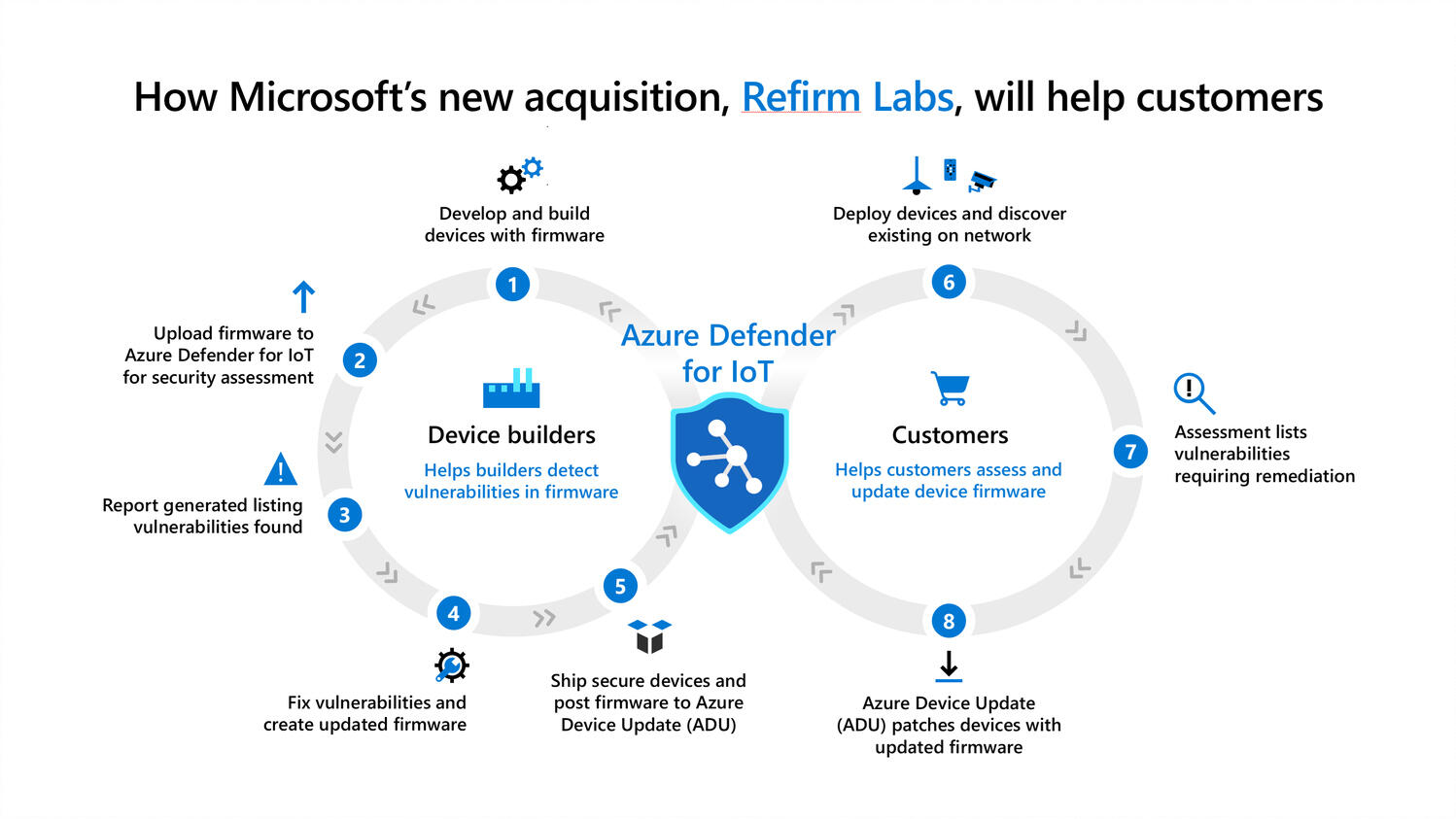
Today, ReFirm needs you to provide the firmware files, but Microsoft plans to create a database of device information, Weston says. "You plug in CyberX and it discovers the devices, it monitors them and it asks ReFirm 'do you know anything about IoT device X or Y'. Hopefully we've pre-scanned most of those devices and we can propagate the information -- and for anything we don't have, there's the drag-and-drop interface to do a custom analysis." Having that visibility of what's on your network and whether it's safe to have on your network is a good first step. The Azure Device Updates service can already push IoT firmware updates out through Windows Update. Microsoft's bigger vision is to create a service based on Windows Update that can handle a much wider range of third-party devices, says Weston. "We're going to take Windows Update, which people already at least know and trust on Patch Tuesdays, and we want to push the IoT and edge devices into that model. Microsoft's update system is a pretty known commodity -- just about every government regulator out there looked at it in one form or another -- and so we feel good about being able to move customers towards it."


Deep Learning, XGBoost, Or Both: What Works Best For Tabular Data?

Today, XGBoost has grown into a production-quality software that can process huge swathes of data in a cluster. In the last few years, XGBoost has added multiple major features, such as support for NVIDIA GPUs as a hardware accelerator and distributed computing platforms including Apache Spark and Dask. However, there have been several claims recently that deep learning models outperformed XGBoost. To verify this claim, a team at Intel published a survey on how well deep learning works for tabular data and if XGBoost superiority is justified. The authors explored whether DL models should be a recommended option for tabular data by rigorously comparing the recent works on deep learning models to XGBoost on a variety of datasets. The study showed XGBoost outperformed DL models across a wide range of datasets and the former required less tuning. However, the paper also suggested that an ensemble of the deep models and XGBoost performs better on these datasets than XGBoost alone. For the experiments, the authors examined DL models such as TabNet, NODE, DNF-Net, 1D-CNN along with an ensemble that includes five different classifiers: TabNet, NODE, DNF-Net, 1D-CNN, and XGBoost.


Insider Versus Outsider: Navigating Top Data Loss Threats

While breaches from outside cybercriminals are becoming more complex and require more resources to combat, companies mustn’t lose sight of a data-loss cause closer to home – their employees. In their day-to-day positions, employees are entrusted with highly sensitive information, from financial and personally identifiable information (PII) to medical records or intellectual property. While employee error is a major source of security breaches, a well-trained employee who knows how to take the proper precautions is a key defense from attacks and breaches. Over the course of their daily responsibilities, employees can mistakenly share that information outside of the secure network. Often, this data loss occurs through email, such as mentioning restricted information in outside correspondence or attaching documents that may violate customer or patient privacy. For example, let’s say that an employee is working on a presentation that contains confidential data. They hit a roadblock while trying to fix a formatting issue and in their race to meet the looming deadline, they decide to reach out to a friend for help and send the presentation via email with the confidential data included.


Lawmakers Urge Private Sector to Do More on Cybersecurity

Treating cybersecurity as a core business risk and devoting the appropriate resources to it is now essential, said Tom Kellermann, head of cybersecurity strategy at software firm VMware Inc., who also sits on the Secret Service’s Cyber Investigation Advisory Board. “Cybersecurity should no longer be viewed as an expense, but a function of conducting business,” he said. Christopher Roberti, senior vice president for cyber, intelligence and supply chain security policy at the U.S. Chamber of Commerce, which says it is the world’s largest business association, said companies don’t stand a chance against determined nation-state attacks regardless of cybersecurity investments. Partnerships between the government and the private sector are essential, he said. “Businesses must take necessary steps to ensure their cyber defenses are robust and up to date, and the U.S. government must act decisively against cyber criminals to deter future attacks. Each has a role to play and both need to work closely to do more,” Mr. Roberti said.


AI Centers Of Excellence Accelerate AI Industry Adoption

It is important to note that there are several functional and operational models that enterprises are adapting in regard to CoE. The change management model focuses on emphasizing the prospective innovation that artificial intelligence can provide for business stakeholders in the organization. Central to this model is education and training of executives and business units. In addition to change management, the Sandbox approach is another central model, in which the CoE acts as the company’s hub of innovation and R&D. This model emphasizes proofs of concepts and different emerging technologies. The key is alignment of business units around POCs and being accountable for the initial launch and development of per-subject use cases. Lastly, the Launchpad model for the CoE leverages and builds upon the capabilities of existing data scientists, engineers, and developers. The CoE deploys top subject-matter experts to across departments to conduct hands-on training and education and scope out early stage business solutions.

Kubernetes: 5 tips we wish we knew sooner

“One thing that’s better to learn earlier than later with Kubernetes is that automation and audits have an interesting relationship: automation reduces human errors, while audits allow humans to address errors made by automation,” Andrade notes. You don’t want to automate a flawed process. It’s often wise to take a layered approach to container security, including automation. Examples include automating security policies governing the use of container images stored in your private registry, as well as performing automated security testing as part of your build or continuous integration process. Check out a more detailed explanation of this approach in 10 layers of container security. Kubernetes operators are another tool for automating security needs. “The really cool thing is that you can use Kubernetes operators to manage Kubernetes itself – making it easier to deliver and automate secured deployments,” as Red Hat security strategist Kirsten Newcomer explained to us. “For example, operators can manage drift, using the declarative nature of Kubernetes to reset and unsupported configuration changes.”


Quote for the day:

"Well, I think that - I think leadership's always been about two main things: imagination and courage." -- Paul Keating

Daily Tech Digest - June 19, 2021

What To Look At When Assessing Your Cybersecurity Vulnerability Risk

Each asset vulnerability is assigned a CVSS score that describes the technical risk. This score is a common, neutral framework based on the ease of exploitation and potential impact on confidentiality, integrity and availability. But CVSS scores alone don’t consider the asset’s value to the business. You should also ask the following three questions: 1. Is the asset the most important server in the organization (i.e., where critical data is stored)?; 2. Is it an application that processes business transactions (e.g., e-commerce)? Business criticality is a factor that must be considered and weighed in determining whether to prioritize the asset; 3. What is the threat level associated with the vulnerability? This is based on assessing activity by hackers around the vulnerability. Solution providers monitor this activity to provide threat intelligence data feeds to mature security organizations. All three factors need to be put together and correlated into a cyber risk score for the asset. A score like this allows the security teams to apply data-driven judgment to their prioritization and remediation of vulnerabilities found. 


Creating a Data Advantage: CIOs Discuss Best Practices

Nick Heudecker, Former VP of Data and Analytics at Gartner, claims “CIOs are at a strange crossroads with data today. They are both competing and collaborating with CDOs that may be taking their budget and staff, but they’re still ultimately responsible for data infrastructure.” Some, says Microsoft Security Architect Wayne Anderson, believe, unfortunately, that the CDO is a yellow flag to the CIO to look at their role in the organization.” Without questions, CIOs need to make IT a better partner. To do this, they need to connect with the business. They need to make data transformative happen and need to become a data champion. Former CIO Joanna Young argues for data to win there needs to be collaboration between technology functions. She says, however, “I have yet to see an organization with CIO, CTO, and CDO where the sum is greater than the parts, as roles and responsibilities get murky how can they be effective?” With this said, IT typically does not own the corporation’s data. For this reason, Sacolick says, “a key responsibility of the CIO and/or CDO is defining owners and educating them on their responsibilities especially for data quality.


Dear enterprise IT: Cybercriminals use AI too

AI-powered cyberattacks are conventional cyberattacks augmented with AI and machine learning technologies. Take phishing, for example — a type of social engineering where an attacker sends a message designed to trick a human into revealing sensitive information or installing malware. Infused with AI, phishing messages can be personalized to target high-profile employees at enterprises (like members of the C-suite) in a practice known as “spear phishing.” Imagine an adversarial group attempting to impersonate board members or send fake invoices claiming to come from familiar suppliers. Sourcing a machine learning language model capable of generating convincing-sounding emails, the group could fine-tune a system to generate replies that adopt the tone and tenor of the impersonated sender and even make references to previous correspondences. That might sound far-fetched — but there’s already growing concern among academics that tools like GPT-3 could be co-opted to foment discord by spreading misinformation, disinformation, and outright lies. Phishing emails need not be highly targeted to present a threat to organizations. 


Cisco Smart Switches Riddled with Severe Security Holes

There are also multiple other security flaws in the same web-management interface. For instance, the bug tracked as CVE-2021-1541 is an arbitrary code-execution vulnerability that would allow an authenticated, remote attacker to execute arbitrary commands as a root user on the underlying operating system. “This vulnerability is due to a lack of parameter validation for TFTP configuration parameters,” according to Cisco. “An attacker could exploit this vulnerability by entering crafted input for specific TFTP configuration parameters. A successful exploit could allow the attacker to execute arbitrary commands as a root user on the underlying operating system.” The attacker must have valid administrative credentials on the device in order to exploit the issue, so the CVSS score comes in at 7.2 rather than critical. The issue tracked as CVE-2021-1543, meanwhile, allows cross-site scripting from an unauthenticated, remote attacker (CVSS score: 6.1). “This vulnerability is due to insufficient validation of user-supplied input by the web-based management interface of the affected device,” according to Cisco. “An attacker could exploit this vulnerability by persuading a user to click a malicious link and access a specific page. ...”


How to Solve Kubernetes Persistent Storage Challenges

By design, containers work best with stateless applications. Kubernetes is able to create and remove containers in a rapid and dynamic manner because the applications within those containers come packaged with all of the dependencies they need to run. Regardless of where a new container is spun up — the same cluster or a different cloud provider — Kubernetes ensures that the application has access to the fundamental resources it needs to operate. The dynamic creation and deletion of containers doesn’t work well for applications that need to persistently store data. As a stateful, containerized application is created or destroyed across a Kubernetes cluster, it must always know where its data is, have a high degree of access to that data and be able to ensure its integrity. This isn’t possible if an application’s stored state is destroyed every time its container is spun down. Developers and platform managers want the best of both worlds: They want the fast failover, easy deployment and the efficiency of containers with the persistence of stateful workloads.


Mathematicians Prove 2D Version of Quantum Gravity Really Works

“It took us 40 years in math to make sense of four pages,” said Vincent Vargas, a mathematician at the French National Center for Scientific Research and co-author of the research with Rémi Rhodes of Aix-Marseille University, Antti Kupiainen of the University of Helsinki, François David of the French National Center for Scientific Research, and Colin Guillarmou of Paris-Saclay University. ... “Quantum gravity basically means random geometry, because quantum means random and gravity means geometry,” said Sun. Polyakov’s first step in exploring the world of random surfaces was to write down an expression defining the odds of finding a particular spiky planet, much as the bell curve defines the odds of meeting someone of a particular height. But his formula did not lead to useful numerical predictions. To solve a quantum field theory is to be able to use the field to predict observations. In practice, this means calculating a field’s “correlation functions,” which capture the field’s behavior by describing the extent to which a measurement of the field at one point relates, or correlates, to a measurement at another point. Calculating correlation functions in the photon field, for instance, can give you the textbook laws of quantum electromagnetism.


DevSecOps: An open source story

DevSecOps adds security into DevOps, further refining the concept to address code quality, security, and reliability assurance through automation, enabling continuous security and compliance. Organizations seeking to comply with Sarbanes Oxley (SOX), Payment Card Industry Data Security Standard (PCI DSS), FedRAMP, and similar programs are candidates for implementing DevSecOps. ... The more you move security mitigation to the left to tackle these issues in development, the more money you save. You also avoid potential negative headlines because your teams don't have to respond to issues in production, where remediation costs can soar way higher than if you caught them in your development environment. You can treat the move from DevOps to DevSecOps as another step in the DevOps journey. ... Even if you treat DevSecOps as another step in your DevOps journey, you can expect changes to your toolchain, roles on your DevOps and security teams, and how your groups interact. Over 60% of the respondents to GitLab's 2021 Global DevSecOps Survey report new roles and responsibilities because of DevOps, so prepare your people upfront and keep surprises to a minimum.


Thought Leadership Strategy: A Key ingredient for Professionals Who Want More Success

We’ve discussed personal branding extensively on this blog. And you can think of thought leadership as an extension of your personal brand — it can even become a goal in your branding and content marketing strategy. But what is it? Thought leadership taps into your industry expertise, your passion, and your talent, all to connect you with your audience. A thought leader produces valuable content that not only addresses the pain points of his/her audience but also delivers key insights and advice on industry trends that aren’t available elsewhere. One of the most advantageous benefits of thought leadership is that it is accessible to anyone. It doesn’t matter your background or degrees. If you have knowledge and expertise, you can become a thought leader! But there’s one caveat. While you can become a thought leader, it is not something that you can force. You can’t just label yourself as a “thought leader” and expect everyone to get the memo. This title has to be earned through great content, proven ability, and visibility.


What Is Blockchain?

How these new blocks are created is key to why blockchain is considered highly secure. A majority of nodes must verify and confirm the legitimacy of the new data before a new block can be added to the ledger. For a cryptocurrency, they might involve ensuring that new transactions in a block were not fraudulent, or that coins had not been spent more than once. This is different from a standalone database or spreadsheet, where one person can make changes without oversight. “Once there is consensus, the block is added to the chain and the underlying transactions are recorded in the distributed ledger,” says C. Neil Gray, partner in the fintech practice areas at Duane Morris LLP. “Blocks are securely linked together, forming a secure digital chain from the beginning of the ledger to the present.” ...  “As a reward for their efforts in validating changes to the shared data, nodes are typically rewarded with new amounts of the blockchain’s native currency—e.g., new bitcoin on the bitcoin blockchain,” says Sarah Shtylman, fintech and blockchain counsel with Perkins Coie.


How Workplace Culture Affects Workplace Performance

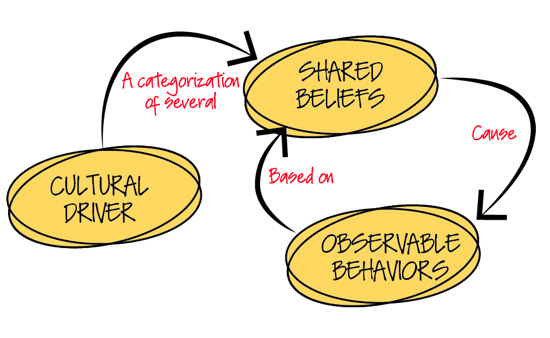
If you have ever visited a software shop where they turn out great products, you will have noticed the enthusiasm of the people for their work. You will also have noticed that these skilled people are given a working atmosphere that is conducive to their work. They feel safe to argue if they think they have a better answer; they are valued by their organisation, they are given an appropriate amount of time to do their tasks This is workplace culture. For the last two years, we, along with our partners in The Atlantic Systems Guild, have been writing a book on workplace culture. It is not the intention of this article to sell you a book (of course we would be delighted if you buy it) but to demonstrate some findings from our work. To have a useful view of culture, we identified six drivers of workplace culture. It is worth having a quick look at these drivers, because even a superficial glance will show you areas that you might work on to improve your own workplace culture, and thereby performance of the workplace.


Quote for the day:

"To do great things is difficult; but to command great things is more difficult." -- Friedrich Nietzsche

Daily Tech Digest - June 18, 2021

Does Cloud Computing Help or Harm the Environment?

Fortunately, getting data centers to rely on clean, renewable energy sources and use that energy more efficiently are far easier tasks than reducing the carbon footprint of the billions of digital storage devices that they've replaced. Here is where economic and environmental interests may overlap. Data center companies have every incentive to maximize the efficiency of their resources and reduce their cost. For that reason alone, the world's biggest data center companies—Amazon, Microsoft, and Google—have all begun implementing plans for their data centers to run on 100% carbon-free electricity. Amazon claims to be the world's largest renewable energy purchaser, consistent with its goals of powering its company with 100% renewables by 2025 and to become carbon net-zero by 2040. Microsoft has pledged to be carbon negative by 2030 and to remove from the atmosphere all the carbon the company has ever emitted since it was founded in 1975. To achieve this, it plans on having all of its data centers running on 100 renewable energy by 2025. And Google had already reached its 100% renewable energy target in 2018, though it did so in part by purchasing offsets to match those parts of its operations that still relied on fossil fuel electricity.


5 Keys to Creating a Zero-Trust Security Foundation

Recent high-profile attacks have disrupted global commerce across the world, bringing home the critical importance of maintaining a robust IT security program. The recent ransomware attacks on the Colonial Pipeline, the largest petroleum pipeline in the US, and meat supplier JBS, highlight the cascading, society-disrupting havoc these types of attacks can create. Those concerns increasingly extend to IoT devices, as evidenced by the recent hack of cloud-based security services firm Verkada, where bad actors gained access to 150,000 of the company’s cameras, including inside factories, hospitals, prisons, schools, and even police stations. Vulnerabilities come in many forms and we have known for a long time that the onslaught of IoT devices onto corporate networks is largely unprotected. It’s little wonder then that when the Ponemon Institute surveyed 4,000 security professionals and asked why breaches still happen, the top answer was the increasing attack surface. ... As a networking vendor, connecting people and things is part of Aruba’s core mission. 


4 ways AI can help us enter a new age of cybersecurity

Combine conventional threat intelligence (a list of all known cyberthreats to date) and use machine learning to understand risks. This should result in a better, more efficient system of threat detection and prevention. This can also help to identify any loophole or threat present in the data. In fact, machine learning can also be used to spot any abnormality or potential vulnerability in the midst of “normal” activity and warn users of a threat before it could compromise essential data. With the right systems in place, your hackers won't even realize that you know of their presence, so you can take immediate measures to ensure the safety of your digital infrastructure. ... In recent years, cryptocurrencies like Bitcoin and Ethereum have been rising in popularity. These cryptocurrencies are built upon blockchain, an innovative technical solution to store a secure, decentralized record of transactions. Blockchain can be used to enable medical records and help in security management by identifying criminal identity loopholes in the system. With blockchain technology, verification keys wouldn't be required anymore. If someone tries to hack the data, the system analyzes the whole mass of data chains. 


Moving From Digital Banking To Embedded Experiences

First and most importantly, banks and credit unions must focus on placing the consumer at the center of the organization, with product silos eliminated in favor of teams aligned around the customer journey. According to the research, 64% of the banking sector’s digital masters have “created personae and journey maps to identify and serve customers better.” Beyond that, it will be imperative to create an agility and flexibility in delivery similar to what exists in fintech and bigtech firms. This will most likely require changes in the composition of boards, top leadership and departmental management who can see banking from a new perspective. New operating models will also be required that will include the collaboration with third-party providers. There also needs to be support of open banking APIs that will enable the offering of new products both within and outside financial services. Bottom line, the infrastructure of banking as well as the perspective of banking’s role in the consumer’s life must change. According to Capgemini, 64% of banks are actively working with a wide ecosystem of partners – such as startups, incubators, technology firms, and even competitors – to co-develop solutions. 


Cybersecurity: Five key reminders for compliance teams

Cybersecurity breaches are not always the work of nefarious actors orchestrating a sophisticated hack. Damaging data breaches may be as likely to result from unintentional human error. Even seemingly benign behaviors –– using public Wi-Fi, neglecting to put passwords on computers and mobile devices, and clicking on bad links –– can be all it takes to give cybercriminals the access they need. It does little good to build a digital fortress if there aren’t adequate controls over who gains access, and under what circumstances. ... First, establishing clear SoD helps avoid conflicts that could lead to fraud or other abuse. For large organizations with multiple lines of business, this is particularly important. Investment professionals on a firm’s buy-side, for example, should not have access to the exact same data as those on the sell-side. SoD may also help prevent control failures that can occur when too many people have access to data for which they aren’t necessarily accountable for. By segregating duties (and data access), compliance teams are better positioned to spot weaknesses, while also ensuring that teams and individuals understand exactly what data should be in their purview and what may be off-limits.


The four Fs of employee experience

Ask yourself what it would take for employee experience to be a delight — for example, through gamified training modules or KPIs. We work with a leading technology firm that asked itself this very question and developed its tools for surveying employees accordingly, designing them to be simple and intuitive, satisfying, and not frustrating. The firm used layman’s terms and an appealing tone of voice in written content such as instructions, explanations, and requests. It avoided jargon. And it invested in interesting, stimulating visual interactions rather than ones that were bland and text-heavy — the new experience was less like a spreadsheet assignment to be endured and more of an opportunity to engage. ... Don’t neglect the foundations. Ultimately, employees have a right to expect that “it just works,” whether “it” is their human resources self-service portal, their expense management system, or their system interoperability. It’s also critical that user experience be accessible to all, including employees with any type of disability. 


Amex bets on AI and NLP for customer service

We started this journey [of leveraging AI] long before we applied machine learning to some other more mature use cases, including our fraud models and some credit risk models. And in the past couple years, especially in the past five years or so, we started to see with certainty that deep neural network models started to outperform almost every other machine learning model when it comes to high dimensional data and highly unstructured data. We not only deal with some of the traditional fields, like customer transactions, but also there are tax consequences and volume history data. Neural network models can effectively deal with all of that. ... First, I think it’s really about recognizing patterns. And if you look at certain use cases where you have customer behavior that’s being repeated and you can expedite that behavior, then that tends to be a real sweet spot for machine learning capabilities. The other thing I would add is we take the decision to apply machine learning techniques quite seriously. We have an entire AI governance board that cross-checks all the models that we build for bias and privacy concerns. So even taking the approach of AI, we have to justify to a number of internal teams why it makes sense.


‘Debt’ as a Guide on the Agile Journey: Technical Debt

If network infrastructure is not your specialty, you might question how much requirements for connectivity could really change over 10 years? Does the Network Team really need to develop a completely new solution and live the DevOps dream? The answer to that is a resounding yes! Today’s (not to mention tomorrow’s) requirements for security features and performance are significantly different from 10 years ago; the network infrastructure is key in the cyber security area of protecting vital business processes and applications by controlling data traffic, and the network must support the vastly increasing amount of data traffic that is the result of new streaming and IoT services, for instance. The Network Team was not able to deliver to these expectations with the legacy technology that we were fighting to operate and maintain, and thus, the business was impacted. Internally, the Network Team themselves were also impacted. They felt the heat from several CXOs who were frustrated that they couldn't satisfactorily support top priorities such as the cyber security agenda.


Deep reinforcement learning will transform manufacturing as we know it

For many large systems, the only possible way to find the best action path is with simulation. In those situations, you must create a digital model of the physical system you want to understand in order to generate the data reinforcement learning needs. These models are called, alternately, digital twins, simulations and reinforcement-learning environments. They all essentially mean the same thing in manufacturing and supply chain applications. Recreating any physical system requires domain experts who understand how the system works. This can be a problem for systems as small as a single fulfillment center for the simple reason that the people who built those systems may have left or died, and their successors have learned how to operate but not reconstruct them. Many simulation software tools offer low-code interfaces that enable domain experts to create digital models of those physical systems. This is important, because domain expertise and software engineering skills often cannot be found in the same person.


Multicluster Management with Kubernetes and Istio

Do you have multiple Kubernetes clusters and a service mesh? Do your virtual machines and services in a Kubernetes cluster need to interact? This article will take you through the process and considerations of building a hybrid cloud using Kubernetes and an Istio Service Mesh. Together, Kubernetes and Istio can be used to bring hybrid workloads into a mesh and achieve interoperability for multicluster. But another layer of infrastructure — a management plane — is helpful for managing multicluster or multimesh deployments. ... Using Kubernetes enables rapid deployment of a distributed environment that enables cloud interoperability and unifies the control plane on the cloud. It also provides resource objects, such as Service, Ingress and Gateway, to handle application traffic. The Kubernetes API Server communicates with the kube-proxy component on each node in the cluster, creates iptables rules for the node, and forwards requests to other pods. Assuming that a client now wants to access a service in Kubernetes, the request is first sent to the Ingress/Gateway, then forwarded to the backend service 


Quote for the day:

"A good leader can't get too far ahead of his followers." -- Franklin D. Roosevelt

Daily Tech Digest - June 17, 2021

A Deep Dive Into Efinity: Next-Generation Blockchain for NFTs

Efinity will be a hub for all fungible and non-fungible tokens, meant to serve and benefit all participants in the digital asset space—collectors, creators, artists, decentralized app (dApp) developers, enterprises, sports teams, and more. The Enjin ecosystem is robust, with a wide range of projects and developers using our products to create, distribute, and integrate NFTs with their projects. Over 1.14 billion digital assets have already been created with Enjin. All of these tokens can benefit from the cost efficiency, speed, and next-generation features of Efinity—and that’s only the existing Enjin ecosystem. We believe Efinity will do for the wider NFT ecosystem what ERC-1155 did for Ethereum: make NFTs even more accessible to everyone. We expect end-users to create NFTs with the same ease and as intuitively as they take a picture with a smartphone today; trade NFTs faster than they can purchase something from Amazon; and most importantly, use those tokens in a myriad of futuristic ways. It’s up to companies and developers across the world to give that next-gen utility to NFTs, and truly unlock their power to the masses.


A Look at a Zero Trust Strategy for the Remote Workforce

If you are new to the security world, it is fair to ask yourself, “Isn’t access to data and systems always conditional? Isn’t it always granted to someone who has access to the credentials (ID and password)?” True enough, but in totality, the approach to managing access encompasses a broader spectrum of privacy policies. These policies include a mix of different strategies that can be applied based on an organization’s security vulnerabilities. Conditional access is one such security management practice that many companies have opted for. The shift to smart mobile devices and cloud has made it necessary to ensure conditional access. Further, this has become imperative, as remote working is here to stay. With several companies making announcements about permanent work-from-home policies, a zero-trust model of conditional access has become crucial. IT security teams must be prepared to both validate and verify devices and users with a set of automated policies. IT teams could easily monitor incoming IP addresses as the first step for identifying credentials. However, growing use of VPNs coupled within a remote working environment is making that impossible, thus rendering organizations more vulnerable to threats.


Most firms face second ransomware attack after paying off first

The majority of businesses that choose to pay to regain access to their encrypted systems experience a subsequent ransomware attack. And almost half of those that pay up say some or all their data retrieved were corrupted. Some 80% of organisations that paid ransom demands experienced a second attack, of which 46% believed the subsequent ransomware to be caused by the same hackers. Amongst those that paid to regain access to their systems, 46% said at least some of their data was corrupted, according to a Cybereason survey released Wednesday. Conducted by Censuswide, the study polled 1,263 security professionals in seven markets worldwide, including 100 in Singapore, as well as respondents in Germany, France, the US, and UK. Globally, 51% retrieved their encrypted systems without any data loss, while 3% said they did not regain access to any encrypted data. The report revealed that one particular organisation reportedly paid up a ransomware amount in the millions of dollars, only to be targeted for a second attack by the same attackers within a fortnight.


Top 10 Security Risks in Web Applications

Injection or SQL injection is a type of security attack in which the malicious attacker inserts or injects a query via input data (as simple as via filling a form on the website) from the client-side to the server. If it is successful, the attacker can read data from the database, add new data, update data, delete some data present in the database, issue administrator commands to carry out privileged database tasks, or even issue commands to the operating system in some cases. ... It is a case where the authentication system of the web application is broken and can result in a series of security threats. This is possible if the adversary carries out a brute force attack to disguise itself as a user, permitting the users to use weak passwords that are either dictionary words or common passwords like “12345678”, “password” etc. This is so common because shockingly 59% of the people use the same passwords on all websites they use. Moreover, 90% of the passwords can be cracked in close to 6 hours! Therefore, it is important to permit users to use strong passwords with a combination of alphanumeric and special characters. This is also possible due to credential stuffing, URL rewriting, or not rotating session IDs.


A Google AI Designed a Computer Chip as Well as a Human Engineer—But Much Faster

Human designers thought “there was no way that this is going to be high quality. They almost didn’t want to evaluate them,” said Goldie. But the team pushed the project from theory to practice. In January, Google integrated some AI-designed elements into their next-generation AI processors. While specifics are being kept under wraps, the solutions were intriguing enough for millions of copies to be physically manufactured. The team plans to release its code for the broader community to further optimize—and understand—the machine’s brain for chip design. What seems like magic today could provide insights into even better floorplan designs, extending the gradually-slowing (or dying) Moore’s Law to further bolster our computational hardware. Even tiny improvements in speed or power consumption in computing could make a massive difference. “We can…expect the semiconductor industry to redouble its interest in replicating the authors’ work, and to pursue a host of similar applications throughout the chip-design process,” said Kahng.

Jensen Huang On Metaverse, Proof Of Stake And Ethereum

For a long time now, Proof of stake has been baffling people interested in crypto and its application in various platforms like Twitter and Project Bluesky. Jensen’s views on the matter have also been favourable to the concept that might replace proof of work in blockchain shortly. He said that the demand for Ethereum had reached such a level that it would be nice to have another method of confirming transactions. “Ethereum has established itself. It now has an opportunity to implement a second generation that carries on that platform approach and all of her services that are built on top of it, he added” Jensen also explained that the reason behind the development of Nvidia’s CMP was the expectation that a lot of Ethereum coins will be mined. CMP has enough functionality that it can be used for crypto mining. ... Addressing the question of how long the chip shortage will last, Jensen said that demand has been growing up consistently, and Nvidia particularly has had pent-up demand since it had reset and reinvested computer graphics, a driving factor in skyrocketing demand. 


Prioritizing and Microservices

Microservices frequently need to communicate with one another in order to accomplish their tasks. One obvious way for them to do so is via direct, synchronous calls using HTTP or gRPC. However, using such calls introduces dependencies between the two services involved, and reduces the availability of the calling service (because when the destination service is unavailable, the calling service typically becomes unavailable as well). This relationship is described by the CAP theorem (and PACELC) which I've described previously. .... If any response is necessary, the processing service publish an event, which the initiating service can subscribe to and consume. ... The issue with this approach is that the prioritization is only applied at the entrance to the system, and is not enforced within it. This is exacerbated by the fact that the report orchestrator has no FIFO expectation and in fact can begin work on an arbitrary number of commands at the same time, potentially resulting in a very large amount of work in process (WIP). We can use Little's Law to understand how WIP impacts the time it takes for requests to move through a system, which can impact high priority SLAs. Constraining total WIP on the system, or at least on the orchestrator, would mitigate the issue.


Cloud Outage Fallout: Should You Brace for Future Disruption?

The outage also put other topics in focus that might not have received consistent attention in the past. Though DevOps is frequently talked about in enterprise development circles, Bates questions to what degree it is being implemented. “If we can truly get to a DevOps world, securing development and operations, it’s going to help a lot,” he says. “We talk very glibly about DevOps, but we don’t ask the really hard questions about if anyone is really doing this.” Taken into context of sudden moves to the cloud in response to the pandemic, the Fastly outage was a relatively quick blip, says Drew Firment, senior vice president of transformation with cloud training platform A Cloud Guru. The incident does offer a moment for reflection for organizations. “Folks are looking at their cloud architecture,” he says. “Architecture equals operations.” As organizations build in the cloud, decisions on cloud providers and services can have a dramatic effect on resiliency, Firment says. “That’s why cloud architects are in such demand, especially if they can take those things into consideration.”


Proactive and reactive: symbiotic sides of the same AI coin

Artificial Intelligence (AI) as a phrase is bandied about to refer to any number of technologies currently in use. And it’s not that this is wrong per se, but it’s like referring to rustic Italian cuisine and molecular gastronomy simply as “food”. The world would be a poorer place without either, but they serve entirely separate purposes for the palate. According to Gartner, “By 2025, proactive (outbound) customer engagement interactions will outnumber reactive (inbound) customer engagement interactions.” The distinction being made here is the AI as it is designed for use in the reactive realm (think chatbots) vs. the use case of proactive engagement. While the core technology that underlies both may be similar, and both have specific use cases, proactive engagement is a more focused utilisation. If you have ever attempted to play the game ‘Twenty Questions’, you have had an inkling of what a chatbot is attempting to do, i.e., asking a series of questions of an individual in an effort to get at an answer. Except in the case of chatbots, you are usually playing the game with an irate customer in a negative frame of mind. 


Are your cryptographic keys truly safe? Root of Trust redefined for the cloud era

When you are working with cloud infrastructure, the hardware (and in many cases also the software) is not under your control. This is also true of cloud-based HSMs provided by cloud service providers (CSPs). You need to look no further than the CLOUD Act to realize that your CSPs have immediate access to your keys and data. This is not theoretical access – this report published by Amazon details the law enforcement data requests with which Amazon complied over a six month period in 2020. It’s not a big jump to imagine an insider at your CSP exploiting this ability to expose your keys. While CSPs make genuine efforts to secure their hardware under the Shared Responsibility Model, the nature of the beast is that using third-party infrastructure also leaves you vulnerable to supply chain attacks. Consider the attack on SolarWinds and imagine the repercussions of your CSP – and by extension you – falling victim to such a large-scale supply chain attack. It’s clear that the implementation of Root of Trust as a purely hardware solution deployed in a single location needs to move with the times.


Quote for the day:

"No person can be a great leader unless he takes genuine joy in the successes of those under him. -- W. A. Nance

Daily Tech Digest - June 16, 2021

Cloud investments slow to deliver ‘substantial’ benefit for many companies

“After a decade of cloud experience, organizations are facing a talent shortage for all cloud-related skills,” Forrester said in a March 2020 report. “Although legacy skill sets translate well to new cloud technologies, the cultural leap to evaluate, select, and operate for productivity, system-level efficiency, and workload-specific problem solving is proving to be a challenge. Enterprise attempts to hire and train talent are constantly plagued with poaching by the cloud vendors themselves.” Other barriers stand in the way of successful cloud technology implementations. According to PwC, trust-related considerations like a cloud’s impact on customer commitments or regulatory compliance are considered either too late or not all. Only 17% of risk management leaders responding to the firm’s survey said they’re involved at the start of cloud projects. And 55% of chief human resource officers see changes to processes and ways of working as significant issues when it comes to the cloud. ... It comes as no surprise that members of the C-Suite are more involved than before in cloud adoption efforts, given the amount of capital at stake.


Why a Serverless Data API Might be Your Next Database

App development stacks have been improving so rapidly and effectively that today there are a number of easy, straightforward paths to push code to production, on the cloud platform of your choice. But what use are applications without the data that users interact with? Persistent data is such an indispensable piece of the IT puzzle that it’s perhaps the reason the other pieces even exist. Enter cloud and internet scale requirements, essentially mandating that back-end services must be independently scalable / modular subsystems to succeed. Traditionally, this requirement has been difficult in the extreme for stateful systems. No doubt, database as-a-service (DBaaS) has made provisioning, operations, and security easier. But as anyone who has tried to run databases on Kubernetes will tell you: auto scaling databases, especially ones that are easy for developers to use, remain out of reach for mere mortals. Serverless data offers enticing benefits, but market offerings are limited. What serverless data can, should, or could do for us isn’t always well understood. And yet, database simplicity for application developers today is increasingly taking a new form: autoscaling database services that are delivered as fluent, industry standard APIs -- APIs that are secure, well documented, easy to use, and always on.


Making Your Life Easier with C# Scripting

if you've installed Visual Studio, then you already have a perfectly good CS-Script environment: CSI.EXE (I found my copy in C:\Users\<user name>\Source\ExchangeControl.WebService\bin\roslyn). You can create a CS-Script command environment by just opening the Developer Command Prompt for Visual Studio and typing CSI. Once the window has re-displayed the command prompt, you can start entering and executing CS-Script. You're not limited to single C# statements with the CSI prompt: Statements that you enter in the CSI environment build on previous statements you've entered. ... Even more useful is the CS-Script REPL window (Read-Evaluate-Print-Loop) that you can open by going to Visual Studio's View | Other Windows menu choice and selecting C# Interactive. In that window you can now enter CS-Script code and just hit the <Enter> key to have it execute. There are a couple of disappointments here, though. It might make sense to try out classes and their members from the interactive window. However, just because the window has opened in Visual Studio while your solution is open, it doesn't mean the window knows anything about the classes defined in the current solution. In fact, the window's default folder isn't even your current solution's folder.


New threat & vulnerability management APIs - create reports, automate, integrate

Customized reports and dashboards enable you to pool the most meaningful data and insights about your organization’s security posture into a more focused view based on what your organization or specific teams and stakeholders need to know and care about most. Custom reports can increase the actionability of information and improve efficiencies across teams, because it reduces the workload of busy security teams and allows them to focus on the most critical vulnerabilities. Before building custom views using tools such as PowerBI and Excel, you can enrich the native datasets provided by Microsoft’s threat and vulnerability management solution with additional data from Microsoft Defender for Endpoint or a third-party tool of your choice. In addition, these reports/dashboards give you an easy way to report key information and trends to top management to track business KPIs and provide meaningful insights on the overall status of the vulnerability management program in your organization. With a custom interface you can show the information that your teams need and nothing more, creating a simpler task view or list of day-to-day work items. 


Combining classical and quantum computing opens door to new discoveries

The research team from IQC in partnership with the University of Innsbruck is the first to propose the measurement-based approach in a feedback loop with a regular computer, inventing a new way to tackle hard computing problems. Their method is resource-efficient and therefore can use small quantum states because they are custom-tailored to specific types of problems. Hybrid computing, where a regular computer's processor and a quantum co-processor are paired into a feedback loop, gives researchers a more robust and flexible approach than trying to use a quantum computer alone. While researchers are currently building hybrid, computers based on quantum gates, Muschik's research team was interested in the quantum computations that could be done without gates. They designed an algorithm in which a hybrid quantum-classical computation is carried out by performing a sequence of measurements on an entangled quantum state. The team's theoretical research is good news for quantum software developers and experimentalists because it provides a new way of thinking about optimization algorithms. 


Critical Factors for Managing Applications and Kubernetes at the Edge

As 5G wireless finds ubiquity, and as more connected devices on the Internet of Things (IoT) begin using wireless communications, data volumes and data rates are also increasing. While these two factors are somewhat independent, together they increase the demand for applications on the edge by orders of magnitude. This demand for speed means that the old model for a central database slowly reacting to application queries from a variety of sources is now being replaced with both applications and data located at the network edge where they can respond quickly to a vast flow of inputs. Containerized, microservice applications that support this flow must be where they can handle it, which means that they, too, must be at the edge. Kubernetes is the industry’s tool of choice for container orchestration, however, when moving containers to the edge, additional Kubernetes management complications appear. Deployment, security, and fleet management processes all become exponentially more complex given the number of clusters that need to be managed is now measured by the hundreds.


Out in IT: A work-in-progress for the LGBTQ+ community

It’s hard to know exactly how underrepresented because to date, the industry hasn’t focused on tracking LGBTQ+ employment, and companies are only now starting to offer self-identification opportunities to get greater transparency into the makeup of their employee base. While identifying gender and race is a common part of the onboarding process at most companies, sexual orientation and gender identity are not, which makes it all the more difficult to gather metrics. Because the decision to share that status is voluntary, LGBTQ+ employees have a different experience than other “visible” minorities, says Jeff Raver (he/him), a top-level IT executive, who openly identifies as gay. “Gay people must choose to share who they are and this affects people in multiple ways,” says Raver, vice president of strategy, growth, and innovation at SAIC. “Since teams may not know they are working with an LGBTQ co-worker, both unintentional and intentional bias becomes a greater challenge. Additionally, the stress of not sharing your authentic self requires substantial energy and can become a huge distraction for LGBTQ persons that choose to remain in the closet.”


SAFe is a marketing framework, not an Agile scaling framework

SAFe tells a story that resonates with the existing worldview of numerous corporations. The SAFe narrative fits snugly with the existing command & control paradigm of many large companies. You can keep on doing what you did before, shuffle some teams, we’ll throw in some fancy new labels and POOF! now you’re Agile. Doesn’t that sound amazing? No hard work necessary, yet you’ll still have the same magnificent results? That’s the promise and appeal of SAFe. The SAFe acronym was carefully picked to seem risk-free. SAFe sells the illusion you can radically change while staying in your comfort zone. As nice as it sounds, deep down we all know it isn’t true. Radical change is never easy. Agile is a new paradigm that requires you to fundamentally change how you work. Most corporations are not up for those kind of drastic changes and that’s perfectly understandable. For them SAFe offers an alluring but ultimately inconsequential alternative. SAFe offers what corporations are familiar with and are able to recognize. That’s exactly why it’s bound to fail. Working in a new paradigm should feel uncomfortable and uncertain until the moment it doesn’t.


How can banks harness automation to its fullest value?

Automation technologies could contribute an additional $US 1 trillion annually in value across the global banking sector – through increased sales, cost reduction and new or unrealized opportunities. But this value is still largely being left on the table. Why? There are well documented challenges with automation, including lack of clear and strategic intent and senior executive support for automation, plus heavily siloed deployment within organisations, resulting in disconnects within and across digital transformation efforts. To be frank, operating models are, per se, neither enable nor ask for strategic use of automation technologies. But a hidden key reason has become increasingly obvious – the failure to grasp the nature and size of the opportunity. If automation technologies can be recombined in new ways, not only can existing opportunities be seized, but new ones can be created, ad infinitum. Prescient banking executives we are researching understand two things: the strategic opportunities offered by intelligent automation; and how automation can drive the twin engines of compound growth and combinatorial innovation. 


3 Ways CIOs Can Enable Innovation Within a Hybrid Workforce

Plan everything intentionally. Design floats luck to the shore; otherwise luck just lies in the offshore mud and waves feebly at the beach. The best virtual gatherings of 2020 were the planned ones -- the games of charades, the holiday meals where people shared recipes and made them independently, the weddings where guests attended, however briefly, when they never could have in person. Fewer meetings can make for better innovation if parts of the process are aligned to the best ways to achieve them. (Workers tell us they spend 8+ hours a week in meetings, on average; help them cut that time by making the meeting time they do spend the most productive it can be.) Make plans that bring people together for the tasks that demand shared presence but also encourage them to share endeavors they might not have been able to foresee. CIO to-do: Show executives the menu of meeting types that they can choose from and model the best behavior in selection by demanding that any meeting have a reason to happen when it does and a reason to include everyone invited. Require participants to set for themselves a role they’ll play in the meeting.


Quote for the day:

"Added pressure and responsibility should not change one's leadership style, it should merely expose that which already exists." -- Mark W. Boyer

Daily Tech Digest - June 15, 2021

How the public sector can accelerate digital discovery

Firstly, public bodies should focus on outcomes rather than output. By identifying where an immediate impact can be made to address the challenges of legacy technology – rather than trying to fix everything at once – you can empower digital partners and discovery teams to identify issues and make key decisions without blockers from other teams, existing structures or business areas. Removing this red tape will mean decisions and actions will be taken at a pace, delivering greater value and results in the process, rather than creating complicated services that users struggle to navigate. The next focus to enhance digital discovery should be diversity, building and working with project teams that cover a wide range of disciplines and skill sets, as well as ages, races and genders. Increased diversity means that a discovery team benefits from different experiences and frames of reference, helping to avoid conformity and a groupthink mentality, which can result in issues being missed or solutions not being considered as everyone is thinking on the same page. For example, including people from non-digital backgrounds in a discovery team, such as service users, will help to identify problems that otherwise may be missed. 


Delivering the Highest Quality of Experience in a Multi-Cloud World

The global pandemic has accelerated enterprise IT teams’ desire to simplify the management of complex multi-cloud and edge environments and operate them holistically as a single WAN. It is also driving IT requirements for delivering the highest levels of application performance for all their cloud-hosted business applications, from any network in the emerging post-pandemic environment. This shift is intensifying the urgency to transform conventional data center and MPLS-centric and VPN-based networks to a more modern hybrid SD-WAN environment that combines MPLS and internet with secure managed internet-based cloud services. In a hybrid WAN environment, application performance across a WAN can vary considerably from site to site or region to region because of underlying factors such as latency, packet loss and jitter that must be taken into consideration, especially using a mix of MPLS and broadband connectivity services. The Aruba EdgeConnect SD-WAN edge platform, acquired with Silver Peak, supports advanced visibility, routing, control and intent-based policy management for any application – thereby improving the performance and availability of business applications by dynamically routing traffic to virtually any site, automatically adapting to real-time network conditions.


Intelligence gathering: Bringing AI technology into strategic planning

While theories governing corporate strategy have been debated (and sometimes overthrown) over the years, real time strategy focuses on modernizing an aspect that has practically been left untouched: methodology. AI techniques, which include machine learning, can import data from an abundance of sources, identify patterns and trends, and supply insights for decision-makers. In the process, AI-enabled planning upends traditional processes that depend on (and are affected by) human bias. Too often, the authors point out, current strategic decisions are based on information that is flawed across multiple dimensions (e.g., completeness, accuracy) and end up being unduly influenced by intuition and experience. During the exhaustive process of devising a plan, many assumptions and hypotheses are undeservedly promoted to “facts,” especially if they help dim uncertainty. The result: strategic plans that gain consensus, but emerge with a blandness akin to vision statements—and no mechanism for consistent follow-up. Without alignment among business units as to how each defines success, even companies that have embraced AI can end up stalled on the AI maturity curve, unable to progress beyond early victories in cost reductions and productivity gains.


Unique TTPs link Hades ransomware to new threat group

Researchers claim to have discovered the identity of the operators of Hades ransomware, exposing the distinctive tactics, techniques, and procedures (TTPs) they employ in their attacks. Hades ransomware first appeared in December 2020 following attacks on a number of organizations, but to date there has been limited information regarding the perpetrators. ... The findings are a result of incident response engagements carried out by Secureworks in the first quarter of 2021. “Some third-party reporting attributes Hades to the Hafnium threat group, but CTU research does not support that attribution,” the researchers wrote. “Other reporting attributes Hades to the financially motivated Gold Drake threat group based on similarities to that group’s WastedLocker ransomware. Despite use of similar application programming interface (API) calls, the CryptOne crypter, and some of the same commands, CTU researchers attribute Hades and WastedLocker to two distinct groups as of this publication.” ... “Typically, when we see a variety of playbooks used around a particular ransomware, it points to the ransomware being delivered as ransomware-as-a-service (RaaS) with different pockets of threat actors using their own methods,"Marcelle Lee, senior security researcher, CTU-CIC at Secureworks, tells CSO.


AI: It’s Not Just For the Big FAANG Dogs Anymore

“Previously, building models, building features, was extremely difficult” and typically required a data scientist. “But today, particularly for SMEs, this type of automation tool can help those aspects a lot…Our type of automation is definitely helping them to ramp up the speed of their AI journey.” Fujimaki noted how one of dotData’s smaller customers was able to build AI solutions without a huge investment. The company, Sticky.io, develops a subscription management service that is provided to other businesses as a SaaS offering. It wanted to add a predictive capability to identify payments that were likely to fail. “For them, the biggest barrier was…skill,” Fujimaki tells Datanami. “They are a cloud-native company, so the data is stored in AWS. On the AI side, they didn’t have data scientists, so they needed AutoML functionality.” Sticky.io’s product manager was able to use dotData to comb through their data and identify the right features that would go into the predictive model. Even though he didn’t posses preexisting talents in data science, the pilot was a success, and Sticky.io’s leadership recognized the value that it brought. “The most important skill that [customers] have to have is the input side and output side,” Fujimaki says. 


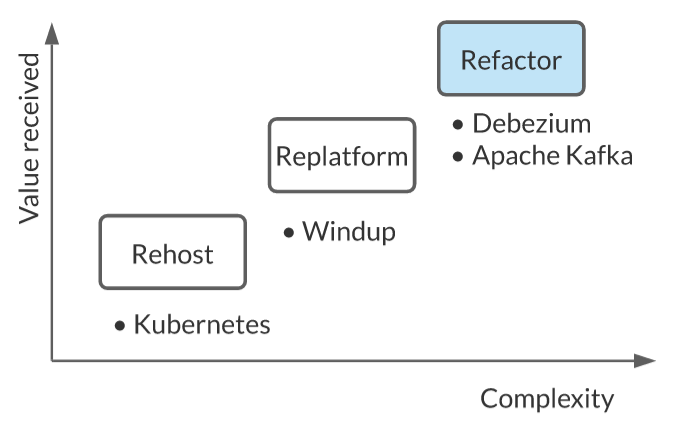
Application modernization patterns with Apache Kafka, Debezium, and Kubernetes

The very first question is where to start the migration. Here, we can use domain-driven design to help us identify aggregates and the bounded contexts where each represents a potential unit of decomposition and a potential boundary for microservices. Or, we can use the event storming technique created by Antonio Brandolini to gain a shared understanding of the domain model. Other important considerations here would be how these models interact with the database and what work is required for database decomposition. Once we have a list of these factors, the next step is to identify the relationships and dependencies between the bounded contexts to get an idea of the relative difficulty of the extraction. Armed with this information, we can proceed with the next question: Do we want to start with the service that has the least amount of dependencies, for an easy win, or should we start with the most difficult part of the system? A good compromise is to pick a service that is representative of many others and can help us build a good technology foundation. That foundation can then serve as a base for estimating and migrating other modules. 


Understanding AIOps – separating fact from fiction

AIOps is much more than another buzzword or a simple tool to correlate incidents. When implemented properly, AIOps can detect anomalies automatically and help remediate and prevent incidents before they impact end-users and customers. Once anomalies or incidents are detected, it takes a further step and provides structured analysis and detail on what these issues are and what the root cause is. This allows the IT team to understand the problem within minutes, and fix it faster, preserving user experience and avoiding disruptions to the business. This is observability in action. When working with telemetry data, AIOps can pick the right team to alert of issues it detects early, and provide actionable insights so that operations become more efficient and DevOps teams can focus on innovation, rather than spending non-productive time reactively troubleshooting problems. ... There is no real reason why a smaller teams could not use AIOps to differentiate their business and correct operational issues and also decrease human burden. In fact for small teams, AIOps can help to quickly discover issues and decrease pressure on already busy teams who need to eliminate toil to focus on value creation.


Data Scientists Will be Extinct in 10 Years

Data scientists will be extinct in 10 years (give or take), or at least the role title will be. Going forward, the skill set collectively known as data science will be borne by a new generation of data savvy business specialists and subject matter experts who are able to imbue analysis with their deep domain knowledge, irrespective of whether they can code or not. Their titles will reflect their expertise rather than the means by which they demonstrate it, be it compliance specialists, product managers or investment analysts. We don’t need to look back far to find historic precedents. During the advent of the spreadsheet, data entry specialists were highly coveted, but nowadays, as Cole Nussbaumer Knaflic (the author of “Storytelling With Data”) aptly observes, proficiency with Microsoft Office suite is a bare minimum. Before that, the ability to touch type with a typewriter was considered a specialist skill, however with the accessibility of personal computing it has also become assumed. Lastly, for those considering a career in data science or commencing their studies, it may serve you well to constantly refer back to the Venn diagram that you will undoubtedly come across.


Cisco bolts together enterprise and industrial edge with new routers

As organizations accelerate digitization, they need a way to simplify management and security across the network and edge devices. "With our new routing portfolio, customers can have a united architecture across their diverse edge use cases from HQ to remote edges. The same rich functionality and robust security models across your entire business – from campuses and branch offices to substations, remote operating locations, fleets, on-the-go connected assets," wrote Butaney. "Now utilities can securely connect their edge to reduce outages, integrate renewables, and improve grid resiliency. Transportation systems providers can optimize routes for first responders and share real-time location and safety information with travelers. Whatever your business, you can connect all your networks with one common architecture and holistic enterprise-wide security approach," Butaney stated. The modular routers, including the Catalyst IR8100, IR8100 Heavy Duty Series and IR8300 Rugged Series Router, can be customized, and all can have storage or CPUs upgraded in the field.


Quick and Seamless Release Management for Java projects with JReleaser

The original mission of JReleaser is to streamline the release and publishing process of Java binaries in such a way that these binaries may be consumed by platform-specific package managers, that is, provide a ZIP, TAR, or JAR file. JReleaser will figure out the rest, letting you publish binaries to Homebrew, Scoop, Snapcraft, Chocolatey, and more. In other words, JReleaser shortens the distance between your binaries and your consumers by meeting them where they prefer to manage their packages and binaries. Early in JReleaser’s design, it became apparent that splitting the work into several steps that could be invoked, individually or as one single unit, would be a better approach than what GoReleaser offers today. This design choice allows developers to micromanage every step as needed to hook-in JReleaser at a specific point of their release process without having to rewrite everything. For example, you can fire up JReleaser and have it create a Git release (GitHub, GitLab, or Gitea) along with an automatically formatted changelog, or you can tell JReleaser to append assets to an existing Git release that was created by other means, or perhaps you’re only interested in packaging and publishing a package to Homebrew regardless of how the Git release was created.


Quote for the day:

"Whenever you see a successful business, someone once made a courageous decision." -- Peter F. Drucker