Showing posts with label Artificial Reality. Show all posts

Daily Tech Digest - September 13, 2022

Data Analytics: The Ugly, But Crucial Step CEOs Can’t Ignore

Leaders only need to look around to see that the best CEOs are making data central to their business. This has become even more important as companies grapple with rising costs. Good data analytics allow companies to stay on top of their purchases and to roll costs over to their customers, a capability that is proving highly valuable these days in the manufacturing and automotive industries. Companies with low data maturity tend to keep data siloed, using different criteria across departments to collect and interpret it. This leads to missed opportunities from not integrating data to generate information at a granular level. They may know if they just had a good month but are not able to see how that breaks down on a per-item level or how it compares to other periods to give them a better understanding of “why” they had a good month and how they might be able to proactively make decisions to repeat or even further improve results. One manufacturing firm we know recently employed analytics to clean up its data and for the first time obtain a SKU-level visualization of the profitability of each item it sold.


Extended reality — where we are, what’s missing, and the problems ahead

What’s missing for immersion in the VR/MR is full-body instrumentation so you can move and interact in the virtual world(s) as you would in the real world. Hand scanning with cameras on a headset has not been very reliable and the common use of controllers creates a disconnect between how you want to interact with a virtual world and how you must react with it. This is particularly problematic with MR because you use your naked hand for touching real objects and the controller for touching rendered objects, which spoils the experience. Haptics, which Meta and others are aggressively developing, are only a poor stop-gap method; what’s needed is a way to seamlessly bring a person into the virtual world and allow full interaction and sensory perceptions as if it were the real world. AR standalone has had issues with occlusion, which are being worked on by Qualcomm and others. When corrected, rendered objects will look more solid and less like ghostly images that are partially transparent. But the use cases for this class are very well developed, making this the most attractive solution today.


Global companies say supply chain partners expose them to ransomware

Mitigation of ransomware risk should start at the organization level. “This would also help to prevent a scenario in which suppliers are contacted about breaches to pressure their partner organizations into paying up,” according to the research. In the last three years, 67% of respondents who had been attacked experienced this kind of blackmail to force payment. While ransomware mitigation starts inside the firewall, the research suggests that it must then be extended to the wider supply chain to help reduce the risk from the third-party attack surface. One of the best practices to reduce risk is to gain a comprehensive understanding of the supply chain itself, as well as corresponding data flows, so that high-risk suppliers can be identified. “They should be regularly audited where possible against industry baseline standards. And similar checks should be enforced before onboarding new suppliers,” according to the research. Some of the other practices include scanning open-source components for vulnerabilities/malware before they are used and built into CI/CD pipelines, running XDR programs to spot and resolve threats before they can make an impact, running continuous risk-based patching and vulnerability management.


Playwright: A Modern, Open Source Approach to End-To-End Testing

Contrary to other solutions, Playwright doesn’t use the WebDriver protocol. It leverages the Chrome DevTools protocol to communicate with Chromium browsers (Chrome/Edge) directly. This approach allows for more direct and quicker communication. Your tests will be more powerful and less flaky. But Playwright doesn’t stop at Chromium browsers. The team behind the project understood that cross-browser tests are essential for an end-to-end testing solution. They’re heavily invested in providing a seamless experience for Safari and Firefox, as well, and even Android WebView compatibility is in the works. Testing your sites in Chrome, Edge, Firefox and Safari is only a configuration matter. And this saves time and headaches! It’s not only about automating multiple browsers, though. If your tests are hard to write because you have to place countless “sleep” statements everywhere, your test suite will take hours to complete and become a burden. To avoid unnecessary waits, Playwright comes with “auto-waiting.” The idea is simple: Instead of figuring out when a button is clickable by yourself, Playwright performs actionability tests for you.


7 ways to create a more IT-savvy C-suite

Carter Busse, CIO at intelligent automation platform provider Workato, stresses the importance of networking with management peers. Each interaction provides an opportunity to ask questions, listen, and share information and insights. “We lack a water cooler in this remote world, but setting up biweekly meetings with my peers helps me understand their priorities and gives me an opportunity to communicate key knowledge,” Busse says. “These meetings also help build the trust that’s so crucial for success as a CIO.” Knowledge communicated to management peers should align with the enterprise’s basic mission. “As CIOs, we need to share our knowledge of the business first, followed by how the technology initiatives our team is working on are aligned with the company mission,” Busse says. “It’s important to work on a shared level of understanding first to ensure that the message lands.” ... Every enterprise leader has a different relationship to technology as well as a different level of IT knowledge. Creating personalized discussions, specific to both the enterprise and the leader’s role, will help develop a more tech-savvy C-suite, which can lead to improved support and adoption of proposed IT solutions.


Consider a mobile-first approach for your next web initiative

When going mobile first, it’s important to remember that content is king. Designers should focus on surfacing exactly the content a user needs and nothing more. Extra elements tend to distract from the user’s focus on the current task, and productivity suffers when screen real estate is limited. So, while it is typical to show all the options on a desktop view, well-designed mobile applications use context to decide what to show when and just as importantly, what not to show. It doesn’t mean mobile users can’t get to all those fine-grained options, it just means those options that don’t generally support the main use case are hidden behind low-profile UI constructs like collapsible menus and accordions. ... While more common in B2C apps, in recent years many B2B organizations are also taking advantage of mobile-first strategies. Because mobile-first development prioritizes the smallest screen, it effectively shifts focus and tough conversations around core functionality left. By starting with deciding how an app will look and operate on a smartphone before moving on to larger screens and devices, developers, designers and product owners quickly get alignment on what matters to users and customers.


AI Risk Intro 1: Advanced AI Might Be Very Bad

No one knows for sure where the ML progress train is headed. It is plausible that current ML progress hits a wall and we get another “AI winter” that lasts years. However, AI has recently been breaking through barrier after barrier, and so far does not seem to be slowing down. Though we’re still at least some steps away from human-level capabilities at everything, there aren’t many tasks where there’s no proof-of-concept demonstration. Machines have been better at some intellectual tasks for a long time; just consider calculators which are already superhuman at arithmetic. However, with the computer revolution, every task where a human has been able to think of a way to break it down into unambiguous steps (and the unambiguous steps can be carried out with modern computing power) has been added to this list. More recently, more intuition- and insight-based activities have been added to that list. DeepMind’s AlphaGo beat the top-rated human player of Go (a far harder game than chess for computers) in 2016. In 2017, AlphaZero beat both AlphaGo at Go (100-0) and superhuman chess programs at chess, despite training only by playing against itself for less than 24 hours.


Making Hacking Futile – Quantum Cryptography

There are many methods for exchanging quantum mechanical keys. The transmitter sends light signals to the receiver, or entangled quantum systems are employed. The scientists employed two quantum mechanically entangled rubidium atoms in two labs 400 meters apart on the LMU campus in the current experiment. The two facilities are linked by a 700-meter-long fiber optic cable that runs under Geschwister Scholl Square in front of the main building. To create an entanglement, the scientists first stimulate each atom with a laser pulse. Following this, the atoms spontaneously return to their ground state, each releasing a photon. The spin of the atom is entangled with the polarization of its emitted photon due to the conservation of angular momentum. The two light particles travel over the fiber optic cable to a receiver station, where a combined measurement of the photons reveals atomic quantum memory entanglement. To exchange a key, Alice and Bob – as the two parties are usually dubbed by cryptographers – measure the quantum states of their respective atoms.


Digital Transformation: Connecting The Dots With Web3

Let's remove the blindfold and have a look around. We can see that the metaverse of business interactions has multiple businesses or business contexts modeled as interconnected domains (and subdomains). In place of business boundaries naturally becoming system boundaries or bounded domain contexts, we now have systems at the enterprise level. You have spaghetti data integrations primarily driven by these systems and their interfaces. Still, the source of truth is fragmented across these multiple systems—whether it's a core operation, collaboration or content management system. Thanks to the advent of cloud computing, we have some solace in transcending these boundaries through a multitenant software/platform service. It's like we have built this world in silos as concrete islands first and then started erecting bridges as we discover more ways of interaction in the context of exchanging value. In a graph, you can picture systems and their integrations like nodes and edges. The digital transformation blueprint essentially translates to a specification for building the bridge between systems (both internal and external).


Third of IT decision-makers rely on gut feel when choosing network operator

Among the top line findings was that business leaders ranked trustworthiness, professionalism and experience as the top reasons for selecting a network operator. When asked whether consistent and transparent communication or speed (in terms of delivery and operations) was more important to them when choosing a network provider, 64% said communication was by far the prime practical quality required – speed was just 36% of the vote. However, decision-makers in the US are particularly driven by emotion, with 46% attributing more than half of their decision-making processes to it. Also, perceived “quality”, in a network services sense, was a broad and somewhat intangible concept, with no single commonly accepted definition. And while, for most leaders, network quality is a given – with service-level agreements (SLAs) acting as a key safety net – the survey suggested that it does not define or capture all the qualities that matter to decision-makers. In addition to this, 84% of decision-makers thought it should always be possible to speak with a customer services person without using chatbots or automated phone lines. In the US, 90% of leaders were adamant about this.


Quote for the day:

"Nobody is more powerful as we make them out to be." -- Alice Walker

Daily Tech Digest - March 30, 2019

As memory prices plummet, PCIe is poised to overtake SATA for SSDs

As memory prices plummet, PCIe is poised to overtake SATA for SSDs
PCIe is several times faster and has much more parallelism, so throughput is more suited to the NAND format. It comes in two physical formats: an add-in card that plugs into a PCIe slot and M.2, which is about the size of a stick of gum and sits on the motherboard. PCIe is most widely used in servers, while M.2 is in consumer devices. There used to be a significant price difference between PCIe and SATA drives with the same capacity, but they have come into parity thanks to Moore’s Law, said Jim Handy, principal analyst with Objective Analysis, who follows the memory market. “The controller used to be a big part of the price of an SSD. But complexity has not grown with transistor count. It can have a lot of transistors, and it doesn’t cost more. SATA got more complicated, but PCIe has not. PCIe is very close to the same price as SATA, and [the controller] was the only thing that justified the price diff between the two,” he said. DigiTimes estimates that the price drop for NAND flash chips will cause global shipments of SSDs to surge 20 to 25 percent in 2019


Edge computing is real. It's here, and companies have to have a strategy to handle the enormous influx of data coming in real time from devices globally. Analysts project there will be 50 billion telematics devices by 2020 and forecast the sum of the world's data will reach 175 zettabytes by 2025. Although edge computing is putting enormous pressure on IT infrastructure -- where legacy systems at the networking, storage, and application layers are straining today -- a new generation of systems is coming to market to help companies deal with the data explosion caused by edge computing. What is most exciting is the ability these new systems give companies to engage with customers in fundamentally new ways. There are examples of new business models being developed around the edge -- Netflix, Uber, and Amazon are notable examples -- but now many companies can adopt these new business models with next-generation, edge-aware systems emerging today.


The second-biggest improvement that Microsoft has made in HoloLens 2 is that the gesture control has been revamped. If I am to be completely honest, I have never had the best luck with getting HoloLens gestures to work. I always assumed that I was doing something wrong, because nobody else that I have talked to seems to have any trouble. From what I have heard about HoloLens 2, a new artificial intelligence (AI) processor and something called a time-of-flight depth sensor will collectively make it so that HoloLens will allow you to interact with holographic objects in the same way that you would interact with their real-world counterparts. This might mean being able to pick up a hologram and move it as if it were a physical object, as opposed to having to resort to using the convoluted gestures that are currently required. It remains to be seen how this new capability will actually be implemented, but I have high hopes that using HoloLens 2 will be far more intuitive than using its predecessor.


How to eliminate the security risk of redundant data
Most enterprises migrate their data to the public cloud in that second way: they just cart it all from the data center to the cloud. Often, there is no single source of truth in the on-premises databases, so all the data is moved to the public cloud keeps all its redundancies. Although it’s an architectural no-no, the reality is that most systems are built in silos, which is where the redundancies come from. They often create their own version of common enterprise data, such as customer data, order data, and invoice data. As a result, most enterprises have several security vulnerabilities that they have inadvertently moved to the cloud. ... The best solution to this problem is to not maintain redundant data. I’m sure the CRM system has APIs to allow for secure access to customer data that can be integrated directly into the inventory system. Or, the other way around. The goal is to maintain data in a single physical location, even if accessed by multiple systems. Even if you do eliminate most of the redundant data, all your data should be secured under a holistic security system that’s consistent from application to application and from database to database.


Vulnerability management woes continue, but there is hope
Let data analytics be your guide. In other words, take all your vulnerability scanning data and analyze it across a multitude of parameters, including asset value, known exploits, exploitability, threat actors, CVSS score, similar vulnerability history, etc. This data analysis can be used to calculate risk scores, and these risk scores can help guide organization on which vulnerabilities should be patched immediately, which ones require compensating controls until they can be patched, which ones can be patched on a scheduled basis, and which ones can be ignored.  Of course, few organizations will have the resources or data science skills to put together the right vulnerability management algorithms on their own, but vendors such as Kenna Security, RiskSense, and Tenable Networks are all over this space. Furthermore, SOAR vendors such as Demisto, Phantom, Resilient, ServiceNow, and Swimlane are working with customers on runbooks to better manage the operational processes.  


7 tips for stress testing a disaster recovery plan

A disaster recovery plan is a bit like an insurance policy: we all agree we need it and we all hope we’ll never use it. And as with insurance, nobody wants to discover their DR plan doesn’t actually protect them when a disaster hits. Similarly, nobody wants to find out that their DR plan is overdone – meaning they’ve been spending too much time, money and energy maintaining it. But if you don’t regularly stress test your DR plan, you could find yourself in one of these situations. I’ve worked with a lot of businesses, and I’ve noticed that few conduct regular stress tests of their DR plans. That’s a problem: no disaster recovery plan is good enough to magically transform as a business changes – and realistically, no business remains static. At a previous firm, we tested quarterly and found changes and updates during every test! So how can you verify that your DR plan fits your current needs? Follow these seven steps.


woman with hands over face mistake oops embarrassed shy by marisa9 getty
Cisco rates both those router vulnerabilities as “High” and describes the problems like this:  One vulnerability is due to improper validation of user-supplied input. An attacker could exploit this vulnerability by sending malicious HTTP POST requests to the web-based management interface of an affected device. A successful exploit could allow the attacker to execute arbitrary commands on the underlying Linux shell as root; and the second exposure is due to improper access controls for URLs. An attacker could exploit this vulnerability by connecting to an affected device via HTTP or HTTPS and requesting specific URLs. A successful exploit could allow the attacker to download the router configuration or detailed diagnostic information. Cisco said firmware updates that address these vulnerabilities are not available and no workarounds exist, but is working on a complete fix for both. On the IOS front, the company said six of the vulnerabilities affect both Cisco IOS Software and Cisco IOS XE Software, one of the vulnerabilities affects just Cisco IOS software and ten of the vulnerabilities affect just Cisco IOS XE software.


VS Code Python Type Checker Is Microsoft 'Side Project'

Deemed a work in progress with no official support from Microsoft and much functionality yet to be implemented, the GitHub-based project is described as an attempt to improve on currently available Python type checkers, with mypy mentioned specifically. Of course, the increasingly popular Visual Studio Code editor already sports an increasingly popular Microsoft-backed, jack-of-all-trades Python extension (just updated) that boasts more than 35 million downloads and 7.3 million installations and does type checking and a whole lot more. But Pyright isn't aiming to compete with that tool, rather to just improve on its type-checking capabilities, which are powered by the Microsoft Python Language Server that uses the language server protocol to provide IntelliSense and other advanced functionality for different programming languages in code editors and IDEs. "Pyright provides overlapping functionality but includes some unique features such as more configurability, command-line execution, and better performance," the GitHub project says.


Tapping security cameras for better algorithm training

surveillance camera (Sensay/Shutterstock.com)
For computer vision and facial recognition systems to work reliably, they need training datasets that approximate real-world conditions. So far, researchers have had access to only a small number of image datasets, many of which are heavily populated with still pictures of fair-skinned men. This limitation impacts the accuracy of the technology when it comes across types of images it's not familiar with – those of women or people of color, for instance. Another challenge is related to the varying quality of the images on video feeds available from surveillance cameras. Often the cameras' scope and angle, as well as the lighting or weather during a given recording, make it difficult for law enforcement to track or re-identify people from security camera footage as they try to reconstruct crimes, protect critical infrastructure and secure special events. To help solve this problem, the Intelligence Advanced Research Projects Activity has issued a request for information regarding video data that will help improve computer vision research in multicamera networks.


Huawei Security Shortcomings Cited by British Intelligence

Huawei Security Shortcomings Cited by British Intelligence
The latest findings are contained in the fifth annual report to be issued by the NCSC's Huawei Cyber Security Evaluation Center, which the U.K. government launched in 2010 to review Huawei's business strategies and test all product ranges before they were potentially used in any setting that might have national security repercussions. The new report emphasizes that the findings should not imply that U.K. telecommunications networks are at any greater risk now than they were before. Rather, the findings are part of a high-level review to ensure that Britain's telecommunications networks remain as secure as possible. "We can and have been managing the security risk and have set out the improvements we expect the company to make. We will not compromise on the progress we need to see: sustained evidence of better software engineering and cybersecurity, verified by HCSEC," the NCSC spokeswoman says. "This report illustrates above all the need for improved cybersecurity in the U.K. telco networks, which is being addressed more widely by the digital secretary's review."


Quote for the day:


"Prosperity isn't found by avoiding problems, it's found by solving them." -- Tim Fargo


Daily Tech Digest - October 10, 2018

security threats and vulnerabilities
Underlying all this likely nonsense is the obvious fact that almost every computer chip in the world is made outside of the U.S., often in Asian locations. I used to laugh when I was told that I couldn’t bring my Lenovo laptop in, but I could bring in my Dell laptop, which itself was full of nothing but Asian-made chips. If you are worried about supply chain threats, and you should be, it’s not just one little purported spy chip you should be worried about. You can’t find a computerized device in the U.S. that doesn’t have foreign-made chips. There isn’t some secret U.S. government agency that goes around inspecting all those chips for security holes or backdoors before they get put into all our computers. To me it is a hilarious idea that the Chinese would have to insert a specialized, tiny spy chip when it would be far easier to put an intentional weakness or backdoor into any of the hundreds of chips that are used in every computer on the planet. It would be far easier to hide in the weeds than to create a dedicated spy chip that any hardware expert would notice and question.


Overcoming the top obstacles to digital transformation success

You should begin developing a solid digital transformation strategy by first establishing a small, integrated governance team with equal representation and influence from the business and IT, including security. The governance team will enable a clear line of communication between digital and legacy IT teams and ensure initiatives are synchronized so appropriate investments are made to harden core systems while securely exposing functionality that enables digital initiatives. While security was not cited as one of the top three barriers, it remains a concern. With the highly-fragmented state of data across most enterprises today, exposing data sources to new digital systems creates yet another opportunity for attack. IT and security are integral to governance to limit risk exposure as new digital capabilities are introduced. As you launch digital initiatives, especially if you are behind the digital curve, partner with digital leaders who can provide the capabilities you need to get your products to market securely while you continue learning and developing internally.


IT departments struggle to balance innovation with everyday IT operations


“Organisations have become acutely aware of the critical role technology now plays in overall business strategy, from enabling a more productive and connected workforce to increasing market share and customer loyalty,” she said. “The Insight Intelligent Technology Index signifies how competing demands on IT are inhibiting their ability to plan and innovate.” The index, which queried 200 IT professionals, also found 79% of IT decision makers felt there were not enough resources to effectively support the demand for innovation, with another 33% saying innovation was expected of them despite existing processes, practices and business operations not evolving in ways that allowed them to do so. Another 30% cited a lack of clearly defined roles and responsibilities in the organisation as a reason for the lack of innovation.


CEO Fraud: Barriers to Entry Falling, Security Firm Warns

To hide their efforts, attackers may alter the rules for a compromised email account to divert copies of their fraudulent messages - and potentially replies - to other, attacker-controlled accounts, Digital Shadows notes. Such fraud can take the form of false invoices or modifying legitimate ones, but swapping in details for accounts controlled by attackers. Because BEC scams typically exploit weak corporate controls, organizations can use many actions to better defend themselves, Digital Shadows says. One of the most basic steps is to ensure that email accounts always have two-step verification enabled. That at least prevents an attacker that has the login credentials from accessing the account. Controls around wire transfers can also be shored up, Digital Shadows says. Fraudsters have had success, for example, by compromising the email account of a CEO and then sending an email to the finance department saying a payment needs to be made.


Discovering Blind Spots in the Data


Usually, there’s a trade-off between precision and recall. Improving precision can drop the recall and vice-versa. It’s up to the business stakeholders to tell the data scientists, which is more important: identifying more actual escalations at the cost of having more false escalations classified as escalations (high recall, low precision)? Or minimizing false escalations at the cost of missing many actual escalations (low recall, high precision)?  If the business stakeholders go for high recall and low precision, they will need to engage more people to deal with a higher number of real escalations and possibly many false escalations. If they choose low recall and high precision, they can engage fewer people to deal with the escalations but will risk having model miss many real escalations. In our case, initially, the Business stakeholders preferred high precision over low recall so that they didn’t have to deal with a lot of false escalation alerts. Our dataset had a few features whose value changed with time. This introduced us to a phenomenon called signal leakage.


Why 60% of IT security pros want to quit their jobs right now

retain.jpg
The main reasons cited by the IT pros who wanted to leave were job dissatisfaction and the lack of growth opportunities within their companies, said the release. The survey gathered data from more than 9,000 IT security professionals and decision-makers in the enterprise, said the release. This survey could give businesses better insight into how to retain and support their current tech talent. Other top reasons for employees looking to quit include unhealthy work environments (53%), absence of IT security prioritization from executives or upper management (46%), unclear job expectations (37%), and lack of mentorship (30%), said the release. Buy-in from upper management is crucial for security efforts, since only 38% of CEOs are really engaged in cybersecurity. This low engagement percentage is proof that executives don't prioritize cybersecurity as much as other factors of business, which further validates the dissatisfaction IT professionals are feeling.


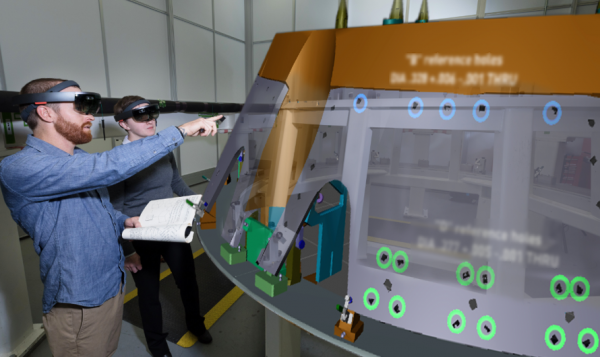
NASA is using HoloLens AR headsets to build its new spacecraft faster


In the headset, the workers can see holograms displaying models that are created through engineering design software from Scope AR. Models of parts and labels are overlaid on already assembled pieces of spacecraft. Information like torquing instructions—how to twist things—can be displayed right on top of the holes to which they are relevant, and workers can see what the finished product will look like. The virtual models around the workers are even color-coded to the role of the person using the headset. For Jory’s team, which is currently constructing the heat shield skeleton of Orion, the new technology takes the place of a 1,500-page binder full of written work instructions. Lockheed is expanding its use of augmented reality after seeing some dramatic effects during testing. Technicians needed far less time to get familiar with and prepare for a new task or to understand and perform processes like drilling holes and twisting fasteners. These results are prompting the organization to expand its ambitions for the headsets: one day it hopes to use them in space.


Why today's containers and microservices will be tomorrow's legacy sooner than you think

The industry will be stuck with container platforms because these are interesting technologies that give the operators a taste of the power of running massive jobs at scale. Unfortunately, the ROI of maintaining that platform is elusive, since very few companies running these platforms will ever reach a point where they can even optimize job scheduling, and the cost of maintaining the container platform itself competes with the modest improvements in the developer's user experience. A similar phenomenon was seen with OpenStack half a decade ago, when, in the rush to have an in-house cloud, many companies grossly underestimated the short- and long-term associated costs and are now stuck maintaining OpenStack in perpetuity for the sake of the unnamed applications running on top of it. Well, that's a depressing thought, isn't it? But true. And why? Well, because technology change is hard. 


“Given the way the data was captured and displayed, it would not be readily available or searchable, but [the information commissioner] considers that a motivated individual could locate and extract the data in a more permanent way,” the notice said. Although the USB stick contained more than 1,000 files overall, just 1% of this information could be classified as being personal in nature. Also, a subsequent investigation by the ICO revealed less than 2% of the airport’s 6,500-strong workforce had received data protection training.  “Given that Heathrow Airport is Europe’s busiest airport, where high-level security should be inherent, loss or unauthorised disclosure of personal data of staff could have presented a greater risk if found by individuals who had not handled the data responsibly,” the penalty notice said. “Taking into account all of the above, the commissioner has decided that the penalty is £120,000.” According to the report, the USB stick was found in Kilburn, west London, on 16 October 2017, before being handed in to a national newspaper 10 days later


Behavioral Biometrics: Key Challenges

As more companies move away from passwords toward behavioral biometrics, they face new challenges, says Rajiv Dholakia, vice president products at Nok Nok Labs, a company which is into next generation authentication. Behavioral biometrics relies on a behavioral trait of an individual, rather than a physical trait. Examples include speech patterns, signatures and keystrokes. "There are no standards as such in this area on how the information is collected, how it's stored and how it's processed," Dholakia says in an interview with Information Security Media Group. "And therefore, there may be some privacy hazards associated with the technique unless a manufacturer makes it super clear exactly what is being collected, how it's being processed and whether that profile data is anonymized." Other behavioral biometrics issues include accuracy and concerns about passive collection of information from users, he says. "Moreover, when you are using behavioral biometrics, you have to be super certain that the information coming from all sensors is coming from a real device as opposed to a virtual machine," he says


Quote for the day:


"He who cannot be a good follower cannot be a good leader." -- Aristotle


Daily Tech Digest - September 03, 2017

A Web Of Interoperable Blockchain Platforms

When blockchain technology first reared its head, interoperability was not a subject of much debate; there was only one blockchain and it was all about bitcoin. As time passed, more and more disparate blockchain platforms rose, among them Ethereum, and these various platforms innovated in different directions, creating their own protocols. These protocols make it impossible for the chains to send and receive data from one another for reasons similar to that of why a program designed for Windows OS will not function on Mac OS. ... These protocols are designed to both maximize efficiency between disparate blockchain deployments and allow for a co-existence between them to form, creating a more cohesive ecosystem. There are some great examples of innovation to that end.


Your Digital Transformation Won't Succeed Without Cultural Change

Companies from the pre-digital era therefore need to adjust or shift their organizational culture to keep up in today’s digital world. MIT Sloan Management Review and Deloitte recently released their third annual Digital Business report. The report highlighted five key practices of companies developing into "more mature digital organizations." Each of these five key practices focuses on some aspect of organizational culture, a clear indication of the importance culture plays in a company’s ability to adopt new business methods and practices. The question is why is modifying culture so challenging and what guidance can companies follow to increase the likelihood of a successful cultural change?


Business intelligence data is getting even more user friendly

In the digital era, data is pervasive. For many organizations, the amount of data they collect has become a major problem. Others struggle to identify what data will be most helpful for them to gather. Big data, while revolutionary, has created a glut of information leaving companies trying to figure out how to structure it to generate actionable insights. Business Intelligence is at the core of any kind of long-term business strategy, because it helps make sense of the data. When utilized, data strategy can have a big impact on any operation. When surveyed, 72% of business leaders said that they lacked the tools to effectively manage their data for their existing and future efforts. To meet that need, technology companies are beginning to bring more integrated solutions to market.


3 key advantages for AI in the retail space

We’ve learned how to understand real-time customer queries via NLP and extract value from legacy data using machine learning methodology. The challenge of making use of ongoing customer feedback is bigger, but so are its benefits. This challenge requires joint forces. First, an NLP engine needs to extract sense from a query in natural language. After, machine learning steps in to extract value from this sense. Using classification, intelligent machines assign meaning to data, relying on their background and existing knowledge. In practice, the system classifies certain products, say “books,” by categories, say “popular among women over 65.” For retail, this means more focused recommendation and upselling. Using clustering for new information, in turn, opens totally new horizons.


Emotional Intelligence Needs a Rewrite

In short, when it comes to detecting emotion in other people, the face and body do not speak for themselves. Instead, variation is the norm. Your brain may automatically make sense of someone’s movements in context, allowing you to guess what a person is feeling, but you are always guessing, never detecting. Now, I might know my husband well enough to tell when his scowl means he’s puzzling something out versus when I should head for the hills, but that’s because I’ve had years of experience learning what his facial movements mean in different situations. People’s movements in general, however, are tremendously variable. To teach emotional intelligence in a modern fashion, we need to acknowledge this variation and make sure your brain is well-equipped to make sense of it automatically.


Get real on container security: 4 rules DevOps teams should follow

The numbers underscore that paying attention to the packages and components that make up a container image is extremely important, especially if the container is from a public repository. Managing the software supply chain requires that companies regularly test their container images for vulnerabilities and vulnerable dependencies. The first lesson is for developers to use container images from sources that they trust, said Anders Wallgren, chief technology officer at Electric Cloud, a software deployment company. "Use images of well-known provenance. If you are going to use Ubuntu, use the published machine instance." In addition, any container image—whether sourced or homegrown—should be frequently tested for vulnerabilities and unwanted software. Luckily, software testing can be easily automated, and should be.


Open Banking - What Does It Mean For Banks And Fintechs?

Open Banking is a new set of regulations in the UK that were created to give consumers more control over their money. The Competition and Markets Authority (CMA) issued new rules that would allow consumers to more easily manage their money, switch accounts to find the best deals for their particular needs, as well as avoid high overdraft charges. These new regulations will go into effect in January 2018. As part of the Open Banking regulations, the CMA set a package of remedies to increase innovation and improve competition in retail banking. This includes a requirement for the nine largest current account providers to make available to authorized third parties – customer consent and secure access to specific current accounts in order to read the transaction data and initiate payments.


Distributed, always-on data management

Data platforms should support applications in context, blending transactional, analytical, search, and graph capabilities. In a financial services context, that might mean taking a credit card transaction, analyzing the customer’s buying patterns and searching for the information to approve the transaction. Data management platforms have to process multiple workloads in a single data platform simultaneously. ... A data platform must provide zero downtime. For example, one DataStax customer kept its recommendation engine running despite a hurricane that took down a whole data center. All of the company’s databases failed except DSE because its architecture was able to retain uptime via data distribution across other data centers.


AI chatbots can provide business value when used wisely

One area where businesses are finding the most value from AI today is in customer service. Chatbot applications are among the most mature areas of AI. But enterprises are finding that, while AI chatbots can provide value, they have to be deployed the right way. For online test preparation company Magoosh Inc., that means giving machines license to recommend responses to simple customer service queries, while still maintaining a team of agents who handle more complicated issues. Magoosh uses a customer service bot from DigitalGenius to handle incoming customer service inquiries. The system scans messages for their content and recommends prewritten responses that can be personalized or sent out as is.


The product design challenges of AR on smartphones

So there’s a very real and difficult problem in getting a user to get their phone out while they are in the best place to use your app. Notifications could come via traditional push messages, or the user might think to use the app by seeing something in the real world that they want more information on, and they already know your app can help with this. Otherwise, your app just needs to work anywhere, either through using unstructured content, or being able to tap into content that is very, very common. This problem is the No. 1 challenge for all the “AR graffiti” type apps that let people drop notes for others to find. It’s almost impossible for users to be aware that there’s content to find. FYI —  this is just another version of the same problem that all the “beacon” hardware companies have, getting the shopper to pull out their phone to discover beneficial content.


Quote for the day:


"As long as you are fighting for what is right instead of who is right, you can never lose!" -- @Rory_Vaden