Daily Tech Digest - February 16, 2020

Is Your Cybersecurity Workforce Ready To Win Against Cybercriminals?

Photo:
A trained staff is a critical business asset when it comes to handling information security projects. Whether your company is involved in a simple privileged access management (PAM) project or implementing a complex continuous adaptive risk and trust assessment (CARTA-based) strategy design, success depends on employee competency. Now that you have a training plan, implement it by assigning specific information security training certifications or training modules to each employee and measure the effectiveness and quality of execution against your business goals. ... The ultimate goal is to foster a cybersecurity culture across the organization. This is a tough task because it involves the human aspects of cybersecurity. Be prepared for resistance, and plan efforts to address employee concerns in an understanding and open manner. Empathy will get you to your goals faster than issuing strict directives and hoping employees will follow. Make cybersecurity practices a routine part of your business processes as well as strategic concerns. This 360-degree approach will become your best defense against information security risks.


For enterprise developers attempting to meet the highly specialized needs of a vertical and tech-savvy users' expectations, low-code platforms are a way to handle the scalability, data management, architecture and security concerns that hold back internal bespoke software projects. To be worth the money, a low-code platform must be flexible enough to build almost any app securely, even if it's only for internal users, said AbbVie's Cattapan. Low-code examples at the company range from a shipment management app to track chemicals around its labs and manufacturing campus, to a reporting app related to drug approval rules in more than 200 countries. To work for these purposes, a low-code platform has to scale in diverse situations: "We might have a really large dataset ... and we want the app server next to the data, but we also want the option to have it up in the cloud," Cattapan said. 


4 in Chinese Army Charged With Breaching Equifax
While many of the security issues at Equifax in 2017 have been discussed in lawsuits, investigations and news media reports, the new indictments offer some additional details of what happened staring in May of that year. After exploiting the vulnerability in Apache Struts, the hackers allegedly gained access to Equifax's online dispute portal in order to gain a foothold within the corporate network and steal more credentials, according to the indictment. After that, the four hackers spent several weeks mapping the network and running queries to understand what databases they could access and which ones held the personal data and intellectual property they were seeking, the indictment says. The hackers ran about 9,000 queries within the network over the course of several months, it adds. "Once they accessed files of interest, the conspirators then stored the stolen information in temporary output files, compressed and divided the files, and ultimately were able to download and exfiltrate the data from Equifax's network to computers outside the United States," prosecutors say.


How Edge Computing Is Supercharging the Internet of Things
Though many may imagine servers as rows of tall, boxy machines, in recent years servers have gone mobile, enabling edge computing on the road. Vehicle servers are a boon to law enforcement officers, who can avoid spending precious time on tasks such as manually keying in a license plate number to check suspicious vehicles. Police cruisers equipped with servers such as NEXCOM's MVS series of vehicle servers powered by Intel® Core and Intel Atom processors can quickly decode images of cars taken by a cruiser's rooftop camera, identify license plates, and determine whether they're listed in a database of vehicles of interest to law enforcement. ... Machines can see what humans miss. Imagine a failing motor on a factory floor begins to vibrate more quickly. That initial, negligible acceleration won't be noticeable to workers. But an electronic vibration sensor detects it, triggering analysis by predictive maintenance software. The software notifies personnel, who address the problem before it leads to a costly equipment breakdown. Edge computing helps manufacturers make the most efficient use of predictive maintenance technology.


IBM highlights new approach to infuse knowledge into NLP models


There have been two schools of thought or "camps" since the beginning of AI: one has focused on the use of neural networks/deep learning, which have been very effective and successful in the past several years, said David Cox, director for the MIT-IBM AI Watson Lab. Neural networks and deep learning need data and additional compute power to thrive. The advent of the digitization of data has driven what Cox called "the neural networks/deep learning revolution." Symbolic AI is the other camp and it takes the point of view that there are things you know about the world around you based on reason, he said. However, "all the excitement in the last six years about AI has been about deep learning and neural networks,'' Cox said. Now, "there's a grouping idea that just as neural networks needed something like data and compute for a resurgence, symbolic AI needed something,'' and the researchers theorized that maybe what it needs is neural networks, he said. There was a sense among researchers that the two camps could complement each other and capitalize on their respective strengths and weaknesses in a productive way, Cox said.


The Kongo Problem: Building a Scalable IoT Application with Apache Kafka

Kafka is a distributed stream processing system which enables distributed producers to send messages to distributed consumers via a Kafka cluster. Simply put, it’s a way of delivering messages where you want them to go. Kafka is particularly advantageous because it offers high throughput and low latency, powerful horizontal scalability, and the high reliability necessary in production environments. It also enables zero data loss, and brings the advantages of being open source and a well-supported Apache project. At the same time, Kafka allows the use of heterogeneous data sources and sinks – a key feature for IoT applications that can leverage Kafka to combine heterogeneous sources into a single system. In order to achieve high throughput, low latency and horizontal scalability Kafka was designed as a "dumb" broker and a "smart" consumer. This results in different trade-offs in functionality and performance compared to other messaging technologies such as RabbitMQ and Pulsar


Deep Instinct nabs $43M for a deep-learning cybersecurity solution that can suss an attack before it happens

GettyImages 1079200304
“Deep Instinct is the first and currently the only company to apply end-to-end deep learning to cybersecurity,” he said in an interview. In his view, this provides a more advanced form of threat protection than the common traditional machine learning solutions available in the market, which rely on feature extractions determined by humans, which means they are limited by the knowledge and experience of the security expert, and can only analyze a very small part of the available data (less than 2%, he says). “Therefore, traditional machine learning-based solutions and other forms of AI have low detection rates of new, unseen malware and generate high false-positive rates.” There’s been a growing body of research that supports this idea, although we’ve not seen many deep learning cybersecurity solutions emerge as a result (not yet, anyway). He adds that deep learning is the only AI-based autonomous system that can “learn from any raw data, as it’s not limited by an expert’s technological knowledge.” In other words, it’s not based just on what a human inputs into the algorithm, but is based on huge swathes of big data, sourced from servers, mobile devices and other endpoints, that are input in and automatically read by the system.


What Differentiates AI Leaders, According To A Founder Of Globant

AI
Given that AI is so laden with ambiguity, companies often lack clarity in terms of determining what AI can do for them and how they can build roadmaps that will empower them to most effectively implement the technology. What’s more, half of the organizations don’t have a clear definition of how employees and AI will most productively work together. In order to succeed, organizations must work to define the role of AI in their workplace and the ideal relationship between AI and employees. Armed with this knowledge, organizations will be primed to adopt the most appropriate AI solution for their business and customer needs. Recognizing that companies face an uphill battle to understand how AI can help them realize their organizational objectives, Globant has embraced a unique organizational structure called “Agile Pods.” Pods are multidimensional teams comprised of members from Globant’s various Studios that serve as customer-facing service delivery teams and help ensure that its solutions are built and implemented with a customer-first mindset.


Rethinking change control in software engineering


Programmers that make mistakes with their conditional feature flags could accidentally deploy a change to production when it is supposed to stay dark, which means they might not be able to roll it back -- not easily, at least. The key to using feature flags is to place them where they make sense and to diligently make smart decisions regarding the risk they create. A key issue in change control in software engineering is figuring out who change control affects and how it affects them. If nearly everyone is affected by a change -- a likely scenario for teams contributing to a single mobile app deployment -- there tends to be heavy regression testing, triage meetings, go/no go meetings and documentation. This bureaucratic process often adds cost and delays, and it can be difficult to see where exactly the process provides value. One way to cut away barrier-inducing change control processes is to isolate the impact of changes.


5 biggest mistakes developers can make in a job interview

Successfully passed job interview
Interviews can be nerve-racking, but developers must avoid letting that apprehension take over their thought processes, said Tomás Pueyo, vice president of growth at Course Hero. "The biggest mistake I see when interviewing tech candidates is jumping to solutions before understanding the problem," Pueyo said. "Candidates are eager to answer questions, so they believe the faster they come up with a solution, the cleverer they will sound. But this is not what our job is about." "In tech, we deal with massive amounts of data, solving problems that are frequently unclear. A key marker of wisdom is taking a step back, gathering all the available information, understanding it, and only then jumping to solutions," Pueyo added. While interviews do focus on questioning the interviewee, the candidate should also have their own questions prepared, Hill said. "As a hiring manager, I expect the candidate to come with their own questions. That's how I know that they're enthusiastic about the company, and that they're eager to learn and improve," Hill noted.


Quote for the day:


"Leadership is about carrying on when everyone else has given up" -- Gordon Tredgold


Daily Tech Digest - February 15, 2020

How Can Companies Minimize Risk Against Emerging Threats?

Photo:
It's estimated that there is a ransomware attack every 14 seconds somewhere in the world. By far, the single greatest vulnerability that companies continue to face is the infiltration of malware from phishing campaigns. Other vulnerabilities stem from the proliferation of IoT components, cloud storage and computing, and new data and financial apps that external vendors provide and install on the organization's system. To battle the threat, I believe a dedicated effort must go all the way up to the C-level to ensure that everyone is put to the task because when an intrusion attempt succeeds, it's already too late. It can take hackers as little as 19 minutes to get into a system and up to eight hours for many companies to respond due to their obligation to internal processes. Many larger companies install a variety of specialized solutions to protect themselves in different areas, and it seems that endless products answer very specific threats. Too often, though, that buildup of solutions from a multitude of vendors exacerbates the risk that each patch is intended to guard against.


Emotion AI researchers say overblown claims give their work a bad name


Emotion recognition, also known as affective computing, is still a nascent technology. As AI researchers have tested the boundaries of what we can and can’t quantify about human behavior, the underlying science of emotions has continued to develop. There are still multiple theories, for example, about whether emotions can be distinguished discretely or fall on a continuum. Meanwhile, the same expressions can mean different things in different cultures. In July, a meta-study concluded that it isn’t possible to judge emotion by just looking at a person’s face. The study was widely covered, often with headlines suggesting that “emotion recognition can’t be trusted.” Emotion recognition researchers are already aware of this limitation. The ones we spoke to were careful about making claims of what their work can and cannot do. Many emphasized that emotion recognition cannot actually assess an individual’s internal emotions and experience. It can only estimate how that individual’s emotions might be perceived by others, or suggest broad, population-based trends.


AIoT – Convergence of Artificial Intelligence with the Internet of Things


Large volumes of confidential company information and user data are tempting targets for dark web hackers as well as the global government entities. The high level of risk has also brought in newer and more responsibilities that accompany the increased capability. Sensors are now applied to almost everything. This indicates that infinitely more data can be collected from every transaction or process in real-time. IoT devices are the front line of the data collection process in manufacturing environments and also in the customer service departments. Any device with a chipset can potentially be connected to a network and begin streaming data 24/7. Complex algorithms allow performing predictive analytics from all conceivable angles. Machine learning (ML), a subset of AI, continues to upgrade workflows and simplify problem-solving. Companies now capture all the meaningful data surrounding their processes and problems to develop specific solutions for real challenges within the organization, improving efficiency, reliability, and sustainability. 


8 steps to being (almost) completely anonymous online

9 steps to make you completely anonymous online
The universe believes in encryption, a wise man once opined, because it is astronomically easier to encrypt than it is to brute force decrypt. The universe does not appear to believe in anonymity, however, as it requires significant work to remain anonymous. We are using privacy and anonymity interchangeably, and this is incorrect. An encrypted message may protect your privacy — because (hopefully) no one else can read it besides you and your recipient — but encryption does not protect the metadata, and thus your anonymity. Who you're talking to, when, for how long, how many messages, size of attachments, type of communication (text message? email? voice call? voice memo? video call?), all this information is not encrypted and is easily discoverable by sophisticated hackers with a mass surveillance apparatus, which is most these days. A final thought before we dig into specific technical tools: "Online" is now a meaningless word. Meatspace and cyberspace have merged. We used to live in the "real world" and "go online."


MIT finds massive security flaws with blockchain voting app

screen-shot-2020-02-14-at-1-54-47-pm.png
MIT researchers released a lengthy paper on Thursday that said hackers could change votes through the app, which has already been used in Oregon, West Virginia, Washington and Utah since 2018. "Their security analysis of the application, called Voatz, pinpoints a number of weaknesses, including the opportunity for hackers to alter, stop, or expose how an individual user has voted," MIT said in a news release. Additionally, the researchers found that Voatz' use of a third-party vendor for voter identification and verification poses potential privacy issues for users," the MIT press release said. In a blog post and call with reporters, Voatz defended its security practices and disputed the claims made by the MIT researchers. The company said the research paper was based on an "old version" of the app and that because of this, many of their claims were invalid.  "Voatz has worked for nearly five years to develop a resilient ballot marking system, a system built to respond to unanticipated threats and to distribute updates worldwide with short notice.


The time is now: How to manufacture your smart factory with Industrial IoT


Although the value of digital innovation is apparent, widespread adoption has been slow. This is due to a myriad of challenges. For many organisations, the biggest challenge is available talent — they simply don’t have the internal expertise to plan and execute digital innovation initiatives. With continued strain on IT budgets, organisations struggle to both manage the priorities of today and invest in the talent needed to help them transform their business. A new report by PwC identified hiring more Internet of Things (IoT) engineers and data scientists – while training the wider workforce in digital skills – as a key change CEOs must implement if they want to maximise the benefits from digitisation of manufacturing. Legacy technology is another factor holding manufacturers back. The average factory today is 25 years old, according to McKinsey, with machinery that’s approaching nine years old. Before any plans of integrating the IoT can begin at these plants, they must first upgrade equipment to enable digital readiness. Driven by immediate goals of reducing costs and returns, some manufacturing companies have deferred technology investment.


Microsoft's Windows Terminal: This is the final preview of its new command-line tool

terminal-command-args1.gif
This update brings new command-line arguments, such as the 'wt' execution alias. Users can now launch Terminal with new tabs and split panes, which open with preferred profiles and directories.  Terminal developers point out that the 'wt' design was "heavily inspired by that of the venerable and beloved GNU screen competitor" called tmux, a terminal for Unix-like systems. "You can wt new-tab, wt split-pane, wt new-tab -p Debian ; split-pane -p PowerShell until your heart's content," says Dustin Howett, an engineer lead at Microsoft. .. This release also has some goodies for PowerShell Core fans, with Terminal now automatically finding PowerShells on a system. "The Windows Terminal will now detect any version of PowerShell and automatically create a profile for you," explains Kayla Cinnamon, Windows Terminal program manager. "The PowerShell version we think looks best (starting from highest version number, to the most GA version, to the best-packaged version) will be named as 'PowerShell' and will take the original PowerShell Core slot in the dropdown."


Machine learning could lead cybersecurity into uncharted territory


Security threats are evolving to include adversarial attacks against AI systems; more expensive ransomware targeting cities, hospitals, and public-facing institutions; misinformation and spear phishing attacks that can be spread by bots in social media; and deepfakes and synthetic media have the potential to become security vulnerabilities. In the cover story, European correspondent Chris O’Brien dove into how the spread of AI in security can lead to less human agency in the decision-making process, with malware evolving to adapt and adjust to security firm defense tactics in real time. Should costs and consequences of security vulnerabilities increase, ceding autonomy to intelligent machines could begin to seem like the only right choice. We also heard from security experts like McAfee CTO Steve Grobman, F-Secure’s Mikko Hypponen, and Malwarebytes Lab director Adam Kujawa, who talked about the difference between phishing and spear phishing, addressed an anticipated rise in personalized spear phishing attacks ahead, and spoke generally to the fears — unfounded and not — around AI in cybersecurity.


Cloud Threat Report Shows Need for Consistent DevSecOps

Image: areebarbar - Adobe Stock
Despite efforts to educate developers on the importance of security, he says most developers believe their top priority is getting new features and functionality out as quickly as possible. “Yes, they’re supposed to engineer-in security but that doesn’t happen in many cases,” Chiodi says. “Many organizations have not yet embraced the concept of DevSecOps.” Unit 42’s research shows that forward leaning organizations such as consumer companies want to operate with cloud-scale, serving a multitude of users, while maintaining security. Chiodi cites Netflix as a company that does so because it fully integrated development, security, and operations. He suggests that security teams should also embrace infrastructure as code to automatically put written security policies into code. “That way when a developer creates a new cloud environment, if it has security standards coded right in, every time they create from that template it will be the same every time,” he says. Conversely, Chiodi says a template with vulnerabilities will repeat those vulnerabilities each time it is applied.


Election hacking: is it the end of democracy as we know it?

Election hacking: is it the end of democracy as we know it? image
According to David Emm, senior security researcher at Kaspersky Lab, “the term ‘hacking’ often gets used loosely to refer to different attempts to interfere in elections. These include using social media to try and shape opinions or stealing data held on compromised computers to try and shame political figures, as well as tampering directly with machines used to manage the voting process.” Mateo Meier, the founder and CEO of Artmotion, a cloud security company, agrees that “threat actors will use all available tools at their disposal to hack the outcome [of an election]. So it’s always likely to be a multi-pronged approach rather than a single data breach during election season.” In recent years, governments have made some serious accusations, and researchers have demonstrated how vulnerabilities in voting machines can be targeted. “Such vulnerabilities have also been seen in the real-world, with NSW election results being challenged over [the] iVote security flaw. Yet, it’s difficult to gauge the impact a successful real world attack would have.


Quote for the day:


"Leaders need to be optimists._ Their vision is beyond the present." -- Rudy Giuliani


Daily Tech Digest - February 14, 2020

Can you put your trust in AIops?

Can you put your trust in AIops?
The objective was and is obvious. Since most of these tools have been data gathering tools and analytics tools from the beginning, adding AI allows them to learn from that data rather than just externalize issues with the services under management. In some cases, they can correct issues using preprogrammed routines, such as restarting a server or blocking an IP address that seems to be attacking one of your servers. Now that we’re a few years into this paradigm and its technology offerings, we’re starting to note some patterns—some good, and some not so good. Let’s explore both.  As far as what’s working, AIops tools in many instances are ops tools in their fourth, fifth, or sixth generations. Moreover, most of them have had public cloud management in mind for a while and are able to bridge the gap between on-premises legacy system management and managing applications and services in the public clouds. They are capable tools for managing and monitoring cloud, multicloud, legacy, and even IoT and edge-based systems. This ability to support complex system heterogeneity is really the true value of the ops tools, and why they are important to those implementing cloud or noncloud systems.


Server sales projected to decline 10% due to coronavirus

Antivirus digital syringe and virus/biohazard symbol in binary matrix
Vladimir Galabov, principal analyst for data-center compute in Omdia’s cloud and data-center research practice, also expects to see server shipments impacted by the coronavirus driving a prolonged holiday period in China. “I think the majority of the hit will be in the Chinese market,” he said. “This does impact server shipments globally as China represents about 30% of server shipments worldwide. So, I expect the quarterly decline to be more significant than the seasonal 10%. I expect that China will have a 5% additional downward impact on the growth.” He added that Q4 of 2019 did significantly overachieve his expectations due to cloud service providers making massive purchases. Omdia expected servers shipped in 2019 to be flat compared to 2018 based on data from 1Q19-3Q19. Instead, it was up 2% to 3% for the year, thanks to the fourth-quarter spurt. And servers aren’t the only products taking a hit. DigiTimes says that should the outbreak of the coronavirus last until June, sales of smartphones in the country would be slashed by about 30%, from a projected 400 million units to 280 million units in 2020.


Ohio man arrested for running Bitcoin mixing service that laundered $300 million

Bitcoin cryptocurrency
The Bitcoin blockchain is a public database. In many cases, purchases of new Bitcoin funds aquired by a user can sometimes be linked to a credit card, bank account, or PayPal account. Helix functioned as a Bitcoin mixer (Bitcoin tumbler), a type of service that takes funds from a user, split the sum into small parts, and using thousands of transactions, sends and reassembles the original funds at a new Bitcoin address, in an effort to hide the original funds under a cloud of micro-transactions. "The sole purpose of Harmon's operation was to conceal criminal transactions from law enforcement on the Darknet, and because of our growing expertise in this area, he could not make good on that promise," Don Fort, Chief, IRS Criminal Investigation, said today in a DOJ press release. "Working in tandem with other sites, he sought to be the 'go-to' money launderer on the Darknet, but our investigators once again played the role of criminal disrupters, unraveling the interlinked web from one tentacle to another," Fort said.


Q&A on the Book Agile Machine Learning
With data projects - especially those which continuously output a data product - having metrics in place to fill this role is essential. The range of metrics helps elaborate on the general idea of the customer wanting to "improve" the quality of the data. With this in mind, projects of a certain scale should consider investing in a metrics team. This team needs to handle the collection of data, the (human) annotation of that data as well as the regular computation of metrics. We found that while it is useful to design a single metric that summarizes the quality and progress of the product, this is often of less value within the team and so we design a number of metrics as required by the components of the products and the dimensions that we wish to optimize for. We also innovated around the idea of a data wallow. This is a semi-structured meeting in which an engineer presents some data and the team as a whole provides feedback and insights into the characteristics of the data and the performance of any inference being made.


LokiBot Impersonates Popular Game Launcher and Drops Compiled C# Code File


LokiBot, which has the ability to harvest sensitive data such as passwords as well as cryptocurrency information, proves that the actors behind it is invested in evolving the threat. In the past, we have seen a campaign that exploits a remote code execution vulnerability to deliver LokiBot using the Windows Installer service, a Lokibot variant that uses ISO images, and a variant with an improved persistence mechanism using steganography. Recently, we discovered LokiBot (detected by Trend Micro as Trojan.Win32.LOKI) impersonating a popular game launcher to trick users into executing it on their machines. Further analysis revealed that a sample of this variant employs a quirky, installation routine that involves dropping a compiled C# code file. This unusual LokiBot variant, which uses a “compile after delivery” detection evasion technique, was proactively detected and blocked by machine learning detection capabilities built into Trend Micro solutions as Troj.Win32.TRX.XXPE50FFF034. The infection starts with a file that is supposedly the installer of the Epic Games store. This fake installer was built using the NSIS (Nullsoft Scriptable Install System) installer authoring tool.


Android facial recognition is more secure than you think

aiface.jpg
After careful consideration, I've drawn a conclusion that isn't meant to shame or blame but to highlight what I believe is at the heart of the concerns about the Android facial recognition system. The pushback to facial recognition isn't about the ability to crack it--it's about the ability to abuse it. I'm not talking about the ability of a rogue user being able to abuse your mobile phone via facial recognition; this is about companies and governments being able to use facial recognition in such a way that might invade citizens' privacy. I believe that is why so many people are concerned about how much facial recognition systems have improved. If the Android system is any indication, it is certainly ready for prime time. However, as far as a system to secure your mobile device? You shouldn't worry about it. Cracking the Android facial recognition system isn't easy--just short of someone taking your phone and forcing you to unlock it, chances are slim it's going to be cracked. Of course, if someone wants to get inside your phone that badly, it wouldn't matter if the device used facial recognition, fingerprint biometrics, or a password.


What’s next for serverless architecture?

serverless edge architecture 01
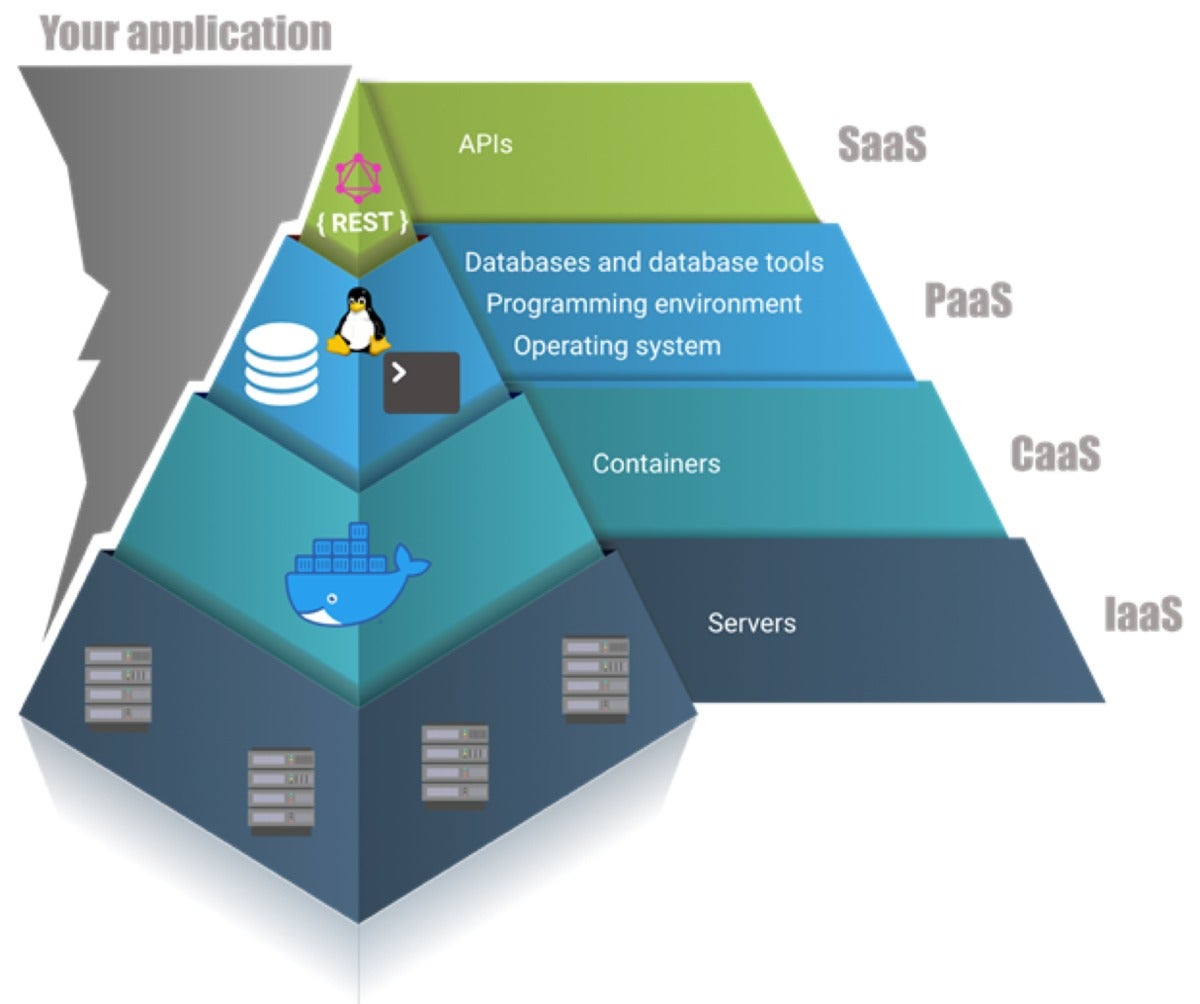
Container platforms are the latest incarnation of IaaS. Instead of offering full-blown server hosts, CaaS providers let you host your services or applications within containers, and manage the containers on your behalf. Containers are more efficient at utilizing underlying host resources than virtual machines. One can think of containers as “tiny machines.” They launch quickly, and multiple instances can run on a single server. CaaS providers offer tools to deploy containers on servers and to scale the number of container instances up and down. The most advanced offerings completely manage the underlying servers for you, allowing your company to focus on the code (or containers) instead of the infrastructure. CaaS has quickly become one of the building blocks for PaaS and SaaS, resulting in a layered architecture. There has been a shift toward developing applications as high on the pyramid as possible. Many complex applications are still a combination of SaaS, PaaS, and CaaS, since the available platforms are not flexible enough to deliver everything an application needs. By relying as much as possible on SaaS, you free yourself from provisioning and scalability concerns. For the remaining parts, companies typically resort to running containers, which means they still have configuration and provisioning concerns.


Serverless computing: Ready or not?

binary code vortex
Serverless computing can lighten IT workloads in several ways, most noticeably by freeing staff from routinely managing server performance, reliability, maintenance and security tasks. "The need to implement health checks to ensure application uptime, managing the underlying OS in regard to applying the latest security patch, or ensuring the underlying infrastructure has been provisioned with enough capacity to handle peak workloads are all things that are essentially handled for you by the serverless platform," Austin says. Serverless also lightens developers' workloads. "Writing less code, particularly infrastructure code, is attractive to the IT bottom line," Austin notes. "Having more developers deploying business functionality, while letting the serverless technology handle infrastructure provisioning, is a powerful benefit to an IT organization." Accelerating development speed can also make organizations nimbler and more innovative. Serverless is the fastest way to turn an idea into a functional solution, Kralj says. "The approach is perfect for rapid application development; you can now achieve it with just a few lines of code."


Google to Samsung: Stop messing with Linux kernel code. It's hurting Android security


"Android has been reducing the security impact of such code by locking down which processes have access to device drivers, which are often vendor-specific," explains Horn. An example is that newer Android phones access hardware through dedicated helper processes, collectively known as the Hardware Abstraction Layer (HAL) in Android. But Horn says vendors modifying how core parts of the Linux kernel work undermines efforts to "lock down the attack surface". Instead, he suggests handset makers use direct hardware access features already supported in Linux, rather than customizing Linux kernel code. Horn says some of the custom features that Samsung added are "unnecessary" and wouldn't affect the device if they were removed. He speculated that PROCA is meant to restrict an attacker who has already gained read and write access on the kernel. But he reckons Samsung could be more efficient by directing engineering resources to preventing an attacker from getting this access in the first place. "I believe that device-specific kernel modifications would be better off either being upstreamed or moved into userspace drivers, where they can be implemented in safer programming languages and/or sandboxed, and at the same time won't complicate updates to newer kernel releases," explained Horn.


Mono: From Xamarin to WebAssembly, Blazor, and .NET 5

Mono: From Xamarin to WebAssembly, Blazor, and .NET 5 - Q&A with Miguel de Icaza
With .NET 5, we are unifying the implementation of the class libraries, yet providing two options of runtimes for users. At a high-level, we have a high-throughput, high-performance runtime in CoreCLR, and we have the lightweight, (but not as fast) Mono runtime. Each runtime has been tuned for the workloads where they have been used the most — CoreCLR, for server and desktop applications, and Mono, for mobile and lightweight uses, such as WebAssembly. Also in .NET 5, we will have a unified runtime that can execute your C# or F# code on all the platforms that we support. On some of the platforms, users will be able to choose the runtime they want to use, and on other platforms, there will be a single runtime to use. For example, for desktop applications on Windows, only the CoreCLR runtime is suitable, and for iOS, only the Mono runtime is available. Now, historically, Mono has had two execution and code generation engines. One, we called the "mini" code generator, and it produced native code very quickly, but also without many optimizations.


Quote for the day:


"One measure of leadership is the caliber of people who choose to follow you." -- Dennis A. Peer


Daily Tech Digest - February 13, 2020

Revolut automates compliance workflows to fuel expansion


“There’s a couple of aspects to it: the ability to coordinate approval and review from the same location, and the ability to organize and connect our policy to the rest of our risk and compliance data points,” said Nicholas Melas, senior global policy manager at Revolut. According to Evgeny Likhoded, CEO and founder of ClauseMatch, the platform allows for real-time content collaboration and workflow management, and lets users map the content across the platform. The tool also uses natural language processing and machine learning to suggest relevant content. ClauseMatch allows Revolut to coordinate input, approvals and workflow in the same location without having to provide users with links to different passwords; it also lets the company automate the policy-approval process. This offers two benefits: consistency of approach and the ability to make changes to policies with minimal legwork. While ClauseMatch streamlines policy approvals and changes, it doesn’t eliminate humans completely, emphasized Melas. Instead, it takes away menial tasks, allowing staff members to focus on more complex roles, including oversight and verification.


US finds Huawei has backdoor access to mobile networks globally, report says


The backdoors were inserted for law enforcement use into carrier equipment like base stations, antennas and switching gear, the Journal said, with US officials reportedly alleging they were designed to be accessible by Huawei. "We have evidence that Huawei has the capability secretly to access sensitive and personal information in systems it maintains and sells around the world," Robert O'Brien, national security adviser, reportedly said. O'Brien also called less-expensive Chinese solutions "tempting of a gift to turn down" for some countries, according to CNN, but that they come "with a price" of the Chinese company having access to information on the network. Huawei denied the reports, saying it's the US government that's been "covertly accessing telecom networks worldwide, spying on other countries." "US allegations of Huawei using lawful interception are nothing but a smokescreen," Huawei said in an emailed statement Wednesday. "Huawei has never and will never covertly access telecom networks, nor do we have the capability to do so."


Spearheading the defence against a cyber attack requires c-suite buy-in

Spearheading the defence against a cyber attack requires c-suite buy-in image
Cyber security and data security risks have climbed to the top of UK plcs’ boardroom agenda to become a top five issue following recent high profile cyber attacks, such as the ransomware attack on Travelex. This shift is largely because the business consequences of such an event can be catastrophic — loss of revenue and major disruption, plus steep fines due to GDPR, damage to reputation and a hit on the share price. Depending on the severity of the breach it is possible that jobs, including those of the CEO and CISO, could be put at risk. The c-suite must live up to its responsibility for protecting the business by taking whatever action is necessary to prevent it suffering from an attack. But what form should this action take? The C-suite needs to ensure the right cyber security policies and procedures are in place, as well as a response plan should the worst happen.


2020 And The Dawn Of AI Learning At The Edge

Photo:
One of the biggest challenges when it comes to the implementation of AI today is its inflexibility and lack of adaptability. AI algorithms can be trained on huge amounts of data, when available, and can be fairly robust if all data is captured for their training beforehand. But unfortunately, this is not how the world works. We humans are so adaptable because our brains have figured out that lifelong learning (learning every day) is key, and we can’t rely solely on the data we are born with. That’s why we do not stop learning after our first birthday: We continuously adapt to changing environments and scenarios we encounter throughout our lives and learn from them. As humans, we do not discard data, we use it constantly to fine-tune our own AI. Humans are a primary example of edge learning-enabled machines. In fact, if human brains acted in the same way as a DNN, our knowledge would be restricted to our college years. We would go about our 9-to-5s and daily routines only to wake up the next morning without having learned anything new. Traditional DNNs are the dominant paradigm in today’s AI, with fixed models that need to be trained before deployment.


Ericsson's eSIM technology - fully dynamic and automatic provisioning of eSIMs

Purchasing add-on subscription from mobile phone
Ericsson’s eSIM solution is comprised of Ericsson Secure Entitlement Server (SES) and Ericsson eSIM manager (GSMA certified SM-DP+) serving the onboarding of eSIM consumer devices. The solution provides a fully automated end-to-end device and subscription orchestration procedure managing the device detection, user authorization for onboarding the eSIM device, creation of user and subscription profile, provisioning handling of both eSIM device and network elements as well as updating the Service Provider’s back office system as relevant. It contributes with simplified user experience process for end users and, at the same time for the Service Provider, saving operational expenses for handling eSIM devices over their life cycle management. Ericsson’s eSIM solution will give the Service Provider the opportunity to launch many attractive services for a wide range of eSIM devices. Users can instantly enable new services on their new eSIM device with minimum efforts. The need to pre provision, create batch processes or use middleware solutions for eSIM profiles, is removed.


How Can We Fix Biased AI?

How Can We Fix Biased AI?
“There seem to be countless stories of ways that bias in AI is manifesting itself, and there are many thought pieces out there on what contributes to this bias,” says Fay Payton, a professor of information systems/technology and University Faculty Scholar at NC State. “Our goal here was to put forward guidelines that can be used to develop workable solutions to algorithm bias against women, African American and Latinx professions in the IT workforce. “Too many existing hiring algorithms incorporate de facto identity markers that exclude qualified candidates because of their gender, race, ethnicity, age and so on,” says Payton, who is co-lead author of a paper on the work. “We are simply looking for equity – that job candidates be able to participate in the hiring process on an equal footing.” Payton and her collaborators argue that an approach called feminist design thinking could serve as a valuable framework for developing software that reduces algorithmic bias in a meaningful way. In this context, the application of feminist design thinking would mean incorporating the idea of equity into the design of the algorithm itself.


Is AI cybersecurity’s salvation or its greatest threat?

cybersecurity threat or salvation
Security experts predict that 2020 could be the year hackers really begin to unleash attacks that leverage AI and machine learning. “The bad [actors] are really, really smart,” said Burg of EY Americas. “And there are a lot of powerful AI algorithms that happen to be open source. And they can be used for good, and they can also be used for bad. And this is one of the reasons why I think this space is going to get increasingly dangerous. Incredibly powerful tools are being used to basically do the inverse of what the defenders [are] trying to do on the offensive side.” In an experiment back in 2016, cybersecurity company ZeroFox created an AI algorithm called SNAPR that was capable of posting 6.75 spear phishing tweets per minute that reached 800 people. Of those, 275 recipients clicked on the malicious link in the tweet. These results far outstripped the performance of a human, who could generate only 1.075 tweets per minute, reaching only 125 people and convincing just 49 individuals to click.


Emotet evolving to exploit coronavirus fear


“One of the main abilities of Emotet is that it stays topical, and we will see campaigns similar to those leveraging fear of the coronavirus throughout the year. As the US enters tax season, for example, Emotet is gearing up to offer the public help to file the forms on their behalf. “The email messages will not be sophisticated and can contain a link to download infected files or will have an attachment of a fake W9 form. We can anticipate that malware campaigns related to tax season will continue towards the filling date in April.” The best way for users to protect themselves against threats exploiting the coronavirus is to trust only official government or health service guidance, or legitimate news services. In IT terms, standard guidance to use antivirus programs with automatic updates, to download and apply patches and software updates, and to not open suspicious or unsolicited emails, applies.


Machine Learning in the cloud vs on-premises


The hyper cloud providers (AWS, Azure, GCP) are able to offer a smaller total cost of ownership while delivering superior features from scalability to security. It doesn’t make financial sense to build everything in-house when you can get it off the shelf for only the time you need it. The cloud vendors are constantly innovating with solutions such as servers that only cost for the time they are used, as opposed to the time they are up and waiting for requests. They are also able to attract talent specialized in e.g. scalability and security in ways that would be impossible for every other vendor on their own. ... Most machine learning experimentation starts from understanding your data on your laptop and doesn’t require that much computation power. But very quickly you will run into the need more than your local CPU can provide you with. The cloud is by far the more scalable place to do machine learning. You’ll get access to the latest GPUs or, even TPUs that you wouldn’t be able to afford and maintain on your own.


Your phone talks about you behind your back. These researchers are listening in


By taking a look under the hood, they've found that many apps are sending data that goes beyond what people agree to under privacy policies and permissions requests. "In the end, you're left with a policy that's essentially meaningless because it doesn't describe what's accurately happening," said Serge Egelman, director of usable security and privacy research at the International Computer Science Institute. "The only way to answer that question is going in and seeing what the app is doing with that data." Sometimes, the data is just headed to advertisers, who think they can use it to sell you products. Phone location data can be a gold mine for advertisers, who tap it to figure out where people are at certain times. But it may also be going to government agencies that leverage the technology to surveil people using data collected by apps that never disclosed what they were doing. Recently, The Wall Street Journal reported that government agencies were using such data to track immigrants. These researchers are shining a light on a hidden world of data tracking, and raising concerns about how much information people are giving away without knowing it.




Quote for the day:


"The most important quality in a leader is that of being acknowledged as such." -- Andre Maurois


Daily Tech Digest - February 12, 2020

What is data governance? A best practices framework for managing data assets

What is data governance? A best practices framework for managing data assets
Data governance is just one part of the overall discipline of data management, though an important one. Whereas data governance is about the roles, responsibilities, and processes for ensuring accountability for and ownership of data assets, DAMA defines data management as "an overarching term that describes the processes used to plan, specify, enable, create, acquire, maintain, use, archive, retrieve, control, and purge data. While data management has become a common term for the discipline, it is sometimes referred to as data resource management or enterprise information management. Gartner describes EIM as "an integrative discipline for structuring, describing, and governing information assets across organizational and technical boundaries to improve efficiency, promote transparency, and enable business insight." Data governance may best be thought of as a function that supports an organization’s overarching data management strategy. A data governance framework provides your organization with a holistic approach to collecting, managing, securing, and storing data.


Average tenure of a CISO is just 26 months due to high stress and burnout

under-half-of-cisos-are-ready-to-respond-5dc128aca99ca300012762fc-1-nov-05-2019-10-29-01-poster.jpg
Today, CISO jobs come with low budgets, long working hours, a lack of power on executive boards, a diminishing pool of trained professionals they can hire, but also a constant stress of not having done enough to secure the company's infrastructure against cyber-attacks, continuous pressure due to newly arising threats, and little thanks for the good work done, but all the blame if everything goes wrong. Across the years, many CISOs have often pointed out the problems with their jobs and the stress and damage they inflict. However, there has been no conclusive study to support broad assertations. ... The Nominet study only surveyed high-ranking CISO executive jobs, but the problem is widespread across the industry. Infosec -- or cyber-security -- has a habit of grinding through employees due to the rigors of the job. Low-level infosec positions, like threat analyst or penetration tester, are just as bad in terms of stress level, if not worse, primarily for the same reasons -- constant fear of new incoming attacks, long-working hours, low pay, almost no job satisfaction.


How do I build a cloud-ready network?


Enterprises that decide to move processing to a cloud provider must prepare their networks for the migration. That will almost certainly mean upgrading WAN links, but enterprises shouldn't start talking to internet service providers until they've performed a careful analysis of the applications they plan to move. Here are some considerations enterprises should evaluate when preparing a cloud-ready network: Are you planning to move an interactive application to the cloud or begin using a SaaS platform? Are you simply eliminating the need to maintain the resources for end-of-month processing or application testing? Are you currently operating an in-house private cloud but plan to move some of the processing to a public cloud to create a hybrid cloud? Look carefully at what network resources each type of application requires. Interactive applications typically don't move a great deal of data across the network.


Half of cybercrime losses in 2019 were the result of BEC scams


For comparison, BEC/EAC-associated losses were $1.3 billion in 2018, $676 million in 2017 and $360 million in 2016 (with a $30,000 average monetary loss per complaint). The IC3 also observed an increase in the number of BEC/EAC complaints related to the diversion of payroll funds. Some victims can get their money back, though: IC3’s Recovery Asset Team (RAT), which was established to streamline communication with financial institutions and assist FBI field offices, gets involved if the victims made transfers to domestic accounts under fraudulent pretenses. In 2019, they recovered $305 million of the $384 million lost in 1,307 such incidents, by reacting quickly and requesting banks to freeze the accounts involved. In some cases, they even managed to identify the scammer. “In February 2019, the IC3 RAT received a complaint involving a BEC incident for $138,000, where the victim received a spoofed email and wired funds to a fraudulent bank account in Florida. The RAT took quick action and worked with key financial partners to freeze the funds,” the IC3 shared.


Presidential campaigns taking email security more seriously--not so much at the local level

election hacking security 2020 election security flag global breach by stuartmiles99 getty
While the picture for email security at the presidential campaign level appears to be improving, at the local level, email security seems to be overlooked: 142 of 187 domains used by election officials in the three largest counties (or parishes) in every state don't use DMARC at all. Of the remaining jurisdictions, 42 use monitor-mode only, and 11 use invalid DMARC, leaving only 5.3% of those local domains protected by DMARC, Valimail's research shows. At the local level, "it appears to be awareness more than anything else," that is a problem with adopting DMARC and other secure email technologies, Blank says. "There is an enormous amount of technology that exists [but local officials] don't even know where to start and that there are tools that can help." Organizations such as the Messaging, Malware and Mobile Anti-Abuse Working Group (M3AAWG) stand ready to help campaign officials learn what the best technologies are and how to deploy them. Last week the group issued summary guidance for what it calls "essential cybersecurity" for election officials. The three key technologies the M3AAWG advises campaigns to use are multi-factor authentication (MFA), email authentication and encryption.


Cybersecurity Jobs Going Begging As College Computer Science Grads Lack Skills


Many of the half-million cybersecurity job openings are going begging because college computer science graduates often lack the needed skills and hands-on experience, House Research and Technology Chair Haley Stevens (D-MI) asserted today. She added the nation’s education system is further exacerbating the problem because few high school students have any exposure to computer science in the classroom, let alone cybersecurity. Another reason for the cybersecurity workforce abyss Stevens pointed to is a lack of women in the profession. “The cybersecurity field as a whole lacks diversity, even more so than many other STEM fields. The math is simple: Last year, women accounted for only 20 percent of the global cybersecurity workforce,” she noted. Aggrieved women of color in cybersecurity jobs make on average $10,000 less than their male counterparts, Congressman Stevens contended: “We cannot address our current and future cybersecurity workforce needs without recruiting and retaining more women and minorities into the field.”


The tech IT professionals love: 5G, cloud management, Graph API

Tech IT professionals love: 5G, cloud management, Graph API
The biggest appeal? Increased speed. 5G networks have potential download speeds of 20Gbps, which is not only faster than 4G but faster than cable internet connections, according to Josh Fruhlinger in What is 5G? How is it better than 4G? Plus, 5G significantly reduces network latency, which is critical for Internet of Things uses such as telemedicine and autonomous vehicles that require fast transmissions. “5G is looking extremely promising: better coverage, less energy consumption, low latency, high data rates. This is a game-changer that will take us to new levels,” said Scott Schober, CEO of Berkeley Varitronics Systems, during the Twitter chat. “We are working with a lot of the carriers and teams actively testing, and they are making some great progress. There is enough money and marketing behind this, so they have to make it happen sooner than later.” 5G installations are starting to appear, such as Whirlpool’s private 5G network, provided by AT&T for its fleet of driverless vehicles. The company is in the process of rolling out the 5G network across the plant, and hopes to make 80% of its 100 vehicles driverless.


Cloud computing security: These two Microsoft tools can help you battle shadow IT


You get more control by analysing and controlling cloud app usage on the device directly. Microsoft Cloud App Security (MCAS, a Cloud Application Service Broker, which is itself a cloud service) now includes a shadow IT discovery tool that integrates with Defender ATP to discover cloud app and service usage on any managed device. Defender already monitors what processes are running and what files are being opened as it checks for malware, and that same information lets it report back on what cloud services are being used. It's an automated process that creates a catalog of cloud apps that are in use, by which users and on which devices, with security and compliance risk scores for each app. But because MCAS is integrated with Defender, you get the option to block and whitelist apps directly on the device. That works for all devices, not just the ones on the corporate network -- and it even lets you enforce read-only access to your corporate resources for external users like suppliers and partners. Defender ATP can look at the labels you apply with Azure Information Protection, so you can tell when data tagged as sensitive or confidential is being sent to a cloud service -- in real time, or later on, even if that device is no longer connected for you to scan or available for you to look at physically.


What are the newest cyber attacks to look out for?

What are the newest cyber attacks to look out for? image
Swarm technology refers to decentralised systems that use automation such as AI to operate without the need for human intervention. Named after the term that defines a group of insects and acting in a similar manner, although swarm tech has been known to have the potential to benefit society, some experts are wary of its possible cyber attacking capabilities as well. Derek Manky, chief of security insights & global threat alliances at Fortinet, explained: “Over the past few years, the rise of swarm technology, which can leverage things like machine learning and AI to attack networks and devices has shown new potential. “Advances in swarm technology have powerful implications in the fields of medicine, transportation, engineering, and automated problem solving. However, if used maliciously, it may also be a game changer for adversaries if organisations do not update their security strategies. “When used by cyber criminals, bot swarms could be used to infiltrate a network, overwhelm internal defences, and efficiently find and extract data.


Police use of facial recognition ‘unjustifiable’, says Scottish Justice Committee


“The sub-committee believes that there would be no justifiable basis for Police Scotland to invest in technology which is known to have in-built racial and gender bias, and unacceptably high levels of inaccuracy,” said the report. It said the committee had not received sufficient evidence to justify the introduction of LFR technology, or that it is even possible to use the technology in a “proportionate” way. “Its use on people who attend legitimate and legal pursuits, such as peaceful protests, concerts or sporting events, is not necessary or proportionate,” the report said. Although Police Scotland does not currently use LFR, plans to introduce it were included in its 10-year Policing 2026 strategy, which the committee said must be reviewed and updated if the police still plan to deploy the technology. “The Scottish Police Authority must ensure that comprehensive human rights, equalities, community impact, data protection and security assessments are carried out,” it said, adding these must all be made publicly available.


Quote for the day:


"Leadership is a matter of having people look at you and gain confidence, seeing how you react. If you're in control, they're in control." -- Tom Laundry