Daily Tech Digest - May 05, 2020

How to teach AI to reason about videos

video reel
Visual reasoning is an active area of research in artificial intelligence. Researchers have developed several datasets that evaluate AI systems’ ability to reason over video segments. Whether deep learning alone can solve the problem is an open question. Some AI scientists believe that given enough data and compute power, deep learning models will eventually be able to overcome some of these challenges. But so far, progress in fields that require commonsense and reasoning has been little and incremental. ... The controlled environment has enabled the developers of CLEVRER to provide richly annotated examples to evaluate the performance of AI models. It allows AI researchers to focus their model development on complex reasoning tasks while removing other hurdles such as image recognition and language understanding. But what it also implies is that if an AI model scores high on CLEVRER, it doesn’t necessarily mean that it will be able to handle the messiness of the real world where anything can happen. The model might work on other limited environments, however.


CISA reiterates DNS resolution requirements

security defense (deepadesigns/Shutterstock.com)
The Cybersecurity and Infrastructure Security Agency is reminding agencies to use Domain Name System resolution services provided by CISA. The global DNS system translates website URLs into their corresponding IP addresses. However, an attacker can interfere with that translation to reroute internet traffic away from its intended destination, instead sending users to fake or spoofed websites where they can be eavesdropped on or tricked into downloading malware or revealing personal information. In a memo dated Apr. 21, CISA Director Chris Krebs reiterated that civilian agencies are legally required to use sinkholing capabilities through EINSTEIN 3 Accelerated as their primary upstream DNS resolving service. According to a Privacy Impact Assessment drafted in 2016, EINSTEIN 3 Accelerated's sinkholing capability “prevent[s] malware installed on .gov networks from communicating with known or suspected malicious Internet domains by redirecting the network connection away from the malicious domain to 'safe servers ... thus preventing further malicious activity by the installed malware."


Neuro-symbolic AI seen as evolution of artificial intelligence


"Neuro-symbolic modeling is one of the most exciting areas in AI right now," said Brenden Lake, assistant professor of psychology and data science at New York University. His team has been exploring different ways to bridge the gap between the two AI approaches. Companies like IBM are also pursuing how to extend these concepts to solve business problems, said David Cox, IBM Director of MIT-IBM Watson AI Lab. "I would argue that symbolic AI is still waiting, not for data or compute, but deep learning," Cox said. His team is working with researchers from MIT CSAIL, Harvard University and Google DeepMind, to develop a new, large-scale video reasoning data set called, "CLEVRER: CoLlision Events for Video REpresentation and Reasoning." This allows AI to recognize objects and reason about their behaviors in physical events from videos with only a fraction of the data required for traditional deep learning systems. Deep learning is incredibly adept at large-scale pattern recognition and at capturing complex correlations in massive data sets, NYU's Lake said.


Xen Orchestra latest victim of Salt cryptojackers


“In short, we were caught in a storm affecting a lot of people. We all have something in common: we underestimated the risk of having the Salt master accessible from outside,” said Lambert. “Luckily, the initial attack payload was really dumb and not dangerous. We are aware it might have been far more dangerous and we take it seriously as a big warning. The malware world is evolving really fast: having an auto update for our management software wasn’t enough. “If you are running SaltStack in your own infrastructure, please be very careful. Newer payloads could be far more dangerous,” he said. More technical details of Xen Orchestra’s experience can be read on its website. Alex Peay, senior vice-president of product and marketing at SaltStack, said it had taken immediate action to remediate the vulnerability, develop and issue patches, and communicate widely to customers about the affected versions. “Although there was no initial evidence that the CVE had been exploited, we have confirmed that some vulnerable, unpatched systems have been accessed by unauthorised users since the release of the patches,” he said.


How remote working has forced us to look beyond the traditional PC


A minor but interesting consequence seems to be an increased interest in PC alternatives -- whether because of lack of supply or simply because businesses and consumers have had to respond to changing circumstances with limited budgets. For example, the Raspberry Pi Foundation has noted that sales have rocketed during the coronavirus crisis, which it puts down to people buying the tiny computers to end battles over the single home PC during lockdown. The lastest Raspberry Pi might be diminutive, but it's powerful enough to take on the role of budget computer if need be. Chromebooks, which are slightly easier to work with if you don't have the technical skills to play with a Pi, have also been selling well. And it's not only harassed parents looking for extra PCs that have been getting creative. Here at ZDNet we've also written about how councils have been digging old laptops out of storage, putting Linux on them or otherwise lightening the operating system load, and sending them out to allow staff to work from home. An old or lower-spec device is good enough for many employees, especially if your teams only need to access cloud-based tools and/or virtual desktop services. It's been pointed out that without the option of using a wide range of cloud-computing services businesses would be in even more trouble.


Microsoft Announces the General Availability of Windows Server Containers

Besides the support for Windows Containers in AKS, Microsoft also announced support for private clusters and managed identities – which are intended to provide developers with greater security capabilities and to easier meet compliance requirements. Private clusters allow the use of managed Kubernetes within a closed network - without connection to the internet. And, with private clusters, the security measures of highly regulated industries such as finance or healthcare can be met. Next to the support for private clusters, AKS supports managed identities, which enables secure interaction with other Azure services such as Azure Monitor for Containers or Azure Policy. Furthermore, developers do not have to manage their service principals or rotate credentials often. Lastly, Burns wrote in his blog post about the continuous development of more integrations between AKS and Azure Advisor and bringing industry best practices right into the AKS experience. Moreover, Microsoft is committed to bringing customer learning into the VS Code extension for Kubernetes to provide developers with advice and integrate security advice into the Azure Security Center.


What is smishing? How phishing via text message works

Smishing  >  A woman looks at her mobile phone in horror when receiving a malicious SMS text message
Smishing is, essentially, phishing via text messages. The word is a portmanteau of "phishing" and "SMS," the latter being the protocol used by most phone text messaging services. Because of this etymology, you'll sometime see the word written as "SMiShing," though that's increasingly rare; people also include scam attempts via non-SMS text services, like WeChat or Apple's iMessage, under the smishing umbrella. The term has been around since at least the late '00s, though the omnipresence of smartphones in the modern era has made it a more tempting attack vector for hackers. "Vishing" is a similar type of attack that uses voice calls instead of emails or texts; the word is a portmanteau of "voice" and "phishing." ... Bank smishing is often successful for a couple of reasons. One is that many banks really do have services that text you about suspicious activity on your account. An important thing to keep in mind is that legitimate messages should contain information proving that the bank already knows who you are: they might include the last few digits of your credit card or bank account number, for instance.


Microsoft officially acknowledges Windows 10X is coming first to single-screen devices

windows10xsinglescreen.jpg
Microsoft's official reason for targeting single-screen devices is the impact of the COVID-19 coronavirus pandemic on users' buying habits. And that may, in fact, be true, as users are likely more interested right now in tried-and-true form factors, like laptops and 2-in-1 devices than in brand-new, unproven ones. That's why Microsoft has suspended delivery of its own dual-screen Neo device, which was due this holiday season. While Windows 10X is important, it's not the only thing that matters. Windows 10, as it currently exists, is still important and more relevant than ever, Panay emphasized. He said Microsoft will be making Windows-specific developer content a big part of its Build 2020 developers conference coming up later this month. Panay's post includes some new data from Microsoft about how the current health situation has impacted Windows' usage. Windows 10 is being used 75 percent more, in terms of minutes of usage, than this same period a year ago, Panay said. This makes sense, given users are working and learning remotely and are likely less on the move/more tethered to their desks.


Changing realities of digital transformation in the public sector


Given the increase in online interactions, digital transformation in government is no longer about simply innovating, but managing scale, operational efficiency and ensuring taxpayer value for money, while user expectations, technologies and suppliers’ services are rapidly shifting. "The ability of government to continue to deliver high-quality services in times of change depends on its ability to dynamically respond to changing circumstances, legislation, policy and risk,” says Halliday. “The breadth, scale and nature of the technology that underpins public service delivery provides both enormous opportunities and significant challenges,” he adds. In the context of the coronavirus crisis, cloud-based software as a service (SaaS) becomes crucial in ensuring demands for scalability and reduced cost, as well as simpler integration of digital services, automation, efficiency and improved interactions.  Between late 2019 and early 2020, government departments seemed more willing to adopt cloud SaaS offerings, according to Halliday.


How Remote Working Is Reshaping A Future New World Of Work

Working from home has given coworkers a peak into our personal lives. And that's a good thing.
Corporate heads are speaking out more about their concerns for employee mental health as it relates to stress and anxiety, which is a shift for many business leaders. Joe Lallouz, CEO and Co-founder of technology platform Bison Trails, points out that people aren’t just choosing to work from home. They have to work remotely because of the global health crisis. And if you’re going to reduce people’s stress and anxiety about a shift in the way they work, it’s important to try to make them feel more comfortable, and a little empathy goes a long way: “The most important thing that CEOs and their leadership teams need to do is recognize that this can be very difficult for their teams. Exercising extra patience and empathy is probably the most important thing that anyone in a leadership position can do in an organization. Remember to give people the actual time it takes to adjust to these work style shifts . . . Arm your team the way you can by providing them with the information and resources they need, not just for their physical well-being, but also for their psychological and mental well-being.”


Quote for the day:


“Solitude matters, and for some people, it's the air they breathe” -- Susan Cain


Daily Tech Digest - May 04, 2020

7 Tips for Security Pros Patching in a Pandemic

(Image: MR -- stock.adobe.com)
Patch management has historically been a challenge for IT and security teams, which are under pressure to create strong programs and deploy fixes as they're released. Now their challenges are intensified as a global shift to remote work forces companies to rethink patching strategies. "It's a massive challenge all of a sudden," says Stephen Boyer, co-founder and CTO at BitSight. Businesses accustomed to protecting 2,000 employees across three to four offices now have to secure the same workers in 2,000 home offices. People are working on personal devices, with home routers they don't properly configure, on networks the corporation cannot manage. Data shows home networks pose a higher security risk than enterprise networks, he continues. BitSight research shows 45% of remote office networks have observed malware, compared with 13% of corporate networks. And more industries are enforcing work-from-home policies: 84% of traffic in the US education sector shifted off-network during the fourth week of March, data shows, along with 63% of government/policies sector traffic and 35% of finance sector traffic.


Why the Banking Industry Must Prove Its Worth During the COVID-19 Crisis

Moving forward, banks should continue their dedication towards their customers and British business in general through swift action and financial support that proves ongoing, selfless commitment to the economy and its people. This concerted effort requires adaptation from the financial services industry. The increased dependency on loans and support will inevitably have an overwhelming impact on the skeleton crew of bankers, who are themselves having to deal with the transition to remote working and unprecedented economic climate brought upon us by COVID-19. Fortunately, there is an abundance of automation and regulatory technology (regtech) at the banking sectors’ disposal. Recommendations from the Financial Action Task Force (FATF) and updated legislation from the Fifth Money Laundering Directive (5MLD), for example, has increasingly pushed banks towards using automation in recent years. 


Due to the exponential increase of data-driven technologies--think artificial intelligence, the Internet of Things, and 5G--apps and data, along with their supporting infrastructure, are increasingly spread across edge sites and multiple clouds. These distributed workloads introduce several serious operational and security challenges for organizations. Specifically, IT teams are struggling to securely, reliably, and cost-effectively manage these workloads. What's more, these challenges will only continue to grow. By 2025, up to 90% of enterprise-generated data will be produced and processed outside traditional data centers or a single centralized cloud. The distributed cloud is an emerging approach that will enable organizations to manage disparate components of its enterprise IT infrastructure as one unified, logical cloud. As organizations can deploy apps with a common set of policies and overarching visibility across all locations and heterogeneous infrastructure, using a cloud-native model, the distributed cloud mitigates the aforementioned operational challenges. This is why Gartner named distributed cloud one of its "Top 10 Strategic Technology Trends for 2020."


Australia's COVIDSafe contact tracing story is full of holes and we should worry

The Brookings researchers detail flaws such as false positives leading people to ignore repeated alerts, when people are close but safely separated by walls, or using personal protective equipment (PPE). "Because most exposures flagged by the apps will not lead to infection, many users will be instructed to self-quarantine even when they have not been infected," they write. "A person may put up with this once or twice, but after a few false alarms and the ensuing inconvenience of protracted self-isolation, we expect many will start to disregard the warnings." False negatives are equally problematic. People might leave their phones in their car, or the app might just fail. And it's not like the 1.5 metres for 15 minutes rule is magic. Even the most fleeting encounter can be unlucky. As has also been pointed out, people might trust the magic of technology more than their own judgement, a phenomenon called automation bias. "Contact tracing apps therefore cannot offer assurance that going out is safe, just because no disease has been reported in the vicinity," the Bookings team writes.


Cisco Debunks Cybersecurity Myths

Cisco Debunks Cybersecurity Myths
Cisco compared the types of attacks that SMBs and large enterprises reported experiencing in the past year, and how much downtime these attacks caused. Ransomware was most likely to cause more than 24 hours of downtime for SMBs, as well as for businesses with 1,000 or more employees. Malware, on the other hand, was at the bottom of the list for SMBs. “But yet, if you talk to a lot of the people in these companies, malware is the first thing they think about,” Goerlich said. “One thing is to look at the security efforts, both in terms of time and spend, and make sure they are aligned with the actual threats the business is facing to better allocate the budget and the efforts to provide better defense.” And while complex security environments and vendor fatigue is an area that plagues the entire industry, it appears that SMBs feel this pain more acutely than their larger counterparts. Cisco found the more vendors that SMB survey respondents used, the longer their reported downtime from their most sever breach. This ranged from an average of four hours of lost businesses time for SMBs using one vendor to an average of more than 17 hours downtime for those using more than 50 vendors.


NCSC tackles unconscious bias in security terminology
It is not uncommon within the security sector to use the terms black and white to describe undesirable and desirable things, such as allowed applications, passwords, IP addresses and so on. However, as the organisation’s head of advice and guidance pointed out, the terminology only makes sense if one equates white with good and black with bad. “There are some obvious problems with this. So, in the name of helping to stamp out racism in cyber security, we will avoid this casually pejorative wording on our website in the future,” they said. The NCSC said it took the decision after being contacted by a customer to ask if would consider making the change – which, while small, is highly significant, even though it may not appear to be. “You may not see why this matters. If you’re not adversely affected by racial stereotyping yourself, then please count yourself lucky. For some of your colleagues (and potential future colleagues), this really is a change worth making,” the organisation said.

Business During A Pandemic: Mitigating The Other (Cyber) Risks

Photo:
Employees downloading tools to help them get around bottlenecks, work more efficiently or deal with applications they’re familiar with has long been a security problem in organizations. Shadow IT — software, apps and systems being used without the knowledge of an organization’s leaders or the information technology department — can take up a big chunk of a company’s IT spending and become the target of a lot of cyber exploits. And with COVID-19 forcing more remote work for enterprises and third-party vendors alike, companies must consider the impact shadow IT can have inside or on the periphery of their organization. To address the vulnerabilities created by shadow IT, visibility is the first step in combatting the problem. After identifying all of the systems and software in use, you can then determine which pose you risk and should be assessed. Third-party vendors well prepared to guard against this risk will have a clear governance plan and policy, along with a system for educating users about the risks of shadow IT. Companies can also collaborate with key third-party IT teams and establish an approved IT vendor list.


A Singleton Application with Interprocess Communication in C#

Sometimes you might have an application where it doesn't make sense to launch the main application twice, but you may want to run the app again passing additional command line parameters. This way you can run the app, it will open your program, and then you can run the app again, and pass additional command line information to the already running app. This is useful for example, when you want to get the existing app to open a new file from the command line. ... First, the app needs to detect if it's already running, and it will do different things depending on whether it is already running. Second, we need a way for two processes to communicate. In this case, the primary app will wait on command line data coming from subsequence launches. The first aspect is pretty easy. We use a named mutex in order to prevent the main app code from launching twice. Named mutexes can be seen by all running processes for this user. The second aspect is a little more difficult, but not by much, thankfully.


What Does AI and Test Automation Have in Common?
With the obvious rise in popularity and availability, grew the popular misconception that test automation can replace the human manual tester. That is, of course, total nonsense, there is still a high demand for test engineers and there will always be. However, the end of the software tester job is a frequently discussed topic that tends to draw a lot of readers. Another popular misconception is that test automation saves you time. Well, it was the initial goal, but what many companies fail to realize is that in most cases, before you can benefit from test automation you have to put in a huge amount of effort in implementation and eventually maintenance. ... Whether we like it or not AI is already here and it’s embedded in our lives more than you can even imagine. If you ever interacted with “Alexa” or “Siri”, received a recommendation for the next “Netflix” movie to watch, chances are you encountered AI in this form or another. Did you recently search anything via the world's most popular search engine? Then you must know that you will receive different results for the word “Java'' depending on whether you are a programmer or coffee-maker.


A Look at the Downsides of Artificial Intelligence

AI can be fantastic at triaging or automating processes up to 80-85% of “grunt-work” that would normally take 10x longer for humans to do, but that still leaves 15-20% of the work that requires subjective human oversight. This approach will avoid biased outcomes. “The disadvantages can be overcome if businesses approach AI as a technology that can be leveraged to help employees and not replace their functions, and [AI] needs to adapt to changes in the business workflows in an ongoing manner,” she said. ... All the problems with AI are not technology-based. There are also management issues too, according to Brett Gould CMO of Saint Louis, Miss.-based Intelligence Factory. Companies, he said, are putting themselves through digital transformations as a matter of survival and AI is proving to be pivotal in the success of many of these companies. Those who ignore it set themselves up to be disrupted by smaller, leaner, and more nimble players who have built their business model around AI/ML.


Quote for the day:


"Leaders live by choice, not by accident." -- Mark Gorman


Daily Tech Digest - May 03, 2020

Communicating with Management About Technical Debt

Technical Debt
In making your case to business leaders on the need to address technical debt, it’s important to adopt a campaign approach. Think like advertisers who measure their impact in terms of reach and frequency–how many people they reach and how many times those people are exposed to their message. While you’re not running an advertising campaign, you need to be prepared to make your case over time, and to reach both the decision makers and the people who influence the decision makers. One email, or one presentation to management, isn’t going to get your message across. Technical debt is inevitable and, in some cases, makes sound business sense–i.e., when speed-to-market is critical, when resources are limited or information is incomplete. If technical debt reaches a certain level, it makes good business sense to forego immediate gratification projects in order to pay it down. That’s why framing technical debt in a manner that business leaders understand can make business leaders more inclined to realize the importance of managing it, as they do other risks facing the business.


WHO Reports 'Dramatic' Increase in Cyberattacks
While the WHO is one of the most high-profile agencies targeted by cybercriminals and nation-state hacking groups, other organizations have seen a dramatic rise in various security incidents, especially around phishing attempts. This week, security firm Zscaler released on report concerning phishing campaigns and malicious domains using COVID-19 as a lure. In January, the company reported about 1,200 of these incidents, but that number increased to 380,000 incidents in March. That's an eye-popping 30,000 percent increase, according to the report. In addition, Zscaler found that since the start of the healthcare crisis in January, about 130,000 suspicious domains have been registered. These domains include keywords such as "test," "mask," "Wuhan" and "kit," according to the report. And while attackers have focused on using COVID-19 as a lure, Brock Bell, principal consultant with the Crypsis Group, an incident response and risk management firm, notes that these tactics are likely to change over time as cybercriminal and hacking groups adjust to their messages based on the news of the day.


3 ways SMBs use machine learning to power digital transformation


Another good use case for ML is contract management, specifically automating the signing process. Software company Conga helps businesses automate contract lifecycle management (CLM) including the need for multiple signatures on a paper document. The platform allows Salesforce users to manage contracts directly in the application, while automating CLM from creation to signature. The software also automates reporting, tracking, and reminders. Conga's Digital Transformation Officer, Aishling Finnegan said that the best approach to using ML is to map technology to a company's existing processes and build an individualized road map for digital transformation. "If you have a more programmatic approach, you're more in control, and it feels less overwhelming," she said, adding that demos of AI software are often too complicated. Finnegan said that automating the contract process is especially important now that entire companies are working remotely. "Sales teams are able to generate vital important documents at home and get them to clients quickly," she said.


Is Augmented Intelligence The Best Perspective On AI?

One interesting insight comes not from AI, but rather from another technology that aimed to replace human activity - the Automated Teller Machine (ATM). When ATM machines were first put into place in the 1980s, there was widespread concern that it would eliminate the jobs of ordinary bank tellers and bank operations. However, according to Davenport, "One of my favorite statistics is that there are roughly the same number of bank tellers now, as there was in 1980 despite all the ATMs, internet banking, and other such changes." From this perspective he sees AI too not having the same sort of disruptive effects on employment as many might at first assume. From Davenport’s point of view, introducing technology that automates and performs tasks previously accomplished by humans actually creates more jobs for people who take time to learn about how they work. For example, these new machines create opportunities for technicians and programmers and whole new industries that are enabled by new technology.


How to make algorithms fairer


Of course, most of us would be reluctant to give up on procedural fairness entirely. If a referee penalises every minor infringement by one team, while letting another get away with major fouls, we’d think something had gone wrong — even if the right team wins. If a judge ignores everything a defendant says and listens attentively to the plaintiff, we’d think this was unfair, even if the defendant is a jet-setting billionaire who would, even if found guilty, be far better off than a more deserving plaintiff. We do care about procedural fairness. Yet substantive fairness often matters more — at least, many of us have intuitions that seem to be consistent with this. Some of us think that presidents and monarchs should have the discretion to offer pardons to convicted offenders, even though this applies legal rules inconsistently — letting some, but not others, off the hook. Why think this is justified? Perhaps because pardons help to ensure substantive fairness where procedurally fair processes result in unfairly harsh consequences. Many of us also think that affirmative action is justified, even when it looks, on the face of it, to be procedurally unfair, since it gives some groups greater consideration than others.


Cybersecurity pros share insights into their current work situations

cybersecurity pros work challenges
Some of the themes that came to light included a lack of hardware to support a larger number of remote workers, the struggle between organizational priorities for quick deployment of remote technology and the commensurate level of security to protect systems, and helping end users understand and abide by security policies outside the office. One respondent commented, “Security at this point is a best effort scenario. Speed has become the primary decision-making factor. This has led to more than a few conversations about how doing it insecurely will result in a worse situation than not doing it at all.” ... “COVID-19 hit us with all the necessary ingredients to fuel cybercrime: 100% work from home [WFH] before most organizations were really ready, chaos caused by technical issues plaguing workers not used to WFH, panic and desire to ‘know more’ and temptation to visit unverified websites in search of up-to-the-minute information, remote workforce technology supported by vendors driven by ‘new feature time to market’ and NOT security, employees taking over responsibilities for COVID-19 affected co-workers, and uncertainty regarding unexpected communication supposedly coming from their employers.”


Self-supervised learning is the key to human-level intelligence


“There’s a lot of progress that could be achieved by bringing together things like grounded language learning, where we’re jointly trying to understand a model of the world and how high-level concepts are related to each other. This is a kind of joint distribution,” said Bengio. “I believe that human conscious processing is exploiting assumptions about how the world might change, which can be conveniently implemented as a high-level representation. Those changes can be explained by interventions, or … the explanation for what is changing — what we can see for ourselves because we come up with a sentence that explains the change.” Another missing piece in the human-level intelligence puzzle is background knowledge. As LeCun explained, most humans can learn to drive a car in 30 hours because they’ve intuited a physical model about how the car behaves. By contrast, the reinforcement learning models deployed on today’s autonomous cars started from zero — they had to make thousands of mistakes before figuring out which decisions weren’t harmful.


OpenAI unveils neural network capable of creating music and releases debut mixtape

neural-network.jpg
While we were expecting something along the lines of a series of neurons misfiring over a theremin, overall, the songs are fairly impressive. At a low volume, these jams could pass in most environments without raising any eyebrows, however, once you take a more discerning listen or even a slight gander at the lyrics the wheels start to fall off a bit. To assist, the lyrics in the released songs "have been co-written by a language model and OpenAI researchers." The lyrics for the most part pass muster aside from maybe a line or two in the Sinatra nod. This song, in particular, opens with: "It's Christmas time, and you know what that means, Ohhh, it's hot tub time!" The overall quality and clarity of the "rudimentary singing" varies wildly from track to track. As noted in an OpenAI release, "singing voices generated by those models, while often sung in a compelling melody, are mostly composed of babbling, rarely producing recognizable English words." The Sinatra track sounds more or less like ol' Blue Eyes. The country ode to Alan Jackson passes and in all honesty could potentially even inconspicuously slide right in the middle of a few classic saloon hits.


Why Enterprise Blockchains Fail: No Economic Incentives

https://www.shutterstock.com/image-vector/vector-illustration-virtual-business-assistant-flat-1039237918
First and foremost, firms have been putting technical design ahead of economic design. They prioritize hiring technical teams and developing code, and then delay important discussions about the value that the product delivers and users’ incentives to adopt it. By the time the team addresses incentive design, teams have boxed themselves in to a narrow set of economic design options that are compatible with the existing code, or face deleting and rewriting huge chunks of the platform. Firms want to make a return on their investments, and these questions reflect that desire. However, they betray a fundamental misunderstanding of the economics of blockchain networks and the path to creating long-term monetization. Like social networks, blockchain consortia derive much of their value from network effects: that the value of the network to each participant increases with each additional participant. Many teams are familiar with this concept, which was popularized by Google Chief Economist Hal Varian and UC Berkeley Professor Carl Shapiro in the late 1990s.


The 7 Habits Of Good Data Scientists

Front cover image of The State of Open Data Histories and Horizons.
More than just data analytics, more than just big data insight, more than just the ability to handle new streams of raw unstructured data and more than just knowing how to drive a database while blindfolded, data scientists have to understand business and be flexible super-performers. So what core attributes make a good data scientist? “The work of data scientists is, by definition, experimental. They need to be allowed to experiment and the outcomes may or may not be successful, but do enough experiments in the right areas... and you will find the value,” said Asplen-Taylor. “Considering problem solving experimentation further, data scientists need to follow not to lead i.e. they need to be given a problem to fix, which means they need business analysts to define the problem… and, after their experimentation phase, they need someone to test the outcome of their projects, validate the results (so they are not marking their own homework) and they need IT people who will put their models into a production environment…”


Quote for the day:


"Don't measure yourself by what you have accomplished. But by what you should have accomplished with your ability." -- John Wooden


Daily Tech Digest - May 02, 2020

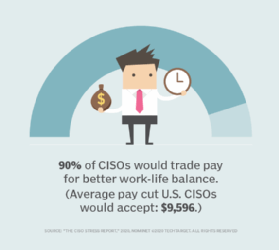
CISO position burnout causes high churn rate

Nominet 2020 CISO Stress Report pay results
Even the most impressive professional pedigree can't guarantee a CISO's success. Those with technical backgrounds often find navigating the politics of the C-suite "extremely stressful," according to Budge. On the other hand, CISOs who come from management environments may be unprepared for the day-to-day grind of operational support, said Tony Buffomante, principal and cybersecurity leader at professional services firm KPMG. "Taking those calls and fixing systems in the middle of the night -- that's the part that drives burnout," he added. Budge suggested that problems arise when the right CISO takes the wrong job. "A lot of us are so eager for that title, we don't actually do the homework," she said, adding that she knows few security executives who conducted adequate due diligence before accepting job offers. In her research, Budge identified six distinct types of CISO, all with different backgrounds and abilities: transformational, post-breach, tactical/operational, compliance/risk, steady-state and customer-facing evangelist. Transformational CISOs, for example, tend to be energetic, business-oriented types with large appetites for change.


The home networks we need today are coming tomorrow


Recently, though, two wireless networking developments have paved the way to a future in which bandwidth-intensive applications from powerful client devices will have access to far greater spectrum than they ever have, while devices that need very little bandwidth -- but battery life that extends for months -- will be able to tap into an industry-shaping collaboration that will allow unprecedented interoperability. The first of these is the Wi-Fi 6E. Following a recent ruling by the FCC, Wi-Fi will soon be able to operate in the 6GHz range whereas today's Wi-Fi is limited to the heavily taxed 2.4GHz range and 5.8GHz range. This opens up more spectrum to Wi-Fi than the older two ranges have offered combined. Its impact will be felt particularly strongly once people start gathering again in venues such as conferences and arenas. However, it should also help improve network congestion in the home. There is a small catch. While new Wi-Fi standards have always required both the access point and client to be upgraded to take full advantage of what they can offer, backward compatibility has always been assumed.


AIOps 2020: IT Talent Is the Game-Changer 

AIOps 2020
Automation is the backbone of technology, but true AIOps panacea is found when the right technologists know how to use the information AIOps provides. Think of a medical MRI: Once the technology identifies issues, human intervention steps in to determine how and when to improve and fix things. The same is true with AIOps. It frees an IT team to prioritize the most important items and who should tackle them, instead of combing through endless logs and wasting every developer’s time on break fixes. How a highly qualified, on-demand workforce makes a tangible, measurable difference here is a factor not to be underestimated. Talented technologists who can immediately ramp up on teams and systems—because it’s what they do day in and day out—seamlessly augment internal development staff and can address/remediate issues. The future of AIOps goes beyond the technology itself and rests in the hands of dynamically built, virtual teams that can address issues just as quickly as the AIOps platforms identify them.


Java Feature Spotlight: Text Blocks

A text block uses triple-quotes (""") as its opening and closing delimiter, and the remainder of the line with the opening delimiter must be blank. The content of the text block begins on the next line, and continues up until the closing delimiter. ... Java's string literals do not support interpolation of expressions, as some other languages do; text blocks do not either. (To the extent that we may consider this feature at some point in the future, it would not be specific to text blocks, but applied equally to string literals.) Historically, parameterized string expressions were built with ordinary string concatenation (+); in Java 5, String::format was added to support "printf" style string formatting. Because of the global analysis surrounding whitespace, getting the indentation right when combining text blocks with string concatenation can be tricky. ... What may be surprising is the number of different ways that such a feature is expressed in popular languages. It's easy to say "we want multi-line strings", but when we survey other languages, we find a surprisingly diverse range of approaches in both syntax and goals.


How much does it cost to launch a cyberattack?

United States one-cent coin / penny / binary code
Buying an individual piece of malware or even a full phishing kit isn’t enough to launch an attack: attacks require hosting, distribution channels, obfuscation for malware, account checkers and more. In a new report, Black-market ecosystem: Estimating the cost of “Pwnership,” Deloitte has gone beyond just listing the piecemeal costs and instead calculated the total cost of operations — from malware and keyloggers to things like domain hosting, proxies, VPNs, email distribution, code obfuscation and more — for threat actors to launch a full campaign against organizations. “The groups behind these types of large campaigns need multiple layers of services,” says Loucif Kharouni, threat intelligence leader at Deloitte Cyber Risk Services. For an operation to deliver a banking Trojan, you would need to use at least five or six services.” The report found that the dark web is awash with a variety of readily accessible services to suit the individual needs of the attacker, with pricing that accommodates all levels of investment.


Revealing leaders’ blind spots


As much as executives try to be self-aware, gaps — often big ones like Stephen’s — inevitably appear between how they think they are showing up in the world and how people perceive them. What is noteworthy is how widespread these misperceptions are. An analysis by Merryck & Co. and the Barrett Values Centre of the self-assessments of 500 leaders and then 10,000 of their peers over a period of 16 years offers a humbling insight for any senior executive who aspires to be self-aware: The top areas leaders identified in themselves as needing work barely ever overlapped with what their peers and key colleagues saw as areas that needed improvement. The conclusion is that leaders are mostly oblivious to the way their colleagues view their weaknesses. And these disconnects have consequences. Leaders’ blind spots can limit their opportunities, impede their performance, and ultimately drag down their career. For executives in the most critical roles, these limitations can also hamper their organization’s ability to execute its strategy, as was the case with Stephen.


Determined AI makes its machine learning infrastructure free and open source

Human businessman cooperation with robot concept
“Machine learning is going to be a big part of how software is developed going forward. But in order for companies like Google and Amazon to be productive, they had to build all this software infrastructure,” said CEO Evan Sparks. “One company we worked for had 70 people building their internal tools for AI. There just aren’t that many companies on the planet that can withstand an effort like that.” At smaller companies, ML is being experimented with by small teams using tools intended for academic work and individual research. To scale that up to dozens of engineers developing a real product… there aren’t a lot of options. “They’re using things like TensorFlow and PyTorch,” said Chief Scientist Ameet Talwalkar. “A lot of the way that work is done is just conventions: How do the models get trained? Where do I write down the data on which is best? How do I transform data to a good format? All these are bread and butter tasks. There’s tech to do it, but it’s really the Wild West. And the amount of work you have to do to get it set up… there’s a reason big tech companies build out these internal infrastructures.”


Data Science for analytical minds | Introduction

Data science requires a lot of data wrangling, multiple model testing and optimisation along with visualisation to draw right insights, make inferences, do predictions or enable decisions. What’s more is that this needs to be done every day with varying data scale and capacity within the organisation. Therefore, knowing scripting programming languages that can best automate and optimise the work — from data cleaning to visualisation — is essential for any data scientist. R and python are most famously used programming languages used by data scientists but there are a lot more which we will discuss in detail in the coming section. Economists or statisticians are mostly taught STATA and basics of R or python in some universities, which is a good stepping stone but there is a long road ahead in learning how to write R or python scripts that are optimised for agility and speed.


YubiKey hands-on: Hardware-based 2FA is more secure, but watch out for these gotchas  

yubikey-5-nfc-ci.jpg
Hardware-based security, on the other hand, is much more difficult to successfully attack remotely. To sign in, you have to insert the key and then tap it in response to a prompt to submit the proof of identity. The Yubikey devices I tested support hundreds of services that use a handful of standards, including FIDO2 Web Authentication (WebAuthn). A full list of supported services is available on the Yubico website, where you can search and filter to find the ones that interest you. It's worth noting that support for hardware-based authentication is considered a premium feature for many services; for example, if you use the password managers LastPass, Dashlane, or Bitwarden, you must upgrade to a Business, Premium, or Enterprise plan to enable a security key as a second factor. I tested both YubiKey devices with a representative sample of the kind of services you're likely to use regularly, including 1Password, Dropbox, Namecheap, GoDaddy, and Twitter. I also used the hardware key to secure Microsoft and Google accounts, as well as to sign in to a local account on a MacBook Pro.


Successful Transformation: Challenge the Status Quo

Successful Transformation: Challenge the Status Quo
“The organization needs a shift in culture to encourage all employees to become more open to changes in their daily processes and tools–digital transformation is largely about creating a culture of constant learning. Without the pressure to provide perfect continuity in current technologies, IT leaders can become more comfortable trying new things,” said Stringer. “This is one of the reasons why it’s common to see large organizations collaborate with smaller companies for projects,” said Hennelund. “In the financial sector we see a flourishing fintech and insurtech market around established banks and insurance companies. Companies successful in challenging their status quo are those that can navigate between these collaborations or even small in-house sub-divisions that develop new digital IT-based projects,” added Hennelund. “Putting into place a quick decision-making process is also critical.” This could include making it possible for stakeholders to hold meetings and move forward with their consensus without always having to get board approval. Such shifts in behavior require culture change. So, how do organizations and IT leaders get there?


Quote for the day:


"Without courage, it doesn't matter how good the leader's intentions are." -- Orrin Woodward


Daily Tech Digest - May 01, 2020

Running business intelligence using data: Connect the dots

Running business intelligence using data: Connect the dots image
The better an organisation’s visibility into their data and the easier access they have, the better able they are to make good business decisions. In my early career, seeing organisations cut costs, increase profits, or lower customer churn was the proof point I needed to shift my focus from business process re-engineering (BPR) to business intelligence (BI) and analytics, as merging both skillsets was a great way to work with organisations and support them through their data journeys. In the not-for profit sector, business intelligence data and analytics are really important for showing donors how their funds are being used, so that they continue to invest in causes that they support. As an example, the largest privately-funded not-for-profit organisation in the world, United Way, ensures good governance by conducting regular studies to collect data on donations and outcomes. 


TABi to the Rescue – the Process Automation Bot

TABi, Process Automation Bot
“The result of having this next level Robotic Process Automation (RPA) technology for transportation and logistics operations is more time that can be used to grow your business,” Gonzalez added. “It also means you can improve your focus on continually ensuring customer satisfaction, and enhance the way your employees view your company as a great place to work.” TABi uses RPA, a rules-based software technology driven by Machine Learning and AI, to turn unstructured and semi-structured data in documents, spreadsheets, and emails into structured data that can be automatically integrated with any transportation or enterprise management system. The technology also does not require the development of an API. “Through our partnership with Automation Anywhere,” explained Gonzalez, “integrating data between multiple platforms is as easy as setting up a new user account. TABi becomes the new user and seamlessly pulls information from one platform to the next. No lengthy integration process, no manual data entry. Let TABi take care of the mundane so humans can perform the social, creative, service-oriented aspects of a job. The fun stuff!”


Microsoft to rebrand Planner app in Teams as 'Tasks'

microsoftplannertasks.jpg
The move seems similar to what Microsoft announced recently around Yammer in Teams. The Yammer Teams app is being rechristened as "Communities." But outside of Teams, the Yammer app will continue to be known as Yammer. And I believe outside of Teams, the Planner app will remain "Planner," but I am asking Microsoft just to be sure. There is more going on than just a rebranding in the case of Planner in Teams, however. The Microsoft 365 roadmap, which now includes an item called "Tasks in Teams," describes the coming Tasks app as providing users with a consolidation of tasks across Microsoft To Do, Teams channels, Planner, and Outlook Tasks.  Microsoft announced plans to consolidate To Do and Planner last Fall but didn't provide specifics around timing for the new Tasks in Teams experience at that time. Officials said a new Tasks app and Tasks tab would be coming to Teams and that Outlook endpoints would be coming, as well in 2020. With the new Tasks experience in Teams, we are delivering several capabilities that will support new levels of team collaboration.


Industrial robots could 'eat metal' to power themselves

Industry 4.0 / Industrial IoT / Smart Factory / automation
Robots will "eat metal for energy," according to a news article published in Medium. The researchers' vision for a "metal-air scavenger" could solve one of the quandaries of future IoT-enabled factories. That quandary is how to power a device that moves without adding mass and weight, as one does by adding bulky batteries. The answer, according to the University of Pennsylvania researchers, is to try to electromechanically forage for energy from the metal surfaces that a robot or IoT device traverses, thus converting material garnered, using a chemical reaction, into power. "Robots and electronics [would] extract energy from large volumes of energy dense material without having to carry the material on-board," the researchers say in a paper they've published in ACS Energy Letters. It would be like "eating metal, breaking down its chemical bonds for energy like humans do with food." Batteries work by repeatedly breaking and creating chemical bonds. The research references the dichotomy between computing and power storage.


Healthcare AI for Individuals


AI has already drastically reduced the cost of sequencing and is bound to reduce the cost even further. As we move forward, the use of AI can help boost precision medicine available to each and every one. According to the Precision Medicine Initiative, precision medicine can be defined as “an emerging approach for disease treatment and prevention that takes into account individual variability in genes, environment, and lifestyle for each person.” With an increasing number of datasets, the Healthcare industry can leverage the fast computational techniques that our AI-based systems have in their artillery. In place of treating generalized symptoms, AI can help medicine shift towards prevention, personalization, and ultimately precision medicine. This will help in the medication of individuals precisely for themselves and could potentially improve lifespan by a year at average globally. 


Latest Version of Open Source IPFS Improves Performance

IPFS
IPFS is a distributed file system that makes use of a global namespace to connect all computing devices. The fundamental difference between IPFS and other distributed file systems is a decentralized system of operators who hold a portion of the overall data, which serves to create a highly resilient system for storing and sharing files. Any operator on the network can serve a file by its content address, and IT teams can find and request content from any node using a distributed hash table (DHT). Molly Mackinlay, project lead for IPFS and a senior product manager for Protocol Labs, which provides protocols, systems and tools to improve how the internet works, said the latest 0.5 update to IPFS significantly improves the content routing performance in addition to adding support for the Transport Layer Security (TLS) protocol. IPFS can now also add files to the IPFS network twice as fast, in addition to performance improvements that have been made to the core file transfer mechanism.


Critical SaltStack vulnerability affects thousands of datacentres

Successfully exploited, they enable attackers to execute code remotely with root privileges on Salt master repositories, meaning they could, for example install backdoors into systems, carry out ransomware attacks, or take over systems to mine cryptocurrencies. F-Secure said it had already found 6,000 such repositories openly vulnerable on the public internet. F-Secure principal consultant Olle Segerdahl said this meant the vulnerabilities were particularly dangerous and urged Salt users to download two new patches – versions 3000.2 and 2019.2.4 – that were issued by SaltStack on 29 April 2020, prior to the co-ordinated disclosure. “Patch by Friday or compromised by Monday,” said Segerdahl. “That’s how I’d describe the dilemma facing admins who have their Salt master hosts exposed to the internet.” Segerdahl said the 6,000 Salt masters he found during the course of his research, which are popular in environments such as Amazon Web Services (AWS) and Google Cloud Platform (GCP), were of particular concern.


Google open-sources faster, more efficient TensorFlow runtime


Google today made available TensorFlow RunTime (TFRT), a new runtime for its TensorFlow machine learning framework that provides a unified, extensible infrastructure layer with high performance across a range of hardware. Its release in open source on GitHub follows a preview earlier this year during a session at the 2020 TensorFlow Dev Summit, where TFRT was shown to speed up core loops in a key benchmarking test. TFRT is intended to address the needs of data scientists looking for faster model iteration time and better error reporting, Google says, as well as app developers looking for improved performance while training and serving models in production. Tangibly, TFRT could reduce the time it takes to develop, validate, and deploy an enterprise-scale model, which surveys suggest can range from weeks to months (or years). And it might beat back Facebook’s encroaching PyTorch framework, which continues to see rapid uptake among companies like OpenAI, Preferred Networks, and Uber.


Hands holding mobile phone on blurred abstract backgrounds
FAIR has focused on three specific behaviors -- the ability to display empathy, personality and knowledge -- to further humanize Blender’s responses. But it’s not so much that Blender can produce those three behaviors so much as it can switch seamlessly between them as the conversation progresses thanks to its unique Blended Skill Talk feature.  “We, in the past two years of research, have designed tasks for each one of these skills,” Emily Dinan, a research engineer at FAIR, told Engadget. “This is the first time we've really shown that you can blend all of these aspects of conversation seamlessly in one. Our evaluation setup showed that models that were fine-tuned on these nice conversational skill datasets are more engaging and consider more human, more lifelike than models which were not.” This means that Blender is emotionally smart enough to know to congratulate you if you tell it you just got a promotion at work and offer condolences when you reveal that your dog just died. FAIR has also taught it to give more than rote cursory responses when asked about a particular subject.


CorePlus: A Microsoft Bot Framework v4 Template

After working on a pioneering project with Microsoft Bot Framework v3, I realized the need to restart studying the platform almost from scratch. Microsoft was releasing a new version with lots of breaking changes. Actually, a completely different framework that rendered obsolete all v3 projects. BFv4 is a complete re-write of the framework with new concepts, terminology, documentation, architecture, etc. Quoting Microsoft: Bot Framework SDK V4 is an evolution of the very successful V3 SDK. V4 is a major version release which includes breaking changes that prevent V3 bots from running on the newer V4 SDK. Microsoft has developed a number of samples to help you get started with the Bot Builder SDK v4, as well as a set of templates powered by the scaffolding tool Yeoman. This article introduces CorePlus, a Microsoft Bot Framework v4 template that I have created, based on a previous version of the Core Bot template (Node.js) supported by the generator-botbuilder Yeoman generator.


Quote for the day:


"Pull the string and it will follow wherever you wish. Push it and it will go nowhere at all." -- Dwight D. Eisenhower


Daily Tech Digest - April 30, 2020

Why the Public Versus Private Blockchain Debate Is the Wrong Conversation

Public versus private blockchain
The conversation regarding public versus private blockchain doesn’t have to be a polarizing one. It’s not an either/or debate but rather a question of application. Private blockchains don’t have to be viewed as the enemy, or a replacement for public ones. They are simply a case-specific option. When taken out of the theoretical arena, there is room for both open read-and-write blockchains and those with access restrictions. What we find in practice, having developed numerous blockchain applications for both entrepreneurs and intrapreneurs, is that the apparently different requirements of each tend to converge over time. That is, many applications built by entrepreneurs will integrate with one or more large corporate enterprises at some point, and will therefore need to address their needs. Similarly, many enterprise applications are tackling obstacles that currently prevent them from making their solutions more open and capable of incorporating tokens of some form. Both sides are invested in the value of bringing integrity around data. 


It's because of the sudden change in working that 47% of those surveyed say they've found themselves reassigned to general IT tasks as organisations adapt to the new reality. In 90% of cases, the security team is working remotely full-time – the remaining 10% that are still going to an office are doing so either because their organisation is sensitive in nature and the work can't be done from home, or the company doesn't have the capability to allow full-time remote work. In many cases, these people would prefer to stay home, but as some respondents put it, "duty calls". In a significant number of cases, those duties involve dealing with a rise in the number of cyberattacks and other security incidents: overall 23% said the number of these had gone up since the transition to remote work and in some cases security teams are tracking double the number of incidents. Worryingly, 30% of those security professionals who've been reassigned to IT say there's been a rise in security incidents against their organisation, compared to 17% who haven't changed roles but say they're dealing with more attacks.


Shade Ransomware Operation Apparently Shuts Down

Shade Ransomware Operation Apparently Shuts Down
Jornt van der Wiel, another security researcher at Kaspersky, notes that even though the decryption keys are real, the true motive behind why the Shade operators decided to end their operations may never be known. "Keys can be stolen by a rival gang who put the message on Github, or it can be the real authors," van der Wiel tells Information Security Media Group. "We will never know until law enforcement agencies do some arrests." Those who say they are the operators of Shade, which is also known as Troldesh or Encoder.858, say in their GitHub post that they shut down their operations at the end of 2019 and that they were publishing their decryption keys, which can help security companies create their own tools to help remove the malware and recover any other crypto-locked files. "We are also publishing our decryption; we also hope that, having the keys, anti-virus companies will issue their own more user-friendly decryption tools. All other data related to our activity was irrevocably destroyed," according to the GitHub post. "We apologize to all the victims of the Trojan and hope that the keys we published will help them to recover their data."


Designing software to include older people in the digital world


“If you design for older people, you’re making inclusive choices for design and accessibility for everyone,” says Froso Ellina, product design manager at software development consultant VMware Pivotal Labs. On text, Ellina says that as well as using high colour contrasts and larger sizes, the choice of typography is important. A small number of simple fonts – with sans-serif ones such as Arial often the more accessible choice – can increase readability. Subtitling online videos means they can be used by those with poor hearing or no ability to hear, but also makes these work for those who are in a location where they can’t use audio. Older people can also find it harder to use touch screens due to declining motor skills. Ellina says that one centimetre is a good minimum length for a target area such as a button or link, and it makes sense to leave plenty of space between them. Short-term memory tends to decline with age, which has implications for how software is updated.


AI cannot be recognised as an inventor, US rules

The US Patent Office says that only humans are able to be inventors under the law.
The US Patent and Trademark Office rejected two patents where the AI system Dabus was listed as the inventor, in a ruling on Monday. US patent law had previously only specified eligible inventors had to be "individuals". ... Dabus designed: interlocking food containers that are easy for robots to grasp; and a warning light that flashes in a hard-to-ignore rhythm. And its creator, physicist and AI researcher Stephen Thaler, had argued that because he had not helped it with the inventions, it would be inaccurate to list himself as the inventor. But patents offices insist innovations are attributed to humans - to avoid legal complications that would arise if corporate inventorship were recognised. Some academics, however, have previously suggested this should no longer apply. The European Patent Office has seen a surge in AI-driven filings, according to Powell Gilbert LLP intellectual property law specialist Penny Gilbert. "AI is a fast-evolving field, set to revolutionise many industries, and raises many untested issues around patentability and ownership of inventions that are made using it," she told BBC News.


Reinforcement Machine Learning for Effective Clinical Trials


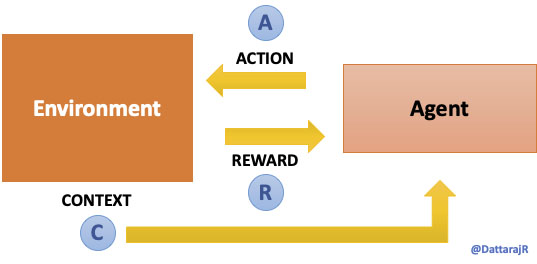
Machine Learning (ML) is often thought to be either Supervised (learning from labeled data) or Unsupervised (finding patterns in raw data). A less talked about area of ML is Reinforcement Learning (RL) – where we train an agent to learn by “observing” an environment rather than from a static dataset. RL is considered to be more of a true form of Artificial Intelligence (AI) – because it’s analogous to how we, as humans, learn new things – observing and learning by trial and error. ... A simpler abstraction of the RL problem is the Multi-armed bandit problem. A multi-armed bandit problem does not account for the environment and its state changes. As shown in figure 2 below, here the agent only observes the actions it takes and rewards it receives and tries to devise the optimal strategy. The idea in solving multi-armed bandit problems is to try and explore the action space and understand the distribution of the unknown rewards function. 


Get to know edge storage and the technology around it

Fog computing
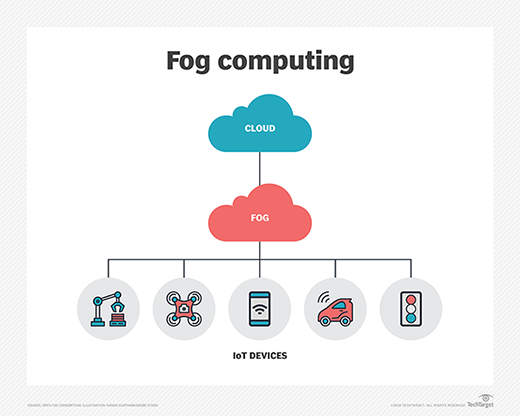
Edge computing: Data is rarely static and often moves from where users are collecting and using it to the cloud or to a central data center for analysis, processing and storage. But data centers and clouds are often far from where the data is collected. Transmission takes time and inserts latency and inefficiencies into the processing equation. That's time that most organizations using IoT functionality just don't have. For instance, an autonomous vehicle can't wait for an answer on whether to swerve right or left; it needs a real-time response. Edge computing closes that data transmission distance and puts compute and storage closer to where the data is collected. This approach essentially decentralizes the traditional data center. Fog computing: Fog computing refers to a decentralized computing infrastructure in which data, applications, compute and storage sit between where the data originates and the cloud. Fog computing brings the cloud's intelligence, processing, compute and storage capabilities closer to the data for faster analysis and processing. Like edge computing, fog eliminates inefficiencies that come with data transmission and solves privacy and security issues inherent in data transmission.


Data governance matters now more than ever

Records Management is built into the Microsoft 365 productivity stack and existing customer workflows, easing the friction that often occurs between enforcing governance controls and user productivity. For example, say your team is working on a contract. Thanks to built-in retention policies embedded in the tools people use every day, they can continue to be productive while collaborating on a contract that has been declared a record—such as sharing, coauthoring, and accessing the record through mobile devices. We have also integrated our disposition process natively into the tools you use every day, including SharePoint and Outlook. Records versioning also makes collaboration on record-declared documents better, so you can track when edits are made to the contract. It allows users to unlock a document with a record label to make edits to it with all records safely retained and audit trails maintained. With Records Management, you can balance rigorous enforcement of data controls with allowing your organization to be fully productive.


Some of the reasons as to why senior executives in Australia are adopting AI is because 41% believe it frees up more time for employees to focus on more important tasks, another 40% see AI as a way to improve customer experience and service, and 39% agree AI offers businesses the ability to leverage data and analytics. Genpact Australia vice president and country manager Richard Morgan said the adoption of AI by Australian businesses signals that executives understand the potential benefits it could deliver. "I think AI is now a way to try to mine information and drive better outcomes for the company themselves, and to give clients a better experience to get them coming back and using your products and services more frequently -- that's the holy grail," he told ZDNet. Australian executives also believe that integrating AI into the talent process could help reduce gender bias in recruitment, hiring, and promotion, the study showed. On the other end of the spectrum, three-quarters of Australians said they are concerned about AI bias and another 67% fear that AI will make decisions that affect them without their knowledge.


Arming yourself against deepfake technology

Deepfakes are likely to continue causing havoc for politicians in the coming years, but equally, modern enterprises could also find themselves under threat. In 2019, the UK boss of an energy company was tricked over the phone when he was asked to transfer £200,000 to a Hungarian bank account by an individual using deepfake audio technology. The individual believed the call to be from his boss, but actually, the voice had been impersonated by a fraudster who succeeded in defrauding the man out of money. Occasions like this, particularly where there are substantial amounts of capital at risk, are reminders that organisations should be on high alert for deceptive fraudsters and arm themselves accordingly.  In sectors such as financial services, vast amounts of customer data are at risk and a breach of information or assets can have detrimental effects on all involved. When data is breached, both the consumer and organisation face potentially large consequences.


Quote for the day:


"When you find an idea that you just can't stop thinking about, that's probably a good one to pursue." -- Josh James