Daily Tech Digest - February 15, 2018

How cloud computing surveys grossly underreport actual business adoption

rightscale-state-of-the-cloud-report-public-cloud-spend-increases.png
Whatever the size of the IT department, all companies are having to fundamentally rethink their applications, with cloud-first increasingly a matter of survival. One example I am familiar with is that of a large enterprise that was trying to figure out how to rearchitect a massive application first conceived in the early 2000s. At the time it was first built, the enterprise had very different needs from today—thousands of users, gigabytes or terabytes of data, customers all sitting in the same region, performance important but not all-consuming. This enterprise built on internal servers and focused on a scale-up model. That's all there was. Today, that same application has millions of users, distributed globally. The data volume is in the petabytes (and approaches exabytes). Performance latency must be measured in milliseconds and, in some cases, microseconds. There is no option but cloud. More applications look like this today than the earlier instantiation of that application.


How AI will underpin cyber security in the next few years

Artificial intelligence (AI) is emerging as the frontrunner in the battle against cyber crime. With autonomous systems, businesses are in a far better place to strengthen and reinforce cyber security strategies. But does this technology pose challenges of its own? Large organisations are always exposed to cyber criminals, and so they need appropriate infrastructure to spot and combat threats quickly. James Maude, senior security engineer at endpoint security specialist Avecto, says systems incorporating AI could save firms billions in damage from attacks. “Although AI is still in its infancy, it’s no secret that it is becoming increasingly influential in cyber security,” he says. “In fact, AI is already transforming the industry, and we can expect to see a number of trends come to a head, reshaping how we think about security in years to come. We might expect to see AI applied to cyber security defences, potentially avoiding the damage from breaches costing billions.”


IBM sees blockchain as ready for government use
google trends blockchain
There is a growing concern that cryptocurrency could be a threat to the global financial system through unbridled speculation and unsecured borrowing by consumers looking to purchase the virtual money. ... "First and foremost, blockchain is changing the game. In today's digitally networked world, no single institution works in isolation. At the center of a blockchain is this notion of a shared immutable ledger. You see, members of a blockchain network each have an exact copy of the ledger," Cuomo said. "Therefore, all participants in an interaction have an up-to-date ledger that reflects the most recent transactions – and these transactions, once entered, cannot be changed on the ledger." For blockchain to fulfill its potential, it must be "open," Cuomo emphasized, and based on non-proprietary technology that will encourage widespread industry adoption by ensuring compatibility and interoperability.


7 threat modeling mistakes you’re probably making
iot threats security
The Open Web Application Security Project (OWASP) describes threat modeling as a structured approach for identifying, quantifying and addressing the security risks associated with an application. It essentially involves thinking strategically about threats when building or deploying a system so proper controls for preventing or mitigating threats can be implemented earlier in the application lifecycle. Threat modeling as a concept certainly isn't new, but few organizations have implemented it in a meaningful way. Best practices for threat models are still emerging says Archie Agarwal, founder and CEO of ThreatModeler Software. "The biggest problem is a lack of understanding of what threat modeling is all about," he says. There are multiple ways to do threat modeling and companies often can run into trouble figuring out how to look at it as a process and how to scale it. "There is still a lack of clarity around the whole thing."


Skype can't fix a nasty security bug without a massive code rewrite

Security researcher Stefan Kanthak found that the Skype update installer could be exploited with a DLL hijacking technique, which allows an attacker to trick an application into drawing malicious code instead of the correct library. An attacker can download a malicious DLL into a user-accessible temporary folder and rename it to an existing DLL that can be modified by an unprivileged user, like UXTheme.dll. The bug works because the malicious DLL is found first when the app searches for the DLL it needs. Once installed, Skype uses its own built-in updater to keep the software up to date. When that updater runs, it uses another executable file to run the update, which is vulnerable to the hijacking. The attack reads on the clunky side, but Kanthak told ZDNet in an email that the attack could be easily weaponized. He explained, providing two command line examples, how a script or malware could remotely transfer a malicious DLL into that temporary folder.


Cryptomining malware continues to drain enterprise CPU power

Global Threat Impact Index January 2018
“Over the past three months cryptomining malware has steadily become an increasing threat to organizations, as criminals have found it to be a lucrative revenue stream,” said Maya Horowitz, Threat Intelligence Group Manager at Check Point. “It is particularly challenging to protect against, as it is often hidden in websites, enabling hackers to use unsuspecting victims to tap into the huge CPU resource that many enterprises have available. As such, it is critical that organizations have the solutions in place that protect against these stealthy cyber-attacks.” In addition to cryptominers, researchers also discovered that 21% of organizations have still failed to deal with machines infected with the Fireball malware. Fireball can be used as a full-functioning malware downloader capable of executing any code on victims’ machines. It was first discovered in May 2017, and severely impacted organizations during Summer of 2017.


Intel launches new Xeon processor aimed at edge computing

Intel Xeon D-2100 processor
Edge computing is an important, if very early stage, development that seeks to put computing power closer to where the data originates, and it is seen as working hand in hand with Internet of Things (IoT) devices. IoT devices, such as smart cars and local sensors, generate tremendous amounts of data. A Hitachi report (pdf) estimated that smart cars would at some point generate 25GB of data every hour. This can’t all be sent back to data centers for processing. It would overload the networks and the data centers. Instead, edge computing processes the data at its origin. So, smart car data generated in New York would be processed in New York rather than sent to a remote data center. Major data center providers, such as Equinix and CoreSite, offer such services at their data centers around the country, and startup Vapor IO offers ruggedized mini data centers that can be deployed at the base of cell phone towers.


Q# language: How to write quantum code in Visual Studio

Q# language: How to write quantum code in Visual Studio
Designed to use familiar constructs to help program applications that interact with qubits, it takes a similar approach to working with coprocessors, providing libraries that handle the actual quantum programming and interpretation, so you can write code that hands qubit operations over to one Microsoft’s quantum computers. Bridging the classical and quantum computing worlds isn’t easy, so don’t expect Q# to be like Visual Basic. It is more like using that set of Fortran mathematics libraries, with the same underlying assumption: that you understand the theory behind what you’re doing. One element of the Quantum Development Kit is a quantum computing primer, which explores issues around using simulators, as well as providing a primer in linear algebra. If you’re going to be programming in Q#, an understanding of key linear algebra concepts around vectors and matrices is essential—especially eigenvalues and eigenvectors, which are key elements of many quantum algorithms.


Breaking the cycle of data security threats


First, there’s the lack of mandatory reporting and the limits of voluntary reporting. Second, the lack of real protection for the personal information we’ve entrusted to various companies. Third, the clear indication that CEOs and corporations still aren’t paying enough attention to cybersecurity issues; perhaps because there’s been a startling lack of real penalty for failing to protect information from hackers. Finally, there’s a need to recognize that securing information is hard work on an ongoing basis. It’s a truism of security that no product is a “silver bullet” to put an end to attacks. Another industry truism says security is a journey, not a destination. There are few regulations that require organizations to report data breaches, especially those outside financial services and health care. Is it any surprise that companies are reporting breaches years after they occurred? How many unreported breaches will never surface?


The Top Five Data Governance Use Cases and Drivers

As the applications for data have grown, so too have the data governance use cases. And the legacy, IT-only approach to data governance, Data Governance 1.0, has made way for the collaborative, enterprise-wide Data Governance 2.0. In addition to increasing data applications, Data Governance 1.0’s decline is being hastened by recurrent failings in its implementation. Leaving it to IT, with no input from the wider business, ignores the desired business outcomes and the opportunities to contribute to and speed their accomplishment. Lack of input from the departments that use the data also causes data quality and completeness to suffer. So Data Governance 1.0 was destined to fail in yielding a significant return. But changing regulatory requirements and mega-disruptors effectively leveraging data has spawned new interest in making data governance work.


Quote for the day:


"Technological change is not additive; it's ecological. A new technology does not merely add something; it changes everything." -- Neil Postman



Daily Tech Digest - February 14, 2018

Microsoft to test blockchain-based self-sovereign ID system

blockchain challenge
"Today, the Microsoft Authenticator app is already used by millions of people to prove their identity every day. As a next step we will experiment with Decentralized Identities by adding support for them into Microsoft Authenticator," Patel wrote. "With consent, Microsoft Authenticator will be able to act as your User Agent to manage identity data and cryptographic keys." On the new platform, only a user's hashed ID is rooted on a blockchain, while actual identity data is encrypted and stored in an off-chain ID Hub that Microsoft can't see. "Once we have added this capability, apps and services will be able to interact with [a] user's data using a common messaging conduit by requesting granular consent," Patel said. "Initially, we will support a select group of [digital ID] implementations across blockchains and we will likely add more in the future."


Fileless Malware: Not Just a Threat, but a Super-Threat

Those invisible aliens may not have landed on earth just yet, but invisible malware — called fileless malware or in-memory malware — is wreaking havoc and bringing intergalactic war-style destruction to IT systems the world over. Like an invisible alien, fileless malware can strike from multiple directions, without victims even being aware they were targeted, until it's too late. Fileless malware — in which hackers call malware routines remotely and load them into memory in order to compromise or steal data — is not new, but hackers increasingly have turned to that type of attack. According to McAfee, fileless threats with PowerShell malware grew by 119% in the third quarter of 2017 alone, and they have been such a rousing success that hackers plan to greatly expand their use this year, security experts are convinced. But fileless malware is just one of numerous threats and attacks that are now in vogue;


3 common pitfalls of microservices integration—and how to avoid them

3 common pitfalls of microservices integration—and how to avoid them
Microservices are all the rage. They have an interesting value proposition, which is getting software to market fast while developing with multiple software development teams. So, microservices are about scaling your development force while maintaining high agility and a rapid development pace. In a nutshell, you decompose a system into microservices. Decomposition is nothing new, but with microservices you give the teams developing services as much autonomy as possible. For example, a dedicated team fully owns the service and can deploy or redeploy whenever they want to. They typically also do devops to be able to control the whole service. They can make rather autonomous technology decisions and run their own infrastructure, e.g. databases. Being forced to operate the software typically limits the number of wired technology choices, as people tend to choose boring technology much more often when they know they will have to operate it later on.


Untrained employees can undercut cybersecurity efforts

“If employees don't understand what their responsibilities are when interacting with a company computer system, it's going to be difficult for them to truly protect it," said Mark Burnette, partner at Brentwood-based LBMC Information Security. "They might unknowingly do something that would put the company's data at risk.” Employees may have the company’s best interests at heart, but at the end of the day, it truly comes down to employers to educate them. According to Burnette, the single biggest step employers can take is to routinely provide multifactor authentication. That means using something more than just a password to access sensitive data. The most common form of this is some sort of token, like a key fob with a rotating password or a code sent via SMS to a cell phone.  “This is something companies have to get ahead of. They cannot rely on their users to always catch it. In many cases, the attacks are so good that anyone would fall for them,” he said.


The sudden death of the website


Now, almost every website looks the same — and performs poorly. Offline, brands try to make their store experiences unique to differentiate themselves. Online, every website — from Gucci to the Gap — offers the same experience: a top nav, descriptive text, some pictures and a handful of other elements arranged similarly. Google’s rules have sucked the life out of unique online experiences. Of course, as e-commerce has suffered, Google has become more powerful, and it continues to disintermediate the consumer from the brand by imposing a terrible e-commerce experience. There also is a hidden knock-on effect of bad website design. As much as 90 percent of calls placed to a company’s contact center originate from its website. The journey looks like this: Consumers visit a website to get answers, become confused and have to call. This has become an epidemic, as contact centers field 268 billion calls per year at a cost of $1.6 trillion.


5 Top Threats While Using Social Media Accounts

With your physical life becoming integrated with your cyber life, social media has become the important tool to keep in touch with your work and friends. With the advent of social networks like Facebook, WhatsApp Twitter, YouTube, FourSquare, and Google+, we have changed the way we interact with our bosses, colleagues, and friends. Social media plays a significant role in our lives and by default they are also a high risk for security threats. Cyber risks are directly proportional to popularity. The more popular any App or service is, the more risks it has from cybercriminals. Take Facebook for instance. With over billion users, it is the most hacked social media network. To make sure that your social media account doesn’t get hacked, you need to know the threats you face from cybercriminals to better prepare your self. Here are the top five security threats currently out there to help you stay safe online.


Chrome 68 to condemn all unencrypted sites by summer

slide 14 chrome logo
Google's campaign to call out HTTP websites as unsafe began in 2014, with the search giant ramping up the effort in September 2016, when it told users Chrome 56 would shame pages that didn't encrypt password or credit card form fields. Chrome 56 debuted in late January 2017, and immediately started to apply the "Not secure" label to pertinent pages. The push for always-HTTPS - backed by Google and others, including Mozilla, maker of Firefox - has worked, Schechter argued. Eighty-one of the web's top 100 sites, she asserted, now used HTTPS by default, while 68% of Chrome traffic on Windows and Android (by pages) and 78% on both macOS and Chrome OS was encrypted. That was up significantly from September 2016, when Schechter said half of all Chrome desktop page loads were being served via HTTPS. Eventually, Chrome's "Not secure" label will be accompanied by a red-for-danger icon.


Israel is becoming an artificial intelligence powerhouse

As has been the case in other tech sectors, including Cybersecurity and Fintech, Israeli AI startups are generating quite a buzz. Broadly speaking, Israeli tech startups have continued to attract tremendous interest from investors, raising a total of $5.24 billion in 2017, an increase of 9 percent from the previous year. Yet, broken down by sector, it is astounding that a staggering $1.1 billion of investment, nearly 20 percent of the aforementioned total, was directed towards AI companies. Driven by multi-sector demand for AI technology, activity in the sector is broad and encompasses all industries, with Israeli AI firms developing solutions across a wide cross section of verticals including Technology, Industrial, Automotive, Enterprise, Healthcare, Fintech, and Marketing. Given the breadth of activity, it is not surprising that Israeli AI startups are receiving global acclaim. Last year, seven Israeli AI companies appeared on CB Insight’s list of “the most promising artificial intelligence companies in the world”.


The Difference between Data Scientists, Data Engineers, Statisticians ...


A data engineer is someone who is dedicated towards developing, constructing, testing, and maintaining architectures, such as a large scale processing system or a database. The main difference between a data engineer and its often confused alternative data scientist is that a data scientist is someone who cleans, organizes, and looks over big data.  You might find the use of the verb “cleans” in the comparison above really exotic and inadvertent, but in fact it has been placed with a purpose that helps reflect the difference between a data engineer and data scientist even more. In general, it can be mentioned that the efforts that both these experts put in are directed towards getting the data in an easy, usable format, but the technicalities and responsibilities that come in between are different for both of them.  Data engineers are responsible for dealing with raw data that is host to numerous machine, human, or instrument errors. 


Financial services firms most adept at making balanced security investments

The report also notes while cyberattacks have a greater financial impact on the financial services industry than on any other industry, financial services firms continue to make prudent and sophisticated security technology investmentsthat contribute to reducing the cost of breaches significantly. The greatest proportion of financial services firms’ cyberdefense spending is for more advanced solutions like security intelligence systems, followed by automation, orchestration and machine-learning technologies. “While the cost of cybercrime for financial services companies continues to rise, our research found that these companies have considerably more balanced and appropriate spending levels on key security technologies to combat sophisticated attacks than do those in other industries,” said Chris Thompson, a senior managing director at Accenture who leads financial services security and resilience in the company’s Security practice.


Quote for the day:


"When Things Fall Apart " is when we usually have the most to learn about ourselves. -- Oprah Winfrey


Daily Tech Digest - February 12, 2018

Thousands of websites hijacked by hidden crypto-mining code after popular plugin pwned

A bunch of shadow people leg it across a backdrop of dollar bills (conceptual illustration)
The malicious code was first spotted by UK-based infosec consultant Scott Helme, and confirmed by The Register. He recommended webmasters try a technique called SRI – Subresource Integrity – which catches and blocks attempts by hackers to inject malicious code into strangers' websites. Just about every non-trivial website on the planet loads in resources provided by other companies and organizations – from fonts and menu interfaces to screen readers and translator tools. If any one of these outside resources is hacked or tampered with to perform malicious actions, such as mine crypto-coins, all the websites relying on that compromised resource will end up pulling the evil code onto their pages and into visitors' browsers. SRI uses a fingerprinting approach to stop vandalized JavaScript from being imported into webpages. If an internet dirtbag changes a third-party provider's source code, the alteration is detected and blocked by the individual websites using this signature technique.


After dismissing security flaw, Amazon patches Key smart lock anyway


The hack effectively blocks the bolt from locking once it's opened, allowing the hacker to later walk right into the victim's home. MG shared specifics of the bug with ZDNet, which he asked to withhold until Amazon fixed the flaw. He published his own write-up after Amazon dismissed the bug last week. "I posted the [proof-of-concept] video with technical details redacted," said MG. "Amazon reached out to me the same day and I started helping them understand the attack." "There was a window of time I didn't hear back for about half a day, meanwhile Amazon PR started talking about the attack and saying it was a non-issue," he added. "Annoying... but I promised Amazon that I would withhold technical details until they released a fix." "A day later, would completely explain the entire attack to Forbes even though a fix wasn't rolled out," he said. When reached, Amazon spokesperson Kristen Kish said the attack was "not a real-life delivery scenario" because "the security features built into the delivery application technology used for in-home delivery are not being used in the demonstration."


How IoT Security Is Integral To Gaining And Retaining Consumer Trust

How IoT security is integral to gaining and retaining consumer trust - IT Next
Technology is only adopted when it actually gets enmeshed with our everyday life; considering this, IoT still has a long way to go. As for the future, it is impossible to offer precise predictions as to what devices will be developed. As a paradigm, IoT should further simplify our lives by utilizing connected devices. On the one hand, IoT opens up exciting new business opportunities and a trail for economic growth. On the other hand, it also opens the door to a variety of new security threats. Since IoT involves networking of “things” or objects that are relatively new and their product design doesn’t always consider security an important factor. Most of the IoT products in the market are often sold with old and unpatched embedded operating system and software. It is generally observed that purchasers of these IoT devices often fail to change the default passwords or fail to select sufficiently strong passwords. IoT also faces a greater number of possible threats as compared to earlier internet technologies due to the various reasons


What It Takes to Transform Your Firm


“If you set the bar too low, that sounds like incrementalism,” she says. Modest steps over a protracted timeline tend to exhaust an organization, making it difficult to reach the finish line. In her view—somewhat counterintuitively—firms that set a lofty target, one with the power to inspire the organization, may stand the best chance of ultimately achieving it. But lofty targets must remain rooted in a company’s core purpose. “Up front, you’ve got to have clarity on why you’re in the business that you’re in,” she says. “If you’re not sure why you’re doing what you’re doing, it’s going to be very hard to set up a transformation that will support your brand position.” Before any transformation, the executive, marketing, and strategy teams should discuss implications for the business model and the brand, outlining in detail how the proposed new direction complements the company’s core purpose. Is this a natural and logical change?


Hybrid Databases for Real Time Online Transaction Processing and Analytics

Hybrid Databases for Real Time Online Transaction Processing and Analytics
In the conventional data warehouse model, though, the latency between the time that a transaction has occurred and when it is extracted, transformed, and loaded into the data warehouse prevents any immediate analysis that can influence actions in real time. In essence this model limits any options that would allow the use of the data for complex analysis that might provide useful insights to inform someone of an immediate manual action or to trigger an automated reaction to a customer interaction. And as organizations seek to differentiate their customer centricity initiatives by establish strong customer relationships that are supported by automating reactions to customer interactions though system touch points, there is a need to eliminate this latency and facilitate more immediate analytics so that opportunities for customer engagement and revenue generation are not missed That being said, there are developing options to finesse this impediment.


Time to stop sweating


"Organisations, especially in the mid market, haven't spent a huge amount on IT really since the banking crisis. Money was tight after that and there was uncertainty around spending," he said. "A lot of people have held back but it's got to the point now where sweating has now become in some cases impactful on the business growth and the sustainability of the business," he added that the brakes were now coming off on some investments in order for the customer to remain effective. "It isn't an open cheque book and it still has to be done with the right level of due diligence and checks on it and it has to be linked very closely to aligning it to the business value," he said.  Retail and hospitality are having to react to a growing number of different payment methods, review apps and changing customer expectations. As a result the investment is going into making sure the technology can help firms deal with those changes.


10 top ways IT and data pros are boosting their careers

It's often been said that with technology, the only constant is change, notes Peter Tsai, a B2B technical marketer and IT content writer at Spiceworks in his blog. Therefore, if you're not consistently learning, you’re standing still while the world of tech passes you by. It's no wonder that the majority of IT pros we talked to said learning new things will be a priority this year. ... They say the best things in life are free, but it's also true that money talks, Tsai explains. Staying gainfully employed was probably the second most popular response in our poll, because you need cash to pay for things like food, shelter, video games, and Star Wars tickets. ... In a Spiceworks career study, 67% of IT pros said that tech certifications can help increase job opportunities, Tsai explains. Additionally, 55% said that having a tech certification can help you negotiate a higher salary. Also, some IT recruiters screen candidates based on certs. Therefore, many IT pros want to earn credentials that give their CVs a better chance of moving to the top of the stack.


The Elephant In The Room Is Ransomware


How many times have I heard this catastrophic scenario that predicts the end for tape (again)? It’s Monday, and your manager asks you to delete someone’s personal data from your backup copies because the data protection officer received an email asking the company to follow the “right to be forgotten.” So, you grab a coffee and start figuring out where to find the data—but how can you delete a single file in a tape? You can’t. You’ll need to wipe the entire tape. Should you restore everything? Delete the personal information and backup the remaining data again? Sounds complex. Now imagine that this happens many times per day because of this new regulation—the GDPR. Kind of scary, right? It seems like we’re living in a world where backup software doesn’t use catalogues to track what data is stored where—a world where you need NSA tools to just make a file inaccessible to the public or internal users. But let’s imagine another scenario. It’s Sunday morning and you find that part of your systems have been encrypted by a ransomware attack. You decide to use your backups…until you discover the criminals encrypted your backups first.


How to ensure your IT and security teams stay aligned amid digital transformation

The rapid adoption of new, unfamiliar technology can leave companies vulnerable during the transition, and security teams can feel like they are in the dark as they wait for new systems to be implemented. With the risk of surveillance feeds going down during a technology migration, it’s no wonder that these security experts are nervous about a major shift to cloud and IoT solutions. On the other end of the spectrum, IT teams regularly assess rapidly evolving project requirements and are used to supporting business initiatives with new networks, servers and cloud technology. But managing additional video surveillance tools eats up IT bandwidth, and keeps technology teams from pursuing work such as IoT integration and the implementation of machine learning technology. Because the IT team is tasked with maintaining on-premise servers, they are responsible for designing and executing network upgrades as dictated by the security team’s needs.


How BPM Ensures Future Digital Success For Enterprises

How BPM ensures future digital success for enterprises - IT Next
BPM is a vital component of any device that has IoT connectivity. IoT devices excel at sensing, alerting, augmenting reality, and generally interacting seamlessly with the wearer, but are somewhat lacking in areas such as system integration, data processing and process logic. BPM fills this gap by integrating people, processes, tools, systems and devices. BPM’s role in IoT is to determine what is to be done with data received from other devices. BPM supports time sensitive, dynamic business processes, and takes advantage of the real-time data coming out of and going back into IoT devices. Growing adoption will result in more data and more connected devices. Digitalization using BPM involves using digitized data to enable organizations to make quicker decisions, enable optimization of processes and, ease the life of users. BPM provides the ability to integrate processes that involve devices, systems, and humans. Advanced BPM solutions provide access across devices with responsive user experiences, allowing access-driven information sharing across the enterprise.


Quote for the day:

"Managers maintain an efficient status quo while leaders attack the status quo to create something new." -- Orrin Woodward


Daily Tech Digest - February 11, 2018

How data scientists can improve their careers in 2018


Many data scientists emerged from the world of business intelligence and data warehousing; in the 1990s, we were doing what many data scientists are, at least in part, doing today. As skilled and knowledgeable as we were about data warehousing, I doubt many people doing that work knew anything about artificial intelligence. If this sounds similar, take time in 2018 to master machine learning, neural networks, genetic algorithms, expert systems, and all the wonderful techniques that will eventually teach computers how to take over the world. Conversely, a number of data scientists entered the profession from the artificial intelligence and/or advanced mathematics world--it seemed to be a logical progression. These professionals felt they had the hard part figured out, and now it was only a matter of learning about databases. The reality is becoming a data professional is not as easy as it looks. So, when faced with the frustrations of long-running queries and outer joins gone wild, most data scientists revert back to their comfort zone of Bayesian data analysis and stochastic calculus. 


Building a CI System With Java 9 Modules and Vert.x Microservices


Developers familiar with JavaScript can probably recall the single threaded event loop that delivers events as they arrive to registered handlers. The multi-reactor pattern is a related approach, but to overcome the inherent limitation of a single threaded event loop, vert.x employs multiple event loops based on the available cores on a given server. Vert.x also comes with an opinionated concurrency model loosely based on the actor model where “actors” receive and respond to messages and communicate with others using messages. In the vert.x world, actors are called “verticles” and they typically communicate with each other using JSON messages sent over an event bus. We can even specify the number of instances of each verticle that should be deployed by vert.x. The event bus is designed such that it can form a cluster using a variety of plug and play cluster managers like Hazelcast and Zookeeper.


AI Enhanced Smart Homes Reduce Power Grid Demands

sensors
Power companies currently have to charge higher peak-usage rates for drawing power from the grid at times when demand is high. Solar panels have become increasingly popular – thanks in no small part to the many government grants available to homeowners. While solar panels help reduce demand on the grid for power needs, it’s unlikely that a single solar roof installation can provide all the power a home needs. Therefore, power is still drawn from the grid. This is especially true at night when the sun goes down. Batteries can be installed at a home to help store excess energy created by solar panels during low-usage times. The beauty of this is that instead of tapping into the grid while peak-usage rates are in effect, an AI powered grid could do the calculation – taking into account up-to-the-minute power costs – and deploy reserve power from batteries. In fact, AI could go so far as to perform calculations constantly to decide whether it makes more sense to consume cheap power from the grid, while redirecting all of the solar power to the battery packs.


Back to Basics: AI Isn't the Answer to What Ails Us in Cyber

AI has a great PR machine behind it and may hold good long-term potential. But it's not the answer to what ails us in cyber. In fact, I'd put AI in the same camp as advanced persistent threats (APTs) — sophisticated cyberattacks usually orchestrated by state-sponsored hackers and often undetected for long periods of time (think Stuxnet). Both are really intriguing, but in their own ways they're existential distractions from the necessary work at hand. At the crux of just about every high-profile breach and compromise, from Yahoo to Equifax, sits a lack of foundational cyber hygiene. Those breaches weren't about failing to use some super-expensive, bleeding-edge, difficult-to-deploy and unproven mouse trap. In cyber, what differentiates the leaders from the laggards isn't spending millions and millions of dollars on sexy bells-and-whistles interfaces. It's about organizations setting a culture in which security matters.


What’s needed to unlock the real power of blockchain and distributed apps


It’s a great irony that right at the very moment everyone is talking about unlocking parallelization and writing multi-threaded and hyper-efficient code, we suddenly have to figure out how to write efficient single-threaded code again. This goes back to the distributed nature of blockchain’s architecture and the consensus mechanisms that verify activity on the blockchain. In this environment, the infinite parallel execution that comes from every node on the network computing every transaction means that compute costs are extremely high. In other words, there is very little excess compute power available to the network, making it an exceptionally scarce resource. It’s a fascinating challenge. Programmers today are used to having access to cheap and virtually unlimited processing power. Not so with blockchain. Today, we’re seeing all this effort to relearn how to write extremely efficient software. But efficient code will only get us so far. For blockchain to gain widespread adoption, processing power will need to get much cheaper.


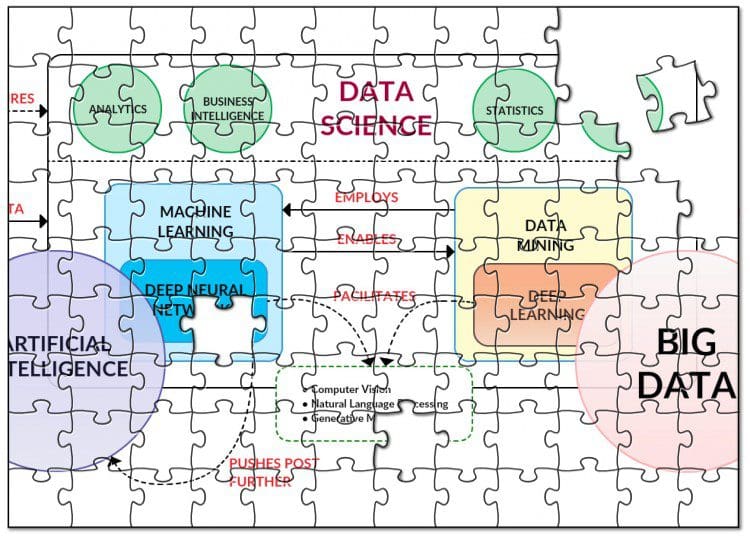
The Data Science Puzzle, Revisited

Broken data science puzzle
Though machine learning, artificial intelligence, deep learning, computer vision and natural language processing (along with a variety of other applications of these "intelligent" technologies) are all separate and distinct fields and application domains, even practitioners and researchers have to admit that there is some continually evolving "concept creep" going on any more, beyond the regular ol' confusion and confounding that has always taken place. And that's OK; these fields all started out as niche sub-disciplines of other fields (computer science, statistics, linguistics, etc.), and so their constant evolution should be expected. While it is important on some level to ensure that everyone who should have a basic understanding of their differences indeed possesses this understanding, when it comes to their application in fields such as data science, I would humbly submit that getting too far into the semantic weeds doesn't provide practitioners with much benefit in the long term.


6 machine learning success stories: An inside look

4 machine learning success stories: An inside look
Ed McLaughlin, president of operations and technology at Mastercard, says ML “pervades everything that we do.” Mastercard is using ML to automate what he calls “toil,” or repetitive and manual tasks, freeing up humans to perform work that adds productivity and value. “It's clear we've reached a state of the art where there is a clear investment case to automate workplace tasks,” McLaughlin says. Mastercard is also using ML tools to augment change management throughout its product and service ecosystem. For example, ML tools help determine which changes are the most risk-free and which require additional scrutiny. Finally, Mastercard is using ML to detect anomalies in its system that suggest hackers are trying to gain access. McLaughlin also put a “safety net” in the network; when it finds suspicious behavior it trips circuit breakers that protect the network. “We have fraud-scoring systems constantly looking at transactions to update it and score the next transaction that's going in,” he says.


Innovation Isn't About What You Know, But What You Don't


When Steve Jobs first came up with the idea for the iPod, it wasn't actually a machine he had in mind, but "a thousand songs in my pocket." It was, at the time, an impossible idea, because hard drives of that capacity and size just didn't exist. In fairly short order though, the technology caught up to the vision. That kind of singular focus and drive helps explain Jobs' incredible success, but what about his failures? The Lisa, a precursor to the Macintosh, flopped. So did his first venture after Apple, NeXT Computer. Even at the height of Apple's dominance, there were failures such as iAds. Apple TV still hasn't really gained traction. "It's not what you don't know that kills you," Mark Twain famously said, "it's what you know for sure that ain't true" and that's the real innovator's dilemma. Innovation, necessarily, is about the future, but all we can really know is about the past and some of the present. Innovation is always a balancing act of staying true to your vision and re-examining your assumptions.


Does artificial intelligence have a language problem?


If AI were truly intelligent, it should have equal potential in all these areas, but we instinctively know machines would be better at some than others. Even when technological progress appears to be made, the language can mask what is actually happening. In the field of affective computing, where machines can both recognise and reflect human emotions, the machine processing of emotions is entirely different from the biological process in people, and the interpersonal emotional intelligence categorised by Gardener. So, having established the term “intelligence” can be somewhat problematic in describing what machines can and can’t do, let’s now focus on machine learning – the domain within AI that offers the greatest attraction and benefits to businesses today. The idea of learning itself is somewhat loaded. For many, it conjures mental images of our school days and experiences in education.


The Kubernetes Effect


The container and the orchestrator features provide a new set of abstractions and primitives. To get the best value of these new primitives and balance their forces, we need a new set of design principles to guide us. Subsequently, the more we use these new primitives, the more we will end up solving repeating problems and reinventing the wheel. This is where the patterns come into play. Design patterns provide us recipes on how to structure the new primitives to solve repeating problems faster. While principles are more abstract, more fundamental and change less often, the patterns may be affected by a change in the primitive behaviour. A new feature in the platform may make the pattern an anti-pattern or less relevant. Then, there are also practices and techniques we use daily. The techniques range from very small technical tricks for performing a task more efficiently, to more extensive ways of working and practices.


Quote for the day:


"Keep your face always toward the sunshine - and shadows will fall behind you." -- Walt Whitman


Daily Tech Digest - February 10, 2018

Think, Do We Rule Technology, or Does Tech Rule Us?

Image: Shutterstock
As CompTIA notes, we can see the dark side of technology every day. Companies misuse or fail to protect data from hackers. Bad data leads to bad decisions. Then, consider our personal lives. Walk into almost any restaurant and see couples on "date night." No talking, just two people looking at their screens. I wonder if some people spend more time talking to Alexa than they do to other humans. "Balance" is about spending an hour without tech. It also means questioning tech decisions. Balance also is about applying the right technology solution to the right problem or opportunity. The saw about "technology for technology's sake" rings true when you see data scientists working on a corporate island soaking up data that holds no relevance to the business. It surfaces when executives say, "We need the IoT," when they have no clue as to why they need it or what IoT really is. The vast majority of technology adoption is for the better, but we still need to ask a few simple questions along the way. Does everyone need it? In fact, does anyone need it?


What Is Cryptojacking? How To Prevent Detect & Recover From It

vulnerable cryptojacking hacking breach security
Hackers have two primary ways to get a victim’s computer to secretly mine cryptocurrencies. One is to trick victims into loading cryptomining code onto their computers. This is done through phishing-like tactics: Victims receive a legitimate-looking email that encourages them to click on a link. The link runs code that places the cryptomining script on the computer. The script then runs in the background as the victim works. The other method is to inject a script on a website or an ad that is delivered to multiple websites. Once victims visit the website or the infected ad pops up in their browsers, the script automatically executes. No code is stored on the victims’ computers. Whichever method is used, the code runs complex mathematical problems on the victims’ computers and sends the results to a server that the hacker controls. Hackers often will use both methods to maximize their return. “Attacks use old malware tricks to deliver more reliable and persistent software [to the victims’ computers] as a fall back,” says Vaystikh.


Generating new revenue streams through intelligent IoT connectivity

Low-bandwidth messaging can be used to send small quantities of data across the core GSM network, which is embedded across the world in 2G and LTE networks. An MQTT-SN-based messaging protocol provides a globally connected network to support the development of new revenue streams. Because this type of connection doesn’t require any form of internet connection that would otherwise leave it prone to external intrusions, greater stability is offered for IoT devices, keeping connectivity levels high and costs low. ... As IoT technology continues to develop, we will gradually see fully automated solutions – which only send data when parameters change – become increasingly commonplace, minimising the need for human interaction. This will enable easy, wide-scale implementation of new, intelligent IoT solutions, presenting increased cost savings for existing streams, while offering further scope to build new business models. It is now crucial that organisations adapt their business models accordingly, allowing them to utilise IoT in further monetising these services.


Governments eye their own blockchain cryptocurrencies

bitcoin security vault
"They've been pretty emphatic," said Brian Behlendorf, executive director of Hyperledger, a collaborative formed to create blockchain technologyfor business use. "They're talking about third-party cryptocurrencies, like bitcoin and the 1,300 other cryptocurrencies out there. But they're not talking about blockchain technology. They're still extremely bullish on that. "They're pushing hard, as many countries are, for using distributed ledgers - using blockchain - to implement their own domestic digital token," Behlendorf added. While blockchain is the foundation for cryptocurrency, it is not anchored to digital currencies. Blockchain distributed ledgers are used for a myriad of business applications, such as authenticating real estate transfers or for digitizing supply chains or tracking international shipments in real time. A government-backed, blockchain-based digital token would offer the benefits of an international currency usable for settlement of global trade and holdings.


Cyber Warranties: What to Know, What to Ask

A cyber warranty is for all services provided by a solutions provider to their customer base. It covers the cost to re-perform services associated with the system update following an external data breach caused by a vendor's product, explains Matt Kletzli, management liability leader at Schinnerer, which recently launched a warranty for tech solutions providers. Schinnerer, an underwriting manager, teamed up with Guidewire, which builds software for the property and casualty (P&C) insurance industry. Its Cyber Warranty uses Cyance, a risk analytics tool from Guidewire, to gauge the risk of vendors' customers so they can customize strategies. The warranty is for small and mid-size solutions providers making $40M maximum each year. "What we're doing is providing the solutions providers with a tangible contractual agreement with every one of their clients where they have a service agreement in place," says Kletzli.


Key iPhone Source Code Gets Posted Online in 'Biggest Leak in History'

Someone just posted what experts say is the source code for a core component of the iPhone’s operating system on GitHub, which could pave the way for hackers and security researchers to find vulnerabilities in iOS and make iPhone jailbreaks easier to achieve. The GitHub code is labeled “iBoot,” which is the part of iOS that is responsible for ensuring a trusted boot of the operating system. In other words, it’s the program that loads iOS, the very first process that runs when you turn on your iPhone. It loads and verifies the kernel is properly signed by Apple and then executes it—it’s like the iPhone’s BIOS. The code says it’s for iOS 9, an older version of the operating system, but portions of it are likely to still be used in iOS 11. Apple has traditionally been very reluctant to release code to the public, though it has made certain parts of iOS and MacOS open source in recent years.


Could Machine Learning Help Startups Beat the Odds?

machine learning helping entrepreneurs
And technology is rapidly reducing the overall cost of starting up. One hundred years ago, the cost to start a business was immense – goods were difficult to transport over long distances. You were limited to a market that immediately surrounded you, and everything had to be done with the help of manual labor. There’s a reason that the average work week was 45.6 hours in 1918, with some estimates placing it at nearly double as industrialization took over later in the century. Today, technology isn’t just industrial in nature. Computer technology is advancing rapidly. Startups can harness the web to gather information and present useful visual data to consumers – just look at how the online gaming industry has become more transparent thanks to big data and ML technology that provides real-time insights. Your smartphone has more technological horsepower than the first space program to successfully reach the moon. Artificial Intelligence (AI) and Machine Learning (ML) allow cars to drive themselves, and computers to beat humans at chess.


Most remain dissatisfied with threat intelligence quality and accuracy

Lack of accuracy and timeliness is among the top complaints about threat intelligence, which in turn hinders its effectiveness and security teams’ ability to quickly mitigate threats. In fact, only 31 percent of respondents cited threat intelligence as actionable. But exchanging threat intelligence amongst peers, industry groups, IT vendors and government bodies can result in more holistic, accurate and timely threat intelligence and a stronger security posture. Two-thirds of respondents (66 percent) reported that threat intelligence could have prevented or minimized the consequence of a data breach or cyber attack, indicating that more infosecurity professionals are realizing the importance of threat intelligence. “Cybersecurity takes a village, and this survey spotlights a real need for the cybersecurity community – and public sector to better cooperate and communicate to share intel on security threats,” said Dr. Larry Ponemon, Chairman of the Ponemon Institute.


The Belgian Federal Computer Crime Unit (FCCU) was able to locate a command and control centre in one of Belgium’s neighbouring countries. Led by the federal prosecutor’s office, the Belgian authorities seized the command and control servers and other servers, while forensic analysis worked to retrieve the decryption keys. ... By sharing the keys with No More Ransom, the Belgian Federal Police becomes a new associated partner of the project, the second law enforcement agency after the Dutch National Police. In recent years, ransomware has eclipsed most other cyber threats, with global campaigns indiscriminately affecting organisations across multiple industries in the public and private sector, as well as consumers. ... The release of the Cryakl decryption keys is yet another successful example of how cooperation between law enforcement and internet security companies can lead to great results, said Europol. 


When should an organization report a data breach?

Notwithstanding requirements, organizations will sometimes notify authorities as soon as possible when there is evidence of a data breach. Doing so always looks good, because it shows you care about your customers’ privacy and ensures your organization is protected. Prompt notifications can also help remedy the situation if data breach details escalate. However, if details worsen, or multiple breaches are involved, notifying the public of each step can lead to unnecessary ‘breach fatigue’. Fallout may occur, as consumers lose trust in an organization beset by confusion. It may also prevent state legislators from incentivizing on cybersecurity regulations, as they become the norm and are considered less urgent. According to databreachtoday.com, “it depends.” Organizations should have established information security management policies and processes well in advance of a data breach.Quote for the day:


Quote for the day:


"Every great movement must experience three stages: ridicule, discussion, adoption." -- Voltaire


Daily Tech Digest - February 08, 2018

What is quantum computing? A machine learning supercharger businesses can’t ignore
CIOs interested in the potential of quantum computing should take stock of early adopters. Volkswagen in March 2017 began using quantum machines from D-Wave Systems to optimize traffic flow for 10,000 taxis in Beijing, China. Volkswagen CIO Martin Hofmann says that his team had to program a quantum chip to address every bit on the chip. "Quantum computing in the next five years will be a dominating technology," Hoffman says. Accenture and 1Qubit are working with Biogen to speed up drug discovery by accelerating the rate at which they can simulate molecules and chemical reactions. J.P. Morgan Chase is working with IBMto use quantum computers for risk analysis and trading strategies. In looking where to apply quantum computing, Brisse says CIOs should identify problems involving large data sets that can't be solved by classic computers, including NP-hard problems, such as the travelling salesman optimization problem. Analyzing death and mortality tables in insurance and calculating risk in securities are a couple of common problems for which Brisse fields inquiries.


Identity fraud enters a new era of complexity

identity fraud complexity
While credit card accounts remained the most prevalent targets for new account fraud, there was significant growth in the opening of new intermediary accounts, such as email payments (e.g. PayPal) and other internet accounts (e.g. e-commerce merchants such as Amazon) by fraudsters. Although not as easily monetized alone, these account types are invaluable in helping fraudsters transfer funds from the existing accounts of their victims. The study also found three significant changes in data breaches in 2017. Nearly a third (30 percent) of U.S. consumers were notified of a breach in the past year, up from 12 percent in 2016. For the first time ever, Social Security numbers (35 percent) were compromised more than credit card numbers (30 percent) in breaches. Data breaches are causing consumers to lose trust in institutions. These trends combined to cause consumers to shift the perceived responsibility for preventing fraud from themselves to other entities, such as their financial institution or the companies storing their data.


Cybersecurity PTSD affects many security professionals

Cybersecurity PTSD affects many security professionals
70 percent of cybersecurity professionals say the cybersecurity skills shortage has had some impact on their organization. Of course, they are living this impact; 63 percent of cybersecurity professionals say the cybersecurity skills shortage has increased the workload on existing staff. More work and stress at the same salary is a surefire recipe for dissatisfied employees and high attrition; 41 percent of cybersecurity professionals say the cybersecurity skills shortage has led to a situation where the infosec staff spends a disproportional amount of time dealing with high-priority issues and incident response. This means that many cybersecurity pros face a high-stress workplace from the beginning to the end of their workdays; 68 percent of cybersecurity professionals believe that a cybersecurity career can be taxing on the balance between one’s personal and professional life. In other words, infosec pros are taking the pressure of their jobs home with them. It’s safe to assume that this can leads to issues like substance abuse and others.


Aryaka enhances SD-WAN with Radware DDoS protection


With this new partnership, Aryaka said users will gain another layer of data security and threat mitigation with Radware DDoS protection. For example, Radware offers its Attack Mitigation service, which protects against DDoS attacks with "always-on detection and mitigation," according to a statement made by Aryaka. In the statement explaining the need for Radware DDoS, Gary Sevounts, Aryaka's chief marketing officer, said, "Today's ever-changing threat landscape necessitates a layered, defense-in-depth approach to security that scales to global enterprise networks and combines advanced threat detection, mitigation and perimeter protection." Aryaka's private network offers customers a foundational layer of security since traffic isn't exposed to the public internet, thereby, avoiding potential outsider threats. Aryaka then offers end-to-end encryption for another layer of protection.


What is Cython? Python at the speed of C

What is Cython? Python at the speed of C
Cython code looks a lot like Python code, by design. If you feed the Cython compiler a Python program, it will accept it as-is, but none of Cython’s native accelerations will come into play. But if you decorate the Python code with type annotations in Cython’s special syntax, Cython will be able to substitute fast C equivalents for slow Python objects. Note that Cython’s approach is incremental. That means a developer can begin with an existing Python application, and speed it up by making spot changes to the code, rather than rewriting the whole application from the ground up. This approach dovetails with the nature of software performance issues generally. In most programs, the vast majority of CPU-intensive code is concentrated in a few hot spots—a version of the Pareto principle, also known as the “80/20” rule. Thus most of the code in a Python application doesn’t need to be performance-optimized, just a few critical pieces. You can incrementally translate those hot spots into Cython, and so get the performance gains you need where it matters most.


More POS malware detected in the wild


The researchers said it is still unclear whether the malware is currently being used in campaigns in the wild, but the co-ordinated use of LogMeIn-themed filenames and command and control (C2) server addresses in Switzerland, coupled with evidence of an earlier Intel-themed variant, suggest that it may well be. The researchers noted that they have been in contact with LogMeIn throughout the investigation to help determine whether its services or products may have been abused as part of the malware deployment process, but no evidence of this was found. “It appears that the use of LogMeIn-themed filenames and C2 domain by the actors behind the malware is a simple lure and ‘camouflage’ technique,” they said, adding that LogMeIn has not been affected or infected in any way. LogMeIn has also issued a statement saying that all legitimate updates for LogMeIn products, including patches, will always be delivered securely in-product.


Ticking Time Bombs in Your Data Center

Programming is the linchpin of the modern data center, the building block for developing all manner of software that makes navigating enterprise IT easier. That being said, one of the data center's biggest threats lies in this foundation of its composition: complex legacy code. If you look at the flaws that lead to most breaches, they aren't so much on algorithmic levels as they are on primary levels, rooted in the legacy code. As the data center moves to the cloud and is forced to update existing protocols, reining in the small but powerful lines of stray programming becomes more critical than ever. In order to compensate for these Achilles' heels, IT teams must ensure that there are proper measures in place to both spot these errors and revise them. If the software is too far down the rabbit hole to be revised at a foundational level, additional layers of security can be enforced through management


5 reasons digital twins matter to your IoT deployment

twin suns
A digital representation of a physical object, digital twins allow businesses to create a crystal-ball-like-view into the future. They enable simulation, analysis and control to test and explore scenarios in a practice setting before initiating changes in the real world. While digital twins have historically been associated with more complex technology environments, its impressive ability to both eliminate problems and deliver next-level operational performance is making these models a must-have technology in every IoT team’s toolkit. Some of the first digital twin cases I’ve witnessed involved complex—and usually expensive—capital assets such as diesel engines, turbines, and heavy-duty mining and construction equipment. Their digital representations are equally complex, comprising finite state machines with potentially tens of thousands of discrete states. However, digital twins offer even the simplest constructs a vast number of benefits.


Teenager suspected of crippling Dutch banks with DDoS attacks


The attacks began more than a week ago when ABN Amro, one of the Netherlands’ bigger banks, fell victim to the first DDoS attack. Customers could not log into their online banking accounts or use the bank’s mobile app. After the first attacks were fended off, a new wave struck, this time also hitting other banks, such as Rabobank, and some other organisations. The Dutch Tax Authority was attacked, as well as DigiD, the country's login system for governmental services. The attacks on both the banks and institutions continued throughout the week, and later affected popular technology website Tweakers.net. As the waves of DDoS attacks crippled the Netherlands’ financial system, many experts started speculating about who was behind them. Fingers were quickly pointed at Russia. Although no concrete evidence emerged, many found the timing of the attacks to be a little coincidental – a matter of days after the news of the AIVD findings broke, so a retaliatory attack seemed a possibility.


The future of work: How to thrive through IT’s latest revolution

The future of work: How to thrive through IT’s latest revolution
“What does an exponential IT worker look like?” asks Jeff Schwartz, human capital principal at Deloitte Consulting. “What part of her work is problem solving? How much is routine? What communication is required in her job? What supervision is required?” If she oversees several people, consider what that oversight might entail, he says. “Is it scheduling a bunch of people, which could be done by algorithm, or is it people talking and seeing and interacting with each other?” With automation, the scheduling function could be handled by a chatbot. Our hypothetical IT employee might still hold a daily meeting with her team, but now they could spend that time solving work problems or discussing priorities. “I look at it and say there’s an opportunity to boost productivity,” Burns says. “In general, I don’t think people like doing mundane tasks. They genuinely want to focus on adding value and these machines help them add more value than they could on their own.”


Quote for the day:


"It is a fine thing to have ability, but the ability to discover ability in others is the true test." -- Elbert Hubbard