Showing posts with label IT Leadership. Show all posts

Daily Tech Digest - July 07, 2026


Quote for the day:

“Cybersecurity is not about avoiding risk; it’s about managing it.” -- Admiral Mike Rogers

🎧 Listen to this digest on YouTube Music

▶ Play Audio Digest

Duration: 23 mins • Perfect for listening on the go.


Why developers are over the cloud

While cloud computing remains massive, software developers are fundamentally shifting their initial focus away from choosing a specific cloud provider and instead prioritizing tools that offer the fastest development workflow. In the past, the "first mile" of building an application usually started with selecting foundational infrastructure from major vendors like AWS or Azure. Today, developers increasingly start their projects in AI-assisted coding environments and utilize streamlined platforms like Vercel, Cloudflare, or Supabase. These modern developer experience platforms effectively abstract away complex backend infrastructure, allowing engineering teams to focus entirely on their core application logic rather than managing servers, databases, or networking components. However, traditional cloud providers still dominate the "second mile" of software development—the crucial transition from a working prototype to enterprise-grade production. This stage requires robust security, compliance, cost management, and identity controls. To maintain their relevance, major cloud infrastructure providers must adapt by integrating directly into modern coding workflows rather than expecting users to navigate complex cloud consoles. Ultimately, developers are flocking toward platforms that deliver immediate application outcomes, challenging legacy cloud giants to make the leap to production feel like a natural, seamless upgrade rather than a difficult administrative burden.


The token economy: The state of AI mid-2026

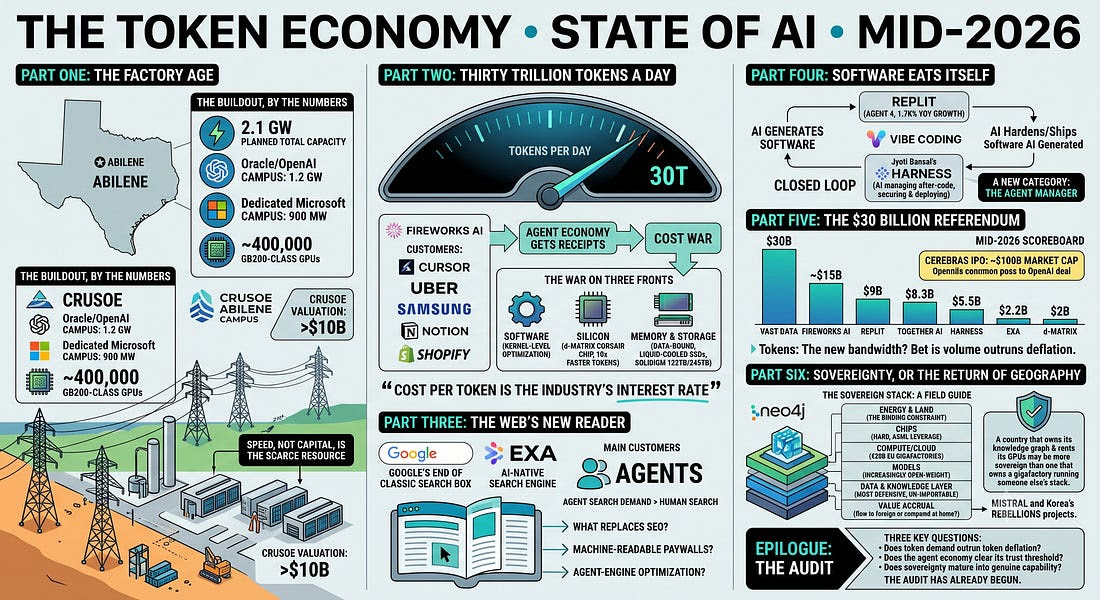
By mid-2026, the artificial intelligence industry has firmly moved past its experimental phase and matured into a tangible, large-scale economy. The primary focus has shifted from software laboratories to expansive physical infrastructure. Companies are now constructing gigawatt-scale computing facilities to meet intense processing demands. These sprawling centers require unprecedented amounts of electricity, making power generation just as critical to the industry as the technology itself. The underlying currency of this working economy is the token. Inference platforms are processing tens of trillions of tokens daily, driven largely by independent software programs that perform complex tasks like coding and internet research without human oversight. As software increasingly interacts directly with other software, the main competitive battleground is no longer just about creating smarter models, but about systematically lowering the processing cost for each token. This technological shift is also altering global priorities. Recognizing the strategic importance of these computing systems, nations are heavily funding independent AI initiatives. Governments are securing local infrastructure and building proprietary knowledge bases to ensure they retain direct control over their hardware, data, and economic resources rather than depending on foreign tech providers.


The problem with AI model routing

As organizations move away from simply maximizing artificial intelligence usage, many are adopting a new strategy called model routing. The idea is quite straightforward: send complex questions to advanced, expensive models and route simpler, everyday requests to cheaper alternatives. While this approach seems like a highly practical way to manage rising costs, it carries significant technical flaws. The fundamental problem is that modern language models rely heavily on keeping recent data in a ready memory state—such as remembering recent conversation history and caching details—to operate efficiently. When organizations route requests across different models from various providers, they throw away these essential, built-in efficiencies. Every switch causes a system cold start, forcing the platform to reprocess the entire context completely from scratch. This wasted effort ultimately raises the overall cost for everyone involved, effectively negating the expected financial savings. Consequently, rather than relying on third-party routing systems that create disjointed workflows, the industry will likely shift toward built-in routing managed directly by the major providers. By handling the routing internally, these providers can preserve system efficiency and lower costs, which will ultimately lead to deeper reliance on a single ecosystem.


Delegated authentication: A security essential plus strategic data asset

The rapid shift from physical cards to mobile transactions has introduced significant security and compliance challenges, often resulting in clunky customer experiences. Older verification methods required shoppers to use static passwords during checkout, which frequently caused them to abandon their carts out of frustration. To solve this problem, delegated authentication allows merchants to verify a customer’s identity—often through familiar methods like fingerprint or facial recognition—and seamlessly pass that proof directly to the card issuer. This smoother process reduces purchase friction while still meeting strict security regulations. Modern payment systems now treat this authentication data as a practical tool rather than a simple compliance checklist. By sharing clear transaction context, banks can safely reduce false card declines and approve more legitimate purchases. Furthermore, as automated commerce expands and digital assistants begin making purchases on behalf of users, these systems adapt by establishing pre-approved spending boundaries. By combining secure data handling with clear customer permissions, financial institutions can accurately verify both human shoppers and their automated representatives. Ultimately, this collaborative approach aligns business operations with firm security standards, ensuring that everyday payments remain safe and dependably convenient.


Single points of failure fail. The SaaS layer is not an exception

Higher education institutions have heavily consolidated their core operations into a small number of massive software platforms, turning these systems into critical single points of failure. Recent major disruptions, including severe ransomware attacks and extended platform outages during crucial times like finals week, have highlighted the danger of this dependency. When these platforms go dark, entire academic operations halt, leaving students and faculty stranded without access to coursework, rosters, or grades. The risk is compounded by the fact that the education sector has a history of paying ransoms, which actively incentivizes further attacks. To address this vulnerability, information technology leaders must stop treating external software as an exception to standard disaster recovery practices. Service level agreements and compliance checklists are not sufficient to keep classes running during a crisis. Instead, institutions need an independent contingency plan. Building a secure, independent data repository that regularly synchronizes information from primary systems ensures that schools maintain access to vital records during an outage. Just as modern infrastructure requires redundant network connections and backup power, securing academic operations demands building reliable workarounds for when primary platforms inevitably fail.


Operational Resilience Starts with Risk-Intelligent Microsegmentation

In a highly connected world, protecting critical infrastructure like manufacturing plants and water treatment facilities has become more challenging. If operational technology systems fail, the entire business halts. Recognizing this threat, ColorTokens has partnered with Claroty to improve security for these vital environments. The collaboration combines Claroty’s ability to deeply monitor and catalog physical and digital assets with ColorTokens’ expertise in controlling how those systems communicate. Because modern cyber threats can spread rapidly, simply detecting an intrusion is no longer enough. Organizations must prevent attackers from moving freely across their networks. This approach uses risk-aware network separation to block harmful activity without interrupting essential business functions. By integrating with existing monitoring and defense tools, the joint solution allows security teams to identify vulnerabilities and apply protective rules without installing complex software on older machinery. Ultimately, it is impossible to prevent every attack. However, by understanding which systems carry the most risk and limiting their exposure, companies can ensure that a minor breach does not become a major crisis. This strategy focuses on practical readiness, giving organizations the reliable control they need to maintain continuous operations and safeguard both production and human safety.


Zebra CIO warns of 'AI bloat' risk in enterprise adoption push

As companies rush to adopt artificial intelligence, they risk creating "AI bloat" by deploying tools without a solid strategy, warns Matt Ausman, Chief Information Officer at Zebra Technologies. Much like the software subscription bloat of the past, disorganized AI integration leads to over-engineering, clutter, and inefficiency. The core issue is that corporate ambition is currently outpacing workforce readiness. Deep, effective AI adoption is a multi-year effort where change management and employee training often lag far behind the initial technology rollout. To prevent this scattered approach, Ausman outlines a structured five-step blueprint for success. Organizations should establish cross-functional governance, appoint a dedicated executive to lead the transformation, clearly define their strategy, heavily invest in training for all staff, and launch a comprehensive change management program with steady feedback loops. Zebra itself is modeling this disciplined approach by focusing on standard, widely deployed tools rather than chasing every new release. The company actively uses AI to assist frontline workers, automating routine tasks like pallet scanning while keeping a close eye on employee well-being to prevent burnout. Ultimately, success requires technical leaders to shift from simply managing systems to actively championing thoughtful, strategic business transformation.


Spite-Driven Engineering: A New Blueprint for Cloud Security in the AI Native Era

In a recent InfoQ podcast, Alex Zenla discusses a fresh approach to securing cloud infrastructure, built around the concept of "spite-driven development." This philosophy encourages engineers to tackle fundamental technical frustrations head-on rather than simply layering quick fixes over deeply flawed systems. Zenla points out that much of our current infrastructure relies on fragile foundations, particularly highlighting how shared memory in standard operating system cores fails to provide true security when running multiple applications side-by-side. Instead of accepting these risks, teams need stronger separation methods for their workloads. The conversation also explores the practical realities of using artificial intelligence in development. While AI tools are helpful for building early prototypes, blindly trusting them can introduce dangerous technical debt. Developers still need a deep understanding of the underlying systems to fix issues when things inevitably break. Furthermore, forcing standard graphics processors to handle secure AI tasks is both inefficient and risky, pointing to a need for more specialized hardware. Ultimately, Zenla argues that engineers should stop viewing security and regulation as simple compliance checklists. By taking ownership and building resilient architecture from the ground up, companies can turn strong security into a genuine competitive advantage.


IPv6-only vs IPv6-mostly: Appropriate use cases

As organizations transition their network infrastructures, the terms "IPv6-only" and "IPv6-mostly" are frequently confused, despite serving different environments. Properly defining the scope of these concepts is essential to prevent scalability issues. Describing a full network as "IPv6-only" is rarely accurate today, since many applications still need IPv4 connectivity. Instead, it is more precise to refer to an "IPv6-only access network" paired with an IPv4 transition mechanism. This approach works well for unmanaged environments like mobile and residential networks, allowing the wide area network to operate on IPv6 while maintaining dual-protocol functionality for users. In contrast, the "IPv6-mostly" model was explicitly designed for managed corporate networks. It allows devices to signal they do not need an IPv4 address, reducing reliance on older infrastructure without requiring dedicated network segments. However, applying this approach to residential networks introduces severe communication barriers. Devices would be completely unable to interact with local legacy hardware, such as printers or cameras, without manual configurations. Choosing the appropriate deployment model based on your specific network context is fundamentally critical to ensuring a smooth and functional transition.


6 new rules of IT leadership - and what they replace

The role of the CIO is undergoing a significant transformation, largely driven by the impact of artificial intelligence on the modern business landscape. Rather than merely taking direction from the CEO, today's IT leaders are expected to collaborate directly with top executives to define the company's future vision and architect a completely new, AI-driven organization. This means embracing uncertainty and creating a culture where employees feel safe enough to learn from failure, replacing the outdated "fail fast" mentality with a focus on sustainable growth and psychological safety. Furthermore, IT chiefs can no longer rely solely on business counterparts for operational insights; they must possess a panoramic understanding of all business operations, much like a COO. The financial demands on CIOs have also intensified, requiring them to act more like CFOs by rigorously calculating the total cost of ownership and return on investment for cloud and AI initiatives. Finally, modern IT leadership requires abandoning a one-size-fits-all management style in favor of adapting to the diverse, global, and often remote needs of individual team members, ensuring that everyone can thrive in a rapidly changing environment.

Daily Tech Digest - July 04, 2026


Quote for the day:

“When you connect to the silence within you, that is when you can make sense of the disturbance going on around you.” -- Stephen Richards

🎧 Listen to this digest on YouTube Music

▶ Play Audio Digest

Duration: 22 mins • Perfect for listening on the go.


Don’t waste your next cloud outage

Recent, widespread cloud outages at major providers like Google, AWS, and Microsoft Azure highlight a critical vulnerability in modern enterprise architecture: relying too heavily on a single cloud vendor. When hyperscale platforms fail, the ripple effects cause millions of dollars in lost revenue, disrupted operations, and damaged customer trust. Unfortunately, service-level agreements (SLAs) offer minimal financial recourse, leaving the burden of risk almost entirely on the customer. To protect their operations, organizations must stop treating the cloud as an infallible foundation and start building deliberate resilience into their systems. While adopting hybrid or multicloud architectures introduces complexity and requires diverse management skills, it is a necessary investment. Technology leaders should audit their current cloud dependencies to uncover hidden single points of failure. From there, they can implement hybrid architectures for mission-critical workloads, ensuring an alternative operational path if the primary cloud fails. Finally, businesses need to conduct formal disaster-recovery testing specifically tailored to cloud API unresponsiveness and region-wide blackouts. By taking responsibility for their own resilience and distributing workloads sensibly, enterprises can ensure their operations continue smoothly during the next inevitable cloud failure.


Why Every AI Strategy Needs a Cybersecurity Strategy: Building Secure AI Systems from Day One

As artificial intelligence transforms business operations through automation and data management, it also introduces serious new security threats that many organizations completely overlook. Rather than treating security as an afterthought, companies must build cybersecurity into the very foundation of their AI strategies from day one. Failing to do so leaves valuable customer and financial data exposed to damaging attacks. Key threats unique to AI include data poisoning, where attackers manipulate training data to produce false results, and prompt injection, which tricks systems into revealing sensitive information. Furthermore, unauthorized access and vulnerabilities in connected third-party systems expand the potential attack surface. Instead of waiting for an incident to happen, organizations should prioritize strong access controls, data encryption, and regular security testing well before deployment. It is equally important to train employees to avoid human error and to establish a dedicated incident response plan for AI-related breaches. Ultimately, balancing rapid innovation with sound risk management is absolutely essential. By designing security into AI systems from the start, businesses can save time and money, ensure continuous business operations, and build lasting trust with their customers while safely leveraging modern technology.


How Four Often-overlooked Forces Shape Architectural Decisions

In enterprise architecture, the most significant obstacles to successful technology upgrades are rarely technical; instead, they are driven by human behavior. While we often blame failing projects on poor integration or data issues, the true root causes usually stem from four underlying forces: fear, incentives, politics, and ego. Fear frequently causes stakeholders to delay hard choices, leading to structural workarounds that become permanent architectural debt. Incentives can encourage teams to optimize for their own goals, such as delivery speed or budget cuts, at the expense of building coherent, shared infrastructure. Politics often turns system architecture into a quiet battlefield where leaders compete for influence and control over resources. Finally, ego keeps obsolete legacy systems alive simply because individuals or organizations are too attached to what they built or how they have always worked. To truly fix broken architecture, professionals must look beyond the diagrams and address these human elements directly. Rather than arguing over technology, architects should diagnose which human force is driving resistance and apply the right intervention, whether that means providing safety, aligning rewards, escalating decisions, or managing pride. Ultimately, shaping enterprise systems means shaping human decisions.


Prompt Data Is the New Shadow Data Layer

The increasing use of generative AI tools has created a new "shadow data" layer within organizations. While traditional security systems effectively catch obvious outbound data leaks, they often miss sensitive information that employees paste directly into AI prompts to clean up wording or write code. Prompt data should be managed as a governed channel because even minor, careless use of unmanaged SaaS tools or personal AI accounts on corporate devices can expose confidential company information. To reduce this risk, organizations must map their AI usage into distinct tiers—such as approved enterprise AI, unmanaged SaaS AI, personal accounts, and locally hosted models—and classify the actual data rather than just the application. Clear policies should restrict sensitive material like credentials, proprietary source code, and customer data from entering unauthorized external systems. Rather than outright banning AI, which usually drives employees to use personal workarounds, companies should establish approved workflows and educate teams on safe alternatives. By layering browser visibility, proxy inspection, and data loss prevention controls, organizations can effectively monitor prompt activity and connect AI governance to their existing security and incident response frameworks.


How AI automation is reshaping the IT leadership pipeline

The rapid integration of AI automation is fundamentally reshaping the traditional IT leadership pipeline by eliminating the entry-level and routine tasks that once served as a foundational training ground. Historically, junior employees built essential technical and business acumen by performing hands-on, task-based work, allowing them to naturally progress into leadership roles. However, with AI absorbing these responsibilities, job openings for early-career roles have notably declined, threatening to create a significant talent and leadership gap in the near future. To prevent this, organizations can no longer rely on the standard hierarchical progression. Instead, they must intentionally redesign job structures and create active learning experiences to replace the foundational work lost to automation. This requires senior leaders to dedicate more time to mentoring and exposing junior staff to complex decision-making much earlier in their careers. Furthermore, companies must avoid treating AI merely as a software rollout. They need to pair technology investments with robust early-talent development programs and intentional upskilling. By providing transparent career pathways and clear guidance, organizations can keep emerging talent engaged and secure a highly capable generation of future IT leaders.


Modern identity security without an enterprise budget

Protecting your organization's digital footprint does not require an unlimited budget or prohibitively expensive software tiers. Many smaller and mid-sized businesses often feel priced out of top-tier security solutions, but you can achieve a robust defense by maximizing the tools you likely already have. The foundation of this approach is moving away from easily compromised, traditional passwords and standard SMS-based verification. Instead, organizations should prioritize deploying phishing-resistant multi-factor authentication (MFA) across their environments. Coupled with this is the transition to passkeys. Passkeys offer a highly secure, user-friendly alternative that relies on device-based biometrics or PINs, practically eliminating the risk of credential theft while keeping deployment costs low. Furthermore, implementing conditional access policies allows you to tighten security dynamically. By evaluating the specific context of every login attempt—such as the user's geographic location, the time of day, or the health of their device—you can block suspicious activity before it reaches your data. By shifting focus toward these modern, practical authentication methods, IT teams can build highly resilient, enterprise-grade identity security architectures without having to secure an enterprise-sized budget.


Is the SaaSpocalypse already over?

The initial panic that artificial intelligence would destroy the software-as-a-service (SaaS) industry—dubbed the "SaaSpocalypse"—appears to be fading. While AI has drastically lowered the barrier to creating single-purpose software features, the overall value of robust software platforms remains highly relevant. Before AI, building specific features required significant engineering effort and served as a competitive moat. Today, AI can easily replicate those basic functions, rendering single-use tools less valuable. However, building software is very different from securely and reliably operating it at scale. As businesses integrate AI into their operations, they are demanding greater security, governance, and operational resilience rather than just standalone features. Consequently, the focus is shifting away from simple feature creation and toward comprehensive platforms capable of managing the complexity and risks introduced by AI. Software categories that offer broad ecosystems—such as data platforms, security systems, and developer infrastructure—are perfectly positioned to thrive in this new environment. Ultimately, trust and the ability to operate safely at scale are emerging as the new competitive advantages. Organizations will increasingly rely on established platforms to maintain control and visibility as their AI adoption continues to grow.


The Software Deployment Failures That Pass Every Pre-Deployment Check

The article "The Software Deployment Failures That Pass Every Pre-Deployment Check" by Sancharini Panda explains why code deployments can still break production even when all automated pipeline checks succeed. Standard pre-deployment validations like unit and integration tests are fundamentally limited because they verify code against static, outdated assumptions rather than the current state of a live system. In modern microservice architectures, dependencies are constantly updated on independent schedules. When a service relies on a mock test that represents an older version of another service, it tests against a reality that no longer exists. Consequently, errors emerge not within the newly deployed code itself, but at the integration boundaries where the code interacts with changed downstream or upstream systems. Writing more tests against these static specifications does not solve the root issue and manual tracking becomes impossible at scale. To genuinely prevent these deployment failures, organizations must shift to validating code against the actual, observed behavior of active dependencies right now. By doing so, teams can ensure their updates are compatible with the real-time system environment rather than a frozen snapshot of the past, effectively closing the gap where the most insidious deployment risks hide.


From Data Fragmentation to Agentic Intelligence

Snowflake’s recent announcements of a new open interoperability framework and a $6 billion infrastructure commitment with AWS highlight the vital structural foundation required for enterprise-ready agentic AI. The primary barrier to enterprise AI success is no longer the models themselves, but severely outdated data architectures. Traditional systems require data to be copied, transformed, and moved before it can be utilized, which is fundamentally incompatible with AI systems that demand continuous access to real-time, distributed information. To solve this crippling data fragmentation problem, Snowflake’s framework leverages open standards like Apache Iceberg to allow organizations to operate on a single, governed copy of their data across multiple platforms without ever moving it. Furthermore, because autonomous AI agents require strict security measures to safely operate, the framework provides a unified governance plane that consistently enforces data privacy and audit controls everywhere. The massive infrastructure partnership with AWS supplies the necessary computing power to train and run these models directly on governed enterprise data. Ultimately, as AI models become commoditized, the true competitive advantage will belong to organizations that proactively resolve their underlying data infrastructure challenges to safely deploy agentic intelligence at scale.


The UN wants to shape the future of AI governance. CIOs must act today

The United Nations recently launched the AI for Good Global Commission to guide the responsible development and governance of artificial intelligence on a global scale. While this commission brings together influential technology companies and policymakers, its formal recommendations may take years to shape actual regulations. However, enterprise technology leaders cannot afford to wait for a unified global rulebook to be finalized. Today's landscape of artificial intelligence governance remains highly fragmented, with different countries and regions implementing their own specific laws and standards. Despite these regional differences, a common foundation is steadily beginning to emerge around core principles like transparency, accountability, data privacy, and human oversight. Instead of waiting for perfect regulatory clarity, organizations should proactively establish their own internal governance frameworks, focusing particularly on high-risk applications that impact large numbers of people. Interestingly, companies will likely experience the commission's impact much sooner than formal laws are passed, as major technology providers are already embedding these evolving governance standards directly into the platforms and tools businesses use daily. By treating governance as a fundamental operational practice rather than a mere compliance checklist, businesses can build customer trust and safely scale their technology initiatives in a complex landscape.

Daily Tech Digest - June 15, 2026


Quote for the day:

“Moral authority comes from following universal and timeless principles like honesty, integrity, and treating people with respect.” -- Stephen R. Covey

🎧 Listen to this digest on YouTube Music

▶ Play Audio Digest

Duration: 17 mins • Perfect for listening on the go.


Open source moves from ‘a nerdy audience’ to the geopolitical stage

Open-source software has evolved from a niche interest for technical developers into a critical element of global business strategy and European digital sovereignty. In an interview, Nextcloud CEO Frank Karlitschek explains that geopolitical tensions and data privacy concerns have made European organizations increasingly cautious about relying on major United States technology suppliers. Worries over the US CLOUD Act, industry espionage, and vendor lock-in are driving a strong push for digital independence. As a result, companies are exploring open-source alternatives to proprietary platforms like Microsoft and Google to maintain control over their data. Nextcloud is addressing this shift by offering secure collaboration tools, including the recently launched Euro-Office application suite, and by integrating artificial intelligence into its platforms. Karlitschek views the demand for digital sovereignty as a permanent structural change rather than a temporary trend. While he welcomes the European Commission's Tech Sovereignty Package, he emphasizes the need to translate these proposals into binding legislation. Furthermore, he remains skeptical of attempts by US firms to market localized cloud services as sovereign solutions, noting that true independence requires freedom from foreign software updates and potential security vulnerabilities. Moving forward, Nextcloud intends to maintain its focus on secure, self-hosted collaboration software while expanding its artificial intelligence capabilities and supporting independent software vendors.


The Pilot Trap: Why Enterprise AI Keeps Failing the Walk from Demo to Production

Enterprise artificial intelligence projects frequently stall when transitioning from controlled testing to practical application. The core issue is rarely the AI model itself, which typically performs well in isolated trials using clean, organized information. Instead, failures occur because the surrounding business infrastructure is not equipped to handle the transition. In a live production environment, AI systems must navigate messy, inconsistent data, strict security rules, and complex daily operations. When basic terms vary across different departments or data structures change without warning, the entire system begins to degrade. To build lasting solutions, organizations must stop treating AI as a standalone tool and start treating it as an ongoing engineering challenge. A dependable system requires a strong foundation where data standards and security policies are automatically enforced whenever the system is operating. Furthermore, companies should avoid the common temptation to use the largest, most complex model for every single task. Selecting the most efficient, capable model for a specific job lowers costs and improves overall reliability. Ultimately, achieving lasting success with enterprise technology comes down to focusing on the unglamorous groundwork. By establishing clear guidelines, enforcing strict security, and engineering a resilient foundation, organizations can ensure their tools remain dependable for daily work rather than just serving as fragile demonstrations.


Sovereign cloud won’t fix your AI risk. Identity governance will

In this article, Sabine Frömling explains that relying solely on sovereign cloud infrastructure cannot fully eliminate the security and regulatory risks associated with artificial intelligence workloads. While sovereign clouds ensure data residency and help satisfy European regulations like NIS2 and the EU AI Act, they do not guarantee true operational control. Real authority over data resides at the identity governance layer instead. European companies have already discovered that keeping data within local borders fails to protect enterprise systems if user and system access permissions are poorly managed. This issue is particularly pressing for artificial intelligence because autonomous AI agents introduce non-human identities that frequently operate outside standard security monitoring. If an unauthorized person or a compromised software agent gains high-level access, data residency laws will not prevent a major data breach. Therefore, security leaders must shift their primary focus from physical data center boundaries to maturing their identity and access management systems. Rather than moving every single workload to expensive sovereign clouds, organizations should categorize their data by actual regulatory risk and prioritize governing digital credentials, especially short-lived ones for automated tools. Ultimately, sovereign cloud platforms only buy legal protection within a specific jurisdiction, whereas a solid identity governance strategy provides the actual security control needed to manage modern AI technologies.


The Global State of Technology Risk in 2026

In 2026, technology risk is evolving rapidly as organizations worldwide integrate advanced artificial intelligence into their daily operations. According to recent industry reports, the shift toward increasingly autonomous systems requires leaders to rethink their approach to trust, safety, and workforce management. For government entities, a key focus is building strong internal expertise so they can effectively evaluate solutions, direct suppliers, and maintain strategic control over their digital services. In the private sector, surveys indicate that while companies are deploying these tools on a much larger scale, many still lack mature safety strategies and appropriate internal controls. The primary challenges are no longer just entirely new types of threats, but rather traditional security and operational risks that are developing much faster and with far less transparency. To manage these highly complex systems properly, organizations need flexible methods for managing risk and clear lines of accountability, ensuring that essential human oversight remains intact at all times. Furthermore, international perspectives, such as newly released standards from China, highlight growing global concerns around model safety, open-source misuse, and broader societal impacts. Ultimately, navigating this complex landscape requires leaders to look beyond standard local practices. They must adopt a global perspective and establish practical guidelines to safely balance technological advancement with necessary security.


Architecture-as-code is the next frontier for enterprise governance

Enterprise architecture governance traditionally relies on manual review boards, slide decks, and point-in-time assessments to ensure compliance and manage risk. However, as organizations increasingly adopt continuous software delivery, these episodic reviews struggle to keep pace with rapid system changes. "Architecture-as-code" offers a more effective approach by turning architectural standards and design expectations into machine-readable formats. Instead of waiting for a final meeting to discover compliance issues, this method embeds automated governance checks directly into the software delivery lifecycle. By treating architectural intent as executable code, teams can continuously compare their declared designs against actual implementation evidence, such as configuration files and application interfaces. This continuous assurance model spots discrepancies early, highlighting problems before they become major delivery risks. While artificial intelligence can support this process by interpreting automated test results and preparing clear narratives, it does not replace human oversight. AI assists with evaluation, but human architects remain fully accountable for final judgments, risk acceptance, and strategic choices. Ultimately, architecture-as-code transforms governance from a static, cumbersome bottleneck into a measurable, ongoing practice. It provides organizations with the necessary structure to build complex systems quickly while maintaining clear standards and reliable oversight.


Cybersecurity, identity, and observability at machine speed

Artificial intelligence in cybersecurity is rapidly shifting from a supportive role to active execution. Instead of just analyzing data and suggesting fixes, systems are now directly managing tasks such as assessing alerts, blocking threats, and altering access rights. This change is necessary because manual human responses can no longer keep up with the sheer speed of modern cyber attacks. However, handing over direct control to automated systems introduces new risks. If a program makes a mistake, the operational consequences for a business can be severe. Because of this, industry leaders emphasize that raw speed is useless without strict oversight. For automation to be safely integrated into live operations, organizations must establish clear rules, maintain human oversight for complex decisions, and ensure every automated action is traceable and reversible. A critical part of this safety net involves strict identity controls and deep system monitoring. By integrating automation closely with access management, organizations can ensure the system only interacts with what it is explicitly allowed to touch. Meanwhile, continuous monitoring guarantees that the network behavior remains predictable and accurate over time. Ultimately, modern security relies on automated responses, but these tools are only effective if they remain firmly under direct human governance.


Individual AIs Turn Personal Expertise Into Scalable Enterprise Assets

The article explores the emergence of individual artificial intelligence, a concept where professionals create and own models trained exclusively on their personal expertise, experiences, and decision-making styles. Spearheaded by startup founder Rob LoCascio, this approach contrasts with relying on broad, general-purpose models controlled by large technology companies. The company, backed by recent venture funding, aims to help creators transform their specialized knowledge into scalable, owned digital resources. Instead of trading time for money through traditional consulting or coaching, experts can use these personalized systems to offer guidance to many people simultaneously. Because the system deeply reflects a person's authentic voice and specific instincts, it holds distinct practical value over generic consumer tools. The individual retains full ownership of their data, which remains private and entirely separate from public internet models. This shift offers new paths to generate income, such as licensing a top sales trainer's specific methods directly to a corporate team or offering ongoing coaching through subscription access. Ultimately, this movement seeks to return control and economic value to the people who actually possess the knowledge, allowing them to expand their influence efficiently while fully protecting their core intellectual property.


Onspring CISO on where automated GRC systems fall short

In a recent interview, Nichole Windholz, the Chief Information Security Officer at Onspring, discusses the practical limitations of automated risk management systems. She points out that while automated dashboards offer a helpful starting point, their simple indicators often strip away important context. Because these tools treat different types of risks similarly, they can mislead leaders into making poorly informed decisions. Windholz emphasizes that automated tools are only as reliable as the data they receive. If the underlying information is flawed or misconfigured, the polished output easily creates a false sense of security. Organizations must carefully track where their data originates and periodically validate it with human oversight. Furthermore, she highlights that certain complex risks, such as insider threats, geopolitical changes, and vendor reliance, cannot be fully measured by automated tracking. These areas always require human judgment and qualitative review. Looking ahead, Windholz observes that the industry spends too much time building attractive presentation screens and not enough time fixing broken processes or establishing trust in the underlying data. Ultimately, automated systems should not replace human choices or technical security measures. Instead, they should serve as supportive tools to help leaders connect technical issues with real business impacts.


Digital sovereignty in the AI era: Why control is becoming the new currency of innovation

In the artificial intelligence era, digital sovereignty has shifted from a basic regulatory requirement to a core business strategy, particularly for organizations in the Asia Pacific region. Sovereignty now means having complete control over how data is governed and secured to support modern tools, rather than simply dictating where information is stored. As governments introduce stricter compliance mandates and data localization rules, organizations face a critical choice. Those operating with fragmented systems risk regulatory penalties and security threats, while those adopting unified structures are better prepared for market changes. A key solution is adopting frameworks that build compliance and control directly into system designs. This approach allows enterprises to run intelligent systems across various computing environments while maintaining strict policy enforcement and geographic boundaries. Instead of limiting technological progress, these frameworks act as a practical foundation for growth. They allow businesses in highly regulated sectors, such as finance and government, to utilize sensitive data safely. As the need for secure computing continues to expand, maintaining data control is becoming a clear economic necessity. Ultimately, leaders who treat digital sovereignty as a standard part of their operations will transform compliance into a distinct competitive advantage, building trust while safely driving long-term progress.


Beyond the Stack: The New Skills of Effective Technology Leaders

The rapid advancement of artificial intelligence demands a fundamental shift in the capabilities of technology leaders. While traditional technical expertise remains a necessary foundation, it is no longer sufficient on its own. Unlike previous technological developments that could be safely assigned to specialized departments, artificial intelligence impacts virtually every function within an organization. Consequently, leaders must now cultivate a practical knowledge of these digital tools rather than relying solely on briefings or vendor presentations. This involves developing a hands-on understanding of new software to accurately assess both genuine opportunities and inherent risks. Effective leadership today requires moving beyond abstract awareness and engaging directly with the technology. Leaders must personally experiment with new programs to understand how automated systems can best operate alongside human workers. Furthermore, organizations that successfully adapt to these changes are those that foster a culture of shared learning. Leaders play a crucial role here by visibly using new tools, establishing small test projects that allow teams to experiment safely, and bringing technology discussions into general management meetings. By actively rewarding learning and making technological familiarity a basic workplace expectation, leaders can build teams fully prepared to navigate a changing landscape with competence and stability.

Daily Tech Digest - April 28, 2026


Quote for the day:

"Authentic leaders give credit when and where it is due." -- Samuel Adams


🎧 Listen to this digest on YouTube Music

▶ Play Audio Digest

Duration: 23 mins • Perfect for listening on the go.


Zero trust at scale: Practical strategies for global enterprises

In the article "Zero Trust at Scale: Practical Strategies for Global Enterprises," Shibu Paul of Array Networks highlights the necessity of Zero Trust Architecture (ZTA) as traditional perimeter-based security fails against modern, decentralized cyber threats. Built on the core principle of "never trust, always verify," ZTA replaces outdated assumptions of internal safety with rigorous, continuous authentication for every user and device. The framework relies on four critical pillars: continuous verification, least-privilege access, micro-segmentation, and real-time monitoring. Paul notes that while 86% of organizations have begun their Zero Trust journey, only 2% have fully matured their implementation. Practical strategies for global deployment include robust Identity and Access Management (IAM), multi-factor authentication, and sophisticated data loss prevention (DLP) across cloud and mobile environments. Despite integration complexities and the need for a significant cultural shift, the benefits are quantifiable; organizations adopting ZTA report a decrease in security incidents from an average of 18.2 to 8.5 per month and a 50% reduction in incident response times. Ultimately, Paul argues that Zero Trust is no longer an optional competitive advantage but a fundamental requirement for maintaining operational resilience and securing sensitive data within the increasingly complex digital landscape of contemporary global enterprises.


Slow down to speed up: Why steadfast IT leadership is critical in the age of AI

In the CIO.com article, "Slow down to speed up: Why steadfast IT leadership is critical in the age of AI," author Glen Brookman argues that while the pressure to adopt artificial intelligence is immense, sustainable success requires a "readiness-first" approach rather than raw speed. Brookman asserts that AI acts as an amplifier; it strengthens robust foundations but ruthlessly exposes weaknesses in data governance, security, and infrastructure. The core philosophy of "slowing down to speed up" suggests that leaders must prioritize the hard work of preparation—cleaning data sets, upgrading legacy systems, and establishing rigorous governance—to ensure innovation can take root. He warns that moving too quickly creates a "gravity doesn’t exist" mindset, where organizations believe AI can paper over process gaps, ultimately leading to fragility and risk. Brookman highlights that 75 percent of Canadian organizations utilize structured pilots to maintain discipline and avoid scattered experimentation. Ultimately, the CIO’s role is not to obstruct progress but to provide the "engine and steering" necessary for safe acceleration. By leading with clarity and technical rigor, IT executives ensure that their organizations are not just the first to deploy AI, but the most prepared to win in the long term.


Stopping AiTM attacks: The defenses that actually work after authentication succeeds

Adversary-in-the-Middle (AiTM) attacks have fundamentally shifted the cybersecurity landscape by bypassing traditional multi-factor authentication (MFA) through the real-time interception of session tokens. While many organizations respond to these threats by strengthening the authentication layer with FIDO2 or passkeys—which are effective at preventing initial credential theft—this approach is often incomplete because it fails to address what happens after a session is established. Since session cookies typically act as "bearer tokens" that are not cryptographically bound to a specific device, an attacker who captures one can impersonate a user without further challenges. Effective defense requires moving beyond the login event to implement post-authentication controls. Key strategies include session binding, which links a token to a specific hardware context, and continuous behavioral monitoring to detect anomalies like "impossible travel" or unusual API activity. Additionally, organizations should enforce strict conditional access policies that evaluate device posture and location in real time. Reducing token lifetimes and implementing rapid revocation capabilities for both access and refresh tokens are also critical for minimizing an attacker's window of opportunity. Ultimately, the article argues that security teams must treat "successful MFA" as a starting point for monitoring rather than an absolute guarantee of trust.


Deepfake Voice Attacks are Outpacing Defenses: What Security Leaders Should Know

"Deepfake Voice Attacks are Outpacing Defenses" by Marshall Bennett highlights the alarming rise of AI-generated audio and video fraud, which surged by 680% in 2025. The article warns that attackers need only three seconds of a person's voice—often harvested from social media or public appearances—to create a convincing, real-time replica. These sophisticated deepfakes are increasingly used to bypass traditional security stacks by targeting the human element, specifically finance and HR teams. High-profile incidents, such as a $25.6 million theft from the firm Arup and a $499,000 fraud in Singapore, illustrate the devastating financial impact of these "thin slice" attacks. Beyond financial theft, AI personas are even infiltrating hiring pipelines to gain internal system access. Because modern security software is often blind to conversational fraud, Bennett argues that the most effective defense is building human intuition. He recommends that organizations implement strict verification protocols, such as verbal passcodes and mandatory callbacks for high-value transfers. Ultimately, security leaders must move beyond annual compliance training to active simulations that build a "reflex to pause," ensuring employees can recognize and verify urgent requests before falling victim to a synthetic voice.


How AI is Changing Programming Language Usage

The article "How AI Is Changing Programming Language Usage" explores the profound impact of generative AI and Large Language Models (LLMs) on the software development landscape. As AI-powered tools like GitHub Copilot and ChatGPT become integral to the coding process, they are fundamentally altering which programming languages developers prioritize and how they interact with them. Python continues to dominate due to its extensive libraries and its role as the primary language for AI development itself. However, the rise of AI is also revitalizing interest in lower-level languages like Rust and C++, which are essential for building the high-performance infrastructure that powers AI models. Furthermore, the article highlights a shift in the "barrier to entry" for coding; natural language is increasingly becoming a bridge, allowing non-experts to generate functional code in diverse languages. This democratization suggests a future where the specific syntax of a language may matter less than a developer’s ability to architect systems and provide precise prompts. While AI enhances productivity by automating boilerplate tasks, it also introduces risks, such as the propagation of legacy bugs or "hallucinated" code, requiring developers to evolve into more critical reviewers and system designers rather than just manual coders.


Short-Lived Credentials in Agentic Systems: A Practical Trade-off Guide

In the article "Short-Lived Credentials in Agentic Systems: A Practical Trade-off Guide," Dwayne McDaniel highlights the critical role of short-lived credentials as a foundational security control for autonomous AI agents. As these systems transition from theoretical designs to production environments, they interact with numerous APIs, data stores, and cloud resources, significantly expanding the potential attack surface. Because agents can improvise and operate autonomously, long-lived "standing permissions" represent a major risk; if leaked, they allow for extended periods of unauthorized access and lateral movement. McDaniel argues that a mature security posture requires tying credential lifetimes—or Time to Live (TTL)—directly to the agent’s specific task, privilege level, and execution model. For instance, user-facing copilots might utilize a 5-to-15-minute TTL, whereas complex orchestration workflows require segmented access rather than a single broad token. By implementing a system where a broker or vault issues scoped, ephemeral credentials only after verifying the workload’s identity, organizations can drastically reduce the "blast radius" of a leak. Ultimately, while short-lived credentials increase operational complexity, they are essential for ensuring that autonomous agents remain accountable, revocable, and secure within modern digital ecosystems.


AI regulation set to become US midterm battleground

As the 2026 U.S. midterm elections approach, artificial intelligence regulation has emerged as a high-stakes political battleground, fueled by record-breaking campaign spending and a sharp ideological divide. Pro-innovation groups, such as Leading the Future and Innovation Council Action, have amassed over $225 million to support candidates favoring a "light-touch" regulatory approach, arguing that strict guardrails would stifle American competitiveness against China. These organizations are largely backed by tech industry leaders and align with a federal push to preempt state-level regulations. Conversely, groups like Public First Action, supported by Anthropic, are mobilizing tens of millions to advocate for robust safety measures to protect workers and families from AI risks. This clash is intensified by a volatile regulatory environment where the White House’s National AI Policy Framework faces significant pushback from states like California and Colorado, which have enacted their own stringent transparency and consumer protection laws. With polls indicating that a majority of Americans favor stronger oversight, the debate over whether to centralize authority or allow a patchwork of state rules has become a defining issue for voters. Consequently, the midterm results will likely determine the trajectory of U.S. technological governance for years to come.


3 Ways To Turn Your Leadership Gaps Into Your Purpose-Driven Advantage

In her Forbes article, "3 Ways To Turn Your Leadership Gaps Into Your Purpose-Driven Advantage," Luciana Paulise argues that leadership flaws are not mere liabilities but essential catalysts for professional growth and organizational impact. She asserts that the traditional "superhero" leadership model is increasingly obsolete in a modern workforce that prioritizes authenticity and shared values. Paulise outlines a transformative framework where leaders first practice radical self-awareness by identifying their specific "gaps"—whether in technical skills or emotional intelligence—and reframing them as opportunities for team collaboration. By openly acknowledging these limitations, leaders foster a culture of psychological safety that encourages others to step up and fill those voids, thereby creating a more resilient, distributed leadership structure. The article emphasizes that purpose-driven leadership emerges when personal vulnerabilities align with the organization’s mission, allowing for more genuine connections with employees. Paulise concludes that by leaning into their imperfections, executives can build higher levels of trust and engagement, shifting the focus from individual performance to collective achievement. This approach not only bridges capability gaps but also turns them into a strategic advantage that drives long-term retention and social impact.


Trying Pair Programming With An LLM Chatbot

The article "Trying Pair Programming With An LLM Chatbot" on Hackaday explores the potential of Large Language Models (LLMs) as coding partners, framed through the lens of an introverted developer who typically avoids the social friction of traditional pair programming. The author, skeptical of the hype surrounding "vibe coding," conducts an experiment using GitHub Copilot to see if an AI assistant can provide the benefits of collaboration without the awkwardness of human interaction. The narrative details a technical journey involving the STM32 microcontroller and the challenges of digging through complex datasheets and reference manuals. Unfortunately, the experience is marred by technical instability, such as the Copilot chat failing to load, and the realization that unlike human partners, AI can become abruptly unresponsive. Ultimately, the piece highlights a growing divide in the developer community: while some see LLMs as a "universal API" for specialized tasks like sentiment analysis, others warn that delegating engineering to statistical models can degrade critical thinking and lead to "AI slop." The experiment serves as a cautionary tale about model selection and the limitations of current AI tools in high-stakes, "close-to-the-metal" programming environments.


Your IAM was built for humans, AI agents don’t care

The Help Net Security article "Your IAM was built for humans, AI agents don't care" argues that traditional Identity and Access Management (IAM) systems are fundamentally ill-equipped for the rise of autonomous AI agents. While modern IT environments are increasingly dominated by non-human identities—accounting for over 90% of authentications—most IAM architectures still rely on the "single-gate" assumption: once a user is authenticated, they are trusted throughout a multi-step workflow. This creates a structural vulnerability when AI agents act on behalf of users, often utilizing broad, pre-provisioned permissions that lack visibility and granular control. The author warns against the industry's instinct to treat agents like employees by applying directory-based lifecycle management, which leads to "identity sprawl" as agents spawn and dissolve in seconds. Instead, the piece advocates for a shift toward runtime authorization where access tokens serve as carriers of dynamic context—defining who the agent represents and exactly what task it is authorized to perform at that specific moment. By transitioning from static credentials to just-in-time, task-scoped authorization, organizations can close the security gap in API chains and ensure that permissions disappear the moment a task is completed, effectively mitigating the risks of standing access.