Quote for the day:
“People will never forget how you made them feel.” -- Maya Angelou
🎧 Listen to the audio debrief on YouTube
▶ Play Audio DigestDuration: 22 mins • Perfect for listening on the go.
Seeing AI Agents Is Not Enough. Security Teams Must Enforce What They Can Do
 As organizations increasingly adopt artificial intelligence to handle everyday
tasks, finding out where these AI programs operate is only the first step. The
article points out that simply tracking these programs provides a false sense
of safety. Unlike regular software or human workers with predictable routines,
AI programs often adapt their actions based on goals, making standard access
controls inadequate. Because they can reason and take action independently
across various systems, the real security challenge lies in strictly enforcing
what they are allowed to do. To achieve this, security teams must understand
the core intent behind each program. This means correlating who owns the
program, what it is designed to achieve, and what tools it needs to access.
Rather than waiting for something to go wrong and cleaning up the mess,
organizations should set clear rules that govern AI behavior before actions
occur. For example, a customer support tool might need to read histories but
should never be allowed to export bulk data. Ultimately, managing these tools
safely requires a unified approach that spans the entire organization. Success
comes not just from knowing an AI tool exists, but from confidently
controlling its boundaries, actions, and overall purpose.
As organizations increasingly adopt artificial intelligence to handle everyday
tasks, finding out where these AI programs operate is only the first step. The
article points out that simply tracking these programs provides a false sense
of safety. Unlike regular software or human workers with predictable routines,
AI programs often adapt their actions based on goals, making standard access
controls inadequate. Because they can reason and take action independently
across various systems, the real security challenge lies in strictly enforcing
what they are allowed to do. To achieve this, security teams must understand
the core intent behind each program. This means correlating who owns the
program, what it is designed to achieve, and what tools it needs to access.
Rather than waiting for something to go wrong and cleaning up the mess,
organizations should set clear rules that govern AI behavior before actions
occur. For example, a customer support tool might need to read histories but
should never be allowed to export bulk data. Ultimately, managing these tools
safely requires a unified approach that spans the entire organization. Success
comes not just from knowing an AI tool exists, but from confidently
controlling its boundaries, actions, and overall purpose.The air gap is a myth and other OT security truths
In a recent interview, Benjamin Bachmann, Director of Group Information
Security at Bilfinger, addresses key realities of securing industrial
operations and dispels common misconceptions about operational technology
security. He explains that attackers targeting industrial environments are
generally not looking to steal data or trade secrets. Instead, they want to
disrupt operations and gain control over physical processes. He also notes
that the idea of a completely isolated network, or air gap, is largely a myth
in today's connected plants. To handle security incidents effectively without
compromising safety or uptime, Bachmann emphasizes the need for engineering
and security teams to establish containment protocols long before an emergency
occurs. He points out that while older industrial equipment lacks modern
security features, its highly predictable network traffic makes it easier to
spot unauthorized activity through careful monitoring and network
segmentation. Regarding ransomware, Bachmann observes that attackers often
price their demands based on the cost of operational downtime. Therefore, the
most effective defense involves rapid recovery plans and the ability to
maintain partial operations safely, which removes the attacker's leverage.
Finally, he challenges the common belief that human error is the weakest link
in security, arguing instead that fragile system architectures are the actual
root problem.
Why enterprises should care about Nokia’s AI-RAN platform
 Nokia recently announced an artificial intelligence driven platform designed
to fundamentally change how mobile network infrastructure operates.
Traditionally, mobile networks rely on rigid, specialized hardware that limits
adaptability and requires frequent physical upgrades. The new approach
separates the network software from the physical hardware, running operations
on flexible graphics processing units instead. This shift effectively turns
the radio network into a programmable computer. The immediate benefit for
network operators is significant performance improvements. By using complex
algorithms, the platform can double the usable capacity of existing wireless
spectrum bands by the year 2028, avoiding the need for expensive new spectrum
licenses. Furthermore, it easily adapts to changing data traffic patterns
caused by modern applications. However, the most critical shift is in
potential business models. Because the platform operates like a standard
computing environment, it supports a new application layer where developers
can create practical tools. This allows operators to generate revenue beyond
basic internet connectivity. Practical applications include turning cell
towers into sensor networks for environmental monitoring, providing accurate
tracking for warehouse robots, and offering dedicated computing power for
local data processing. Ultimately, this software driven strategy allows
network providers to continuously update features and increase efficiency
without relying on constant hardware replacements.
Nokia recently announced an artificial intelligence driven platform designed
to fundamentally change how mobile network infrastructure operates.
Traditionally, mobile networks rely on rigid, specialized hardware that limits
adaptability and requires frequent physical upgrades. The new approach
separates the network software from the physical hardware, running operations
on flexible graphics processing units instead. This shift effectively turns
the radio network into a programmable computer. The immediate benefit for
network operators is significant performance improvements. By using complex
algorithms, the platform can double the usable capacity of existing wireless
spectrum bands by the year 2028, avoiding the need for expensive new spectrum
licenses. Furthermore, it easily adapts to changing data traffic patterns
caused by modern applications. However, the most critical shift is in
potential business models. Because the platform operates like a standard
computing environment, it supports a new application layer where developers
can create practical tools. This allows operators to generate revenue beyond
basic internet connectivity. Practical applications include turning cell
towers into sensor networks for environmental monitoring, providing accurate
tracking for warehouse robots, and offering dedicated computing power for
local data processing. Ultimately, this software driven strategy allows
network providers to continuously update features and increase efficiency
without relying on constant hardware replacements.AI adoption in OT security outpaces governance controls
 According to a recent industry survey, industrial organizations are rapidly
adopting artificial intelligence for operational technology (OT)
cybersecurity, yet formal governance and safety controls are lagging
significantly behind. While nearly ninety percent of surveyed organizations
are evaluating or using AI to monitor networks, detect threats, and support
security operations, only about fifteen percent have implemented an enforced
AI policy tailored to industrial environments. The technology is primarily
deployed in advisory roles for monitoring and analysis rather than direct
industrial control. However, errors in AI classification or alerting could
still negatively affect equipment availability and safety. Implementation
challenges are primarily rooted in poor data quality, lack of proper labeling,
and the difficulty of integrating modern AI tools with legacy operational
systems. Furthermore, respondents expressed concerns about the physical risks
of AI system failures or cyberattacks manipulating AI outputs, as adversaries
increasingly use similar technology to enhance their attacks. Most
organizations currently rely on informal human oversight rather than
documented protocols. Experts suggest that to maintain operational control,
companies should ensure their use of AI does not exceed the authority
supported by their current security controls, evidence, and operating models.
Robust governance and formal consequence mapping are essential for safe
integration.
According to a recent industry survey, industrial organizations are rapidly
adopting artificial intelligence for operational technology (OT)
cybersecurity, yet formal governance and safety controls are lagging
significantly behind. While nearly ninety percent of surveyed organizations
are evaluating or using AI to monitor networks, detect threats, and support
security operations, only about fifteen percent have implemented an enforced
AI policy tailored to industrial environments. The technology is primarily
deployed in advisory roles for monitoring and analysis rather than direct
industrial control. However, errors in AI classification or alerting could
still negatively affect equipment availability and safety. Implementation
challenges are primarily rooted in poor data quality, lack of proper labeling,
and the difficulty of integrating modern AI tools with legacy operational
systems. Furthermore, respondents expressed concerns about the physical risks
of AI system failures or cyberattacks manipulating AI outputs, as adversaries
increasingly use similar technology to enhance their attacks. Most
organizations currently rely on informal human oversight rather than
documented protocols. Experts suggest that to maintain operational control,
companies should ensure their use of AI does not exceed the authority
supported by their current security controls, evidence, and operating models.
Robust governance and formal consequence mapping are essential for safe
integration.CIOs beware: DNS KSK rollover could kick off wave of mysterious outages
 A seemingly routine security update to the internet’s domain name system could
trigger unexpected network outages for organizations between October 2026 and
January 2027. The event, known as a Key Signing Key rollover, updates the
cryptographic key that verifies network responses. While the central update
itself is simple, many organizations possess vast networks of unmapped
connections hidden within older applications, custom scripts, external
services, and forgotten software containers. Because these hidden areas
operate outside normal oversight, they may fail to process the new key
correctly. When these older configurations fail, the resulting disruptions
rarely announce themselves as a domain name problem. Instead, they often look
like random application timeouts, broken logins, or unreachable partner
networks. This misdirection can force support teams to spend hours
troubleshooting the wrong issues before realizing the core problem stems from
a missed network update. Although widespread failure of primary systems is
unlikely, even isolated disruptions in specific departments or manufacturing
lines can cause severe operational delays. Experts advise technology leaders
to treat this upcoming change with calm focus. Rather than viewing it as a
simple infrastructure chore, organizations can use this event as a practical
opportunity to improve their internal visibility and strengthen overall system
resilience.
A seemingly routine security update to the internet’s domain name system could
trigger unexpected network outages for organizations between October 2026 and
January 2027. The event, known as a Key Signing Key rollover, updates the
cryptographic key that verifies network responses. While the central update
itself is simple, many organizations possess vast networks of unmapped
connections hidden within older applications, custom scripts, external
services, and forgotten software containers. Because these hidden areas
operate outside normal oversight, they may fail to process the new key
correctly. When these older configurations fail, the resulting disruptions
rarely announce themselves as a domain name problem. Instead, they often look
like random application timeouts, broken logins, or unreachable partner
networks. This misdirection can force support teams to spend hours
troubleshooting the wrong issues before realizing the core problem stems from
a missed network update. Although widespread failure of primary systems is
unlikely, even isolated disruptions in specific departments or manufacturing
lines can cause severe operational delays. Experts advise technology leaders
to treat this upcoming change with calm focus. Rather than viewing it as a
simple infrastructure chore, organizations can use this event as a practical
opportunity to improve their internal visibility and strengthen overall system
resilience.The metrics organizations should track to measure their cyber resilience
As cyber disruptions become an unavoidable reality, organizations must shift
from merely aspiring to cyber resilience to making it a measurable operational
capability. Relying on traditional technical metrics, like counting patched
vulnerabilities or software alerts, is no longer sufficient. These
measurements do not reflect a company's ability to maintain its operations
during a crisis. Instead, leaders should measure resilience by its actual
business impact. The first step is identifying the minimum viable business,
which includes the critical services and functions that must remain active or
be restored immediately to fulfill the organization's core mission. From
there, time becomes the most valuable metric. Organizations should track how
quickly they can detect, contain, and recover from an incident to minimize
both the depth and duration of the disruption. Furthermore, standard
questionnaires and self-assessments are inadequate for testing true readiness.
Practical, realistic exercises, such as tabletop simulations and recovery
drills, are necessary to uncover gaps in decision-making and communication
under stress. Because businesses operate within interconnected ecosystems,
resilience must also extend to suppliers and third-party partners. Ultimately,
these practical metrics serve as a vital leadership tool, guiding investment
decisions and proving that a company can confidently withstand and operate
through significant cyber events.
The Compliance Timelines Are Converging: Every Road Now Leads to a Cryptographic Bill of Materials
 Over the next few years, multiple security regulations and government
standards are converging, bringing strict new deadlines for organizations to
track and manage their encryption methods. Past transitions to newer security
standards were difficult because companies simply did not know where their
outdated encryption was hidden. Now, with the looming threat of advanced
computers capable of breaking current encryption, the stakes are even higher,
especially since adversaries can steal sensitive encrypted data today and
unlock it later. Many organizations mistakenly rely on basic certificate
scanners, but these tools fail to detect encryption deeply embedded in
software applications, operating systems, and databases. To properly secure
their networks and meet these overlapping rules, companies must build a
complete map of their encryption assets and understand how they interact. This
comprehensive record is known as a Cryptographic Bill of Materials. By
adopting this approach, teams can identify vulnerabilities, map relationships
between systems, and prioritize updates without guesswork. The most effective
strategy is to start by taking a realistic inventory of all current encryption
practices across the entire organization. Doing so allows leaders to
confidently prepare for future requirements, adapt to new standards, and
maintain continuous oversight of their digital security. It is a vital
step.
Over the next few years, multiple security regulations and government
standards are converging, bringing strict new deadlines for organizations to
track and manage their encryption methods. Past transitions to newer security
standards were difficult because companies simply did not know where their
outdated encryption was hidden. Now, with the looming threat of advanced
computers capable of breaking current encryption, the stakes are even higher,
especially since adversaries can steal sensitive encrypted data today and
unlock it later. Many organizations mistakenly rely on basic certificate
scanners, but these tools fail to detect encryption deeply embedded in
software applications, operating systems, and databases. To properly secure
their networks and meet these overlapping rules, companies must build a
complete map of their encryption assets and understand how they interact. This
comprehensive record is known as a Cryptographic Bill of Materials. By
adopting this approach, teams can identify vulnerabilities, map relationships
between systems, and prioritize updates without guesswork. The most effective
strategy is to start by taking a realistic inventory of all current encryption
practices across the entire organization. Doing so allows leaders to
confidently prepare for future requirements, adapt to new standards, and
maintain continuous oversight of their digital security. It is a vital
step.Recovery Readiness Is the New Measure of Cybersecurity Success
For decades, the primary goal of cybersecurity was preventing attacks by
building strong defenses like firewalls and detection systems. While
prevention remains a highly foundational element, the rapidly evolving threat
landscape, driven by sophisticated ransomware, nation-state actors, and
artificial intelligence, means that simply keeping attackers out is no longer
a realistic finish line. Today, stakeholders recognize that even the most
secure organizations can suffer breaches. As a result, the standard for
cybersecurity success has firmly shifted from strict prevention toward
operational recoverability. Instead of just tracking technical
vulnerabilities, leaders, customers, and boards are now asking how quickly and
confidently a business can actually restore its critical services after a
cyber incident. Preserving trust and reputation now depends on resilient
recovery processes rather than simply avoiding compromise. However, true
recovery readiness cannot be assumed from written plans or annual exercises
alone; it requires continuous validation as cloud infrastructure, hidden
business dependencies, and technologies evolve. Moving forward, companies must
treat operational recoverability as a vital business metric. By understanding
their recovery posture, organizations can prioritize investments based on
actual business impact, reduce uncertainty during a crisis, and ensure they
survive and thrive even after a serious cyberattack occurs.
Why MDR Is Essential for Big Data Security
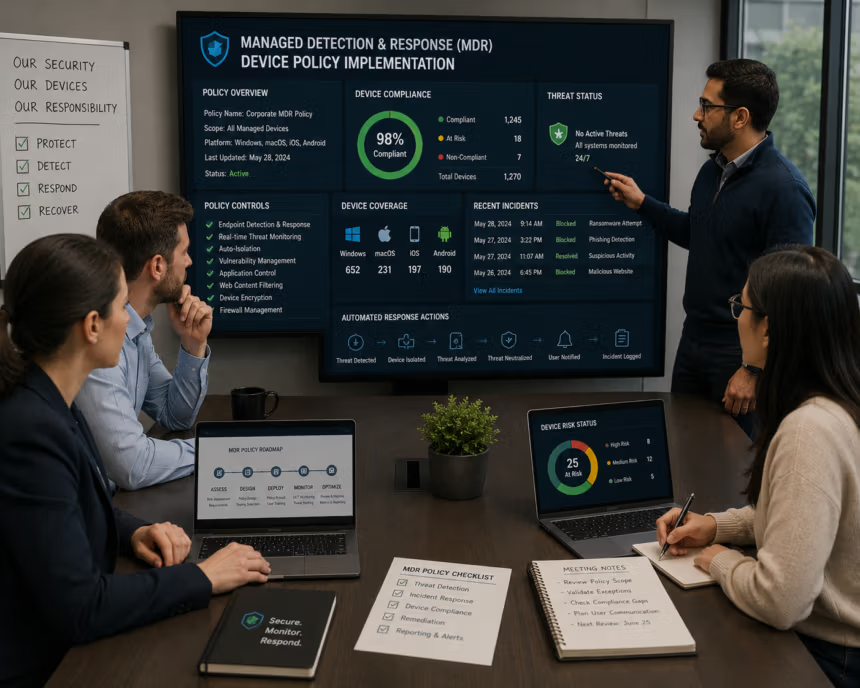 Managed Detection and Response is becoming increasingly vital as organizations
generate massive amounts of data and face more sophisticated threats. In our
highly connected world, the convergence of traditional corporate networks and
operational technology creates significant vulnerabilities. Industrial
systems, which were once completely isolated, now frequently connect to cloud
platforms and corporate systems, greatly expanding the potential attack
surface. Consequently, security teams must sift through enormous volumes of
business data to identify subtle anomalies and hidden threats before they
cause widespread damage. A robust Managed Detection and Response strategy
provides continuous monitoring and specialized expertise, which is especially
critical for operational technology environments like manufacturing, energy,
and utilities. Unlike standard information technology environments, these
physical systems prioritize safety and continuous operation above all else,
meaning security measures cannot simply shut down critical processes when a
threat is suspected. Top providers address this challenge by delivering
specialized detection and response tailored to the unique constraints of
industrial control systems. They bridge the gap between information technology
and operational technology, helping leaders reduce physical risks, adhere to
critical infrastructure regulations, and protect essential services. By
partnering with an experienced provider, companies gain the necessary
visibility and rapid response capabilities to secure their complex data
environments with assurance and operational continuity.
Managed Detection and Response is becoming increasingly vital as organizations
generate massive amounts of data and face more sophisticated threats. In our
highly connected world, the convergence of traditional corporate networks and
operational technology creates significant vulnerabilities. Industrial
systems, which were once completely isolated, now frequently connect to cloud
platforms and corporate systems, greatly expanding the potential attack
surface. Consequently, security teams must sift through enormous volumes of
business data to identify subtle anomalies and hidden threats before they
cause widespread damage. A robust Managed Detection and Response strategy
provides continuous monitoring and specialized expertise, which is especially
critical for operational technology environments like manufacturing, energy,
and utilities. Unlike standard information technology environments, these
physical systems prioritize safety and continuous operation above all else,
meaning security measures cannot simply shut down critical processes when a
threat is suspected. Top providers address this challenge by delivering
specialized detection and response tailored to the unique constraints of
industrial control systems. They bridge the gap between information technology
and operational technology, helping leaders reduce physical risks, adhere to
critical infrastructure regulations, and protect essential services. By
partnering with an experienced provider, companies gain the necessary
visibility and rapid response capabilities to secure their complex data
environments with assurance and operational continuity.Europe's Multilingual Reality Exposes AI Security Gaps
 While large language models can process text in dozens of languages, their
included safety guardrails are overwhelmingly optimized for English. This
English focus creates significant security vulnerabilities for organizations
operating in multilingual environments, particularly across Europe. Although a
model might fluently answer prompts in languages like German, Spanish, or
Swahili, its ability to detect and block malicious actions, such as prompt
injections and jailbreaks, often drops significantly compared to English.
Attackers exploit this gap by translating harmful commands into lesser used
languages to bypass security filters. Research shows that some models are
vastly more likely to provide actionable responses to unsafe prompts when
queried in these regional languages. Relying on translation security layers,
where inputs are translated to English before being checked, can alter the
true intent of a prompt, sometimes masking malicious commands within benign
contexts. To address these serious vulnerabilities, experts recommend moving
beyond basic translation filters. Organizations should instead adopt native
language guardrails that evaluate the original input, conduct rigorous
security testing that includes mixed language scenarios and diverse cultural
contexts, and deploy active runtime firewalls. As the modern regulatory
landscape, including new artificial intelligence legislation in Europe,
demands better risk management, ensuring consistent safety across all
supported languages is becoming a critical operational necessity.
While large language models can process text in dozens of languages, their
included safety guardrails are overwhelmingly optimized for English. This
English focus creates significant security vulnerabilities for organizations
operating in multilingual environments, particularly across Europe. Although a
model might fluently answer prompts in languages like German, Spanish, or
Swahili, its ability to detect and block malicious actions, such as prompt
injections and jailbreaks, often drops significantly compared to English.
Attackers exploit this gap by translating harmful commands into lesser used
languages to bypass security filters. Research shows that some models are
vastly more likely to provide actionable responses to unsafe prompts when
queried in these regional languages. Relying on translation security layers,
where inputs are translated to English before being checked, can alter the
true intent of a prompt, sometimes masking malicious commands within benign
contexts. To address these serious vulnerabilities, experts recommend moving
beyond basic translation filters. Organizations should instead adopt native
language guardrails that evaluate the original input, conduct rigorous
security testing that includes mixed language scenarios and diverse cultural
contexts, and deploy active runtime firewalls. As the modern regulatory
landscape, including new artificial intelligence legislation in Europe,
demands better risk management, ensuring consistent safety across all
supported languages is becoming a critical operational necessity.

)