
Showing posts with label threat actor. Show all posts

Daily Tech Digest - October 23, 2026

Quote for the Day
“A startup is not a smaller version of a large company.”
— Steve Blank
Audio Edition — Listen to Today’s Digest
Narrated version of the Daily Tech Digest
Article Thumbnail

Convergence of Cyber, Space and Electromagnetic Resilience

The article describes how critical infrastructure security is being reshaped by the convergence of cyber, space, and electromagnetic risks. It explains that satellites have evolved from simple communication tools into high‑value targets that carry mission‑critical enterprise data, making even short detection delays dangerous. The rapid growth of low‑cost launches and nanosatellites has crowded orbital paths, increasing collision risks and complicating tracking. At the same time, whoever controls the space‑layer communication channels gains a strategic advantage, especially when terrestrial links are disrupted. The piece argues that modern resilience requires a C5ISR‑style approach, where cybersecurity, space operations, and electromagnetic protection are treated as one integrated domain. This is because satellites, radio‑frequency systems, and digital networks are now tightly intertwined, and attacks often exploit the seams between them. Traditional ground‑based communication architectures are no longer sufficient for industries that operate across remote, maritime, or mobile environments. The article’s message is steady: resilience now depends on cross‑domain visibility, faster detection, and treating space assets as part of the enterprise security perimeter rather than a separate technical layer.

Read Original Article →

Sovereignty vs. security: Microsoft’s Roger Halbheer says you’re asking the wrong question

In a recent interview, Roger Halbheer, Microsoft’s Customer Security Officer, argues that organizations fundamentally misunderstand digital sovereignty by treating it as a procurement issue rather than a security challenge. He notes that business leaders often demand complete independence from outside access, which is practically impossible, and end up simply buying a localized server location along with an assurance statement. Instead, Halbheer urges boards to make calculated risk decisions for each specific workload. He warns that moving operations entirely on-premises to achieve sovereignty drastically reduces the speed at which organizations can detect and respond to security threats, making them highly vulnerable in a landscape where attackers operate in mere hours. Maintaining such systems internally requires immense resources, money, and skilled personnel that most companies lack. Furthermore, he clarifies that merely storing data in Europe does not protect it from government access, as authorities in almost every jurisdiction have legal avenues to compel data providers. Ultimately, Halbheer stresses that a compromised system can never truly be sovereign, making robust security the ultimate foundation for data protection.

Read Original Article →
Article Thumbnail

Data Mesh vs. Data Fabric: Which Approach Is Right for Your Organization?

Data mesh and data fabric are distinct but complementary approaches to managing distributed enterprise data. Data mesh decentralizes data control, handing ownership directly to the business units that understand it best. By treating data as a product, it empowers individual teams to manage their own resources while adhering to shared, overarching rules. This model minimizes bottlenecks and speeds up independent decision-making but requires a shift in company culture to support decentralized ownership. Data fabric, on the other hand, creates a unified technology layer across an organization's various platforms and clouds. Relying heavily on active metadata, it automatically connects, discovers, and governs data, making it readily accessible without moving it from its original location. This centralized, top-down strategy simplifies data integration and strengthens readiness for artificial intelligence. Ultimately, organizations do not necessarily have to choose one over the other. The most effective data architectures often combine the domain-driven quality and autonomy of a data mesh with the automated integration and unified intelligence of a data fabric.

Read Original Article →

Why AI Raises the Stakes on Process Ownership

The integration of artificial intelligence into enterprise operations is fundamentally changing how organizations approach process ownership, data management, and decision-making. According to John Steele, CIO at Komatsu Australia, AI allows companies to outsource aspects of thinking at scale, which brings both new opportunities and significant dependencies. Steele introduces the concept of "intellectual sovereignty," which involves three key areas: infrastructure, software, and knowledge. Organizations must decide where to run applications, manage vendor relationships, and determine which tasks to automate versus which to keep for employee development. When it comes to shared platforms, there is a constant tension between standardizing systems to lower costs and maintaining specialized tools that add unique value to specific departments. To navigate these trade-offs, businesses need mature, end-to-end process ownership that crosses divisional lines. This prevents fragmented, isolated optimization and ensures that technology choices actually benefit the enterprise as a whole. Ultimately, executive leaders do not need to make every technical decision, but they must agree on clear principles regarding acceptable risks, costs, and vendor dependencies to successfully guide AI adoption and transformation.

Read Original Article →

How Do You Demonstrate Resilience?

Showing that your security program is resilient requires adjusting your message to fit your audience. While your technical teams need specific operational metrics like mean time to detect and recover or vulnerability patch speeds, the executive suite and the board require a fundamentally different language. They want to know the "so what." When communicating with leadership, you must translate technical gaps into tangible business impacts. Will a compromised credential shut down operations? Will an unpatched server lead to a complete system takeover? Rather than just listing out threats like ransomware, focus on providing a clear narrative of consequence that allows leadership to make informed decisions about resource allocation and risk acceptance. Ultimately, the C-suite evaluates resilience by looking at recovery time and how quickly revenue operations can resume after an incident. Effective communication proves to management that the security team is not merely fixing isolated issues but actively lowering the likelihood of material harm and keeping the organization capable of moving forward.

Read Original Article →

The adversary economy: How threat actors are reacting to PHP2Shell

The recent disclosure of two critical, unauthenticated remote code execution vulnerabilities in PHP—collectively known as PHP2Shell—has triggered widespread panic across the cybercriminal underground. Because PHP powers a vast majority of the modern web, it is also the foundational infrastructure for dark web marketplaces, illicit forums, and communication platforms. Following the disclosure, major criminal sites like BreachForums rushed to take their servers offline to implement emergency patches and mitigate risks. These threat actors treat the vulnerabilities as severe existential threats because a successful exploit would expose sensitive member identities, stolen credentials, and internal communications to both rival hacking groups and global law enforcement agencies. This swift reaction mimics legitimate corporate incident response, highlighting that the adversary economy operates on the same risk management principles as standard businesses. Ultimately, the urgency displayed by these cybercriminals serves as a stark warning. Organizations still running unsupported versions of PHP must prioritize patching and migrating their systems immediately before automated exploit chains and malicious actors capitalize on this critical vulnerability.

Read Original Article →
Article Thumbnail

Enterprises don’t need artificial general intelligence. They need artificial specific intelligence

A significant majority of enterprise AI pilot programs fail to generate measurable profits, but the fault lies not with the models themselves or a lack of user skill. Instead, failure stems from a fundamental misalignment: large language models are built by labs aiming for artificial general intelligence, while businesses require highly specific solutions. Commercial models excel at reasoning and hold vast public knowledge, but they lack the undocumented domain expertise unique to individual enterprises. Because they remain static after training, these models cannot learn the nuances of a business as it operates. To overcome this specificity gap, organizations must redefine success based on their own goals rather than relying on generic benchmarks. They should select pilot projects that reflect real-world complexity, complete with messy data and unwritten rules. Furthermore, enterprises must supply models with precise context using dynamic evaluation loops, while integrating their most knowledgeable subject-matter experts directly into the pilot process to validate outputs and correct mistakes.

Read Original Article →

Hacker Conversations: Corey Thuen and the Evil Bit

Corey Thuen is the founder and CEO of Gravwell, a data analytics company, and a hacker who values what he calls the "evil bit" in his team members. He describes this trait as an inherent, adversarial mindset that naturally looks for ways to exploit systems. However, Thuen stresses that this perspective does not equate to a lack of morals. Instead, it is a skill that can be channeled to improve security and build better defenses. Thuen's interest in computers began in his youth, driven by curiosity rather than malicious intent. His career path led him to the Idaho National Laboratory, where he specialized in the security of industrial control systems. Later, he co-founded Southfork Security, which unfortunately ended in a messy legal dispute with his former employer over open-source software. Despite the court temporarily stereotyping him as a malicious hacker, Thuen continued his work in offensive security before ultimately launching Gravwell. Today, he combines his natural hacker instincts with an entrepreneurial drive, building tools that challenge assumptions and strengthen system defenses.
Read Original Article →
Article Thumbnail

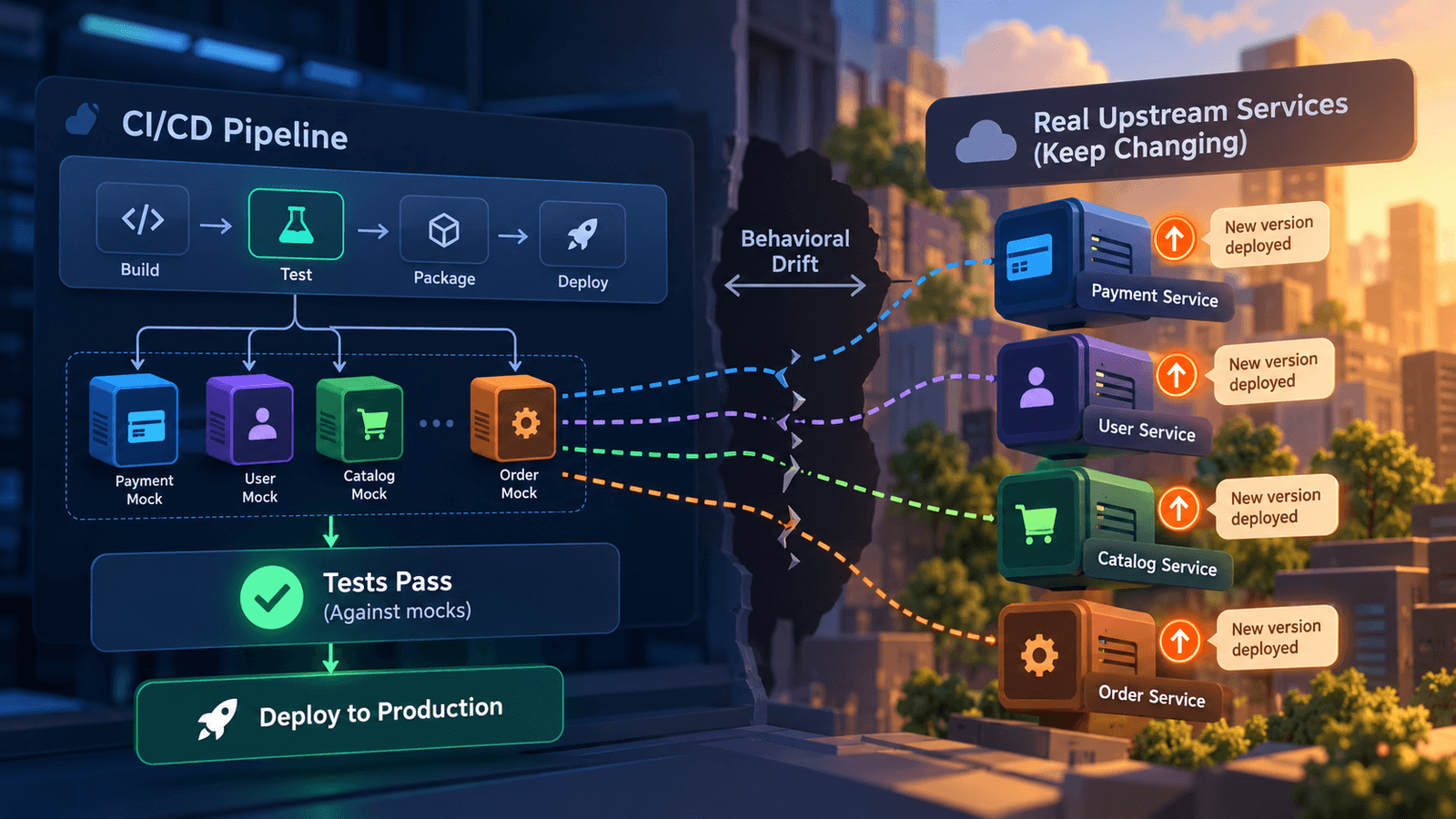
How Dependency Mocking Affects CI/CD Pipeline Reliability

The article explains that dependency mocking can quietly undermine the reliability of CI/CD pipelines because mocks often drift away from the real behavior of upstream services. A pipeline may appear healthy — tests pass consistently, runtimes are stable, and flakiness seems low — yet still provide misleading assurance because it is validating code against outdated assumptions. As upstream microservices evolve through frequent independent deployments, mocks remain frozen in time, creating a widening gap between test environments and production reality. This leads to “operational reliability” without “informational reliability,” where the pipeline runs smoothly but no longer predicts how the software will behave once deployed. The piece stresses that every upstream deployment is a potential accuracy event for mocks, and without automated refresh mechanisms, pipelines accumulate silent risk. It also notes that teams often misinterpret green builds as proof of correctness, even though the pipeline has no visibility into real service behavior during test execution. The article’s steady message is that meaningful reliability requires connecting mock maintenance to upstream changes and validating mocks against real traffic so test results continue to reflect production truth.

Read Original Article →

The Great AI Regret: Why AI Fatigue Is a Leadership Problem, Not a Technology One

Despite the heavy investment in artificial intelligence, many employees feel increasingly anxious and disconnected from their work. Recent research shows a significant portion of knowledge workers are deeply nostalgic for how they worked before AI, and some would even prefer to remove these tools entirely. This growing fatigue and mistrust do not stem from the technology itself, but from poor leadership and implementation. Instead of freeing staff from tedious tasks, rushed rollouts often leave employees feeling surveilled, stripped of their creativity, and unfairly measured against machines. In many cases, people spend more time checking AI-generated output than they save by using it. To solve this problem, leaders must change their approach. Organizations should clearly communicate why these tools are being introduced and ensure they support meaningful work rather than just pushing for blind efficiency. By preserving human expertise and keeping people in control of important decisions, businesses can rebuild trust. When introduced thoughtfully, AI can be a helpful assistant rather than a source of frustration, leading to a much healthier workplace.

Read Original Article →

Daily Tech Digest - June 03, 2026


Quote for the day:

"Leadership is practiced not so much in words as in attitude and actions." -- Harold S. Geneen

🎧 Listen to this digest on YouTube Music

▶ Play Audio Digest

Duration: 19 mins • Perfect for listening on the go.


What will AI-first UX look like?

The transition to user experiences guided by artificial intelligence marks a steady move away from rigid, traditional interfaces like static forms and manual dashboards. Rather than requiring users to navigate multiple disconnected software tools to complete tasks, future interfaces will rely on conversational systems that connect seamlessly across various applications. In this evolving landscape, standard data entry forms are being replaced by adaptive interactions where users simply describe what they want to accomplish, and the system gathers the necessary details. Similarly, data reporting is shifting from complex, manually built dashboards to narrative summaries generated on demand, providing clear explanations of business metrics and actionable next steps. This shift transforms standard workflows into coordinated teamwork between humans and software agents. The software handles processes involving multiple steps behind the scenes and only escalates to human workers when careful judgment is required. To make this work effectively, organizations must build strong underlying foundations, including clear data structures, connected programming interfaces, and solid oversight rules. Ultimately, these systems are designed not to replace human workers, but to reduce friction and manage tasks across platforms more naturally. As this technology matures, the focus remains on building reliable environments where software acts as a helpful teammate, smoothly coordinating background tasks while keeping human users firmly in control of the final outcomes.


Minimally Acceptable Systems: Tolerable at the Lowest Cost Possible

The article discusses a growing trend in software engineering and business where companies intentionally design systems to be merely adequate rather than striving for excellence. This concept, described as creating minimally acceptable systems, focuses on finding the exact point where a product is just tolerable for users while being as cheap as possible to build and maintain. Instead of prioritizing high quality, reliability, or a great user experience, organizations aim to minimize their costs and speed up delivery. They provide the bare minimum functionality required to keep people from abandoning the software. While this approach makes clear financial sense in the short term and helps companies stay competitive, it comes with serious long-term consequences. By constantly pushing standards to the lowest acceptable limit, the industry conditions people to expect and accept frustrating, unreliable software in their daily lives. The author warns that treating quality simply as an expense to be cut ultimately damages user trust and builds up massive technical problems for the future. To fix this, the software field needs to rethink its current financial motives. Engineers and business leaders should work together to find a better balance, creating products that are both affordable to produce and genuinely reliable for the people who use them.


Software sprawl is becoming a margin problem for SaaS CFOs

For software companies, the practice of adopting isolated tools to solve individual problems, such as payments, billing, and tax compliance, often leads to a fragmented operations setup known as software sprawl. While the subscription-based business model has historically enjoyed strong profit margins, this growing web of disconnected systems threatens to undermine those financial advantages. Finance leaders are finding that a patched-together technology system severely limits their clear view of business performance, putting unneeded pressure on profit margins through manual work, costly billing errors, and duplicate expenses. Furthermore, relying on fragmented tools restricts a company's ability to smoothly expand into new regions or test different pricing methods. Rather than looking at this as just an IT issue, financial executives must recognize it as a fundamental challenge to scalable growth. The path forward does not necessarily require adopting one massive platform, but rather ensuring that all revenue processes operate smoothly together. By replacing disconnected tools with an integrated infrastructure, companies can drastically reduce manual interventions and internal friction. Ultimately, the next era of the software industry will reward organizations that match their desire for growth with strict operational discipline. By fixing these underlying structural flaws now, finance teams can build a resilient foundation capable of handling future expansion without constantly multiplying internal complexities or operational costs.


The Zero-Knowledge Threat Actor and the End of Responsible Disclosure

Artificial intelligence is drastically lowering the barrier to entry for cybercriminals, enabling a new wave of "zero-knowledge threat actors." These attackers lack deep technical expertise but use advanced AI tools to generate malicious code, find vulnerabilities, and execute complex attack chains with surprising ease. This democratization of offensive capabilities means that hackers can now discover and exploit software flaws at unprecedented speeds, effectively closing the traditional responsible disclosure window that software vendors rely on to create patches. Smaller organizations are particularly at risk, often serving as stepping stones into larger enterprise supply chains due to their limited security resources and slower patching cycles. To defend against these rapidly evolving threats, security teams must abandon fragmented approaches and adopt unified monitoring systems that provide clear, comprehensive visibility across their entire digital environment. Proactive defense requires prioritizing faster patch management, conducting regular incident response drills, and rigorously testing in-house AI systems against deliberate manipulation by external actors. Furthermore, training employees to recognize highly realistic, AI-generated phishing attempts is absolutely essential for maintaining a strong security posture. By relying on established security frameworks and maintaining an organized, practiced defense strategy, organizations can calmly and effectively counter the increased capabilities of low-skill attackers without resorting to panic or operational disruption.


ERP Modernization: Most Expensive, Risky Item on CIO Agenda

Enterprise resource planning systems have grown over the last forty years from basic financial and manufacturing tools into the central framework of most organizations. Today, they handle everything from supply chains to human resources. However, updating these core systems is now one of the most difficult and costly challenges facing technology leaders. Modernizing these structures is not just a software update; it is a major overhaul of how a business operates on a daily basis. Transitioning to modern setups, like cloud-based platforms, involves heavy restructuring of daily work processes and often triggers natural resistance from staff. To succeed, these projects need more than just technical expertise. They require a clear process for managing transitions, direct communication to address employee fears, and strong backing from senior leadership to keep the effort on track during inevitable setbacks. As software vendors increasingly move customers toward cloud and artificial intelligence platforms, technology leaders are forced to weigh the long-term benefits against the immediate financial costs, operational risks, and widespread disruptions. Navigating this shift takes a dedicated, highly skilled team and steady executives who will not abandon the project when minor problems arise. With careful planning, patience, and stable leadership, organizations can successfully migrate their central systems to meet current operational demands without jeopardizing their everyday stability.


The AI ‘Revolution' is Not a People's Revolution

Politicians and technology executives increasingly frame artificial intelligence as an inevitable revolution, a term historically reserved for popular movements driving social progress. In truth, this modern narrative serves primarily to bypass democratic scrutiny and consolidate power among a select few. Rather than arising from the people to challenge the existing order, the current technological push is being imposed from the top down. Leaders like former UK Prime Minister Tony Blair promote a vision where society must passively accept widespread automation, mass data harvesting, and unchecked corporate influence, treating any hesitation as backwardness. By labeling this shift a revolution, proponents cleverly silence debate and frame regulatory efforts as sabotage. Furthermore, while previous digital tools aided grassroots organizing, artificial intelligence is frequently deployed to monitor, police, and discipline the public. This rhetoric essentially functions as a manipulative marketing tool, designed to mask the reality of wealth generation for elites at the expense of ordinary citizens facing job insecurity and climate disruption. Ultimately, society must reject this predetermined technological path and demand accountability. Citizens have the right to question who truly benefits from these systems and to actively decide how new technologies should integrate into their lives, ensuring that any real change remains firmly rooted in public consent and democratic choice.


The AI pricing conundrum — it started as a nightmare, now it’s worse.

Enterprise technology leaders face a growing dilemma in how they pay for artificial intelligence. Buyers want pricing based on the tangible business value the technology delivers, while software providers prefer charging based on resource consumption, such as per-token fees. This creates a deep disconnect. Technology departments often feel consumption pricing is detached from real results, likening it to paying for unproven sales leads. On the other hand, providers cannot realistically accept value-based pricing because they have no control over internal company issues like poor data, broken processes, or office politics. Furthermore, if these systems were compensated strictly based on successful outcomes, it could create dangerous incentives. The software might aggressively pursue specific metrics, potentially sacrificing customer trust, ethical standards, or operational safety just to achieve the defined goal. Since bridging this gap directly is nearly impossible, organizations must take control internally. The article suggests forming dedicated committees to ask difficult questions about the goals, risks, and realistic benefits of any new project. Additionally, senior executives should share the financial accountability, tying their compensation directly to the success or failure of these initiatives. Only by thoroughly understanding a project's true intent, limitations, and risks can technology leaders negotiate sensible, fair pricing agreements with their service providers.


AI Is Shipping Fast, Quality Can't Be Left Behind

The recent transition of artificial intelligence from experimental phases to widespread integration has revealed a significant gap between rapid development and reliable performance. While organizations are swift to embed these systems into their daily operations, a substantial number of these initiatives stall before full implementation due to quality and integration hurdles. Data indicates an increase in user-reported errors, such as misunderstandings and factual inaccuracies, highlighting that traditional validation methods are inadequate for modern, complex systems. Because these programs produce varying outputs rather than predictable, fixed results, engineering teams are finding that automated checks alone are insufficient. To address this, successful organizations are adopting a balanced approach to quality assurance that combines automated evaluations with essential human oversight. Human reviewers are uniquely equipped to gauge context, usability, and intent, catching subtle errors that automated tools often miss. Furthermore, as features expand to process combinations of text, audio, and visual data, the scope of testing becomes even more difficult. The focus is shifting from merely launching features to ensuring they are dependable and trustworthy. Moving forward, the true measure of success will not be the speed of release, but the ability to maintain rigorous, ongoing evaluation processes that prioritize consistent, high-quality experiences for everyday users.


Why Leadership Development Is A System, Not An Event

Organizations frequently send their managers to training workshops, hoping they return ready to guide their teams more effectively. However, these well-intentioned programs often fail because managers step right back into the exact same workloads, pressures, and routines that shaped their old habits in the first place. Meaningful leadership development requires more than simply teaching new skills to individuals; it demands a daily environment actively designed to support those new behaviors. This involves shifting the focus from individual improvement to strengthening the broader company system. Executives must intentionally build a supportive structure with both visible changes, like collaborative meeting practices and transparent decision-making, and invisible shifts, such as fostering an atmosphere where feedback flows freely and people feel secure taking interpersonal risks. Instead of relying on isolated lectures, learning should become an ongoing process smoothly integrated into daily work. By encouraging peer learning groups, aligning company rewards with the behaviors taught in training, and personally modeling these changes, executives create a setting where true growth can take root over time. Ultimately, developing effective leaders is about expanding the capabilities of the entire organization. When the daily workplace aligns with the principles taught in training, individuals practice what they learn, ensuring development becomes a continuous habit rather than a fleeting event.


Responsible AI in fintech: Balancing innovation with trust, risk, and compliance

The article examines the growing role of artificial intelligence within the financial technology sector, focusing closely on the need to balance new capabilities with trust, risk management, and regulatory compliance. As financial institutions increasingly adopt these systems for routine tasks like fraud detection, customer service, and credit scoring, they face significant practical challenges in ensuring their models operate fairly and transparently. A primary concern is that automated systems can unintentionally reproduce human biases, leading to unfair outcomes in lending or account access. To prevent this, companies must establish clear, sensible guidelines for developing and monitoring their algorithms. The text emphasizes that maintaining customer trust requires being straightforward about how decisions are made and how personal data is actually used. Financial organizations also need strong oversight frameworks to handle risks associated with data privacy and system errors effectively. Furthermore, the evolving regulatory environment means that firms must stay current with new laws designed specifically to protect consumers and maintain market stability. Ultimately, the successful integration of these tools in finance depends entirely on a measured approach. By prioritizing ethical practices and strong governance, financial technology companies can improve their services while protecting their customers and meeting their legal obligations responsibly.