
Convergence of Cyber, Space and Electromagnetic Resilience
The article describes how critical infrastructure security is being reshaped by the convergence of cyber, space, and electromagnetic risks. It explains that satellites have evolved from simple communication tools into high‑value targets that carry mission‑critical enterprise data, making even short detection delays dangerous. The rapid growth of low‑cost launches and nanosatellites has crowded orbital paths, increasing collision risks and complicating tracking. At the same time, whoever controls the space‑layer communication channels gains a strategic advantage, especially when terrestrial links are disrupted. The piece argues that modern resilience requires a C5ISR‑style approach, where cybersecurity, space operations, and electromagnetic protection are treated as one integrated domain. This is because satellites, radio‑frequency systems, and digital networks are now tightly intertwined, and attacks often exploit the seams between them. Traditional ground‑based communication architectures are no longer sufficient for industries that operate across remote, maritime, or mobile environments. The article’s message is steady: resilience now depends on cross‑domain visibility, faster detection, and treating space assets as part of the enterprise security perimeter rather than a separate technical layer.
Sovereignty vs. security: Microsoft’s Roger Halbheer says you’re asking the wrong question
In a recent interview, Roger Halbheer, Microsoft’s Customer Security Officer, argues that organizations fundamentally misunderstand digital sovereignty by treating it as a procurement issue rather than a security challenge. He notes that business leaders often demand complete independence from outside access, which is practically impossible, and end up simply buying a localized server location along with an assurance statement. Instead, Halbheer urges boards to make calculated risk decisions for each specific workload. He warns that moving operations entirely on-premises to achieve sovereignty drastically reduces the speed at which organizations can detect and respond to security threats, making them highly vulnerable in a landscape where attackers operate in mere hours. Maintaining such systems internally requires immense resources, money, and skilled personnel that most companies lack. Furthermore, he clarifies that merely storing data in Europe does not protect it from government access, as authorities in almost every jurisdiction have legal avenues to compel data providers. Ultimately, Halbheer stresses that a compromised system can never truly be sovereign, making robust security the ultimate foundation for data protection.

Data Mesh vs. Data Fabric: Which Approach Is Right for Your Organization?
Data mesh and data fabric are distinct but complementary approaches to managing distributed enterprise data. Data mesh decentralizes data control, handing ownership directly to the business units that understand it best. By treating data as a product, it empowers individual teams to manage their own resources while adhering to shared, overarching rules. This model minimizes bottlenecks and speeds up independent decision-making but requires a shift in company culture to support decentralized ownership. Data fabric, on the other hand, creates a unified technology layer across an organization's various platforms and clouds. Relying heavily on active metadata, it automatically connects, discovers, and governs data, making it readily accessible without moving it from its original location. This centralized, top-down strategy simplifies data integration and strengthens readiness for artificial intelligence. Ultimately, organizations do not necessarily have to choose one over the other. The most effective data architectures often combine the domain-driven quality and autonomy of a data mesh with the automated integration and unified intelligence of a data fabric.
Why AI Raises the Stakes on Process Ownership
The integration of artificial intelligence into enterprise operations is fundamentally changing how organizations approach process ownership, data management, and decision-making. According to John Steele, CIO at Komatsu Australia, AI allows companies to outsource aspects of thinking at scale, which brings both new opportunities and significant dependencies. Steele introduces the concept of "intellectual sovereignty," which involves three key areas: infrastructure, software, and knowledge. Organizations must decide where to run applications, manage vendor relationships, and determine which tasks to automate versus which to keep for employee development. When it comes to shared platforms, there is a constant tension between standardizing systems to lower costs and maintaining specialized tools that add unique value to specific departments. To navigate these trade-offs, businesses need mature, end-to-end process ownership that crosses divisional lines. This prevents fragmented, isolated optimization and ensures that technology choices actually benefit the enterprise as a whole. Ultimately, executive leaders do not need to make every technical decision, but they must agree on clear principles regarding acceptable risks, costs, and vendor dependencies to successfully guide AI adoption and transformation.
How Do You Demonstrate Resilience?
Showing that your security program is resilient requires adjusting your message to fit your audience. While your technical teams need specific operational metrics like mean time to detect and recover or vulnerability patch speeds, the executive suite and the board require a fundamentally different language. They want to know the "so what." When communicating with leadership, you must translate technical gaps into tangible business impacts. Will a compromised credential shut down operations? Will an unpatched server lead to a complete system takeover? Rather than just listing out threats like ransomware, focus on providing a clear narrative of consequence that allows leadership to make informed decisions about resource allocation and risk acceptance. Ultimately, the C-suite evaluates resilience by looking at recovery time and how quickly revenue operations can resume after an incident. Effective communication proves to management that the security team is not merely fixing isolated issues but actively lowering the likelihood of material harm and keeping the organization capable of moving forward.
The adversary economy: How threat actors are reacting to PHP2Shell
The recent disclosure of two critical, unauthenticated remote code execution vulnerabilities in PHP—collectively known as PHP2Shell—has triggered widespread panic across the cybercriminal underground. Because PHP powers a vast majority of the modern web, it is also the foundational infrastructure for dark web marketplaces, illicit forums, and communication platforms. Following the disclosure, major criminal sites like BreachForums rushed to take their servers offline to implement emergency patches and mitigate risks. These threat actors treat the vulnerabilities as severe existential threats because a successful exploit would expose sensitive member identities, stolen credentials, and internal communications to both rival hacking groups and global law enforcement agencies. This swift reaction mimics legitimate corporate incident response, highlighting that the adversary economy operates on the same risk management principles as standard businesses. Ultimately, the urgency displayed by these cybercriminals serves as a stark warning. Organizations still running unsupported versions of PHP must prioritize patching and migrating their systems immediately before automated exploit chains and malicious actors capitalize on this critical vulnerability.

Enterprises don’t need artificial general intelligence. They need artificial specific intelligence
A significant majority of enterprise AI pilot programs fail to generate measurable profits, but the fault lies not with the models themselves or a lack of user skill. Instead, failure stems from a fundamental misalignment: large language models are built by labs aiming for artificial general intelligence, while businesses require highly specific solutions. Commercial models excel at reasoning and hold vast public knowledge, but they lack the undocumented domain expertise unique to individual enterprises. Because they remain static after training, these models cannot learn the nuances of a business as it operates. To overcome this specificity gap, organizations must redefine success based on their own goals rather than relying on generic benchmarks. They should select pilot projects that reflect real-world complexity, complete with messy data and unwritten rules. Furthermore, enterprises must supply models with precise context using dynamic evaluation loops, while integrating their most knowledgeable subject-matter experts directly into the pilot process to validate outputs and correct mistakes.
Hacker Conversations: Corey Thuen and the Evil Bit
Corey Thuen is the founder and CEO of Gravwell, a data analytics company, and a hacker who values what he calls the "evil bit" in his team members. He describes this trait as an inherent, adversarial mindset that naturally looks for ways to exploit systems. However, Thuen stresses that this perspective does not equate to a lack of morals. Instead, it is a skill that can be channeled to improve security and build better defenses. Thuen's interest in computers began in his youth, driven by curiosity rather than malicious intent. His career path led him to the Idaho National Laboratory, where he specialized in the security of industrial control systems. Later, he co-founded Southfork Security, which unfortunately ended in a messy legal dispute with his former employer over open-source software. Despite the court temporarily stereotyping him as a malicious hacker, Thuen continued his work in offensive security before ultimately launching Gravwell. Today, he combines his natural hacker instincts with an entrepreneurial drive, building tools that challenge assumptions and strengthen system defenses.
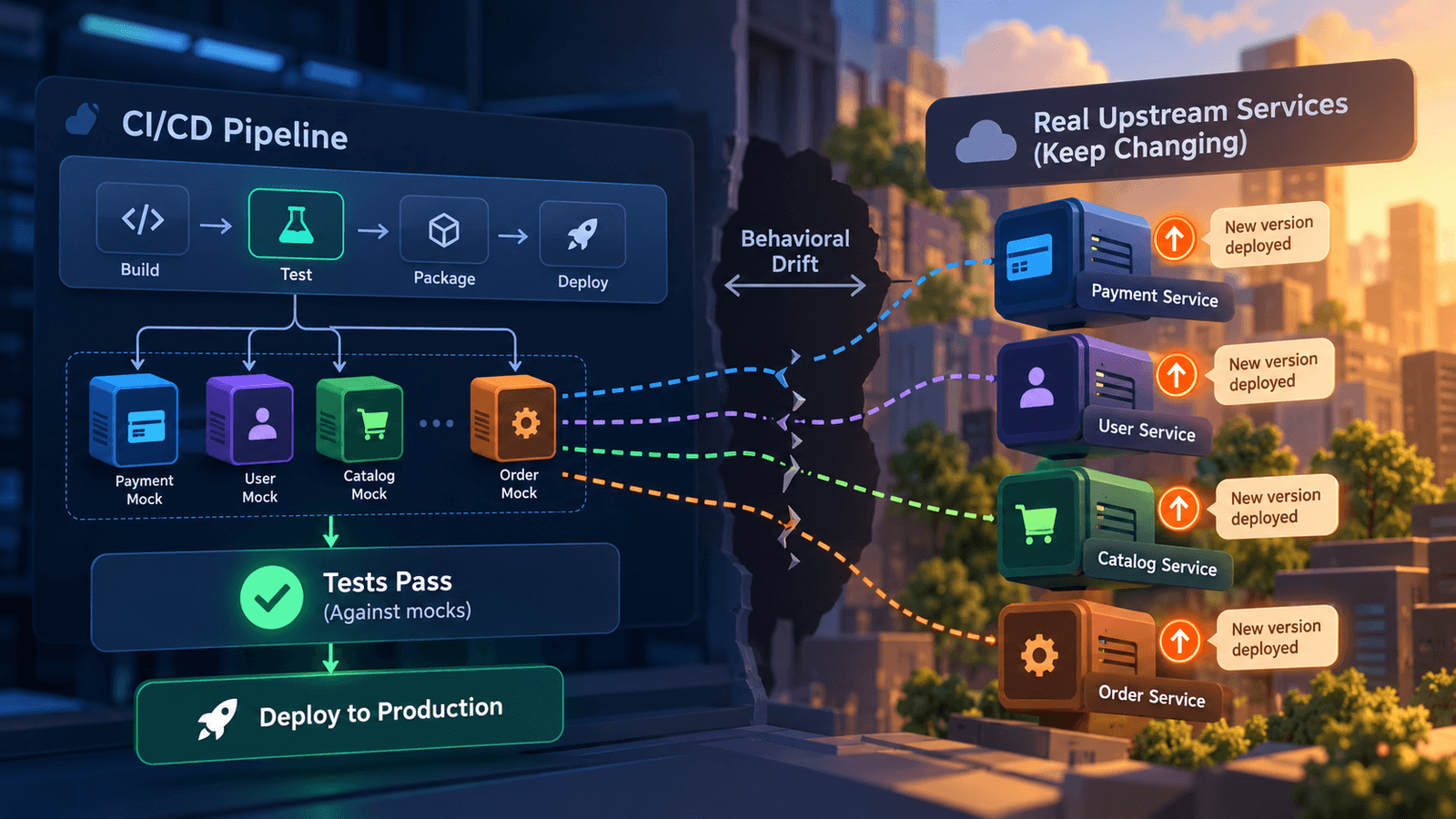
How Dependency Mocking Affects CI/CD Pipeline Reliability
The article explains that dependency mocking can quietly undermine the reliability of CI/CD pipelines because mocks often drift away from the real behavior of upstream services. A pipeline may appear healthy — tests pass consistently, runtimes are stable, and flakiness seems low — yet still provide misleading assurance because it is validating code against outdated assumptions. As upstream microservices evolve through frequent independent deployments, mocks remain frozen in time, creating a widening gap between test environments and production reality. This leads to “operational reliability” without “informational reliability,” where the pipeline runs smoothly but no longer predicts how the software will behave once deployed. The piece stresses that every upstream deployment is a potential accuracy event for mocks, and without automated refresh mechanisms, pipelines accumulate silent risk. It also notes that teams often misinterpret green builds as proof of correctness, even though the pipeline has no visibility into real service behavior during test execution. The article’s steady message is that meaningful reliability requires connecting mock maintenance to upstream changes and validating mocks against real traffic so test results continue to reflect production truth.
The Great AI Regret: Why AI Fatigue Is a Leadership Problem, Not a Technology One
Despite the heavy investment in artificial intelligence, many employees feel increasingly anxious and disconnected from their work. Recent research shows a significant portion of knowledge workers are deeply nostalgic for how they worked before AI, and some would even prefer to remove these tools entirely. This growing fatigue and mistrust do not stem from the technology itself, but from poor leadership and implementation. Instead of freeing staff from tedious tasks, rushed rollouts often leave employees feeling surveilled, stripped of their creativity, and unfairly measured against machines. In many cases, people spend more time checking AI-generated output than they save by using it. To solve this problem, leaders must change their approach. Organizations should clearly communicate why these tools are being introduced and ensure they support meaningful work rather than just pushing for blind efficiency. By preserving human expertise and keeping people in control of important decisions, businesses can rebuild trust. When introduced thoughtfully, AI can be a helpful assistant rather than a source of frustration, leading to a much healthier workplace.


No comments:
Post a Comment