Quote for the day:
“The more you loose yourself in something bigger than yourself, the more energy you will have.” -- Norman Vincent Peale
🎧 Listen to the audio debrief on YouTube
▶ Play Audio DigestDuration: 22 mins • Perfect for listening on the go.
Why the hardest AI skills to learn might be the human ones
 The article explores why the most challenging AI‑related skills today are not
technical ones but human ones, a theme highlighted at a London roundtable
discussing Coursera and Udemy’s joint Global Skills Report. The report shows
that while countries are rapidly adopting AI, the ability to pair technical
capability with judgment, curiosity, and critical thinking is lagging. Speakers
from Oxford, DeepMind, Imperial College, and the two learning platforms shared
stories illustrating how good questions, thoughtful collaboration, and basic
statistical reasoning often matter more than access to powerful models. They
noted that organizations are adopting AI faster than they are preparing people
to use it responsibly, and that learners worldwide are increasingly seeking
skills like critical thinking, complex problem‑solving, and ethics. The piece
also describes emerging efforts to use AI to help people practice human skills,
such as role‑play simulations and task‑based micro‑credentials. Yet several
participants stressed that knowing when not to use AI is just as important. A
story about a team choosing pen and paper over automation underscores this
point. The article closes by suggesting that as AI accelerates routine tasks,
the ability to pause, question, and learn from one another may become the most
valuable skill of all.
The article explores why the most challenging AI‑related skills today are not
technical ones but human ones, a theme highlighted at a London roundtable
discussing Coursera and Udemy’s joint Global Skills Report. The report shows
that while countries are rapidly adopting AI, the ability to pair technical
capability with judgment, curiosity, and critical thinking is lagging. Speakers
from Oxford, DeepMind, Imperial College, and the two learning platforms shared
stories illustrating how good questions, thoughtful collaboration, and basic
statistical reasoning often matter more than access to powerful models. They
noted that organizations are adopting AI faster than they are preparing people
to use it responsibly, and that learners worldwide are increasingly seeking
skills like critical thinking, complex problem‑solving, and ethics. The piece
also describes emerging efforts to use AI to help people practice human skills,
such as role‑play simulations and task‑based micro‑credentials. Yet several
participants stressed that knowing when not to use AI is just as important. A
story about a team choosing pen and paper over automation underscores this
point. The article closes by suggesting that as AI accelerates routine tasks,
the ability to pause, question, and learn from one another may become the most
valuable skill of all.
Rethinking automotive cyber risk for the age of accelerated vulnerability discovery
Automotive security used to focus mainly on preventing physical tampering. Today, however, the rise of connected vehicles requires a completely different approach. Modern cars depend on cloud platforms, mobile apps, over-the-air updates, and software from various third-party suppliers, meaning a single flaw can now compromise entire fleets rather than just one vehicle. Recent analysis shows a sharp thirty percent increase in new automotive vulnerabilities, with high-severity issues more than doubling in just one quarter. This growing scale of potential damage is one of the most pressing challenges in the industry. The attack surface has expanded significantly, with shared infrastructure like electric vehicle charging networks and common backend systems presenting concentrated risks. Attackers are frequently using diagnostic interfaces to gain initial access, using seemingly minor systems like infotainment units as stepping stones to reach deeper into the vehicle's architecture. Furthermore, the complex supply chain introduces additional risks, as third-party breaches can easily expose sensitive engineering data or disrupt operations. To navigate this changing landscape, manufacturers must establish complete visibility over all software dependencies and external components. Without a clear and comprehensive view of these interconnected systems, automakers simply cannot respond fast enough to secure their vehicles against the accelerating pace of new threats.Crypto-Agility Is the Goal. The PQC Migration Is Only Its First Test
 The migration to post-quantum cryptography (PQC) should not be treated as a
finite project, but rather as the first major test of a broader "crypto-agility"
program. While organizations often assume new cryptographic algorithms will
remain secure for decades, recent vulnerabilities discovered in schemes like
HAWK and Classic McEliece demonstrate how quickly security assessments can
change. Instead of simply replacing old algorithms, organizations must build the
capability to swap out cryptography seamlessly whenever necessary. There are six
primary reasons organizations will need to change algorithms again:
cryptanalysis of new algorithms, the acceleration of cryptanalysis via AI tools,
implementation flaws in PQC libraries, differing national algorithm standards,
routine deprecation schedules, and the eventual development of quantum
computers. The goal of a crypto-agility program is to provide a permanent,
funded capability to manage these shifts without disrupting ongoing operations.
While regulatory deadlines make PQC migration an urgent priority, the true
measure of success is passing a rehearsed algorithm change on schedule. After
this capability is proven, it should transition to a dedicated owner with its
own budget, ensuring the organization remains secure against both current and
future cryptographic threats.
The migration to post-quantum cryptography (PQC) should not be treated as a
finite project, but rather as the first major test of a broader "crypto-agility"
program. While organizations often assume new cryptographic algorithms will
remain secure for decades, recent vulnerabilities discovered in schemes like
HAWK and Classic McEliece demonstrate how quickly security assessments can
change. Instead of simply replacing old algorithms, organizations must build the
capability to swap out cryptography seamlessly whenever necessary. There are six
primary reasons organizations will need to change algorithms again:
cryptanalysis of new algorithms, the acceleration of cryptanalysis via AI tools,
implementation flaws in PQC libraries, differing national algorithm standards,
routine deprecation schedules, and the eventual development of quantum
computers. The goal of a crypto-agility program is to provide a permanent,
funded capability to manage these shifts without disrupting ongoing operations.
While regulatory deadlines make PQC migration an urgent priority, the true
measure of success is passing a rehearsed algorithm change on schedule. After
this capability is proven, it should transition to a dedicated owner with its
own budget, ensuring the organization remains secure against both current and
future cryptographic threats.
The Economics Behind AI’s Infrastructure Boom
The article examines the massive economic forces driving today’s AI infrastructure boom and argues that the scale of investment has quietly pushed AI into the realm of heavy industry rather than experimental technology. It explains how “free” AI tools mask enormous underlying costs, much like earlier tech platforms that used subsidized pricing to gain market share. Building modern AI data centers requires tens of thousands of high‑end GPUs, huge amounts of power, advanced cooling systems, and dedicated grid infrastructure. As a result, capital spending by major cloud and AI companies has surged to levels that exceed their operating cash flow, forcing them to rely on complex financing structures involving private equity, bond markets, and long‑term debt. The article warns that these arrangements hide significant risk, especially as hardware becomes obsolete quickly and demand forecasts remain uncertain. It also questions whether advertising, subscriptions, or corporate spending can realistically cover annual operating costs that may reach several trillion dollars. Some companies are already cutting jobs to offset rising AI expenses, raising concerns about broader economic consequences. While the author acknowledges that predictions of collapse may be overstated, he suggests the current trajectory is financially unsustainable and that the industry will eventually face a reckoning, whether through consolidation, slower growth, or a painful correction.From Reusable to Regeneratable: Rethinking the Shared UI Component Library
/articles/regeneratable-ui-component-library/en/smallimage/regeneratable-ui-component-library-thumbnail-1790758478325.jpg) According to a recent InfoQ article by Daniel Curtis, the long-standing practice
of building company-wide UI component libraries is becoming outdated as AI
coding agents mature. For years, organizations relied on centralized libraries
to ensure consistent design, accessibility, and speed, avoiding the need for
multiple teams to rebuild standard elements like date pickers and buttons.
However, these libraries come with a steep, long-term maintenance cost. Managing
dependencies, resolving conflicting priorities across teams, and treating the
library like a standalone project creates significant overhead that often
outweighs the initial benefits. The author argues that with the rise of AI tools
capable of regenerating styled, accessible code on demand, the economics of
reuse have fundamentally shifted. Instead of maintaining a single shipped code
package, companies should centralize their design systems, tokens, guidelines,
and testing frameworks. Visual-regression, accessibility, and token-conformance
tests ensure the regenerated code remains trustworthy and consistent. While some
curated code might still be necessary for complex widgets or strict
accessibility standards, AI allows teams to move from a rigid "reusable" model
to a flexible "regeneratable" one, reducing the burden of endless library
maintenance while preserving the core benefits of a unified design language.
According to a recent InfoQ article by Daniel Curtis, the long-standing practice
of building company-wide UI component libraries is becoming outdated as AI
coding agents mature. For years, organizations relied on centralized libraries
to ensure consistent design, accessibility, and speed, avoiding the need for
multiple teams to rebuild standard elements like date pickers and buttons.
However, these libraries come with a steep, long-term maintenance cost. Managing
dependencies, resolving conflicting priorities across teams, and treating the
library like a standalone project creates significant overhead that often
outweighs the initial benefits. The author argues that with the rise of AI tools
capable of regenerating styled, accessible code on demand, the economics of
reuse have fundamentally shifted. Instead of maintaining a single shipped code
package, companies should centralize their design systems, tokens, guidelines,
and testing frameworks. Visual-regression, accessibility, and token-conformance
tests ensure the regenerated code remains trustworthy and consistent. While some
curated code might still be necessary for complex widgets or strict
accessibility standards, AI allows teams to move from a rigid "reusable" model
to a flexible "regeneratable" one, reducing the burden of endless library
maintenance while preserving the core benefits of a unified design language.
Spring Boot Microservices Architecture: What I Would Build Differently at Senior Level
 The article argues that a production-ready microservices architecture goes far
beyond assembling tools like API gateways, software containers, or standard
message brokers. At a senior engineering level, the focus shifts to defining
clear boundaries based strictly on business needs and data ownership, rather
than generic technical layers. The author emphasizes that independent services
should never share a single database, as this practice creates a fragile system
where one team's database changes can easily break another's functionality.
Because distributed systems completely lack simple rollback buttons, developers
must deliberately design workflows with explicit recovery paths for partial
failures instead of relying on traditional transactions. Furthermore, operations
must be designed to safely handle duplicate requests, meaning that processing
the exact same event twice should be a completely normal scenario rather than a
critical system error. Long chains of synchronous network calls should be
controlled through strict timeout limits and careful capacity planning to
prevent one slow dependency from crashing the entire system. Finally,
comprehensive system observability is considered essential to track requests
across multiple services. Ultimately, a mature architecture is defined by its
ability to isolate unexpected failures, protect shared resources, and gracefully
manage moments when network dependencies stop working normally in a production
environment.
The article argues that a production-ready microservices architecture goes far
beyond assembling tools like API gateways, software containers, or standard
message brokers. At a senior engineering level, the focus shifts to defining
clear boundaries based strictly on business needs and data ownership, rather
than generic technical layers. The author emphasizes that independent services
should never share a single database, as this practice creates a fragile system
where one team's database changes can easily break another's functionality.
Because distributed systems completely lack simple rollback buttons, developers
must deliberately design workflows with explicit recovery paths for partial
failures instead of relying on traditional transactions. Furthermore, operations
must be designed to safely handle duplicate requests, meaning that processing
the exact same event twice should be a completely normal scenario rather than a
critical system error. Long chains of synchronous network calls should be
controlled through strict timeout limits and careful capacity planning to
prevent one slow dependency from crashing the entire system. Finally,
comprehensive system observability is considered essential to track requests
across multiple services. Ultimately, a mature architecture is defined by its
ability to isolate unexpected failures, protect shared resources, and gracefully
manage moments when network dependencies stop working normally in a production
environment.
When the Platform Can Say No Without Saying Why
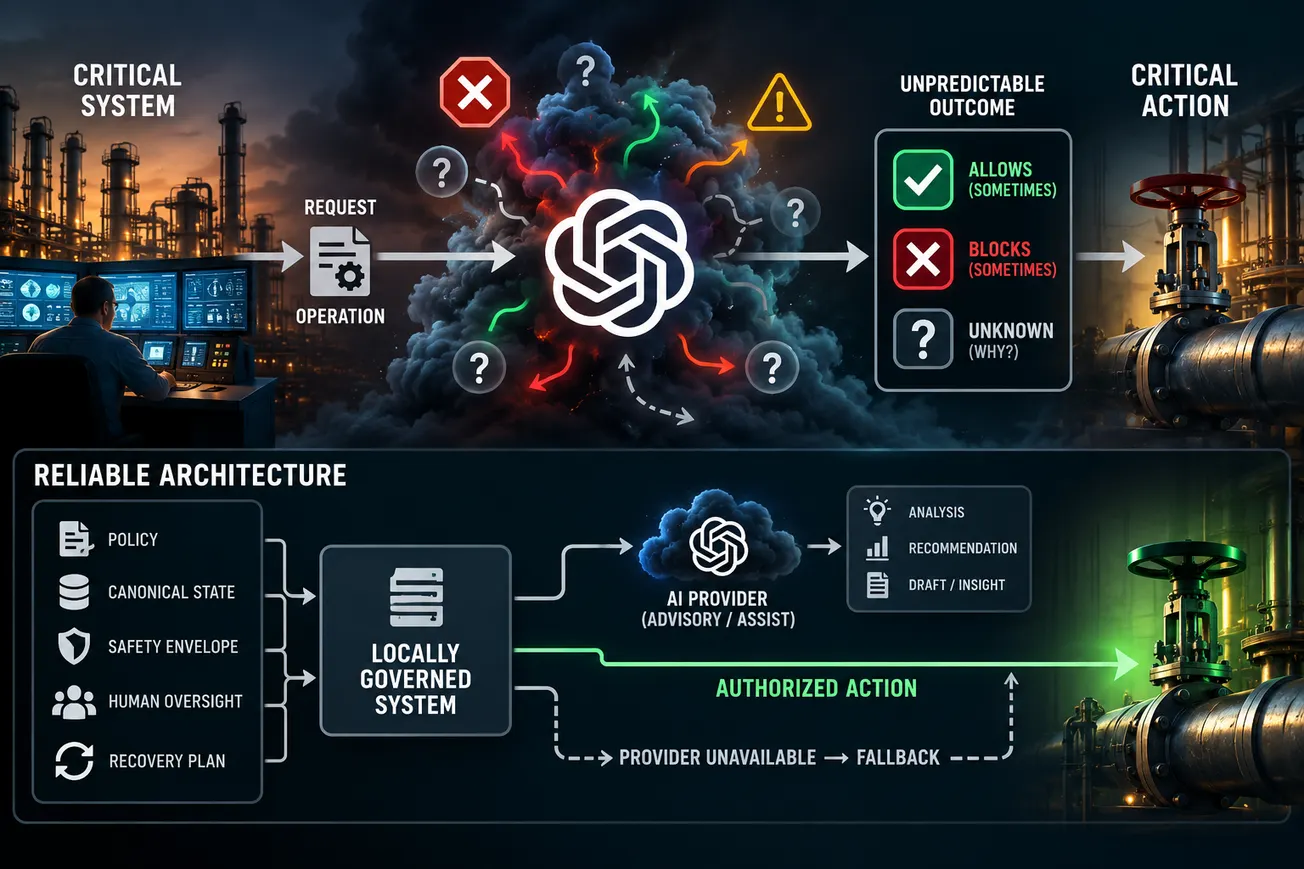 When an AI platform uses opaque safety controls to deny operations without
explanation, it introduces significant reliability risks for system architects.
While security mechanisms like firewalls or access controls routinely deny
actions, their rules and error codes are typically known, allowing engineers to
build predictable, resilient systems around those boundaries. However, when a
platform blocks a seemingly ordinary repository action—offering no policy
identifier, reason code, or consistent failure pattern—that safety control
effectively becomes an uncharacterized availability dependency. Without
understanding the failure rate, the exact trigger, or how to reliably reproduce
the error, designers are forced to assume the execution path could become
unavailable at any time. Standards like the NIST AI Risk Management Framework
and ISO reliability guidelines emphasize that external dependencies must remain
governable. Organizations cannot outsource their risk management; they need
measurable outcomes, clear service-level agreements, and observable failure
modes to maintain functional safety. Furthermore, relying on multiple downstream
connectors (like GitHub, Slack, or Drive) through a single AI provider creates a
common-cause failure point. If one opaque gate governs all these paths, they can
all fail simultaneously, proving that true system resilience requires
independent redundancy rather than just multiple adapters.
When an AI platform uses opaque safety controls to deny operations without
explanation, it introduces significant reliability risks for system architects.
While security mechanisms like firewalls or access controls routinely deny
actions, their rules and error codes are typically known, allowing engineers to
build predictable, resilient systems around those boundaries. However, when a
platform blocks a seemingly ordinary repository action—offering no policy
identifier, reason code, or consistent failure pattern—that safety control
effectively becomes an uncharacterized availability dependency. Without
understanding the failure rate, the exact trigger, or how to reliably reproduce
the error, designers are forced to assume the execution path could become
unavailable at any time. Standards like the NIST AI Risk Management Framework
and ISO reliability guidelines emphasize that external dependencies must remain
governable. Organizations cannot outsource their risk management; they need
measurable outcomes, clear service-level agreements, and observable failure
modes to maintain functional safety. Furthermore, relying on multiple downstream
connectors (like GitHub, Slack, or Drive) through a single AI provider creates a
common-cause failure point. If one opaque gate governs all these paths, they can
all fail simultaneously, proving that true system resilience requires
independent redundancy rather than just multiple adapters.
Batch Processing: Understanding Distributed Job Orchestration
 Distributed job orchestration manages complex computing tasks across multiple
machines, much like an operating system coordinates processes on a single
computer. When a system needs to run a large batch process, a scheduler receives
the request and assigns the work to executors, such as Kubernetes or Hadoop.
These executors rely on three core components: task executors that run the
commands, a resource manager that tracks available memory and processing power,
and a scheduler that decides which machine handles which task. Allocating these
resources is a complex balancing act, often using practical approaches like
priority queues to keep the system efficient without leaving tasks stranded. In
these systems, tasks are organized into workflows where the output of one job
naturally becomes the input for the next. To keep these dependent jobs properly
organized and decoupled, data is typically shared through a distributed file
system. Because hardware or network failures are inevitable in large setups,
fault tolerance is built directly into the design. For example, traditional
models like MapReduce save intermediate progress to disk to prevent data loss,
while newer frameworks like Spark hold this data in memory to speed up the
process, ensuring the system remains highly reliable without sacrificing overall
performance.
Distributed job orchestration manages complex computing tasks across multiple
machines, much like an operating system coordinates processes on a single
computer. When a system needs to run a large batch process, a scheduler receives
the request and assigns the work to executors, such as Kubernetes or Hadoop.
These executors rely on three core components: task executors that run the
commands, a resource manager that tracks available memory and processing power,
and a scheduler that decides which machine handles which task. Allocating these
resources is a complex balancing act, often using practical approaches like
priority queues to keep the system efficient without leaving tasks stranded. In
these systems, tasks are organized into workflows where the output of one job
naturally becomes the input for the next. To keep these dependent jobs properly
organized and decoupled, data is typically shared through a distributed file
system. Because hardware or network failures are inevitable in large setups,
fault tolerance is built directly into the design. For example, traditional
models like MapReduce save intermediate progress to disk to prevent data loss,
while newer frameworks like Spark hold this data in memory to speed up the
process, ensuring the system remains highly reliable without sacrificing overall
performance.
Shaping Board Culture Amid Structural and Contextual Obstacles
 A successful corporate board relies on much more than strict compliance and
formal processes; its true effectiveness is rooted in a strong, carefully
cultivated culture. Board culture encompasses the shared values, everyday
behaviors, and social norms that dictate how directors interact, debate, and
ultimately make decisions. To achieve organizational excellence, boards must
foster an environment of trust, openness, and psychological safety. This
atmosphere is essential for ensuring that diverse perspectives are actually
heard and used, allowing directors to comfortably challenge assumptions and
provide sound judgment. When these elements are present, the board and
management can operate as distinct but deeply collaborative teams. However,
shaping this ideal culture is rarely simple. Boards must navigate various
structural and contextual obstacles that influence their dynamics. Legal
frameworks, market expectations, and distinct national customs all play a
significant role. For example, the governance system in Germany, which mandates
employee representation on supervisory boards, creates a rich but complex
environment for boardroom interactions. Overcoming these hurdles requires
intentional effort, particularly from the board chair, who must actively
encourage constructive dialogue and candid feedback. Ultimately, a resilient
board culture transforms diverse insights into sustainable value, protecting the
organization from the severe consequences of poor oversight and constrained
communication.
A successful corporate board relies on much more than strict compliance and
formal processes; its true effectiveness is rooted in a strong, carefully
cultivated culture. Board culture encompasses the shared values, everyday
behaviors, and social norms that dictate how directors interact, debate, and
ultimately make decisions. To achieve organizational excellence, boards must
foster an environment of trust, openness, and psychological safety. This
atmosphere is essential for ensuring that diverse perspectives are actually
heard and used, allowing directors to comfortably challenge assumptions and
provide sound judgment. When these elements are present, the board and
management can operate as distinct but deeply collaborative teams. However,
shaping this ideal culture is rarely simple. Boards must navigate various
structural and contextual obstacles that influence their dynamics. Legal
frameworks, market expectations, and distinct national customs all play a
significant role. For example, the governance system in Germany, which mandates
employee representation on supervisory boards, creates a rich but complex
environment for boardroom interactions. Overcoming these hurdles requires
intentional effort, particularly from the board chair, who must actively
encourage constructive dialogue and candid feedback. Ultimately, a resilient
board culture transforms diverse insights into sustainable value, protecting the
organization from the severe consequences of poor oversight and constrained
communication.

