Showing posts with label SD Branch. Show all posts

Daily Tech Digest - December 28, 2024

Forcing the SOC to change its approach to detection

Make no mistake, we are not talking about the application of AI in the usual sense when it comes to threat detection. Up until now, AI has seen Large Language Models (LLMs) used to do little more than summarise findings for reporting purposes in incident response. Instead, we are referring to the application of AI in its truer and broader sense, i.e. via machine learning, agents, graphs, hypergraphs and other approaches – and these promise to make detection both more precise and intelligible. Hypergraphs gives us the power to connect hundreds of observations together to form likely chains of events. ... The end result is that the security analyst is no longer perpetually caught in firefighting mode. Rather than having to respond to hundreds of alerts a day, the analyst can use the hypergraphs and AI to detect and string together long chains of alerts that share commonalities and in so doing gain a complete picture of the threat. Realistically, it’s expected that adopting such an approach should see alert volumes decline by up to 90 per cent. But it doesn’t end there. By applying machine learning to the chains of events it will be possible to prioritise response, identifying which threats require immediate triage. 


Sole Source vs. Single Source Vendor Management

A Sole source is a vendor that provides a specific product or service to your company. This vendor makes a specific widget or service that is custom tailored to your company’s needs. If there is an event at this Sole Source provider, your company can only wait until the event has been resolved. There is no other vendor that can produce your product or service quickly. They are the sole source, on a critical path to your operations. From an oversight and assessment perspective, this can be a difficult relationship to mitigate risks to your company. With sole source companies, we as practitioners must do a deeper dive into these companies from a risk assessment perspective. From a vendor audit perspective, we need to go into more details of how robust their business continuity, disaster recovery, and crisis management programs are. ... Single Source providers are vendors that provide a service or product to your company that is one company that you choose to do business with, but there are other providers that could provide the same product or services. An example of a single source provider is a payment processing company. There are many to choose from, but you chose one specific company to do business with. Moving to a new single source provider can be a daunting task that involves a new RFP process, process integration, assessments of their business continuity program, etc. 


Central Africa needs traction on financial inclusion to advance economic growth

Beyond the infrastructure, financial inclusion would see a leap forward in CEMAC if the right policies and platforms exist. “The number two thing is that you have to have the right policies in place which are going to establish what would constitute acceptable identity authentication for identity transactions. So, be it for onboarding or identity transactions, you have to have a policy. Saying that we’re going to do biometric authentication for every transaction, no matter what value it is and what context it is, doesn’t make any sense,” Atick holds. “You have to have a policy that is basically a risk-based policy. And we have lots of experience in that. Some countries started with their own policies, and over time, they started to understand it. Luckily, there is a lot of knowledge now that we can share on this point. This is why we’re doing the Financial Inclusion Symposium at the ID4Africa Annual General Meeting next year [in Addis Ababa], because these countries are going to share their knowledge and experiences.” “The symposium at the AGM will basically be on digital identity and finance. It’s going to focus on the stages of financial inclusion, and what are the risk-based policies countries must put in place to achieve the desired outcome, which is a low-cost, high-robustness and trustworthy ecosystem that enables anybody to enter the system and to conduct transactions securely.”


2025 Data Outlook: Strategic Insights for the Road Ahead

By embracing localised data processing, companies can turn compliance into an advantage, driving innovations such as data barter markets and sovereignty-specific data products. Data sovereignty isn’t merely a regulatory checkbox—it’s about Citizen Data Rights. With most consumer data being unstructured and often ignored, organisations can no longer afford complacency. Prioritising unstructured data management will be crucial as personal information needs to be identified, cataloged, and protected at a granular level from inception through intelligent, policy-based automation. ... Individuals are gaining more control over their personal information and expect transparency, control, and digital trust from organisations. As a result, businesses will shift to self-service data management, enabling data stewards across departments to actively participate in privacy practices. This evolution moves privacy management out of IT silos, embedding it into daily operations across the organisation. Organisations that embrace this change will implement a “Data Democracy by Design” approach, incorporating self-service privacy dashboards, personalised data management workflows, and Role-Based Access Control (RBAC) for data stewards. 


Defining & Defying Cybersecurity Staff Burnout

According to the van Dam article, burnout happens when an employee buries their experience of chronic stress for years. The people who burn out are often formerly great performers, perfectionists who exhibit perseverance. But if the person perseveres in a situation where they don't have control, they can experience the kind of morale-killing stress that, left unaddressed for months and years, leads to burnout. In such cases, "perseverance is not adaptive anymore and individuals should shift to other coping strategies like asking for social support and reflecting on one's situation and feelings," the article read. ... Employees sometimes scoff at the wellness programs companies put out as an attempt to keep people healthy. "Most 'corporate' solutions — use this app! attend this webinar! — felt juvenile and unhelpful," Eden says. And it does seem like many solutions fall into the same quick-fix category as home improvement hacks or dump dinner recipes. Christina Maslach's scholarly work attributed work stress to six main sources: workload, values, reward, control, fairness, and community. An even quicker assessment is promised by the Matches Measure from Cindy Muir Zapata. 


Revolutionizing Cloud Security for Future Threats

Is it possible that embracing Non-Human Identities can help us bridge the resource gap in cybersecurity? The answer is a definite yes. The cybersecurity field is chronically understaffed and for firms to successfully safeguard their digital assets, they must be equipped to handle an infinite number of parallel tasks. This demands a new breed of solutions such as NHIs and Secrets Security Management that offer automation at a scale hitherto unseen. NHIs have the potential to take over tedious tasks like secret rotation, identity lifecycle management, and security compliance management. By automating these tasks, NHIs free up the cybersecurity workforce to concentrate on more strategic initiatives, thereby improving the overall efficiency of your security operations. Moreover, through AI-enhanced NHI Management platforms, we can provide better insights into system vulnerabilities and usage patterns, considerably improving context-aware security. Can the concept of Non-Human Identities extend its relevance beyond the IT sector? ... From healthcare institutions safeguarding sensitive patient data, financial services firms securing transactional data, travel companies protecting customer data, to DevOps teams looking to maintain the integrity of their codebases, the strategic relevance of NHIs is widespread.


Digital Transformation: Making Information Work for You

Digital transformation is changing the organization from one state to another through the use of electronic devices that leverage information. Oftentimes, this entails process improvement and process reengineering to convert business interactions from human-to-human to human-to-computer-to-human. By introducing the element of the computer into human-to-human transactions, there is a digital breadcrumb left behind. This digital record of the transaction is important in making digital transformations successful and is the key to how analytics can enable more successful digital transformations. In a human-to-human interaction, information is transferred from one party to another, but it generally stops there. With the introduction of the digital element in the middle, the data is captured, stored, and available for analysis, dissemination, and amplification. This is where data analytics shines. If an organization stops with data storage, they are missing the lion’s share of the potential value of a digital transformation initiative. Organizations that focus only on collecting data from all their transactions and sinking this into a data lake often find that their efforts are in vain. They end up with a data swamp where data goes to die and never fully realize its potential value. 


Secure and Simplify SD-Branch Networks

The traditional WAN relies on expensive MPLS connectivity and a hub-and-spoke architecture that backhauls all traffic through the corporate data centre for centralized security checks. This approach creates bottlenecks that interfere with network performance and reliability. In addition to users demanding fast and reliable access to resources, IoT applications need reliable WAN connections to leverage cloud-based management and big data repositories. ... The traditional WAN relies on expensive MPLS connectivity and a hub-and-spoke architecture that backhauls all traffic through the corporate data centre for centralized security checks. This approach creates bottlenecks that interfere with network performance and reliability. In addition to users demanding fast and reliable access to resources, IoT applications need reliable WAN connections to leverage cloud-based management and big data repositories. ... To reduce complexity and appliance sprawl, SD-Branch consolidates networking and security capabilities into a single solution that provides seamless protection of distributed environments. It covers all critical branch edges, from the WAN edge to the branch access layer to a full spectrum of endpoint devices. 


Breaking up is hard to do: Chunking in RAG applications

The most basic is to chunk text into fixed sizes. This works for fairly homogenous datasets that use content of similar formats and sizes, like news articles or blog posts. It’s the cheapest method in terms of the amount of compute you’ll need, but it doesn’t take into account the context of the content that you’re chunking. That might not matter for your use case, but it might end up mattering a lot. You could also use random chunk sizes if your dataset is a non-homogenous collection of multiple document types. This approach can potentially capture a wider variety of semantic contexts and topics without relying on the conventions of any given document type. Random chunks are a gamble, though, as you might end up breaking content across sentences and paragraphs, leading to meaningless chunks of text. For both of these types, you can apply the chunking method over sliding windows; that is, instead of starting new chunks at the end of the previous chunk, new chunks overlap the content of the previous one and contain part of it. This can better capture the context around the edges of each chunk and increase the semantic relevance of your overall system. The tradeoff is that it requires greater storage requirements and can store redundant information.


What is quantum supremacy?

A definitive achievement of quantum supremacy will require either a significant reduction in quantum hardware's error rates or a better theoretical understanding of what kind of noise classical approaches can exploit to help simulate the behavior of error-prone quantum computers, Fefferman said. But this back-and-forth between quantum and classical approaches is helping push the field forwards, he added, creating a virtuous cycle that is helping quantum hardware developers understand where they need to improve. "Because of this cycle, the experiments have improved dramatically," Fefferman said. "And as a theorist coming up with these classical algorithms, I hope that eventually, I'm not able to do it anymore." While it's uncertain whether quantum supremacy has already been reached, it's clear that we are on the cusp of it, Benjamin said. But it's important to remember that reaching this milestone would be a largely academic and symbolic achievement, as the problems being tackled are of no practical use. "We're at that threshold, roughly speaking, but it isn't an interesting threshold, because on the other side of it, nothing magic happens," Benjamin said. ... That's why many in the field are refocusing their efforts on a new goal: demonstrating "quantum utility," or the ability to show a significant speedup over classical computers on a practically useful problem.


Shift left security — Good intentions, poor execution, and ways to fix it

One of the first steps is changing the way security is integrated into development. Instead of focusing on a “gotcha”, after-the-fact approach, we need security to assist us as early as possible in the process: as we write the code. By guiding us as we’re still in ‘work-in-progress’ mode with our code, security can adopt a positive coaching and helping stance, nudging us to correct issues before they become problems and go clutter our backlog. ... The security tools we use need to catch vulnerabilities early enough so that nobody circles back to fix boomerang issues later. Very much in line with my previous point, detecting and fixing vulnerabilities as we code saves time and preserves focus. This also reduces the back-and-forth in peer reviews, making the entire process smoother and more efficient. By embedding security more deeply into the development workflow, we can address security issues without disrupting productivity. ... When it comes to security training, we need a more focused approach. Developers don’t need to become experts in every aspect of code security, but we do need to be equipped with the knowledge that’s directly relevant to the work we’re doing, when we’re doing it — as we code. Instead of broad, one-size-fits-all training programs, let’s focus on addressing specific knowledge gaps we personally have. 


Quote for the day:

“Whenever you see a successful person, you only see the public glories, never the private sacrifices to reach them.” -- Vaibhav Shah

Daily Tech Digest - July 04, 2018

Understanding Blockchain Fundamentals, Part 3: Delegated Proof of Stake


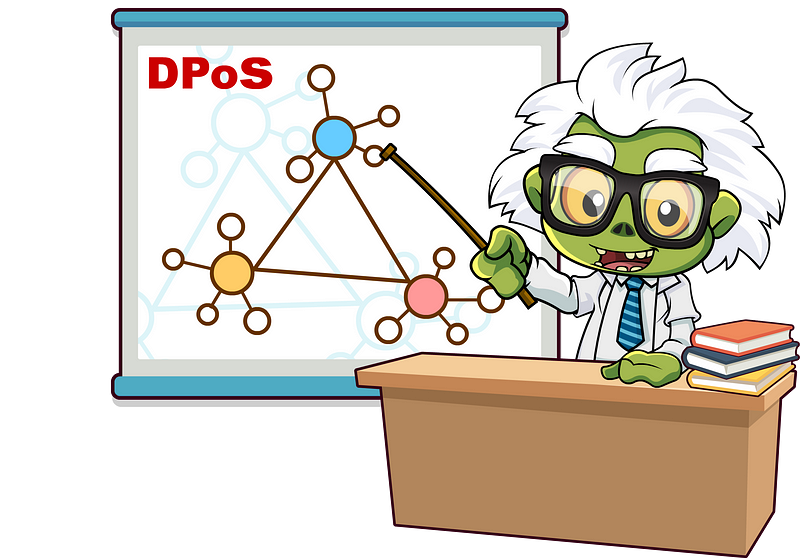
The gist is that PoW provides the most proven security to date, but at the cost of consuming an enormous amount of energy. PoS, the primary alternative, removes the energy requirements of PoW, and replaces miners with “validators”, who are given the chance to validate (“mine”) the next block with a probability proportional to their stake. Another consensus algorithm that is often discussed is Delegated Proof of Stake (DPoS) — a variant of PoS that provides a high level of scalability at the cost of limiting the number of validators on the network. ... DPoS is a system in which a fixed number of elected entities (called block producers or witnesses) are selected to create blocks in a round-robin order. Block producers are voted into power by the users of the network, who each get a number of votes proportional to the number of tokens they own on the network (their stake). Alternatively, voters can choose to delegate their stake to another voter, who will vote in the block producer election on their behalf.


Cryptocurrency Theft Drives 3x Increase in Money Laundering

"We're now seeing, in the last probably eight to 12 months, a real influx of new criminals that are highly technically sophisticated," he explains. There's a major difference between seasoned threat actors and those who have been dabbling in cybercrime for less than 12 months: operational security. It isn't a question of technical prowess so much as lack of experience, Jevans continues. Cybercrime's newest threat actors can craft advanced malware designed to target cryptocurrency addresses and inject similar addresses, under their control, to receive funds. Their malware is designed to target digital funds in a way traditional malware isn't, created by people who grew up learning about virtual currencies and can exploit them in new ways. The problems start when they secure the money. ... "It's clear these people really understand cryptocurrency and crypto assets really, really well," he explains. "What they don't understand is old-school operational security … they're just not sophisticated that way. Legacy folks, they definitely have better operational security. They're better at how they interface with it, how they distribute malicious code, how they manage user handles on different forums."


Dell New XPS 13 vs. HP Spectre x360 13t: Which laptop is better

dell new xps 13 vs hp spectre x360 13 1
With completely refreshed models at hand, we're putting these two dream machines through an old-fashioned smackdown. We're comparing them on everything from design and features to price and performance, declaring a winner in each category. Keep reading to see who comes out ahead. ... Both laptops are extremely portable for what they offer in capability and performance. In pure weight contests, our scale put the New XPS 13 at 2 pounds, 10.5 ounces, and the Spectre x360 13t at 2 pounds, 11.7 ounces. Unless you’re looking for a true featherweight-class devices that's closer to two pounds, it’s going to be hard to beat these two. Where it might matter to someis how large the actual body is, which can affect the size of your laptop bag or your comfort on a cramped airplane. While we think this is a pretty close battle, the nod obviously goes to the New XPS 13, which is just incredibly small despite having a 13.3-inch screen. ... It’s interesting that both the XPS 13 and Spectre x360 13t are the last refuge of “good keyboards.” There's no marketing to make you believe that less key travel is better.


4 reasons why CISOs must think like developers

number 4 four with binary grunge background
Developers are constantly looking for ways to extend services and share data using API’s & Microservices. Microservices help weave a digital fabric through a set of loosely-coupled services stitched together as a platform. Platform-centric architectures provide for extensibility with the ability to plug-and-play new tools and services using API’s with open data formats like JSON. CISO’s similarly must start thinking of ways to break down data silos and integrate the data from various tools and sub-systems. The list of “sensors” generating security data is endless and keeps growing every day. Anti-virus scan reports, firewall logs, vulnerability scan data, server access logs, authentication logs and threat profiles are just some of the sources of critical security information. All this data only makes sense when integrated into one single view and analyzed using AI-models. The volume, velocity and variety of data make it impossible for human-beings to analyze and react. AI-driven models help discern anomalous behavior from regular patterns and are the only scalable approach for detecting threats in near real-time. Security operations, automation, analytics and incident response as an integrated platform is the way to go.


Network professionals should think SD-Branch, not just SD-WAN

Aruba, SD-Branch, SD-WAN, WAN, networking
Doyle defines the SD-Branch as having SD-WAN, routing, network security, and LAN/Wi-Fi functions all in one platform with integrated, centralized management. An SD-Branch can be thought of as the next step after SD-WAN, as the latter transforms the transport and the former focuses on things in the branch, such as optimizing user experience and improving security. ... Most SD-WAN solutions focus on WAN transport, but apps continue on inside the branch. Aruba’s SD-Branch provides fine-grained contextual awareness and QoS across the WAN, but also inside the branch, and can be extended to mobile users. This is an important step in breaking down the management silos of remote networks, in office, and WAN. Network engineers should think of the end-to-end network instead of discrete places. Apps don’t care about network boundaries, and it’s time for network operations to think that way, as well. From an operations perspective, Aruba’s SD-Branch would enable IT organizations to manage more branches with fewer people. The automated capabilities and ZTP takes care of many of the tasks that were historically done manually.


Open source isn’t the community you think it is

Open source isn̢۪t the community you think it is
The interesting thing is just how strongly the central “rules” of open source engagement have persisted, even as open source has become standard operating procedure for a huge swath of software development, whether done by vendors or enterprises building software to suit their internal needs. While it may seem that such an open source contribution model that depends on just a few core contributors for so much of the code wouldn’t be sustainable, the opposite is true. Each vendor can take particular interest in just a few projects, committing code to those, while “free riding” on other projects for which it derives less strategic value. In this way, open source persists, even if it’s not nearly as “open” as proponents sometimes suggest. Is open source then any different from a proprietary product? After all, both can be categorized by contributions by very few, or even just one, vendor. Yes, open source is different. Indeed, the difference is profound. In a proprietary product, all the engagement is dictated by one vendor.


Java Parallel Streams
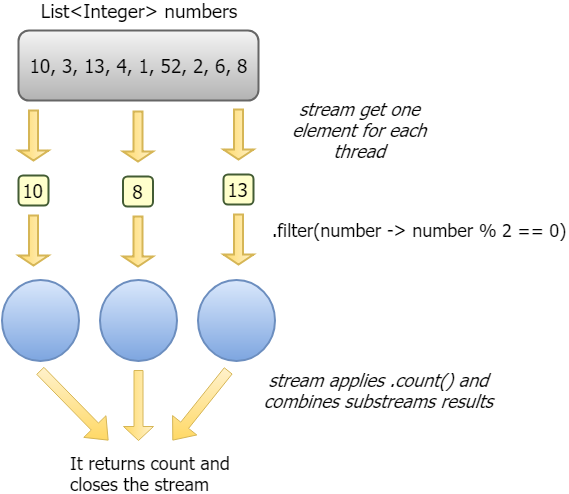
A stream is a sequence of elements. An array is a data structure that stores a sequence of values. Then, a stream is an array? Well, not really - let's look at what a stream really is and see how it works. First of all, streams don't store elements, an array does. So, no, a stream is not an array. Also, while collections and arrays have a finite size, streams don't. But, if a stream doesn't store elements, how can it be a sequence of elements? Streams are actually a sequence of data being moved from one point to the another, but they're computed on demand. So, they have at least one source, like arrays, lists, I/O resources, and so on. Let's take a file for an example: when a file is opened for editing, all or part of it remains in memory, thus allowing for changes, so only when it is closed there's a guarantee that no data will be lost or damaged. Fortunately, a stream can read/write data chunk by chunk, without buffering the whole file at once. Just so you know, a buffer is a region of a physical memory storage (usually RAM) used to temporarily store data while it is being moved from one place to another.


Cloud computing concept
The marketplace consists of suppliers and consumers that either rent out or purchase computing power to perform their tasks. Consumers who connect to the virtual space can either select a rental time or buy available power for their projects, and then calculate the cost accordingly. When the power resource is theirs, consumers can then take advantage of SONM’s capabilities to render videos, host apps and websites, make scientific calculations, manage data storage, or work with machine learning. Suppliers — the computing power owners — earn SNM tokens when they sell computer resources to consumers. SONM is completely decentralized, which means the platform is transparent and free from ownership, and the company claims it is less expensive than centralized competitors. “Blockchain enables the creation of a genuinely open decentralized system without a single control center,” Antonio said. “Additionally, using blockchain to manage settlements on-platform with the help of the SNM cryptocurrency allows the interests of participants to be protected.”


An urban scene.
Economic viability is important, says Sharma, because of the public policy imperative to find cost-effective solutions to the problems facing urban areas. “In general, cities are stretched in terms of their budgets,” he says, “They are thinking about how to efficiently utilize all of the assets they have. For example, better traffic management can be an economic alternative to building a new highway. The ultimate goal is not necessarily to build roads, it’s to improve mobility, and do a better job of getting people from point A to point B.” Sharma says that social media and awareness of new technology is increasing the motivation of urban planners and politicians to implement smarter solutions to problems such as traffic congestion, parking shortages, security, and first-responder response times. “Citizens are demanding more from their leaders,” he says. “I think this will motivate policymakers, and result in the right decisions when it comes to using digital technology.” A recently released report from Juniper Research, sponsored by Intel, looks at the evolution of smart cities in the context of mobility, healthcare, public safety and productivity.


Facial Recognition: Big Trouble With Big Data Biometrics

Amazon Web Services, for example, in 2016 began to offer biometric capabilities via Amazon Rekognition, and it's ready to highlight positive use cases. "We have seen customers use the image and video analysis capabilities of Amazon Rekognition in ways that materially benefit both society (e.g. preventing human trafficking, inhibiting child exploitation, reuniting missing children with their families, and building educational apps for children), and organizations (enhancing security through multi-factor authentication, finding images more easily, or preventing package theft)," Matt Wood, general manager for deep learning and artificial intelligence at Amazon Web Services, said in a blog post last month. ... As data breach expert Troy Hunt has written as well as extensively documented: "Sooner or later, big repositories of data will be abused. Period." Hunt was specifically writing about India's Aadhaar implementation, which is the world's largest biometric system, storing about 1.2 billion individuals' details, and which has not been a security success story


Quote for the day:


"The essence of leadership is the willingness to make the tough decisions. Prepared to be lonely." -- Colin Powell


Daily Tech Digest - January 23, 2018

Meltdown and Spectre: How much are ARM and AMD exposed?

Meltdown and Spectre: How much are ARM and AMD exposed?
AMD issued a statement on Meltdown and said it is potentially vulnerable to only one of the three variants of Meltdown, but no one has demonstrated an AMD vulnerability as yet. This applies to both the new Epyc server processor and older Opteron server chips for the half dozen customers still using them. With ARM, it gets complicated. The company has published a list of cores at risk. ARM has three types of cores — Cortex-A, Cortex-M and Cortex-R. Cortex-M is an embedded microcontroller used in Internet of Things (IoT) devices and a 32-bit processor, so it has no exposure. Cortex-R is also an embedded controller used in real-time applications, such as cars. Those are used in closed systems and are not prone to attack, although ARM said they are at risk of exposure. Only the Cortex-A line has exposure, and not all of the chips are at risk. For example, the Cortex-A53, which is the most widely used processor in smartphones and tablets, is not at risk. 


Blockchain and cryptocurrency may soon underpin cloud storage

bitcoin currency blockchain finance bank binary
The emerging blockchain-based distributed storage market could challenge traditional cloud storage services, such as Amazon AWS and Dropbox, for a cut of the cloud storage market. "Distributed compute and storage models are still in their infancy, but I do believe that there is an enormous market for this technology," said Paul Brody, Ernst & Young's (EY) Global Innovation Leader for Blockchain Technology. The idea of using P2P networks to aggregate computer resources is not new. In the early 2000s, BitTorrent opened as a distributed file-sharing service and grew to handle more than half of the internet's file-sharing bandwidth. Because blockchains come with a built-in mechanism for payments – cryptocurrencies, which were missing from the last go-around at P2P services – they are more likely to succeed, according to Brody.


Bitcoin: A cheat sheet for professionals

bitcoin.jpg
Bitcoin is the first decentralized form of cryptocurrency, but it's certainly not the only one. A large number of blockchain-based cryptocurrencies have emerged since 2009, which raises the obvious question: How is Bitcoin different? Aside from its much greater value, there are several things that make Bitcoin different from cryptocurrencies such as Etherium, Dogecoin, Litecoin, and others. All of these cryptocurrencies use blockchain technology, but the method and purpose of each one is different. Etherium, one of the most talked about bitcoin alternatives, isn't actually a value transfer platform; instead, it is used for distributed application programming. Etherium does have a monetary value in the form of its fuel, called Ether, but that's just one part of its overall model. Other cryptocurrencies, like Litecoin, Dogecoin, and PotCoin, use blockchains but don't rely on SHA-256 encryption like Bitcoin does; they use Scrypt, a password-based key derivation function, to build coin hashes instead.


What you need to know about Azure Notebooks

What you need to know about Azure Notebooks
The underlying technologies are familiar: You can add content around executable code playgrounds using Markdown to format text. Azure Notebooks automatically adds UI to your code snippets, and you can use any of a selection of visualization tools for charting results. Data can be uploaded to and downloaded from local PCs, so you can take files you’ve been using with Excel’s analytics and use them in Azure Notebooks, letting you compare results and use business intelligence tools to prepare data before it’s used. You import online data with Curl or Wget, using Python code in a notebook or from a notebook’s built-in terminal window. There’s also integration with Dropbox, so you can share files with colleagues or use it to ensure you’re always working with the latest version of a file. Although Microsoft provides most of the tools you’ll need, it can only really support general-purpose analytical operations with tools like Python’s Anaconda data science extensions.


The InfoQ eMag: APM & Observability


The topic of “observability” has been getting much attention recently, particularly in relation to building and operating “cloud native” systems. Several thought-leaders within this space like Cindy Sridharan have mused that observability could simply be a re-packaging of the age-old topic of monitoring (and argued that no amount of “observability” or “monitoring” tooling can ever be a substitute to good engineering intuition and instincts). Others, like Charity Majors have looked back at the roots of the term, which was taken from control theory and corresponds to a measure of how well internal states of a system can be inferred from knowledge of its external outputs. Both Sridharan and Majors discuss that the implementation of an observable systems should enable engineers to ask ad hoc (or following an incident, post hoc) questions about how the software works during execution. This eMag explores the topic of observability in-depth, covering the role of the “three pillars of observability” -- monitoring, logging, and distributed tracing


Are Advisors’ Cyberdefenses Strong Enough?

The speed at which cybercriminals launch attacks means the industry has no choice but to be more vigilant in protecting the precious information it keeps for its investors, so it can give more peace of mind to advisors and their clients. The public already sees cybercrime as a major threat. Research by Bitdefender, a cybersecurity technology provider based in Bucharest, Romania, finds U.S. citizens are more concerned about stolen identities (79%) than email hacking (70%) or home break-ins (63%). One major problem for the financial-services industry is that authentication methods are “severely outdated,” according to Harvey. “Many institutions have not yet recognized that cyberfelons already have the data to beat these practices. Millions of clients’ assets are at risk.” ... Today’s authentication practices largely rely on the of use private data, such as passwords, PINs and Social Security numbers — information that cyberfelons already possess.


Do data scientists have the right stuff for the C-suite?


For a data scientist or analyst to evolve as an effective leader three personal quality characteristics are needed: curiosity, imagination, and creativity. The three are sequentially linked. Curious people constantly ask “Why are things the way they are?” and “Is there a better way of doing things?” Without these personal qualities then innovation will be stifled. The emergence of analytics is creating opportunities for analysts as leaders. Weak leaders are prone to a diagnostic bias. They can be blind to evidence and somehow believe their intuition, instincts, and gut-feel are acceptable masquerades for having fact-based information. In contrast, a curious person always asks questions. They typically love what they do. If they are also a good leader they infect others with enthusiasm. Their curiosity leads to imagination. Imagination considers alternative possibilities and solutions. Imagination in turn sparks creativity.


6 ways hackers will use machine learning to launch attacks

job search machine learning ai artifical intelligence robotics automation
“We must recognize that although technologies such as machine learning, deep learning, and AI will be cornerstones of tomorrow’s cyber defenses, our adversaries are working just as furiously to implement and innovate around them,” said Steve Grobman, chief technology officer at McAfee, in recent comments to the media. “As is so often the case in cybersecurity, human intelligence amplified by technology will be the winning factor in the arms race between attackers and defenders.” This has naturally led to fears that this is AI vs AI, Terminator style. Nick Savvides, CTO at Symantec, says this is “the first year where we will see AI versus AI in a cybersecurity context,” with attackers more able to effectively explore compromised networks, and this clearly puts the onus on security vendors to build more automated and intelligent solutions.


Why the Cloud is more secure than On Prem

It is obvious that we are heading with this discussion in the direction of the classical security hygiene like risk management, identity management, patch management etc. to the extend needed by the customer, which is basically risk management. This needs to be done in every infrastructure and it needs to be done professionally. However, as most companies do not have IT as their core competence, they are trying to run security with a 0.5 FTE who then has to cover all the tasks needed – and who will be on a mission impossible. And even with the big and global companies, they are having difficulties with their inventory, with patch management (as a consequence), with their identities etc. I am deeply convinced that the cloud can help there! But before we need to understand the different responsibilities, knowing that this discussion is not new by far


SD-Branch: What it is and why you'll need it

bridge between two buildings
The branch network is a critical piece of the IT infrastructure for most distributed organizations. The branch network is responsible for providing reliable, high quality communications to and from remote locations. It must be secure, easy to deploy, able to be managed centrally and cost effective. Requirements for branch networks continue to evolve with needs for increased bandwidth, quality of service, security and support for IoT. SDN and network virtualization technologies have matured to the point where they can deliver significant benefits for branch networks. For example, SD-WAN technology is rapidly being deployed to improve the quality of application delivery and reducing operational complexity. SD-WAN suppliers are rapidly consolidating branch network functions and have reduced (or eliminated) the need for branch routers and WAN optimization. The broader concept of SD-Branch is still in its early stages. During 2018, we will see a number of suppliers introduce their SD-Branch solutions.


Quote for the day:


"No obstacle is so big that one person with determination can't make a difference." -- Jay Samit