Showing posts with label localization. Show all posts

Daily Tech Digest - June 05, 2018

10 Open Source Security Tools You Should Know

(Image: Anemone123)
The people, products, technologies, and processes that keep businesses secure all come with a cost — sometimes quite hefty. That is just one of the reasons why so many security professionals spend at least some of their time working with open source security software. Indeed, whether for learning, experimenting, dealing with new or unique situations, or deploying on a production basis, security professionals have long looked at open source software as a valuable part of their toolkits.  However, as we all are aware, open source software does not map directly to free software; globally, open source software is a huge business. With companies of various sizes and types offering open source packages and bundles with support and customization, the argument for or against open source software often comes down to its capabilities and quality. For the tools in this slide show, software quality has been demonstrated by thousands of users who have downloaded and deployed them. The list is broken down, broadly, into categories of visibility, testing, forensics, and compliance. If you don't see your most valuable tool on the list, please add them in the comments.


The growing ties between networking roles and automation

Automation was expected to steal jobs and replace human intelligence. But as network automation use cases have matured, Kerravala said, employees and organizations increasingly see how automating menial network tasks can benefit productivity. To automate, however, network professionals need programming skills to determine the desired network output. They need to be able to tell the network what they want it to do. All of this brings me to an obvious term that's integral to automation and network programming: program, which means to input data into a machine to cause it to do a certain thing. Another definition says to program is "to provide a series of instructions." If someone wants to give effective instructions, a person must understand the purpose of the instructions being relayed. A person needs the foundation -- or the why of it all -- to get to the actual how. Regarding network automation, the why is to ultimately achieve network readiness for what the network needs to handle, whether that's new applications or more traffic, Cisco's Leary said.


5 ways location data is making the world a better place

A salesperson (L) talks with a visitor in front of a map showing the location of an apartment complex which is currently under construction at its showroom in Seoul March 18, 2015. While activity is soaring, with the number of transactions at a 7-year high, housing prices are rising at a glacial pace as heavy household debt and a fast-ageing population keep a lid on price growth. To match story SOUTHKOREA-ECONOMY/HOUSING Picture taken on March 18. REUTERS/Kim Hong-Ji
In the insurance sector, detailed data creates better predictions and more accurate customer quotes. Yet potential purchasers often don’t know the information needed for rigorous risk assessments, such as the distance of their house from water. Furthermore, lengthy and burdensome questionnaires can lose firms business; analysis from HubSpot found, by reducing form fields, customer conversions improve. PCA Predict uses its Location Intelligence platform to compile free data from the Land Registry and Ordinance Survey, including LiDAR height maps, as well as commercial address data, to determine accurate information on a potential customer’s property, such as distance from a river network, height, footprint, if the property is listed and its risk of wind damage. The model is also being developed to determine a building’s age using machine-learning and road layout. “We take disparate datasets and apply different types of analysis to extract easy-to-use attributes for insurers,” says Dr Ian Hopkinson, senior data scientist at GBG, the parent company of PCA.


Adoption of Augmented Analytics Tools Is Increasing Among Indian Organizations

Indian organizations are increasingly moving from traditional enterprise reporting to augmented analytics tools that accelerate data preparation and data cleansing, said Gartner, Inc. This change is set to positively impact the analytics and business intelligence (BI) software market in India in 2018. Gartner forecasts that analytics and BI software market revenue in India will reach US$304 million in 2018, an 18.1 percent increase year over year. ... "Indian organizations are shifting from traditional, tactical and tool-centric data and analytics projects to strategic, modern and architecture-centric data and analytics programs," said Ehtisham Zaidi, principal research analyst at Gartner. "The 'fast followers' are even looking to make heavy investments in advanced analytics solutions driven by artificial intelligence and machine learning, to reduce the time to market and accuracy of analytics offerings."


Apple’s Core ML 2 vs. Google’s ML Kit: What’s the difference?

core ml 2
A major difference between ML Kit and Core ML is support for both on-device and cloud APIs. Unlike Core ML, which can’t natively deploy models that require internet access, ML Kit leverages the power of Google Cloud Platform’s machine learning technology for “enhanced” accuracy. Google’s on-device image labeling service, for example, features about 400 labels, while the cloud-based version has more than 10,000. ML Kit offers a couple of easy-to-use APIs for basic use cases: text recognition, face detection, barcode scanning, image labeling, and landmark recognition. Google says that new APIs, including a smart reply API that supports in-app contextual messaging replies and an enhanced face detection API with high-density face contours, will arrive in late 2018. ML Kit doesn’t restrict developers to prebuilt machine learning models. Custom models trained with TensorFlow Lite, Google’s lightweight offline machine learning framework for mobile devices, can be deployed with ML Kit via the Firebase console, which serves them dynamically.


How to evaluate web authentication methods

user authentication
Two attributes I hadn’t give a lot of thought to are “requiring explicit consent” and “resilient to leaks from other verifiers.” The former ensures that a user’s authentication is not initiated without them knowing about it, and the latter is about preventing related authentication secrets from being used to deduce the original authentication credential. The authors evaluate all the covered authentication solutions across all attributes, and they include a nice matrix chart so you can see how each compared to the other. It’s a genius table that should have been created a long time ago. The authors rate each authentication option as satisfying, not satisfying or partially satisfying each attribute. The attributes aren’t ranked, but anyone could easily take the unweighted framework, add or delete attributes, and weight it with their own needed importance. For example, many authentication evaluators looking for real-world solutions will want to add cost (both initial and ongoing) and vendor product solutions. The author’s candid conclusions include: “A clear result of our exercise is that no [authentication] scheme we examined is perfect – or even comes close to perfect scores.”


Advanced Architecture for ASP.NET Core Web API


Before we dig into the architecture of our ASP.NET Core Web API solution, I want to discuss what I believe is a singlebenefit which makes .NET Core developers lives so much better; that is, DependencyInjection (DI). Now, I know you will say that we had DI in .NET Framework and ASP.NET solutions. I will agree, butthe DI we used in the past would be from third-party commercial providers or maybe open source libraries. They did a good job, butfor a good portion of .NET developers, there was a big learning curve, andall DI libraries had their uniqueway of handling things. Today with .NET Core, we have DI built right into the framework from the start. Moreover,it is quite simple to work with, andyou get it out of the box. The reason we need to use DI in our API is that it allows usto have the best experience decoupling our architecture layers and also to allowus to mock the data layer, or have multiple data sources built for our API. To use the .NET Core DI framework, justmake sure your project references the Microsoft.AspNetCore.AllNuGet package (which contains a dependency on Microsoft.Extnesions.


Intuitively Understanding Convolutions for Deep Learning
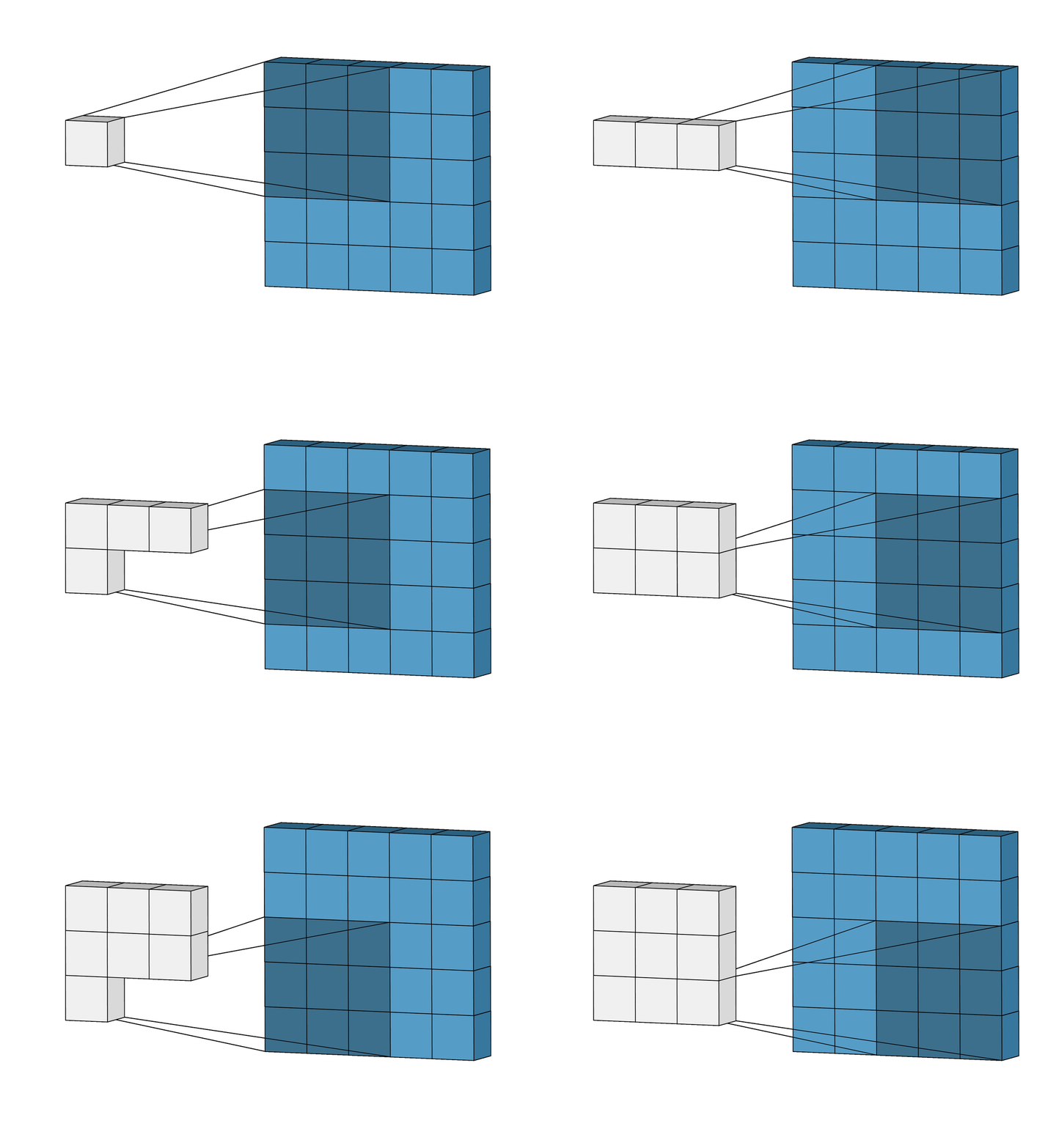

The advent of powerful and versatile deep learning frameworks in recent years has made it possible to implement convolution layers into a deep learning model an extremely simple task, often achievable in a single line of code. However, understanding convolutions, especially for the first time can often feel a bit unnerving, with terms like kernels, filters, channels and so on all stacked onto each other. Yet, convolutions as a concept are fascinatingly powerful and highly extensible, and in this post, we’ll break down the mechanics of the convolution operation, step-by-step, relate it to the standard fully connected network, and explore just how they build up a strong visual hierarchy, making them powerful feature extractors for images. The 2D convolution is a fairly simple operation at heart: you start with a kernel, which is simply a small matrix of weights. This kernel “slides” over the 2D input data, performing an elementwise multiplication with the part of the input it is currently on, and then summing up the results into a single output pixel.


Windows Server 2019 embraces SDN

windows server 2019
The new virtual networking peering functionality in Windows Server 2019 allows enterprises to peer their own virtual networks in the same cloud region through the backbone network. This provides the ability for virtual networks to appear as a single network. Fundamental stretched networks have been around for years and have provided organizations the ability to put server, application and database nodes in different sites. However, the challenge has always been the IP addressing of the nodes in opposing sites. When there are only two static sites in a traditional wide area network, the IP scheme was relatively static. You knew the subnet and addressing of Site A and Site B. However, in the public cloud and multi-cloud world – where your target devices may actually shift between racks, cages, datacenters, regions or even hosting providers – having addresses that may change based on failover, maintenance, elasticity changes, or network changes creates a problem. Network administrators have already spent and will drastically increase the amount of time they spend addressing, readdressing, updating device tables, etc to keep up with the dynamic movement of systems.


Managing a hybrid cloud computing environment


Ensuring the security of physical edge networking connections and the connectivity of all communication is equally essential. This requires redundant networking components that utilize built-in failover capabilities. Finally, careful selection of the power infrastructure is vital to supporting all elements of edge computing. The ability to maintain power at all times via the use of backup power and integration of the remote monitoring of the power infrastructure into the customer’s management system are paramount. You can do this by seeking UPSs, rackmount power distribution units (PDUs) and power management software with remote capabilities. Being able to remotely reboot UPSs or PDUs can be extremely helpful in edge applications. In addition, solutions like Eaton’s Intelligent Power Manager software can enhance your disaster avoidance plan by allowing you to set power management alerts, configurations and action policies. By creating action policies for remediation, Eaton enables you to automate server power capping, load shedding and/or virtual machine migration should problems occur.


Quote for the day:


"Don't be buffaloed by experts and elites. Experts often possess more data than judgement." -- Colin Powell


August 02, 2014

How one judge single-handedly killed trust in the US technology industry
The ruling on Thursday follows from an earlier lower court, in which U.S. Magistrate Judge James Francis in New York ruled that a search warrant can be applied outside the country. The theory was that because Microsoft, named in this case, owned and controlled a foreign subsidiary company based in Dublin, Ireland, any data stored in its overseas offices or datacenters still fell within US territory — albeit loosely. The official channels between countries that allow cross-border law enforcement operations to work, called mutual legal assistance treaties (MLAT), are "generally... slow and laborious," Francis said in his ruling. He added that the "burden" on the US government to work with other nations would be "seriously impeded."


Beyond Localization: Software for a Global Audience
This article is about going beyond localization and delivering software to a truly global audience. Most developers think this can be accomplished simply by translating and localizing the text, but this is not true. This article does not contain source code and is not about the technical aspect of localizing your software. Rather it is about the process and how to prepare your team and software for the necessary changes. Globalizing your software includes adapting for language, dialect, customs, cultural issues, monetary issues, times, dates, formatting, and measurement standards.


Six reasons why cloud computing will transform the way banks serve clients
The EC is also waking up to the possibilities. In a recent policy paper, the EC’s European Cloud Partnership spelt out the need to tackle issues around data, privacy security and legal differences across national boundaries. Its vision is to create a secure environment in which private and public sector organisations can use, buy and sell cloud services. All this momentum is building at a time when banks are under increasing pressure to use their IT budgets more efficiently, while competition from non-bank payments providers is much tougher and the need to serve clients better is becoming more acute. But it is not a technological Valhalla – there are disadvantages too.


Is Silicon Valley’s Image Going Up in Flames?
In a July 28 blog post, Rudder admitted that OkCupid experimented by, at times, removing user pictures or profile texts, and indicating a good match or bad match even though the algorithm showed the opposite. The goal apparently was to find out how much importance is being placed on a user's picture, the power of suggestion, and how effective OkCupid's matching engine works. Ethical questions about secret experimentation be damned. "We noticed recently that people didn’t like it when Facebook 'experimented' with their news feed," writes Rudder in a blog post,


Meet the Engineer: Sravya Tirukkovalur
As Cloudera rightly says in one sentence: It lets you “ask bigger questions”. If you think about how much data we produce every day versus how much we actually process, it is astonishing to imagine how many ways the world could benefit if we had the software capabilities to easily store, process, measure, and learn from all of it. And with more and more new datasets becoming available daily, it is very important for the software to evolve rapidly in terms of scale, performance, usability, and security. I think this rapidity of software development in the Hadoop ecosystem is only possible because of the open source community, and I am very glad to be a part of that community as well as working with the leader, Cloudera.


How to Make Your Department More Data-Friendly
Of course, most organizations or businesses aim to be data-driven. In reality, though, decision-makers aren't the ones primarily using the data. They are instead at the receiving end, where the effectiveness of a data-driven strategy is polished into pretty presentations.  We're not here to focus on them. Instead, we're here to focus on the pieces of the business using the data on a day-to-day basis to not only do their jobs better but also do them more effectively. And we're here for them to provide something rarely seen when it comes to big data productivity: a game plan.  See, there's a simple way to get started and make your department more data-driven in the process, and it begins with these five steps.


Cloudify Aims To Automate Cloud Troubleshooting
Cloudify has the potential to erase the border between monitoring and orchestration. The new version of Cloudify provides a feedback loop from the monitoring engine to the orchestration engine. When it spots performance falling below expected thresholds, it can notify the orchestration engine, which can "react to monitored events with appropriate corrective measures." While the capability is now part of a re-designed product, it remains to be fleshed out with policies that will provide the guidance for non-manual, automated corrective actions, says Shalom. They are due in the fourth quarter, according to the announcement.


We don’t do that here
Taking a Big Bang approach to becoming FIT is just as foolish as taking a Big Bang approach to delivering large projects. There is far too much risk to go that way. Think of making these changes like the way an airplane’s autopilot works. Trying to hit the runway in Hawaii based on calculations made once in LA is impossible. Not virtually possible but not probable, it is impossible. Not only is there the need for extreme accuracy that would be required if you only take one reading, but there are all the variables of wind speed, direction, atmospheric pressure and others. With all these variables it is impossible to set course once. That is not how autopilot works. The auto pilot systems on airplanes are constantly taking readings against their destination and making small course corrections.


DDoS Attacks Are Still Happening — and Getting Bigger
This is partly because banks have invested in better DDoS mitigation technology and services, observers say. Another factor is that banks are being targeted less frequently — only about 10% of incidents. Gaming, technology and media companies have become more popular targets. But attacks are still being launched against banks and other companies, and with greater force than ever, according to large information security providers such as Prolexic (which is now owned by Akamai), Verizon and Verisign. The three companies recently issued reports that shed light on the changing nature of DDoS attacks.


Ynote Classic - Text and Source Code Editor
The first ynote version consisted of nothing, just a TextBoxcontrol and some basic commands - Cut, Copy, etc. Then I saw the FastColoredTextBox control. TheFastColoredTextBox control was first included in v2.0, supporting only 5 languages. Now, it has just everything a perfect code editor can have. Another reason was to know the capabilities of .NET because I didn't find any decent Text Editor written using the .NET Platform (not including C++) So I mae "Ynote Classic" - The Text Editor, coded with .NET.


Quote for the day:

"Leadership and learning are indispensable to each other." -- John F. Kennedy

July 25, 2014

Super-Dense Computer Memory
Like flash memory, RRAM can store data without a constant supply of power. Whereas flash memory stores bits of information in the form of charge in transistors, RRAM stores bits using resistance. Each bit requires less space, increasing the amount of information that can be stored in a given area.  What’s more, it should be easier to stack up layers of RRAM, helping to further increase the amount of information that can be packed onto a single chip. RRAM can also operate a hundred times faster than flash. Some prototypes can store data densely enough to enable a terabyte chip the size of a postage stamp.


The internet is a politically and culturally loaded tool, particularly when it comes to censorship
Two different situations — the deletion of certain search links in Europe, and Vladimir Putin’s setting-up of the Russian internet for further censorship — have elements in common that cannot be denied. Yet I see the former as acceptable in theory and the latter as unacceptable in both theory and practice, and as such I view the nature of the internet differently in either case. It’s the same internet, of course, and therein lies the quandary. That quandary ultimately comes down to the ability of countries and regions to maintain their own characters and social systems in the context of a network that is, like it or not, steeped in a specific set of values.


Amazon CTO talks IoT in science, retail and on the playing fields
Armed with data points, Vogels rattled off a list of examples of how the Internet of Things (IoT) is already changing how Amazon does business -- and it's a list that extends well beyond Amazon drones. Amazon Dash is a new connected device that Vogels calls "a magic wand." For those enrolled in its grocery delivery service, customers can either speak into the wand or use it as a barcode scanner to reorder supplies. Dash streams the information into a virtual basket, and customers can check out online or via a smartphone app. Vogels' bigger point, however, was that the IoT is making inroads at many companies, not just at Amazon. Here is his rundown of how the IoT is already making an impact.


SoundLoc: Acoustic Method for Indoor Localization without Infrastructure
SoundLoc is a room-level localization system that exploits the intrinsic acoustic properties of individual rooms and obviates the needs for infrastructures. As we show in the study, rooms' acoustic properties can be characterized by Room Impulse Response (RIR). Nevertheless, obtaining precise RIRs is a time-consuming and expensive process. The main contributions of our work are the following. First, a cost-effective RIR measurement system is implemented and the Noise Adaptive Extraction of Reverberation (NAER) algorithm is developed to estimate room acoustic parameters in noisy conditions. Second, a comprehensive physical and statistical analysis of features extracted from RIRs is performed.


The ‘flexible & inclusive’ BYOD dream
BYOD evangelists talk about the importance of creating a “vendor neutral applications portfolio” with a future-proof architecture and rightly so. Let us remember that BYOD itself (as a phenomenon no less) is brought about (very often) by the fact that IT has not provided an adequate level of applications and/or device functionality to workers, so they will find their own preferred means of computing — and this often means BYOA (Bring Your Own Application) also comes into the mix. Intel reminds us that a decade ago, Wi-Fi was considered a new, disruptive technology… but today, it has become the computing norm. Consumerization and BYOD usage is on a comparable path.


How Internal Entrepreneurs Can Deal with Friendly Fire
Our first bit of advice for those of you in this situation is: persist. Your internal situation is not that different from the external entrepreneur who must “befriend” her market—thinking of it as a treasured counselor teaching her about current reality—and never treat it as an adversary. True, this is difficult, but it is nonetheless required. You must change your mindset about opposition—from foe to friend—and then work hard to maintain it. You will never succeed if you view your organization and your colleagues as enemies. All of this is just as true for your perception of your boss; perhaps more so.


Security must evolve to be 'all about the data'
That model, which, "relies on the program to identify the person and what is the operation," is now obsolete, he said. "Data are everywhere, on the device, in the cloud, moving around. You can't find all the places that are moving it around, so data need to be self-protecting. And existing apps are not coded that way." Changing that model, said Patrick Sweeney, executive director at Dell SonicWALL, would, "solve the BYOD problem." Instead of focusing on a device or a user, it would be, "only about the data -- not about the device, not about the network. You need to protect it, own it, revoke it." To do that in the next five years, he said, would require three things: "First, encrypt it with enterprise key management.


Zero-day broker exploits vulnerability in I2P to de-anonymize Tails users
Although Exodus sells zero-days, CEO Aaron Portnoy said he would provide the information to Tails so the flaws could be fixed. It’s not quite clear if the vulnerability broker’s decision was for the greater good or due to backlash from the security community. The zero-day is in the Invisible Internet Project, or I2P, networking component that comes bundled with Tails to encrypt web traffic and hide a user’s real IP address. The 30,000 I2P users who previously felt anonymous could be unmasked, their true IP address revealed, by visiting a booby-trapped website.


When it comes to Android vs. iOS in the enterprise, Android is the Borg
iOS is incredibly limiting, sold on a very limited set of form-factor devices, and can't be modified with anywhere near the flexibility of Android. On top of that, no matter what form-factor/price you might need, there's an Android device to fill that need. Not nearly as much with a few iPads and an iPhone. A great example of the flexibility available to Android comes out of an an interview I did with Dell almost two years ago where we discussed how they'd built a military-hardened kernel in Android for devices on the battlefield.


Seven Changes to Remove Waste From Your Software Development Process
Implementing User Stories has proved to be very challenging, most importantly with the software engineers as it has completely changed their perspective on their daily work. To succeed with implementations the following has been critical: Train people to User Stories; Coach functional analysts to help them define the right user stories; and Initiate functional analysis sessions for all roles (development, tests, UX) to contribute in User Story design and make it Ready To Develop. There are some technical areas where User Story design is not easy. In that case we have challenged the software engineers to see if it was possible for them to reframe their thinking and integrate technical solutions into User Stories, from the user perspective.


Quote for the day:

"An overburdened executive is the best executive, because he or she doesn't have the time to meddle" -- Jack Welch

August 21, 2012

Implementation options for Android ads in code or layouts
You can choose to set up the ad request in the layout files (XML), or you can implement the ads entirely in code. Each has advantages and disadvantages, so it might be appropriate to use one or the other in different situations.

India backtracks on domestic networking tech rule
The revised draft, which was completed on Aug. 3, was then updated to say India will "progressively develop indigenous capacity to manufacture electronic telecom equipment and software [to be] inducted into the network

HTC Signals Focus on Business Market with Investment in Enterprise App Provider
HTC announced the investment on Monday in a Taiwan Stock Exchange filing, stating that the company was buying a 17.1 percent stake in the Silicon Valley-based Magnet Systems. "The investment will bring social, mobile, and cloud capabilities to HTC's portfolio of service offerings to its mobile enterprise customers," HTC said in its filing.

20 Must See CSS3 and jQuery Tutorials
Although, HTML5 will not be fully implanted until 2014 , many web designers/developers, companies and web enthusiasts are using HTML5 and CSS3 in their products and apps. In this post we are sharing 20 recent web design tutorials that explore the true potential of HTML5, CSS3 and with a mix of good old jQuery.

NetApp adds Flash server caching, forges Fusion-io partnership
According to Paul Feresten, senior product marketing manager of NetApp's intelligent caching products, the company's strategy is to bring end-to-end caching including server-level Flash. Moving to the server, NetApp argues that it can provide better performance and granularity to requirements and serve databases.

Compuverde pitches object storage at cloud, big data
The company's Linux-based gateway works as a network attached storage (NAS) head to expose CIFS, NFS, Cloud Data Management Interface (CDMI) and open source OpenStackinterfaces to the object storage software. The gateway can also host virtual machines (VMs) and cache data on solid-state drives and NVRAM.

Preparing your teams for software defined networking
SDN provides the means to automate networks to better support different workloads, but I&O professionals also need to understand how SDN can support turning networks into a virtual network infrastructure.


Two news items from the tech startup ecosystem broke through the clutter of politics, cricket, Bollywood, and more politics news in India earlier this month. The first was good. The second was just grim.

Communicating Cybersecurity Risk to Business Leaders
Communicating  cybersecurity risk effectively to business leaders depends on your ability to answer the question  "How much risk do we have?" with a credible financial metric familiar to risk management decision makers. Here is a webinar on the topic.

Automaticly localizing applications with Google Translate
Google does offer a web service that provides that ability to programmaticly translate strings, however this does require a purchase of a license where this application allows for the use of the web site for free.

Oracle pays $2 million SEC fine to settle India corruption case
The Securities and Exchange Commission charged Oracle under the Foreign Corrupt Practices act for failing to keep its India subsidiary from creating a slush fund used to pay phony vendors.


Quote for the day:

"The excitement of learning separates youth from old age. As long as you're learning you're not old." - Rosalyn S. Yalow