Quote for the day:
"The organizations that succeed this year will be the ones that build confidence faster than AI can erode it." -- 2026 Data Governance Outlook
🎧 Listen to this digest on YouTube Music
▶ Play Audio DigestDuration: 17 mins • Perfect for listening on the go.
Google's 2029 Quantum Deadline Is a Wake-Up Call
 Google has issued a significant "wake-up call" to the technology industry by
accelerating its deadline for transitioning to post-quantum cryptography (PQC)
to 2029. This aggressive timeline positions the company well ahead of the 2035
target set by the National Institute for Standards and Technology (NIST) and
the 2031 requirement for national security systems. By moving faster, Google
aims to provide the necessary urgency for global digital transitions,
addressing critical vulnerabilities such as "harvest now, decrypt later"
attacks and the inherent fragility of current digital signatures. These
threats involve adversaries collecting encrypted sensitive data today with the
intention of unlocking it once cryptographically relevant quantum computers
become available. Furthermore, the 2029 deadline aligns with industry shifts
to reduce public TLS certificate validity to 47 days, emphasizing a broader
move toward cryptographic agility. Experts suggest that because Google is a
foundational component of many corporate technology stacks, its early
migration forces dependent organizations to upgrade and test their systems
sooner. Enterprise leaders are advised to immediately inventory their
cryptographic assets, prioritize high-risk data, and collaborate with vendors
to ensure their infrastructure can support rapid, automated algorithm
rotations. The message is clear: the journey to quantum readiness is lengthy,
and waiting until the next decade to act may be too late.
Google has issued a significant "wake-up call" to the technology industry by
accelerating its deadline for transitioning to post-quantum cryptography (PQC)
to 2029. This aggressive timeline positions the company well ahead of the 2035
target set by the National Institute for Standards and Technology (NIST) and
the 2031 requirement for national security systems. By moving faster, Google
aims to provide the necessary urgency for global digital transitions,
addressing critical vulnerabilities such as "harvest now, decrypt later"
attacks and the inherent fragility of current digital signatures. These
threats involve adversaries collecting encrypted sensitive data today with the
intention of unlocking it once cryptographically relevant quantum computers
become available. Furthermore, the 2029 deadline aligns with industry shifts
to reduce public TLS certificate validity to 47 days, emphasizing a broader
move toward cryptographic agility. Experts suggest that because Google is a
foundational component of many corporate technology stacks, its early
migration forces dependent organizations to upgrade and test their systems
sooner. Enterprise leaders are advised to immediately inventory their
cryptographic assets, prioritize high-risk data, and collaborate with vendors
to ensure their infrastructure can support rapid, automated algorithm
rotations. The message is clear: the journey to quantum readiness is lengthy,
and waiting until the next decade to act may be too late.The one-model trap: Why agentic AI won’t scale in production
 In "The One-Model Trap," Jofia Jose Prakash explains that relying on a single
monolithic AI model is a strategic error that prevents agentic AI from scaling
in production. While the "one-model" approach seems simpler to manage, it
fails to account for the high variance in real-world workloads. Using
high-capability models for routine tasks leads to excessive costs and latency,
while the lack of isolation boundaries makes the entire system vulnerable to
model outages and policy shifts. To build resilient agents, organizations must
transition from a prompt-centric view to a system-centric architectural
approach. This involves a multi-model strategy featuring "capability tiering,"
where tasks are routed based on complexity to fast-cheap, balanced, or premium
reasoning tiers. Such an architecture allows for graceful degradation and
easier governance, as policy updates become control-plane adjustments rather
than complete system overhauls. Prakash outlines five critical stages for
scalability: separating control from generation, implementing failure-aware
execution with circuit breakers, and enforcing strict economic controls like
token budgets. Ultimately, the author concludes that successful agentic AI is
a control-plane challenge rather than a model-choice problem. By prioritizing
orchestration and robust monitoring over model standardization, enterprises
can achieve the reliability and cost-efficiency necessary for production-grade
AI.
In "The One-Model Trap," Jofia Jose Prakash explains that relying on a single
monolithic AI model is a strategic error that prevents agentic AI from scaling
in production. While the "one-model" approach seems simpler to manage, it
fails to account for the high variance in real-world workloads. Using
high-capability models for routine tasks leads to excessive costs and latency,
while the lack of isolation boundaries makes the entire system vulnerable to
model outages and policy shifts. To build resilient agents, organizations must
transition from a prompt-centric view to a system-centric architectural
approach. This involves a multi-model strategy featuring "capability tiering,"
where tasks are routed based on complexity to fast-cheap, balanced, or premium
reasoning tiers. Such an architecture allows for graceful degradation and
easier governance, as policy updates become control-plane adjustments rather
than complete system overhauls. Prakash outlines five critical stages for
scalability: separating control from generation, implementing failure-aware
execution with circuit breakers, and enforcing strict economic controls like
token budgets. Ultimately, the author concludes that successful agentic AI is
a control-plane challenge rather than a model-choice problem. By prioritizing
orchestration and robust monitoring over model standardization, enterprises
can achieve the reliability and cost-efficiency necessary for production-grade
AI.Are You Overburdening Your Most Engaged Employees?
The Harvard Business Review article, "Are You Overburdening Your Most Engaged
Employees?" by Sangah Bae and Kaitlin Woolley, explores a critical paradox in
workforce management. While senior leaders invest heavily in fostering
employee engagement, new research involving over 4,300 participants reveals
that managers often inadvertently undermine these efforts. When unexpected
tasks arise, managers tend to assign approximately 70% of this additional
workload to their most intrinsically motivated staff. This systematic bias
stems from two flawed assumptions: that highly engaged employees find extra
work inherently rewarding and that they possess a unique resilience against
burnout. In reality, both beliefs are incorrect. This disproportionate burden
significantly reduces job satisfaction and heightens turnover intentions among
the very individuals organizations are most desperate to retain. By
over-relying on "star" performers to handle unforeseen demands, companies risk
depleting their most valuable human capital through an unintended "engagement
tax." To combat this, the authors propose three low-cost interventions aimed
at promoting more equitable work distribution. Ultimately, the research
highlights the necessity for leaders to move beyond convenience-based task
allocation and adopt strategic practices that protect their most dedicated
employees from exhaustion, ensuring that high engagement remains a sustainable
asset rather than a precursor to professional burnout.
 The article "When AI turns software development inside-out" explores a
transformative shift in engineering productivity where a team achieved 170%
throughput while operating at 80% of its previous headcount. This transition
marks a fundamental departure from traditional "diamond-shaped"
development—where large teams execute designs—to a "double funnel" model. In
this new paradigm, humans focus intensely on the beginning stages of defining
intent and the final stages of validating outcomes, while AI handles the rapid
execution in between. The shift has collapsed the cost of experimentation,
enabling ideas to move from whiteboards to working prototypes in a single day.
Consequently, roles are being redefined: creative directors maintain
production code, and QA engineers have evolved into system architects who
build AI agents to ensure correctness. This "inside-out" approach prioritizes
validation over manual coding, treating software development as a control
tower operation rather than an assembly line. By automating the middle layer
of implementation, the organization has not only increased its velocity but
also improved product quality and reduced bugs. Ultimately, AI-first workflows
allow teams to focus on defining "good" while leveraging technology to handle
the heavy lifting of execution and technical translation across dozens of
programming languages.
The article "When AI turns software development inside-out" explores a
transformative shift in engineering productivity where a team achieved 170%
throughput while operating at 80% of its previous headcount. This transition
marks a fundamental departure from traditional "diamond-shaped"
development—where large teams execute designs—to a "double funnel" model. In
this new paradigm, humans focus intensely on the beginning stages of defining
intent and the final stages of validating outcomes, while AI handles the rapid
execution in between. The shift has collapsed the cost of experimentation,
enabling ideas to move from whiteboards to working prototypes in a single day.
Consequently, roles are being redefined: creative directors maintain
production code, and QA engineers have evolved into system architects who
build AI agents to ensure correctness. This "inside-out" approach prioritizes
validation over manual coding, treating software development as a control
tower operation rather than an assembly line. By automating the middle layer
of implementation, the organization has not only increased its velocity but
also improved product quality and reduced bugs. Ultimately, AI-first workflows
allow teams to focus on defining "good" while leveraging technology to handle
the heavy lifting of execution and technical translation across dozens of
programming languages.
When AI turns software development inside-out: 170% throughput at 80% headcount
The article "When AI turns software development inside-out" explores a
transformative shift in engineering productivity where a team achieved 170%
throughput while operating at 80% of its previous headcount. This transition
marks a fundamental departure from traditional "diamond-shaped"
development—where large teams execute designs—to a "double funnel" model. In
this new paradigm, humans focus intensely on the beginning stages of defining
intent and the final stages of validating outcomes, while AI handles the rapid
execution in between. The shift has collapsed the cost of experimentation,
enabling ideas to move from whiteboards to working prototypes in a single day.
Consequently, roles are being redefined: creative directors maintain
production code, and QA engineers have evolved into system architects who
build AI agents to ensure correctness. This "inside-out" approach prioritizes
validation over manual coding, treating software development as a control
tower operation rather than an assembly line. By automating the middle layer
of implementation, the organization has not only increased its velocity but
also improved product quality and reduced bugs. Ultimately, AI-first workflows
allow teams to focus on defining "good" while leveraging technology to handle
the heavy lifting of execution and technical translation across dozens of
programming languages.4 Out of 5 Organizations Are Drowning in Security Debt
The Veracode 2026 State of Software Security Report reveals that approximately 82% of organizations are currently overwhelmed by significant security debt, representing a concerning 11% increase from the previous year. Alarmingly, 60% of these entities face "critical" debt levels characterized by severe, long-unresolved vulnerabilities that could cause catastrophic damage if exploited by malicious actors. The study identifies a widening gap between the rapid, modern pace of software development and the capacity of security teams to manage remediation, noting a 36% spike in high-risk flaws. Several factors exacerbate this trend, including the unprecedented velocity of AI-generated code and a heavy reliance on complex third-party libraries, which account for 66% of the most dangerous long-lived vulnerabilities. To combat this escalating crisis, the report suggests moving beyond simple detection toward a comprehensive and strategic "Prioritize, Protect, and Prove" (P3) framework. By focusing resources specifically on the 11.3% of flaws that present genuine real-world danger and utilizing automated remediation for critical digital assets, enterprises can manage their debt more effectively. Ultimately, the report emphasizes that success in today's digital landscape requires a deliberate shift toward risk-based prioritization and rigorous compliance to stem the tide of vulnerabilities and safeguard essential infrastructure.The agentic AI gap: Vendors sprint, enterprises crawl
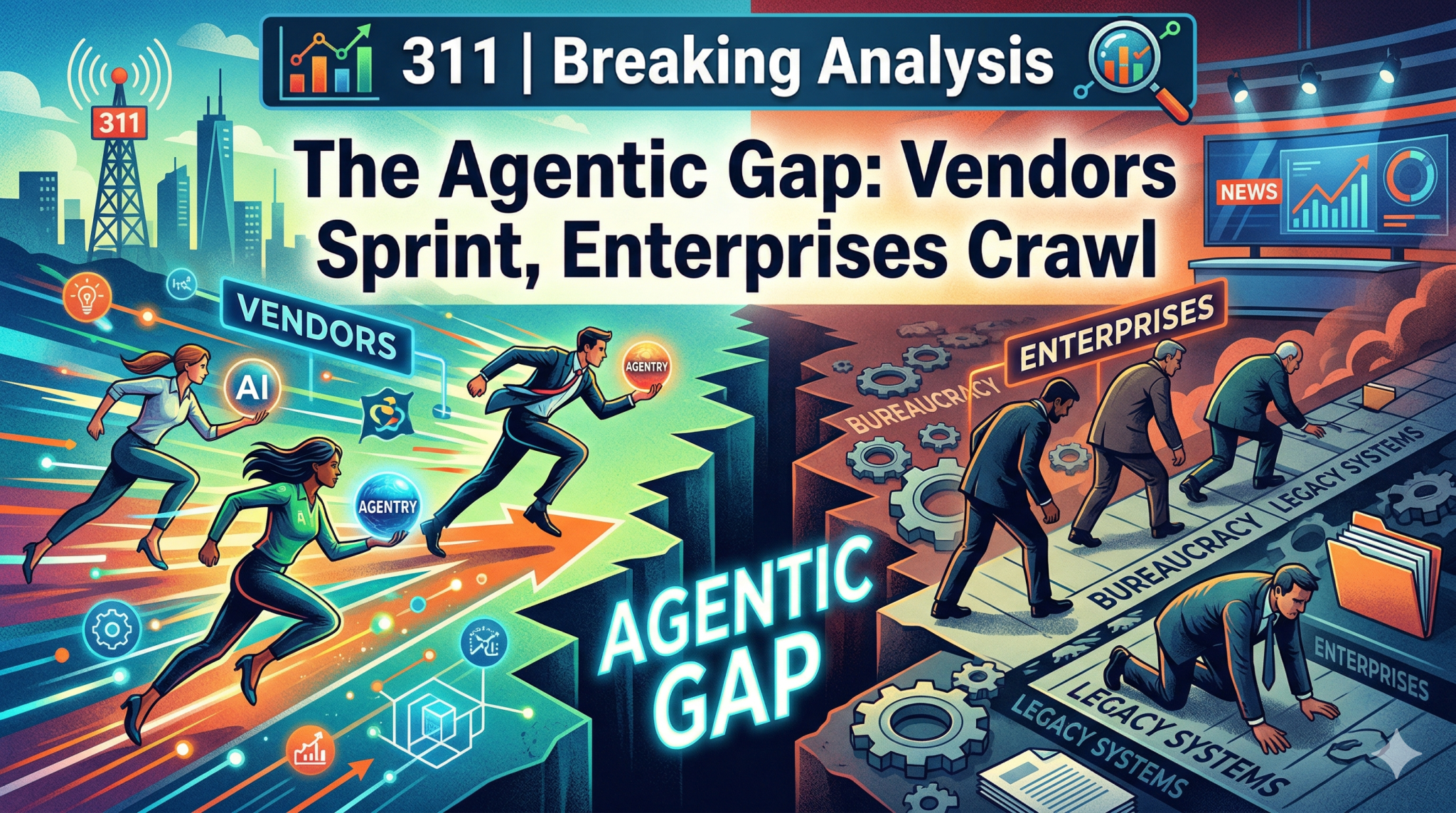 The "agentic AI gap" highlights a stark disconnect between the rapid innovation
of tech vendors and the cautious, often sluggish adoption of artificial
intelligence within mainstream enterprises. While vendors are "sprinting" toward
sophisticated agentic workflows and reasoning capabilities, most organizations
are still "crawling," primarily focused on basic productivity gains and
early-stage pilots. This hesitation is fueled by a combination of macroeconomic
uncertainty—such as geopolitical tensions and fluctuating interest rates—and a
lack of operational readiness. Currently, only about 13% of enterprises report
achieving sustained ROI at scale, as hurdles like data governance, security, and
integration remain significant barriers. The article suggests that a new
four-layer software architecture is emerging, shifting the focus from
application-centric models to intelligence-centric systems. Central to this
transition is the "Cognitive Surface," a middle layer where intent is shaped and
enterprise policies are enforced. As the industry moves toward an economic model
based on tokenized intelligence, business leaders must evolve their operational
strategies to manage digital agents effectively. Ultimately, bridging this gap
requires more than just better technology; it demands a fundamental
transformation in how enterprises secure, govern, and value AI to turn
experimental pilots into scalable, revenue-generating business assets.
The "agentic AI gap" highlights a stark disconnect between the rapid innovation
of tech vendors and the cautious, often sluggish adoption of artificial
intelligence within mainstream enterprises. While vendors are "sprinting" toward
sophisticated agentic workflows and reasoning capabilities, most organizations
are still "crawling," primarily focused on basic productivity gains and
early-stage pilots. This hesitation is fueled by a combination of macroeconomic
uncertainty—such as geopolitical tensions and fluctuating interest rates—and a
lack of operational readiness. Currently, only about 13% of enterprises report
achieving sustained ROI at scale, as hurdles like data governance, security, and
integration remain significant barriers. The article suggests that a new
four-layer software architecture is emerging, shifting the focus from
application-centric models to intelligence-centric systems. Central to this
transition is the "Cognitive Surface," a middle layer where intent is shaped and
enterprise policies are enforced. As the industry moves toward an economic model
based on tokenized intelligence, business leaders must evolve their operational
strategies to manage digital agents effectively. Ultimately, bridging this gap
requires more than just better technology; it demands a fundamental
transformation in how enterprises secure, govern, and value AI to turn
experimental pilots into scalable, revenue-generating business assets.
India’s Proposal for Age-verification Is a Blunt Response to a Complex Problem
 India’s Digital Personal Data Protection Act of 2023 and subsequent regulatory
proposals introduce a stringent age-verification framework, mandating
"verifiable parental consent" for users under eighteen. This article by Amber
Sinha argues that such measures constitute a "blunt response" to the
multifaceted challenges of online child safety, potentially compromising privacy
and fundamental digital rights. By shifting toward a graded approach that
includes screen-time caps and "curfews," the government risks creating massive
"honeypots" of sensitive identification data—often tied to the Aadhaar biometric
system—thereby enabling state surveillance and increasing vulnerability to data
breaches. Furthermore, the reliance on official documentation and repeated
parental consent threatens to deepen the gender digital divide; in many South
Asian households, these barriers may lead families to restrict girls' access to
shared devices entirely. Critics emphasize that these rigid mandates often drive
minors toward riskier, unregulated corners of the internet while stifling their
constitutional right to information. Rather than imposing a universal,
one-size-fits-all age-gating mechanism, the author advocates for a more nuanced
strategy. This alternative would prioritize "privacy by design" and leverage
advanced cryptographic techniques like Zero-Knowledge Proofs to verify age
without compromising user anonymity, ultimately focusing on safety through
empowerment rather than through restrictive control and pervasive data
collection.
India’s Digital Personal Data Protection Act of 2023 and subsequent regulatory
proposals introduce a stringent age-verification framework, mandating
"verifiable parental consent" for users under eighteen. This article by Amber
Sinha argues that such measures constitute a "blunt response" to the
multifaceted challenges of online child safety, potentially compromising privacy
and fundamental digital rights. By shifting toward a graded approach that
includes screen-time caps and "curfews," the government risks creating massive
"honeypots" of sensitive identification data—often tied to the Aadhaar biometric
system—thereby enabling state surveillance and increasing vulnerability to data
breaches. Furthermore, the reliance on official documentation and repeated
parental consent threatens to deepen the gender digital divide; in many South
Asian households, these barriers may lead families to restrict girls' access to
shared devices entirely. Critics emphasize that these rigid mandates often drive
minors toward riskier, unregulated corners of the internet while stifling their
constitutional right to information. Rather than imposing a universal,
one-size-fits-all age-gating mechanism, the author advocates for a more nuanced
strategy. This alternative would prioritize "privacy by design" and leverage
advanced cryptographic techniques like Zero-Knowledge Proofs to verify age
without compromising user anonymity, ultimately focusing on safety through
empowerment rather than through restrictive control and pervasive data
collection.
The Danger of Treating CyberCrime as War – The New National Cybersecurity Strategy
The article "The Danger of Treating CyberCrime as War – The New National Cybersecurity Strategy," published in March 2026, analyzes the fundamental shift in U.S. cybersecurity policy following the release of the "Cyber Strategy for America." This new approach moves away from traditional regulatory compliance and defensive engineering, instead prioritizing a posture of active disruption and the projection of national power. By treating cybersecurity as a contest against adversaries, the strategy leverages law enforcement, intelligence, and sanctions to impose significant costs on bad actors. However, the author warns that this "war-like" framing may be misaligned with the reality of most digital threats. While nation-states might respond to traditional deterrence, the vast majority of cyber harm is caused by economically motivated criminals—such as ransomware operators and fraudsters—who are highly elastic and adaptive. These actors often respond to increased pressure by evolving their tactics or shifting jurisdictions rather than ceasing operations. Consequently, the article suggests that over-emphasizing state-level power risks neglecting the underlying economic drivers of cybercrime. Ultimately, a successful strategy must balance the pursuit of geopolitical adversaries with the practical need to secure the private sector’s daily operations against profit-driven threats.The AI Leader
 In "The AI Leader," Tomas Chamorro-Premuzic explores the profound transformation
of the professional landscape as artificial intelligence reaches parity with
human cognitive capabilities. He argues that while AI has commoditized technical
expertise and routine management—such as data processing and tactical
execution—it has simultaneously increased the "leadership premium" on uniquely
human qualities. As the distinction between human and machine intelligence
blurs, the author posits that the essence of leadership must shift from
traditional authority and information control to the cultivation of empathy,
moral judgment, and a sense of purpose. Chamorro-Premuzic warns against the
temptation for executives to abdicate their decision-making responsibility to
algorithms, emphasizing that leadership is fundamentally a human-centric
endeavor centered on motivation and cultural alignment. He suggests that the
modern leader’s primary role is to serve as a filter for AI-generated noise,
using intuition to navigate ambiguity where data falls short. Ultimately, the
article concludes that the most successful organizations in the AI era will be
those led by individuals who leverage technology to enhance efficiency while
doubling down on the "soft" skills that foster trust and inspiration. In this
new paradigm, leadership is not about competing with AI but about mastering the
human elements that technology cannot replicate.
In "The AI Leader," Tomas Chamorro-Premuzic explores the profound transformation
of the professional landscape as artificial intelligence reaches parity with
human cognitive capabilities. He argues that while AI has commoditized technical
expertise and routine management—such as data processing and tactical
execution—it has simultaneously increased the "leadership premium" on uniquely
human qualities. As the distinction between human and machine intelligence
blurs, the author posits that the essence of leadership must shift from
traditional authority and information control to the cultivation of empathy,
moral judgment, and a sense of purpose. Chamorro-Premuzic warns against the
temptation for executives to abdicate their decision-making responsibility to
algorithms, emphasizing that leadership is fundamentally a human-centric
endeavor centered on motivation and cultural alignment. He suggests that the
modern leader’s primary role is to serve as a filter for AI-generated noise,
using intuition to navigate ambiguity where data falls short. Ultimately, the
article concludes that the most successful organizations in the AI era will be
those led by individuals who leverage technology to enhance efficiency while
doubling down on the "soft" skills that foster trust and inspiration. In this
new paradigm, leadership is not about competing with AI but about mastering the
human elements that technology cannot replicate.


No comments:
Post a Comment