Showing posts with label scalability. Show all posts

Daily Tech Digest - August 17, 2026


Quote for the day:

"Listen with curiosity, speak with honesty act with integrity." -- Roy Bennett

🎧 Listen to the audio debrief on YouTube

▶ Play Audio Digest

Duration: 20 mins • Perfect for listening on the go.


How to level up from IT management to IT leadership

Transitioning from a mid-level technical management position to a senior executive role requires a deliberate shift in focus from mastering technology to mastering human connections and business operations. Aspiring leaders must build upon their foundational knowledge by developing essential communication habits, such as empathy, active listening, and the ability to build trust across different departments. Successfully navigating this career path involves taking on significant projects, learning from the inevitable missteps, and seeking out experienced mentors who can provide honest feedback. It is crucial to understand the broader goals of the organization and how technology can practically support those objectives. This means stepping away from the desk to learn about budgeting, risk management, and the daily challenges faced by other teams. True leadership is not defined by a specific title, but by the capacity to align people around a shared vision and empower them to succeed. Rather than simply executing technical tasks, effective leaders focus on mentoring their teams, translating complex concepts into plain language for non-technical coworkers, and making thoughtful decisions that deliver measurable value. Ultimately, ascending to the executive level is about solving company-wide problems with calm confidence and a steady collaborative mindset.


Why IoT systems fail at scale – and why Edge vs Cloud is the wrong debate

Internet of Things systems often struggle to scale, but the root cause is rarely the technology itself. Instead, failures usually stem from fragmented design. When teams develop hardware, software, connectivity, and security in isolation, the gaps between these components become major hurdles once the system moves into production. The ongoing debate pitting edge computing against the cloud misses the point. In practice, successful systems rely on both. The real challenge lies in deciding how they work together—specifically, figuring out which data should be processed locally for quick, time-sensitive tasks and which should be sent to the cloud for long-term analysis. This need for unified design is becoming even more obvious as artificial intelligence enters the picture. AI requires clear, reliable data pipelines. If a system's architecture is disjointed, having massive amounts of data won't help much. To build systems that last, developers need to shift from component-level thinking to holistic system design. This means planning data flow, security protocols, and long-term maintenance strategies from the very beginning. Treating features like security or software updates as add-ons only creates expensive problems later. By building a cohesive architecture from day one, organizations can create reliable systems that easily adapt and grow over time.


The new audit equation puts AI to work and judgement at the centre

In a recent interview, Atul Deshmukh of the accounting firm KNAV discusses how artificial intelligence is transforming the auditing profession from the ground up. Central to this shift is the transition from traditional statistical sampling to the comprehensive analysis of entire data sets. By deploying AI platforms, firms can automate repetitive and time-consuming tasks like document extraction and transaction matching. These digital workers drastically compress the time required for routine procedures, turning tasks that once took a full day into minutes. This efficiency is fundamentally altering the traditional accounting firm structure. The classic pyramid model, which relied heavily on junior staff for groundwork, is evolving into a diamond shape that demands analytical thinking and diverse backgrounds, including engineering. Furthermore, the massive time savings challenge the industry's conventional billable-hour model, paving the way for pricing based on value, complexity, and outcomes. Despite AI taking on larger segments of the workflow and even moving toward autonomous processes, human judgment remains the irreplaceable core of auditing. Auditors are not being replaced; their roles are shifting from manual verification to higher-level review and critical decision-making. Ultimately, AI handles the heavy lifting, allowing human professionals to focus their time on complex analysis and valuable insights.


What the CISO role will look like in 2029

By 2029, the role of the Chief Information Security Officer will shift away from being a purely technical position focused on building network defenses. Instead, security leaders will take on broader responsibilities as business strategists and risk managers. As technology cycles shorten and artificial intelligence accelerates the pace of both innovation and cyber threats, the old approach of simply saying no to all new ideas will no longer work. Tomorrow’s security executives will be expected to help their organizations take smart, calculated risks. Rather than managing security tools in isolation, future leaders will act as organizational orchestrators. They will connect engineering, legal, product, and executive teams to build systems that can identify and reduce risks almost instantly. Because threats are moving faster, organizations will rely on resilient engineering and automated decision-making processes to maintain safety. Some experts predict that the position will even expand to cover overall enterprise risk, potentially changing titles to emphasize trust and broader risk management. Despite these changes, the fundamental mission of the job remains steady. Security leaders will still need strong technical foundations, sound judgment, and clear communication skills to protect the entire business and help executives make informed choices in a rapidly changing world.


The Infrastructure Bottleneck That Keeps AI From Scaling Up

While many organizations focus entirely on choosing the right artificial intelligence models, the real challenge in making these systems work at a large scale lies in the underlying physical and technical foundational structures. According to Dilip Kumar of NTT DATA, practically all organizations find that their current networks, data storage, and security setups are slowing down their progress. Proving that an AI tool works in a small initial test is relatively simple, but running it reliably across an entire business is much harder. A common mistake is buying thousands of expensive software licenses without having the internal systems to actually use them. It is similar to buying a high-performance sports car but having no paved roads to drive it on. For AI to be truly useful, companies must ensure their networks can handle the data traffic and that their information is clean and organized. Instead of trying to transform an entire business at once, a smarter approach is to focus on a single, specific problem. By ensuring the foundation—the core networks, data organization, user identity, the appropriately sized model, and the daily operating procedures—is solid, businesses can prove the value of their investment quickly and then expand those efforts with complete confidence.


The Rise of Runtime Governance

In the article "The Rise of Runtime Governance," Christian Siegers argues that artificial intelligence forces a fundamental shift in how modern organizations manage system behavior. Historically, enterprise governance focused heavily on the implementation phase. Dedicated teams reviewed system architectures, assessed security measures, and validated strict compliance standards well before deployment. This approach was highly effective for traditional systems because their behavior was largely dictated by static code and predefined business rules. However, AI introduces a complex new dynamic where critical decisions actually occur during execution. Even if an AI system successfully passes all pre-deployment governance checks, its behavior can still drift due to changing context, model interactions, and new information retrieval. Consequently, companies may strictly follow governance processes without actually retaining control over the final operational outcomes. To bridge this gap, Siegers suggests that governance must evolve from a series of static checkpoints into a continuous architectural capability. This concept, known as runtime governance, requires embedding continuous system observability, active policy enforcement, and human oversight directly into the daily operational environment. By doing so, organizations can monitor what their systems are doing in real time, ensure all behavior remains within acceptable boundaries, and actively intervene when necessary. This ultimately maintains true control over AI-enabled operations long after the initial deployment.


Agentic Fitness Functions: Extending Evolutionary Architecture Beyond Deterministic Rules

Evolutionary software architecture relies on fitness functions—automated checks like dependency rules, performance budgets, and security scans—to ensure systems can change safely over time without degrading their core characteristics. While these deterministic rules are excellent for enforcing strict, measurable metrics, they often fall short when evaluating complex, judgment-heavy architectural concerns. For example, a basic schema check can confirm that an application programming interface still functions, but it cannot determine if a new field accidentally leaks user interface details into a core domain model. This is where agentic fitness functions come into play to fill the gap. By using artificial intelligence agents calibrated with past architectural decisions, ownership data, and clear rubrics, these functions can evaluate nuanced changes that defy simple yes-or-no rules. They are not meant to replace human architects or traditional automated tests. Instead, they act as an advisory layer that provides structured feedback, including confidence scores and clear reasoning, for changes that require context and human-like judgment. This approach helps teams maintain healthy system boundaries, catch semantic drift early, and ensure that architectural intent is preserved. Ultimately, agentic fitness functions make complex architectural decisions more transparent and auditable, allowing teams to confidently manage rapid software delivery and continuous system evolution.


From Agile to the Product Operating Model

Based on a recent survey of 48 practitioners, the transition from traditional development methods to a product operating model often changes company vocabulary and structure more than it changes how decisions are actually made. Among the respondents whose organizations are making this shift, most report that their teams still operate by building requested features rather than acting as fully empowered groups that decide how to solve problems. However, the survey does highlight some positive trends. Many participants notice improvements in the speed of delivery, the value provided to customers, and overall collaboration with stakeholders. On the other hand, business results remain largely inconclusive, likely because financial outcomes take longer to measure. One notable concern is the human element, as team morale and developer satisfaction appear to decline during these transitions. Additionally, the findings show that artificial intelligence adoption and structural operating changes are happening as separate efforts. While artificial intelligence is starting to influence how product decisions are made across many companies, this shift is occurring independently of formal organizational redesigns. Overall, the data suggests that while operational efficiency might improve, true changes in decision making authority and employee well being remain significant challenges for organizations attempting this transition today.


US cloud act, sovereignty, and why you might need to care

The article by Kate Carruthers discusses the crucial difference between data residency and true data sovereignty, emphasizing that physical location alone does not insulate data from foreign legal reach. Prompted by Airbus’s decision to move critical applications to a European provider, the piece highlights that the US CLOUD Act allows US authorities to compel American cloud providers to hand over data, regardless of whether that data is stored in Sydney, Frankfurt, or Dublin. This makes cloud hosting a matter of national security and governance, not just a technical or architectural choice. The author notes that Australia often mistakenly equates local data residency with sovereignty, creating a blind spot that leaves critical infrastructure vulnerable to geopolitical disputes or commercial shifts. Organizations are advised to map their vital dependencies and classify workloads based on the potential harm of disruption rather than blindly adopting a "cloud-first" strategy. Furthermore, companies should design systems for degraded operation, practice isolation techniques, and preserve clear exit options to ensure resilience. Ultimately, Carruthers argues that cloud computing has evolved into institutional and geopolitical infrastructure, requiring boards to make deliberate, strategic choices about where sensitive workloads sit and how much control they truly retain.


The cyber resilience divide

In today's digital landscape, security incidents are a routine reality, and companies can no longer rely solely on preventing attacks. A recent Fujitsu report explores the growing gap between organizations that successfully build strong defenses and those that remain vulnerable, particularly as artificial intelligence reshapes both security threats and defense strategies. While artificial intelligence helps criminals find weaknesses and automate attacks, it also provides companies with powerful tools to detect and respond to these threats early. The research identifies a clear division between leading organizations and those lagging behind. Leaders understand that security breaches are inevitable. Rather than focusing only on prevention, they prepare to maintain operations and recover quickly. They treat security as a shared priority that begins at the board level, balancing new technology adoption with careful oversight. By running practical simulations and using smart tools for defense, these leaders reduce the impact of incidents while building trust and supporting steady growth. In contrast, lagging organizations often rush to adopt new technologies without fully understanding the risks, leaving gaps in their defenses. To secure their futures, companies must accept that breaches will happen, embed security awareness into their daily routines, and focus on protecting their most important systems through practical testing.

Daily Tech Digest - July 21, 2026


Quote for the day:

“When something is important enough, you do it even if the odds are not in your favor.” -- Elon Musk

🎧 Listen to the audio debrief on YouTube

▶ Play Audio Digest

Duration: 24 mins • Perfect for listening on the go.


True tech sovereignty could be a bridge too far for Europe

Europe’s ambition to achieve true technological sovereignty and break free from United States providers will likely fall short due to deep, persistent dependencies. According to a recent Forrester report, European nations will make only marginal progress toward digital independence over the next five years. The continent relies heavily on major American cloud providers, who currently control sixty-five percent of the European market. Shifting away from these established platforms or abandoning decades of investment in vital software applications is not a simple switch; it requires a massive, disruptive overhaul that many organizations simply cannot execute. Furthermore, Europe lacks the necessary infrastructure and manufacturing capabilities to stand alone, currently designing a mere one percent of global computer chips. While there is a lot of hype surrounding tech sovereignty driven by geopolitical tensions and data privacy concerns, there are actually no new overarching regulations forcing companies to make this complicated transition. Despite localized efforts, such as the French government moving toward open-source operating systems or new European Union funding for local semiconductor manufacturing, the fundamental gaps remain too large to close quickly. Consequently, industry experts advise that European organizations should focus on managing their technological dependencies rather than attempting to avoid them entirely.


Software-Defined Cabins Transform How Drivers Interact With Vehicles Through Multimodal Systems

Modern vehicle interiors are rapidly shifting from traditional mechanical designs to highly intelligent, software-driven environments. Instead of relying solely on physical buttons and switches, modern car cabins now function like digital ecosystems that constantly learn and adapt to their occupants. This transformation depends on multimodal systems, which seamlessly combine voice, touch, and gesture controls to create a natural user experience. For instance, a vehicle might automatically switch from voice commands to touchscreen input if background noise levels rise too high. Ensuring these features work flawlessly together requires significant engineering efforts, such as advanced audio synchronization and transitioning to more powerful electrical systems. However, many automakers still struggle to deliver a truly intuitive experience, with recent studies showing that drivers frequently find new in-car technology confusing and distracting. Because software is increasingly viewed as the core identity of a vehicle, an enormous majority of consumers admit they would switch car brands simply to get a better digital interface. Ultimately, the most successful automakers will be those that provide simple, highly personalized technology that safely assists the driver without causing unnecessary frustration.


SOCs face a human challenge as AI speeds alerts and threats

Security operations centers are struggling with a severe human challenge as artificial intelligence dramatically speeds up both threat discovery and alert generation. For decades, many organizations have built up a massive backlog of ignored software vulnerabilities, essentially carrying a massive technological burden. Today, automated tools are suddenly exposing these hidden flaws at an unprecedented pace, burying security professionals under a relentless avalanche of automated alerts. Analysts must now spend excessive amounts of time meticulously verifying whether this incoming information represents a genuine threat or simply a frustrating false positive. This dynamic causes severe cognitive overload and rapidly escalates employee burnout. Successful, mature security teams handle this by acting like fire departments; they rely on carefully refined processes, well rehearsed drills, and clear procedures, allowing them to absorb the sudden surge without panicking. In stark contrast, unprepared and understaffed teams are collapsing under the intense pressure. The future of modern cybersecurity depends heavily on adapting how these teams are structured. Experts suggest organizations must move away from rigid, traditional hierarchies toward highly collaborative groups. By using artificial intelligence to automate repetitive manual tasks, companies can better support the human defenders who remain absolutely essential for evaluating the complex threats that machines uncover.


Post-quantum cryptography: are we sleepwalking into the next Y2K moment?

Many organizations treat the shift to post-quantum security as a distant concern, repeating the same delay tactics seen before the Y2K bug. However, the risk is already active. Attackers are currently stealing protected information with the intention of unlocking it once quantum computers become powerful enough to break standard encryption. This means any sensitive data with a long shelf life is vulnerable today. Moving to new security standards will be significantly harder than fixing older date codes because encryption is deeply embedded across modern software, hardware, and external services. Most companies do not even have a complete inventory of where they use these protective measures. With government deadlines for phasing out current encryption methods approaching by the end of the decade, the window for a smooth transition is closing. Major security migrations take years to execute properly. The most urgent step for any business is gaining clear visibility into their systems to understand exactly what information is protected and how it is secured. Instead of waiting for a sudden crisis, teams must begin mapping their infrastructure and planning their upgrades immediately. Treating this transition as an active governance issue rather than a future technology problem will prevent a rushed and costly panic.


Remediating Vulnerabilities With LLMs: Inside Ivanti's Automation Push

Software vendor Ivanti is successfully using artificial intelligence to identify and fix security vulnerabilities within its own products. After realizing the potential of newer language models, the company launched an internal project with two main goals: discovering security flaws that traditional scanning tools miss and automatically repairing known weaknesses. When scanning tools detect a potential issue, Ivanti uses artificial intelligence agents to pull the affected code, write a fix, verify the solution, and send it to human engineers for final review. Eventually, the company hopes to remove humans from this repair loop entirely. The results have been surprisingly effective, particularly in finding missing authentication checks that standard security tools often overlook. To manage the rising costs of these computing models, Ivanti carefully restricts their use to complex tasks rather than wasting resources on basic setup procedures. Despite these promising early results, the company notes that this technology does not immediately level the playing field against cybercriminals. Attackers can operate recklessly without worrying about safe implementation or computing costs. Furthermore, while artificial intelligence speeds up how fast software companies can issue fixes, internal technology teams still face the heavy burden of constantly installing those necessary updates across their own enterprise networks.


Explaining DevOps vs. DataOps

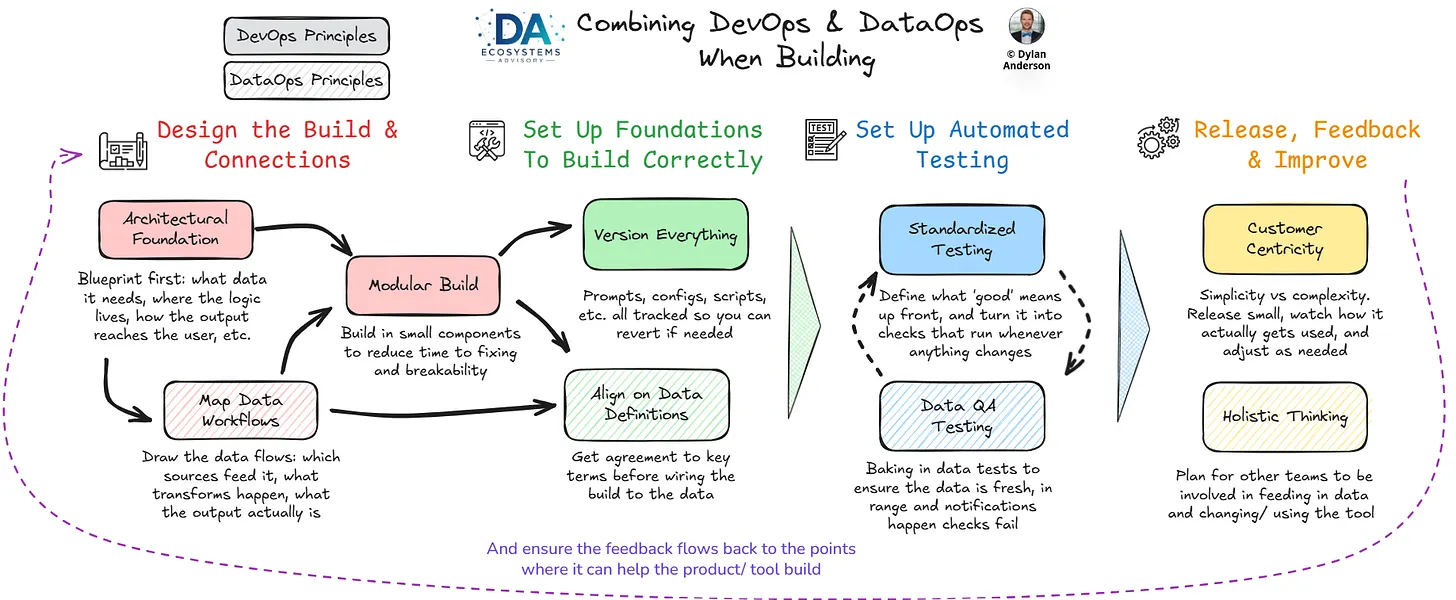
The concepts of Development Operations and Data Operations are essential disciplines for building and maintaining reliable technological systems, especially in the current era of artificial intelligence. Development Operations focuses on the smooth creation and stable release of software. Historically, software developers and operations teams had conflicting goals, with developers wanting to build fast and operations wanting stability. Development Operations unites these sides by emphasizing small, frequent updates, automated testing, clear code versioning, and shared responsibility for the final product. Data Operations applies similar rigorous principles to managing information, but it deals with unique challenges. Unlike software code, which remains static until changed by a person, data flows continuously, decays over time, and originates from sources outside a company's direct control. Because of these unpredictable factors, Data Operations requires constant monitoring, automated quality checks, and clear definitions to ensure the information remains accurate and trustworthy. Whether a team is building traditional software or experimenting with new artificial intelligence tools, combining these two frameworks is crucial. Development Operations ensures the software itself is built logically and can be updated safely, while Data Operations ensures the information flowing through that software remains reliable. Applying both prevents teams from building chaotic, unmaintainable systems.


What Enduring Leadership Looks Like in an Age of Disruption

The article reflects on how leaders can remain effective in a world where disruption is constant rather than occasional. It explains that traditional leadership models, built for predictable environments, no longer match today’s reality of rapid technological change, shifting workforce expectations, and global uncertainty. The author argues that enduring leadership begins with creating clarity even when answers are incomplete. People do not expect leaders to foresee every outcome, but they do expect steady communication and a sense of direction. Adaptability is presented as another essential trait, not as a sign of inconsistency but as evidence of maturity—leaders must be willing to question old assumptions and adjust their approach as conditions evolve. The piece also highlights the importance of emotional intelligence, noting that disruption affects people as much as systems. Leaders who understand this can reduce anxiety, strengthen engagement, and make better decisions. Investing in people is described as a practical necessity rather than a nice‑to‑have, since strong leadership pipelines help organizations absorb change more smoothly. Finally, the article emphasizes values as the anchor that sustains trust. When leaders act consistently and ethically, employees are more likely to support difficult decisions. Overall, enduring leadership is portrayed as a calm, principled way of guiding others through uncertainty without losing sight of purpose.


Finding the right balance between autonomy and scale

The article explores how CIOs can find a practical balance between giving business units autonomy and creating scale through centralization. It explains that both approaches have strengths and weaknesses: autonomy encourages speed and local ownership, while centralization supports efficiency, consistency, and shared learning. The challenge, the author notes, is that many organizations end up with a mix of both without a clear rationale, leading to duplicated systems, rising costs, and unnecessary complexity. Drawing on Paul Krebs’ experience at Koch Industries and Coca‑Cola, the piece describes centralization as a design choice rather than a rigid doctrine. Some capabilities—like infrastructure, cybersecurity, cloud management, and collaboration platforms—naturally benefit from scale and should remain centralized. Others, such as certain applications or data functions, can shift closer to the business as teams mature. The article stresses that standardization and centralization are not the same, and leaders can blend them to meet regional or business‑specific needs without creating one‑off solutions. It also argues that business architecture should guide technology decisions, especially in areas like ERP consolidation and M&A integration. Ultimately, the author encourages CIOs to revisit operating models regularly, recognizing that the right balance changes as capabilities grow and organizational needs evolve.


The EU’s AI transparency deadline is weeks away. Is your enterprise ready?

The article explains that the EU’s AI transparency rules are about to take effect, and companies have only a short time left to prepare. Beginning August 2, any organization offering AI systems in the EU must clearly tell users when they are interacting with AI, whether through chatbots, AI‑generated text, or deepfakes. The rules apply broadly, covering both EU and non‑EU companies if their systems are used in Europe. The Commission has issued guidelines and a voluntary code of practice to help organizations comply, though those who choose not to sign will face closer scrutiny. Content must carry machine‑readable markers and one of three labels—“AI,” “Fully AI‑generated,” or “Partially AI‑modified”—unless it is creative or satirical deepfake material. The article notes that compliance is not just about labeling but about building a durable transparency pipeline that can withstand audits. Companies must track responsibility for content, ensure marks survive real‑world editing, and maintain evidence for regulators. Contracts may need updating, and procurement processes must include requirements for marking and verification. The author stresses that sustained compliance requires ongoing testing, clear ownership, and a consistent baseline across jurisdictions, with local adjustments layered on top.


Platform Engineering for Everyone - Success Can’t Be Coded

The talk centers on why platform engineering succeeds only when treated as a product rather than an infrastructure project. Max Korbacher explains that many internal platforms fail because teams begin with tools or portals instead of a clear purpose, often installing something like Backstage only to discover it is empty and costly to configure: “You install it first… and it’s empty… you need five engineers and a couple of months” . He argues that infrastructure‑first thinking leads teams to focus on technology rather than the people who will use the platform, noting that engineers often avoid asking users what they actually need: “It’s not my nature to go out and ask people, what do you really want?” . Korbacher describes how organizational waves, hype cycles, and duplicated effort create patchwork systems that exhaust DevOps teams and push companies toward platform engineering as a more stable, product‑driven approach. Success, he says, requires principles, understanding user drivers, defining a clear purpose, and measuring outcomes with meaningful metrics. He stresses that adoption—not technical elegance—is the real indicator of value, and that platforms thrive only when they solve common problems, reduce waste, and make everyday work easier for developers, security teams, and even business stakeholders.

Daily Tech Digest - May 22, 2026


Quote for the day:

"Success… seems to be connected with action. Successful people keep moving. They make mistakes, but they don’t quit." -- Conrad Hilton


🎧 Listen to this digest on YouTube Music

▶ Play Audio Digest

Duration: 21 mins • Perfect for listening on the go.


The New Geography of Risk: Why Businesses Need a Real-Time Country Risk Dashboard

The Risk Awareness article highlights a profound shift in the corporate landscape, where geopolitical risk has evolved from a peripheral strategic concern into a vital daily operational variable. The modern business environment is increasingly shaped by fast-moving disruptions like tariffs, export controls, sanctions, and vulnerable maritime corridors, as evidenced by recent supply chain shocks such as the Red Sea shipping disruptions and the global semiconductor crisis. Because reactive crisis management leaves organizations highly exposed, forward-thinking businesses are shifting their focus toward continuous, real-time internal "country risk dashboards." Unlike traditional risk frameworks that look only at sovereign stability and macroeconomic indicators, modern dashboards integrate comprehensive, dynamic tracking of trade restrictions, shifting technology ecosystem policies, maritime dependencies, hidden vendor concentration threats within procurement networks, and currency volatility. This evolution reflects a broader corporate transition from optimizing purely for cost efficiency to designing for long-term operational resilience through proactive strategies like friend-shoring and regional diversification. Ultimately, predictive certainty is unrealistic; therefore, a sustainable competitive advantage will belong to organizations that successfully cultivate deep internal geopolitical literacy and translate global political developments into rapid, actionable operational signals across procurement, logistics, and treasury functions faster than their industry peers.


Beyond Unit Tests: Using AI to Find Secret Failures in Distributed Systems

The article explores Cross-Layer Synthetic Scenario Modeling (CLSSM), an approach proposed by Naveen Prakash to identify elusive, interaction-driven failures in complex distributed systems. Traditional methods like unit and integration testing focus on isolated components or service pairs under perfect conditions, often missing silent issues created by intersecting system variables like cache inconsistencies, retry amplification, and asynchronous message reordering. To address this, CLSSM merges chaos engineering with AI-assisted testing to evaluate system behavior under unpredictable production-like conditions. The practical framework begins with utilizing OpenTelemetry to capture distributed traces and extract service relationships into an interaction graph. AI clustering or anomaly detection models then analyze this runtime data to expose highly vulnerable paths based on error rates and tail latency. By feeding these insights into Large Language Models (LLMs) or rule-based analyzers, teams can generate highly realistic, complex failure scenarios that manual testing would completely miss. Finally, fault injection tools like Chaos Mesh or Toxiproxy are deployed to simulate real production degradations—such as artificial timeouts or throttled connections—allowing engineering teams to actively observe critical metrics like service recovery time and system depth. Ultimately, CLSSM replaces deterministic validation with a continuous AI-driven feedback loop, ensuring latent architectural flaws are exposed before impacting end-users.


Inside a Crypto Drainer: How to Spot it Before it Empties Your Wallet

The BleepingComputer article details the increasing professionalization of cryptocurrency theft through structured Drainer as a Service (DaaS) platforms. Analyzing Flare researchers' extensive data on the malicious Lucifer DaaS platform between January 2025 and early 2026, the report highlights how these modern ecosystems closely mimic legitimate SaaS businesses. DaaS operators manage complex transaction logic, wallet interactions, and software updates while taking a twenty percent commission on successful thefts, whereas recruited affiliates use social engineering to drive phishing traffic toward malicious websites. Rather than relying on traditional device compromise, drainers exploit user confusion regarding complex Web3 permissions and approvals, abusing authorization mechanisms like Permit and Permit2 to siphon digital assets within seconds. Lucifer significantly reduced technical barriers for its affiliates by introducing automated utilities like website cloning features and Zero Config deployment workflows. Furthermore, the group demonstrated robust operational resilience against security takedowns by shifting suspended documentation onto the decentralized InterPlanetary File System (IPFS). Because these malicious interactions deliberately mimic routine crypto operations, spotting a drainer requires careful user vigilance. Key warning signs include sites demanding immediate wallet connections, requests for unlimited token approvals, unexpected off-chain signature prompts, and artificial urgency. Ultimately, proactive monitoring of these underground networks allows security teams to detect threat indicators before fraud reaches users.


Throughput vs Goodput: The Performance Metric You Are Probably Ignoring in LLM Testing

The DZone article contrasts throughput and goodput as essential performance metrics, particularly within the context of Large Language Model (LLM) testing. While throughput measures raw operational volume by tracking total request completions or transactions per second, it inherently overlooks latency and user experience quality. For instance, an LLM server might maintain a stable, high throughput by successfully delivering standard HTTP 200 responses, even as the actual token processing time severely degrades. To address this dangerous blind spot, goodput acts as a quality-focused metric that incorporates Service Level Objectives (SLOs), counting only the specific requests that finish entirely within acceptable thresholds like Time to First Token and Inter-Token Latency. Consequently, as concurrent user loads increase and saturate critical GPU computing resources, goodput will diverge downward from throughput, serving as an early warning signal of performance deterioration. Featured in advanced tools like NVIDIA’s AIPerf, goodput proves indispensable for validating the production readiness of endpoints and mapping out exactly where systems begin to break under stress. Ultimately, the article advises reporting both metrics together; while throughput determines if an infrastructure configuration can physically handle the overall data volume, goodput answers whether the system is truly serving users effectively without silently breaching response boundaries.


AI at scale: What engineering teams are confronting

The InfoWorld article explores the shift enterprise engineering teams face when transitioning AI from exploratory experimentation to operational deployment at scale. While early enterprise discussions focused on model size and automated pilots, production reality demands secure, observable, and operationally durable environments. Recent research reveals that while nearly seventy-five percent of organizations utilize production GPU workloads and invest heavily in agentic AI designed to execute tasks, severe infrastructure mismatches remain. Most cloud estates were originally built for application deployment rather than the governed, reproducible pipelines required for execution level AI; notably, most firms must migrate over a quarter of their data to adapt. This foundational disconnect exposes severe governance gaps, especially when processing personally identifiable data under strict regulatory frameworks. Furthermore, managing dozens of cloud accounts across multiple vendors running diverse tools like Terraform and CloudFormation multiplies this operational complexity, making uniform policy enforcement across teams difficult. Rather than treating adoption as a simple build versus buy decision, successful organizations prioritize sustainable architectural fit. They avoid isolated silos by embedding external delivery expertise directly into core networks, actively testing workloads against production grade standards from day one. Ultimately, scaling success is determined not by algorithmic novelty, but by the deliberate, AI native design of the underlying cloud platform.


Why Enterprise Technology Is Becoming More About Stability Than Speed

The article explores a shifting paradigm in enterprise technology, highlighting how modern businesses are transitioning their focus from pure digital acceleration and speed toward operational stability, coordination, and resilience. For years, digital transformations prioritized rapid deployment, which accidentally generated fragmented, layered digital environments burdened by overlapping software systems and continuous employee notifications. Relying on reports from PwC, McKinsey, and Deloitte, the article underscores that unchecked technical complexity reduces business visibility and slows overall operational coordination. Furthermore, the expansion of artificial intelligence does not automatically resolve organizational fragmentation; instead, it often amplifies existing systemic weaknesses unless integrated into well-structured, cohesive workflows. Consequently, modern technology strategies are prioritizing invisible operational infrastructure, secure workflows, and foundational simplicity over superficial disruptions. Enterprise cybersecurity is similarly evolving from an isolated IT defense mechanism into a foundational business driver supporting continuity and customer trust. Crucially, as enterprise tools become more complex and automated, human judgment remains indispensable for interpreting context, guiding strategy, and navigating uncertainty. Ultimately, the next era of successful enterprise technology will value the calming ability to sustain reliable, unified, and stable operations within interconnected environments far above the urge to continuously move fast.


Deloitte survey: Gen Z and millennials are forcing HR to rethink leadership

The Deloitte Global 2026 Gen Z and Millennial Survey, which polled over 22,500 participants across 44 countries, reveals that younger professionals are fundamentally reshaping traditional corporate frameworks. While they maintain career ambition, they heavily prioritize flexibility, psychological safety, and sustainable long-term progress over aggressive ladder-climbing. Alarmingly, only 6 percent identify becoming a corporate leader as their top professional goal, primarily because modern management roles are overwhelmingly associated with stress, burnout, and a compromised work-life balance. Beyond leadership structures, persistent financial anxieties—specifically regarding the cost of living and housing affordability—are directly dictating where these employees choose to work and live. Furthermore, an "AI readiness gap" has emerged; although nearly three-quarters of respondents utilize AI tools daily, one-third believe their employers are fundamentally unprepared to manage this rapid technological shift. While corporate recognition of mental health has marginally improved, pervasive digital fatigue and workload pressures continue to trigger widespread exhaustion. Ultimately, retention increasingly hinges on shared organizational values and workplace community, with roughly 40 percent of younger workers rejecting assignments that conflict with their personal ethics. HR departments must therefore shift from rigid enforcement toward dynamic, human-centered systems focused on genuine well-being, organizational trust, and workflow redesign.


Protecting Sensitive Training Data in the Age of AI

The CPO Magazine article highlights the re-emergence of modern tape technology as a critical and cost-effective solution for storing and protecting the massive volumes of data required to train large language models. As artificial intelligence integration expands, modern organizations collect unprecedented amounts of raw information, leading to soaring cloud storage expenses and heightened cybersecurity threats. Unlike costly flash drives or traditional hard disk media, modern Linear Tape-Open solutions offer an exceptionally affordable way to house cold data lakes, streaming continuous high throughput without experiencing performance bottlenecks or supply chain pressures. Beyond clear financial advantages, tape storage serves as a robust cybersecurity asset. Because it is a physical and air-gapped medium, it provides an isolated offline repository that safeguards proprietary training data sets from remote cybercriminals. This architecture completely mitigates traditional cloud platform vulnerabilities and effectively thwarts dangerous data poisoning attacks designed to inject biased details, manipulate algorithms, or degrade model accuracy. Furthermore, tape technology incorporates Write-Once, Read-Many functionalities that ensure immutable, tamper-proof historical records, helping businesses satisfy strict compliance and evolving regulatory mandates. Ultimately, utilizing tape alongside cloud frameworks in hybrid storage deployments enables enterprises to responsibly scale and secure their artificial intelligence infrastructure.


20 Leadership Strategies For Continuous Learning And Skill Development

The Forbes Human Resources Council article outlines twenty foundational strategies for leaders committed to continuous learning and skill development. The expert contributors emphasize that effective leadership is an ongoing journey requiring an open, curious mindset rather than a rigid posture of absolute expertise. Key actionable tactics include building daily habits rooted in deep curiosity, seeking diverse perspectives, and integrating real-time self-reflection into everyday operational decisions. Rather than treating professional training as an isolated retreat, successful executives hardwire learning into their daily organizational rhythms through robust feedback loops, comprehensive reviews, and the establishment of a personal board of directors to uncover hidden organizational blind spots. Furthermore, the panel highlights the immense value of modern development channels, such as engaging in two-way reverse mentoring with next-generation talent, utilizing personalized AI-powered coaching tools, and actively pursuing challenging stretch assignments outside of their comfort zones. Crucially, sustainable growth involves intentionally focusing on developing others, ensuring that knowledge sharing, substantial educational assistance budgets, and collaborative operational reviews build a future-ready talent pipeline. By consistently staying close to day-to-day operations and carefully analyzing failures, leaders can remain nimble, highly context-aware, and exceptionally well equipped to successfully navigate a rapidly changing business environment.


Quantum computing faces security, skills shortage problem

The InformationWeek article outlines the critical security threats and severe talent shortages threatening the rapidly growing quantum computing industry. Speaking at Fiber Connect 2026, industry experts Matthew Cimaglia and Ryan Harring highlighted "Q-Day," the looming milestone when quantum machines achieve the computational power required to crack standard RSA encryption, thereby endangering banking systems, private data, and national security agencies. To mitigate this threat, the National Institute of Standards and Technology has mandated that public and private infrastructure transition to post-quantum cryptography by 2035, prompting organizations to develop specialized key distribution technologies. However, implementing these vital defensive measures is heavily bottlenecked by an immense global workforce deficiency. While the ecosystem currently supports only 30,000 quantum professionals, it is projected to require 250,000 by 2030 to capture an estimated $3 trillion economic opportunity, particularly across logistics and telecom sectors. Addressing this talent issue demands skilled physicists who can also effectively translate complex quantum implications for business audiences. Consequently, enterprises are partnering with universities and securing federal grants to build robust pipelines. These advancements are geographically decentralized across emerging hubs like Maryland and Arizona rather than clustered in Silicon Valley, as demonstrated by Florida's recent rollout of a fully quantum-secured fiber network.

Daily Tech Digest - May 17, 2026


Quote for the day:

“In tech, leadership isn’t about predicting the future — it’s about creating the conditions where your teams can build it.” -- Unknown

🎧 Listen to this digest on YouTube Music

▶ Play Audio Digest

Duration: 23 mins • Perfect for listening on the go.


Scale ‘autonomous intelligence’ for real growth

In an interview with Ryan Daws, Prakul Sharma, the AI and Insights Practice Leader at Deloitte Consulting LLP, explains that modern enterprises must look beyond the localized productivity gains of generative AI to scale "autonomous intelligence" for real business growth. Sharma describes an intelligence maturity curve transitioning from assisted and artificial intelligence into autonomous intelligence, where systems independently execute actions within predefined boundaries. To unlock true economic value, organizations must integrate these autonomous agents directly into critical, costly workflows like enterprise procurement. However, scaling successfully faces significant technical and structural hurdles. First, enterprises frequently lack decision-grade data, which means real-time, traceable information required for binding transactions, relying instead on outdated reporting-grade data. Second, the production gap and governance debt often stall live deployments, because shortcuts taken during small pilots become major barriers for corporate legal and compliance teams. Sharma advises leaders to conduct thorough decision audits of existing workflows to uncover operational bottlenecks and data gaps. By building pilots from the very outset as reusable platforms equipped with proper identity verification, continuous model evaluations, and robust risk frameworks, enterprises can securely transition from experimental testing to successful, widespread live deployment.


6 Technical Red Flags Product Managers Should Never Ignore

In the article "6 Technical Red Flags Product Managers Should Never Ignore," Seyifunmi Olafioye emphasizes that product managers must recognize signs of underlying technical instability, as it directly impacts delivery, scalability, and customer trust. The author identifies six major red flags that product managers should never overlook: a lack of clear understanding among the team regarding how the system works, new feature development consistently taking much longer than estimated, and resolved bugs repeatedly resurfacing in production. Additionally, product managers should be concerned if operational teams must rely heavily on manual workarounds to keep the platform functioning, if the entire project suffers from an over-reliance on a single engineer's institutional knowledge, or if internal errors are only discovered after users report them due to a lack of proper monitoring. While no system is entirely flawless, ignoring these persistent warning signs can lead to severe operational issues. The article concludes that product managers should not dictate technical fixes; instead, they must proactively initiate honest conversations with engineering leadership, ask challenging questions during planning, and prioritize long-term technical health alongside new features to ensure sustainable growth and protect the user experience.
In this article, Ed Leavens argues that Quantum Day, known as Q-Day, is the precise moment when quantum computers become advanced enough to break existing asymmetric encryption standards like RSA and ECC, presenting a far greater threat than Y2K. While Y2K had a definitive deadline and a known remedy, Q-Day has no set timeline and introduces the insidious risk of "harvest now, decrypt later" (HNDL) tactics. Under HNDL, adversaries secretly exfiltrate and stockpile encrypted data today, waiting to decrypt it once sufficiently powerful quantum technology becomes available. Furthermore, this threat compounds daily due to modern data sprawl across multiple environments. To counter this impending crisis, organizations must look beyond traditional encryption upgrades and adopt data-layer protection strategies like vaulted tokenization. This quantum-resilient approach mathematically separates original sensitive data from its representation by replacing it with non-sensitive, format-preserving tokens. Because tokens share no reversible mathematical connection with the underlying information, quantum algorithms cannot decipher them, effectively neutralizing the value of stolen payloads. Implementing vaulted tokenization requires comprehensive data discovery, strict access governance, and cross-functional organizational alignment. Ultimately, Leavens emphasizes that enterprises must act immediately to secure their data directly, rendering harvested information useless before quantum-powered breaches materialize.


The AI infrastructure bottleneck is becoming a CIO problem

The article by Madeleine Streets explores how the expanding ambitions of artificial intelligence are colliding with physical infrastructure limitations, shifting the AI bottleneck from a general tech industry challenge into a critical problem for Chief Information Officers (CIOs). While billions of dollars continue pouring into AI development, physical realities like power grid limitations, data center construction delays, permitting hurdles, and cooling requirements are struggling to match software demand. This mismatch threatens to create a more constrained operating environment where AI access becomes expensive, delayed, or regionally uneven. Consequently, this pressure exposes "AI sprawl" within organizations where uncoordinated and disconnected AI initiatives compete for the same resources without centralized governance. To mitigate these risks, experts suggest that CIOs treat AI capacity as a core operational resilience and business continuity issue. IT leaders must introduce disciplined governance by tiering AI workloads into critical, important, and experimental categories, or utilizing smaller, local models to reduce compute reliance. Furthermore, CIOs must demand greater transparency from vendors regarding capacity guarantees, regional availability, and workload prioritization during peak demand. Ultimately, enterprise AI strategies can no longer assume infinite compute availability and must instead realign their deployment ambitions with physical operational constraints.


How AI Is Repeating Familiar Shadow IT Security Risks

The rapid adoption of artificial intelligence across the corporate enterprise is triggering new governance and security risks that closely mirror past technological shifts, such as the initial emergence of shadow IT and unauthorized software as a service platform usage. Modern organizations currently face three primary vectors of vulnerability, starting with employees inadvertently leaking proprietary intellectual property, corporate source code, and confidential financial records by pasting this data into public generative AI platforms. Furthermore, software developers frequently introduce hidden backdoors or compromised dependencies into production systems by integrating unverified open source models and components that circumvent traditional software supply chain scrutiny. Compounding these operational issues is the sudden rise of autonomous AI agents that operate with dynamic decision making authority but completely lack explicitly defined ownership or documented permission boundaries within internal corporate networks. To successfully mitigate these vulnerabilities, blanket restrictive policies are typically ineffective; instead, companies must establish robust frameworks that ensure absolute visibility, accountability, and adaptive identity controls. As detailed in the SANS Institute’s new AI Security Maturity Model, managing these continuous threats requires treating artificial intelligence not as an isolated software application, but as a critical operational layer demanding proactive lifecycle validation and verification.


Six priorities reshaping the MENA boardroom in 2026

The EY report details how the 2026 macroeconomic landscape in the Middle East and North Africa (MENA) region requires corporate boardrooms to transition from traditional, periodic oversight toward integrated, forward-looking strategic leadership. Driven by overlapping pressures across geopolitics, rapid technological innovation, sustainability demands, and complex governance regulations, MENA boards face a highly volatile operating environment. To navigate this uncertainty and secure long-term value, directors must actively address six central boardroom priorities. First, boards need to develop geopolitical foresight, embedding regional shifts directly into strategic scenario planning. Second, they must manage the expanding technology and cyber assurance landscape, ensuring ethical artificial intelligence governance and robust defenses against escalating digital threats. Third, strengthening corporate integrity, fraud prevention, and independent investigation oversight remains essential for maintaining stakeholder trust. Fourth, elevating climate resilience and sustainability governance helps mitigate critical environmental risks while driving resource efficiency. Fifth, achieving financial excellence requires rigorous cost optimization and aligning internal controls across financial and sustainability reporting frameworks. Finally, adopting mature, behavioral-based board evaluations over mere procedural assessments fosters deep accountability. Ultimately, orchestrating these interconnected priorities empowers MENA leaders to fortify institutional trust and transform market disruptions into sustainable growth.


The software supply chain is the new ground zero for enterprise cyber risk. Don’t get caught short

In this article, Matias Madou highlights the rising vulnerabilities within the software supply chain as the new ground zero for enterprise cyber risks, heavily exacerbated by the rapid adoption of artificial intelligence tools. Recent highly sophisticated breaches, such as the TeamPCP supply chain attacks, have aggressively weaponized critical security and developer platforms like Checkmarx and the open-source library LiteLLM. By embedding highly obfuscated, multistage credential stealers into these trusted systems, attackers successfully moved laterally through development pipelines and Kubernetes clusters to exfiltrate highly sensitive enterprise data. Madou warns that traditional, reactive security measures are entirely insufficient against fast-moving, AI-driven threats. To mitigate these expanding dangers, organizations must redefine AI middleware as critical infrastructure, implementing rigorous monitoring of application programming interface keys and environment variables that constantly flow through these abstraction layers. Furthermore, security leaders must modernize risk management strategies by locking down dependency pipelines, enforcing strict least-privilege access, and gaining visibility into autonomous Model Context Protocol agents. Ultimately, the author urges modern enterprises to establish comprehensive internal AI governance frameworks and continuously upskill developers in secure coding standards rather than waiting for formal government legislation, thereby proactively shielding their operational workflows from devastating, cascading supply-chain compromises.


World Bank, African DPAs outline formula for trusted digital identity, DPI

During the ID4Africa 2026 Annual General Meeting, a key World Bank presentation emphasized that establishing public trust is vital for the success of digital public infrastructure and national identity systems across Africa. Experts noted that even mature digital identity networks remain vulnerable to operational failures and public mistrust due to weak data collection safeguards, frequent data breaches, and expanding cyberattack surfaces. To address these vulnerabilities, data protection authorities from nations like Liberia, Benin, and Mauritius highlighted that digital forensics, cybersecurity, and rigorous data governance must operate collectively. Although these under-resourced regulatory bodies often struggle to fund large population-scale awareness campaigns, they are pioneering localized solutions. For example, Mauritius leverages chief data officers and amicable dispute resolution mechanisms to efficiently settle compliance breaches without lengthy prosecution, while Benin relies on specialized government liaisons to ensure proper database compliance across different agencies. Furthermore, regional frameworks like the East African Community body facilitate international knowledge-sharing and joint investigative capabilities. Ultimately, achieving an ecosystem worthy of citizen and business trust requires a comprehensive formula blending careful system architecture, strictly enforced data protection, robust cybersecurity defenses, and transparent communication that effectively helps citizens understand their rights within the broader data lifecycle.


When configuration becomes a vulnerability: Exploitable misconfigurations in AI apps

The rapid deployment of artificial intelligence and agentic applications on cloud-native platforms, particularly Kubernetes clusters, often compromises cybersecurity in favor of operational speed. According to the Microsoft Defender Security Research Team, this trend has led to an increase in exploitable misconfigurations, which are scenarios where public internet access is paired with absent or weak authentication mechanisms. Rather than relying on sophisticated zero-day vulnerabilities, threat actors can leverage these low-effort attack paths to achieve high-impact compromises, including remote code execution, credential exfiltration, and unauthorized access to sensitive internal data. Microsoft identified these specific dangers across several popular AI platforms: Model Context Protocol servers frequently permitted unauthenticated interaction with corporate tools, Mage AI default setups enabled internet-accessible administrative shells, and frameworks like kagent and AutoGen Studio leaked plaintext API keys or allowed unauthorized workload deployments. To mitigate these pervasive security gaps, organizations must treat AI systems as high-impact workloads. Security teams should enforce strong authentication across all endpoints, apply strict least-privilege principles, and continuously audit infrastructure configurations. Furthermore, cloud protection tools like Microsoft Defender for Cloud can actively detect exposed services, helping defenders remediate dangerous oversights before malicious adversaries can exploit them.


Tokenized assets face trust infrastructure test, Cardano chief says

The article, titled "Tokenized assets face trust infrastructure test, Cardano chief says," by Jeff Pao, outlines a pivotal shift in the digital assets sector as financial institutions transition from tentative pilot projects to scaled, production-level tokenization. According to Cardano’s leadership, the primary challenges facing this widespread adoption are no longer the core blockchain mechanisms themselves, but rather the underlying hurdles of verification, identity, and robust auditability. These elements form a critical "trust infrastructure" that remains essential for creating compliant, institutional-grade financial networks. As real-world asset tokenization expands rapidly across global markets, traditional financial institutions require secure mechanisms like decentralized identifiers and privacy-preserving verifiable credentials to interact safely with public ledgers. By embedding accountability directly into the network architecture, digital trust frameworks turn complex compliance into seamless operational coordination, enabling institutions to efficiently manage counterparty exposure and automated settlement risks without exposing sensitive transactional data. Ultimately, the piece underscores that the long-term survival of decentralized finance relies heavily on resolving these identity and legal infrastructure gaps. Establishing a standardized trust layer will determine whether tokenized finance achieves mature stability or succumbs to institutional fragility and unresolved regulatory friction, marking a major turning point for future global capital flows.

Daily Tech Digest - May 02, 2026


Quote for the day:

“The more you loose yourself in something bigger than yourself, the more energy you will have.” - Norman Vincent Peale

🎧 Listen to this digest on YouTube Music

▶ Play Audio Digest

Duration: 17 mins • Perfect for listening on the go.


The architectural decision shaping enterprise AI

In "The architectural decision shaping enterprise AI," Shail Khiyara argues that the long-term success of enterprise AI initiatives hinges on an often-overlooked architectural choice: how a system finds, relates, and reasons over information. The article outlines three primary patterns—vector embeddings, knowledge graphs, and context graphs—each offering unique advantages and trade-offs. Vector embeddings excel at identifying semantically similar unstructured data, making them ideal for rapid RAG deployments, yet they lack deep relational understanding. Knowledge graphs provide precise, traceable answers by mapping explicit relationships between entities, though they are resource-intensive to maintain. Crucially, Khiyara introduces context graphs, which capture the dynamic reasoning behind decisions to ensure continuity across multi-step workflows. Unlike static models, context graphs treat reasoning as a first-class data artifact, allowing AI to understand the "why" behind previous actions. The most effective enterprise strategies do not choose one in isolation but instead layer these patterns to balance speed, precision, and contextual awareness. Ultimately, Khiyara warns that leaving these decisions to default configurations leads to "confident mistakes" and trust erosion. For CIOs, intentional architectural design is not just a technical necessity but a fundamental business imperative to transition from isolated pilots to scalable, reliable AI ecosystems that deliver genuine organizational value.


The Evidence and Control Layer for Enterprise AI

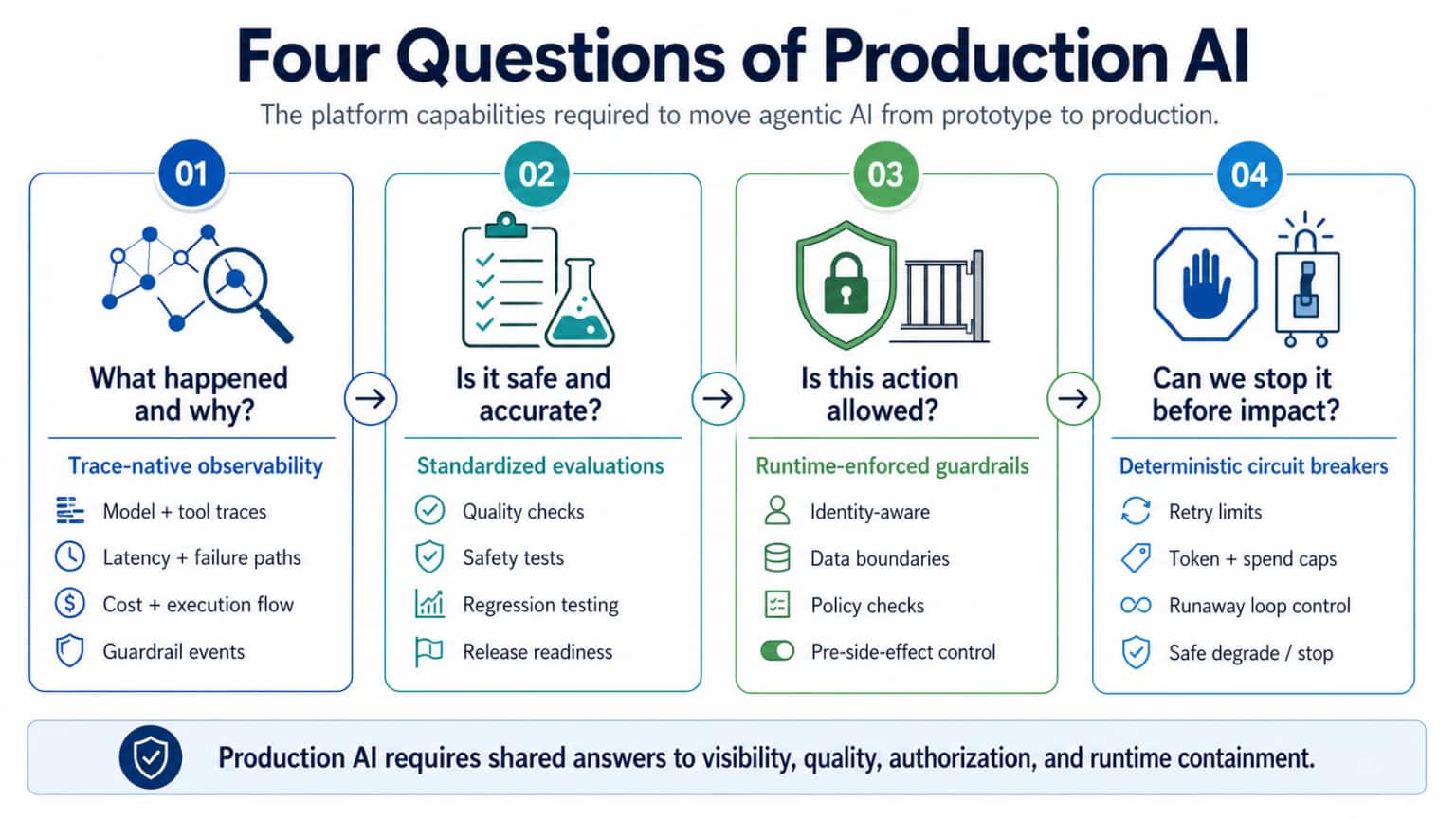
The article "The Evidence and Control Layer for Enterprise AI" by Kishore Pusukuri argues that the transition from AI prototypes to production requires a robust architectural layer to manage the inherent unpredictability of agentic systems. This "Evidence and Control Layer" acts as a shared platform substrate that mediates between agentic workloads and enterprise resources, shifting governance from retrospective reviews to proactive, in-path execution controls. The framework is built upon three core pillars: trace-native observability, continuous trace-linked evaluations, and runtime-enforced guardrails. Unlike traditional logging, trace-native observability captures the complete execution path and decision context, providing the foundation for operational trust. Continuous evaluations act as quality gates, while runtime guardrails evaluate proposed actions—such as tool calls or data transfers—before side effects occur, ensuring safety and compliance in real-time. By formalizing policy-as-code and generating structured evidence events, the layer ensures that every material action is explicit, auditable, and cost-bounded. Ultimately, this centralized approach accelerates enterprise adoption by providing reusable governance defaults, effectively closing the "stochastic gap" and transforming black-box agents into trusted, scalable enterprise assets that operate with clear authority and within defined budget constraints.


Organizational Culture As An Operating System, Not A Values System

In the article "Organizational Culture As An Operating System, Not A Values System," the author argues that the traditional definition of culture as a static set of internal values is no longer sufficient in a hyper-connected world. Modern organizational culture must be reframed as a dynamic operating system that bridges internal decision-making with external community engagement. While internal culture dictates how information flows and authority is exercised, external culture defines how a brand interacts with decentralized movements in art, fashion, and social identity. The disconnect often arises because corporate hierarchies prioritize control and predictability, whereas external cultural trends move at a high velocity from the periphery. To remain relevant, organizations must shift from a "broadcast" model to one of "co-creation," where authority is distributed to those closest to social signals and speed is enabled by trust rather than bureaucratic process. By treating culture with the same rigor as any other core business function, leaders can diagnose internal friction and align incentives to ensure the organization moves at the "speed of culture." Ultimately, success depends on building internal systems that allow companies to participate in and shape cultural conversations in real time, moving beyond corporate manifestos to authentic community collaboration.


Re‑Architecting Capability for AI: Governance, SMEs, and the Talent Pipeline Paradox

The article "Re-architecting Capability for AI Governance: SMEs and the Talent Pipeline Paradox" examines the profound obstacles small and medium-sized enterprises encounter while attempting to establish formal AI oversight. Central to the discussion is the "talent pipeline paradox," which describes how the concentration of AI expertise within large technology firms creates a vacuum that leaves smaller organizations vulnerable. To address this, the author advocates for a strategic shift from talent acquisition to capability re-architecting. Rather than competing for scarce high-end specialists, SMEs should integrate AI governance into their existing business architecture through modular and risk-based frameworks. This approach emphasizes the importance of leveraging cross-functional internal teams, automated tools, and external partnerships to manage algorithmic risks effectively. By focusing on scalable governance patterns and clear accountability, SMEs can achieve ethical and regulatory compliance without the overhead of massive administrative departments. Ultimately, the piece suggests that the key to overcoming resource limitations lies in structural agility and the democratization of governance tasks. This enables smaller firms to harness the transformative power of artificial intelligence safely while maintaining a competitive edge in an increasingly automated global marketplace where talent remains the ultimate bottleneck.


The AI scaffolding layer is collapsing. LlamaIndex's CEO explains what survives

In this VentureBeat interview, LlamaIndex CEO Jerry Liu explores the significant transformation occurring within the "AI scaffolding" layer—the software stack connecting large language models to external data and applications. As frontier models increasingly incorporate native reasoning and retrieval capabilities, Liu suggests that simplistic RAG wrappers are rapidly losing their utility, leading to a "collapse" of the middle layer. To survive this consolidation, infrastructure tools must evolve from thin architectural shells into robust systems that manage complex data pipelines and orchestrate sophisticated agentic workflows. Liu emphasizes that while base models are becoming more powerful, they still lack the specialized, proprietary context required for high-stakes enterprise tasks. Consequently, the future of AI development lies in solving "hard" data problems, such as handling heterogeneous sources and ensuring data quality at scale. Developers are encouraged to pivot away from basic integration toward building deep, specialized intelligence layers that provide the structured context models inherently lack. Ultimately, the survival of platforms like LlamaIndex depends on their ability to offer advanced orchestration and data management that transcends the capabilities of the base models alone, marking a shift toward more resilient and professionalized AI engineering.


Guide for Designing Highly Scalable Systems

The "Guide for Designing Highly Scalable Systems" by GeeksforGeeks provides a comprehensive roadmap for building architectures capable of managing increasing traffic and data volume without performance degradation. Scalability is defined as a system’s ability to grow efficiently while maintaining stability and fast response times. The guide highlights two primary scaling strategies: vertical scaling, which involves enhancing a single server’s capacity, and horizontal scaling, which distributes workloads across multiple machines. To achieve high scalability, the article emphasizes the importance of architectural decomposition and loose coupling, often implemented through microservices or service-oriented architectures. Key components discussed include load balancers for even traffic distribution, caching mechanisms like Redis to reduce backend load, and advanced data management techniques such as sharding and replication to prevent database bottlenecks. Furthermore, the guide covers essential architectural patterns like CQRS and distributed systems to improve fault tolerance and resource utilization. Modern applications must account for various non-functional requirements such as availability and consistency while scaling. By prioritizing stateless designs and avoiding single points of failure, organizations can create robust systems that handle peak usage and unpredictable growth effectively. Ultimately, designing for scalability requires balancing cost, performance, and complexity to ensure long-term reliability in a dynamic digital landscape.


Why Debugging is Harder than Writing Code?

The article "Why Debugging is Harder than Writing Code" from BetterBugs examines the fundamental reasons why developers spend nearly half their time fixing issues rather than creating new features. The core difficulty lies in the disparity between the "happy path" of initial development and the exponential state space of potential failures. While writing code involves building a single successful outcome, debugging requires navigating a combinatorially vast range of unexpected inputs and conditions. This process imposes a significant cognitive load, as developers must maintain a massive context window—often jumping between different files, servers, and logs—which incurs heavy switching costs. Furthermore, modern complexities like distributed systems, non-deterministic concurrency, and discrepancies between local and production environments add layers of friction. In concurrent systems, for instance, the mere act of observing a bug can change the timing and make the issue disappear. Ultimately, the article argues that debugging is more demanding because it forces engineers to move beyond theoretical models and confront the messy realities of hardware limits, memory leaks, and network latency. To manage these challenges, the author suggests that teams must prioritize observability and evidence-based reporting tools to bridge the gap between mental models and actual system behavior, ensuring more predictable software lifecycles.


Cybersecurity: Board oversight of operational resilience planning

The A&O Shearman guidance emphasizes that as cyberattacks grow more sophisticated and regulatory scrutiny intensifies, boards must adopt a proactive stance toward operational resilience. With the emergence of unpredictable criminal gangs and AI-driven threats, it is no longer sufficient to treat cybersecurity as a purely technical issue; it is a critical governance priority. To exercise effective oversight, boards should appoint dedicated individuals or committees to monitor cyber risks and ensure that Business Continuity and Disaster Recovery (BCDR) plans are robust, defensible, and accessible offline. Practical preparations must include clear decision-making protocols and alternative communication channels, such as Signal or WhatsApp, for use during systems outages. Additionally, leadership should oversee the development of pre-approved communication templates for stakeholders and define strict Recovery Time Objectives (RTOs). A cornerstone of this framework is the implementation of regular tabletop exercises and technical recovery drills that involve third-party providers to identify vulnerabilities. By documenting these proactive measures and integrating lessons learned into evolving strategies, boards can meet regulatory expectations for evidence-based oversight. Ultimately, this comprehensive approach to resilience planning helps organizations minimize the risk of material revenue loss and navigate the complexities of a volatile global digital landscape.


Beyond the Region: Architecting for Sovereign Fault Domains and the AI-HR Integrity Gap

In "Beyond the Region," Flavia Ballabene argues that software architects must evolve their definition of resilience from surviving mechanical failures to navigating "Sovereign Fault Domains." Traditionally, redundancy across Availability Zones addressed physical infrastructure outages; however, modern geopolitical shifts and evolving privacy laws now create "blast radii" where data becomes legally trapped or AI models suddenly non-compliant. Ballabene highlights an "AI-HR Integrity Gap," where centralized systems fail to account for regional jurisdictional constraints. To bridge this, she proposes shifting toward sovereignty-aware infrastructures. Key strategies include Managed Sovereign Cloud Models, which leverage localized partner-led controls like S3NS or T-Systems, and Cell-Based Regional Architectures, which deploy independent stacks for each major market to eliminate reliance on a global control plane. These approaches allow organizations to maintain operational continuity even when specific regions face regulatory upheavals. By auditing AI dependency graphs and prioritizing data residency, executives can transform compliance from a burden into a competitive advantage. Ultimately, the article suggests that in a fragmented global cloud, the most resilient HR and technology stacks are those built on digital trust and localized integrity, ensuring they remain robust against both technical glitches and the unpredictable tides of international policy.


Designing resilient IoT and Edge Computing with federated tinyML

The article "Real-time operating systems for embedded systems" (available via ScienceDirect PII: S1383762126000275) provides a comprehensive examination of the architectural requirements and performance constraints inherent in modern real-time operating systems (RTOS). As embedded devices become increasingly integrated into safety-critical infrastructure, the study highlights the transition from simple cyclic executives to sophisticated, preemptive multitasking environments. The authors analyze key RTOS components, including deterministic scheduling algorithms, interrupt latency management, and inter-process communication mechanisms, emphasizing their role in ensuring temporal correctness. A significant portion of the discussion focuses on the trade-offs between monolithic and microkernel architectures, particularly regarding memory footprint and system reliability. By evaluating various commercial and open-source RTOS solutions, the research demonstrates how hardware-software co-design can mitigate the overhead typically associated with complex task synchronization. Ultimately, the paper argues that the future of embedded systems lies in adaptive RTOS frameworks that can dynamically balance power efficiency with the rigorous timing demands of Internet of Things (IoT) applications. This synthesis serves as a vital resource for engineers seeking to optimize system predictability in increasingly heterogeneous computing environments, ensuring that software responses remain consistent under peak load conditions.