Showing posts with label reliability. Show all posts

Daily Tech Digest - November 22, 2026

Quote for the Day
“Leadership is not about being in charge; it’s about taking care of those in your charge.”
— Simon Sinek
Audio Edition — Listen to Today’s Digest
Narrated version of the Daily Tech Digest
Article Thumbnail

The leadership gap when technical specialists become executives

When an organization promotes its top technical specialist into an executive role, it often creates a significant leadership gap if the transition is not managed carefully. Technical mastery in a single area, such as software development or cybersecurity, does not automatically translate to the broad strategic, financial, and interpersonal capabilities required to lead a diverse division. A new executive must shift from solving specific technical problems to making complex business trade-offs, allocating budgets, managing team structures, and influencing people with different incentives. Instead of simply hoping the new title will produce these essential capabilities, organizations should intentionally assess a candidate’s readiness against the actual decisions they will inherit in their new role. This means exposing technical experts to real financial choices, team management challenges, and strategic planning before they formally take on executive authority. Furthermore, a successful technical leader must build a team of experts with complementary skills who can openly challenge their assumptions. True executive readiness is not about mastering every discipline, but about knowing the limits of your own expertise and effectively guiding the people around you to make sound business decisions.

Read Original Article →
Article Thumbnail

5 Major Outages in 6 Days Put New Focus on IT Resilience

The article examines five major technology outages affecting Microsoft, the FAA, JPMorgan Chase, the NSA and Apple within six days, emphasizing that none was attributed to a confirmed cyberattack. Instead, software defects, maintenance, infrastructure changes and updates disrupted cloud services, aviation, banking and internal systems. Microsoft’s outage showed how a dormant software flaw, reduced capacity and failed containment safeguards could combine into widespread disruption. The FAA experienced instability linked to legacy equipment while new routers were being deployed, leading to a nationwide ground stop. JPMorgan Chase traced transaction delays to a software bug in an on-premises hardware system, while the NSA reported temporary degradation during routine maintenance. Apple connected its service disruption to an internal update. Although the technical causes differed, the incidents share a broader lesson: resilience is not only about defending against attackers. Technology changes intended to maintain or improve systems can themselves create serious operational risk. The article argues that organizations should test changes across different environments, maintain sufficient capacity, strengthen failure containment and ensure recovery mechanisms can restore services when routine technical work produces unexpected consequences.

Read Original Article →
Article Thumbnail

Agentic AI repeats same old enterprise adoption cycle

Agentic AI is the latest technology trend capturing the attention of enterprise leaders, promising to automate complex workflows as if thousands of experts were working around the clock. However, the adoption of this technology is clearly mirroring the familiar, flawed cycles seen with past structural shifts like service-oriented architecture, microservices, and cloud-native systems. While agentic AI offers genuine capabilities for tasks requiring interpretation and independent action, many organizations are adopting it simply because it is the current standard, rather than because it fits their specific business needs. Building these systems involves significant hidden challenges, including extensive integration, data cleaning, strict security controls, and entirely new operational processes. As a result, companies often find that deploying agentic AI costs significantly more—sometimes up to twenty times as much—without delivering a better return on investment than a traditional, simpler approach. To avoid these costly mistakes, business leaders must prioritize measurable value over passing trends. Agentic AI should be reserved for complex, unpredictable problems, while stable and highly regulated tasks should remain on conventional systems that deliver the exact same results for a fraction of the overall cost.

Read Original Article →
Article Thumbnail

Your RTO Probably Doesn’t Include the Time Spent Figuring Out What Failed

Recovery Time Objectives (RTOs) focus on how quickly services can be restored after a disruption. However, typical RTOs completely ignore a critical phase: the vast amount of time spent diagnosing the problem before recovery can even begin. While organizations may boast a fast recovery time for a well-known issue, real-world incidents rarely present themselves clearly. During an actual outage, the initial symptoms are usually vague, such as a failing business process or a disconnected application. Identifying the root cause across complex, multi-vendor environments can consume hours of valuable time, especially when essential information is scattered and access credentials are hard to find. Furthermore, running standard recovery tests that assume the problem is already known creates a false sense of security for leadership. To build genuine resilience, organizations must test their diagnostic readiness by presenting teams with ambiguous symptoms rather than clear-cut technical failures. By maintaining updated dependency maps, securing reliable emergency administrative access, and assigning clear ownership for cross-system incidents, companies can drastically reduce this hidden discovery interval. Ultimately, a successful recovery plan must account for the time it takes to figure out what actually broke.

Read Original Article →
Article Thumbnail

Beyond Green Pipelines: Designing Stateful Governance for CI/CD

As artificial intelligence accelerates the pace of software development, traditional CI/CD pipelines are struggling to keep up. Simply adding more runners to handle the increased volume of AI-generated code is not a sustainable long-term solution. The core issue lies in the task-centric nature of most pipelines, where a successful "green" execution is treated as permanent permission to deploy. In reality, external factors like new security advisories, evolving policies, or shifting dependencies can invalidate a previously successful validation without a single line of code changing. To address this, organizations should move beyond basic caching and implement a separate, stateful governance layer. This layer retains structured validation reports and continuously evaluates them against current conditions, security events, and human decisions right up until deployment. By reusing evidence when it remains valid and only re-running checks when necessary, teams can reduce redundant testing. Most importantly, this approach ensures that an outdated approval never automatically becomes a green light to deploy, securing the release process even as development speeds up.

Read Original Article →
Article Thumbnail

PHP2Shell aftershock: 18 more PHP flaws put enterprise web admins on alert

Following the recent discovery of the major PHP2Shell vulnerabilities, the PHP development team has released patches to fix eighteen additional security flaws. The most pressing issue is a critical defect in how certain web servers handle incoming requests. Under specific setups, this flaw allows unauthorized individuals to run their own code remotely, potentially giving them full access to sensitive business data, passwords, and underlying system controls. Other addressed issues include memory problems, service interruptions, and a subtle bug where using a capital letter in web addresses could accidentally expose data without encryption. To protect their networks, system administrators must first properly identify everywhere PHP is running, as it is often hidden inside various web servers, hosting panels, and appliances. Teams should prioritize updating systems connected directly to the internet and those running PHP version 8.5. It is also important to note that PHP version 8.2 will stop receiving security updates at the end of this year. Ultimately, these routine updates highlight a simple truth: organizations cannot secure software if they do not know exactly where it is installed across their entire digital environment.

Read Original Article →
Article Thumbnail

Do AI’s mathematical advances put PKI under threat?

Recent warnings from prominent cryptographers suggest that advances in artificial intelligence could eventually threaten the foundations of public-key infrastructure (PKI). Historically, the security of public-key encryption has relied on the sheer difficulty of solving certain complex mathematical problems. However, AI is now proving capable of tackling analytical problems previously thought to require human intuition, raising concerns that it might soon uncover shortcuts to break established cryptographic standards. While experts emphasize that an immediate collapse of internet security is unlikely, AI has already played a role in weakening some newer encryption schemes and finding shortcuts in legacy systems. Because public-key cryptography inherently requires a structured mathematical "trapdoor," it is considered more vulnerable to these AI-driven discoveries than symmetric-key cryptography. To mitigate these risks, specialists advise organizations to focus on cryptographic agility—the ability to swiftly transition to new encryption methods if a current standard is compromised. Much like preparing for the arrival of quantum computers, the best defense against AI's mathematical advances involves adopting a hybrid approach, using a mix of cryptographic schemes so that communication remains secure even if one algorithm fails.

Read Original Article →
Article Thumbnail

A Capability-First Approach to Modernizing Retirement Services Technology Platforms

To successfully upgrade technology in retirement services, organizations should first identify what the business actually needs to achieve before they begin selecting new software. When companies simply replace aging systems without aligning the technology to their specific market goals, the new platforms frequently suffer from the exact same operational roadblocks as the old ones. Instead, leaders must map out their core business capabilities, such as enrolling participants, managing compliance, or processing distributions. This complete view allows technical teams to prioritize system investments based on business value, existing maturity, and regulatory risk. They can direct resources toward the specific functions that offer a true competitive edge while relying on standard solutions for routine daily tasks. By understanding these priorities, a company can decide the most effective path forward for each capability, whether that means a gradual replacement, adding an integration layer, or moving entirely to a cloud platform. Ultimately, organizing system architecture around enduring business needs ensures the organization remains highly adaptable, making it much easier to adjust to future regulatory shifts and new tools like artificial intelligence without rebuilding everything.

Read Original Article →
Article Thumbnail

Can CIOs turn a week of outages into a business advantage?

Recent high-profile outages across major platforms like Microsoft and the FAA have exposed a critical vulnerability: highly interconnected systems can fail with widespread consequences, even without malicious attacks. These recent, unexpected disruptions give CIOs a brief but crucial window to turn business leaders' attention into meaningful operational improvements. Rather than simply expanding customer support desks to apologize faster when things inevitably break down, organizations must address the root causes of these failures. This means reinvesting in experienced engineering talent who understand complex system dependencies, rather than diverting their valuable time solely to vendor-driven upgrades. It also requires developing true resilience through manual workarounds, independent communication channels, and upstream fixes that prevent future downtime. To successfully secure the necessary financial backing, CIOs should avoid abstract risk metrics and instead present clear, quantified business exposures, such as the exact cost of an hour of downtime. By treating deferred maintenance as a growing debt that outages eventually collect, technology leaders can make a compelling, practical case for strategic infrastructure investments that protect the organization long before the next major unexpected failure occurs.

Read Original Article →
Article Thumbnail

Building Reliability Into the Cloud: Observability as the Control Plane for Multi-Region Failover

This article argues that cloud reliability should not rely solely on vendor service-level agreements (SLAs), but rather on active, automated failover systems driven by deep observability. The author shares a personal anecdote where an intermittent failure in Amazon S3 disrupted their Terraform execution platform. Because the failure was subtle and inconsistent—specifically affecting sequential module dependency downloads rather than manual URL access—it took hours of localized load testing and client-side instrumentation to identify a change in how AWS handled HEAD requests. This incident highlighted the danger of treating a 99.99 percent SLA as an absolute guarantee rather than a statistical probability. To achieve true resilience, the author advocates shifting observability from a passive monitoring role to an active control plane. Instead of just waking up an engineer when a threshold is breached, observability metrics should automatically trigger a failover response and then verify that the recovery actually worked. Furthermore, maintaining an active-active setup ensures both regions are continuously validated under real load, proving that the backup plan functions properly before a crisis strikes.

Read Original Article →

Daily Tech Digest - October 23, 2026

Quote for the Day
“A startup is not a smaller version of a large company.”
— Steve Blank
Audio Edition — Listen to Today’s Digest
Narrated version of the Daily Tech Digest
Article Thumbnail

Convergence of Cyber, Space and Electromagnetic Resilience

The article describes how critical infrastructure security is being reshaped by the convergence of cyber, space, and electromagnetic risks. It explains that satellites have evolved from simple communication tools into high‑value targets that carry mission‑critical enterprise data, making even short detection delays dangerous. The rapid growth of low‑cost launches and nanosatellites has crowded orbital paths, increasing collision risks and complicating tracking. At the same time, whoever controls the space‑layer communication channels gains a strategic advantage, especially when terrestrial links are disrupted. The piece argues that modern resilience requires a C5ISR‑style approach, where cybersecurity, space operations, and electromagnetic protection are treated as one integrated domain. This is because satellites, radio‑frequency systems, and digital networks are now tightly intertwined, and attacks often exploit the seams between them. Traditional ground‑based communication architectures are no longer sufficient for industries that operate across remote, maritime, or mobile environments. The article’s message is steady: resilience now depends on cross‑domain visibility, faster detection, and treating space assets as part of the enterprise security perimeter rather than a separate technical layer.

Read Original Article →

Sovereignty vs. security: Microsoft’s Roger Halbheer says you’re asking the wrong question

In a recent interview, Roger Halbheer, Microsoft’s Customer Security Officer, argues that organizations fundamentally misunderstand digital sovereignty by treating it as a procurement issue rather than a security challenge. He notes that business leaders often demand complete independence from outside access, which is practically impossible, and end up simply buying a localized server location along with an assurance statement. Instead, Halbheer urges boards to make calculated risk decisions for each specific workload. He warns that moving operations entirely on-premises to achieve sovereignty drastically reduces the speed at which organizations can detect and respond to security threats, making them highly vulnerable in a landscape where attackers operate in mere hours. Maintaining such systems internally requires immense resources, money, and skilled personnel that most companies lack. Furthermore, he clarifies that merely storing data in Europe does not protect it from government access, as authorities in almost every jurisdiction have legal avenues to compel data providers. Ultimately, Halbheer stresses that a compromised system can never truly be sovereign, making robust security the ultimate foundation for data protection.

Read Original Article →
Article Thumbnail

Data Mesh vs. Data Fabric: Which Approach Is Right for Your Organization?

Data mesh and data fabric are distinct but complementary approaches to managing distributed enterprise data. Data mesh decentralizes data control, handing ownership directly to the business units that understand it best. By treating data as a product, it empowers individual teams to manage their own resources while adhering to shared, overarching rules. This model minimizes bottlenecks and speeds up independent decision-making but requires a shift in company culture to support decentralized ownership. Data fabric, on the other hand, creates a unified technology layer across an organization's various platforms and clouds. Relying heavily on active metadata, it automatically connects, discovers, and governs data, making it readily accessible without moving it from its original location. This centralized, top-down strategy simplifies data integration and strengthens readiness for artificial intelligence. Ultimately, organizations do not necessarily have to choose one over the other. The most effective data architectures often combine the domain-driven quality and autonomy of a data mesh with the automated integration and unified intelligence of a data fabric.

Read Original Article →

Why AI Raises the Stakes on Process Ownership

The integration of artificial intelligence into enterprise operations is fundamentally changing how organizations approach process ownership, data management, and decision-making. According to John Steele, CIO at Komatsu Australia, AI allows companies to outsource aspects of thinking at scale, which brings both new opportunities and significant dependencies. Steele introduces the concept of "intellectual sovereignty," which involves three key areas: infrastructure, software, and knowledge. Organizations must decide where to run applications, manage vendor relationships, and determine which tasks to automate versus which to keep for employee development. When it comes to shared platforms, there is a constant tension between standardizing systems to lower costs and maintaining specialized tools that add unique value to specific departments. To navigate these trade-offs, businesses need mature, end-to-end process ownership that crosses divisional lines. This prevents fragmented, isolated optimization and ensures that technology choices actually benefit the enterprise as a whole. Ultimately, executive leaders do not need to make every technical decision, but they must agree on clear principles regarding acceptable risks, costs, and vendor dependencies to successfully guide AI adoption and transformation.

Read Original Article →

How Do You Demonstrate Resilience?

Showing that your security program is resilient requires adjusting your message to fit your audience. While your technical teams need specific operational metrics like mean time to detect and recover or vulnerability patch speeds, the executive suite and the board require a fundamentally different language. They want to know the "so what." When communicating with leadership, you must translate technical gaps into tangible business impacts. Will a compromised credential shut down operations? Will an unpatched server lead to a complete system takeover? Rather than just listing out threats like ransomware, focus on providing a clear narrative of consequence that allows leadership to make informed decisions about resource allocation and risk acceptance. Ultimately, the C-suite evaluates resilience by looking at recovery time and how quickly revenue operations can resume after an incident. Effective communication proves to management that the security team is not merely fixing isolated issues but actively lowering the likelihood of material harm and keeping the organization capable of moving forward.

Read Original Article →

The adversary economy: How threat actors are reacting to PHP2Shell

The recent disclosure of two critical, unauthenticated remote code execution vulnerabilities in PHP—collectively known as PHP2Shell—has triggered widespread panic across the cybercriminal underground. Because PHP powers a vast majority of the modern web, it is also the foundational infrastructure for dark web marketplaces, illicit forums, and communication platforms. Following the disclosure, major criminal sites like BreachForums rushed to take their servers offline to implement emergency patches and mitigate risks. These threat actors treat the vulnerabilities as severe existential threats because a successful exploit would expose sensitive member identities, stolen credentials, and internal communications to both rival hacking groups and global law enforcement agencies. This swift reaction mimics legitimate corporate incident response, highlighting that the adversary economy operates on the same risk management principles as standard businesses. Ultimately, the urgency displayed by these cybercriminals serves as a stark warning. Organizations still running unsupported versions of PHP must prioritize patching and migrating their systems immediately before automated exploit chains and malicious actors capitalize on this critical vulnerability.

Read Original Article →
Article Thumbnail

Enterprises don’t need artificial general intelligence. They need artificial specific intelligence

A significant majority of enterprise AI pilot programs fail to generate measurable profits, but the fault lies not with the models themselves or a lack of user skill. Instead, failure stems from a fundamental misalignment: large language models are built by labs aiming for artificial general intelligence, while businesses require highly specific solutions. Commercial models excel at reasoning and hold vast public knowledge, but they lack the undocumented domain expertise unique to individual enterprises. Because they remain static after training, these models cannot learn the nuances of a business as it operates. To overcome this specificity gap, organizations must redefine success based on their own goals rather than relying on generic benchmarks. They should select pilot projects that reflect real-world complexity, complete with messy data and unwritten rules. Furthermore, enterprises must supply models with precise context using dynamic evaluation loops, while integrating their most knowledgeable subject-matter experts directly into the pilot process to validate outputs and correct mistakes.

Read Original Article →

Hacker Conversations: Corey Thuen and the Evil Bit

Corey Thuen is the founder and CEO of Gravwell, a data analytics company, and a hacker who values what he calls the "evil bit" in his team members. He describes this trait as an inherent, adversarial mindset that naturally looks for ways to exploit systems. However, Thuen stresses that this perspective does not equate to a lack of morals. Instead, it is a skill that can be channeled to improve security and build better defenses. Thuen's interest in computers began in his youth, driven by curiosity rather than malicious intent. His career path led him to the Idaho National Laboratory, where he specialized in the security of industrial control systems. Later, he co-founded Southfork Security, which unfortunately ended in a messy legal dispute with his former employer over open-source software. Despite the court temporarily stereotyping him as a malicious hacker, Thuen continued his work in offensive security before ultimately launching Gravwell. Today, he combines his natural hacker instincts with an entrepreneurial drive, building tools that challenge assumptions and strengthen system defenses.

Read Original Article →
Article Thumbnail

How Dependency Mocking Affects CI/CD Pipeline Reliability

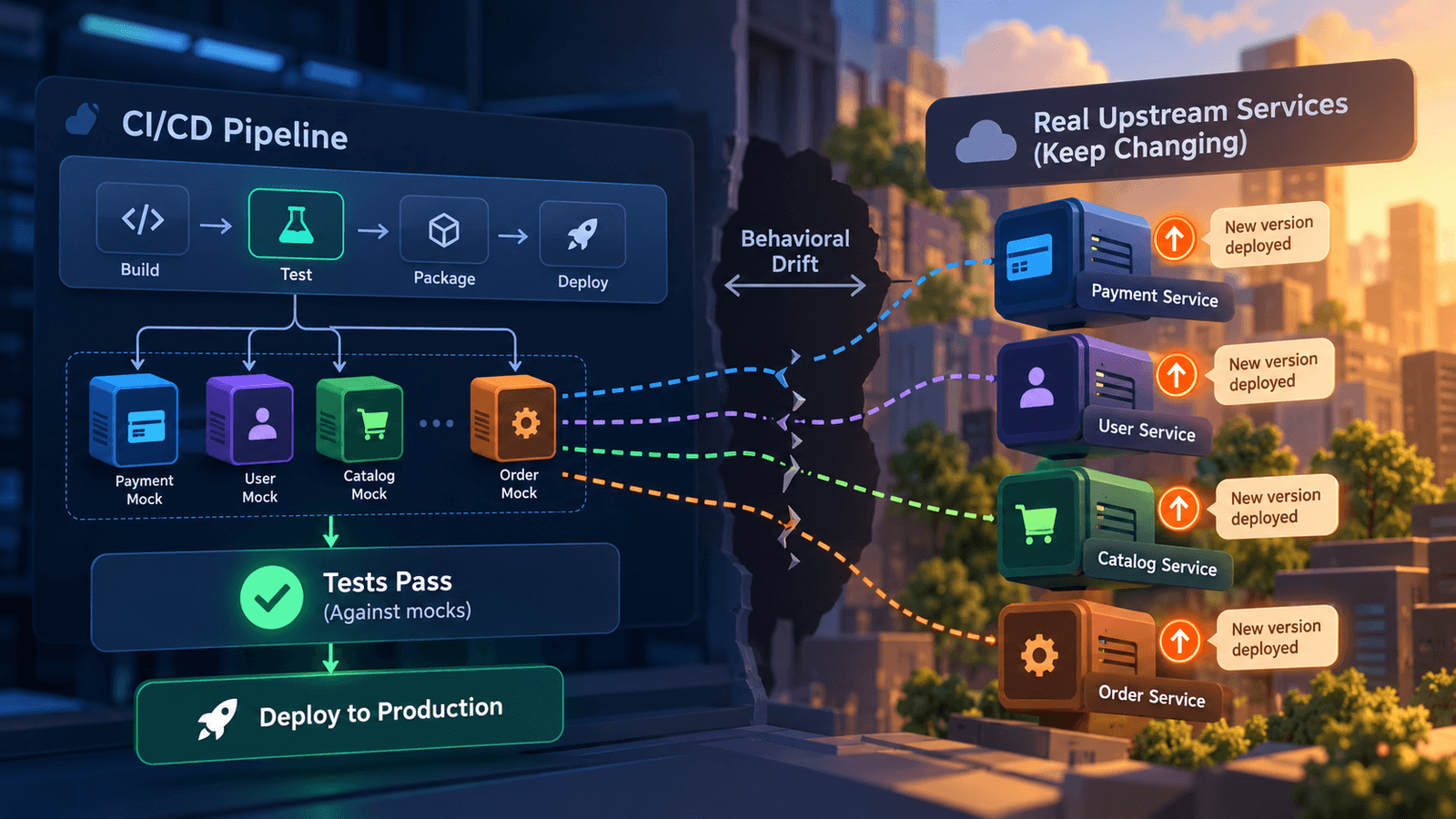
The article explains that dependency mocking can quietly undermine the reliability of CI/CD pipelines because mocks often drift away from the real behavior of upstream services. A pipeline may appear healthy — tests pass consistently, runtimes are stable, and flakiness seems low — yet still provide misleading assurance because it is validating code against outdated assumptions. As upstream microservices evolve through frequent independent deployments, mocks remain frozen in time, creating a widening gap between test environments and production reality. This leads to “operational reliability” without “informational reliability,” where the pipeline runs smoothly but no longer predicts how the software will behave once deployed. The piece stresses that every upstream deployment is a potential accuracy event for mocks, and without automated refresh mechanisms, pipelines accumulate silent risk. It also notes that teams often misinterpret green builds as proof of correctness, even though the pipeline has no visibility into real service behavior during test execution. The article’s steady message is that meaningful reliability requires connecting mock maintenance to upstream changes and validating mocks against real traffic so test results continue to reflect production truth.

Read Original Article →

The Great AI Regret: Why AI Fatigue Is a Leadership Problem, Not a Technology One

Despite the heavy investment in artificial intelligence, many employees feel increasingly anxious and disconnected from their work. Recent research shows a significant portion of knowledge workers are deeply nostalgic for how they worked before AI, and some would even prefer to remove these tools entirely. This growing fatigue and mistrust do not stem from the technology itself, but from poor leadership and implementation. Instead of freeing staff from tedious tasks, rushed rollouts often leave employees feeling surveilled, stripped of their creativity, and unfairly measured against machines. In many cases, people spend more time checking AI-generated output than they save by using it. To solve this problem, leaders must change their approach. Organizations should clearly communicate why these tools are being introduced and ensure they support meaningful work rather than just pushing for blind efficiency. By preserving human expertise and keeping people in control of important decisions, businesses can rebuild trust. When introduced thoughtfully, AI can be a helpful assistant rather than a source of frustration, leading to a much healthier workplace.

Read Original Article →

Daily Tech Digest - August 02, 2026


Quote for the day:

“If you want to be successful, you must be willing to be misunderstood for a long time.” -- Naval Ravikant

🎧 Listen to the audio debrief on YouTube

▶ Play Audio Digest

Duration: 21 mins • Perfect for listening on the go.


The 5 laptop features worth spending extra on (and 3 that are mostly hype)

When buying a new laptop, figuring out which upgrades deserve your money can be confusing. To help you get the most value out of your purchase, it helps to focus on practical features that genuinely improve your daily experience. First, invest in memory. Having 16GB of RAM is a smart baseline, while 32GB is great for heavier workloads, preventing slowdowns when multitasking. Second, upgrade the display. A high resolution and color accurate screen reduces eye strain and makes everything look clearer. Third, prioritize battery life by choosing laptops with efficient processors, allowing you to work all day without hunting for outlets. Fourth, if you edit video or play games, a dedicated graphics card and an advanced cooling system are essential to maintain performance and manage heat. On the other hand, you can confidently skip a few common additions. Touchscreens on standard laptops add extra cost and smudge easily without offering much real benefit. Similarly, extreme hardware upgrades, like top tier processors or 64GB of RAM, are unnecessary for the average person and offer diminishing returns. Finally, ignore structural gimmicks like dual screens unless they specifically solve a workflow problem for you. Stick to the essentials for a very reliable machine.


AI as an Enterprise Operating System

The concept of treating artificial intelligence as an enterprise operating system argues that large language models are evolving past being simple chatbots to become the core foundation of modern business infrastructure. Just as a traditional operating system manages computer hardware and software resources to provide common services for programs, artificial intelligence is now beginning to manage internal workflows, data routing, and complex decision processes. Instead of human employees manually navigating a dozen isolated applications to complete daily tasks, they interact with a central intelligent layer that interprets their intent, gathers necessary information from various databases, and executes actions across different systems. This shift means that the intelligence layer handles the heavy lifting of backend integration, allowing staff to use normal spoken or written language as the primary interface for their work. Making this transition requires companies to carefully rebuild their data architecture, ensuring that internal knowledge is properly structured for these models to read. Additionally, strict access controls and governance become central to this new system so agents only take allowed actions. Ultimately, viewing this technology as an operating system shifts the focus from merely buying separate software products to building a unified, robust foundation that reliably connects all business functions.


Revisiting CPU Silent Data Corruptions in Modern Datacenters

Data centers are experiencing a growing number of silent data corruptions. These are subtle hardware errors where a computer's central processing unit performs incorrect calculations without triggering any crash or system alarm, meaning the errors go entirely unnoticed. For years, the computing industry assumed these issues were incredibly rare and mostly caused by environmental factors, such as cosmic rays flipping bits in memory. However, recent findings in massive data centers show that many of these undetected errors actually originate from tiny manufacturing defects or natural wear and aging in the silicon of the processor itself. As chips become more complex and their internal components shrink to microscopic sizes, they become much more vulnerable to these hidden faults. Because the operating system does not recognize that an error has occurred, corrupted information can be permanently saved to databases or cause applications to behave unpredictably. Fixing this problem requires a significant shift in how companies test and maintain their hardware. Instead of relying solely on factory testing before deployment, operators must continuously monitor and verify processors while they are running normal workloads. By running specialized background checks, facility operators can identify and remove faulty processors before they cause meaningful harm to everyday users and their private files.


Why cybercriminals are targeting MSPs first

Cybercriminals are increasingly directing their efforts toward Managed Service Providers (MSPs) because these organizations serve as a central gateway to hundreds or thousands of client networks. Instead of attacking businesses one at a time, hackers recognize that compromising a single service provider offers access to an entire downstream ecosystem. MSPs hold the keys to client infrastructure, identity management, and cloud services. When an attacker breaches an MSP, they can steal credentials, deploy ransomware, and quietly monitor multiple environments without having to break into each one separately. This shift mirrors the industrialization of cybercrime, where attackers standardize their methods to maximize their impact in the shortest amount of time. As the risks grow, clients and regulatory bodies are scrutinizing how these providers secure their own systems. Good security is no longer just a technical feature; it is an absolute requirement for doing business. To protect themselves and their clients, service providers must move away from simply reacting to incidents after they happen. They need to study how specific threat groups operate, track emerging patterns, and use local and global intelligence to detect and stop intrusions early. Ultimately, safeguarding this central layer of access has become critical for maintaining trust across the wider business landscape today.


The Data Center’s Hidden Attack Surface: Why OT Security Can’t Wait

Data centers have become critical infrastructure for the modern economy, yet many operators overlook a significant vulnerability within their own facilities: operational technology. While perimeter security receives heavy focus, the internal physical systems that keep servers running—such as power distribution units, uninterrupted power supplies, and cooling equipment—are increasingly connected to external networks. These components often rely on outdated protocols and lack the rigorous oversight applied to standard IT networks. Because facilities teams and security departments typically operate in separate silos, a dangerous gap in accountability emerges. When these operational systems are compromised, the result is not a traditional data breach but a widespread physical outage. This risk is compounding daily as the rapid construction of new data centers to support growing artificial intelligence demands leads to supply chain vulnerabilities and hasty setups with misconfigured networks. To protect these critical assets, organizations must bridge the gap between their IT and facility teams. Leaders should prioritize clear visibility into all physical equipment, strictly separate control networks from standard business networks, and enforce strong authentication for any remote access. Ultimately, treating the security of physical infrastructure with the exact same rigor as digital data is essential for maintaining steady operations and ensuring long-term resilience against costly disruptions.


Cyber Sovereignty Isn’t a Trend. It Is the New Operating Model for Digital Trust

Data control used to be a minor compliance task, but it has now become a central priority for organizations worldwide. Because information constantly moves across various systems, maintaining genuine control over it is harder than ever. Many companies shifted to the cloud for flexibility, but this transition often obscured who actually controls the data. This illusion of safety usually shatters when a disruption, like a cyberattack or sudden legal issue, occurs. To build true resilience, organizations need to focus on recovery just as much as prevention. They must be able to restore their information quickly and confidently, which is completely impossible without clear ownership. This shift does not mean abandoning cloud services. Instead, it requires refining how we use them by keeping essential control in the hands of the organization rather than the service provider. Crucially, simply keeping data in a specific physical location is not enough. Genuine control requires legal, operational, and technical authority over the information. The rapid expansion of artificial intelligence makes this even more pressing, as these systems deeply integrate the information they process. Ultimately, treating data control as a fundamental design principle ensures that systems remain secure, easily recoverable, and fully capable of earning lasting trust in an increasingly complex environment.


Is Open-Source AI Really the Dangerous Path?

A core debate is unfolding over the future of artificial intelligence, centered on whether open source models pose a threat or offer a necessary path forward. While some governments argue for strict control over AI to ensure security, others believe that widely shared, open technology is the key to global influence and innovation. Open models currently handle a significant portion of global AI workloads, yet they capture very little of the financial value. The real contest, however, is not about the models themselves but the software built around them. Proprietary companies are attempting to lock down this surrounding infrastructure, creating systems that are difficult for users to leave. This approach mirrors older industries where buyers own the hardware but rent the essential software. For developers and users to maintain control over their tools, they must consciously support open systems, manage their own data, and avoid becoming trapped in closed ecosystems. The ongoing arguments about AI safety are often less about genuine security and more about protecting market dominance. Ultimately, the future of the technology depends on whether developers continue to choose and build upon open foundations, ensuring that power remains distributed rather than concentrated in a few hands.
In business continuity, a flawlessly performing system often hides a dangerous vulnerability known as Crisis Support Debt. Coined by Nikita Saran, it is the unseen decay of the underlying support structures, like human expertise, documentation, supply chains, operational readiness, and governance, required to restore a critical system during a disruption. Standard monitoring metrics like uptime and service level agreements only confirm that a system is currently working. Ironically, a long track record of reliability actively conceals this debt because organizations naturally shift their budgets, lifecycle reviews, and attention toward visible problems. As years pass, seasoned engineers retire, recovery runbooks become outdated, and vendor support silently lapses. The debt accumulates across five key areas: human support, knowledge, supply, operational capability, and governance. When a trigger event occurs, such as a cyberattack or a routine upgrade, this hidden debt transforms a standard disruption into a full scale crisis. Missing capabilities compound, stalling diagnosis and recovery efforts because the necessary support ecosystem no longer exists. To mitigate this hidden risk, organizations must stop relying on uptime as proof of recoverability. Instead, they should assign clear ownership for each system support ecosystem, track readiness metrics independent of performance, and routinely test whether the people and resources needed for recovery are actually available.


Technology is not fun anymore

In his article "Technology is not fun anymore," Jakub Neruda reflects on how the modern tech world has lost its charm, overshadowed by corporate control and sterile standardization. He longs for the days when technology felt like a frontier of discovery rather than a rigid system. Neruda points to the decline of local multiplayer and LAN parties, which have been replaced by centralized servers, mandatory accounts, and paid subscriptions that strip away community ownership. He notes that hacking, once characterized by relatively harmless pranks and exploration, has devolved into serious financial crime. This shift has forced the adoption of cumbersome security measures, like strict sandboxing, which often hinder the user experience. Similarly, the web has transformed from a quirky, experimental space of personal sites and message boards into a repetitive sea of corporate templates and predictable layouts. Neruda also highlights the forgotten ingenuity of older tools, such as Windows HTML applications, which offered native capabilities long before current frameworks existed. Finally, he laments the shift in mobile gaming from high-quality premium titles to exploitative games built around timers and constant payments. However, he remains hopeful that modern phone hardware might eventually revive the classic premium gaming experience we once had.


The New ROI: Return On Integrity

In an era where artificial intelligence makes information readily available, trust has become increasingly scarce. This shift highlights a new approach to business value, moving away from traditional financial metrics toward what can be called a return on integrity. While technology can analyze data and generate content at remarkable speeds, it cannot build relationships, exercise reliable judgment, or earn a solid reputation over time. Those remain distinctly human capabilities. The foundation of lasting business success relies on trust. Every kept promise strengthens your reputation, acting as a reliable currency that builds customer loyalty, keeps employees engaged, and supports long-term performance. In contrast, broken promises quickly erode that standing. As automated systems become the norm, genuine human interactions stand out as highly valuable. Simple actions, such as remembering a name or taking the time for a personal phone call, leave a lasting impression that algorithms simply cannot replicate. Ultimately, technology should handle routine efficiency, freeing up people to focus on building meaningful connections and exercising sound judgment. The organizations that will consistently thrive are those that recognize this balance. By prioritizing human relationships, personal respect, and consistent integrity, businesses can secure a competitive advantage that cannot be easily copied or replaced.

Daily Tech Digest - July 02, 2026


Quote for the day:

"Winners are not afraid of losing. But losers are. Failure is part of the process of success. People who avoid failure also avoid success." -- Robert T. Kiyosaki

🎧 Listen to this digest on YouTube Music

▶ Play Audio Digest

Duration: 25 mins • Perfect for listening on the go.


Shadow agents: How IT leaders must govern ‘headless’ AI before it breaks the enterprise

As businesses increasingly rely on autonomous artificial intelligence to handle complex tasks, technology leaders are facing a new security challenge. Invisible AI programs are operating in the background of enterprise networks, completing workflows without logging in or leaving standard audit trails. Driven by the high costs of cloud computing, organizations are shifting these automated tools to run locally on employee laptops. Because conventional security systems are designed to monitor human behavior, they cannot track these automated processes, leaving teams blind to what the software is accessing or deciding. To safely manage this shift, companies need to move away from traditional perimeter defenses and adopt strict containment strategies. By placing these programs in isolated environments, organizations can strictly control their permissions and limit their access to sensitive information. This transition also requires dedicated engineers focused on establishing behavioral rules, testing instructions, and securing data retrieval. Governing these automated systems at scale demands centralized oversight and clear policies. By establishing this accountability infrastructure now, technology leaders can confidently harness the power of autonomous software without compromising their security or losing visibility into their own networks.


The 20 Software Engineering Laws

The DZone article "The 20 Software Engineering Laws" by Dr. Milan Milanovic explores fundamental principles that dictate how software projects actually unfold, rather than how we hope they will. Instead of focusing on code syntax, these laws address the human, organizational, and structural realities that engineers face when working under pressure. The piece categorizes these principles into several practical themes, such as system building, speed, planning, and metrics. For instance, laws related to system building include Conway’s Law, which states that a system’s architecture inevitably mirrors a company's communication structure, and Gall’s Law, reminding us that successful complex systems must evolve from working simple ones. When exploring lost speed, the author highlights Brooks’s Law, explaining why adding more developers to a late project only delays it further. The article also tackles planning and metrics, citing Parkinson's Law, where work expands to fill available time, and Goodhart's Law, which warns that when a measure becomes a target, it stops being a good measure. By grounding these concepts in real-world examples like Instagram's pivot and Berlin's delayed airport, the article provides a practical framework to help engineers navigate common pitfalls with confidence and clarity.


Machine Unlearning with Minimal Gradient Dependence for High Unlearning Ratios

As machine learning systems process enormous volumes of information, the ability to make them forget specific private data is increasingly critical for security. A recent research paper introduces Mini-Unlearning, a method designed to tackle the difficulties of removing information when a large proportion of the original data must be forgotten. Traditional approaches to this problem usually require saving extensive records of past training updates, which demands heavy memory usage and becomes inefficient at scale. To resolve this, Mini-Unlearning operates on the mathematical insight that unlearned settings naturally correspond to retrained settings through a predictable geometric relationship. By taking advantage of this relationship, the new technique effectively calculates necessary adjustments using only a tiny subset of recent training updates. This approach completely bypasses the need for full historical records, greatly lowering the required computational power and memory. Testing shows that this lightweight method successfully deletes targeted personal information while maintaining overall system accuracy and effectively defending against targeted attempts to uncover hidden user data. Ultimately, this scalable solution allows organizations to reliably comply with strict privacy regulations without compromising the performance or efficiency of their broader systems.


Reliability Comes From the System, Not the Agent

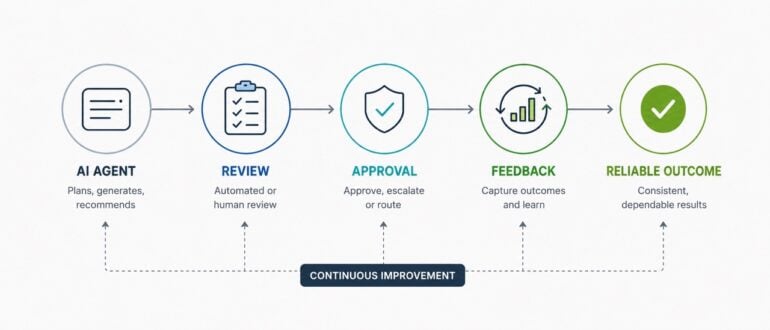
When adopting artificial intelligence, many executives mistakenly judge an AI agent’s reliability in complete isolation. This perspective stems from traditional software development practices, where individual components are expected to function perfectly on their own. However, in complex or high-stakes environments—such as aviation or healthcare—reliability has never depended on the perfection of a single actor. Instead, it naturally emerges from a well-designed surrounding system that anticipates and catches inevitable human errors before they can escalate into a larger issue. The exact same principle applies directly to artificial intelligence agents. Rather than waiting around for a completely flawless model, organizations should focus their efforts on building robust workflows around these tools. A truly dependable system assumes occasional failures and uses practical safeguards like approval gates, continuous feedback loops, and risk-based reviews to ensure consistent outcomes. When an agent produces an error, it is not necessarily a sign that the technology is unready; rather, it highlights the pressing need for stronger operational structures. Ultimately, the competitive advantage in AI will not come from choosing the best model, but from designing resilient organizational workflows that gracefully handle imperfections and deliver predictable results over time.


Detection engineering: A programmatic approach to identifying cyber threats

Detection engineering is rapidly becoming a key focus for cybersecurity teams as organizations look to defend against increasingly advanced digital threats. Instead of relying heavily on rigid, pre-built rules that often fail to catch modern attacks, detection engineering takes a highly tailored approach. It involves building customized systems designed to spot suspicious behaviors specific to an organization’s unique environment, effectively minimizing the flood of false alarms that commonly overwhelm security teams today. The growing interest in this practice is driven by the realization that traditional, signature-based security methods are no longer sufficient to stop modern tactics like fileless malware or complex attacks on cloud infrastructure. By carefully mapping out potential attack paths and analyzing real-world adversary behavior, companies can proactively spot threats rather than just reacting after a damaging incident has occurred. Recent surveys indicate that the vast majority of large enterprises are heavily investing in these active strategies, with many now establishing dedicated detection teams. Additionally, artificial intelligence and automation are playing crucial roles in helping these professionals fine-tune rules and process vast amounts of threat data. Ultimately, adopting detection engineering reduces the time attackers can hide within a network, greatly improving an organization's overall cyber resilience.


Compute Concentration: The Emerging Enterprise Risk Inside the AI Economy

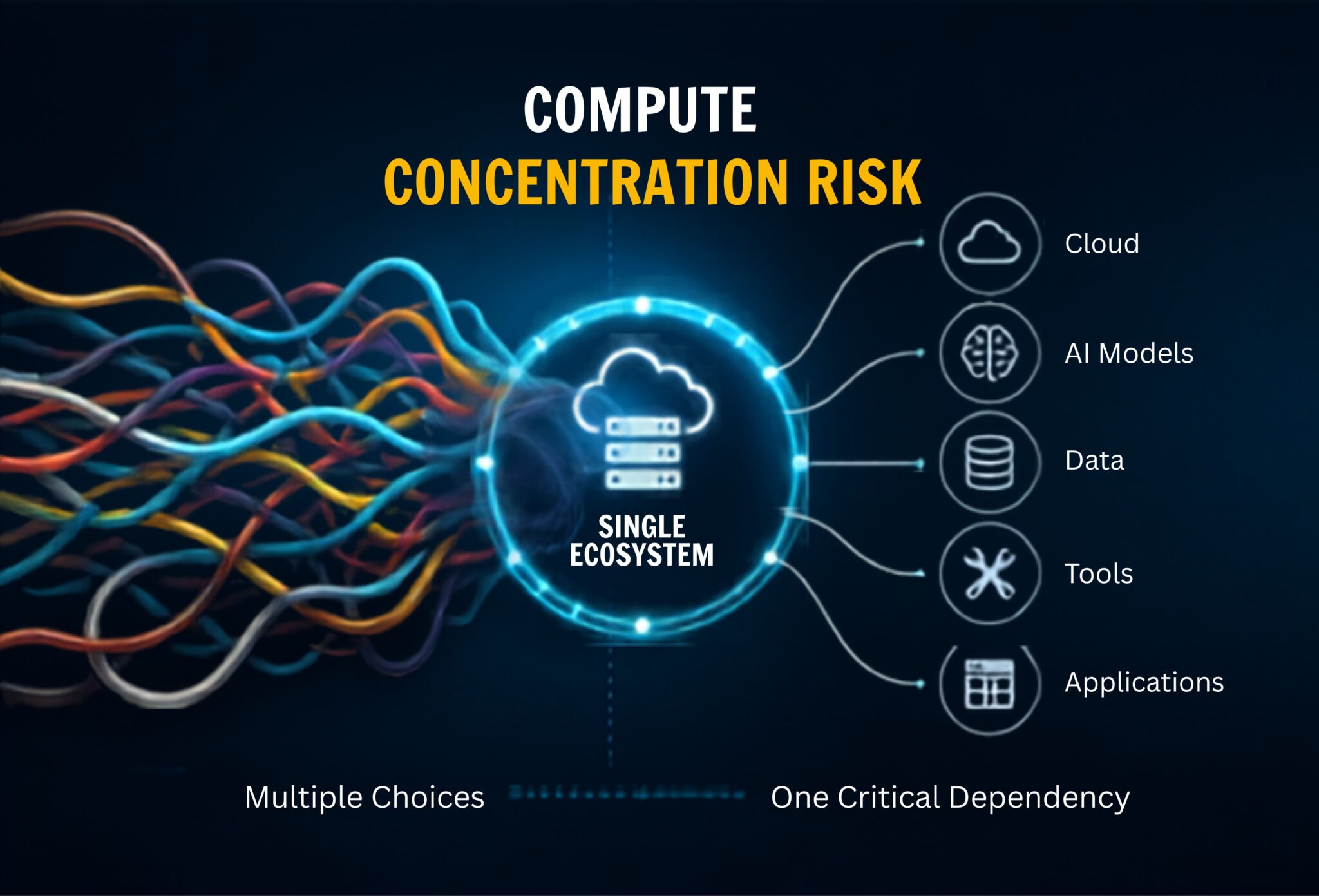
As artificial intelligence transitions from testing to full-scale operations, a new, hidden challenge is emerging for modern businesses: compute concentration. This happens when companies quietly become overly reliant on a very small group of external providers for the core infrastructure needed to run their systems, such as cloud storage, data centers, and computer chips. Often, this dependency develops by accident. A company might start with one provider for ease of use and speed, eventually deeply intertwining all their critical functions within a single technology ecosystem. While working with large providers offers undeniable benefits like strong security and massive scale, heavy reliance creates significant vulnerabilities. If a primary provider experiences an outage, changes their pricing, or alters their policies, the affected business faces immediate disruptions, unexpected costs, and a loss of control over their own operations. It is not just about managing vendors; it is a fundamental issue of business continuity and strategic independence. True resilience does not mean avoiding large providers entirely, but rather fully understanding these deep dependencies. Organizations must ensure they have viable alternatives ready so they are not caught off guard if their primary technology foundation shifts.


Preventing agent-generated infrastructure bloat through spec-driven governance

Autonomous AI engineering agents can drastically improve software delivery speed, but they also risk creating massive infrastructure bloat if left unchecked. Because these agents often default to the inefficient patterns found in their training data, they frequently over-provision resources—such as requesting excessively large Kubernetes pods or pulling bloated container images. This inefficiency replicates rapidly across environments, wasting cloud space and increasing energy consumption. To prevent this, organizations must implement strict, spec-driven governance directly within their development pipelines. Instead of treating sustainability and efficiency as afterthoughts, engineering teams need to embed clear constraints into their infrastructure specifications. By defining rules for machine types, pod resource limits, and minimal base images before the agent generates any code, the agent is forced to execute within those boundaries. Organizations can enforce these constraints using static analysis tools and quality gates that block non-compliant deployments. Addressing this issue upstream ensures that agent-driven development yields efficient, cost-effective, and sustainable infrastructure by design, rather than creating a sprawling operational mess that becomes nearly impossible to fix later.


Agentic AI creates enterprise challenge beyond LLM boom

As businesses move beyond early experiments with artificial intelligence, they face a practical new challenge: managing and governing the automated software programs, or agents, that will soon work alongside human employees. While recent attention has focused on language models, the conversation is shifting toward the infrastructure needed to support these agents. Companies must figure out how to integrate them, control their access to company data, and manage the costs associated with running them. A primary issue is matching the right level of computing power to specific tasks to keep expenses predictable and responses consistent. Because current technology frameworks were built for human users, new standards are emerging to help these agents communicate securely with existing systems. Over time, managing the lifecycle of these digital assistants will become essential to prevent the lack of oversight that accompanied early cloud software adoption. As regulations develop unevenly across different regions, leaders are currently focused on learning how to build the right foundations. Soon, companies will shift from planning to execution, preparing for a future where each employee might collaborate with several automated assistants daily, requiring careful oversight and clear guidelines.


The rise of emotion as a trust signal

Digital identity systems are evolving beyond traditional passwords and basic biometrics by incorporating emotion as a new trust signal. Voice artificial intelligence is now being trained to analyze vocal cues—such as tone and pacing—to determine a speaker's underlying emotional state. By converting these real-time observations into structured data, companies hope to better understand customer intent, improve service routing, and identify potential signs of fraud or distress during live interactions. While this technology aims to close the gap between what people say and what they actually mean, it introduces significant privacy and ethical concerns. Inferring human emotion is inherently complex and can easily lead to bias or inaccurate risk profiling if used improperly. Consequently, industry experts caution that emotional data should merely provide helpful context rather than serve as definitive proof of identity or deception. As the market for this technology grows, organizations must implement it responsibly. This means ensuring clear user consent, strictly limiting data retention, and mandating human oversight so that unverified emotional inferences do not independently drive critical decisions regarding a person's access, credit, or employment.


The endpoint recovery gap many teams discover during an incident

Organizations often make a costly mistake by assuming that having data backups is the same as having a comprehensive recovery plan. According to Matthias Haas, CTO of IGEL, backups are essential for restoring information and applications, but they do not automatically grant users safe access back into their work environments. When a significant incident occurs and knocks thousands of devices offline, companies frequently realize they have planned for infrastructure recovery while completely ignoring endpoint recovery. This gap leads to enormous expenses tied to replacing hardware, reimaging devices, and coordinating manual repairs. A well-planned architecture must focus on restoring both the systems themselves and the trusted access to those systems. Rather than relying on technical heroics to fix thousands of individual devices during a crisis, businesses need pre-planned alternative paths, such as dual-boot options or secure browser resources. The true measure of resilience is not the number of threats a security team blocks, but the time it takes to safely restore trusted user access. By calculating the actual per-hour cost of interrupted workflows, security leaders can successfully justify investing in solid endpoint recovery before an incident even happens.