Showing posts with label debugging. Show all posts

Daily Tech Digest - November 12, 2026

Quote for the Day
“You can’t fix a team by fixing individuals; you fix a team by fixing interactions.”
— Esther Derby
Audio Edition — Listen to Today’s Digest
Narrated version of the Daily Tech Digest
Article Thumbnail

The Rise of AI Site Reliability Engineers – Can Autonomous Agents Handle Production Incidents

The role of Site Reliability Engineering is undergoing a major shift as AI-driven autonomous agents take on the responsibility of managing production incidents. While traditional automation simply executed static scripts, modern AI tools can read logs, spot anomalies, and actively reroute traffic or roll back deployments without human intervention. This capability drastically accelerates incident recovery and reduces alert fatigue, allowing minor outages to be fixed before users ever notice them. However, relying entirely on autonomous systems introduces hidden dangers to overall stability. AI agents lack the situational context and intuition required for messy, unprecedented failures, and their speed means a wrong decision can instantly cascade across an entire infrastructure. Moreover, these automated quick fixes can easily mask deeper underlying infrastructure problems that silently worsen over time until a massive failure occurs. Consequently, the future of system operations is not a fully human-free environment. Instead, human engineers are transitioning from frontline firefighters to strategic architects. Their new focus is on setting boundaries, designing guardrails, and managing the AI systems to ensure that automation acts safely and effectively when standard procedures inevitably fail.

Read Original Article →

Moving from organisational implementation to scaling of AI

As organizations rapidly adopt artificial intelligence, the next major hurdle is scaling that technology to achieve measurable impact, according to a recent global survey by BearingPoint. While many companies successfully launch small AI pilots to automate tasks and increase capacity, deeply integrating these solutions across the enterprise remains rare. Without proper planning, businesses risk falling into an "AI productivity trap," where new technology fails to improve financial performance or support sustainable growth. Moving from a pilot to widespread use requires strict attention to governance, regulatory compliance, data accountability, and adapting workforce structures to support new capabilities. The report highlights that organizations must balance the agility to experiment with the discipline required to build strong foundations for scaling. Interestingly, Irish organizations are particularly ambitious, prioritizing agentic AI and actively assessing their skills gaps, though they still face challenges in enterprise-wide rollout. Ultimately, successful AI scaling depends on connecting investment to clear financial goals and treating workforce strategy as an integral part of the AI roadmap, ensuring that technological capacity is converted into genuine, long-lasting organizational value.

Read Original Article →
Article Thumbnail

Choosing QuePaxa, an unusual consensus algorithm

Cloudflare explains why it chose QuePaxa, a relatively new consensus algorithm, for Meerkat, its experimental distributed service for managing a global control plane. Traditional approaches such as Raft and Paxos often depend on a leader to coordinate decisions. They work well when networks are stable, but a slow, disconnected, or failed leader can stall the system while other machines detect the problem and elect a replacement. This becomes difficult across global networks, where latency and temporary connectivity problems are common. QuePaxa takes a different approach: its leader is optional, other machines can continue proposing decisions, and proposals cooperate rather than repeatedly blocking one another. Under good network conditions, the leader can still reach agreement quickly. When conditions deteriorate, the system may slow down but can continue processing requests without waiting for formal failure detection. Cloudflare says its Meerkat evaluations across widely distributed servers showed this behaviour in practice. The trade-off is maturity: QuePaxa has not been tested as extensively as established alternatives. Cloudflare is therefore using formal verification, simulation, and fault-injection testing as it develops the implementation further.

Read Original Article →

Measuring AI’s Unintended Consequences

As teams increasingly adopt AI to accelerate software development, measuring its unintended consequences becomes critical for long-term sustainability. While AI tools boost delivery speed, heavy reliance on them can generate complex code that humans struggle to understand, potentially causing developer burnout, vendor lock-in, and rising maintenance costs. The core metric to monitor these hidden costs is the "cost of change," which acts like a tax on every software update you make. To gauge this effectively, engineering leaders should track their value-add percentage—the ratio of time spent building new features versus non-value-add tasks like bug fixes and technical debt. While a certain baseline of maintenance is unavoidable, a declining value-add percentage indicates that AI-generated code is increasing organizational drag. Other helpful indicators include standard deployment metrics and individual AI token usage patterns. Because these data points are inherently noisy and can take months to reveal clear trends, organizations should supplement them with forward-looking maintenance models and scenario planning. Ultimately, relying on both data tracking and strategic models allows leaders to make informed judgments and protect their teams' capacity for meaningful work.

Read Original Article →
Article Thumbnail

Building the infrastructure of consent for India’s digital economy

The growth of India’s digital economy depends on building a robust infrastructure of consent. At its core, the Data Empowerment and Protection Architecture (DEPA) forms the foundation of this ecosystem by changing how user data is managed and shared across sectors. Instead of keeping data locked in rigid, isolated systems, this framework places control back in the hands of the individual. Through a network of licensed account aggregators, users can securely share their financial or personal information with service providers they trust—and they can revoke that access at any time. This approach not only simplifies compliance for businesses but also builds deep trust with consumers by offering transparency and choice. By prioritizing privacy alongside progress, India is setting a global standard for digital rights. For businesses, adopting these transparent practices means better customer relationships and a streamlined approach to offering personalized services. Ultimately, building a secure, consent-based infrastructure ensures that innovation serves everyone fairly, turning data protection from a simple regulatory checklist into a fundamental driver of a thriving, inclusive digital economy.

Read Original Article →

The Cyber Resilience Act clock doesn’t stop for weekends

In a recent Help Net Security interview, Copla CEO Aurimas Bakas explores the demanding reality of the EU Cyber Resilience Act (CRA) and its stringent vulnerability reporting mandates. While many company boards fixate on the CE marking deadline of December 2027, they overlook that active vulnerability reporting obligations already took effect in September 2026. This timeline gap creates significant risk, as non-compliance carries massive penalties. To prepare, organizations must develop a comprehensive register of every product version currently running in customer environments, including legacy firmware. Bakas emphasizes that the 24-hour reporting clock begins the moment a company becomes aware of an exploited flaw. This makes it critical to define what “awareness” means internally and clearly designate who has the authority to initiate the countdown—even at 2 a.m. on a Sunday. He advises CISOs to contractually bind suppliers to strict reporting timeframes matching their regulatory requirements. Finally, conducting unannounced tabletop exercises on weekends can reveal whether a team can realistically execute a handover, verify their multi-factor authentication, and draft an early warning within the mandatory 24-hour window.

Read Original Article →
Article Thumbnail

US Democrats prepare to scrutinize federal biometric surveillance

With Democrats set to take control of Congress, federal use of biometric surveillance and digital identity systems is about to face intense scrutiny. Lawmakers are preparing to investigate existing surveillance infrastructure, particularly within the Department of Homeland Security, focusing on facial recognition, mobile biometric identification, and the commercial data brokers that support these systems. However, they face a complicated reality. Billions of dollars in previously approved funding are already locked in for border security and immigration enforcement technologies, making it difficult to simply defund these programs. As a result, Congress is expected to lean heavily on its investigative powers to demand accountability and transparency from agencies and their private contractors. The core challenge will be determining which biometric applications are legitimate and establishing clear boundaries for their use. While some lawmakers advocate for strict moratoriums on facial recognition and new federal privacy laws to regulate how companies handle sensitive data, others recognize the need to modernize digital identity infrastructure to prevent fraud. The upcoming legislative session will likely focus on finding a balance between security needs and privacy protections.

Read Original Article →
Article Thumbnail

The iOS Crash We Could Not Reproduce

Debugging intermittent production crashes in iOS applications can often be a frustrating experience, especially when the logs lack a clear stack trace and local testing fails to reproduce the issue. This scenario unfolded in a large-scale consumer app where a vague SIGBUS error tied to NSAttributedString appeared randomly, resisting all initial attempts to pinpoint the failing code. While early defensive fixes—such as tightening object ownership and updating concurrency patterns with async/await and MainActor—lowered the overall crash rate, they merely altered the timing of the defect rather than solving the underlying problem. The turning point occurred when a QA engineer managed to probabilistically reproduce the crash on a specific device, transforming speculative debugging into testable engineering work. This controlled fault isolation eventually revealed that HTML imports through NSAttributedString have a strict main-thread requirement, which is easily overlooked when the call is nested within asynchronous screen preparation. Ultimately, implementing a shared main-actor abstraction proved to be a much stronger and more reliable safeguard than expecting developers to remember a nuanced framework threading rule at every single call site.

Read Original Article →
Article Thumbnail

Why does old access outlive the job?

Organizations consistently struggle with lingering access rights because granting permissions is fast and driven by clear business needs, while removing them is an overlooked administrative chore. When employees change roles, their new access is typically approved within hours so they can start working. However, their old permissions often remain active simply because no one takes ownership of revoking them. During routine security reviews, managers frequently rubber-stamp existing access levels because dashboards rarely show if the permissions are actually being used, and removing them might accidentally break a process. To fix this dangerous oversight without adding expensive new software, companies need to treat every internal job transfer as an offboarding event where old managers explicitly confirm what is no longer needed. Additionally, assigning clear expiration dates and named owners to all permissions prevents endless access creep. Finally, displaying the last login timestamp directly on security review screens makes it much easier for managers to confidently delete dormant accounts. By treating permission removal with the same urgency as granting it, organizations can dramatically shrink their security vulnerabilities.

Read Original Article →
Article Thumbnail

eMudhra Revokes 8 More CAs It Previously Declared Unaffected by Key Compromise

The Python script responsible for eMudhra's October key compromise has now resulted in the revocation of eight additional intermediate certificate authorities (CAs), despite earlier claims that they were unaffected. According to the company's recent incident report, these eight CAs were revoked after an internal investigation revealed that their RSA keys were processed through the same flawed python script during a key ceremony in April 2025. Although the script did not shorten these RSA keys to a single byte—the critical error that compromised the original eight ECDSA keys—the private keys were still exposed in the memory of the ceremony computer. Because eMudhra cannot definitively prove that this handling met its own strict compliance standards or verify exactly how the key material was managed, the company was forced to revoke the CAs. These certificates were used for websites and code signing across various organizations. As a broader response, eMudhra is currently exiting the publicly trusted TLS certificate business, with major browsers like Microsoft, Google, and Apple scheduled to phase out trust in their remaining root certificates by late November.

Read Original Article →

Daily Tech Digest - May 02, 2026


Quote for the day:

“The more you loose yourself in something bigger than yourself, the more energy you will have.” - Norman Vincent Peale

🎧 Listen to this digest on YouTube Music

▶ Play Audio Digest

Duration: 17 mins • Perfect for listening on the go.


The architectural decision shaping enterprise AI

In "The architectural decision shaping enterprise AI," Shail Khiyara argues that the long-term success of enterprise AI initiatives hinges on an often-overlooked architectural choice: how a system finds, relates, and reasons over information. The article outlines three primary patterns—vector embeddings, knowledge graphs, and context graphs—each offering unique advantages and trade-offs. Vector embeddings excel at identifying semantically similar unstructured data, making them ideal for rapid RAG deployments, yet they lack deep relational understanding. Knowledge graphs provide precise, traceable answers by mapping explicit relationships between entities, though they are resource-intensive to maintain. Crucially, Khiyara introduces context graphs, which capture the dynamic reasoning behind decisions to ensure continuity across multi-step workflows. Unlike static models, context graphs treat reasoning as a first-class data artifact, allowing AI to understand the "why" behind previous actions. The most effective enterprise strategies do not choose one in isolation but instead layer these patterns to balance speed, precision, and contextual awareness. Ultimately, Khiyara warns that leaving these decisions to default configurations leads to "confident mistakes" and trust erosion. For CIOs, intentional architectural design is not just a technical necessity but a fundamental business imperative to transition from isolated pilots to scalable, reliable AI ecosystems that deliver genuine organizational value.


The Evidence and Control Layer for Enterprise AI

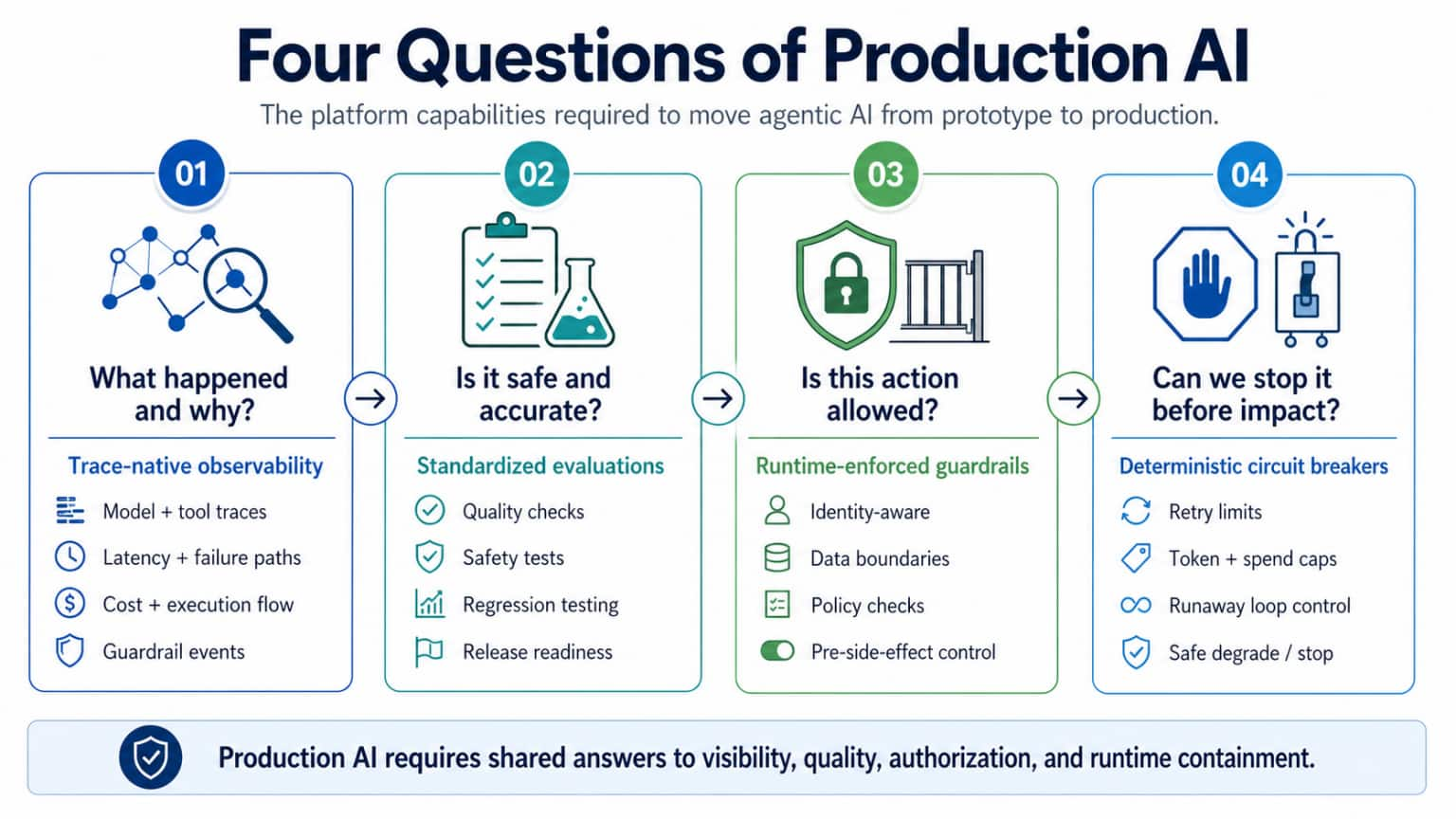
The article "The Evidence and Control Layer for Enterprise AI" by Kishore Pusukuri argues that the transition from AI prototypes to production requires a robust architectural layer to manage the inherent unpredictability of agentic systems. This "Evidence and Control Layer" acts as a shared platform substrate that mediates between agentic workloads and enterprise resources, shifting governance from retrospective reviews to proactive, in-path execution controls. The framework is built upon three core pillars: trace-native observability, continuous trace-linked evaluations, and runtime-enforced guardrails. Unlike traditional logging, trace-native observability captures the complete execution path and decision context, providing the foundation for operational trust. Continuous evaluations act as quality gates, while runtime guardrails evaluate proposed actions—such as tool calls or data transfers—before side effects occur, ensuring safety and compliance in real-time. By formalizing policy-as-code and generating structured evidence events, the layer ensures that every material action is explicit, auditable, and cost-bounded. Ultimately, this centralized approach accelerates enterprise adoption by providing reusable governance defaults, effectively closing the "stochastic gap" and transforming black-box agents into trusted, scalable enterprise assets that operate with clear authority and within defined budget constraints.


Organizational Culture As An Operating System, Not A Values System

In the article "Organizational Culture As An Operating System, Not A Values System," the author argues that the traditional definition of culture as a static set of internal values is no longer sufficient in a hyper-connected world. Modern organizational culture must be reframed as a dynamic operating system that bridges internal decision-making with external community engagement. While internal culture dictates how information flows and authority is exercised, external culture defines how a brand interacts with decentralized movements in art, fashion, and social identity. The disconnect often arises because corporate hierarchies prioritize control and predictability, whereas external cultural trends move at a high velocity from the periphery. To remain relevant, organizations must shift from a "broadcast" model to one of "co-creation," where authority is distributed to those closest to social signals and speed is enabled by trust rather than bureaucratic process. By treating culture with the same rigor as any other core business function, leaders can diagnose internal friction and align incentives to ensure the organization moves at the "speed of culture." Ultimately, success depends on building internal systems that allow companies to participate in and shape cultural conversations in real time, moving beyond corporate manifestos to authentic community collaboration.


Re‑Architecting Capability for AI: Governance, SMEs, and the Talent Pipeline Paradox

The article "Re-architecting Capability for AI Governance: SMEs and the Talent Pipeline Paradox" examines the profound obstacles small and medium-sized enterprises encounter while attempting to establish formal AI oversight. Central to the discussion is the "talent pipeline paradox," which describes how the concentration of AI expertise within large technology firms creates a vacuum that leaves smaller organizations vulnerable. To address this, the author advocates for a strategic shift from talent acquisition to capability re-architecting. Rather than competing for scarce high-end specialists, SMEs should integrate AI governance into their existing business architecture through modular and risk-based frameworks. This approach emphasizes the importance of leveraging cross-functional internal teams, automated tools, and external partnerships to manage algorithmic risks effectively. By focusing on scalable governance patterns and clear accountability, SMEs can achieve ethical and regulatory compliance without the overhead of massive administrative departments. Ultimately, the piece suggests that the key to overcoming resource limitations lies in structural agility and the democratization of governance tasks. This enables smaller firms to harness the transformative power of artificial intelligence safely while maintaining a competitive edge in an increasingly automated global marketplace where talent remains the ultimate bottleneck.


The AI scaffolding layer is collapsing. LlamaIndex's CEO explains what survives

In this VentureBeat interview, LlamaIndex CEO Jerry Liu explores the significant transformation occurring within the "AI scaffolding" layer—the software stack connecting large language models to external data and applications. As frontier models increasingly incorporate native reasoning and retrieval capabilities, Liu suggests that simplistic RAG wrappers are rapidly losing their utility, leading to a "collapse" of the middle layer. To survive this consolidation, infrastructure tools must evolve from thin architectural shells into robust systems that manage complex data pipelines and orchestrate sophisticated agentic workflows. Liu emphasizes that while base models are becoming more powerful, they still lack the specialized, proprietary context required for high-stakes enterprise tasks. Consequently, the future of AI development lies in solving "hard" data problems, such as handling heterogeneous sources and ensuring data quality at scale. Developers are encouraged to pivot away from basic integration toward building deep, specialized intelligence layers that provide the structured context models inherently lack. Ultimately, the survival of platforms like LlamaIndex depends on their ability to offer advanced orchestration and data management that transcends the capabilities of the base models alone, marking a shift toward more resilient and professionalized AI engineering.


Guide for Designing Highly Scalable Systems

The "Guide for Designing Highly Scalable Systems" by GeeksforGeeks provides a comprehensive roadmap for building architectures capable of managing increasing traffic and data volume without performance degradation. Scalability is defined as a system’s ability to grow efficiently while maintaining stability and fast response times. The guide highlights two primary scaling strategies: vertical scaling, which involves enhancing a single server’s capacity, and horizontal scaling, which distributes workloads across multiple machines. To achieve high scalability, the article emphasizes the importance of architectural decomposition and loose coupling, often implemented through microservices or service-oriented architectures. Key components discussed include load balancers for even traffic distribution, caching mechanisms like Redis to reduce backend load, and advanced data management techniques such as sharding and replication to prevent database bottlenecks. Furthermore, the guide covers essential architectural patterns like CQRS and distributed systems to improve fault tolerance and resource utilization. Modern applications must account for various non-functional requirements such as availability and consistency while scaling. By prioritizing stateless designs and avoiding single points of failure, organizations can create robust systems that handle peak usage and unpredictable growth effectively. Ultimately, designing for scalability requires balancing cost, performance, and complexity to ensure long-term reliability in a dynamic digital landscape.


Why Debugging is Harder than Writing Code?

The article "Why Debugging is Harder than Writing Code" from BetterBugs examines the fundamental reasons why developers spend nearly half their time fixing issues rather than creating new features. The core difficulty lies in the disparity between the "happy path" of initial development and the exponential state space of potential failures. While writing code involves building a single successful outcome, debugging requires navigating a combinatorially vast range of unexpected inputs and conditions. This process imposes a significant cognitive load, as developers must maintain a massive context window—often jumping between different files, servers, and logs—which incurs heavy switching costs. Furthermore, modern complexities like distributed systems, non-deterministic concurrency, and discrepancies between local and production environments add layers of friction. In concurrent systems, for instance, the mere act of observing a bug can change the timing and make the issue disappear. Ultimately, the article argues that debugging is more demanding because it forces engineers to move beyond theoretical models and confront the messy realities of hardware limits, memory leaks, and network latency. To manage these challenges, the author suggests that teams must prioritize observability and evidence-based reporting tools to bridge the gap between mental models and actual system behavior, ensuring more predictable software lifecycles.


Cybersecurity: Board oversight of operational resilience planning

The A&O Shearman guidance emphasizes that as cyberattacks grow more sophisticated and regulatory scrutiny intensifies, boards must adopt a proactive stance toward operational resilience. With the emergence of unpredictable criminal gangs and AI-driven threats, it is no longer sufficient to treat cybersecurity as a purely technical issue; it is a critical governance priority. To exercise effective oversight, boards should appoint dedicated individuals or committees to monitor cyber risks and ensure that Business Continuity and Disaster Recovery (BCDR) plans are robust, defensible, and accessible offline. Practical preparations must include clear decision-making protocols and alternative communication channels, such as Signal or WhatsApp, for use during systems outages. Additionally, leadership should oversee the development of pre-approved communication templates for stakeholders and define strict Recovery Time Objectives (RTOs). A cornerstone of this framework is the implementation of regular tabletop exercises and technical recovery drills that involve third-party providers to identify vulnerabilities. By documenting these proactive measures and integrating lessons learned into evolving strategies, boards can meet regulatory expectations for evidence-based oversight. Ultimately, this comprehensive approach to resilience planning helps organizations minimize the risk of material revenue loss and navigate the complexities of a volatile global digital landscape.


Beyond the Region: Architecting for Sovereign Fault Domains and the AI-HR Integrity Gap

In "Beyond the Region," Flavia Ballabene argues that software architects must evolve their definition of resilience from surviving mechanical failures to navigating "Sovereign Fault Domains." Traditionally, redundancy across Availability Zones addressed physical infrastructure outages; however, modern geopolitical shifts and evolving privacy laws now create "blast radii" where data becomes legally trapped or AI models suddenly non-compliant. Ballabene highlights an "AI-HR Integrity Gap," where centralized systems fail to account for regional jurisdictional constraints. To bridge this, she proposes shifting toward sovereignty-aware infrastructures. Key strategies include Managed Sovereign Cloud Models, which leverage localized partner-led controls like S3NS or T-Systems, and Cell-Based Regional Architectures, which deploy independent stacks for each major market to eliminate reliance on a global control plane. These approaches allow organizations to maintain operational continuity even when specific regions face regulatory upheavals. By auditing AI dependency graphs and prioritizing data residency, executives can transform compliance from a burden into a competitive advantage. Ultimately, the article suggests that in a fragmented global cloud, the most resilient HR and technology stacks are those built on digital trust and localized integrity, ensuring they remain robust against both technical glitches and the unpredictable tides of international policy.


Designing resilient IoT and Edge Computing with federated tinyML

The article "Real-time operating systems for embedded systems" (available via ScienceDirect PII: S1383762126000275) provides a comprehensive examination of the architectural requirements and performance constraints inherent in modern real-time operating systems (RTOS). As embedded devices become increasingly integrated into safety-critical infrastructure, the study highlights the transition from simple cyclic executives to sophisticated, preemptive multitasking environments. The authors analyze key RTOS components, including deterministic scheduling algorithms, interrupt latency management, and inter-process communication mechanisms, emphasizing their role in ensuring temporal correctness. A significant portion of the discussion focuses on the trade-offs between monolithic and microkernel architectures, particularly regarding memory footprint and system reliability. By evaluating various commercial and open-source RTOS solutions, the research demonstrates how hardware-software co-design can mitigate the overhead typically associated with complex task synchronization. Ultimately, the paper argues that the future of embedded systems lies in adaptive RTOS frameworks that can dynamically balance power efficiency with the rigorous timing demands of Internet of Things (IoT) applications. This synthesis serves as a vital resource for engineers seeking to optimize system predictability in increasingly heterogeneous computing environments, ensuring that software responses remain consistent under peak load conditions.

Daily Tech Digest - January 17, 2026


Quote for the day:

"Success does not consist in never making mistakes but in never making the same one a second time." -- George Bernard Shaw


Expectations from AI ramp up as investors eye returns in 2026

Billions in investments and a concerted focus on the tech over the past few years has led to artificial intelligence (AI) completely transforming how major global industries work. Now, investors are finally expecting to see some returns. ... Investors will no longer be satisfied with AI’s potential future capabilities – they want measurable returns on investment (ROI), says Jiahao Sun, the CEO of Flock.ie, a platform that allows users to build, train and deploy AI models in a decentralised manner. AI investment is entering its “show me the money era”, he says. This isn’t to say that investments into AI will pause, but that investors will begin prioritising critical areas that give guaranteed returns. These could include agentic AI platforms that enable multi-agent orchestration; AI-native infrastructures built for scale, security and interoperability; data modernisation tools that unlock the full potential of unstructured data; and AI observability and safety tools that monitor, govern and refine agent behaviour in real time, explains Neeraj Abhyankar, the VP of Data and AI at R Systems. ... “Single-purpose tools will be absorbed into unified AI platforms. The era of juggling 10 different AI products is ending and the race to offer a complete, integrated experience will intensify,” he adds. Meanwhile, some experts say that the EU’s AI Act will – for better or for worse – prohibit European firms from experimenting with high-risk use cases for AI.


The Next S-Curve of Cybersecurity: Governing Trust in a New Converging Intelligence Economy

Cybersecurity has crossed a threshold where it no longer merely protects technology ~ it governs trust itself. In an era defined by AI-driven decision-making, decentralized financial systems, cloud-to-edge computing, and the approaching reality of quantum disruption, cyber risk is no longer episodic or containable. It is continuous, compounding, and enterprise-defining. What changed in 2025 wasn’t just the threat landscape. It was the architecture of risk. Identity replaced networks as the dominant attack surface. Software supply chains emerged as systemic liabilities. Machine intelligence ~ on both sides of the attack began evolving faster than the controls designed to govern it. For boards, investors, and executives, this marked the end of cybersecurity as a control function and the beginning of cybersecurity as a strategic mandate. ... The next S-curve of cybersecurity is not driven by better tooling. It is driven by a shift in how trust is architected and governed across a converging ecosystem. This new curve is defined by: Identity-centric security rather than network-centric defense; Data-aware protection instead of application-bound controls; Continuous assurance rather than point-in-time audits; and Integration with enterprise risk, governance, and capital strategy Cybersecurity evolves from a defensive posture into a trust architecture discipline ~ one that governs how intelligence, identity, data, and decisions interact at scale.


Why Mental Fitness Is Leadership's Next Frontier

The distinction Craze draws between mental health and mental fitness is crucial. Mental health, he explains, is ultimately about functioning—being sufficiently free from psychological injury or mental illness to show up and perform one's job. "Your mental health or illness is a private matter between yourself, and perhaps your family or physician, and is a matter of respecting your individual rights," he says. Mental fitness, by contrast, is about capacity. "Assuming you are mentally healthy enough to show up and perform your job, then mental fitness is all about how well your mind performs under load, over time, and in conditions of uncertainty," Craze explains. "Being mentally healthy is a baseline. Being mentally fit is what allows leaders to think clearly at hour ten, stay composed in conflict, and recover quickly after setbacks rather than slowly eroding away," he says. Here, the comparison to elite athletics is instructive. In professional sports, no one confuses being injury-free with being competition-ready. Leadership has been slower to make that distinction, even as today’s executives face sustained cognitive and emotional demands that would have been unthinkable a generation ago. ... One of the most persistent myths in leadership development, according to Craze, is the idea that thinking happens in some abstract cognitive space, detached from the body. "In reality, every act of judgment, attention and self-control has an underlying physiological component and cost," he says. 


Taking the Technical Leadership Path

Without technical alignment, individuals constantly touch the same codebase, adding their feature in the simplest way (for them) but often they do this without ensuring the codebase is kept consistent. Over time accidental complexity grows such as having five different libraries that do the same job, or seven different implementations of how an email or push notification is sent and when someone wants to make a future change to that area, their work is now much harder. ... There are plenty of resources available to develop leadership skills. Kua advised to break broader leadership skills into specific ones, such as coaching, mentoring, communicating, mediating, influencing, etc. Even when someone is not a formal leader, there are daily opportunities to practice these skills in the workplace, he said. ... Formal technical leaders are accountable for ensuring teams have enough technical leadership. One way of doing this is to cultivate an environment where everyone is comfortable stepping up and demonstrating technical leadership. When you do this well, this means everyone can demonstrate informal technical leadership. Formal leaders exist because not all teams are automatically healthy or high-performing. I’m sure every technical person can remember a team they’ve been on with two engineers constantly debating about which approach to take, and wish someone had stepped in to help the team reach a decision. In an ideal world, a formal leader wouldn’t be necessary, but it’s rare that teams live in the perfect world.


From model collapse to citation collapse: risks of over-reliance on AI in the academy

Model collapse is the slow erosion of a generative AI system grounded in reality as it learns more and more from machine-generated data rather than from human-generated content. As a result of model collapse, the AI model loses diversity in its outputs, reinforces its misconceptions, increases its confidence in its hallucinations and amplifies its biases. ... Among all the writing tasks involved in research, GenAI appears to be disproportionately good at writing literature reviews. ChatGPT and Google Gemini both have deep research features that try to take a deep dive into the literature on a topic, returning heavily sourced and relatively accurate syntheses of the related research, while typically avoiding the well-documented tendency to hallucinate sources altogether. In some ways, it should not be too surprising that these technologies thrive in this area because literature reviews are exactly the sort of thing GenAI should be good at: textual summaries that stay pretty close to the source material. But here is my major concern: while nothing is fundamentally wrong with the way GenAI surfaces sources for literature reviews, it risks exacerbating the citation Matthew effect that tools like Google Scholar have caused. Modern AI models largely thrive on a snapshot of the internet circa 2022. In fact, I suspect that verifiably pre-2022 datasets will become prized sources for future models, largely untainted by AI-generated content, in much the same way that pre-World War II steel is prized for its lack of radioactive contamination from nuclear testing. 


Why is Debugging Hard? How to Develop an Effective Debugging Mindset

Here’s how most developers debug code: Something is broken; Let me change the line; Let’s refresh (wishing the error would go away); Hmm… still broken!; Now, let me add a console.log(); Let me refresh again (Ah, this time it may…); Ok, looks like this time it worked! This is reaction-based debugging. It’s like throwing a stone in the dark or finding a needle in a haystack. It feels busy, it sounds productive, but it’s mostly guessing. And guessing doesn’t scale in programming. This approach and the guessing mindset make debugging hard for developers. The lack of a methodology and solid approach makes many devs feel helpless and frustrated, which makes the process feel much more difficult than coding. This is why we need a different mental model, a defined skillset to master the art of debugging. ... Good debuggers don’t fight bugs. They investigate them. They don’t start with the mindset of “How do I fix this?”. They start with, “Why must this bug exist?” This one question changes everything. When you ask about the existence of a bug, you go back to the history to collect information about the code, its changes, and its flow. Then, you feed this information through a “mental model” to make decisions that lead you to the fix. ... Once the facts are clear and assumptions are visible, the debugging makes its way forward. Now you’ll need to form a hypothesis. A hypothesis is a simple cause-and-effect statement: If this assumption is wrong, then the behaviour makes sense. If not, provide a fix.


Promptware Kill Chain – Five-Step Kill Chain Model for Analyzing Cyberthreats

While the security industry has focused narrowly on prompt injection as a catch-all term, the reality is far more complex. Attacks now follow systematic, sequential patterns: initial access through malicious prompts, privilege escalation by bypassing safety constraints, establishing persistence in system memory, moving laterally across connected services, and finally executing their objectives. This mirrors how traditional malware campaigns unfold, suggesting that conventional cybersecurity knowledge can inform AI security strategies. ... The promptware kill chain begins with Initial Access, where attackers insert malicious instructions through prompt injection—either directly from users or indirectly through poisoned documents retrieved by the system. The second phase, Privilege Escalation, involves jailbreaking techniques that bypass safety training designed to refuse harmful requests. ... Traditional malware achieves persistence through registry modifications or scheduled tasks. Promptware exploits the data stores that LLM applications depend on. Retrieval-dependent persistence embeds payloads in data repositories like email systems or knowledge bases, reactivating when the system retrieves similar content. Even more potent is retrieval-independent persistence, which targets the agent’s memory directly, ensuring the malicious instructions execute on every interaction regardless of user input.


AI SOC Agents Are Only as Good as the Data They Are Fed

If your telemetry is fragmented, your schemas are inconsistent, or your context is missing, you won’t get faster responses from AI SOC agents. You’ll just get faster mistakes. These agents are being built to excel at cybersecurity analysis and decision support. They are not constructed to wrangle data collection, cleansing, normalization, and governance across dozens of sources. ... Modern SOCs integrate telemetry from EDRs, cloud providers, identity, networks, SaaS apps, data lakes, and more. Normalizing all that into a common schema eliminates the constant “translation tax.” An agent that can analyze standardized fields once, and doesn’t have to re-learn CrowdStrike vs. Splunk Search Processing Language vs. vendor-specific JavaScript Object Notation, will make faster, more reliable decisions. ... If the agent must “crawl back” into five source systems to enrich an alert on its own, latency spikes and success rates drop. The right move is to centralize, normalize, and clean security data into an accessible store, like a data lake, for your AI SOC agents and continue streaming a distilled, security-relevant subset to the Security Information and Event Management (SIEM) platform for detections and cybersecurity analysts. Let the SIEM be the place where detections originate; let the lake be the place your agents do their deep thinking. The problem is that the industry’s largest SIEM, Endpoint Detection and Response (EDR), and Security Orchestration, Automation, and Response (SOAR) platforms are consolidating into vertically integrated ecosystems. ...”


IT portfolio management: Optimizing IT assets for business value

The enterprise’s most critical systems for conducting day-to-day business are a category unto themselves. These systems may be readily apparent, or hidden deep in a technical stack. So all assets should be evaluated as to how mission-critical they are. ... The goal of an IT portfolio is to contain assets that are presently relevant and will continue to be relevant well into the future. Consequently, asset risk should be evaluated for each IT resource. Is the resource at risk for vendor sunsetting or obsolescence? Is the vendor itself unstable? Does IT have the on-staff resources to continue running a given system, no matter how good it is (a custom legacy system written in COBOL and Assembler, for example)? Is a particular system or piece of hardware becoming too expense to run? Do existing IT resources have a clear path to integration with the new technologies that will populate IT in the future? ... Is every IT asset pulling its weight? Like monetary and stock investments, technologies under management must show they are continuing to produce measurable and sustainable value. The primary indicators of asset value that IT uses are total cost of ownership (TCO) and return on investment (ROI). TCO is what gauges the value of an asset over time. For instance, investments in new servers for the data center might have paid off four years ago, but now the data center has an aging bay of servers with obsolete technology and it is cheaper to relocate compute to the cloud.


Ransomware activity never dies, it multiplies

One of the most significant findings in the study involves extortion campaigns that do not rely on encryption. These attacks focus on stealing data and threatening to publish it, skipping the deployment of ransomware entirely. Encryption based attacks remained just above 4,700 incidents annually. When data theft extortion is included, total extortion incidents reached 6,182 in 2025. That represents a 23% increase compared with 2024. Snakefly, which runs the Cl0p ransomware operation, played a major role in this shift. These actors exploited vulnerabilities in widely used enterprise software to extract data at scale. Victims included large organizations in government and industry, with some campaigns affecting hundreds of companies through a single flaw. ... A newer ransomware strain tracked as Warlock drew attention due to its tooling and infrastructure. First observed in mid 2025, Warlock attacks exploited a zero day vulnerability in Microsoft SharePoint and used DLL sideloading for payload delivery. Analysis linked Warlock to tooling previously associated with Chinese espionage activity, including signed drivers and custom command frameworks. Some ransomware payloads appeared to be modified versions of leaked LockBit code, combined with older malware components. The study notes overlaps between ransomware activity and long running espionage campaigns, where ransomware deployment may serve operational or financial goals within broader intrusion efforts.