Showing posts with label machine learning. Show all posts

Daily Tech Digest - May 09, 2026


Quote for the day:

“Leaders become great not because of their power, but because of their ability to empower others.” -- John C. Maxwell

🎧 Listen to this digest on YouTube Music

▶ Play Audio Digest

Duration: 22 mins • Perfect for listening on the go.


API-First architecture: The backbone of modern enterprise innovation

Pankaj Tripathi explains that API-first architecture has evolved from a technical choice into a strategic leadership mandate essential for digital survival and modern enterprise innovation. By prioritizing Application Programming Interfaces as the core of strategic ecosystems, organizations can achieve greater agility, seamless scaling, and faster time-to-market metrics. This methodology effectively decouples front-end user experiences from back-end logic, fostering a modular environment that allows for the integration of sophisticated capabilities without the heavy burden of legacy technical debt. In sectors like banking, travel, and retail, this approach facilitates interoperability and unified digital experiences, as evidenced by the massive success of India’s UPI and Open Government Data platforms. Furthermore, API-first design is a critical prerequisite for deploying advanced artificial intelligence at scale, as it eliminates data silos and ensures that AI agents can consume the continuous flow of clean data required for real-time insights. This architecture also supports operational resilience, allowing individual microservices to scale independently during demand surges without stressing the broader system. Transitioning to this model requires a cultural shift toward managing product-centric digital ecosystems that leverage third-party integrations as growth multipliers. Ultimately, embracing an API-first framework provides the structural integrity required to dismantle internal barriers and deliver the exceptional, connected experiences that define modern market leadership in an increasingly complex global economy.


5,000 vibe-coded apps just proved shadow AI is the new S3 bucket crisis

The VentureBeat article details how "vibe coding"—the practice of using natural language AI prompts to build applications—has sparked a significant security crisis, drawing parallels to the notorious S3 bucket exposures of a decade ago. Research by RedAccess and Escape.tech revealed that over 5,000 AI-generated applications are currently exposing sensitive corporate and personal data, including medical records and financial details. This vulnerability stems from popular platforms like Lovable and Replit having public-by-default privacy settings, which allow search engines to index internal tools created by non-technical "citizen developers" without proper access controls. Gartner predicts that by 2028, these prompt-to-app approaches will increase software defects by 2,500%, primarily through code that is syntactically correct but contextually flawed. Shadow AI is identified as a massive financial liability, with IBM reporting that breaches linked to unsanctioned AI tools cost organizations an average of $4.63 million per incident. To combat these risks, the article outlines a comprehensive five-domain CISO audit framework focusing on discovery, authentication, code scanning, data loss prevention, and governance. This strategy emphasizes moving beyond mere gatekeeping to implementing automated inventorying and strict identity management. CISOs are urged to adopt a structured remediation plan to secure their AI environments, ensuring that rapid innovation does not compromise fundamental security hygiene.


How Goldman Sachs, JPMorgan, AIG Are Actually Deploying AI

The article details insights from leaders at Goldman Sachs, JPMorgan Chase, and AIG regarding their strategic deployment of artificial intelligence, particularly following Anthropic’s launch of specialized financial agents. At an event in New York, Goldman Sachs CIO Marco Argenti outlined a three-wave adoption strategy focusing on engineering productivity, operational redesign, and enhanced risk decision-making. He notably described the shift as a transition from purchasing infrastructure to "buying intelligence." JPMorgan Chase CIO Lori Beer stressed that the primary hurdle is not the technology itself but an organization’s capacity to absorb and integrate these tools effectively. CEO Jamie Dimon highlighted Claude’s efficiency, noting it completed accurate research tasks in twenty minutes that typically require forty analyst hours. Meanwhile, AIG CEO Peter Zaffino revealed that AI achieved eighty-eight percent accuracy in insurance claims processing, emphasizing its role in supporting human expertise rather than replacing it. The discussion coincided with Anthropic’s debut of ten pre-built agents designed for high-value workflows like pitchbook creation and KYC screening. Additionally, the article covers a one-point-five billion dollar joint venture between Anthropic, Blackstone, and Goldman Sachs aimed at scaling AI for mid-sized firms. Ultimately, these leaders view AI as a fundamental shift in financial services, demanding both rigorous safety guardrails and profound cultural transformation.


The agentic enterprise will be built on people, not just intelligence; here's how
The shift toward the agentic enterprise signifies a transition where artificial intelligence moves beyond generating insights to autonomous execution and machine-led workflows. While this evolution sparks concerns regarding employee relevance, the article emphasizes that the success of such enterprises hinges more on human readiness than technological intelligence. As AI assumes more execution-oriented tasks, uniquely human capabilities—such as navigating ambiguity, exercising ethical judgment, and managing complex relationships—become increasingly vital. India is positioned as a global leader in this transition due to its high AI talent acquisition and literate workforce. To thrive, organizations must prioritize building an agentic-ready workforce by embedding transformation directly into technology adoption rather than treating it as a separate initiative. This involves fostering a culture of inquiry and psychological safety where experimentation is encouraged. Training should focus on elevating judgment and discretion, particularly in high-stakes areas like strategy and hiring. Ultimately, the most resilient professionals will be those who develop versatile skills that transcend specific tools, while the most successful companies will be those that empower their people to lead alongside AI. By centering human intuition and leadership, the agentic enterprise can effectively balance automated efficiency with the critical oversight necessary for long-term organizational trust and cultural integrity.


AI on trial: The Workday case that CIOs can't ignore

The article "AI on Trial: The Workday Case That CIOs Can’t Ignore" explores the legal battle in Mobley v. Workday Inc., where over 14,000 job applicants over age 40 allege that Workday’s AI-driven recruitment tools caused systematic discrimination. The lawsuit challenges how antidiscrimination laws apply to algorithms that score and rank candidates, placing the vendor’s liability under intense scrutiny. Workday maintains that employers, not the software provider, remain in control of hiring decisions and that their technology focuses strictly on qualifications. However, the case highlights a critical technical dispute over bias detection mathematics, specifically comparing the “four-fifths rule” against standard-deviation analysis. This conflict underscores why Chief Information Officers (CIOs) can no longer rely solely on vendor-provided audits, which may suffer from “drift” or lack independent criteria. The article advises CIOs to establish robust internal oversight committees comprising technical, legal, and ethics experts to independently validate AI outputs. As political environments shift and legal risks surrounding "disparate impact" theories grow, the Workday case serves as a landmark warning. Organizations must move beyond passive trust in AI vendors, adopting proactive governance strategies to ensure their automated hiring processes remain fair, transparent, and legally defensible in an increasingly litigious landscape.


The “Context Poisoning” Crisis: Why Metadata Is the New Security Perimeter

The article "The ‘Context Poisoning’ Crisis: Why Metadata Is the New Security Perimeter" by Sriramprabhu Rajendran explores the emerging threat of context poisoning within agentic AI and retrieval-augmented generation (RAG) pipelines. Context poisoning occurs when AI agents utilize information that is technically valid but semantically incorrect, often due to stale data vectors, recursive hallucinations from agent-generated content, or amplified semantic bias. Unlike traditional cybersecurity, which focuses on access controls and encryption at the network perimeter, this crisis targets the metadata layer where AI systems consume their grounding context. To mitigate these risks, the author proposes a "metadata firebreak" rooted in zero-trust principles. This architecture serves as a critical verification layer that validates every piece of retrieved context before it enters the AI agent’s processing window. The framework is built on four essential pillars: never trusting retrieved chunks by default, continuously verifying data freshness against original source timestamps, enforcing lineage tracking to prevent recursive feedback loops, and applying semantic checksums to maintain truth. Ultimately, as AI agents become integral to enterprise operations, the security focus must shift from merely controlling access to ensuring data veracity. By establishing metadata as the new security perimeter, organizations can ensure that AI-driven decisions remain accurate, compliant, and trustworthy in a complex digital environment.


Three skills that matter when AI handles the coding

In the rapidly evolving landscape where artificial intelligence increasingly manages the mechanical aspects of software development, the value of a developer's expertise is shifting toward higher-level strategic functions. This InfoWorld article argues that as large language models take over the heavy lifting of code generation, three specific "upstream" skills are becoming indispensable for modern engineers. First, developers must master the art of providing precise context; this involves crystallizing complex requirements, architectural designs, and functional constraints into detailed prompts that guide the AI effectively. Second, the ability to critically evaluate and verify model outputs remains crucial. Since AI can produce confident yet incorrect solutions, developers need the technical depth to review generated code against rigorous performance standards and existing frameworks. Finally, deep problem understanding is essential to ensure that the developer is not misled by plausible hallucinations or "confident but wrong" answers. By focusing on these core competencies, teams can leverage AI to accelerate iterative lifecycles, such as spiral development and evolutionary prototyping, while maintaining absolute control over system complexity. Ultimately, those who transition from manual coding to high-level system design and rigorous evaluation will achieve significantly higher productivity, while those failing to adapt risk being left behind in an increasingly competitive AI-driven industry.


Implementing the Sidecar Pattern in Microservices-based ASP.NET Core Applications

In the article "Implementing the Sidecar Pattern in Microservices-based ASP.NET Core Applications," author Joydip Kanjilal explores how the sidecar design pattern effectively addresses cross-cutting concerns like logging, monitoring, and security. By deploying these auxiliary tasks into a separate container or process that runs alongside the primary application, developers can decouple business logic from infrastructure requirements, thereby significantly reducing complexity and enhancing overall maintainability. The author provides a practical implementation walkthrough using an inventory management system where a Transactions API offloads log persistence to a shared file system. A dedicated Sidecar API then monitors this shared storage, processes the incoming logs, and transmits them to Elasticsearch for analysis. This architectural approach facilitates language-agnostic components and allows for the independent scaling of auxiliary services without requiring modifications to the core application code. However, the article highlights significant trade-offs, such as increased resource overhead and potential latency resulting from additional network hops, which may make it less suitable for ultra-latency-sensitive workloads. Furthermore, Kanjilal discusses modern alternatives like the Distributed Application Runtime (Dapr) and potential enhancements through structured logging with Serilog or observability via OpenTelemetry. Ultimately, the sidecar pattern emerges as a robust solution for building modular and resilient microservices in the ASP.NET Core ecosystem while keeping individual services lightweight.


What is Quantum Machine Learning (QML)?
Quantum Machine Learning (QML) represents a transformative convergence of quantum computing and artificial intelligence, leveraging quantum mechanical phenomena to solve complex data-driven problems. The article explores how QML utilizes qubits, which exist in superpositions of states, and entanglement to achieve computational parallelism beyond the reach of classical bits. As of May 2026, the field is firmly rooted in the "Noisy Intermediate-Scale Quantum" (NISQ) era, where advanced hardware like IBM’s Nighthawk and Google’s Willow processors facilitate hybrid workflows. In these systems, classical computers handle data preprocessing and optimization while quantum circuits perform the most computationally intensive subroutines, such as feature mapping in high-dimensional spaces. This synergy is particularly potent for Variational Quantum Algorithms (VQAs) and Quantum Neural Networks (QNNs), which are currently being piloted for drug discovery, financial risk modeling, and advanced materials science. Despite the promise of exponential speedups, the article notes significant hurdles, including qubit decoherence, extreme cooling requirements, and the necessity for more robust error correction. Nevertheless, the transition from theoretical research to early commercial pilots suggests that QML is poised to revolutionize industries by identifying patterns and correlations that remain invisible to traditional machine learning models, eventually paving the way for full-scale fault-tolerant systems by the end of the decade.


The case for data centers in space

The McKinsey article examines the emerging potential of space-based data centers as a strategic solution to the escalating energy and infrastructure constraints hindering terrestrial AI development. As global demand for AI compute skyrockets, traditional land-based facilities face significant hurdles, including lengthy permitting timelines, limited power grid capacity, and the high environmental costs of terrestrial energy production. In contrast, orbital data centers utilize space-qualified hardware modules powered by near-continuous solar energy, effectively bypassing the logistical bottlenecks found on Earth. While current deployment remains more expensive than terrestrial alternatives due to high launch costs, the economics are projected to reach a competitive tipping point once launch prices drop to approximately $500 per kilogram. Philip Johnston, CEO of Starcloud, highlights that these orbital platforms are particularly suited for AI inference workloads where latency requirements—typically staying below 200 milliseconds—are easily met for applications like search queries, chatbots, and back-office automation. Primary customers include hyperscalers and neocloud providers seeking to scale rapidly without traditional energy limitations. Despite remaining technical uncertainties regarding long-term reliability and replacement cycles, the transition of data centers from a terrestrial concept to an orbital reality offers a compelling pathway for unconstrained energy scaling and sustainable high-performance computing in the AI era.

Daily Tech Digest - May 02, 2026


Quote for the day:

“The more you loose yourself in something bigger than yourself, the more energy you will have.” - Norman Vincent Peale

🎧 Listen to this digest on YouTube Music

▶ Play Audio Digest

Duration: 17 mins • Perfect for listening on the go.


The architectural decision shaping enterprise AI

In "The architectural decision shaping enterprise AI," Shail Khiyara argues that the long-term success of enterprise AI initiatives hinges on an often-overlooked architectural choice: how a system finds, relates, and reasons over information. The article outlines three primary patterns—vector embeddings, knowledge graphs, and context graphs—each offering unique advantages and trade-offs. Vector embeddings excel at identifying semantically similar unstructured data, making them ideal for rapid RAG deployments, yet they lack deep relational understanding. Knowledge graphs provide precise, traceable answers by mapping explicit relationships between entities, though they are resource-intensive to maintain. Crucially, Khiyara introduces context graphs, which capture the dynamic reasoning behind decisions to ensure continuity across multi-step workflows. Unlike static models, context graphs treat reasoning as a first-class data artifact, allowing AI to understand the "why" behind previous actions. The most effective enterprise strategies do not choose one in isolation but instead layer these patterns to balance speed, precision, and contextual awareness. Ultimately, Khiyara warns that leaving these decisions to default configurations leads to "confident mistakes" and trust erosion. For CIOs, intentional architectural design is not just a technical necessity but a fundamental business imperative to transition from isolated pilots to scalable, reliable AI ecosystems that deliver genuine organizational value.


The Evidence and Control Layer for Enterprise AI

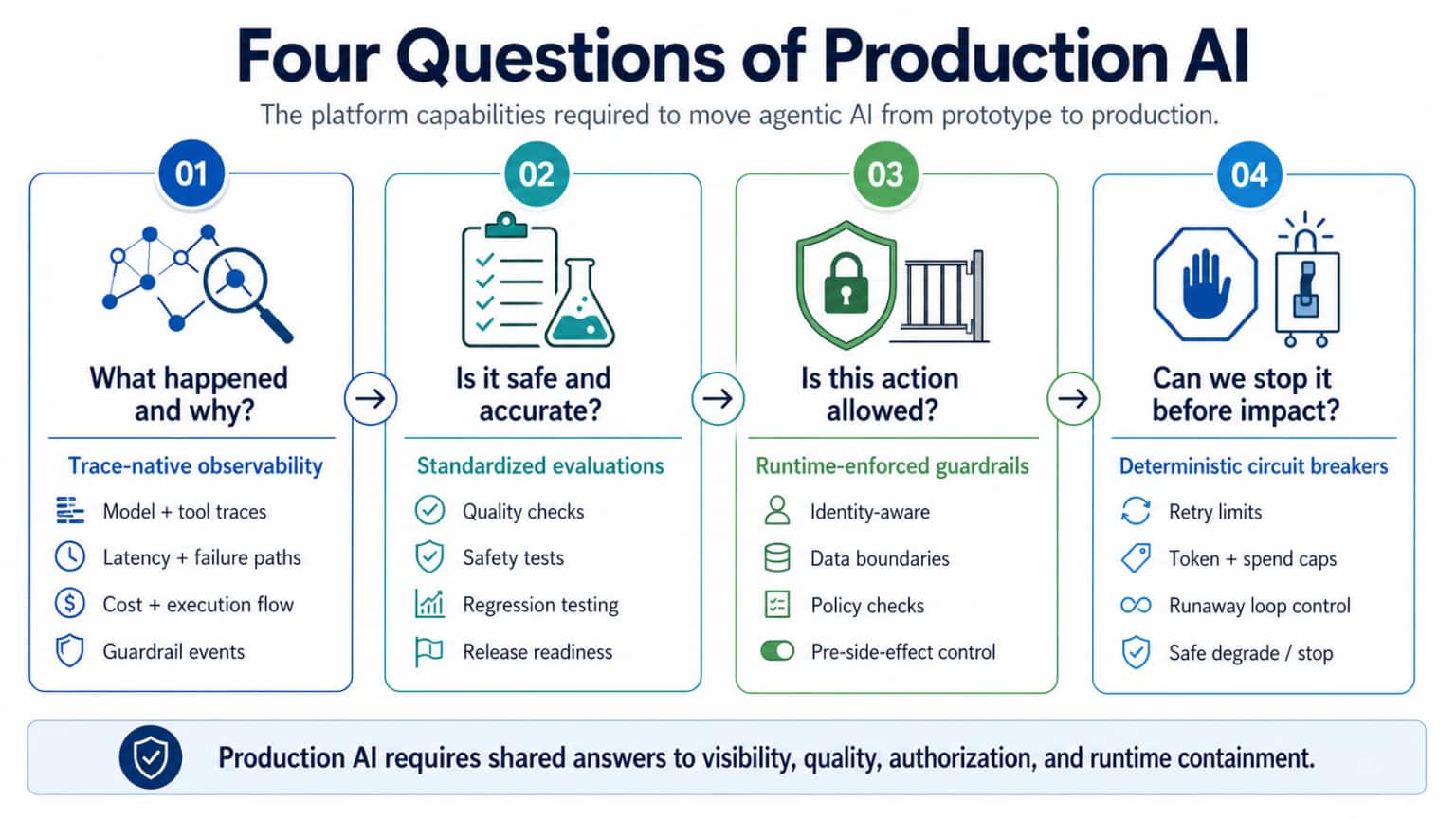
The article "The Evidence and Control Layer for Enterprise AI" by Kishore Pusukuri argues that the transition from AI prototypes to production requires a robust architectural layer to manage the inherent unpredictability of agentic systems. This "Evidence and Control Layer" acts as a shared platform substrate that mediates between agentic workloads and enterprise resources, shifting governance from retrospective reviews to proactive, in-path execution controls. The framework is built upon three core pillars: trace-native observability, continuous trace-linked evaluations, and runtime-enforced guardrails. Unlike traditional logging, trace-native observability captures the complete execution path and decision context, providing the foundation for operational trust. Continuous evaluations act as quality gates, while runtime guardrails evaluate proposed actions—such as tool calls or data transfers—before side effects occur, ensuring safety and compliance in real-time. By formalizing policy-as-code and generating structured evidence events, the layer ensures that every material action is explicit, auditable, and cost-bounded. Ultimately, this centralized approach accelerates enterprise adoption by providing reusable governance defaults, effectively closing the "stochastic gap" and transforming black-box agents into trusted, scalable enterprise assets that operate with clear authority and within defined budget constraints.


Organizational Culture As An Operating System, Not A Values System

In the article "Organizational Culture As An Operating System, Not A Values System," the author argues that the traditional definition of culture as a static set of internal values is no longer sufficient in a hyper-connected world. Modern organizational culture must be reframed as a dynamic operating system that bridges internal decision-making with external community engagement. While internal culture dictates how information flows and authority is exercised, external culture defines how a brand interacts with decentralized movements in art, fashion, and social identity. The disconnect often arises because corporate hierarchies prioritize control and predictability, whereas external cultural trends move at a high velocity from the periphery. To remain relevant, organizations must shift from a "broadcast" model to one of "co-creation," where authority is distributed to those closest to social signals and speed is enabled by trust rather than bureaucratic process. By treating culture with the same rigor as any other core business function, leaders can diagnose internal friction and align incentives to ensure the organization moves at the "speed of culture." Ultimately, success depends on building internal systems that allow companies to participate in and shape cultural conversations in real time, moving beyond corporate manifestos to authentic community collaboration.


Re‑Architecting Capability for AI: Governance, SMEs, and the Talent Pipeline Paradox

The article "Re-architecting Capability for AI Governance: SMEs and the Talent Pipeline Paradox" examines the profound obstacles small and medium-sized enterprises encounter while attempting to establish formal AI oversight. Central to the discussion is the "talent pipeline paradox," which describes how the concentration of AI expertise within large technology firms creates a vacuum that leaves smaller organizations vulnerable. To address this, the author advocates for a strategic shift from talent acquisition to capability re-architecting. Rather than competing for scarce high-end specialists, SMEs should integrate AI governance into their existing business architecture through modular and risk-based frameworks. This approach emphasizes the importance of leveraging cross-functional internal teams, automated tools, and external partnerships to manage algorithmic risks effectively. By focusing on scalable governance patterns and clear accountability, SMEs can achieve ethical and regulatory compliance without the overhead of massive administrative departments. Ultimately, the piece suggests that the key to overcoming resource limitations lies in structural agility and the democratization of governance tasks. This enables smaller firms to harness the transformative power of artificial intelligence safely while maintaining a competitive edge in an increasingly automated global marketplace where talent remains the ultimate bottleneck.


The AI scaffolding layer is collapsing. LlamaIndex's CEO explains what survives

In this VentureBeat interview, LlamaIndex CEO Jerry Liu explores the significant transformation occurring within the "AI scaffolding" layer—the software stack connecting large language models to external data and applications. As frontier models increasingly incorporate native reasoning and retrieval capabilities, Liu suggests that simplistic RAG wrappers are rapidly losing their utility, leading to a "collapse" of the middle layer. To survive this consolidation, infrastructure tools must evolve from thin architectural shells into robust systems that manage complex data pipelines and orchestrate sophisticated agentic workflows. Liu emphasizes that while base models are becoming more powerful, they still lack the specialized, proprietary context required for high-stakes enterprise tasks. Consequently, the future of AI development lies in solving "hard" data problems, such as handling heterogeneous sources and ensuring data quality at scale. Developers are encouraged to pivot away from basic integration toward building deep, specialized intelligence layers that provide the structured context models inherently lack. Ultimately, the survival of platforms like LlamaIndex depends on their ability to offer advanced orchestration and data management that transcends the capabilities of the base models alone, marking a shift toward more resilient and professionalized AI engineering.


Guide for Designing Highly Scalable Systems

The "Guide for Designing Highly Scalable Systems" by GeeksforGeeks provides a comprehensive roadmap for building architectures capable of managing increasing traffic and data volume without performance degradation. Scalability is defined as a system’s ability to grow efficiently while maintaining stability and fast response times. The guide highlights two primary scaling strategies: vertical scaling, which involves enhancing a single server’s capacity, and horizontal scaling, which distributes workloads across multiple machines. To achieve high scalability, the article emphasizes the importance of architectural decomposition and loose coupling, often implemented through microservices or service-oriented architectures. Key components discussed include load balancers for even traffic distribution, caching mechanisms like Redis to reduce backend load, and advanced data management techniques such as sharding and replication to prevent database bottlenecks. Furthermore, the guide covers essential architectural patterns like CQRS and distributed systems to improve fault tolerance and resource utilization. Modern applications must account for various non-functional requirements such as availability and consistency while scaling. By prioritizing stateless designs and avoiding single points of failure, organizations can create robust systems that handle peak usage and unpredictable growth effectively. Ultimately, designing for scalability requires balancing cost, performance, and complexity to ensure long-term reliability in a dynamic digital landscape.


Why Debugging is Harder than Writing Code?

The article "Why Debugging is Harder than Writing Code" from BetterBugs examines the fundamental reasons why developers spend nearly half their time fixing issues rather than creating new features. The core difficulty lies in the disparity between the "happy path" of initial development and the exponential state space of potential failures. While writing code involves building a single successful outcome, debugging requires navigating a combinatorially vast range of unexpected inputs and conditions. This process imposes a significant cognitive load, as developers must maintain a massive context window—often jumping between different files, servers, and logs—which incurs heavy switching costs. Furthermore, modern complexities like distributed systems, non-deterministic concurrency, and discrepancies between local and production environments add layers of friction. In concurrent systems, for instance, the mere act of observing a bug can change the timing and make the issue disappear. Ultimately, the article argues that debugging is more demanding because it forces engineers to move beyond theoretical models and confront the messy realities of hardware limits, memory leaks, and network latency. To manage these challenges, the author suggests that teams must prioritize observability and evidence-based reporting tools to bridge the gap between mental models and actual system behavior, ensuring more predictable software lifecycles.


Cybersecurity: Board oversight of operational resilience planning

The A&O Shearman guidance emphasizes that as cyberattacks grow more sophisticated and regulatory scrutiny intensifies, boards must adopt a proactive stance toward operational resilience. With the emergence of unpredictable criminal gangs and AI-driven threats, it is no longer sufficient to treat cybersecurity as a purely technical issue; it is a critical governance priority. To exercise effective oversight, boards should appoint dedicated individuals or committees to monitor cyber risks and ensure that Business Continuity and Disaster Recovery (BCDR) plans are robust, defensible, and accessible offline. Practical preparations must include clear decision-making protocols and alternative communication channels, such as Signal or WhatsApp, for use during systems outages. Additionally, leadership should oversee the development of pre-approved communication templates for stakeholders and define strict Recovery Time Objectives (RTOs). A cornerstone of this framework is the implementation of regular tabletop exercises and technical recovery drills that involve third-party providers to identify vulnerabilities. By documenting these proactive measures and integrating lessons learned into evolving strategies, boards can meet regulatory expectations for evidence-based oversight. Ultimately, this comprehensive approach to resilience planning helps organizations minimize the risk of material revenue loss and navigate the complexities of a volatile global digital landscape.


Beyond the Region: Architecting for Sovereign Fault Domains and the AI-HR Integrity Gap

In "Beyond the Region," Flavia Ballabene argues that software architects must evolve their definition of resilience from surviving mechanical failures to navigating "Sovereign Fault Domains." Traditionally, redundancy across Availability Zones addressed physical infrastructure outages; however, modern geopolitical shifts and evolving privacy laws now create "blast radii" where data becomes legally trapped or AI models suddenly non-compliant. Ballabene highlights an "AI-HR Integrity Gap," where centralized systems fail to account for regional jurisdictional constraints. To bridge this, she proposes shifting toward sovereignty-aware infrastructures. Key strategies include Managed Sovereign Cloud Models, which leverage localized partner-led controls like S3NS or T-Systems, and Cell-Based Regional Architectures, which deploy independent stacks for each major market to eliminate reliance on a global control plane. These approaches allow organizations to maintain operational continuity even when specific regions face regulatory upheavals. By auditing AI dependency graphs and prioritizing data residency, executives can transform compliance from a burden into a competitive advantage. Ultimately, the article suggests that in a fragmented global cloud, the most resilient HR and technology stacks are those built on digital trust and localized integrity, ensuring they remain robust against both technical glitches and the unpredictable tides of international policy.


Designing resilient IoT and Edge Computing with federated tinyML

The article "Real-time operating systems for embedded systems" (available via ScienceDirect PII: S1383762126000275) provides a comprehensive examination of the architectural requirements and performance constraints inherent in modern real-time operating systems (RTOS). As embedded devices become increasingly integrated into safety-critical infrastructure, the study highlights the transition from simple cyclic executives to sophisticated, preemptive multitasking environments. The authors analyze key RTOS components, including deterministic scheduling algorithms, interrupt latency management, and inter-process communication mechanisms, emphasizing their role in ensuring temporal correctness. A significant portion of the discussion focuses on the trade-offs between monolithic and microkernel architectures, particularly regarding memory footprint and system reliability. By evaluating various commercial and open-source RTOS solutions, the research demonstrates how hardware-software co-design can mitigate the overhead typically associated with complex task synchronization. Ultimately, the paper argues that the future of embedded systems lies in adaptive RTOS frameworks that can dynamically balance power efficiency with the rigorous timing demands of Internet of Things (IoT) applications. This synthesis serves as a vital resource for engineers seeking to optimize system predictability in increasingly heterogeneous computing environments, ensuring that software responses remain consistent under peak load conditions.

Daily Tech Digest - March 10, 2026


Quote for the day:

"A leader has the vision and conviction that a dream can be achieved. He inspires the power and energy to get it done." -- Ralph Nader


🎧 Listen to this digest on YouTube Music

▶ Play Audio Digest

Duration: 37 mins • Perfect for listening on the go.

Job disruption by AI remains limited — and traditional metrics may be missing the real impact

This article on computerworld explores the current state of artificial intelligence in the workforce. Despite widespread alarm, data from Challenger, Gray & Christmas indicates that AI accounted for roughly 8 to 10 percent of job cuts in early 2026. Researchers from Anthropic argue that traditional metrics fail to capture the nuances of AI integration, introducing an "observed exposure" methodology. This technique combines theoretical large language model capabilities with actual usage data, revealing that while certain roles—such as computer programmers and customer service representatives—have high exposure to automation, actual deployment lags significantly behind technical potential. Currently, AI functions primarily as a tool for task-based augmentation rather than full-scale replacement, which enhances worker productivity but complicates entry-level hiring. The report suggests that while immediate mass unemployment hasn't materialized, the long-term impact will require a fundamental re-engineering of workflows. This shift may disproportionately affect younger workers as companies struggle to balance AI efficiency with the necessity of maintaining a pipeline of human talent. Ultimately, the transition necessitates a strategic realignment of human roles to ensure sustainable growth in an intelligence-native era.


Why Password Audits Miss the Accounts Attackers Actually Want

This article on BleepingComputer highlights a critical disconnect between standard compliance-driven password audits and the actual tactics used by cybercriminals. While traditional audits prioritize technical requirements like complexity and rotation, they often overlook the context that makes an account vulnerable. For instance, a password can be statistically "strong" yet already compromised in a previous breach; research indicates that 83% of leaked passwords still meet regulatory standards. Furthermore, audits frequently neglect "orphaned" accounts belonging to former employees or contractors, which provide silent entry points for attackers. Service accounts—often over-privileged and exempt from expiry policies—represent another major blind spot. The piece argues that point-in-time snapshots are insufficient against continuous threats like credential stuffing. To be truly effective, security teams must shift toward continuous monitoring, incorporating breached-password screening and risk-based prioritization. By expanding the scope to include dormant, external, and service accounts, organizations can move beyond mere compliance to address the high-value targets that attackers prioritize. Ultimately, securing a digital environment requires recognizing that a compliant password is not necessarily a safe one in the face of modern, targeted exploitation.


AI is supercharging cloud cyberattacks - and third-party software is the most vulnerable

The latest Google Cloud Threat Report, as analyzed by ZDNET, highlights a significant escalation in cybersecurity risks where artificial intelligence is increasingly being used to "supercharge" cloud-based attacks. The report reveals a dramatic collapse in the window between the disclosure of a vulnerability and its mass exploitation, shrinking from weeks to mere days. Rather than targeting the highly secured core infrastructure of major cloud providers, threat actors are now focusing their efforts on unpatched third-party software and code libraries. This shift emphasizes that the modern supply chain remains a critical weak point for many organizations. Furthermore, the report notes a transition away from traditional brute force attacks toward more sophisticated identity-based compromises, including vishing, phishing, and the misuse of stolen human and non-human identities. Data exfiltration is also evolving, with "malicious insiders" increasingly using consumer-grade cloud storage services to move confidential information outside the corporate perimeter. To combat these AI-powered threats, Google’s experts recommend that businesses adopt automated, AI-augmented defenses, prioritize immediate patching of third-party tools, and strengthen identity management protocols. Ultimately, the report serves as a stark warning that in the current threat landscape, speed and automation are no longer optional but essential components of a robust cybersecurity strategy.


Change as Metrics: Measuring System Reliability Through Change Delivery Signals

This article highlights that system changes account for the vast majority of production incidents, necessitating their treatment as primary reliability indicators. To manage this risk, the author proposes a framework centered on three core business metrics: Change Lead Time, Change Success Rate, and Incident Leakage Rate. While aligned with DORA principles, this model specifically focuses on delivery quality by distinguishing between immediate deployment failures and latent defects that manifest as post-release incidents. To operationalize these goals, technical control metrics such as Change Approval Rate, Progressive Rollout Rate, and Change Monitoring Windows are introduced to provide actionable insights into pipeline friction and risk. The piece further advocates for a platform-agnostic, event-centric data architecture to collect these signals across diverse, distributed environments. This centralized approach avoids the brittleness of platform-specific logging and provides a unified view of system health. Ultimately, the framework empowers organizations to transform change management from a reactive necessity into a proactive, measurable engineering capability. By integrating these metrics, development teams can effectively balance the need for high-speed delivery with the imperative of system stability, ensuring that rapid innovation does not come at the expense of user experience or operational reliability.


The future of generative AI in software testing

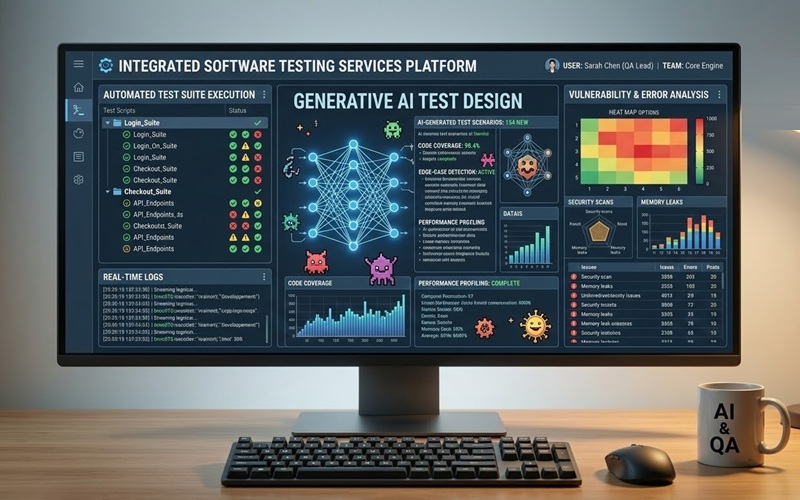
In this article on Techzine, experts Hélder Ferreira and Bruno Mazzotta discuss the transformative shift of AI from a simple task accelerator to a fundamental structural layer within delivery pipelines. As global IT investment in AI is projected to surge toward $6.15 trillion by 2026, the software testing landscape is evolving beyond early challenges like hallucinations and "vibe coding" toward a sophisticated "quality intelligence layer." The authors outline four critical areas where AI adds strategic value: generating complex scenario-based datasets, suggesting high-risk exploratory prompts, automating defect triage to identify regression patterns, and enabling context-aware execution that prioritizes testing based on actual risk rather than volume. Crucially, the piece argues that while AI can significantly enhance velocity, sustainable success depends on maintaining "humans-in-the-loop" to ensure traceability and accountability. In this new era, the primary differentiator for enterprises will not be the sheer amount of AI deployed, but the effectiveness of their governance frameworks. By linking intent with execution and using AI as connective tissue across the lifecycle, organizations can achieve a balance where rapid delivery is supported by explainable automation and human-verified confidence in software quality.


CIOs cut IT corners to manufacture budget for AI

In this CIO.com article, author Esther Shein examines the aggressive strategies IT leaders are employing to fund artificial intelligence initiatives amidst stagnant overall budgets. Faced with intense pressure from boards and executive leadership to prioritize AI, many CIOs are being forced to make difficult trade-offs that jeopardize long-term stability. Common tactics include delaying non-critical infrastructure refreshes, such as server expansions and network improvements, which are often pushed out by twelve to eighteen months. Additionally, organizations are aggressively consolidating vendors, renegotiating contracts, and cutting legacy software subscriptions to free up capital. Some leaders have even implemented strict "self-funding" mandates where every new AI project must be offset by equivalent cuts elsewhere. Beyond technical sacrifices, the human element is also affected, with many departments reducing reliance on contractors or trimming internal staff to reallocate funds toward high-impact AI use cases. While these measures enable rapid deployment, they frequently lead to the accumulation of technical debt and a narrower scope for implementations. Ultimately, the piece warns that while these "corners" are being cut to fuel innovation, the resulting lack of focus on foundational maintenance could present significant operational risks in the future.


Beyond Prompt Injection: The Hidden AI Security Threats in Machine Learning Platforms

In the article "Beyond Prompt Injection: The Hidden AI Security Threats in Machine Learning Platforms," the focus of AI security shifts from headline-grabbing prompt injections to the critical vulnerabilities within MLOps infrastructure. While many security teams prioritize protecting chatbots from manipulation, the underlying platforms used to train and deploy models often present a far more dangerous attack surface. Through a red team engagement, researchers demonstrated how a simple self-registered trial account could be used to achieve remote code execution on a provider’s cloud infrastructure. By deploying a seemingly legitimate but malicious machine learning model, attackers can exploit the fact that these platforms must execute arbitrary code to function. The study highlights a significant risk: once RCE is achieved, weak network segmentation can allow adversaries to bypass trust boundaries and access sensitive internal databases or services. This effectively turns a managed ML environment into a gateway for lateral movement within a corporate network. To mitigate these threats, the article stresses that organizations must move beyond model-centric security and adopt robust infrastructure protections, including strict network isolation, continuous behavior monitoring, and a "zero-trust" approach to user-deployed artifacts, ensuring that the convenience of rapid AI development does not come at the cost of total system compromise.


Enterprise agentic AI requires a process layer most companies haven’t built

The VentureBeat article emphasizes that while 85% of enterprises aspire to implement agentic AI within the next three years, a staggering 76% acknowledge that their current operations are fundamentally unequipped for this transition. The core issue lies in the absence of a "process layer"—a critical foundation of optimized workflows and operational intelligence that provides AI agents with the necessary context to function effectively. Without this layer, agents are essentially "guessing," leading to a lack of reliability that causes 82% of decision-makers to fear a failure in return on investment. The piece argues that the primary hurdle is not merely technological but rather rooted in organizational structure and change management. Most companies suffer from siloed data and fragmented processes that hinder the seamless integration of autonomous systems. To overcome these barriers, businesses must prioritize process optimization and operational visibility, ensuring that AI-driven initiatives are linked to strategic executive outcomes. Simply layering advanced AI over inefficient, legacy frameworks will likely result in costly friction. Ultimately, for agentic AI to move beyond experimental pilots and deliver scalable value, organizations must first build a robust architectural bridge that connects sophisticated models with the complex, real-world logic of their daily business operations and high-stakes organizational decision cycles.


Building resilient foundations for India’s expanding Data Centre ecosystem

In "Building resilient foundations for India's expanding Data Centre ecosystem," Saurabh Verma explores the rapid evolution of India’s data infrastructure and the urgent necessity of prioritizing long-term resilience over mere capacity. As cloud adoption and 5G accelerate growth across hubs like Mumbai, Chennai, and Hyderabad, the sector faces escalating challenges that demand a sophisticated understanding of risk management. The article argues that modern data centres are no longer just IT assets but critical infrastructure whose failure directly impacts the digital economy. Beyond physical damage, business interruptions often result in massive financial losses, contractual penalties, and significant reputational harm. Climate change has emerged as a significant operational reality, with heatwaves and flooding stressing cooling systems and electrical grids. Furthermore, the convergence of cyber and physical risks means that digital disruptions can quickly translate into tangible infrastructure damage. Construction complexities and logistical interdependencies further amplify potential losses, making early risk engineering essential for success. Ultimately, the piece emphasizes that resilience must be a core design pillar rather than an afterthought. By integrating disciplined risk management from site selection through operations, Indian providers can gain a commercial advantage, securing better investment and insurance terms while building a sustainable, trustworthy backbone for the nation’s digital future.


CVE program funding secured, easing fears of repeat crisis

The Common Vulnerabilities and Exposures (CVE) program has successfully secured stable funding, alleviating industry-wide fears of a repeat of the 2025 crisis that nearly crippled global vulnerability tracking. As detailed in the CSO Online report, the Cybersecurity and Infrastructure Security Agency (CISA) and the MITRE Corporation have renegotiated their contract, transitioning the 26-year-old program from a discretionary expenditure to a protected line item within CISA's budget. This structural change effectively eliminates the "funding cliff" that previously required a last-minute emergency extension. While CISA leadership emphasizes that the program is now fully funded and evolving, some experts note that the specifics of the "mystery contract" remain opaque. The resolution comes at a critical time, as the cybersecurity community had already begun developing contingencies, such as the independent CVE Foundation, to reduce reliance on a single government source. Despite the financial stability, challenges regarding transparency, modernization, and international governance persist. The article underscores that while the immediate threat of a service lapse has faded, the incident served as a stark reminder of the global security ecosystem's fragility. Moving forward, the focus shifts toward ensuring this essential public resource remains resilient against future political or administrative shifts within the United States government.

Daily Tech Digest - January 30, 2026


Quote for the day:

"In my experience, there is only one motivation, and that is desire. No reasons or principle contain it or stand against it." -- Jane Smiley


Crooks are hijacking and reselling AI infrastructure: Report

In a report released Wednesday, researchers at Pillar Security say they have discovered campaigns at scale going after exposed large language model (LLM) and MCP endpoints – for example, an AI-powered support chatbot on a website. “I think it’s alarming,” said report co-author Ariel Fogel. “What we’ve discovered is an actual criminal network where people are trying to steal your credentials, steal your ability to use LLMs and your computations, and then resell it.” ... How big are these campaigns? In the past couple of weeks alone, the researchers’ honeypots captured 35,000 attack sessions hunting for exposed AI infrastructure. “This isn’t a one-off attack,” Fogel added. “It’s a business.” He doubts a nation-state it behind it; the campaigns appear to be run by a small group. ... Defenders need to treat AI services with the same rigor as APIs or databases, he said, starting with authentication, telemetry, and threat modelling early in the development cycle. “As MCP becomes foundational to modern AI integrations, securing those protocol interfaces, not just model access, must be a priority,” he said.  ... Despite the number of news stories in the past year about AI vulnerabilities, Meghu said the answer is not to give up on AI, but to keep strict controls on its usage. “Do not just ban it, bring it into the light and help your users understand the risk, as well as work on ways for them to use AI/LLM in a safe way that benefits the business,” he advised.


AI-Powered DevSecOps: Automating Security with Machine Learning Tools

Here's the uncomfortable truth: AI is both causing and solving the same problem. A Snyk survey from early 2024 found that 77% of technology leaders believe AI gives them a competitive advantage in development speed. That's great for quarterly demos and investor decks. It's less great when you realize that faster code production means exponentially more code to secure, and most organizations haven't figured out how to scale their security practice at the same rate. ... Don't try to AI-ify your entire security stack at once. Pick one high-pain problem — maybe it's the backlog of static analysis findings nobody has time to triage, or maybe it's spotting secrets accidentally committed to repos — and deploy a focused tool that solves just that problem. Learn how it behaves. Understand its failure modes. Then expand. ... This is non-negotiable, at least for now. AI should flag, suggest, and prioritize. It should not auto-merge security fixes or automatically block deployments without human confirmation. I've seen two different incidents in the past year where an overzealous ML system blocked a critical hotfix because it misclassified a legitimate code pattern as suspicious. Both cases were resolved within hours, but both caused real business impact. The right mental model is "AI as junior analyst." ... You need clear policies around which AI tools are approved for use, who owns their output, and how to handle disagreements between human judgment and AI recommendations.


AI & the Death of Accuracy: What It Means for Zero-Trust

The basic idea is that as the signal quality degrades over time through junk training data, models can remain fluent and fully interact with the user while becoming less reliable. From a security standpoint, this can be dangerous, as AI models are positioned to generate confident-yet-plausible errors when it comes to code reviews, patch recommendations, app coding, security triaging, and other tasks. More critically, model degradation can erode and misalign system guardrails, giving attackers the opportunity exploit the opening through things like prompt injection. ... "Most enterprises are not training frontier LLMs from scratch, but they are increasingly building workflows that can create self-reinforcing data stores, like internal knowledge bases, that accumulate AI-generated text, summaries, and tickets over time," she tells Dark Reading.  ... Gartner said that to combat the potential impending issue of model degradation, organizations will need a way to identify and tag AI-generated data. This could be addressed through active metadata practices (such as establishing real-time alerts for when data may require recertification) and potentially appointing a governance leader that knows how to responsibly work with AI-generated content. ... Kelley argues that there are pragmatic ways to "save the signal," namely through prioritizing continuous model behavior evaluation and governing training data.


The Friction Fix: Change What Matters

Friction is the invisible current that sinks every transformation. Friction isn’t one thing, it’s systemic. Relationships produce friction: between the people, teams and technology. ... When faced with a systemic challenge, our human inclination is to blame. Unfortunately, we blame the wrong things. We blame the engineering team for failing to work fast enough or decide the team is too small, rather than recognize that our Gantt chart was fiction, which is an oversimplification of a complex dynamic. ... The fix is to pause and get oriented. Begin by identifying the core domain, the North Star. What is the goal of the system? For Fedex, it is fast package delivery. Chances are, when you are experiencing counterintuitive behavior, it is because people are navigating in different directions while using the same words. ... Every organization trying to change has that guy: the gatekeeper, the dungeon master, the self-proclaimed 10x engineer who knows where the bodies are buried. They also wield one magic word: No. ... It’s easy to blame that guy’s stubborn personality. But he embodies behavior that has been rewarded and reinforced. ... Refusal to change is contagious. When that guy shuts down curiosity, others drift towards a fixed mindset. Doubt becomes the focus, not experimentation. The organization can’t balance avoiding risk with trying something new. The transformation is dead in the water.


From devops to CTO: 8 things to start doing now

Devops leaders have the opportunity to make a difference in their organization and for their careers. Lead a successful AI initiative, deploy to production, deliver business value, and share best practices for other teams to follow. Successful devops leaders don’t jump on the easy opportunities; they look for the ones that can have a significant business impact. ... Another area where devops engineers can demonstrate leadership skills is by establishing standards for applying genAI tools throughout the software development lifecycle (SDLC). Advanced tools and capabilities require effective strategies to extend best practices beyond early adopters and ensure that multiple teams succeed. ... If you want to be recognized for promotions and greater responsibilities, a place to start is in your areas of expertise and with your team, peers, and technology leaders. However, shift your focus from getting something done to a practice leadership mindset. Develop a practice or platform your team and colleagues want to use and demonstrate its benefits to the organization. Devops engineers can position themselves for a leadership role by focusing on initiatives that deliver business value. ... One of the hardest mindset transitions for CTOs is shifting from being the technology expert and go-to problem-solver to becoming a leader facilitating the conversation about possible technology implementations. If you want to be a CTO, learn to take a step back to see the big picture and engage the team in recommending technology solutions.


The stakes rise for the CIO role in 2026

The CIO's days as back-office custodian of IT are long gone, to be sure, but that doesn't mean the role is settled. Indeed, Seewald and others see plenty of changes still underway. In 2026, the CIO's role in shaping how the business operates and performs is still expanding. It reflects a nuanced change in expectations, according to longtime CIOs, analysts and IT advisors -- and one that is showing up in many ways as CIOs become more directly involved in nailing down competitive advantage and strategic success across their organizations. ... "While these core responsibilities remain the same, the environment in which CIOs operate has become far more complex," Tanowitz added. Conal Gallagher, CIO and CISO at Flexera, said the CIO in 2026 is now "accountable for outcomes: trusted data, controlled spend, managed risk and measurable productivity. "The deliverable isn't a project plan," Gallagher said. "It's proof that the business runs faster, safer and more cost-disciplined because of the operating model IT enables." ... In 2026, the CIO role is less about being the technology owner and more about being a business integrator, Hoang said. At Commvault, that shift places greater emphasis on governance and orchestration across ecosystems. "We're operating in a multicloud, multivendor, AI-infused environment," she said. "A big part of my job is building guardrails and partnerships that enable others to move fast -- safely," she said. 


Inside the Shift to High-Density, AI-Ready Data Centres

As density increases, design philosophy must evolve. Power infrastructure, backup systems, and cooling can no longer be treated as independent layers; they have to be tightly integrated. Our facilities use modular and scalable power and cooling architectures that allow us to expand capacity without disrupting live environments. Rated-4 resilience is non-negotiable, even under continuous, high-density AI workloads. The real focus is flexibility. Customers shouldn’t be forced into an all-or-nothing transition. Our approach allows them to move gradually to higher densities while preserving uptime, efficiency, and performance. High-density AI infrastructure is less about brute force and more about disciplined engineering that sustains reliability at scale. ... The most common misconception is that AI data centres are fundamentally different entities. While AI workloads do increase density, power, and cooling demands, the core principles of reliability, uptime, and efficiency remain unchanged. AI readiness is not about branding; it’s about engineering and operations. Supporting AI workloads requires scalable and resilient power delivery, precision cooling, and flexible designs that can handle GPUs and accelerators efficiently over sustained periods. Simply adding more compute without addressing these fundamentals leads to inefficiency and risk. The focus must remain on mission-critical resilience, cost-effective energy management, and sustainability. 


Software Supply Chain Threats Are on the OWASP Top Ten—Yet Nothing Will Change Unless We Do

As organizations deepen their reliance on open-source components and embrace AI-enabled development, software supply chain risks will become more prevalent. In the OWASP survey, 50% of respondents ranked software supply chain failures number one. The awareness is there. Now the pressure is on for software manufacturers to enhance software transparency, making supply chain attacks far less likely and less damaging. ... Attackers only need one forgotten open-source component from 2014 that still lives quietly inside software to execute a widespread attack. The ability to cause widespread damage by targeting the software supply chain makes these vulnerabilities alluring for attackers. Why break into a hardened product when one outdated dependency—often buried several layers down—opens the door with far less effort? The SolarWinds software supply chain attack that took place in 2020 demonstrated the access adversaries gain when they hijack the build process itself. ... “Stable” legacy components often go uninspected for years. These aging libraries, firmware blocks, and third-party binaries frequently contain memory-unsafe constructs and unpatched vulnerabilities that could be exploited. Be sure to review legacy code and not give it the benefit of the doubt. ... With an SBOM in hand, generated at every build, you can scan software for vulnerabilities and remediate issues before they are exploited. 


What the first 24 hours of a cyber incident should look like

When a security advisory is published, the first question is whether any assets are potentially exposed. In the past, a vendor’s claim of exploitation may have sufficed. Given the precedent set over the past year, it is unwise to rely solely on a vendor advisory for exploited-in-the-wild status. Too often, advisories or exploitation confirmations reach teams too late or without the context needed to prioritise the response. CISA’s KEV, trusted third-party publications, and vulnerability researchers should form the foundation of any remediation programme. ... Many organisations will leverage their incident response (IR) retainers to assess the extent of the compromise or, at a minimum, perform a rudimentary threat hunt for indicators of compromise (IoCs) before involving the IR team. As with the first step, accurate, high-fidelity intelligence is critical. Simply downloading IoC lists filled with dual-use tools from social media will generate noise and likely lead to inaccurate conclusions. Arguably, the cornerstone of the initial assessment is ensuring that intelligence incorporates decay scoring to validate command-and-control (C2) infrastructure. For many, the term ‘threat hunt’ translates to little more than a log search on external gateways. ... The approach at this stage will be dependent on the results of the previous assessments. There is no default playbook here; however, an established decision framework that dictates how a company reacts is key.


NIST’s AI guidance pushes cybersecurity boundaries

For CISOs, what should matter is that NIST is shifting from a broad, principle-based AI risk management framework toward more operationally grounded expectations, especially for systems that act without constant human oversight. What is emerging across NIST’s AI-related cybersecurity work is a recognition that AI is no longer a distant or abstract governance issue, but a near-term security problem that the nation’s standards-setting body is trying to tackle in a multifaceted way. ... NIST’s instinct to frame AI as an extension of traditional software allows organizations to reuse familiar concepts — risk assessment, access control, logging, defense in depth — rather than starting from zero. Workshop participants repeatedly emphasized that many controls do transfer, at least in principle. But some experts argue that the analogy breaks down quickly in practice. AI systems behave probabilistically, not deterministically, they say. Their outputs depend on data that may change continuously after deployment. And in the case of agents, they may take actions that were not explicitly scripted in advance. ... “If you were a consumer of all of these documents, it was very difficult for you to look at them and understand how they relate to what you are doing and also understand how to identify where two documents may be talking about the same thing and where they overlap.”

Daily Tech Digest - January 18, 2026


Quote for the day:

"Surround yourself with great people; delegate authority; get out of the way" -- Ronald Reagan


Data sovereignty: an existential issue for nations and enterprises

Law-making bodies have in recent years sought to regulate data flows to strengthen their citizens’ rights – for example, the EU bolstering individual citizens’ privacy through the General Data Protection Regulation (GDPR). This kind of legislation has redefined companies’ scope for storing and processing personal data. By raising the compliance bar, such measures are already reshaping C-level investment decisions around cloud strategy, AI adoption and third-party access to their corporate data. ... Faced with dynamic data sovereignty risks, enterprises have three main approaches ahead of them: First, they can take an intentional risk assessment approach. They can define a data strategy addressing urgent priorities, determining what data should go where and how it should be managed - based on key metrics such as data sensitivity, the nature of personal data, downstream impacts, and the potential for identification. Such a forward-looking approach will, however, require a clear vision and detailed planning. Alternatively, the enterprise could be more reactive and detach entirely from its non-domestic public cloud service providers. This is riskier, given the likely loss of access to innovation and, worse, the financial fallout that could undermine their pursuit of key business objectives. Lastly, leaders may choose to do nothing and hope that none of these risks directly affects them. This is the highest-risk option, leaving no protection from potentially devastating financial and reputational consequences of an ineffective data sovereignty strategy.


Verification Debt: When Generative AI Speeds Change Faster Than Proof

Software delivery has always lived with an imbalance. It is easier to change a system than to demonstrate that the change is safe under real workloads, real dependencies, and real failure modes. ... The risk is not that teams become careless. The risk is that what looks correct on the surface becomes abundant while evidence remains scarce. ... A useful name for what accumulates in the mismatch is verification debt. It is the gap between what you released and what you have demonstrated, with evidence gathered under conditions that resemble production, to be safe and resilient. Technical debt is a bet about future cost of change. Verification debt is unknown risk you are running right now. Here, verification does not mean theorem proving. It means evidence from tests, staged rollouts, security checks, and live production signals that is strong enough to block a release or trigger a rollback. It is uncertainty about runtime behavior under realistic conditions, not code cleanliness, not maintainability, and not simply missing unit tests. If you want to spot verification debt without inventing new dashboards, look at proxies you may already track. ... AI can help with parts of verification. It can suggest tests, propose edge cases, and summarize logs. It can raise verification capacity. But it cannot conjure missing intent, and it cannot replace the need to exercise the system and treat the resulting evidence as strong enough to change the release decision. Review is helpful. Review is evidence of readability and intent.


Executive-level CISO titles surge amid rising scope strain

Executive-level CISOs were more likely to report outside IT than peers with VP or director titles, according to the findings. The report frames this as part of a broader shift in how organisations place accountability for cyber risk and oversight. The findings arrive as boards and senior executives assess cyber exposure alongside other enterprise risks. The report links these expectations to the need for security leaders to engage across legal, risk, operations and other functions. ... Smaller organisations and industries with leaner security teams showed the highest levels of strain, the report says. It adds that CISOs warn these imbalances can delay strategic initiatives and push teams towards reactive security operations. The report positions this issue as a management challenge as well as a governance question. It links scope creep with wider accountability and higher expectations on security leaders, even where budgets and staffing remain constrained. ... Recruiters and employers have watched turnover trends closely as demand for senior security leadership has remained high across many sectors. The report suggests that title, scope and reporting structure form part of how CISOs evaluate roles. ... "The demand for experienced CISOs remains strong as the role continues to become more complex and more 'executive'," said Martano. "Understanding how organizations define scope, reporting structure, and leadership access and visibility is critical for CISOs planning their next move and for companies looking to hire or retain security leaders."


What’s in, and what’s out: Data management in 2026 has a new attitude

Data governance is no longer a bolt-on exercise. Platforms like Unity Catalog, Snowflake Horizon and AWS Glue Catalog are building governance into the foundation itself. This shift is driven by the realization that external governance layers add friction and rarely deliver reliable end-to-end coverage. The new pattern is native automation. Data quality checks, anomaly alerts and usage monitoring run continuously in the background. ... Companies want pipelines that maintain themselves. They want fewer moving parts and fewer late-night failures caused by an overlooked script. Some organizations are even bypassing pipes altogether. Zero ETL patterns replicate data from operational systems to analytical environments instantly, eliminating the fragility that comes with nightly batch jobs. ... Traditional enterprise warehouses cannot handle unstructured data at scale and cannot deliver the real-time capabilities needed for AI. Yet the opposite extreme has failed too. The highly fragmented Modern Data Stack scattered responsibilities across too many small tools. It created governance chaos and slowed down AI readiness. Even the rigid interpretation of Data Mesh has faded. ... The idea of humans reviewing data manually is no longer realistic. Reactive cleanup costs too much and delivers too little. Passive catalogs that serve as wikis are declining. Active metadata systems that monitor data continuously are now essential.


How Algorithmic Systems Automate Inequality

The deployment of predictive analytics in public administration is usually justified by the twin pillars of austerity and accuracy. Governments and private entities argue that automated decision-making systems reduce administrative bloat while eliminating the subjectivity of human caseworkers. ... This dynamic is clearest in the digitization of the welfare state. When agencies turn to machine learning to detect fraud, they rarely begin with a blank slate, training their models on historical enforcement data. Because low-income and minority populations have historically been subject to higher rates of surveillance and policing, these datasets are saturated with selection bias. The algorithm, lacking sociopolitical context, interprets this over-representation as an objective indicator of risk, identifying correlation and deploying it as causality. ... Algorithmic discrimination, however, is diffuse and difficult to contest. A rejected job applicant or a flagged welfare recipient rarely has access to the proprietary score that disqualified them, let alone the training data or the weighting variable—they face a black box that offers a decision without a rationale. This opacity makes it nearly impossible for an individual to challenge the outcome, effectively insulating the deploying organisation from accountability. ... Algorithmic systems do not observe the world directly; they inherit their view of reality from datasets shaped by prior policy choices and enforcement practices. To assess such systems responsibly requires scrutiny of the provenance of the data on which decisions are built and the assumptions encoded in the variables selected.


DevSecOps for MLOps: Securing the Full Machine Learning Lifecycle

The term "MLSecOps" sounds like consultant-speak. I was skeptical too. But after auditing ML pipelines at eleven companies over the past eighteen months, I've concluded we need the term because we need the concept — extending DevSecOps practices across the full machine learning lifecycle in ways that account for ML-specific threats. The Cloud Security Alliance's framework is useful here. Securing ML systems means protecting "the confidentiality, integrity, availability, and traceability of data, software, and models." That last word — traceability — is where most teams fail catastrophically. In traditional software, you can trace a deployed binary back to source code, commit hash, build pipeline, and even the engineer who approved the merge. ... Securing ML data pipelines requires adopting practices that feel tedious until the day they save you. I'm talking about data validation frameworks, dataset versioning, anomaly detection at ingestion, and schema enforcement like your business depends on it — because it does. Last September, I worked with an e-commerce company deploying a recommendation model. Their data pipeline pulled from fifteen different sources — user behavior logs, inventory databases, third-party demographic data. Zero validation beyond basic type checking. We implemented Great Expectations — an open-source data validation framework — as a mandatory CI check. 


Autonomous Supply Chains: Catalyst for Building Cyber-Resilience

Autonomous supply chains are becoming essential for building resilience amid rising global disruptions. Enabled by a strong digital core, agentic architecture, AI and advanced data-driven intelligence, together with IoT and robotics, they facilitate operations that continuously learn, adapt and optimize across the value chain. ... Conventional thinking suggests that greater autonomy widens the attack surface and diminishes human oversight turning it into a security liability. However, if designed with cyber resilience at its core, autonomous supply chain can act like a “digital immune system,” becoming one of the most powerful enablers of security. ... As AI operations and autonomous supply chains scale, traditional perimeter simply won’t work. Organizations must adopt a Zero Trust security model to eliminate implicit trust at every access point. A Zero Trust model, centered on AI-driven identity and access management, ensures continuous authentication, network micro-segmentation and controlled access across users, devices and partners. By enforcing “never trust, always verify,” organizations can minimize breach impact and contain attackers from freely moving across systems, maintaining control even in highly automated environments. ... Autonomy in the supply chain thrives on data sharing and connectivity across suppliers, carriers, manufacturers, warehouses and retailers, making end-to-end visibility and governance vital for both efficiency and security. 


When enterprise edge cases become core architecture

What matters most is not the presence of any single technology, but the requirements that come with it. Data that once lived in separate systems now must be consistent and trusted. Mobile devices are no longer occasional access points but everyday gateways. Hiring workflows introduce identity and access considerations sooner than many teams planned for. As those realities stack up, decisions that once arrived late in projects are moving closer to the start. Architecture and governance stop being cleanup work and start becoming prerequisites. ... AI is no longer layered onto finished systems. Mobile is no longer treated as an edge. Hiring is no longer insulated from broader governance and security models. Each of these shifts forces organizations to think earlier about data, access, ownership and interoperability than they are used to doing. What has changed is not just ambition, but feasibility. AI can now work across dozens of disparate systems in ways that were previously unrealistic. Long-standing integration challenges are no longer theoretical problems. They are increasingly actionable -- and increasingly unavoidable. ... As a result, integration, identity and governance can no longer sit quietly in the background. These decisions shape whether AI initiatives move beyond experimentation, whether access paths remain defensible and whether risk stays contained or spreads. Organizations that already have a clear view of their data, workflows and access models will find it easier to adapt. 


Why New Enterprise Architecture Must Be Built From Steel, Not Straw

Architecture must reflect future ambition. Ideally, architects build systems with a clear view of where the product and business are heading. When a system architecture is built for the present situation, it’s likely lacking in flexibility and scalability. That said, sound strategic decisions should be informed by well-attested or well-reasoned trends, not just present needs and aspirations. ... Tech leaders should avoid overcommitting to unproven ideas—i.e., not get "caught up" in the hype. Safe experimentation frameworks (from hypothesis to conclusion) reduce risk by carefully applying best practices to testing out approaches. In a business context with something as important as the technology foundation the organization runs in, do not let anyone mischaracterize this as timidity. Critical failure is a career-limiting move, and potentially an organizational catastrophe. ... The art lies in designing systems that can absorb future shifts without constant rework. That comes from aligning technical decisions not only with what the company is today, but also what it intends to become. Future-ready architecture isn’t the comparatively steady and predictable discipline it was before AI-enabled software features. As a consequence, there’s wisdom in staying directional, rather than architecting for the next five years. Align technical decisions with long-term vision but built with optionality wherever possible. 


Why Engineering Culture Is Everything: Building Teams That Actually Work

The culture is something that is a fact and it's also something intrinsic with human beings. We're people, we have a background. We were raised in one part of the world versus another. We have the way that we talk and things that we care about. All those things influence your team indirectly and directly. It's really important, you as a leader, to be aware that as an engineer, I use a lot of metaphors from monitoring and observability. We always talk about known knowns, known unknowns, and unknown unknowns. Those are really important to understand on a systems level, period, because your social technical system is also a system. The people that you work with, the way you work, your organization, it's a system. And if you're not aware of what are the metrics you need to track, what are the things that are threats to it, the good old strengths, weaknesses, opportunities, and threats. ... What we can learn from other industries is their lessons. Again, we are now on yet another industrial revolution. This time it's more of a knowledge revolution. We can learn from civil engineering like, okay, when the brick was invented, that was a revolution. When the brick was invented, what did people do in order to make sure that bricks matter? That's a fascinating and very curious story about the Freemasons. People forget the Freemasons were a culture about making sure that these constructions techniques, even more than the technologies, the techniques, were up to standards.