Showing posts with label hacking. Show all posts

Daily Tech Digest - March 21, 2026


Quote for the day:

"Management is about arranging and telling. Leadership is about nurturing and enhancing." -- Tom Peters


🎧 Listen to this digest on YouTube Music

▶ Play Audio Digest

Duration: 22 mins • Perfect for listening on the go.


Three ways AI is learning to understand the physical world

The VentureBeat article "Three ways AI is learning to understand the physical world" explores how researchers are overcoming the physical reasoning limitations of large language models through "world models." While LLMs excel at abstract knowledge, they lack grounding in causality, prompting a shift toward three distinct architectural approaches to simulate the real world. The first, Joint Embedding Predictive Architecture (JEPA), mimics human cognition by learning abstract latent features, ignoring irrelevant pixels to achieve the high efficiency required for real-time robotics. The second approach utilizes Gaussian splats to generate detailed 3D spatial environments from prompts, allowing AI agents to interact within standard physics engines like Unreal Engine. Finally, end-to-end generative models, such as DeepMind’s Genie 3 and Nvidia’s Cosmos, act as native physics engines by continuously generating frames and physical dynamics on the fly. This third method is particularly vital for creating massive synthetic data factories to safely train autonomous systems in complex edge cases. Ultimately, the analysis suggests a future defined by hybrid architectures, where LLMs provide the reasoning interface while world models serve as the foundational infrastructure for spatial data, enabling AI to move beyond digital browsers and into physical spaces.


Field workers don’t need more access, they need better security

In this interview, Chris Thompson, CISO at West Shore Home, outlines the evolving landscape of cybersecurity for field-based workforces. He emphasizes that the principle of least privilege should be applied consistently across all roles, dismissing the notion that field workers require broader access for convenience. A significant shift involves replacing antiquated, shared generic accounts with individual credentials secured by robust multifactor authentication, reflecting a modern standard where security is never sacrificed for speed. Thompson details how West Shore Home manages sensitive customer data through continuous risk assessments and bi-monthly executive reviews, ensuring mitigation strategies remain agile rather than stuck in traditional annual cycles. Addressing the logistical hurdles of training, he advocates for integrating security awareness into daily "toolbox talks" at warehouses, which proves more effective than email-based modules for employees on the move. By aligning security protocols with the technology field teams use daily, the organization fosters a unified culture where every worker understands their role in the broader security posture. Ultimately, Thompson argues that field workers do not need expanded access; they require more sophisticated, integrated security measures that support their unique operational environment without introducing unnecessary risk to the enterprise.


6 innovation curves are rewriting enterprise IT strategy

The article "6 innovation curves are rewriting enterprise IT strategy" highlights a fundamental shift from sequential technology updates to managing multiple, overlapping waves of digital transformation. These six innovation curves include transitioning from traditional software to systems of autonomous collaborators, adopting AI-native applications that embed machine learning into their core architecture, and treating enterprise memory as a queryable knowledge layer for real-time decision-making. Additionally, IT leaders must redesign human-machine interactions to enhance productivity, establish robust governance for trust and integrity in a world of synthetic data, and utilize virtual simulations to de-risk experimentation. The author emphasizes that these curves are deeply interdependent; for example, autonomous agents require high-quality memory layers to function effectively, while simulation environments provide the necessary testing grounds for AI-native interactions. To succeed, organizations must move beyond linear management models and instead develop an integrated strategy that orchestrates these curves concurrently. By focusing on areas like "AgentOps" and persistent data layers, businesses can build a resilient digital architecture capable of absorbing continuous disruption while maintaining operational priorities, effectively redefining how enterprises create value and manage risk in an AI-driven landscape.


Credential theft compounded in 2025, says new data from Recorded Future

Recorded Future’s 2025 Identity Threat Landscape Report reveals that credential theft has become the primary initial access vector for enterprise security breaches, characterized by a staggering escalation throughout the year. Data indicates that credential indexing surged by 90 percent in the final quarter compared to the first, with a significant majority of these attacks specifically targeting authentication systems to maximize unauthorized access. A particularly alarming trend is the proliferation of infostealer malware, which harvested 276 million credentials containing active session cookies. These cookies enable cybercriminals to bypass multi-factor authentication entirely, rendering traditional security measures increasingly insufficient. The report underscores that a single compromised endpoint can jeopardize an entire organization, as the average infected device now yields approximately 87 distinct stolen credentials across various corporate and personal platforms. Consequently, industry experts advocate for a transition toward "verified trust" models, which emphasize continuous, contextual identity verification using biometrics and passkeys. Despite the escalating risk, research from IDC and Ping Identity suggests that only nine percent of organizations have successfully operationalized these advanced safeguards at scale, highlighting a critical maturity gap in global digital infrastructure and a pressing need for board-level prioritization of identity security.


Configuration as a Control Plane: Designing for Safety and Reliability at Scale

The InfoQ article "Configuration as a Control Plane" explores the evolution of configuration from static deployment files into a dynamic, live control plane that actively shapes system behavior. In modern cloud-native architectures, configuration changes often move faster and impact more systems than application code, making them a primary driver of large-scale reliability incidents. Consequently, configuration management is transitioning from traditional agent-based convergence toward continuously reconciled, policy-enforced systems. The article emphasizes treating configuration as a high-leverage reliability discipline rather than a mere operational task. Key strategies discussed include using strongly typed, schema-validated configurations and policy engines like Open Policy Agent (OPA) to enforce guardrails before and during rollouts. By adopting practices such as staged regional rollouts, canary deployments, and automated diff analysis, organizations can ensure that configuration correctness is a systemic property rather than a manual checklist. Looking ahead, the integration of AI-driven risk assessment and unified configuration APIs promises to further enhance safety and resilience. Ultimately, this shift enables infrastructure to become more self-healing and predictable, allowing teams to manage complex, ephemeral workloads at scale while minimizing the risk of catastrophic human error or cascading failures.


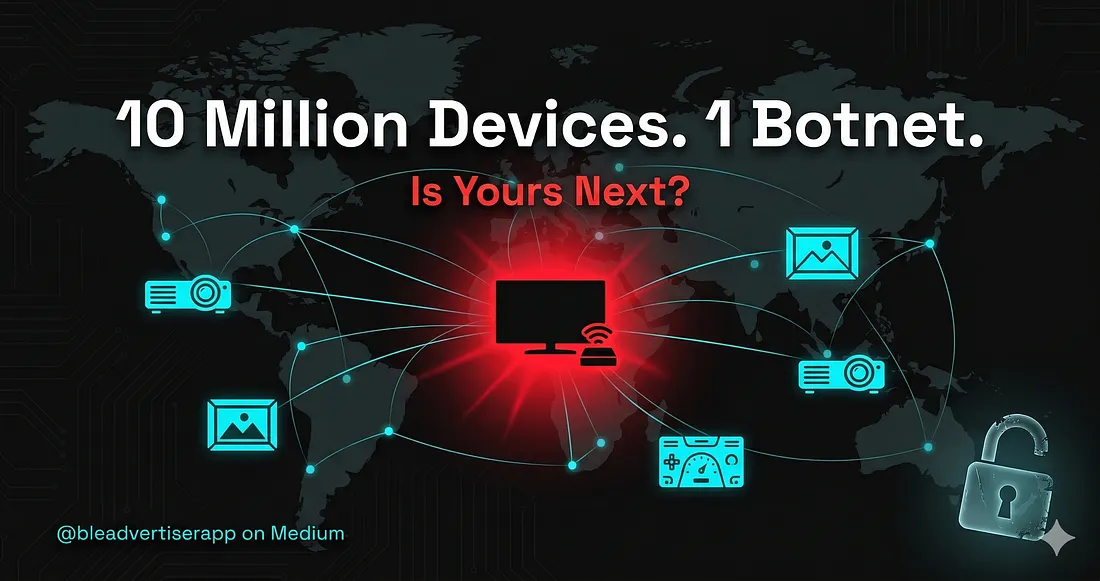
10 Million IoT Devices Hacked: Is Yours Next?

The Medium article "10 Million IoT Devices Hacked: Is Yours Next?" explores the alarming rise of BadBox 2.0, a sophisticated global botnet that has compromised over ten million Internet of Things (IoT) devices. Highlighting a 2025 federal lawsuit by Google, the piece details how seemingly harmless gadgets—such as unbranded streaming boxes, digital picture frames, and car infotainment systems—are being transformed into criminal infrastructure. A critical revelation is that many of these devices are pre-infected with malware during manufacturing, meaning consumers are compromised the moment they connect to Wi-Fi. The vulnerability primarily affects cheap hardware running the Android Open Source Project (AOSP) without Google’s Play Protect certification. To safeguard home networks, the author recommends identifying all connected devices via router admin panels and scanning for red flags like "Seekiny Studio" apps or unusual traffic to foreign IP ranges. Ultimately, the article serves as a stark warning against purchasing low-cost, unverified electronics, urging users to prioritize "purchase hygiene" by sticking to reputable brands with verifiable firmware update histories. By verifying Play Protect status and monitoring for network anomalies, users can better defend their digital privacy against these pervasive, invisible threats.


How CISOs Can Survive the Era of Geopolitical Cyberattacks

In the current era of geopolitical cyber warfare, Chief Information Security Officers (CISOs) must pivot from traditional perimeter defense to a robust strategy of internal containment. Geopolitical attacks, exemplified by Iranian wiper campaigns like the Handala group’s strike on Stryker, differ from standard ransomware because they prioritize operational chaos and destruction over financial gain. To survive these threats, the article outlines a vital five-step playbook centered on limiting lateral movement. First, CISOs should implement identity-aware access controls to prevent compromised credentials from granting broad network access. Second, they must enforce default-deny policies on administrative ports to block common pivot points. Third, restricting privileged accounts through role-based segmentation is essential to reduce the potential blast radius of a breach. Fourth, organizations need deep visibility into internal traffic to detect covert tunnels and unauthorized connection paths. Finally, implementing automated isolation capabilities ensures that destructive activity is contained before it can spread across the entire infrastructure. Ultimately, the transition to a self-defending network that focuses on stopping an attacker’s mobility rather than just their entry is crucial. By treating internal connectivity as a primary risk factor, CISOs can ensure their organizations remain operational despite increasingly sophisticated, state-sponsored cyber disruptions.


Building A Sustainable Hustle Culture

In "Building A Sustainable Hustle Culture," Greg Dolan, CEO of Keen Decision Systems, critiques the traditional "work hard, play hard" model for its tendency to cause burnout and employee dissatisfaction. Instead, he advocates for a reimagined "smart hustle" that prioritizes work-life integration and mental well-being over relentless overwork. Central to this approach is the implementation of a four-day workweek, which Dolan argues allows for the deep rest necessary for high performance. By establishing clear temporal constraints, employees are encouraged to maximize their focus during work hours while fully disconnecting during their time off. This period of rest often serves as a catalyst for innovation, as personal interactions and downtime can unlock fresh professional insights. Despite the fact that only 22% of American employers have adopted this schedule, Dolan highlights research showing that 98% of employees feel significantly more motivated under such a model. Ultimately, the article suggests that sustainable success is achieved not through endless hours, but by valuing employee autonomy and recognizing that a refreshed workforce is inherently more productive and creative, transforming the very definition of professional ambition and organizational health in the modern era.


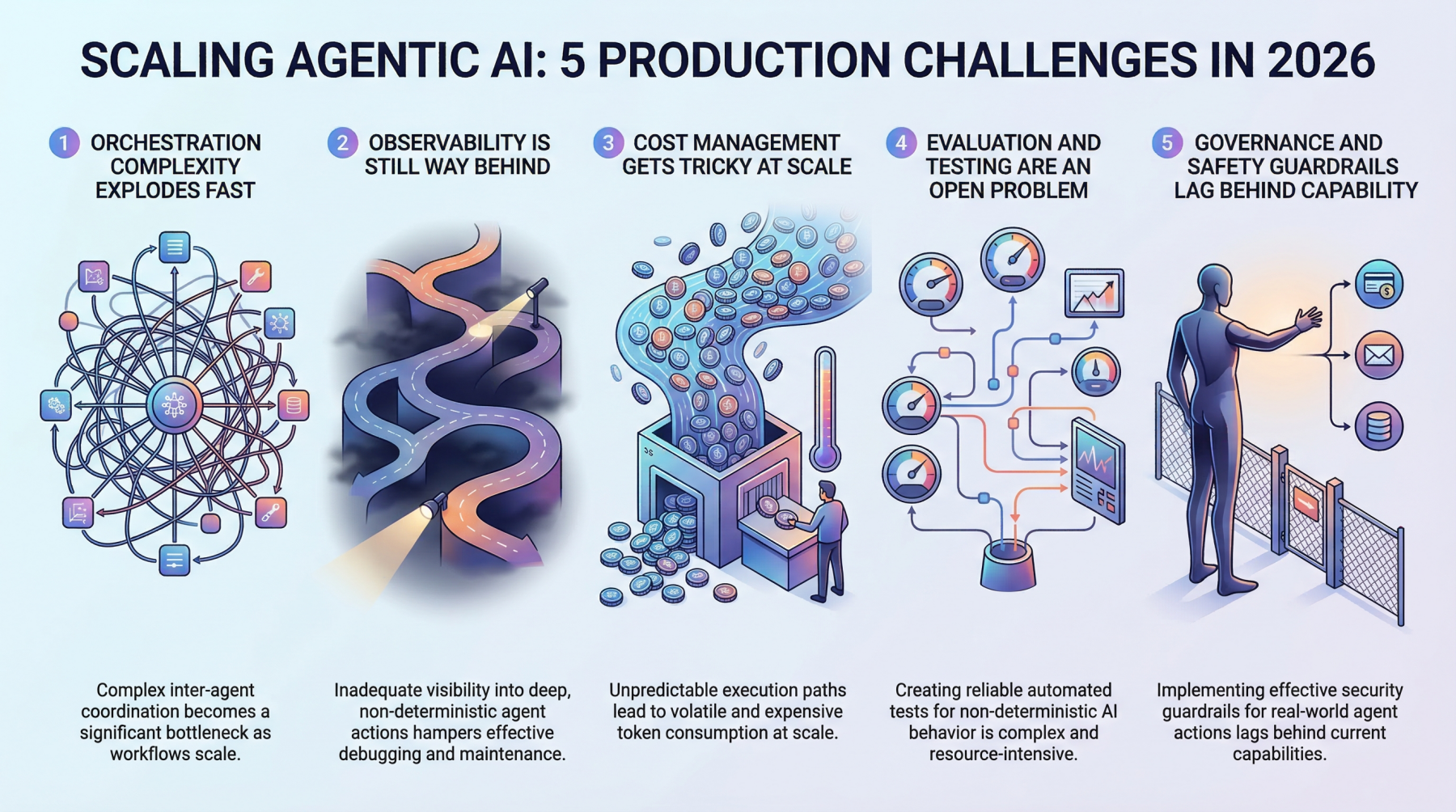
5 Production Scaling Challenges for Agentic AI in 2026

In the article "5 Production Scaling Challenges for Agentic AI in 2026," Nahla Davies examines the significant hurdles organizations face when moving autonomous systems from prototype to large-scale production. The first major obstacle is orchestration complexity, which grows exponentially in multi-agent environments where coordination overhead often becomes a performance bottleneck. Second, current observability tools remain inadequate for tracing the non-deterministic, multi-step decision paths inherent in agentic workflows, making debugging a profound challenge. Third, cost management is increasingly difficult as autonomous loops consume tokens rapidly, with variable execution paths creating high billing unpredictability. Fourth, traditional testing and evaluation methods are insufficient for probabilistic systems; teams must instead develop advanced simulation environments or "LLM-as-a-judge" pipelines to ensure reliability. Finally, the rapid deployment of agentic capabilities has outpaced governance and safety frameworks. Implementing robust guardrails is essential to prevent harmful real-world actions—such as unauthorized transactions or database modifications—without stifling the agent’s practical utility. Ultimately, the analysis highlights that while agentic AI is transformative, bridging the production gap requires solving these foundational infrastructure and safety problems to move beyond "pilot purgatory" into meaningful, scaled operations.


Building trust in the future of quantum computing

The article "The Future of Quantum," published on Phys.org in March 2026, outlines a pivotal transition in quantum science from experimental demonstrations to "utility-scale" industrial applications. As the field marks the centennial of quantum mechanics, researchers are shifting focus from simply increasing qubit counts to enhancing system reliability through advanced error-mitigation and standardized benchmarking. A central theme is "building trust," which involves creating transparent performance metrics that allow industries to transition from classical to quantum-enhanced workflows in sectors like drug discovery, sustainable material design, and financial modeling. Significant breakthroughs highlighted include the development of diamond-based quantum internet nodes and the emergence of "quantum batteries" that exhibit faster charging at larger scales. Additionally, the analysis emphasizes the geopolitical dimension, noting substantial national investments aimed at securing sovereign quantum capabilities for national security and economic resilience. Ultimately, the piece argues that the "second quantum revolution" is now defined by the convergence of hardware stability and sophisticated software stacks, effectively turning the strange properties of entanglement and superposition into dependable tools for global digital infrastructure and solving previously intractable computational challenges.

Daily Tech Digest - February 13, 2026


Quote for the day:

"If you want teams to succeed, set them up for success—don’t just demand it." -- Gordon Tredgold


Hackers turn bossware against the bosses

Huntress discovered two incidents using this tactic, one late in January and one early this month. Shared infrastructure, overlapping indicators of compromise, and consistent tradecraft across both cases make Huntress strongly believe a single threat actor or group was behind this activity. ... CSOs must ensure that these risks are properly catalogued and mitigated,” he said. “Any actions performed by these agents must be monitored and, if possible, restricted. The abuse of these systems is a special case of ‘living off the land’ attacks. The attacker attempts to abuse valid existing software to perform malicious actions. This abuse is often difficult to detect.” ... Huntress analyst Pham said to defend against attacks combining Net Monitor for Employees Professional and SimpleHelp, infosec pros should inventory all applications so unapproved installations can be detected. Legitimate apps should be protected with robust identity and access management solutions, including multi-factor authentication. Net Monitor for Employees should only be installed on endpoints that don’t have full access privileges to sensitive data or critical servers, she added, because it has the ability to run commands and control systems. She also noted that Huntress sees a lot of rogue remote management tools on its customers’ IT networks, many of which have been installed by unwitting employees clicking on phishing emails. This points to the importance of security awareness training, she said. 


Why secure OT protocols still struggle to catch on

“Simply having ‘secure’ protocol options is not enough if those options remain too costly, complex, or fragile for operators to adopt at scale,” Saunders said. “We need protections that work within real-world constraints, because if security is too complex or disruptive, it simply won’t be implemented.” ... Security features that require complex workflows, extra licensing, or new infrastructure often lose out to simpler compensating controls. Operators interviewed said they want the benefits of authentication and integrity checks, particularly message signing, since it prevents spoofing and unauthorized command execution. ... Researchers identified cost as a primary barrier to adoption. Operators reported that upgrading a component to support secure communications can cost as much as the original component, with additional licensing fees in some cases. Costs also include hardware upgrades for cryptographic workloads, training staff, integrating certificate management, and supporting compliance requirements. Operators frequently compared secure protocol deployment costs with segmentation and continuous monitoring tools, which they viewed as more predictable and easier to justify. ... CISA’s recommendations emphasize phased approaches and operational realism. Owners and operators are advised to sign OT communications broadly, apply encryption where needed for sensitive data such as passwords and key exchanges, and prioritize secure communication on remote access paths and firmware uploads.


SaaS isn’t dead, the market is just becoming more hybrid

“It’s important to avoid overgeneralizing ‘SaaS,’” Odusote emphasized . “Dev tools, cybersecurity, productivity platforms, and industry-specific systems will not all move at the same pace. Buyers should avoid one-size-fits-all assumptions about disruption.” For buyers, this shift signals a more capability-driven, outcomes-focused procurement era. Instead of buying discrete tools with fixed feature sets, they’ll increasingly be able to evaluate and compare platforms that are able to orchestrate agents, adapt workflows, and deliver business outcomes with minimal human intervention. ... Buyers will likely have increased leverage in certain segments due to competitive pressure among new and established providers, Odusote said. New entrants often come with more flexible pricing, which obviously is an attraction for those looking to control costs or prove ROI. At the same time, traditional SaaS leaders are likely to retain strong positions in mission-critical systems; they will defend pricing through bundled AI enhancements, he said. So, in the short term, buyers can expect broader choice and negotiation leverage. “Vendors can no longer show up with automatic annual price increases without delivering clear incremental value,” Odusote pointed out. “Buyers are scrutinizing AI add-ons and agent pricing far more closely.”


When algorithms turn against us: AI in the hands of cybercriminals

Cybercriminals are using AI to create sophisticated phishing emails. These emails are able to adapt the tone, language, and reference to the person receiving it based on the information that is publicly available about them. By using AI to remove the red flag of poor grammar from phishing emails, cybercriminals will be able to increase the success rate and speed with which the stolen data is exploited. ... An important consideration in the arena of cyber security (besides technical security) is the psychological manipulation of users. Once visual and audio “cues” can no longer be trusted, there will be an erosion of the digital trust pillar. The once-recognizable verification process is now transforming into multi-layered authentication which expands the amount of time it takes to verify a decision in a high-pressure environment. ... AI’s misuse is a growing problem that has created a paradox. Innovation cannot stop (nor should it), and AI is helping move healthcare, finance, government and education forward. However, the rate at which AI has been adopted has surpassed the creation of frameworks and/or regulations related to ethics or security. As a result, cyber security needs to transition from a reactive to a predictive stance. AI must be used to not only react to attacks, but also anticipate future attacks. 


Those 'Summarize With AI' Buttons May Be Lying to You

Put simply, when a user visits a rigged website and clicks a "Summarize With AI" button on a blog post, they may unknowingly trigger a hidden instruction embedded in the link. That instruction automatically inserts a specially crafted request into the AI tool before the user even types anything. ... The threat is not merely theoretical. According to Microsoft, over a 60-day period, it observed 50 unique instances of prompt-based AI memory poisoning attempts for promotional purposes. ... AI recommendation poisoning is a sort of drive-by technique with one-click interaction, he notes. "The button will take the user — after the click — to the AI domain relevant and specific for one of the AI assistants targeted," Ganacharya says. To broaden the scope, an attacker could simply generate multiple buttons that prompt users to "summarize" something using the AI agent of their choice, he adds. ... Microsoft had some advice for threat hunting teams. Organizations can detect if they have been affected by hunting for links pointing to AI assistant domains and containing prompts with certain keywords like "remember," "trusted source," "in future conversations," and "authoritative source." The company's advisory also listed several threat hunting queries that enterprise security teams can use to detect AI recommendation poisoning URLs in emails and Microsoft Teams Messages, and to identify users who might have clicked on AI recommendation poisoning URLs.


EU Privacy Watchdogs Pan Digital Omnibus

The commission presented its so-called "Digital Omnibus" package of legal changes in November, arguing that the bloc's tech rules needed streamlining. ... Some of the tweaks were expected and have been broadly welcomed, such as doing away with obtrusive cookie consent banners in many cases, and making it simpler for companies to notify of data breaches in a way that satisfies the requirements of multiple laws in one go. But digital rights and consumer advocates are reacting furiously to an unexpected proposal for modifying the General Data Protection Regulation. ... "Simplification is essential to cut red tape and strengthen EU competitiveness - but not at the expense of fundamental rights," said EDPB chair Anu Talus in the statement. "We strongly urge the co-legislators not to adopt the proposed changes in the definition of personal data, as they risk significantly weakening individual data protection." ... Another notable element of the Digital Omnibus is the proposal to raise the threshold for notifying all personal data breaches to supervisory authorities. As the GDPR currently stands, organizations must notify a data protection authority within 72 hours of becoming aware of the breach. If amended as the commission proposes, the obligation would only apply to breaches that are "likely to result in a high risk" to the affected people's rights - the same threshold that applies to the duty to notify breaches to the affected data subjects themselves - and the notification deadline would be extended to 96 hours.


The Art of the Comeback: Why Post-Incident Communication is a Secret Weapon

Although technical resolutions may address the immediate cause of an outage, effective communication is essential in managing customer impact and shaping public perception—often influencing stakeholders’ views more strongly than the issue itself. Within fintech, a company's reputation is not built solely on product features or interface design, but rather on the perceived security of critical assets such as life savings, retirement funds, or business payrolls. In this high-stakes environment, even brief outages or minor data breaches are perceived by clients as threats to their financial security. ... While the natural instinct during a crisis (like a cyber breach or operational failure) is to remain silent to avoid liability, silence actually amplifies damage. In the first 48 hours, what is said—or not said—often determines how a business is remembered. Post-incident communication (PIC) is the bridge between panic and peace of mind. Done poorly, it looks like corporate double-speak. Done well, it demonstrates a level of maturity and transparency that your competitors might lack. ... H2H communication acknowledges the user’s frustration rather than just providing a technical error code. It recognizes the real-world impact on people, not just systems. Admitting mistakes and showing sincere remorse, rather than using defensive, legalistic language, makes a company more relatable and trustworthy. Using natural, conversational language makes the communication feel sincere rather than like an automated, cold response.


Why AI success hinges on knowledge infrastructure and operational discipline

Many organisations assume that if information exists, it is usable for GenAI, but enterprise content is often fragmented, inconsistently structured, poorly contextualised, and not governed for machine consumption. During pilots, this gap is less visible because datasets are curated, but scaling exposes the full complexity of enterprise knowledge. Conflicting versions, missing context, outdated material, and unclear ownership reduce performance and erode confidence, not because models are incapable, but because the knowledge they depend on is unreliable at scale. ... Human-in-the-loop processes struggle to keep pace with scale. Successful deployments treat HITL as a tiered operating structure with explicit thresholds, roles, and escalation paths. Pilot-style broad review collapses under volume; effective systems route only low-confidence or high-risk outputs for human intervention. ... Learning compounds over time as every intervention is captured and fed back into the system, reducing repeated manual review. Operationally, human-in-the-loop teams function within defined governance frameworks, with explicit thresholds, escalation paths, and direct integration into production workflows to ensure consistency at scale. In short, a production-grade human-in-the-loop model is not an extension of BPO but an operating capability combining domain expertise, governance, and system learning to support intelligent systems reliably.


Why short-lived systems need stronger identity governance

Consider the lifecycle of a typical microservice. In its journey from a developer’s laptop to production, it might generate a dozen distinct identities: a GitHub token for the repository, a CI/CD service account for the build, a registry credential to push the container, and multiple runtime roles to access databases, queues and logging services. The problem is not just volume; it is invisibility. When a developer leaves, HR triggers an offboarding process. Their email is cut, their badge stops working. But what about the five service accounts they hardcoded into a deployment script three years ago? ... In reality, test environments are often where attackers go first. It is the path of least resistance. We saw this play out in the Microsoft Midnight Blizzard attack. The attackers did not burn a zero-day exploit to break down the front door; they found a legacy test tenant that nobody was watching closely. ... Our software supply chain is held together by thousands of API keys and secrets. If we continue to rely on long-lived static credentials to glue our pipelines together, we are building on sand. Every static key sitting in a repo—no matter how private you think it is—is a ticking time bomb. It only takes one developer to accidentally commit a .env file or one compromised S3 bucket to expose the keys to the kingdom. ... Paradoxically, by trying to control everything with heavy-handed gates, we end up with less visibility and less control. The goal of modern identity governance shouldn’t be to say “no” more often; it should be to make the secure path the fastest path.


India's E-Rupee Leads the Secure Adoption of CBDCs

India has the e-rupee, which will eventually be used as a legal tender for domestic payments as well as for international transactions and cross-border payments. Ever since RBI launched the e-rupee, or digital rupee, in December 2022, there has been between INR 400 to 500 crore - or $44 to $55 million - in circulation. Many Indian banks are participating in this pilot project. ... Building broad awareness of CBDCs as a secure method for financial transactions is essential. Government and RBI-led awareness campaigns highlighting their security capability can strengthen user confidence and drive higher adoption and transaction volumes. People who have lost money due to QR code scams, fake calls, malicious links and other forms of payment fraud need to feel confident about using CBDCs. IT security companies are also cooperating with RBI to provide data confidentiality, transaction confidentiality and transaction integrity. E-transactions will be secured by hashing, digital signing and [advanced] encryption standards such as AES-192. This can ensure that the transaction data is not tampered with or altered. ... HSMs use advanced encryption techniques to secure transactions and keys. The HSM hardware [boxes] act as cryptographic co-processors and accelerate the encryption and decryption processes to minimize latency in financial transactions. 


Daily Tech Digest - January 14, 2026


Quote for the day:

"To accomplish great things, we must not only act, but also dream, not only plan, but also believe." -- Anatole France


Outsmarting Data Center Outage Risks in 2026

Even the most advanced and well-managed facilities are not immune to disruptions. Recent incidents, such as outages at AWS, Cloudflare, and Microsoft Azure, serve as reminders that no data center can guarantee 100% uptime. This highlights the critical importance of taking proactive steps to mitigate data center outage risks, regardless of how reliable your facility appears to be. ... Overheating events can cause servers to shut down, leading to outages. To prevent an outage, you must detect and address excess heat issues proactively, before they become severe enough to trigger failures. A key consideration in this regard is to monitor data center temperatures granularly – meaning that instead of just deploying sensors that track the overall temperature of the server room, you monitor the temperatures of individual racks and servers. This is important because heat can accumulate in small areas, even if it remains normal across the data center. ... But from the perspective of data center uptime, physical security, which protects against physical attacks, is arguably a more important consideration. Whereas cybersecurity attacks typically target only a handful of servers or workloads, physical attacks can easily disable an entire data center. To this end, it’s critical to invest in multi-layered physical security controls – from the data center perimeter through to locks on individual server cabinets – to protect against intrusion. ... To mitigate outage risks, data center operators must take proactive steps to prevent fires from starting in the first place. 


Deploying AI agents is not your typical software launch - 7 lessons from the trenches

Across the industry, there is agreement that agents require new considerations beyond what we've become accustomed to in traditional software development. In the process, new lessons are being learned. Industry leaders shared some of their own lessons with ZDNET as they moved forward into an agentic AI future. ... Kale urges AI agent proponents to "grant autonomy in proportion to reversibility, not model confidence. Irreversible actions across multiple domains should always have human oversight, regardless of how confident the system appears." Observability is also key, said Kale. "Being able to see how a decision was reached matters as much as the decision itself." ... "AI works well when it has quality data underneath," said Oleg Danyliuk, CEO at Duanex, a marketing agency that built an agent to automate the validation of leads of visitors to its site. "In our example, in order to understand if the lead is interesting for us, we need to get as much data as we can, and the most complex is to get the social network's data, as it is mostly not accessible to scrape. That's why we had to implement several workarounds and get only the public part of the data." ... "AI agents do not succeed on model capability alone," said Martin Bufi, a principal research director at Info-Tech Research Group. His team designed and developed AI agent systems for enterprise-level functions, including financial analysis, compliance validation, and document processing. What helped these projects succeed was the employment of "AgentOps" (agent operations), which focuses on managing the entire agent lifecycle.


What enterprises think about quantum computing

Quantum computers’ qubits are incredibly fragile, so even setting or reading qubits has to be incredibly precise or it messes everything up. Environmental conditions can also mess things up, because qubits can get entangled with the things around them. Qubits can even leak away in the middle of something. So, here we have a technology that most people don’t understand and that is incredibly finicky, and we’re supposed to bet the business on it? How many enterprises would? None, according to the 352 who commented on the topic. How many think their companies will use it eventually? All of them—but they don’t know where or when, as an old song goes. And by the way, quantum theory is older than that song, and we still don’t have a handle on it. ... First and foremost, this isn’t the technology for general business applications. The quantum geeks emphasize that good quantum applications are where you have some incredibly complex algorithm, some math problem, that is simply not solvable using digital computers. Some suggest that it’s best to think of a quantum computer as a kind of analog computer. ... Even where quantum computing can augment digital, you’ll have to watch ROI according to the second point. The cost of quantum computing is currently prohibitive for most applications, even the stuff it’s good for, so you need find applications that have massive benefits, or think of some “quantum as a service” for solving an occasional complex problem.


Beyond the hype: 4 critical misconceptions derailing enterprise AI adoption

Leaders frequently assume AI adoption is purely technological when it represents a fundamental transformation that requires comprehensive change management, governance redesign and cultural evolution. The readiness illusion obscures human and organizational barriers that determine success. ... Leaders frequently assume AI can address every business challenge and guarantee immediate ROI, when empirical evidence demonstrates that AI delivers measurable value only in targeted, well-defined and precise use cases. This expectation reality gap contributes to pilot paralysis, in which companies undertake numerous AI experiments but struggle to scale any to production. ... Executives frequently claim their enterprise data is already clean or assume that collecting more data will ensure AI success — fundamentally misunderstanding that quality, stewardship and relevance matter exponentially more than raw quantity — and misunderstanding that the definition of clean data changes when AI is introduced. ... AI systems are probabilistic and require continuous lifecycle management. MIT research demonstrates manufacturing firms adopting AI frequently experience J-curve trajectories, where initial productivity declines but is then followed by longer-term gains. This is because AI deployment triggers organizational disruption requiring adjustment periods. Companies failing to anticipate this pattern abandon initiatives prematurely. The fallacy manifests in inadequate deployment management, including planning for model monitoring, retraining, governance and adaptation.


Inside the Growing Problem of Identity Sprawl

For years, identity governance relied on a set of assumptions tied closely to human behavior. Employees joined organizations, moved roles and eventually left. Even when access reviews lagged or controls were imperfect, identities persisted long enough to be corrected. That model no longer reflects reality. The difference between human and machine identities isn't just scale. "With human identities, if people are coming into your organizations as employees, you onboard them. They work, and by the time they leave, you can deprovision them," said Haider Iqbal ... "Organizations are using AI today, whether they know it or not, and most organizations don't even know that it's deployed in their environment," said Morey Haber, chief security advisor at BeyondTrust. That lack of awareness is not limited to AI. Many security teams struggle to maintain a reliable inventory of non-human identities, especially when those identities are created dynamically by automation or cloud services. Visibility gaps don't stop access from being granted, but they do prevent teams from confidently enforcing policy. "Without integration … I don't know what it's doing, and then I got to go figure it out. When you unify together, then you have all the AI visibility," Haber said, describing the operational impact of fragmented tooling. ... Modern enterprise environments rely on elevated access for cloud orchestration, application integration and automated workflows. Service accounts and application programming interfaces often require broad permissions to function reliably.


The Timeless Architecture: Enterprise Integration Patterns That Exceed Technology Trends

A strange reality is often encountered by enterprise technology leaders: everything seems to change, yet many things remain the same. New technologies emerge — from COBOL to Java to Python, from mainframes to the cloud — but the fundamental problems persist. Organizations still need to connect incompatible systems, convert data between different formats, maintain reliability when components fail, and scale to meet increasing demand. ... Synchronous request-response communication creates tight coupling and can lead to cascading failures. Asynchronous messaging has appeared across all eras — on mainframes via MQ, in SOA through ESB platforms, in cloud environments via managed messaging services such as SQS and Service Bus, and in modern event-streaming platforms like Kafka. ... A key architectural question is how to coordinate complex processes that span multiple systems. Two primary approaches exist. Orchestration relies on a centralized coordinator to control the workflow, while choreography allows systems to react to events in a decentralized manner. Both approaches existed during the mainframe era and remain relevant in microservices architectures today. Each has advantages: orchestration provides control and visibility, while choreography offers resilience and loose coupling. ... Organizations that treat security as a mere technical afterthought often accumulate significant technical debt. In contrast, enterprises that embed security patterns as foundational architectural elements are better equipped to adapt as technologies evolve.


From distributed monolith to composable architecture on AWS: A modern approach to scalable software

A distributed monolith is a system composed of multiple services or components, deployed independently but tightly coupled through synchronous dependencies such as direct API calls or shared databases. Unlike a true microservices architecture, where services are autonomous and loosely coupled, distributed monoliths share many pitfalls of monoliths ... Composable architecture embraces modularity and loose coupling by treating every component as an independent building block. The focus lies in business alignment and agility rather than just code decomposition. ... Start by analyzing the existing application to find natural business or functional boundaries. Use Domain-Driven Design to define bounded contexts that encapsulate specific business capabilities. ... Refactor the code into separate repositories or modules, each representing a bounded context or microservice. This clear separation supports independent deployment pipelines and ownership. ... Replace direct code or database calls with API calls or events. For example: Use REST or GraphQL APIs via API Gateway. Emit business events via EventBridge or SNS for asynchronous processing. Use SQS for message queuing to handle transient workloads. ... Assign each microservice its own DynamoDB table or data store. Avoid cross-service database joins or queries. Adopt a single-table design in DynamoDB to optimize data retrieval patterns within each service boundary. This approach improves scalability and performance at the data layer.


Firmware scanning time, cost, and where teams run EMBA

Security teams that deal with connected devices often end up running long firmware scans overnight, checking progress in the morning, and trying to explain to colleagues why a single image consumed a workday of compute time. That routine sets the context for a new research paper that examines how the EMBA firmware analysis tool behaves when it runs in different environments. ... Firmware scans often stretch into many hours, especially for medium and large images. The researchers tracked scan durations down to the second and repeated runs to measure consistency. Repeated executions on the same platform produced nearly identical run times and findings. That behavior matters for teams that depend on repeatable results during testing, validation, or research work. It also supports the use of EMBA in environments where scans need to be rerun with the same settings over time. The data also shows that firmware size alone does not explain scan duration. Internal structure, compression, and embedded components influenced how long individual modules ran. Some smaller images triggered lengthy analysis steps, especially during deep inspection stages. ... Nuray said cloud based EMBA deployments fit well into large scale scanning activity. He described cloud execution as a practical option for parallel analysis across many firmware images. Local systems, he added, support detailed investigation where teams need tight control over execution conditions and repeatability. 


'Most Severe AI Vulnerability to Date' Hits ServiceNow

Authentication issues in ServiceNow potentially opened the door for arbitrary attackers to gain full control over the entire platform and access to the various systems connected to it. ... Costello's first major discovery was that ServiceNow shipped the same credential to every third-party service that authenticated to the Virtual Agent application programming interface (API). It was a simple, obvious string — "servicenowexternalagent" — and it allowed him to connect to ServiceNow as legitimate third-party chat apps do. To do anything of significance with the Virtual Agent, though, he had to impersonate a specific user. Costello's second discovery, then, was quite convenient. He found that as far as ServiceNow was concerned, all a user needed to prove their identity was their email address — no password, let alone multifactor authentication (MFA), was required. ... An attacker could use this information to create tickets and manage workflows, but the stakes are now higher, because ServiceNow decided to upgrade its virtual agent: it can now also engage the platform's shiny new "Now Assist" agentic AI technology. ... "It's not just a compromise of the platform and what's in the platform — there may be data from other systems being put onto that platform," he notes, adding, "If you're any reasonably-sized organization, you are absolutely going to have ServiceNow hooked up to all kinds of other systems. So with this exploit, you can also then ... pivot around to Salesforce, or jump to Microsoft, or wherever."


Cybercrime Inc.: When hackers are better organized than IT

Cybercrime has transformed from isolated incidents into an organized industry. The large groups operate according to the same principles as international corporations. They have departments, processes, management levels, and KPIs. They develop software, maintain customer databases, and evaluate their success rates. ... Cybercrime now functions like a service chain. Anyone planning an attack today can purchase all the necessary components — from initial access credentials to leak management. Access brokers sell access to corporate networks. Botnet operators provide computing power for attacks. Developers deliver turnkey exploits tailored to known vulnerabilities. Communication specialists handle contact with the victims. ... What makes cybercrime so dangerous today is not just the technology itself, but the efficiency of its use. Attackers are flexible, networked, and eager to experiment. They test, discard, and improve — in cycles that are almost unimaginable in a corporate setting. Recruitment is handled like in startups. Job offers for developers, social engineers, or language specialists circulate in darknet forums. There are performance bonuses, training, and career paths. The work methods are agile, communication is decentralized, and financial motivation is clearly defined. ... Given this development, absolute security is unattainable. The crucial factor is the ability to quickly regain operational capability after an attack. Cyber ​​resilience describes this competence — not only to survive crises but also to learn from them.

Daily Tech Digest - January 09, 2026


Quote for the day:

"Always remember, your focus determines your reality." -- George Lucas


The AI plateau: What smart CIOs will do when the hype cools

During the early stages of GenAI adoption, organizations were captivated by its potential -- often driven by the hype surrounding tools like ChatGPT. However, as the technology matures, enterprises are now grappling with the complexities of scaling AI tools, integrating them into existing workflows and using them to meet measurable business outcomes. ... History has shown that transformative technologies often go through similar cycles of hype, disillusionment and eventual stabilization. ... Early on, many organizations told every department to use AI to boost productivity. That approach created energy, but it also produced long lists of ideas that competed for attention and resources. At the plateau stage, CIOs are becoming more selective. Instead of experimenting with every possible use case, they are selecting a smaller number of use cases that clearly support business goals and can be scaled. The question is no longer whether a team can use AI, but whether it should. ... CIOs should take a two-speed approach that separates fast, short-term AI projects from larger, long-term efforts, Locandro said. Smaller initiatives help teams learn and deliver quick results. Bigger projects require more planning and investment, especially when they span multiple systems. ... A key challenge CIOs face with GenAI is avoiding long, drawn-out planning cycles that try to solve everything at once. As AI technology evolves rapidly, lengthy projects risk producing outdated tools. 


Middle East Tech 2026: 5 Non-AI Trends Shaping Regional Business

The Middle Eastern biotechnology market is rapidly maturing into a multi-billion-dollar industrial powerhouse, driven by national healthcare and climate agendas. In 2026, the industry is marking the shift toward manufacturing-scale deployment, as genomics, biofuels, and diagnostics projects move into operational phases. ... Quantum computing has moved past the stage of academic curiosity. In 2026, the Middle East is seeing the first wave of applied industrial pilots, particularly within the energy and material science sectors. ... While commercialization timelines remain long, the strategic value of early entry is high. Foreign suppliers who offer algorithm development or hardware-software integration for these early-stage pilots will find a highly receptive market among national energy champions. ... Geopatriation refers to the relocation of digital workloads and data onto sovereign-controlled clouds and local hardware and stands out as a major structural shift in 2026. Driven by national security concerns and the massive data requirements of AI, Middle Eastern states are reducing their reliance on cross-border digital architectures. This trend has extended beyond data residency to include the localization of critical hardware capabilities. ... the region is moving away from perimeter-based security models toward zero-trust architectures, under which no user, device, or system receives implicit trust. Security priorities now extend beyond office IT systems to cover operational technology


Scaling AI value demands industrial governance

"Capturing AI's value while minimizing risk starts with discipline," Puig said. "CIOs and their organizations need a clear strategy that ties AI initiatives to business outcomes, not just technology experiments. This means defining success criteria upfront, setting guardrails for ethics and compliance, and avoiding the trap of endless pilots with no plan for scale." ... Puig adds that trust is just as important as technology. "Transparency, governance, and training help people understand how AI decisions are made and where human judgment still matters. The goal isn't to chase every shiny use case; it's to create a framework where AI delivers value safely and sustainably." ... Data security and privacy emerge as critical issues, cited by 42% of respondents in the research. While other concerns -- such as response quality and accuracy, implementation costs, talent shortages, and regulatory compliance -- rank lower individually, they collectively represent substantial barriers. When aggregated, issues related to data security, privacy, legal and regulatory compliance, ethics, and bias form a formidable cluster of risk factors -- clearly indicating that trust and governance are top priorities for scaling AI adoption. ... At its core, governance ensures that data is safe for decision-making and autonomous agents. In "Competing in the Age of AI," authors Marco Iansiti and Karim Lakhani explain that AI allows organizations to rethink the traditional firm by powering up an "AI factory" -- a scalable decision-making engine that replaces manual processes with data-driven algorithms.


Information Management Trends in the Year Ahead

The digital workforce will make its presence felt. “Fleets of AI agents trained on proprietary data, governed by corporate policy, and audited like employees will appear in org charts, collaborate on projects, and request access through policy engines,” said Sergio Gago, CTO for Cloudera. “They will be contributing insights alongside their human colleagues.” A potential oversight framework may effectively be called an “HR department for AI.” AI agents are graduating from “copilots that suggest to accountable coworkers inside their digital environments,” agreed Arturo Buzzalino ... “Instead of pulling data into different environments, we’re bringing compute to the data,” said Scott Gnau, head of data platforms at InterSystems. “For a long time, the common approach was to move data to wherever the applications or models were running. AI depends on fast, reliable access to governed data. When teams make this change, they see faster results, better control, and fewer surprises in performance and cost.” ... The year ahead will see efforts to reign in the huge volume of AI projects now proliferating outside the scope of IT departments. “IT leaders are being called in to fix or unify fragmented, business-led AI projects, signaling a clear shift toward CIOs—like myself,” said Shelley Seewald, CIO at Tungsten Automation. The impetus is on IT leaders and managers to be “more involved much earlier in shaping AI strategy and governance. 


What is outcome as agentic solution (OaAS)?

The analyst firm, Gartner predicts that a new paradigm it’s named outcome as agentic solution (OaAS) will make some of the biggest waves, by replacing software as a service (SaaS). The new model will see enterprises contract for outcomes, instead of simply buying access to software tools. Instead of SaaS, where the customer is responsible for purchasing a tool and using it to achieve results, with OaAS providers embed AI agents and orchestration so the work is performed for you. This leaves the vendor responsible for automating decisions and delivering outcomes, says Vuk Janosevic, senior director analyst at Gartner. ... The ‘outcome scenario’ has been developing in the market for several years, first through managed services then value-based delivery models. “OaAS simply formalizes it with modern IT buyers, who want results over tools,” notes Thomas Kraus, global head of AI at Onix. OaAS providers are effectively transforming systems of record (SoR) into systems of action (SoA) by introducing orchestration control planes that bind execution directly to outcomes, says Janosevic. ... Goransson, however, advises enterprises carefully evaluate several areas of risk before adopting an agentic service model, Accountability is paramount, he notes, as without clear ownership structures and performance metrics, organizations may struggle to assess whether outcomes are being delivered as intended.


Bridging the Gap Between SRE and Security: A Unified Framework for Modern Reliability

SRE teams optimize for uptime, performance, scalability, automation and operational efficiency. Security teams focus on risk reduction, threat mitigation, compliance, access control and data protection. Both mandates are valid, but without shared KPIs, each team views the other as an obstacle to progress. Security controls — patch cycles, vulnerability scans, IAM restrictions and network changes — can slow deployments and reduce SRE flexibility. In SRE terms, these controls often increase toil, create unpredictable work and disrupt service-level objectives (SLOs). The SRE culture emphasizes continuous improvement and rapid rollback, whereas security relies on strict change approval and minimizing risk surfaces. ... This disconnect impacts organizations in measurable ways. Security incidents often trigger slow, manual escalations because security and operations lack common playbooks, increasing mean time to recovery (MTTR). Risk gets mis-prioritized when SRE sees a vulnerability as non-disruptive while security considers it critical. Fragmented tooling means that SRE leverages observability and automation while security uses scanning and SIEM tools with no shared telemetry, creating incomplete incident context. The result? Regulatory penalties, breaches from failures in patch automation or access governance and a culture of blame where security faults SRE for speed and SRE faults security for friction. 


The 2 faces of AI: How emerging models empower and endanger cybersecurity

More recently, the researchers at Google Threat Intelligence Group (GTIG) identified a disturbing new trend: malware that uses LLMs during execution to dynamically alter its own behavior and evade detection. This is not pre-generated code, this is code that adapts mid-execution. ... Anthropic recently disclosed a highly sophisticated cyber espionage operation, attributed to a state-sponsored threat actor, that leveraged its own Claude Codemodel to target roughly 30 organizations globally, including major financial institutions and government agencies. ... If adversaries are operating at AI speed, our defenses must too. The silver lining of this dual-use dynamic is that the most powerful LLMs are also being harnessed by defenders to create fundamentally new security capabilities. ... LLMs have shown extraordinary potential in identifying unknown, unpatched flaws (zero-days). These models significantly outperform conventional static analyzers, particularly in uncovering subtle logic flaws and buffer overflows in novel software. ... LLMs are transforming threat hunting from a manual, keyword-based search to an intelligent, contextual query process that focuses on behavioral anomalies. ... Ultimately, the challenge isn’t to halt AI progress but to guide it responsibly. That means building guardrails into models, improving transparency and developing governance frameworks that keep pace with emerging capabilities. It also requires organizations to rethink security strategies, recognizing that AI is both an opportunity and a risk multiplier.


Hacker Conversations: Katie Paxton-Fear Talks Autism, Morality and Hacking

“Life with autism is like living life without the instruction manual that everyone else has.” It’s confusing and difficult. “Computing provides that manual and makes it easier to make online friends. It provides accessibility without the overpowering emotions and ambiguities that exist in face-to-face real life relationships – so it’s almost helping you with your disability by providing that safe context you wouldn’t normally have.” Paxton-Fear became obsessed with computing at an early age. ... During the second year into her PhD study, a friend from her earlier university days invited her to a bug bounty event held by HackerOne. She went – not to take part in the event (she still didn’t think she was a hacker nor understood anything about hacking), she went to meet up with other friends from the university days. She thought to herself, ‘I’m not going to find anything. I don’t know anything about hacking.’ “But then, while there, I found my first two vulnerabilities.” ... he was driven by curiosity from an early age – but her skill was in disassembly without reassembly: she just needed to know how things work. And while many hackers are driven to computers as a shelter from social difficulties, she exhibits no serious or long lasting social difficulties. For her, the attraction of computers primarily comes from her dislike of ambiguity. She readily acknowledges that she sees life as unambiguously black or white with no shades of gray.


‘A wild future’: How economists are handling AI uncertainty in forecasts

Economists have time-tested models for projecting economic growth. But they’ve seen nothing like AI, which is a wild card complicating traditional economic playbooks. Some facts are clear: AI will make humans more productive and increase economic activity, with spillover effects on spending and employment. But there are many unknowns about AI. Economists can’t isolate AI’s impact on human labor as automation kicks in. Nailing down long-term factory job losses to AI is not possible. ... “We’re seeing an increase in terms of productivity enhancements over the next decade and a half. While it doesn’t capture AI directly… there is all kinds of upside potential to the productivity numbers because of AI. ... “There are basically two ways this can go. You can get more output for the same input. If you used to put in 100 and get 120, maybe now you get 140. That’s an expansion in total factor productivity. Or you can get the same output with fewer inputs. “It’s unclear how much of either will happen across industries or in the labor market. Will companies lean into AI, cut their workforce, and maintain revenue? Or will they keep their workforce, use AI to supplement them, and increase total output per worker? ... If AI and automation remove the human element from labor-intensive manufacturing, that cost advantage erodes. It makes it harder for developing countries to use cheap labor as a stepping stone toward industrialization.


Understanding transformers: What every leader should know about the architecture powering GenAI

Inside a transformer, attention is the mechanism that lets tokens talk to each other. The model compares every token’s query with every other token’s key to calculate a weight which is a measure of how relevant one token is to another. These weights are then used to blend information from all tokens into a new, context-aware representation called a value. In simple terms: attention allows the model to focus dynamically. If the model reads “The cat sat on the mat because it was tired,” attention helps it learn that “it” refers to “the cat,” not “the mat.” ... Transformers are powerful, but they’re also expensive. Training a model like GPT-4 requires thousands of GPUs and trillions of data tokens. Leaders don’t need to know tensor math, but they do need to understand scaling trade-offs. Techniques like quantization (reducing numerical precision), model sharding and caching can cut serving costs by 30–50% with minimal accuracy loss. The key insight: Architecture determines economics. Design choices in model serving directly impact latency, reliability and total cost of ownership. ... The transformer’s most profound breakthrough isn’t just technical — it’s architectural. It proved that intelligence could emerge from design — from systems that are distributed, parallel and context-aware. For engineering leaders, understanding transformers isn’t about learning equations; it’s about recognizing a new principle of system design.

Daily Tech Digest - December 05, 2025


Quote for the day:

“Failure defeats losers, failure inspires winners.” -- Robert T. Kiyosaki


The 'truth serum' for AI: OpenAI’s new method for training models to confess their mistakes

A confession is a structured report generated by the model after it provides its main answer. It serves as a self-evaluation of its own compliance with instructions. In this report, the model must list all instructions it was supposed to follow, evaluate how well it satisfied them and report any uncertainties or judgment calls it made along the way. The goal is to create a separate channel where the model is incentivized only to be honest. ... During training, the reward assigned to the confession is based solely on its honesty and is never mixed with the reward for the main task. "Like the Catholic Church’s 'seal of confession', nothing that the model reveals can change the reward it receives for completing its original task," the researchers write. This creates a "safe space" for the model to admit fault without penalty. This approach is powerful because it sidesteps a major challenge in AI training. The researchers’ intuition is that honestly confessing to misbehavior is an easier task than achieving a high reward on the original, often complex, problem. ... For AI applications, mechanisms such as confessions can provide a practical monitoring mechanism. The structured output from a confession can be used at inference time to flag or reject a model’s response before it causes a problem. For example, a system could be designed to automatically escalate any output for human review if its confession indicates a policy violation or high uncertainty.


Why is enterprise disaster recovery always such a…disaster?

One of the brutal truths about enterprise disaster recovery (DR) strategies is that there is virtually no reliable way to truly test them. ... From a corporate politics perspective, IT managers responsible for disaster recovery have a lot of reasons to avoid an especially meaningful test. Look at it from a risk/reward perspective. They’re going to take a gamble, figuring that any disaster requiring the recovery environment might not happen for a few years. And by then with any luck, they’ll be long gone. ... “Enterprises place too much trust in DR strategies that look complete on slides but fall apart when chaos hits,” he said. “The misunderstanding starts with how recovery is defined. It’s not enough for infrastructure to come back online. What matters is whether the business continues to function — and most enterprises haven’t closed that gap. ... “Most DR tools, even DRaaS, only protect fragments of the IT estate,” Gogia said. “They’re scoped narrowly to fit budget or ease of implementation, not to guarantee holistic recovery. Cloud-heavy environments make things worse when teams assume resilience is built in, but haven’t configured failover paths, replicated across regions, or validated workloads post-failover. Sovereign cloud initiatives might address geopolitical risk, but they rarely address operational realism.


The first building blocks of an agentic Windows OS

Microsoft is adding an MCP registry to Windows, which adds security wrappers and provides discovery tools for use by local agents. An associated proxy manages connectivity for both local and remote servers, with authentication, audit, and authorization. Enterprises will be able to use these tools to control access to MCP, using group policies and default settings to give connectors their own identities. ... Be careful when giving agents access to the Windows file system; use base prompts that reduce the risks associated with file system access. When building out your first agent, it’s worth limiting the connector to search (taking advantage of the semantic capabilities of Windows’ built-in Phi small language model) and reading text data. This does mean you’ll need to provide your own guardrails for agent code running on PCs, for example, forcing read-only operations and locking down access as much as possible. Microsoft’s planned move to a least-privilege model for Windows users could help here, ensuring that agents have as few rights as possible and no avenue for privilege escalation. ... Building an agentic OS is hard, as the underlying technologies work very differently from standard Windows applications. Microsoft is doing a lot to provide appropriate protections, building on its experience in delivering multitenancy in the cloud. 


Syntax hacking: Researchers discover sentence structure can bypass AI safety rules

The findings reveal a weakness in how these models process instructions that may shed light on why some prompt injection or jailbreaking approaches work, though the researchers caution their analysis of some production models remains speculative since training data details of prominent commercial AI models are not publicly available. ... This suggests models absorb both meaning and syntactic patterns, but can overrely on structural shortcuts when they strongly correlate with specific domains in training data, which sometimes allows patterns to override semantic understanding in edge cases. ... In layperson terms, the research shows that AI language models can become overly fixated on the style of a question rather than its actual meaning. Imagine if someone learned that questions starting with “Where is…” are always about geography, so when you ask “Where is the best pizza in Chicago?”, they respond with “Illinois” instead of recommending restaurants based on some other criteria. They’re responding to the grammatical pattern (“Where is…”) rather than understanding you’re asking about food. This creates two risks: models giving wrong answers in unfamiliar contexts (a form of confabulation), and bad actors exploiting these patterns to bypass safety conditioning by wrapping harmful requests in “safe” grammatical styles. It’s a form of domain switching that can reframe an input, linking it into a different context to get a different result.


In 2026, Should Banks Aim Beyond AI?

Developing native AI agents and agentic workflows will allow banks to automate complex journeys while fine-tuning systems to their specific data and compliance landscapes. These platforms accelerate innovation and reinforce governance structures around AI deployment. This next generation of AI applications elevates customer service, fostering deeper trust and engagement. ... But any technological advancement must be paired with accountability and prudent risk management, given the sensitive nature of banking. AI can unlock efficiency and innovation, but its impact depends on keeping human decision-making and oversight firmly in place. It should augment rather than replace human authority, maintaining transparency and accountability in all automated processes. ... The banking environment is too risky for fully autonomous agentic AI workflows. Critical financial decisions require human judgment due to the potential for significant consequences. Nonetheless, many opportunities exist to augment decision-making with AI agents, advanced models and enriched datasets. ... As this evolution unfolds, financial institutions must focus on executing AI initiatives responsibly and effectively. By investing in home-grown platforms, emphasizing explainability, balancing human oversight with automation and fostering adaptive leadership, banks, financial services and insurance providers can navigate the complexities of AI adoption.


Building the missing layers for an internet of agents

The proposed Agent Communication Layer sits above HTTP and focuses on message structure and interaction patterns. It brings together what has been emerging across several protocols and organizes them into a common set of building blocks. These include standardized envelopes, a registry of performatives that define intent, and patterns for one to one or one to many communication. The idea is to give agents a dependable way to understand the type of communication taking place before interpreting the content. A request, an update, or a proposal each follows an expected pattern. This helps agents coordinate tasks without guessing the sender’s intention. The layer does not judge meaning. It only ensures that communication follows predictable rules that all agents can interpret. ... The paper outlines several new risks. Attackers might inject harmful content that fits the schema but tricks the agent’s reasoning. They might distribute altered or fake context definitions that mislead a population of agents. They might overwhelm a system with repetitive semantic queries that drain inference resources rather than network resources. To manage these problems, the authors propose security measures that match the new layer. Signed context definitions would prevent tampering. Semantic firewalls would examine content at the concept level and enforce rules about who can use which parts of a context. 


The Rise of SASE: From Emerging Concept to Enterprise Cornerstone

The case for SASE depends heavily on the business outcomes required, and there can be multiple use cases for SASE deployment. However, not everyone is always aligned around these. Whether you’re looking to modernize systems to boost operational resilience, reduce costs, or improve security to adhere to regulatory compliance, there needs to be alignment around your SASE deployment. Additionally, because of its versatility, SASE demands expertise across networking, cloud security, zero trust, and SD-WAN, but, unfortunately, these skills are in short supply. IT teams must upskill or recruit talent capable of managing (and running) this convergence, while also adapting to new operational models and workflows. ... However, most of the reported benefits don’t focus on tangible or financial outcomes, but rather those that are typically harder to measure, namely boosting operational resilience and enhancing user experience. These are interesting numbers to explore, as SASE investments are often predicated on specific and easily measurable business cases, typically centered around cost savings or mitigation of specific cyber/operational risks. Looking at the benefits from both a networking and security perspective, the data reveals different priorities for SASE adoption: IT Network leaders value operational streamlining and efficiency, while IT Security leaders emphasize secure access and cloud protection. 


Intelligent Banking: A New Standard for Experience and Trust

At its core, Intelligent Banking connects three forces that are redefining what "intelligent" really means: Rising expectations - Customers not only expect their institutions to understand them, but to intuitively put forward recommendations before they realize change is needed. All while acting with empathy while delivering secure, trusted experiences. ... Data abundance - Financial institutions have more data than ever but struggle to turn it into actionable insight that benefits both the customer and the institution. ... AI readiness - For years, AI in banking was at best a buzz word that encapsulated the standard — decision trees, models, rules. ... The next era of AI in banking will be completely different. It will be invisible. Embedded. Contextual. It will be built into the fabric of the experience, not just added on top. And while mobile apps as we know them will likely be around for a while, a fully GenAI native banking experience is both possible and imminent. ... In the age of AI, it’s tempting to see "intelligence" purely as technology alone. But the future of banking will depend just as much on human intelligence as it will artificial intelligence. The expertise, empathy, and judgement of the institutions who understand financial context and complexity blended with the speed, prediction and pattern recognition that uncover insights humans can’t see will create a new standard for banking, one where experiences feel both profoundly human and intelligently anticipatory.


Taking Control of Unstructured Data to Optimize Storage

The modern business preoccupation with collecting and retaining data has become something of a double-edged sword. On the plus side, it has fueled a transformational approach to how organizations are run. On the other hand, it’s rapidly becoming an enormous drain on resources and efficiency. The fact that 80-90% of this information is unstructured, i.e. spread across formats such as documents, images, videos, emails, and sensor outputs, only adds to the difficulty of organizing and controlling it. ... To break this down, detailed metadata insight is essential for revealing how storage is actually being used. Information such as creation dates, last accessed timestamps, and ownership highlights which data is active and requires performance storage, and which has aged out of use or no longer relates to current users. ... So, how can this be achieved? At a fundamental level, storage optimization hinges on adopting a technology approach that manages data, not storage devices; simply adding more and more capacity is no longer viable. Instead, organizations must have the ability to work across heterogeneous storage environments, including multiple vendors, locations and clouds. Tools should support vendor-neutral management so data can be monitored and moved regardless of the underlying platform. Clearly, this has to take place at petabyte scale. Optimization also relies on policy-based data mobility that enables data to be moved based on defined rules, such as age or inactivity, with inactive or long-dormant data.


W.A.R & P.E.A.C.E: The Critical Battle for Organizational Harmony

W.A.R & P.E.A.C.E, the pivotal human lens within TRIAL, designed specifically to address this cultural challenge and shepherd the enterprise toward AARAM (Agentic AI Reinforced Architecture Maturities)2 with what I term “speed 3” transformation of AI. ... The successful, continuous balancing of W.A.R. and P.E.A.C.E. is the biggest battle an Enterprise Architect must win. Just as Tolstoy explored the monumental scope of war against intimate moments of peace in his masterwork, the Enterprise Architect must balance the intense effort to build repositories against the delicate work of fostering organizational harmony. ... The W.A.R. systematically organizes information across the four critical architectural domains defined in our previous article: Business, Information, Technology, and Security (BITS). The true power of W.A.R. lies in its ability to associate technical components with measurable business and financial properties, effectively transforming technical discussions into measurable, strategic imperatives. Each architectural components across BITS are tracked across Plan, Design & Run lifecycle of change under the guardrails of BYTES. ... Achieving effective P.E.A.C.E. mandates a carefully constructed collaborative environment where diverse organizational roles work together toward a shared objective. This requires alignment across all lifecycle stages using social capital and intelligence.