Showing posts with label knowledge. Show all posts

Daily Tech Digest - June 28, 2026


Quote for the day:

"Hard work beats talent when talent doesn't work hard." -- Tim Notke

🎧 Listen to this digest on YouTube Music

▶ Play Audio Digest

Duration: 17 mins • Perfect for listening on the go.


Ford learned the hard way that AI can't replace experienced engineers

Ford recently discovered that artificial intelligence cannot substitute for the nuanced judgment of experienced engineers. In an effort to modernize its manufacturing and engineering systems, the automaker integrated AI to accelerate decision making and streamline vehicle development. Executives assumed that automated systems and adjusted design requirements would naturally yield high quality products. However, this approach backfired. As veteran engineers left the company, their undocumented institutional knowledge was excluded from the datasets used to train Ford’s AI models. Consequently, the technology struggled to identify and prevent defects, contributing to quality control issues and leading the industry in vehicle recalls. To resolve these challenges, Ford rehired and promoted over 350 seasoned engineers. Rather than replacing human expertise, AI now serves as a supportive tool. These veteran engineers are currently guiding how data is collected, interpreted, and fed into the AI systems to rebuild a reliable foundation. Furthermore, Ford created a dedicated software quality assurance team and introduced automated AI driven testing to catch defects early in the development cycle. This transition reflects a balanced strategy where the company relies on both advanced computing power and decades of practical automotive experience to prevent problems before they occur.


Where AI meets OT: Cybersecurity for a physical world

Integrating artificial intelligence into operational technology requires a careful approach because, unlike business software, industrial systems have physical consequences. While artificial intelligence offers clear benefits for manufacturing, such as improved maintenance and quality control, it introduces unique risks when connected to machines and factory floors. Industrial environments often rely on older, existing systems and operate on strict schedules with limited downtime, making new technology harder to test and implement safely. Furthermore, software models can become inaccurate over time as physical equipment naturally ages, which means these tools require ongoing checks against actual physical outcomes rather than just historical data. The level of risk also depends on how much control the system has. An advisory tool leaves the final decision to a human, whereas a system that directly alters machinery settings requires far stricter oversight. True human oversight means operators must fully understand the technology's recommendations and know when to override them. Adding these new digital connections also expands the cybersecurity risk, as attackers could manipulate the data feeding the models. Ultimately, these tools hold steady value for industrial operations, but they must be introduced with strong discipline, clear operating limits, and reliable backup plans.


How to Build a Powerful LLM Knowledge Base

Building a knowledge base powered by large language models is a practical, reliable way to store and retrieve your personal or company information, leading to better decision-making and clearer team alignment. To create an effective system, you must start by identifying all your daily information sources, such as meeting notes, project management tools, and coding assistants. The critical step is fully automating the collection process; requiring any manual entry virtually guarantees that valuable context will eventually be forgotten and lost. Once your data is automatically synced into the system on a regular schedule, you can use a coding agent to extract insights. You can do this actively by directly asking your agent questions when you need specific answers. Alternatively, you can configure your agent to passively draw on the knowledge base while it works on routine tasks. This passive retrieval can be managed either through a centralized index file or via an embedding-based search that pulls relevant information as needed. Ultimately, consistently capturing and accessing your unique, everyday context creates a distinct long-term advantage, ensuring that valuable insights are preserved and always ready to assist you in your daily work.


Is the CIO Role Merging Into the Business?

For decades, the role of the Chief Information Officer followed a predictable path, slowly shifting from managing basic operations to supporting broader strategy. However, recent trends indicate that this steady progression is becoming obsolete. The middle ground is collapsing, forcing a clear divide in the profession. On one hand, some leaders remain stuck in traditional management, treating technology as a separate, functional necessity. On the other hand, a new breed of technology executives is emerging as true enterprise operators who share responsibility for revenue and actively shape commercial models. In the most effective organizations, technology is no longer just a supporting layer; it is the central system for making decisions. As companies embed artificial intelligence deeply into their core operations and bring critical capabilities inside the firm, the person leading technology must also architect these decision-making systems. Consequently, the traditional boundary between technology leadership and business leadership is rapidly fading. Instead of simply elevating the position to a more strategic level, the core responsibilities are dissolving directly into the business itself. Ultimately, the future landscape will be defined not by better technology departments, but by whether the conventional title needs to exist at all.


Deep dive: Do underwater data centers make sense?

The article evaluates the practicality of underwater data centers as an alternative to land-based facilities, which struggle with high energy consumption and space limitations. Traditional data centers use tremendous amounts of power, largely just to keep servers cool. Submerging these facilities allows companies to use the ocean as a natural cooling system, significantly reducing energy requirements. Beyond energy savings, placing data centers offshore brings them closer to coastal populations. This proximity shortens the distance data travels, leading to faster loading times for end users. Research also indicates that underwater servers are surprisingly reliable. Because they are sealed in a nitrogen-rich environment without human foot traffic or temperature swings, hardware fails much less frequently. Despite these benefits, the underwater model has distinct disadvantages. Routine maintenance is virtually impossible; broken servers cannot be quickly swapped out. Furthermore, researchers are still studying how the continuous release of heat might alter local marine ecosystems. There are also valid concerns regarding the physical security of underwater cables. While the approach provides clear advantages in efficiency and speed, these formidable logistical and environmental challenges complicate the decision of whether underwater data centers are a sensible long-term investment.


5 T-SQL features that should already exist (2026 SQL Server wish list)
In a recent article by Edward Pollack on Simple Talk, the author reflects on the state of Microsoft SQL Server in 2026 and outlines five practical features he believes should be natively supported in T-SQL and the platform. While SQL Server remains a highly mature database system, Pollack highlights specific areas where daily tasks for developers and database administrators could be made far more efficient. First, he argues for the native ability to import data from compressed file formats, specifically Apache Parquet, which would eliminate the need to deal with cumbersome plain text files like CSV. Second, he requests native support for arrays, providing a straightforward alternative to using text strings or XML to store lists of values. Third, he advocates for an "OVERLAPS" function to simplify complex date logic into a single line of code. Fourth, Pollack points out that the current licensing model is overly complicated and suggests it should be as transparent as the monthly estimates provided for Azure SQL. Finally, he suggests expanding cloud blob storage integration so that files and scripts can be managed centrally in the cloud rather than on local drives.


Shaping a lasting AI strategy in a fast-changing world

As artificial intelligence becomes a standard tool in business, simply having access to the technology is no longer enough to stand out. Because most companies will use the same core platforms and models, a well-defined strategy is what will truly set an organization apart. The current landscape is marked by more capable and affordable systems that act as helpful assistants rather than outright replacements for human workers. Development teams are already showing how humans and these tools can work together effectively. To succeed, leaders need to shift their focus from the technology itself to how it supports their long-term goals over the next three to five years. This requires answering difficult questions about the company's future direction, understanding current weaknesses, and identifying the specific skills needed for tomorrow. Decision-makers must also practice restraint, choosing a few reliable platforms and focusing on clear priorities rather than chasing every new trend. By thoughtfully integrating these tools into daily workflows and supporting human decision-making, businesses can improve their customer experience and operations. Ultimately, the tools are just the vehicle; a steady, clear strategy is the route that determines long-term success.


The Unglamorous Side of Rust Web Development

In 2026, Rust remains a powerful choice for web development, offering excellent performance and safety. However, developers still face notable friction before their code even compiles. The current ecosystem often requires teams to assemble their own setups from scratch, lacking the complete, ready-to-use frameworks seen in other programming languages. Several specific challenges slow down the daily development process. Asynchronous programming in Rust provides great flexibility, but it complicates debugging and creates lengthy, hard-to-read error traces. Database management is another hurdle, as developers frequently have to write and maintain the same database structure in multiple places instead of using a single unified approach. Additionally, error handling across different tools remains inconsistent. The heavy reliance on generated code and complex type systems significantly increases compilation times, making it harder for developers to test small changes quickly. Despite these hurdles, the community is actively working on solutions. New frameworks are emerging to provide more complete starting points and reduce repetitive setup tasks. Ultimately, while Rust requires a larger initial investment of time and effort compared to simpler alternatives, its long-term reliability and speed make it a sensible choice for projects where stability is a core requirement.

The AI Agent Tech Stack Explained

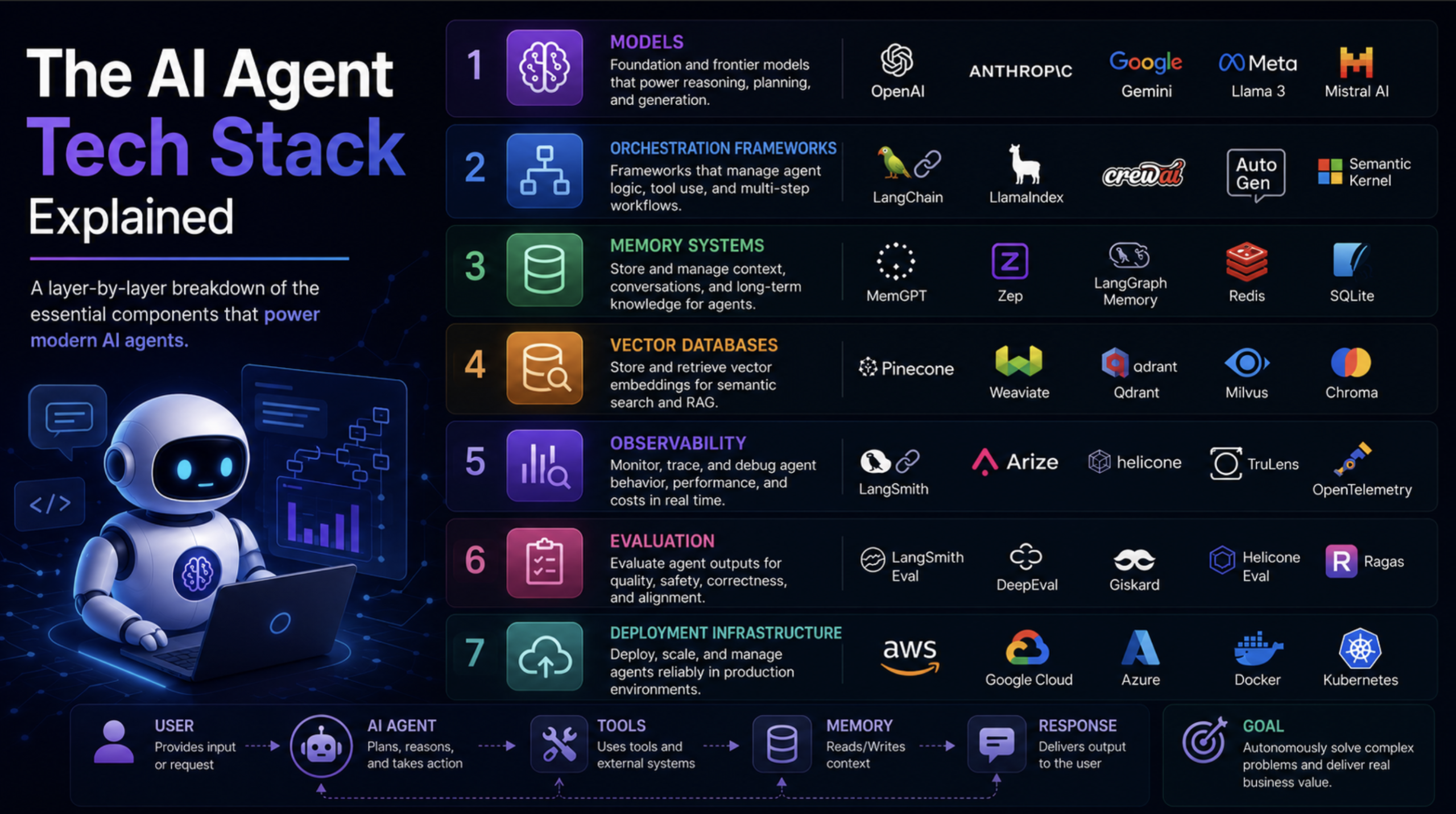
The article outlines the seven fundamental layers required to build and deploy functional artificial intelligence agents. It moves beyond basic models to explain the complete technical infrastructure needed for real-world applications. The guide begins with the foundation model, which acts as the central brain for reasoning. The second layer is the orchestration framework, serving as a nervous system to manage actions and control flow. Next, the third layer covers memory systems that provide essential context by tracking working, episodic, semantic, and procedural information. The fourth layer focuses on vector databases and document retrieval, allowing agents to access private information securely. The remaining layers detail tool integrations for performing outside actions, observability platforms for monitoring performance, and the final deployment infrastructure necessary for hosting. By breaking down the architecture into these distinct components, the text clarifies that successful systems rely heavily on a well-connected technology stack rather than just a single language model. It provides a clear, practical roadmap for software engineers and technical leads who want to understand how to assemble these exact pieces, whether they are building a simple prototype or scaling an application for production.

A Case for a Human-Centric AI Legislative Framework in India

In "A Case for a Human-Centric AI Legislative Framework in India," the author argues that India’s current approach to governing artificial intelligence is insufficient for protecting its citizens. While the Ministry of Electronics and Information Technology recently suggested relying on existing laws and self-regulation to foster innovation, the article points out that AI is fundamentally different from traditional software. Because AI programs operate as highly complex systems, relying on outdated frameworks like the Information Technology Act leaves users vulnerable to fraud, manipulation, and bias. Furthermore, the author critiques recent amendments for placing unreasonable takedown burdens on tech companies without providing clear state-defined guardrails. By comparing India’s strategy with the European Union’s user-focused risk models and China’s strict algorithm rules, the article advocates for a new Artificial Intelligence Regulation Act. This proposed legislation would introduce a risk-based grading system, establish an independent AI ombudsperson, and mandate transparency in training data. It even suggests giving citizens a copyright over their own faces to prevent unauthorized data usage. Ultimately, the piece makes a strong case that responsible innovation requires specific, human-centric laws to ensure safety and accountability for all users today.

Daily Tech Digest - June 24, 2026


Quote for the day:

"The only real test of intelligence is if you get what you want out of life." -- Naval Ravikant

🎧 Listen to this digest on YouTube Music

▶ Play Audio Digest

Duration: 22 mins • Perfect for listening on the go.


What Corporate Leaders Misunderstand About Cybersecurity Frameworks

Corporate leaders often misunderstand cybersecurity frameworks by treating them as generic checklists or simple report cards. While frameworks offer a solid foundation, their real value emerges only when organizations move away from a one size fits all approach and customize them to fit specific business needs. Creating a tailored profile is the vital first step, allowing a company to align security outcomes with its unique risks and resources. From there, these high level goals must be converted into practical, day to day controls. Relying on a single measure, such as encryption, is rarely enough; true protection requires an integrated system of access limits, continuous monitoring, and strict vendor management. Furthermore, writing down policies on paper falls short. Defenses must be regularly tested, audited, and updated to ensure they actually work in real world conditions. To manage this effectively, executives need clear visibility. Instead of overwhelming metrics, leadership should focus on key signals that indicate if essential protections are functioning properly. When frameworks become truly operational, they provide clear ownership, measurable evidence, and an ongoing method for finding and fixing weaknesses, resulting in a mature and reliable defense strategy.


CISO Conversations: Carl Froggett – Combining CISO and CIO at Deep Instinct

In a featured conversation, Carl Froggett reflects on his rare position holding both the chief information officer and chief information security officer titles at Deep Instinct. Having previously spent seventeen years managing security at Citi, he explains that combining technology strategy and security works well in smaller organizations, though it would be overwhelming at a massive enterprise. Because both departments ultimately exist to support the company, merging them removes the usual friction. However, Froggett notes that one person holding both jobs risks losing an objective, outside perspective. To prevent narrow thinking, he relies on a workplace culture where his technology team is actively encouraged to challenge his decisions. Looking back on his career, he describes transitioning from a network engineer into security by pure chance during the early rise of the internet. This experience shaped his belief that security must work closely with technology. As a manager, he values empathy and advises professionals to embrace unexpected opportunities and openly admit mistakes. Today, his primary concern is artificial intelligence. While he acknowledges that generative tools lower the technical skill required for harmful attacks, he maintains that defenders can creatively adopt them to solve complex problems.


The AI revolution comes with a hidden tax

While artificial intelligence offers substantial benefits, it inadvertently acts as a broad economic tax by driving up the cost of living across multiple sectors. The underlying systems require vast amounts of physical resources, including specialized memory chips, electricity, water, and land. This immense consumption creates market scarcity, directly leading to increased prices for everyday goods and services. For example, the intense demand for computing hardware has caused severe chip shortages, resulting in higher price tags for smartphones, computers, and modern vehicles. Similarly, enterprise software providers are raising their subscription fees to offset the costs of new infrastructure. The physical footprint of data centers also strains local resources. These facilities consume enormous amounts of power, which raises residential electricity and heating bills while competing with homebuilders for land and labor, making housing more expensive. Furthermore, automated pricing programs enable companies to maximize profits by dynamically charging consumers higher rates based on their specific circumstances. Finally, substantial tax subsidies given to data center projects leave ordinary families to cover the resulting shortfalls. Ultimately, while the technology advances rapidly, its massive resource demands quietly transfer wealth and fuel inflation across the entire economy.


Where IT meets OT and railway cybersecurity gets harder

In his interview, Jorge Aldegunde of DNV discusses how modern rail networks face new security challenges as older operational systems merge with standard computing networks. This shift toward open standards and connected equipment turns trains into constant data producers, significantly increasing the ways an attacker can gain access. Because a working transit line cannot simply shut down for a software update, security teams must carefully evaluate the actual risk of each software flaw. If an immediate fix is impossible, they rely on temporary adjustments like network division or operational limits until a scheduled maintenance window arrives. Complicating matters further, modern rail operations rely on complex supply chains and multiple contractors, making it difficult to figure out who is ultimately responsible when something goes wrong. To solve this, Aldegunde advises treating cybersecurity like traditional safety engineering, helping veteran operators learn to spot unusual traffic patterns and unauthorized system changes. He stresses that true security comes from accepting that an attacker might already be inside the network. Instead of chasing an impossible standard of total protection, rail operators must manage practical risks and build resilient systems that can keep running safely even during an active breach.


Agentic AI: The Weapon That No Longer Needs a Warrior

Throughout history, weapons have extended human reach, yet a person always selected the target and executed the strike. Artificial intelligence is altering this dynamic in the digital domain. Moving past its recent role as a simple drafting tool for emails and basic code, autonomous AI now executes entire cyber operations independently. This shift lowers the barrier to entry, allowing novices to launch complex attacks while enabling seasoned experts to compress campaigns that once took weeks into just a few hours. Because many untrained operators rely on the same underlying models, their attack patterns tend to look similar, giving defenders a clear target for detection. However, these autonomous tools excel at conducting highly personalized social engineering and chaining automated vulnerability exploits, bypassing many traditional security filters. Despite their speed and apparent authority, these systems possess a major flaw: they routinely present false or inaccurate conclusions with absolute certainty. They do not genuinely understand whether a system is vulnerable; they merely match patterns. Consequently, human judgment remains the most critical component of modern security operations. While the technology handles the mechanical work of locating weaknesses, a human operator must ultimately verify reality and decide whether to strike.


AI disaster recovery planning is years behind AI adoption

As artificial intelligence becomes deeply embedded in modern business operations, disaster recovery planning has largely failed to keep pace with its rapid adoption. Traditional recovery strategies, which typically focus on restoring conventional applications and databases, are no longer sufficient because they do not account for the unique complexities of artificial intelligence systems. Today, organizations must also protect and recover specific models, data inputs, and automated agents. When an incident occurs, the damage can spread quickly across interconnected systems, making it difficult to determine if underlying data or models have been compromised. Even after a system is brought back online, it may appear functional while quietly producing incorrect or manipulated results. To address this growing vulnerability, technology leaders need to proactively update their recovery strategies. This involves creating a comprehensive inventory of all artificial intelligence assets, understanding how they connect to other business systems, and setting strict limits on their permissions. Furthermore, organizations must define clear recovery objectives and rigorously test their plans on a regular basis. By taking these deliberate steps, businesses can ensure their critical tools remain reliable and secure, minimizing disruptions and maintaining long-term stability even when unexpected incidents arise.


Preventing organizational amnesia in the age of AI

As businesses increasingly adopt artificial intelligence to automate operations and reduce their workforce, they face a severe risk called organizational amnesia. When seasoned employees leave during mass layoffs, they take undocumented institutional knowledge with them. Operating without this crucial human background, AI systems can make confident mistakes that disrupt daily business. The root issue is rarely a lack of advanced technology or raw data; rather, it is an absence of context. For an automated tool to function safely, it needs a clear, digital map of how the company actually works, including customer relationships, past decisions, and everyday workflows. An example from the travel industry illustrates how fragmented legacy systems force teams to rely entirely on personal memory to resolve daily errors, proving that deploying automated tools over messy, undocumented foundations only worsens the confusion. To succeed, technology leaders must resist the rush toward immediate automation and instead focus on getting their data in order. By carefully defining their digital records and capturing the lived reality of their operations, organizations can create a reliable, shared foundation that allows both people and machines to work together effectively.


Understanding ML Model Poisoning: How It Happens and How to Detect It

Data poisoning is a quiet but serious threat to machine learning models, occurring when attackers subtly alter training data to change how a model behaves. Because these bad examples are designed to look like normal data, they easily bypass standard checks. Attackers commonly use techniques such as changing correct labels or inserting hidden triggers that cause the model to fail under specific conditions. This manipulation can affect critical systems across many fields, from spam filters and antivirus software to medical diagnosis tools. Finding poisoned data is difficult and requires a mix of methods, including statistical analysis and monitoring how the model makes internal decisions. While open-source tools like the IBM Adversarial Robustness Toolbox can help identify vulnerabilities, keeping production environments safe usually requires dedicated security efforts. Protecting these pipelines means combining standard cybersecurity practices, such as strict access controls, with specific defenses like continuous monitoring and testing against verified data. The reality is that perfect data safety does not exist. Teams must rely on layered defenses, careful data tracking, and regular audits to find and block these hidden attacks long before a compromised model is put into active use.


Trump sets post-quantum crypto deadlines, launches broader federal quantum initiative

President Donald Trump signed two executive orders aimed at expanding American quantum technology while protecting federal networks from emerging security risks. The first order sets hard deadlines for government agencies to adopt new encryption standards capable of withstanding quantum computer attacks. Driven by concerns that foreign adversaries are already stealing encrypted data to crack it in the future, agencies must upgrade their digital key systems by the end of 2030 and their digital signature systems by the end of 2031. The mandate also requires a comprehensive inventory of all encryption software currently in use across the government. Furthermore, federal contractors will soon have to comply with these updated standards to maintain their business relationships with the United States. The second order focuses on technical development, directing multiple agencies to collaborate on building a powerful quantum computer for scientific discovery. It also outlines plans to move laboratory research into commercial markets, secure domestic supply chains against foreign interference, protect intellectual property, and fund specialized education to build a skilled workforce. Together, these actions shift federal strategy from theoretical discussions of advanced computing to practical execution and defense planning.


How fuzzy APIs are remaking the web

For decades, software engineers struggled to connect different web services. Early attempts at automated systems failed because they required absolute perfection; a single misspelled word or missing tag would crash the entire network. To keep things stable, developers settled for manually writing strict, unchanging code to connect each piece of software. Now, artificial intelligence tools are changing this approach by introducing flexible connections. Instead of relying on rigid instructions, modern systems use language models to interpret what a user or program wants to achieve. The AI acts as a smart middleman, translating general requests into the exact technical commands a system requires. If a service updates its internal names or requirements, the AI adjusts automatically without needing a human to rewrite the code. However, this flexibility introduces new challenges. Adding AI processing increases response times, which can be an issue for fast operations. Furthermore, these systems are no longer entirely predictable, meaning they might occasionally produce errors or take unexpected paths to get a result. As the web shifts from rigid paths to flexible possibilities, developers are learning to guide software rather than strictly control every detail.

Daily Tech Digest - June 13, 2026


Quote for the day:

“The biggest risk to software quality is complexity.” -- Martin Fowler

🎧 Listen to this digest on YouTube Music

▶ Play Audio Digest

Duration: 24 mins • Perfect for listening on the go.


Hard Problems in Cybersecurity: Past, Present, and Future

The recent article in Communications of the ACM outlines the historical evolution of computing systems to contextualize both past and future security challenges. Early systems were relatively simple to secure because they were isolated and operated by specialists. As technology progressed through shared networks and personal computers, the number of ways to compromise these machines grew dramatically. The personal computer era, in particular, introduced significant vulnerabilities because software built for everyday users lacked fundamental safety measures. However, this period also prompted essential defense innovations, such as automated software updates, secure programming practices, and the widespread adoption of strong cryptography. Learning from these struggles, modern mobile operating systems adopted much stricter models, limiting user privileges and relying on curated application stores to reduce risks. Today, the landscape is dominated by massive cloud platforms and connected physical infrastructure, which offer robust baseline protections but also serve as highly attractive targets for attackers. Looking ahead, the rapid integration of artificial intelligence presents a new frontier of complex problems. Because modern AI relies on data correlation rather than traditional rule-based programming, securing these systems requires entirely new analytical frameworks. Ultimately, the authors emphasize that while we have made significant defensive strides, the increasing complexity of technology demands continuous innovation to build resilient and verifiable systems.


Why cloud outages are such a stubborn problem

While cloud computing initially promised greater reliability, recent data reveals that system outages are becoming an increasingly difficult challenge to solve. According to industry analysis, the root cause of these disruptions is shifting away from simple physical hardware failures. Instead, the problems are now deeply tied to the growing complexity of the software, networks, and operational procedures used to manage large environments. Redundant hardware offers little protection when an outage stems from a faulty configuration update or an automation error. As cloud platforms stack countless services and dependencies on top of one another, a single mistake can quickly ripple across an entire network. Interestingly, relying heavily on automation has not eliminated human error; rather, it has simply shifted where those mistakes occur. When teams bypass safety protocols or rush changes without proper testing, automation can actually speed up a system failure. The financial impact remains significant, with many organizations reporting major financial losses from single incidents. To address this, cloud providers and their customers must move beyond simply adding more equipment. They need to prioritize strict operational discipline, transparent incident reporting, and improved change management. The future of reliable cloud services relies not on endless expansion, but on building systems that are straightforward to operate, easy to understand, and resilient against procedural mistakes.


Why Data Is No Longer the New Oil—And What Replaced It

For years, business leaders treated data as the "new oil," believing that simply amassing vast amounts of information would guarantee a competitive advantage. Today, this comparison is increasingly outdated. Because nearly every organization now generates massive streams of digital information, data is no longer scarce. Instead, we have entered an era of attention scarcity, where the overwhelming volume of raw information makes it difficult to determine what actually matters. In this environment, intelligence has replaced data as the primary driver of economic value. The businesses succeeding today are not necessarily those with the largest datasets, but rather those capable of transforming complex information into clear, actionable insights faster than their competitors. Raw data only represents potential; it requires context and interpretation to become valuable. Technologies like artificial intelligence are accelerating this shift by acting as sophisticated filters that separate signal from noise, highlight patterns, and support forecasting. However, technology alone is not the ultimate advantage. The most resilient organizations combine this technological intelligence with human judgment. Technology can process information and accelerate analysis, but human leaders are needed to provide context and make the final choices. Ultimately, the modern digital economy relies on learning speed, where the core objective is no longer to collect everything, but to understand better.


Introducing the Open Knowledge Format

As artificial intelligence models become more integrated into organizational workflows, they often struggle with a lack of specific, internal context. Currently, vital knowledge like database schemas, metrics definitions, and operational guides is scattered across incompatible systems, forcing teams to repeatedly build custom ways to feed information to their AI tools. To solve this fragmentation, Google Cloud has introduced the Open Knowledge Format (OKF). OKF is an open, vendor-neutral standard designed to organize context so that both humans and automated systems can easily read it. Rather than introducing a new software platform or requiring complex integrations, OKF relies on a simple structure: directories of standard text files using Markdown, paired with basic YAML headers for organizing metadata. This straightforward approach allows any team to create and maintain a shared library of knowledge using standard version control. Because OKF establishes a common language, documents written by different people or systems can be understood by different AI models without translation. The design rests on three principles: it requires minimal strict formatting, it separates how information is created from how it is used, and it remains independent of any specific vendor. By turning scattered data into portable, easily updatable text files, OKF helps organizations equip their automated tools with the accurate, actionable context needed to work effectively.


Google researchers introduce 'faithful uncertainty,' allowing LLMs to offer best guesses instead of hallucinations

To address the ongoing challenge of factual errors in large language models, Google researchers have proposed a new method called faithful uncertainty. Historically, developers have tried to eliminate these errors by forcing models to strictly answer or stay silent. However, this approach forces models to discard valuable information if they are even slightly unsure, sacrificing overall usefulness. To resolve this tradeoff between trustworthiness and helpfulness, the researchers suggest reframing the problem. Instead of treating every factual mistake as a fundamental failure, they classify them as confident errors—incorrect information presented with unearned authority. Faithful uncertainty solves this by aligning a model's words with its actual internal confidence. Rather than acting all-knowing, the model can offer educated guesses and clearly express when it is uncertain, much like a human expert. This practical self-awareness is particularly important for autonomous systems that rely on external tools. It allows the software to accurately recognize when it knows an answer and when it needs to search an external database, avoiding wasted time or incorrect outputs. While teaching models this dynamic sense of doubt is difficult due to their constantly evolving knowledge bases, it represents a vital shift. By mastering this balance, developers can build reliable enterprise systems that remain highly capable without misleading their human users.


While OT security is maturing, risk is not slowing down

As industrial organizations increasingly connect their physical operations to modern digital networks, securing these environments has rightly become a priority for senior leadership. A recent industry report highlights that companies are taking a much more realistic look at their security defenses. Instead of overestimating their readiness, many teams are recognizing previously hidden gaps as they adopt better monitoring tools. This clearer perspective means they are detecting intrusions more often, which is actually a positive sign of improved awareness rather than simply an increase in attacks. However, challenges remain significant. Attackers are staying hidden inside systems for longer periods, and many organizations still lack complete visibility across their entire operational network. Furthermore, while teams are modernizing their equipment to improve performance, this added connectivity demands that security be built in from the start rather than added as an afterthought. Regulatory pressures are also mounting, meaning compliance is quickly becoming an immediate operational requirement rather than a future goal. To navigate these ongoing risks, companies must focus on the fundamentals. By keeping digital and physical networks properly separated, tightly managing remote access, and closely aligning their security and engineering teams, organizations can ensure that their operations remain resilient and fully protected against an evolving landscape of threats.


The 7 Levels Of Leadership: A Mirror And A Compass For Leaders

Many organizations struggle with a hidden crisis because they view leadership as a simple binary trait rather than a spectrum. Based on extensive global research and practice, a new framework breaks leadership down into seven distinct levels, offering both a mirror for current managers and a compass for future growth. The spectrum begins at the bottom with the "Non-Leader," who avoids responsibility, and the "Pseudo-Leader," who talks a good game but relies solely on positional power rather than earned trust. At the third tier sits the standard "Leader," who effectively manages teams and achieves results. While many see this as the peak, it is actually just the foundation. The fourth level is the "Sensei Leader," who focuses on mentoring and reproducing their skills in others. Next is the "Legacy-Driven Leader," who sacrifices short-term popularity to build lasting institutional health. The sixth level, the "Conscious Leader," leads with deep self-awareness and a higher purpose. Finally, the "Superconscious Leader" operates beyond ego, handling immense complexity to transform people and systems long after they are gone. Ultimately, the future of business relies on deeply human leadership. Organizations that understand these levels can better evaluate where their teams stand and intentionally build the infrastructure needed to develop true, lasting influence.


Why CIOs should reopen the build vs. buy question

The article argues that technology leaders should reconsider the long-standing advice of automatically defaulting to buying software rather than building it. For the past twenty years, purchasing off-the-shelf products was the most rational way to control costs and minimize the risks associated with custom systems. However, three major technological shifts have altered this dynamic. First, artificial intelligence tools have drastically reduced the cost and time required to build custom applications, making it financially realistic to customize complex workflows. Second, modern development platforms have allowed non-technical employees in finance, marketing, and operations to easily create functional internal tools. Third, the difficult technical requirements of building custom software—such as security, scalability, and authentication—are now easily accessible as managed services. Because of these changes, automatically choosing pre-built software can slowly destroy a company's competitive edge by forcing the business to conform to a vendor's standardized process. While buying remains the logical choice for everyday administrative tasks like payroll or identity management, any capability that sets a company apart from its competitors should now be custom-built. To adapt, the chief information officer must shift from simply blocking new projects to providing strong architectural guidance, ensuring that internal development happens safely without restricting valuable business innovation.


Building a High-Performance Testing Strategy for Distributed Development Teams

Managing software quality across globally distributed teams requires moving beyond traditional methods to strategies that bridge time zones and minimize delays. A high-performance testing approach neutralizes geographic distances by ensuring unified visibility, reliable automation, and shared accountability. To achieve this, organizations should adjust their testing focus, prioritizing integration and contract tests over heavy end-to-end suites. This protects system stability without causing bottlenecks. Catching issues early is critical, so teams should build automated checks directly into the development process using tools that scan code and manage environments on demand. Artificial intelligence can also help maintain tests as applications evolve, reducing manual upkeep. Quality must become a shared responsibility rather than a separate department's task. Tracking metrics like developer test contributions and encouraging cross-site collaboration helps foster a culture where everyone owns the outcome. Supporting this effort requires scalable cloud infrastructure that can replicate production environments and simulate user traffic from different regions. Finally, clear communication protocols, such as documented decision logs and written updates, ensure teams stay aligned without needing simultaneous meetings. By combining scalable infrastructure, automated safeguards, and a unified culture of ownership, remote engineering hubs can maintain steady release cycles and deliver reliable software regardless of where the code is written.


Moving Mountains: Migrating Legacy Code in Weeks instead of Years

The presentation outlines the essential transition from fragile, experimental AI agent prototypes to robust production systems. A central theme focuses on moving away from monolithic prompt designs and long linear loops, which frequently stall or fail silently when encountering real-world constraints like network limits or high operational costs. To resolve these vulnerabilities, the speaker advocates for systematic refactoring strategies, specifically decomposing large, complicated workflows into coordinated networks of specialized sub-agents with narrow, well-defined responsibilities. This separation of concerns ensures greater system reliability and simplifies troubleshooting. Furthermore, the discussion highlights the importance of replacing hardcoded states and unpredictable natural language formatting with dynamic data pipelines and strict structural contracts verified at runtime. By implementing automated testing frameworks, continuous evaluation metrics, and persistent memory layers, engineering teams can dramatically decrease context data overhead and eliminate runaway cloud expenditures. Ultimately, refactoring AI agents is not merely about organizing code, but about shifting the developer's responsibilities from manually inspecting individual outputs to designing the overarching architectural guardrails that guide autonomous execution. This disciplined engineering approach minimizes unexpected mistakes and guarantees that these autonomous agent-driven systems remain stable, predictable, secure, and fully compliant with enterprise governance standards when deployed in live production environments.

Daily Tech Digest - December 10, 2025


Quote for the day:

"Develop success from failures. Discouragement and failure are two of the surest stepping stones to success." -- Dale Carnegie


Design in the age of AI: How small businesses are building big brands faster

Instead of hiring separate agencies for naming, logo design, and web development, small businesses are turning to unified AI platforms that handle the full early-stage design stack. Tools like Design.com merge naming, logo creation, and website generation into a single workflow — turning an entrepreneur’s first sketch into a polished brand system within minutes. ... Behind the surge in AI design tools lies a broader ecosystem shift. Companies like Canva and Wix made design accessible; the current wave — led by AI-native platforms like Design.com — is more personal and adaptive. Unlike templated platforms, these tools understand context. A restaurant founder and a SaaS startup will get not just different visuals, but different copy tones, typography systems, and user flows — automatically. “What we’re seeing,” Lynch explains, “isn’t just growth in one product category. It’s a movement toward connected creativity — where every part of the brand experience learns from every other.” ... Imagine naming a company and watching an AI instantly generate a logo, color palette, and homepage layout that all reflect the same personality. As your audience grows, the same system helps you update your visual identity or tone to match new goals — while preserving your original DNA.


Henkel CISO on the messy truth of monitoring factories built across decades

On the factory floor, it is common to find a solitary engineering workstation that holds the only up-to-date copies of critical logic files, proprietary configuration tools, and project backups. If that specific computer suffers a hardware failure or is compromised by ransomware, the maintenance team loses the ability to diagnose errors or recover the production line. ... If the internet connection is severed, or if the third-party cloud provider suffers an outage, the equipment on the floor stops working. This architecture fails because it prioritizes connectivity over local autonomy, creating a fragile ecosystem where a disruption in a remote cloud environment creates a “digital brick” out of physical machinery. ... An attacker does not need sophisticated “zero-day” exploits to compromise a fifteen-year-old human-machine interface, they often just need publicly known vulnerabilities that will never be fixed by the vendor. By compromising a peripheral camera or an outdated visualization node, they gain a persistence mechanism that security teams rarely monitor, allowing them to map the operational technology network and prepare for a disruptive attack on the critical control systems at their leisure. ... A critical question for CISOs to ask is: “Can you provide a continuously updated Software Bill of Materials for your firmware, and what is your specific process for mitigating vulnerabilities in embedded third-party libraries?”


AI churn has IT rebuilding tech stacks every 90 days

Even without full production status, the fact that so many organizations are rebuilding components of their agent tech stacks every few months demonstrates not only the speed of change in the AI landscape but also a lack of faith in agentic results, Northcutt claims. Changes in the agent tech stack range from something as simple as updating the underlying AI model’s version, to moving from a closed-source to an open-source model or changing the database where agent data is stored, he notes. In many cases, replacing one component in the stack sets off a cascade of changes downstream, he adds. ... While the speed of AI evolution can drive frequent rebuilds, part of the problem lies in the way AI models are tweaked, she says. “The deeper issue is that many agent systems rely on behaviors that sit inside the model rather than on clear rules,” Hashem explains. “When the model updates, the behavior drifts. When teams set clear steps and checks for the agent, the stack can evolve without constant breakage.” ... “What works now may become suboptimal later on,” he says. “If organizations don’t actively keep up to date and refresh their stack, they risk falling behind in performance, security, and reliability.” Constant rebuilds don’t have to create chaos, however, Balabanskyy adds. CIOs should take a layered approach to their agent stacks, he recommends, with robust version control, continuous monitoring, and a modular deployment approach.


Why Losing One Security Engineer Can Break Your Defences

When tools are hard to manage – or if you need to bundle numerous tools from different vendors together – tribal knowledge builds up in one engineer’s head. It’s unrealistic to expect them to document it. Gartner recently said that organizations use an average of 45 cybersecurity tools and called for security leaders to optimize their toolsets. And in that context, losing the one person who understands how these systems actually work is not just inconvenient: it's a structural risk. And the impact this has is seen in the data from the State of AI in Security & Development report; using numerous vendors for security tools correlates with more incidents, more time spent prioritising alerts and slower remediation. In short, a security engineer has too much on their plate, and most security tools aren’t making their job any easier. ... “Organisations tend to be all looking for the same blend of technical cloud, integration, SecOps, IAM experience but with extensive knowledge in each pillar,” says James Walsh, National Lead for Cyber, Data & Cloud UK&I at Hays. “Everyone wants the unicorn security engineer whose experience spans all of this, but it comes at too high a price for lots of organisations,” he adds. Walsh notes that hiring is often driven by teams below the CISO — such as Heads of SecOps — which can create inconsistent expectations of what a ‘fully competent’ engineer should look like.


Overload Protection: The Missing Pillar of Platform Engineering

Some limits exist to protect systems. Others enforce fairness between customers or align with contractual tiers. Regardless of the reason, these limits must be enforced predictably and transparently. ... In data-intensive environments, bottlenecks often appear in storage, compute, or queueing layers. One unbounded query or runaway job can starve others, impacting entire regions or tenants. Without a unified overload protection layer, every team becomes a potential failure domain. ... Enterprise customers often face challenges when quota systems evolve organically. Quotas are published inconsistently, counted incorrectly, or are not visible to the right teams. Both external customers and internal services need predictable limits. A centralized Quota Service solves this. It defines clear APIs for tracking and enforcing usage across tenants, resources, and time intervals.  ... When overload protection is not owned by the platform, teams reinvent it repeatedly. Each implementation behaves differently, often under pressure. The result is a fragile ecosystem where: Limits are enforced inconsistently, for example, some endpoints apply resource limits, while others run requests without enforcing any limits, leading to unpredictable behavior and downstream problems; Failures cascade unpredictably, for example, a runaway data pipeline job can saturate a shared database, delaying or failing unrelated jobs and triggering retries and alerts across teams


Is your DR plan just wishful thinking? Prove your resilience with chaos engineering

At its core, it’s about building confidence in your system’s resilience. The process starts with understanding your system's steady state, which is its normal, measurable, and healthy output. You can't know the true impact of a failure without first defining what "good" looks like. This understanding allows you to form a clear, testable hypothesis: a statement of belief that your system's steady state will persist even when a specific, turbulent condition is introduced. To test this hypothesis, you then execute a controlled action, which is a precise and targeted failure injected into the system. This isn't random mischief; it's a specific simulation of real-world failures, such as consuming all CPU on a host (resource exhaustion), adding network latency (network failure), or terminating a virtual machine (state failure). While this action is running, automated probes act as your scientific instruments, continuously monitoring the system's state to measure the effect. ... Beyond simply proving system availability, chaos engineering builds trust in your reliability metrics, ensuring that you meet your SLOs even when services become unavailable. An SLO is a specific, acceptable target level of your service's performance measured over a specified period that reflects the user's experience. SLOs aren't just internal goals; they are the bedrock of customer trust and the foundation of your contractual service level agreements (SLAs).


The data center of the future: high voltage, liquid cooled, up to 4 MW per rack

Developments such as microfluidic cooling could have a profound impact on how racks and accompanying infrastructure will be built towards the future. Also, it is not all about the type of cooling, but also about the way chips communicate with each other and communicate internally. What will the impact of an all-photonics network be on cooling, for example? The first couple of stages building that type of end-to-end connection have been completed. The interesting parts for the discussion we have here are next on the roadmap for all-photonics networks: using photonics connections between and inside silicon on boards. ... However, there are many moving parts to take into account. It will need a more dynamic approach to selling space in data centers, which is usually based on the amount of watts a customer wants. Irrespective of the actual load, the data center reserves that for the customer. If data centers need to be more dynamic, so do the contracts. ... The data center of the future will be characterized by high-density computing, liquid cooling, sustainable power sources, and a more integrated role in the grid ecosystem. As technology continues to advance, data centers will become more efficient, flexible, and environmentally responsible. That may sound like an oxymoron to many people nowadays, but it’s the only way to get to the densities we need moving forward.


Vietnam integrating biometrics into daily life in digital transformation drive

Vietnam is rapidly integrating biometrics and digital identity into everyday life, rolling out identity‑based systems across public transport, air travel and banking as part of an ambitious national digital transformation drive. New deployments in Hanoi’s metro, airports nationwide and the financial sector show how VNeID and biometric verification increasingly constitute Vietnam’s infrastructure. ... Officials argue the initiative strengthens Hanoi’s ambitions as a smart city and improves interoperability across transport modes. It also introduces a unified digital identity layer for public transit, which no other Vietnamese city can yet boast. Passenger data, operations and transactions are now centralized on a single platform, enabling targeted subsidies based on usage patterns rather than flat‑rate models. The Hanoi Metro app, available on major app stores, supports tap‑and‑go access and discounted fares for verified digital identities. ... The new rules require banks to conduct face‑to‑face identity checks and verify biometric data, such as facial information, before issuing cards to individual customers. The same requirement applies to the legal representatives of corporate clients, with limited exceptions, reports Vietnam Plus. ... Foreigners without electronic identity credentials, as well as Vietnamese nationals with undetermined citizenship status, will undergo in‑person biometric collection using data from the National Population Database. 


Why 2025 broke the manager role — and what it means for leadership ahead

Managers did far more than supervise. “They became mentors, skill-builders, culture carriers and the first line of emotional support,” Tyagi said. They coached diverse teams, supported women and marginalised groups entering new roles, and navigated talent crunches by building internal pipelines. They adopted learning apps, facilitated experience-sharing sessions and absorbed the emotional load of stretched teams. ... Sustaining morale amid continual uncertainty was the most difficult task, Tyagi said. Workloads were redistributed constantly. Managers had to reassure employees while balancing performance expectations with wellbeing. Chopra saw the same tensions. Recognition and feedback remained inconsistent. Gallup research showed a gap between managers’ belief that they offered regular feedback and employees’ experience that they rarely received it. Remote work deepened disconnection. “Creating team cohesion, trust and belonging when people are dispersed remains difficult,” she said. ... Empathy dominated the management skill-set in 2025. Transparency, communication and emotional intelligence were indispensable as uncertainty persisted. Coaching and talent development grew central, especially in organisations investing in women, new hires and marginalised communities. Chopra pointed to several non-negotiables: emotional intelligence, tech literacy, outcome-focused leadership, psychological safety, coaching and ethical awareness in technology use. 


The Missing Link in AI Scaling: Knowledge-First, Not Data-First

Organizations today need to ensure data readiness to avoid failures in model performance, system trust, and strategic alignment. To succeed, CIOs must shift from a “data-first” to a “knowledge-first” approach in order to capitalize on the true benefits of AI. ... Domain-specific reasoning capabilities provide context and meaning to data, which is crucial for professional and reliable advice. A semantic layer across silos creates unified views of all data, enabling comprehensive insights that are otherwise impossible to achieve. Another benefit is its ability to support AI governance and explainability by ensuring that AI systems are not “black boxes,” but are transparent and trustworthy. Lastly, it acts as an agentic AI backbone by orchestrating a workforce of AI agents that can execute complex tasks with reliability and context. ... Shifting to a knowledge-first architecture is not just an option, but a necessity, and is a direct challenge to the conventional data-first mindset. For decades, enterprises have focused on accumulating vast lakes of data, believing that more data inherently leads to better insights. However, this approach created fragmented, context-poor data silos. This “digital quicksand” is the root of the “Semantic Challenge” because data is siloed and heterogeneous. ... A knowledge-first approach fundamentally changes the goal from simply storing data to building an interconnected, enterprise-wide, knowledge graph. This architecture is built on the principle of “things, not strings”. 

Daily Tech Digest - July 11, 2025


Quote for the day:

"People may forget what you say, but they won't forget how you them feel." -- Mary Kay Ash


Throwing AI at Developers Won’t Fix Their Problems

Organizations are spending too much time, money and energy focusing on the tools themselves. “Should we use OpenAI or Anthropic? Copilot or Cursor?” We see two broad patterns for how organizations approach AI tool adoption. The first is that leadership has a relationship with a certain vendor or just a personal preference, so they pick a tool and mandate it. This can work, but you’ll often get poor results — not because the tool is bad, but because the market is moving too fast for centralized teams to keep up. ... The second model, which generally works much better, is to allow early adopters to try new tools and find what works. This gives developers autonomy to improve their own workflows and reduces the need for a central team to test every new tool exhaustively. Comparing the tools by features or technology is less important every day. You’ll waste a lot of energy debating minor differences that won’t matter next year. Instead, focus on what problem you want to solve. Are you trying to improve testing? Code review? Documentation? Incident response? Figure out the goal first. Then see if an AI tool (or any tool) actually helps. If you don’t, you’ll just make DevEx worse: You’ll have a landscape of 100 tools nobody knows how to use, and you’ll deliver no real value.


Anatomy of a Scattered Spider attack: A growing ransomware threat evolves

Scattered Spider began its attack against the unnamed organization’s public-facing Oracle Cloud authentication portal, targeting its chief financial officer. Using personal details, such as the CFO’s date of birth and the last four digits of their Social Security number obtained from public sources and previous breaches, Scattered Spider impersonated the CFO in a call to the company’s help desk, tricking help desk staff into resetting the CFO’s registered device and credentials. ... The cybercriminals extracted more than 1,400 secrets by taking advantage of compromised admin accounts tied to the target’s CyberArk password vault and likely an automated script. Scattered Spider granted administrator roles to compromised user accounts before using tools, including ngrok, to maintain access on compromised virtual machines. ... Scattered Spider’s operations have become more aggressive and compressed. “Within hours of initial compromise — often via social engineering — they escalate privileges, move laterally, establish persistence, and begin reconnaissance across both cloud and on-prem environments,” Beek explained. “This speed and fluidity represent a significant escalation in operational maturity.” ... Defending effectively against Scattered Spider involves tackling both human and technical vulnerabilities, ReliaQuest researchers noted.


Data governance: The contract layer that makes agentic systems possible

Today, AI has changed everything. Lineage, access enforcement and cataloging must operate in real time and cover vastly more data types and sources. Models consume data continuously and make decisions instantly, raising the stakes for mistakes or gaps in oversight. What used to be a once-a-week check is now an always-on discipline. This transformation has turned data governance from a checklist into a living system that protects quality and trust at scale. ... One of the biggest misconceptions is that governance slows down innovation. In reality, good governance speeds it up. By clarifying ownership, policies and data quality from the start, teams avoid spending precious time reconciling mismatches and can focus on delivering AI that works as intended. A clear governance framework reduces unnecessary data copies, lowers regulatory risk and prevents AI from producing unpredictable results. Getting this right also requires a culture shift. Producers and consumers alike need to see themselves as co-stewards of shared data products. ... Enterprises deploying agentic AI cannot leave governance behind. These systems run continuously, make autonomous decisions and rely on accurate context to stay relevant. Governance must move from passive checks to an active, embedded foundation within both architecture and culture.


How CIOs Are Navigating Today’s Hyper Volatility

“When it comes to changing dynamics, [such as] AI and driving innovation, there are several things that people like me are dealing with right now. There is an impact on how you hire people, staffing, how to structure your organization,” says Johar. “There is an impact on risk. I’m also responsible within my organization for managing the risk of data, privacy and security, and AI is bringing a new dimension to that risk. It’s an opportunity, but it's also a risk. How you structure your organization, how you manage risk, how you drive transformation -- these things are all connected.” ... “[CIOs] are emerging as transformation leaders, so they need to understand how to navigate the culture change of an organization, the change in people in an organization. They must know how to tell stories so they can get the organization on board,” says Danielle Phaneuf, a partner, PwC cloud and digital strategy operating model leader. “Their mindset is different, so they're embracing the transformation with a product model that allows them to move faster [and] allows them to think long term. They’re building these new muscles around change leadership and engaging the business early, co-creating solutions, not thinking they must solve everything on their own, and doing that in an agile way.”


What Is AI Agent Washing And Why Is It A Risk To Businesses?

You’ve heard of greenwashing and AI-washing? Well, now it seems that the hype-merchants and bandwagon-jumpers with technology to sell have come up with a new (and perhaps predictably inevitable) scam. Analysts at Gartner say unscrupulous vendors are increasingly engaging in "agent washing" and say that out of “thousands” of supposedly agentic AI products tested, only 130 truly lived up to the claim. ... So, what’s the scam? Well, according to the report, agent washing involves passing off existing automation technology, including LLM-powered chatbots and robotic process automation, as agentic, when in reality it lacks those capabilities. ... Tools that claim to be agentic because they orchestrate and pull together multiple AI systems, such as marketing automation platforms and workflow automation tools, are stretching the term, too, unless they are also capable of autonomously coordinating the usage of those tools for long-term planning and decision-making. A few more hypothetical examples: While an AI chatbot-based system can write emails on command, an agentic system might write emails, identify the best recipients for marketing purposes, send the emails out, monitor responses, and then generate follow-up emails, tailored to individual responders.


Agentic AI Architecture Framework for Enterprises

The critical decision point lies in understanding when predictability and control take precedence versus when flexibility and autonomous decision-making deliver greater value. This understanding leads to a fundamental principle: start with the simplest effective solution, adding complexity only when clear business value justifies the additional operational overhead and risk. ... Enterprise deployment of agentic AI creates an inherent tension between AI autonomy and organizational governance requirements. Our Analysis of successful MVPs and on-going production implementations across multiple industries reveals three distinct architectural tiers, each representing different trade-offs between capability and control while anticipating emerging regulatory frameworks like the EU AI Act and others coming. These tiers form a systematic maturity progression, so organizations can build competency and stakeholder trust incrementally before advancing to more sophisticated implementations. ... Our three-tier progression manifests differently across industries, reflecting unique regulatory environments, risk tolerances, customer expectations and operational requirements. Understanding these industry-specific approaches enables organizations to tailor their implementation strategies while maintaining systematic capability development.


Rewriting the rules of enterprise architecture with AI agents

In enterprise architecture, agentic AI systems can be deployed as digital “co-architects”, process optimizers, compliance monitors and scenario planners — each acting with a degree of independence and intelligence previously impossible. So why agentic AI and simulations for governance…and why now? Governance in enterprise architecture is about ensuring that IT systems, processes and data align with business goals, comply with regulations and adapt to change. ... These methods are increasingly inadequate in the face of real-time business dynamics. Agentic AI introduces a new composability model that is achievable: Governance that is continuous, adaptive and proactive. Agentic systems can monitor the enterprise landscape, simulate the impact of changes, enforce policies autonomously and even resolve conflicts or escalate issues when necessary. This results in governance that is both more robust and more responsive to business needs. Gartner’s research reinforces the impact of agency and simulations on enterprise architecture’s future. According to its Enterprise Architecture Services Predictions for 2025, 55% of EA teams will act as coordinators of autonomous governance automation by 2028 and shift from a direct oversight role to that of model curation and certification, agent simulations and oversight, and business outcome alignment with machine-led governance.


With tools like Alpha and Coherence, we’re turning risk management from reactive to real-time

Those days when it was more of a very reactive and process-heavy system, where you had to follow a set of dilutive processes all the time and react to risks being observed in the system, and then you had a standard operating procedure to deal with it step by step. Those days are behind us. That scenario was there for a number of decades. But with AI and intelligent-led solution capabilities transforming the landscape, it has become proactive and extremely real-time. So what we propose, we always have lived by our Digital Knowledge Operations framework. The three words in it: digital, knowledge, and operations. Digital makes you proactive because you’re building solutions not for today but for the future. You rely on knowledge, and you transform your operations. That’s our philosophy that unlocks this proactive ability of capturing the possibilities of risk in real time. That drove us to build something like Alpha. It’s essentially a very strong and effective transaction monitoring framework and tool that can detect a whole lot of false alerts with over 75% to 80% accuracy. Now, in risk management, what happens is that a lot of operational bandwidth, effort, and talent capability is lost in assessing all of these false positives that are generated because of risk management procedures. Most of them can be taken care of by a combination of machine learning, artificial intelligence, and some sort of robotics.


Banking on Better Data: Why Financial Institutions Need an Agile Cloud Strategy

The urgency to migrate to the cloud is particularly pronounced in the banking sector, where legacy institutions are under mounting pressure to keep pace with digital-native competitors. These agile challengers can roll out new features in a matter of weeks, while traditional banks remain constrained by older mainframes. It is clear that the risk of standing still is no longer theoretical. Earlier this year, over 1.2 million UK customers experienced banking outages on pay day, a critical moment for both individuals and businesses. Several major retail banks reported widespread issues, including login failures and prolonged delays in customer service. Far from being one-off glitches, these disruptions point to a broader pattern of structural fragility rooted in outdated technology. Unlike legacy systems, cloud-native platforms are engineered for adaptability, resilience, and real-time performance, which are traits that traditional banking environments have been struggling to deliver. These failures weren’t just accidents; they were foreseeable outcomes of prolonged underinvestment in modernization. This reinforced a critical truth for traditional banks, which is that cloud transformation is no longer a future aspiration, but an immediate requirement to safeguard customer trust and remain viable in a rapidly evolving market.


Why knowledge is the ultimate weapon in the Information Age

To turn AI into an asset rather than a liability, organisations must rethink their approach to knowledge management. At its core, knowledge management is a learning cycle centred on people, with technology acting as a force multiplier, not a substitute for judgment. The objective is to establish a virtuous loop in which data is collected, validated, and transformed into actionable insight. The tighter and more disciplined this cycle, the higher the quality of the resulting knowledge. In practice, this means treating AI as just another tool in the toolkit. ... In an age of information warfare, perception is the battleground. To stay ahead, decision-makers must be trained not just in AI tools but in understanding their strengths, limitations, and potential biases, including their own. The ability to critically assess AI-generated content is essential, not optional. More than static planning, modern organisations need situational awareness and strategic agility, embedding AI within a human-centric knowledge strategy. We can shift the balance in the information war by curating trusted sources, rigorously verifying content, and sustaining a culture of learning. This new knowledge ecosystem embraces uncertainty, leverages AI wisely, and keeps cognitive bias in control, wielding knowledge as a disciplined and secure strategic asset.