Showing posts with label authentication. Show all posts

Daily Tech Digest - August 04, 2026


Quote for the day:

“Whether you think you can or think you can’t, you’re right.” -- Henry Ford

🎧 Listen to the audio debrief on YouTube

▶ Play Audio Digest

Duration: 23 mins • Perfect for listening on the go.


The missing role in every enterprise AI strategy: The analytics engineer

Many enterprise artificial intelligence projects fail to reach their full potential because a crucial piece of the puzzle is missing: a clear and reliable data foundation. Often, companies employ software engineers to collect data, data engineers to move it, data scientists to build AI models, and analysts to read the results. Yet, despite this robust team, executives frequently encounter a frustrating problem: the numbers generated by the AI contradict the figures on the company's internal dashboards. This inconsistency erodes trust in the new technology. The missing link is the analytics engineer. This professional acts as a bridge between data storage, data science, and business intelligence. Their job is not just to build reports, but to create a governed "semantic layer" where every important business metric is clearly defined, standardized, and validated. They ensure that when an AI system or an analyst asks a question, they both pull from the same trustworthy source. Without this role, teams waste valuable time fighting over which numbers are correct. Ultimately, the companies succeeding with AI today are not necessarily those with the largest budgets, but those that have prioritized establishing this solid, governed data foundation first.


Digital executive protection is a strategic imperative for CEOs

In a recent interview, Brian Hill from BlackCloak explained that cybercriminals are increasingly targeting the personal lives of company executives as a backdoor into corporate networks. Because enterprise security has grown much stronger, attackers find it easier to exploit poorly secured personal devices and home networks. Hill shared real-world examples, including an executive whose unprotected personal email was hacked to steal an unreleased annual report for insider trading, and a CEO whose home network was left wide open because a technician plugged in a cable incorrectly. Another executive unknowingly picked up malware on their personal device while using public Wi-Fi at a luxury hotel. Hill emphasized that corporate security teams usually cannot monitor or fix these personal vulnerabilities because they lack the authority and visibility into executives' private lives. To defend against growing threats like deepfakes and AI-driven impersonation, Hill advocates for solutions that verify the actual person rather than just analyzing the message. Ultimately, protecting the digital lives of executives and their families is becoming a necessary extension of corporate security, closing a critical gap that traditional enterprise defenses cannot reach.


5 Hidden Leadership Fractures

Leadership failures rarely happen suddenly; instead, they stem from gradual, hidden fractures that erode a leader's effectiveness over time. One primary issue is the loss of identity, where leaders begin making decisions based on external pressures and the need for approval rather than their core values. This internal disconnect leads to poor judgment and an inability to maintain healthy boundaries. Another critical fracture involves decision-making habits. Under pressure, leaders often revert to reactive behaviors or avoid making choices altogether, which stalls organizational progress. Furthermore, while companies frequently promote individuals to higher roles, they often fail to develop the internal capacity needed to handle increased complexity, inevitably resulting in burnout and emotional exhaustion. There is also the issue of stewardship, which extends beyond managing finances to how leaders handle time, relationships, and influence. Poor stewardship creates organizational chaos, even when teams appear productive. Finally, a lack of alignment between a leader's actions and the organization's broader purpose can leave executives feeling successful yet unfulfilled, as their daily activities disconnect from their core mission. To build sustainable leadership, organizations must address these underlying structural issues rather than just treating surface-level symptoms.


The great AI disconnect: Why enterprise AI adoption often fails to deliver measurable business value

The failure of enterprise AI adoption to deliver measurable business returns—a situation Vaibhav Vora, CTO of Ascendion, calls the "Great AI Disconnect"—is rarely the fault of the AI model itself. Instead, the problem stems from trying to force new AI capabilities into outdated environments. Many organizations still rely on legacy applications, fragmented data, and workflows designed long before modern AI tools existed. Consequently, true AI readiness requires more than just deploying a new model; businesses must modernize their underlying infrastructure, clean their data, and redesign workflows to allow human employees and AI agents to collaborate seamlessly. This comprehensive approach shifts the focus away from simply lowering human labor costs and toward achieving concrete business outcomes, such as faster software delivery or improved customer service. Ascendion's internal operations reflect this philosophy, utilizing an AI platform that supports the entire software development lifecycle, from planning to deployment. This unified environment is proving particularly valuable for complex tasks like updating decades-old legacy systems in the financial sector. Furthermore, as AI reshapes enterprise technology, Global Capability Centers (GCCs) in India are evolving beyond cost-saving roles to take full ownership of complex, end-to-end global projects.


CISA Issues Fresh SBOM Guidance. Did They Get It Right?

The US Cybersecurity and Infrastructure Security Agency (CISA) has released updated guidelines for Software Bill of Materials (SBOMs), replacing the previous 2021 framework. Think of an SBOM as a recipe or ingredients list for software, designed to help organizations identify vulnerabilities in their systems. The new guidance, created with input from 16 international government entities and major tech companies like Google and Microsoft, adds 10 new elements and revises several others. A significant change is the shift from measuring the "depth" of a software's dependencies to its "coverage," meaning an SBOM should now list not just the immediate software components, but also the components those components rely on, with no limits. However, some security experts feel the updates miss the mark. Critics argue that CISA focuses too heavily on adding new data fields rather than addressing the core issue: ensuring the information provided is accurate and actually helps reduce risk. Furthermore, because these guidelines are not legally binding requirements, the responsibility still falls on customers and regulators to force suppliers to adopt these practices and provide useful, reliable security data.


Keeping Technical Skills in the Age of the LLM

The widespread adoption of artificial intelligence in software development is fundamentally changing how programmers work, presenting a unique challenge to maintaining technical proficiency. While large language models excel at generating boilerplate code, producing documentation, and exploring potential architectures, heavily relying on them can gradually erode an engineer’s core skills. The primary danger lies in allowing automated tools to replace the struggle and critical thinking required to genuinely understand complex systems. When developers stop writing code by hand and surrender the planning process to AI, they risk losing the deep, intuitive knowledge necessary to troubleshoot issues and build robust applications. To combat this slow skill degradation, professionals must actively choose to write code manually, even if just for personal projects, to keep their problem-solving abilities sharp. Additionally, consistently reading high-quality technical literature, learning new languages, and pushing boundaries ensures continuous growth. Engineers should also manage high-level project planning independently, as this develops crucial communication and strategic skills that machines cannot replicate. By treating AI as a powerful assistant rather than a replacement for critical thought and hands-on practice, developers can protect their most valuable asset: their hard-earned technical expertise.


Stop depending on heroics and start operationalizing third-party risk

In cybersecurity, assessing the risks associated with third-party vendors is often a reactive, chaotic process because security teams are brought in too late. When business units decide to purchase a new tool, they typically focus on efficiency and budget, leaving security and compliance checks for the final moments before signing a contract. This last-minute involvement creates friction, delaying projects as security scrambles to evaluate data exposure, compliance, and vendor controls. To fix this, organizations must shift away from relying on last-minute “heroics” and instead operationalize a formal, repeatable third-party risk management program. Security must partner early with legal, finance, and procurement teams to ensure assessments happen before contracts are signed, as leverage is lost once the ink is dry. The rapid adoption of artificial intelligence—both through official vendor updates and unauthorized "shadow AI"—makes this proactive approach even more critical, as sensitive data can easily be exposed to public training models. Ultimately, a mature risk management process shouldn't block business; it should define clear success criteria, hold vendors accountable through legally binding contract language, and allow companies to adopt new technologies confidently and securely.


Enabling Evolutionary Architecture Through the Preservation of Change Locality

In software engineering, maintaining an adaptable architecture means building systems that can handle constant change without forcing developers to understand the entire technical landscape. A key measure of this flexibility is change locality, which refers to a team's ability to safely implement a localized update with an amount of context that is directly proportional to the task. When boundaries between teams or systems drift—often due to expanding products, shifting internal structures, or changing responsibilities—this locality breaks down. For example, a seemingly simple task like updating a customer delivery address in a checkout system might actually require navigating warehouse cutoff times, fraud rules, and refund policies. This hidden complexity increases the mental burden on developers and slows down progress. To preserve change locality, engineering leaders must ensure that boundaries remain strictly aligned with the actual paths of change within the business. This involves making decision paths transparent and keeping responsibilities with the specific teams that best understand them. If a problem is isolated, structural interventions can clarify boundaries. Conversely, when a change genuinely affects multiple areas, teams must coordinate explicitly rather than relying on assumed knowledge. By clarifying essential rules and redistributing shared work, organizations keep changes local and systems highly adaptable.


AI is finding bugs faster than humans can fix them: How enterprise security teams must adapt

Artificial intelligence is significantly accelerating the discovery of software security flaws, but human developers simply cannot patch them fast enough. While AI tools make it cheap and easy to uncover high volumes of vulnerabilities across all types of software, fixing these issues remains a highly complex, highly manual task. Attempting to use AI to repair code often backfires, as automated fixes can introduce entirely new vulnerabilities or fail to account for specific deployment environments. Consequently, security teams and developers are increasingly overwhelmed by a massive, ongoing backlog of bug reports. This surge creates a heavy attention tax, requiring professionals to spend valuable time separating genuine, exploitable threats from machine-generated noise. The challenge affects everything from open-source platforms to proprietary systems run by major tech companies. Because security teams are often understaffed due to tighter budget constraints, they cannot possibly address every single alert. To adapt, organizations must fundamentally rethink their approach to vulnerability management. Rather than trying to patch everything blindly, companies need to implement stricter triage rules and leverage automation to filter out duplicate or low-priority reports before they reach human eyes. Ultimately, businesses must balance rapid AI detection capabilities with careful human oversight to maintain highly secure, stable enterprise systems.


Why SSO and data governance should be planned together in enterprise SaaS

Enterprise software teams can no longer separate identity management from data governance. When organizations grant users access to business platforms, they also expose critical information that influences reporting, compliance, and automation. Logging in securely is just the beginning. The real challenge is controlling what each person can view, edit, export, or approve once they are inside the system. Data governance typically handles rules, ownership, and quality checks, while identity management determines who has permission to interact with those systems. When these two functions are planned separately, security gaps quickly emerge. For instance, a data team might establish quality standards but fail to restrict who can approve exceptions. To prevent these issues, buyers expect robust identity controls before scaling data platforms. Essential features include single sign-on options, automated user provisioning to keep access aligned with current employment status, and role-based access that matches actual job responsibilities. Additionally, audit logs provide a vital record of who changed rules or exported sensitive information, and tenant isolation keeps separate business units secure. Ultimately, trusted data requires trusted access. Integrating data quality and identity planning improves information reliability and ensures that only the right people manage sensitive records, making the entire system much easier to operate safely.

Daily Tech Digest - July 30, 2026


Quote for the day:

“The most important thing in communication is hearing what isn’t said.” -- Peter F. Drucker

🎧 Listen to the audio debrief on YouTube

▶ Play Audio Digest

Duration: 22 mins • Perfect for listening on the go.


How MFA gets hacked — and strategies to prevent it

Multifactor authentication (MFA) is a standard security measure, but improper implementation often leaves organizations vulnerable to sophisticated attacks. While MFA adoption is growing, attackers continually find ways to bypass these defenses across various platforms and devices. Common attack methods fall into several categories. Attackers frequently use MFA fatigue, which involves overwhelming a user with approval requests until they relent and grant access. Social engineering tactics, such as phishing, voice phishing, and SIM swapping, are also used to trick individuals into handing over their authentication codes. Additionally, attackers can bypass MFA entirely by stealing authentication cookies or targeting legacy systems and accounts that lack strong authentication protocols. To protect against these threats, organizations must strengthen their MFA strategies. This begins with identifying critical assets and using strong tools like hardware keys and biometric verification. Using flexible authentication that continuously checks for risk during a session is more effective than relying on a single login check. Organizations should also strictly manage user access rights to ensure individuals only have the permissions they actually need. Regularly reviewing authentication workflows and securing vulnerable processes, such as password resets, are essential steps. Finally, applying the strongest security measures to important accounts, like administrators, helps minimize the risk of severe breaches.


Former Citigroup CISO Blauner on What Makes A Great Security Leader

In a recent interview, former Citigroup executive Charles Blauner reflects on the evolution of the chief information security officer role over the past three decades. Having served as a CISO at major financial institutions since the early days of the profession, Blauner explains how the position has shifted from a purely technical job to a strategic leadership role. He credits Steve Katz, often considered the first CISO, for building a culture of collective defense and generous mentorship that still shapes the field today. Blauner advises aspiring professionals to develop a broad and diverse network of both mentors and mentees to navigate the industry. He notes that the CISO role is uniquely demanding compared to other executive positions because it is the only executive position facing an active adversary whose primary goal is to bypass the organization's defenses. To succeed in this challenging environment, modern security leaders must look beyond technology and focus on building lasting operational resilience. Furthermore, Blauner emphasizes the importance of clear communication. Rather than relying on complicated technical terms, effective CISOs must translate security risks into practical business impacts. By explaining how threats directly affect core operations and products, security leaders can better align their strategies with broader corporate goals.


Why the future of network security is the convergence of SASE and firewalls

The initial excitement around Secure Access Service Edge suggested that all physical network security hardware would soon be replaced entirely by cloud-based solutions. However, the tech landscape is clearly moving in a different direction. With the rapid growth of edge computing, connected devices, and local artificial intelligence applications, physical network locations are becoming much more complex. Processing data locally generates significant internal traffic. Routing all of this data to the cloud for basic security checks creates unacceptable delays and drives up bandwidth costs unnecessarily. Because high-performance computing is increasingly happening locally, security enforcement must be stationed right alongside it to maintain both speed and efficiency. The industry is moving away from choosing between legacy hardware and cloud security. Instead, the clear focus is on merging both approaches into a unified framework. Managing separate systems for local and cloud security creates unnecessary operational hurdles and fragmented policies. By integrating physical firewalls and cloud security under a single operating system, IT teams can establish a consistent defense strategy. This sensible convergence allows for shared threat intelligence and simplified management across the entire network. Ultimately, treating physical and cloud security as two parts of a cohesive whole is the most practical way to protect modern data environments.


UK fintech faces tougher oversight as rules tighten

UK fintech companies are preparing for stricter regulatory oversight as authorities expand their focus to include critical cloud infrastructure and installment payment services. The UK government and the Financial Conduct Authority are setting new standards that require providers to rethink their product designs and risk management strategies. Regulators now recognize major cloud platforms as essential financial infrastructure, ensuring better resilience for the banks and insurers that rely on them. Experts suggest that artificial intelligence systems could soon face similar scrutiny as they become more embedded in financial operations. In the consumer space, new rules for buy now, pay later products aim to deliver better shopper protections, such as real affordability checks and limits on fees. Companies are adapting by aligning their business models with these stricter standards, often by operating within existing regulated credit frameworks rather than issuing new debt. At the same time, investors are demanding much greater transparency and robust data management from fintech firms. Securing funding now requires a strong foundation in data analytics, moving beyond simple revenue figures to granular transactional insights. Founders who prioritize early investment in secure data systems will be much better positioned to answer investor questions, integrate new technologies, and build long-term business resilience going forward.


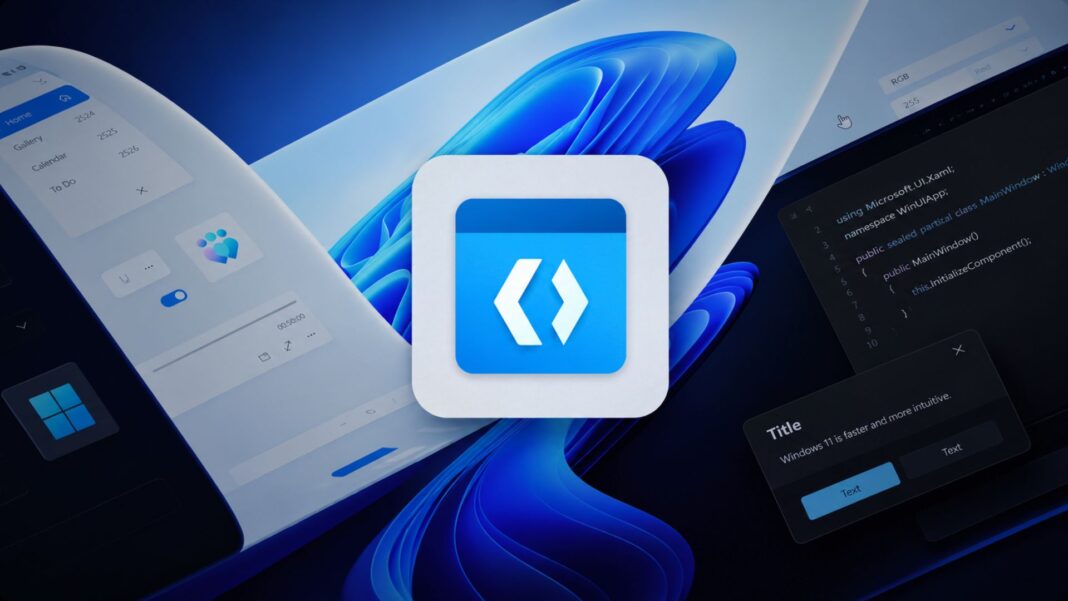
A major Windows 11 UI redesign is coming, Microsoft is dumping legacy code for WinUI

Microsoft is redesigning the Windows 11 interface by replacing older software code and web applications with its native user interface framework, WinUI. Historically, Windows 11 has struggled with visual inconsistencies, placing modern panels alongside outdated menus and relying on web wrappers because developers lacked faith in Microsoft's commitment to previous design tools. Now, the company is demonstrating a clear shift by fully rebuilding foundational elements, such as the File Explorer Properties menu and the Run dialog, directly in WinUI instead of just applying superficial themes or dark mode patches. Other older menus, like the file copy prompt and local account switch screen, are also scheduled for similar updates. While initial data shows the new Run dialog loads faster than its predecessor, the broader WinUI framework still has notable performance challenges. Current issues include high memory usage, slower loading times in areas like the File Explorer Home tab, and visual tearing when resizing applications. Recognizing these problems, Microsoft is delaying the WinUI rewrite of more complex features, such as the Start menu, until the underlying framework becomes more efficient. Overall, the company aims to establish a unified and responsive interface, provided it can resolve the current speed and stability limitations of its new system.


Beyond Deadlines: CMMC As A Continuous Enterprise Risk Governance Challenge

The Department of Defense’s Cybersecurity Maturity Model Certification (CMMC) program is no longer just a compliance hurdle with a fast-approaching deadline. Instead, it represents a permanent shift in how defense contractors must manage enterprise risk. CMMC certification is a continuous requirement for doing business with the government, transforming cybersecurity from a routine IT task into a critical business continuity issue. Failure to achieve or maintain certification directly threatens revenue by limiting an organization's ability to win or keep contracts. Beyond daily operations, CMMC introduces significant financial uncertainty, as certification costs and potential delays must be factored into accurate revenue forecasting. It also exposes hidden vulnerabilities in the defense supply chain. Prime contractors rely heavily on smaller subcontractors who may struggle to meet the strict regulatory standards, potentially disrupting entire projects. Furthermore, CMMC introduces unprecedented personal legal liability. A designated senior official must personally affirm the accuracy of the company’s security posture. Inaccurate affirmations can lead to severe legal consequences under strict federal laws like the False Claims Act. Ultimately, boards of directors and risk officers must recognize CMMC as a fundamental, cross-functional governance challenge. Success requires moving these discussions directly into the boardroom, treating certification as a dynamic risk factor that affects finance, procurement, legal, and overall corporate strategy.


Business transformation needs a true economic approach, not guesswork

Most organizations approach business changes by focusing heavily on cutting costs and improving efficiency. They look at how fast a task is completed and how much money can be saved by streamlining or automating it. While these are valid goals, efficiency alone does not show the true worth of a process. Improving a bad process just makes it fail faster, and finding ways to save time does not guarantee that the task creates any real value for the company. Because of this narrow focus on expenses, a large majority of transformation efforts fall short of their goals. A more effective method is economic process modeling, which examines the full picture rather than just the costs. This approach breaks down tasks and evaluates them based on five clear factors: how they contribute to revenue, the actual expenses involved, the risks they carry, the future options they leave open, and the value of the information they produce. By looking at data as a genuine asset rather than a simple byproduct, teams can make smarter decisions about which activities truly matter. Taking an economic approach provides a solid foundation for change, ensuring that improvements deliver lasting and meaningful results instead of just temporary savings.


Mythos Asks the Right Question. It Doesn't Answer It.

As artificial intelligence models like Anthropic's Mythos accelerate how quickly vulnerabilities can be exploited, security teams are realizing that their current methods of handling risks are no longer enough. The core issue is not simply the speed of these new threats, but rather how organizations decide which problems to fix first. Currently, most teams rely on traditional severity scores to manage massive lists of software flaws. This approach lacks important context, such as whether a vulnerable system is exposed to the internet, who has access to it, and if it connects directly to sensitive company data. Without understanding these practical details, teams waste time on issues that pose no real danger while missing critical paths that attackers could easily use. Instead of replacing existing security tools or just trying to patch everything faster, organizations need to connect the information they already have. By linking data about user access, cloud settings, and network structures, teams can see exactly how an attacker might reach their most important information. Platforms like Mesh gather these different signals into one clear picture, allowing teams to confidently identify and fix the few actual threats that matter, rather than getting lost in thousands of theoretical warnings.


DNS Poisoning Campaign Makes Hospitality Wi-Fi Spots Inhospitable

A recent report by ReliaQuest reveals a sophisticated DNS poisoning campaign targeting the hospitality sector, including hotels and conference centers. Since June 2026, threat actors have been compromising captive Wi-Fi gateways to quietly hijack corporate accounts. By gaining initial access through exposed management interfaces and weak administrative credentials, these attackers bypass security measures without ever touching user endpoints or sending phishing emails. Once in control of a gateway, they modify configurations and use DNS poisoning to stealthily redirect legitimate web traffic to infrastructure they control. A particularly alarming aspect of this attack is the abuse of device-code authentication. Attackers redirect users to legitimate-looking Microsoft authorization prompts. If approved, the attacker receives a valid, multi-factor authentication-bypassing OAuth token. This campaign mirrors the tactics of FrostArmada, an earlier operation linked to the Russian threat group APT28. However, experts note a shift from surgical targeting to non-selective redirection, capturing valuable data from any connected user. Security professionals emphasize that compromised shared networks turn a single breach into a massive risk, exposing hundreds of corporate devices at once. To mitigate these risks, organizations are strongly advised to immediately implement always-on, full-tunnel VPNs to securely route their DNS requests before they interact with potentially vulnerable public gateways.


Cloud Resilience Expert: AI Can Be a Single Point of Failure for Lean SMB Teams

When organizations shrink their IT departments because AI tools are available to help, they risk turning the AI itself into a critical single point of failure. Analyst Greg Schulz warns that while AI assistants are valuable for monitoring, triage, and troubleshooting, relying on them too heavily can leave a lean team vulnerable if the technology goes offline. AI introduces a long chain of dependencies, including language models, cloud services, and identity providers. An outage affecting any of these components can disable the AI just when the team needs it most to resolve a problem. Furthermore, cutting headcount can lead to brain drain. If experienced employees leave without passing on their institutional knowledge, the remaining staff might lack the necessary context to independently assess AI recommendations or fix issues during an outage. To prevent this, organizations must protect their AI just as they would any critical production infrastructure. This involves mapping out all dependencies and limiting agent permissions to prevent automated actions from worsening an incident. Ultimately, disaster recovery plans must account for scenarios where the AI assistant is unavailable. Teams need to ensure they maintain the practical skills and documented procedures required to keep systems running independently.

Daily Tech Digest - July 24, 2026


Quote for the day:

“Do the thing you fear to do and keep on doing it… that is the quickest way yet discovered to conquer fear.” -- Dale Carnegie

🎧 Listen to the audio debrief on YouTube

▶ Play Audio Digest

Duration: 22 mins • Perfect for listening on the go.


Google’s AI and computing chief talks about its shapeshifting data centers

Google is rapidly upgrading its data center infrastructure to meet the massive computing demands of a new era of artificial intelligence agents. In a recent interview, Mark Lohmeyer, Google’s vice president of AI and computing, explained that modern AI has shifted from simple chat interfaces to complex agent driven tasks, increasing inference workloads dramatically. To support this rapid growth while keeping costs manageable, Google is investing heavily in advanced hardware and software technologies. Energy efficiency remains a top priority, achieved through widespread liquid cooling and the new highly efficient Axion based processor. The company has also introduced its eighth generation Tensor Processing Unit, featuring distinct systems optimized separately for training and inference workloads. To ensure maximum flexibility, Google is improving software compatibility so that applications can easily shift between these TPUs and traditional graphics processors. Additionally, Google is transforming its Kubernetes engine into an agile orchestration tool capable of spinning compute resources up and down almost instantly. To tie everything together, the new Virgo network architecture allows millions of processors to connect seamlessly, while upgraded storage systems deliver massive bandwidth and low latency. Ultimately, these targeted upgrades allow Google to deliver scalable, high performance computing power that keeps pace with fast evolving industry requirements.


Should we still design code for humans?

When artificial intelligence takes over the heavy lifting of writing software, it is natural to wonder if we still need to structure code for human eyes. The short answer is a definitive yes. Even as AI accelerates how quickly we can build systems, it does not remove the need for clarity, precision, and careful organization. Programming languages were created to strike a necessary balance, allowing people to express complex logic safely while giving machines exact instructions to execute. Natural language is simply too vague to serve as the sole blueprint for reliable software. Instead of making human-readable code obsolete, AI makes good design more important than ever. If a system is built on messy or confusing foundations, AI tools will simply amplify those flaws at a much faster rate. Well-organized code with clear names and logical boundaries helps both human developers and AI assistants understand the underlying intent of the system. Ultimately, developers are shifting from merely typing lines of code to acting as essential reviewers and stewards of system integrity. Maintaining high standards for code quality ensures that human developers can confidently verify, adapt, and trust the software that runs our critical infrastructure, keeping control securely in human hands.


Continuous authentication is the new trust infrastructure

The traditional "authenticate once" model is no longer sufficient in a landscape where AI-driven threats like deepfakes and sophisticated phishing compromise digital security. Relying on a single checkpoint—like a password or initial biometric scan—assumes that trust established at login remains secure throughout a session, a premise attackers exploit by hijacking active sessions or using malware. To counter this, organizations are shifting toward continuous authentication, treating digital identity as a persistent profile that must be consistently validated. Rather than granting permanent trust after an initial check, this approach continuously evaluates risk using a blend of explicit signals, like biometric checks, and passive signals, such as user behavior and location. When risk indicators rise, the system dynamically requires additional, strong authentication to re-establish trust. This continuous model bridges the gap between verification—proving identity at onboarding—and authentication, ensuring the same user remains present in all subsequent interactions. By eliminating disjointed security checkpoints across various channels, continuous authentication acts as the essential infrastructure for maintaining trust, ensuring that identity security adapts in real time to evolving threats.


Why climate-tech is emerging as an important segment within India’s enterprise technology landscape

Climate technology in India has transitioned from a side conversation about sustainability into a core component of mainstream enterprise technology. Once viewed simply as a compliance task or public relations effort, it is now an essential infrastructure decision for modern businesses. This shift is supported by strong investment, with the sector drawing roughly $12.8 billion in funding, indicating a mature market driven by genuine commercial traction rather than just experimental grants. Several practical factors are accelerating this change, primarily the need for national energy security and the introduction of stricter policies, such as the upcoming carbon trading market. As a result, tools like carbon accounting software, energy management systems, and emissions monitoring are no longer isolated to sustainability offices; they sit firmly on the desks of chief information and technology officers. Organizations are increasingly seeking to secure their own resources, such as water and energy, to build independence from strained public systems. For business leaders, the message is clear: climate technology should be integrated directly into their standard digital planning rather than treated as a separate project. Companies that adopt these systems early will gain a lasting structural advantage over those who wait until regulations force them to change.


The new value architecture of the AI-native SaaS era

The article explains how artificial intelligence is fundamentally changing the software industry, specifically the software as a service business model. Traditionally, companies sold software access based on how many employees needed to use it, known as seat pricing. Now, because artificial intelligence functions more like an automated worker than just a passive tool for humans, the focus is shifting toward measuring what the software actually accomplishes. This means pricing and success metrics are moving toward a credit system, where customers pay for the specific amount of work the artificial intelligence performs or the computing power it requires. Furthermore, artificial intelligence costs more to run per task compared to traditional software, which makes older profit measures completely outdated and inaccurate. As a result, software businesses must track new financial indicators, such as how quickly customers use their purchased credits and the actual profit made after covering artificial intelligence computing expenses. Investors are also adapting how they value these companies, looking closely at reliable, committed credit income versus unpredictable daily usage. Ultimately, software providers need to embrace these new financial tracking methods to properly price their products, understand their true operational costs, and clearly demonstrate their long-term stability to investors in a rapidly changing market.


The automotive software vulnerabilities hiding in your dashboard

Modern vehicles increasingly rely on established operating systems like Linux, Android, and QNX, transforming cars into rolling computers. While this shift enables quick updates and app ecosystems, it also introduces years of publicly documented software vulnerabilities. Researchers at Télécom SudParis developed a specialized scanner named VERA to evaluate these operating systems within current vehicles. Their analysis revealed a wide variation in known flaws. For example, Automotive Grade Linux showed over a thousand vulnerabilities, whereas highly certified systems had significantly fewer. However, the researchers emphasize that a high vulnerability count is not necessarily a definitive measure of risk. A documented flaw only matters if the vulnerable code is active and reachable by an attacker under specific conditions. To demonstrate this, the team tested identical attacks across different platforms, finding that success depended heavily on which specific defenses were enabled rather than the theoretical severity of the bug. Furthermore, standard security scanners often struggle with automotive software, generating numerous false alarms. By filtering out irrelevant components that a secured vehicle would never expose, the new scanner provides a more accurate assessment. Ultimately, while modern cars inherit the flaws of general computing, the practical challenge lies in identifying which bugs are genuinely exploitable.


Reselling unused cloud instances is no longer easy

Many organizations are purchasing large amounts of reserved cloud capacity, particularly for artificial intelligence projects, only to discover they have overcommitted and cannot easily unload the excess. In the past, companies could rely on a secondary resale market, such as the official marketplace provided by Amazon Web Services, to sell their unused reservations to other businesses and recover some of their costs. However, AWS shut down this official resale channel in January 2024, leaving many customers completely locked into their ongoing financial commitments. Today, the available options for handling excess capacity are far more limited and complex. Companies can attempt to modify their existing reservations if their provider allows it, navigate riskier independent brokers, or try to optimize their current usage to reduce future waste. None of these alternatives fully solve the initial problem of overspending. Because major cloud providers tightly control these contracts and can change their policies at any time, relying on the ability to resell unused space as a safety net is no longer a realistic strategy. Moving forward, businesses must focus on accurate forecasting, careful capacity planning, and responsible financial management rather than simply assuming they can always sell their way out of a poor purchasing decision.


When the Responder Is the Threat — Ransomware Negotiators, Insider Trust, and Incident Response Ethics

The article examines the insider threat posed by compromised incident response professionals during ransomware attacks, highlighted by a recent Department of Justice case. In April 2026, a former ransomware negotiator pleaded guilty to assisting the BlackCat ransomware group by secretly feeding them victims' confidential negotiation strategies and insurance policy limits. This betrayal allowed the attackers to maximize their extortion demands, proving that trust can easily be weaponized in chaotic breach environments. To prevent such compromises, organizations must treat ransomware response as a highly secure, restricted access operation rather than an unmanaged crisis. A key recommendation is enforcing strict segregation of duties. No single individual should control negotiations, forensic investigations, legal strategy, and payment logistics. Sensitive details, particularly cyber insurance limits and payment ceilings, should only be disclosed to team members who absolutely require them. Furthermore, all communications with threat actors must be carefully logged, monitored, and reviewed to prevent unauthorized side deals. Companies are strongly advised to vet incident response vendors well before an attack occurs. Engagement contracts should explicitly prohibit conflicts of interest and unauthorized information sharing. Ultimately, while organizations rely heavily on specialized experts during a security emergency, that reliance must be balanced with rigorous access controls and continuous oversight.


Multi-Agent AI for Production Security Operations: An A2A and MCP Architecture in a 5G Core

This article outlines a multiple agent AI architecture designed for production security operations, specifically within a top tier telecommunications 5G core. The primary challenge in modern security centers is not just triage, but the inability of engineering teams to write detection rules fast enough to keep pace with evolving threats. To solve this, the author proposes a system of specialized AI agents coordinated through an open protocol and integrated into the environment using the Model Context Protocol. A key component of this architecture is its reliance on classical anomaly detection to filter raw telemetry before it reaches the language models. This approach bounds inference costs and ensures the AI processes only genuinely novel samples. Furthermore, a dedicated reviewer agent enforces safety constraints as code and provides a clear escalation path to human operators. The author explicitly rejects using a single monolithic language model, which is too unpredictable for production, as well as simply bolting generative AI onto existing security tools. Implementing this collaborative strategy has significantly improved operational efficiency, reducing the time needed to detect and respond to threats by forty percent and cutting the human effort required to create new detection rules from three hours to just fifteen minutes.


After the AI Rush, Can Data Centers Reclaim Sustainability?

The rapid expansion of generative AI temporarily sidelined the data center industry's longstanding focus on environmental sustainability, shifting priorities toward raw performance and massive scale. Before the AI boom, operators actively improved efficiency through better cooling, reduced water use, and robust renewable energy commitments. However, the immense power requirements of modern AI infrastructure forced many providers to admit that reaching their ambitious net zero targets would become significantly more difficult. Now, the industry is facing a necessary course correction driven by hard economics, community opposition, and strict physical grid constraints. Heightened public scrutiny and regulatory pauses on new facility builds mean that operators can no longer afford to ignore their environmental footprint if they want to keep growing. Sustainability is returning not just as a corporate ideal, but as an absolute business necessity. Because power availability is the ultimate bottleneck, any energy wasted on inefficient cooling is power that simply cannot be monetized for computing. As a result, data centers are prioritizing advanced water conservation and strict energy efficiency measures to secure local permitting approvals and control operating costs. Ultimately, the next phase of data center growth requires operators to seamlessly integrate environmental stewardship with economic pragmatism to successfully maintain their expansion in the AI era.

Daily Tech Digest - July 07, 2026


Quote for the day:

“Cybersecurity is not about avoiding risk; it’s about managing it.” -- Admiral Mike Rogers

🎧 Listen to this digest on YouTube Music

▶ Play Audio Digest

Duration: 23 mins • Perfect for listening on the go.


Why developers are over the cloud

While cloud computing remains massive, software developers are fundamentally shifting their initial focus away from choosing a specific cloud provider and instead prioritizing tools that offer the fastest development workflow. In the past, the "first mile" of building an application usually started with selecting foundational infrastructure from major vendors like AWS or Azure. Today, developers increasingly start their projects in AI-assisted coding environments and utilize streamlined platforms like Vercel, Cloudflare, or Supabase. These modern developer experience platforms effectively abstract away complex backend infrastructure, allowing engineering teams to focus entirely on their core application logic rather than managing servers, databases, or networking components. However, traditional cloud providers still dominate the "second mile" of software development—the crucial transition from a working prototype to enterprise-grade production. This stage requires robust security, compliance, cost management, and identity controls. To maintain their relevance, major cloud infrastructure providers must adapt by integrating directly into modern coding workflows rather than expecting users to navigate complex cloud consoles. Ultimately, developers are flocking toward platforms that deliver immediate application outcomes, challenging legacy cloud giants to make the leap to production feel like a natural, seamless upgrade rather than a difficult administrative burden.


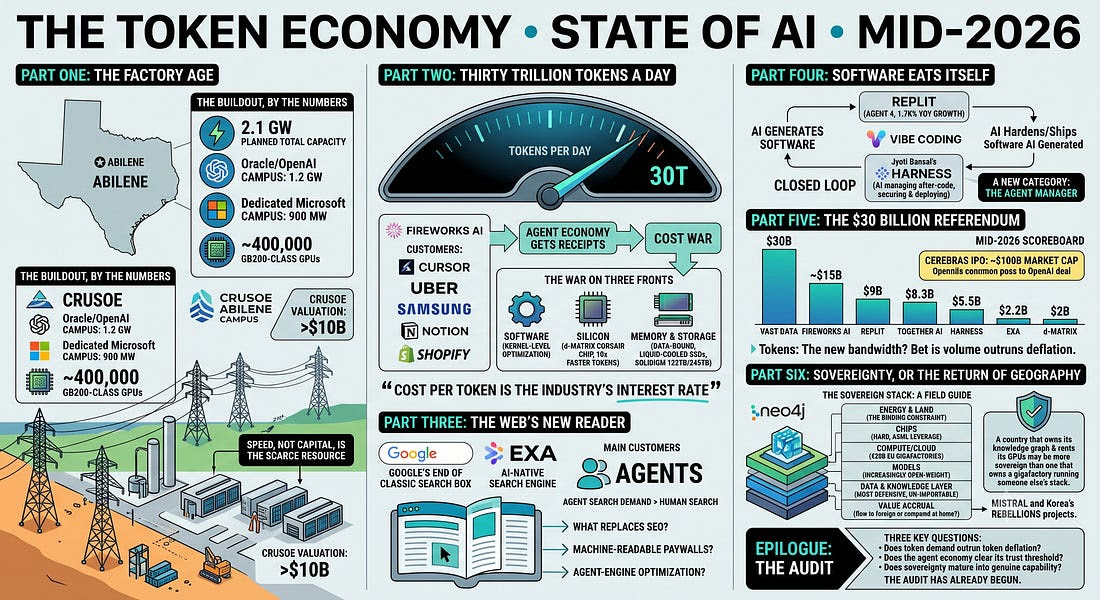
The token economy: The state of AI mid-2026

By mid-2026, the artificial intelligence industry has firmly moved past its experimental phase and matured into a tangible, large-scale economy. The primary focus has shifted from software laboratories to expansive physical infrastructure. Companies are now constructing gigawatt-scale computing facilities to meet intense processing demands. These sprawling centers require unprecedented amounts of electricity, making power generation just as critical to the industry as the technology itself. The underlying currency of this working economy is the token. Inference platforms are processing tens of trillions of tokens daily, driven largely by independent software programs that perform complex tasks like coding and internet research without human oversight. As software increasingly interacts directly with other software, the main competitive battleground is no longer just about creating smarter models, but about systematically lowering the processing cost for each token. This technological shift is also altering global priorities. Recognizing the strategic importance of these computing systems, nations are heavily funding independent AI initiatives. Governments are securing local infrastructure and building proprietary knowledge bases to ensure they retain direct control over their hardware, data, and economic resources rather than depending on foreign tech providers.


The problem with AI model routing

As organizations move away from simply maximizing artificial intelligence usage, many are adopting a new strategy called model routing. The idea is quite straightforward: send complex questions to advanced, expensive models and route simpler, everyday requests to cheaper alternatives. While this approach seems like a highly practical way to manage rising costs, it carries significant technical flaws. The fundamental problem is that modern language models rely heavily on keeping recent data in a ready memory state—such as remembering recent conversation history and caching details—to operate efficiently. When organizations route requests across different models from various providers, they throw away these essential, built-in efficiencies. Every switch causes a system cold start, forcing the platform to reprocess the entire context completely from scratch. This wasted effort ultimately raises the overall cost for everyone involved, effectively negating the expected financial savings. Consequently, rather than relying on third-party routing systems that create disjointed workflows, the industry will likely shift toward built-in routing managed directly by the major providers. By handling the routing internally, these providers can preserve system efficiency and lower costs, which will ultimately lead to deeper reliance on a single ecosystem.


Delegated authentication: A security essential plus strategic data asset

The rapid shift from physical cards to mobile transactions has introduced significant security and compliance challenges, often resulting in clunky customer experiences. Older verification methods required shoppers to use static passwords during checkout, which frequently caused them to abandon their carts out of frustration. To solve this problem, delegated authentication allows merchants to verify a customer’s identity—often through familiar methods like fingerprint or facial recognition—and seamlessly pass that proof directly to the card issuer. This smoother process reduces purchase friction while still meeting strict security regulations. Modern payment systems now treat this authentication data as a practical tool rather than a simple compliance checklist. By sharing clear transaction context, banks can safely reduce false card declines and approve more legitimate purchases. Furthermore, as automated commerce expands and digital assistants begin making purchases on behalf of users, these systems adapt by establishing pre-approved spending boundaries. By combining secure data handling with clear customer permissions, financial institutions can accurately verify both human shoppers and their automated representatives. Ultimately, this collaborative approach aligns business operations with firm security standards, ensuring that everyday payments remain safe and dependably convenient.


Single points of failure fail. The SaaS layer is not an exception

Higher education institutions have heavily consolidated their core operations into a small number of massive software platforms, turning these systems into critical single points of failure. Recent major disruptions, including severe ransomware attacks and extended platform outages during crucial times like finals week, have highlighted the danger of this dependency. When these platforms go dark, entire academic operations halt, leaving students and faculty stranded without access to coursework, rosters, or grades. The risk is compounded by the fact that the education sector has a history of paying ransoms, which actively incentivizes further attacks. To address this vulnerability, information technology leaders must stop treating external software as an exception to standard disaster recovery practices. Service level agreements and compliance checklists are not sufficient to keep classes running during a crisis. Instead, institutions need an independent contingency plan. Building a secure, independent data repository that regularly synchronizes information from primary systems ensures that schools maintain access to vital records during an outage. Just as modern infrastructure requires redundant network connections and backup power, securing academic operations demands building reliable workarounds for when primary platforms inevitably fail.


Operational Resilience Starts with Risk-Intelligent Microsegmentation

In a highly connected world, protecting critical infrastructure like manufacturing plants and water treatment facilities has become more challenging. If operational technology systems fail, the entire business halts. Recognizing this threat, ColorTokens has partnered with Claroty to improve security for these vital environments. The collaboration combines Claroty’s ability to deeply monitor and catalog physical and digital assets with ColorTokens’ expertise in controlling how those systems communicate. Because modern cyber threats can spread rapidly, simply detecting an intrusion is no longer enough. Organizations must prevent attackers from moving freely across their networks. This approach uses risk-aware network separation to block harmful activity without interrupting essential business functions. By integrating with existing monitoring and defense tools, the joint solution allows security teams to identify vulnerabilities and apply protective rules without installing complex software on older machinery. Ultimately, it is impossible to prevent every attack. However, by understanding which systems carry the most risk and limiting their exposure, companies can ensure that a minor breach does not become a major crisis. This strategy focuses on practical readiness, giving organizations the reliable control they need to maintain continuous operations and safeguard both production and human safety.


Zebra CIO warns of 'AI bloat' risk in enterprise adoption push

As companies rush to adopt artificial intelligence, they risk creating "AI bloat" by deploying tools without a solid strategy, warns Matt Ausman, Chief Information Officer at Zebra Technologies. Much like the software subscription bloat of the past, disorganized AI integration leads to over-engineering, clutter, and inefficiency. The core issue is that corporate ambition is currently outpacing workforce readiness. Deep, effective AI adoption is a multi-year effort where change management and employee training often lag far behind the initial technology rollout. To prevent this scattered approach, Ausman outlines a structured five-step blueprint for success. Organizations should establish cross-functional governance, appoint a dedicated executive to lead the transformation, clearly define their strategy, heavily invest in training for all staff, and launch a comprehensive change management program with steady feedback loops. Zebra itself is modeling this disciplined approach by focusing on standard, widely deployed tools rather than chasing every new release. The company actively uses AI to assist frontline workers, automating routine tasks like pallet scanning while keeping a close eye on employee well-being to prevent burnout. Ultimately, success requires technical leaders to shift from simply managing systems to actively championing thoughtful, strategic business transformation.


Spite-Driven Engineering: A New Blueprint for Cloud Security in the AI Native Era

In a recent InfoQ podcast, Alex Zenla discusses a fresh approach to securing cloud infrastructure, built around the concept of "spite-driven development." This philosophy encourages engineers to tackle fundamental technical frustrations head-on rather than simply layering quick fixes over deeply flawed systems. Zenla points out that much of our current infrastructure relies on fragile foundations, particularly highlighting how shared memory in standard operating system cores fails to provide true security when running multiple applications side-by-side. Instead of accepting these risks, teams need stronger separation methods for their workloads. The conversation also explores the practical realities of using artificial intelligence in development. While AI tools are helpful for building early prototypes, blindly trusting them can introduce dangerous technical debt. Developers still need a deep understanding of the underlying systems to fix issues when things inevitably break. Furthermore, forcing standard graphics processors to handle secure AI tasks is both inefficient and risky, pointing to a need for more specialized hardware. Ultimately, Zenla argues that engineers should stop viewing security and regulation as simple compliance checklists. By taking ownership and building resilient architecture from the ground up, companies can turn strong security into a genuine competitive advantage.


IPv6-only vs IPv6-mostly: Appropriate use cases

As organizations transition their network infrastructures, the terms "IPv6-only" and "IPv6-mostly" are frequently confused, despite serving different environments. Properly defining the scope of these concepts is essential to prevent scalability issues. Describing a full network as "IPv6-only" is rarely accurate today, since many applications still need IPv4 connectivity. Instead, it is more precise to refer to an "IPv6-only access network" paired with an IPv4 transition mechanism. This approach works well for unmanaged environments like mobile and residential networks, allowing the wide area network to operate on IPv6 while maintaining dual-protocol functionality for users. In contrast, the "IPv6-mostly" model was explicitly designed for managed corporate networks. It allows devices to signal they do not need an IPv4 address, reducing reliance on older infrastructure without requiring dedicated network segments. However, applying this approach to residential networks introduces severe communication barriers. Devices would be completely unable to interact with local legacy hardware, such as printers or cameras, without manual configurations. Choosing the appropriate deployment model based on your specific network context is fundamentally critical to ensuring a smooth and functional transition.


6 new rules of IT leadership - and what they replace

The role of the CIO is undergoing a significant transformation, largely driven by the impact of artificial intelligence on the modern business landscape. Rather than merely taking direction from the CEO, today's IT leaders are expected to collaborate directly with top executives to define the company's future vision and architect a completely new, AI-driven organization. This means embracing uncertainty and creating a culture where employees feel safe enough to learn from failure, replacing the outdated "fail fast" mentality with a focus on sustainable growth and psychological safety. Furthermore, IT chiefs can no longer rely solely on business counterparts for operational insights; they must possess a panoramic understanding of all business operations, much like a COO. The financial demands on CIOs have also intensified, requiring them to act more like CFOs by rigorously calculating the total cost of ownership and return on investment for cloud and AI initiatives. Finally, modern IT leadership requires abandoning a one-size-fits-all management style in favor of adapting to the diverse, global, and often remote needs of individual team members, ensuring that everyone can thrive in a rapidly changing environment.

Daily Tech Digest - May 08, 2026


Quote for the day:

“Everything you’ve ever wanted is on the other side of fear.” -- George Addair

🎧 Listen to this digest on YouTube Music

▶ Play Audio Digest

Duration: 22 mins • Perfect for listening on the go.


How enterprises can manage LLM costs: A practical guide

Managing large language model (LLM) costs has become a critical priority for enterprises as generative and agentic AI deployments scale. According to the InformationWeek guide, LLM expenses are primarily driven by token pricing and consumption, factors that remain notoriously difficult to forecast due to the iterative nature of AI workflows. This unpredictability is exacerbated by dynamic vendor pricing, a lack of specialized FinOps tools, and limited user awareness regarding how complex queries impact the bottom line. To mitigate these financial risks, the article recommends a multi-pronged approach: matching task complexity to model capability by using lower-cost LLMs for routine work, and implementing technical optimizations like response caching and prompt compression to reduce token usage. Furthermore, enterprises should utilize prompt libraries of validated, efficient inputs and leverage query batching for non-urgent tasks to access vendor discounts. While self-hosting models eliminates third-party token fees, the guide warns of significant underlying costs in infrastructure and energy. Ultimately, successful cost management requires a strategic balance where the productivity gains of AI clearly outweigh the operational expenditures. By proactively setting token allowances and comparing vendor rates, CIOs can prevent AI budgets from spiraling while still fostering innovation across the organization.


The Death of the Firewall

The article "The Death of the Firewall" by Chandrodaya Prasad explores why the firewall has survived decades of premature obituaries to remain a cornerstone of modern cybersecurity. Rather than becoming obsolete, the technology has successfully transitioned from a standalone perimeter appliance into a versatile, integrated architecture. The global firewall market continues to expand, currently valued at approximately $6 billion, as organizations face complex security challenges that identity-centric models alone cannot solve. The firewall has evolved through critical phases, including convergence with SD-WAN for simplified networking and integration with cloud-based Security Service Edge (SSE) frameworks. Crucially, it serves as a necessary enforcement point for inspecting encrypted traffic and implementing post-quantum cryptography. It remains indispensable in Operational Technology (OT) sectors, such as manufacturing and healthcare, where legacy systems and IoT devices cannot support endpoint agents or tolerate cloud-based latency. For these heavily regulated industries, the firewall is not merely an architectural choice but a fundamental requirement for regulatory compliance. Ultimately, the firewall’s endurance is attributed to its ongoing adaptation, offloading intelligence to the cloud while maintaining essential local execution. As cyber threats grow more sophisticated due to AI, the firewall is evolving into a vital, persistent component of a unified security fabric.


AI clones: the good, the bad, and the ugly

The Computerworld article "AI clones: The good, the bad, and the ugly" examines the dual-edged nature of digital personas, categorizing their applications into three distinct ethical spheres. Under "the good," the author highlights authorized use cases where public figures like Imran Khan and Eric Adams employ AI voice clones to transcend physical or linguistic barriers, amplifying their reach and accessibility. However, "the bad" introduces the problematic rise of nonconsensual professional cloning. Tools like "Colleague Skill" enable individuals to replicate the expertise and communication styles of coworkers or supervisors, often to retain institutional knowledge or manipulate workplace dynamics. This section also underscores the threat of sophisticated financial fraud perpetrated through voice impersonation. Finally, "the ugly" explores the deeply controversial territory of "Ex-Partner Skill" and "digital resurrection." These tools allow users to simulate interactions with former or deceased loved ones by mimicking subtle nuances and shared memories, raising profound ethical concerns regarding consent and emotional health. Ultimately, the piece argues that as AI cloning technology becomes more accessible, society must navigate the erosion of reality and establish clear boundaries to protect individual identity and privacy in an increasingly synthetic world.


Fire at Dutch data center has many unintended consequences

On May 7, 2026, a significant fire erupted at the NorthC data center in Almere, Netherlands, triggering a regional emergency response and demonstrating the fragility of modern digital infrastructure. The blaze, which originated in the technical compartment housing critical power systems, forced emergency services to order a total power shutdown. Although the server rooms remained largely protected by fire-resistant separations, the resulting outage caused widespread, often bizarre, secondary consequences. Beyond standard digital disruptions, the failure crippled physical security at Utrecht University, where students and staff were locked out of buildings and even restrooms because electronic access card systems failed completely. Public transit in Utrecht faced communication breakdowns, while healthcare billing services and numerous pharmacies across the country saw their operations grind to a halt. This incident serves as a stark wake-up call, proving that even ISO-certified facilities with redundant backups are susceptible to catastrophic failure when authorities prioritize safety over continuity. It underscores a critical lesson for organizations: business continuity plans must account for the unpredictable ripple effects of physical infrastructure loss. The event highlights the inherent risks of centralized digital dependencies, revealing that a localized technical fire can effectively paralyze diverse sectors of society far beyond the immediate flames.


The hidden cost of front-end complexity

The article "The Hidden Cost of Front-End Complexity" explores how modern web development has transitioned from solving rendering challenges to facing profound system design issues. While current frameworks have optimized UI performance and component modularity, complexity has not disappeared; instead, it has shifted "up the stack" into application logic and state coordination. Modern front-end engineers now shoulder responsibilities once reserved for multiple infrastructure layers, managing distributed APIs, CI/CD pipelines, and intricate data flows that reside within the browser. The author argues that the true "hidden cost" of this evolution is the significantly increased cognitive load required for developers to navigate a dense web of invisible dependencies and reactive chains. Consequently, development cycles slow down and maintainability suffers when state relationships remain opaque or poorly defined. To address these architectural failures, the industry must pivot from debating framework syntax or rendering speed to prioritizing a "state-first" architecture. In this paradigm, the UI is treated as a simple projection of a clearly modeled state. By shifting the focus toward explicit state representation and observable system design, engineering teams can manage the inherent complexity of large-scale applications more effectively. Ultimately, the future of the front-end lies in building systems that are fundamentally easier to reason about.


How Federated Identity and Cross-Cloud Authentication Actually Work at Scale

This article discusses the critical shift from traditional, secrets-based authentication to Federated Identity and Workload Identity Federation (WIF) within modern DevOps and multi-cloud environments. Historically, integrating services across clouds (such as Azure, AWS, or GCP) required storing long-lived service principal keys or static credentials, which posed significant security risks including credential leakage and management overhead. To solve this, Federated Identity utilizes OpenID Connect (OIDC) to establish a trust relationship between an external identity provider and a cloud resource. Instead of using persistent secrets, a workload—such as a GitHub Action or an Azure DevOps pipeline—requests a short-lived, ephemeral token from its identity provider. This token is then exchanged for a temporary access token from the target cloud service, which automatically expires after the task is completed. This approach eliminates the need for manual secret rotation and significantly reduces the attack surface by ensuring no permanent credentials exist to be stolen. By leveraging Managed Identities and structured OIDC exchanges, organizations can achieve a "zero-trust" authentication model that scales across diverse cloud providers, providing a more secure, automated, and maintainable framework for cross-cloud resource management and CI/CD workflows.


Ten years later, has the GDPR fulfilled its purpose?

A decade after its adoption, the General Data Protection Regulation (GDPR) presents a bittersweet legacy, having fundamentally reshaped global corporate culture while facing significant modern hurdles. The regulation successfully elevated privacy from a legal footnote to a core management priority, institutionalizing principles like "privacy by design" and establishing a gold standard for international digital governance. However, experts highlight a growing disconnect between regulatory intent and practical application. While the GDPR empowered citizens with theoretical rights, the reality often manifests as "consent fatigue" through ubiquitous cookie pop-ups rather than providing meaningful control. Furthermore, the enforcement landscape reveals a stark gap; despite billions in issued fines, the actual collection rate remains remarkably low due to protracted legal appeals and the complexity of the "one-stop-shop" mechanism. International data transfers also remain a legal Achilles' heel, plagued by ongoing uncertainty across borders. The emergence of generative AI further complicates this framework, as massive training datasets and opaque algorithms challenge core tenets like data minimization and transparency. Additionally, the proliferation of overlapping EU regulations has created a "regulatory avalanche," making compliance increasingly difficult for smaller organizations. Ultimately, the article suggests that while the GDPR fulfilled its primary purpose, it now requires urgent refinement to remain relevant in a complex, AI-driven digital economy.


Bunkers, Mines, and Caverns: The World of Underground Data Centers

The article "Bunkers, Mines, and Caverns: The World of Underground Data Centers" by Nathan Eddy explores the growing strategic niche of subterranean infrastructure through the adaptive reuse of retired mines and Cold War-era bunkers. Predominantly found in North America and Northern Europe, these facilities offer a unique "underground advantage" centered on unparalleled physical security, environmental resilience, and inherent cooling efficiency. By repurposing sites like Iron Mountain’s Pennsylvania campus or Norway’s Lefdal Mine, operators benefit from a natural, impenetrable shield against extreme weather and external threats, making them ideal for high-security or mission-critical workloads. Furthermore, underground locations often bypass local "NIMBY" resistance because they are invisible to surrounding communities. However, the article notes that subterranean deployments present significant engineering and logistical hurdles. Managing humidity, ventilation, and heat dissipation requires complex systems, and retrofitting older structures can be costly. Site selection is also intricate, requiring rigorous assessments of structural stability and risks like water ingress or geological faults. Despite these challenges, underground data centers are no longer a novelty but a proven, permanent fixture in the industry. They are increasingly attractive in land-constrained hubs like Singapore and for highly regulated sectors, providing a sustainable and secure alternative to traditional above-ground facilities.


Why the future of software is no longer written — it is architected, governed and continuously learned

The article argues that software development is undergoing a fundamental structural shift, moving from manual coding to a paradigm defined by architecture, governance, and continuous learning. As generative AI and agentic systems take over the heavy lifting of building code, the role of the developer is evolving into that of an "intelligence orchestrator" who curates intent rather than writing lines of syntax. For CIOs, this transition represents a critical leadership inflection point where software is no longer just a business enabler but the primary engine for scaling enterprise intelligence. The focus is shifting from development speed to the strategic design of decision systems. This new era necessitates the rise of roles like the Chief AI Officer (CAIO) to govern AI as a strategic asset, ensuring security through zero-trust principles and navigating complex regulatory landscapes like the EU AI Act. While productivity gains are significant, organizations must proactively manage risks such as code hallucinations, model bias, and intellectual property concerns. Ultimately, the future of digital economies will be shaped by leaders who prioritize "intelligence orchestration" over traditional application building, fostering adaptive systems that learn and evolve. Success in 2026 requires a focus on three core mandates: architecting intelligence, governing AI assets, and aligning technology ecosystems with overarching corporate strategy.


Maximizing Impact Amid Constraints: The Role of Automation and Orchestration in Federal IT Modernization

Federal IT leaders currently face a challenging landscape where they must fortify complex digital environments against persistent threats while navigating significant fiscal uncertainty and budget constraints. According to a recent report, over sixty percent of these leaders struggle with monitoring tools across diverse hybrid environments, largely due to the persistence of legacy, multi-vendor systems that create integration gaps and increase operational costs. To overcome these hurdles, federal agencies must strategically embrace automation and orchestration as foundational components of a modern zero-trust architecture. By integrating AI-driven technologies for routine tasks like alert analysis and anomaly detection, IT teams can transition from a reactive posture to a proactive defense, effectively reducing monitoring complexity through single-pane-of-glass solutions. This methodical approach allows organizations to maximize the value of their existing investments while freeing up personnel for mission-critical initiatives. The success of such incremental improvements can be clearly measured through enhanced metrics like mean time to detection (MTTD) and mean time to resolution (MTTR). Ultimately, a disciplined, phased implementation of these technologies ensures that federal agencies maintain operational resilience and mission readiness. By focusing on strategic automation, IT leaders can deliver maximum impact for every budget dollar, ensuring that modernization efforts continue to advance despite the ongoing challenges of a resource-constrained environment.