Showing posts with label CRM. Show all posts

Daily Tech Digest - July 23, 2026


Quote for the day:

“People will never forget how you made them feel.” -- Maya Angelou

🎧 Listen to the audio debrief on YouTube

▶ Play Audio Digest

Duration: 23 mins • Perfect for listening on the go.


Seven sins of the modern software developer

The article takes a candid look at how modern developers are bending long‑standing engineering norms now that large language models and agentic IDEs can generate, fix, and scaffold code with very little human effort. It frames these behaviors as “sins” not in a moral sense, but as habits that quietly erode craftsmanship. Developers increasingly skip foundational knowledge, assuming the AI will choose the right patterns or frameworks. Documentation is often ignored; instead, programmers paste entire stack traces into an AI chat and accept whatever fix it proposes. The piece notes that many developers no longer understand how their back ends are wired because they rely on AI‑generated scaffolding that “just sort of… ran it,” including security rules they never fully review . The article also highlights a growing detachment from architectural discipline: teams let AI handle data flows, deployment setups, and even language translation, turning engineers into “copy‑paste orchestrators” rather than deliberate designers. While the tone is humorous, the underlying message is serious: AI can accelerate development, but it can also tempt developers to abandon the practices that keep systems understandable, secure, and maintainable. The author urges readers to stay honest about these shortcuts and re‑anchor themselves in thoughtful engineering rather than letting convenience dictate their craft.


Shadow AI is becoming enterprise security’s biggest blind spot

Shadow AI, the article explains, has become one of the biggest blind spots in enterprise security because employees adopt AI tools far faster than organizations can govern them. As Help Net Security notes, workers now use AI to summarize documents, analyze spreadsheets, write code, and automate tasks, often without formal approval . These tools frequently slip in through everyday software updates or personal accounts, making them hard to detect or control. The real risk isn’t just unauthorized tools but unauthorized data movement — employees rarely stop to consider what information an AI feature might capture or where that data might be stored . Even companies with clear policies discover far more AI usage than expected once they start investigating. Attempts to block tools often fail because employees simply switch devices or use built‑in AI features already present in business applications. This creates a growing visibility gap: organizations may believe they have only a handful of sanctioned AI systems, while dozens operate quietly in the background. The article stresses that shadow AI is usually accidental, driven by convenience and deadlines rather than malice, but the security implications are serious. Without stronger governance, training, and monitoring, sensitive data can leak, compliance obligations can be breached, and AI‑driven workflows can evolve outside any formal oversight.


AI, security operations and the new race against time

The piece explains how AI is reshaping security operations by compressing the time defenders have to understand and respond to threats. Attackers are already using autonomous agents to scan networks, chain exploits, and move laterally at speeds that outpace human analysts. As the article notes, AI “changes the tempo of intrusion,” turning what used to be hours or days of attacker activity into minutes. This shift creates a new race against time: defenders must detect, interpret, and act before an automated adversary completes its workflow. Traditional SOC processes—manual triage, ticket queues, and human‑driven investigation—cannot keep up with this pace. The article argues that security teams need AI systems of their own, not as replacements for analysts but as tools that can summarize logs, correlate signals, and surface the most urgent issues quickly. It also stresses that automation must be paired with guardrails, since AI can generate false positives or misjudge context if left unchecked. The core message is that the advantage now goes to whichever side can act faster with the help of AI. Security operations must evolve from slow, linear processes to tightly orchestrated workflows where humans and machines work together to keep pace with automated threats.


Are data centers ready for ‘quantum in the cloud’?

The article examines whether today’s data centers are prepared to host quantum computers as cloud‑based services, noting that the shift from lab prototypes to production‑grade systems requires a different level of engineering maturity. Quantum‑Computing‑as‑a‑Service is gaining momentum, with analysts projecting a market of up to $26 billion by 2030 . But most quantum machines are still fragile, research‑grade devices that demand specialized cooling, careful calibration, and hands‑on maintenance. To operate them reliably in a cloud environment, vendors must redesign hardware to be more compact, modular, and serviceable — including hot‑swappable components, standardized rack formats, and elimination of single points of failure. The article also highlights early deployments, such as Oxford Quantum Computing installing multiple quantum processing units directly in colocation facilities to ensure uptime and meet customer requirements for low‑latency access and data‑sovereignty constraints . These examples show that quantum systems can coexist with traditional data‑center infrastructure, but only with significant adaptation on both sides. Overall, the piece conveys calm realism: quantum in the cloud is coming, major providers are investing, and the potential value is high — but widespread readiness depends on engineering quantum machines to behave like dependable data‑center resources rather than delicate laboratory instruments.


From outsourcing to ownership: How we brought development in-house without breaking delivery

The article describes how one company shifted from outsourced development to an in‑house model without slowing delivery, emphasizing that the change required discipline rather than dramatic reinvention. The team had relied on vendors for years, which created predictable patterns: long handoffs, limited architectural control, and a growing gap between what the business needed and what external teams could deliver. Bringing development back inside the organization meant rebuilding core practices — ownership of code, clearer product direction, and tighter collaboration between engineering and business teams. The author explains that success came from starting small, choosing a few critical products, and pairing internal engineers with existing vendor teams so knowledge transfer happened gradually instead of abruptly. They focused on predictable delivery, stable architecture, and reducing dependency on external decision‑making. Over time, internal teams became confident enough to take full ownership, and delivery speed improved because decisions no longer required external negotiation. The article stresses that the goal was not to eliminate vendors entirely but to ensure the company controlled its most important systems. The overall message is calm and practical: insourcing works when it is done deliberately, with clear priorities, steady capability building, and a willingness to reshape processes rather than rushing toward independence.


Data protection, digital trust and AI: Building the foundations of India’s next growth story

The article argues that India’s next phase of digital growth depends on treating data protection, digital trust, and responsible AI as core foundations rather than afterthoughts. It explains that India’s privacy journey, which began with the 2017 Puttaswamy judgment, has matured into a full regulatory framework through the Digital Personal Data Protection Act, 2023, and the DPDP Rules, 2025. These laws shift organizations from policy anticipation to operational readiness, requiring consent management, retention controls, breach‑response processes, and privacy‑by‑design to be built directly into everyday decision‑making. The authors note that this framework places individuals at the center of the digital ecosystem, giving citizens clearer rights over how their data is collected, used, and erased. Penalties of up to ₹250 crore for inadequate safeguards underscore the seriousness of compliance. The article also highlights how India’s digital public infrastructure — including platforms like DigiLocker — shows what trusted, identity‑linked services can achieve at national scale. Overall, the piece presents data protection as a strategic business priority that strengthens trust, accountability, and resilience. It argues that as AI adoption accelerates, India’s growth story will depend on embedding strong governance and transparent data practices so innovation and public confidence advance together.


AI agents aren't confidently wrong because of bad context — they're wrong because of bad data engineering

The article argues that AI agents often fail not because they misunderstand context, but because the underlying data engineering is flawed. It explains that many organizations rush to build agentic systems on top of messy pipelines, outdated schemas, and brittle integrations. When an agent receives incomplete, duplicated, or poorly labeled data, it produces confident but incorrect actions — not because the model is reckless, but because the foundation beneath it is unreliable. The author notes that teams frequently blame “bad prompts” or “missing context,” when the real issue is that their data flows were never designed for autonomous decision‑making. Agents depend on clean event streams, consistent identifiers, and predictable structures, yet most enterprise systems still contain silent failures: stale tables, broken joins, untracked edge cases, and logic scattered across legacy services. The piece stresses that traditional analytics can tolerate these imperfections, but autonomous systems cannot. To make agents dependable, organizations must treat data engineering as a first‑order discipline — validating inputs, enforcing contracts, instrumenting pipelines, and eliminating ambiguity before the agent ever sees the data. The core message is calm and practical: agents are only as reliable as the plumbing beneath them, and fixing that plumbing is the real work of making AI trustworthy.


AI Agents Force CRM Vendors to Rethink Their Platforms

The article explains how AI agents are pushing CRM vendors to rethink how their platforms are built and what they should actually do for customers. Traditional CRM systems were designed around static workflows, manual data entry, and rule‑based automation. But AI agents can now take on full segments of the sales cycle — identifying leads, drafting outreach, updating records, and coordinating follow‑ups — without waiting for human input at every step. This shift forces CRM vendors to reconsider long‑standing assumptions about how their products should function. Instead of serving as passive databases, CRMs must become environments where autonomous agents can operate safely, consistently, and with clear guardrails. That means better data quality, stronger integration layers, and architectures that support goal‑driven decision‑making rather than simple triggers. The article also notes that AI agents reduce the burden on sales teams by eliminating much of the repetitive work that once made CRM upkeep a chore. As a result, vendors must design platforms that are more flexible, more transparent, and more capable of handling autonomous workflows. The core message is steady and practical: AI agents aren’t just an add‑on feature — they fundamentally change what a CRM needs to be, and vendors who adapt will shape the next generation of customer‑management tools.


When Identity Verification Fails: Lessons from a Real-World SIM Swap and Near Account Takeover

The article recounts a real SIM‑swap attack to show how identity verification can fail even when a company believes its controls are solid. The victim noticed his phone suddenly losing service — the first sign that an attacker had convinced the carrier to move his number to a different SIM. With that foothold, the attacker tried to reset passwords and access financial accounts, relying on the fact that many services still treat SMS messages as proof of identity. What stopped the takeover was not a single safeguard but a mix of luck, quick action, and stronger authentication on a few key accounts. The investigation revealed how easily social‑engineering can bypass call‑center procedures, especially when staff rely on superficial checks or feel pressured to resolve customer issues quickly. It also showed how attackers chain small weaknesses: outdated recovery paths, over‑reliance on phone numbers, and inconsistent use of multifactor authentication. The article’s tone is steady and cautionary. It argues that organizations must treat identity verification as a security control, not a customer‑service formality. That means reducing dependence on SMS, tightening recovery workflows, and training support teams to recognize manipulation. The broader lesson is simple: identity failures rarely come from one big mistake — they come from many small ones lining up at the wrong moment.


10 cool things Copilot can do in PowerPoint

The article walks through ten practical ways Copilot can make working in PowerPoint easier, focusing on everyday tasks rather than flashy tricks. It explains that Copilot can turn a rough outline into a clean, structured deck, saving time on the initial setup. It can also rewrite slide text to be clearer or more concise, adjust tone, and help reduce clutter without changing the core message. For visuals, Copilot can generate images, suggest layouts, and reorganize content so slides look more polished with less manual tweaking. The article notes that Copilot can summarize long documents into a few slides, which is useful when preparing executive updates or briefing materials. It can also create speaker notes, build sample timelines, and help reshape dense data into simpler charts. Another helpful feature is the ability to restyle an entire deck to match a theme or brand without reformatting each slide. Throughout the piece, the tone is steady: Copilot doesn’t replace thoughtful presentation design, but it removes much of the repetitive work that slows people down. The overall message is that Copilot acts as a quiet assistant — one that helps users start faster, clean up slides more easily, and focus on the parts of a presentation that actually require human judgment.

Daily Tech Digest - August 04, 2022

Artificial intelligence makes project planning better

Unlike neural networks, expert systems do not require up-front learning, nor do they necessarily require large amounts of data to be effective. Yes, expert systems can and do absolutely learn and get smarter over time (by adjusting or adding rules in the inference engine) but they have the benefit of not needing to be “trained up front” in order to function correctly. Capturing planning knowledge can be a daunting task and arguably very specific and unique to individual organizations. If all organisations planned using the same knowledge e.g., standard sub-nets, then we could simply put our heads together as an industry and establish a global “planning bible” from which we could all subscribe. This of course isn’t the case and so for a neural network to be effective in helping us in project planning, we would need to mine a lot of data. Even if we could get our hands on it, it wouldn’t be consistent enough to actually help with pattern recognition. Neural networks have been described as black boxes — you feed in inputs, they establish algorithms based on learned patterns and then spit out an answer.


Trending Programming Language to Learn

Generally, Python is seen as an easy-to-learn software language thanks to its simple syntax, extensive library of guidelines and toolkits, and its compatibility with other prominent programming languages, including C and C++. Its popularity is demonstrated by its ranking in TIOBE and PYPL Index in 2021: Python was the leading programming language. Companies like Intel, Facebook, Spotify, and Netflix are still using the best python developers to take advantage of this language’s extensive libraries. ... Although GO is somehow similar to C in syntax, it’s a unique language that offers excellent memory protection and management functionality. It is likely that GO’s popularity will continue to rise as it’s used to design systems that use artificial intelligence, just like Python. ... It's no wonder Java is so popular; getting started with this language is fairly simple, and it boasts a high level of security. Furthermore, it’s capable of handling large amounts of data. The technology is used in a variety of applications on almost all major systems like mobile, desktop, web, artificial intelligence, cloud applications, and more.


Why Microsoft Azure and Google Cloud love Ampere Computing’s server chips

“Ampere is designing for a completely different goal,” to its rivals, says Dylan Patel, a chip industry analyst from SemiAnalysis. “Intel is targeting a wider net of people, versus what Ampere is going for, which allows them to make certain sacrifices and gain benefits from that,” he says. Though the company’s chips have a “weaker and smaller CPU core” than some of the x86 processors designed by Intel and AMD for servers, Patel says this means the chips themselves are smaller, and that as a result power usage is lower and the chips are more efficient. “That’s a big deal” for data centre operators, he says. Patel adds: “Renee realised this needed to be done much earlier than most of the cloud providers themselves. Amazon figured out they needed to build CPUs like this, but the others did not, and as a result, most of them are now in a position where they need to buy the technology from someone else. That’s why you find Ampere in every major cloud now.”


Digital transformation: How to guide innovation leaders

Digital Trailblazers are lifelong learners and can start their careers in product management, technology, security, or data roles. What sets Digital Trailblazers apart is their ability to ask the questions that challenge people’s thinking and get into the weeds around customer experience, data quality issues, or how to integrate emerging technologies. But finding Digital Trailblazers isn’t easy, and guiding them requires leadership’s commitment to empowering their creativity and collaboration. CIOs who dedicate themselves and their lieutenants to seek and guide aspiring transformation leaders are setting their entire organization up for success for years to come. Once you identify these leaders, you must encourage them to step out of their comfort zones because many will soon be experiencing firsts such as presenting to leadership, responding to detractors, or making tough calls in setting priorities. In the book, I tell the stories of what it feels like to be a Digital Trailblazer, knowing they will face many new experiences. I’ll share an excerpt from the chapter “Buried in bad data.” 


6 key advantages of ERP and CRM software integration

Typically, businesses purchase and deploy ERP and CRM systems separately. However, if your ERP and CRM systems have their own databases, you will consistently have to worry about keeping them synchronised. Whether it’s a CRM user from customer service or an ERP user from billing who updates a customer’s account, any changes implemented in one system will have to be transferred to the other. Considering this is a manual process, having to wait for a database to update before you can, for example, process bills, replenish inventory levels and arrange product returns for customers, will result in slower operations and an increased risk of database errors. Applying an integrated CRM functionality to your ERP solution will ensure both systems share one database; meaning updates in either system are visible instantaneously. Customers can be billed faster and any product returns can be automated between systems; providing your business with clearer visibility into all stages of your business’ sales process.


Can You Recover Losses Sustained During a Cloud Outage?

Even if the providers do have insurance, the terms of those policies are unlikely to cover more than a fraction of the costs incurred by the clients. “Negotiate how much risk is being held by the company and how much risk is being retained by the cloud service provider,” advises Michael Phillips, chief claims officer of cyber insurance company Resilience. “It's an unfortunate fact of life right now that many of the major cloud service providers are willing to accept none of the risk of their own failure.” The public cloud is a multi-tenant environment, further complicating the issue of responsibility. “Many cloud providers currently do not offer meaningful SLAs, arguing the application must meet the demands of multiple customers,” says Lisa Rovinsky, partner at full-service law firm Culhane Meadows. “I think this power structure will be changing as customers become more sophisticated and hybrid cloud solutions develop.” This puts the onus on clients to ensure that their cloud agreements are as airtight as possible from the get-go. Boilerplate contracts are unlikely to offer even cursory protection, so customization is increasingly the name of the game.


6 Smart Ways to Optimize Your Tech Stack

Consolidation can be thought of through the lens of technical debt. While some technical debt may be intentional, all technical debt creates added complexity that gets in the way of organizational agility. Recent research found that while 94% of organizations recognize the impact of technical debt digital transformation, less than half have a strategy in place to manage it. Looking for ways to eliminate technical debt by consolidating solutions and letting go of those that are highly customized or out of support offers a clear path to delivering measurable business value. ... EA can align with DevOps in two complementary ways. First, the development tech stack must be reflected in the overall organizational tech stack. On this front, collaboration with head of development and software architects are key. Second, EA can use their tools and expertise to help dev teams manage their one tech landscape, particularly when it comes to microservices. A microservice catalog can serve in this case as both an essential tool for DevOps, particularly when it promotes reuse, and a natural extns


Hacking Concerns Delay Balloting for New UK Prime Minister

Online voting has been changed so that instead of a Tory party member being able to use their unique code multiple times to change their vote, the code will instead be deactivated after they initially vote. "The part that caused particular concern was being able to change your vote after submission," says Alan Woodward, professor of computer science at the University of Surrey. NCSC, which is the public-facing arm of Britain's security, intelligence and cyber agency, GCHQ, confirms that it has been providing guidance to the Tory party. "As you would expect from the U.K.'s national cybersecurity authority, we provided advice to the Conservative Party on security considerations for online leadership voting," an NCSC spokesperson tells Information Security Media Group. "Defending U.K. democratic and electoral processes is a priority for the NCSC, and we work closely with all parliamentary political parties, local authorities and MPs to provide cybersecurity guidance and support." The Conservative Party acknowledged the cybersecurity center's input.


How to succeed as an enterprise architect: 4 key strategies

Technical debt should be used intentionally to make incremental gains, not accumulated from neglect. Every architect must decide how to deal with debt—both addressing it and taking it on—to succeed in their role. Get comfortable with technical debt as a tool. The key questions that need to be addressed are when to take on debt and when to pay it off. Take on debt when the future of a product or feature is uncertain. Whether for a proof of concept or a minimum viable product, use debt to move fast and prove or realize value quickly before committing more cycles to make it robust. Architects can minimize the impact of debt by first solidifying interfaces. Changes to interfaces impact users. Consequently, these changes are not only sometimes technically difficult but can also be logistically challenging. And the more difficult it is to address debt, the less likely it is to be managed. Pay down technical debt when its value proposition turns negative and has a measurable impact on the business. That impact could come in the form of decreased engineering velocity, infrastructure brittleness leading to repeated incidents, monetary cost, or many other related effects. 


6 ways your cloud data security policies are slowing innovation – and how to avoid that

Some security professionals may consider this first pitfall as irrelevant to their organization, as they allow data to be freely moved or modified across cloud environments without restrictions. While beneficial for business purposes, this approach ignores the exponential growth in data and its tendency to spread across data stores and environments, with little ability to locate where it resides. This lack of visibility and control will inevitably lead to loss of what may be sensitive, personal or customer data in the process. If data is the fuel of many of our business processes, then losing some of it means that you’re running low on gas. Innovative teams require access to data. Whether it’s data scientists who are creating new machine learning algorithms, threat researchers researching new trends, marketing or product management teams who need to understand customer behavior or other stakeholders – innovating without data is like trying to bake without an oven. Managing organizational access to data may be critical to ensure that it isn’t abused or lost but creating stringent access control policies and boundaries around data usage creates what are essentially data silos, once again restricting innovation.


Quote for the day:

"Failures only triumph if we don't have the courage to try again." -- Gordon Tredgold

Daily Tech Digest - November 13, 2021

New law needed to rein in AI-powered workplace surveillance

“AI offers invaluable opportunities to create new work and improve the quality of work if it is designed and deployed with this as an objective,” said the report. “However, we find that this potential is not currently being materialised. “Instead, a growing body of evidence points to significant negative impacts on the conditions and quality of work across the country. Pervasive monitoring and target-setting technologies, in particular, are associated with pronounced negative impacts on mental and physical wellbeing as workers experience the extreme pressure of constant, real-time micro-management and automated assessment.” The report added that a core source of workers’ anxiety around AI-powered monitoring is a “pronounced sense of unfairness and lack of agency” around the automated decisions made about them. “Workers do not understand how personal, and potentially sensitive, information is used to make decisions about the work that they do, and there is a marked absence of available routes to challenge or seek redress,” it said.


New Application Security Toolkit Uncovers Dependency Confusion Attacks

Application security teams will most likely implement the Dependency Combobulator at the CI level, says Moshe Zioni, vice-president of security research at Apiiro. For example, if the team uses Jenkins for its CI process, the toolkit may be used as part of the build process. Another place to use the toolkit would be during code commits and push requests, in which every change in dependency imports will be sent to the Dependency Combobulator for inspection and decision-making. “It can potentially be interconnected via a plugin but that's a more convoluted way that is not easily supported out of the box and will need some extra development work," Zioni says. There are numerous other tools that act similarly to Dependency Combobulator. Snyk offers snync, an open source tool to detect potential instances of dependency confusion in the code repository. Sonatype offers developers a dependency/namespace confusion checker script on GitHub which checks if a project has artifacts with the same name between repositories, and to determine whether the developer has been impacted by a dependency confusion attack in the past.


Managing the risks and returns of intelligent automation

Most companies do not yet have the appropriate structures and tools to effectively manage the risks and returns of intelligent automation. Specifically, different aspects of system development and operation (such as implementation and system management, risk and resilience management, and business-process optimization) are often managed by various functions in a fragmented way. Furthermore, organizations typically lack robust frameworks, processes, and infrastructure to ensure the effective risk and return assessment of AI and automation. It’s therefore increasingly critical for companies to incorporate automation-specific considerations into their broader AI- and digital-risk-management programs. To drive strategic decisions across the organization, institutions can create a holistic view of both the benefits and risks of intelligent automation—including where these tools touch critical processes and where there might be vulnerabilities. They also need to understand not only how to simplify and automate processes, but also how to systematically reduce risk and improve institutional resilience. For this purpose, five key tactical steps can be considered across the automation and AI life cycle


Upgrading to Intel 12th-gen Alder Lake: Motherboard, cooler, and more

For performance, you have three options: The Core i9-12900K, Core i7-12700K, or Core i5-12600K. They scale down in performance and price, with the top chip sporting 16 cores for around $600 and the bottom 10 cores for around $300. All three chips are unlocked for overclocking, so you can push them beyond the rated clock speed. The KF-series processors are identical to their K-series counterparts. They come with the same number of cores, same boost clock, and same power limit. The only difference is that KF-series processors don’t include integrated graphics. All of these processors pair best with a discrete graphics card, so you can save a little bit of money by going with the KF-series model. If you’re focused on gaming, we recommend the Core i5-12600K most. It’s the best gaming processor you can buy right now, sporting a massive core count and solid clock speeds for a reasonable price. The Core i9-12900K is overkill for gaming, but its extra cores are excellent for content creation, as you can read in our Core i9-12900K review.


Why Pulsar Beats Kafka for a Scalable, Distributed Data Architecture

Software developers today prefer to work with open source. Open source makes it easier for developers to look at their components and use the right ones for their projects. Using a modular, flexible, open architecture not only enables the right mix of best-of-breed tools as the business – and the technology – evolves; it also simplifies the ability to scale. By taking a fully open source approach, developers can support their business goals more easily. In fact, companies using an open source software data stack are two times more likely to attribute more than 20 percent of their revenue to data and analytics, according to a recent research report by DataStax. When your developers have the option of using open source projects, they will pick the project that they think is best. This can lead to the issue of creating a level of consistency and cohesiveness in your data stack. Without some consistency of approach, managing the implementation will get harder as you scale. Building on the same set of platforms that carry out their work in the same way can lessen the overhead.


What Are CRM Integrations? Everything You Need To Know

A CRM system reaches its full potential when it’s connected with other applications and software. “CRM integration” is the act of connecting a CRM system with other systems, and simply means that a business’s customer data can be seamlessly integrated with third-party systems. These third-party systems might be unrelated to the CRM system, but the data they generate or use can make CRM work better, and vice versa. Integration will look quite different for different types of businesses. For some, it’s as simple as linking a CRM system with a few functions of a company website, which can be done via integrations already built into CRM software. However, more complex businesses will need to integrate a CRM platform with a variety of other systems, including ones that are equally or more complex, such as an ERP (enterprise resource planning) system. Most CRM system integrations require connecting through APIs (application programming interfaces). A tool called “integration platform as a service” (iPaaS) that facilitates information sharing between third-party systems has become common for performing CRM integrations.


Leveraging social media background checks to balance friction and risk

Partly driving this trend is new legislation such as PSD2, the EU directive that mandates stronger fraud prevention checks to complete payments. Coming into full effect on 14 September 2019, the anti-fraud aspect of PSD2 is essentially equivalent to hitting every new shopper with a hardcore 3DS2 check, requiring more than one point of authentication from shoppers in a fashion similar to multi-factor authentication practices. What is now the established approach to deterring fraudsters at checkout relies on biometrics to verify users, including selfies combined with scans of ID documents, as well as voice, fingerprints and other data elements. For instance, we have seen such measures adopted by popular players in the fintech landscape, such as Revolut and the recently rebranded Wise. While, according to Visa, consumers have taken well to biometrics, with 61% finding them easier and 70% finding them faster than passwords in the context of payments and banking, their applications vary considerably, from a quick scan to time-consuming multi-layered requests that might even require the shopper to switch devices.


Quantum computing skills are hard to find. Here's how companies are tackling the shortage

Quantum computers operate on inherently different principles to classical computers, requiring a new approach to problem-solving and a workforce consisting of academic, technical, and businesses expertise. No one candidate is going to possess all of these. "It involves so many different skills: we need classical hardware engineers, we need software engineers, we need mathematicians, we need simulation and modelling experts," says Edmondson. "I think the challenge for us is, if we go to hire a classical engineer, they don't have the physics background; if we hire a physicist, they're not used to working with classical hardware engineering – analogue design is new to them." Another fundamental challenge for businesses is getting people interested in technical fields to begin with. Not only are fewer young people taking IT and STEM-related subjects at school, but research also suggests that younger generations aren't all too confident about their chances of landing a career in tech either.


In-person and hybrid meeting strategies in the COVID era

It is a mess. And it's not likely to change anytime soon. Business leadership has to plan as if this level of disruption will remain the new normal for the foreseeable future, because it probably will. In that context, how do we do meetings? Sure, we had the answer back at the beginning of COVID: We all just used Zoom or Teams. But now? Now we have some people in the office and some at home, and we still have to sync up and work through business challenges. Let's start with conference rooms. As it turns out, crammed conference room meetings weren't as prevalent as we may remember. Office planning company Density Inc. did some really interesting polling back in 2019, before the pandemic hit. Density found that, 76% of the time, conference rooms were used by four people or fewer. In fact, 36% of the time, conference rooms were used by just one person. I'm guilty of that. During my years working in an office, I camped out in a conference room as much as possible. My cube was noisy and there were constant drop-ins, but if I moved to a conference room, I could get some peace and quiet and get my writing or research done.


Pace of Cybercrime Evolution Is Accelerating, Europol Warns

Unfortunately, the cybercrime-as-a-service ecosystem makes a number of malicious services and tools available for easy access - including the ability to access call centers, as not just cryptocurrency scammers but also ransomware operations continue to do to attack or contact victims. Budding criminals, who may not have deep technical knowledge, can also purchase ready-to-use strains of ransomware and other malware, tap bulletproof hosting sites or rent botnets to aid their attacks, and seek guidance via cybercrime forums. To combat this, Europol notes that law enforcement agencies continue to target so-called "gray infrastructure," referring to services that are marketed by criminals to other criminals. "Gray infrastructure services include bulletproof hosters, rogue cryptocurrency exchanges and VPNs that provide safe havens for criminals," Europol says. While such services cannot always be disrupted, police have continued to do so on numerous occasions.


Quote for the day:

"If you fuel your journey on the opinions of others, you are going to run out of gas." -- Steve Maraboli

Daily Tech Digest - June 26, 2020

5 areas IT leaders should be followers

Top executives tend to carry and have access to higher-value data. They also tend to have the most relaxed attitudes toward mobile security, according to MobileIron. Such executives find mobile security protocols frustrating, limiting and confusing. Leadership and authority means that the c-suite has the power to ignore security protocols -- using unsupported devices and apps and skipping multi-factor authentication, to name just a few examples. But this is a mistake, and a common one. Leadership doesn't confer expertise. It simple means that your own personal mobile security tools and practices need to be at least as strong as other employees, or you become the perfect target -- easier to hack and more profitable to breach. ... Of course, every organization has a different calculation to make on budgeting for cybersecurity, taking into account existing infrastructure, number of employees, the nature of the specific industry, the risks business impacts of such spending and deployment. In a world where coronavirus crisis has forced an acceleration of digital transformation, as well as other trends that include remote work. The attack surface of the average organization has suddenly increased. Both digital transformation and remote work increase cyber risk.


Developing a Cloud Migration Framework

The processes that need addressing via cloud adoption may also sit in different departments. A lack of institutional knowledge or documentation also hinders proper assessment of a legacy application, applications suite, or enterprise. These are tidbits your organization may not know off-hand. They are the finding that can become known after a cloud migration team assesses your cloud readiness. Your cloud migration team’s assessment may also find other issues such as inadequate network bandwidth and the over-provisioning of resources. Both problems can contribute to higher costs once your organization is in the cloud. Having a joint solution provider and internal cloud migration team lets you answer the challenging questions about your organization’s actual state of cloud readiness. Team members from your development, operations, and security teams need seats at the table. The full team’s analyses and reports should help turn up where your enterprise excels or lags in cloud support. Those answers come from meetings and interviews with your organization’s business and application owners. 


Digital Transformation: What Can Banks Learn From Other Sectors?

We’ve established that banks can profit by following the example of the big tech companies when it comes to designing the technical architecture and processes around digital transformation. But technology isn’t everything. Successful digital transformation also has a strong human element. To see why this is important, let’s look at a counterexample. Another fintech company that has enjoyed rapid growth is Robinhood Markets, whose mobile app has made it easy for a new generation of investors to start trading stocks, ETFs, options and cryptocurrencies. However, in early March 2020, the Robinhood app suffered a series of systemwide outages that prevented users from opening or closing their positions. The cause of the problems was a technology failure. In a subsequent blog post, the company’s founders noted that their infrastructure couldn’t handle the combination of “highly volatile and historic market conditions; record volume; and record account sign-ups.” But the impact was human. When the app failed, there was no contact centre to act as a backup for booking trades. The result? Many of Robinhood’s small investors were helpless as the markets turned against their positions, or unable to make trades to take advantage of opportunities they spotted during a week when the coronavirus pandemic sparked a mass selloff.


How to future-proof CRM solutions for digital business

Louise Whitcombe, head of customer engagement at Ogilvy UK, explains that CRM isn’t a magic bullet it’s an enabler. “The success of your business depends on your business strategy and being consistently relevant to your customers. It is the business model that drives the specification for the solution not the other way around and this is where the challenge lies. As the speed at which market change increases, so too must our ability as organisations to adapt to it,” she says. Instead, Whitcombe believes that businesses need a “CRM ecosystem that has the ability to cope with the demands of business models that increasingly need to adapt to the changing consumer world around them.” Luckily, she points out that the current tech map shows the marketplace is absolutely teaming with shiny new solutions to businesses CRM challenges. However, she warns that this myriad of opportunity can sometimes feel like a minefield of choice making it tricky to offset and balance CapEx and OpEx costs with the ROI and capabilities of differing solutions. 


7 Tips for Effective Deception

Deception is an interesting and very old concept that has become quite popular over the past few years says Tony Cole, CTO of Attivo Networks. "Deception can work on almost any place in an enterprise where potential compromises can take place," he says, adding it is especially useful where endpoint protection and endpoint detection and response tools may have gaps in protection. "For instance, when an endpoint is comprised and the adversary uses it to query Active Directory, you can provide false information back to the adversary without ever impacting the production environment." Rick Moy, chief marketing officer at Acalvio, points to three main use cases for deception: to add an additional layer of protection in mission-critical environments, to shore up detection capabilities in areas with known security weaknesses, and to lure out adversaries hiding in a sea of security information and event management (SIEM) alerts. "Deploying attractive lures and decoys amid the various network segments works much like the proverbial cheese or peanut butter in a mousetrap that's strategically placed along the kitchen baseboards," Moy says. Here, according to Moy and others, are seven best practices for using deception to detect threats quickly.


Robotics in business: Everything humans need to know

IDC found that spending on robotics hit $135.4 billion in 2019, up from $71 billion two years earlier. According to the report, services such as training, deployment, integration, and consulting will account for $32 billion of that, which accounts for a lot of new jobs. Even the oft-cited PWC report isn't all doom and gloom. Robots increase productivity, and productivity gains tend to generate wealth. Historically, that's led to an increase in service sector jobs, which aren't easy to automate. There are plenty of holes to poke in the methodology of all these reports. And that's the point: An accurate method for predicting how technologies will change the future is elusive -- and that's especially true when the technologies under consideration will fundamentally alter the economic paradigm. In the broad wake of that uncertainty, you have Ray Kurzweil predicting utopia and author Martin Ford predicting something much bleaker. Ultimately, the PWC report comes to what may be the most sensible, albeit frustratingly vague, conclusion. It's not really clear what's going to happen. Average pre-tax incomes should rise with increases in productivity. But the benefits won't be spread evenly across income or education groups.


The Cyberthreat You Didn't Even Know Was Out There

Cybercrime has become today's fastest-growing form of criminal activity. Cybersecurity Ventures predicted that cybercrime will become "more profitable than the global trade of all major illegal drugs combined" and "cost the world $6 trillion annually by 2021." While the majority of attacks continue to be aimed at small to mid-sized businesses with less sophisticated IT infrastructure, organizations that collect massive amounts of sensitive data will always be natural targets and "white whale" prizes for cybercriminals. Chasing such an enticing payday means hackers are willing to launch thousands, maybe even hundreds of thousands, of digital attacks. Only one of them needs to connect in order to unlock scores of lucrative personal information. That means companies that handle our most sensitive data must level up their security beyond that of other high-profile or large organizations in order to ensure this precious data is safeguarded against a constant barrage of threats. The good news is that modern IT infrastructure and security and identity tools are more powerful and sophisticated than ever to stymie malicious access attempts — but only if we are proactive about staying one step ahead of security threats.


European Bank Targeted in Massive Packet-Based DDoS Attack

In the bank incident, the attackers used a packet per second, or PPS, method instead of the more commonly used bits per second, or BPS, method. In the BPS approach, the attacker's goal is to overwhelm the inbound internet pipeline, sending more traffic to a circuit than it's designed to handle, according to the report. Akamai believes the attackers went with a PPS attack to overwhelm the target's DDoS mitigation systems via a high PPS load. A PPS attack is designed to overwhelm a network's gear and applications in the customer's data center or cloud environment, the report notes. A PPS attack exhausts the resources of the gear, rather than the capability of the circuits - as in a BPS attack. "One way to think about the difference in DDoS attack types is to imagine a grocery store checkout," Emmons explains. "A high-bandwidth attack, measured in bps, is like a thousand people showing up in line, each one with a full cart ready to check out. However, a PPS-based attack is more like a million people showing up, each to buy a pack of gum. In both cases, the final result is a service or network that cannot handle the traffic thrown at it."


How enterprises need to rethink business continuity planning

Corporate culture is another important but often overlooked element of business resiliency. Before COVID-19, remote work was already rising in popularity as more digitally savvy millennials and Gen-Zers entered the workforce. But there was still a deeply ingrained preference among corporate leaders to have most workers physically present in corporate facilities. Some believe employees lose creativity and productivity when working from home, analysts say. Others think it's just human nature to slack a bit when not under the watchful eye of management. Neither sentiment is necessarily validated by statistics (the opposite may actually be true). And if enterprises are to going to evolve and enable more remote workers, their cultures will also need to adjust to make way for that, analysts say. "We've always had a lot of societal and cultural resistance to remote work where management just felt that if it didn't see you, it couldn't be confident you were doing your job," says Grossner. "But when COVID-19 hit, guess what? All of a sudden, everyone is working from home, and we find out the model actually can work. A big cultural barrier now seems to be permanently lifting. I don't know if we'll ever go back to that old way of thinking, and future continuity planning should not allow it.


How IT Pros Can Lead the Fight for Data Ethics

A key challenge lies in the many ways IT teams must determine and respond to data ethics within the technical specification of a given system. Examining how data is processed helps to surface the norms at risk. The decision from Amazon, IBM, and Microsoft to halt the availability of their facial recognition AI software to police departments is an example. The decision is partly a response to police brutality protests in the wake of the police killings of George Floyd, Tony McDade, Breonna Taylor, and other Black people across the country. It is also a response to raised questions regarding regulating surveillance tech and negative bias of face recognition involving people of color. So how can IT best lead the ethics fight? Establishing an observability process within given DataOp and AIOps initiatives can help. Observability is a collection of processes to monitor and analyze data within a system. The purpose of observability is to assist developers and operators in understanding issues that appear within distributed systems. Observability reveals critical paths, reducing development time to remove errors and programmatic bugs. The issues associated with those errors and bugs can lead to ethical breaches



Quote for the day:

“Let no feeling of discouragement prey upon you, and in the end, you are sure to succeed.” -- Abraham Lincoln

Daily Tech Digest - October 12, 2018


The first step in reducing TCO is understanding what it is and why current solutions are driving it so high. A data protection TCO analysis should do what its name implies; calculate the TOTAL cost of ownership. For data protection this means adding up all the hard costs like data protection storage, the data protection network and data protection software. It should also include periodic costs like hardware and software maintenance (including support) as well as subscription costs like cloud storage or cloud compute. Calculating data protection infrastructure TCO also means adding up the operating costs associated with learning and operating the data protection system. Most data protection solutions are not self-service or designed for IT generalists; they need a well-trained administrator familiar with the infrastructure to interact with it. Operating costs are particularly important because certain complicated data protection tasks – like a full restore – will require a knowledgeable person to complete.


Taking Agile Transformations Beyond the Tipping Point

Not all leaders can make this transition. For example, one Asia-Pacific company undergoing an agile transformation replaced one-quarter of its top 40 leaders with individuals who better embodied agile values, such as collaboration and teamwork. Middle managers will also face challenges. Those who have grown up inside silos will need to learn how to manage cross-functional teams and delegate decision making to employees closer to the field. They may even need to return to doing the daily work rather than only managing other people. The coordination activities that consumed so much of managers’ time are increasingly handled within and between teams. While agile may be a fundamentally different way of working, many of the steps to become an agile organization are familiar to any executive who has gone through a successful corporate transformation. (See Exhibit 2.) The steps of committing, designing, preparing, and refining are variations of any large-scale change.


Detail of Dutch reaction to Russian cyber attack made public deliberately


The attackers used a rental car parked close to the OPCW building in The Hague. The hackers then attempted to use Pineapples to break into the WiFi network of the organisation. Pineapples are devices usually used for intercepting network traffic. The hackers were also caught using antennas and signal amplifiers, and other equipment the MIVD considers “specifically used during hacking operations”. During the operation, the MIVD found laptops with extra batteries (which the MIVD said were purchased in the Netherlands), and mobile phones with 4G connectivity, which the hackers tried to destroy during their arrest. Eichelsheim reiterated that the excuse the Russian might’ve simply been on holiday won’t fly. “They were caught with very specific equipment, entered on diplomatic visas, and were found carrying €20,000 and $20,000 in cash. That’s not a holiday.”


A Day In The Life Of Ms. Smith: How IoT And IIoT Enhance Our Lives

Ms. Smith walks out of the building. An RFID reader at the door scans her badge as she walks past it. Computer vision sees her approaching the exit and walking into the parking lot. The drive home is much like her drive to work. Computer vision devices on the road monitor and control traffic signals. Her ride home is slow—but again, she misses most of the red lights. Fifteen minutes before she gets home, the thermostat automatically turns on the heat (or cooling) so that the temperature is comfortable when she comes in the door. Finally at home, she walks inside, and the lights turn on. To relax, she turns on the TV, and the lights in the room automatically dim, making it easier for her to watch her favorite show. As she’s ready for bed, she says, “Turn down the lights,” to her digital assistant. “Oh, and wake me up at 5:30,” she says. “No, make it 6.” Lights in the other parts of her house dim, the lights in her bedroom slowly fade, and so does Ms. Smith.


5 CRM trends for 2018

5 CRM trends for 2018
Applying machine learning to CRM data has been a difficult process for most organizations. To do this traditionally you would need machine learning expertise on staff, developers and the drive to build the solution. Alternatively, you would have to build and maintain integration between your CRM system and an external machine learning service. That’s starting to change. “Machine learning is now built directly into CRM products,” explains Julian Poulter, research director for CRM and CX (customer experience) at Gartner. “We have seen about 30 use cases applying machine learning to CRM, but industry adoption is slow so far. The use cases include recommending alternative products, lead scoring and ecommerce recommendations.” That means the kinds of product recommendation features offered by Amazon and other ecommerce providers are within reach of many more organizations. But that’s not the only way machine learning can help.


Spinnaker is the Kubernetes of Continuous Delivery

Despite its humble and slow start, Spinnaker is enjoying widespread adoption. Today, Spinnaker is backed by industry leaders like Microsoft, Google, Netflix, Oracle and so on. It’s supported by all major cloud providers, including but not limited to, AWS, Google Compute Platform, Microsoft Azure and OpenStack. Spinnaker users include big names like Capital One, Adobe, Schibsted, LookOut and more. There is a growing vendor ecosystem around it which includes players like Mirantis, Armory and OpsMx. ... There were roughly 400 people at the event, representing over 125 companies and over 16 countries. During the Summit, the community announced the governance structure for the project. “Initially, there will be a steering committee and a technical oversight committee. At the moment Google and Netflix are steering the governance body, but we would like to see more diversity,” said Steven Kim, Google’s Software Engineering Manager who leads the Google team that works on Spinnaker.


Anomaly detection methods unleash microservices performance

AKF cube diagram
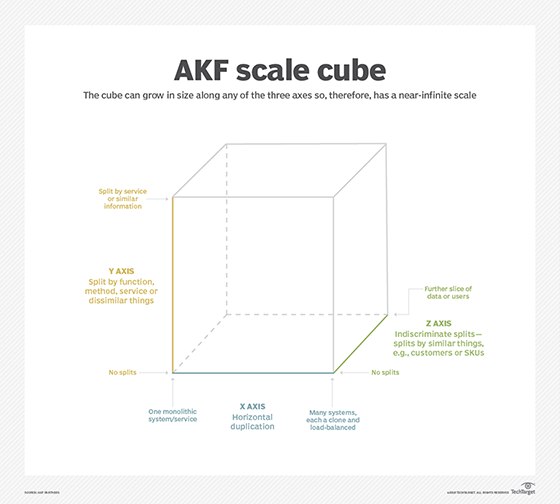
A symptom-manifestation-cause approach involves working back from external signs of poor performance to internal manifestations of a problem to then investigate likely root causes. For example, the symptom of increased response times can be tracked to the internal manifestation of excess latency in message passing between the app's services, which occurred because of a failing network switch. Other potential root causes exist for those same symptoms and manifestation, however. For example, an application design using overly large message requests, or too many small messages, would cause the same issue. These root causes would be found by different tools and resolved by different people. Change-impact analysis creates broad categories that lump together changes in component-level metrics based on their effect on external performance measures. These metric categories might include network link latency, database queue depth and CPU utilization, grouped according to assessments such as excessive resource usage, cost overages or response time.


Unlock distributed analytics with a microservices approach


Combining BI and analytics software with a microservices approach enables average end users to drill down into data with specific types of queries. When it comes time to visualize that data, organizations must decide whether to build customized visualization tools in-house or adopt a third-party option. A vast number of options exist for visualization, which include web-based platforms and stand-alone, open source tools. These tools tend to focus on a range of data interaction, from complex depictions of near-time data to simple renderings. However, big data sources have their limitations. Streaming and unstructured data sources present challenges that mainstream analytical tools struggle to depict. For example, some query connections won't accept data set blending, which limits exploratory analysis. Teams may also encounter system timeouts, out-of-memory exceptions, long query waits and rendering limitations. However, distributed analytics approaches can excel in big data.


Digital transformation in 2019: Lessons learned the hard way

Because of the focus on the technology components, the people-side of the changes required for digital transformation often go under-addressed, yet arguably are the key success factors. That's because the people in the organization have to carry out the digital transformation, yet are often inadequately equipped to do so from a skill, culture, mindset, inclination, and talent perspective. Many organizations have had their digital change initiatives crash upon the shoals of insufficient human capability to carry them out or an inadequately enabling environment. Currently, lack of appropriately skilled personnel ranks in the top five obstacles to digital transformation and is reported by 39 percent of orgs. The good news is that improved organizational focus and improved techniques for upskilling workers to support digital transformation have been arriving. Expect to see both more in 2019. The smart digital leader will use the resources of HR's L&D department to help drive them.


Multicloud does not eliminate vendor lockin

Multicloud does not eliminate vendor lockin
You might think you can avoid the trade-off by using containers or otherwise writing applications so they are portable. But there is a trade-off there as well. Containers are great, and they do provide cloud-to-cloud portability, but you’ll have to modify most applications to take full advantage of containers. That could be an even bigger cost than going cloud-native. Is it worth the avoided lockin? That’s a question you’ll need to answer for each case. Moreover, writing applications so they are portable typically leads to the least-common-denominator approach to be able to work with all platforms. And that means that they will not work well everywhere, because they are not cloud-native. I suppose you could write portable applications that are cloud-native to mutiple clouds, but then you’re really writing the application multiple times in advance and just using one instance at a time. That’s really complex and expensive. Lockin is unavoidable. But lockin is a choice we all must make in several areas: language, tooling, architecture, and, yes, platform.


Quote for the day:


"Leadership cannot just go along to get along. Leadership must meet the moral challenge of the day." -- Jesse Jackson


Daily Tech Digest - November 28, 2017

chair spotlight
CISOs who assume all the responsibility for the organization regarding decisions on risk put their jobs at risk. In this case the CISO defines what the company will and will not tolerate from a security, risk and compliance standpoint—rather than being the facilitator of communication, Curran says. “Too many security people think they shoulder the burden for the organization and that the ‘technical’ knowledge is beyond the business,” Curran says. “As a result, they do not communicate the risk at all, effectively stifling management’s ability to decide how much investment they should make to address the risk.” A CISO “must be able to articulate risk and security solutions to a board or senior executives who are not familiar with security, so they can make informed decisions on risk tolerance,” Curran says.


How CRM's Are Creating Time For High Priority Tasks

Customer Relationship Management (CRM) provides a business with centralized application software to carry out its daily activities. The software manages a business, tracks customers, identifies a target market, receives customer feedback, analyzes data, tracks sales, manages tasks and documents, ensures sales mobility and facilitates social media integration into the business. As a result, effective CRM software should be capable of moving customer prospects through all purchasing stages without any major challenges. Therefore, establishing and maintaining the CRM software requires a distinct sales pipeline, established sales practice, prioritizing of activities in the sales pipeline, dedicating time blocks for each activity, analyzing the sales and making frequent reports. CRMs create time for high priority tasks by grouping the sales tasks as vital, important or optional.


Why We Can't Trust Smartphones Anymore

smartphone shocked group
Quartz reported this week that for the past 11 months, Android has been sending user location data back to Google, even if location services are off, no apps have been used and the phone is without a SIM card. The location data is based on proximity to cell towers, something called “Cell ID.” A Google spokesperson told me that in January, Google “began looking into using Cell ID codes as an additional signal to improve the speed and performance of message delivery.” Google never used or even stored this data, and the data had no connection to location services, targeted advertising or other functions. The company basically turned it on with the intention of exploring performance tweaks later. Google plans to remotely terminate this location function over the next month for all users as a result of the controversy. The termination does not require a software patch or download.


How did Linux come to dominate supercomputing?

How did Linux come to dominate supercomputing?
“There wouldn’t be Linux if it weren’t for Unix,” said Steve Conway, research vice president for Hyperion Research, the high-performance computing (HPC) unit of IDC. “The Unix era gave way to the Linux era because Linux is more open and not vendor-specific. So, here was a chance with Linux for the whole community to have one main flavor of an operating system.” None of the major Unix flavors supported the x86 architecture, either. Sun did with SunOS, which was a text-based OS, and it had Solaris on x86 but never made a big push for it. All the other Unixes were on custom RISC processors. Of course, no one saw the massive rise of x86 on the server, either. Prior to Linux, the only heavily supported x86 Unixes out there was The Santa Cruz Operation with Xenix and FreeBSD out of the University of California at Berkeley.


Internet censorship: It's on the rise and Silicon Valley is helping it happen

"A decade ago, our main concern was governments implementing filtering mechanisms to censor the internet. Today that remains a problem, but more and more, Silicon Valley companies are willing to comply with takedown requests from authoritarian governments," she said. According to York, in the past few months, the EFF has seen Snapchat and Medium comply with the government of Saudi Arabia, an attitude "unthinkable in previous years". "Internet censorship creates inequality -- economic inequality, inequality of ideas, educational inequality, and more," she said. It's up to the people to protect their digital rights, as "governments are working together in their bids for repression, closure of borders, the implementation of mass-surveillance, or cooperation on censorship", York said. 


4 ways to prevent QSR data breaches


One of the biggest trends in restaurant service is the ability to accept card payments at the point of service via mobile point of sale (mPOS). An mPOS solution frees your staff from being tied to the service counter or server station, and it enables seamless card acceptance from anywhere a sale may occur. Secure payments can be accepted in virtually any environment—ranging from a restaurant table or drive thru, to a food truck or pop-up location at a special event. Notably, many mPOS solutions are also EMV-enabled and offer P2PE and tokenization for added security, making them an ideal choice to protect customers and ensure PCI compliance. Increasingly, casual dining and table service restaurants are adopting mPOS and wireless terminals to offer Pay-at-the-Table convenience to their patrons, including acceptance of EMV chip cards and NFC/contactless payments such as Apple Pay and Android Pay.


CEOs Must Do These 3 Things To Turbocharge Innovation


High innovators use culture management to promote transparent and collaborative cultures. This represents one of the biggest factors that distinguishes them from lagging innovators – it separates the cohorts by a margin of nearly two to one. The comments from the survey respondents speak volumes – particularly those classified as lagging innovators. They advocate for the mere basics of culture development, tools, processes and metrics. For guidance on this front, the medical device maker Medtronic warrants a look. For decades, the company’s CEOs have frequently highlighted the company’s innovation strategies and projects at global all-employee meetings. During routine reviews, project leaders evaluate progress against technical and patient-service metrics.


Cloud, Agile and What Startups Can Teach the Enterprise

Software engineering is still a young discipline. Until the Agile Manifesto challenged the accepted waterfall-based development model, software creation borrowed most of its processes from that of hardware. But those older, hardware-like methodologies failed to take advantage of software’s biggest benefit: that it’s soft. What has emerged in the last 15 to 20 years is the idea of “failing quickly.” Developers want to get products in front of users as early as possible, learn from their mistakes, and iterate better versions quickly. This new process takes advantage of the “softness” of software and ultimately sculpts better products. Mantras like “fail quickly” assume that some large percentage of ideas are bad. The faster you can get those ideas in front of people and find out how they perform, the more “at bats” you’ll get and the better your chances are at finding an innovation.


Resiliency in the age of cloud services

hybrid cloud
The emergence of cloud and IaaS has dramatically changed the way we think about application resiliency. Thin provisioning and auto-scaling for rapid deployment of new resources are now possible as conditions change and workloads shift. Spinning up secondary and tertiary DR environments is easy. There are now technologies that enable active/active setups, such as multi-master database replication systems and global load balancing technologies like those provided by modern DNS and traffic management services. Today, we’re seeing a new shift in the way resilient applications are built, because of the emerging criticality of cloud services in application stacks. Cloud services include Software-as-a-Service (SaaS)-style technologies like cloud storage, Database-as-a-Service (DBaaS), Artificial Intelligence-as-a-Service (AIaaS), content delivery networks (CDNs) and Managed DNS networks.


Developing a Google Chrome Extension using Angular 4

It seemed quite a daunting challenge; but after puzzling out how to register our Angular app as a Chrome extension, choose the optimum build process and configuration and to use the messaging system, it proved to be a great opportunity to learn some new technologies in depth. The use of Angular 4 makes the developer’s life easier because the projecat acquires a well-defined structure. It can can be more easily maintained and enhanced thanks to the modularity of Angular. Also, TypeScript, as a superset of JavaScript, brings the object-oriented programming experience with strong typing to the development of client-side browser-based applications. This article describes the general approach, the problems I needed to face, and the solution I adopted.


Quote for the day:


"Leadership cannot really be taught. It can only be learned." -- Harold S. Geneen