Showing posts with label Information Architecture. Show all posts

Daily Tech Digest - June 22, 2023

Mass adoption of generative AI tools is derailing one very important factor, says MIT

Many companies "were caught off guard by the spread of shadow AI use across the enterprise," Renieris and her co-authors observe. What's more, the rapid pace of AI advancements "is making it harder to use AI responsibly and is putting pressure on responsible AI programs to keep up." They warn the risks that come from ever-rising shadow AI are increasing, too. For example, companies' growing dependence on a burgeoning supply of third-party AI tools, along with the rapid adoption of generative AI -- algorithms (such as ChatGPT, Dall-E 2, and Midjourney) that use training data to generate realistic or seemingly factual text, images, or audio -- exposes them to new commercial, legal, and reputational risks that are difficult to track. The researchers refer to the importance of responsible AI, which they define as "a framework with principles, policies, tools, and processes to ensure that AI systems are developed and operated in the service of good for individuals and society while still achieving transformative business impact."


From details to big picture: how to improve security effectiveness

Benjamin Franklin once wrote: “For the want of a nail, the shoe was lost; for the want of a shoe the horse was lost; and for the want of a horse the rider was lost, being overtaken and slain by the enemy, all for the want of care about a horseshoe nail.” It’s a saying with a history that goes back centuries, and it points out how small details can lead to big consequences. In IT security, we face a similar problem. There are so many interlocking parts in today’s IT infrastructure that it’s hard to keep track of all the assets, applications and systems that are in place. At the same time, the tide of new software vulnerabilities released each month can threaten to overwhelm even the best organised security team. However, there is an approach that can solve this problem. Rather than looking at every single issue or new vulnerability that comes in, how can we look for the ones that really matter? ... When you look at the total number of new vulnerabilities that we faced in 2022 – 25,228 according to the CVE list – you might feel nervous, but only 93 vulnerabilities were actually exploited by malware. 


3 downsides of generative AI for cloud operations

While we’re busy putting finops systems in place to monitor and govern cloud costs, we could see a spike in the money spent supporting generative AI systems. What should you do about it? This is a business issue more than a technical one. Companies need to understand how and why cloud spending is occurring and what business benefits are being returned. Then the costs can be included in predefined budgets. This is a hot button for enterprises that have limits on cloud spending. The line-of-business developers would like to leverage generative AI systems, usually for valid business reasons. However, as explained earlier, they cost a ton, and companies need to find either the money, the business justification, or both. In many instances, generative AI is what the cool kids use these days, but it’s often not cost-justifiable. Generative AI is sometimes being used for simple tactical tasks that would be fine with more traditional development approaches. This overapplication of AI has been an ongoing problem since AI was first around; the reality is that this technology is only justifiable for some business problems.


Pros and cons of managed SASE

If a company decides to deploy SASE by going directly through SASE vendors, they’ll have to configure and implement the service themselves, says Gartner’s Forest. “The benefits of a managed service provider are a single source for all setup and management, the ability to redeploy internal resources for other tasks, and the ability to access skills and capabilities that don’t exist internally,” he says. Getting in-house IT staff with the right expertise to handle SASE can be a real challenge, particularly in today’s hiring climate: 76% of IT employers say they’re having difficulty finding the hard and soft skills they need, and one in five organizations globally is having trouble finding skilled tech talent, according to a 2023 survey by ManpowerGroup. The access to outside experts is particularly appealing to companies that don’t have the resources to manage SASE themselves. Managed SASE providers have specialized expertise in deploying and managing SASE infrastructure, says Ilyoskhuja Ikromkhujaev, software engineer at software developer Nipendo. “Which can help ensure that your system is set up correctly and stays up to date with the latest security features and protocols,” he says.


The security interviews: Exploiting AI for good and for bad

AI has moved beyond automation. Looking at large language models, which some industry experts see as representing the tipping point that ultimately leads to wide-scale AI adoption, Heinemeyer believes that an AI capable of writing code offers attackers the opportunity to develop much more bespoke and tailored, sophisticated attacks. Imagine, he says, highly personalised phishing messages that have error-free grammar and no spelling mistakes. For its customers, he says Darktrace uses machine learning to learn what normal looks like in business email data: “We learn exactly how you communicate, what syntax you use in your emails, what attachments you receive, who you talk to, and when this is internal or external.We can detect if somebody sends an email that is unusual for you.” A large language model like ChatGPT reads everything that is on the public internet. The implication is that it will be reading people’s social media profiles, seeing who they interact with, their friends, what they like and do not like. Such AI systems have the ability to truly understand someone, based on the publicly available information that can be gleaned across the web. 


Switching the Blame for a More Enlightened Cybersecurity Paradigm

The “blame the user” mentality is a cognitive bias that ignores the complexities of human-computer interaction. Research in cognitive psychology and human factors engineering has shown that humans are not designed to be perfect digital operators. Mistakes are a natural part of our interaction with systems, especially those that are complex and non-intuitive. Moreover, our susceptibility to scams and manipulation is not just a personal failing, but a product of millennia of evolution. For instance, social engineering attacks exploit our natural tendency to trust and cooperate, which have been crucial to human survival and societal development. To put the onus on the individual is to ignore the broader context. Shifting the blame is an easy way out. It absolves organizations of the responsibility to address systemic issues and allows them to maintain the status quo. This is underpinned by the “just-world hypothesis,” a cognitive bias which propounds that people get what they deserve. When an employee falls for a scam, it's easy to assume that they were careless or ill-prepared.


Standardized information sharing framework 'essential' for improving cyber security

Security experts have called for improvements in how private sector organizations share threat intelligence data with the wider industry. It’s believed that better cross-organizational collaboration would improve cyber resiliency in the face of cyber attacks that continue to rise in frequency and develop ever more sophisticated. “I think this is one of the ways in which the private sector can work with governments around the world, and each other across sectors, industries, and regions,” said Jen Ellis, co-chair at the Institute for Science and Technology’s Ransomware Task Force. Government agencies such as the UK’s Information Commissioner’s Office (ICO) or the US’ Cybersecurity and Infrastructure Security Agency (CISA) enforce strict reporting deadlines around data breaches, but companies often report the minimum required information. The designated cyber security authorities in the UK and US enforce strict reporting deadlines around data breaches and this is seen as a positive step. However, victims often report the minimum required information which in turn reduces other organizations’ ability to learn from, and potentially prevent, follow-on attacks.


Hybrid Microsoft network/cloud legacy settings may impact your future security posture

Often in large organizations, there are users in your network who have the equivalent of Domain administrative rights and are not even aware of this. Your firm may have even inherited the setup of the domain with original accounts and permissions set for a Novell network that was migrated from years before. Often the difference between a firm with better security and one with poor security is having a staff that takes the additional time to test and confirm that there will be no side effects in the network if changes are made. Take the example of unconstrained delegation; this is a setting that many web applications need to function, including those that are internal only to the organization. But this setting can expose the domain to excessive risk. Delegation allows a computer or server to save the Kerberos authentication tickets. Then these saved tickets are used to act on the user’s behalf. Attackers love to grab these tickets, as they can then interact with the server and impersonate the identity and in particular the privileges of those users.


Why we don't have 128-bit CPUs

You might think 128-bit isn't viable because it's difficult or even impossible to do, but that's actually not the case. Lots of parts in processors, CPUs and otherwise, are 128-bit or larger, like memory buses on GPUs and SIMDs on CPUs that enable AVX instructions. We're specifically talking about being able to handle 128-bit integers, and even though 128-bit CPU prototypes have been created in research labs, no company has actually launched a 128-bit CPU. The answer might be anticlimactic: a 128-bit CPU just isn't very useful. A 64-bit CPU can handle over 18 quintillion unique numbers, from 0 to 18,446,744,073,709,551,615. By contrast, a 128-bit CPU would be able to handle over 340 undecillion numbers, and I guarantee you that you have never even seen "undecillion" in your entire life. Finding a use for calculating numbers with that many zeroes is pretty challenging ... Ultimately, the key reason why we don't have 128-bit CPUs is that there's no demand for a 128-bit hardware-software ecosystem. The industry could certainly make it if it wanted to, but it simply doesn't.


Data sovereignty and security driving hybrid IT adoption in Australia

According to Nutanix’s fifth global Enterprise cloud index survey, data sovereignty was the top driver of infrastructure decisions in Australia, with 15% of local respondents citing that as the most important criteria when considering infrastructure investments. Data sovereignty was also one of the top three considerations for over a third (37%) of enterprises in Australia. “Control and security are the biggest factors Australian organisations are weighing up when transforming their IT infrastructure,” said Jim Steed, managing director of Nutanix Australia and New Zealand. “While public cloud was seen as a panacea for many years, it’s becoming increasingly clear that cloud is a tool – not a destination. Some workloads and applications are perfectly suited to a public cloud, but Australian organisations are moving their most sensitive and business-critical workloads back home to their on-premises infrastructure.” According to the study, over half of Australian organisations are planning to repatriate some applications from the public cloud to on-premise datacentres in the next 12 months due to data sovereignty concerns.


Quote for the day:

"Effective team leaders adjust their style to provide what the group can't provide for itself." -- Kenneth Blanchard

Daily Tech Digest - January 15, 2023

How confidential computing will shape the next phase of cybersecurity

At its core, confidential computing encrypts data at the hardware level. It’s a way of “protecting data and applications by running them in a secure, trusted environment,” explains Noam Dror—SVP of solution engineering at HUB Security, a Tel Aviv, Israel-based cybersecurity company that specializes in confidential computing. In other words, confidential computing is like running your data and code in an isolated, secure black box, known as an “enclave” or trusted execution environment (TEE), that’s inaccessible to unauthorized systems. The enclave also encrypts all the data inside, allowing you to process your data even when hackers breach your infrastructure. Encryption makes the information invisible to human users, cloud providers, and other computer resources. Encryption is the best way to secure data in the cloud, says Kurt Rohloff, cofounder and CTO at Duality, a cybersecurity firm based in New Jersey. Confidential computing, he says, allows multiple sources to analyze and upload data to shared environments, such as a commercial third-party cloud environment, without worrying about data leakage.


Not All Multi-Factor Authentication Is Created Equal

Many legacy MFA platforms rely on easily phishable factors like passwords, push notifications, one-time codes, or magic links delivered via email or SMS. In addition to the complicated and often frustrating user experience they create, phishable factors such as these open organizations up to cyber threats. Through social engineering attacks, employees can be easily manipulated into providing these authentication factors to a cyber criminal. And by relying on these factors, the burden to protect digital identities lies squarely on the end user, meaning organizations’ cybersecurity strategies can hinge entirely on a moment of human error. Beyond social engineering, man-in-the middle attacks and readily available toolkits make bypassing existing MFA a trivial exercise. Where there is a password and other weak and phishable factors, there is an attack vector for hackers, leaving organizations to suffer the consequences of account takeovers, ransomware attacks, data leakage, and more. A phishing-resistant MFA solution completely removes these factors, making it impossible for an end user to be tricked into handing them over even by accident or collected by automated phishing tactics.


Europe’s cyber security strategy must be clear about open source

While the UK government has tried to recognise the importance of digital supply chain security, current policy doesn’t consider open source as part of that supply chain. Instead, regulation or proposed policies focus only on third-party software vendors in the traditional sense but fail to recognise the building blocks of all software today and the supply chain behind it. To hammer the point, the UK’s 11,000+ word National Cyber Security Strategy does not include a single reference to open source. GCHQ guidance meanwhile remains limited, with little detailed direction beyond ‘pull together a list of your software’s open source components or ask your suppliers.’ ... In this sense, the EU has certainly been listening. The recently released Cyber Resilience Act (CRA) is its proposed regulation to combat threats affecting any digital entity and ‘bolster cyber security rules to ensure more secure hardware and software products’. First, the encouraging bits: the CRA doesn’t just call for vendors and producers of software to have (among other things) a Software Bill of Materials (SBoM) - it demands companies have the ability to recall components. 


Eight Common Data Strategy Pitfalls

Lack of data culture: Data hidden within silos with little communication between business units leads to a lack of data culture. Data Literacy and enterprise-wide data training is required to allow business staff to read, analyze, and discuss data. Data culture is the starting point for developing an effective Data Strategy.The Data Strategy is too focused on data and not on the business side of things: When businesses focus too much on just data, the Data Strategy may just end up serving the needs of analytics without any focus on business needs. An ideal Data Strategy enlists human capabilities and provides opportunities for training staff to carry out the strategy to meet business goals. This approach will work better if citizen data scientists are included in strategy teams to bridge the gap between the data scientist and the business analyst.Investing in data technology before democratizing data: In many cases, Data Strategy initiatives focus on quick investment in technology without first addressing data access issues. If data access is not considered first, costly technology investments will go to waste. 


Here's Why Your Data Science Project Failed (and How to Succeed Next Time)

Every data science project needs to start with an evaluation of your primary goals. What opportunities are there to improve your core competency? Are there any specific questions you have about your products, services, customers, or operations? And is there a small and easy proof of concept you can launch to gain traction and master the technology? The above use case from GE is a prime example of having a clear goal in mind. The multinational company was in the middle of restructuring, re-emphasizing its focus on aero engines and power equipment. With the goal of reducing their six- to 12-month design process, they decided to pursue a machine learning project capable of increasing the efficiency of product design within their core verticals. As a result, this project promises to decrease design time and budget allocated for R&D. Organizations that embody GE's strategy will face fewer false starts with their data science projects. For those that are still unsure about how to adapt data-driven thinking to their business, an outsourced partner can simplify the selection process and optimize your outcomes.


5 Skills That Make a Successful Data Manager

The role of a data manager in an organization is tricky. This person is often neither an IT guy who implements databases on his/her own, nor a business guy who is actually responsible for data or processes (that’s rather a Data Steward’s area of responsibility). So what’s the real value-add of a data manager (or even a data management department)? In my opinion, you need someone who is building bridges between the different data stakeholders on a methodical level. It’s rather easy to find people who consider themselves as experts for a particular business area, data analysis method or IT tool, but it is rather complicated to find one person who is willing to connect all these people and to organize their competencies as it is often required in data projects. So what I am referring to are skills like networking, project management, stakeholder management and change management HIwhich are required to build a data community step-by-step as backbone for Data Governance. Without people, a data manager will fail! So in my opinion, a recruiter who seeks for data managers should not only challenge technical skills but also these people skills.


Why distributed ledger technology needs to scale back its ambition

There is nonetheless an expectation that DLT can prove to be a net good for financial markets. Foreign exchange markets have an estimated $8.9 trillion at risk every day due to the final settlement of transactions between two parties taking days. This is why the Financial Stability Board and the Committee on Payments and Market Infrastructures have focused their efforts on enhancing cross-border payments with a comprehensive global roadmap. Part of this roadmap includes exploring the use of DLT and Central Bank Digital Currencies. The problem may not be the technology itself, but the aim of replacing current technology systems with distributed networks. DLT networks are being designed to completely overhaul and replace legacy technology that financial markets depend on today. Many pilot projects, such as mBridge and Jura, rely on a single blockchain developed by a single vendor. This introduces a single point of trust, and removes many of the benefits of disintermediation. 


Why is “information architecture” at the centre of the design process?

The information architecture within a design (both process and output) makes the balancing within the equation possible. It also ensures the equation is “solvable” by other people. It does this by introducing logical coherence. It ensures words, images, shapes and colours are used consistently. And it ensures that as we move from idea to execution, we stay true to the original intent — and can clearly articulate it — so that we can meaningfully measure the effectiveness of our design. Without this internal coherence and confidence that our output is an accurate, reliable test of our hypothesis, we’re not doing design. The power of design which has a consistent information architecture is that if we find that our idea (which we translate to intent, experiments and experiences) is not equal to the problem, we can interrogate every part of the equation. We may have made a mistake in execution. Maybe our idea wasn’t quite right. Or even more powerfully, maybe we didn’t really understand the problem fully. 


Improve Your Software Quality with a Strong Digital Immune System

You can improve your software quality with a strong digital immune system since a digital immune system is designed to guard against cyberattacks and other sorts of hostile activities on computer systems, networks, and hardware. It operates by constantly scanning the network and systems for indications of prospective threats and then taking the necessary precautions to thwart or lessen such dangers. This can entail detecting and preventing malicious communications, identifying and containing compromised devices, and patching security holes. A robust digital immune system should offer powerful and efficient protection against cyber threats and assist individuals and companies in staying secure online. Experts in software engineering are searching for fresh methods and strategies to reduce risks and maximize commercial impact. The idea of “digital immunity” offers a direction. It consists of a collection of techniques and tools for creating robust software programmes that provide top-notch user experiences. With the help of this roadmap, software engineering teams may identify and address a wide range of problems, including functional faults, security flaws, and inconsistent data.


Security Bugs Are Fundamentally Different Than Quality Bugs

For each one of the types of testing listed above, a different skillset is required. All of them require patience, attention to detail, basic technical skills, and the ability to document what you have found in a way that the software developers will understand and be able to fix the issue(s). That is where the similarities end. Each one of these types of testing requires different experience, knowledge, and tools, often meaning you need to hire different resources to perform the different tasks. Also, we can’t concentrate on everything at once and still do a great job at each one of them. Although theoretically you could find one person who is both skilled and experienced in all of these areas, it is rare, and that person would likely be costly to employ as a full-time resource. This is one reason that people hired for general software testing are not often also tasked with security testing. Another reason is that people who have the experience and skills to perform thorough and complete security testing are currently a rarity. 


Quote for the day:

"Leadership is particularly necessary to ensure ready acceptance of the unfamiliar and that which is contrary to tradition." -- Cyril Falls

Daily Tech Digest - October 24, 2021

Artificial Intelligence Is Smart, but It Doesn’t Play Well With Others

Humans hating their AI teammates could be of concern for researchers designing this technology to one day work with humans on real challenges — like defending from missiles or performing complex surgery. This dynamic, called teaming intelligence, is a next frontier in AI research, and it uses a particular kind of AI called reinforcement learning. A reinforcement learning AI is not told which actions to take, but instead discovers which actions yield the most numerical “reward” by trying out scenarios again and again. It is this technology that has yielded the superhuman chess and Go players. Unlike rule-based algorithms, these AI aren’t programmed to follow “if/then” statements, because the possible outcomes of the human tasks they’re slated to tackle, like driving a car, are far too many to code. “Reinforcement learning is a much more general-purpose way of developing AI. If you can train it to learn how to play the game of chess, that agent won’t necessarily go drive a car. But you can use the same algorithms to train a different agent to drive a car, given the right data” Allen says. “The sky’s the limit in what it could, in theory, do.”


CDR: The secret cybersecurity ingredient used by defense and intelligence agencies

Employees in the defense and intelligence sector are in near-constant contact with each other, sharing information often under challenging circumstances. They move files and documents from low trust environments into networks that hold a nation’s most sensitive data, where a data breach could have a serious impact on national security. Consequently, when it comes to sharing any kind of document, these teams cannot risk threats slipping through the net. Human attackers are now using machines to engineer malware at a pace only imaginable a few years ago. Today, it’s possible to engineer a new piece of malware and to make each version of that file suitably different so that it’s almost impossible for traditional malware protection solutions to identify. In the same way that Facebook or Twitter use algorithms to create a truly unique social feed of information that is tailored to the interests and tastes of a user, bad actors can use similar algorithms to deploy essentially the same underlying threats but packaged in ways that simply evade detection.

Gartner advises tech leaders to prepare for action as quantum computing spreads

Cambridge Quantum’s efforts to expand quantum infrastructure got significant backing earlier this year when Honeywell said it would merge its own quantum computing operations with Cambridge Quantum, to form an independent company to pursue cybersecurity, drug discovery, optimization, material science, and other applications, including AI. Honeywell said it would invest between $270 million – $300 million in the new operation. Cambridge Quantum said it would remain independent, working with various quantum computing players, including IBM. The lambeq work is part of an overall AI project that is the longest-term project among the efforts at Cambridge Quantum, said Ilyas Khan, founder, and CEO of Cambridge Quantum, in an e-mail interview. “We might be pleasantly surprised in terms of timelines, but we believe that NLP is right at the heart of AI more generally and therefore something that will really come to the fore as quantum computers scale,” he said. Khan cited cybersecurity and quantum chemistry as the most advanced application areas in Cambridge Quantum’s estimation.


How to Not Lose Your Job to Low-Code Software

The amount of work you have is driven by the ability of software to make a meaningful difference in your organization. Take a look at your current queue of work. If your team is like most IT teams there will be a mountain of unmet demand for new applications or additional functionality for existing applications. Thinking that any amount of automation will reduce that demand to zero is like thinking that a faster car will get you to Mars. If low code software starts taking some of your work, there will likely be other projects you can work on. If you handle this right, you can even shuffle some of the painful projects over to the party-goers on the low code bus. ... Secondly, and more fundamentally, there are certain aspects of software engineering that are harder to automate than others - making it unsuitable terrain for the low code party bus to drive across. For example, low code tools make it easy for non-developers to create a table to store data. But they can't do much to help the non-developer structure their tables to best map to the business problem they are trying to solve. 


API contract testing with Joi

When you sign a contract, you expect both parties to hold their end of the bargain. The same can be true for testing applications. Contract testing is a way to make sure that services can communicate with each other and that the data shared between the services is consistent with a specified set of rules. In this post, I will guide you through using Joi as a library to create API contracts for services consuming an API. ... Before we get started, let me give you some background about contract testing. This kind of testing provides confidence that different services work when they are required to. Imagine that an organization has multiple payment services that utilize an Authentication API. The API logs in users into an application with a username and a password. It then assigns them an access token when the log-in operation is successful. Other services like Loans and Repayments require the Authentication API service once users are logged in. ... Contract tests are designed to monitor the state of an application and notify testers when there is an unexpected result. Contract tests are most effective when they are used by a tool that relies on the stability of other services. 


Regulating Crypto: Is It Different – Or Is It the Same?

Regulators need to know what the technology is capable of, but they need not know every technical detail just to make good law. “If you can understand clearly what the technology is doing, I think that you can make pretty good judgments about what the fundamental financial activity is and what regulatory box that financial activity can or should fit in,” he told Webster. Strip those technologies down a bit, and they boil down to some basic underpinning concepts that lend themselves to governance. At the core of blockchain and cryptos is database architecture, said Gerety. “It has some neat properties, but nowhere else in the financial services industry do you get regulated differently if you use SAP or Oracle,” he said. To get a sense of how one might approach “newness” in a sector, he offered a concept of a matrix, with axes denoting what the future “feels like” and might actually “be.” Babies will pretty much always “be” and “feel” the same. Not much in the way of technology will change the experience or feelings one will have with birthing and raising a child, despite the newness of, well, becoming a parent.


Information Theory: Principles and Apostasy

Let’s start with a data science interview question. Usually, as part of an initial screening round for entry level candidate I like to find an example on their CV of a project that used real life data. Real life data is much nastier than academic and research data. Its chalked full of missing data, mixed (integer and string) data and outliers that make consuming and modeling the information grossly more difficult. Invariably most of the conversation revolves around these real world considerations. How do you handle missing data? Usual answers involve some sort of information replacement strategy like replace them with the average value of the column. Fair and reasonable. How do we deal with malformed or mixed data? Again usually a fair answer involving mapping strings to numbers. Finally what did you do about the large outlier events? Usually the answer is that they ‘removed them’ because you ‘can’t be expected to predict rare events.’ The ultimate justification: it improved the models accuracy. That’s good answer if building a forecast is a game or contest, much worse if you want to use it.


The OCC Officially Recognizes the Critical and Permanent Role of Blockchain in Banking

This is noteworthy for a couple of reasons. First, it is a recognition that many banks, along with a slew of other financial institutions, are adopting DLT as a technology enabling better processes. Simply put, financial institutions are moving past the exploratory phase of DLT and are now actually implementing the technology into their operations. Secondly, the OCC is declaring its intent to explore and define appropriate governance processes for banks to deploy when such changes are implemented. In other words, the OCC is defining its intent to regulate how such changes should take place. ... The immutability of a distributed ledger provides a new level of security. It is challenging to establish a single customer view across different jurisdictions and business lines. With mutualized data management, DLT allows permitted parties to share data securely and in real time, which could address challenges of Know Your Customer (KYC) and Anti Money Laundering (AML). The themes are clear – DLT injected into the banking and financial ecosystem is an equalizer, a simplifier and a fortifier.


How data drives Air Canada’s cargo business

For business intelligence, the airline has been a long-term user of WebFocus from Tibco. It also uses Microsoft PowerBI. Riboulet’s reason for using two BI platforms is because “they complement each other”, each having different functions it finds useful. For example, WebFocus offers Air Canada the ability to push out reports via email, a feature not available in PowerBI. Riboulet says this is useful for people working in operations, who may only have access to their phone and need to see embedded reports. Also, the data team noticed that many business users require similar datasets and attributes, which can be pulled together into pre-built reports. The company also uses the data grid feature in WebFocus to aggregate data in a way that can easily be customised by users and can be exported to Microsoft Excel. It has also deployed WebFocus Hyperstage, as a staging area for data, to avoid direct access to its on-premise database systems. Riboulet views the data team at Air Canada Cargo as internal consultants who discuss data requirements with businesspeople. 


How Much Power Should Finance Have Over Their Automations?

If you want to automate your finance function and bring lower costs to operate the financing and accounting needs, taking control can provide you with numerous benefits. This includes prioritization of your processes that align with your strategic vision, controlling resource investments and commitments, and insuring SOX control frameworks are adhered to at the onset. It’s not surprising that some finance organizations can feel underserved by their IT partners, as ITs responsible for supporting the whole organization and finance operations can take a back seat to other priorities. This does not mean that IT should be left aside. IT will have a role, even if you run your own automation program end-to-end, and you will need them to have a seat at the table. You will want to avoid creating a shadow IT group and truly focus your financial resources on process improvement and automation. It’s best practice to leverage your IT team for infrastructure, network security, understanding ERP/system schedules, roadmaps, and disaster recovery processes (at a minimum). It is also recommended to adopt the cloud version of the tools, which can significantly reduce the needs of your IT org


Quote for the day:

"Problem-solving leaders have one thing in common: a faith that there's always a better way." -- Gerald M. Weinberg

Daily Tech Digest - September 27, 2021

How to Get Started With Zero Trust in a SaaS Environment

While opinions vary on what zero trust is and is not, this security model generally considers the user's identity as the root of decision-making when determining whether to allow access to an information resource. This contrasts with earlier approaches that made decisions based on the network from which the person was connecting. For example, we often presumed that workers in the office were connecting directly to the organization's network and, therefore, could be trusted to access the company's data. Today, however, organizations can no longer grant special privileges based on the assumption that the request is coming from a trusted network. With the high number of remote and geographically dispersed employees, there is a good chance the connections originate from a network the company doesn't control. This trend will continue. IT and security decision-makers expect remote end users to account for 40% of their workforce after the COVID-19 outbreak is controlled, an increase of 74% relative to pre-pandemic levels, according to "The Current State of the IT Asset Visibility Gap and Post-Pandemic Preparedness," with research conducted by the Enterprise Strategy Group for Axonius.


Tons Of Data At The Company Store

Confidentially, many chief data officers will admit that their companies suffer from what might euphemistically be called “data dyspepsia:” they produce and ingest so much data that they cannot properly digest it. Like it or not, there is such a thing as too much data – especially in an era of all-you-can-ingest data comestibles. “Our belief is that more young companies die of indigestion than starvation,” said Adam Wilson, CEO of data engineering specialist Trifacta, during a recent episode of Inside Analysis, a weekly data- and analytics-focused program hosted by Eric Kavanagh. So what if Wilson was referring specifically to Trifacta’s decision to stay focused on its core competency, data engineering, instead of diversifying into adjacent markets. So what if he was not, in fact, alluding to a status quo in which the average business feels overwhelmed by data. Wilson’s metaphor is no less apt if applied to data dyspepsia. It also fits with Trifacta’s own pitch, which involves simplifying data engineering – and automating it, insofar as is practicable – in order to accelerate the rate at which useful data can be made available to more and different kinds of consumers.


Hyperconverged analytics continues to guide Tibco strategy

One of the trends we're seeing is that people know how to build models, but there are two challenges. One is on the input side and one is on the output side. On the input side, you can build the greatest models in the world, but if you feed them bad data that's not going to help. So there's a renewed interest around things like data governance, data quality and data security. AI and ML are still very important, but there's more to it than just building the models. The quality of the data, and the governance and processes around the data, are also very important. That way you get your model better data, which makes your model more accurate, and from there you're going to get better outcomes. On the output side, since there are so many models being built, organizations are having trouble operationalizing them all. How do you deploy them into production, how do you monitor them, how do you know when it's time to go back and rework that model, how do you deploy them at the edge, how do you deploy them in the cloud and how do you deploy them in an application? 


Gamification: A Strategy for Enterprises to Enable Digital Product Practices

As digital products take precedence, the software ecosystem brings new possibilities to products. With the rise of digital products, cross-functional boundaries are blurring. New skills and unlearning old ways are critical. Gamification can support creating a ladder approach to acquiring and utilizing new skills for continuous software delivery ecosystems, testing and security. However, underpinning collective wisdom through gamification needs a systematic framework where we are able to integrate game ideation, design, validation & incentives with different persona types. To apply gamification in a systematic manner to solve serious problems, ideate, and come together to create new knowledge in a fun way, is challenging. To successfully apply gamification for upskilling and boosting productivity, it will have to be accompanied by understanding the purposefulness through the following two critical perspectives: Benefits of embracing gamification for people – Removing fear, having fun, and making the desirable shift towards new knowledge; creating an environment that is inclusive and can provide a learning ecosystem for all. 


Artificial Intelligence: The Future Of Cybersecurity?

Cybersecurity in Industry 4.0 can't be tackled in the same way as that of traditional computing environments. The number of devices and associated challenges are far too many. Imagine monitoring security alerts for millions of connected devices globally. IIoT devices possess limited computing power and, therefore, lack the ability to run security solutions. This is where AI and machine learning come into play. ML can make up for the lack of security teams. AI can help discover devices and hidden patterns while processing large amounts of data. ML can help monitor incoming and outgoing traffic for any deviations in behavior in the IoT ecosystem. If a threat or anomaly is detected, alarms can be sent to security admins warning them about the suspicious traffic. AI and ML can be used to build lightweight endpoint detection technologies. This can be an indispensable solution, especially in situations where IoT devices lack the processing power and need behavior-based detection capabilities that aren't as resource intensive. AI and ML technologies are a double-edged sword. 


3 ways any company can guard against insider threats this October

Companies don’t become cyber smart by accident. In fact, cybersecurity is rarely top-of-mind for the average employee as they go about their day and pursue their professional responsibilities. Therefore, businesses are responsible for educating their workforce, training their teams to identify and defend against the latest threat patterns. For instance, phishing scams have increased significantly since the pandemic’s onset, and each malicious message threatens to undermine data integrity. Meanwhile, many employees can’t identify these threats, and they wouldn’t know how to respond if they did. Of course, education isn’t limited to phishing scams. One survey found that 61 percent of employees failed a basic quiz on cybersecurity fundamentals. With the average company spending only 5 percent of its IT budget on employee training, it’s clear that education is an untapped opportunity for many organizations to #BeCyberSmart. When coupled with intentional accountability measures that ensure training is implemented, companies can transform their unaware employees into incredible defensive assets.


VMware gears up for a challenging future

“What we are doing is pivoting our portfolio or positioning our portfolio to become the multi-cloud platform for our customers in three ways,” Raghuram said. “One is enabling them to execute their application transformation on the cloud of their choice using our Tanzu portfolio. And Tanzu is getting increased momentum, especially in the public cloud to help them master the complexities of doing application modernization in the cloud. And of course, by putting our cloud infrastructure across all clouds, and we are the only one with the cloud infrastructure across all clouds and forming the strategic partnerships with all of the cloud vendors, we are helping them take their enterprise applications to the right cloud,” Raghuram said. Building useful modern enterprise applications is a core customer concern, experts say. “Most new apps are built-on containers for speed and scalability. The clear winner of the container wars was Kubernetes,” said Scott Miller, senior director of strategic partnerships for World Wide Technology (WWT), a technology and supply-chain service provider and a VMware partner. 


Software cybersecurity labels face practical, cost challenges

Cost and feasibility are among the top challenges of creating consumer labels for software. Adding to these challenges is the fact that software is continually updated. Moreover, software comes in both open-source and proprietary formats and is created by a global ecosystem of firms that range from mom-and-pop shops all the way up to Silicon Valley software giants. "It's way too easy to create requirements that cannot be met in the real world," David Wheeler, director of open source supply chain security at the Linux Foundation and leader of the Core Infrastructure Initiative Best Practices Badge program, said at the workshop. "A lot of open-source projects allow people to use them at no cost. There's often no revenue stream. You have to spend a million dollars at an independent lab for an audit. [That] ignores the reality that for many projects, that's an impractical burden." ... Another critical aspect of creating software labels is to ensure that they don't reflect static points in time but are instead dynamic, taking into account the fluid nature of software. 


Work’s not getting any easier for parents

Part of many managers’ discomfort with remote work is that they are unsure how to gauge their off-site employees’ performance and productivity. Some business leaders equate face time with productivity. I’ll never forget a visit I had to a Silicon Valley startup in which the manager showing me around described a colleague this way: “He’s such a great worker. He’s here every night until 10, and back in early every morning!” In my work helping businesses update their policies and cultures to accommodate caregivers, I often have to rid managers of this old notion. There’s nothing impressive, or even good, about being in the office so much. To help change the paradigm, I work with managers to find new ways of measuring an individual’s performance and productivity. Instead of focusing on hours worked per day, we look at an employee’s achievements across a broader time metric, such as a month or quarter. We ask, what did the employee do for the company during that time? It’s often then that businesses realize how little overlap there is between those who are seen working the most and those who have the greatest impact on the company. 


How to use feedback loops to improve your team's performance

In systems, feedback is a fundamental force behind their workings. When we fly a plane, we get feedback from our instruments and our co-pilot. When we develop software, we get feedback from our compiler, our tests, our peers, our monitoring, and our users. Dissent works because it’s a form of feedback, and clear, rapid feedback is essential for a well functioning system. As examined in “Accelerate”, a four-year study of thousands of technology organizations found that fostering a culture that openly shares information is a sure way to improve software delivery performance. It even predicts ability to meet non-technical goals. These cultures, known as “generative” in Ron Westrum’s model of organizational culture, are performance–and learning–oriented. They understand that information, especially if it’s difficult to receive, only helps to achieve their mission, and so, without fear of retaliation, associates speak up more frequently than in rule-oriented (“bureaucratic”) or power-oriented (“pathological”) cultures. Messengers are praised, not shot.


Quote for the day:

"A pat on the back is only a few vertebrae removed from a kick in the pants, but is miles ahead in results." -- W. Wilcox

Daily Tech Digest - April 13, 2021

19 Realistic Habits To Improve Software Development

When you finish writing a fragment of code and see that it works, take some time to reread it and see if you can improve it. Think that you are going to show it to someone else who is going to evaluate your code. Would you leave it the same? One of the best code refactoring techniques is the red/green process used in Agile test-driven development. To use this technique, your code must be covered with tests. If when refactoring, something fails, the test will not pass, and you will be aware that something is wrong with your refactor. ... Plan a time interval without distractions or interruptions. Interruptions will make your mind lose track of what it is developing, and you will have to start again when you resume the activity, which will cost you extra work time and make you more prone to make mistakes. It works to leave only the IDE open and a browser with a maximum of two tabs. ... Don’t try to write clever code that only you understand. Write code that someone else can read and understand. It doesn’t matter if your code has a few more lines if they’re necessary to make it understood better. Remember that in a few months, you or someone else on your team may have to modify the code, and if it is not easy to understand, it will not be easy to modify.


Clear & Present Danger: Data Hoarding Undermines Better Security

Even though there is overlap between the users of big companies' services and the customers of small businesses, the big companies aren't sharing their data. As a result, customers who use smaller businesses are left to fend for themselves. A few companies are trying to change that. Deduce (disclosure, another company I've consulted for) created a data collective through which companies can share information about user's security-related behavior and logins. In exchange for sharing data with the platform, companies get access to Deduce's repository of identity data from over 150,000 websites. They can use this shared data to better detect suspicious activity and alert their users, just like Microsoft and Google do using their own data. In a different approach to helping businesses identify suspicious users, LexisNexis created unique identifiers for their clients' customers. Using these identifiers, their clients can share trust scores that indicate if a particular user is suspicious. If a suspicious user attempts to log in to a website, the site can block that user to keep themselves and their legitimate users safer.


Optimizing the CIO and CFO Relationship“

CIOs are more likely to be pioneers and/or integrators, while CFOs are more likely to be guardians and drivers,” according to consultancy Deloitte in a description of different corporate personality types. “Pioneers are novelty-seeking, they like having a variety of possibilities, generating new ideas….On the other hand, the guardian personality values structure and loyalty, are much more methodical, detail-oriented, and perhaps a little more risk-averse.” ... CFOs understand that they have to change and expand their skills,” said Mastanuono. “The modern CFO understands technology and how it can transform the business. He or she also needs to understand the future of what finance will look like, and be a transformer of people, processes, and systems. The CFO must move from being a reactive to a proactive collaborator so the end business can be positioned to have the right systems and data at the right time. Breaking down silos and developing empathy and cross-functional collaboration are requirements, and the CFO-CIO relationship is a critical piece.” ... If CFOs and CIOs can develop a common approach to IT investments that looks at strategic risks as well as benefits, it creates common ground for project discussions and evaluations.


How to address post-pandemic infrastructure pain points

Managing workforce transformation is already challenging enough for employees who need to access on-premises resources. It becomes even more difficult if these employees work in regulated sectors, as medical and financial organizations need to track their employees’ identities, access requests, and usage to an even greater degree. Moreover, because there’s no one set of global standards, IT teams will need to account for many different compliance frameworks that vary based on where an employee is sitting, what information they’re accessing, and what sector they’re working in. On top of that, as businesses build new infrastructures that can accommodate and monitor permanently remote workers, they must be mindful of how certain regulations affect what personally identifiable information they can record about their own employees. GDPR, CCPA, and other privacy laws predate the pandemic, but like workforce transformation, they’ve become even starker and more commonplace challenges now. Different jurisdictions will have different mandates, and your IT teams will need to account for them all.


12 steps towards a secure project management framework

Cyber security is a tech-heavy domain, and project/program management is essential to deliver successful projects. However, cyber security requires a few tweaks in regular management practices as it comes with a different set of requirements. Cyber security is a security management program that is complex in nature and entails systematic processes. It deals with all aspects of a company’s operations, from mapping and recruiting skilled security professionals to vendor risk management. It involves protecting and securing computer systems, networks, and data from theft or damage, thereby ensuring business continuity. A project manager usually has to oversee many one-time and recurring cyber security tasks while handling usual responsibilities and priorities. A good project management framework will ensure that projects are delivered smoothly, without exceeding budgets, and are carried out in the timeframe decided. For any project management program to be successful, it’s important to define roles and responsibilities, a detailed plan of action, and milestones to be achieved.While most of the standard project management practices hold good in cyber security programs, there are a few cyber security-specific aspects that need to be taken care of with absolute diligence and strict adherence.


Information Relativity

Relativity was introduced at the beginning of the last century when Einstein proved that reality is fundamentally different depending on your frame of reference, a distortion of the spacetime continuum. The concept has led to the discovery of black holes, gravitational lenses, time dilation, and all kinds of other fantastic things. Relativity is not at all what one would expect based on our regular day-to-day lives that operate according to classic laws of physics. It changes what it means to observe and to be an observer—it means that how we experience the world differs not just in how we interpret it. There are circumstances where the world I experience is inconsistent with yours. It turns out that communication has these same circumstances that also work in this same peculiar way. Information is distorted depending on the location of the observer. Mark Burgess calls this “information relativity”: messages can take multiple paths and interfere with one another, information can be reversed in its order as it travels along one path, the speed of communication can be different from the speed of communication on another path. 


The Role of EiPaaS in Enterprise Architecture: Part 1

When discussing enterprise architecture, a diagram of the IT landscape comes to mind because that is the standard approach to defining an architecture. However, during our work with a number of enterprise architecture teams worldwide, we discovered that enterprise architecture has a larger strategic scope than what typical IT diagrams capture. Fundamentally, enterprise architecture converts business strategy into a value generation outcome by creating a foundation to execute various IT initiatives and processes. It is about gaining a long-term view for the organization, including the integration and standardization of various elements involved in the business. ... At the initial stages, an enterprise architecture will define the systems and subsystems required for each organization’s function. It starts with purchasing core systems, such as human resource management (HRM), customer relationship management (CRM) and/or enterprise resource planning (ERP) based on the business domain of the organization. In addition, subsystems will be built around the core systems by in-house or outsourced development teams. Systems and subsystems that belong to each function operate independently with limited or no information exchange.


Nvidia announces Morpheus, an AI-powered app framework for cybersecurity

Morpheus essentially enables compute nodes in networks to serve as cyberdefense sensors — Nvidia says its newly announced BlueField-3 data processing units can be specifically configured for this purpose. With Morpheus, organizations can analyze packets without information replication, leveraging real-time telemetry and policy enforcement, as well as data processing at the edge. Thanks to AI, Morpheus can ostensibly analyze more security data than conventional cybersecurity app frameworks without sacrificing cost or performance. Developers can create their own Morpheus skills using deep learning models, and Nvidia says “leading” hardware, software, and cybersecurity solutions providers are working to optimize and integrate datacenter security offerings with Morpheus, including Aria Cybersecurity Solutions, Cloudflare, F5, Fortinet, Guardicore Canonical, Red Hat, and VMware. Morpheus is also optimized to run on a number of Nvidia-certified systems from Atos, Dell, Gigabyte, H3C, HPE, Inspur, Lenovo, QCT, and Supermicro. Businesses are increasingly placing their faith in defensive AI like Morpheus to combat the growing number of cyberthreats.


Automation will accelerate decentralization and digital transformation

As the vaccinated population grows, doors reopen, and more people come together again, the reality we find ourselves in will not be the one left behind in 2019. Many long for a return to in-person experiences, but at the same time, have grown accustomed to the flexibilities of a decentralized, digital-first world. As we emerge from lockdown, hitting "rewind" will not satisfy customer and employee needs. Instead, companies must create hybrid experiences that integrate both digital and in-person modalities. In addition, the growing expectations of stakeholders has created unprecedented demand for IT innovation and greater sense of urgency in the post-pandemic world. Even as more offline activities resume, 2020's rapid digitalization will have a large and lasting impact on both customer and employee experiences. For example, analysis of global research from Salesforce shows customers anticipate engaging online with companies just as much in 2021 as they did in 2020. That customers expect to maintain this substantial departure from their 2019 patterns suggests that the swing to digital at the height of the pandemic wasn't purely due to unavailability of in-person channels.


How data poisoning attacks corrupt machine learning models

The main problem with data poisoning is that it's not easy to fix. Models are retrained with newly collected data at certain intervals, depending on their intended use and their owner's preference. Since poisoning usually happens over time, and over some number of training cycles, it can be hard to tell when prediction accuracy starts to shift. Reverting the poisoning effects would require a time-consuming historical analysis of inputs for the affected class to identify all the bad data samples and remove them. Then a version of the model from before the attack started would need to be retrained. When dealing with large quantities of data and a large number of attacks, however, retraining in such a way is simply not feasible and the models never get fixed, according to F-Secure's Patel. "There's this whole notion in academia right now that I think is really cool and not yet practical, but we'll get there, that's called machine unlearning," Hyrum Anderson, principal architect for Trustworthy Machine Learning at Microsoft, tells CSO. "For GPT-3 [a language prediction model developed by OpenAI], the cost was $16 million or something to train the model once.


Quote for the day:

"It's not about how smart you are--it's about capturing minds." -- Richie Norton

Daily Tech Digest - April 11, 2021

One-stop machine learning platform turns health care data into insights

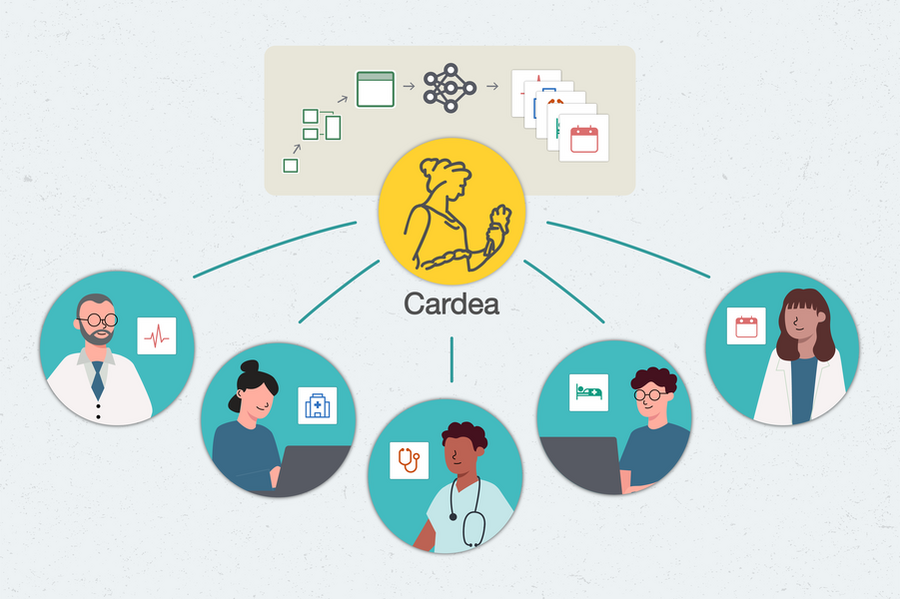
To turn reams of data into useful predictions, Cardea walks users through a pipeline, with choices and safeguards at each step. They are first greeted by a data assembler, which ingests the information they provide. Cardea is built to work with Fast Healthcare Interoperability Resources (FHIR), the current industry standard for electronic health care records. Hospitals vary in exactly how they use FHIR, so Cardea has been built to "adapt to different conditions and different datasets seamlessly," says Veeramachaneni. If there are discrepancies within the data, Cardea's data auditor points them out, so that they can be fixed or dismissed. Next, Cardea asks the user what they want to find out. Perhaps they would like to estimate how long a patient might stay in the hospital. Even seemingly small questions like this one are crucial when it comes to day-to-day hospital operations — especially now, as health care facilities manage their resources during the Covid-19 pandemic, says Alnegheimish. Users can choose between different models, and the software system then uses the dataset and models to learn patterns from previous patients, and to predict what could happen in this case, helping stakeholders plan ahead.


8 Ways Digital Banking Will Evolve Over the Next 5 Years

The initial shift toward digital financial services saw an ad hoc response from regulators. As new technologies come into play and tech giants like Google and Apple become increasingly disruptive in the financial industry, these transformations will force policymakers to identify emerging threat vectors and comprehensively address risk. In contrast to today’s mostly national systems of oversight, a global approach may be necessary to ensure stability in the sector, and we may see the rise of new licensing and supervisory bodies. The future of digital banking appears bright, but the unprecedented pace of innovation and shifts in consumer expectations demand a new level of agility and forward-thinking. Even as financial institutions attempt to differentiate themselves from competitors, co-innovation will become an integral part of success. People and technology will both play critical roles in these developments. Tech capabilities and digital services must be extremely resilient, constantly available at the time of customer need. Human capital, however, will be as crucial as any other asset. Leaders will have to know how to upskill, reskill and retain their talent to promote innovation. 


A new era of innovation: Moore’s Law is not dead and AI is ready to explode

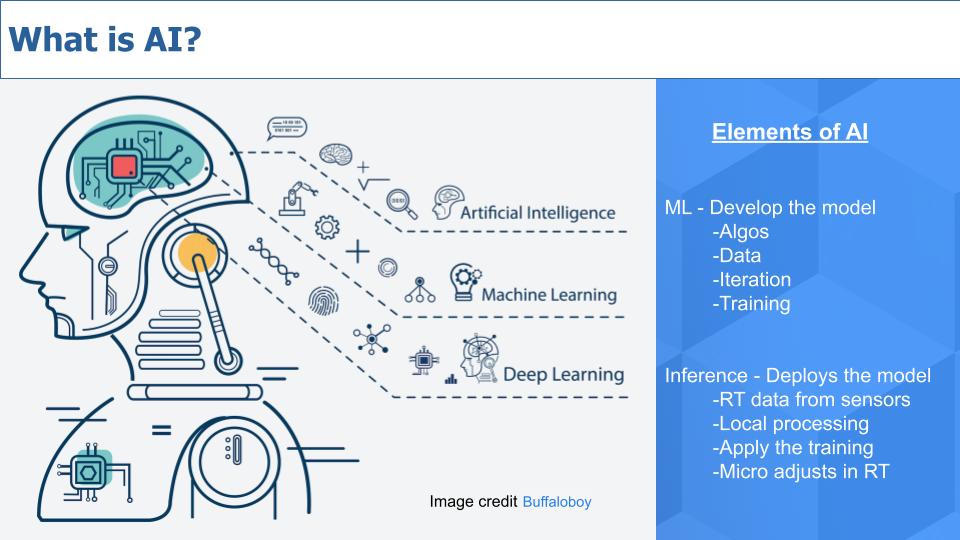
We sometimes use artificial intelligence and machine intelligence interchangeably. This notion comes from our collaborations with author David Moschella. Interestingly, in his book “Seeing Digital,” Moschella says “there’s nothing artificial” about this: There’s nothing artificial about machine intelligence just like there’s nothing artificial about the strength of a tractor. It’s a nuance, but precise language can often bring clarity. We hear a lot about machine learning and deep learning and think of them as subsets of AI. Machine learning applies algorithms and code to data to get “smarter” – make better models, for example, that can lead to augmented intelligence and better decisions by humans, or machines. These models improve as they get more data and iterate over time. Deep learning is a more advanced type of machine learning that uses more complex math. The right side of the chart above shows the two broad elements of AI. The point we want to make here is that much of the activity in AI today is focused on building and training models. And this is mostly happening in the cloud. But we think AI inference will bring the most exciting innovations in the coming years.


Rethinking Ecommerce as Commerce at Home

Ecommerce is all grown up. It’s time to break away from the early-internet paradigm where online shopping was a new, “electronic” form of shopping. Today, almost all commerce involves varying degrees of digital elements (discovery, price comparison, personalization, selection, ordering, payment, delivery, etc.). The defining factor is not whether commerce is digital; rather, one defining factor is the optimal location for a retailer to meet a consumer’s needs. Shopping happens on a spectrum between home and the store. As such, ecommerce is better understood as commerce at home, and Amazon was the early winner. Great retailers focus on convenience or the experiential. In the new paradigm, certain retail truths persist. For example, all great retailers have focused primarily on either convenience retail or experiential retail. To be clear, any retail can be a great experience, but the priority matters. Amazon focuses ruthlessly on convenience. The outcome is a great customer experience. To drive growth, Amazon has prioritized speed and selection over consultation and curation. Amazon’s focus on convenience has yielded an (incredibly) high-volume, low-margin retail business.


These are the AI risks we should be focusing on

AI may never reach the nightmare sci-fi scenarios of Skynet or the Terminator, but that doesn’t mean we can shy away from facing the real social risks today’s AI poses. By working with stakeholder groups, researchers and industry leaders can establish procedures for identifying and mitigating potential risks without overly hampering innovation. After all, AI itself is neither inherently good nor bad. There are many real potential benefits that it can unlock for society — we just need to be thoughtful and responsible in how we develop and deploy it. For example, we should strive for greater diversity within the data science and AI professions, including taking steps to consult with domain experts from relevant fields like social science and economics when developing certain technologies. The potential risks of AI extend beyond the purely technical; so too must the efforts to mitigate those risks. We must also collaborate to establish norms and shared practices around AI like GPT-3 and deepfake models, such as standardized impact assessments or external review periods.


India Inc. must consider Digital Ethics framework for responsible digitalisation

An accelerated pace of digital transition, consumption of goods and services via app-based interface, and proliferation of data bring numerous risks such as biased decision-making processes being transferred to machines or algorithms at the development stage by humans, a Deloitte statement said on Friday. "These biases can be a threat to the reputation and trust towards stakeholders, as well as cause operational risks," it said. Partner, Deloitte India, Vishal Jain, said the pandemic compelled businesses and consumers to embrace digital technologies like artificial intelligence, big data, cloud, IoT and more in a big way. "However, the need of the hour is to relook at the business operations layered on digital touchpoints with the lens of ethics, given biases might arise in the due course, owing to a faster response time to an issue," he said. Societal pressure to do "the right thing" now needs a careful consideration of the trade-offs involved in the responsible usage of technology, Jain said, adding, its interplay becomes vital to managing data privacy rights while actively adopting customer analytics for personalised service.


How to Be a Better Leader By Building a Better Tribe

All of our journeys are exquisitely different, yet come with a unique set of challenges that can blur our leadership lens if not properly focused. This can become a snowball of personal detriment. Therefore, your mental, physical, and emotional health is just as important (if not more) than your professional and economic health—they are interrelated. Identify a therapist, wellness clinician, spiritual leader, life coach, physical trainer and/or anyone who can support your becoming an even greater version of yourself. Let's call this person the "healer". Make time for physical activity, healthy food choices and spending time with loved ones. Ensure the same investment you make in your team members, you also make in yourself. It is up to you to create your rituals for personal success. What will they entail? ... Similarly to curating a list of your tribal elders, remember that you are also an elder to a younger leader in your collective. We all were afforded a different set of societal privileges based on constructs of race/ethnicity, gender, sexual orientation, cognitive and physical abilities, etc. I think it’s important to utilize some of these privileges to be an ally/co-conspirator to someone who may not have the same position in society.


What is an enterprise architect? Everything you need to know about the role

The role of EA is closely connected to solutions architect, but tends to be broader in outlook. While EAs focus on the enterprise-level design of the entire IT environment, solution architects find spot solutions to specific business problems. EAs also work closely with business analysts, who analyse organisational processes, think about how technology might help, and then make sure tech requirements are implemented successfully. Looking upwards, EAs tend to work very closely with chief information officers (CIOs). While the CIO focuses on understanding the wider business strategy, the EA works to ensure that the technology that the organisation buys will help it to meet its business goals, whether that's improvements in productivity, gains in operational efficiency or developing fresh customer experiences, while also working with others – like the security team – to ensure everything remains secure. Nationwide CIO Gary Delooze is a former EA who says a really good enterprise architect will bring the business and IT teams together to create a technology roadmap.


How Blockchain Can Simplify Partnerships

To appreciate the ways in which blockchains can support complex collaborations, consider the task of shipping perishable goods across borders — a feat that requires effective coordination among suppliers, buyers, carriers, customs, and inspectors, among others. When the parties pass the cargo to another, a flood of information is transferred with it. Each party keeps their own record and tends to communicate with one partner at a time, which often leads to inconsistent knowledge across participants, shipping delays, and even counterfeit documentations or products. If, say, the buyer expects the goods to be constantly cooled throughout the shipping process and temperatures exceed agreed thresholds, a dispute is likely to occur among the buyer, the supplier, and the carrier, which can devolve into lengthy wrangling. The carrier may haggle over the liability to lower the compensation, arguing that customs delaying the transportation or the inspectors who improperly operated with the cargo are the ones to blame. The buyer will ask the supplier for remedy, who in turn needs to negotiate with the carrier. And so on. Problems like these can manifest in any collaboration that requires cumbersome information sharing among partners and may involve disputes in the process. 


Practical Points from the DGPO: An Introduction to Information Risk Management

Individuals are starting to pay attention to organizational vulnerabilities that compound risks associated with managing, protecting, and enabling access to information, ranging from poor data quality, insufficient methods of protecting against data breaches, inability to auditably demonstrate compliance with numerous laws and regulations, in addition to customer concerns about ethical and responsible corporate use of personal data. And as organizations expand their data management footprints across an increasingly complex hybrid multicloud environments, there has never been a greater need for systemic information risk management. ... In general, “risk” affects the way that a business operates in a number of ways. At the most fundamental level, it inhibits quality excellence. However, exposure to risks not only has an effect on project objectives, but it also poses threats of quantifiable damage, injury, loss, liability, or other negative occurrence that may be avoided through preemptive action. Using the Wikipedia definition as a start, we can define information risk as “the potential for loss of value due to issues associated with managing information.”


Quote for the day:

"The actions of a responsible executive are contagious." -- Joe D. Batton