Showing posts with label data monetization. Show all posts

Daily Tech Digest - October 17, 2025


Quote for the day:

"Listen with curiosity, speak with honesty act with integrity." -- Roy T Bennett


AI Agents Transform Enterprise Application Development
There's now discussion about the agent development life cycle and the need to supervise or manage AI agent developers - calling for agent governance and infrastructure changes. New products, services and partnerships announced in the past few weeks support this trend. ... Enterprises were cautious about entrusting public models and agents with intellectual property. But the partnership with Anthropic could make models more trustworthy. "Enterprises are looking for AI they can actually trust with their code, their data and their day-to-day operations," said Mike Krieger, chief product officer at Anthropic. ... Embedding agentic AI within the fabric of enterprise architecture enables organizations to unlock transformative agility, reduce cognitive load and accelerate innovation - without compromising trust, compliance or control - says an IBM report titled "Architecting secure enterprise AI agents with MCP." Developers adopted globally recognized models such as Capability Maturity Model Integration, or CMMI, and CMMI-DEV as paths to improve the software development and maintenance processes. ... Enterprises must be prepared to implement radical process and infrastructure changes to successfully adopt AI agents in software delivery. AI agents must be managed by a central governance framework to enable complete visibility into agents, agent performance monitoring and security.


There’s no such thing as quantum incident response – and that changes everything

CISOs are directing attention to have quantum security risks added to the corporate risk register. It belongs there. But the problem to be solved is not a quick fix, despite what some snake oil salesmen might be pushing. There is no simple configuration checkbox on AWS or Azure or GCP where you “turn on” post-quantum cryptography (PQC) and then you’re good to go. ... Without significant engagement from developers, QA teams and product owners, the quantum decryption risk will remain in play. You cannot transfer this risk by adding more cyber insurance policy coverage. The entire cyber insurance industry itself is in a bit of an existential doubt situation regarding whether cybersecurity can reasonably be insured against, given the systemic impacts of supply chain attacks that cascade across entire industries. ...The moment when a cryptographically relevant quantum computer comes into existence won’t arrive with fanfare or bombast. Hence, the idea of the silent boom. But by then, it will be too late for incident response. What you should do Monday morning: Start that data classification exercise. Figure out what needs protecting for the long term versus what has a shorter shelf life. In the world of DNS, we have Time To Live (TTL) that declares how long a resolver can cache a response. Think of a “PQC TTL” for your sensitive data, because not everything needs 30-year protection.


Hackers Use Blockchain to Hide Malware in Plain Sight

At least two hacking groups are using public blockchains to conceal and control malware in ways that make their operations nearly impossible to dismantle, shows research from Google's Threat Intelligence Group. ... The technique, known as EtherHiding, embeds malicious instructions in blockchain smart contracts rather than traditional servers. Since the blockchain is decentralized and immutable, attackers gain what the researchers call a "bulletproof" infrastructure. The development signals an "escalation in the threat landscape," said Robert Wallace, consulting leader at Mandiant, which is part of Google Cloud. Hackers have found a method "resistant to law enforcement takedowns" that and can be "easily modified for new campaigns." ... The group over time expanded its architecture from a single smart contract to a three-tier system mimicking a software "proxy pattern." This allows rapid updates without touching the compromised sites. One contract acts as a router, another fingerprints the victim's system and a third holds encrypted payload data and decryption keys. A single blockchain transaction, costing as little as a dollar in network fees, can change lure URLs or encryption keys across thousands of infected sites. The researchers said the threat actor used social engineering tricks like fake Cloudflare verification or Chrome update prompts to persuade victims to run malicious commands.


Everyone’s adopting AI, few are managing the risk

Across industries, many organizations are caught in what AuditBoard calls the “middle maturity trap.” Teams are active, frameworks are updated, and risks are logged, but progress fades after early success. When boards include risk oversight as a standing agenda item and align on shared performance goals, activity becomes consistent and forward-looking. When governance and ownership are unclear, adoption slows and collaboration fades. ... Many enterprises are adopting or updating risk frameworks, but implementation depth varies. The typical organization maps its controls to several frameworks, while leading firms embed thousands of requirements into daily operations. The report warns that “surface compliance” is common. Breadth without depth leaves gaps that only appear during audits or disruptions. Mature programs treat frameworks as living systems that evolve with business and regulatory change. ... The findings show that many organizations are investing heavily in risk management and AI, but maturity depends less on technology and more on integration. Advanced organizations use governance to connect teams and turn data into foresight. AuditBoard’s research suggests that as AI becomes more embedded in enterprise systems, risk leaders will need to move beyond activity and focus on consistency. Those that do will be better positioned to anticipate change and turn risk management into a strategic advantage.


A mini-CrowdStrike moment? Windows 11 update cripples dev environments

The October 2025 cumulative update, (KB5066835), addressed security issues in Windows operating systems (OSes), but also appears to have blocked Windows’ ability to talk within itself. Localhost allows apps and services to communicate internally without using internet or external network access. Developers use the function to develop, test, and debug websites and apps locally on a Windows machine before releasing them to the public. ... When localhost stops working, entire application development environments can be impacted or “even grind to a halt,” causing internal processes and services to fail and stop communicating, he pointed out. This means developers are unable to test or run web applications locally. This issue is really about “denial of service,” where tools and processes dependent on internal loopback services break, he noted. Developers can’t debug locally, and automated testing processes can fail. At the same time, IT departments are left to troubleshoot, field an influx of service tickets, roll back patches, and look for workarounds. “This bug is definitely disruptive enough to cause delays, lost productivity, and frustration across teams,” said Avakian. ... This type of issue underscores the importance of quality control and thorough testing by third-party suppliers and vendors before releasing updates to commercial markets, he said. Not doing so can have significant downstream impacts and “erode trust” in the update process while making teams more cautious about patching.


How Banks of Every Size Can Put AI to Work, and Take Back Control

For smaller banks and credit unions, the AI conversation begins with math. They want the same digital responsiveness as larger competitors but can’t afford the infrastructure or staffing that traditionally make that possible. The promise of AI, especially low-code and automated implementation, changes that equation. What once required teams of engineers months of coding can now be deployed out-of-the-box, configured and pushed live in a day. That shift finally brings digital innovation within reach for smaller institutions that had long been priced out of it. But even when self-service tools are available, many institutions still rely on outside help for routine changes or maintenance. For these players, the first question is whether they’re willing or able to take product dev work inhouse, even with "AI inside"; the next question is whether they can find partners that can meet them on their own terms. ... For mid-sized players, the AI opportunity centers on reclaiming control. These institutions typically have strong internal teams and clear strategic ideas, yet they remain bound by vendor SLAs that slow innovation. The gap between what they can envision and what they can deliver is wide. AI-driven orchestration tools, especially those that let internal teams configure and launch digital products directly, can help close that gap. By removing layers of technical dependency, mid-sized institutions can move from periodic rollouts to something closer to iterative improvement. 


Why your AI is failing — and how a smarter data architecture can fix it

Traditional enterprises operate four separate, incompatible technology stacks, each optimized for different computing eras, not for AI reasoning capabilities. ... When you try to deploy AI across these fragmented stacks, chaos follows. The same business data gets replicated across systems with different formats and validation rules. Semantic relationships between business entities get lost during integration. Context critical for intelligent decision-making gets stripped away to optimize for system performance. AI systems receive technically clean datasets that are semantically impoverished and contextually devoid of meaning. ... As organizations begin shaping their enterprise general intelligence (EGI) architecture, critical operational intelligence remains trapped in disconnected silos. Engineering designs live in PLM systems, isolated from the ERP bill of materials. Quality metrics sit locked in MES platforms with no linkage to supplier performance data. Process parameters exist independently of equipment maintenance records. ... Enterprises solving the data architecture challenge gain sustainable competitive advantages. AI deployment timelines are measured in weeks rather than months. Decision accuracy reaches enterprise-grade reliability. Intelligence scales across all business domains. Innovation accelerates as AI creates new capabilities rather than just automating existing processes.


Under the hood of AI agents: A technical guide to the next frontier of gen AI

With agents, authorization works in two directions. First, of course, users require authorization to run the agents they’ve created. But as the agent is acting on the user’s behalf, it will usually require its own authorization to access networked resources. There are a few different ways to approach the problem of authorization. One is with an access delegation algorithm like OAuth, which essentially plumbs the authorization process through the agentic system. ... Agents also need to remember their prior interactions with their clients. If last week I told the restaurant booking agent what type of food I like, I don’t want to have to tell it again this week. The same goes for my price tolerance, the sort of ambiance I’m looking for, and so on. Long-term memory allows the agent to look up what it needs to know about prior conversations with the user. Agents don’t typically create long-term memories themselves, however. Instead, after a session is complete, the whole conversation passes to a separate AI model, which creates new long-term memories or updates existing ones. ... Agents are a new kind of software system, and they require new ways to think about observing, monitoring and auditing their behavior. Some of the questions we ask will look familiar: Whether the agents are running fast enough, how much they’re costing, how many tool calls they’re making and whether users are happy. 


Data Is the New Advantage – If You Can Hold On To It

Proprietary data has emerged as one of the most valuable assets for enterprises—and increasingly, the expectation is that data must be stored indefinitely, ready to fuel future models, insights, and innovations as the technology continues to evolve. ... Globally, data architects, managers, and protectors are in uncharted territory. The arrival of generative AI has proven just how unpredictable and fast-moving technological leaps can be – and if there’s one thing the past few years have taught us, it’s that we can’t know what comes next. The only way to prepare is to ensure proprietary data is not just stored but preserved indefinitely. Tomorrow’s breakthroughs – whether in AI, analytics, or some other yet-unimagined technology – will depend on the depth and quality of the data you have today, and how well you can utilize the storage technologies of your choice to serve your data usage and workflow needs. ... The lesson is clear: don’t get left behind, because your competitors are learning these lessons as well. The enterprises that thrive in this next era of digital innovation will be those that recognize the enduring value of their data. That means keeping it all and planning to keep it forever. By embracing hybrid storage strategies that combine the strengths of tape, cloud, and on-premises systems, organizations can rise to the challenge of exponential growth, protect themselves from evolving threats, and ensure they are ready for whatever comes next. In the age of AI, your competitive advantage won’t just come from your technology stack.


Why women are leading the next chapter of data centers

Working her way up through finance and operations into large-scale digital infrastructure, Xiao’s career reflects a steady ascent across disciplines, including senior roles as president of Chindata Group and CFO at Shanghai Wangsu. These roles sharpened her ability to translate high-level strategy into expansion, particularly in the demanding data center sector. ... Today, she shapes BDC’s commercial playbook, which includes setting capital priorities, driving cost-efficient delivery models, and embedding resilience and sustainability into every development decision. In mission-critical industries like data centers, repeatability is a challenge. Every market has unique variables – land, power, water, regulatory frameworks, contractor ecosystems, and community engagement. ... For the next wave of talent, building credibility in the data center industry requires more than technical expertise. Engaging in forums, networks, and industry resources not only earns recognition and respect but also broadens knowledge and sharpens perspective. ... Peer networks within hyperscaler and operator communities, Xiao notes, are invaluable for exchanging insights and challenging assumptions. “Industry conferences, cross-company working groups, government-industry task forces, and ecosystem media engagements all matter. And for bench strength, I value partnerships with local technology innovators and digital twin or AI firms that help us run safer, greener facilities,” Xiao explains.

Daily Tech Digest - September 24, 2025


Quote for the day:

"Great leaders do not desire to lead but to serve." -- Myles Munroe


Managing Technical Debt the Right Way

Here’s the uncomfortable truth: most executives don’t care about technical purity, but they do care about value leakage. If your team can’t deliver new features fast enough, if outages are too frequent, if security holes are piling up, that is financial debt—just wearing a hoodie instead of a suit. The BTABoK approach is to make debt visible in the same way accountants handle real liabilities. Use canvases, views, and roadmaps to connect the hidden cost of debt to business outcomes. Translate debt into velocity lost, time to market, and risk exposure. Then prioritize it just like any other investment. ... If your architects can’t tie debt decisions to value, risk, and strategy, then they’re not yet professionals. Training and certification are not about passing an exam. They are about proving you can handle debt like a surgeon handles risk—deliberately, transparently, and with the trust of society. ... Let’s not sugarcoat it: some executives will always see debt as “nerd whining.” But when you put it into the lifecycle, into the transformation plan, and onto the balance sheet, it becomes a business issue. This is the same lesson learned in finance: debt can be a powerful tool if managed, or a silent killer if ignored. BTABoK doesn’t give you magic bullets. It gives you a discipline and a language to make debt a first-class concern in architectural practice. The rest is courage—the courage to say no to shortcuts that aren’t really shortcuts, to show leadership the cost of delay, and to treat architectural decisions with the seriousness they deserve.


How National AI Clouds Undermine Democracy

The rapid spread of sovereign AI clouds unintentionally creates a new form of unchecked power. It combines state authority with corporate technology in unclear public-private partnerships. This combination centralizes surveillance and decision-making power, extending far beyond effective democratic oversight. The pursuit of national sovereignty undermines the civic sovereignty of individuals. ... The unique and overlooked danger is the rise of a permanent, unelected techno-bureaucracy. Unlike traditional government agencies, these hybrid entities are shielded from democratic pressures. Their technical complexity acts as a barrier against public understanding and journalistic inquiry. ... no sovereign cloud should operate without a corresponding legislative data charter. This charter, passed by the national legislature, must clearly define citizens' rights against algorithmic discrimination, set explicit limits on data use, and create transparent processes for individuals harmed by the system. It should recognize data portability as an essential right, not just a technical feature. ... every sovereign AI initiative should be mandated to serve the public good. These systems must legally demonstrate that they fulfill publicly defined goals, with their performance measured and reported openly. This directs the significant power of AI toward applications that benefit the public, such as enhancing healthcare outcomes or building climate resilience.


IT’s renaissance risks losing steam

IT-enabled value creation will etiolate without the sustained light of stakeholder attention. CIOs need to manage IT signals, symbols, and suppositions with an eye toward recapturing stakeholder headspace. Every IT employee needs to get busy defanging the devouring demons of apathy and ignorance surrounding IT operations today. ... We need to move beyond our “hero on horseback” obsession with single actors. Instead we need to return our efforts forcefully to l’histoire des mentalités — the study of the mental universe of ordinary people. How is l’homme moyen sensual (the man on the street) dealing with the technological choices arrayed before him? ... The IT pundits’ much discussed promise of “technology transformation” will never materialize if appropriate exothermic — i.e., behavior-inducing and energy creating — IT ideas have no mass following among those working at the screens around the world. ... As CIO, have you articulated a clear vision of what you want IT to achieve during your tenure? Have you calmed the anger of unmet expectations, repaired the wounds of system outages, alleviated the doubts about career paths, charted a filled-with-benefits road forward and embodied the hopes of all stakeholders? ... The cognitive elephant in the room that no one appears willing to talk about is the widespread technological illiteracy of the world’s population. 


How One Bad Password Ended a 158-Year-Old Business

KNP's story illustrates a weakness that continues to plague organizations across the globe. Research from Kaspersky analyzing 193 million compromised passwords found that 45% could be cracked by hackers within a minute. And when attackers can simply guess or quickly crack credentials, even the most established businesses become vulnerable. Individual security lapses can have organization-wide consequences that extend far beyond the person who chose "Password123" or left their birthday as their login credential. ... KNP's collapse demonstrates that ransomware attacks create consequences far beyond an immediate financial loss. Seven hundred families lost their primary income source. A company with nearly two centuries of history disappeared overnight. And Northamptonshire's economy lost a significant employer and service provider. For companies that survive ransomware attacks, reputational damage often compounds the initial blow. Organizations face ongoing scrutiny from customers, partners, and regulators who question their security practices. Stakeholders seek accountability for data breaches and operational failures, leading to legal liabilities. ... KNP joins an estimated 19,000 UK businesses that suffered ransomware attacks last year, according to government surveys. High-profile victims have included major retailers like M&S, Co-op, and Harrods, demonstrating that no organization is too large or established to be targeted.


Has the UK’s Cyber Essentials scheme failed?

There are several reasons why larger organisations may steer clear of CE in its current form, explains Kearns. “They typically operate complex, often geographically dispersed networks, where basic technical controls driven by CE do not satisfy organisational appetite to drive down risk and improve resilience,” she says. “The CE control set is also ‘absolute’ and does not allow for the use of compensating controls. Large complex environments, on the other hand, often operate legacy systems that require compensating controls to reduce risk, which prevents compliance with CE.” The point-in-time nature of assessment is also a poor fit for today’s dynamic IT infrastructure and threat environments, argues Pierre Noel, field CISO EMEA at security vendor Expel. ... “For large enterprises with complex IT environments, CE may not be comprehensive enough to address their specific security needs,” says Andy Kays, CEO of MSSP Socura. “Despite these limitations, it still serves a valuable purpose as a baseline, especially for supply chain assurance where larger companies want to ensure their smaller partners have a minimum level of security.” Richard Starnes is an experienced CISO and chair of the WCIT security panel. He agrees that large enterprises should require CE+ certification in their supplier contracts, where it makes sense. “This requirement should also include a contract flow-down to ensure that their suppliers’ downstream partners are also certified,” says Starnes.


Is Your Data Generating Value or Collecting Digital Dust?

Economic uncertainty is prompting many com­panies to think about how to do more with less. But what if they’re actually positioned to do more with more and just don’t realize it? Many organizations already have the resources they need to improve efficiency and resilience in challenging times. Close to two-thirds of organi­zations manage 1 petabyte or more of data, which represents enough data to cover 500 billion standard pages of text. More than 40% of companies store even more data. Much of that data sits unanalyzed while it incurs costs related to collection, compliance, and storage. It also poses data breach risks that require expensive security measures to prevent. ... Engaging with too many apps often makes employees less efficient than they could be. In 2024, companies used an average of 21 apps just for HR tasks. Multiply that across different functions, and it’s easy to see how finding ways to reduce the total could bring down costs. Trimming the number of apps can also increase productivity by reducing employee overwhelm. Constantly switching between different apps and systems has been shown to distract employees while increasing their levels of stress and frustration. Across the orga­nization, switching among tasks and apps consumes 9% of the average employee’s time at work by chipping away at their atten­tion and ability to focus a few seconds at a time with each of the hundreds of tasks switches they perform every day.


The history and future of software development

For any significant piece of software back then, you needed stacks of punch cards. Yes, 1000 lines of code needed 1000 cards. And you needed to have them in order. Now, imagine dropping that stack of 1000 cards! It would take me ages to get them back in order. Devs back then experienced this a lot—so some of them went ahead and had creative ways of indicating the order of these cards. ... y the mid 1970s affordable home computers were starting to become a reality. Instead of a computer just being a work thing, hobbyists started using computers for personal things—maybe we can call these, I don't know...personal computers. ... Assembler and assembly tend to be used interchangeably. But are in reality two different things. Assembly would be the actual language, syntax—instructions being used and would be tightly coupled to the architecture. While the assembler is the piece of software that assembles your assembly code into machine code—the thing your computer knows how to execute. ... What about writing the software? Did they use git back then? No, git only came out in 2005, so back then software version control was quite the manual effort. From developers having their own way of managing source code locally to even having wall charts where developers can "claim" ownership of certain source code files. For those that were able to work on a shared (multi-user) system, or have an early version of some networked storage—Source code sharing was as easy as handing out floppy disks.


Why the operating system is no longer just plumbing

Many enterprises still think of the operating system as a “static” or background layer that doesn’t need active evolution. The reality is that modern operating systems like Red Hat Enterprise Linux (RHEL) are dynamic, intelligent platforms that actively enable and optimize everything running on top of them. Whether you're training AI models, deploying cloud-native applications, or managing edge devices, the OS is making thousands of critical decisions every second about resource allocation, security enforcement, and performance optimization. ... With image mode deployments, zero-downtime updates, and optimized container support, RHEL ensures that even resource-constrained environments can maintain enterprise-grade reliability. We’ve also focused heavily on security—confidential computing, quantum-resistant cryptography, and compliance automation—because edge environments are often exposed to greater risk. These choices allow RHEL to deliver resilience in conditions where compute power, space, and connectivity are limited. ... We don't just take community code and ship it — we validate, harden, and test everything extensively. Red Hat bridges this gap by being an active contributor upstream while serving as an enterprise-grade curator downstream. Our ecosystem partnerships ensure that when new technologies emerge, they work reliably with RHEL from day one.


Ransomware now targeting backups, warns Google’s APAC security chief

Backups often contain sensitive data such as personal information, intellectual property, and financial records. Pereira warned that attackers can use this data as extra leverage or sell it on the dark web. The shift in focus to backup systems underscores how ransomware has become less about disruption and more about business pressure. If an organisation cannot restore its systems independently, it has little choice but to consider paying a ransom. ... Another troubling trend is “cloud-native extortion,” where attackers abuse built-in cloud features, such as encryption or storage snapshots, to hold systems hostage. Pereira explained that many organisations in the region are adapting by shifting to identity-focused security models. “Cloud environments have become the new perimeter, and attackers have been weaponising cloud-native tools,” he said. “We now need to enforce strict cloud security hygiene, such as robust MFA, least privilege access, proactively monitoring of role access changes or credential leaks, using automation to detect and remediate misconfigurations, and anomaly detection tools for cloud activities.” He pointed to rising investments in identity and access management tools, with organisations recognising their role in cutting down the risk of identity-based attacks. For APAC businesses, this means moving away from legacy perimeter defences and embracing cloud-native safeguards that assume breaches are inevitable but limit the damage.


AI Won't Replace Developers, It Will Make the Best Ones Indispensable

The replacement theory assumes AI can work independently, but it can't. Today's AI coding tools don't run themselves, they need active steering. Most AI tools today operate on a "prompt and pray" model: give the AI instructions, get code back, hope it works. That's fine for demos or side projects, but production environments are far less forgiving. ... AI doesn't level the playing field between developers, it widens it. Using AI effectively requires the same skills that make great developers great: understanding system architecture, recognizing security implications, writing maintainable code. ... Tomorrow's junior developers will need to get productive in a different way. Instead of spending months learning basic syntax and patterns, they'll start by learning to collaborate with AI agents effectively. Those who can adapt will find opportunities, and those who can't might struggle to break in. This shift actually creates more demand for senior engineers, because someone needs to train these AI-assisted junior developers, architect systems that can handle AI-generated code at scale, and establish the processes and standards that keep AI tools from creating chaos. ... The teams succeeding with AI coding treat agents like exceptionally capable junior teammates who need oversight. They provide detailed context, review generated code, and test thoroughly before deployment rather than optimizing purely for speed.

Daily Tech Digest - April 25, 2025


Quote for the day:

"Whatever you can do, or dream you can, begin it. Boldness has genius, power and magic in it." -- Johann Wolfgang von Goethe


Revolutionizing Application Security: The Plea for Unified Platforms

“Shift left” is a practice that focuses on addressing security risks earlier in the development cycle, before deployment. While effective in theory, this approach has proven problematic in practice as developers and security teams have conflicting priorities. ... Cloud native applications are dynamic; constantly deployed, updated and scaled, so robust real-time protection measures are absolutely necessary. Every time an application is updated or deployed, new code, configurations or dependencies appear, all of which can introduce new vulnerabilities. The problem is that it is difficult to implement real-time cloud security with a traditional, compartmentalized approach. Organizations need real-time security measures that provide continuous monitoring across the entire infrastructure, detect threats as they emerge and automatically respond to them. As Tager explained, implementing real-time prevention is necessary “to stay ahead of the pace of attackers.” ... Cloud native applications tend to rely heavily on open source libraries and third-party components. In 2021, Log4j’s Log4Shell vulnerability demonstrated how a single compromised component could affect millions of devices worldwide, exposing countless enterprises to risk. Effective application security now extends far beyond the traditional scope of code scanning and must reflect the modern engineering environment. 


AI-Powered Polymorphic Phishing Is Changing the Threat Landscape

Polymorphic phishing is an advanced form of phishing campaign that randomizes the components of emails, such as their content, subject lines, and senders’ display names, to create several almost identical emails that only differ by a minor detail. In combination with AI, polymorphic phishing emails have become highly sophisticated, creating more personalized and evasive messages that result in higher attack success rates. ... Traditional detection systems group phishing emails together to enhance their detection efficacy based on commonalities in phishing emails, such as payloads or senders’ domain names. The use of AI by cybercriminals has allowed them to conduct polymorphic phishing campaigns with subtle but deceptive variations that can evade security measures like blocklists, static signatures, secure email gateways (SEGs), and native security tools. For example, cybercriminals modify the subject line by adding extra characters and symbols, or they can alter the length and pattern of the text. ... The standard way of grouping individual attacks into campaigns to improve detection efficacy will become irrelevant by 2027. Organizations need to find alternative measures to detect polymorphic phishing campaigns that don’t rely on blocklists and that can identify the most advanced attacks.


Does AI Deserve Worker Rights?

Chalmers et al declare that there are three things that AI-adopting institutions can do to prepare for the coming consciousness of AI: “They can (1) acknowledge that AI welfare is an important and difficult issue (and ensure that language model outputs do the same), (2) start assessing AI systems for evidence of consciousness and robust agency, and (3) prepare policies and procedures for treating AI systems with an appropriate level of moral concern.” What would “an appropriate level of moral concern” actually look like? According to Kyle Fish, Anthropic’s AI welfare researcher, it could take the form of allowing an AI model to stop a conversation with a human if the conversation turned abusive. “If a user is persistently requesting harmful content despite the model’s refusals and attempts at redirection, could we allow the model simply to end that interaction?” Fish told the New York Times in an interview. What exactly would model welfare entail? The Times cites a comment made in a podcast last week by podcaster Dwarkesh Patel, who compared model welfare to animal welfare, stating it was important to make sure we don’t reach “the digital equivalent of factory farming” with AI. Considering Nvidia CEO Jensen Huang’s desire to create giant “AI factories” filled with millions of his company’s GPUs cranking through GenAI and agentic AI workflows, perhaps the factory analogy is apropos.


Cybercriminals switch up their top initial access vectors of choice

“Organizations must leverage a risk-based approach and prioritize vulnerability scanning and patching for internet-facing systems,” wrote Saeed Abbasi, threat research manager at cloud security firm Qualys, in a blog post. “The data clearly shows that attackers follow the path of least resistance, targeting vulnerable edge devices that provide direct access to internal networks.” Greg Linares, principal threat intelligence analyst at managed detection and response vendor Huntress, said, “We’re seeing a distinct shift in how modern attackers breach enterprise environments, and one of the most consistent trends right now is the exploitation of edge devices.” Edge devices, ranging from firewalls and VPN appliances to load balancers and IoT gateways, serve as the gateway between internal networks and the broader internet. “Because they operate at this critical boundary, they often hold elevated privileges and have broad visibility into internal systems,” Linares noted, adding that edge devices are often poorly maintained and not integrated into standard patching cycles. Linares explained: “Many edge devices come with default credentials, exposed management ports, secret superuser accounts, or weakly configured services that still rely on legacy protocols — these are all conditions that invite intrusion.”


5 tips for transforming company data into new revenue streams

Data monetization can be risky, particularly for organizations that aren’t accustomed to handling financial transactions. There’s an increased threat of security breaches as other parties become aware that you’re in possession of valuable information, ISG’s Rudy says. Another risk is unintentionally using data you don’t have a right to use or discovering that the data you want to monetize is of poor quality or doesn’t integrate across data sets. Ultimately, the biggest risk is that no one wants to buy what you’re selling. Strong security is essential, Agility Writer’s Yong says. “If you’re not careful, you could end up facing big fines for mishandling data or not getting the right consent from users,” he cautions. If a data breach occurs, it can deeply damage an enterprise’s reputation. “Keeping your data safe and being transparent with users about how you use their info can go a long way in avoiding these costly mistakes.” ... “Data-as-a-service, where companies compile and package valuable datasets, is the base model for monetizing data,” he notes. However, insights-as-a-service, where customers provide prescriptive/predictive modeling capabilities, can demand a higher valuation. Another consideration is offering an insights platform-as-a-service, where subscribers can securely integrate their data into the provider’s insights platform.


Are AI Startups Faking It Till They Make It?

"A lot of VC funds are just kind of saying, 'Hey, this can only go up.' And that's usually a recipe for failure - when that starts to happen, you're becoming detached from reality," Nnamdi Okike, co-founder and managing partner at 645 Ventures, told Tradingview. Companies are branding themselves as AI-driven, even when their core technologies lack substantive AI components. A 2019 study by MMC Ventures found 40% of surveyed "AI startups" in Europe showed no evidence of AI integration in their products or services. And this was before OpenAI further raised the stakes with the launch of ChatGPT in 2022. It's a slippery slope. Even industry behemoths have had to clarify the extent of their AI involvement. Last year, tech giant and the fourth-most richest company in the world Amazon pushed back on allegations that its AI-powered "Just Walk Out" technology installed at its physical grocery stores for a cashierless checkout was largely being driven by around 1,000 workers in India who manually checked almost three quarters of the transactions. Amazon termed these reports "erroneous" and "untrue," adding that the staff in India were not reviewing live footage from the stores but simply reviewing the system. The incentive to brand as AI-native has only intensified. 


From deployment to optimisation: Why cloud management needs a smarter approach

As companies grow, so does their cloud footprint. Managing multiple cloud environments—across AWS, Azure, and GCP—often results in fragmented policies, security gaps, and operational inefficiencies. A Multi-Cloud Maturity Research Report by Vanson Bourne states that nearly 70% of organisations struggle with multi-cloud complexity, despite 95% agreeing that multi-cloud architectures are critical for success. Companies are shifting away from monolithic architecture to microservices, but managing distributed services at scale remains challenging. ... Regulatory requirements like SOC 2, HIPAA, and GDPR demand continuous monitoring and updates. The challenge is not just staying compliant but ensuring that security configurations remain airtight. IBM’s Cost of a Data Breach Report reveals that the average cost of a data breach in India reached ₹195 million in 2024, with cloud misconfiguration accounting for 12% of breaches. The risk is twofold: businesses either overprovision resources—wasting money—or leave environments under-secured, exposing them to breaches. Cyber threats are also evolving, with attackers increasingly targeting cloud environments. Phishing and credential theft accounted for 18% of incidents each, according to the IBM report. 


Inside a Cyberattack: How Hackers Steal Data

Once a hacker breaches the perimeter the standard practice is to beachhead, and then move laterally to find the organisation’s crown jewels: their most valuable data. Within a financial or banking organisation it is likely there is a database on their server that contains sensitive customer information. A database is essentially a complicated spreadsheet, wherein a hacker can simply click SELECT and copy everything. In this instance data security is essential, however, many organisations confuse data security with cybersecurity. Organisations often rely on encryption to protect sensitive data, but encryption alone isn’t enough if the decryption keys are poorly managed. If an attacker gains access to the decryption key, they can instantly decrypt the data, rendering the encryption useless. ... To truly safeguard data, businesses must combine strong encryption with secure key management, access controls, and techniques like tokenisation or format-preserving encryption to minimise the impact of a breach. A database protected by Privacy Enhancing Technologies (PETs), such as tokenisation, becomes unreadable to hackers if the decryption key is stored offsite. Without breaching the organisation’s data protection vendor to access the key, an attacker cannot decrypt the data – making the process significantly more complicated. This can be a major deterrent to hackers.


Why Testing is a Long-Term Investment for Software Engineers

At its core, a test is a contract. It tells the system—and anyone reading the code—what should happen when given specific inputs. This contract helps ensure that as the software evolves, its expected behavior remains intact. A system without tests is like a building without smoke detectors. Sure, it might stand fine for now, but the moment something catches fire, there’s no safety mechanism to contain the damage. ... Over time, all code becomes legacy. Business requirements shift, architectures evolve, and what once worked becomes outdated. That’s why refactoring is not a luxury—it’s a necessity. But refactoring without tests? That’s walking blindfolded through a minefield. With a reliable test suite, engineers can reshape and improve their code with confidence. Tests confirm that behavior hasn’t changed—even as the internal structure is optimized. This is why tests are essential not just for correctness, but for sustainable growth. ... There’s a common myth: tests slow you down. But seasoned engineers know the opposite is true. Tests speed up development by reducing time spent debugging, catching regressions early, and removing the need for manual verification after every change. They also allow teams to work independently, since tests define and validate interfaces between components.


Why the road from passwords to passkeys is long, bumpy, and worth it - probably

While the current plan rests on a solid technical foundation, many important details are barriers to short-term adoption. For example, setting up a passkey for a particular website should be a rather seamless process; however, fully deactivating that passkey still relies on a manual multistep process that has yet to be automated. Further complicating matters, some current user-facing implementations of passkeys are so different from one another that they're likely to confuse end-users looking for a common, recognizable, and easily repeated user experience. ... Passkey proponents talk about how passkeys will be the death of the password. However, the truth is that the password died long ago -- just in a different way. We've all used passwords without considering what is happening behind the scenes. A password is a special kind of secret -- a shared or symmetric secret. For most online services and applications, setting a password requires us to first share that password with the relying party, the website or app operator. While history has proven how shared secrets can work well in very secure and often temporary contexts, if the HaveIBeenPawned.com website teaches us anything, it's that site and app authentication isn't one of those contexts. Passwords are too easily compromised.

Daily Tech Digest - February 28, 2025


Quote for the day:

“Success is most often achieved by those who don't know that failure is inevitable.” -- Coco Chanel


Microservice Integration Testing a Pain? Try Shadow Testing

Shadow testing is especially useful for microservices with frequent deployments, helping services evolve without breaking dependencies. It validates schema and API changes early, reducing risk before consumer impact. It also assesses performance under real conditions and ensures proper compatibility with third-party services. ... Shadow testing doesn’t replace traditional testing but rather complements it by reducing reliance on fragile integration tests. While unit tests remain essential for validating logic and end-to-end tests catch high-level failures, shadow testing fills the gap of real-world validation without disrupting users. Shadow testing follows a common pattern regardless of environment and has been implemented by tools like Diffy from Twitter/X, which introduced automated-response comparisons to detect discrepancies effectively. ... The environment where shadow testing is performed may vary, providing different benefits. More realistic environments are obviously better:Staging shadow testing — Easier to set up, avoids compliance and data isolation issues, and can use synthetic or anonymized production traffic to validate changes safely. Production shadow testing — Provides the most accurate validation using live traffic but requires safeguards for data handling, compliance and test workload isolation. 


The rising threat of shadow AI

Creating an Office of Responsible AI can play a vital role in a governance model. This office should include representatives from IT, security, legal, compliance, and human resources to ensure that all facets of the organization have input in decision-making regarding AI tools. This collaborative approach can help mitigate the risks associated with shadow AI applications. You want to ensure that employees have secure and sanctioned tools. Don’t forbid AI—teach people how to use it safely. Indeed, the “ban all tools” approach never works; it lowers morale, causes turnover, and may even create legal or HR issues. The call to action is clear: Cloud security administrators must proactively address the shadow AI challenge. This involves auditing current AI usage within the organization and continuously monitoring network traffic and data flows for any signs of unauthorized tool deployment. Yes, we’re creating AI cops. However, don’t think they get to run around and point fingers at people or let your cloud providers point fingers at you. This is one of those problems that can only be solved with a proactive education program aimed at making employees more productive and not afraid of getting fired. Shadow AI is yet another buzzword to track, but also it’s undeniably a growing problem for cloud computing security administrators. 


Can AI live up to its promise?

The debate about truly transformative AI may not be about whether it can think or be conscious like a human, but rather about its ability to perform complex tasks across different domains autonomously and effectively. It is important to recognize that the value and usefulness of machines does not depend on their ability to exactly replicate human thought and cognitive abilities, but rather on their ability to achieve similar or better results through different methods. Although the human brain has inspired much of the development of contemporary AI, it need not be the definitive model for the design of superior AI. Perhaps by freeing the development of AI from strict neural emulation, researchers can explore novel architectures and approaches that optimize different objectives, constraints, and capabilities, potentially overcoming the limitations of human cognition in certain contexts. ... Some human factors that could be stumbling blocks on the road to transformative AI include: the information overload we receive, the possible misalignment with our human values, the possible negative perception we may be acquiring, the view of AI as our competitor, the excessive dependence on human experience, the possible perception of futility of ethics in AI, the loss of trust, overregulation, diluted efforts in research and application, the idea of human obsolescence, or the possibility of an “AI-cracy”, for example.


The end of net neutrality: A wake-up call for a decentralized internet

We live in a time when the true ideals of a free and open internet are under attack. The most recent repeal of net neutrality regulations is taking us toward a more centralized, controlled version of the internet. In this scenario, a decentralized, permissionless internet offers a powerful alternative to today’s reality. Decentralized systems can address the threat of censorship by distributing content across a network of nodes, ensuring that no single entity can block or suppress information. Decentralized physical infrastructure networks (DePIN) demonstrate how decentralized storage can keep data accessible even when network parts are disrupted or taken offline. This censorship resistance is crucial in regions where governments or corporations try to limit free expression online. Decentralization can also cultivate economic democracy by eliminating intermediaries like ISPs and related fees. Blockchain-based platforms allow smaller, newer players to compete with incumbent services and content companies on a level playing field. The Helium network, for example, uses a decentralized model to challenge traditional telecom monopolies with community-driven wireless infrastructure. In a decentralized system, developers don’t need approval from ISPs to launch new services.


Steering by insights: A C-Suite guide to make data work for everyone

With massive volumes of data to make sense of, having reliable and scalable modern data architectures that can organise and store data in a structured, secure, and governed manner while ensuring data reliability and integrity is critical. This is especially true in the hybrid, multi-cloud environment in which companies operate today. Furthermore, as we face a new “AI summer”, executives are experiencing increased pressure to respond to the tsunami of hype around AI and its promise to enhance efficiency and competitive differentiation. This means companies will need to rely on high-quality, verifiable data to implement AI-powered technologies Generative AI and Large Language Models (LLMs) at an enterprise scale. ... Beyond infrastructure, companies in India need to look at ways to create a culture of data. In today’s digital-first organisations, many businesses require real-time analytics to operate efficiently. To enable this, organisations need to create data platforms that are easy to use and equipped with the latest tools and controls so that employees at every level can get their hands on the right data to unlock productivity, saving them valuable time for other strategic priorities. Building a data culture also needs to come from the top; it is imperative to ensure that data is valued and used strategically and consistently to drive decision-making.


The Hidden Cost of Compliance: When Regulations Weaken Security

What might be a bit surprising, however, is one particular pain point that customers in this vertical bring up repeatedly. What is this mysterious pain point? I’m not sure if it has an official name or not, but many people I meet with share with me that they are spending so much time responding to regulatory findings that they hardly have time for anything else. This is troubling to say the least. It may be an uncomfortable discussion to have, but I’d argue that it is long since past the time we as a security community have this discussion. ... The threats enterprises face change and evolve quickly – even rapidly I might say. Regulations often have trouble keeping up with the pace of that change. This means that enterprises are often forced to solve last year’s or even last decade’s problems, rather than the problems that might actually pose a far greater threat to the enterprise. In my opinion, regulatory agencies need to move more quickly to keep pace with the changing threat landscape. ... Regulations are often produced by large, bureaucratic bodies that do not move particularly quickly. This means that if some part of the regulation is ineffective, overly burdensome, impractical, or otherwise needs adjusting, it may take some time before this change happens. In the interim, enterprises have no choice but to comply with something that the regulatory body has already acknowledged needs adjusting.


Why the future of privileged access must include IoT – securing the unseen

The application of PAM to IoT devices brings unique complexities. The vast variety of IoT devices, many of which have been operational for years, often lack built-in security, user interfaces, or associated users. Unlike traditional identity management, which revolves around human credentials, IoT devices rely on keys and certificates, with each device undergoing a complex identity lifecycle over its operational lifespan. Managing these identities across thousands of devices is a resource-intensive task, exacerbated by constrained IT budgets and staff shortages. ... Implementing a PAM solution for IoT involves several steps. Before anything else, organisations need to achieve visibility of their network. Many currently lack this crucial insight, making it difficult to identify vulnerabilities or manage device access effectively. Once this visibility is achieved, organisations must then identify and secure high-risk privileged accounts to prevent them from becoming entry points for attackers. Automated credential management is essential to replace manual password processes, ensuring consistency and reducing oversight. Policies must be enforced to authorise access based on pre-defined rules, guaranteeing secure connections from the outset. Default credentials – a common exploit for attackers – should be updated regularly, and automation can handle this efficiently. 


Understanding the AI Act and its compliance challenges

There is a clear tension between the transparency obligations imposed on providers of certain AI systems under the AI Act and some of their rights and business interests, such as the protection of trade secrets and intellectual property. The EU legislator has expressly recognized this tension, as multiple provisions of the AI Act state that transparency obligations are without prejudice to intellectual property rights. For example, Article 53 of the AI Act, which requires providers of general-purpose AI models to provide certain information to organizations that wish to integrate the model downstream, explicitly calls out the need to observe and protect intellectual property rights and confidential business information or trade secrets. In practice, a good faith effort from all parties will be required to find the appropriate balance between the need for transparency to ensure safe, reliable and trustworthy AI, while protecting the interests of providers that invest significant resources in AI development. ... The AI Act imposes a number of obligations on AI system vendors that will help in-house lawyers in carrying out this diligence. Under Article 13 of the AI Act, vendors of high-risk AI systems are, for example, required to provide sufficient information to (business) deployers to allow them to understand the high-risk AI system’s operation and interpret its output.


Why fast-learning robots are wearing Meta glasses

The technology acts as a sophisticated translator between human and robotic movement. Using mathematical techniques called Gaussian normalization, the system maps the rotations of a human wrist to the precise joint angles of a robot arm, ensuring natural motions get converted into mechanical actions without dangerous exaggerations. This movement translation works alongside a shared visual understanding — both the human demonstrator’s smartglasses and the robot’s cameras feed into the same artificial intelligence program, creating common ground for interpreting objects and environments. ... The EgoMimic researchers didn’t invent the concept of using consumer electronics to train robots. One pioneer in the field, a former healthcare-robot researcher named Dr. Sarah Zhang, has demonstrated 40% improvements in the speed of training healthcare robots using smartphones and digital cameras; they enable nurses to teach robots through gestures, voice commands, and real-time demonstrations instead of complicated programming. This improved robot training is made possible by AI that can learn from fewer examples. A nurse might show a robot how to deliver medications twice, and the robot generalizes the task to handle variations like avoiding obstacles or adjusting schedules. 


Targeted by Ransomware, Middle East Banks Shore Up Security

The financial services industry in UAE — and the Middle East at large — sees cyber wargaming as an important way to identify weaknesses and develop defenses to the latest threats, Jamal Saleh, director general of the UAE Banks Federation, said in a statement announcing the completion of the event. "The rapid adoption and deployment of advanced technologies in the banking and financial sector have increased risks related to transaction security and digital infrastructure," he said in the statement, adding that the sector is increasingly aware "of the importance of such initiatives to enhance cybersecurity systems and ensure a secure and advanced environment for customers, especially with the rapid developments in modern technology and the rise of cybersecurity threats using advanced artificial intelligence (AI) techniques." ... Ransomware remains a major threat to the financial industry, but attackers have shifted from distributed denial-of-service (DDoS) attacks to phishing, data breaches, and identity-focused attacks, according to Shilpi Handa, associate research director for the Middle East, Turkey, and Africa at business intelligence firm IDC. "We see trends such as increased investment in identity and data security, the adoption of integrated security platforms, and a focus on operational technology security in the finance sector," she says. 

Daily Tech Digest - September 17, 2024

Dedicated Cloud: What It’s For and How It’s Different From Public Cloud

While dedicated cloud services give you a level of architectural control you will not get from public clouds, using them comes with trade-offs, the biggest one being the amount of infrastructure engineering ability needed. But if your team has concluded that a public cloud isn’t a good fit, you probably know that already and have at least some of that ability on hand. ... Ultimately, dedicated cloud is about keeping control and giving yourself options. You can quickly deploy different combinations of resources, interconnecting dedicated infrastructure with public cloud services, and keep fine-tuning and refining as you go. You get full control of your data and your architecture with the freedom to change your mind. The trade-off is that you must be ready to roll up your sleeves and manage operating systems, deploy storage servers, tinker with traffic routing and do whatever else you need to do to get your architecture just right. But again, if you already know that you need more knobs than you can turn using a typical public cloud provider, you are probably ready anyway.


Building a More Sustainable Data Center: Challenges and Opportunities in the AI Era

Sustainability is not just a compliance exercise on reducing the negative impact on the environment, it also can bring financial benefits to an organization. According to Gartner’s Unlock the Business Benefits of Sustainable IT Infrastructure report, “[Infrastructure and operations’] contribution to sustainability strategies tends to focus on environmental impact, but sustainability also can have a significant positive impact on non-environmental factors, such as brand, innovation, resilience and attracting talent.” As a result, boards should embrace the financial opportunities of companies’ Environmental, Sustainability, and Governance (ESG) compliance rather than consider it just another unavoidable compliance expense without a discernable return on investment (ROI). ... To improve data center resilience, Gartner recommends that organizations expand use of renewable energy using a long-term power purchase agreement to contain costs, generate their own power where feasible, and reuse and redeploy equipment as much as possible to maximize the value of the resource.


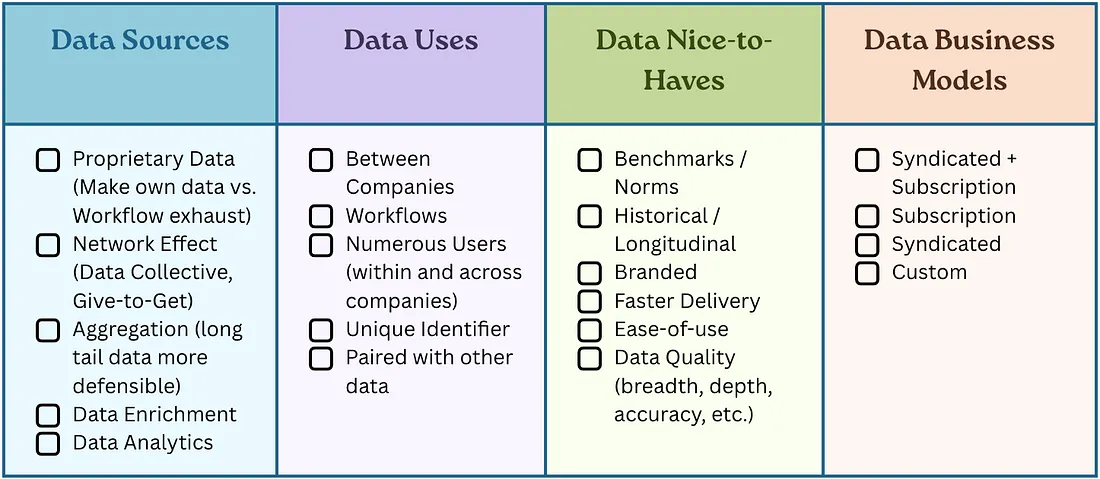
Data Business Evaluation

Why data businesses? Because they can be phenomenal businesses with extremely high gross margins — as good or better than software-as-a-service (SaaS). Often data businesses can be the best businesses within the industries that they serve. ... Data aggregation can be a valuable way to assemble a data asset as well, but the value typically hinges on the difficulty of assembling the data…if it is too easy to do, others will do it as well and create price competition. Often the value comes in aggregating a long tail of data that is costly to do more than once either for the suppliers or a competitive aggregator. ... The most stable data businesses tend to employ a subscription business model in which customers subscribe to a data set for an extended period of time. Subscriptions models are clearly better when the subscriptions are long term or, at least, auto-renewing. Not surprisingly, the best data businesses are generally syndicated subscription models. On the other end, custom data businesses that produce data for clients in a one-off or project-based manner generally struggle to attain high margins and predictability, but can be solid businesses if the data manufacturing processes are optimized 


Leveraging AI for water management

AI is reshaping the landscape of water management by providing predictive insights, optimising operations, and enabling real-time decision-making. One of AI’s key contributions is its ability to forecast water usage patterns. AI models can accurately predict water demand by analysing historical data and considering variables like weather conditions, population trends, and industrial activities. This helps water utilities allocate resources more effectively, minimising waste while ensuring consistent supply to communities. Water utilities can also integrate AI systems to monitor and optimise their supply networks. ... One of the most critical applications of AI is in water quality monitoring. Traditional methods of detecting water contaminants are labour-intensive and involve periodic testing, which can result in delayed responses to contamination events. AI, on the other hand, can process continuous data streams from IoT-enabled sensors installed in water distribution systems. These sensors monitor variables like pH levels, temperature, and turbidity, detecting changes in water quality in real time. AI algorithms analyse the data, triggering immediate alerts when contaminants or irregularities are detected.


History of Cybersecurity: Key Changes Since the 1990s and Lessons for Today

Most cyber attackers hadn’t considered using the internet to pursue financial gain or cause serious harm to organizations. To be sure, financial crimes based on computer hacking took place in the '90s and early 2000s. But they didn't dominate the news in an endless stream of cautionary tales, and most people thought the 1995 movie Hackers was a realistic depiction of how hacking worked. ... By the mid-2000s, however, internet-based attacks became more harmful and frequent. This was the era when threat actors realized they could build massive botnets and then use them to distribute spam or send scam emails. These attacks could have caused real financial harm, but they weren't exactly original types of criminal activity. They merely conducted traditional criminal activity, like scams, using a new medium: the internet. ... The 2010s were also a time of massive technological change. The advent of cloud computing, widespread adoption of mobile devices, and rollout of Internet of Things (IoT) hardware meant businesses could no longer define clear network perimeters or ensure that sensitive data always remained in their data centers. 


Gateways to havoc: Overprivileged dormant service accounts

Dormant accounts go unnoticed, leaving organizations unaware of their access privileges, the systems they connect to, how to access them, and even of their purpose of existence. Their elevated privileges, lax security measures, and invisibility, make dormant service accounts prime targets for infiltration. By compromising such an account, attackers can gain significant access to systems and sensitive data, often without raising immediate suspicion for extended periods of time. During that time, cyber criminals can elevate privileges, exfiltrate data, disrupt operations, and install malware and backdoors, causing total mayhem completely undetected until it’s too late. The weaknesses that plague dormant accounts make them open doors into an organization’s system. If compromised, an overprivileged dormant account can give way to sensitive data such as customer PII, PHI, intellectual property, and financial records, leading to costly and damaging data breaches. Even without being breached, dormant accounts are significant liabilities, potentially causing operational disruptions and regulatory compliance violations.


Overcoming AI hallucinations with RAG and knowledge graphs

One challenge that has come up in deploying RAG into production environments is that it does not handle searches across lots of documents that contain similar or identical information. When these files are chunked and turned into vector embeddings, each one will have its data available for searching. When each of those files has very similar chunks, finding the right data to match that request is harder. RAG can also struggle when the answer to a query exists across a number of documents that cross reference each other. RAG is not aware of the relationships between these documents. ... Rather than storing data in rows and columns for traditional searches, or as embeddings for vector search, a knowledge graph represents data points as nodes and edges. A node will be a distinct fact or characteristic, and edges will connect all the nodes that have relevant relationships to that fact. In the example of a product catalog, the nodes may be the individual products while the edges will be similar characteristics that each of those products possess, like size or color.


Preparing for the next big cyber threat

In addressing emerging threats, CISOs will have to incorporate controls to counter adversarial AI tactics and foster synergies with data and AI governance teams. Controls to ensure quantum-resistant cryptography in the symmetric space to future-proof encrypted data and transmissions will also be put in place if they are not already. Many organizations — including banks — are already enforcing the use of quantum-resistant cryptography, for instance, with the use of the Advanced Encryption Standard (AES)-256 algorithm because data encrypted by it is not vulnerable to cracking by quantum computers. Zero trust as a mindset and approach will be very important, especially in addressing insecure design components of OT environments used in Industry 4.0. Therefore, one of the key areas of strengthening protection would also be identity and access management (IAM). ... As part of strong cyber resilience, we need sound IR playbooks to effectively draw bridges, we need plan Bs and plan Cs, business continuities as well as table-tops and red teams that involve our supply chain vendors. And finally, response to the ever-evolving threat landscape will entail greater adaptability and agility.


The Impact of AI on The Ethernet Switch Market

Enterprises investing in new infrastructure to support AI will have to choose which technology is best for their particular needs. InfiniBand and Ethernet will likely continue to coexist for the foreseeable future. It’s highly likely that Ethernet will remain dominant in most network environments while InfiniBand will retain its foothold in high-performance computing and specialized AI workloads. ... While InfiniBand has several very strong advantages, advances in Ethernet are quickly closing the gap, making its ubiquity likely to continue. There are multiple other reasons that enterprises are likely to stick with Ethernet, too, such as lower cost, existing in-house talent, prolific integrations with existing infrastructures, and compatibility with legacy applications, among others. ... The Ultra Ethernet Consortium is proactively working to extend Ethernet's life to ensure it remains useful and cost-effective for both current and future technologies. The aim is primarily to reduce the need for drastic shifts to alternative solutions that may constitute heavy lifts and costs in adapting existing networks. 


Making the Complex Simple: Authorization for the Modern Enterprise

Modernizing legacy authorization systems is essential for organizations to enhance security and support their growth and innovation. Modernizing and automating operations allows organizations to overcome the limitations of legacy systems, enhance the protection of sensitive information and stay competitive in today’s digital landscape. Simplifying access control and automating workflows to modernize and optimize operations greatly increases productivity and lowers administrative burdens. Organizations can direct important resources toward more strategic endeavors by automating repetitive operations, which increases output and promotes an agile corporate environment. This change improves operational efficiency and puts businesses in a better position to adapt to changing market demands. Enhancing security is another critical benefit of modernizing authorization systems. Centralized management coupled with advanced role-based access control (RBAC) strengthens an organization’s security posture by preventing unauthorized access. Centralized systems allow for efficient user permissions management, ensuring that only authorized individuals can access sensitive information. 


Quote for the day:

"Motivation will almost always beat mere talent." -- Ralph Augustine Norman